Japan outlines action plans for carbon capture strategy; at least three major groups seek state support to hit commercial scale
2050 master plan for power grid unveiled: ¥7 trn needed in investments to decarbonize and expand green capacity
Sumitomo Mitsui makes ¥30 bln in sustainability-linked loans as Japan’s lenders seek to boost financing for climate action
ENERGY TRANSITION & POLICY
Nippon Steel ties up with Exxon, Mitsubishi on CO2 export plans
Tokyo Gas invests in U.S. direct air capture (DAC) venture
Lawmakers urged to bolster domestic biofuel production; Euglena, Marui and Rohto ally to promote biofuel marketing
Toyota debuts both EV and fuel cell EV cars at Tokyo auto show
Tokyo Gas says made world’s first aluminum profile with hydrogen
Honda and GS Yuasa establish JV to develop EV batteries
Sumitomo Heavy group to build liquid air energy storage plant
TEPCO announces delay in Fukushima decontamination works
ELECTRICITY MARKETS
Officials make first-ever onsite utility inspection at Kansai Electric as data breach scandal grows and minister calls for audits
IPP share of retail power sales falls to 19.5%
Miyagi area considers tax on solar developments in forest areas
7 major power utilities ask to raise electricity price up to 40%
TEPCO warns of record loss, hopes for restart of only active NPP
Semiconductor firms to sponsor upgrade of Japan’s hydro plants
Run rates of oil-fired power plants rise on high LNG prices
Kansai Electric to set up new firm for distributed energy business
Eurus Energy plans major onshore wind project in Kagoshima area
OIL, GAS & MINING
Revenue at Russia’s Sakhalin-2 LNG project set to double
LNG tankers to pay 80% more for insurance in Russian waters
IHI to convert Japan’s LNG import facilities to handle ammonia
ANALYSIS
GOVT SIGNALS SMART MONEY SHOULD MOVE TO SMART CITIES TO PROMOTE NET-ZERO
Prime Minister Kishida has pronounced Digital and Green transformations as the two X factors of his government policy. The locus where DX and GX meet is the “smart city” concept. And the number of regions opening their doors to smart city planning is starting to balloon. More than one in 10 local governments have signed up to the most important initiative in this space. That bodes well for the nationwide volume of projects in clean energy, as well as ICT, and strongly suggests that increasing volumes of public money will flow to support the trend.
ENERGY JOBS IN JAPAN: 2022 TALENT TRENDS – A YEAR OF TRANSITION
Last year was very interesting and eventful for the energy industry. In this edition of our regular column, we analyze how this has affected Japan’s talent market.
Shift in investments has revealed shortages of specialized talent. For example, as traditional infrastructure deals slow and conventional oil and gas investments come under greater pressure, Japan Inc has shifted focus to decarbonization tech. Though there’s a huge resurgence in interest in nuclear power, and heavy public and industry support for clean fuels and co-firing, on the talent side the impact has been negligible. The labor market tells a different story about the state of the energy transition in Japan.
GLOBAL VIEW
A wrap of top energy news from around the world.
EVENTS SCHEDULE
A selection of events to keep an eye on in 2023.
JAPAN NRG WEEKLY
PUBLISHER K. K. Yuri Group
Editorial Team Yuriy Humber (Editor-in-Chief) John Varoli (Senior Editor, Americas) Mayumi Watanabe (Japan) Yoshihisa Ohno (Japan) Wilfried Goossens (Events, global)
New Energy and Industrial Technology Development Organization
kWh
Kilowatt hours (electricity generation volume)
TEPCO
Tokyo Electric Power Company
FIT
Feed-in Tariff
KEPCO
Kansai Electric Power Company
FIP
Feed-in Premium
EPCO
Electric Power Company
SAF
Sustainable Aviation Fuel
JCC
Japan Crude Cocktail
NPP
Nuclear power plant
JKM
Japan Korea Market, the Platt’s LNG benchmark
JOGMEC
Japan Organization for Metals and Energy Security
CCUS
Carbon Capture, Utilization and Storage
OCCTO
Organization for Cross-regional Coordination of Transmission Operators
NRA
Nuclear Regulation Authority
GX
Green Transformation
NEWS: ENERGY TRANSITION & POLICY
METI outlines six action plans to push CCS
(Japan NRG, Jan. 26)
METI outlined six programs to make carbon capture and storage (CCS) operational in Japan by 2030: 1) government support to CCS operators; 2) measures to reduce CCS costs; 3) fostering public understanding of CCS; 4) expansion overseas with JOGMEC’s support; 5) enacting a CCS Business Act; and 6) writing and revising a CCS action plan.
The national goal for 2030 is to secure 6-12 million tons of carbon storage space.
METI aims to build a regulatory framework, as soon as possible, starting with the enactment of the “CCS Business Act” that defines carbon collection, transport and storage operators, their liabilities, regulatory processes, and etc.
CONTEXT: Japan promised to phase out low-efficient coal power plants, but USC and IGCC thermal power technology will continue to operate, emitting 700-800 kg of CO2/kWh. Along with ammonia/hydrogen co-firing, CCS is a means to reduce emissions from fossil fuel power.
TAKEAWAY: Carbon will be defined as “material with value”, not industrial waste. Entities will be able to claim ownership of it. Like offshore wind, METI will set “CCS zones”. Storage operators will face more regulatory scrutiny compared to carbon collection and transport operators, and non-Japanese companies can’t be storage operators. Japan also needs more studies on carbon leakage’s impact on marine environment is required.
SIDE DEVELOPMENT: At least three Japanese groups aim for carbon storage business by 2030 (Nikkei, Jan. 25)
At least three Japanese groups are looking to set up carbon capture as a commercial business by 2030
During this fiscal year, METI will choose between three and five CCS projects to support.
Among the firms hoping to make a business in this field are:
Group 1: Itochu, Mitsubishi Heavy Industries, INPEX, Taisei Corp
Group 2: Idemitsu, Hokkaido Electric, JAPEX
Group 3: ENEOS, J Power, and JX Nippon Oil & Gas Exploration
CONTEXT: One billion kWh of coal-fired generation a year emits close to 1 million tons of CO2.
SIDE DEVELOPMENT: “K” LINE and KEPCO sign MoU to develop CCS value chain (Company statement, Jan. 19)
Kawasaki Kisen Kaisha (“K” LINE) signed a MoU to study marine transportation and shipping costs of liquefied CO2 emitted from Kansai Electric to develop a CO2 capture & storage (CCS) value chain.
“K” LINE has experience in the Northern Lights project in Norway; the two companies will investigate how to transport liquefied CO2 long-distance and at large scale, and have more flexibility in the CCS value chain.
SIDE DEVELOPMENT: Mitsui and Kansai Electric agree to study CCS value chain development (Company statement, Jan. 18)
Trading house Mitsui and Kansai Electric signed an MoU for a feasibility study on carbon capture and storage (CCS) value chain development.
Kansai Electric will study the potential to capture CO2 at its thermal power plants and Mitsui will look at ways to transport and store the emissions.
Mitsui wants to handle 15 million tons of CCS capacity by 2035.
TAKEAWAY: The tie-up likely relates to the carbon capture project that Kansai Electric plans around its 1.8 GW Maizuru coal-fired power plant in Kyoto. The utility is already working with Japan CCS Corp. to create a liquified CO2 shipping terminal at the Maizuru complex that will ship 10,000 tons of CO2 emissions from the coal plant in liquid form for storage at the Tomakomai hub in Hokkaido. The demo phase is due to complete in 2027. CO2 transport is due to start in 2024 using a custom built large liquified CO2 carrier, operated by Mitsui OSK Lines (MOL).
Nippon Steel to export CO2 to the U.S.
(Nikkei, Jan. 18)
Nippon Steel, Exxon Mobil, and Mitsubishi signed a MoU to collaborate on a project to capture CO2 produced by Japanese steel furnaces for transport offshore and storage in depleted gas fields and other underground repositories.
Captured CO2 will be sent to Australia, Malaysia, and Indonesia.
Mitsubishi will organize the transportation in dedicated tankers. The start date of the project is as yet undetermined.
CONTEXT: The steel industry is responsible for over 10% of Japan’s total carbon emissions. Nippon Steel needs to cut its CO2 emissions by 30% this decade compared to 2013 levels.
Tokyo Gas invests in U.S. direct air capture (DAC) venture
(Company statement, Jan. 19)
Tokyo Gas became the first Japanese energy company to invest in and conclude an agreement with Global Thermostat, a U.S.-based developer of Direct Air Capture (DAC).
For the last decade, Global Thermostat has been developing tech to create e-fuel; the project is supported by the U.S. Department of Energy.
Tokyo Gas will deploy Global Thermostat’s DAC system in Japan to test its operation. The gas company hopes to develop new businesses by utilizing CO2 captured by DAC for methanation, CCUS and other applications within Japan and abroad
Lawmakers urged to bolster domestic biofuel production
(Japan NRG, Jan. 24)
Japan NRG attended the Biofuel Study Session hosted by the Parliamentary Group to Promote Carbon Neutrality with Domestic Biofuel and Synthetic Fuel that was held at the Diet Members’ Building on Jan 24.
Professor Imou Kenji of Tokyo University said that while there is 3.6 GW of power biomass generation capacity in Japan, 69% uses imported biomass fuel. Biomass used for domestic transportation depends almost 100% on imported biomass fuel.
Professor Imou advised that while the supply of domestic biomass fuel is far less than required to achieve carbon neutrality, the production of domestic biomass would benefit the local economy. Domestic biomass should not only be valued for GHG reduction.
Professor Shigeo Satokawa of Seikei University talked about technology development cases of synthetic fuel, including DAC (Direct Air Capture) by Carbon Engineering (U.S.); the Haru Oni Project that produces gasoline from hydrogen and CO2; and, projects by Mitsui Chemicals and Iceland company Carbon Recycling International (CRI) to produce methanol synthesis from CO2.
TAKEAWAY: EVs attract the most attention as a green transportation solution, but many in Japan would like to explore other decarbonized fuel options, believing that electrification is not the only future solution.
SIDE DEVELOPMENT: Agriculture Ministry selects four more towns to be biomass industry hubs (New Energy Business News, Jan. 25)
The Ministry of Agriculture, Forestry, and Fisheries (MAFF), along with seven other ministries and agencies involved in biomass, selected four new towns to become Biomass Industrial Cities. They are: Hamanaka Town, Hokkaido; Naganohara Town, Gunma Prefecture; Ryuoh Town, Shiga Prefecture; and Sera Town, Hiroshima Prefecture.
Biomass Industrial Cities aim to create climate friendly and resilient areas centered on biomass; to use the local environment and economy to build profitable and integrated supply chains from raw materials to collection, transportation, manufacturing, and use.
The number of biomass industry hubs is now 101.
Euglena, Marui Group, and Rohto Pharmaceutical tie up for supply of biofuels
(Kankyo Business, Jan. 23)
Euglena plans a new business collaboration with its two new partners in the field of healthcare and energy using microalgae “Euglena.”
With its main business in retail, fintech, and future investment, Marui Group will support sales & marketing, e-commerce and distribution of Euglena’s biofuels.
Rohto Pharma has been known for its eye-care, skincare, and other medical drugs, and it plans to adapt “Euglena” into their pharma and cosmetic products.
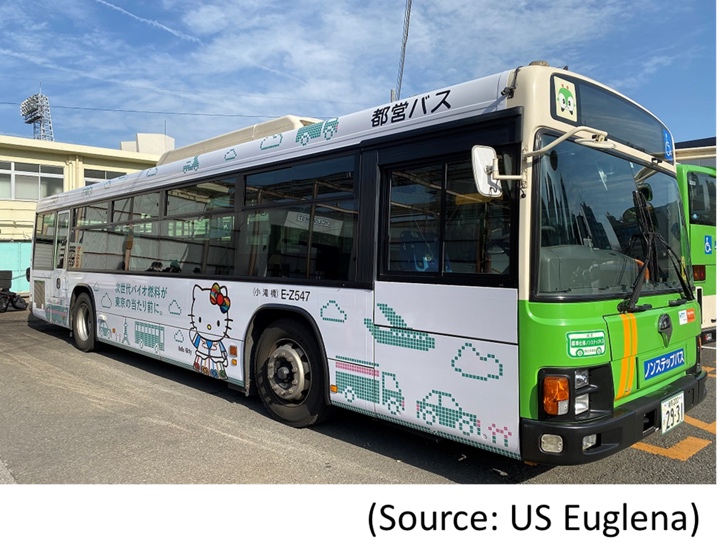
TAKEAWAY: Euglena is making inroads into some short-term government contracts for public transport. It recently won a contract to supply its next-generation biofuel, Susteo, to 58 buses owned by Tokyo City’s Kotakibashi Automobile Office for one month. It has also tried Susteo fuel in ferries, airplanes, and agricultural machinery.
Tokyo Metropolitan Govt trials biofuels on several city routes
Source: Euglena
Toyota Motors debuts both EV and FCEV at Tokyo Auto Salon 2023
(Kankyo Business, Jan. 23)
Tokyo Auto Salon 2023 was held at Makuhari Messe (Jan 13-15) in Chiba Prefecture; Toyota Motors presented two new models with a body based on mass produced cars sold in the 1980s.
One model replaced an IC engine and transmission with motors, inverters, and batteries – “EV conversion.” The other remodeled the original engine into a hydrogen engine. Both were popular in the 1980s for their sporty-design and high speed, and the new models retain the same characteristics.
CONTEXT: Toyota is Japan’s only automaker developing both battery-EVs and hydrogen fuel-cell EVs. Now that Toyota has released these new “makeover” models, EV- or hydrogen-conversion may become a trend in the auto industry.
Tokyo Gas says it made world’s first aluminum profiles using hydrogen
(Denki Shimbun, Jan. 25)
Tokyo Gas said it succeeded in manufacturing aluminum profiles, which are used to make aluminum sashes, using heat fueled by hydrogen.
The test was conducted at an aluminum profile manufacturing facility in Maebashi City owned by LIXIL. There were no problems with the product quality.
For the manufacturing process, natural gas used for combustion in heat treatment was replaced with hydrogen.
Honda, GS Yuasa to launch EV battery JV
(Nikkei Asia, Jan. 23)
Honda Motor will establish a JV with GS Yuasa, a leading Japanese battery maker, to develop EV batteries to tap the growing EV market, as it moves to end gasoline car sales. Honda aims to sell only EV or FCEV by 2040.
The new company will be established by late 2023 and cover product development and a wide range of EV battery-related operations, including the planning of sales channels.
GS Yuasa set up a dedicated department for EV batteries and aims to gain “know-how on installing battery cells in EVs” through this tie-up.
CONTEXT: Honda already has a plan to source batteries from Envision AESC Group for models going on sale in 2024. The new JV covers battery supply for 2025 and beyond. Mass-production of its batteries with South Korea’s LG Energy Solutions will start in the U.S. in 2025. Honda will also purchase batteries from China’s Contemporary Amperex Technology through 2030.
SIDE DEVELOPMENT: Honda and LG Energy Solutions create JV for Li-ion EV batteries (New Energy Business News, Jan. 23)
Honda and LG Energy Solutions set up a JV in Ohio, U.S. to produce lithium-ion batteries for EVs. Plant construction is expected to be completed by late 2024.
Mass production will begin by late 2025, and will go to Honda’s North American plant. Production capacity is expected at 40 GWh per year.
The new company is L-H Battery Company. Honda has a 49% stake and LG the rest.
Sumitomo Heavy and Hiroshima Gas to test liquid-air energy storage technology
(Company Statement, Jan. 18)
Sumitomo Heavy will partner with Hiroshima Gas to build a Liquid Air Energy Storage (LAES) demonstration plant near the Hatsukaichi LNG Terminal in Hiroshima Prefecture. The tech is licensed from Highview Enterprise Ltd., a U.K. developer.
CONTEXT: Liquid air storage uses temperature differences as a means to store electricity. Air is cooled until it turns into a liquid, which can be stored in a tank. Later, the liquid can be returned to gaseous state using waste heat from an industrial process, for example. The gas is then used to turn a turbine to generate electricity.
The project developers say this will be a “commercial” level demonstration plant. They will use the nearby LNG plant for cooling.
The LAES plant will operate in the wholesale power and capacity markets.
Japan joins Coalition of Trade Ministers on Climate
(Government statement, Jan. 20)
Japan joined the Coalition of Trade Ministers on Climate that was inaugurated on Jan. 19 at the World Economic Forum in Davos.
The Coalition, together with 27 ministers, aims for cooperation on climate-friendly trade policies and to support climate adaptations by developing economies.
The METI minister stressed the need to avoid extreme climate-related trade barriers and to synchronize regulations to facilitate transactions from production to consumption.
CONTEXT: The WTO has several committees to discuss trade and sustainability issues, while the Paris Agreement does not address trade issues at all. The Coalition of ministers aims to drive high-level political dialog while aligning with WTO and Paris Agreement objectives.
TAKEAWAY: The METI minister’s remarks reflected Japan’s proposal to the WTO in March 2021 on achieving global carbon neutrality.
Sumitomo Mitsui makes ¥30 billion in sustainability-linked loans
(New Energy Business News, Jan. 27)
Sumitomo Mitsui Trust Bank concluded a series of syndicated sustainability-linked loans totaling ¥30 billion. Borrowers are e-commerce major Z Holdings and Sumitomo Mitsui Trust Panasonic Finance Co.
For Z Holding, in addition to Sumitomo Mitsui Trust Bank, the lenders include Mizuho Bank, Sumitomo Mitsui Banking Corp, Mitsubishi UFJ Bank, and Credit Agricole Bank.
The retail giant aims to convert more than 80% of the electricity used by the group’s major companies to renewable energy by around FY2025, and expand that to 100% within five years after that.
CONTEXT: A sustainability-linked loan comes with KPIs and “Sustainability Performance Targets (SPTs)” defined in the borrower’s management strategy. Loan terms depend on the borrower’s SPTs performance. The aim is to promote environmentally and sustainable business.
University of Tokyo researchers developed a carbon negative concrete blend that has a compressive strength three times greater than that required by Japan’s building code.
To produce the concrete, the team reacted CO2 with carbonated mortar to create calcium hydrogen carbonate, which was then heated to separate out calcium carbonate. The resulting material was then repeatedly exposed to pressure, wetting, and drying to achieve the desired hardness.
The process enables over 50 times more CO2 than usual to be captured.
Sumitomo Mitsui Trust ties up with a U.S. investor on decarbonization fund
(Asia Nikkei, Jan. 26)
U.S. firm Energy Capital Partners will work with Sumitomo Mitsui Trust Bank to launch a multibillion-dollar fund in 2024 for Japanese decarbonization.
The fund will target renewable energy facilities and firms that can take the lead in decarbonization, such as battery makers and renewable fuel producers.
Energy Capital has $16 billion under management, and will raise funds from institutional investors in Japan and overseas, coordinating with Sumitomo Mitsui Trust.
ANA and JAL will be fueled with SAF from Raven SR
(Various, Jan. 18)
All Nippon Airways (ANA) signed an MoU for sustainable aviation fuels (SAF) from Raven SR Inc for major global routes. In 2025, an initial 50,000 tons of SAF will be supplied; that will increase to 200,000 tons by 2035.
Similarly, Japan Airlines (JAL) signed a MoU with Raven SR for supply of 50,000 tons of SAF in 2025 and 200,000 tons by 2035.
CONTEXT: The two major Japanese airlines decided to take a big step towards net zero CO2 by 2050, as required by the Civil Aviation Organization. The rest of Japan’s airlines will follow.
TEPCO: contamination leads to delay in removal of remaining Unit 6 nuclear fuel
(Kyodo, Jan. 26)
TEPCO said the removal of nuclear fuel from unit 5 will be delayed by one year, from the end of FY2023 to 1H of FY2025, due to contamination of shared pool storage for fuel removal from all nuclear reactors.
The storage was contaminated by rust or calcium carbonate. In the future, to prevent contamination TEPCO will cleanse the nuclear fuel before pouring it into storage.
Only Fukushima’s units 3 and 4 completed nuclear fuel removal. However, TEPCO plans to finish removal for all 6 units by 2031, to prepare for major earthquakes or tsunamis.
TAKEAWAY: Under this plan, TEPCO needs 20 years to remove unused fuel. Since one of the most difficult tasks is the retrieval of used fuel and debris, much time is required to finish decommissioning. TEPCO already finished removal of used nuclear fuel from unit 3 (566 storage tanks) and unit 4 (1535 tanks), but removal is still needed for unit 1 (615 tanks), unit 5 (1,542 tanks), and unit 6 (1,654 tanks).
Prosecutor appeals to Supreme Court over TEPCO officials’ acquittal
(Fukushima Broadcasting, Jan. 24)
The prosecutor appealed to the Supreme Court over the Tokyo High Court’s acquittal of former TEPCO executives who were charged in the Fukushima NPP accident.
Former TEPCO Chairman Katsumata and three other former execs were charged with manslaughter in the deaths of 44 people during the accident.
In making its acquittal on Jan 18, the Tokyo High Court rejected the reliability of the government’s “long-term assessment” of tsunami earthquake predictions.
TAKEAWAY: While a number of people were reported to have died from reasons related to the Fukushima accident, no person died directly from it. Therefore, the lawsuit claimed that “TEPCO killed 44 people because they did not stop the operation of the nuclear power plant to prevent the tsunami”, but this logic didn’t make sense to the Tokyo High Court twice in fact. While a section of the population would be happy to see TEPCO execs held responsible for the events in 2011, the prosecutor’s line of argument has had little traction so far. The Supreme Court is the last injunction.
Analysts warn transition to ammonia/hydrogen energy not realistic for Japan
(Japan NRG, Jan. 25)
Michael Liebreich of Liebreich Associates and Takizawa Hajime of the Institute for Global Environmental Studies (IGES) in Kanagawa warned that Japan’s shift to ammonia and hydrogen energy is unrealistic due to costs, limited supplies and lack of technologies.
Takizawa said Japan will vacuum up global ammonia supplies as its 2030 demand is predicted at 3 million tons compared to a global supply level of 20 million tons.
Importing ammonia and hydrogen will be expensive as the molecules require large space, and energy is lost during conversion, said Liebreich.
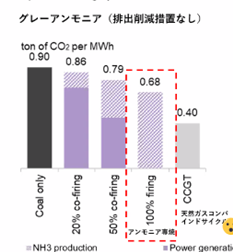
Cost of 20% coal-ammonia co-firing would be ¥12.9/kWh; at 100% ammonia power generation this rises to ¥23.5/kWh; coal burning is ¥10.4/kWh, said Takizawa.
CONTEXT: Liebreich and Takizawa were speaking at the “Possibilities and Risks of Hydrogen” webinar hosted by IGES and the Japan Climate Leadership Partnership.
TAKEAWAY: METI proposes to subsidize hydrogen and ammonia for the next decade or so, to make them affordable. The scope of state funding is likely to expand to non-green hydrogen. Takizawa said his studies show that power generated from 100% gray ammonia releases more carbon than combined cycle gas turbines.
Gray ammonia emissions
Source: IGES
NEWS: POWER MARKETS
OCCTO releases power system master plan: ¥7 trillion needed to decarbonize the grid
(Denki Shimbun, Jan. 26)
OCCTO released a draft of its “Power System Master Plan for 2050 Japan”, which estimates ¥6 to ¥7 trillion of investment in power systems is needed to realize decarbonize the grid.
OCCTO estimated that high voltage direct current (HVDC) transmission lines should be built in east Japan to secure more power transmission for renewable energy. It’s forecast that 6 GW capacity of HVDC transmission lines between Hokkaido and Tohoku, and 8 GW between Tohoku and Tokyo will be needed. Also, 2.8 GW is needed between Chugoku and Kyushu.
The connection between East Japan (50 Hz) and West Japan (60 Hz) is currently planned as 3 GW capacity, but the plan recommends to add another 2.7 GW.
TAKEAWAY: As most high voltage transmission lines were built during the high economic growth period of 1955 to 1973, the majority of those are already aging. Therefore, it’s very important to take advantage of the GX national program to replace the power lines.
METI conducts on-site inspection at Kansai Electric due to compliance breaches
(Japan NRG, Jan. 26)
The Electricity and Gas Market Surveillance Commission – the METI committee that oversees the electricity and gas market – conducted an on-site inspection of KEPCO’s offices over revelations that the utility’s employees accessed confidential data on competitors’ subscribers.
This is the first time since its establishment in 2015 that the commission has raided a utility in relation to an individual incident.
The commission is considering asking METI to take disciplinary action against the utility. This could come in the form of a business improvement order.
Leaks of customer data were also discovered at Tohoku Electric, Kyushu Electric, and Shikoku Electric.
CONTEXT: From September to December of last year, 730 Kansai Electric employees gained illegal computer access to up to 14,657 data points. The METI commission was established in 2015, but this is the first case of an on-site inspection.
SIDE DEVELOPMENT: Minister orders emergency audit of all retailers and grid firms over compliance breach (NHK, Jan. 23)
METI Minister Nishimura says recent compliance breaches by KEPCO, Tohoku Electric, Kyushu Electric, and Shikoku Electric were very unfortunate and could threaten fair competition.
METI ordered an emergency audit of all electricity retailers and transmission service providers to identify any similar conduct.
The utilities admitted to improperly accessing information on competitors’ subscribers.
TAKEAWAY: Major utilities have spun off their transmission and distribution (T&D) assets since the industry was liberalized in 2016. However, these assets are still part of the same holding or group structure as the utility’s generation business. Meanwhile, the T&D companies are regional monopolies in their own right, handling customer information also for new market entrants. This makes the data leaks a very serious issue and brings into question the sincerity of the market liberalization. That’s a key reason why the regulator must act tough.
SIDE DEVELOPMENT: Series of scandals raises questions about electricity industry (Nikkei Energy Next, Jan. 19)
CONTEXT: This is an opinion piece by the Nikkei editorial board.
Recent revelations of collusion and improper accessing of confidential customer data raise questions about oversight in Japan’s electricity sector.
Historically, the METI committee that oversees the electricity and gas market has taken a back seat on compliance matters. One senses that the committee is mocked by utilities.
Japan should look to Europe and the U.S. for solutions. In Europe, for example, the industry is governed by REMIT (the Regulation on Wholesale Energy Market Integrity and Transparency), which allows fair competition to be policed more comprehensively.
In Japan fairness has been neglected. The country’s insular culture might be to blame.
Regulators need to proactively monitor the industry.
IPP share of retail power sales falls to 19.5%
(Japan NRG, Jan. 25)
Independent power providers had a 19.5% share of the power retail market as of September 2022, down from 19.9% in June. IPP’s share in the low voltage market, mainly for households, was up to 26.8% compared to 25.7% in June.
Miyagi Prefecture considers tax on solar developments in forest areas
(NHK News Web, Jan. 19)
The Miyagi government is considering a 30-40% tax on operating profit for a developer building a renewable energy facility that would destroy local forests.
Developers have canceled several projects because of public opposition over fear of deforestation and other environmental issues. This new tax plan may encourage developers to use flat lands, rather than reclaiming forests.
The govt agreed to levy a tax, but the rate needs to be discussed. The new rule will be submitted by June, and the new tax plan will be ready by 2024.
7 EPCOs to raise electricity price up to 40%; TEPCO plans for restart of Kashiwazaki NPP
(Kyodo, Jan. 26)
Seven EPCOs applied to METI to raise power retail prices by 30 to 40%. Tohoku, Hokuriku, Chugoku, Shikoku and Okinawa want to raise the price from April 2023; Hokkaido and Tokyo would raise from June 2023.
Power companies are suffering from fuel price hikes.
TEPCO said the revised power retail price is on the presumption that unit 7 and unit 6 of its Kashiwazaki-Kariwa NPP restarts in October 2023 and April 2025, respectively.
TAKEAWAY: The NRA virtually stopped operation at Kashiwazaki-Kariwa over recent incidents of TEPCO staff misconduct. Thus, it won’t be easy for TEPCO to get approval for the restart of unit 7 in October 2023.
SIDE DEVELOPMENT: TEPCO rate increase means despite subsidies the bill is going up (TBS News Dig, Jan. 23)
TEPCO applied for government permission to raise rates 29.3% on a plan used by over half of its subscribers, starting July.
CEO Kobayagawa says the utility was forced to make a difficult decision.
While the government’s new subsidy will see the average power bill fall by ¥1,800 from February, the rate hike means that bills will rise again in July by an average of ¥2,600. In other words, consumers will face a net increase of ¥800.
SIDE DEVELOPMENT: TEPCO to post a record loss of ¥50.2 million (Jiji, Jan. 23)
TEPCO HD expects a loss of ¥50.2 million for FY2022, its biggest ever.
The main factors are rising cost of fuel and the weakening yen.
IT firms including Applied Materials of U.S. to sponsor upgrades of Japanese hydro plants
(New Energy Business News, Jan. 27)
Chubu Electric agreed with a group of six global companies, including Applied Materials and Micron Technology, a semiconductor manufacturer, to finance renovation of existing hydropower plants to expand capacity.
Global manufacturers seek to increase the amount of electricity they consume from renewable energy sources.
In the agreement with Chubu, customers can participate from the planning stage in the renovation of the utility’s existing non-FIT hydropower plants. In return, they purchase power generated from the added renewables capacity.
As the first project, the consortium plans to sponsor the refurbishment of aged facilities at the Oigawa Hydroelectric Power Station Unit 1 in Shizuoka Prefecture, which should boost its capacity by 1.9 GWh a year starting April 2025.
Run rates of oil-fired power plants rise on high LNG prices
(Japan NRG, Jan. 25)
Run rates of oil-fired power plants rose in August last year to generate over 2 tWh, which is unusual as demand starts to peak off.
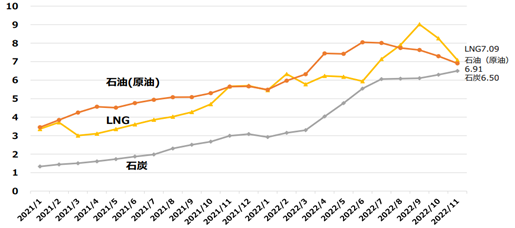
The cost of oil was 6.91 U.S. cents/1,000 Kcal in August, lower than LNG’s cost of 7.09 cents/1,000 Kcal, triggering the switch from LNG to oil.
Meanwhile, import cost spreads among oil, LNG and crude oil are narrowing, possibly reducing run rates of coal power plants.
Kansai Electric to establish new firm to develop distributed energy resources
(Kankyo Business, Jan. 25)
In April, KEPCO will establish a new company, E-Flow, to develop distributed energy resources nationwide. The utility aims to trade 2.5 GW of power and expects sales of ¥30 billion by FY2030.
The new company will handle the VPP business, calculating optimal markets and trading hours for electricity from distributed energy facilities and grid storage batteries.
The new entity will also be involved in renewable energy aggregation.
Energy provider signs up 10,000 clients to third-party ownership solar systems
(New Energy Business News, Jan. 25)
Sharing Energy has signed up more than 10,000 contract applications for its “Share Denki” third-party ownership service for solar power generation systems.
Since the service launched in February 2018, the company has installed solar systems at an initial cost of zero yen. The service first targeted clients with newly built homes but expanded to existing houses, offices, and stores, and is now available nationwide.
Share Denki charges those that install the service ¥22/ kWh but offers zero up-front costs for PV installation. Maintenance is paid and handled by Sharing Energy during a 15-year contract. When it expires, the solar system is transferred to the client free of charge.
The company also rolled out a storage battery package based on the same model.
Eurus Energy plans major onshore wind project in Kagoshima area
(New Energy Business News, Jan. 27)
Eurus Energy Holdings will develop an onshore wind power plant with a max output of 192 MW near Tarumi City, Kagoshima Prefecture.
Construction will begin in April 2026 and trial operation in October 2028. The company’s Eurus Teruboku Wind Farm I and other facilities are located in the vicinity.
Shizuoka solar farm abandoned over local opposition
(Shizuoka Asahi TV, Jan. 24)
One of the two companies behind a plan to build a large solar farm comprising around 100,000 solar panels in Shizuoka has pulled out, citing a poor business environment.
Nagoya-based Toenec says chances for the project to go ahead are slim.
The local govt won’t support the project due to opposition from residents.
Russia’s Sakhalin-2 LNG project could double revenue and profit in 2023, versus 2021 levels, thanks to higher prices, and long-term deals with Asian buyers.
Renewed deals with Asian buyers could secure demand for 6.5 million tons of LNG annually from Sakhalin-2.
That could generate $3.8 billion to $4.5 billion in revenue for Sakhalin-2 this year, according to Rystad Energy. The project could earn another $7.45 billion this year if it keeps production in line with 2022 and sells 4.9 million tons of LNG on the spot market.
In 2021, Sakhalin-2’s revenue was $5.7 billion and net profit was $2 billion.
TAKEAWAY: Japanese shareholders Mitsui & Co and Mitsubishi Corp hold a combined 22.5% stake; Gazprom has a 50% stake. Last week, Osaka Gas renewed its deal to buy gas from Sakhalin-2, taking 200,000 tons of LNG annually, or about 2% of output. Hiroshima Gas, JERA, Kyushu Electric, Saibu Gas, Toho Gas, Tohoku Electric and Tokyo Gas have also renewed deals.
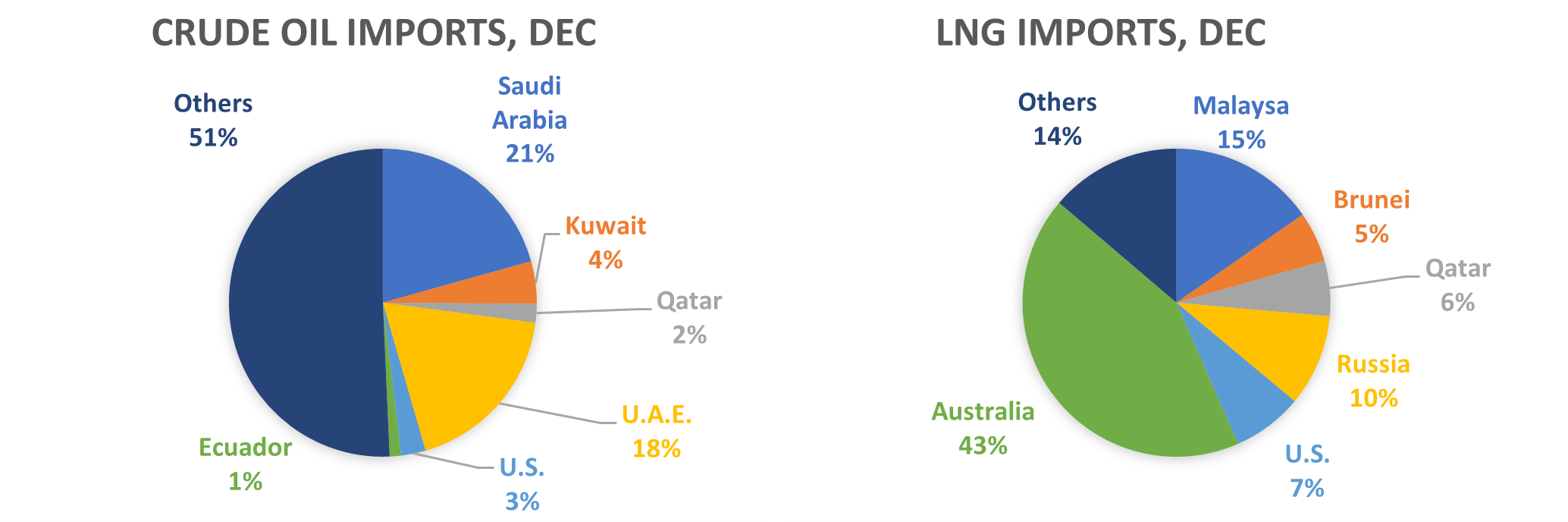
SIDE DEVELOPMENT: Russian LNG holds 10% share, zero for crude in Dec (Government data)
Japan imported 584,458 tons of LNG from Russia in December, accounting for 10% of the total imports. There was no Russian crude import during the month.
Source: Customs data
LNG tanker operators to pay 80% more for insurance when in Russian waters
(Nikkei, Jan. 23)
Japan’s main insurance companies will increase premiums on LNG tankers operating in Russian waters by around 80%.
The increase is due to greater risks of damage due to military conflict.
Initially, the insurance companies said they’d be unable to cover tankers after UK-based reinsurers said they’d stop underwriting the contracts in question.
IHI to convert LNG import facilities to handle ammonia by the late 2020s
(Nikkei, Jan. 25)
IHI started a study to convert existing LNG receiving and storage facilities so that it can receive and store ammonia, starting in the late 2020s.
IHI has 30% of the domestic share of design and construction for LNG receiving and storage facilities, and 50% share of domestic LNG storage tanks.
LNG receiving and storage facilities are often built next to LNG thermal power plants.
LNG stocks slip to 2.57 million tons
(Government data, Jan. 26)
LNG stocks of 10 power grids stood at 2.57 million tons as of Jan 22, down from 2.62 million tons a week earlier. The end-January stocks last year were 1.8 million tons. The five-year average for this time of year is 1.67 million tons.
TAKEAWAY: Power demand was down 8% YoY for Dec 29-Jan 4; down 7% on Jan 5-11; and down 12% for Jan 12-18 on warmer temperatures, but a cold spell hit in the week of Jan 23.
ANALYSIS
BY ANDREW DEWIT PROFESSOR OF ENERGY POLICY SCHOOL OF ECEONOMIC POLICY STUDIES RIKKYO UNIVERSITY, TOKYO
Japan Signals Smart Money Should Move to Smart Cities To Promote Carbon Neutrality Initiatives
Prime Minister Kishida has pronounced Digital and Green transformations as the two X factors of his government policy. The locus where DX and GX meet is the “smart city” concept. And the number of Japanese regions opening their doors to smart city planning is starting to balloon.
More than one in 10 local governments have signed up to the most important initiative in this space, the Smart City Public-Private Collaborative Platform. That bodes well for the nationwide volume of projects in clean energy, as well as ICT, and strongly suggests that increasing volumes of public money will flow to support the trend. In 2022, budget allocations for smart city initiatives grew about 10% beyond initial estimates.
As concern about the Covid pandemic subsides in both Japan and overseas, there’s reemerging interest in improving urban and industrial infrastructure as a way to tackle climate, energy, and supply chain issues. Recent surveys report hundreds of smart city projects globally, with investments worth over $500 billion in the present and likely exceeding $1 trillion by 2027. Some bulls even pronounce that the sector’s market size will hit $7 trillion by 2030.
Of course, what a “smart” city entails – as was the case before the pandemic – remains fluid. The definition has become even more elusive in the net-zero age, through a plethora of new permutations such as “sustainable smart cities,” “smart green cities,” and “smart digital cities.” Kishida recently added his own Vision for a Digital Garden City Nation to the mix.
Whatever the title, this is a topic that’s exciting both national and local governments in Japan, a rare feat. It’s also winning support from industry.
One smart city initiative to rule them all
In a smart city, the ICT element feeds into everything from energy to mobility to environmental solutions. Assessing such a comprehensive approach naturally risks overegging, by implicitly defining everything in the city as smart.
Luckily, Japanese surveys afford a little more precision for measuring the scale of smart cities and the scope of institutional involvement. Toyota’s Woven City gets the most international press, with Toyota and NTT using it as a platform for global connected cars and other deployments. But Japan’s most important initiative is probably its Smart City Public-Private Collaborative Platform, whose diverse membership is itemized in table 1. Of particular note is the growing number of local governments: 187 as of December 2022, or just under 11% of Japan’s 1,765 prefectures, cities and other local governments. Tokyo, Yokohama, and 17 other influential, trend-setting prefectures are official members, together with their large cities such as Yokohama, Sapporo, Fukuoka, and Sendai.
A further 57 local governments – including 9 prefectures – are in the observer category, meaning they have a strong interest in pursuing smart city approaches. And they are doing this in concert with strong representation from civil society.
Table 1: Japan’s Smart City Public-Private Collaborative Platform (as of December 26, 2022)
MEMBER CLASS
NUMBER OF MEMBERS
Subnational Governments
187
Central Agencies
12
Businesses, Research Centers, and others
454
Business Associations
2
Observers
273
Total Membership
928
Source: MLIT, 2022
The platform’s official members include 13 energy-related firms, such as TEPCO and the other major power utilities, plus Tokyo Gas and ENEOS. Japan’s communications, real estate, construction, mobility, finance, and other sectors are also well-represented.
The Smart City Public-Private Collaborative Platform was inaugurated in June of 2019. It’s one of several recently developed public-private platforms, including venues for pursuing such initiatives as SDGs, decarbonized rail transport, and green infrastructure. All of these collaborations address decarbonization, but in a context where other amenities are stressed. That enhances local interests’ willingness to go along with the deregulation and private-finance initiatives that also animate the deliberations
More money, more EMS
Since April of 2021, the Cabinet Office has committed to pursuing a range of smart city, super city, and digital garden city developments in at least 100 local areas by 2025. In July last year, the Cabinet Office’s Council for Science, Technology and Innovation announced that 51 local areas and 54 projects had been selected.
State funds have followed. Items related to smart cities totaled about ¥94 billion in the initial FY2022 government budget, according to Nikkei BP Research, but expanded beyond ¥100 billion as the year unfolded to reflect national concerns about cyber-security and other digital issues.
The trend of more funding for smart cities is set to continue into the upcoming fiscal year that starts in April. MoE alone aims to spend 13% more on smart city programs than it did this fiscal year, according to Japan’s Smart City News service analysis of ministry budgetary requests. Within that increase is an even faster increase in funds for renewable energy projects.
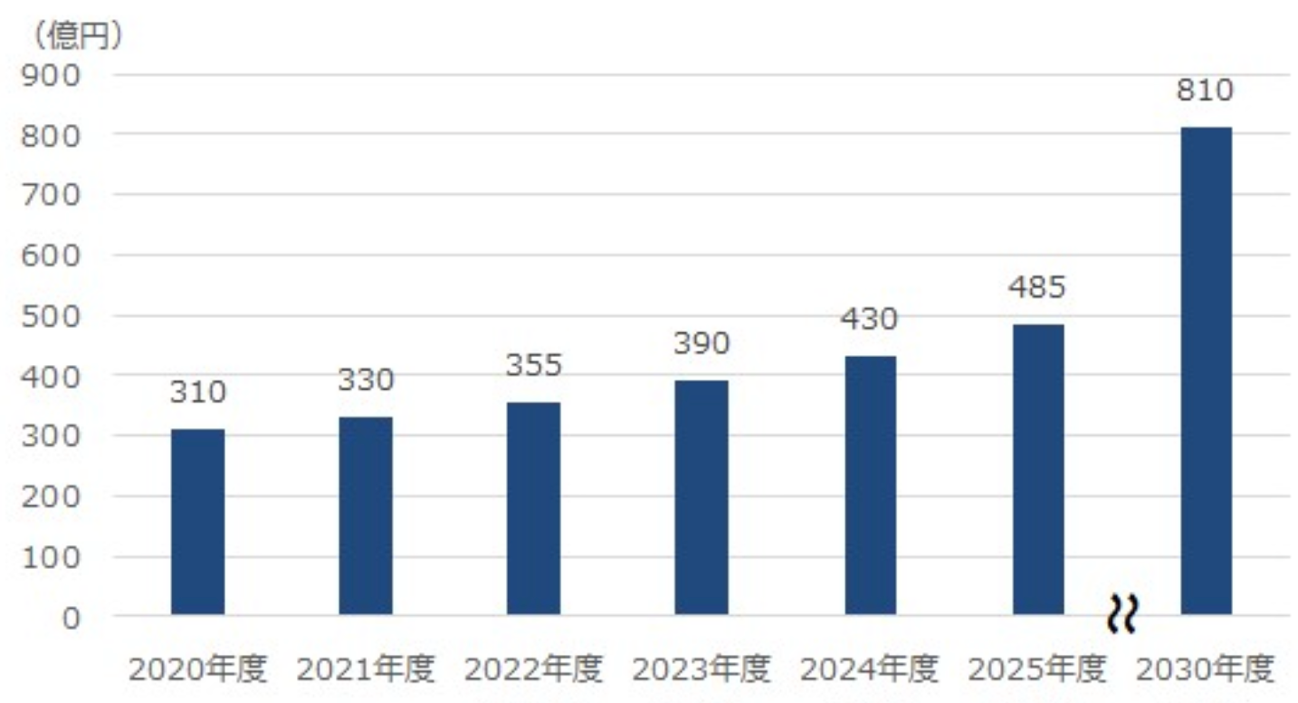
Renewable energy generation won’t be the only direct beneficially of smart city funding. One area highlighted in last year’s survey by the Yano Economic Research Institute is the dissemination of smart-grid community energy management systems (EMS). Yano calculated that domestic spending on EMS will nearly triple in the course of this decade. The forecast is supported by other Japanese market research on smart houses and related items.
Japan’s Community Energy Management Systems Market: 2020-2030 (units: ¥100 million)
Source: Yano Research Institute, 2022
In a way, the emphasis on EMS makes a lot of sense. Such systems were the core element of government smart city programs in the early 2010s in Kitakyushu, Keihanna Science City (Kyoto), Yokohama, and Toyota. They are also seen as ticking several boxes and allow for smoother official funding approval.
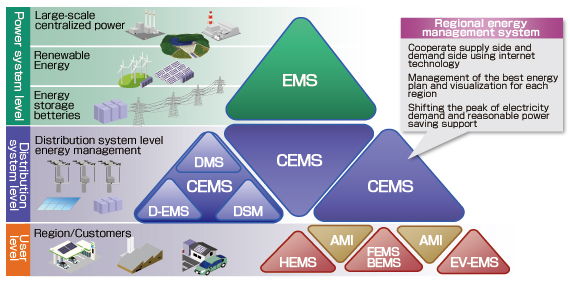
Among the companies that stand to benefit will be not only the communications firms but major domestic engineering conglomerates such as Toshiba and Hitachi. The latter boasts a number of different EMS options that can integrate centralized nuclear, hydro and thermal power with distributed renewable generation such as solar and wind generation, as well as battery storage.
Source: Hitachi Energy Management Systems
EMS can be set up for factories, individual buildings, EVs, and other circumstances. These systems provide advanced monitoring of power supply and demand, allowing for enhanced efficiencies through such measures as identifying and cutting peak demand.
Pushing more SMEs to consider energy efficiency measures, METI has set up a dedicated subsidy mechanism that covers up to half of the business cost of installing EMS for a smaller firm. The subsidy for large firms covers up to a third of the cost.
A niche that’s almost guaranteed a boom, however, are home energy management systems (HEMS). The government has set a target to install HEMS in every home by 2030. What’s more, many local governments are already subsidizing them.
COLUMN: ENERGY JOBS IN JAPAN
BY ANDREW STATTER
2022 Energy Talent Trends – A Year of Transition
Last year was very interesting and eventful for the energy industry. The highlights include Japan’s fundamental shift in nuclear policy, the war in Ukraine, LNG shortages and record energy prices, a pause on Japan’s offshore wind auctions after a shock Round 1 result, as well as a major spotlight on co-firing with hydrogen and ammonia.
Now, let’s take a look at what effects these events had on the talent market here in Japan.
Continued growth in renewables
The renewables sector as a whole continued to grow. Though markets such as PV solar saw some consolidation, demand for talent was driven by growth in energy storage, EV charging infrastructure and wind power. As has been the case for the last 10 years in Japan, demand for quality talent outstripped supply, leading to greater than 30% of all job changes within renewables involving people joining from other sectors. The biggest ‘transfer’ areas were:
Engineering
Electrical engineering skills remain in high demand due to bottlenecks in grid connection, as well as a trend for higher-volume, smaller capacity power plants. Increasing realization within the industry about the need for quality asset management and operations & maintenance (O&M) was also a catalyst for rising demand. We’ve seen people from telecommunications, railways and power utilities moving into this area.
Structural and mechanical engineering talent was also in high demand for wind power, especially as for those with marine engineering experience. There was a clear need for people with experience in shipping or floating facilities in the oil & gas exploration space to move into offshore wind projects.
PV to ESS shift
What do PV and energy storage have in common? A need to acquire land, work with local stakeholders, get permits, grid connections and prove a strong investment case for the people who control the money. As the PV market becomes more competitive and margins shrink, talent with a strong track record in this market shifted to developing ESS projects. This set off both internal job switches and moves to a new company.
Finance
Project finance professionals with general infrastructure experience, such as airports, highways and hospitals, are getting tapped to work in renewables at an increasing rate. That’s because the size, complexity, risk and capital requirements of renewable energy projects are increasing. Those with corporate M&A experience are also seeing increased interest from energy chiefs.
More traditional and private equity investors are launching sustainability and infrastructure funds. This is partly due to consolidation in the PV market, driving a trend for investors to target acquisition of portfolios or equity investments into successful developers, rather than taking an asset-focused greenfield approach that was predominant under the high FIT schemes of old.
Offshore wind: We need a strategy!
Following the shock Round 1 result with Mitsubishi Corporation-led consortiums winning all three auctions in late December 2021, many in the industry were furious. Whereas previously there was a heavy focus on local stakeholder management and development work, industry players noted that local engagement scores would not be sufficient for success in future rounds. In addition to this, METI paused Round 2 auctions to review the criteria, and industry players were keen to lobby and influence the direction of these changes to suit their strengths.
As a result, we saw a heavy demand for strategic positions in Regulatory/Government Affairs, Bid Management and Strategy, and Partnership Strategy that were not heavily apparent in 2021. Those with prior experience in the public sector (especially ex METI/ANRE officials), as well as strategic consultants who had experience supporting Round 1 bids, were in high demand from the developer side as industry players looked to better position themselves for success in Rounds 2 and 3.
Mid-career hiring ramps up
Traditionally, large Japanese banks and trading houses primarily hired new graduates, trained and rotated them around the business to become well-rounded employees. But over the last few years, we’ve seen two changes that are pushing these big industry players to increase mid-career hiring.
The first is an increased departure of top talent in middle-management levels. As large foreign firms have increased investment into Japan and APAC markets, talent from large banks and trading houses has topped the list for many new suitors. In the early 2010s, most people did not leave their large employers until after 40 years old. Now we’re seeing an increasing number of talented people jump ship in their late 20s and early-mid 30s.
The second major reason is a shift in investment sectors, which has revealed a shortage of talent in these niches. As the volume of deals in more traditional infrastructure areas slow and less money flows into power / oil & gas, Japan Inc is turning to decarbonization tech, such as CCS/CCUS and DAC, and digital tech, such as VPP, ESS, and V2H systems. These areas lack experience people, so we’re seeing more mid-career hiring there. Notable examples are the major trading houses poaching talent from technology OEMs and major EPC players.
Outlook for 2023
Moving forward for 2023 we expect to see the above trends to accelerate. Though there’s a huge resurgence in interest for nuclear power, and heavy public and industry support for clean fuels and co-firing, on the talent side we see little impact. The reason for this is that skills required in these areas already exist among the staff of major market players.
LNG traders can easily shift to hydrogen and ammonia; investment talent in major trading houses can be repurposed to find new partnerships; and the power utilities and major manufacturers have retained a lot of talent in the nuclear sector. A trigger point there, however, could be more serious progress in developing new nuclear tech such as SMRs. That could throw an interesting curveball into the hiring market.
Andrew Statter is Partner and Head of GreenTech at Titan Consulting in Tokyo.
GLOBAL VIEW
BY JOHN VAROLI
Below are some of last week’s most important international energy developments monitored by the Japan NRG team because of their potential to impact energy supply and demand, as well as prices. We see the following as relevant to Japanese and international energy investors.
Australia/ Coal exports
Coal miners hope to benefit from a thaw in relations with China, as Xi Jinping seeks to reboot the country’s economy. Whitehaven Coal said China’s relaxation of restrictions on Australian coal imports is helping to drive prices to six-month highs.
Canada/ Renewable diesel
Imperial Oil will invest $720-million to build a renewable diesel facility at its refinery near Edmonton that will produce 20,000 bpd of renewable diesel once completed in 2025. Renewable diesel is a biomass-based fuel that is chemically equivalent to petroleum diesel.
Denmark/ Renewable energy
Local renewable power developer GreenGo Energy will lead a 60-billion Danish crown ($8.77 billion) project to develop a green energy park with 4 GW of solar and wind energy.
India/ Adani Group
Shares in Adani Group’s companies fell 5% on average, shedding $10.8 billion in value after short seller Hindenburg Research released a critical report about the group. Deriving much of its revenues from mining and burning coal, Adani Group plans to invest $70 billion by 2030 to become one of the world’s largest green energy businesses.
Iraq/ Oil
QatarEnergy is in talks to acquire an approximate 30% stake in TotalEnergies’ $27 billion cluster of energy projects, as Baghdad hopes to counter Western energy companies exiting the country as domestic turmoil increases.
Mexico/ Oil refinery
State oil company Pemex’s newest refinery, which is still under construction in the southeast, will begin to process crude oil in July. The refinery will first process 170,000 bpd of crude oil and eventually grow capacity to process 340,000 bpd.
Netherlands/ Natural gas
Europe’s largest gas field, Groningen, might be shut. Officials say it’s “very dangerous” because of earthquakes. Still, the government will wait to see if there’s a shortage of gas after the winter. About 100 tremors have been recorded annually in the area since the 1980s.
UAE/ Commodities
Abu Dhabi National Oil Company and energy trading house Gunvor extended an exclusivity period for deal talks as they try to reach an agreement over a possible investment. ADNOC might take a minority stake in Gunvor, whose net profit soared to $841 million in 1H 2021.
UK/ Batteries
Recharge Industries, an Australian battery company, made a bid for UK battery producer Britishvolt. The UK government offered Britishvolt £100 million in funding before its collapse. Recharge said it will want to secure that money if it takes over.
U.S./ Biofuels
The Department of Energy will award $118 million to 17 projects designed to accelerate the production of biofuels, which can be made from biomass including agricultural waste, soybean oil and animal fats.
2023 EVENTS CALENDAR
A selection of domestic and international events we believe will have an impact on Japanese energy
ASEAN-Japan summit to mark 50 years of cooperation
Last market trading day (December 30)
Disclaimer
This communication has been prepared for information purposes only, is confidential and may be legally privileged. This is a subscription-only service and is directed at those who have expressly asked K.K. Yuri Group or one of its representatives to be added to the mailing list. This document may not be onwardly circulated or reproduced without prior written consent from Yuri Group, which retains all copyright to the content of this report.
Yuri Group is not registered as an investment advisor in any jurisdiction. Our research and all the content express our opinions, which are generally based on available public information, field studies and own analysis. Content is limited to general comment upon general political, economic and market issues, asset classes and types of investments. The report and all of its content does not constitute a recommendation or solicitation to buy, sell, subscribe for or underwrite any product or physical commodity, or a financial instrument.
The information contained in this report is obtained from sources believed to be reliable and in good faith. No representation or warranty is made that it is accurate or complete. Opinions and views expressed are subject to change without notice, as are prices and availability, which are indicative only. There is no obligation to notify recipients of any changes to this data or to do so in the future. No responsibility is accepted for the use of or reliance on the information provided. In no circumstances will Yuri Group be liable for any indirect or direct loss, or consequential loss or damages arising from the use of, any inability to use, or any inaccuracy in the information.
K.K. Yuri Group: Oonoya Building 8F, Yotsuya 1-18, Shinjuku-ku, Tokyo, Japan, 160-0004.
NEWS
・Japan outlines action plans for carbon capture strategy; at least three major groups seek state support to hit commercial scale
・2050 master plan for power grid unveiled: ¥7 trn needed in investments to decarbonize and expand green capacity
・Sumitomo Mitsui makes ¥30 bln in sustainability-linked loans as Japan’s lenders seek to boost financing for climate action