Japan to make open search for firms that can design fast reactor
Toho Gas unveils industrial burn that uses nat. gas and hydrogen
Isuzu Motors unveils first electric trucks; invests in charging hubs
Group to test PV panel and power storage system on street lights
Toyota hydrogen racing car catches fire, withdraws from event
ELECTRICITY MARKETS
Kyushu 220 MW offshore wind power project starts construction
GE plans to market its biggest offshore wind turbines in Japan
Nuclear watchdog says questions around Hokuriku’s NPP resolved
NRA attacks Hokkaido Electric for not providing recent data
Firm to build Japan’s first power plant fueled by chicken litter
Kyushu Electric expands in Hokkaido with first renewables project
Nozawa World plans new solar power project in Nagano area
Chubu Electric to delay decommissioning of Hamaoka reactors
OIL, GAS & MINING
Okinawa Electric to build local demand for LNG with new pipeline
JX Oil and Gas Exploration acquires Japan Drilling Company
ENEOS sees demand for gasoline rising on more travel
LNG stockpiles of power utilities jump over 7% in a week
ANALYSIS
TOYOTA GROUP’S REMARKABLE GAMBLE FOR RENEWABLES
Trading house Toyota Tsusho, which is an integral part of the Toyota Group, is expanding to become Japan’s top player both in wind and solar. The company will have over 4 GW of renewable capacity worldwide. This will see Toyota overtake Orix Corp, which claims to have 3.6 GW of renewable energy capacity globally. Importantly, Toyota Tsusho’s expansion will help Toyota Motor achieve its goal of eliminating CO2 emissions throughout the entire vehicle life cycle.
MUNICIPALITIES RACE TO NET-ZERO; LOCAL PLANS INCLUDE NEW HUBS FOR HYDROGEN
In the past year, Japan’s municipalities have made significant progress on pledging their support to carbon neutrality by 2050. Despite this encouraging start, very few have publicized specific roadmaps or indicated that there’s confidence in how to go about this. The problem often lies in a dearth of local human and financial resources. Other issues include a lack of reliable local data on emissions and other points. We review the various net-zero plans created by municipalities nationwide.
METI compiled its Strategy for the Public Safety of Hydrogen, a safety standards roadmap for production, storage, transport and consumption.
There are three main segments: gathering data, setting rules and standards, and promoting hydrogen consumption. Target date for data gathering is 2025, while other plans fall in the 2025-2030 period.
Current laws and regulations will apply to field tests, but a new regulatory framework will be set up ahead of a commercialization of hydrogen services.
Municipalities have oversight on high-pressure gas safety regulations, and will require guidance from the central government once hydrogen applications spread widely.
Action Plans
Specific actions
Data gathering
Gathering and sharing scientific data
Ensuring testing opportunities
Rule writing
Identifying priorities in the supply chain
Identifying steps
Setting up third-party certification bodies
Collaborating with municipalities
Setting up environment to enhance hydrogen consumption
Communications on various risks
Human resource development
Aligning with international trends
CONTEXT: Rules on hydrogen are disorganized, spread out among the regulation frameworks around high pressure gas, electricity, gas, motor vehicle safety, labor safety, etc. These action plans will consolidate and systematize the standards throughout the sector’s supply chain. In January, a Hydrogen Center was set up in the High-Pressure Gas Safety Institute of Japan to conduct hydrogen and ammonia safety tests. Its goal is to act in a similar manner to the American Petroleum Institute, which sets technical standards for fossil fuel infrastructure.
TAKEAWAY: Current efforts to write and clarify hydrogen safety rules are focused on fuel cell vehicles and hydrogen charging stations. As industries outside mobility, gas and power sectors start developing hydrogen applications, the government will need to lead in setting standards and regulations.
METI to discuss rules on CO2 emissions from synthetic fuel
(Denki Shimbun, March 15)
At the Gas Business System Working Group, METI discussed CO2 emissions from methanation. In other words, during the production of synthetic methane (e-methane), which combines hydrogen and recycled CO2.
Since international regulation to import synthetic methane produced by cheap renewable energy has not yet been set, METI is discussing the issue on both the international and corporate levels.
Professor Kikkawa Takeo said that most synthetic methane will be imported from the U.S., and so, Japan should cooperate more with the U.S. than the EU in this sector.
METI listed issues for carbon accounting of synthetic methane using carbon as feedstock.
Views on registering carbon cuts are split: to register when the gas is collected at industrial sites, or when it’s recycled into synthetic methane, or to allow double counting.
Rule-making on CCU-equipped gas will start in 2024.
When to register carbon cuts
At collection stage/consumption/both?
Carbon coefficient of LNG mixed with synthetic methane
Methodology to change the carbon coefficient which stands at 52.91 kg CO2/ mbtu
GX-emission trading scheme
To count synthetic methane as Scope 1 emissions
J-Credit
To add synthetic methane methodology to award credits
Tax
Changing global warming tax rates for natural gas mixed with synthetic methane
Data category
In official METI energy statistics, create new data categories for synthetic methane and bio methane that uses biogas as feed
CONTEXT: Tokyo Gas and Toho Gas plan to launch pilot methanation projects this year, producing synthetic methane from waste-derived biogas for mixing into city gas supplies. Osaka Gas and INPEX plan to conduct trials in 2024-2025. The commercial launch of such services are expected before 2030. By 2030, 1% of total city gas supplies will consist of synthetic methane, according to the government’s goal.
TAKEAWAY: While larger gas utilities are active in synthetic methane projects, the smaller ones that comprise the greater majority of the industry, lag behind; this splits the industry based on a “climate divide”. Industry observers hope that the gap will not widen as it may deter writing new policies, which by necessity need to apply to the entire sector.
Hitachi Zosen, IHI to grow methanation market as carbon recycling gains momentum
(Japan NRG, March 15)
Hitachi Zosen and IHI, the two leading manufacturers of equipment for producing synthetic methane from CO2 and hydrogen, are expanding products and services on greater demand from the energy and industrial sectors.
In April, Hitachi Zosen plans to open the world’s largest 1,000 Nm3/ hour plant. This will be twice the size of a 500 Nm3/ hour plant that IHI is currently building for JFE Steel.
This fall, IHI will start renting its 12.5 Nm3/ hour methanation equipment to companies that plan pilot carbon recycling projects.
IHI has interest from around 20 companies in the power, gas, steel and chemical sectors in Japan, Australia and the U.S., a company official told Japan NRG.
There’s growing interest in using synthetic methane in non-energy applications too, such as an iron reduction agent, which reduces coking coal consumption in steelmaking and feedstock for olefin chemical production.
TAKEAWAY: In contrast to the saturated water electrolysis equipment market, methanation is a niche with only three big players: Hitachi Zosen, IHI and Toshiba. The firms conducting methanation pilot tests have also been limited to large gas utilities and a few manufacturers. The sector will need to bring in more interested parties both on the consumer and supplier side if it wants to attract the kind of attention that, for example, hydrogen has amassed in recent years.
In terms of strategy, the big players also have very different roadmaps. Hitachi Zosen aims for scalability, focusing on expanding the size of methanation output, as well as water electrolysis plants. The government’s goal is to attain 10,000 Nm3/ hour production capacity by 2030. Meanwhile, IHI promotes on-site consumption to avoid the transport of the fuel across borders. It also appears to be more focused on stimulating more demand cases for e-methane. IHI has managed to cut costs of production by switching high-cost components to cheaper alternatives and by developing cheaper catalysts.
SIDE DEVELOPMENT: IHI developing methanation catalysts with less ruthenium (Japan NRG, March 15)
IHI is developing methanation catalysts that require less ruthenium, which in turn will bring down the cost of producing synthetic methane, a company official told Japan NRG. The catalysts speed up the reaction between CO2 and hydrogen molecules.
IHI has replaced ruthenium with porous metal oxides, which is mixed with nickel.
About 5-6 tons of catalyst are required for a 500 Nm3/ hour e-methane plant. The catalysts need to be replaced after about a year.
CONTEXT: Ruthenium prices have been holding stable below $500/ troy oz ($1,555/ gram) this year but there’s concern that prices will jump again to 2021 highs. Metal demand from the ammonia and hydrogen sectors is less than 10% of the current total, but it may surge as pilot projects move to commercialization.
TAKEAWAY: In addition to the discovery of cheaper materials, equipment manufacturers are studying the best configuration of catalysts in tube-shaped containers to prolong life cycles and the shape of the catalyst containers to maximize reactions with gas molecules.
Non-fossil certificate third-party purchasing up 70% on demand from REITs
(Nikkei, March 15)
Whole Energy, which acts as a purchasing agent for end-users that need non-fossil certificates, said the number of firms engaged in a similar business on the stock exchange has increased by 70% in the last six months or so; up to 168 companies.
The volume of bids for non-fossil certificates exceeded 50 TWh in February, a fourfold increase YoY. Whole Energy purchased 131.6 GWh of certificates in that period, which represents a 10-fold increase YoY.
In the February purchasing round, Whole Energy bought certificates on behalf of 16 companies, five of which were REITs. The latter come from a sector where demand for renewable energy is especially high right now.
CONTEXT: Non-fossil certificates prove the value of renewable energy, and they’re traded four times a year, from August to May. Auctions for fiscal year 2022 were held in August 2022, November 2022, and February 2023; the last one is scheduled for May 2023.
CONTEXT: Sellers of non-fossil certificates are power generators and the state; the main buyers are power retailers and agents like Whole Energy.
TAKEAWAY: Since November 2021, end users can also buy the certificates directly. However, SMEs find the registration process and fees to participate in the certificate actions too burdensome, which opens opportunities for purchasing agents.
METI to open up search for companies that can design a demo fast reactor
(Denki Shimbun, March 15)
This summer, the government will conduct an open search for companies that can do the engineering work for the concept design of a new demonstration-level fast reactor. Work on the concept design is slated to begin in 2024, according to METI’s schedule for the sector’s development.
CONTEXT: In 2022, an expert committee concluded that a sodium-cooled fast reactor is a technology that’s likely to achieve practical use. METI then drew up a roadmap for its development, which includes R&D around its fuel systems (due to start in 2026) and work on the basic design and licensing (from around 2028).
ANRE will conduct the public search for companies interested in taking on the engineering work for the concept design.
TAKEAWAY: Japan has tried to develop a commercial-scale fast breeder reactor since at least 1985 with the Monju prototype project. Beset by troubles and cost overruns, the Monju program was shut down and slated for decommissioning in 2016. METI continued its support for fast reactor technology through a partnership with France and its ASTRID sodium fast reactor program. However, France withdrew from the program in 2018. Interest in fast reactors has reignited in recent years in the U.S. Companies like TerraPower have partnered with Japanese researchers (JAEA) and companies (MHI). The premise of the technology is that it would “recycle” used nuclear fuel and thus minimize the volume of radioactive waste.
Toho Gas launches industrial furnace burner that switches between city gas and hydrogen
(Company statement, March 13)
Toho Gas launched an industrial furnace burner capable of switching between city gas and hydrogen combustion at low cost.
Compared to city gas combustion, hydrogen combustion implies a higher amount of NOx emissions and leads to an earlier deterioration of burner parts. Using a newly developed flow-channeling plate in the exhaust gas recirculation system, Tokyo Gas has pioneered an approach that will keep NOx emissions at the same level as for city gas, and the burner can last longer.
CONTEXT: For switching between city gas and hydrogen combustion in an industrial furnace burner, it is usually necessary to replace the burner’s body and exhaust gas recirculation structure. Plate replacement costs are about 1/10th of the cost to switch other parts.
Isuzu Motors unveils its first electric trucks
(Company statement, March 7)
With full-model changes to the N-Series (light-duty trucks) and F-Series (medium duty trucks), Isuzu Motors launched its first mass-produced battery EV trucks. The improvements span six features.
Newly-developed transmissions now exceed the 2025 Fuel Efficiency Standard (for commercial vehicles) by 15%. New safety features such as the pre-collision braking system are introduced for the first time in Japanese light-duty trucks.
Isuzu utilizes a cloud-based fleet management system that collects and analyzes vehicle operation data, including GHG emissions.
CONTEXT: Isuzu Motors is building out partnerships with other companies in Japan to create sufficient infrastructure for BEVs, such as charging stations. Its partners so far include Itochu, i-Grid Solutions, VPP Japan, and Itochu Enex.
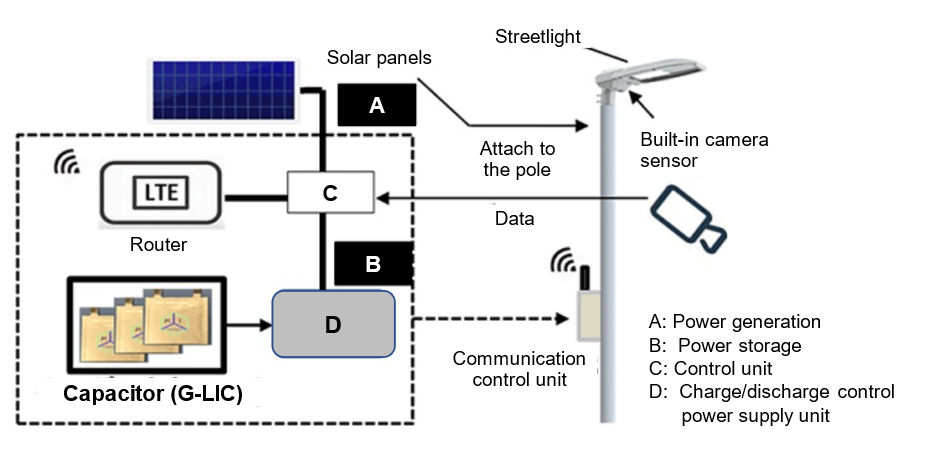
Iwasaki Electric tests energy storage system for IoT devices on street lights
(Company statement, March 9)
Iwasaki Electric and Material Innovation Tsukuba (MI Tsukuba), a startup from the National Institute for Materials Science (NIMS), began an experiment on an electricity storage control system. Solar PVs installed on streetlights supply electricity to IoT devices. This power system is equipped with a graphene lithium-ion capacitor (G-LIC) that’s used as an electricity storage device.
The G-LIC shows high performance in the charging/ discharging of electricity, functions in a wide range of temperatures, has long life, and is easy to maintain. All these features are fit for applications in outdoor environments.
IoT devices inside the system monitor ambient temperature, humidity, CO2 levels, UV rays, etc, and send the data to a control center in Saitama Pref.
Toyota Motor’s Carolla liquid hydrogen racing car caught fire due to leaks, forcing the automaker to withdraw the car from the 2023 endurance race on March 18-19.
On March 8 during a test drive, hydrogen gas leaked from a tube in the engine and caught fire, damaging the car. There were no injuries.
Toyota still plans to race, but with a gasoline vehicle.
TAKEAWAY: According to the High-Pressure Gas Safety Institute of Japan that investigates gas leakage incidents, around 100 cases involving hydrogen were reported to date. Most of these were leaks at hydrogen service stations. Very few involved explosions. The Toyota incident may carry the most damage.
TEPCO and Indonesia’s PPI to study green hydrogen production
(Kensetsu Tsushin Shimbun, March 14)
TEPCO and PT Pertamina Power Indonesia (PPI) plan to develop and commercialize green hydrogen and green ammonia using geothermal energy. The companies are seeking sites for hydrogen production, market segmentation and developing customers.
When commercialized, the hydrogen and ammonia will be sold domestically. Export to other countries, including Japan, are planned in the medium to long term.
Euglena supplies domestically produced SAF to airport in Tokyo
(Company statement, March 10)
Euglena supplied domestically produced sustainable aviation fuel (SAF) to Chofu Airport in Tokyo. This is the first Euglena SAF supply in Tokyo.
Euglena makes SAF from edible oil and Euglena oil extracted from microalgae. SAF emits CO2 in the fuel combustion stage, but the Euglena absorbs CO2 via photosynthesis. The SAF is mixed with conventional jet fuel.
The SAF fueled small airplanes, as well as automobiles used in the airport.
Tokyo Gas and SCREEN developed a way to mass produce catalyst-coated membranes (CCM), a component of water electrolysis systems. The tech applies to proton exchange membrane-based electrolysis, but not for alkaline electrolysis (AEL).
The tech prevents cracks and catalyst agglomerations on CCM that weaken electrolysis performance. Agglomeration is a particle formation process in which at least two primary particles combine to form a new one.
CCM production begins in 2025, for use in production of water electrolysis systems.
CONTEXT: The government cost target is ¥65,000/ kW for PEM water electrolysis by 2030. Tokyo Gas declined to elaborate on the cost data.
DIC and Idemitsu Kosan to study production of biomass polystyrene
(Company statement, March 9)
DIC and Idemitsu Kosan will build a biomass plastic supply chain and study the production of polystyrene (PS) using styrene monomer (SM) as a raw material. Production will start later in 2023 at DIC’s Yokkaichi Plant.
Biomass SM is derived from biomass naphtha, and can reduce CO2 emissions compared to naphtha derived from petroleum. Idemitsu’s Biomass SM obtained ISCC PLUS certification to certify it as sustainable. DIC will obtain certification by late 2023.
Hiroshima Gas installs energy-saving equipment, reducing CO2 by 40%
(Nikkei, March 15)
Hiroshima Gas, in partnership with Higashi-Hiroshima City, installed energy-saving equipment including solar panels and air conditioning systems at some of the public offices. As a result, in January and February, CO2 emissions were reduced 40% YoY.
The equipment was installed in December 2022 at a cost of about ¥263 million; ¥97 million of that came from the MoE.
KWE to Use 100% renewable energy for electricity at all sites in Japan
(Company statement, March 15)
Kintetsu World Express (KWE) will switch the electricity it uses at all sites, including those of affiliates, to renewable energy.
The company purchased FIT non-fossil certificates for 29 GWh of power; this will reduce CO2 emissions to effectively zero.
NEWS: POWER MARKETS
Six consortiums form to vie for 700 MW offshore wind project in Niigata
(Diamond, March 15)
Seven developers (Taisei, RWE, Obayashi, Sumitomo, Invenergy, Vena Energy and Tohoku Electric) have already begun environmental impact assessments for offshore wind projects off the coast of Murakami and Tainai cities in Niigata Prefecture, which are part of the second round of national offshore wind tenders.
The project off the coast of Niigata Prefecture is expected to be the most competitive of the four areas in the second round. In Akita and Nagasaki areas, the spare capacity of the local grid limits the size of new offshore wind projects. In contrast, offshore Niigata Pref can accept 700 MW of capacity.
The tender closes at the end of June.
Current consortium makeup for the Niigata area bids:
TEPCO, Taisei, Cosmo, local general contractor Honma Gumi
RWE, Mitsui, Osaka Gas
Obayashi, Eurus Energy
Invenergy, SSE Pacifico
Tohoku Electric, JERA, TotalEnergies
Vena Energy
Sumitomo Corporation may join with TEPCO and Taisei’s consortium.
TotalEnergies has offered Japanese partners a chance to join projects overseas, including in Europe, as a way to build partnerships in Japan.
Seven EPCOs told to recalculate fuel costs in their electricity rate hike applications
(Denki Shimbun, March 16)
The Electricity and Gas Market Surveillance Commission (EGC) requested seven EPCOs to synchronize the period of fuel costs used to calculate electricity rates. It wants all power utilities to quote the costs during November 2022 to January 2023 as the most recent three-month period.
As a consequence, it’s expected that the applications will be updated to reflect lower LNG prices, which would in turn trim the power rate increases. Also, given the time needed for recalculation, it’s likely that the price increases requested by Tohoku, Hokuriku, Chugoku, Shikoku and Okinawa EPCOs, among others, will be pushed back.
While Tohoku, Hokuriku, Chugoku, Shikoku and Okinawa EPCOs cited fuel costs during July to September 2022, Tokyo used the August to October 2022 period; Hokkaido used September to November 2022.
Tohoku Electric was also required to reference the February 2023 electricity futures prices on the TOCOM exchange, instead of using data from the Mitsubishi Research Institute.
The instruction to the utilities was presented at a tariff system meeting on March 15.
TAKEAWAY: In reaction to the EPCO requests to increase electricity rates from April 2023, PM Kishida has called for a careful review of the applications. It’s clear that the PM hopes to avoid further price hikes in household utility bills. However, there are several issues that the govt will need to tackle if they refuse to accept EPCO applications. For many utilities, this will mean a further deterioration of financials and that will both hurt their business operations and slow new investments, including in clean energy. For households in the central Tokyo area, there is a further complication. TEPCO’s increase is based on the idea that it can restart one unit at its Kashiwazaki-Kariwa NPP in October and thus claw back some profit. If that doesn’t happen, the Tokyo-based utility’s financial situation, which is already severe, will deteriorate further right before the peak power demand period in winter.
Hibiki Wind Energy to build 220 MW offshore wind farm in Kyushu
(New Energy Business, March 15)
Hibiki Wind Energy began building an offshore wind farm in Hibiki Nada, off the coast of Kitakyushu City; it will use fixed-bottom turbines; and have a capacity of 220 MW when it starts operation in 2025.
The project development company, established in 2017, is a consortium of J-Power (40%), Kyuden Mirai Energy (30%), Hokutaku (10%), Saibu Gas (10%), and Kyudenko (10%).
The wind farm will install 25 Vesta, 9.6 MW turbines. Penta Ocean and Nippon Steel Engineering are in charge of construction of the foundations. J-Power Hightech will build an onshore power station. Crew transfer vessels will be provided by Tokyo Kisen.
GE will market world’s largest scale 18 MW offshore wind turbines in Japan
(Various Media, March 17)
GE will start marketing its newly developed, 18 MW offshore wind turbines in Japan. The turbine is the world’s largest and 30% bigger than GE’s previous Haliade-X models.
This is the first time in three years that GE has unveiled a new model for offshore wind turbines. In the Japan market, Toshiba would supply the turbine’s nacelle (i.e. the central hub of the construction, which houses the gearbox, low- and high-speed shafts, generator, and brake).
GE was selected as the sole turbine supplier for the three national tenders won by Mitsubishi Corp in late 2021. The U.S. manufacturer now hopes to offer its new product for developers taking part in new rounds of offshore wind auctions.
CONTEXT: GE is one of the world’s top three makers of offshore wind turbines. In order to win orders in Japan, the company is in the process of obtaining Class T certification, which means that its turbines are judged as able to withstand typhoons.
TAKEAWAY: While the offshore auctions in Japan to date came in at a price well below expectations, they were still above the 2030 govt target for wind power generation costs in Japan, which is ¥8-9/ kWh. Larger turbines are seen as one important way that will help to reduce the sector’s costs.
The NRA: no need for more discussion on Shika NPP Unit 2; restart likely soon
(Denki Shimbun, March 16)
The NRA decided that no further discussion is needed about the possibility of an earthquake fault line at Shika NPP Unit 2.
The NRA decided that the seismic capacity of Unit 2 is “roughly plausible”. This conclusion is the exact opposite of a conclusion made in 2016; the new decision is based on an enormous amount of data submitted by Hokuriku Electric.
CONTEXT: At a regular NRA meeting on March 8, one of the NRA’s five commissioners, Dr. Ishiwatari Akira, requested a comparative review of the 2016 report and the latest decision. At a March 15 meeting, NRA decided that the 2016 report was based on such meager data that it wasn’t worth reviewing.
TAKEAWAY: The fault line issue at Shika Unit 2 is now considered closed and the NPP should be able to resume operations in the near future.
NRA again accuses Hokkaido Electric of not providing relevant data for Tomari NPP restart
(Japan NRG, Denki Shimbun, March 17)
The NRA again accused power utility Hokkaido Electric of not providing relevant documentation around safety measures for its Tomari NPP, which remains idle since 2012.
CONTEXT: The NPP was shut down not long after the Fukushima accident. Back in July 2013, the station’s operator applied for a restart of all three of its reactors, but the NRA’s safety review of the facility continues to this day. The regulator was previously concerned about the possibility of there being an active geological fault running underneath the NPP. Officials have also chastised Hokkaido Electric a number of times for not providing the requested data and other documents.
At a meeting to discuss a number of issues, including severe accident prevention measures for Unit 3 at the Tomari NPP, the NRA accused Hokkaido Electric of failing to submit documents based on recent data.
Hokkaido Electric explained its five-point plan for preventing severe accidents, including upgrades to the design of Unit 1. The regulators, however, said that it was not possible to assess the adequacy of these proposed measures without recent data.
TAKEAWAY: The dialogue between Hokkaido Electric and the NRA has been long and tense, with various accusations against the other party from both sides. Utility officials were due to complete their presentation of various safety upgrades to the NRA by the end of Sept. 2023, but that deadline was recently pushed back. The nature of the dialogue remains difficult, which means that it’s hard to forecast when a restart of Tomari NPP will come into view.
Miyazaki company to build Japan’s first power plant fueled by poultry litter
(New Energy News, March 13)
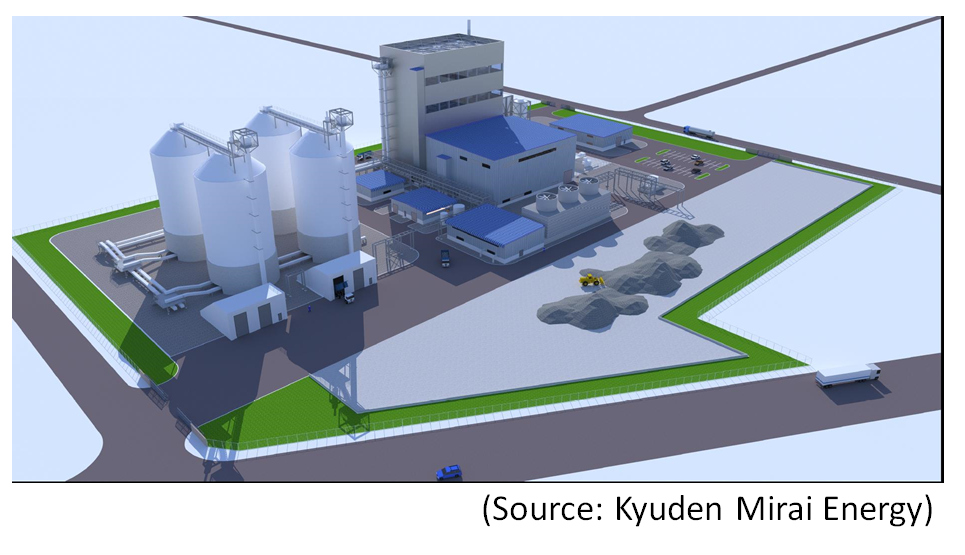
Miyazaki Biomass Recycle, a subsidiary of Kyuden Mirai Energy, will build a power generation plant with a 9.5 MW capacity in Miyazaki City using poultry litter as the fuel (132,000 ton/ year from several local poultry farms).
The new plant will generate 6 GWh, enough to power 20,000 homes and cut CO2 output by 23,000 tons a year. Ashes from the biomass will be used as fertilizers.
The company owns another biomass-to-energy plant that’s been in operation since 2006. Construction of the new plant starts in June 2024; power generation starts in April 2026.
TAKEAWAY: Miyazaki Pref is known for its free-range chicken. Miyazaki Biomass Recycle was established in 2003 with funding from Nishinippon Environmental Energy, a subsidiary of Kyushu Electric, and several poultry farming cooperatives in Kawaminami, Miyazaki. The biomass power plant was built to help dispose of the poultry litter generated by local farms. The ashes from the steam turbine are rich in phosphorus and potassium and the company sells it as fertilizer. This is a good example of eco-recycling.
Kyushu Electric to start operation of 51 MW biomass power station in Hokkaido
(Denki Shimbun, March 16)
Kyuden Mirai Energy, a subsidiary of Kyushu Electric focused on renewables, started operation of the Ishikariwan Shinko Biomass Power Station in Ishikari City, Hokkaido, along with construction company Okumura-gumi, and biomass energy developer New Circle Energy.
Okumura-gumi holds 50%; Kyuden Mirai Energy holds 30%; and New Circle Energy holds 20% share of the 51 MW facility.
Electricity from the station will be sold to Hokkaido Electric Power Network under the FIT scheme for ¥24/ kWh. The project will use imported wood pellets and Palm Kernel Shell as fuel.
Okumura-gumi will head operations and management; Kyuden Mirai Energy will be in charge of engineering. This is the first renewables development for Kyushu Electric in Hokkaido.
Nozawa World plans a new 45 MW solar power plant in Nagano
(New Energy Business, March 15)
Nozawa World in Hitachinaka, Ibaragi Pref submitted a plan for a 45 MW (DC) or 29 MW (AC) solar power project in Nagano Pref.
The plant will be built at an altitude of 1.5 km on a former 18-hole golf course. Nozawa World plans to install 75,000 solar PV panels that will cover 97% of the area.
The plant is expected to be completed in 2 years.
Hokuriku Electric invests in 9 MW Nyuzen offshore wind project in Toyama
(Company statement, March 13)
Hokuriku Electric will invest in the Nyuzen Marine Wind group that runs the Nyuzen offshore wind power farm led by Venti Japan. The group will build three 3 MW wind turbines off the coast of Nyuzen, Toyama Pref, the first offshore wind farm in Hokuriku region. Construction will be completed by August; operations start in September.
The electricity will be sold to Hokuriku Electric Power Transmission & Distribution Company. This project is part of Hokuriku Electric’s corporate plan to generate more than 1 GW of electricity from renewables by 2030.
Nyuzen Marine Wind is a consortium of Venti Japan (O&M), JFE Engineering (EPC), and Hokuriku Electric (grid/distribution).
TAKEAWAY: Prior to this project, Hokuriku Electric acquired an interest in Formosa I Wind Power, which is a company installing bottom-mounted offshore wind turbines in Taiwan, together with Mitsui O.S.K. Lines and Toho Gas.
Chubu Electric will delay the decommissioning schedule of Hamaoka NPP
(Chukyo TV News, March 13)
Chubu Electric postponed by 1 year the decommissioning of Hamaoka NPP Units 1 and 2. The utility needs more time to decide how to dismantle the equipment along with reducing radiation levels. It also needs to find a way to move and dispose of low level radioactive waste that can’t be recycled.
The final decommissioning target of FY2036 remains unchanged.
TAKEAWAY: The decommissioning of the older units at Hamaoka NPP was decided in 2009, before the Fukushima accident, because the cost of upgrading them to reflect higher earthquake protection measures was found to be uneconomic.
NEWS: OIL, GAS & MINING
Okinawa Electric to develop demand for LNG and build a pipeline in Okinawa
(Nikkei, March 14)
Okinawa Electric wants to develop demand for LNG in Okinawa Pref. In 2024, a new gas pipeline will be built in the central part of the main island, in the area where U.S. military facilities are expected to be housed.
The company will build a 14 km high-pressure gas pipeline to connect Yoshinoura Thermal Power Station, where LNG tanks are located, with Urasoe City. Operation will start in spring 2024.
After U.S. military facilities are updated, demand for LNG is expected to hit 6,000 tons/ year, equivalent to 20% of Okinawa Pref’s total consumption.
CONTEXT: Okinawa’s economies still relies on coal and heavy oil for its power and fuel, so a shift to natural gas would reduce emissions. The use of LNG was considered too expensive for the prefecture, which is scattered across many islands. The creation of a pipeline is expected to cut the costs to a similar level as for other fossil fuels.
ENEOS’ subsidiary acquires Japan Drilling Company
(Nikkan Kogyo Shimbun, March 16)
JX Nippon Oil and Gas Exploration, a subsidiary of ENEOS, will acquire Japan Drilling Company (JDC) from Aspirant Group at the end of April.
JDC is the only Japanese company active in offshore drilling.
JDC’s technology for drilling wells to inject and store CO2 underground will strengthen ENEOS’ CCS and CCUS value chain.
TAKEAWAY: ENEOS aims to achieve carbon neutrality by 2040. The company sees CCS (carbon capture and storage) and CCUS (carbon capture utilization and storage) as growth areas.
ENEOS expects demand for gasoline to reach 105% in February
(Sekiyu Tsushin, March 16)
In February, ENEOS saw demand for gasoline reach 3.41 million kl, a 105% rise YoY.
Last year, many regions had movement restrictions to combat Covid. This year, with the lifting of restrictions, gasoline demand is expected to grow.
Total domestic demand for petroleum products is expected to be 9.22 million kl (101% YoY).
LNG stocks of 10 power grids stood at 2.38 million tons as of March 12, up 7.2% from 2.22 million tons a week earlier. METI initially reported the March 5 stocks were 2.23 million tons but corrected the figure.
The end-March stocks last year were 1.63 million tons. The five-year average for this time of year is 2.07 million tons.
In February, Japan imported 12.5 million kiloliters (78.4 million barrels) of crude oil, down 3.5% YoY; 6.4 million tons of LNG, down 9.9%; 0.9 million tons of LPG, down 14.6%; and 9.5 million tons of thermal coal, up 1.4%.
SIDE DEVELOPMENT: Japan Feb total coal imports down 0.2% YoY (Government data)
Japan imported 14.53 million tons of all coal types in February, down 0.2% YoY.
The imports had a value of ¥653 billion, up 74% YoY.
ANALYSIS
BY MASUTOMO TAKEHIRO
Toyota Group’s Remarkable Gambit for Renewables
The recent handover of Toyota Motor’s leadership has raised wide speculation as to whether the global auto champion will finally make a pivot to EVs. What often goes unnoticed, however, is the fact that its subsidiary trading company, Toyota Tsusho, is serving as the vanguard, aggressively expanding its renewable energy portfolio to become Japan’s top player both in wind and solar. After the latest acquisition is completed, the company will have over 4 GW of renewable capacity worldwide.
This kind of scale will see the Toyota group overtake financial services group Orix Corp, which claims it’ll have 3.6 GW of renewable energy capacity globally after taking full control of Spanish utility Elawan this month. Moreover, since the bulk of Toyota’s solar and wind projects are in Japan, it should also make the group by far the biggest player in the domestic renewables industry.
Importantly, the move will help Toyota Motor achieve its highly ambitious goal of eliminating CO2 emissions throughout the entire vehicle life cycle. In a 2021 climate commitment, Toyota also vowed to attain carbon neutrality at all its global manufacturing plants by 2035. Having captive renewables capacity will be one way to hit that target.
Background
Toyota Tsusho’s origin goes back to Toyota Kinkyu Kaisha (Toyota Finance Corp), which provided sales financing for Toyota vehicles. The company expanded overseas throughout the 1980s and 1990s, in line with Toyota Motor’s global expansion.
Following a series of corporate mergers, including with trading companies Kasho Co. in 2000 and Tomen Co. in 2006, Toyota Tsusho continued to grow, and today it’s the fifth largest sogo shosha, or general trading company, by sales. The company has a robust presence in Africa, recently becoming Japan’s first corporate to record sales of over ¥1 trillion on the continent.
When in 2021 Toyota Tsusho unveiled a new strategy to focus on decarbonization in response to emerging green initiatives in Japan, the U.S., and Europe, the company foresaw, “This rapid change will greatly affect the mobility and energy sectors, which are our key business areas. We will see transformation and disruption, especially from now until 2030”.
With this sense of urgency in mind, Toyota Tsusho announced ¥1.6 trillion in investments in carbon neutrality-related fields by 2030. Considering that the company’s net assets at the time stood at ¥2.1 trillion, such a massive financing pledge was highly ambitious.
Toyota Tsusho aims to increase its holdings of renewable energy capacity to 5 GW by 2025 and further to 10 GW by 2030. Specifically, ¥700 billion, or nearly half of the promised investment, will go to renewable energy, while ¥400 billion will go to the battery sector. The remainder will flow into hydrogen and alternative fuels, resource recycling, health care, logistics, information technology and more.
Building through M&A In summer 2022, Toyota Tsusho acquired the remaining 40% share of Eurus Energy Holdings from TEPCO for ¥185 billion, making it a wholly-owned subsidiary. One rationale behind this move was to streamline management and decision making. With TEPCO struggling financially due to high fuel prices and ongoing nuclear sector issues, it also made sense to buy out the weaker partner and fully engage in the business based on Toyota group’s own formidable resources.
Since the 1980s, Eurus has been heavily involved in solar and wind power projects at home and abroad. Currently, the company is Japan’s largest wind operator, with power generation facilities in 14 countries, totaling 3.31 GW, with 1.03 GW in Japan; 255.2 MW in the Asia-Pacific region; 566.9 MW in the U.S.; 1.2 GW in Europe; and 262.5 MW in Africa.
Among future projects, Eurus plans a ¥230 billion onshore wind power project in Hokkaido, which would be one of Japan’s largest. The facilities are slated to connect to the local grid in April 2023. As a unique feature, the wind turbines are built in conjunction with a power grid and storage batteries. The power generation capacity will reach 540 MW, roughly equivalent to half a nuclear power reactor.
In Japan, power grids are usually maintained by major utilities and are, therefore, regarded as a bottleneck for further acceleration in renewable energy. Eurus envisions supplying the power generated on the site to the Tokyo metropolitan region.
Developments On and Offshore
Eurus’ controversial 600 MW Michinoku project is scheduled to be operational in 2030. If built, it would be one of Japan’s largest onshore wind power projects, with up to 150 wind turbines, each 200 meters high. It is slated to be built on 17,300 hectares along a mountain ridge that spans six municipalities, including Aomori City up north.
Michinoku is controversial precisely because in the same way as the fast rollout of solar power has alarmed many locals, the potential sites for onshore wind power are primarily found in mountainous areas, putting such development under intense scrutiny due to concerns about the impact on forests and wildlife. Against this backdrop, the project faces opposition from several local governments — even questioned by Aomori’s Governor — as well as environmental civil groups.
As a result, the mega project is merely at the stage of handing in a “letter of consideration”. The first environmental assessment document, and the submission of the second-phase “methodology document” scheduled for last fall has been postponed. Eurus backed off last summer by proposing a 30% reduction in the number of wind turbines to be installed.
As far as offshore wind power, in 2021 Eurus lost out in the first round of auctions in the sector, with rival trading house Mitsubishi Corp sweeping to victory in the three main contests. Now the attention is placed on which companies Eurus will partner with and whether it will succeed in the next round of auctions.
Meanwhile, outside Japan Toyota Tsusho agreed to take a 40% stake in a wind power project in Egypt that boasts 500 MW of capacity and is due to start operation in August 2025. The company set up an Independent Power Producer (IPP) with Eurus Energy and four others to operate the plant.
Taking over from Masa
Separately, Toyota Tsusho is ready to grab Japan’s lion’s share of solar power plants, and last month it announced plans to acquire 85% of SB Energy at an undisclosed price after reaching a consensus with Masayoshi Son’s SoftBank Group. The transaction is expected to be completed sometime after April.
SB Energy was established in the wake of the 2011 Fukushima earthquake and nuclear disaster, and today it owns 773 MW of renewable power capacity domestically, including 667 MW of solar power and 56 MW of wind power; alongside 50 MW of wind power in Mongolia. Toyota Tsusho and SoftBank intend to jointly develop renewable energy power plants and adjust the supply and demand of electricity in the future.
Meanwhile, Toyota Tsusho has also strengthened its battery business.
In 2012, Toyota Tsusho acquired mining concessions in Argentina’s Salar de Olaroz, which has significant lithium deposits, kicking off full-scale production in 2014.
In November 2021, the company established a joint venture with Toyota to operate a battery plant for EVs in North Carolina starting in 2025.
In September 2022, the company announced a small investment in Hunan Fluopont New Materials, a Chinese manufacturer of electrolyte lithium salts for lithium-ion batteries.
In November 2022, the company completed Japan’s first plant for the production of lithium hydride, a raw material needed for lithium-ion batteries, in Fukushima.
Together with Chubu Electric, the company has been conducting a virtual power plant (VPP) V2G aggregator demo project that utilizes the storage batteries of EVs.
Next steps
Toyota Tsusho’s President and CEO Kashitani Ichiro has hinted that the company may increase its decarbonization-related investments to over ¥3.5 trillion. After consolidating its renewable base at home, the company will most likely further seek overseas business opportunities.
Competition with the world’s major renewable energy players would be inevitable but he says the company “will not only fight but also maintain a flexible attitude to join hands with those majors whenever it should”.
How the international battle unfolds remains to be seen. From a business perspective, however, for the time being the main question is how much Toyota Tsusho can boost profitability after its series of heavy investments. But one thing is for certain, the company’s future is now inextricably linked to the overall success of the clean energy transition.
ANALYSIS
BY MAYUMI WATANABE
Municipalities Go Net-Zero: From Carbon Neutral Baseball Stadiums to Hydrogen Hubs
The clean energy transition is by far the most ambitious collective effort ever undertaken by the global community. While led by Western and Asian democracies, no matter of top-down administrative rulings and regulations can alone guarantee the transition’s success. Reaching net zero emission goals can only be possible if local governments also get on board.
In the past year, Japan has made significant progress on this local front, with many municipalities pledging their support to carbon neutrality goals by 2050. Despite this encouraging start, very few municipalities have set specific roadmaps about how to go about this.
In addition to lacking detailed plans, some municipalities lack resources. Some villages and towns have managed to measure the carbon footprint of their municipal offices, but they still haven’t done so for their entire community and local economy. This lack of reliable local data may also be an obstacle to achieving net zero emissions goals.
Slow start, details to follow
As of March 1, about 870 municipalities that are home to almost 125 million people have pledged carbon neutrality by 2050. This means that 99% of the Japanese nation will soon find themselves having to adapt to net zero lifestyles. This transition will bring disruption to long-established lifestyles, so the government approach is to create a system that encourages municipalities to increase engagements with climate issues.
In January 2022, the Ministry of Environment (MoE) launched a program for municipalities called the Advanced Decarbonizing Areas (ADA), where selected cities and towns were tapped to serve as role models. These municipalities will have to come up with net zero roadmaps by 2025, and assign leading local businesses to be official partners. Then the next and most challenging step will be to start roadmap implementation by 2030.
So far, 46 municipalities have been selected as Advanced Decarbonizing Areas, and the MoE plans to increase this number to 100 or more by 2025. These 46 were chosen from 200 municipalities that applied, and they now enjoy the honor of being labeled the “zero emission elites”.
This system of zero emission elites should hopefully spur friendly rivalry among municipalities competing to attract new energy startups and major hydrogen/ ammonia projects. The ADA program so far has resulted in a positive domino effect; for example, Amagasaki City’s carbon-neutral baseball stadium has made headlines.
By 2026, the city government and the Hanshin Electric Railway, the owner of the Hanshin Tigers baseball team, will reconstruct the team’s training facilities, club house and stadium, equipping them with solar panels, storage batteries and a power generator using city wastes as feed. The facilities are expected to attract tourists too.
The 46 zero emission elites will receive state financing to build infrastructure such as renewable installations. They’ll also work with key local businesses to install micro-grid systems, to raise energy self-efficiency and to drive the shift to low carbon products and services.
For their part, local businesses are increasingly ambitious with their climate goals, especially as they anticipate stricter national regulations. All municipalities are required to implement rules for zero emission homes and buildings, introduce non-fossil buses in transport systems, and provide institutional support for resource recycling.
Meanwhile, those local areas with abundant solar, wind, biomass and hydro potentials have been able to quickly come up with net zero strategies. Out of the 46 zero emission elites, five are in Hokkaido. Municipalities with large ports such as Ishikari City and Himeji City have included hydrogen in their net zero plans. Ten municipalities are in Chiba, Aichi, Kanagawa, Hyogo, and Osaka, which rank as the top emitting prefectures.
Power and gas companies are working with municipalities to encourage shifts away from fossil fuel to renewable and hydrogen systems. For example, Hokuriku Electric partners with Tsuruga City, which has clearly stated nuclear power is its core industry. To enhance the green potential of NPPs, Hokuriku Electric plans production of hydrogen. For its part, the city will build fuel cell charging stations and rebuild the port to ship out hydrogen and ammonia.
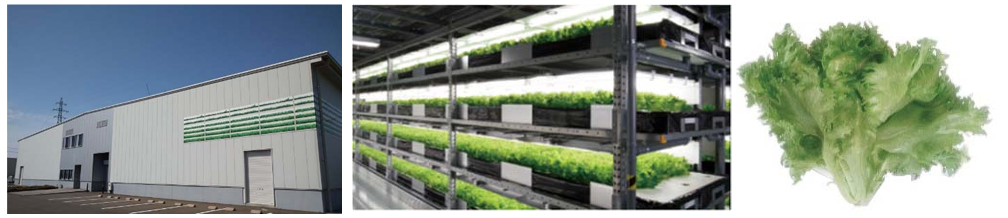
Also, Tsuruga City will provide financial support to businesses that plan renewable and energy saving installations. To increase renewable power, the city will build a new 1.6 MW incinerator power plant that uses city waste as feed. To build consumer awareness, FreDelish, a farm in the city, started to market “carbon neutral lettuce”, which regulates greenhouse temperatures with hydro and other renewable power from Hokuriku Electric.
Source: Taikisha Ltd.
Similarly, Kansai Electric plans hydrogen production in Himeji City, and Hokkaido Electric will build a hydrogen supply chain in Sapporo. Tokyo Electric will work with four municipalities to explore untapped resources such as biogas, biomass and wastes. The utility also plans to launch a new surplus power trading system in Odawara City.
Local net zero plans are even influencing traditional fossil fuels. For example, the net zero plans of Japan’s municipalities are driving up demand for so-called “carbon neutral” LNG, which is a product in which the buyer receives not only the gas but also carbon certificates that claim to offset the emissions associated with the gas.
In the wake of last year’s energy crisis, fresh demand for “carbon neutral” LNG has slowed but the number of municipality clients has increased. Nagoya City, for example, officially partners with Toho Gas. In December last year, Nagasaki City signed with Saibu Gas for “carbon neutral” LNG supplies.
Meanwhile, small towns such as Kamishihoro, which doesn’t have renewable energy or hydrogen supply potential, and which also lacks major corporations, is taking an innovative approach. Its net zero strategy centers on energy conservation, widely implementing efficient boilers and rooftop solar panel installations, and earning carbon offset credits from local forests.
As far as the ‘low-lying fruit’ of the energy transition, almost all municipalities have made progress on writing plans for installation of storage battery systems, as well as for the build out of EV and charging stations.
Role models change corporate behavior
The May 2021 amendments to the GHG Measure Promotion Act, which wrote the 2050 carbon neutrality goal into the law, provides the legal framework that’s now influencing the municipalities to pledge net zero and strive toward such goals.
Municipalities, in turn, influence how the private sector sees this issue, especially those that wish to build plants in new locations. More and more are considering how to build net zero goals into their business projects rather than simply cut GHG emissions.
“Net zero won’t happen unless businesses take more active roles,” said an MoE official, adding that multinationals pledging net zero Scope 3 emissions have prompted suppliers to also aim for net zero.
Even more promising, some municipalities are setting goals more ambitious than the central government – for example, to be carbon neutral by 2040, or to realize a full shift to non-fossil power by 2030. These localities seek to attract energy startups and climate investment funds;
Okuma township in Fukushima Prefecture has already set its goal to be carbon neutral by 2040, and has engaged Toyota group and Toshiba to build new facilities. Also, in June, a Toyota consortium will start construction on a new bioethanol plant in Okuma, and Toshiba will use local facilities to test their perovskite solar systems. Okuma is not yet a part of the Advanced Decarbonizing Areas.
Finally, the MoE’s plan should help bring renewable energy expansion back on track after some municipalities have recently tightened regulations following conflicts with the local community.
Some renewable operators complained that they were passed around from one section to another to clarify the specifics of local regulations, or get the needed data and permits, which prolonged the entire approval process, especially in areas where there were community conflicts around the development of renewables.
The May 2021 amendments to the GHG Measure Promotion Act, which codified the 2050 carbon neutrality goal into the law, is the legal foundation pushing the 870 municipalities to pledge net zero. The MoE’s role model system appears to be effectively pushing them to the next level, adding confidence that the national reduction goal will be met.
After writing their net zero road maps, they’ll move onto the next level, executing their plans. In the course of doing so, the municipalities might come across new technologies and ideas, such as the discovery of new biomass feed, or more varied mobility solutions using new carbon free fuels. If all goes according to plan, these developments will drive the municipalities and their communities to be more climate ambitious. Meanwhile, businesses will also need to step up and provide know-how to the authorities that will help new technologies gain traction.
Net Zero Projects by Municipality Around Japan
Municipality
Business partners
Plan
Sapporo City (Hokkaido)
Hokkaido Gas, Hokkaido Electric Power, Hokkaido Heat Supply Corporation, Hokkaido University, etc.
Power supplies to be net zero by 2030; Co-generation systems
Okushiri Town (Hokkaido)
Gasoline service station
Replace fossil fuel with biomass, solar, geothermal and hydro; build own power transmission network
Ishikari City (Hokkaido)
Renewable operators
Set solar and wind promotion zones; Produce green hydrogen
Kamishihoro Town (Hokkaido)
Fire stations, primary schools, food catering services
Named seven largest emitters that will follow stringent energy conservation goals, offset credits and rooftop solar
Kashioi Town (Hokkaido)
Hotels
1.5 MW biogas plant; Solar-powered zero carbon tourist spots
Miyako City (Iwate)
Tohoku University, Tohoku Electric, NTT East, etc.
New solar, wind power; storage battery installations; Solar-powered EV charging stations
Kuji City (Iwate)
Wind and solar operators
New solar, wind and biomass power installations
Akita Prefecture
Sewer treatment operators
To fully neutralize power by 2030; build a micro-grid around solar, wind and biogas power stations installed at water and sewer facilities
Ogata village (Akita)
Local hotel
New 8 MW solar plant, rice husk-derived biomass, storage battery installations
Utsunomiya City (Tochigi)
Tokyo Gas Network, Tokyo Electric, NTT Anode Energy, etc.
Shift to non-fossil mobility systems, expand solar and biomass capacities
Nasushiobara City (Tochigi)
Tokyo Electric, Nasushiobara Mirai Power
Biogas power generation using manure, new solar and storage battery installations
Ueno Village (Gunma)
NA
New biomass heating systems and greenhouse boilers
Saitama City (Saitama)
Tokyo Electric Power Grid, Saitama Univ, etc.
Power generation at incineration plants, solar rooftops, sharing economy
Chiba City (Chiba)
TNcross Corp.
New solar and storage battery installations
Yokohama City (Kanagawa)
Minato Mirai 21
New solar installations
Kawasaki City (Kanagawa)
Amazon Japan
All public facilities to run on green power by 2030
Odawara City (Kanagawa)
Tokyo Electric Power Grid
Virtual power plant system and a trading mechanism to monetize surplus power
Iida City (Nagano)
Chubu Electric group
Solar centered micro-grid, community-wide demand response systems
Nagoya City (Aichi)
Toho Gas
Carbon-neutral LNG, hydrogen-fueled power, new solar and wind installations, generating power from waste
Okazaki City (Aichi)
Mitsubishi Motor
EV battery recycling, EV-sharing, new solar and storage battery installations
Tsuruga City (Shiga)
Hokuriku Electric
New waste-fired power system; shifting industrial structure to support nuclear power; making Tsuruga port into hydrogen/ammonia hub
Konan City (Shiga)
Konan Ultra Power
Micro-grid, storage battery installations
Maibara City (Shiga)
Yanmar Holdings
Solar power-based micro grid
Kyoto City (Kyoto)
Tera
New solar and storage battery installations
Himeji City (Hyogo)
Kansai Electric
“Himeji Castle zone” to be carbon neutral by 2026; new solar installations and green hydrogen production
Amagasaki City (Hyogo)
Hanshin Electric Railway
Net zero carbon baseball matches, including night games, by 2026
GLOBAL VIEW
BY JOHN VAROLI
Below are some of last week’s most important international energy developments monitored by the Japan NRG team because of their potential to impact energy supply and demand, as well as prices. We see the following as relevant to Japanese and international energy investors.
Brazil/ Mining disaster lawsuit
A lawsuit against BHP for the 2015 mine disaster has expanded to 700,000 claimants seeking damages of up to £36 billion, the largest class action lawsuit ever in the UK. The case concerns the collapse of the Fundão tailings dam at the Samarco Mariana mine complex. The claimants seek compensation for damage to their homes and livelihoods.
China/ Cobalt production
Over the next two years, China’s share of cobalt mining could reach half of global output, up from 44% today, according to Darton Commodities. Chinese cobalt refining reached 140,000 tons in 2022, more than double five years ago, giving the country a 77% share of global refining capacity.
France/ Nuclear power
Energy utility EDF expects to maintain its 2023 nuclear production forecast despite being asked by nuclear safety watchdog ASN to inspect more pipe welds for cracks.
Mozambique/ LNG
TotalEnergies won’t start exporting LNG until 2027, the company said during a visit to the country. The project has been on hold due to terrorist attacks. Resumption of the $20 billion project is crucial to Mozambique’s future.
Russia/ Natural gas
The Kremlin seeks to develop remote Arctic gas reserves by allowing domestic operators to export LNG in circumvention of Gazprom, which has a monopoly on gas shipments. Arctic gas projects are too far from the trunkline network, making seaborne LNG the only feasible way to monetize reserves.
Saudi Arabia/ Oil profits
Oil giant Saudi Aramco posted a record profit of $161 billion in 2022, a 46.5% rise YoY. ExxonMobil made $55.7 billion, and Shell reported $39.9 billion in 2022.
UK/ Carbon capture
The Treasury will provide £20 billion for carbon capture over the next 20 years. The goal is to capture and store 20-30 million tons of CO2 every year by 2030 – equal to emissions from 15 million cars. In 2021, total UK emissions were 505 million tons of CO2 equivalent.
UK/ Renewable energy
Britain’s next auction round to spur renewable power projects will be worth about £205 million. This will be the fifth round of the Contracts for Difference (CfD) auctions that offer a guaranteed price for electricity for new renewables projects
U.S./ Biofuels
Chevron and agribusiness firms Corteva Inc and Bunge Ltd will produce renewable fuels from canola crops. They will introduce winter canola hybrids in the southern U.S. The new joint company, Bunge Chevron Ag Renewables, will buy the harvested winter canola crop to make renewable fuel.
U.S./ Oil exploration
Despite environmental protests, the White House approved ConocoPhillips’ $8 billion Willow oil project in Alaska that’s expected to produce about 180,000 bpd. Willow would account for roughly 1.5% of current U.S. oil production.
2023 EVENTS CALENDAR
A selection of domestic and international events we believe will have an impact on Japanese energy
ASEAN-Japan summit to mark 50 years of cooperation
Last market trading day (December 30)
Disclaimer
This communication has been prepared for information purposes only, is confidential and may be legally privileged. This is a subscription-only service and is directed at those who have expressly asked K.K. Yuri Group or one of its representatives to be added to the mailing list. This document may not be onwardly circulated or reproduced without prior written consent from Yuri Group, which retains all copyright to the content of this report.
Yuri Group is not registered as an investment advisor in any jurisdiction. Our research and all the content express our opinions, which are generally based on available public information, field studies and own analysis. Content is limited to general comment upon general political, economic and market issues, asset classes and types of investments. The report and all of its content does not constitute a recommendation or solicitation to buy, sell, subscribe for or underwrite any product or physical commodity, or a financial instrument.
The information contained in this report is obtained from sources believed to be reliable and in good faith. No representation or warranty is made that it is accurate or complete. Opinions and views expressed are subject to change without notice, as are prices and availability, which are indicative only. There is no obligation to notify recipients of any changes to this data or to do so in the future. No responsibility is accepted for the use of or reliance on the information provided. In no circumstances will Yuri Group be liable for any indirect or direct loss, or consequential loss or damages arising from the use of, any inability to use, or any inaccuracy in the information.
K.K. Yuri Group: Oonoya Building 8F, Yotsuya 1-18, Shinjuku-ku, Tokyo, Japan, 160-0004.
NEWS
・METI sets out the roadmap for setting hydrogen safety standards; strategic document covers production, storage, transport and use
・Six consortiums formed for bids in 700 MW offshore wind project in Niigata area, the biggest on offer in second auction round
・Major power utilities told to recalculate fuel costs as the govt looks to rein in the companies’ increases i