Antitrust authorities slap ¥101 bn in penalties on major utilities; top executives of Chugoku Electric resign
GX Promotion Bill passed by the House; state GX bond program confirmed at ¥20 trillion over 10 years
Petrofac, Hitachi Energy in $14 billion deal with TenneT to supply offshore platforms and onshore converter stations
ENERGY TRANSITION & POLICY
Chief Cabinet Sec: “great interest” in EU’s decision on e-fuel cars
JCM: Govt offers guidance for private sector to boost investment
JERA eyes commercialization of perovskite solar power after 2025
Saudi Aramco to work with Japan startup on all-polymer battery
Japan and U.S. sign bilateral EV critical minerals pact
Maldives to run world’s first zero-emissions NAS battery system
Cosmo questions Japan’s capabilities for direct biomass imports
ENEOS and Australia’s Ampol to explore biofuels production
Tokyo Gas, Mitsubishi HC to use transition financing, Japan’s first
ELECTRICITY MARKETS
ANRE mulls law changes to prevent EPCOs accessing rivals’ data
Summer power reserve to hold above critical 3%, except in Tokyo
Japan Atomic’s future hangs in the balance after NRA threats
TEPCO to develop 1.9 GW offshore wind project in Scotland
Govt says 28% of “inefficient” coal capacity to switch to biomass
METI considers moving oil-fired power plants into reserve system
TEPCO lowers size of price hike request after govt pressure
Tohoku Electric grid awards ¥930 million powerline contract
OIL, GAS & MINING
INPEX says Australia may undermine global security if it quits LNG
METI forecasts double-digit gasoline demand slump in five years
LNG stocks held by power utilities drop 11% in a week
JFE Engineering wins major LNG terminal contract in Taiwa
ANALYSIS
JAPAN TO BOOST ENERGY SECURITY THROUGH NEW STRATEGIC LNG RESERVE
Japan has announced plans to create a strategic LNG reserve to ensure the world’s largest importer has enough natural gas to meet domestic demand in an increasingly competitive market. The reserve could account for about 1% of Japan’s total LNG imports. However, it also suggests a growing conflict between Japanese energy security and climate policies. The reserve attempts to straddle the divide. But how much impact will it actually have?
ENERGY JOBS IN JAPAN: IS THE COUNTRY OPEN TO OVERSEAS TALENT?
At the start of 2020, just as Japan was getting a new wave of overseas investment into the energy sector via the upcoming auctions for offshore wind, Covid-19 hit the world and locked down borders for over two years. Dozens of companies that planned to expatriate talent were not able to do so. This led to a high demand and low supply of experienced talent in key technical skill sets during the pandemic. Now that the world is open again, can Japan leverage global talent pools? What limitations can firms and overseas experts expect?
New Energy and Industrial Technology Development Organization
kWh
Kilowatt hours (electricity generation volume)
TEPCO
Tokyo Electric Power Company
FIT
Feed-in Tariff
KEPCO
Kansai Electric Power Company
FIP
Feed-in Premium
EPCO
Electric Power Company
SAF
Sustainable Aviation Fuel
JCC
Japan Crude Cocktail
NPP
Nuclear power plant
JKM
Japan Korea Market, the Platt’s LNG benchmark
JOGMEC
Japan Organization for Metals and Energy Security
CCUS
Carbon Capture, Utilization and Storage
OCCTO
Organization for Cross-regional Coordination of Transmission Operators
NRA
Nuclear Regulation Authority
GX
Green Transformation
NEWS:ENERGY TRANSITION & POLICY
GX Promotion Bill passed, state bonds will amount to ¥20 trillion over 10 years
(Nikkei, March 30)
The GX Promotion bill was passed by the House of Representatives. The govt aims to issue new state bonds that will amount to ¥20 trillion over 10 years, and to invest over ¥150 trillion in the public and private sectors.
Another aspect is the full-scale introduction of carbon pricing, which requires companies to pay a levy on CO2 emissions.
From FY2028, there’ll be a carbon levy on fossil fuel importers. From FY2033, power generation firms will have to pay such a surcharge. The funds will be used for amortization of transition bonds.
Chief Cabinet Secretary Matsuno said the government has much interest in the recent EU decision to allow e-fuel cars in addition to EVs after 2035; the region accounts for 10% of the Japanese automakers market.
EV, FCV and e-fuel vehicles comprise the carmakers’ portfolios and the govt will continue to engage in technology developments toward their commercialization, he said.
CONTEXT: In February, IHI and Minami Soma City began test runs of bus services fueled by e-methane. E-fuel production cost is ¥300-¥700/ liter; ENEOS expects commercialization in the 2040’s. Bioethanol is seen as a transition fuel until costs fall. The bioethanol blending ratio in gasoline is up to 85-100% in France and Brazil; but Japan lags behind at 3%.
TAKEAWAY: Matsuno’s remarks are encouraging for lobby groups pushing to increase bioethanol and e-fuel consumption. There will be various pressures to overturn ANRE’s February decision to limit the annual country-wide bioethanol import at 0.5 million crude equivalent kiloliters (3.1 million barrels) until 2027, to spur local fuel production. The U.S. govt has also been seeking to export more bioethanol to Japan.
(For more details, check our Archive for the “Green mobility: Is EV the only way?” webinar from Jan 18; and the Analysis piece “Toyota Has Not Given Up on Gasoline: Automaker Plans to Develop “Green Gasoline” in the Sept 5, 2022 NRG Weekly issue.)
Japan published guidance for Joint Crediting Mechanism projects to be implemented by private companies without state financing; the goal is to expand project scope to private investments.
The guidance will be effective possibly in 2024, after reaching agreements with 25 countries participating in JCM.
Two procedures were added: 1) submission of Project Idea Note to both the Japanese govt and the govt of the country where a project takes place, and 2) confirmation that there is no objection to the project.
CONTEXT: JCM projects using governmental aid are subject to spending, scheduling and other rules, while private sector financing will enjoy more flexibility. Further JCM expansion will include projects involving more than two countries and application of new technologies such as CCS and carbon recycling.
TAKEAWAY: This JCM expansion is driven by demand from businesses in Asia looking for Japanese partners, as well as Japan’s need to meet its goal for 100 million ton CO2 of JCM credits by 2030. (For more information, see “MOE’s Point Man for the JCM Program Outlines Expansion Plans” in the Jan 10, 2023 issue.)
JERA eyes commercialization of solar power supplies generated from perovskite solar cells (PSC) possibly after 2025, following pilot projects with Sekisui Chemical.
It plans to supply PSC-generated power at the Yokosuka coal power station.
CONTEXT: PSC is a new technology using perovskite crystal structure to absorb a broader spectrum of light compared to silicon solar cells. PSC modules are lighter and thinner.
TAKEAWAY: JERA would be the first power utility in Japan to commercialize PSC-based services, and possibly the world’s first. If successful, it will have a major impact in the photovoltaic industry as PSC’s applications are generally seen as limited to building-integrated systems, farms and EVs due to PSC’s low power efficiency below 20%.
SIDE DEVELOPMENT: JERA starts PSC cells demo, partners with Sekisui Chemical (Denki Shimbun, March 28)
In a first, JERA began a demo experiment to deploy film-type perovskite solar cells (PSC) at thermal power stations.
One-meter square of PSCs will be installed on the wall surface or rooftop of Yokosuka Power Station (Kanagawa Pref) and Kashima Power Station (Ibaraki Pref), which will be stationed at four angles: flat, 30-degree, 60-degree and 90-degree.
JERA chose Sekisui Chemical because its PSC power generation efficiency is 15%, the highest among all companies.
METI plans to expand the scope of the Resource Reduction, Reuse and Recycling Act, also known as the “3-R Act”, and will be rewriting product guidelines to make material re-use more systematic in industries.
The ministry plans to clarify liability on the recycled materials that may affect the quality and safety of final products; the goal is to encourage labeling recycled material use, etc.
Separately, METI plans to subsidize development of solid waste processing technologies to collect CO2 and produce synthetic methane.
CONTEXT: Industries covered by the 3-R Act are steel, non-ferrous metals, automotive, chemicals and paper, and products including cars, home appliances, PCs and digital gadgets, metal furniture, batteries, paper, and glass containers.
TAKEAWAY: Japan’s recycle rates of car components are almost 100% and over 80% for most metals, but are at about 10% for plastic containers and trays. Sorting plastic wastes ranging from biodegradable plastics made from plants to oil-derived containers is labor intensive.
Japan and the U.S. signed a EV minerals pact covering lithium, manganese, nickel, cobalt and graphite to strengthen supply chains and promote EV battery technologies.
The govts will not impose bilateral trade restrictions on these minerals, and maintain current practice of not imposing export duties while promoting market competition.
They’ll share reviews of investments in mineral supply chains in their jurisdictions.
The pact will be reviewed every two years.
TAKEAWAY: The pact specifically states EV minerals rather than broader “transition minerals” that would cover rare earths. The impact on the Japanese supply chain is marginal as the country hardly buys those five EV minerals from the U.S. Technically, a possibility of the U.S. imposing trade restrictions on rare earths remains. Meanwhile, the pact could be a basis for the multilateral critical mineral security framework discussed among G7 nations.
Maldives to run world’s first zero-emission NAS battery storage system
(Japan NRG, March 30)
A 1.45 MWh sodium sulfide (NAS) storage battery system to be installed in the Gulhifalhu desalination plant in Maldives in 2024 will possibly be the world’s first NAS system that runs entirely on renewable power, system suppliers told Japan NRG.
Storage batteries, including lithium-ion batteries, often require separate power sources to maintain proper temperatures when in standby mode.
Hitachi Zosen will design the power systems; NGK Insulators will supply the batteries.
Cosmo Oil questions current Japan capability for direct biomass imports
(Japan NRG, March 30)
Cosmo Oil told Japan NRG that direct biomass imports from Thailand’s Bangchak and others might be necessary because Japan Biofuel Supply (JBSL) might not be able to meet increases in demand.
JBSL is a JV of Cosmo, ENEOS, Idemitsu, Taiyo Oil and Fuji Oil to import biomass, particularly bioethanol and ethyl tert-butyl ether (ETBE) for gasoline blending. JBSL will import bioethanol for SAF feedstock, but no final decision has been made on importing from Bangchak. Cosmo and Bangchak are discussing options.
Some market participants have raised concerns that if JBSL holds very large market shares, then it may be seen as restraining competition. ENEOS confirmed to JapanNRG that it imports ETBE solely from JBSL. Cosmo and ENEOS maintained that JBSL is fully complying with the Anti-Monopoly Act.
TAKEAWAY: Former Japan Fair Trade Commission officials told Japan NRG that since gasoline blending material has a marginal impact on gasoline prices, and since there’s a lack of verifiable bioethanol market data, any possible anti-monopoly violation is difficult to establish. However, JBSL’s actions will be of interest for businesses planning entry into the biomass import market.
Cosmo Oil and Thailand’s Bangchak Corp will explore projects in SAF, bioethanol and bionaphtha, CCUS, low-carbon hydrogen transport and application, and lubricants.
Bangchak plans to commercialize SAF production in late 2024.
ENEOS and Australia’s Ampol to explore biofuels production
(Company statement, March 23)
ENEOS signed an MoU with Australia’s Ampol to explore biofuel production at Lytton refinery in Brisbane, Queensland. The companies will study production of up to 500 million liters per year of renewable diesel and sustainable aviation fuel (SAF).
The project will utilize waste derived from local flora and fauna, and will utilize the region’s refineries and sales networks.
The companies plan to supply biofuels to Japan, Australia and the rest of Asia and Pacific. Queensland might support the project.
Tokyo Gas and Mitsubishi HC Capital to use a transition loan, Japan’s first
(Company statement, March 24)
Tokyo Gas agreed with Mitsubishi HC Capital to use transition loan financing.
Tokyo Gas will sell a gas engine power generation facility (90 MW) at its Shiinomori Power Station (Sodegaura City, Chiba Pref) to Mitsubishi HC Capital on a ‘lease-back’ basis. The funds will be invested in solar power generation.
Mitsubishi HC Capital will raise funds from Mitsubishi UFJ Bank via a transition loan.
CONTEXT: The funding is from “Transition financing by Enabler” (an institution that funds the transitions of others). This plan debuted with METI’s “FY2022 global warming countermeasures promotion project cost subsidy”. This agreement is the first of its kind in Japan.
Nagoya academic sees way to cut DAC costs by 30%
(Nikkei, March 28)
Nagoya University’s Professor Norinaga Koyo is researching a unique Direct Air Capture (DAC) method that uses cold heat to capture CO2 when LNG vaporizes. The new method is expected to be up to 30% cheaper than conventional methods.
Norinaga cooperates with Toho Gas and JGC, and aims to start testing the approach by FY2024 to capture one ton of CO2.
Norinaga believes that up to 60 million tons of CO2 can be recovered annually from Japanese LNG imports. He also believes that cold heat from liquified hydrogen could be used in a similar way.
SIDE DEVELOPMENT: Kyushu Electric and Sojitz partner to develop commercial DAC system (Company statement, March 22)
Kyushu Electric, Sojitz, and Kyushu University will develop a direct air capture and utilization (DAC-U) system; it will also use a separation membrane-based direct air capture (m-DAC) unit developed by Kyushu Univ that extracts CO2 directly from the atmosphere, with another device that converts the CO2 into fuel.
Since February 2022, Kyushu University and Sojitz have tried to commercialize m-DAC. Kyushu Electric does verification and development of technical applications.
The m-DAC research is part of the Moonshot Research and Development Program.
Aichi Pref, JERA, Toyota Motor and 18 other companies in the Chubu region plan to collectively generate demand for 0.23 million tons of hydrogen and 1.5 million tons of ammonia by 2030, increasing that to 2 million and 6 million tons, respectively, by 2050.
The group will explore applications in mobility, manufacturing, and promote the building of hydrogen service stations and other infrastructure; as well as establish a plan to verify the molecule’s low-carbon footprint.
NYK Line to supply power from tidal energy to an off-grid island in Singapore
(Company statement, March 29)
NYK began supplying electricity generated from tidal energy to Raffles Lighthouse on Satumu Island near Singapore with a demo project by Bluenergy Solutions.
The project aims to commercialize the generation and supply of electricity from tidal energy, which uses tidal currents.
The turbines are provided by Bluenergy Solutions in Singapore. Having “bi-directional configuration,” the turbines can effectively generate energy in both high and low tides. The turbine is small in size and generates a max of 1 GWh of electricity per year.
Mitsui OSK Lines joins ocean energy conversion project in Okinawa
(Company statement, March 24)
Mitsui OSK Lines (MOL), Xenesys, and Saga University joined an ocean thermal energy conversion (OTEC) demo project using deep-ocean water on Kume Island, Okinawa, as a part of the MoE’s “Technology Development and Demonstration Project for Regional Symbiosis and Cross-Sectoral Carbon Neutrality”.
The demo facility is owned by Okinawa Pref, and maintained and managed by Xenesys to gain OTEC operation know-how. The project aims to achieve the world’s first OTEC on a 1 MW scale by 2026.
The project includes manufacturing large, parallel-type titanium heat exchangers equivalent to 200 kW of power generation, aiming to establish large-scale heat recovery technology from seawater by 2024.
CONTEXT: Research has been conducted in Japan, Hawaii, South Korea, and the Republic of Nauru; but commercialization of OTEC still hasn’t been achieved. With this project, MOL aims to commercialize OTEC power generation in Japan and overseas, utilizing the company’s know-how and supply-chain networks. Adapting OTEC to the marine industry is called the Kumejima Model and it has been experimented on for over 10 years.
J-POWER uses wind-powered kite propulsion for a coal carrier
(Company statement, March 23)
On the coal carrier Corona Citrus, J-Power and “K” LINE will install an automated kite system, Seawing. The wind power will reduce fuel oil use, and CO2 emissions by 20% compared with conventional propulsion. The vessel is the first coal carrier to use this system for a Japanese thermal power station.
The vessel also uses a Sox scrubber to remove sulfur oxides from exhaust gas.
Shizuoka Pref plans a carbon neutral port with 16,000 ton of H2 demand
(New Energy Business News, March 24)
The Shimizu carbon neutral port (CNP) project aims to affordably produce, procure, and store hydrogen and fuel ammonia. Production of hydrogen and fuel ammonia is estimated to be 16,000 tons in 2030 and 41,000 tons in 2050.
All vessels and vehicles going to and from the port of Shimizu are also included in the project when calculating decarbonization.
Shizuoka aims to reduce CO2 by 114,000 tons in 2030, which is 44% less than in 2021. By 2050, Shimizu port will be decarbonized 100%.
Japanese banks to provide $300 million for renewable power in Vietnam
(Nikkei Asia, March 28)
JBIC, Mizuho, Joyo, and Shiga Bank will offer $300 million in credit to power producers using renewable energy in Vietnam. The funds will be provided via Vietcombank.
The bank will provide subleasing loans to local businesses. By utilizing Vietcombank’s credit information, Japanese banks expect the high-risk loans can be provided swiftly.
Vietnam has a goal of net-zero carbon emissions by 2050. The country seeks to replace coal-fired power generation, which currently accounts for 50% of total power generation, with alternative power sources; as well as to cope with growing electricity demand.
Saudi Aramco to work with Japanese startup to develop all-polymer battery tech
(Denki Shimbun, March 28)
APB Corp, a lithium-ion battery startup in Fukui Pref will collaborate with Saudi Aramco to develop All-Polymer Battery materials.
APB was founded in 2018 by a former Nissan battery system engineer; it uses technology to replace metals with much safer polymers. Large scale production begins in 2026.
Saudi Aramco seeks to transform its oil business to low-carbon technologies.
Itochu and Resonac to study recycling of plastic with an eye on ammonia production
(Company statement, March 29)
Itochu and Resonac signed an MoU to study recycling plastics and fibers.
Itochu will supply Resonac with RPAF, a recycled solid raw material mixed with used plastics and fibers, which will be transformed into low-carbon ammonia and other chemical products as part of a recycling project by the two companies.
CONTEXT: In 2003, Resonac began to gasify used plastics and recycle them into hydrogen. Low-carbon ammonia, which is produced using hydrogen extracted as a raw material, is made from used plastics and does not use fossil fuel-derived energy in the manufacturing process.
TEPCO: damage at Fukushima NPP Unit 1 containment structure
(Kyodo, March 30)
During inspection using an underwater robot, TEPCO said extensive damage was found at the base of the nuclear reactor containment structure for Fukushima NPP Unit 1.
The concrete had eroded; only an iron frame remains.
The containment structure weighs 440 tons; possibility of a collapse is real. TEPCO claims that the structure won’t collapse because it’s also supported from the sides. TEPCO will also report on earthquake safety measures.
The Japan Fair Trade Commission issued a cease and desist order, and levied penalties totaling ¥101 billion against three EPCOs and their two subsidiaries, on cartel charges.
Chubu Electric, Chugoku Electric, Kyushu Electric, Chubu Electric Power Miraiz, and Kyuden Mirai Energy agreed in 2018 to restrain competition in business users markets, i.e., the high-voltage market.
The parties must pay the penalties by Oct 31, and call a board meeting and confirm that illicit agreements have ceased.
Chugoku Electric president Takimoto Natsuhiko and chairman Shimizu Mareshige resigned following their board meeting.
Chubu Electric and Chubu Electric Miraiz will challenge the JFTC decision.
Chugoku Electric finds some JFTC decisions to be unacceptable and might appeal.
The Electricity and Gas Market Surveillance Commission (EGC) has asked companies for follow-up reports.
CONTEXT: The cartel was exposed during discussions on revising power market competition rules amid transition to non-fossil power. One idea was to put the former regional monopolies, or EPCOs, and the new market entrants in separate markets, but that was shelved. Due to the recent incident of EPCOs illicitly accessing customer data of other power companies, the idea to fully separate the power generation, transmission and retail units of EPCOs – in order to guarantee a level playing field for non-EPCOs – is gaining momentum. Ironically, it was the JFTC that first proposed the full separation of EPCOs business units in 2012.
TAKEAWAY: The JFTC hearing for the power companies, a procedure before regulatory decisions, took four months, which is unusually long. One former JFTC official said this was due to the EPCOs filing massive amounts of evidence to dispute the allegations.
Eyes are on the power market regulator, the EGC, whether it will take a hard line to restore confidence, and how the EGC will align with the JFTC. For example, to ensure nondiscriminatory offering of wholesale power, the EPCOs file “commitment pledges” to the EGC. Some observers doubt this guarantees a level playing field. (See also “Japan’s Electricity Watchdog Gets Expanded Remit, Still Lacks Real Clout to Maintain Market Competition” in the Dec 21, 2020 issue.)
ANRE told the basic power and gas policy panel that it’s studying law and ordinance amendments, new sector-wide rules, and stronger compliance guidelines to prevent major power utilities (EPCOs) from illicitly accessing the customer data of other operators.
Another ANRE panel on renewables and next-gen networks is also reviewing the case, as well as the Electricity and Gas Market Surveillance Commission (EGS). ANRE stressed the need for speedy and strong actions following these reviews.
On March 31, the EGS submitted its findings and proposed action to the METI minister, who makes the final decision. By 2026, EGS said the companies will separate customer data systems shared by the EPCOs and their power transmission arms, as well as conduct compliance staff training and disclose progress of corrective actions.
The JFTC asked the Federation of Electric Power Companies (FEPC) for stricter compliance, not just among EPCO members, but also among the secretariat.
The FEPC will investigate the EPCOs facing cartel charges, their affiliates and the FEPC secretariat on information sharing and other issues relevant to antitrust compliance.
The FEPC is also required to set measures for fair and transparent competition.
TAKEAWAY: This is an unusual move by the JFTC, suggesting that the regulator is looking beyond antitrust compliance and into improving the market competition mechanism. JFTC also has oversight on mergers and acquisitions, and will continue to have a role in the power sector. This also means the JFTC’s capacity to design future rules, in addition to enforcing existing regulations, is being tested.
Petrofac, Hitachi Energy in $14 billion deal with TenneT
(Reuters, March 30)
Petrofac and Hitachi won a $14 billion deal from Dutch-German electricity grid operator TenneT to supply offshore platforms and onshore converter stations.
The deal is part of TenneT’s 2 GW high-voltage direct current offshore wind program in the North Sea, and it includes six projects equally split between Petrofac and Hitachi.
Petrofac will do engineering, procurement, construction and installation of offshore platforms and parts of the onshore converter stations, to be supplied by Hitachi.
ANRE forecasts power reserve rates to hold above the critical 3% threshold this summer, except for Tokyo. Rates above 4.6% are forecasted for winter.
There is a 40% chance of summer temperatures rising above averages. While June is not a high demand month, ANRE requests to closely track demand and supply trends.
Supplies have increased with new thermal capacities and higher run rates of nuclear plants. JERA will launch commercial operation of the 647 MW New Anegasaki Unit 3 (LNG) in August and the 650 MW Yokosuka Unit 2 (coal) in Feb 2024.
CONTEXT: Reserve rates are the forecast of demand over supply in a worst-case scenario. 3% is the minimum threshold.
TAKEAWAY: The supply demand balance has improved dramatically. A year ago, all areas except Hokkaido and Okinawa were at single-digit reserve rates during summer months.
Regional reserve rates (%)
Jul
Aug
Sep
Dec
Jan
Feb
Mar
Hokkaido
8.6
10.9
20
13
4.6
5.3
14.2
Tohoku
19.3
Tokyo
3.0
3.9
5.3
12.4
4.9
Chubu
11.7
13.6
11.4
9.4
8.9
Hokuriku
12.9
Kansai
Chugoku
Shikoku
14.4
21
Kyushu
13.6
18.5
14.2
Okinawa
22.3
18.7
21.6
51.6
42.8
40.8
59.3
Japan Atomic’s future hangs in balance after regulator threatens to end Tsuruga NPP review
(Denki Shimbun, March 30)
NRA Chairman Yamanaka said there’s a possibility of ending the restart review of Japan Atomic Power Company (JAPC)’s Tsuruga NPP Unit 2. The regulator will make a final decision in April on how to proceed after accusing the utility of complying far less than required with its review process.
CONTEXT: In 2020, JAPC was accused of revising geological data for Tsuruga, which stopped the review until late 2022. The process restarted, but last month JAPC reported that there were seven more data errors in its submissions.
TAKEAWAY: This matter has grave implications for JAPC that extend far beyond one reactor at its Tsuruga NPP. It could undermine the entire company, which is the only power utility in Japan to focus almost exclusively on nuclear energy.
The regulator is accusing the company of manipulating or interfering with data, which is a safety and compliance issue. While the NRA makes the final technical decision on the restart of reactors in Japan, the facilities cannot operate without local consent that comes through a green light from the local authorities. In 2018, the NRA gave its approval for the restart of JAPC’s Tokai NPP Unit 2. The reactor, however, has not come back online due to a lack of local support. That support is now even less likely given the nature of the current accusations. What’s more, J-Atomic also planned to build two more units at the Tsuruga NPP. Those plans too will be in jeopardy if the company is seen as unfit to handle nuclear operations. In this sense, the Tsuruga NPP Unit 2 decision affects the future of four reactors and possibly the fate of the company as a whole.
TEPCO to develop 1.9 GW offshore wind in Scotland with Norway’s Vårgrønn
(Company statement, Kyodo, March 27)
TEPCO’s UK subsidiary Flotation Energy will develop two floating offshore wind projects in Scotland, with total capacity of up to 1.9 GW.
For ¥16 billion, Flotation Energy acquired the right to develop offshore wind in northeast Scotland for 50 years, in collaboration with renewable energy developer Vårgrønn.
Commercial operation of the two projects, Green Volt (560 MW) and Cenos (1.35 MW), launches in 2028 and 2030, respectively.
The two power plants will supply 9,000 GWh per year of electricity, which will reduce annual CO2 emissions by 3.6 million tons.
CONTEXT: In November, TEPCO acquired UK offshore wind power producer Flotation Energy. This was TEPCO’s first investment in overseas wind power; the company plans to develop up to 7 GW of offshore wind and hydroelectric power by 2030. With these two offshore wind farms in Scotland, TEPCO’s total renewable capacity will reach 3 GW.
ANRE says that 28% of coal power stations utilizing older technologies will upgrade to biomass co-firing by 2030. Total inefficient coal capacity stood at 1.68 GW in 2021.
46% of capacity face replacement or scrappage plans; 19% have already implemented co-firing and other GHG reduction measures.
According to Nippon Environmental Energy Development (NEED), costs to upgrade a 95 MW plant are estimated to be ¥44 billion and ¥4.3 billion/ year additional running costs.
METI considers moving oil-fired power plants into the reserve system
(Denki Shimbun, March 30)
As the cost of oil is now lower than natural gas and coal, METI is discussing whether to grant preferential treatment to oil-fired power plants as a reserve source.
At the meeting of the Power and Gas Strategic Policy Committee, METI said it will share the cost of oil-fired power plants under a standby system.
TAKEAWAY: This will mean these facilities can start up in times of urgent need, such as a major disaster, and do not have to trade on the capacity market.
TEPCO will lower price hike in compliance with government’s request
(Denki Shimbun, March 31)
TEPCO HD and TEPCO Energy Partner, the electricity retailer company operating under TEPCO, pledged to lower the price hike that they requested on Jan 23.
The period used to calculate the cost of crude oil, LNG and coal was changed to a more recent period (from Nov 2022 to Jan 2023); so, the price hike requested was cut from ¥9.16/ kWh to ¥5.51/ kWh. Thus, the average price hike was cut from 29.3% to 17.6%.
Responding to the high cost of living and weaker yen, PM Kishida requested EPCOs to adjust the fuel cost period used to calculate electricity price.
CONTEXT: TEPCO’s initial calculations were based on fuel costs for the August-October period.
Mitsubishi Corp to place offshore wind as core of renewable energy portfolio
(Denki Shimbun, March 31)
Mitsubishi Corp will expand renewable energy assets in Japan to 2.2 GW in 2030.
The company will place offshore wind projects at the core of its renewable energy portfolio. Among that 2.2 GW, planned offshore wind farms account for 1.74 GW.
Mitsubishi plans to double its global renewable power assets to 6.6 GW by 2030.
Tokyo Gas acquires Mitsubishi Chemical’s stake in Kashima Power
(Company statement, March 27)
Tokyo Gas bought Mitsubishi Chemical’s 14.7% stake in Kashima Power. Together with Tokyo Gas Engineering Solutions (TGES), Tokyo Gas will operate Kashima Power’s energy centers from April 1. Tokyo Gas will now be the largest shareholder.
Kashima Power operates a center consisting of large-scale gas cogeneration systems (CGS) and boilers ranging from 5 MW to 10 MW. It supplies steam and electricity to 20 companies and 20 offices. Tokyo Gas supplies fuel and CGS to the company.
Kashima Power and TGES will also introduce a 4 MW, PV power generation facility through an on-site PPA (power purchase agreement), and start operation later in FY2023.
CONTEXT: Kashima Power was established in 1975 by companies located in Hasaki Industrial Park in Kamisu City, Ibaraki Pref. When production ended at the Hasaki Industrial Park, the largest shareholder, Mitsubishi Chemical, looked for a company to transfer its shares.
Tohoku Electric Power Network awards ¥930 million powerline project in Miyagi
(Company statement, March 22)
Tohoku Electric Power Network awarded a ¥930 million, 500 kV powerline project to ETS Holdings. 12 power stations will be built for dual routes for the 500 kV grid between Tohoku and Tokyo.
This is a main line construction project to strengthen power transmission capacity, as well as to help support and recover electricity in case of emergency (i.e., natural disasters).
The new power line enables Tohoku Electric to transmit electricity to other areas where electricity from wind and solar power generation are rapidly increasing.
This is the first phase of the Tohoku-Tokyo powerline, and more projects will come.
In world first, JR Kyushu and Sumitomo to operate power storage with reused EV batteries
(Company statement, March 29)
Sumitomo Corp, collaborating with JR Kyushu, will start a grid storage business on railway lines and idle land. They’ll install storage battery systems in Kumamoto City using reused EV batteries.
In addition, the station will provide energy services that offer safety and security to the community. For example, the EV charging spot at the station can be opened to the community in times of emergency.
CONTEXT: Sumitomo Corp has gained know-how in operating energy storage projects, such as procuring reused EV batteries and launching an energy storage center demo in 2015. The project with JR Kyushu is a world first.
TAKEAWAY: Trials of reused EV batteries are starting to pick up in anticipation of rising availability of such units later in the decade. In October 2022, JERA and Toyota launched the world’s first large-capacity Sweep Energy Storage System, using batteries reclaimed from EVs connected to the power grid.
NEWS:OIL, GAS & MINING
INPEX says Australia could undermine global security if it quits LNG
(ABC, Bloomberg, March 30)
INPEX CEO Ueda Takayuki expressed concern about Australia’s decision to quit the international gas trade, as it could have a negative impact on global security.
Ueda said such policies could lead Japan to rely more on coal instead of LNG for energy. He also said Russia, Iran and China would inevitably replace Australia.
Ambassador Yamagami Shingo stressed the importance of cooperation with Australia, as Japan heavily depends on its resources.
CONTEXT: Late last year, the Australian govt capped coal and gas prices for 12 months, and asked producers to abide by “reasonable pricing”. This followed last year’s record coal and gas prices and increased household electric bills. The govt’s decision heavily affected several local LNG projects, including INPEX’s Ichthys.
Last week, the Australian Energy Market Operator said that Australia may need to curb contracted LNG exports from 2026 unless it raises domestic gas output. Current consumption trends and the potential for natural gas to be used in the manufacture of hydrogen mean that local supply is very tight.
Gasoline demand is set to decrease by 10.8% in 2027 compared to the 2022 level of 44.7 million kiloliters (281 million barrels), METI said in its long-term demand forecast.
Kerosene is set to fall 12.8% from 12.8 million kl; and A fuel oil, also known as marine fuel oil, to fall by 16.9% from 10.4 million kl.
Total fuel oil demand is set to fall 5.4% from 146.2 million kl.
LNG stocks of 10 power grids stood at 2.29 million tons as of March 26, down 11% from 2.56 million tons a week earlier.
The end-March stocks last year were 1.63 million tons. The five-year average for this time of year is 2.07 million tons.
JFE Engineering to build ¥30 billion LNG terminal in Taiwan
(Company statement, March 28)
JFE Engineering secured a contract from Taiwan’s major oil and gas company, CPC, for the construction of a new LNG terminal in Taiwan. Contract is about ¥30 billion.
The facility will include LNG recovering equipment from transport vessels, pipelines, and equipment for transporting seawater to heat LNG and return it to gas. Construction will start by May 2025.
JFE Engineering will build pipe platforms at a port near the construction site in order to avoid problems related to strong winds. This will be the method’s first application in Taiwan for LNG terminal construction.
CONTEXT JFE Engineering has been building LNG terminals in Japan for 50 years. As Taiwan expands its power plants, JFE Engineering expects more orders in the future.
Idemitsu increased its stake in Australian vanadium miner Vecco Group to 14.7%, investing an additional A$8.26 million.
Vecco plans to produce vanadium pentoxide and electrolyte for redox-flow batteries using metal feedstock from its own mine.
CONTEXT: Redox-flow batteries are one of the alternatives to lithium-ion storage batteries.
TAKEAWAY: A key vanadium trader told Japan NRG that Idemitsu’s decisions to invest in several Australian vanadium mining companies last year surprised the metal trading community, because the company has almost no track record in the redox-flow battery nor vanadium businesses. Redox-flow batteries face slow growth, even in China, which had plans to scale up production, the trader added.
JX Nippon Mining & Metals will sell to Toronto-based Lundin Mining Corp 51% of its shares in wholly-owned subsidiary, SCM Minera Lumina Copper Chile that operates the Caserones Copper Mine. The deal is worth ¥120 billion. JX Nippon Mining faces a loss of ¥70 billion for FY2023.
There are plans to sell an additional 19% stake to Lundin or a third party, which would bring the final stake down to 30%.
CONTEXT: In 2006, when JX Nippon Mining acquired the middle-sized mine with ¥5.4 billion in funds from JOGMEC, it was publicized as the “hinomaru mine”, the first mine with a national flag. Previously, Japanese companies held minority stakes in international mines but did not have whole ownership. The mine is unique as it produces copper cathode on-site, along with copper and molybdenum ore concentrate. Total investment will be more than ¥600 billion. Caserones was also a high cost mine due to its ore quality, volume and location.
TAKEAWAY: It took a long time for the Caserones sale to materialize. Alongside energy self-sufficiency, the govt was pushing to raise self-sufficiency of copper concentrate, making it difficult for any company to justify a copper mine stake sale.
Japan’s coal imports from Russia down 85%; thermal coal imports from U.S. up 70%
(Government data, March 30)
In February, Japan imported a total of 14.53 million tons of coal, down 0.2% YoY. Thermal coal imports totalled 9.49 million tons, up 1.4% YoY.
The value of coal imports were ¥652 billion, up 74% YoY; thermal coal was ¥447 billion, up 106% YoY.
Japan’s coal imports from Russia dropped to 225,425 tons, a 85% decrease YoY. U.S. thermal coal imports rose 70% to 568,481 tons. Australia once again took the lionshare of Japan’s coal imports, representing over 60% of total imports (9.08 million tons).
SIDE DEVELOPMENT: Japan imports Russian crude oil again in Feb (Government data, March 30)
Japan imported 37,031 kiloliters (233,000 barrels) of crude oil from Russia in February, following 81,843 kl in Jan. There were no imports from September to December 2022.
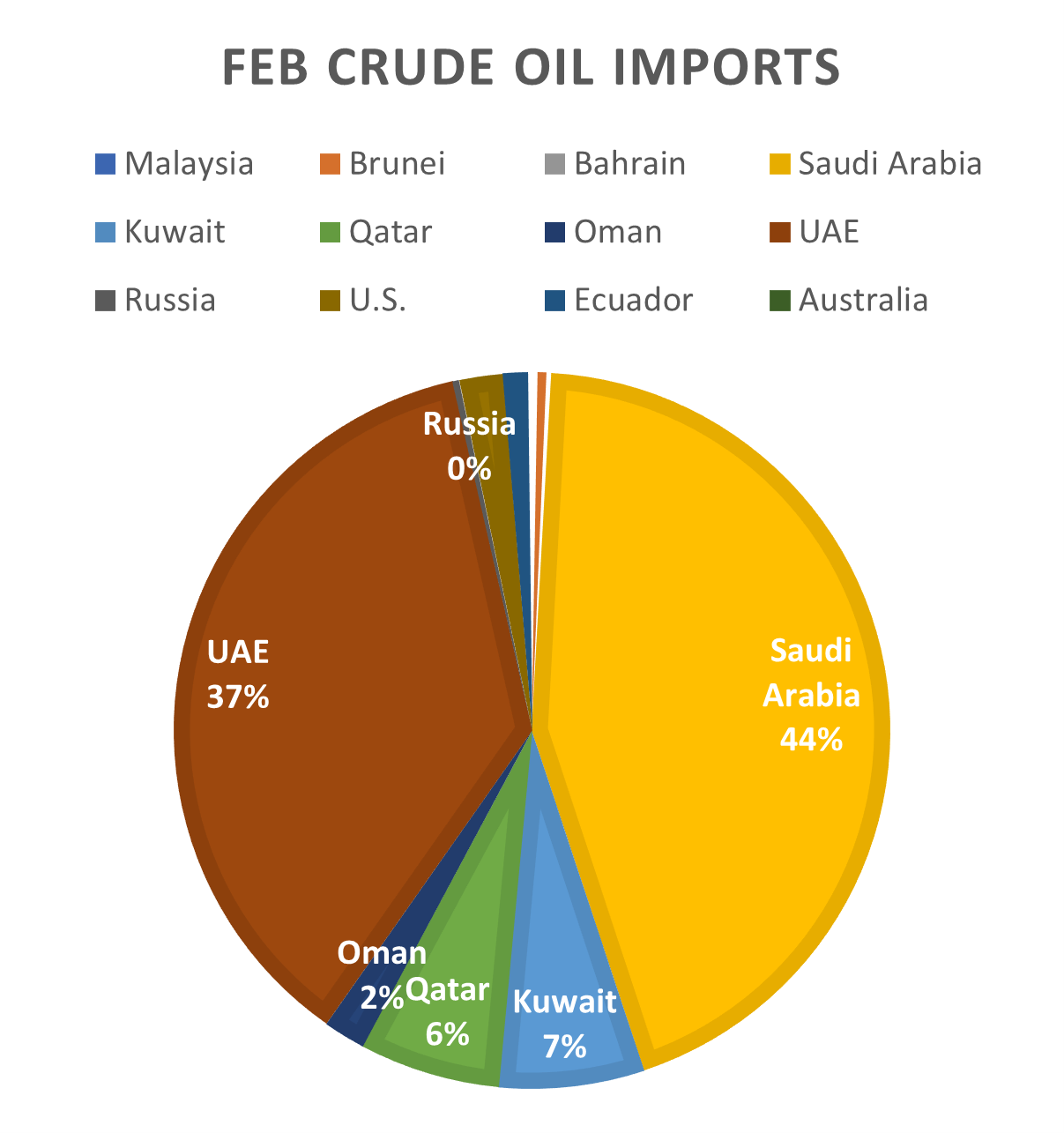
Total February oil imports were 12.5 million kl, down 3.5% YoY. The Middle East accounted for 96% of the imports.
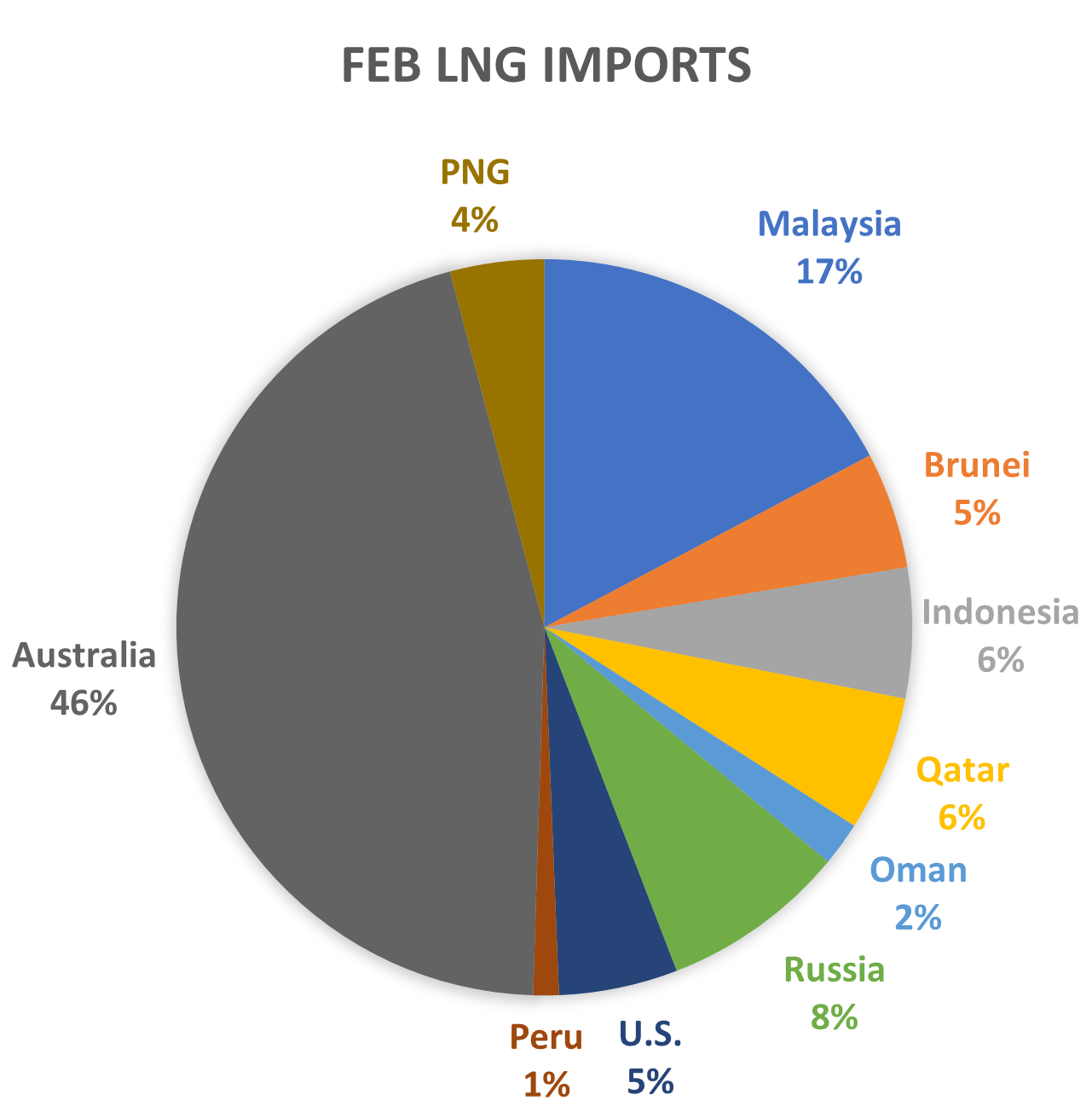
February LNG imports were 6.4 million tons, down 10% YoY. Imports from Russia were 0.5 million tons while those from the U.S. 0.3 million tons.
ANALYSIS
BY NING LIN AND ED O’TOOLE
Japan to Create Energy Security Through New Strategic LNG Reserve
Japan has announced plans to create a strategic LNG reserve to ensure the world’s largest importer has enough natural gas to meet domestic demand in an increasingly competitive market. The reserve could account for about 1% of Japan’s total LNG imports. However, it also suggests a growing conflict between Japanese energy security and climate policies.
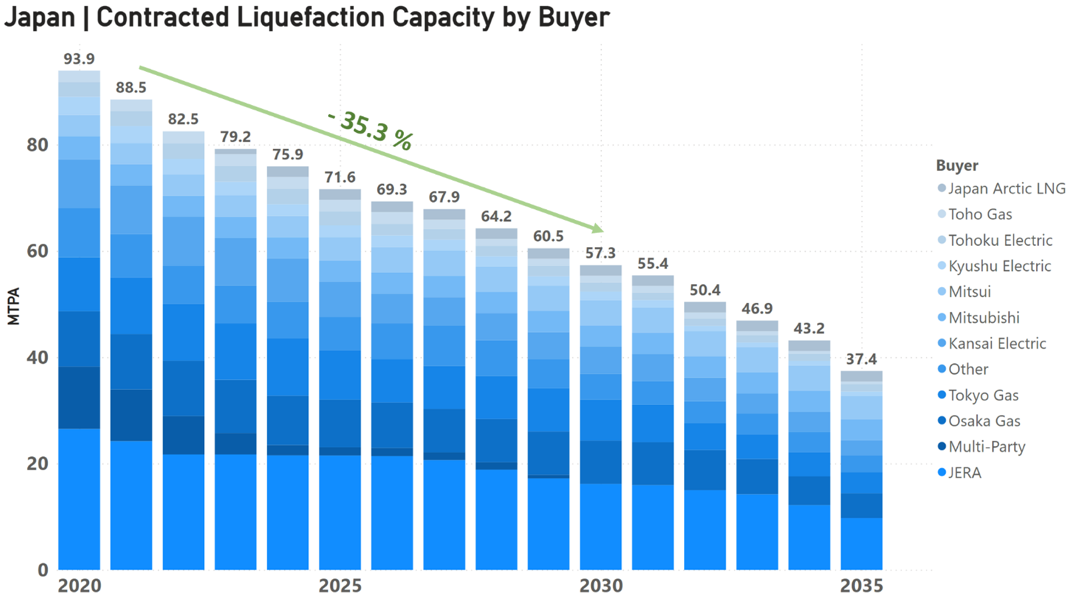
Traditionally, Japan has purchased the vast bulk of its LNG via long-term contracts, lasting several decades in some cases. Uncertainty about future domestic demand, partly driven by the national goal to shift the power mix away from fossil fuels, has created a strong reaction from Japanese LNG buyers. The volume that Japan has contracted under long-term deals is forecast to decline by over a third during this decade alone.
The shrinking of Japan’s long-term LNG portfolio comes at a time when other major markets are signing up to a host of such lengthy deals. China, which is set to displace its neighbor as the world’s top buyer, is projected to see its contracted volumes jump significantly over the next few years.
Should Japan’s proposed shift to a greater reliance on renewable energy proceed as planned, thus also meeting national emission reduction targets, the scale back on longer-term LNG deals will be justified. But a disruption to those plans, or to the LNG supply from existing contracts, could push Japan into the unfamiliar territory of depending on the more capricious spot market to balance the scales. The new strategic reserve attempts to straddle the divide. How much impact will it have?
Background METI has announced its intention to create a strategic LNG reserve in Japan to expand the nation’s options for coping with acute LNG shortage situations.
The ministry proposes that Japanese LNG importers continue to secure supply via longer term contracts. If the contracted volumes are not required domestically, the buyers would be free to sell their “buffer” cargoes into the international market. However, in times of a fuel shortage, the government would ask the importers to redirect their LNG to the utilities and other consumers most in need. Any losses incurred by the LNG sellers would be reimbursed through a fund within state-owned JOGMEC Corp., which is now also known as the Japan Organization for Metals and Energy Security.
The reserve’s mechanism is still being worked through, but the initial proposal states that Japan buy one cargo per month, between December and February. At an average LNG cargo of 70,000 to 80,000 tons, that could net the reserve close to 1 million tons per annum (mtpa). In 2022, Japan imported 72 million tons.
If METI’s plan moves forward and companies are selected, the system could begin in December 2023. Supporting a strategic LNG reserve could become more important for the country as up to 19.2 million tons of Japan’s contracts expire between 2021 to 2026, according to the latest release by the G2M2 database.
In the short term, this strategic buffer is expected to provide additional security of LNG supply for the peak demand in winter. Natural gas makes up about a third of the nation’s power mix.
Looking further out, however, the 2030 energy strategy calls for fossil fuels to lose half of their share of the electricity mix. As a result, METI estimates that the nation’s demand for natural gas will decline by a third at the end of the decade compared to 2021 levels.
Recent contract activity suggests that Japan’s LNG buyers expect METI policies to have an immediate and steady impact on demand, as they allow for a commensurate decrease in their contracted LNG supply.
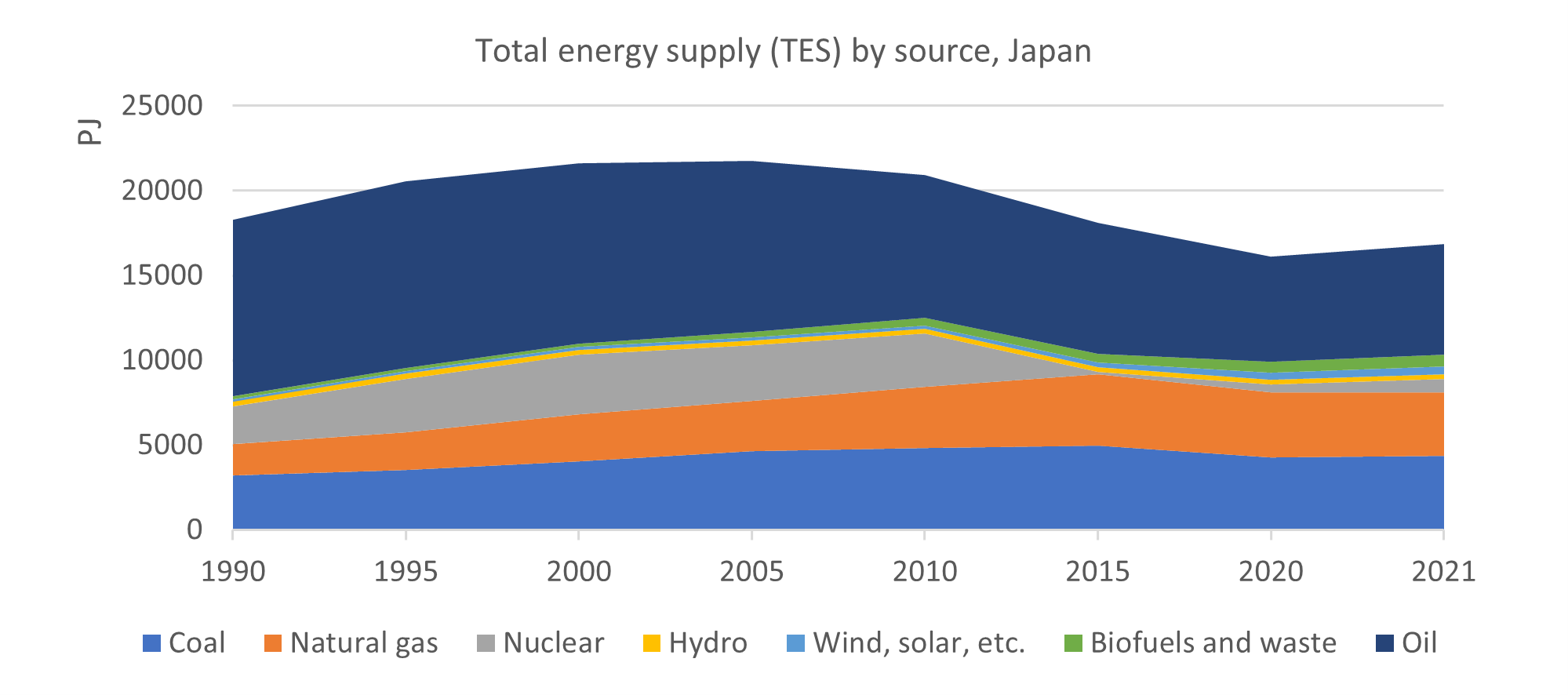
Figure 1: Energy generation by source for Japan. Source: IEA
Carbon neutrality impact Japan has enshrined its net-zero 2050 pledge into law. Although the country’s emissions have declined for a seventh consecutive year in 2020, Japan still ranks as the world’s No.5 emitter. Carbon dioxide (CO2) accounts for most of its greenhouse gas emissions, which stood at 1.15 billion tons, according to government data.
Natural gas is predominantly used for power generation and heat, as city gas. It is also a key part of many industrial processes. Together with oil and coal, fossil fuels account for well over 80% of Japan’s primary energy.
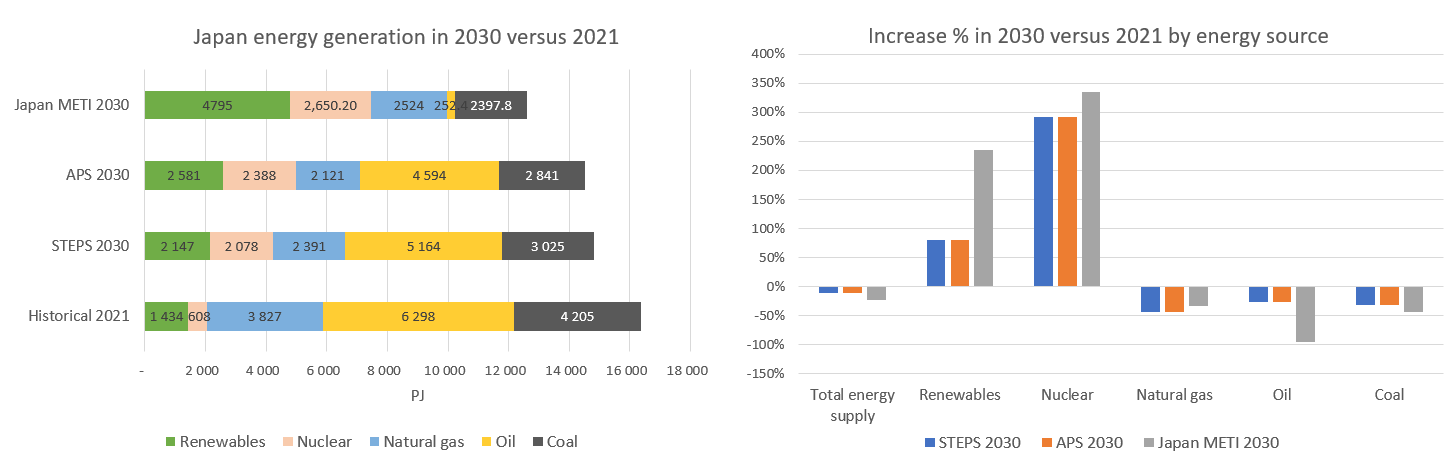
According to the International Energy Agency, that high dependence will ease before 2030. The IEA’s World Energy Outlook (2022) paints several scenarios, all of which see significant declines in Japan’s use of petroleum and coal, which will be replaced by nuclear and renewables. The IEA forecasts natural gas demand to drop by as much as 45% by 2030. METI’s estimate is more cautious at 34%, but still a notable decline.
Figure 2: Comparison of Japan’s projected energy generation in 2030 by IEA scenarios vs METI’s plan. Source: ANRE, METI and IEA
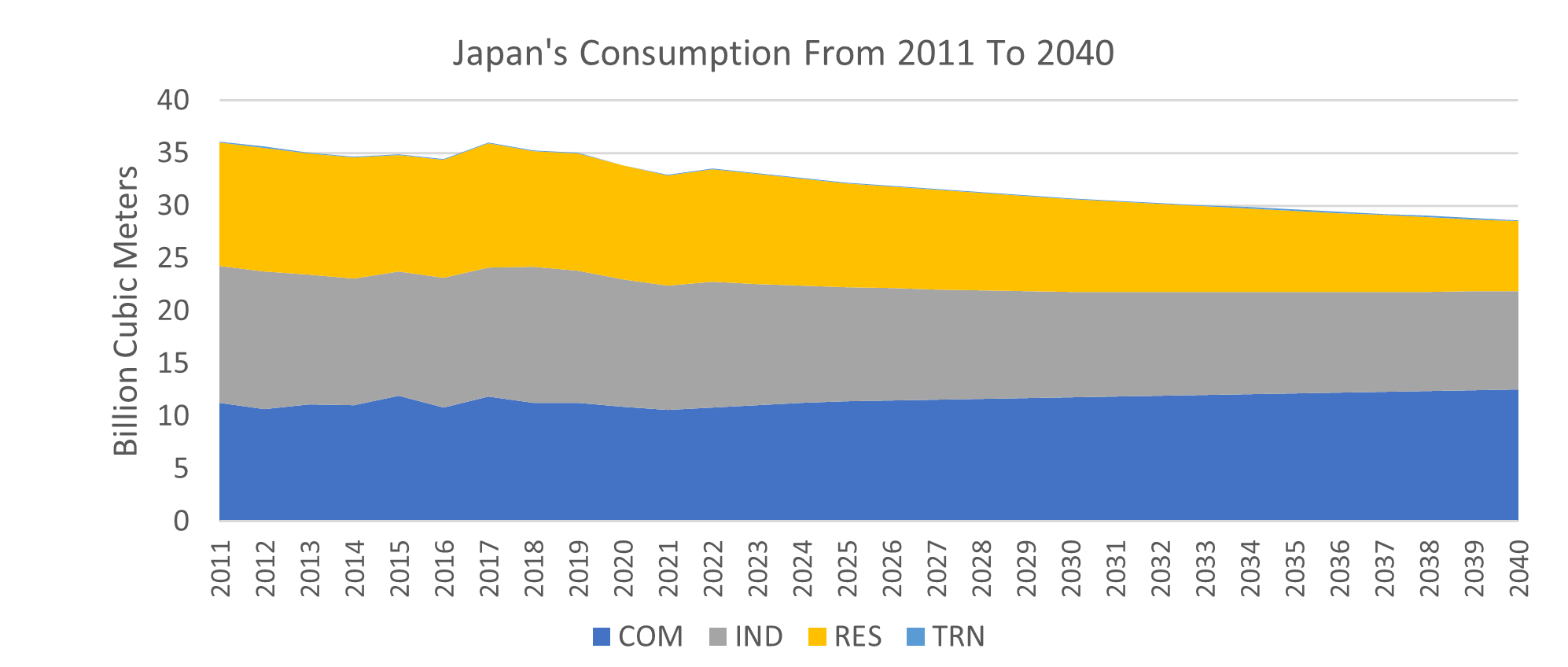
RBAC’s G2M2 Global Gas Market Simulator sees a more conservative gas demand decline rate of 3.9% (CAGR) from 2023 through 2030 as Japan uses less of it to produce electricity.
Figure 3: Japan’s gas consumption from 2011 to forecasted 2040. Source: RBAC G2M2®
It should be added, however, that gas is also used in many cogeneration systems in Japan, which simultaneously produce electricity and heat in the industrial, commercial, and residential sectors. This boosts efficiency and cuts emissions, and shows the strong role natural gas plays in energy security. In the past decade, sudden shortages of gas have led to spikes in electricity prices since Japan has a low self-sufficiency rate for primary energy.
As an island nation, Japan has no power grid connections to other countries and no international gas pipeline links.
Is Japan shedding long-term deals too quickly?
While the analyses indicate that Japan’s gas demand will decline, the behavior of the country’s buyers demonstrates that they agree.
The current portfolio of LNG contracts for all of Japan’s LNG importers (“buyers” in Figure 5 below) is declining at a more aggressive rate than METI’s goal for a 34% reduction in gas demand by 2030.
Figure 5: Contracted liquefaction capacity by buyers in Japan. Source: RBAC G2M2®, GIIGNL
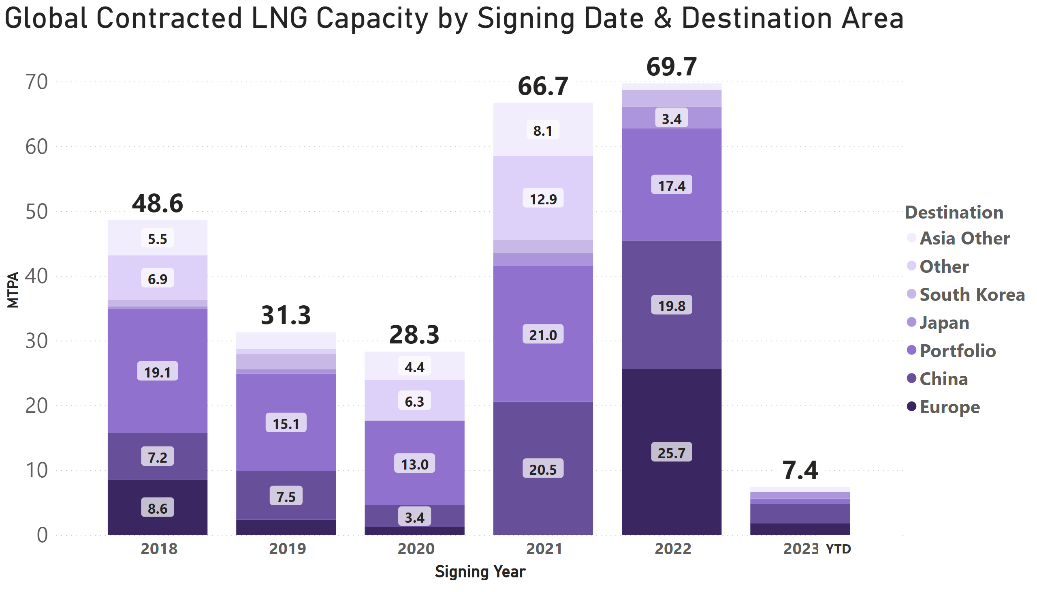
The decline in contracted LNG going to Japan comes as Europe’s long-term contracts have jumped from nothing in 2021 to over 25 mtpa in 2022. China’s contracted liquefaction capacity grew from 3.4 mtpa to 20.5 mtpa in 2021 and remained steady at 19.8 mpta in 2022.
Figure 6: Contract signing by year and destination. Source: RBAC G2M2®, GIIGNL
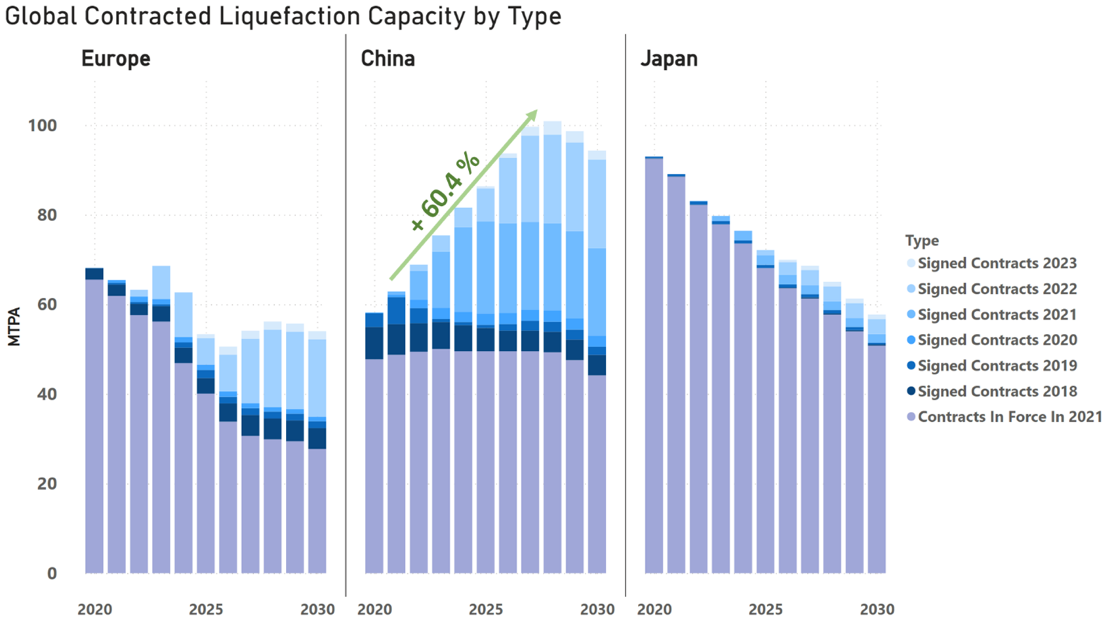
While European buyers are signing new contracts seemingly to offset declines from contracts in force that are expiring through 2030, China’s buyers are much more bullish. There has been a 60.4% increase in recently signed contracted capacity between 2021 and 2028, which reflects the Chinese government’s greater emphasis on natural gas in its current five-year plan.
Figure 7: Contracted LNG capacity by year, destination and signing date. Source: RBAC G2M2®, GIIGNL
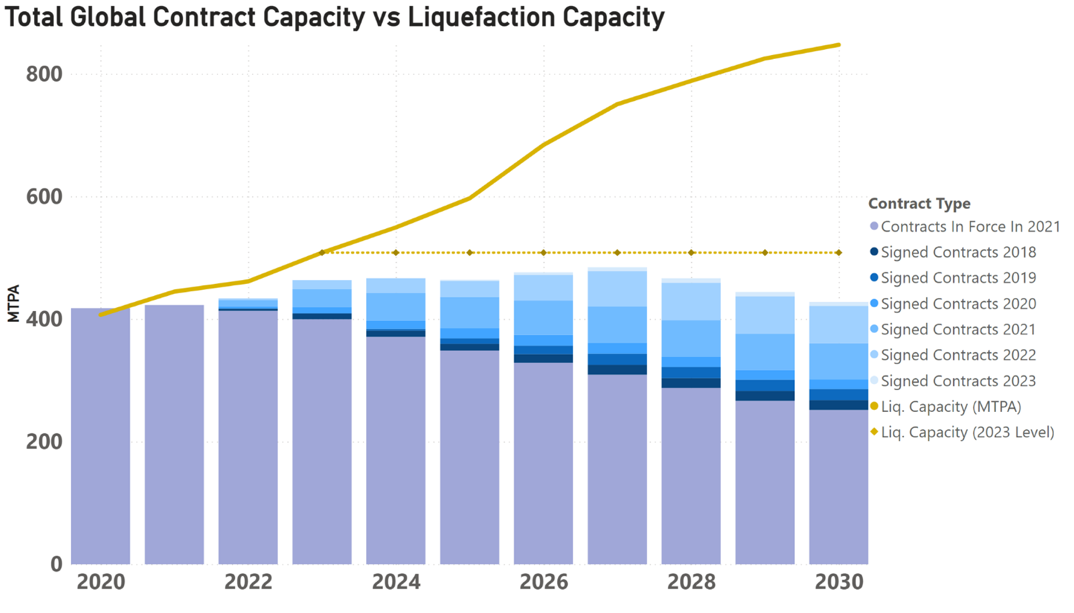
Japan’s reluctance to renew or sign new long-term deals in recent years comes just as the global LNG market enters a very tight supply-demand phase. Almost all new capacity available in 2023 is taken. After that, the majority of production capacity that’s available for contracting will come from proposed or under-construction export facilities. As shown in Figure 8, current levels of contracted capacity remain relatively steady through 2027.
Figure 8: Global LNG liquefaction capacity and contracted capacity. Source: RBAC G2M2®, GIIGNL
Conclusion
For Japan’s LNG buyers, the confluence of the trends above could pose a problem if demand reduction goals set by METI are not met and new LNG export facilities do not come online as planned. And yet, the mere creation of the LNG reserve plan shows how important the fuel is to the power and heating sector.
Managing a decline in demand over the mid to long-term is tricky. It seems that METI is acting to create a buffer to counter the pace of withdrawal of Japanese buyers from the LNG term market. Ironically, the withdrawal is guided by METI’s and the broader government’s own indications of shrinking gas demand by 2030, especially in the power mix.
Should the demand response not be strong enough, or other unforeseen events create an additional need for LNG supply, Japan may find itself suddently overexposed to the spot market at a time when contracted capacity may be limited. That’ll translate directly into energy security risks and high power prices in a nation that doesn’t like sudden surprises.
RBAC Inc. is a leading supplier of global and regional gas and LNG market simulation systems. The G2M2® Market Simulator is designed for developing scenarios for forecasting natural gas and LNG production, transportation, storage, and deliveries across the global gas markets. For more information visit http://www.rbac.com
ENERGY JOBS IN JAPAN
BY ANDREW STATTER
Japan Is Open for Tourists, But How About Overseas Talent?
At the start of 2020, just as Japan was getting a new wave of overseas investment into the energy sector via the upcoming auctions for offshore wind, Covid-19 hit the world and locked down borders for over two years. Dozens of companies that planned to expatriate experienced talent were not able to do so, whereas Japanese firms were able to bring their own people back from where they had been gaining experience in overseas markets.
This led to a high demand and low supply of experienced talent in key technical skill sets during the pandemic. Not limited to offshore wind, other solutions such as VPP technologies, battery storage and energy trading experts also confronted significant demand but were limited by lockdowns.
Now that the world is open again, can Japan leverage global talent pools? Should they do so? What limitations can companies and overseas experts expect in Japan?
Language barrier
Let’s start with the easy one. Japan is an island, and many aspects of business operate in highly domestic ecosystems. Subcontractors, utilities, and many engineering and survey firms will not have sufficient English-language capabilities to be well engaged by non-Japanese speakers. As far as local stakeholder management or negotiations, technical documentation and applications for permits? All in Japanese.
Does this close the door to non-Japanese speaking talent? Not 100%. In areas where the Japanese talent pool is in short supply, foreign expertise can be highly valued. Companies must however, consider hiring and developing local resources to complement overseas talent.
Expat / local balance
Can you have a team of all expats? In the early to mid 2010s we did see a number of PV solar firms with very little Japanese talent. Developers, in large part from Europe, came in with expertise that included EPC firms, as well as producers of modules, racks and power conditioners (inverters).
For a brief moment in time, knowledge of Japanese was only needed for a few key elements such as forestry permits, grid connections etc. The ‘Spanish Solar Mafia’ came and experienced success – however, this could not last forever. It was only a matter of time for the Japanese to learn the solar business, build local expertise, leverage bigger partnerships, lower cost of capital, and ultimately drive out much of the early foreign solar players. Those who stayed have two things in common: Firstly, they learned to speak Japanese, and secondly, they diversified their teams to have a healthier expat / local balance.
If we look now at the offshore wind market, there are a number of foreign players who have teams comprised primarily of expats and are relying on their Japanese consortium partners for the local content, but this is the minority.
Most global players have a 10~20% contingent of expats and are building up the bulk of the team with local talent. Expats bring real experience in various engineering disciplines, project management, or in leading competitive tender bids.
Companies with longer term vision and plans for Japan are leveraging this expat knowledge to hire, train and build out strong local capability for two reasons: Firstly, they recognize the need for Japanese technical expertise and understanding of local regulations, as well as language abilities to effectively work within this ecosystem. Secondly, the market is growing at such a rapid rate globally that many firms do not have enough talent to send to Japan; distributing skills among all key markets is a topic to be tackled strategically and with care.
Are firms hiring overseas talent? There are cases of energy companies hiring overseas talent with in-demand technical skill sets from overseas. A number of these firms have invested in translation/ interpretation resources in-house to leverage this talent. Typically, the profile of these companies have been Japanese firms playing in new markets (offshore wind, trading, energy storage) that don’t have an expat pool to pull from and therefore have turned to headhunting talent from global markets.
Another case where this is evident is the battery technology manufacturers. Japan used to be the center of the world for battery technology, however there has been a heavy talent leak to China and the U.S., with the impact compounded by Japan’s aging population. This has led to opportunities for global talent in the research, development and production areas as can be seen in firms such as Murata and AESC.
Technical limitations
Japan has various specific regulations and technical challenges, which are very difficult, if not impossible to circumvent without knowledge of Japanese. Ask any wind turbine manufacturer, ship operator or developer about Nippon Kaiji Kyokai (ClassNK) and hear their challenges. Foreign electrical engineers can transfer a lot of skills to Japan, until faced with the challenges of different technical requirements and regulations for grid connection depending on the local utility and region.
Long-term expats
As we discussed above, there is real value for global firms to expatriate experts in talent-starved areas. For the expat however, these assignments have an end date, and some people wish to remain in Japan beyond that expiration date.
This is possible, as demonstrated by the hundreds of global citizens in the solar community here, and a growing number in wind. To do so successfully, in almost all cases you should learn Japanese to the business level!
In addition, understand your value. As an expat, your value is to bring expertise to develop local capability, and to act as a communication bridge back to HQ. Once you step out of that organization, you must add the same value. This means your next employer should be a global firm that has struggled to understand the intricacies of the Japan market, which you are quite knowledgeable of. You can act as a bridge and help that new employer to build out or improve local capabilities.
Especially if we look at the executive and functional leadership level we can see many examples of long-term, non-Japanese success cases.
Glass ceilings
Due to the technical and language limitations listed above, there are some glass ceilings that can be hard (but not impossible) to break through. A frequent example that best illustrates this is Site Engineers desiring to take on HQ Engineering roles. Often, managing the construction site for a plant is a role well done by non-Japanese, especially when leveraging major or global EPCs, contractors, vendors etc. Though many of these professionals have strong engineering skills, they struggle to make the move to Tokyo HQ and work on plant design, grid connections etc., as the technical and language barriers are high.
Summary
There is certainly a place for global talent in the Japan market. The key is in the supply and demand of the particular skill set and market niche that we are considering. Secondarily, the Japanese are masters in mastering skills; just look at their whiskey! This means that the window of opportunity in a particular niche is always temporary. Once enough local capability is established, the need, and therefore the value of the foreign talent will diminish, with the exception foreign talent who invest in themselves to integrate better into Japanese society.
GLOBAL VIEW
BY JOHN VAROLI
Below are some of last week’s most important international energy developments monitored by the Japan NRG team because of their potential to impact energy supply and demand, as well as prices. We see the following as relevant to Japanese and international energy investors.
Canada/ Clean energy tech
PM Trudeau announced C$80 billion in tax credits for clean technology over the next decade, including C$25 billion to develop clean electricity. Canada needs about C$100 billion a year in clean tech investment to meet its net-zero emissions goal by 2050.
Czechia/ Nuclear power
Starting in 2024, Westinghouse will supply nuclear fuel to the Dukovany NPP of power utility CEZ 2024, replacing Russia’s TVEL, which had been the only source of fuel for Dukovany’s VVER reactors.
Indonesia/ Battery metals
Ford Motor Co plans to invest in a $4.5 billion battery materials plant together with China’s Huayou Cobalt and Brazilian miner Vale. The plant will be located in Southeast Sulawesi, where Vale operates a nickel mine. Indonesia has the world’s biggest nickel reserves.
Iraq/ Oil
Producers shut or reduced output at several oilfields. This impacts 450,000 bpd through a pipeline that runs to the Turkish port of Ceyhan. Turkey stopped pumping Iraqi crude after Baghdad won an arbitration case in which it said Ankara violated an agreement by allowing the Kurdistan government to export oil without Baghdad’s consent.
EU/ Hydrogen power
Tense talks continue over how to classify hydrogen produced using nuclear power. It’s part of a wider dispute over whether EU hydrogen policies should encourage nuclear energy with subsidies and incentives, or give primacy to renewables technologies like wind and solar.
Norway/ Offshore wind power
Tenders opened for two areas in the North Sea to build wind parks with 3 GW capacity; this is a first step towards a goal of producing 30 GW by 2040. Soerlige Nordsjoe II is suitable for bottom-fixed wind turbines. It will be developed in two phases.
Philippines/ Biofuels
The Bases Conversion and Development Authority supports plans for a $250 million waste-to-energy project in New Clark City in Tarlac. The project is jointly with Plambeck Emirates, a JV between Plambeck Holdings (Germany) and the Royal Family of Abu Dhabi.
UK/ SAF
The government recommended subsidies for production of low-carbon jet fuel made from household waste. Producing SAF is about three times the price of normal jet fuel. The UK announced £165 million in grants and will require at least 10% of jet fuel in the UK — an estimated 1.5 billion liters — to be made from “sustainable sources” by 2030.
U.S./ Blue ammonia
Norway’s fertiliser maker Yara and Canada’s pipeline company Enbridge will invest $2.9 billion to build a blue ammonia production plant in Texas. It will be built at an Enbridge oil storage and export facility near Corpus Christi; production starts in 2027.
Zimbabwe/ Floating solar power
China Energy Engineering Corp proposed a 1 GW floating solar plant on Kariba dam. The country generates less than half of its 1.7 GW power demand; this is due to the poor performance of its ageing coal-fired plants and low water levels that impact its 1 GW hydropower plant at Kariba.
2023 EVENTS CALENDAR
A selection of domestic and international events we believe will have an impact on Japanese energy
ASEAN-Japan summit to mark 50 years of cooperation
Last market trading day (December 30)
Disclaimer
This communication has been prepared for information purposes only, is confidential and may be legally privileged. This is a subscription-only service and is directed at those who have expressly asked K.K. Yuri Group or one of its representatives to be added to the mailing list. This document may not be onwardly circulated or reproduced without prior written consent from Yuri Group, which retains all copyright to the content of this report.
Yuri Group is not registered as an investment advisor in any jurisdiction. Our research and all the content express our opinions, which are generally based on available public information, field studies and own analysis. Content is limited to general comment upon general political, economic and market issues, asset classes and types of investments. The report and all of its content does not constitute a recommendation or solicitation to buy, sell, subscribe for or underwrite any product or physical commodity, or a financial instrument.
The information contained in this report is obtained from sources believed to be reliable and in good faith. No representation or warranty is made that it is accurate or complete. Opinions and views expressed are subject to change without notice, as are prices and availability, which are indicative only. There is no obligation to notify recipients of any changes to this data or to do so in the future. No responsibility is accepted for the use of or reliance on the information provided. In no circumstances will Yuri Group be liable for any indirect or direct loss, or consequential loss or damages arising from the use of, any inability to use, or any inaccuracy in the information.
K.K. Yuri Group: Oonoya Building 8F, Yotsuya 1-18, Shinjuku-ku, Tokyo, Japan, 160-0004.
NEWS
・Antitrust authorities slap ¥101 bn in penalties on major utilities; top executives of Chugoku Electric resign
・GX Promotion Bill passed by the House; state GX bond program confirmed at ¥20 trillion over 10 years
・Petrofac, Hitachi Energy in $14 billion deal with TenneT to supply offshore platforms and onshore converter stations