G7 meeting in Sapporo: vows to phase out unabated fossil fuels; sets major targets for solar and wind; renews support for nuclear
G7 meeting in Sapporo: members commit to new mining and recycling action plans with joint spending on the table
JERA forms LNG buyers’ alliance with Korea Gas to ensure supply stability; interested in adding more members
ENERGY TRANSITION & POLICY
G7 ministers to agree on method to calculate steel emissions
IEA moves to define clean hydrogen based on emissions intensity
Hokkaido’s renewables key to Japan reaching net zero: REI forum
NRA finds errors in application to start nuclear processing plant
Exxon, Toyota partner in low-carbon fuels for gasoline cars
Chubu Electric mulls building turquoise hydrogen plant locally
Osaka Gas, IHI, Petronas plan e-methane, CCS feasibility studies
Consortium delivers Japan’s first negative-carbon concrete
Top sushi restaurant chain to supply used cooking oil for SAF
ELECTRICITY MARKETS
EPCOs to use “decarbonized” auction to revamp LNG generation
Power utility body to set up third-party probe over cartel charges
NRA orders Japan Atomic to resubmit reactor restart application
Chubu grid ordered its first curtailment of renewables output
Octopus Energy invests in Yotsuya Capital to develop solar farms
Renova secures financing for wind power project in Kyushu area
Mitsubishi begins building SE Asia’s largest onshore wind farm
Toshiba introduces VPPA for 100% renewable energy operation
OIL, GAS & MINING
Sumitomo Metal Mining to start lithium ouput overseas in 2028
U.S. LNG developer Tellurian looks for Japanese investors
Kobe Steel, Mitsui mull building a low-CO2 iron factory in Oman
ENEOS completely withdraws from Myanmar
ANALYSIS
JAPAN LOOKS TO A NEW TECHNOLOGY TO KICKSTART ITS SOLAR COMEBACK
Almost 15 years ago, just as the sun began to set on Japan’s solar panel industry, a ray of light appeared that gave hope to dispel the pessimism. In 2009, Prof. Tsutomu Miyasaka of Toin University of Yokohama made the world’s first demonstration of a new solar tech known as PSC (perovskite solar cells). The path of PSC technology since then has been challenging. But if Japan were to achieve commercially viable PSC-based renewable power generation, it could be a game changer not only for the country but the energy transition as a whole.
JAPAN PREPARES TO BET BIG ON DEEP-WATER OFFSHORE WIND GENERATION IN THE EEZ
Promoting floating wind power technology is a key part of the maritime strategy mapped out in the draft of the Fourth Basic Plan on Ocean Policy, soon to be approved by Prime Minister Kishida’s cabinet. The Basic Plan is updated every five years and the current draft was open to public comment until early April. It consists of policy measures and strategies to cover a range of issues from national security threats to natural disasters, as well as energy-related issues. One of the plan’s focus points is the utilization of Japan’s exclusive economic zone (EEZ).
New Energy and Industrial Technology Development Organization
kWh
Kilowatt hours (electricity generation volume)
TEPCO
Tokyo Electric Power Company
FIT
Feed-in Tariff
KEPCO
Kansai Electric Power Company
FIP
Feed-in Premium
EPCO
Electric Power Company
SAF
Sustainable Aviation Fuel
JCC
Japan Crude Cocktail
NPP
Nuclear power plant
JKM
Japan Korea Market, the Platt’s LNG benchmark
JOGMEC
Japan Organization for Metals and Energy Security
CCUS
Carbon Capture, Utilization and Storage
OCCTO
Organization for Cross-regional Coordination of Transmission Operators
NRA
Nuclear Regulation Authority
GX
Green Transformation
NEWS: ENERGY TRANSITION & POLICY
G7 Climate and Energy Ministers Meeting in Sapporo: Key Points
(Nikkei, Reuters, Japan NRG, April 16)
The G7’s climate and energy ministers met in Sapporo on April 15 and 16.
They agreed to accelerate the phase out of all unabated fossil fuels, including coal and natural gas (i.e., facilities that do not have a way to capture their emissions in some form, such as using CCS). Gas was added to this list for the first time, which signals its phase out will also now start.
The G7 will not seek to stop investment in natural gas production when it is done “in a manner consistent with our climate objectives and without creating lock-in effects.” The group accepted that emerging nations may wish to utilize to gas for power generation. However, the G7 stressed the need to cut overall gas consumption, as well as to cut energy use in general.
There was no agreement on a final date by which to phase out coal-fired power generation. Canada and the UK had hopes to persuade the group to set a target of 2030 for this action.
The G7 renewed its commitment to support more renewable energy use, especially in power generation. The seven nations collectively set the goals of adding 150 GW of offshore wind capacity and 1 TW of solar capacity by 2030.
Nuclear energy retained its support.
The G7 statement included a target of a 60% reduction in GHG emissions by 2035, compared to 2019 levels.
METI Minister Nishimura said there is interest to finding ways to use finance to cut CO2 in “hard-to-abate” sectors like chemicals, shipping and steel.
The UAE called for a fairer deal for the developing economies, especially via climate finance.
The G7 agreed to work on an action plan to secure a stable supply of critical raw materials (CRM) for clean tech through investment in mining and recycling.
SIDE DEVELOPMENT: G7 ministers to agree on method to calculate steel sector’s GHG emissions (Nikkei, April 14)
G7 countries were expected to agree at the Climate, Energy and Environment Ministers’ meeting on a global method to collect data on the steel industry’s GHG emissions.
There are five methods for calculating emissions of the steel sector. Differences emerge, for example, to which extent raw materials are included in the calculation methods.
The Japan Iron and Steel Federation uses a calculation method equivalent to ISO 14404, which permits easy comparison with other developed countries.
CONTEXT: According to the MoE, the steel industry is Japan’s largest CO2 emitting sector, accounting for about 40% of the CO2 emitted in Japan in FY2020.
SIDE DEVELOPMENT: UK, Canada ministers say won’t back Japan on ammonia co-firing (Asia Nikkei, April 14)
Canada’s Minister of the Environment and Climate Change Steven Guilbeault, and the U.K.’s Secretary of State for Energy Security and Net Zero Grant Shapps, both said they do not support Japan’s idea of moving coal power plants to also burn ammonia in a so-called co-firing strategy.
Ammonia does not emit CO2 when burned. However, both ministers said this approach will allow the use of coal power plants to continue.
SIDE DEVELOPMENT: Over 300 Japanese organizations and companies send G7 message on renewables (Coalition statement, April 12)
The Japan Climate Initiative (JCI), a coalition of 303 Japanese organizations, called on the government to accelerate renewable energy and introduce a carbon pricing system.
JCI wants regulatory reforms for Japan to achieve a fully or predominantly decarbonized electricity supply by 2035, in line with G7 goals.
JCI’s message was released ahead of the G7 Ministers’ Meeting on Climate, Energy and Environment, held in Sapporo this weekend.
G7 members discuss joint action plans to stabilize critical minerals supplies
(NHK, Japan NRG, April 15)
The G7 members were expected to agree on joint action plans to address the need to stabilize critical minerals procurement that has seen intense competition with China and other countries.
G7 will jointly spend ¥1 trillion to develop new mines and materials recycling.
CONTEXT: Critical minerals commonly include lithium, nickel and cobalt, which are used in EV batteries, for hydrogen storage alloys and synthetic fuel production equipment. Investment in mining has stagnated over recent years despite greater demand for raw materials, including for the energy transition.
TAKEAWAY: It’s too early to say how this commitment will translate into boosting the primary source of new raw materials (mines), since the sector’s problems go far beyond a shortage of finance. However, the G7 agreement to cooperate on recycling could prove to be significant since it seems to address some of the uncertainties around the movement of the secondary source of raw materials (old equipment).
As an example, the G7 commitment should help to resolve the years-long debate on whether to classify black mass – a material containing lithium, cobalt and nickel, and recovered from spent lithium-ion batteries — as hazardous waste or scrap metal.
The present scrap classifications system is broad and includes any material with impurities which cannot be used for batteries. This is not an effective tool to understand international battery material supply flow. So, if the G7 agreement adds clarity to classifications, it should help companies build more efficient battery supply chains.
Industry stakeholders say a new system of trade codes specifically for recycled battery materials is required.
What’s less clear is how this G7 policy trend will impact China, whose rare earths and silicon supplies underpin the global markets for clean tech.
If the Chinese metals sector becomes more vulnerable to demand uncertainties due to geopolitical de-coupling trends, it will cause broader concerns in Beijing. China has also traditionally suffered from the smuggling of mineral resources out of the country.
IEA moves to define clean hydrogen based on emissions intensity not colors
(Nikkei, April 11)
The IEA has a new report to help define “clean” hydrogen based on emissions intensity. When the criteria are met, hydrogen generated from fossil-fuels with CCUS (carbon capture, utilization and storage) can also be referred to as “clean.”
By setting regulations and certification, plans of different hydrogen production routes enable the industry to move away from the use of terminologies based on colors and will help develop international hydrogen supply chains.
METI plans to revise its hydrogen strategy in May. In the short-term, METI will support “blue hydrogen” generated from natural gas with a carbon capture process.
SIDE DEVELOPMENT: Japan Gas Association welcomes IEA’s hydrogen carbon intensity standard proposal (Japan NRG, April 14)
The Japan Gas Association (JGA) welcomes the International Energy Agency (IEA) proposal to create hydrogen standards based on emission intensity, rather than gas production routes, often denominated by colors, a JGA official told Japan NRG.
The creation of global hydrogen standards should support Japanese gas utilities, which aim to commercialize new energy sources such as synthetic methane (e-methane) that require clean hydrogen.
CONTEXT: Senior JGA officials met with the environment minister and senior METI officials ahead of the G7 summits in Sapporo this past weekend to push Japan’s role in global rulemaking for synthetic fuel consisting of hydrogen and recycled carbon.
TAKEAWAY: Hydrogen is a clear, transparent gas, but how it is produced differs. The various energy sources used to make hydrogen have been assigned a color. Brown or grey hydrogen represents traditional hydrogen from fossil-fuels that emits a lot of CO2 during manufacture. Green hydrogen is generated through electrolysis using renewable energy. But the definitions of other colors such as blue, yellow, turquoise, pink, etc have no internationally agreed criteria.
Hokkaido’s renewable resources key to net zero: Renewable Energy Institute forum
(Japan NRG, April 13)
Hokkaido has huge renewable potential and is key to Japan’s carbon neutrality goals by 2035. Japan has 656 GW wind power potential, and 320 GW are in the Hokkaido area.
To enable other parts of the country to benefit from this clean energy potential, the govt must encourage construction of new power lines to connect with Japan’s main island of Honshu and accelerate decisions on where to set the line routes.
People in Hokkaido also need to see that renewable projects are improving their lives.
Green energy will attract investments from other industries. Ishikari City has three renewable-powered data centers and Rapidus plans a chip plant in Chitose City that may be powered with green electricity.
CONTEXT: Hokkaido local govt heads and renewable energy experts discussed the region’s potentials at a forum organized by REI, ahead of the April 15-16 Sapporo G7 climate summit.
TAKEAWAY: Staging the G7 meeting in Hokkaido was clearly one way for Japan to signal the clean energy ambitions of that region. A Japan NRG survey found in the two months running up to the Sapporo meeting, at least six local municipalities announced plans to be carbon neutral by 2050.
SIDE DEVELOPMENT City in Hokkaido aims to become major wind power hub (Japan Times, April 9)
Ishikari is attracting renewable energy firms, and METI estimates its potential for renewable-generated electricity at 3.6 GW; currently 300 MW is installed.
Around 10 energy firms are operating or have plans to build onshore or offshore wind turbines in the area.
Obstacles to realizing Hokkaido’s renewable energy potential include environmental concerns, technological and economic considerations, and political acceptance.
Some unique renewable projects in Hokkaido
Bibai City
White Data Center, using snow to cool servers
Niki Town
Vertical solar panel systems (demo phase)
Tobetsu Town
Geothermal road heating system
Shakotan Town, Erimo Town, etc.
Blue carbon from growing edible seaweed
Shintoku Town
Biogas to fuel greenhouses growing tropical fruits
Source: Japan NRG
The NRA finds errors in Japan Nuclear Fuel application for earthquake equipment
(TBS, April 14)
Errors were found in a 3,100-page application submitted by Japan Nuclear Fuel Limited (JNFL) to the Nuclear Regulation Authority (NRA) in December 2022 for the operation of a spent fuel reprocessing plant in Rokkasho, Aomori Pref. The NRA has requested that JNFL resubmit the application.
JNFL had already been alerted to numerous errors in the application by the NRA in January 2023. Upon further investigation, JNFL discovered that about 5% of the 60,000-page application contained errors such as missing pages, typos or omissions.
JNFL president apologized and said he wasn’t aware that the application had been rushed.
CONTEXT: JNFL operates the Vitrified Waste Storage Center, Uranium Enrichment Plant, and Low-Level Radioactive Waste Disposal Center; and is building a spent fuel reprocessing plant and MOX fuel production facility at Rokkasho.
TAKEAWAY: JNFL keeps pushing back the start of the reprocessing plant, which is one of the most important facilities for Japan’s nuclear industry. The original schedule was to complete construction in 1997. The latest deadline is for the first half of FY2024.
Exxon and Toyota partner to develop low-carbon fuels for gasoline cars
(Bloomberg, April 12)
Exxon Mobil and Toyota Motor will partner on testing low-carbon fuels to be used in gasoline engines. These fuels are made from cleaner feedstock and the companies claim they cut GHG emissions by 75% compared with regular gasoline cards.
CONTEXT: The fuels are made with renewable biomass and ethanol produced by green energy.
These are early phase tests and the fuels need govt support to reach commercialization.
TAKEAWAY: Toyota conducts R&D for a variety of vehicle fuels and technologies. While the company will roll out more EVs going forward, it also warns that EVs alone won’t be the sole solution for transport because of the lengthy time needed to green the global car fleet.
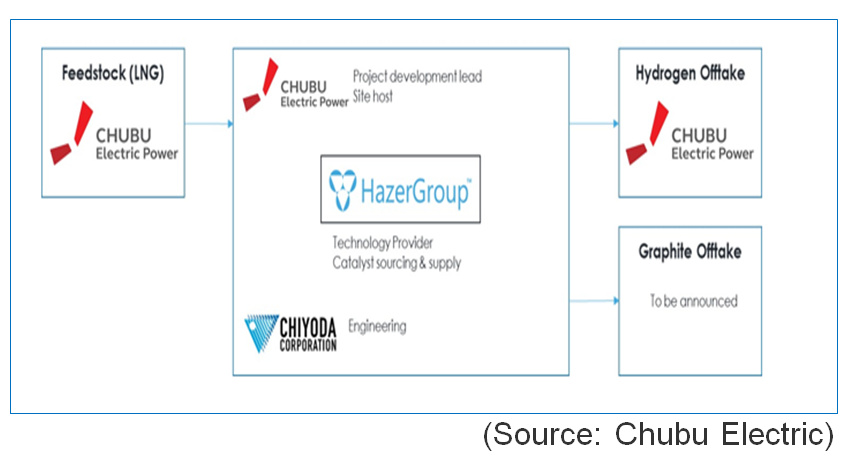
Chubu Electric, Chiyoda and Hazer to study building hydrogen production facility
(Company statement, April 12)
Chubu Electric, Chiyoda and Australian hydrogen tech company Hazer will study the building of a hydrogen production facility, based on Hazer’s proprietary tech. The three partners aim to use a high efficiency process to produce hydrogen and graphite from methane. This is known as “turquoise” hydrogen.
If the project goes forward, the production facility will be in the Chubu region. Annual production capacity might start at as much as 10,000 tons of hydrogen, and expand to 50,000 to 100,000 tons. Chubu Electric would use the hydrogen as fuel at power plants, as well as for industry and mobility.
A final decision is expected by late 2024.
Idemitsu, H-Cycle to do a study on producing hydrogen from solid waste
(Company statement, April 13)
Idemitsu Kosan and U.S.-based H-Cycle will do a study on production of low-emission hydrogen using solid waste, eyeing a launch of 200-300 tons/day in 2030-2035.
H-Cycle has proprietary plasma gasification technologies to process solid wastes into hydrogen without using external power or fuel sources. CCS facilities will be set up to store high-intensity CO2 released from the gasification plant.
TAKEAWAY: The re-use of solid wastes as feedstock to produce power and hydrogen is spreading. In the Hokuriku region, portable hydrogen manufacturing equipment has been installed in public spaces. Residents can deposit aluminum cans that are converted into hydrogen for fuel cell vehicles. Local technology startup Alhytec made the equipment. (See also Analysis “Toyota-backed firm hopes to utilize aluminum to produce hydrogen-based energy” in the June 14, 2021 issue of Japan NRG)
Top sushi restaurant chain to supply used cooking oil for SAF
(Company statement, April 5)
Food & Life Companies, JGC, REVO International and Saffaire Sky Energy agreed to use restaurant cooking oil to produce sustainable aviation fuels (SAF).
F&LC has 680 restaurants in Japan. Total annual cooking oil use is about 900,000 liters. This is the first case in the food industry that a major Japanese restaurant chain agreed to supply used cooking oil for production of SAF.
Saffaire Sky Energy is owned by JGC (48%), Cosmo Oil (48%), and REVO (4%); SAF production is slated to start in late 2024 to supply 30 million tons annually. REVO collects used cooking oil and delivers it for processing. JGC configures the supply chain.
This project is financed with subsidies from NEDO.
Mitsubishi, Shikoku Electric to develop Namikata terminal as a hub for ammonia fuel
(Company statement, April 14)
Mitsubishi, Shikoku Electric, Taiyo Oil, Taiyo Nippon Sanso, Mazda Motor, Namikata Terminal and Mitsubishi Corp Clean Energy agreed to establish the “Council for utilizing Namikata Terminal as a hub for introducing fuel ammonia.”
The council will study how to turn the Namikata Terminal (Imabari City, Ehime Pref) into a clean energy hub.
Existing LPG tanks will be converted to ammonia tanks. By 2030, the hub will handle about 1 million tons of ammonia annually.
CONTEXT: Namikata Terminal handles about 1 million tons of LPG and petroleum products from across Japan and overseas annually. It is equipped with tanks that can be converted to ammonia, such as large-scale low-temperature LPG tanks (45,000 tons/unit). It also has docking berths for vessels to respond to demand for ammonia.
Mitsubishi Ube Cement tests world’s first ammonia co-firing kiln
(Company statement, April 5)
Mitsubishi Ube Cement is testing an ammonia co-firing kiln at its Ube factory in Yamaguchi Pref.; it’s the world’s first trial of cement production using this technology.
The company is testing various materials to produce clinker, an interim material of cement, such as used plastics mixed with coal to reduce CO2 emission.
Ube has been developing ammonia co-firing cement kiln technology since 2014 with help from the government’s Strategic Innovation Program (SIP).
The company will continue testing, to increase the ratio of ammonia to 30%.
TAKEAWAY: Cement production emits a lot of CO2, and substituting fossil fuels with ammonia for at 10% of the total mix helps to reduce emissions.
Toshiba ESS develops new CO2 absorbent
(Company statement, April 10)
Toshiba Energy Systems (ESS) joined with City of Saga to develop a high-performance CO2 absorbent to be used for CO2 capture.
The experiment will be conducted at a local incineration plant.
The plant was built to accelerate the use of biomass energy for the incineration plant. In 2016 the plant started using the equipment to capture about 10 tons/day of CO2.
The plant asked ESS to develop a CO2 absorbent to improve efficiency of the separation/recovery unit in order to cut costs.
JR West starts using fuel cell trains
(Kankyo Business, April 13)
Japan Railway Nishi Nippon (JR West) will use fuel cell trains that run on hydrogen. The trains will be refueled directly through hydrogen recharge stations installed along with the railway network.
The hydrogen refueling stations are connected to hydrogen storage tanks at rail yards with pipelines. Refueling stations supply hydrogen not only for trains but also to fuel trucks, buses, forklifts, and other assets that JR West owns.
TAKEAWAY: This is a first step towards increasing hydrogen consumption in Japan. Once JR West is successful, similar operations will be expected at other JR companies around Japan.
Itochu invests in shipping investment company focused on decarbonization infrastructure
(Company statement, April 12)
Itochu invested in Purus Marine, a London-based shipping investment company that specializes in decarbonized shipping and marine infrastructure-related assets.
Purus Marine is a leading owner and operator of environmentally friendly vessels and low-carbon maritime infrastructure assets including offshore wind power support vessels and port infrastructure.
Itochu has already acquired high performance assets, such as 60 vessels (ammonia ships, LNG ships, CO2 capture equipment ships and other) and terminals.
Osaka Gas, IHI and Petronas plan e-methane and CCS feasibility studies
(Company statement, April 10)
Osaka Gas, IHI and Petronas Global Technical Solutions will conduct a study in Malaysia to produce e-methane from biomass-derived syngas and green hydrogen. Syngas consists of CO2, hydrogen, CO, and methane.
They will also develop carbon capture and storage of biogenic CO2, a byproduct of e-methane, to achieve negative emissions.
Consortium delivers Japan’s first negative-carbon concrete
(Company statement, April 13)
A consortium of Tokyo Gas, Kajima Corp, and Nippon Concrete Industries delivered Japan’s first carbon-negative concrete to a school in Yokohama City.
The concrete, CO2 SUICOM, absorbs carbon released and captured at a Tokyo Gas facility; it uses low carbon cement as feedstock, and achieved negative emissions of -27 kgCO2/m3.
Toyota and Siam Cement collaborate towards carbon neutrality in Thailand
(Company statement, April 3)
Toyota Motor, Siam Cement Group (SCG), and Commercial Japan Partnership Technologies Corp (CJPT) signed a MoU on achieving carbon neutrality in Thailand.
Toyota and SCG have had a good partnership since 1987 through their JV, Siam Toyota Manufacturing, and Toyota Motor Thailand. CJPT is formed by investment from Toyota and three other Japanese auto manufacturers – Isuzu, Suzuki, and Daihatsu.
The three companies are helping Thailand to utilize more renewable energy, enhance logistics and introduce more EVs and FCEVs for better mobility.
NEWS: POWER MARKETS
Long-term decarbonizing power auction to promote modernization of thermal power plants
(Denki Shimbun, April 14)
Major power utilities are seizing on METI’s launch of the “Long-Term Decarbonized Capacity Auction” system as a way to update aging thermal power facilities.
CONTEXT: METI announced earlier this month that the auctions for this system will begin in January 2024. The aim of the auction is to stimulate the construction of clean power generation facilities. However, due to a perceived shortage of LNG-fired capacity, METI also wants to use the first three years of the auction system to support the addition of 6 GW of low-carbon generation fueled by natural gas.
Kansai Electric and Kyushu Electric are considering plans to upgrade aged thermal power plants to combined cycle technology, which may be able to boost their energy efficiency from around 44% to 63%, while cutting emissions by about 30%.
The targets for upgrades are Kansai’s Nanko LNG power Plant (1.8 GW), its oldest gas-fired station, and Units 3 (600 MW) and 5 (600 MW) at Kyushu’s Shin-Kokura Thermal Power Plant.
TAKEAWAY: METI is skilled in political rhetoric and maneuvering. Recently, it was able to revive plans to build new nuclear power stations under the “Green Transformation” agenda. This time, a system ostensibly set up to support the building of “decarbonized” capacity seems to be deployed also to support new gas-fired facilities. Officials argue these are pragmatic solutions to short-term issues until more renewables capacity is available.
Power utility body to probe cartel charges, strengthen anti-monopoly compliance
(FEPC statement, April 14)
The Federation of Electric Power Companies (FEPC) set up a third-party panel consisting of lawyers to probe allegations that cartel discussions took place during federation meetings.
The panel will propose measures to strengthen Antimonopoly Act compliance.
CONTEXT: After charging six power companies with cartel practices last month, the Japan Fair Trade Commission asked the FEPC to improve compliance to competition regulations.
NRA ordered JAPC to reintroduce corrected application of Tsuruga NPP Unit 2 by Sept
(Denki Shimbun, April 13)
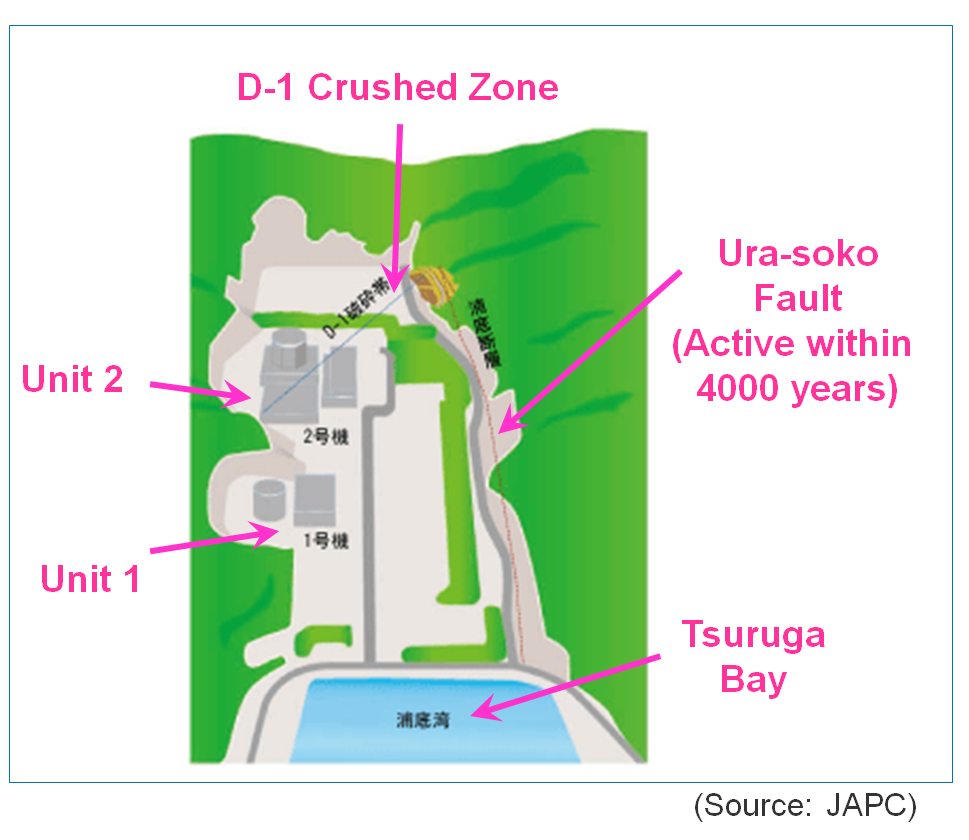
The NRA told Tsuruga NPP operator, Japan Atomic Power Co. (JAPC), that they should resubmit the application for the restart of the station’s Unit 2 reactor by Aug. 31.
The NRA said this will be the utility’s last chance to gain approval for the facility.
The message was delivered directly to the president of JAPC at an emergency meeting on April 11. The regulator gave an administrative direction to the company to resubmit its application with all relevant data corrected.
CONTEXT: The regulator is concerned about an area referred to as the “D-1 Crushed Zone,” which is where the main components of Unit 2 are situated. It sits just 200 meters away from an active geological fault, known as “Active Fault K”. The utility submitted data to show that the two are not connected, but since the data was tampered with, the NRA is not confident on this issue.
TAKEAWAY: If the company cannot convince the NRA that the station is not at risk from an earthquake, then it must be decommissioned. This will stop JAPC’s plans to add more reactors to the site. This debate has raged since 2013, when the NRA made its initial conclusion that the location is unsafe based on unofficial meetings with geologists. Evidence of JAPC tampering with data has already damaged its reputation and will make the restart of Unit 2, whatever the NRA final decision, extremely difficult.
Chubu Power Grid curtailed renewables operators, company’s first
(Nikkei, Tokyo Shimbun, April 11)
On April 7 the grid operator curtailed output from 30-410 MW of capacity for the following day. For solar sites, the suspension was based on operators with an output of 10 kW or more.
Chubu Power Grid said curtailment of renewable energy was for 30 minutes during the day on April 8 and 9, curbing 4 MW and 590 MW, respectively.
The company said these measures were due to factories and other facilities not operating on holidays, and decreasing demand for electricity when there was low air conditioning use. Also, solar power generation had increased due to good weather.
CONTEXT: This was the first curtailment in one of Japan’s three major metropolitan areas, as well as a first for Chubu Power Grid. During Chubu’s peak demand, almost half the electricity in the grid came from renewables.
TAKEAWAY: In 2018, the Kyushu grid operator started to curtail some power generators due to excess supply in certain moments. In 2022, grid companies in Hokkaido, Tohoku, Chugoku, Shikoku, and Okinawa did the same. The Chubu area has only just joined this nationwide trend, but it could see more regular curtailments if the Hamaoka NPP is allowed to restart, which is unlikely in the near term.
Octopus Energy invests in Yotsuya Capital to develop 250 MW solar capacity
(New Energy Business, April 11)
Through its Sky fund “ORI SCSp,” Octopus Energy Generation UK will invest in Yotsuya Capital that develops renewable energy power plants in Japan. This is its first investment in Asia; the value wasn’t disclosed.
Yotsuya Capital will develop solar power generation in the next five years, for a 250 MW total capacity, and which will eliminate 140,000 tons of CO2 annually. The electricity will be sold to corporations through PPAs.
CONTEXT: Octopus has an AI-based customer management platform and partners with Tokyo Gas.
Renova concludes financing for onshore wind power project in Kumamoto
(New Energy Business, April 10)
Renova secured financing for the Reihoku Amakusa Wind Power farm, which starts in 2026. Generation capacity is 54.6 MW, comprising 13 Vestas wind turbines.
Reihoku Wind Power is owned by Renova (38%), SMFL Mirai Partners (31%), and NEC Capital Solutions (31%).
Once completed, Renova can buy out its partners, possibly boosting its stake to 90%.
Mitsubishi begins construction of onshore wind farm in Laos, SE Asia’s largest
(Company statement, April 10)
Mitsubishi signed a $692 million financing agreement for the Monsoon cross-border wind power project in Laos, which will sell electricity to Vietnam under a 25-year PPA.
The wind farm will have the largest installed capacity of any in Southeast Asia and it will be the first cross-border renewable energy project in the ASEAN region.
Construction begins this year, operations in 2025. Capacity will be 600 MW.
Toshiba introduces VPPA for 100% renewable energy operation
(Company statement, April 12)
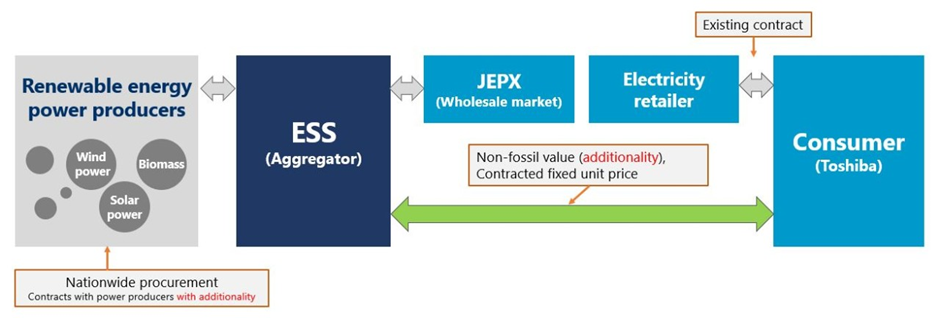
Toshiba and Toshiba Energy Systems (ESS) introduced a Virtual Power Purchase Agreement (VPPS) to its Smart Community Center in Kawasaki city to realize 100% renewable energy operation, along with FIT non-fossil certificates.
Toshiba purchases renewable electricity from No. 2 Satsuma Solar Power Station in Kagoshima with ESS as an aggregator to adjust the demand/response balances. The volume for the VPPA is 510 MWh/ year and 244 ton/ year CO2 reduction is expected.
IHI and Sharing Energy to collaborate on creating environmental value from solar
(Company statement, April 13)
IHI and Sharing Energy will launch a joint project in April 2023 to create “environmental value” by installing solar power generation systems in homes, offices, stores, and others.
CONTEXT: Environmental value refers to a certified reduction of emissions that can be packaged into a sellable product, such as a carbon credit. Buyers use such products to cut their own emissions total.
Sharing energy provides a service called “Share-Denki” that allows customers to install solar power generation systems for free and save on their electricity bills.
The project aims to convert the energy from this service into credits through the J-Credit system using an environmental value management platform developed by IHI.
Marubeni and Taisei to build wood-fired biomass power plant in Hokkaido
(Company statement, April 13)
Marubeni and Taisei will build and operate a wood-fired biomass power plant with capacity of 9.95 MW, near Ishikari City, Hokkaido.
This project will provide power from the region’s unused thinned wood. Marubeni has developed six biomass-fueled power plants in Japan. This will be the second biomass power plant to involve domestic consumption of locally produced fuel.
JRC developed access gangway for offshore wind station
(Company statement, April 11)
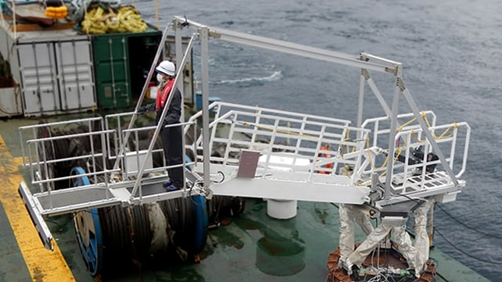
Japan Radio Co. (JRC) developed an offshore access gangway for safe transfer between a crew transfer vessel (CTV) and an offshore wind farm. JRC plans to launch it in 2024.
It’s not easy to move from a CTV to a wind farm platform – the vessel moves up and down and sideways. The gangway is fit for both small-size and large vessels.
JRC knows the water conditions in Japan well and the new gangway mitigates risk of falling in the water or getting caught between the vessel and platform. The gangway has AIP (approval in principle) from Bureau Veritas in France.
TAKEAWAY: Japan plans to build more offshore wind power plants in the next 20 years, and demands for safe transport from onshore to offshore and back to onshore is a must.
NEWS: OIL, GAS & MINING
JERA forms LNG buyers’ alliance with Korea Gas to guarantee LNG supply stability
(Company statement, April 10)
JERA and Korea Gas Corp (KOGAS) signed an MoU to guarantee LNG supply stability through swaps, trading, shipping optimization and exchange of market information.
JERA seeks to set up similar schemes with other LNG buyers in and outside Japan.
CONTEXT: JERA, the leading global LNG buyer, purchases 37 million tons/ year. KOGAS was the world’s largest buyer until JERA’s establishment in 2015.
TAKEAWAY: Nippon Steel and South Korea’s Posco formed a similar iron ore buyers alliance that later developed into joint upstream investments, long-term contract negotiations and cross-shareholding. The latter is something that is unlikely for JERA and KOGAS since the Korean company is state-owned. Meanwhile, expansion of the buyer’s alliance to other Japanese companies, notably the EPCOs (former regional power monopolies), may not be possible until the full separation of power generation units from other grid operating business and other assets.
Sumitomo Metal Mining to start lithium production overseas in 2028
(Japan NRG, Nikkei Asia, April 11)
Sumitomo Metal Mining plans to start lithium production overseas in 2028; it developed a new absorbent material that speeds up lithium extraction from brine raw materials.
SMM told Japan NRG that its lithium extraction R&D achieved a breakthrough but the tech isn’t ready for commercial use. 2028 is too early to start lithium production.
CONTEXT: SMM has been developing a new absorbent material for lithium extraction since 2021. Its goal was to launch a pilot test of the new method by 2030. It may possibly be looking for sites to conduct the tests.
TAKEAWAY: The success of SMM’s tech would depend on its cost and environmental impact. There are several technologies to extract lithium from raw materials and Sumitomo Corp invests in one of them, the U.S.-based Lilac Solutions. As SMM does not own any lithium mines, it will need to make new project investments if it plans to secure lithium production.
LNG developer Tellurian looks for Japanese investors for Gulf of Mexico facility
(Asia Nikkei, April 11)
U.S. LNG developer Tellurian is in talks with Japanese and Indian companies about investing in its planned LNG plant, Driftwood, in Louisiana that’s set to start in 2027.
Annual capacity will be about 11 million tons in the first phase, and would equal more than 10% of Japan’s LNG demand. However, the project took a hit after two of its top customers, Shell and Vitol, canceled long-term deals last year.
Kobe Steel and Mitsui to study plans for a large low-CO2 iron factory in Oman
(Asia Nikkei, April 11)
Kobe Steel and Mitsui signed a MoU to potentially build a new direct-reduced iron (DRI) factory in Oman. The facility would use low-carbon steel feedstock and start as early as in 2027. At 5 million tons of annual capacity, it would be one of the world’s largest.
DRI is made by removing oxygen from iron ore using hydrogen or natural gas; the resulting material can be used in blast furnaces or electric-arc furnaces.
The plant would use natural gas, but could further cut emissions by utilizing green hydrogen. Mitsui will supply iron ore and natural gas; Kobe Steel will use the factory’s end product in its blast furnaces or sell it to other steelmakers.
CONTEXT: The steel sector is one of Japan’s top CO2 emitters.
ENEOS completely withdraws from Myanmar
(Jiji, April 13)
ENEOS Holdings withdrew from a project in Myanmar’s Yetagun gas field.
The company cited the deteriorating political situation and declining productivity.
CONTEXT: The company had a 19.3% stake in the project through its local subsidiary, a JV with Mitsubishi Corp and the Japanese govt. Production started in 2000.
LNG stocks slip to 2.4 million tons
(Government data, April 12)
LNG stocks of 10 power grids stood at 2.4 million tons as of April 9, down 0.8% from 2.42 million tons a week earlier. METI previously reported April 2 stocks as 2.4 million tons but revised the figure.
The end-April stocks last year were 1.96 million tons. The five-year average for this time of year was 1.95 million tons.
ANALYSIS
BY MAYUMI WATANABE
Part II: Japan looks to a new tech to kickstart its solar boom
Last week we published Part I of this article, which outlined the rise and decline of Japan’s solar panel manufacturing industry. This week, we focus on a new innovative technology, perovskite solar cells (PSC), which Japan is betting big on in order to stimulate domestic production in solar infrastructure.
Almost 15 years ago, just as the sun began to set on Japan’s solar panel industry, a ray of light appeared that gave hope to dispel the pessimism. In 2009, Prof. Tsutomu Miyasaka of Toin University of Yokohama made the world’s first demonstration of a new solar tech known as PSC.
While perovskite minerals had been discovered more than 150 years ago, Miyasaka was the first to incorporate their compound structure into a solar cell. The power conversion efficiency achieved by Miyasak was low, and the cell was stable for only a matter of minutes. But the experiment gave birth to a new solar technology. And since the research originated in Japan, the government fostered hope that it could help the country recover its position as a solar energy leader.
The path of PSC technology since then has been challenging as the cost of current solar panels has declined precipitously. But if Japan were to achieve commercially viable PSC-based renewable power generation, it could be a game changer not only for the country itself but the energy transition as a whole.
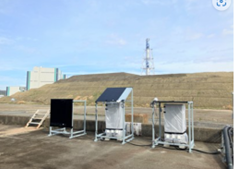
After years in the lab, the technology is now starting to see the light of day. Last month, Japan’s biggest power utility, JERA, launched a PSC demo at one of its thermal power stations. This high-profile experiment is deploying three mini-module prototypes developed by Osaka-based Sekisui Chemical. And while the scale of the demo is not large, JERA says it sees great potential in the technology, which can be installed along the walls and other parts of the power plant’s facilities.
According to the most optimistic prognosis, perovskite solar power may hit commercial scale as soon as by 2025.
JERA’s pilot PSC project
Source: JERA
The science behind PSC
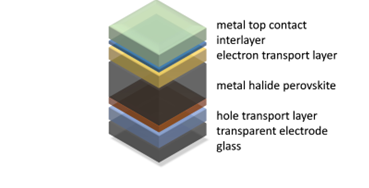
What is a perovskite solar cell (PSC)? The cell is made of thin layers of chemicals and is only 1 micrometer thick, less than 1% that of a silicon solar panel. It is also far lighter. One of the layers has a crystal structure consisting of two positively charged and one negative ions. This layer is called perovskite. Similar to silicon, this layer absorbs light and converts it into electricity. Perovskite is sandwiched between two layers, which help electrons to flow and produce electric current.
Source: Molecular Materials and Nanosystems (M2N) research group
There are various metal oxides that can turn into perovskite structures. The main ones are lead, tin and titanium, all of which are widely available. Such abundance of raw material candidates makes the scale-up of PSC look promising.
Key properties of PSC
Other positive factors include production efficiency and low energy requirements. The PSC production process is short:
Make a perovskite solution
Roll it or spray it on sheet materials, stack up electron and hole transport layers, as well as electrodes and contact interlayers, to form a module.
The process takes place at temperatures of 100 C, which is much less energy intensive than silicon. Since PSC is light and thin, it can be bent, shaped flexibly and installed upright in building walls. The layers are semi-transparent and can even be installed on windows, as well as in other areas with space constraints.
Upcoming PSC projects
Several domestic Japanese PSC projects could define whether this niche will have a future. In addition to JERA’s demo project, a number of outdoor field studies of PSCs will be launched, five years after the world’s first demo project in Poland.
In February, Toshiba Energy Systems said it will start testing PSC modules not directly exposed to the sun by installing a film-based module on a public pathway connecting a railway station in Yokoyama.
In April, Sekisui Chemical and NTT Data will start testing PSC on building exteriors. Sekisui will install its module on a water system operated by the Tokyo Metropolitan Government, to measure the impact of moisture. In the future, Tokyo sees the potential to add modules to water treatment systems.
Sekisui has also partnered with the West Japan Railway Company (JR West) to conduct field tests at the new Umekita station that opens in 2025.
Demo projects in 2023
Partners
Cell specifications
Installation
Future plans
Toshiba Energy Systems, Tokyu group, Yokohama City, Toin Gakuen
703 cm2-sized film-based module, best power efficiency record 16.6%
Public pathway to the Aobadai train station
Tokyu group will install PSC systems on buildings, rail cars and bridges
Sekisui Chemical, NTT Data
Film-based module, 30 cm wide, best power efficiency recorded at 15%
Building exterior
Data centers with built-in PSC systems
Sekisui Chemical, Tokyo metropolis
Water processing facility
Installations on water treatment systems
Sekisui Chemical, JERA
Thermal power stations
Commercialization of PSC-power supply
Target date: 2025
Market observers say 2025 will be a milestone year for PSCs, when grants for many government-funded PSC research projects expire. Under the state scenario, this means PSC as a technology will need to move onto the stage of mass production, and by 2030 it should be available on a fully commercial basis in the market.
The New Energy and Industrial Technology Development Organization (NEDO) has financed six projects, including at Aisin and Tokyo University, which are developing 30 cm2 modules with a 20% power efficiency, with a target cost of ¥20/ kWh. They aim to beat silicon module production costs, which amount to about ¥50/ kWh.
Companies planning entry into the PSC market, whether as a supplier for perovskite chemical feedstock or manufacturer of building materials with embedded modules, are expected to make their final business decisions around 2025 as the practical specs around the technology become clearer.
NEDO-funded PSC projects
National Institute of Advanced
Industrial Science and Technology
Establishing performance measurement methodologies, data analysis
Sekisui Chemical, Tokyo University,
Ritsumeikan University
Roll-to-roll production technology to enhance module endurance
Toshiba, Tokyo University,
Ritsumeikan University
Inverted PSC structures and PSC ink for speedy mass production
Kaneka
Polyamide substrates and new materials for the module layers for higher performance
EneCoat Technologies
Coating and spraying of PSC materials on films for speedy production
Aisin, Tokyo University
Reducing hole transport material costs
Cost challenges
PSC is promoted as a cheaper solar technology because its key raw materials are inexpensive iodine and lead. The most expensive chemicals involved are the Spiro-meOTAD compound powders used for the hole transport layers. According to Tokyo Chemical Industry, which has made perovskite materials since 2014, Spiro-meOTAD alone costs ¥50,000/ gram. While the chemicals involved are inexpensive, the processing is lengthy and complicated, which drives up costs.
All in all, the cost of producing one square meter of PSC module weighing 1,500 grams comfortably exceeds the ¥30,000 market price for the same-size silicon PV panel. This suggests that lower cost materials and production techniques are needed before PSC can move to commercialization.
Also, PSCs will likely require a power efficiency above 20% to be competitive. Recent reports describe some prototype PSC modules as hitting that target and even reaching 30% efficiency, but the units in question are tiny: one cm squared, or smaller. When enlarged, the same modules lose efficiency due to the difficulty of evenly distributing molecules.
In spite of all this, a dramatic cut in production costs will be essential for PSC to compete with silicon modules, the cost of which comes at around ¥40-50/ watt.
PSC modules also face durability and production scalability issues. While Toshiba Energy Systems holds the domestic record for PSC power efficiency (16.6%), the company told Japan NRG that it won’t use those 16.6% modules for the public pathway test outside the Aobadai train station.
Sekisui Chemical claims its prototype PSC modules can last 10 years. That’s an impressive number, according to Sekisui’s project partner, JERA. Earlier iterations of PSC technology lasted only a few years. But in comparison with silicon PV panels, which typically last 30 years, this is another minus. Many solar projects need at least 10 years to repay their financing.
Short lifespans mean PSC systems would require frequent replacements, which is especially problematic for modules embedded in walls or windows. Furthermore, many believe PSC to be vulnerable to changes in air pressure, moisture, and other physical shocks. PSC pioneers like Sekisui and Toshiba will need to find effective solutions for this through their outdoor trials.
One final issue to consider will be PSC’s reliance on lead. According to the University of Electro-Communications, lead accounts for 30% of the weight of current PSC modules. While Japan’s regulations on lead are less restrictive than the EU, lead content needs to be controlled especially for water and waste management.
Consumers will not be able to dispose of lead-heavy equipment without a specialist recycling system in place, which is another cost item. Alternatively, PSCs will need to switch to other metals.
Future of the PSC market
With such a list of challenges, the fate of JERA’s demo PSC project is of interest to many market players. While many are enthused by the properties of PSC, few see the new technology squeezing the market for silicon-based panels in the next two decades.
Instead, the thin, lightweight and flexible modules are likely to create entirely new market niches. The fact that PSC does not require racks could also spread its popularity for micro environments and tight spaces.
Since PSCs absorb a larger spectrum of light compared to silicon, in theory they can generate power in the absence of sun. One possibility is power generation in closed spaces, such as devices with built-in perovskite systems mounted on EVs. PSCs are transparent like cellophane tape, and they do not block out light.
This feature could be exploited at farms that install PSC systems above ground but still grow crops on the land. The University of Electro-Communications sees potential for a market that’s over ¥1 trillion in size for each of the three possible applications.
Competition for a better PSC future
At the end of the day, competition will foster better products and expand markets. Even high raw material costs should spur further efficiency breakthroughs.
One such industry optimist is a Japan-Sino joint venture that claims to have achieved cost cuts of several percentage points already thanks to improved project management and by allocating some processes to Chinese facilities, the company told Japan NRG. Of course, this could also be a disadvantage if manufacturing of the new tech moves to China and mirrors the trend of silicon PVs in the early 2000s.
Meanwhile, Chinese silicon PV makers are also innovating to make their panels thinner, lighter and cheaper. Perhaps this is the biggest lesson from the rise and fall of Japan’s silicon PV sector. Creating the best technology will not be enough. Japan will also need to create a profitable domestic market for the technology in order for it to take root.
ANALYSIS
BY CHISAKI WATANABE
Japan prepares to bet big on deep-water offshore wind in the EEZ
Japan is updating its ocean policy with an eye on utilizing its exclusive economic zone to expand the wind power generation. This should turbocharge the local deployment of floating turbines amid rising global competition for the technology.
Promoting floating wind power technology is a key part of the maritime strategy mapped out in the draft of the Fourth Basic Plan on Ocean Policy, soon to be approved by Prime Minister Kishida’s cabinet.
The Basic Plan is updated every five years and the current draft was open to public comment until early April. It consists of policy measures and strategies to cover a range of issues from national security threats to natural disasters, such as typhoons and high tides, as well as energy-related issues that concern ocean resources.
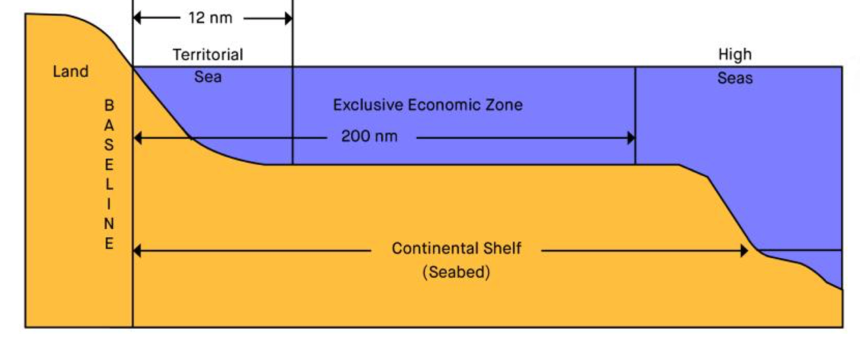
One of the plan’s focus points is the utilization of Japan’s exclusive economic zone (EEZ), which is an area extending 200 nautical miles (about 370 km) from the nation’s shore. Within the EEZ, countries have exclusive rights to explore and exploit natural resources under the United Nations Convention on the Law of the Sea (UNCLOS).
Expanding offshore wind into the EEZ means that available areas for development will dramatically increase. Current development is based entirely on Japan’s territorial waters, which limits projects to within 22 km from shore.
Setting targets for floating offshore
While Japan’s land area is relatively small, its maritime area and EEZ come in at some 4.47 million km2, the world’s sixth largest. This equals nearly 12 times Japan’s land mass.
According to an MoE database, Japan has the potential to install 783 GW of floating offshore wind capacity, more than twice the 337 GW potential for fixed-bottom turbine units.
Source: Maritime Boundary Office
In the Basic Plan, the government highlighted the importance of expanding offshore wind power generation. Installing turbines in the ocean is key to making renewables a main source of electricity and crucial for carbon neutrality goals.
The plan also noted that there’s a growing need to utilize the EEZ to further Japan’s wind power ambitions and that floating units will be the main turbine technology given the characteristics of the surrounding ocean. To that end, the government will now set specific targets for floating offshore wind and promote technology development. Legislation is to be prepared to deploy offshore wind in the EEZ starting with reviews of related laws such as UNCLOS, according to the plan.
This summer, the government will reconvene a public-private council on offshore wind to come up with industrial strategies and targets for floating installations in the EEZ by March 2024, according to an action plan released earlier this month by a task force chaired by PM Kishida. The new targets for floating turbines will be part of the government’s overall strategy to install up to 45 GW in offshore wind capacity by 2040.
Legal nuances
As for legal frameworks, the government has already taken its first steps. In January, an expert panel appointed by the Cabinet Office released a report after a series of discussions on legal issues for offshore wind farms in Japan’s EEZ and how to interpret the UN’s law of the sea.
This panel concluded that offshore wind turbines and related facilities can be categorized as “installations and structures” that the coastal State in the EEZ has jurisdiction over because their primary purpose is to produce wind energy, as per the UNCLOS (Article 56).
Other key points made by the panel:
1. So long as necessary procedures are taken under domestic laws, the coastal State can issue approvals for research and development, and conduct inspections during periods of construction, operation and maintenance, and the dismantling of offshore wind farms in the EEZ.
2. The coastal State may designate safety zones within 500 meters from the outer limits of offshore wind power stations in the EEZ.
The second point is important since ships must respect safety zones and need to comply with generally accepted standards for navigation near installations, structures and safety zones.
At least nine countries already have offshore wind power stations in their EEZ either in operation or in the pipeline. In East Asia alone, China and South Korea each have plans for nearly 10 GW of offshore wind capacity within their EEZs. South Korea plans for all but one of its projects to use floating turbines; China expects to rely only on bottom-fixed units.
Fig. 1: Offshore wind power in the EEZ as of 2021
Country (number of projects)
Total MW
(in the pipeline, operating;
floating and bottom-fixed)
Operating MW
(floating and bottom-fixed)
Floating MW
Netherlands (8)
3,871
2,352
UK (24)
24,131
4,453
30
(operating)
Belgium (11)
1,898
1,898
U.S. (17)
14,788
12
Denmark, Norway (5)
1,708
1,620
88
(pre-construction)
Germany (29)
10,237
7,367
China (11)
9,500
0
South Korea (21)
9,704
0
9,504
(in the pipeline)
Taiwan
0
0
Source: compiled by JapanNRG from ANRE data
Ocean synergies
Offshore wind power is not the only opportunity in the EEZ. The Basic Plan also sheds light on Japan’s marine resource development, saying that energy and a stable supply of mineral resources are essential for the national economy.
There are energy and mineral resources on the sea bottom in the EEZ, such as methane hydrate, oil, natural gas, cobalt-rich ferromanganese crusts, manganese nodules and deep-sea mud containing rare earths, according to the plan.
These are used in power generation from renewable sources and the manufacture of electric vehicles. Japan relies on their imports, and counts on a limited number of countries for processing and refining. While it may take years before such subsea resources become commercially available, floating offshore wind is a proven technology and could spur subsea resource development.
Expanding the wind deployment area into Japan’s EEZ comes with its own challenges. For example, installing turbines in the EEZ means equipment must be shipped further, requiring longer time for construction and O&M. Also, more copper is required for cables to carry electricity to shore.
Meanwhile, Japan will have to compete with neighboring countries, especially South Korea, to procure the equipment for floating wind power projects, as well as the vessels to transport and install it.
Setting targets for floating offshore wind is just the first step for Japan to show its commitment to this promising technology.
GLOBAL VIEW
BY JOHN VAROLI
Below are some of last week’s most important international energy developments monitored by the Japan NRG team because of their potential to impact energy supply and demand, as well as prices. We see the following as relevant to Japanese and international energy investors.
China/ Critical raw materials
Beijing is expanding export restrictions on critical minerals, leading to higher prices of raw materials for the clean energy transition, according to an OECD report. More than 13,000 restrictions were passed by late 2020, and even more introduced since then.
Germany/ Nuclear power
The last of three nuclear power stations closed this weekend, ending a six-decade nuclear energy program. The closures were spurred on by Japan’s 2011 Fukushima NPP accident. Germany aims for fully-renewable electricity generation by 2035.
Gulf of Mexico/ Oil
BP started pumping crude through its new $9 billion Argos deepwater offshore platform in the U.S. Gulf of Mexico. This is the biggest new project in the region in more than a decade, and can pump 140,000 bpd from subsea oil and gas fields.
Indonesia/ Gas pipeline
By Q1 2024, national oil company Petroliam Nasional Berhad plans to restart a gas pipeline. In October, Petronas announced a force majeure on gas supply to Malaysia due to a leak on its Sabah-Sarawak Gas Pipeline.
Netherlands/ CO2 emissions
The government will support Shell to reduce CO2 and nitrogen emissions. Shell is one of the country’s largest polluters, and plans to cut 3.9 megatons of CO2 emissions from its Dutch plants by 2030. Shell’s plan equals 20% of Dutch industry’s total goal in cutting CO2.
Netherlands/ Russian LNG
The government plans to end all LNG imports from Russia, said Dutch energy minister Rob Jetten. The Netherlands stopped signing new contracts for Russian LNG imports this year and will wind down pre-existing contracts.
Russia/ Oil exports
Seaborne oil product exports rose in March by 17.3% month-on-month. Volumes increased to 12.374 million tons from 9.53 million in February. A full embargo of Russian oil product exports to the EU went into effect on Feb.5.
Thailand/ Green hydrogen
Saudi Arabian renewables developer ACWA Power signed a $7 billion agreement with two state-owned Thai companies to produce 225,000 tons of green hydrogen each year; that’s equal to about 1.2 million tons of green ammonia. Production will be in Thailand.
U.S./ Critical raw materials
General Motors will invest in lithium technology startup EnergyX to ensure long-term supplies for EV batteries. The global rush by automakers to electrify their cars has led to a push for stable supplies of lithium, copper, nickel and other critical minerals.
U.S./ EVs
Americans are more motivated by saving money on gas than climate change. Only 41% are somewhat likely to purchase an EV because they believe the upfront costs outweigh fuel and maintenance savings, according to the University of Chicago.
Wind and solar power
Wind and solar energy accounted for a record 12% of global electricity generation last year, up from 10% in 2021, said think tank Ember. It studied power sector data from 78 countries in its annual global electricity review, representing 93% of global power demand.
2023 EVENTS CALENDAR
A selection of domestic and international events we believe will have an impact on Japanese energy
ASEAN-Japan summit to mark 50 years of cooperation
Last market trading day (December 30)
Disclaimer
This communication has been prepared for information purposes only, is confidential and may be legally privileged. This is a subscription-only service and is directed at those who have expressly asked K.K. Yuri Group or one of its representatives to be added to the mailing list. This document may not be onwardly circulated or reproduced without prior written consent from Yuri Group, which retains all copyright to the content of this report.
Yuri Group is not registered as an investment advisor in any jurisdiction. Our research and all the content express our opinions, which are generally based on available public information, field studies and own analysis. Content is limited to general comment upon general political, economic and market issues, asset classes and types of investments. The report and all of its content does not constitute a recommendation or solicitation to buy, sell, subscribe for or underwrite any product or physical commodity, or a financial instrument.
The information contained in this report is obtained from sources believed to be reliable and in good faith. No representation or warranty is made that it is accurate or complete. Opinions and views expressed are subject to change without notice, as are prices and availability, which are indicative only. There is no obligation to notify recipients of any changes to this data or to do so in the future. No responsibility is accepted for the use of or reliance on the information provided. In no circumstances will Yuri Group be liable for any indirect or direct loss, or consequential loss or damages arising from the use of, any inability to use, or any inaccuracy in the information.
K.K. Yuri Group: Oonoya Building 8F, Yotsuya 1-18, Shinjuku-ku, Tokyo, Japan, 160-0004.
NEWS
・G7 meeting in Sapporo: vows to phase out unabated fossil fuels; sets major targets for solar and wind; renews support for nuclear
・G7 meeting in Sapporo: members commit to new mining and recycling action plans with joint spending on the table
・JERA forms LNG buyers’ alliance with Korea Gas to ensure supply stability; interested in adding more members