Panasonic to invest $5 bln to expand EV battery production in the U.S., seeking growth beyond Tesla
NYK Line to spend ¥560 bln on LNG carriers and decarbonization of vessels; expects LNG transport demand to rise
Toyota vows to cut autos’ CO2 footprint by over 50% by 2035, while also investing in biofuel hybrids in Brazil, EVs, fuel cells
ENERGY TRANSITION & POLICY
Report says Honda Motor is developing next-gen solar cells
ANRE sets up panel to reform data access policy for renewables
G7 business groups must join push for circular economy: IGES
GS Yuasa to invest in high-capacity lithium batteries with Honda
Japan group, ADNOC to study GHG footprint of ammonia
Shipping line to invest in U.S. startup to develop ammonia vessel
UAE, Kawasaki Heavy to work on liquid hydrogen supply chain
Oil lobby asks govt for more support to reduce hydrogen costs
Idemitsu forms a JV to recycle plastic waste, replacing crude oil
ELECTRICITY MARKETS
Regulator issues improvement advisory to EPCOs over data leaks
Kyushu Electric restarts one, idles one reactor at Sendai NPP
Chubu Power Grid mistakenly curtailed 110 MW of solar power
Chiyoda completed construction of 240 MW in BESS capacity
REI releases beta version of offshore wind project data and map
Cosmo began operations of two onshore wind farms
Eurus Energy decommissions two wind farms in Aomori area
Air Water develops Japan’s first vertical solar power system
OIL, GAS & MINING
Mitsui buys shale gas asset in Texas; tests its hand as an operator
Philippines to start LNG imports with help from Japan gas utilities
LNG stockpiles at power utilities rise slightly; well above avg.
March thermal coal and LNG imports slump, crude oil edges up
ANALYSIS
OCCTO’S GRID PLAN SHOWS CHANGING DIRECTION OF JAPAN’S ENERGY MIX
A view into how the nation’s power mix will change is seen in the 2050 “masterplan” by OCCTO, the grid oversight entity. It says Japan needs to modernize its power system to allow large volumes of electricity from mostly renewable sources to move from production hubs to places of high demand. Unlike energy sources, pylons, power cables, and substations rarely attract attention. Yet these will form the backbone of Japan’s power mix in coming decades.
CAN JAPAN BUILD A DOMESTIC OFFSHORE WIND POWER SUPPLY CHAIN?
Japan has committed to a major buildout of offshore wind power generation. The top goals are clear: Offshore should be a significant source of energy and squeeze out fossil fuel generation while also overtaking nuclear capacity. To realize those plans, however, the sector will need to aggressively cut costs and create a vibrant and competitive domestic supply chain for the full cycle of wind power generation from environmental assessments to turbine decommissioning.
New Energy and Industrial Technology Development Organization
kWh
Kilowatt hours (electricity generation volume)
TEPCO
Tokyo Electric Power Company
FIT
Feed-in Tariff
KEPCO
Kansai Electric Power Company
FIP
Feed-in Premium
EPCO
Electric Power Company
SAF
Sustainable Aviation Fuel
JCC
Japan Crude Cocktail
NPP
Nuclear power plant
JKM
Japan Korea Market, the Platt’s LNG benchmark
JOGMEC
Japan Organization for Metals and Energy Security
CCUS
Carbon Capture, Utilization and Storage
OCCTO
Organization for Cross-regional Coordination of Transmission Operators
NRA
Nuclear Regulation Authority
GX
Green Transformation
NEWS:ENERGY TRANSITION & POLICY
Panasonic to invest $5 bln in EV battery facility in the U.S., seeks growth beyond Tesla
(Nikkei Asia, April 18)
Panasonic Holdings will invest $5 billion to expand EV battery production capacity in the U.S. The company inked a deal with the State of Oklahoma for incentives.
Panasonic has a 7.3% global share of EV batteries and ranked fourth in 2022. With Tesla, in 2017 it began EV battery production in the U.S., with 40 GWh of capacity. In 2018, the company built a plant in Kansas, investing $4 billion for 30 GWh of capacity.
Panasonic is considering either to expand the existing factories or build a new one – and no decision has been finalized. Kansas offered $800 million in subsidies over a decade, and Oklahoma’s incentive package is $700 million.
SIDE DEVELOPMENT: Panasonic to supply lithium-ion battery cells to Hexagon Purus in the U.S. starting 2026 (Company statement, April 18)
Panasonic Energy agreed with Hexagon Purus Systems to supply lithium-ion battery cells to be used for the company’s proprietary battery systems.
Panasonic will produce the battery cells in a new facility in Kansas and benefit from the Inflation Reduction Act’s incentives. Hexagon Purus will prepay $43 million through 2025. Panasonic will start supplying the cells in early 2026. This prepayment secures Hexagon battery cell capacity in the U.S.
TAKEAWAY: Panasonic ships most of its EV batteries to Tesla. As production in the U.S. expands, the company needs new clients, for example, Hexagon Purus. The EV market is expected to grow rapidly, despite a speculative shortage anticipated in lithium supply.
Report says Honda will develop perovskite solar cells; but company has no comment
(Asahi Shimbun, Japan NRG, April 18)
Honda Motor group is developing perovskite solar cells (PSC), aiming for their practical application by 2030.
Honda declined to confirm or deny the newspaper report.
TAKEAWAY: The PSC industry has been very quiet and uneasy about sharing too much information at this point. Honda’s attitude may reflect the need for more time to explore PSC’s potential and challenges. What’s more, Honda has some bad experience in this field. The company previously had to close Honda Soltec, a maker of copper-indium-selenium-gallium (CIGS) solar cells, which promised to be more a more reliable tech for solar energy than silicon.
ANRE sets up panel to reform METI’s renewable operators data access policy
(Japan NRG, April 17)
Following data breaches by EPCO staff, ANRE set up a four-member panel to reform management policy of renewable operators’ databases run by METI. This panel is separate from the others discussing EPCO’s unauthorized access of outside customer data.
The Digital Agency joins the panel as an observer.
ANRE told the panel that EPCO power transmission staff had access to 100 out of 400 data series, which included privacy data of renewable operator managers. The EPCO staff were passing the data to the retail arms of their group.
One set of ID and password were issued to one EPCO that was shared by up to 50 people. The EGC suggested METI to review ID and password policies.
CONTEXT: The panel purpose is heightening the data security of METI’s renewable operators’ database rather than improving the regulatory systems. The panel members are data security experts rather than power market experts.
TAKEAWAY: Panel members agreed that the measures must go beyond EGC recommendations. A deeper probe is needed and the panel urged ANRE and METI for more data disclosure. Panelist Maruyama Mitsuhiko pointed out that METI’s ID/password policy possibly violates the govt-wide cyber security rule and that other METI systems need to be checked.
IGES: G7 businesses must join G7 discussion on circular economy
(IGES statement, April 19)
One highlight of the G7 Climate Ministers meeting was the agreement to promote circular economy and resource efficiency principles, said the Kanagawa-based Institute for Global Environment Strategies (IGES), a govt think tank.
The agreement, proposed by Japan, urges businesses to voluntarily set circular economy criterias and to build resource-efficient business cycles.
Next is to step up collaborations among the Business 7 (B7) Engagement Group consisting of the Japan Business Federation (Keidanren), the chambers of commerce in the U.S. and Canada, and major business federations in the EU, and other stakeholders.
A new govt-private-academia partnership to be set up by METI are expected to drive the initiatives.
G7 Ministers support IAEA’s green light for discharge of treated water at Fukushima site
(Denki Shimbun, April 18)
On April 16, the G7 Ministers’ Meeting on Climate, Energy and Environment issued a statement to support the IAEA’s safety report regarding the Advanced Liquid Processing System (ALPS) treated water discharge.
The original draft said “We welcome the steady progress of decommissioning at the Fukushima Dai-Ichi NPP including the discharge of ALPS-treated water, which is consistent with IAEA safety standards and international law”; but the final version was softened.
Not everyone was on board. The German Minister for the Environment, Nature Conservation and Nuclear Safety Steffi Lemke said after the meeting that “While Germany appreciates Japan’s effort in handling the Fukushima nuclear accident, we cannot welcome the discharge of ALPS-treated water”.
TAKEAWAY: A statement by the G7 Climate Energy and Environment Meeting supporting the ALPS-treated water release is very important for Japan. TEPCO can now adhere to the release schedule this summer. Still, it is unlikely that the action will avoid some criticism globally. Outside the G7, China has regularly expressed its concerned about the water release.
GX bills discussed by the Diet
(Denki Shimbun, April 19 and 20)
On April 18, the “GX Promotion Bill” was discussed at the Committee on Economy, Trade and Industry in the House of Councillors.
In the House of Representatives on April 19, the GX Decarbonized Power Source Bill was discussed by a joint examination of committees combining: ①The Committee of Economy Trade and Industry; ②The Committee of Environment; and ③The Committee of Nuclear Issues. Some Diet Members accused the NRA of making rash decisions. However, NRA Chairman Yamanaka Shinsuke replied that diversity of voices shows the independence and transparency of NRA members.
One Constitutional Democratic Party member said that the extension of operating years for nuclear reactors might lead to safety issues. NRA Chair Yamanaka replied there’s no scientific basis for the 60-year limit.
TAKEAWAY: Additional questions were asked by Diet members, but most were superficial, such as “How many years can be excluded from calculating total operation for Ikata Unit 3?” This can be easily calculated from the years of forced stoppage by the NRA. GX related bills are expected to be passed next month.
Toyota CEO vows to cut emissions by more than half by 2035
(Nikkei, April 21)
Toyota Motor’s new CEO Koji Sato promised to cut the CO2 per car sold around the world by more than 50% (compared to 2019 levels) by 2035.
Toyota will maintain a diverse range of vehicle options including EVs, plug-in HVs and fuel cell vehicles.
Toyota’s CO2 reduction goal is based on the “Well-to-Wheel” standards, which means including the emissions associated with the electricity used by the cars. Since some of the power currently comes from fossil fuel generation, Toyota vows to support societal moves to speed up the rollout of renewable energy.
SIDE DEVELOPMENT: Toyota to invest $334 mln to make compact biofuel hybrids in Brazil (Nikkei Asia, April 19)
Toyota Motor plans to invest $334 million to produce compact hybrid vehicles fueled by gasoline and bioethanol. Currently, Toyota offers Corolla compact flexible fuel hybrid models and plans to expand to other series.
The Sorocaba plant in Sao Paulo will make the hybrids. Sales start in 2024.
SIDE DEVELOPMENT: Toyota and Chevron to test drive vehicles with gasoline with over 50% renewable content (Company statement, April 17)
U.S. Chevron and Toyota Motor will conduct a demo of gasoline with more than 50% biofuel and other renewable content, driving Toyota’s Tundra, RAV4 and Camry models from Mississippi to Texas.
CONTEXT: Toyota has also partnered with Exxon to develop low-carbon fuels for gasoline cars.
GS Yuasa to invest ¥190 billion in high-capacity lithium-ion batteries with Honda Motor
(New Energy News, April 14)
GS Yuasa is a leading manufacturer of automotive and industrial batteries, and in its 2023-2025 business plan the company will develop high-performance, high-capacity lithium-ion batteries with Honda Motor. Investment will total ¥190 billion.
Of that amount, ¥105 billion will be spent on lithium-ion batteries for automobiles.
GS Yuasa expects that more hybrid cars (HEVs or PHEVs) will be sold in Japan and it plans to expand annual battery production capacity to 20 GWh by 2035.
INPEX, Mitsui, JOGMEC and ADNOC to study GHG footprint of ammonia
(Company statement, April 18)
INPEX, Mitsui, JOGMEC and ADNOC agreed to study the GHG footprints of the latter’s ammonia projects in Abu Dhabi. The agreement was signed at the sideline of the G7 Climate Ministers Meeting last week.
The goal is to establish GHG measurement methods of ammonia production using hydrogen generated from fossil fuels, and discover requirements for long-term carbon storage at onshore oil fields.
CONTEXT: Hydrogen and ammonia are at the core of the UAE’s energy strategy, aiming to take a 25% share of the global hydrogen supplies. Ruwais and Kizap are the country’s major ammonia production sites, not Abu Dhabi.
TAKEAWAY: ADNOC’s CEO Al Jaber is chairman of COP28 to be held in the UAE; it’s expected that he’ll take every opportunity to push hydrogen, ammonia and renewables projects but remain committed to increasing his country’s oil and LNG output.
Mitsui O.S.K. Lines to corporate with U.S. ammonia startup to develop vessel
(Denki Shimbun, April 20)
Mitsui O.S.K. Lines will cooperate with U.S. ammonia startup Amogy to develop ammonia powered generation technology, targeted for vessel usage. The parties aim to have an ammonia-fueled vessel operate as soon as in 2024.
Amogy has developed the technology to generate electricity via fuel cells which use hydrogen produced from ammonia. It has created ammonia-based fuel cell systems for tractors (100kW) and trucks (300kW).
Amogy was founded in 2020 by four MIT Ph.D. alumni to develop ammonia technology for the transportation sector.
Kawasaki Heavy and the UAE’s ADNOC to develop liquid hydrogen supply chains
(Company statement, April 17)
Kawasaki Heavy Industries agreed with Abu-Dhabi-based ADNOC to explore opportunities to set up a liquefied hydrogen supply chain.
The companies will explore opportunities in the production of hydrogen, hydrogen liquefaction and associated infrastructure, and maritime transportation of hydrogen to potential offtakers to set up a commercial-scale international hydrogen supply chain.
CONTEXT: Kawasaki is just the latest of a number of Japanese companies partnering with ADNOC. In early 2023, ADNOC cemented ties with INPEX in clean energy; also, ADNOC’s Abu Dhabi Chemicals Derivatives inked a deal with trading house Mitsui to develop a low-carbon ammonia production facility at the TA’ZIZ Industrial Chemicals Zone in Abu Dhabi. Other hydrogen and ammonia deals between ADNOC and Japanese companies were signed in 2022.
PAJ asks govt for more hydrogen cost reduction and support to counter U.S. incentives
(Nikkan Kogyo, April 18)
The Petroleum Association of Japan (PAJ) agrees with the govt’s plan to revise its hydrogen strategy and invest ¥15 trillion to help realize an annual supply target of 12 million tons by 2040, six times the current level.
However, the association chairman Kito Shunichi (president of Idemitsu) also called for large-scale support in order for hydrogen to bridge the price gap with other fuels.
Kito said the U.S. is investing ¥50 trillion in clean energy under the Inflation-Reduction Act; if that continues, doing business in the U.S. rather than Japan will be more attractive.
TAKEAWAY: The EU noted several times that the IRA made the U.S. more attractive for businesses involved in clean energy and rolled out its own set of measures to prevent companies from moving production away from Europe. PAJ comments seek to make a similar point. Japan has many clean energy programs in place, but the headline GX vision has yet to secure the funding PM Kishida’s government claims will be necessary to execute an energy transition in Japan.
Honda and Yamato Transport test EVs for deliveries, eye 2030 plans
(Company statement, April 14)
In June-August, Honda Motors and Yamato Transport will use new EV light vans to test their commercial use in Tokyo, Tochigi, and Hyogo prefectures.
Yamato is one of Japan’s biggest logistics and delivery service groups.
Yamato plans to have a fleet of 20,000 EVs by 2030, mainly for the light vans named “N-VAN”. The data obtained during the test period will be used to improve operations.
Nichicon will build EV charger factory in Kyoto
(New Energy Business, April 20)
Nichicon, a leading manufacturer of capacitors in Japan, announced plans to construct a new factory for electric vehicle (EV) chargers in Kameoka, Kyoto Prefecture. The company is set to invest ¥2 billion in the project, with the goal of doubling its current production capacity. Daiwa House was awarded the construction contract.
The new factory will produce rapid chargers ranging from 10 kW to 200 kW, as well as vehicle-to-home (V2H) chargers. Nichicon was the first company to introduce the V2H system in 2012 and has since continued to enhance its products, capturing 90% of the domestic market share.
Mitsui invests in innovative U.S. biodiesel fuel system manufacturer
(Company statement, April 19)
Mitsui invested in Optimus Technologies, a U.S. clean energy technology company that manufactures a fuel system that allows diesel engines to run on 100% biodiesel.
Biodiesel is a renewable and clean replacement for traditional diesel. However, biodiesel blends can cause engine malfunctions due to fuel impurities and corrosion. Optimus’ product solves these problems, enabling the use of 100% biodiesel fuels (BDF).
Mitsui plans to introduce the product in Japan and overseas. It will market 100% BDF and Optimus’ systems to logistics companies in Japan, targeting the installation of 200 trucks by the end of 2025.
Sumitomo Rubber Industries unveils tires produced without emitting CO2
(Nikkei, April 18)
Sumitomo Rubber Industries unveiled tires made with zero CO2 emissions, utilizing solar power generation and hydrogen for manufacturing.
Production began at the Shirakawa Plant (Shirakawa City, Fukushima Pref) in late January and will be about 60,000 tires a year.
Goldman launches new $1.6 billion green fund, seeks opportunities also in Japan
(Nikkei Asia, April 21)
Goldman Sachs has launched a new $1.6 billion Horizon Environment & Climate Solutions fund that invests in companies focusing on decarbonization and sustainable economic activity.
The majority of the fund’s investment will be in North America, with a portion in Europe and Asia, and Goldman Sachs is looking into environmental investment opportunities in Japan.
Potential targets for investment include companies with storage batteries, recycling and energy efficiency technologies.
Idemitsu, Environment Energy form JV to recycle plastic wastes, replacing crude oil
(Company statement, April 20)
Idemitsu Kosan and Environment Energy will set up a JV that recycles plastic wastes into petrochemical feedstock, replacing crude oil.
The recycling plant will have 20,000 tons/year processing capacity and will be located in Idemitsu’s Chiba refinery. Commercial operation is slated for 2025.
IHI develops a cement-free geopolymer concrete, reduces CO2 emissions by 80%
(Company statement, April 17)
IHI and IHI Kenzai Kogyo (IKK), in cooperation with Yokohama National University and Advan-Engine, developed a cement-free geopolymer concrete with strength properties equivalent to cement concrete.
The new product’s manufacturing reduces CO2 emissions up to 80%. In addition, combined with CCS technologies it can be carbon neutral and carbon negative.
IHI and IKK conducted tests and confirmed the product’s feasibility for supply.
CONTEXT: Geopolymer is a category of synthetic materials based on aluminosilicates. They are especially used as a replacement for cement.
REVO brings together industry to collect waste oil for SAF feedstock
(Company statement, April 17)
REVO International, with 29 organizations from the private and public sectors, started a new project to collect edible oil waste in order to produce sustainable aviation fuels (SAF). The project is called: “Fry to Fly.”
Members of the projects include Daiwa Royal Hotel, Kansai Airports, JGC, Japan Post, Saffaire Sky Energy, Japan Airlines, All Nippon Airways, Boeing, Minato Mirai 21, Nissin Group, Nippon Express, Cosmo Group, and Mitsubishi Estate.
JGC Holdings created a dedicated website for the project.
CONTEXT: In March 2022, REVO International established a new organization, “Act for Sky” that aimed to contribute to the production of SAF from waste cooking oil. The Fry to Fly Project is an extension of its activities. In Japanese, the term “Fry” is used to represent something deep-fried that consumes a lot of cooking oil. About 380,000 tons of waste cooking oil was collected in 2022, of which one-third was exported. The price to collect used cooking oil shot up in the past 12 months from ¥45/kg to ¥130/kg.
NEWS:POWER MARKETS
EGC issues improvement advisory to EPCOs on unauthorized data access
(Government Statement, April 17)
The Electricity and Gas Market Surveillance Commission (EGC) issued improvement advisories to Tohoku Electric, Tohoku Electric Power Network, Chubu Electric Power Grid, Chubu Electric Power Miraiz, Chugoku Electric and Shikoku Electric following their unauthorized access to customer data of operators outside their groups.
The EGC asked the companies to file plans addressing data access control and compliance measures by May 12. METI will also conduct follow-up checks.
The EGC also itemized effective measures that include risk management, integrity, IT governance and monitoring.
CONTEXT: The response by EPCOs (former power monopolies) has been varied with the regulator believing that some companies are taking it less seriously than others.
TAKEAWAY: In theory, an advisory can be ignored, and is less authoritative than an order. Moreover, under the current regulatory mechanism, the EGC does not have the capacity to issue orders. In practice, an order can be challenged, while an advisory cannot. Also, due to public pressure and media scrutiny, companies cannot simply ignore the issue. So, in effect, while the system seems “soft”, it can still achieve results. Making EPCOs disclose their compliance plans may effectively correct their behavior.
Advisory
Non-binding, no penalty for ignoring it
Cannot challenge or make claims against it
Order
Binding and may be subject to penalty if ignored
Can challenge the decision and file suits
Kyushu Electric to start normal operation of Sendai NPP Unit 1 in May
(Denki Shimbun, April 18)
On April 23, Kyushu Electric will restart Sendai NPP Unit 1 reactor (PWR, 890 MW) After gradually increasing output, normal operation begins in mid-May.
However, Sendai Unit 2 (PWR, 890 MW) will stop operation in late May for a regular inspection. Restart will take place before peak summer demand.
TAKEAWAY: In July 2024, the operational age of Sendai NPP Unit 1 will be 40 years; while Unit 2 turns 40 in November 2025. In October 2022, Kyushu Electric applied to the NRA for an operation extension for both Unit 1 and 2.
Chubu Power Grid mistakenly shut 110 MW of solar power for 30 minutes
(Denki Shimbun, April 19)
Chubu Electric Power Grid said it accidentally curtailed output for 314 solar power sites (total capacity 110 MW) from 7:30 AM to 8:00 AM on April 16.
Chubu Electric PG curtailed 760 MW of renewable power from 7:30 AM to 4:00 PM.
The reason was because staff made an error in the data and cut off extra solar power.
Chiyoda completed construction of 240 MW capacity BESS in Hokkaido
(Company statement, April 14)
Chiyoda completed the five-year engineering, procurement and construction (EPC) work for a large-scale battery energy storage system (BESS) in Toyotomi-cho in Hokkaido Pref for the North Hokkaido Wind Energy Transmission Corp. The facility started this month.
The BESS has a 240 MW output capacity, total storage of 720 MWh and comprises of batteries, control systems, power receiving and transforming facilities and storage.
Chiyoda will utilize the facility as a power source for grid restoration during blackouts, and use AI to forecast and optimize storage capacity and mitigate output fluctuations. The company also received a 20-year maintenance contract.
Beta-version of offshore wind project areas & transmission lines map released
(Company statement, April 13)
The Renewable Energy Institute released its full “Offshore Wind Power Development Area & Transmission Line Map”. The initial version was in October, with transmission line information in the Tohoku region. Now, data and a map for all of Japan is available.
Based on the “Renewable Energy Sea Area Utilization Act,” the map shows information for offshore wind power projects such as transmission lines, port area, fisheries, distance from shore, water depth, etc., both in English and Japanese.
Cosmo began operations of two onshore wind farms with 63 MW total capacity
(Company statements, April 18)
Cosmo Eco Power, a subsidiary of Cosmo Energy Holdings, began operations of two onshore wind farms.
Ooita Wind Farm in Ooita-Usuki (Ooita Pref) has 14 MW capacity from five GE wind turbines. The electricity will be traded at ¥22/kWh by Feed-in-Tariff (FIT).
The other is Kamiyuchi Wind Farm in Wakkanai, Hokkaido Pref, with 49.4 MW capacity from 12 Siemens Gamesa turbines. The trading price is the same as Ooita.
Eurus Energy decommissions two 20-year-old wind farms in Aomori
(Company statement, April 14)
Eurus Energy held a Shinto ceremony for safe decommissioning of two wind farms in Aomori. Eurus Iwaya Wind Farm launched in November 2001 with 32.5 MW capacity, having installed 1.3 MW x 25 Siemens turbines. Eurus Shitsukari Wind Farm 19.25 MW began in October 2003, with 1.75 MW x 11 Vestas turbines.
After 20 years of operations, both wind farms ceased operations in March 2023 and demolished the facilities. Eurus Energy will consider how to utilize the empty sites.
Daiwa House converts coal-fired power station to biomass
(Company statement, April 17)
Daiwa House acquired the managing rights of Hibikinada Thermal Power Station (Kitakyushu, Fukuoka Pref) in January 2023 and plans to convert it into a 100% biomass generation plant by 2026.
Hibikinada Station (112 MW) has implemented co-firing (coal 70%; wood pellets 30%) since December. 2019. This cuts emissions by 30% compared to only burning coal.
Daiwa House will modify existing equipment and storage buildings to make them suitable for biomass.
Japan Marine United received approval for medium-sized SEP vessel
(Company statement, April 14)
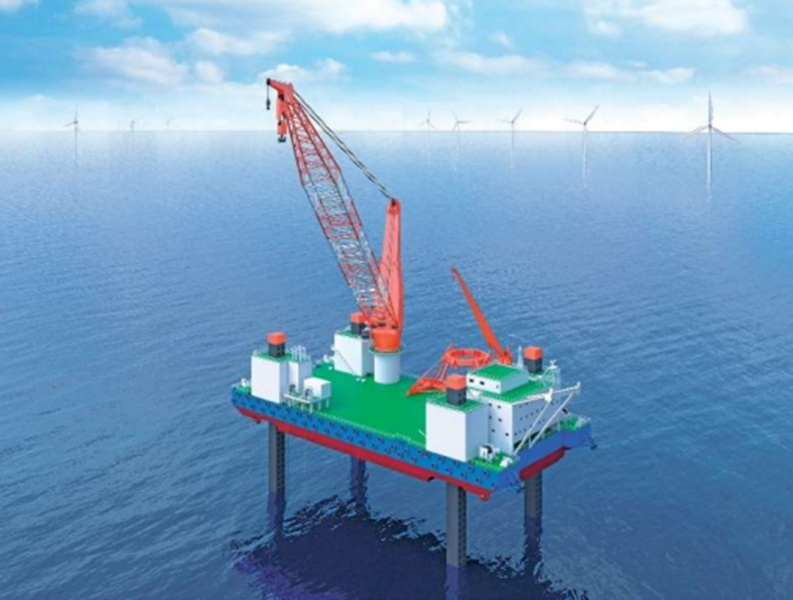
Japan Marine United (JMU), Nihon Shipyard (NSY), and Toa Corp got approval in principle (AiP) to convert medium-sized self-elevated platform (SEP) vessels for large wind turbine installation on semi-sub floaters and service ports.
This design allows construction of floating wind facilities at the base port where there is less tidal and wave impact. Quay reinforcement or land-based cranes aren’t needed.
This project was financed by the Green Innovation Fund.
TAKEAWAY: As Japan plans more offshore wind farms, demand for SEP vessels will grow. Major shipbuilding companies are involved in their development. The seas surrounding Japan are known for strong tides and currents, and adopting Japanese technology should help wind farm construction.
Air Water develops Japan’s first vertical solar power system
(Company statement, April 13)
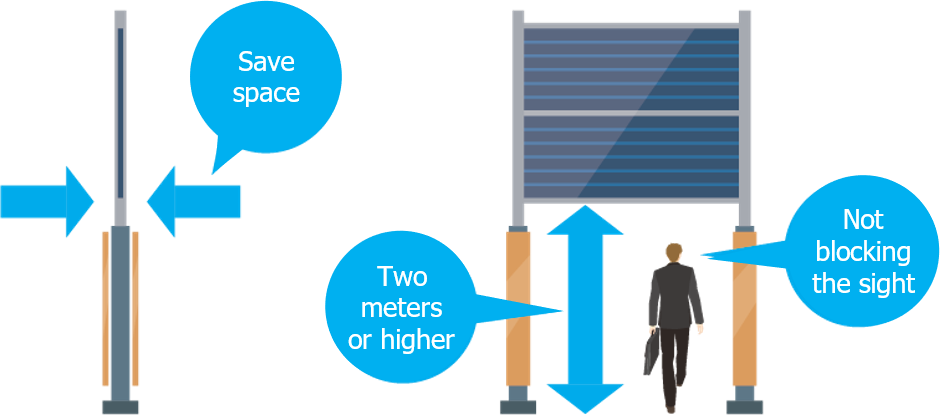
Air Water and Luxor Solar (Germany) developed high-performance solar PVs for vertical installation in parking lots.
The bi-facial solar PV is seen as efficient for power generation and shows no difference in that regard from flat installations. Also, vertical units can’t be damaged by heavy snow.
Air Water starts sales in May. The technology is called VERPA = vertical solar systems for parking areas.
TAKEAWAY: Vertical installations of solar PVs were tested in Europe with positive results. With availability of open flat land becoming an issue for further solar installations in Japan, this approach is likely to win strong interest.
Two bioenergy plants in Fukushima started operations
(New Energy Business, April 19)
Hirata Bioenergy, a company owned by Okumura-gumi (56%), Shikoku Electric (39%), and Iwahori Construction (5%), launched operation in two locations in Fukushima Pref; both have 1.99 MW of generation capacity (total 3.98 MW).
Main equipment such as boilers and turbines are supplied by Takuma, and construction was done by Iwahori. The fuel (wood chips) are sourced from nearby areas.
MHI began operation of gas turbine at new 5.3 GW gas-fired plant in Thailand
(Company statement, April 19)
Mitsubishi Heavy Industries (MHI) began operation of the first M701JAC unit at a natural gas-fired power plant in Thailand. It’s the fifth of eight M701JAC gas turbines that are part of a turnkey 5.3 GW contract that Mitsubishi Power signed in 2018.
Mitsubishi Power will deliver three more turbines for two gas turbine combined-cycle thermal power plants in Rayong and Chonburi provinces; each with a 2.65 GW capacity.
The plants are owned by Thai Gulf Energy Development and Mitsui. They’ll sell the power to the Electricity Generating Authority of Thailand (EGAT). The plants begin operation in autumn 2024.
NEWS:OIL, GAS & MINING
Mitsui acquires “unconventional” gas asset in Texas; output goal is 200 million cfd
(Company statement, April 20)
Mitsui acquired a 92% interest in an “unconventional gas asset” in Texas from a subsidiary of Silver Hill Energy Partners.
The asset is part of the Hawkville field, which has access to the Gulf Coast industrial area, including LNG export terminals and ammonia plants.
Mitsui will operate the asset through its subsidiary Mitsui E&P USA. It aims to produce over 200 million cubic feet per day.
CONTEXT: This is the first time for Mitsui to be an operator of gas development and production business in the U.S.
NYK Line to invest ¥560 bln in LNG carriers and decarbonization of vessels
(Japan Maritime Daily, April 20)
NYK Line’s president, Soga Takaya, said the company will invest ¥300 billion in new LNG carriers.
Soga expects LNG transport demand to rise, since transport through Russian pipelines will be transferred to ships.
The company will also invest ¥290 billion in ship decarbonization. Orders for car carriers, which require fuel conversion, are for a series of LNG-fueled vessels.
Philippines soon to receive first LNG imports; Osaka Gas and Tokyo Gas involved
(Nikkei, April 21)
The Philippines is preparations to import its first LNG cargo. The country’s only natural gas field is expected to be depleted in a few years.
Several companies, including Osaka Gas, have invested in local energy infrastructure development, while power companies are partnering with Tokyo Gas to develop facilities. AG&P, an energy infrastructure developer funded by Osaka Gas’ subsidiary in Singapore and the Japan Bank for International Cooperation, will operate an LNG receiving terminal near Manila.
CONTEXT: In the Philippines, gas-fired generation serves as an important alternative to coal-fired power. Currently, gas accounts for 18% of the country’s electricity generation, while renewables make up 22%. Coal power is the dominant source at 60%.
LNG stocks rise to 2.42 million tons, up 0.4% from a week earlier
(Government data, April 19)
LNG stocks of 10 power grids stood at 2.42 million tons as of April 16, up 0.4% from 2.41 million tons a week earlier. METI previously reported April 9 stocks as 2.4 million tons but revised the figure.
The end-April stocks last year were 1.96 million tons. The five-year average for this time of year was 1.95 million tons.
March thermal coal and LNG imports slump, crude oil edges up
(Government data, April 20)
Japan imported 8.5 million tons of thermal coal in March, down 19.9% YoY; LNG imports were 5.7 million tons, down 12%; crude oil rose 0.4% to 12.9 million kiloliters (82 million barrels).
TAKEAWAY: Coal imports fell back to the usual March level after surging to a multi-year high in March 2022 after the Russian invasion. LNG buying has slowed globally, on the back of high stockpiles due to warm temperatures. JOGMEC, however, warns a buying frenzy may restart depending on EU supplies.
ANALYSIS
BY YOSHIHISA OHNO
OCCTO’s grid plan shows changing direction of Japan’s energy mix
Japan’s next edition of its Basic Energy Plan is not due until next year, but a glimpse into how the nation’s power mix is likely to change can be seen in a recent document submitted by OCCTO, the grid oversight entity.
According to OCCTO’s 2050 “masterplan”, the country needs to modernize its power system to allow large volumes of electricity from mostly renewable sources to move quickly from major production hubs to places of high demand.
The document paints a vision in which the proliferation of solar (260 GW target) and wind (86 GW target) power generation is underpinned by investment in High Voltage Direct Current (HDVC) cables, including underwater, to set a more flexible and interconnected system.
In some ways, the masterplan is an attempt to put into practical detail the carbon neutral policy direction of Prime Minister Kishida’s government. It makes room for scenarios that include electricity generation fueled by hydrogen and ammonia, as well as carbon capture for thermal stations.
The plan also assumes that nuclear power stays as part of the mix. However, while the plan’s three scenarios differ in terms of spending and other factors, each has the renewables capacity component absolutely fixed.
Unlike energy sources, pylons, power cables, and substations rarely attract much media attention. Yet these items will form the backbone of Japan’s power mix in coming decades. Should OCCTO’s multi-trillion-yen investment plan go ahead, it will plot the course of energy policies with more certainty than any political announcement.
Background
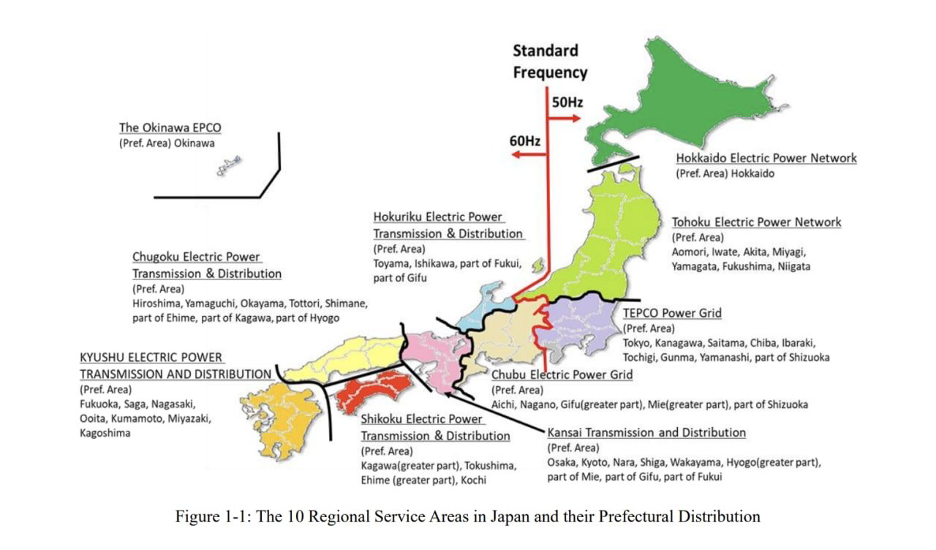
Prior to the power industry’s deregulation, regional Electric Power Companies (EPCOs) were responsible for generating, transmitting, and selling electricity within their territories. Each of the 10 EPCOs maintained their system independently, and there was little emphasis on regional grids being connected to each other.
The so-called interconnection power lines (which carry electricity from one regional grid to another) had limited capacity. The difficulty with moving electricity from one area to another was exacerbated further by the fact that Japan is one of only two countries in the world to maintain two electricity frequencies.
As Japan moved to liberalize the power sector and push EPCOs to unbundle, the need arose to make the regional grids more connected and flexible. A new entity to oversee the country’s nationwide power transmission network was established in 2015. And while ostensibly the Organization for Cross-regional Coordination of Transmission Operators (OCCTO) is a private body, it works closely with the government, and METI in particular, to coordinate nationwide power supply and demand.
For some years, OCCTO has worked on a plan to revamp Japan’s power grid to reflect the changing realities since the 2011 Fukushima nuclear disaster, which kickstarted the boom in solar power construction around the country.
In an electricity sector that utilizes more and more variable renewable energy, it was clear that the ability to move power volumes from sunny and windy Kyushu or windy Hokkaido and Tohoku to major centers of demand was paramount. The upgrade of the grid’s infrastructure was also timely as most of the core equipment such as high-voltage pylons was installed during the economic boom of the 1960s to 1980s.
Still, when OCCTO published its first masterplan for modernization of the power grid in 2017, it primarily focused on short-term measures to shore up transmission systems, such as installing new pylons, cables, transformers and pushing for a widening of the gates that allow the transfer of electricity from one region to another. It also called for better coordination between EPCOs.
Adding net-zero to the mix
Over the last two years, OCCTO’s proposals have become more ambitious and also more expensive. In May 2021, it produced an interim report for the masterplan with several scenarios based on the recently unveiled 2050 net-zero national vision.
In March, OCCTO unveiled the final 139-page “Masterplan for Cross-regional Power System Operation” that shifted the focus from security of local supply to a wholesale upgrade of technical capabilities.
“Accommodating the growing adoption of renewable energy is an urgent matter to be addressed; as well as dealing with balancing capacity matters and other issues,” said OCCTO president Tsutomu Oyama in a company statement. “We’ve taken on new operations related to the Act on Renewable Energy Special Measures in accordance with the Act for Establishing Energy Supply Resilience enacted in June 2020. We will focus on these operations while keeping the government’s goals in mind.”
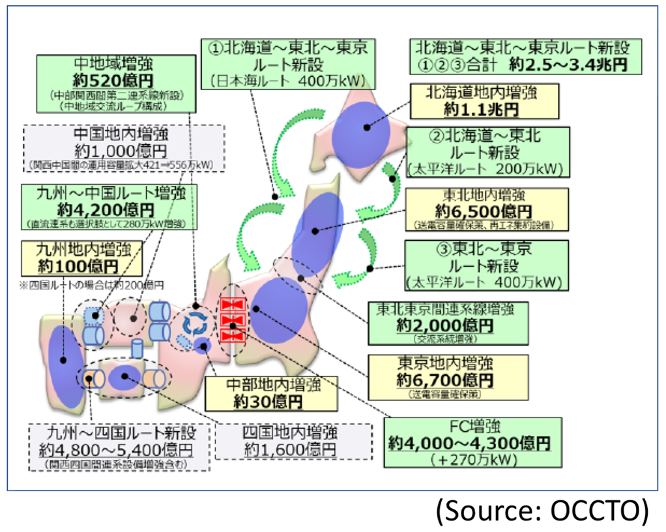
One of top cost items in the plan, which estimates outlays of ¥6 trillion to ¥7.9 trillion, is the installation of HVDC submarine cables to link major urban areas such as Tokyo and Osaka with future offshore wind power plants in Hokkaido, Tohoku, etc.
By 2050, the plan sees Japan operating 14 GW of offshore wind power capacity in Hokkaido and 9 GW in the Tohoku areas, with Tokyo the main recipient of the volumes. Similarly, 12 GW of offshore wind power in Kyushu could supply green power to the Kansai area.
Creating the infrastructure to enable long-term transmission is seen as vital to support a large renewables component, which in turn would bring down the carbon intensity of the nation’s electricity mix, while also providing resilience for the grid.
Details on future capacity
The 2023 masterplan splits its proposal to help Japan achieve carbon neutrality by 2050 into three scenarios: the base case; the “demand location guidance” case; and the “demand location natural” case.
In all three scenarios, power demand and supply are set at the same level, with renewable energy as the main power source by 2050; these goals are 260 GW of solar, 41 GW of onshore wind, 45 GW of offshore wind, and 60 GW of hydro, biomass, and geothermal energy.
The plan does not provide specific output capacities for thermal and nuclear power but assumes that thermal power plants will operate until the end of their submitted plans and be replaced with hydrogen or ammonia-based plants. Nuclear reactors are projected to operate for 60 years.
To enable this, OCCTO advocates for more interconnection capacity, especially between the east and west of Honshu Island, and to establish stronger transmission links between north Japan, such as Hokkaido and Tohoku and the central Tokyo area. The content of the latest OCCTO Master Plan reflects the government’s GX Basic Policy announced on December 22, 2022.
Beneficiaries
Japan has a strong electrical engineering sector, but domestic firms have not made major breakthroughs in technologies such as HVDC transmission. However, in 2018, one of the engineering majors, Hitachi Ltd., made a record investment in the transmissions business of Zurich-based ABB. Last year, Hitachi took full control of the grid-focused company that also specializes in HVDC.
There was speculation that METI supported the acquisition since it wanted to see a Japanese firm obtain engineering and manufacturing capacity for HVDC transmission, especially for submarine cables linking Hokkaido, Tohoku, and Tokyo.
It’s too early to ascertain which companies will be tasked with upgrading the nation’s power grid infrastructure. But it’s clear that the business opportunities match if not exceed those in electricity generation. Pylons and cables may not get the headlines, but they will certainly generate lucrative contracts.
ANALYSIS
BY KYOKO FUKUDA
Can Japan build a domestic offshore wind farm supply chain?
Together with fellow G7 members, Japan has committed itself to a major buildout of offshore wind power generation. In effect, this means creating a sector almost from scratch.
While most attention so far has focused on the slow rollout of auctions to decide which companies will develop offshore wind projects, there’s been one positive result: allowing time for domestic industry to grasp the policy shift and start planning ways it can participate in the sector’s burgeoning supply chain. That also instigated a flurry of partnerships between Japanese and international firms, creating new market players.
The government’s top goals for offshore wind generation are clear: Become a significant source of energy on a scale that squeezes fossil fuel generation to a minimum and overtakes domestic nuclear capacity. The initial 10 GW of offshore wind capacity penciled in for this decade is supposed to precede a much faster rollout in the 2030s and the 2040s, with a gradual shift to turbines that float in deep water, as opposed to fixed to the ocean floor.
For these plans and visions to be realized, however, the sector will need to aggressively cut its costs and one way to do that, according to the government, will be to create a vibrant and competitive domestic supply chain that would service the full cycle of wind power generation from environmental assessments to turbine decommissioning.
We review some of the recent developments in this space.
Market size
In 2019, METI set out the following long-term roadmap for the wind power sector.
Target Year
Onshore Wind
Offshore Wind
Total Capacity
2030
26.6 GW
9.6 GW
36.2 GW
2040
38 GW
27.9 GW
65.9 GW
2050
38 GW
37 GW
75 GW
Source: METI
In December 2020, METI revised its target for offshore wind capacity to 10 GW by 2030 and 30-45 GW by 2040. The target for 2050 wasn’t specified, but was widely believed to stay at the 37 GW from the earlier plan.
So far, adding wind capacity both onshore and offshore has been slow going; as of late 2022, there was a total of 4.6 GW in operation, of which only 0.06 GW was offshore. This makes the 2030 government target for offshore projects particularly ambitious.
In December 2022, Japan’s first commercial offshore wind power operations kicked off in the Akita area as Marubeni Corp started feeding electricity from its 140 MW Noshiro Port project that uses Vestas V117-4.2 MW turbines.
Background
The deep waters off Japan’s coasts pose technological challenges that differ from some of the other regions where offshore wind power is currently flourishing. Japan’s four major islands – Hokkaido, Honshu (mainland), Shikoku, and Kyushu – are surrounded by strong currents and tides. Typhoons regularly visit in late summer and autumn, bringing an added layer of complexity to both construction and operations.
The initial cost estimate for the first 10 GW was calculated at about ¥5 trillion to ¥6 trillion, according to METI and the Japan Wind Power Association (JWPA) calculations first released in 2019. Since then, inflation in raw material and construction costs is up by double digits.
A way to mitigate these costs now and for the future, is to secure more production in Japan. After all, the cost of wind turbine production accounts for about 24% of the total offshore wind power project cost.
Japan, however, currently imports most of its wind turbines. Despite efforts to break into this sector in the last decade, Japanese manufacturers failed to win orders in a barren domestic market or get traction abroad. Most exited from turbine manufacturing altogether. Even in the current policy environment, Japanese firms have responded by forming international partnerships and JVs rather than strike out on their own.
Complex systems and supply chains
The offshore wind supply chain comprises a wide range of components, including wind turbines, foundations, substations, and transmission cables. As Japan’s offshore wind capacity expands, the demand for these components is set to rise exponentially, creating a thriving ecosystem of manufacturers, suppliers, and service providers.
Wind turbines, the most critical component, are particularly complex, consisting of parts such as nacelles, towers, and rotor blades. The total number of components can reach 20,000 and include small items like nuts and bolts but also parts that weigh several tons.
The Agency for Natural Resources and Energy (ANRE) and JWPA stated that their goal is to domestically source 60% of the components (not just turbines) by 2040. How that will be accomplished is still not clear.
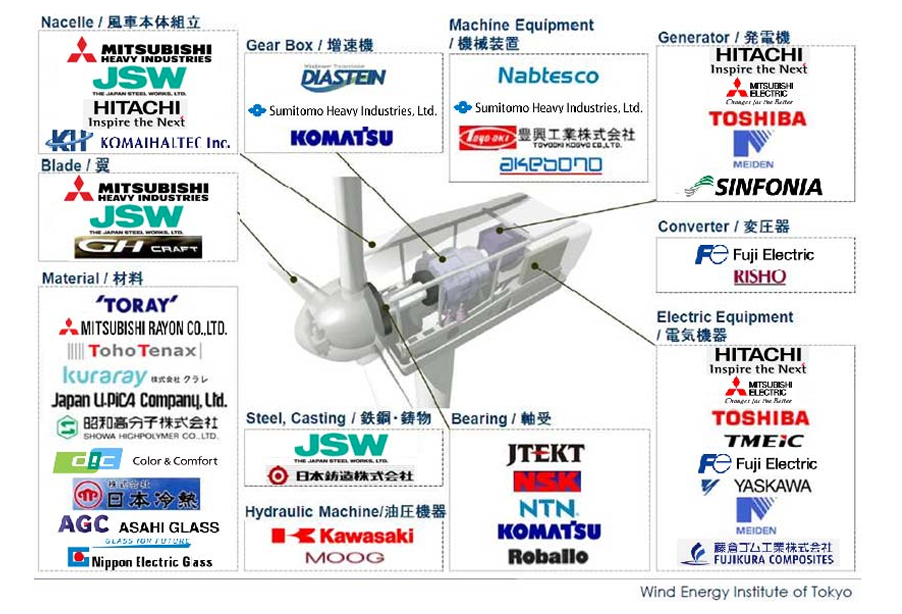
About a decade ago, and up until the mid to late 2010s, Japan’s main wind turbine production was led by Mitsubishi Heavy Industries (MHI), Hitachi (based on the assets of Fuji Heavy Industries), and Japan Steel Works. By the mid 2010s, these three firms supported an ecosystem of over 60 wind component producers across 69 factories, generating over $1 billion of sales.
Other prominent industry players were Fuji Electric (electric devices), NTN (bearings) and Ishibashi (gearbox).
Japan’s wind turbine supply chain circa FY2014-15
Source: WindEurope Summit 2016
However, by 2020 the above ecosystem was devastated. In 2018, MHI touted itself as the maker of the world’s largest wind turbines, but a few years later it gave up on the devices, taking a back seat in the business driven by its once 50-50 partner Vestas. In February 2021, the manufacturer announced that a new joint venture, MHI Vestas Offshore Wind, will supply Japan’s offshore wind market. So far, Vestas is playing more of a marketing role.
Hitachi pulled out of the wind turbine business in 2019, citing global competition, and said it would instead focus on distributing machines made by Germany’s Enercon. In the same year, Japan Steel Works withdrew from the business also, although it stopped producing wind turbines back in 2016.
In 2021, Toshiba became the first major domestic engineering conglomerate to wade back into wind turbine production, but only as a local partner for GE to help produce parts for the assembly of the U.S. firm’s Haliade-X turbine nacelle.
Unlike its domestic peers, Toshiba scored an early victory because half a year after the GE partnership was announced, a group led by Mitsubishi Corp swept at Japan’s first major offshore wind tenders. All three of Mitsubishi’s projects will install GE turbines.
The big win could help the Toshiba group act as the hub to regroup the domestic turbine component makers, although the government has revised the next set of offshore wind auctions so that the Mitsubishi group is unable to repeat their success. As such, Toshiba and GE will need to seek favor with other project developers in a very competitive market.
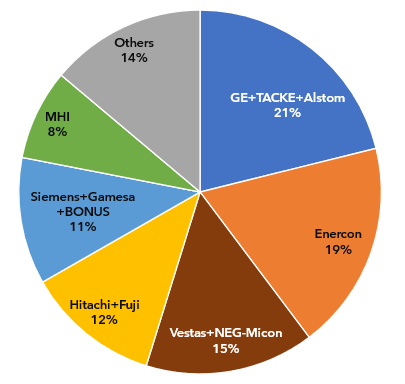
Until these large offshore wind projects begin construction, turbine orders are likely to remain small with onshore developments constrained by land availability and local concerns. Last year, there was just 233 MW of new wind capacity installed in Japan, with Vestas as the top supplier, according to JWPA data. This took the market total to 4.8 GW.
Japan turbine market, late 2022
JE Wind is the only existing wind turbine manufacturer in Japan that produces MW-class turbines.
Finance and construction
Since offshore wind power projects are still new for Japan, there are concerns about risks of project completion. Thus, only big players (keiretsu group companies) tend to participate since they are able to secure financing.
Due to high costs, companies must form a consortium to build the supply chain and complete construction. Usually, the group is led by a general construction company or engineering procurement and construction company (EPC), or a trading company that offers financing. Majors in this segment include Toshiba, Hitachi, JFE Holdings, Mitsubishi Shipbuilding, Sumitomo Electric Industries, Toray, and Penta-Ocean Construction.
The assessment involves environmental research at the installation site, such as the local weather patterns, tide and currents, seabed, as well as the impact that the wind project will have on local communities, etc. Once the project zones are defined, the consortiums that plan to bid will conduct their own assessment.
Traditionally in Japan, EPC companies – JGC, Chiyoda, Toyo Engineering – led the building of a power plant. For construction of offshore wind plants, however, major construction companies such as Kajima, Shimizu, Obayashi, Toa, Penta-Ocean have taken the lead. These companies build wind turbine foundations and towers, as well as other structures.
For the big three Round 1 projects won by Mitsubishi, Kajima is said to be the general contractor after agreeing to a multi-project discount. Other firms involved at the engineering and construction stage often involve subsidiaries of trading companies and oil and gas firms. These include Mitsubishi Energy Solutions, Marubeni Power Systems, Cosmo Engineering, GE Power Solutions, CTech, etc.
Ancillary work
A crucial but often overlooked part of offshore wind power is the vital infrastructure around the turbines. This includes laying cables between the offshore power station, sub stations and onshore stations.
Japan’s offshore wind stations are built relatively close to shore; however, the area is often marked by steep subsea slopes and deep water. Technological advances are needed to overcome these issues.
Shipping companies such as Mitsui OSK Line and NYK Line provide offshore wind projects with self-elevating platforms and deliver construction materials offshore. They also provide crew-transfer vessels (CTVs) for transporting construction workers, engineers, and operators.
Not all the residents living near a project site welcome construction of wind turbines, but giving some orders to local companies often helps to soften such opposition and stimulate the local economy. These contracts include lodging, transportation, insurance, labor, security service, garbage collection, etc.
Operation and maintenance
Once the wind farm is completed, usually after just a few years, operation and maintenance begins. While the daily operation is conducted by the electric power company or the owner of the power plant, safe and stable operation must be guaranteed, especially in the face of extreme weather such as typhoons and strong tides and currents. Subsea drones and other unmanned autonomous vehicles (UAVs) to monitor the towers can help with maintenance.
Cosmo and Eurus Energy are just a few of the companies involved in running wind projects and doing maintenance.
Finally, wind farm operators will have to think of what to do with the turbines once they reach their termination point, usually after 30 years. Decommissioning and recycling are done by O&M companies, which are often local subcontractors with a special license in industrial waste recycling.
Cost basis of offshore wind projects
Source: METI
All of the stages of offshore wind power development in Japan offer tremendous business opportunities for industry and service firms. But the long-term gestation of the offshore wind projects mean that it will be those that dig in for the long term that gain the fruit of the Japanese market once it finally ripens around the second half of this decade.
GLOBAL VIEW
BY JOHN VAROLI
Below are some of last week’s most important international energy developments monitored by the Japan NRG team because of their potential to impact energy supply and demand, as well as prices. We see the following as relevant to Japanese and international energy investors.
Brazil/ biofuel
Acelen will invest $2.44 billion in a biorefinery to make “green” diesel and jet fuel, with an annual capacity of 1 billion liters of hydrotreated vegetable oil. Construction begins in January 2024; launch is slated for 2026.
Brazil/ Solar power
ArcelorMittal Brazil (AMB) will form a JV with Casa dos Ventos, a leading local renewable energy developer, to build a 554 MW wind power project. AMB will own 55%, while Casa dos Ventos will have 45% in the $800 million project in the Bahia region.
China/ Coal demand
The rise in EV sales in the world’s largest EV market will increase pressure on grids, which are struggling amid low hydropower output and rising power demand from industry and households, especially from rising EV fleets. This means that China will rely more on coal to provide the country with power, said consultancy ANZ Group.
Europe/ Offshore wind power
Danish energy firm Orsted and Spain’s Acciona will team up to develop cost-effective foundations for floating offshore wind turbines. They’ll explore the use of carbon-neutral bio-concrete and other materials.
Germany/ Energy efficiency
The cabinet banned most new oil and gas heating systems starting 2024; new systems will have to run on 65% renewable energy. This will engender costs of €9 billion annually; the govt will subsidize 50%. Heating accounts for 15% of Germany’s GHG emissions.
G7/ Russian nuclear materials
Japan, the UK, Canada, the U.S. and France agreed to co-operate to reduce dependence on Russia as a nuclear materials and technology source. This came at the Nuclear Energy Forum during the G7 ministers on climate, energy and environment meeting in Sapporo.
Iraq/ Oil exports
Iraq restarted crude oil exports from its autonomous region of Kurdistan, settling most of their differences with regards to oil exports that travel by pipeline to Turkey.
Pakistan/ Oil
The country placed its first order for discounted Russian crude oil, which will dock in Karachi in May. Pakistan is a close U.S. ally, but faces an acute balance of payments crisis, risking default on its debt.
Peru/ Solar power
Ecorer won the 100 MW Montalvo solar project in the Moquegua region. Ecorer is a subsidiary of hydroelectric producer Compañía Eléctrica El Platanal, and it already has concessions for wind projects: Acarí (40 MW), Acarí 2 (50 MW) and La Quebrada (100 MW).
Russia/ Oil exports
Despite Moscow’s pledge to cut output, the amount of crude exports and transit this month from the ports of Primorsk, Ust-Luga and Novorossiysk will rise above 10 million tons, up from 9.7 million tons in March.
Kazakhstan/ Natural gas
Russia offered to sell natural gas to Kazakhstan at a lower price than for Belarus, which pays Moscow an equivalent of €117 per 1,000 c/m. Moscow and Astana also agreed on a preliminary plan for gas pipelines. In Europe, gas trades at about €430 per 1,000 c/m.
U.S./ LNG
The Federal Energy Regulatory Commission approved LNG export terminals – Texas LNG, and Rio Grande LNG – as well the associated Rio Bravo Pipeline. Environmental activists, such as the Sierra Club, want a rehearing of the approvals, saying “We’re not backing down.”
U.S./ Solar power
Sunergy Renewables will go public via a merger with ESGEN Acquisition Corp; the new company will be valued at $475 million. Sunergy provides solar and battery-based power as well as storage systems for residential use in Florida, Texas and Arkansas.
2023 EVENTS CALENDAR
A selection of domestic and international events we believe will have an impact on Japanese energy
ASEAN-Japan summit to mark 50 years of cooperation
Last market trading day (December 30)
Disclaimer
This communication has been prepared for information purposes only, is confidential and may be legally privileged. This is a subscription-only service and is directed at those who have expressly asked K.K. Yuri Group or one of its representatives to be added to the mailing list. This document may not be onwardly circulated or reproduced without prior written consent from Yuri Group, which retains all copyright to the content of this report.
Yuri Group is not registered as an investment advisor in any jurisdiction. Our research and all the content express our opinions, which are generally based on available public information, field studies and own analysis. Content is limited to general comment upon general political, economic and market issues, asset classes and types of investments. The report and all of its content does not constitute a recommendation or solicitation to buy, sell, subscribe for or underwrite any product or physical commodity, or a financial instrument.
The information contained in this report is obtained from sources believed to be reliable and in good faith. No representation or warranty is made that it is accurate or complete. Opinions and views expressed are subject to change without notice, as are prices and availability, which are indicative only. There is no obligation to notify recipients of any changes to this data or to do so in the future. No responsibility is accepted for the use of or reliance on the information provided. In no circumstances will Yuri Group be liable for any indirect or direct loss, or consequential loss or damages arising from the use of, any inability to use, or any inaccuracy in the information.
K.K. Yuri Group: Oonoya Building 8F, Yotsuya 1-18, Shinjuku-ku, Tokyo, Japan, 160-0004.
NEWS
・Panasonic to invest $5 bln to expand EV battery production
in the U.S., seeking growth beyond Tesla
・NYK Line to spend ¥560 bln on LNG carriers and decarbonization of vessels; expects LNG transport demand to rise
・Toyota vows to cut autos’ CO2 footprint by over 50% by 2035, while also investing in biofuel hybrids in Brazil, EVs, fuel cells