Japan to ask EV makers to report CO2 emitted during production
Trading of TOCOM electricity futures rose nearly 50% in 2022
High energy prices propel Mitsui’s profit to over ¥1 trillion, a first for a Japanese trading house
ENERGY TRANSITION & POLICY
Deliberations start for GX Decarbonization Power Supply law
New 2040 hydrogen goal highly ambitious: FEPC
MoE to study environmental impact of offshore floating wind
5 Hokkaido areas designated potential offshore wind zones
Chile seeks hydrogen superpower status, Japan involved
Japan and France will deepen nuclear cooperation
Toyota and Paccar to commercialize hydrogen fuel cell trucks
Itochu and Veloce partner on EV power storage and distribution
ELECTRICITY MARKETS
Sales at new power market players drops by double digits
Restart of two units at Kansai Electric’s Takahama NPP delayed
NRA approves “additional inspection” for reactors over 60 years
Shizen Energy established a renewables JV in South Korea
Hitachi Energy inks multi-billion-yen HVDC order in U.S.
JAEA signs with Cavendish Nuclear on sodium disposal at Monju
First offshore wind farm near fishing port approved in Aomori Pref
Mitsubishi Steel makes parts for wind power at Muroran Works
OIL, GAS & MINING
Seoul and Tokyo mull cooperation on LNG
Mitsubishi, Capstone to test cobalt extraction tech
Osaka Gas plans to issue ¥20-30 billion transition bonds for LNG
ENEOS to push JX Metals IPO
ANALYSIS
GOING INTO THIS WEEK’S G7 SUMMIT, JAPAN IS ON THE DEFENSIVE
When Japan hosts the G7 this weekend in Hiroshima, PM Kishida will be keen to tout his Green Transformation (GX) policy. Some of his G7 peers, however, might be skeptical. Many international media and environmental groups see Japan as the laggard in the G7.
ELECTRICITY TRADING MARKET RENEWAL SCHEDULED AFTER 2028
Electricity always requires perfect balance. Maintaining this equilibrium between what power plants can deliver to the grid and what users require is a tough task that’s only getting harder. Now, officials hope a new market platform will better mirror what it takes to provide electricity at competitive prices, while also ensuring sufficient capacity to meet future demand.
GLOBAL VIEW
A wrap of top energy news from around the world.
EVENTS SCHEDULE
A selection of events to keep an eye on in 2023.
JAPAN NRG WEEKLY
PUBLISHER K. K. Yuri Group
Editorial Team Yuriy Humber (Editor-in-Chief) John Varoli (Senior Editor, Americas) Mayumi Watanabe (Japan) Yoshihisa Ohno (Japan) Wilfried Goossens (Events, global)
New Energy and Industrial Technology Development Organization
kWh
Kilowatt hours (electricity generation volume)
TEPCO
Tokyo Electric Power Company
FIT
Feed-in Tariff
KEPCO
Kansai Electric Power Company
FIP
Feed-in Premium
EPCO
Electric Power Company
SAF
Sustainable Aviation Fuel
JCC
Japan Crude Cocktail
NPP
Nuclear power plant
JKM
Japan Korea Market, the Platt’s LNG benchmark
JOGMEC
Japan Organization for Metals and Energy Security
CCUS
Carbon Capture, Utilization and Storage
OCCTO
Organization for Cross-regional Coordination of Transmission Operators
NRA
Nuclear Regulation Authority
GX
Green Transformation
NEWS: ENERGY TRANSITION & POLICY
Starting FY2024, Japan will ask EV makers to report CO2 emitted during production
(Nikkei Asia, May 9)
Starting FY2024, Japan plans to mandate that EV makers disclose the CO2 volume released during battery production, to determine eligibility for subsidies.
Initially, battery emissions will only be reported to METI but eventually consumers will also have access to this information.
The government may impose a cap on emissions, which would prevent vehicles exceeding the limit from receiving subsidies.
CONTEXT: Although EVs have minimal emissions during operation, they are believed to emit twice as much CO2 as gasoline vehicles during manufacturing. Up to 60% of all CO2 emitted by EVs comes from battery production.
Trading of TOCOM electricity futures in 2022 rose 50%; May volume is record high
(Denki Shimbun, May 9)
TOCOM’s trading of electricity futures rose 49.7% in FY2022, to 1,561 GWh.
In reaction to the sharp price hike of Spot Market (Day Ahead Market) traded at JEPX, the demand to fix electricity prices showed a substantial increase.
In May, monthly trading volume reached over 200 GWh for the first time. One reason was that prediction accuracy was ahead of the high demand season.
CONTEXT: In the summer, electricity markets tend to be volatile, which makes price forecasting difficult. However, in May, since trading is not so active, traders find it easier to forecast. This is why trading increased in May 2022, even when fuel prices were uncertain following the start of war in Ukraine in February 2022.
TAKEAWAY: Power trading volumes are up in Japan in general. The two main platforms for electricity futures in the country are the TOCOM, which is part of the JPX exchange group, and the EEX. Trading volume on the EEX almost doubled in February from a month earlier to approach 2,500 GWh. Greater interest in power futures is attributed to increased price volatility and uncertainty, as well as a push to have more market participants deploy risk-hedging strategies.
Record energy prices propel Mitsui to surpass ¥1 trillion in profit, a first for Japan
(Business Nikkei, May 10)
Mitsui reported a 23.6% YoY increase in profit, reaching ¥1.13 trillion in FY2022, the company’s first time exceeding ¥1 trillion and a first among trading companies.
The growth was primarily attributed to the energy sector, which benefited from the combined effect of a weaker yen, and higher oil and gas prices.
The company lowered its 3-year profit plan to ¥920 billion, assuming that the current “strong tailwind” driving profits will subside in the next three years.
TAKEAWAY: Record energy prices last year helped propel profits at major oil and gas suppliers around the world and Mitsui is no exception. The most energy-reliant of Japan’s trading houses, Mitsui is heavily invested in both resource extraction, processing, and retail. Its biggest assets in the field include a stake in Russia’s Sakhalin-2 LNG project, investments in Mozambique and Australian LNG developments, and a shale gas and pipelines business in the U.S. It is also involved in energy distribution in Brazil, Mexico and North America, as well as ranking among the top Japanese importers of iron ore from Australia.
Deliberations start for GX Decarbonization Power Supply Law
(Denki Shimbun, May 11)
The Committee on Economy and Industry in the House of Councillors began discussions on the GX Decarbonization Power Supply bill.
At the Q&A, a Komeito Party member said the GX policy would be incongruous with the Sixth Strategic Energy Plan, which calls for less nuclear energy. METI Minister Nishimura replied that nuclear power’s share won’t exceed 30%, which was the share at the time of the Fukushima accident, and it will eventually be lessened.
TAKEAWAY: The GX Decarbonization Power Supply bill was passed during the House of Representatives plenary session on April 27, with some amendments. Now, the bill has been sent back to the House of Councillors to deliberate on the amended parts.
New 2040 hydrogen goal highly ambitious: FEPC
(Japan NRG, May 8)
The Federation of Electric Power Companies (FEPC) told an ANRE panel, which is rewriting the 2017 Basic Hydrogen Strategy, that the new goal to supply 12 million tons of hydrogen in 2040, (up from 3 million tons in 2030), was highly ambitious.
The FEPC urged ANRE to include in the revised hydrogen strategy the necessary steps to reach this goal, as well as challenges that the relevant industries need to clear.
It also asked ANRE to include measures to support local hydrogen production, which might be hampered by low cost imports. Until domestic renewable costs drop, the govt’s support for local renewables needs to be clarified, FEPC said.
CONTEXT: In revising the 2017 Basic Hydrogen Strategy, ANRE plans to add new targets: the water electrolysis capacity target of 15 GW by 2030, and the 2040 hydrogen supply target of 12 million tons that stands between the goal of 3 million tons in 2030 and 20 million tons in 2050.
MoE launches study group on environmental impact of offshore floating wind stations
(Japan NRG, May 11)
The MoE set up a group to study the long-term environmental impact of floating wind power stations. The 13-member panel comprises experts from academia, the Central Research Institute of Electric Power Industry and the Development Bank of Japan.
Floating power stations are believed to have less impact compared to fixed foundation stations since there are less bird and wildlife species further out in the sea; but there’s no data to back it up.
Five Hokkaido coastal areas designated potential offshore wind zones
(Government statement, May 12)
METI approved five Hokkaido coastal areas as potential offshore wind zones. Talks with stakeholders will cover “Offshore Wind Promotion Zones” and project tenders.
The five areas are the coasts in Ishikari City, Ganwu-Minami Shiribeshi, Shimasaki, Hiyama and Matsumae.
CONTEXT: There are four other areas designated as “promising zones”, which are the north side of the Japan Sea coast in Aomori Pref, the south side of the Japan Sea coast in Aomori, Yuza Township in Yamagata Pref, Kujukuri in Chiba Pref, and Isumi City in Chiba.
Chile aims for hydrogen superpower status, Japanese companies involved
(Nikkei, May 10)
Diego Pardow, the Minister of Energy for Chile, said he’s in talks with several Japanese companies to finalize investment plans in the hydrogen sector.
Chile’s goal is to make hydrogen exports a major industry, with plans to become one of the world’s leading green hydrogen exporters by 2040. Japanese companies, including Sumitomo and Idemitsu Kosan, entered Chile in early 2023.
CONTEXT: Chile boasts areas suitable for generating solar and wind power, and intends to establish large-scale hydrogen plants in various regions to export to Japan and the EU. Additionally, the country aims to mass-produce both green ammonia and green hydrogen.
Japan and France will deepen nuclear cooperation
(Government statement, May 3)
METI minister Nishimura and France’s Minister of Energy Transition pledged to deepen their 50-year old nuclear cooperation.
The countries affirm the importance of building supply chains and developing small modular reactors and other advanced reactors. The cooperation will extend to the deployment of new reactors in their own countries and other countries.
Private companies and research institutes will strengthen efforts to develop sodium-cooled reactors.
Toyota and Paccar to commercialize hydrogen fuel cell trucks
(Financial Times, Various, May 2)
PACCAR and Toyota will design and manufacture trucks powered by hydrogen fuel cells with zero emissions. Toyota’s hydrogen fuel cell modules will be installed.
The hydrogen fuel cell powertrain kit recently received the Zero Emission Powertrain certification from the California Air Resources Board (CARB), and Toyota will begin putting together the modules in the U.S. later this year.
PACCAR will produce and sell the trucks in the U.S. and Canada; mass production begins in 2025. These long-haul, Class 8 trucks will have ranges of up to 725 km.
CONTEXT: Toyota is developing hydrogen fuel cell vehicles and already offers the Mirai. Despite infrastructure challenges, Toyota believes hydrogen is more promising than electric batteries for big vehicles like trucks because they can be charged in a short time, are smaller and lighter, and require smaller amounts of rare earth minerals.
Itochu partners with Veloce on EV power storage systems and distribution products
(Company statement, May 1)
Itochu bought a stake in Veloce Energy, a U.S. startup that develops energy storage systems and distribution products. The two will cooperate in marketing and sales.
Itochu and Veloce will also create a solution package that simplifies installation of EV chargers. They also plan to promote hardware and software functions in the energy management business, utilizing EVs and charging infrastructure.
Itochu plans to offer this solution to local logistics companies and others in the U.S. market, and customize it for Japan.
Marubeni starts sales of low-CO2 emission methanol produced in China
(Company statement, May 10)
Marubeni and MFE Shanghai Environmental Engineering and Technology secured marketing rights in Asia, except for China, for a low-carbon emission methanol called Circular Methanol.
This methanol is synthesized at the Shunli plant in China, utilizing Carbon Recycling International’s technology to combine CO2 and hydrogen. The methanol produced absorbs and utilizes more CO2 than it releases during production.
The plant has an annual production capacity of 110,000 tons and is the first-ever commercial facility to produce methanol exclusively from CO2 and hydrogen.
Toyota Tsusho starts Japan’s first continuous supply of biodiesel fuel for ships
(Company statement, May 10)
In April, Toyota Tsusho and Toyotsu Energy began Japan’s first continuous supply of blended biodiesel fuel to Toyofuji Shipping’s vessels at the Port of Nagoya.
The biofuel is derived from waste cooking oil from Toyota Group and Toyota Tsusho Group’s cafeterias, refined, and mixed with heavy oil.
The commercial launch is a result of Toyota Tsusho’s biofuel trials and research at the Port of Nagoya in 2022.
INPEX to supply biofuel to VLGC vessels in UAE
(Company statement, May 11)
INPEX will supply biofuel to very large gas carriers (VLGC) chartered by Astomos Energy to transport gas from the United Arab Emirates’ port of Khor Fakkhan. This is the first VLGC in the Middle East to sail on biofuel.
The biofuel comprises 24% used cooking oil-based fatty acid methyl ester (FAME) and 76% low-sulfur fuel oil.
The biofuel is expected to cut emissions by 15-20%.
Euglena established a biomass lab in Malaysia
(Company statement, May 1)
Euglena established a laboratory, “Euglena-UTM satellite lab” in Kuala Lumpur for research and development of biomass (e.g. algae, microalgae) production technology.
Malaysia was chosen because of the local climate’s biodiversity and abundant biomass. The lab will be the hub for Euglena’s biomass R&D in the ASEAN region.
JGC and Colowide agreed for building domestic SAF supply chain
(Company statement, May 10)
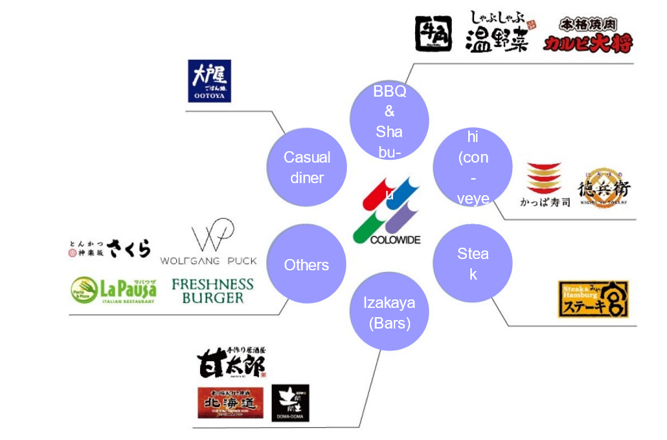
JGC, Colowide, Revo International and Saffaire Sky Energy will build a domestic sustainable aviation fuel (SAF) supply chain using used cooking oil.
Colowide is a chain of 2,300 restaurants for Japanese, Italian, hamburgers, etc; annually it uses 3,500 tons or 3.8 million liters of cooking oil.
Revo International collects the used cooking oil, while JGC provides technologies to process the oil into SAF.
TAKEAWAY: Saffaire Sky Energy was established in November 2022 by JGC, Revo, and Cosmo Oil to produce SAF at Cosmo’s Sakai (Osaka Pref) refinery to utilize used cooking oil and produce SAF. More restaurant chains are likely to join this supply chain to provide used cooking oil and monetize rather than pay to dispose of it.
KEPCO and MHI demonstrate absorption method to recover CO2 from exhaust gases
(Nikkan Kogyo, May 8)
A technology that reduces CO2 emissions from thermal power plants by capturing CO2 was successfully shown by KEPCO and Mitsubishi Heavy Industries.
The process recovers up to 99% of the CO2 in exhaust, resulting in emissions with a lower concentration of CO2 than in the atmosphere. Currently, the two companies have delivered thirteen CO2 capture plants for commercial use across the globe
Obtaining negative emissions, however, is energy-intensive
CONTEXT: Carbon prices in Japan are expected to grow, alongside the development of carbon markets through emission trading. In the past, a CO2 recovery percentage of 90% was a common standard, but recently the target has risen to around 95%.
Osaka Gas and Shell to collaborate on CCS value chain development
(Company statement, May 9)
Osaka Gas and Shell Singapore are studying developing a CCS (carbon capture and storage) value chain where CO2 for global use.
The study includes aggregation and liquefaction of CO2 emitted from steel, cement, chemical, and other hard-to-abate sectors; transport of liquefied CO2 via ship to storage facilities in the APAC region; and injection and storage of CO2 underground.
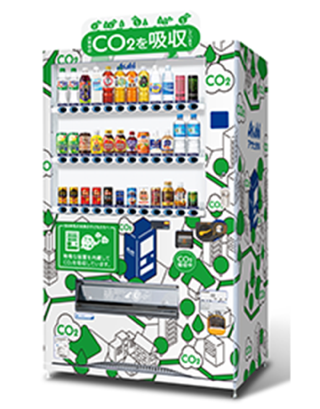
Asahi tests vending machines that absorb CO2 from the air
(Company statement, May 9)
Asahi Soft Drinks will test sustainable vending machines that absorb CO2, starting June. 30 units will be installed in big cities.
The vending machine will annually reduce CO2 emissions by 20%, compared to conventional ones.
The absorbed CO2 will be used for fertilizers or industrial material such as concrete.
Osaka Gas and Shell to launch CCS feasibility study
(Company statement, May 9)
Osaka Gas and Shell will study CCS value chains that capture carbon from industrial facilities in Japan, liquefies the gas, and injects it underground at sites in Asia Pacific.
The feasibility studies begin this month.
ENEOS to participate in Eastwood Climate Smart Forestry Fund
(Company statement, May 11)
ENEOS, Fuyo General Lease, and Unicharm will participate in the Eastwood Climate Smart Forestry Fund run by Sumitomo Forestry in the U.S.
The fund will generate carbon credits from forestry projects in North America. It will be formally launched in June.
MoE fund to invest in low-carbon chips
(Government statement, May 9)
The Japan Green Investment Corp for Carbon Neutrality (JICN) will invest in Tokyo-based Elephantech, a semiconductor tech firm developing printed electronics processes which reduces emissions, water, copper and other resource consumption.
NRA approves the program change proposal for ALPS treated water discharge
(Denki Shimbun, May 11)
The NRA approved the changes in TEPCO’s proposal for discharge of ALPS-treated water that was advised by the IAEA.
The IAEA pointed out that TEPCO should lessen the number of nucleus types needed to measure and assess, from 64 to 30 (including tritium).
TEPCO and the govt plan to release the ALPS-treated water this summer. But the fishing community strongly objects to the entire project.
NEWS: POWER MARKETS
Electricity sales of new power market players decline by double digits four months in a row
(Denki Shimbun, May 12)
According to the January 2023 Electricity Sales Report released by the EGC on May 9, the electricity sales of new power market players was 14,409 GWh, a 19% YoY decline. This is the fourth month in a row of double digit decline in electricity sales.
The market share of new power market players was 18.8%, a 2.9% YoY decline. There was a 6.8% share for the extra high voltage market (3% YoY decline), and 19.7% share for the extra high voltage market (8.2% YoY decline).
However, electricity sales of EPCOs were 62,213 GWh, a 3.4% YoY decline.
TAKEAWAY: Historically the main products of new power market players have been high voltage and extra high voltage electricity. However, in light of this sharp decline in those sales, it’s clear that they’re facing difficulties.
Restart of Takahama NPP Units 1 and 2 delayed due to fire safety work
(Denki Shimbun, May 8)
Kansai Electric said restart of Takahama NPP Units 1 and 2 (both 826 MW) will be delayed because they need additional fire safety work.
The original restart was June 3 for Units 1 and July 15 for Unit 2; but fire safety work will only be completed in mid May for Unit 1 and mid June for Unit 2.
After the work is finished, Kansai Electric will conduct preoperative tests before loading nuclear fuel. After the fuel is loaded, the two reactors will restart power generation in about three weeks.
NRA approves “additional inspection” for reactors over 60 years in operation
(Denki Shimbun, May 11)
The NRA approved a policy requiring “additional inspection” for nuclear reactors to operate longer than 60 years.
Currently, reactors are allowed to operate for 60 years if they pass the “special inspection” before reaching 40 years.
Under the new rule, reactors that passed “additional inspection” can operate for 60 years, plus the years forced to stop operation after Fukushima; additionally, the reactors also need to pass safety approval every 10 years after 30 years.
Shizen Energy established a JV in South Korea
(New Energy News, May 11)
Shizen International set up a JV, Inmark Jayeon Energy, with INMARK Asset Management and DOHWA Engineering for renewables projects in South Korea.
INMARK and DOHWA hold 60% and Shizen holds 40% of the new company, which sees 2 GW of renewable energy power generation opportunities in South Korea.
This year it’s investing in 100 MW of wind power stations and floating solar PV projects. By 2028, Inmark Jayeon Energy aims to develop 1 GW of renewables.
Inmark is responsible for operation and finance, Dohwa undertakes construction of the power stations, and Shizen takes care of land assessment, project planning, building supply chain, and networking with end users.
Hitachi Energy inks multi-billion-yen HVDC order in U.S.
(Company statement, May 12)
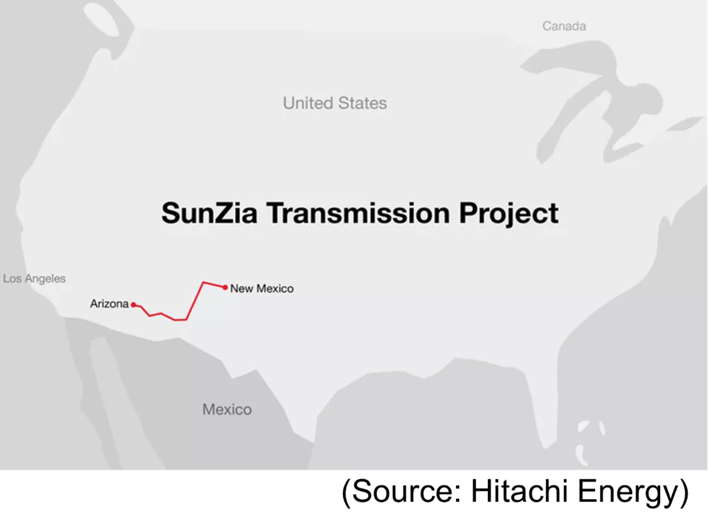
Hitachi Energy secured an order of high-voltage direct current (HVDC) equipment for U.S. renewable energy developer Pattern Energy. The contract is estimated to be tens of billions of yen.
Hitachi Energy will install two voltage source converters (VSC) to deliver the wind power generated at the 3.5-GW SunZia Wind project in New Mexico, to be sent to Arizona via more than 885 km of HVDC transmission lines.
The 525-kW transmission line, called “SunZia Transmission Project”, is the longest HVDC transmission line in the U.S. SunZia Wind is scheduled to start 2026; Hitachi will deliver the equipment by late 2025.
CONTEXT: HVDC is a system that efficiently transmits power over long distances using direct current, which must be converted to alternating current at converter stations before being sent to homes, etc.
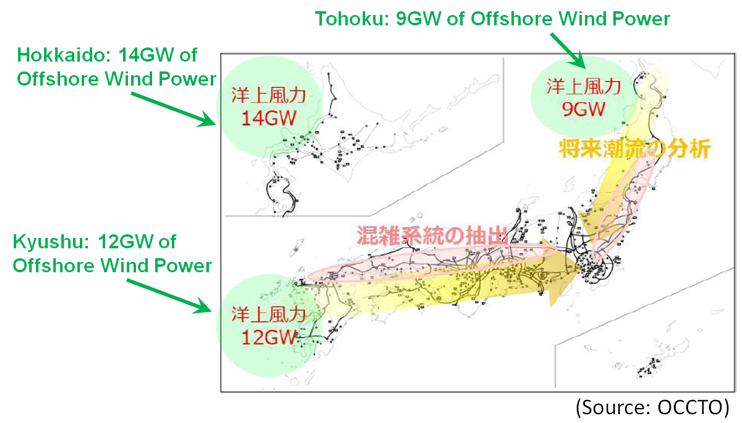
TAKEAWAY: As seen in the “Masterplan for Cross-regional Power System Operation” that was released by OCCTO on March 29, Japan has plans to deliver 14 GW of offshore wind power of Hokkaido and 9 GW of offshore wind power of Tohoku to Tokyo Area, as well as 12 GW of offshore wind power from Kyushu to Osaka Area. Thus, this new order for SunZia will be an important experience for the future of energy in Japan. Also, it’s believed that METI facilitated Hitachi’s acquisition of ABB, the world’s most advanced HVDC technology company, to secure HVDC technology for Japan.
JAEA to sign with UK’s Cavendish Nuclear to accelerate sodium disposal at Monju
(Denki Shimbun, May 8)
Japan Atomic Energy Agency (JAEA), which has been developing the Prototype Fast Breeder Reactor (FBR) at Monju and the Prototype Advanced Thermal Reactor (ATR) Fugen at Tsuruga Bay, signed a 10-year accord with UK decommissioning firm Cavendish Nuclear for disposal of sodium.
Cavendish has sodium disposal experience decommissioning the UK’s Prototype Fast Reactor. The plan for Monju calls for the sodium to be sent to the UK in 2028 to 2031. According to JAEA, 1,665 tons of sodium were stored at Monju as of 2021.
TAKEAWAY: Monju’s decommissioning was decided in December 2016, and the Japan office of Cavendish Nuclear opened in Oct 2018. Therefore, it seems that the govt asked them to open a Japan office to help with Monju’s decommissioning.
First offshore wind farm in vicinity of fishing port approved in Aomori Pref
(The To-o Nippo Press, May 11)
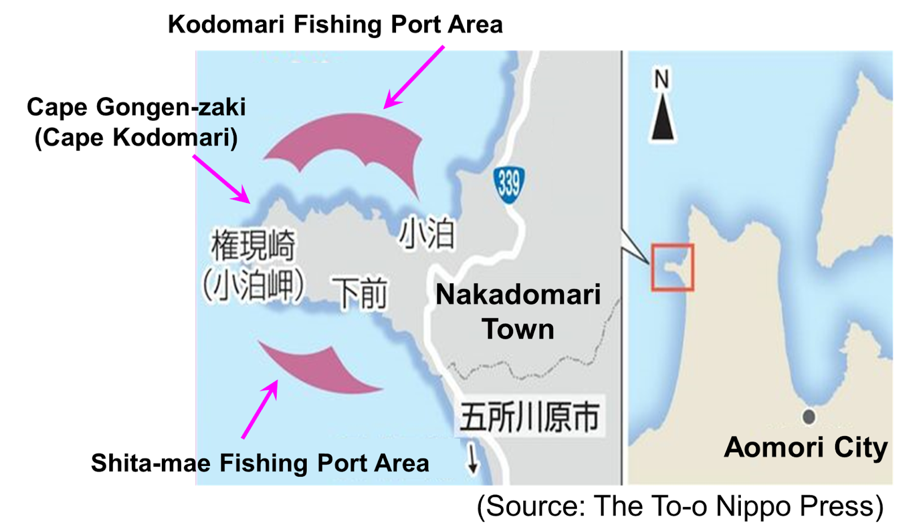
Nakadomari Town in Aomori Pref approved two offshore wind farms at the north and south sectors of Cape Gongen-zaki (Cape Kodomari), together with Japan Wind Development. This will be Japan’s first offshore wind farm in a fishing port area.
Seven 15 MW offshore wind turbines will be built in the north part of Cape Kodomari Fishing Port, and at the south part of Shita-mae Fishing Port. Both have a 100 MW capacity, and start in 2029. Electricity generated will be sold to Tohoku Electric.
The income from selling power and generated electricity will go back to the local community. Also, Nakadomari Town will train young people in Aomori Pref and hire them as maintenance staff.
Mitsubishi Steel to produce components for wind power at Muroran Works
(Nikkei, May 10)
Mitsubishi Steel invested ¥12 billion to upgrade its Muroran Works located in Hokkaido; this will enhance energy-saving efforts.
The company plans also involve bearing material production facilities for EVs and offshore wind power, and responding to future areas of demand.
By FY2026 the plant aims to achieve an annual production capacity of 6,000 tons.
Japan Renewable Energy began operation of a wind farm in Fukushima
(Company statement, May 8)
Japan Renewable Energy, Fukushima Mirai Kenkyukai, and Shinobuyama Fukushima Power began operation of the Azma Kogen Wind Farm in Fukushima City.
The wind farm has 32.4 MW capacity (3.6 MW x 9 Vestas turbines). Tohoku Electric Power Network buys all electricity generated.
Itochu and Hitachi will build an onshore wind project in Aomori
(Company statement, May 11)
Itochu inked a deal with Hitachi Zosen to build and for 20-year operation & maintenance of an onshore wind farm in Rokkasho-mura in Aomori Pref. Mitsubishi UFJ and Development Bank of Japan will finance the deal.
This 65 MW onshore wind farm starts commercial operation in April 2026..
The wind farm will be operated by Mutsu Ogawara Wind, funded 50-50 by Itochu and Hitachi. The 15 turbines are supplied by Siemens Gamesa (each 4.3 MW).
Vena Energy submitted an environmental assessment for a wind farm in Fukui
(Company statement, May 9)
Vena Energy made an environmental impact assessment for the Kunimi (onshore) wind farm in Fukui city, Fukui Pref. It’s available for online review May 9 to June 8. The 50 MW wind farm will have 12 turbines (each 4.2 MW).
The wind farm will be located on 10.5 hectares of land in the mountains. Construction starts in August and commercial operation in December 2025.
Renewable Japan began construction of hydropower plant in Yamagata
(Company statement, May 8)
Renewable Japan began work on a hydropower plant in Yonezawa, Yamagata Pref., of which capacity is 965 kW. Operation starts in July 2025.
The plant will be built in the Mogami (Matsukawa) river, using run-of-river hydroelectric methods. Construction cost will be ¥180 million.
Marubeni signed MoU with AEPCL in Bangladesh
(New Energy Business, May 10)
Marubeni signed an MoU with Asian Entech Power Corp (AEPCL), a Bangladesh power generator to develop power generation in Bangladesh.
The two will develop 600 MW of solar projects in south Bangladesh.
Actis launched Nozomi Energy targeting Japan’s renewable market
(Company statement, May 9)
Actis, a UK private equity firm, launched Nozomi Energy to develop renewables in Japan. Notomi targets 1.1 GW of onshore wind and solar power generation by 2027.
Actis acquired 100% of Hergo Japan Energy from Infrastrutture and IPP. Hergo has a portfolio of operating and developing solar and onshore wind projects totaling 230 MW, and a pipeline of early-stage projects.
NEWS: OIL, GAS & MINING
Seoul and Tokyo can cooperate on LNG: South Korea finance minister
(Nikkei Asia, May 4)
Choo Kyung-ho, South Korea’s deputy PM and Minister of Economy and Finance, spoke about possible cooperation with Japan on LNG.
He said that given both countries’ high dependency on LNG and their geographical proximity, cooperation should be natural.
According to the minister, the two countries should cooperate through price negotiation, joint purchases and exchanges when facing unstable supply and demand.
CONTEXT: For years, historical issues have strained relations between Japan and South Korea. In March, a summit resulted in improved economic and security ties. South Korean leader Yoon Suk Yeol’s proposal to address historical issues played a role in improving relations. Both countries are U.S. allies and are urged to cooperate to confront the challenges presented by China and North Korea.
TAKEAWAY: Japan is the world’s biggest importer of LNG and until the recent rise of demand in China, South Korea was the world’s second largest buyer. Should this evolve into more than political statements, it could give the two countries some more clout in negotiations with LNG sellers. Perhaps the greatest benefit of cooperation between the two, however, would be if they had flexibility to swap cargos to better balance each other’s demand and supply.
Mitsubishi Materials, Capstone to test cobalt extraction technologies in Chile
(Japan NRG, May 10)
Mitsubishi Materials and Canada’s Capstone will develop new processes to extract cobalt from waste generated at the Mantoverde copper mine in Chile. It’s owned 30% by Mitsubishi Materials and 70% by Capstone.
Mitsubishi Materials said field tests of its proprietary leaching technologies will start before March 2024, and if positive then cobalt production starts around 4 years later.
Mantoverde reserves contain around 1,512/grams of cobalt in one ton of ore and 14 other minerals. Presently the mine focuses on copper production.
CONTEXT: Capstone’s goal is to develop cost-efficient cobalt production processes, with new technologies and expanding mine scalability. It plans to bring onstream the Santa Domingo mine close to Mantoverde and integrate the two. Mitsubishi Materials has no stake in Santa Domingo.
TAKEAWAY: Mitsubishi Materials faces complicated negotiations with Capstone on the licensing of the tech developed separately and sharing the mine facilities and production.
Pressures to reduce cobalt refining costs are mounting globally as untapped reserves containing over 2,000 grams of cobalt per ton of ore have been discovered in Africa.
ENEOS to push JX Metals IPO
(Company statement, May 11)
ENEOS Holdings plans an IPO of JX Nippon Mining and Metals on the Tokyo Stock Exchange.
It will eventually turn the company into a consolidated subsidiary.
CONTEXT: JX Metals has been known as a “copper market maker” since its decisions were closely followed by peers in Southeast Asia and India. However, its limited track record in nickel, cobalt, molybdenum and chromium, which are the metals used for ammonia and hydrogen facilities, are unlikely to result in group-wide synergies.
TAKEAWAY: The metals segment generated more profit than the energy segment in FY2022. Ten years ago, energy generated four times more profit than metals.
Osaka Gas plans to issue ¥20-30 billion transition bonds for LNG
(Kobe Shimbun, May 10)
Osaka Gas will issue transition bonds, raising funds for projects aimed at decarbonization; it expects to raise ¥20-30 billion.
The bonds will finance an LNG power plant being built in Himeji, Hyogo Pref.
Aboitiz Power and JERA to consider LNG projects in the Philippines
(Bloomberg, May 10)
Aboitiz Power and JERA, its Japanese shareholder, are examining potential LNG projects in the Philippines.
Also, the company is on track to add 3.7 MW of renewable energy capacity by 2030, with roughly one-third of that commercially operational by 2026.
CONTEXT: In February, JERA signed an MoU with Aboitiz Power to study ammonia co-firing for the decarbonization of Aboitiz Power’s business in the Philippines and the development of hydrogen and ammonia supply chains for decarbonization.
LNG stocks fall to 2.25 million tons
(Government data, May 10)
LNG stocks of 10 power grids stood at 2.25 million tons as of May 7, down 7.8% from 2.44 million tons a week earlier. The May 7 stocks were the lowest since the 2.22 million tons on March 5.
The end-May stocks last year were 2.11 million tons. The five-year average for this time of year was 2.01 million tons.
Tokyo Gas, France’s GRDF to study gas transmission systems
(Company statement, May 9)
Tokyo Gas and France’s gas network operator GRDF will study gas transmission systems that meet technical, market and regulatory requirements for the net-zero age.
The companies will study aspects of gas pipelines transporting hydrogen, synthetic methane, biogas and other carbon neutral gasses, as well as digital devices used in the systems, new markets and regulatory challenges.
ANALYSIS
BY YOSHIHISA OHNO
Japan Electricity Trading Market Renewal Scheduled After 2028
Electricity always requires perfect balance. Maintaining this equilibrium between what power plants can deliver to the grid and what users require is, however, a tough task that’s only getting harder.
Two years ago, Japan’s energy officials thought that they had mostly fixed the issue by unveiling a new electricity trading platform specifically designed to keep disparate forces at bay. The aptly named Balancing Market was supposed to do just that: patch up short-term discrepancies in weather, generator performance, and consumer demand. But the result can be best described as imperfect.
What Japan’s policy specialists discovered is that while the end product – electricity – was always the same and priced equally, how and when this energy was produced, and the efforts to do so, had a huge impact on its availability. And, hence, on the overall balance of the system.
Now, officials are hoping that a new, more complex market platform will better mirror the realities of what it takes to provide electricity at competitive prices, while also ensuring that there is sufficient capacity to meet future demand. The platform is partly based on the PJM system in the U.S., and while it won’t launch for another five years, the main tenants are already known.
What is the PJM system?
PJM is the largest competitive power market in the world, serving 65 million people in the U.S. The system operates a competitive wholesale electricity market that enables generators to sell electricity to retail electricity suppliers, which in turn sell electricity to end-use customers.
The PJM market is a two-settlement system, which means that power suppliers must first submit their offers for energy, capacity, and ancillary services into the Day-Ahead Market, which clears one day in advance of actual delivery. Then, in real-time, suppliers can submit additional offers or modify existing offers based on changing market conditions, and the PJM Balancing Authority dispatches generators to meet real-time demand.
The PJM market has several components, including the Day-Ahead Energy Market, which schedules generation resources to meet forecasted energy requirements for the next day; the Real-Time Energy Market, which accounts for real-time deviations from the Day-Ahead Energy Schedule; and the Capacity Market, which ensures that PJM has sufficient resources to meet the future peak load requirements.
In addition to these markets, PJM also has an Ancillary Services Market, which provides for the procurement of ancillary services such as regulation and frequency response, and a Financial Transmission Rights Market, which enables market participants to hedge against the risks associated with transmission congestion.
What is Japan’s current system?
Before Japan fully liberalized its electricity market in 2016, then regional monopolies (now better known as EPCOs) were fully integrated power utilities. That means, they were responsible for the generation, transmission, distribution, and retail of electricity in their respective regions.
Japan’s power balancing system was largely based on dispatchable thermal power and pumped storage hydro power plants, all of which the EPCOs controlled. Even the power plants that EPCOs did not own, such as in-house power generators at factories, were strictly monitored by the energy companies. If a factory failed to fully consume the electricity it produced in-house and sent the surplus to the grid, it was fined.
As a result, keeping the balance of power demand and supply was relatively straightforward. Staff at a load dispatch center could manage the balance without modern software tools and systems. In addition, there was little intermittent power generation from solar or wind to consider at that time.
Once the market was fully opened to competition in 2016, and with the ongoing boom in solar and other renewables, the number of factors impacting on the daily balance of electricity in the grid rose. METI tried to keep pace with the changes by introducing a number of market mechanisms.
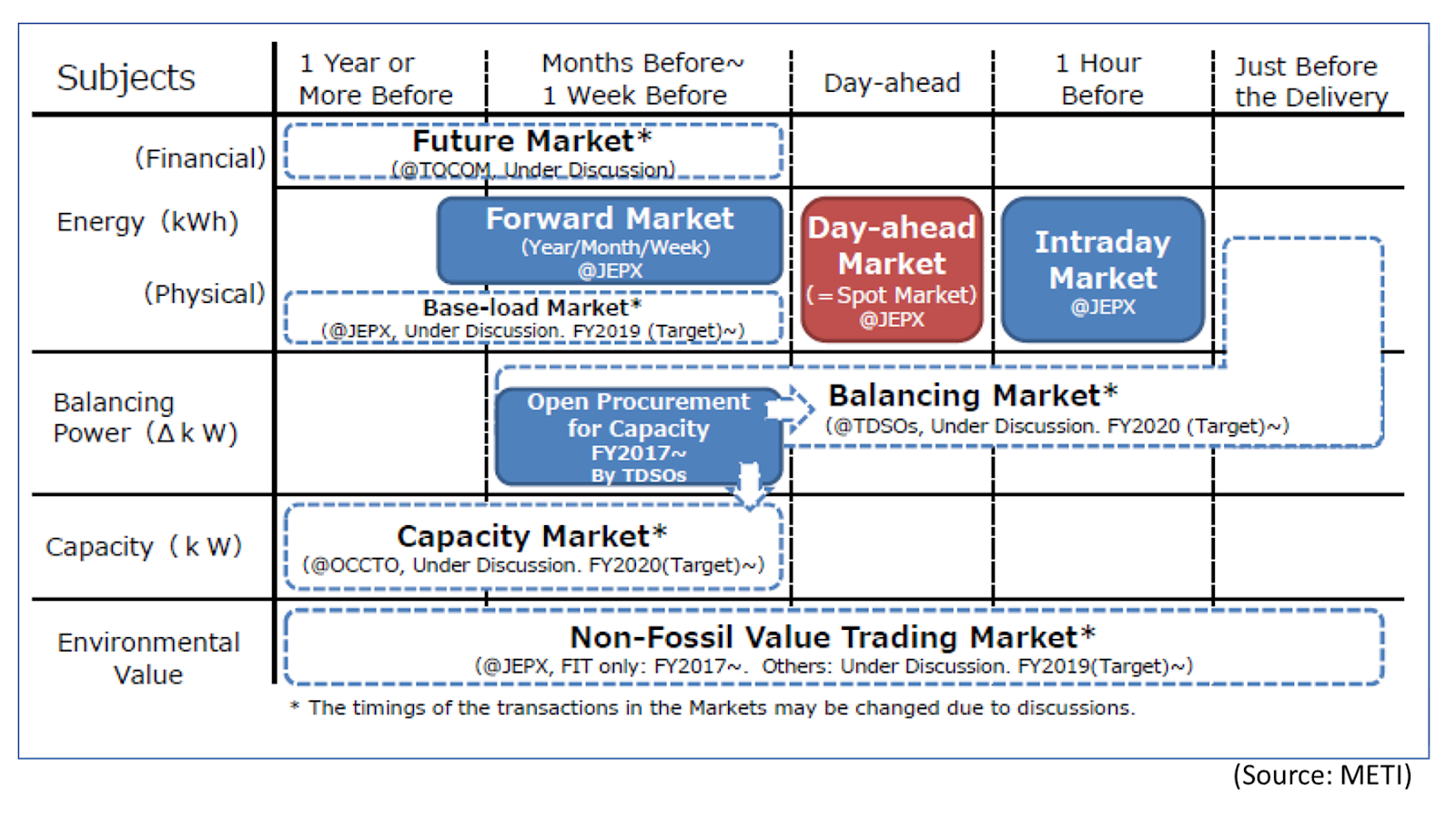
Over the last three to four years, the number of these mechanisms has grown substantially. Many are also subdivided by regions and other factors.
Electricity volume (kWh)
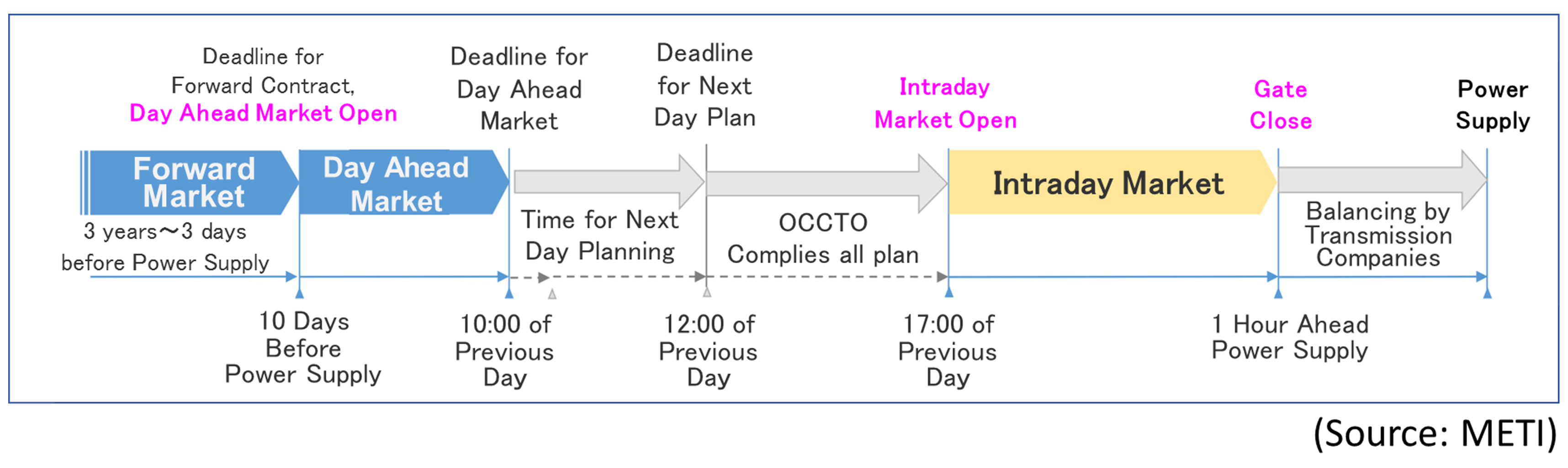
Day-Ahead Market (Spot Market): Electricity is traded for each of the 30-minute slots in the next 24 hours of the following day. Managed by JEPX.
Intraday Market: Opens at 5pm on the previous day and trades electricity until one hour before the real-time delivery of electricity.
Forward Market: Contracts for virtual or physical delivery of electricity are bought for delivery as soon as in three days, or as far back as three years.
Baseload Market: Trade electricity volumes for the following year.
Electricity capacity (kW)
Capacity Market: Auction-based system that allows buyers to book capacity four years from now. Started in FY2020 and managed by OCCTO.
Long-Term Decarbonized Power Resource Auction: starting this year, this sub-section of the capacity market will target capacity that reduces the energy system’s emissions, and may allow booking for up to 20 years.
Electricity availability (delta kW)
Balancing Market: Introduced two years ago to relieve the EPCOs of performing the (expensive) role of balancing the overall electricity system. This task now falls to transmission and distribution (T&D) firms, which use the platform to secure the power they need to balance their local system.
Problems with the current system
In theory, the various platforms cover all the angles. The Japan Electric Power Exchange (JEPX) collects information on expected demand and supply for the next 24-hours. Power generators (EPCOs and new market players) then adjust their supply/demand and submit offers for the next day’s market. Should circumstances change just before the deadline for such submissions, known as “Gate Close”, operators can turn to the Intraday Market for fine-tuning.
In reality, there are a number of imperfections in the balancing system.
The Day-Ahead Market is based on a single-price auction (all contracts for each 30-minute slot for the next 24h are traded at the same price), but the Intraday Market is based on a Merit Order auction (contracts executed based on the cheapest bid). This means power plants used to balance the system are priced differently in the two markets.
The balancing power sources are traded in two different units, namely kilowatt-hour (kWh) (real power supply at a specific time) in the spot and the Intraday markets, but they are sold as kilowatts (kWs) (the right to use power generation capacity at a specific time) on the Reserve Exchange. This leads to inefficiency in allocations.
The time and cost needed to start up reserve power sources widely differ, but this is not presently reflected in the price. For example, gas-fired power plants are able to start supplying electricity within 18 or so hours. Coal plants need more than a day, while nuclear plant operations are planned months in advance.
Japan relies on pumped storage hydro plants for energy storage and to regulate electricity frequencies. However, EPCOs need one week for preparation, so that they can most effectively pump water from the lower reservoir to the upper reservoir. Prior to 2011, EPCOs used night-time electricity volumes from nuclear plants to move the water higher at a low cost. But the current shutdown of many of the reactors means operating costs of pumped storage to cover peak times are significant.
New system
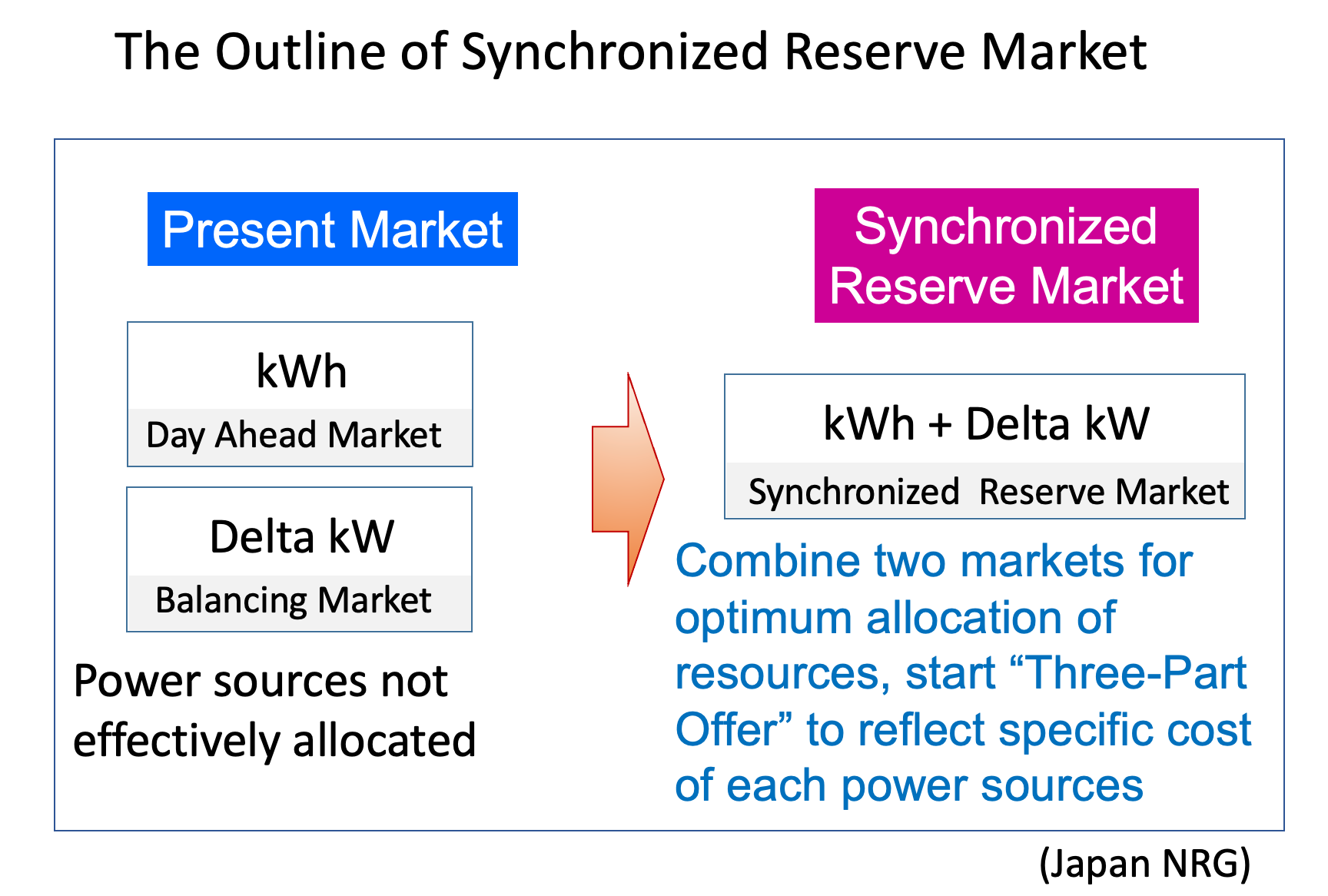
In response to these issues METI plans to merge several components of the current power balancing setup. The ministry wants to combine Electricity Volumes (i.e., the kWh based Spot and Intraday markets), with Electricity Availability (i.e., the delta kW market on the Power Reserve Exchange. In other words, this will take into account the cost of maintaining a power plant that’s ready to go as needed; the cost of starting it up; and the incremental cost of running it.
In practice, this means bids will need to reflect all of the above aspects on an integrated market platform. So, the bidding will be based on what METI calls “three-part cost-based offers”. The combination would take into account short-term needs and the situation in a week’s time, and match that with the awareness of the time and cost required to bring additional capacity online.
While this sounds even more complicated than the current system, the caveat is that a very similar set-up already exists and works well elsewhere. METI’s new system took inspiration from the PJM Interconnection, which is a regional transmission organization (RTO) that coordinates the movement of wholesale electricity in 13 U.S. states and the District of Columbia.
Such a system is better able to differentiate and value the power sources in terms of their characteristics. A power plant that’s quick to go online can get paid for its flexibility or lose out to alternatives that best match the demand picture.
Once Japan completes the renewal of load-dispatch centers at T&D companies, probably after FY2028, the new power market is supposed to come into effect.
The change could be monumental, not only because it’s likely to bring more efficiency to the nation’s electricity markets, but also because it should create a fairer industry landscape.
The system will allow power sources to be priced by their characteristics, including how quickly they can respond to changes in demand or weather, and how economically they do so. Amid endless debates about which energy sources are “best”, this could settle at least one of the arguments.
ANALYSIS
BY MATSUMOTO TAKEHIRO
Going into this week’s G7 summit Japan is on the defensive
When Japan hosts the Group of Seven this weekend in Hiroshima, Prime Minister Kishida will be keen to project a positive image of the country’s energy agenda. His headline Green Transformation (GX) policy will no doubt be touted as a pragmatic solution attuned to the realities of developing Asia and Japan. Some of his G7 peers, however, may be less sanguine.
Energy won’t be the only topic discussed in Hiroshima, which is Kishida’s home constituency, but it will be the one area that connects the key challenges facing the G7 today: international security, climate action, and the cost of living crisis (inflation, global economic inequality, etc.)
Given the central role of energy, the G7 leaders will be keen to show a united front. Tensions with China and Russia almost demand it. However, the gaps between allies on energy strategy are also obvious. The roles of nuclear and natural gas, the timing for a phaseout of coal, the weight of reliance on renewables, the faith in EVs, and the interpretation of “transition” in financing are among potential flashpoints.
In the eyes of many international media and environmental groups, Japan is the laggard that needs to upgrade its views. Coverage of the G7 Energy Ministers’ meeting in Sapporo on April 15-16 largely painted Japan as a holdout against a cleaner world. But Kishida won’t be relying on diplomacy and mild manners alone to keep the peace while defending Japan’s position.
The prime minister has invited strong voices from outside the G7 to join the Summit. These will likely challenge what it means to be “ambitious” in energy and climate discussions.
Political background
In the last two decades, with the notable exceptions of the late Abe Shinzo and Junichiro Koizumi, Japanese prime ministers have lasted in office only about a year. Kishida also looked to be on his way out last fall with plummeting ratings, but six months on his approval rate has rebounded strongly. The G7 is seen as a crowning moment for a PM who’s spent much of his 20 months in office focused on foreign policy.
It’s now expected that Kishida will call for a snap election soon after the G7 summit, possibly in June. The summit will be a test of his ability to balance divergent views between Japan and its Western allies on climate and energy issues, as well as a way to build smoother relations between the developed and developing worlds.
Should Kishida prevail and lead his party to victory in a general election, his GX policy will be cemented in the national strategy.
April meeting sets the tone
The Sapporo meeting is an indicator how the Hiroshima summit might unfold on May 19-21. The meeting highlighted the urgency to cut global GHGs by an eye-popping 60% by 2035 compared with 2019 levels, in line with the latest IPCC report released in March.
The G7 ministers, however, failed to discuss in what form and to what extent China should take responsibility. China accounts for one third of global GHGs and isn’t a member of the G7. Neither is India, the world’s No. 3 emitter of GHGs.
China and India, however, are part of the broader G20, which the latter also hosts this year. As such, Kishida has made a point of inviting India among eight non-member countries to the G7 summit. These include the United Arab Emirates, which will host the COP28 climate conference later this year, as well as Indonesia, the current chair of ASEAN, and also Brazil.
Indonesia and Brazil are in the Top 10 countries by GHG emissions, according to the World Resource Institute, which counts the EU as a single entity in its rankings.
The presence of G20 members and others from outside the G7 in Hiroshima will likely make it more difficult for the summit to commit to new emission-cutting targets without locking in more financial commitments to achieve this, especially as regards aid for developing economies.
Coal and gas
The G7 climate ministers agreed last month to “accelerate the phase-out of unabated fossil fuels so as to achieve net zero in energy systems by 2050” in general, including LNG. Adding LNG to this conversation, which was previously focused on coal, was seen as a victory for the European members of the G7.
Still, from Japan’s viewpoint, this was not really a loss. Abating fossil fuels means installing carbon capture technology, which Japan has supported for many years and where many of its engineering firms claim to have a competitive advantage. While locations for storing CO2 inside Japan are yet to be decided, there are multiple projects exploring the creation of such storage hubs with partners in South East Asia, as well as in North America and Australia. A number of pilot projects are also testing the idea of recycling carbon.
For Japan, the question lies more on timing. Abating thermal generation remains an expensive and still partly experimental task. No two projects are the same. And until carbon capture, utilization and storage (CCUS) can be declared as fully commercialized, Japan and its allies will likely remain cautious in putting a definitive date on an exit from coal.
In this context, adding natural gas to the “abated” rule was also not as significant for Japan and some other G7 members as the tacit approval by the group’s ministers for further investment in upstream natural gas. While acknowledging the need to end dependence on natural gas, the climate ministers’ communiqué said that investment “can be appropriate” to the extent that it accords with GHG reduction targets.
Hydrogen and ammonia Hydrogen seems to get almost universal approval, but Japan’s suggestion that ammonia (a hydrogen carrier) should also be used for power generation is starting to face strong pushback from some G7 partners.
Japan’s logic is that ammonia does not release CO2 when burned and can be used as a substitute at coal power plants. Initially, the gas would be burned alongside coal, with the former’s ratio gradually rising until it takes over completely.
In the last six months, however, that vision has come under strong criticism from environmental groups inside and outside Japan. According to calculations by entities including BNEF, burning ammonia as well as coal is not cost-efficient and could allow coal to be used for many years to come. The drop in CO2 emissions from switching to ammonia is also questioned since nearly all of it today is made from fossil fuels. Manufacturing the gas with the help of renewables is expensive.
U.S. climate envoy John Kerry even expressed concerns that hydrogen / ammonia co-firing (with coal) would lead to a “postponement” of the energy transition.
Most G7 ministers expressed a desire for hydrogen and ammonia to be reserved for industrial and transport use. Japan’s GX strategy, however, sees power generation as the catalyst for greater use of hydrogen / ammonia.
EVs
Perhaps the most sensitive issue from Japan’s viewpoint is how the G7 views the future of transport. The expansion of electric vehicle (EV) sales in European countries, as well as in the U.S., has led those G7 members to push for concrete targets in the sector. Most accept that clean vehicles (termed Zero Emission Vehicles, or ZEVs) could also include those that run on some form of hydrogen as well as on batteries. For Japan, this is not an ideal solution.
The U.K. wants the G7 to demand that all new vehicles sold in major markets be ZEVs by 2035, while the U.S. proposes a 50% share of ZEV sales in the next 10 years, synchronized with its respective industrial policy at home.
So far, however, G7 ministers only agreed to “note the opportunity to collectively reduce by at least 50% the CO2 emissions from the G7’s vehicle stock by 2035 or earlier relative to the level in 2000 as a halfway point to achieving net zero….”
The ministers also agreed to track progress on an annual basis. In doing so, Japan believes that there is room to insert another clean-transport pathway via biofuels and synthetic fuels. This is why the use of the term ZEV is preferable to the one previously used: BEV (battery electric vehicles).
Japan has announced a policy that new car sales will be limited to EVs by 2035, but the country’s highly influential auto industry is also keen to develop synthetic or e-fuels, noting that blending regular gasoline with cleaner fuels would cut emissions of the cars already on the road (and hence total emissions) faster than waiting for everyone to switch to electric cars.
Furthermore, Japan has expressed concern about the availability of the raw materials needed to make EV batteries. China controls the majority of the market for such materials or their processing.
Fukushima cleanup
Japan is also keen for the G7 to support its agenda to clean up the wrecked Fukushima nuclear plant. This includes releasing water, which has been treated to remove radiation, into the ocean over a period of time.
The plan has so far received the blessing of the IAEA, but not everyone is convinced. German Environment Minister Steffi Lemke, for example, said the release of treated water is not welcomed.
A green light from the G7 for the Fukushima cleanup plan would help Kishida win further domestic approval for such actions. But this remains a sensitive subject.
Carbon pricing
One area where the G7 may see the biggest consensus is that of carbon credits and / or pricing. The April climate ministers’ meeting already spelled out that Japan will establish a secretariat for the “Article 6 Partnership,” a scheme to trade emission reductions among nations, indicating that preparations are now in place for the creation of an international carbon trading market.
This is seen as a useful mechanism to transfer funding from wealthier nations to developing economies by financing emission reduction projects. In effect, it also helps to transfer clean energy tech to the Global South while allowing developed economies to claim some of the benefit against their own CO2 numbers.
Ever since the 2000s, UN climate summits and similar events have been hampered by tensions between the developed and developing economies, with the latter claiming that any climate “ambitions” should be matched by real financial assistance. The $100 billion per year promised to developing countries in 2009 has never materialized.
If Kishida is able to persuade his guests from the G7 and the G20 that carbon credits are a way to bridge those differences and allocate funding to match the ambitions, he will achieve a major coup and real progress in climate action. In that case, the other rifts will become a lot easier to gloss over.
GLOBAL VIEW
BY JOHN VAROLI
Below are some of last week’s most important international energy developments monitored by the Japan NRG team because of their potential to impact energy supply and demand, as well as prices. We see the following as relevant to Japanese and international energy investors.
Australia/ Solar power
The govt earmarked AU$4 billion for new investments in the energy transition, with focus on lowering energy costs and supply reliability. AU$1.3 billion will go to household energy upgrades, of which AU$1 billion will provide low‑cost loans for solar modules.
Brazil/ Natural gas
Equinor and partners will invest $9 billion to develop a gas discovery off the coast; it’s estimated to hold more than 1 billion barrels of recoverable oil equivalent. Gas from the project could represent 15% of Brazil’s total gas demand when it starts in 2028.
China/ Peak emissions
China’s carbon emissions will hit a new record in 2023, but a rapid expansion in green energy will soon enable peak emissions. China, the world’s largest emitter of GHGs, saw CO2 emissions rise 4% in Q1 YoY, reaching more than 3 billion tons, according to the Centre for Research on Energy and Clean Air (CREA).
France/ ESG
BNP Paribas will no longer finance new gasfield projects, as it faces lawsuits for supporting the sector. But climate activists say that most of the bank’s support for oil and gas is through corporate loans and bond underwriting, not direct loans.
Germany/ Batteries
Northvolt, Europe’s main battery maker, will go ahead with plans for a factory after the govt agreed to hundreds of millions of euros in subsidies. Northvolt had earlier indicated it might suspend its plans for the factory and concentrate solely on North America unless the EU matched generous U.S. subsidies.
Indonesia/ Cobalt mining
The country is now the world’s second-largest supplier of cobalt, contributing to a sharp fall in the price of the battery metal. Indonesia generated 9,500 tons of cobalt in 2022 — 5% of the global supply; this is up from very small volumes in 2020, said the Cobalt Institute.
Turkey/ Natural gas
Turkey has deferred to 2024 payment to Russia of a $600 million natural gas bill, the first such postponement under a new deal. As much as $4 billion in Turkey’s energy payments to Russia may be postponed until next year.
UK/ Battery management tech
Abu Dhabi-based renewables developer Masdar agreed to use Octopus Energy’s technology platform Kraken to manage battery systems. In October, Masdar committed to invest £1 billion in UK battery storage, following its acquisition of London-based Arlington Energy.
U.S./ Coal power plants
Joe Biden unveiled a plan to impose GHG limits on power plants. Existing coal plants will have to install CCS technology starting in 2030, while those shutting between 2035 and 2040 will have to co-fire with 40% natural gas by 2030. By 2050, the capacity of coal-fired power plants in the U.S. should decline by more than half from 2022 levels.
U.S./ Oil
Berkshire Hathaway won’t take full control of Occidental Petroleum, where it has a 20% stake, Warren Buffett said at its annual shareholder meeting. Last year, Berkshire received regulatory approval to purchase as much as a 50% stake in the oil and gas company.
Venezuela/ Oil exports
Chevron will boost oil production in Venezuela to recover $3 billion of debt by late 2025. So far, Chevron recovered $220 million. In November, The U.S. issued a 6-month, automatically renewing license for Chevron to resume Venezuelan crude exports to the U.S.
2022 EVENTS CALENDAR
A selection of domestic and international events we believe will have an impact on Japanese energy
January
OPEC quarterly meeting;
JCCP Petroleum Conference – Tokyo;
EU Taxonomy Climate Delegated Act activates;
Regional Comprehensive Economic Partnership (RCEP) Trade Agreement that includes ASEAN countries, China and Japan activates;
Indonesia to temporarily ban coal exports for one month;
Regional bloc developments: Cambodia assumes presidency of ASEAN; Thailand assumes presidency of APEC; Germany assumes presidency of G7; France assumes presidency of EU; Indonesia assumes presidency of G20; and Senegal assumes presidency of African Union;
Japan-U.S. two-plus-two meeting;
Japan’s parliament convenes on Jan. 17 for 150 days;
Prime Minister Kishida visits Australia (tentative)
February
Chinese New Year (Jan. 31 to Feb. 6);
Beijing Winter Olympics;
South Korea joins RCEP trade agreement
March
Renewable Energy Institute annual conference;
Smart Energy Week – Tokyo;
Japan Atomic Industrial Forum annual conference – Tokyo;
World Hydrogen Summit – Netherlands;
EU New strategy on international energy engagement published;
End of 2021/22 Japanese Fiscal Year;
South Korean presidential election
April
Japan Energy Summit – Tokyo;
MARPOL Convention on Emissions reductions for containerships and LNG carriers activates;
Japan Feed-in-Premium system commences as Energy Resilience Act takes effect;
Launch of Prime Section of Japan Stock Exchange with TFCD climate reporting requirement;
Convention on Biological Diversity Conference for post-2020 biodiversity framework – China;
Elections: French presidential election; Hungarian general election
May
World Natural Gas Conference WCG2022 – South Korea;
Elections: Australian general election; Philippines general and presidential elections
Germany to eliminate nuclear power from energy mix;
Happo-Noshiro offshore wind project auction result released;
Japan submits revised 2030 CO2 reduction goal following Glasgow’s COP26;
Japan-Canada Annual Energy Forum (tentative);
Tesla expected to achieve 1.3 million EV deliveries for full year 2022
Disclaimer
This communication has been prepared for information purposes only, is confidential and may be legally privileged. This is a subscription-only service and is directed at those who have expressly asked K.K. Yuri Group or one of its representatives to be added to the mailing list. This document may not be onwardly circulated or reproduced without prior written consent from Yuri Group, which retains all copyright to the content of this report.
Yuri Group is not registered as an investment advisor in any jurisdiction. Our research and all the content express our opinions, which are generally based on available public information, field studies and own analysis. Content is limited to general comment upon general political, economic and market issues, asset classes and types of investments. The report and all of its content does not constitute a recommendation or solicitation to buy, sell, subscribe for or underwrite any product or physical commodity, or a financial instrument.
The information contained in this report is obtained from sources believed to be reliable and in good faith. No representation or warranty is made that it is accurate or complete. Opinions and views expressed are subject to change without notice, as are prices and availability, which are indicative only. There is no obligation to notify recipients of any changes to this data or to do so in the future. No responsibility is accepted for the use of or reliance on the information provided. In no circumstances will Yuri Group be liable for any indirect or direct loss, or consequential loss or damages arising from the use of, any inability to use, or any inaccuracy in the information.
K.K. Yuri Group: Oonoya Building 8F, Yotsuya 1-18, Shinjuku-ku, Tokyo, Japan, 160-0004.
NEWS
・Japan to ask EV makers to report CO2 emitted during production
・Trading of TOCOM electricity futures rose nearly 50% in 2022
・High energy prices propel Mitsui’s profit to over ¥1 trillion,
a first for a Japanese trading house