Russia pays dividends for Sakhalin projects in Chinese yuan
MOL and JERA sign charter deal for LNG carriers
Thermal coal, LNG and crude oil imports — all down
Idemitsu takes 15% stake in Australian lithium miner
ANALYSIS
JAPANESE PEROVSKITE SOLAR STARTUPS: LUCRATIVE INVESTMENT OPPORTUNITIES?
Japan can take the lead in the next stage of solar tech, with the perovskite solar cell (PSC). Globally, university startups have led PSC development, but in Japan established manufacturers dominate. Yet, Japan has two PSC startups; one has been a successful fundraiser. Whether international investors will be able to pour financing into Japan’s PSC venture pioneers, however, remains to be seen.
WHAT’S CHANGED IN THREE YEARS? A REVIEW OF THE ENERGY SECTOR SINCE JAPAN NRG LAUNCHED
Japan NRG published its first report three years ago. A lot has since changed in terms of policies and corporate actions, but also in the report’s style and content. Looking back at the first issues of Japan NRG, we see how many of the stories and narratives are familiar today.
Let’s take a trip down memory lane to review what were the big issues and stories when Japan NRG first launched, and give an update on those developments.
New Energy and Industrial Technology Development Organization
kWh
Kilowatt hours (electricity generation volume)
TEPCO
Tokyo Electric Power Company
FIT
Feed-in Tariff
KEPCO
Kansai Electric Power Company
FIP
Feed-in Premium
EPCO
Electric Power Company
SAF
Sustainable Aviation Fuel
JCC
Japan Crude Cocktail
NPP
Nuclear power plant
JKM
Japan Korea Market, the Platt’s LNG benchmark
JOGMEC
Japan Organization for Metals and Energy Security
CCUS
Carbon Capture, Utilization and Storage
OCCTO
Organization for Cross-regional Coordination of Transmission Operators
NRA
Nuclear Regulation Authority
GX
Green Transformation
NEWS: ENERGY TRANSITION & POLICY
Japan to kickstart GX strategy this month by making Sapporo a ¥40 bln environmental hub
(Nikkei, June 17)
The govt is ready to kick start its ¥150 trillion Green Transformation (GX) investment program. Later this month, it will reveal a plan to position Sapporo, Hokkaido Pref, as an international environmental financial city
Sapporo will seek to attract as much as ¥40 trillion for clean energy projects and develop them in sync with national plans to make Hokkaido a hub for the semiconductor industry.
CONTEXT: Private firms together with the govt have created a new company, Rapidus, to lead Japan’s charge in advanced semiconductors. Rapidus aims to build a large factory in Hokkaido.
The Sapporo initiative is the collaboration of work by the govt and the country’s three largest banks (Mitsubishi UFJ, Sumitomo Mitsui, and Mizuho). They aim to help with GX fundraising.
From the govt side, there are plans to make Sapporo City a special zone to nurture advanced environmental finance by 2024. The idea is that it would help attract ESG capital and blended finance (public and private funds). A new organization, Team Sapporo-Hokkaido, will be set up to drive the efforts.
TAKEAWAY: It should be no surprise that the govt is seeking to pair its national industrial strategy, which is heavily tilted to semiconductors, with its energy and climate ambitions. This should be positive. After all, Hokkaido is known to have the biggest renewables potential of all Japanese regions, largely thanks to its flatter land and offshore wind resources. However, Hokkaido’s industrial demand never required such large additions in energy supply. Meanwhile, transporting power halfway across the country to the Tokyo area or beyond is expensive and likely to result in significant energy losses. Thus, marrying energy-intensive industries with locally produced renewables resources makes sense. The challenge will be in tailoring the variable output of solar and wind generators with industrial demand. It’s likely that some form of baseload, such as through the restart of the Tomari NPP in southern Hokkaido, will also be required.
Panasonic calls for creation of Scope 4 to represent ‘avoided emissions’
(Financial Times, June 15)
Panasonic CEO Kusumi Yuki says a new metric is needed to assess a company’s decarbonization efforts. It could be labelled as Scope 4 and represent GHG emissions that were avoided because a business created products that help to reduce the overall environmental impact of society.
Panasonic is a major battery manufacturer for clients such as Tesla. However, the process of making batteries is energy intensive and can lead to high carbon emissions.
CONTEXT: As per the Greenhouse Gas Protocol, emissions fall into three categories: Scope 1 are GHGs emitted by the company’s facilities; Scope 2 are GHGs emitted in making the electricity and fuels that a business needs for operations; and Scope 3 are emissions from a company’s value chain.
Panasonic targets reducing Scope 1 emissions to net zero by 2030. Panasonic’s products (batteries, heat pumps, and fuel cells) will also help the world to avoid 300 million tons of CO2 equivalent by 2050, or about 1% of the world’s total emissions.
The company wants these ‘avoided emissions’ to be counted. Some other Japanese firms and overseas asset managers are starting to support the idea of a new ‘avoided emissions’ metric, in order to expand climate finance.
Tokyo Stock Exchange publishes changes for its Carbon Credit Market
(Company statement, June 9)
The Tokyo Stock Exchange announced a list of changes to its carbon trading platform, which is currently in trial mode.
Changes include: Clarification that participants are prohibited to act as agents for orders from other customers unless they already trade with the customer outside of the market.
Participants must adhere to the new invoice system starting October, which means they can only engage in transactions with qualified invoice issuers when claiming input tax credits.
The names of participants will be listed on the JPX website.
The price limits on bids and offers will be lowered from 100% (as observed at the end of the demo project) to 90%.
CONTEXT: For J-Credits, the price limits will be 90% above or below the base price, with any fraction less than ¥1 being rounded down. The goal is to prevent incorrect order placement while still allowing fair price formation.
TAKEAWAY: After a five-month demonstration project stage last fiscal year, carbon trading was due to start in the slightly upgraded “trial” mode. It seems that the stock exchange wants to iron out the rules before restarting trading this fiscal year. The current plan is for trades to resume before the end of this fiscal year, while still aiming for full operation in FY2026. TSE believes that transparency and clear rules are needed in order to enroll participants and grow the market’s scale.
Govt clarifies structure of impact assessment of wind power station on fisheries
(Japan NRG, June 16)
METI and the Ministry of Land, Infrastructure, Transport and Tourism clarified the basic structure for the plans to evaluate the impact of offshore wind stations on fisheries. Project operators are expected to make detailed plans based on the suggested structure.
The structure follows the Murakami-Tainai wind assessment plan which studies the volume of fish caught and delivered to ports, operating days, hours and distance traveled by fishing boats and average catch.
Data will be taken a year before plant construction, during the construction period and for three years after operations begin.
CONTEXT: Commercial fishermen are required to obtain fishing licenses from prefectural authorities. The areas covered by the licenses cover all coastal areas around Japan.
TAKEAWAY: Japanese Act on the Use of the Sea for Renewables defines the processes for launching offshore wind projects but not “the rights to occupy sea areas,” which some say could complicate negotiations with stakeholders such as the fishermen.
Fish catch volumes comprise a key metric in negotiations as fishermen are able to file compensation suits to project developers on the basis of these numbers and other project operational data. The validity of damage claims also depend on the type of fishing license. For example, the Yamaguchi District Court in 2016 dismissed damage claims by local fishermen against wind projects saying the plaintiffs were not direct license holders but members of a cooperative which holds such a license.
Mitsui O.S.K. Lines joins blue ammonia production project in U.S.
(Denki Shimbun, June 16)
Mitsui O.S.K. Lines (MOL) joined the clean ammonia production and transportation project led by Clean Hydrogen Works in Louisiana, U.S. MOL has investments in the operating company, which will produce “blue ammonia” that involves capturing CO2 during manufacturing, and export it on MOL ammonia transportation vessels.
The project aims to produce 7.2 million tons of blue ammonia annually using natural gas. The target CO2 recovery rate is 98%. The cost for plant construction and port facilities is $7.5 billion.
JERA to collaborate with EnBW and VNG on ammonia supply chain in Germany
(Company statement, June 12)
JERA and German companies EnBW and VNG will conduct a study for an ammonia cracker demo plant in Rostock, northeastern Germany. The goal is to assess the viability of building a plant that produces hydrogen from ammonia.
The demo plant would facilitate importation of large amounts of hydrogen in the form of ammonia from overseas. It would then be converted back into hydrogen and supplied to German customers.
SIDE DEVELOPMENT JERA, NS and Chiyoda to study how best to extract hydrogen from ammonia (Nikkan Kogyo Shimbun, June 13)
JERA, Nippon Shokubai, and Chiyoda joined forces to develop catalyst technology that can efficiently extract hydrogen from ammonia. The main goal is to explore effective strategies for utilizing ammonia as a carrier for hydrogen energy.
The project is part of a NEDO initiative that runs until FY2025. JERA will evaluate the catalyst’s performance.
Chiyoda will expand equipment size to facilitate larger-scale ammonia decomposition and hydrogen production.
CONTEXT: Efficiently transporting hydrogen requires ultra-low temperatures, and utilizing ammonia as an intermediate carrier offers advantages in long-distance transportation due to its easier handling. Thus, it’s crucial to develop technology capable of extracting hydrogen from ammonia.
INPEX to build world’s largest synthetic methane plant; test run expected in mid 2025
(Company statement, June 16)
INPEX began building the world’s largest 400 NM3/ hour synthetic methane (e-methane) plant at its Nagaoka City site in Niigata Pref.
The plant consists of methanation, gas supply and utility units. It will run on a trial basis in April 2025-March 2026. INPEX will supply the e-methane production to consumers via its city gas pipeline.
Osaka Gas provided to INPEX technical advice on the methanation catalyst to speed up the chemical process, and enlarge the plant size.
CONTEXT: E-methane is produced by reacting CO2 with hydrogen. INPEX and Osaka Gas experimented with a 8 NM3/ h plant also built at the Nagaoka site.
TAKEAWAY: The new plant will apply the traditional Sabatier methanation process. Osaka Gas is developing a new process – SOEC (Solid Oxide Electrolysis Cell) methanation and an upgrade is possible if SOEC costs are reduced and can be applied to big plants.
Osaka Gas urges METI to launch talks on e-methane carbon counting
(Japan NRG, June 14)
Osaka Gas urged METI to enhance bilateral policy discussions with potential synthetic methane (e-methane) producing countries. A company official made the request during the Public Private Council to Promote Methanation meeting.
The company proposes a system that sets carbon release of final e-methane consumers at zero, to incentivize synthetic gas use.
It also proposed issuing e-methane certificates and allowing the certificates to trade.
Osaka Gas, along with other gas utilities and trading houses, is conducting e-methane production feasibility studies in the U.S., Australia, Peru, and Malaysia.
JOGMEC selects seven sites to store 13 million tons of CO2
(Official statement, June 13)
JOGMEC will provide financial assistance and technical support to accelerate the deployment of CCS technology. It chose seven sites in Japan for CCS projects with a total storage capacity of 13 million tons by 2030.
In FY2023, the govt allocated ¥3.5 billion for advanced CCS projects. The five cases of domestic storage will be hubs for CCS, with potential for future expansion.
The agency aims to develop 20 to 25 sites by 2050 and achieve annual CO2 storage of 120 million to 240 million tons.
The sites and participating companies are listed below. CO2 will be shipped by vessels or via pipelines, depending on the location.
METI offers ¥127.6 billion to seven companies developing storage batteries
(Nikkei Shimbun, June 17)
METI plans to provide ¥127.6 billion in total to seven companies developing storage battery technologies. Toyota Motor will receive up to ¥117.8 billion.
The companies are either developing solid batteries or manufacturing lithium-ion batteries.
Toyota to “challenge” lithium solid battery roll out in 2027-2028
(Company statements, June 13)
Toyota Motor said it developed a solution to improve durability of all solid-state lithium batteries, which will speed up replacement of present lithium ion batteries.
The company will “challenge” the goal to offer the battery product in 2027-2028. Its research team is working on mass production.
In 2018, the company said taxis mounted with the prototype solid batteries would run during the 2020 Tokyo Olympics, but then scrapped the plan. Instead, it conducted test drives of a battery-mounted passenger car.
CONTEXT: Toyota Motor ranks top in the number of solid battery related patents in the world. There are two mainstream technologies: sulfur-based and oxide-based batteries. Toyota is focused on sulfur-based solid cells.
TAKEAWAY: Automakers are competing to be the first to commercialize solid batteries. Nissan Motor also plans to offer solid-state batteries by 2028.
SIDE DEVELOPMENT METI to subsidize Toyota’s local EV battery production to tune of ¥120 billion (Nikkei Asia, June 16)
METI will subsidize Toyota Motor’s EV battery production – to the tune of ¥120 billion – in a bid to boost domestic battery output and reduce supply chain risks.
Toyota plans to use the subsidy to expand output at Prime Planet Energy & Solutions, a JV with Panasonic.
SIDE DEVELOPMENT: Toyota Motor hosted a media briefing on next-gen technology (Company statement, June 13)
Toyota Motor held a workshop for the media to introduce its next-gen technologies for “electrification, intelligence, and diversification”, featuring all-solid batteries for battery electric vehicles (BEV) and hydrogen for fuel cell electric vehicles (FCEV).
Toyota plans to launch the first next-gen BEV in 2026, and those new BEVs will account for the majority of the global market of 3.5 million units. To reach this target, two new types of lithium-ion batteries were developed. One is to double the cruise range to 1,000 km, at 20% less cost and that recharges within 20 minutes. Another is an all-solid-state battery to be commercialized around 2027-2028.
In addition to BEV, next-gen FCEV is being developed with an innovative fuel-cell system to reduce maintenance intervals, halve the stack cost, and provide a 20% longer cruise range. Also, Toyota is working on lowering hydrogen production costs.
Sojitz set up a new company to accelerate commercial use of DAC tech
(Company statement, June 12)
Sojitz and NanoMembrane Technologies set up Carbon Xtract to implement separation membrane-based direct air capture technology (m-DAC).
R&D began in Feb 2022 after signing a MoU with Kyushu University. Sojitz said the new company will identify consumers’ needs to realize m-DAC sooner.
Itoki starts trading J-Credit in e-dash carbon offset marketplace
(Company statement, June 12)
Itoki and e-dash, a company visualizing CO2 emissions on the cloud, began trading J-Credit on the “e-dash Carbon Offset” marketplace starting May 30.
Itoki has traded carbon credits since 2011.
The e-dash Carbon Offset marketplace started selling J-Credits online, which is a first in Japan by a private company. Based on the know-how obtained from Itoki, the new service will provide J-Credit transactions as a one-stop shop.
Kaneka to raise solar battery component prices by 20%
(Company statement, June 13)
Kaneka will increase all its solar battery prices by 20%, starting July 1. Hikes will also apply for all components used in residential and commercial building solar battery systems.
JERA and international partners set up Trusted Energy Interoperability Alliance
(New Energy Business, June 12)
JERA signed an MoU to form the “Trusted Energy Interoperability Alliance” (TEIA). Partners include Intertrust Technologies, a data platform supplier that JERA invests in the U.S.; Germany energy company E.ON; and Australia’s Origin Energy.
JERA has collaborated with Intertrust on energy solutions since October 2022; data utilization needs to establish bi-directional secure data exchange between platforms and various devices by standardizing communication methodology.
The four companies will be the core to expand TEIA’s activities globally in device manufacturing, software companies, and energy companies, as well to set open standards and provide solutions.
Nuclear regulation chief to visit ALPS water release site in Fukushima
(Japan NRG, June 14)
NRA chairman Yamanaka plans to visit the Fukushima Daiichi NPP on June 24. He will check the ALPS for treating contaminated water, a separate system to release the water into the sea, and the pedestal unit of the earthquake-damaged reactor.
The water release date is not set yet as the systems, which will be built by the end of June, must perform several tests, Yamanaka added.
TAKEAWAY: The water release is likely to start after IAEA director general Grossi’s visit to Japan early next month. While Grossi is expected to meet with PM Kishida, it is unclear whether a meeting with Yamanaka is also planned.
NEWS: POWER MARKETS
TEPCO to invest $7 bln into renewables by FY2030
(Nikkei Asia, June 17)
TEPCO Holdings seeks to invest ¥1 trillion ($7 billion) on renewable energy projects by FY2030, which should allow the company to add 6 GW to 7 GW of new capacity.
This will include about 2-3 GW of offshore wind both in Japan and overseas, including in the UK and Australia, and will likely be done with partners, according to TEPCO Renewable Power President Nagasawa. The company will bid in Japan’s second round of offshore wind auctions; the deadline is this month.
TEPCO also plans to add more hydropower overseas. It already has 10 GW of hydropower in its portfolio in Japan.
CONTEXT: TEPCO also plans to spend about ¥9 trillion by FY2030 on decarbonization. Most of this sum is expected to go toward nuclear power and electricity transmission.
EEX introduces daily products to its electricity futures, starting with the Tokyo area.
(Company statement, June 13)
The European Energy Exchange (EEX) will introduce daily products in Japan’s electricity futures market starting from June 26. The initial introduction will be for the Tokyo area, allowing trading of one-day contracts for both base load and peak load, including weekend products for the following Saturday and Sunday.
The extension of contract months will also start from June 26, increasing the monthly contract that’s available today to nine months from now from six.
EEX has seen a huge increase in trading volume, and the goal is to enhance convenience for futures market participants based on feedback.
Sojitz cancels plans to build wind power plant in Hokkaido on rising costs, local opposition
(Hokkaido Shimbun, Bloomberg, June 13-17)
Sojitz has canceled plans to build a 109 MW wind power plant with 26 turbines in the state-owned forest in Hokkaido. It cited rising materials costs and local opposition due to environmental concerns.
The Otaru city mayor said that preventing environmental damage is more important than economic benefits from tax revenue of about ¥2 billion over 20 years. The mayor said he welcomed offshore wind plans but would not approve Sojitz’s project until all concerns were resolved.
Sojitz intended to install large wind turbines in forests located in the city of Otaru and the town of Yoichi in Hokkaido. Local opposition even pushed the Hokkaido governor to say that the local community lacked a clear understanding of the project. Sojitz said that it had tried to change the project layout to mitigate impact on the landscape.
CONTEXT: Several wind farm projects in Hokkaido were recently canceled due to local opposition. Kansai Electric and Hitachi Zosen were among the firms affected.
TAKEAWAY: Setting global and national targets is not the same as implementing them on a local level. It’s well known that Hokkaido holds great potential for wind power, both onshore and offshore. The region’s goal is to be a “Zero Carbon City” by 2050, and companies have interest in building over 50 wind power stations locally. There are also plans for more than 1 GW in offshore wind projects, but just as residents have a say over land-based developments so local fishermen can block the construction of turbines close to the coast.
Toyota Tsusho completes storage battery system and wind power plant in Hokkaido
(Denpa Shimbun, June 13)
Toyota Tsusho unveiled facilities in north Hokkaido that include a large-scale storage battery system, transmission and substation facilities, and a wind power plant.
The 240 MW/ 720 MWh lithium-ion storage battery system is Japan’s largest.
CONTEXT: This project is part of the “Transmission Network Development Demonstration Project for Wind Power Generation” led by ANRE. It will address the technical limitations of wind power generation expansion in Hokkaido, an ideal location for wind but which lacks a sufficient power transmission network.
Nearby on Hokkaido, a group including Dohoku Wind Power that’s affiliated with Eurus Energy, are building a 540 MW onshore wind farm.
Shikoku Electric plans island’s first large-scale power storage facility
(Nikkei, June 14)
Shikoku Electric plans the Matsuyama Energy Storage Station, the island’s first large-scale power storage facility. Output will be 12 MW and capacity 36 MWh.
The station will cover about 2,000 m2, and will house 96 large lithium-ion storage batteries. Construction begins in August; operation is expected in FY2025.
CONTEXT: Solar and wind power often face output fluctuations due to weather conditions and time of day. Upon opening this large-scale power storage station, excess energy generated during peak times can be stored and released during high-consumption periods, thereby stabilizing electricity supply and demand.
Hitachi Energy won contract for first France-Spain subsea electricity interconnection
(Company statement, June 15)
Hitachi Energy won a contract with Electricity Interconnection France-Spain (Inelfe) to supply four HVDC converter stations for the Biscay Gulf interconnection project.
This project will connect France and Spain through a subsea cable and involves two HVDC links with converter stations at each end. The interconnection will deliver a total of 2000 MW of electricity at 400 kV over a distance of 400 km.
Vestas has installed wind power in Japan exceeding a total of 1.1 GW
(Denki Shimbun, June 15)
Denmark’s Vestas said its wind power generators installed in Japan now exceed a cumulative capacity of 1.1 GW. It took nearly 30 years to achieve this; the first unit was installed in Ishikawa Prefecture in 1993.
In 2022, operators in Japan installed 231 MW of Vestas turbines on land and 84 MW offshore.
KEPCO reports to Fukui Pref on spent MOX fuel reprocessing demo
(Company statement, June 12)
Kansai Electric sent a report to the Fukui Prefectural govt on the removal of spent fuel as part of the Spent MOX Fuel Reprocessing Demonstration Study.
The plan entails a demo study on reprocessing spent MOX fuel, with an estimated 200 tons of fuel to be transported from their nuclear power plants to France.
The reprocessing activities are scheduled to take place in France in the late 2020s. KEPCO is deciding for the transportation, including procuring transportation containers and coordinating logistics.
TAKEAWAY: By deciding to remove the spent fuel, KEPCO is facilitating its transfer out of Fukui Prefecture, set to be completed by late 2023. Two years ago, the company made a commitment to the Governor of Fukui Prefecture to do this so that it could get approval to restart its reactors.
SIDE DEVELOPMENT: NuRO, FEPC finalize spent nuclear fuel reprocessing plan (FEPC statement, June 12)
The Nuclear Reprocessing Organization of Japan (NuRO) approved a plan by the Federation of Electric Power Companies to outsource spent nuclear fuel reprocessing to Orano in France.
Kansai Electric will ship around 200 tons of spent nuclear fuel to France sometime after 2025, and reprocessing studies will be launched in early 2030’s.
Around 190 tons of spent uranium fuel and 10 tons of spent mixed oxide fuel (MOX) will be reprocessed in France.
Toshiba developing new floating offshore wind turbine technology
(Company statement, June 9)
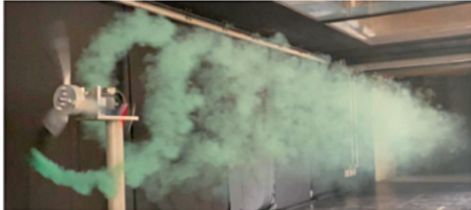
Toshiba Energy Systems, University of Kyushu, Hitachi Zosen, and NSK will use a large-scale wind tunnel to research evaluation methods of wake effects for floating offshore wind turbines. Their project was accepted by NEDO as a part of its new technology/energy and environmental R&D program.
The wake effect is the trail left by each turbine whereby wind speeds are reduced. The wind regime generates turbulence in addition to that produced by the terrain, affecting nearby wind turbines and even neighboring wind farms.
The group will collect data from wind farms built along coastal areas to detect and measure the offshore stream using remote sensing, and monitor how turbines behave when influenced by the wake effect. The results may help visualize the wind turbine conditions that Toshiba aims to commercialize.
Vena Energy secures a ¥17 billion green loan for the Kasama solar power station
(Company statement, June 13)
Vena Energy secured a ¥17 billion green loan from Mitsubishi UFJ Bank and Joyo Bank to fund the 53 MW solar power station in Kasama city, Ibaraki Pref.
The station will avoid 38,000 tons of CO2 per year, compared to conventional thermal power stations, and conserve 54 million liters of water a year.
Aquila Capital’s solar project in Chiba secured ¥3 billion from Ashikaga Bank
(New Energy Business, June 13)
Hamburg-based Aquila Capital secured ¥3 billion from Ashikaga Bank to build a 8 MW solar power station in Kimitsu, Chiba Pref, and to be completed in late 2023.
This project was certified for feed-in-tariff (FIT) in 2014; the company will sell electricity at ¥32/ kWh.
Aquila Capital began investing in Japan in 2012 and opened its Tokyo office in 2021. The company also has a partnership with Yamato Energy Infrastructure.
PAG Renewables and Toshiba begin operation of 10 solar projects
(Company statement, June 13)
PAG Renewables began commercial operations for 10 solar projects in Japan, totaling 309 MW in capacity.
Toshiba handled the engineering, procurement, and construction aspects of eight of these projects, which have 225 MW total capacity.
Toshiba will also handle the O&M of all 10 projects.
Mitsui begins renewable energy procurement project from Japan Benex’s solar facilities
(Company statement, June 12)
Mitsui will procure electricity and environmental benefits from Japan Benex’s rooftop solar facilities that operated under the FIT and will transition to the FIP.
In addition to selling the electricity on the market, Mitsui will provide precise forecasting of solar power output and ensure supply-demand balance.
Mitsui has acquired expertise in adjusting supply and demand for renewable energy in Europe, the U.S., Brazil, etc, and will now apply that in the domestic market.
7-Eleven trials rooftop solar PV at store, mulls broader rollout
(New Energy Business, June 12)
7-Eleven Japan joined with Hitachi, Ricoh, Sanden Retail System to do a pilot with an energy storage system at its convenience store in Misato, Saitama Pref.
The store will install an energy management system to optimize consumption. Solar panels and storage batteries will be installed on the roof to generate and store electricity. The goal is to generate 60% of electricity consumption.
CONTEXT: If this experiment succeeds, all 7-Eleven convenience stores around Japan may follow suit in order to reduce electricity consumption and CO2 emissions. As of May, 7/11, has a total of 21,401 stores in Japan.
MOL and Toyo Construction set up a JV for offshore wind power
(Company statement, June 9)
Mitsui OSK (MOL) and Toyo Construction will form an offshore wind power generation company to service the offshore wind business, including survey planning, procurement of work vessels, and offshore construction.
MOL has experience in shipbuilding; Toyo in offshore construction and in offshore wind power generation.
SIDE DEVELOPMENT MOL signs time charter contract for CTVs in Hokkaido (Company statement, June 15)
MOL inked a contract with Shimizu for two crew transfer vessels (CTV) for the offshore wind farm at Ishikari Bay New Port in Hokkaido. These 12-passenger CTVs are the first in Japan to be operated under International Safety Management (ISM).
MOL and its subsidiary MOL Coastal Shipping will operate the CTVs to transfer construction crews to the wind farm being built by Green Power Ishikari in Hokkaido; it has 14 wind turbines (each 8 MW) and starts operation in 2026.
Newly-elected Tsuruga City mayor visits local NPPs
(Japan NRG, June 15)
Yonezawa Koji, a newly elected Tsuruga City mayor, visited the Japan Atomic Power Company’s nuclear power plant sites in the city, including planned sites of the new Units 3 and 4 at Tsuruga NPP.
Yonezawa serves as the chairman of Zengenkyo (National Council of Municipalities with Nuclear Power Plants). He has been pressing the govt for more itemized schedules of new plant construction.
CONTEXT: Unit 1 at Tsuruga NPP is to be decommissioned; the NRA suspended a safety review of Unit 2 earlier this year as the plant’s regulatory filing had errors. The plans for new Units 3 and 4, which were made 30 years ago, have stalled.
Small fire reported at Onagawa NPP site
(Company statement, June 14)
Tohoku Electric reported a fire at the Onagawa nuclear power plant that occurred when welding plastic tubes.
The work was outside, near the sea wall. The local fire department put out the fire.
No damage was reported.
NEWS: OIL, GAS & MINING
Japan and OPEC to start high-level dialogue after years of stalled talks
(Nikkei Asia, June 14)
After years of stalled talks, Japan and OPEC began a high-level dialogue to enhance energy security.
Takagi Kei, Japan’s Diet vice minister for foreign affairs, met OPEC Secretary General Haitham al-Ghais in Vienna. They agreed to hold regular meetings between senior officials and a permanent line of communication.
The joint goal is to analyze the global energy supply and demand forecast.
Russia pays dividends for Sakhalin projects in Chinese yuan
(Nikkei, June 15)
Russia paid dividends in Chinese yuan to shareholders, which include Japanese trading companies, for the Sakhalin 1 and 2 oil projects.
This move was necessitated by Western sanctions. Previously, Sakhalin project dividends were paid in dollars twice a year through a bank in Singapore.
The dividen transactions are said to have been handled by Russia’s Gazprombank, a subsidiary of Gazprom.
CONTEXT: Japan’s Sakhalin Oil and Gas Development Co. — in which METI and Japanese trading companies have equity stakes — holds a 30% interest in Sakhalin 1. As for Sakhalin 2, Mitsui has a 12.5% stake and Mitsubishi 10%.
INPEX, Tosai Gas and Proterial sign carbon neutral gas deal
(Japan NRG, June 13)
INPEX agreed to supply carbon neutral gas to Tosai Gas which will then supply Proterial’s Okegawa factory in Saitama Pref.
The gas will be either from INPEX’s gas field in Niigata Pref, or imported. Carbon will be offset using voluntary credits earned from its forest conservation project and purchases from third parties.
The company declined to elaborate on the gas volumes or the credit amount.
Thermal coal, LNG and crude oil imports — all down
(Government data, June 15)
Thermal coal imports slumped 27.4% YoY, to 6.2 million tons; LNG was down 19.9% YoY, to 4.6 million tons; crude oil down 6.7% YoY, to 11.4 million kiloliters (71.5 million barrels).
Total value of imports slumped further. Thermal coal was ¥206 billion, down 38.5% YoY; LNG ¥413 billion, down 31.6% YoY; crude oil ¥836 billion, down 21.7% YoY.
Idemitsu takes 15% stake in Australian lithium miner for A$53 million
(Company statement, June 16)
Idemitsu Kosan acquired a 15% stake in Australian lithium miner Delta Lithium Ltd for A$53 million. Idemitsu invested A$5 million in January and the balance recently.
Delta Lithium runs two projects in Western Australia: the Mt. Ida project and Yinnethara project. Mt. Ida is estimated to hold 12.7 million tons of lithium reserves.
MOL and JERA sign long-term charter deal for LNG carriers
(Company statement, June 14)
MOL inked a long-term contract for a newbuild LNG carrier with a vessel operation management company funded by JERA. This is their fifth contract. The vessel will be built in South Korea and delivered in 2025.
The new vessel will be equipped with the cutting-edge MAN Energy Solutions engine, which has better fuel efficiency, and be managed by MOL. It will transport LNG for JERA.
LNG stocks fall 3.4%, to 2.3 million tons
(Government data, June 14)
LNG stocks of 10 power grids stood at 2.3 million tons as of June 11, down 3.4% from 2.38 million tons a week earlier. METI first reported the June 7 stocks at 2.39 million tons but revised the figure.
The end-June stocks last year were 2.14 million tons. The five-year average for this time of year was 1.95 million tons.
ANALYSIS
BY MAYUMI WATANABE
Japanese Perovskite Solar Startups: Lucrative Investment Opportunities?
There’s a very good chance that Japan can take the lead in the next stage of solar tech development. But there’s a snag. While the research side requires vast resources, Japan has closed ranks around its main players in the space to prevent precious knowhow from leaking.
Two of Japan’s leading actors in the next-generation of solar tech, known as perovskite solar cell (PSC), are actually startups. Some of Japan’s PSC pioneers may seek funding to evolve their R&D into commercial products. Whether investors will be able to step in, however, remains moot. According to NEDO, the state research hub that’s provided funding for almost all Japanese PSC research, there is no ban on foreign investment into domestic PSC players, but those that received grants should be “mindful of national interests”, an official told Japan NRG.
The situation shows the difficulty of pushing through innovation along the lines of the Silicon Valley style, venture capital model. At the same time, Prime Minister Kishida’s Green Transformation (GX) strategy insists that it is private capital that will act as the catalyst for decarbonization in Japan.
Still wary after seeing its global dominance in the prior iteration of solar tech usurped by China, Japan’s caution around PSC is understandable. The tiny market share that Japan retains in world PV sales contrasts with China’s utter dominance of the industry. And yet, working in isolation as a quasi national project does not seem to be a viable option either. It certainly didn’t help the country build its own regional jet or revive the LCD industry.
Recently, PM Kishida courted international collaboration as a way to rebuild Japan’s semiconductor chips sector and there were reports of him touting such an approach at the recent G7 Summit. That suggests that the current mystique around the next-gen solar sector could recede in time, allowing private international capital to come in. For investors, what opportunities would this bring?
Background
In the first decade of the 2000s, Japan was the global leader in solar technology as Sharp, Kyocera, Sanyo (now Panasonic) and Mitsubishi Electric supplied half of the global market. Today, however, Chinese competitors dominate every step of the supply chain. China holds over over 90% of global polysilicon, wafer, solar cell, and module manufacturing capacity.
To challenge China’s position, one needs to develop a new industrial ecosystem for solar technology that doesn’t rely on polysilicon. That’s the genesis of Japan’s PSC idea.
PSC makes use of perovskite-structured crystal compounds instead of silicon as the light-absorbing layer for generating electricity. The perovskite layer is thin and light as a film, allowing panels to be manufactured in flexible shapes and sizes. Processed at normal temperatures – as opposed to silicon that’s manufactured at 1,400° C – the technology uses less power and thus has a low-carbon footprint.
PSC, however, has a number of stumbling blocks on the road to commercialization. It still lacks chemical stability and durability. The bigger PSC modules tend to have lower efficiency. This makes it tricky to scale up to mass manufacturing. In addition, the current energy efficiency of PSC halves after 1,000 hours of continuous charging / discharging, which is too fast for commercial applications.
To overcome such issues, developers need to find new raw materials, explore printing, rolling and other innovations to process cell layers, or stack PSC on top of silicon layers to form a tandem cell.
The main sector goals are to:
Raise power efficiency from 10-20% to 20-30%
Expand module size to one-meter square from one-centimeter square, and
Develop stronger resistance against moisture and other environmental conditions.
All this is seen as possible, but it requires hefty sums of investment.
Globally, PSC startups are starting to attract bigger ticket investments. In 2019, UK-based startup Oxford PV raised $80 million from investors including China’s Gold Wind and the German government. Last year, U.S.-based CubicPV took in $26 million from Thailand’s SCG Cleanergy and UK’s Synergy Capital, among others.
Poland’s Saule Technologies, which is seen by some as the current global leader in PSC applications, even attracted Japanese private capital. Travel firm entrepreneur Sawada Hideo backed Saule Technologies with over $5 million. Sawada seems to believe he can help Saule establish its first Asian hub in Japan.
In comparison, Japan’s startups have had a tougher time attracting resources. Japan’s venture capitalism ecosystem is 34 times smaller than the one in the U.S.
Japan’s PSC scene
Most of the funding for Japan’s PSC research to date has come from NEDO (New Energy and Industry Development Organization), which has handed out ¥49.8 billion ($355 million) in state grants. This has gone to both mature market players and startups.
There are two main PSC startups in Japan:
EneCoat Technologies, founded by Kyoto University researchers
Peccell Technologies, established by Dr. Miyasaka Tsutomu, a former Yokohama University professor and the person who invented the world’s first perovskite solar cell in 2009
In the last two years, Kyoto-based EneCoat Technologies raised ¥2.1 billion ($15 million) from over 20 Japanese companies and funds including KDDI, NGK Insulators and Toyoda Gosei. Set up in 2018, EneCoat is capitalized at ¥90 million. After raising ¥2.1 billion, its goal is to become an integrated PSC manufacturer, covering raw material production, and mass module manufacturing, which it hopes to start in 2024.
Yokohama-based Peccell Technologies has a lower public profile, even though it launched the country’s first mass production of PSC modules in 2021. Former Yokohama University Professor Miyasaka founded the company in 2004. Capitalized at ¥20 million, Peccell develops PSC mass production by applying print technologies.
The Peccell module had 60 x 100 cm dimensions and a power efficiency of around 15%. The company also researches dye sensitized solar cells commissioned by the government. Unlike EneCoat, it has not raised funds, nor has plans to do so.
Established year
Founders
Capital
Employees
EneCoat Technologies
2018
Kyoto University researchers
¥90 million
37
Peccell Technologies
2004
Yokohama University researcher
¥20 million
NA
While both startups seem to enjoy a positive market reputation, development of PSC is highly risky. R&D takes a long time and is capital intensive. Most startups run out of funds before making significant breakthroughs and seeing their product reach commercialization.
The high-risk nature of the field makes securing more private capital difficult, while the pool of domestic venture capitalist funding is small on an international scale.
So, it may be no surprise that a lot of the big PSC players in Japan today are actually established conglomerates such as Sekisui Chemicals, Toshiba, Panasonic and Aisin. Blue chips have resources and manufacturing capabilities, but on a global basis it is the smaller, university-affiliated enterprises that are making the biggest strides in PSC innovation at the moment.
Perovskite network expands
Japan’s startup funding model tends to focus on big companies partnering with startups to carry the development. In the PSC space, automotive component manufacturer Toyoda Gosei has joined with EneCoat to co-develop PSC mass manufacturing processes. This doesn’t mean that the partner will limit their PSC application to autos, a spokesman for Toyoda Gosei told Japan NRG.
NGK Insulators, a storage battery manufacturer, plans to combine EneCoat’s PSC with its sodium sulfide storage battery systems, and sees potential for PSC-powered IoT devices, and PSC-embedded zero emission buildings.
Since their days at Kyoto University, EneCoat’s researchers have worked with chemical companies to develop raw materials. The Tokyo Chemical Industry has commercialized some of these products. Osaka-based Mitsuboshi Diamond Industrial began manufacturing laser processing machines on request from Kyoto University.
“We had a strong track record in cutting instruments for glass panels and copper-indium-selenide solar panels and this was relevant to the university’s requirement,” said a company official. The machinery was commercialized in 2020.
Meanwhile, Peccell Tech has brought Wakayama-based Kishu Giken Kogyo into the PSC space, seeing a potential to apply the latter’s inkjet printing technology in PSC manufacturing.
In a rare case of international collaboration, Kishu Giken Kogyo has reached out to Swiss Solaronix and German research institute FraunhofaISE to work jointly on improving PSC durabilities. This collaboration became possible because the project was an international research program of several govts.
With demand for PSC prototype manufacturing machines on the rise, there are more market entrants. “We have up to 10 orders for PSC prototype production machines. Over half are from academia and some are from companies planning to launch new R&D programs,” said one manufacturer.
Universities with semiconductor device and electronics engineering departments are keen to diversify into PSC research. There is a clear goal to create higher power efficiency and that’s fueling competition and motivation. At the same time, the government is encouraging universities to monetize their patents and promising startup support plans.
Material science research is also shifting to PSC. In 2018, Chiba University established Chiba Iodine Resource Innovation Center (CIRIC), a research facility allowing university and company-hired researchers to work on iodine application development including perovskite materials.
Business sector participants include Ise Chemicals Industry, which is developing perovskite ink, and Godo Shigen, a manufacturer of iodine chemicals. Godo is presently developing high purity iodine lead as a possible PSC raw material.
Isolation risks mis-direction
Such a concerted domestic effort has created a vibrant but inward-looking PSC sector in Japan. Unlike developers abroad, which are working in collaboration and with an eye on global markets, Japan’s PSC startups say they are constricted.
Both EneCoat and Peccell tell Japan NRG that they aren’t actively seeking foreign investments or ties with foreign companies. “Licensing to overseas companies and receiving foreign funds are very sensitive issues. We cannot comment, even say as much as yes or no. This would lead to repercussions,” one official said.
Identifying other good prospects in the sector is tricky. Universities no longer disclose their R&D collaboration with the private sector, citing data security.
Even companies involved in the PSC supply chain say they are at present cautious about approaching overseas partners or capital.
The problem with such isolation is that domestic development could veer away from the needs of the global market. That’s already evident in the approach to PSC module composition. In Japan, developers are focused on avoiding silicon at all costs since that is seen as key to breaking free from a China-dominant solar supply chain. But in Europe and the U.S. industry players see the tandem cells which combine PSC and silicon cells as a way to boost energy efficiency and entice buyers.
In Japan, there is only one global tandem cell player: Kaneka.
From the point of energy security, Japan’s approach may well make sense. But any product is nothing without demand. International investors would help Japanese R&D develop with an eye on the global consumer. This is a realization that may be finally dawning on the sector.
ANALYSIS
BY YURIY HUMBER
What’s Changed in Three Years? A Review of the Energy Sector Since Japan NRG Launched
Japan NRG published the first weekly report exactly three years ago. In this time, a lot has changed in terms of policies and corporate actions, but also in the report’s style and content. We hope the changes are for the better.
In June 2020, Japan was several months into dealing with a new pandemic and uncertainty swirled around energy supply and demand. The country had yet to embrace the language and spirit of “net zero” or “carbon neutrality”. However, many of the directions that Japan’s energy sphere has taken since then were already emerging.
Looking back at the first issues of Japan NRG Weekly, what’s surprising is how many of the stories and narratives seem familiar even today. A number of traditional energy firms were taking early steps into renewables. The major power utilities were engulfed in multiple scandals. Climate action groups were pressuring companies to exit coal. And new technologies were threatening to disrupt established incumbents.
Such story echoes might feed into the idea that in Japan nothing ever changes. Yet, clearly the energy landscape is markedly different from where it was in June 2022. Today, Japan has a law that mandates net-zero emissions nationwide by 2050. The level of investment primed for clean energy projects is several times bigger; the scope of innovation is broader; the attention and sense of urgency is that much greater and widespread. Also, Japan’s actions are much more in tune with those in other parts of the world.
In this piece, we’re taking a trip down memory lane to review what were the big issues and stories when Japan NRG first launched, and give an update on those developments.
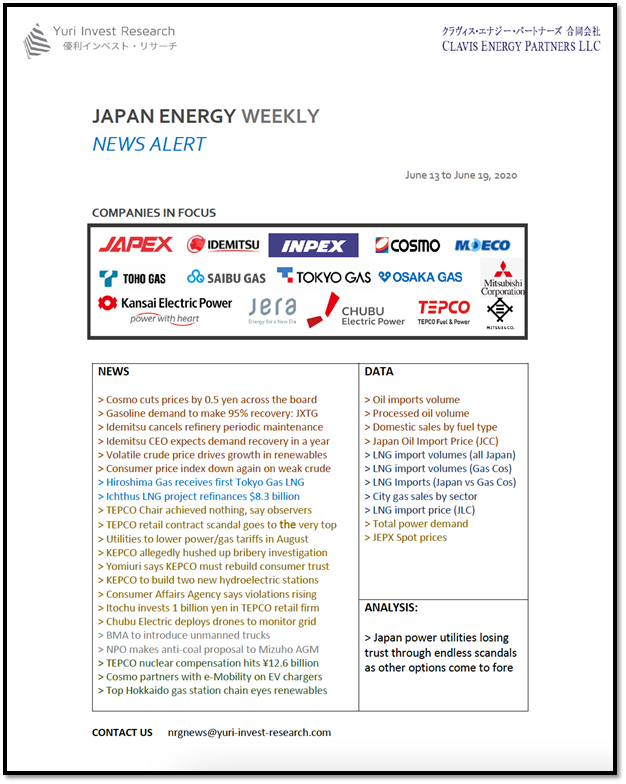
Cover of the first public edition of Japan NRG Weekly
Market for crude oil and oil products is shrinking
A string of mergers in the oil refining sector left three brands (ENEOS, Idemitsu and Cosmo) in control of around 95% of the market. The Covid-19 pandemic further damaged the industry as transport and transit activity considerably slowed. At the time, JXTG Holdings (now ENEOS) chairman Sugimori Tsutomu correctly predicted that it would take until 2022/2023 for domestic oil demand to recover.
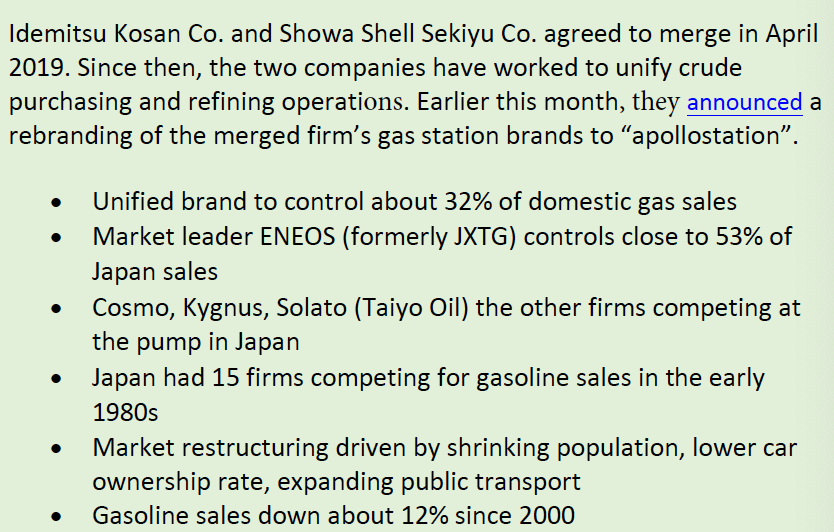
TODAY: Activist investors associated with Murakami Yoshiaki have taken a stake in Cosmo and are pushing the smallest of the domestic majors to consider further industry consolidation. Murakami helped Idemitsu complete its merger with Showa Shell Sekiyu in 2019 and has strong industry connections. Cosmo, however, is resisting Murakami’s advice and has gone on the defensive.
Traditional energy firms moving into greener options
One reason Cosmo isn’t playing ball in seeking mergers with rival oil firms is because the company has spent a number of years expanding into renewables and electric vehicles (EVs).
TODAY: The energy group operates at least 300 MW of renewable energy projects already and aims to grow its wind power generation capacity to 1.5 GW by 2030 through onshore and offshore operations. The group is also now pursuing new business directions in biofuels and Sustainable Aviation Fuel (SAF).
Of course, Cosmo isn’t the only traditional energy firm to branch out. In our first edition, Sapporo-based gasoline station chain, Hokkaido Energy, appointed a new president to explore ways to enter the renewables field. TEPCO Holdings chair Kobayakawa Tomoaki promised to make stronger investments into renewable energy sources as well as nuclear energy.
Major power utilities (EPCOs) are in trouble?
In the summer of 2020, the former regional power monopolies were facing a number of scandals. TEPCO’s Kobayakawa may have talked about the need to go green, but the company was in the public light for allegedly allowing contractors to cold-call the elderly and manipulate them into switching electricity providers. When the practice was discovered, TEPCO was reported as ordering contractors to falsify recordings of customer conversations.
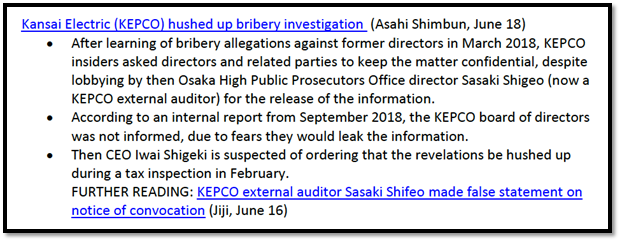
Meanwhile, directors of Kansai Electric were revealed as bribing at least 75 people in the locality around the utility’s Takahama nuclear station to be favorably disposed to the plant’s restart. In a highly unusual move, Japan’s top newspaper by circulation, the YomiuriShimbun, lambasted Kansai Electric in particular for its actions and called for a drastic overhaul of corporate culture.
The scandals helped push more households and business subscribers to switch suppliers to new market entrants. Japan NRG Weekly’s first-ever analysis text, published June 19, 2020, noted none of the EPCOs featured in the Top 10 best electricity retailers in a ranking compiled by aggregator site Denryko Kaisha Hack. Consumers turned from EPCOs to companies like Tokyo Gas, ENEOS, Rakuten and SoftBank, according to the ranking.
TODAY: Earlier this year, Kansai Electric was one of several major utilities accused by officials of anti-competitive behavior and cartel-like activities. TEPCO continues to be beset by governance issues, especially around its nuclear station in Kashiwazaki Kariwa. And the utilities are hurting from high fuel prices and constraints over how much they are allowed to raise tariffs.
Despite all this, the EPCOs are actually in a stronger position than three years earlier. The energy crisis over the last 18 months has led to more than a quarter of new entrants in the power retail sector suspending operations or going bankrupt. Many customers have flocked back to EPCOs for stability. However, recent price increases by new players like SoftBank mean that they are now more expensive than major utilities.
Climate action on the rise
Environmental action groups have been pushing corporate Japan to walk away from coal for many years with mixed success.
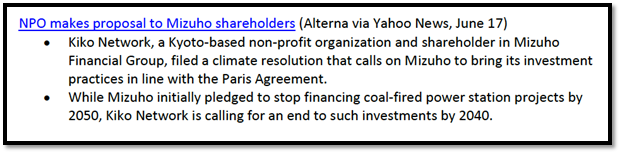
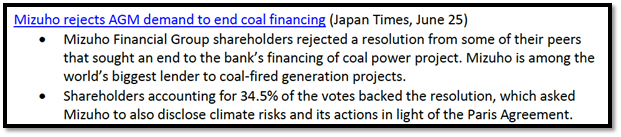
TODAY: Japanese firms are facing a record number of proposals from shareholders this year, with quite a few related to climate action. Not only non-profit organizations, but investment funds are now asking firms to expand climate change-related disclosures and firm up plans to hit net zero emissions. Among the firms under the spotlight in 2023 are TEPCO, trading house Mitsubishi Corp, and Toyota Motor. The big banks, including Mizuho, are again targeted by environmental groups both inside and outside the country to get tough on loans to fossil fuel projects.
Geopolitical tensions
Russia-Japan relations plummeted last year after Moscow’s incursion into Ukraine, but friction between the two in the energy field was evident even in June 2020.
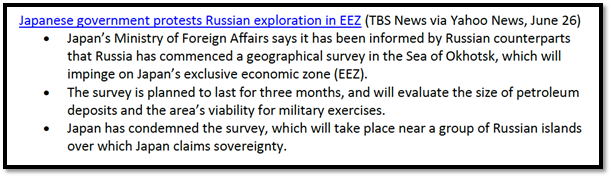
TODAY: In line with G7 allies, Japan has introduced a series of sanctions against Russia and vowed to phase out imports of its crude oil and coal. That promise never carried a definitive timeline and continues to be problematic to complete. Oil and coal imports are down, but energy security concerns show that they are unlikely to dwindle to zero anytime soon. The same and more can be said about Japan’s imports of Russian LNG, which actually look set to increase with the start of the Arctic 2 LNG project at the end of 2023 / early 2024.
Pursuit of offshore wind potential
Former Prime Minister Suga’s October 2020 declaration that Japan will be net-zero 2050 led to the creation of a national Green Growth Strategy, which for the first time put offshore wind as one of the top vectors for clean energy development in the country. But this change did not come entirely out of the blue.
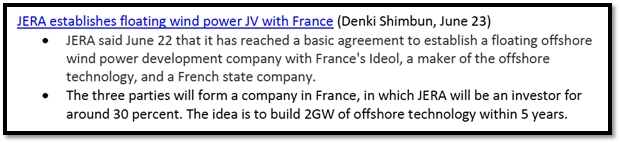
TODAY: Interest in developing offshore wind power in Japan continues to grow with many international as well as domestic companies bidding in government auctions for new projects. But the transition from fixing wind turbines to the ocean floor to creating floating turbine technology continues to be a work in process. Recently, groups led by J-Power and Japan Marine United (JMU) announced either mock-up tests or demonstration projects of new floating turbines as part of national development projects. Still, a homegrown floating turbine is not expected to enter commercial operations until the end of this decade.
Out of the blue (hydrogen)
One narrative that has undergone drastic change in the last three years, however, is the future of hydrogen development. Initially pitched by Japan as a fuel for transport, the country has revised its primary application of hydrogen and now considers it initially as a fuel for power generation. Later, it’s seen as expanding to Industrial applications / mobility. What’s more, hydrogen itself has changed “form” in the government’s strategy over these years. Today, ammonia, which is a compound of one nitrogen and three hydrogen atoms, is seen as a more practical version of a gas from the “hydrogen family”. Meanwhile, the debate over the colors of hydrogen seems to be waning and moving in the direction of calculating associated CO2 content rather than categorization by power source.
Prices
One aspect that has changed considerably from three years ago was the price of energy. Soon after the outbreak of Covid-19 global prices for many energy commodities plummeted and demand was uncertain. The year 2020 saw electricity and gas bills drop precipitously, before the volatility of 2021 and 2022 unleashed wild swings in pricing amid numerous energy crises.
Today, many energy conversations remain focused on the cost of deploying one or another technology. Most of these discussions are still based on the idea that generation and demand are constant, and that theoretical pricing models such as the LCOE are applicable in real life. The last three years show that volatility in markets, societies, weather, supply chains and cost will surely only increase. Hoping that a cheap and plentiful solution will emerge is fanciful. If there is one thing that the last three years of Japan NRG Weekly reporting conclusively shows, it’s that our energy systems need to be resilient, flexible, and multifaceted. They will need to deal not only with what we already know or suspect, but also what we have yet to anticipate.
GLOBAL VIEW
BY JOHN VAROLI
Below are some of last week’s most important international energy developments monitored by the Japan NRG team because of their potential to impact energy supply and demand, as well as prices. We see the following as relevant to Japanese and international energy investors.
Germany/ Natural gas
Industrial capacity might be curtailed if Ukraine’s gas transit agreement with Russia isn’t renewed after its expiration. The country’s energy minister said that policymakers should avoid “making the same mistake” by assuming that the economy will be unaffected without precautions to secure energy supplies.
Mexico/ Thermal power plants
Spanish utility Iberdrola will sell to the state 13 gas-fired thermal power plants for $6 billion, which is 55% of its Mexican business. The company is now focused on wind and solar power generation in Europe and the Americas.
Netherlands/ Natural gas
The Groningen gas field will likely shut on October 1. The cabinet will make an official decision later this month. The Netherlands previously aimed to close the field by October 2024, but officials face pressure over the earthquakes it causes.
Nigeria/ Oil
Crude oil production fell to slightly more than 1 million b/d in April, dropping below Angola’s production that was estimated at 1.1 million b/d. Oil theft and sabotage of export infrastructure are major issues in Nigeria, which was once Africa’s leading crude oil producer.
Renewable diesel
Labor costs and commodity prices are hurting the renewable diesel sector. Cargill suspended plans to build a giant soybean-processing plant to make feedstock for renewable diesel. Exxon Mobil canceled a deal to buy the green fuel from Global Clean Energy Holdings, which faces project delays in part from a lack of skilled workers.
Russia/ Oil
President Putin spoke on the price ceiling for Russian oil: “with our OPEC+ partners we make joint decisions that minimize negative consequences for global energy markets when politically motivated economic decisions are made. We are gradually replacing one market with another. Our companies act more energetically, looking for new partners and they find them.”
Slovakia/ Nuclear power
The Economy Ministry and Slovenské elektrárne agreed to support development of small modular reactors (SMRs), including applying for funding from Project Phoenix (U.S.). Other partners include U.S. Steel Košice and the Slovak Electricity Transmission System.
Solar energy
Solar energy parts maker CubicPV raised $103 million to build a U.S. factory to make silicon wafers, the key components for solar panels. The investment was led by the Thai conglomerate SCG, with additional funding from Bill Gates’ Breakthrough Energy. China produces about 98% of the world’s wafers.
UK/ Natural gas storage
A partial reopening in October of the largest gas storage, Rough, boosted the UK’s stockpiles, but that’s not enough. The UK now has nine days of peak winter demand in storage, by far Europe’s lowest. Compare that to Germany’s 89 day’s worth of peak demand storage.
U.S./ UK/ Nuclear power
Both countries announced the Atlantic Declaration, which is a framework for economic cooperation. Nuclear power cooperation is one main area. The goal is to develop end-to-end fuel cycles to challenge Russian uranium fuel dominance.
2023 EVENTS CALENDAR
A selection of domestic and international events we believe will have an impact on Japanese energy
ASEAN-Japan summit to mark 50 years of cooperation
Last market trading day (December 30)
Disclaimer
This communication has been prepared for information purposes only, is confidential and may be legally privileged. This is a subscription-only service and is directed at those who have expressly asked K.K. Yuri Group or one of its representatives to be added to the mailing list. This document may not be onwardly circulated or reproduced without prior written consent from Yuri Group, which retains all copyright to the content of this report.
Yuri Group is not registered as an investment advisor in any jurisdiction. Our research and all the content express our opinions, which are generally based on available public information, field studies and own analysis. Content is limited to general comment upon general political, economic and market issues, asset classes and types of investments. The report and all of its content does not constitute a recommendation or solicitation to buy, sell, subscribe for or underwrite any product or physical commodity, or a financial instrument.
The information contained in this report is obtained from sources believed to be reliable and in good faith. No representation or warranty is made that it is accurate or complete. Opinions and views expressed are subject to change without notice, as are prices and availability, which are indicative only. There is no obligation to notify recipients of any changes to this data or to do so in the future. No responsibility is accepted for the use of or reliance on the information provided. In no circumstances will Yuri Group be liable for any indirect or direct loss, or consequential loss or damages arising from the use of, any inability to use, or any inaccuracy in the information.