Miyagi Pref passes renewable tax plan, will slow local development for new wind and solar power plants
Electricity futures: TOCOM trading volume triples in May, due to a more flexible trading environment
Solar PV manufacturers racing to secure germanium metal supplies from China ahead of Aug 1 deadline
ENERGY TRANSITION & POLICY
NRA approved TEPCO’s plan for Fukushima water release
Toyota says new EV battery tech can halve unit costs and size
AI could help find climate solutions: experts say
enechain begins trading environmental commodities
Terra Motors secures ¥4 billion to expand EV charging
Tohoku Electric to work with Power-X on storage batteries
J-Power and Genex develop solar power and BESS in Australia
Toshiba with world’s first wireless monitoring of storage batteries
ELECTRICITY MARKETS
OCCTO to notify generators when power reserve drops below 8%
Kansai Electric/ RWE to bid for 1 GW offshore wind in Wakayama
Mitsui to complete sale of Indonesia’s PT Paiton Energy
JERA begins operation of new coal-fired power station
Kyushu Electric to avoid summer power shortage thanks to NPPs
Chubu Electric and MLIT test method to improve hydropower
TEPCO RP invests in geothermal plant in the Akita Pref
Kansai T&D addresses customer data leak
OIL, GAS & MINING
Idemitsu makes additional investment in Australian lithium firm
LNG stocks at power utilities fall to 2.1 million tons
IHI works with Thai petrochemical plant on lower olefin synthesis
ANALYSIS
JAPANESE COMPANIES EAGER TO SPARK THE U.S. ENERGY TRANSITION
Nearly a year has passed since the U.S. government approved the Inflation Reduction Act, and investments into the country’s energy sector are growing. Of all U.S. allies, Japan is in the forefront of this trend, with new substantial investments planned in clean energy, building on many others made over the past decade. In fact, Japan has now become the world’s largest investor and its capital could be the spark for the energy tradition both in the U.S. and at home.
ENERGY JOBS IN JAPAN: BOOM IN ENERGY STORAGE COMPLICATES HIRING
Energy Storage projects are on the rise in Japan, with many players looking to capitalize on the METI subsidies announced in 2021, and the necessity to co-locate ESS with new renewable assets in certain areas, namely Hokkaido. Does this mean that there is a booming talent market in the ESS market? The answer is both yes and no, and we can get a better understanding of this by looking at the capabilities of the players in the ESS market.
The Miyagi Pref assembly unanimously passed the prefectural proposal to tax solar, wind and biomass operators that build facilities by tearing down over 0.5 hectares of forest areas. The tax rate is 20% of operating profit from power operations.
The new tax will be introduced in April 2024 following a consultation with the Ministry of Internal Affairs and Communications. The plan may change if the ministry opposes it.
The Miyagi Pref is studying plans to set up Renewable Promotion Zones. Operators there wouldn’t be taxed.
Offshore wind operators won’t be taxed either. There are currently no offshore wind projects in Miyagi, and the prefecture is keen to attract projects.
The tax rate was set high in order to deter land development that conflicts with community stakeholders. The plan is not positioned as a new source of tax revenue.
It will be reviewed after 3-5 years.
Renewable operators pay Environment Tax and Development Tax to the prefecture, in addition to property related taxes and other national taxes.
CONTEXT: The new tax will hit onshore wind operators since it would be difficult to build power stations without tearing down mountain landscape in Miyagi. Some operators have argued more emissions are reduced from building wind power stations than keeping trees, and if renewable expansion stops due to the tax, the prefecture will not meet its 2050 net zero goal.
Miyagi Pref’s 2030 renewable expansion goal
2021
2030 goal
Renewable demand
2.3 TWh
2.7 TWh
Total power demand
14.4 TWh
11 TWh
TAKEAWAY: The passing of the local tax bill, just a week after the assembly convened, shocked renewable operators nationwide as the move is likely to spread. Even if the Ministry of Internal Affairs had blocked the Miyagi plan, there’d be other municipalities trying different tax ideas, they said. Driven by a shortage of space for new solar and onshore wind installations, some operators have started to review their business models, by exploring demand response, EV charging and other mobility services. National renewable expansion plans have come to a turning point. As possible solutions to break the deadlock, ruling party lawmakers eye speeding up next-gen perovskite solar tech development and floating offshore wind power planning in EEZ waters.
NRA approve TEPCO’s plan for Fukushima Daiichi water release, despite opposition
(Nikkei, July 7)
The NRA issued a certificate to TEPCO, the operator of the Fukushima Daiichi Nuclear Power Station in Japan, indicating that it has passed the pre-use inspection of facilities related to the discharge of treated water.
The IAEA assessed that the radiation impact of the discharged treated water on people and the environment is negligible.
Local fishermen remain opposed to the discharge. Some countries, including China and Russia, have also criticized the project. To explain the contents of the IAEA report, the IAEA Director General Grossi will also visit South Korea to meet with govt officials and members of the opposition party, which opposes the water release.
The NRA coordination officer is stationed in Fukushima to explain to the community stakeholders its review findings, chairman Yamanaka said. Unlike the IAEA head Grossi, Yamanaka has no plan for meetings with the fishermen and other community members. “There is no request for meetings with me,” he told reporters.
The IAEA will open an office in Fukushima to monitor the water release until completion.
CONTEXT: The water release will be spread out over several years.
Toyota says battery tech breakthrough can halve unit costs and size, a boost for EVs
(Financial Times, July 4)
Toyota recently unveiled a breakthrough in its next-gen batteries, known as solid-state technology. This will cut by half the cost of batteries used in EVs, as well as reduce their size and weight. Their cost would be similar or even lower than the lithium ion battery, said Kaita Keiji, president of Toyota’s R&D center for carbon neutrality.
CONTEXT: Lithium ion batteries use liquid or polymer gel electrolytes. Solid-state tech promises to be a more stable, more efficient battery in terms of charging and recharging, and which also avoids the flammability risks of liquid batteries.
Toyota could start to mass produce EVs with solid-state battery tech by about 2027 or 2028, Kaita said. Toyota’s recent announcements said that an EV with the new type of battery could charge in 10 minutes to cover a range of 1,200 km.
TAKEAWAY: Toyota’s comments could have interesting implications for battery raw materials, of which there is currently a shortage. It might ease the demand for graphite over time, but increase it for lithium metal. However, the economics of the new tech is not yet clear, and the speed at which Toyota will roll out the technology will play a role in raw material demand-supply calculations.
AI could help find climate solutions: experts say
(Japan NRG, July 3)
Generative AI could help find climate solutions, according to technology analysts speaking at “JX (Japan Transformation) Live! 2023”, a conference organized by the Japan Association of New Economy.
Climate change will have a larger impact on mankind than ChatGPT, causing natural disasters comparable to the 2011 Tohoku Earthquake, said Hirano Miku, the founder of AI startup Cinnamon.
AI will tailor an individual’s information needs. AI can also collect opinions on divisive issues such as nuclear power, and suggest a solution, said Uchiyama Koki, the CEO of Hottolink, and Ito Joi, Director for Digital Garage.
Japan excels in energy conservation tech and the country’s next growth focus should be power savings for AI, which is power intensive, said METI Minister Nishimura.
CONTEXT: Business leaders, startups, lawmakers, METI Minister and MoE Vice Minister gathered at “JX Live! 2023” to discuss how digital and green initiatives will propel Japan’s economic growth.
TAKEAWAY: METI and the MoE are likely to ask companies to provide more data to improve climate decision making, with or without AI. The performance of generative AI will depend on the data supplied to the system. Some countries have data localization laws requiring data of local citizens and organizations to remain in local servers, and allow government access to the data. Japan does not have such a law, and the possibility of enacting such a law is slim.
enechain begins trading environmental commodities
(Company statement, July 5)
enechain, Japan’s largest wholesale energy trading marketplace, started trading environmental commodities on its energy platform “eSquare”. The company buys non-fossil certificates of electricity from renewable energy suppliers and trades them and J-Credit.
The company says that eSquare will give clients everywhere access to energy and environmental commodity products at any time. This will provide price transparency and transaction liquidity.
The platform’s trading volume exceeded ¥1 trillion in 2023. Eurus Energy, Hokkaido Electric Power, and JERA are among the platform’s customers.
Terra Motors secures ¥4 billion to expand EV charging
(Company statement, June 26 and June 29)
Terra Motors raised ¥4 billion via a third-party capital increase from Osaka Gas, Tokyo Century, Sumitomo Mitsui Auto Service, and Pegasus Tech Ventures.
With these funds, Terra Motors will install more EV chargers across Japan, as well as develop software and hardware services for recharging.
CONTEXT: On June 29, the company said it will change its name from Terra Motors to Terra Charge effective February 2024, to focus on EV charging as its core business.
SIDE DEVELOPMENT: Nitori and Plugo partner for installing EV chargers (Company statement, June 30)
Nitori Holdings and Plugo will install a total of 750 EV chargers for all 300 Nitori and Shimachu shops in Japan by late 2024.
Nitori is a retail chain selling electric appliances and furniture; Shimachu mainly deals with furniture, both under Nitori Holdings. Plugo is a supplier of EV chargers.
Through “My Plugo”, customers will know if there’s a free parking space (with EV charger) and let them reserve it.
Tohoku Electric to work with Power-X on storage batteries
(Denki Shimbun, July 4)
Tohoku Electric and storage battery start-up Power-X formed an alliance to utilize Power-X’s stationary storage batteries and to explore new service opportunities.
The alliance will support Tohoku Electric’s business that’s focused on corporate PPAs and VPPs (Virtual Power Plants), which require the use of storage battery systems.
Power-X also raised ¥1.92 billion through a share allocation to several companies, including Tohoku Electric and Nippon Gas. The funds will go to R&D of storage battery products and building a storage battery factory.
J-Power and K4 Ventures have invested in Power-X. The total is ¥12.55 billion.
CONTEXT: Power-X has also formed alliances with Kansai Electric and Kyushu Electric. This is the second partnership for Tohoku Electric in the storage battery sector, following its alliance with Next Energy and Resources in July 2020.
Sala Energy will install a 70 MWh sodium sulfide (NAS) storage battery system supplied by NGK Insulators to complement power supply deals in spot, capacity and other markets, and to balance supply and demand.
The installation starts this month and operation is planned for early 2026.
J-Power and Genex develop solar power and BESS in Australia
(Company statement, June 30)
J-Power and Genex Power in Sydney will develop the Bulli Creek Project solar power and BESS project (2 GW) in Queensland.
J-Power will hold a 50% stake and provide A$35 million. The project will cover 13,000 acres. Construction begins in 2025; and commercial use in 2026.
Genex develops and operates renewable energy in Australia. J-Power has been investing in Genex since May 2021, but to develop wind power generation.
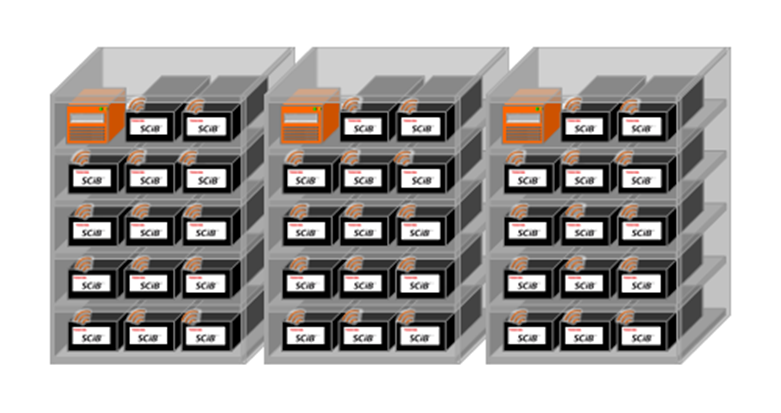
Toshiba succeeds in world’s first wireless monitoring of storage batteries
(Company statement, June 22)
Toshiba succeeded in enabling wireless monitoring of storage batteries using Bluetooth Low Energy (BLE), a versatile low energy consumption wireless standard.
Wireless monitoring simplifies system maintenance, improves insulation, and allows more flexibility of placement (of storage batteries). All these contribute to improving safety of the storage battery system.
CONTEXT: Storage batteries are indispensable for stabilizing power supplies of renewable energy sources. They’re used in a wide range of applications such as railway, marine vessels, and virtual power plants (VPP). This market’s size is expected to expand 4-fold by 2035.
Hitachi Zosen Inova won two orders for WtE plants in the UK
(Company statement, July 6)
Hitachi Zosen Inova, a subsidiary of Hitachi Zosen, won two long-term operating orders for Waste to Energy (WtE) plants in the UK.
The first is a plant being built in Slough, with a waste treatment capacity of 480,000 tons per year and a 50 MW output. The second is for a project in Scotland, with a waste treatment capacity of 216,000 tons per year and 23 MW output.
With these new orders, Hitachi Zosen Inova will soon operate three WtE plants in the UK. It was previously awarded a contract by Brockwell for the design, construction, and 25-year operation of the Westfield Energy Centre in Fife, Scotland.
CONTEXT: Apart from the UK projects, Hitachi Zosen Inova also has O&M orders for WtE projects in Dubai, UAE, and Rockingham, Australia. The company has a track record operating and maintaining WtE plants, with maintenance contracts for 131 facilities and waste treatment operations at seven sites.
Mitsui invests in world’s first e-methanol production company
(Company statement, July 6)
Mitsui will purchase a 49% stake in Kasso MidCo, the Danish affiliate of European Energy, and which owns Solar Park Kasso, a solar power and e-methanol producer.
Kasso built PV generation facilities (304 MW) that are north Europe’s largest, and is building a water electrolyzer and e-methanol factory.
Kasso’s e-methanol business, which annually produces up to 42,000 tons, is the world’s largest and first such commercially viable initiative.
CONTEXT: E-methanol is a green fuel, the chemical raw material of which is synthesized from renewables-based electricity and captured biomass-derived CO2.
TAKEAWAY: Demand for e-methanol is expected to grow as a green fuel to decarbonize the shipping industry. Mitsui, Maersk Oil Trading, Mitsui & Co Energy Trading Singapore, and the American Bureau of Shipping are collaborating to set up the world’s first methanol bunkering pilot in Singapore. Last month, Mitsui partnered with Asahi Kasei to establish a supply and procurement system for bio-methanol made in the U.S.
SIDE DEVELOPMENT: Mitsui buys UK pipeline repair equipment maker, with eye to hydrogen and CCS (Company statement, July 5)
Mitsui completed the 100% acquisition of STATS Group, a global pipeline repair equipment maker and technical services provider. STATS specializes in servicing large-diameter, high-pressure pipelines and has operations in nine countries.
The acquisition will provide opportunities for Mitsui in CCS and hydrogen power. Mitsui will leverage its industry knowledge, partner and client base, and global network to support the expansion of STATS’ products and services.
Japan Petroleum Exploration (JAPEX) and Deloitte proposed to deploy a pipeline network to connect carbon storage sites and manufacturers using carbon as feedstock, to develop carbon sharing economies.
Tomakomai City (Hokkaido), the site for Japan’s first CCS pilot, is best positioned to become a “carbon hub” and attract “clusters” of renewables, green hydrogen facilities, and manufacturers using carbon and hydrogen as feedstock. Details are in their report, “Carbon Recycling Scenario Based on Cross-Industry Collaborations in Tomakomai”.
They hope their plan will be put into action in 2028.
CONTEXT: Writing a plan for the carbon sharing economy was a state project from 2021 to 2023. JAPEX and Deloitte interviewed 43 companies and organizations in Tomakomai on how the different sectors can cooperate in carbon recycling.
NEDO awards ammonia cracking R&D project to JGC, Kubota, and Taiyo Nippon Sanso
(Company statement, July 6)
JGC, Kubota and Taiyo Nippon Sanso were selected to develop ammonia cracking technology to produce hydrogen under NEDO’s “Technology Development Project for Building Competitive Hydrogen Supply Chain”.
Technologies for ammonia cracking exist, but they’re for small-scale commercial purposes. The companies will develop and optimize hydrogen production methods that can also scale up by the end of FY2024.
JGC leads the group to design, develop, and implement the pyrolysis. Kubota develops ammonia cracking tubes. Taiyo Nippon Sanso develops hydrogen refining equipment.
Itochu and others join carbon neutrality project for Osaka Expo 2025
(Company statement, June 28)
Itochu, along with Itochu Enex, Isuzu Motors, Kajima, Konoike Construction, Shimizu, and Takenake, applied to participate in the Carbon Neutral Technology Development and Verification Project 2023 offered by Osaka Pref.
The project aims to achieve carbon neutrality using renewable diesel (RD) in the construction and transport sectors, specifically for the Osaka Expo in 2025.
Itochu will procure RD from Neste, a producer of green fuels, while Isuzu will conduct engine tests and studies for the use of Neste RD in trucks and industrial machinery. Itochu Enex will expand the supply network in Osaka Pref.
CONTEXT: RD is a renewable fuel with much GHG emissions reduction potential, and can be used in existing vehicles and machinery.
Kyrgyzstan became the 27th country to join the Joint Crediting Mechanism for sharing offset credits from Japanese company emission reduction projects in Kyrgyzstan.
NEWS:POWER MARKETS
Electricity futures: TOCOM trading volume triples in May
(Denki Shimbun, July 5)
In May, the volume of contracts in the electricity futures market on the Tokyo Commodity Exchange (TOCOM) reached a record high of 218.86 GWh, which is 3.3 times greater than the previous month, thanks to a more flexible trading environment.
There was a significant increase in trading of the East Area Baseload contracts, with a growing trend of hedging during summer and winter peaks outside of the regular trading session. Some trades also played the arbitrage between east and west area prices.
CONTEXT: Usually, participants tend to refrain from trading and holding futures positions that span across fiscal years during February to March. However, May showed a vibrant trading activity. Market participants said this is the result of the resolution of year-end transitions and a better visibility of summer demand.
East Area Baseload volumes jumped 6.4 times higher compared with the previous month. There was an increase in hedging for July to September 2023, and December 2023 to February 2024. Overall, prices trended down due to lower fuel costs.
OCCTO to notify generators when power reserve ratio drops below 8%
(Denki Shimbun, July 3)
From April 2024, OCCTO will notify generation companies when the areawide reserve capacity ratio is due to fall below 8%. The assessment will be updated every week as part of the systems operator’s review of the market’s supply-demand situation. When the reserve rate drops below the 8% level, OCCTO will ask all available power sources to supply power or bid in the market. If the target is not met, penalties will be imposed.
CONTEXT: It takes two to three days to start up some generators, so to make sure the capacity is available OCCTO will make the call as part of its weekly review and drafting of the weekly supply-demand plan.
The information will be on OCCTO’s website and also sent to market participants by email.
SIDE DEVELOPMENT:
OCCTO guidelines: Cross-regional reserve rate of 12%
(Denki Shimbun, July 3)
At a meeting on the supply-demand adjustment market, OCCTO presented guidelines for additional procurement of adjustment capacity. These were approved and will now be introduced later in the year.
The threshold for conducting additional procurement was set at a regional reserve rate of 12%. Should the ratio fall below this by noon a day ahead, procurement will be stopped.
Kansai Electric and RWE to bid for 1 GW offshore wind project in Wakayama
(Company statement, June 30)
Kansai Electric and RWE Renewables Japan submitted an environmental assessment to METI and Wakayama Pref. The report is open to public review, July 4 to Aug 2.
This is for bidding on an offshore wind platform near Wakayama Pref coast in which the two companies will participate. Total power capacity of the proposed project will be 1 GW, consisting of 50-110 floating-type wind turbines, each 9.5 to 20 MW.
TAKEAWAY: Wakayama has not yet been on the list of any of the state-led projects in Round 1 to Round 3 of offshore wind power tenders. In 2019, Pacifico Energy did an environmental assessment locally for fixed-bottom type of offshore wind turbines. The project’s future depends on whether the Wakayama area will be designated as an offshore wind promotion area under the Act on Promoting the Utilization of Sea Areas for the Development of Marine Renewable Energy Power Generation Facilities.
Mitsui to complete delayed sale of all its shares in Indonesia’s PT Paiton Energy
(Company statement, July 3)
This month, Mitsui will finalize the sale of all of its shares in Indonesia’s PT Paiton Energy, which owns and operates three coal-fired power plants. The buyers are Singapore’s RH International and PT Medco Daya Energi Sentosa (Indonesia).
The deal was originally expected to be concluded in Q1 of FY2023, but was subject to conditions, such as consent from PLN (Indonesia’s national electricity company).
As of June 27, all conditions were met. Profit from this transaction has been factored into Mitsui’s forecast for FY2023, which were disclosed on May 2.
CONTEXT: In June 2021, Mitsui announced plans to divest all its shares in PT Paiton Energy and two related entities, to be sold to Singapore’s RH International (RHI), a subsidiary of RATCH Group. The deal was to be completed by late FY2021, but due to issues in meeting specific conditions, Mitsui delayed the deal. On Feb 15, 2023, Mitsui announced another delay and a partial change in buyers. Alongside RHI, Mitsui also agreed with PT Medco Daya Energi Sentosa.
JERA begins operation at new coal-fired Yokosuka Thermal Power Station
(Denki Shimbun, July 3)
JERA began commercial operations at Yokosuka Thermal Power Station Unit 1, a 650 MW coal-fired power plant in Yokosuka City, Kanagawa Pref.
Construction began in August 2019, employing turbines and boilers made by MHI, along with generators from Mitsubishi Electric. The plant will consume around 1.8 million tons of coal annually.
In 2016, TEPCO Fuel & Power began an environmental assessment for the project, later taken over by JERA. The demolition of the old power station was simultaneous with the construction of Unit 1, starting in 2017 and concluding in 2022.
CONTEXT: Yokosuka Unit 2, the remaining coal-fired power plant under construction by JERA, is expected to begin full operations in February 2024.
Kyushu Electric to avoid summer power shortage thanks to NPPs
(Nikkei, July 6)
Kyushu Electric expects that it will avoid a power supply shortage this summer. July’s reserve ratio, which indicates surplus supply capacity, is expected to exceed 9%, way above the required 3% minimum.
If the rainy season continues, solar power output may decrease, and there are concerns about potential natural disasters and equipment issues affecting supply.
Kyushu Electric plans to resume operations of Sendai Nuclear Power Plant Unit 2 in mid-August to maximize its nuclear power generation. Although the company doesn’t plan to request power conservation measures from customers, it will take precautions to ensure adequate supply.
The NRA launched a public consultation on its proposed rules for long-term management of nuclear power plants that follow enactment of the GX Decarbonization Power Supply Act and removal of the 40-year operation limit.
The NRA defined the information required for regulatory filing of degradation checks, which are to be conducted separately from regular facility checks. The NPP operators are to report methodologies for assessing the status of facilities and equipment, time of inspection, and the results, as well as the names of contractors participating in the technical evaluation and how the operators engage with them.
The public feedback period ends on August 5. The NRA hopes to launch the review processes in 2025, said chairman Yamanaka.
Chubu Electric and MLIT test method to improve hydropower generation
(Denki Shimbun, July 7)
Efforts are underway to increase hydroelectric power generation at existing dams, specifically focusing on the Yokoyama Dam. Chubu Electric and the MLIT plan to review dam operations and increase power generation during periods when water outflows do not reach flood levels.
Instead of releasing water through flood discharge gates, the excess water was stored and used for power generation discharge.
During the June 28-July 2 trial, the water level was set three meters higher than the flood stage water level, resulting in about 8.8 MWh of increased power generation. This is part of the MLIT’s efforts to promote “hybrid dams” that enhance hydroelectric power generation while maintaining flood control capabilities.
CONTEXT: The Ministry plans to expand the project to 72 dams, aiming to add about 20 million GWh of power generation. The Yokoyama Dam is the first in the Chubu area to test these methods.
TAKEAWAY: Until the 1970s -80s, hydropower was Japan’s biggest source of green electricity. The sector has stagnated since then with few technological improvements or new projects, but the recent push to add Japan’s renewables capacity is motivating the govt and industry to rethink ways to get more electricity volumes from the nation’s water resources. For a more detailed look at the sector, see the Analysis section in the July 3, 2023 report.
TEPCO RP invests in Akita Pref geothermal plant
(Nikkan Kogyo, July 3)
TEPCO Renewable Power made its first investment in a geothermal power project, acquiring a 15% stake in Oyasu Geothermal’s Katatsumuriyama plant in Yuzawa, Akita Pref; purchased from Mitsui Oil Exploration.
Max capacity is 15 MW; operation is due to start March 2027. INPEX and Idemitsu Kosan will each have a 42.5% stake.
TEPCO RP aims to gain experience in geothermal power and promote geothermal development in other prefectures like Tochigi and Gunma.
Kansai Transmission and Distribution addresses customer data leak
(Denki Shimbun, July 4)
KEPCO’s Kansai Transmission and Distribution set up an in-house Neutrality and Impartiality Advisory, in light of the recent leak of company customer data.
It will advise the board of directors on ways to improve the neutrality and impartiality of power transmission and distribution companies, including conduct regulations.
The first meeting is Aug 10, and discussions will be held twice a year.
Eurus Energy joins GWO – Japan’s first
(Company statement, July 6)
Eurus Energy joined the Global Wind Organisation (GWO) as a board member. GWO unites wind power generation facility owners and major wind turbine manufacturers.
Eurus is the first Japanese company to become a member of GWO.
CONTEXT: To join GWO requires meeting certain criteria. Eurus will share risk information and expertise with other members in the wind power industry, and help to set up international standards for safety training and emergency procedures.
Chuo Nippon Land Building, Photon Capital and TEPCO sign off-site PPA
(Company statement, July 5)
Chuo Nippon Land Building, Photon Capital and TEPCO signed an off-site physical corporate PPA for renewable energy supply.
TEPCO will provide electricity from Photon Capital’s newly established solar power plant in Fukaya City to three buildings owned by Chuo-Nippon Land Building.
This means the buildings will be powered by 100% renewable energy.
NEWS:OIL, GAS & MINING
Solar PV manufacturers racing to secure germanium from China ahead of Aug 1 deadline
(Japan NRG, July 7)
Solar PV products manufacturers are racing to secure as much germanium metal from China before new export controls take effect, traders told Japan NRG.
This week, China’s Commerce Ministry said germanium and gallium metal exports will be subject to screening as of August 1.
Prices are surging. Germanium traded at $2,550/ kg this week, up 8% from January.
CONTEXT: China has an 80% share of Japan’s germanium metal imports used for infrared ray sensing devices, solar PV components and semiconductor chips. China has around 60-70% share of Japan’s gallium imports, used for chips. Japan has its own gallium production and relies less on Chinese supplies.
TAKEAWAY: A fierce exchange of words among officials this year over Chinese rare earths sales overseas hardly disturbed the market. China says it has no intention to stop germanium and gallium exports, but rather to tighten control. Nevertheless, traders say the move could hit germanium metal consumers in the defense sector as China’s supply share is higher than for rare earths.
Idemitsu invests A$48 million in Australian lithium company
(Denki Shimbun, July 5)
Idemitsu Kosan invested about A$48 million in Delta Lithium, to increase its stake to 15%.
In January, Idemitsu Kosan invested $A5 million in Delta Lithium.
CONTEXT: Idemitsu Kosan aims to acquire knowledge in the mining of lithium, demand for which will grow due to the proliferation of EVs and large-scale batteries.
IHI collaborates with Thai petrochemical plant on lower olefin synthesis
(Company statement, July 4)
IHI partnered with Siam Cement Group on a proof-of-concept test at a petrochemicals plant in Thailand. The tests are part of a project funded by NEDO and aim to develop sustainable lower olefin synthesis technology from CO2 as a feedstock.
IHI plans to extract CO2 from exhaust gas emitted by naphtha crackers at the plant and convert it into lower olefins using their developed catalysts.
The installation of CO2 capture and olefin synthesis facilities is planned for 2024, with proof-of-concept tests running until March 2026.
LNG stocks of 10 power utilities stood at 2.1 million tons as of July 2, down 6.7% from 2.25 million tons a week earlier. The June 28 stocks were first reported at 2.23 million tons but METI corrected the figure.
The end-July stocks last year were 2.28 million tons. The five-year average for this time of year was 2.08 million tons.
ANALYSIS
BY JOHN VAROLI
Japanese Companies Eager to Spark the U.S. Energy Transition
Nearly a year has passed since the U.S. government approved the Inflation Reduction Act, and investments into the country’s energy sector are growing. Of all U.S. allies, Japan is in the forefront of this trend, with new substantial investments planned in clean energy, building on many others made over the past decade.
In 2020, foreign direct investment outflow from Japan was $222 billion, making the country the world’s largest investor. Japan’s investments are focused in the EU and North America, and the country is the leading direct foreign investor in the U.S, with a total of $721 billion in 2021 — 14% of the $5 trillion total, according to the Department of Commerce.
U.S. subsidiaries and affiliates of Japanese companies exported $75 billion worth of goods in 2020, far ahead of Germany’s $47 billion in second place. About half of Japan’s investment is in manufacturing, such as the car industry, but new investments in pharmaceuticals and energy are growing.
While China is another major destination for Japanese investment, concerns over geopolitical risks have changed the landscape significantly. Also, the White House’s effort to return manufacturing and supply chains home has complicated business for Japanese companies which need to import parts and materials from China. Businesses that seek to expand in the U.S. now need to spend more to build up local supply and production.
According to the Japan External Trade Organization (JETRO), over half of Japanese companies operating in the U.S. cited rising wages as a challenge, as well as rising logistics costs. This, of course, impacts the bottom line. While profit margins on direct investment by Japanese companies have been in the double digits in China, in the U.S. they’ve slumped to less than 5% since 2020.
In the eyes of many Japanese companies, however, those obstacles and challenges are worth tolerating for one prime reason – most states in the U.S. are seen as mature, stable markets with a long-established and transparent legal framework that’s conducive to business growth. Texas is by far the lead destination for Japanese investment in energy, with Houston serving as the unofficial capital for Japanese energy companies in North America.
Japan loves tech in the U.S.
Natural gas power generation and LNG development have long been a major focus of Japanese investment in the U.S., and this trend shows no sign of abating even though Europeans are now the leading buyers of LNG from the U.S.
JERA, a thermal power and LNG joint venture between TEPCO and Chubu Electric, plans to invest $935 million through 2030 in U.S. power generation projects. Since 2016, JERA has taken over nearly 3 GW of generation in North America, set over three U.S. natural gas-fired power plants as part of the Tenaska Gas Thermal IPP Project. Also, J-Power has stakes in a dozen U.S. power plants, mostly gas-fired plants that are less than 20 years old.
New technologies, however, are the essence of the energy transition, and this is the main opportunity for Japanese investors eager to enter the American energy transition. A knack for cutting-edge technology has personified Japan in the minds of many Americans since the early 1980s. While that reputation has weakened in recent years, ‘green tech’ is precisely where Japan hopes to emerge as a leader in the U.S. market.
Here’s an overview of some of Japan’s most significant energy transition projects in the U.S. Some predate the passage of the IRA.
Smart Grid, Energy Efficiency and Climate Tech:
In early 2022, NEDO and Sumitomo Electric completed a demo project in California to improve the grid’s power quality, achieving the establishment of a microgrid on a commercial power distribution network, operation of a large-scale stationary storage battery, and multi-use operation in both normal and emergency situations.
In May, Mitsui O.S.K. Lines (MOL) set up a subsidiary, MOL Switch, in the U.S. Over the next three years it will invest $100 million in startups working on climate tech focused on decarbonization.
Also in May, Hitachi Energy secured a multi-billion yen order of high-voltage direct current (HVDC) equipment from U.S. renewable energy developer Pattern Energy. The high voltage source converters will deliver the power generated at the 3.5-GW SunZia wind project in New Mexico to Arizona, which is scheduled to start in 2026, via 885 km of HVDC transmission lines.
Energy Storage/ EV batteries: To safeguard energy security, the White House is stimulating domestic battery production.
Toward that goal, Panasonic will expand by 10% its EV battery production at Tesla’s Gigafactory in Nevada, adding a 15th line by 2025. Panasonic also plans a $4 billion lithium-ion EV battery factory in Kansas, with an initial production capacity of 30 GWh; to start production in March 2025.
Also, six Japanese companies including INPEX, Development Bank of Japan, and Rakuten Capital invested in TerraWatt Technology that develops lithium-ion batteries.
Solar Power: Japanese companies have made sizable investments in solar power projects in the U.S., with Texas as the main destination. Companies, such as Kyocera Solar and Sharp, have long had solar panel manufacturing facilities and develop solar projects across various states. But in the past three years, Japanese energy companies have been gobbling up entire solar farms.
The most recent was in May when Osaka Gas USA bought a 350 MW utility scale solar project in Texas from EE North America, a subsidiary of European Energy. The project will be operational in 2025.
Also, J-Power USA, a unit of the Tokyo company, has a 50% stake in the 400 MW Charger Solar facility in Texas that begins operation this year.
Tokyo Gas Americas has a stake in the 500 MW Aktina Solar Project in Texas. The deal was Tokyo Gas’ first international solar project from construction to completion.
Wind Power: Japanese companies have also invested in wind power projects in the U.S., again, with Texas as the lead destination. Sumitomo owns wind farms in Texas.
Kansai Electric has a 49% stake in the 525 MW Aviator Wind Project in Texas, the company’s first renewable energy project in the U.S.
Also, Marubeni has an agreement with BP Alternative Energy Investments (BPAEIL) for development of offshore wind and other decarbonization projects. BPAEIL already has a net offshore wind development pipeline of more than 5 GW.
Nuclear power:
In 2021, NuScale, a U.S. startup maker of SMRs, secured $20 million from Japan’s IHI Corp. Also, as part of its relationship with Fluor Corp, NuScale’s majority investor, Japan’s JGC HD will invest $40 million in NuScale and partner with Fluor on the deployment of NuScale’s SMRs.
Meanwhile, the Japan Atomic Energy Agency and Mitsubishi Heavy Industries will cooperate with the U.S. government and TerraPower on an advanced nuclear power venture founded by Bill Gates; the goal is to build an advanced sodium fast reactor in Wyoming. Terrapower had initially explored building the experimental nuclear reactor with China National Nuclear Corp.
In March 2022, Holtec signed an agreement with the U.S. division of Mitsubishi Electric to design and engineer the digital instrumentation and control systems for Holtec’s SMR-160 modular reactor.
Hydrogen power: Japanese companies are investing in hydrogen-related projects in the U.S., including in production, storage, and transportation infrastructure.
In June, JERA began co-firing hydrogen at a gas-fired power plant in the U.S., with plans to achieve a ratio of 40%. Unit 6 of the 972-MW Linden gas-fired power plant in New Jersey mixes a by-product gas that includes hydrogen supplied from nearby oil refineries, with natural gas to generate electricity. This is JERA’s first project to implement hydrogen co-firing in a thermal power plant. The company’s co-firing strategy for Japan currently focuses on ammonia co-firing at coal-fired power stations.
Biofuels:
Sojitsu Corp of America is investing in Next Renewable Fuels to build a plant in Oregon to make renewable fuels from used cooking oil with HEFA technology. Annual production will be 2.8 billion liters of sustainable aviation fuel (SAF) and renewable diesel. Plant construction and port facilities are estimated at $7.5 billion.
Also, last month Asahi Kasei and Mitsui announced a plan for a supply system for bio-methanol made in the U.S. Mitsui will acquire renewable natural gas (RNG) from local waste landfills.
In the coming years, and probably decades, the ‘special relationship’ between Japan and the U.S. looks set to grow and prosper. In the wake of the tectonic geopolitical shift since the start of the Russian-Ukraine conflict in early 2022, Tokyo and Washington need each other more than ever in order to bolster their economies and guarantee energy security.
The common goals of the energy transition are serving to further compound this alliance on both a geopolitical and commercial level. As both countries revive their industrial strategies and pair energy development with that of key and sensitive sectors like semiconductors, the current investment numbers feel more like the floor and not the ceiling of this relationship.
COLUMN: ENERGY JOBS IN JAPAN
BY ANDREW STATTER
Energy Storage Market Special – Hiring in the BESS boom
Energy Storage projects are on the rise in Japan, with many players looking to capitalize on the METI subsidies announced in 2021, and the necessity to co-locate ESS with new renewable assets in certain areas, namely Hokkaido. Does this mean that there is a booming talent market in the ESS market? The answer is both yes and no, and we can get a better understanding of this by looking at the capabilities of the players in the ESS market.
Players and capabilities
Main market players are renewable developers, both multinational and domestic, with experience in other asset types, most commonly PV solar players with a track record in Japan.
As the FIT for PV dries up – large-scale projects have faced challenges such as land scarcity, local opposition and declining economics – many developers have shifted their focus to ESS projects. These players already have strong capabilities in project origination and development. As ESS projects tend to require smaller parcels of land, these early stages of development are relatively easy to cover with existing human resources.
In most cases, they employ electrical engineers, who are able to perform tasks such as system design, working with TSO for grid connection, etc. However, the trading and power markets are where these firms tend to lack expertise. Most of their projects in PV have been subsidized by FIT, and they have little or no experience in trading their power, and thus, they need expertise to help maximize sales.
Next are experienced global ESS system developers and power utilities. Storage markets in the UK, U.S. (certain states) and Australia are further advanced than in Japan. Successful firms in those markets see the potential in Japan, and there have been multiple market entries in recent months. Conversely to our first group of players, these global firms such as Eku, Akaysha Energy or even Tesla have experience in operating and trading power in their home markets. When they enter the Japanese market, they tend to have more local focused needs, for example technical development and talent who are strong with partnerships and policy.
Finally, there are large Japanese companies, such as trading houses and utilities. We see the least mid-career hiring for ESS in the large Japanese firms, with the reason that they have a broad spectrum of existing talent. Often, they invest in and partner in ESS projects overseas, gaining experience that they bring home.
Many of these firms have had a power retail arm, or have been early movers in PPA offtake projects, both of which give them a firm understanding of the commercial aspects. Mid-career movement in the large Japanese players has been observed on the technical side. Trading houses are the prime example – with strong commercial, development and financial resources. However, often lacking in technical expertise, they’ve been hiring strong talent with experience in battery technology manufacturers.
Does this mean that there is a lack of opportunity in ESS? No, we are seeing a demand for different talent and skill sets than we’d normally see in the development and operation of generation assets. As the majority of market players can repurpose existing resources to cover aspects of their ESS business, hiring takes more of a ‘fill the gaps’ approach, as opposed to development of full new teams.
Keeping lean
The other reason for lower volume of ESS opportunities is the smaller scale of projects at this early stage. For example, Pacifico Energy’s first two stand-alone ESS projects recently launched; their capacity is 2MW/ 8MWh each. The company is a developer with a track record of very large scale PV generation projects. Illustrating the points above, they achieved this with only a couple of specific hires for the ESS team, while relying on existing development and engineering capabilities. As both project volume and scale increase, we expect this to change.
Quality > volume
In contrast to the PV boom of a decade ago, the market today does not expect to rely on subsidies long-term. Therefore, new market entrants must start from day one with a business plan to succeed in an open market.
This has led to firms taking more care with their OPEX, which includes hiring. The result is a focus on building small, lean, high quality teams rather than hiring en masse and grabbing land left, right and center, and collecting FIT ID’s as if they were Pokemon to put their names on as much pipeline as possible.
Summary
The ESS market in Japan is one of the next large growth sectors, which is already reflected in an increase of hiring across the space. In contrast to the scale of hiring from outside the industry during the PV boom, and to a lesser extent in the offshore wind industry over the past few years, the approach by the market has been more measured. It is still early days, and the scale of stand-alone projects is small when compared to global markets; hence, this is an area we expect to accelerate in the near future.
GLOBAL VIEW
BY JOHN VAROLI
Below are some of last week’s most important international energy developments monitored by the Japan NRG team because of their potential to impact energy supply and demand, as well as prices. We see the following as relevant to Japanese and international energy investors.
China/ Critical raw materials
China will restrict exports of gallium and germanium, which are used in computer chips and other components. This raises concerns of export limits of other materials, notably rare earths, whose production China dominates, and which are vital for the energy transition.
EU/ Critical raw materials
Aluminum joined the list of minerals and metals covered by the Critical Raw Materials Act, which seeks to safeguard supplies to compete with the U.S and China. The World Bank has identified aluminum as a “high-impact” metal in all existing and potential green energy technologies from solar to geothermal, as well as in EVs.
EVs
Tesla shares, which have more than doubled in the first half of 2023, are set to extend their rally after the company beat expectations, delivering 466,000 vehicles between April and June, up 10.4% from the previous quarter and 83.5% YoY.
India/ Oil imports
Indian refiners have begun paying for some oil imports from Russia in yuan, as Western sanctions force Moscow and its customers to find alternatives to the dollar for settling payments. India is now the largest buyer of seaborne Russian oil.
LNG
Surging EU demand for LNG to offset the loss of Russian gas has pushed prices beyond the reach of buyers in south and Southeast Asia, fueling coal use – this was the message at the Energy Asia conference in Kuala Lumpur this week. Europe’s thirst for LNG has taken some permanent supply from Asia, plus all the new supply from the U.S.
Netherlands/ Energy infrastructure
Canada’s OMERS and Dutch investor APG will buy Kenter, the Dutch infrastructure solutions firm. The deal values Kenter at close to €700 million. It specializes in the energy transition, selling products such as transformers, switchgear, and meters.
Offshore drilling
The number of offshore drilling vessels recovered to pre-pandemic levels, rising by 45% from a low in October 2020. Wood Mackenzie forecasts offshore exploration and drilling to grow 20% by 2025. Upstream oil and gas have returns of about 15% to 20%, while most renewables projects deliver up to 8%.
Oil prices
Saudi Arabia will extend the one million bpd production cut announced last month for July into August, while Russia will make a voluntary supply cut of an additional 500,000 bpd next month. Oil prices rose slightly on the news. Having risen above $130 a barrel last March, oil now trades closer to $75 a barrel.
Russia/ gas
Gazprom threatened sanctions against Ukraine’s Naftogaz, saying it was not “constructive” in overseeing Russian gas transit to Europe. The company also said that it won’t take part in international legal cases initiated by Naftogaz to recover $5 billion awarded to it by an arbitration court as compensation for assets expropriated in Crimea.
Wind power
Siemens Energy will set up a task force to investigate deepening problems at its crisis-ridden wind turbine division. The problems, which were revealed in June, caused Siemens Energy’s shares to plunge by 37%.
2023 EVENTS CALENDAR
A selection of domestic and international events we believe will have an impact on Japanese energy
ASEAN-Japan summit to mark 50 years of cooperation
Last market trading day (December 30)
Disclaimer
This communication has been prepared for information purposes only, is confidential and may be legally privileged. This is a subscription-only service and is directed at those who have expressly asked K.K. Yuri Group or one of its representatives to be added to the mailing list. This document may not be onwardly circulated or reproduced without prior written consent from Yuri Group, which retains all copyright to the content of this report.
Yuri Group is not registered as an investment advisor in any jurisdiction. Our research and all the content express our opinions, which are generally based on available public information, field studies and own analysis. Content is limited to general comment upon general political, economic and market issues, asset classes and types of investments. The report and all of its content does not constitute a recommendation or solicitation to buy, sell, subscribe for or underwrite any product or physical commodity, or a financial instrument.
The information contained in this report is obtained from sources believed to be reliable and in good faith. No representation or warranty is made that it is accurate or complete. Opinions and views expressed are subject to change without notice, as are prices and availability, which are indicative only. There is no obligation to notify recipients of any changes to this data or to do so in the future. No responsibility is accepted for the use of or reliance on the information provided. In no circumstances will Yuri Group be liable for any indirect or direct loss, or consequential loss or damages arising from the use of, any inability to use, or any inaccuracy in the information.