ANRE, Ammonia Association begin writing ammonia safety rules
INPEX to work on domestic blue hydrogen and ammonia plant
Orix Bank begins financing ¥400 billion for renewable energy
Kyushu Electric to conduct second ammonia-coal co-firing test
Marubeni buys into carbon capture project in Canada
ELECTRICITY MARKETS
METI set to take action against utilities involved in cartel issue
Regulator review quashes TEPCO timeline for reactor restarts
No. of electricity retailers keeps shrinking amid subdued demand
Heat stroke alert for Tokyo; Utilities coped with demand surge
Additional environmental assessments for offshore wind projects
Toshiba ESS decides on next-gen nuclear reactor technology
Kansai Electric to collaborate on Indonesia’s first pumped storage
Reserve capacity power framework starts to take shape
OIL, GAS & MINING
JX Metals, BHP to build sustainable copper supply chains
Startup develops tech to capture CO2 from offshore gas fields
Kansai Electric and Saibu Gas begin regional LNG bunkering
LNG stocks at power utilities fall to 2.07 million tons
ANALYSIS
REFORMED OFFSHORE WIND TENDER ATTONES FOR ROUND 1’S FUROR
More than 18 months have passed since Japan announced the results of its first tender for offshore wind farm licenses. That first experience ended with an uproar among the many companies that felt the process was less than fair, because consortiums led by Mitsubishi Corp won all three fixed-bottom turbine tenders. The government then instituted a number of reforms hoping to improve the tender process, making it more transparent and competitive. Bids for Round 2 in the offshore capacity tender closed on June 30, and so far the industry reaction is more upbeat.
This is Part 2 of our coverage on climate tech in Japan. The primary vectors in the government’s plan on economic revitalization shows that climate tech is going mainstream. While big businesses are heavily involved, some climate tech innovations are carried by new startups. Though Japan’s climate tech scene is in its infancy, there are promising startups. We examine some of the leading names in Japan’s climate tech scene and the investment funds involved.
New Energy and Industrial Technology Development Organization
kWh
Kilowatt hours (electricity generation volume)
TEPCO
Tokyo Electric Power Company
FIT
Feed-in Tariff
KEPCO
Kansai Electric Power Company
FIP
Feed-in Premium
EPCO
Electric Power Company
SAF
Sustainable Aviation Fuel
JCC
Japan Crude Cocktail
NPP
Nuclear power plant
JKM
Japan Korea Market, the Platt’s LNG benchmark
JOGMEC
Japan Organization for Metals and Energy Security
CCUS
Carbon Capture, Utilization and Storage
OCCTO
Organization for Cross-regional Coordination of Transmission Operators
NRA
Nuclear Regulation Authority
GX
Green Transformation
NEWS: ENERGY TRANSITION & POLICY
Japan and Saudi Arabia to cooperate on rare-earth development; PM tours the Middle East
(Japan NRG, Government statement, Nikkei, Reuters, July 17)
PM Kishida and Crown Prince Mohammad bin Salman met on Sunday, July 17, and agreed to expand the energy relationship from one based on fossil fuel sales (mainly, crude oil and natural gas) to encompass close cooperation also in clean energy. Among areas that Japan and Saudi Arabia could jointly develop are investments in critical raw materials, such as rare earths mines and refining facilities, the production of hydrogen and ammonia, e-fuels and solar power generation.
Kishida encouraged Saudi investment in Japan’s battery and semiconductor sectors and said he hoped for concrete talks around this.
In terms of rare earths, Japan and Saudi Arabia will explore resource development projects in third countries for joint investment, hoping to secure rights to these materials, which are used in EVs.
Japan’s state-owned resource company, JOGMEC, will contribute technical expertise to assist Riyadh in conducting geological surveys. Japan will also help accelerate the development of resources already being mined in Saudi Arabia, such as copper, iron and zinc.
PM Kishida is visiting Saudi Arabia, UAE and Qatar over July 16-18 to discuss Ukraine and other geopolitical issues and pursue stronger bilateral relations collaborations such as in energy.
CONTEXT: Japanese-Saudi business relations are fostered in the framework of the “Saudi-Japan Vision 2030” that was signed in 2017 and which METI called a “new compass … to facilitate public and private sector involvement between Saudi Arabia and Japan.” As far as rare-earths, while Saudi Arabia has long been a hydrocarbon superpower it’s keen to transition to clean energy, and needs to search for rare-earth deposits close to home. Japan is also a primary market for Saudi ammonia and hydrogen produced with natural gas.
TAKEAWAY: Japan and Saudi Arabia seek to diversify supply chains for strategic metals to avoid depending on any specific supplier. Japan already relies on China for nearly 80% of its lithium hydroxide supply, and over 60% of its cobalt processing. However, Japan was forced to seek other suppliers when China restricted rare-earth exports in 2010 following tensions over the Senkaku Islands, which are Japanese administered but also claimed by China.
In major shift, Toyota to focus on China and EU for sales of hydrogen-powered vehicles
(Reuters, July 11)
Toyota Motor will focus on selling hydrogen-powered trucks and cars in Europe and China, as part of a push to sell 200,000 of these vehicles by 2030.
Fuel cell vehicles, also known as hydrogen fuel cell vehicles, are powered by electric motors that run on electricity generated from hydrogen fuel. These vehicles are considered clean and sustainable as they emit zero emissions at the tailpipe.
Toyota sold just over 3,900 fuel cell vehicles in 2022, less than half of 1% of its global sales of around 9.5 million vehicles.
Toyota said it expects the global market for fuel cells to grow to around $35 billion by 2030, up more than 15-fold from 2020.
CONTEXT: Toyota is a pioneer in fuel cell vehicle technology with its flagship model, the Toyota Mirai. The decision to focus on China and the EU marks a shift for the automaker, which believes hydrogen fuel-cell vehicles should be considered as a realistic alternative to battery electric vehicles. Until now Toyota’s focus has been on passenger cars and the North American market, an approach that has stalled.
After updating the Basic Hydrogen Strategy last month, METI nailed down plans to spread hydrogen fuel cell vehicles in the mid-term.
The ministry’s survey of the private sector showed that the high cost of fuel cell (FC) vehicles and hydrogen fuel itself, as well as a lack of hydrogen service stations, were discouraging the spread. It plans to beef up subsidies to develop FC commercial vehicles and taxis, and build more service stations to meet the 2030 targets.
An estimated ¥13.6 billion from the issue of so-called GX bonds and another ¥6.58 billion from a subsidy program will finance the FCV spread.
In addition to 70MPa FC service terminals, METI plans to add 35MPa terminals which may reduce capital expenditure for this infrastructure.
METI will also identify areas with high potential for FCV spread, such as ports.
Hydrogen consumption in the mobility sector
Number of FCVs
on the road
Number of hydrogen
service stations
Present
negligible
7,400
A little over 100
2030
80,000 tons/year
Around 800,000
(5,000 trucks)
1,000
Sumitomo and Rio Tinto collaborate on world’s first hydrogen pilot for alumina refining
(Company statement, July 12)
Sumitomo and Rio Tinto will build a hydrogen pilot plant in Gladstone, Australia, to trial the use of hydrogen instead of natural gas in alumina refining.
Sumitomo will own and operate a 2.5 MW electrolyser, producing over 250 tons of hydrogen annually at Rio Tinto’s Yarwun alumina refinery. The hydrogen will supply one of Rio Tinto’s calciners.
Construction begins in 2024, with the hydrogen plant and calciner to be operational by 2025. This A$111 million project is supported by a A$32 million grant from the Australian Renewable Energy Agency. Japan’s JGC won the EPC (engineering, procurement and construction) contract.
TAKEAWAY: Alumina refining accounts for about one-third of aluminum production costs. Low-carbon alumina has higher commercial value than regular alumina. Previously, alumina and aluminum prices were closely linked, but for the past decade many market participants were trading them as separate commodities with their own pricing mechanism. It will be interesting to see what happens with increases in low-carbon alumina supplies, and whether the market will return to the old practice of closely linking the two metal prices.
SPARX began a pilot for a renewable hydrogen supply chain in Hokkaido
(Company statement, July 10)
SPARX Green Energy & Technology began a pilot to create a hydrogen supply chain from production through storage and shipping, to utilization in Tomakomai city, Hokkaido. This project has been selected as the MoE’s “FY2023 model pilot project for lower cost hydrogen supply using existing infrastructure.”
The project plans to produce and supply up to 1 million Nm3 renewable hydrogen annually by combining electricity generated from waste at Tomakomai’s Numanohata Clean Center with solar power generation. By supplying the self-generated electricity directly to the water electrolysis plant, the need for installing a new renewable energy generation facility can be eliminated.
The surplus energy will reduce costs, and the hydrogen produced will be used in fuel cell batteries, boilers, and stoves, which will reduce the local usage of kerosene.
Nippon Steel developed a stainless-steel resistant to liquid hydrogen, making it suitable for pipes that pump from trucks into storage tanks at fuel cell stations.
The company found the right mix of chrome and manganese to improve corrosion resistance to liquid hydrogen pumped at minus 235 C.
CONTEXT: The product offering for liquid hydrogen container materials is growing more diverse. Earlier this year, Nippon Steel started to market HRX-19 stainless steel containing niobium and vanadium. The new chrome-manganese stainless steel has stronger anti-corrosion features but less durability than HRX19.
TAKEAWAY: Every component used in fuel cell station systems, from rubber hoses to storage tanks, must have strong corrosion resistance and durability. For example, hoses need to be replaced after 100 fills, which increases costs to operate the service station.
Kyushu Electric to conduct second ammonia-coal co-firing test in fall
(Japan NRG, July 14)
Kyushu Electric plans to conduct its second ammonia-coal co-firing test in this coming fall at the No. 2 Unit of Matsuura thermal power station in Nagasaki, a company spokeswoman told Japan NRG. Like its first test, a small dose of ammonia gas stored in the denitrification facility inside the plant premises will be used for co-firing.
The company’s first co-firing test took place at the Reihoku coal power station in April this year.
The Matsuura plant will be Japan’s fourth coal plant to conduct ammonia co-firing.
ANRE, Ammonia Association begin writing ammonia safety rules
(Japan NRG, July 11)
ANRE and the Clean Ammonia Fuel Association launched studies to write safety rules for ammonia use in power generation.
ANRE will write rules related to power generation; likely to be METI ordinances that supplement the Electricity Business Act. ANRE said the usual process of writing safety rules takes two years, but it outsourced the studies to shorten the process.
The Clean Ammonia Fuel Association will write rules related to ammonia storage.
The officials didn’t clarify when the proposed rules will be open to public consultation.
CONTEXT: Ammonia power generation rules are needed as JERA plans to commercialize ammonia-coal co-firing in 2027. Presently, Japan’s annual ammonia consumption is 1 million tons, and they are kept in small storage tanks of several thousand tons. JERA alone is expected to consume 0.5 million tons/ year and demand is expected to rise to 3 million tons/ year by 2030. A lack of clarity in the safety guidelines for large tanks deters the building of bigger tanks that can hold tens of thousands of tons of ammonia.
TAKEAWAY: In theory, Japan has 22 GW of ultra-supercritical (USC) grade coal capacity suited for ammonia co-firing. However, local power utilities have different approaches to introducing ammonia. Chugoku Electric conducted the country’s first co-firing test in 2017, but has removed the test equipment and has no immediate plans for ammonia. J-Power is focused instead on coal gasification technology. Meanwhile, Kansai Electric is developing hydrogen-fired power generation at its thermal power facilities.
USC-grade coal capacities suited for co-firing (GW)
INPEX began construction of the country’s first pilot blue hydrogen and ammonia production plant in Kashiwazaki City, Niigata Pref.
Natural gas from the company’s Minami Nagaoka gas field will be used as feedstock, and the carbon captured will be injected into a nearby storage facility. Also, INPEX plans to generate electricity and ammonia using blue hydrogen.
The plant starts trial runs in March 2025 and will be completed by autumn that year.
Following the pilot, INPEX expects to build a commercial grade facility in Niigata and bring it on-line before 2030.
Process
Technology
Technology provider
Hydrogen production
Autothermal Reforming
Air Liquide Global E&C Solutions
Carbon separation and capture
HiPACT
JGC Global/BASF
Ammonia production
Proprietary non-Haber Bosche process
Tsubame BHB
TAKEAWAY: INPEX’s pilot addresses concerns of policymakers that Japan’s hydrogen strategy is based purely on imports and that could damage the economy as well as increase exposure to geopolitical risks, which include uncertainty over emission counting rules.
SIDE DEVELOPMENT: IHI awarded pre-FEED contract for ammonia production in New Zealand (Company statement, July 12)
IHI was awarded a pre-FEED (Front-End Engineering Design) contract by Woodside Energy to assess the manufacturing and export of ammonia in Greenpoint and Tiwai Point in New Zealand’s Southland.
The project aims for annual ammonia production of 500,000 tons, using electrolysis powered by renewables, primarily hydropower. By switching to ammonia produced from renewables, CO2 emissions in the supply chain can be reduced.
IHI and Woodside Energy will explore the potential of establishing an ammonia supply chain between Japan and Oceania.
Orix Bank begins financing ¥400 billion for renewable energy and logistics projects
(Nikkei Asia, July 14)
Orix Bank, a Japanese lender, will extend ¥400 billion to domestic renewable energy projects in FY2023, to diversify its portfolio away from real estate. Orix will also target disaster prevention and recycling projects.
Over the past two years, Orix provided ¥240 billion to logistics centers in Japan.
Of the ¥400 billion this year about ¥360 billion will be securitized and sold to insurance companies, regional financial groups, and other investors.
Over 80% of Orix’s outstanding loans are in investment properties, and repayment periods last over 30 years. By shifting away from real estate, the bank aims to reduce its depressed asset efficiency.
SIDE DEVELOPMENT Orix invests in EVAR, an EV charger solutions company in South Korea (Company statement, July 5)
Orix signed a share subscription agreement with EVAR, an in-house venture of Samsung Electronics and a strong player in EV chargers space.
So far, the company has sold about 20,000 chargers in South Korea. It develops rapid chargers, van mounted rapid chargers, and autonomous EV recharging robots.
EVAR will enter Japan and North American markets, expanding its product portfolio.
Marubeni inks share subscription with Bison for CCS in Canada
(Company statement, July 13)
Marubeni signed a share subscription agreement with Bison Low Carbon Ventures, which focuses on developing CCS projects in Canada.
The agreement will support the Meadowbrook CCS Project to establish large-scale storage for 3 million tons of CO2 annually.
Geological work, including drilling and formation evaluation, begins this year; storage starts in late 2024 and will expand as demand for CCS services grows.
Marubeni works on world’s first LPG carrier powered by biofuel
(Company statement, July 7)
Marubeni, Biofuel Technology Research (BTR), and Tabuchi Kaiun supplied biofuel to a fully-pressurized LPG carrier, named Buena Reina, using a mixture of about 24% biofuel and conventional bunker heavy oil.
This biofuel, made in Japan, combines biomass-based waste liquid and green methanol, both derived from recycling by-products of various industries.
During the refueling of the Buena Reina, the world’s first pure battery tanker, Asahi, had zero GHG emissions.
KHI wins order for LPG-powered LPG/ NH3 carrier
(Company statement, July 14)
Kawasaki Heavy Industries signed a contract with Nippon Yusen to build an 86,700 m3 LPG and liquefied ammonia gas (NH3) carrier powered by LPG fuel.
This marks the sixth LPG/ NH3 carrier for Nippon Yusen. The vessel is designed to carry both LPG and NH3 simultaneously, and increases tank capacity without major changes to specifications.
It’s fueled by low-sulfur oil and LPG, which reduces emissions compared to marine fuel oil, meeting emission standards set by the International Maritime Organization.
METI selected the tank-type, sodium-cooled fast reactor proposed by Mitsubishi FBR Systems as the R&D focus of the next gen high-speed nuclear reactor. Mitsubishi Heavy Industries will build the reactor.
Mitsubishi FBR Systems proposed a mid-sized reactor, but the technology can be applied to small or big reactors. It’s touted as cost efficient and offers international collaboration opportunities.
The basic design will be completed in FY2028; if all goes well, the reactor will be operational in the 2040’s.
PowerX and Muroran City partners on battery tanker and storage battery
(Company statement, July 12)
PowerX and Muroran City of Hokkaido will explore utilization of a battery tanker and storage batteries to support the city’s carbon-neutral port initiatives.
PowerX will consider Muroran Port as a hub for operating its battery tanker in Hokkaido, and which can support development of the city’s offshore wind power services industry.
On July 1, Idemitsu Kosan began sales of fuel oil with a carbon footprint offset by voluntary credits sourced from Verra and other international bodies. The company offers completely carbon-neutral fuel oil, offset by 50% and 10%.
It’s limited to type-A heavy oil used for building heating systems. Other fuel oil types, such as bunker fuel for ships, will be added in the future.
Idemitsu is seeking ClassNK endorsement from Nippon Kaiji Kyokai (a maritime organization) to certify the emission offsets.
Marubeni signs MoU for EV fleet management services in Thailand
(Company statement, July 10)
Marubeni and WHA Corp signed an MoU for EV fleet management services in Thailand.
The goal is to deliver solutions and efficient operations using EVs, integrating digital technology and know-how in WHA’s logistics warehouses and industrial customers.
EV fleet management services encompass procurement, maintenance, repair, and disposal of EVs, as well as monitoring of improved efficiency and cost reduction.
Kaihan and Energy Links developed an aggregation system
(Company statement, July 4)
In partnership with Energy Links, Kaihan developed a new aggregation system to calculate non-FIT tariff solar power generation and retail electricity prices. It monitors electricity generated and retail prices sourced from Kaihan’s power stations in real-time.
Energy Links developed the system which allows it to conduct PPAs more flexibly.
In the past, electricity generation and retail price data have been manually aggregated and cost much time and human labor. With the new system, all the data can be seamlessly managed without manual calculation, reducing overhead costs.
METI Minister Nishimura visits Fukushima NPP ahead of water release
(Nikkei, July 10)
METI Minister Nishimura inspected the Fukushima Daiichi NPP and confirmed safety measures for the release of treated water into the sea, scheduled for August.
The goal is to start the release during the summer, but no specific date is decided.
He urged TEPCO to prioritize safety and to communicate with locals, especially the fishing industry.
TAKEAWAY: While the scientific consensus on the safety of the Fukushima water release is nearly unanimous, concerns are growing about the impact that negative rumors and criticism might have on businesses in the region. Hong Kong, for example, has already threatened to ban import of all seafood from 10 prefectures of Japan – but later promised to consider easing the measure if the discharge plan was proved to be safe. Meanwhile, domestically the head of the junior ruling coalition partner, the Komeito party, suggested that treated water should be released after the bathing season ends, so as to avoid unwanted controversy. Minister Nishimura said the govt is ready to compensate businesses affected by negative rumors.
NEWS:POWER MARKETS
Toshiba and GE plan to form 100-strong company supply chain for offshore wind turbines
(Nikkei, July 15)
Toshiba and General Electric (GE) plan to jointly establish a domestic supply chain for key equipment for offshore wind turbines. Toshiba will recruit about 100 small and medium-sized companies, mainly in Akita and other areas where offshore wind power is being promoted, and provide comprehensive support from component development to manufacturing.
CONTEXT: Dozens of manufacturers in Japan left the wind equipment sector in the last five years or so as development of the power source struggled. The govt has pushed for offshore wind in particular in recent years to be a pillar of Japan’s renewables development.
Toshiba aims to establish a supply network for wind power generation drive units called “nacelles,” with the goal of domestic production by 2026. The nacelle is equivalent in size to a three-story building, and is equipped with a speed booster, brake, generator, and other components, with the number of parts required numbering in the thousands.
Toshiba will host briefings for local SMEs to recruit them into the supply chain. Procurement may start in FY2025. This will help Toshiba provide maintenance and repair services for the turbines.
Toshiba will assemble nacelles at Keihin Works (Yokohama City), with an annual assembly capacity of about 80 units.
TAKEAWAY: The govt has set a target of boosting the share of local offshore wind parts and components to 60% of total on a value basis. This stated goal is to lower the cost of building wind turbines and sighting them in Japan. However, localization of the supply chain has not helped all countries to optimize costs. For example, Taiwan’s efforts have made locally built turbines more expensive. Still, from Japan’s point of view, creating a local supply chain is also an energy security issue. Given the importance of the latter, we expect the govt to provide ample support for such supply-chain-building initiatives.
METI set to take action against utilities involved in cartel issue
(Denki Shimbun, July 11)
METI is expected to take administrative action against the electric utilities involved in the cartel scandal. The five companies are KEPCO, Chubu Electric, Chugoku Electric, Kyushu Electric, and Kyuden Mirai.
The Ministry, along with ANRE, has listened to the utilities’ defense and will consult with the Electricity and Gas Market Surveillance Commission (EGC).
If a business improvement order is issued, the operator will have to establish an internal evaluation system led by an external majority and implement rules for interaction with other retail electricity providers.
CONTEXT: If ordered to improve operations, this will be the third such case, following previous actions against KEPCO for financial misconduct and leaks.
NRA to inspect TEPCO’s Kashiwazaki-Kariwa NPP
(Mainichi Shimbun, July 13)
The NRA will inspect TEPCO’s Kashiwazaki-Kariwa NPP, expected to take three months, in order to reconfirm TEPCO’s eligibility to operate the plant.
Until inspection is completed, the plant won’t be allowed to restart Units 6 and 7. The inspection will focus on whether TEPCO is adhering to security regulations and will also involve reviewing records and exchanging opinions with management.
The Commission’s decision in 2017 to grant TEPCO eligibility for Units 6 and 7 won’t be overturned, so the inspection is primarily a confirmation process.
CONTEXT: The plant had previously faced issues related to anti-terrorism, leading to a corrective action order. Some anti-terrorism issues still need to be addressed, and TEPCO aims to make improvements by late July.
TAKEAWAY: Local officials and residents expressed concerns and suggested alternative entities to operate the plant, citing doubts about TEPCO’s safety culture. TEPCO must now face both the NRA inspections and distrust of its management. Many people seem to be more skeptical of the company than of nuclear power.
Arguably the most important thing to note, however, is that the three-month NRA inspection means TEPCO’s hopes for an October 2023 restart are now completely in tatters. Realistically, if the inspection goes well, the time needed to prepare for a restart means the units would come online mid-winter 2023/24, at the earliest.
Number of power retailers continues to shrink amid subdued demand; Tokyo Gas doing well
(Denki Shimbun, July 10)
The number of officially registered power retailers in Japan dropped by 19 to 659 companies in February 2023 compared with a month earlier; of those, the number of firms that actually engage in electricity sales and supply declined to 511, a drop of 14.
One factor behind the shrinking of the market was a general trend of subdued demand in January and February compared to an average year. The volume of power sold by new entrants to the Japanese market since 2016 (shin denryoku) was down 4.9%.
The best performer in power retail was Tokyo Gas, which expanded its market share and volumes to top the supplier rankings for the second month in a row. The gas company’s effective marketing strategies and customer satisfaction are cited as the reasons.
Heat stroke alert for Tokyo area; Utilities coped with demand surge
(Japan NRG, July 10)
On July 10, temperatures reached 38.3°C in Sano City, 36.5°C in central Tokyo. Other areas also saw temperatures 7 to 8 degrees above normal. The MoE and Japan Meteorological Agency issued a heat stroke alert, calling to avoid unnecessary trips outside and using air conditioning.
Despite the rise in temperatures, power facilities have coped well and not registered a huge spike in demand. In the most populous Kanto region, the consumption rate over the last week surpassed the 90% rate during peak demand times for only three days in a row, according to TEPCO data.
Most of the other days in July, the demand rate stayed within the 80-89% range. Overall, this data was similar to the same month in 2022, when the rate surpassed 90% only for the first three days of July and on other singular days.
Tokyo temperatures are forecast to cool by 4-5 degrees Celsius from July 19 onward.
Additional environmental assessments required for offshore wind projects
(New Energy Business News, July 11 & 13)
The MoE asked Cosmo Ecopower to conduct additional assessments for its plan of 1 GW Hiyama Offshore Wind Power Station off the coast of Setana and Kamino-kuni in Hokkaido where the company plans to install 100 turbines (each 10-20 MW). The goal is to help protect rare bird species.
Similarly, Japan Renewable Energy was asked to review its environmental assessment for the Kimotsuki (onshore) wind project to protect rare species. Total project capacity is 43 MW.
CONTEXT: Japan launched an ambitious campaign to develop wind power towards achieving 140 GW capacity by 2050. However, several of the projects are stalled due to concerns over environmental issues and/or local opposition. Despite plans to expand wind power capacity, the govt seems to be more cautious when reviewing environmental assessments in order to avoid potential conflicts.
Toshiba ESS strategizes with next-gen reactor, focusing on Innovative Light Water Reactor
(Denki Shimbun, July 10)
Toshiba Energy Systems & Solutions (Toshiba ESS) will focus on next-gen nuclear power, with the Innovative Light Water Reactor as its main focus.
The ILWR represents a new generation of light water reactors that aim to enhance safety, efficiency, and sustainability in nuclear power generation.
By prioritizing development of ILWR, Toshiba ESS aims to address the challenges faced by traditional nuclear reactors.
Tess Holdings secures ¥20 billion green loan for 46 MW biomass station
(New Energy Business News, July 12)
Tess Holdings and Mitsubishi UFJ Bank inked a green loan for the Imari Biomass power generation development fund. Mitsubishi UFJ will be the lead agent to finance the ¥20 billion, along with Mizuho, Mitsui-Sumitomo and several other local banks.
Imari Green Power, a 100% subsidiary of Tess holdings, will apply for funds to build the 46 MW Saga Imari Biomass Power Station in Saga Pref, with the fuel PKS (palm kernel shell) to be imported from Indonesia. The power generated will be sold to Kyushu Electric Transmission for almost 20 years.
Construction started in Feb 2022 and will be completed by May 2025. Tess Engineering is in charge of the ¥32 billion construction budget.
SIDE DEVELOPMENT: Chubu Electric to develop biomass power plant in Iwate (Nikkan Kogyo, July 11)
Chubu Electric and Inabata are developing a wood-fired biomass power plant in Yahaba, Iwate Pref, with an output of almost 2 MW. Operations start in January 2026.
The plant uses discarded thinned wood and wood left in forests as fuel. The annual amount of electricity generated is about 14.5 GWh.
Construction is planned to start in April 2025.
Reserve power framework takes shape; Start date and procurement volume to be discussed
(Denki Shimbun, July 14)
The overall framework for the “reserve power capacity system” is beginning to take shape, although the start date and procurement volumes remain under discussion.
The concept of reserve power involves having alternatives to ensure a stable and uninterrupted power supply in case of emergencies or disruptions to primary power sources. The application period for the backup power system is set at a basic duration of 2 to 3 years.
While progress has been made in defining the general structure and requirements, two key points still require work: 1) start date of the reserve power initiative and 2) the volume of power procurement.
TAKEAWAY: As well as deciding the issue of power reserves and energy security, this system will have a considerable impact on the financial performance of the big power utilities. That’s because generation companies with designated reserve power sources are eligible for compensation to cover costs required to maintain the dormant state. Short-term reserve capacity is expected to supply electricity through kilowatt auctions that seek power supply a few months in advance. Meanwhile, facilities that could serve as reserve capacity over the long-term will likely participate in additional auctions in the capacity market.
TEPCO PG and Hitachi develop energy management technology
(Company statement, July 5)
TEPCO Power Grid (PG) and Hitachi completed experiments to maximize adoption of renewable energy by optimizing the grid’s electricity demand/ consumption balance.
The project compared electricity demand and consumption between two distant regions where the companies tried to maximize electricity from renewable energy sources. They shifted electricity demand and checked if the demand/ supply balance could be ensured.
CONTEXT: These experiments aim to see whether demand-response or grid optimization can help the energy system adapt to higher rates of renewables online.
Kansai Electric to collaborate on Indonesia’s first pumped storage
(Denki Shimbun, July 11)
Newjec, a construction consultancy in Kansai Electric Group, began work on the Upper Cisokan Pumped Storage Power Plant in Indonesia.
Developed by state-owned PLN, this will be the country’s first pumped storage, to be completed by late 2027.
It will have 1 GW capacity, using a 300-meter drop between upper and lower dams.
The $850 million cost will be financed by PLN, loans from the International Bank for Reconstruction and Development and the Asian Infrastructure Investment Bank.
INPEX acquired a 50% stake in diversified renewable operator Enel Green Power Australia (EGPA), a subsidiary of Italy’s Enel.
EGPA operates solar, wind and storage battery power generation, and trades retail power. With this deal, INPEX enters into the Australian renewable market.
Heavy rains damage solar power sites in Kyushu
(Japan NRG, July 14)
Heavy rains in Kyushu damaged several solar power farms. In Aira city, rain washed away large amounts of pumice stone and soil from the construction site of one solar power station.
Kagoshima Pref ordered the company to suspend construction and enact measures to rectify the situation.
The construction of the 18 MW capacity solar plant started in July 2017 and is expected to be completed in late 2023.
JX Mining & Metals and BHP signed an MoU to build traceable copper supply chains from ore production to consumer products.
The MoU, called Green Enabling Partnership, aims to strengthen plans for copper origin certificates and the metal’s carbon traceability across multi-industry supply chains. The companies will also share best practices in measuring carbon footprint and reducing it in copper production.
CONTEXT: JX Metals group company Pan Pacific Copper (PPC) buys copper ore concentrates from BHP’s Escondida mine in Chile and processes the concentrates into copper cathodes at its Saganoseki smelter in Japan. PPC buys concentrates from other mines as well. Japan Copper Casting, another group company, processes the cathode into billets and other shapes.
TAKEAWAY: Achieving full traceability throughout the supply chain, not limited to the stage up to cathode production, is highly ambitious. Some end-users may not appreciate the copper origin certification as they encourage the use of recycled metals.
Anvahr to collaborate with a major U.S. petroleum company to capture CO2 from gas fields
(Denki Shimbun, July 13)
Startup company Anvahr develops various technologies in the resource and energy sectors, such as tech to efficiently capture CO2 from offshore natural gas fields in collaboration with ExxonMobil and other U.S. petroleum companies.
This involves the use of a porous material called Metal-Organic Framework (MOF) that can have various applications, including for CO2 capture and hydrogen storage.
Untreated gas extracted from gas wells often contains around 5-15% CO2, and the goal is to remove it to obtain impurity-free natural gas.
If high-efficiency CO2 removal tech will be successful, then it could foster development and utilization of gas fields that were deemed economically unviable.
CONTEXT: Anvahr is a startup that specializes in the recovery of valuable substances from the ocean and CO2 fixation technology. This project is being implemented as part of the technology development consortium called “DeepStar,” led by major oil companies in Europe and the U.S., and it has received grants from the Japan Foundation.
KEPCO and Saibu Gas launch LNG bunkering vessel for Kyushu and Setouchi regions
(Yomiuri Shimbun, July 13)
On July 12, KEPCO, Saibu Gas and others launched an LNG bunkering vessel to supply fuel to cargo ships in the Kyushu and Setouchi regions. It’s the first of its kind in western Japan.
The ship is 82.4 meters long, 4,850 tons and carries about 3,500 m3 of LNG. It was built by Mitsubishi Shipbuilding and will be operated by a JV in which Kyushu Electric, Saibu Gas, NYK Line and Itochu Enex have invested.
It features the ability to refuel cargo vessels while they’re loading and unloading, instead of stopping at an LNG terminal. Work is underway to install equipment inside the vessel, due to be completed in March 2024.
LNG stocks of 10 power utilities stood at 2.07 million tons as of July 9, down 0.5% from 2.08 million tons a week earlier. The July 2 stocks were first reported at 2.1 million tons but METI corrected the figure.
The end-July stocks last year were 2.28 million tons. The five-year average for this time of year was 2.08 million tons.
ANALYSIS
BY KYOKO FUKUDA
Reformed Round 2 Offshore Wind Power Generation Tender Atones for the Furor from Round 1
More than 18 months have passed since Japan announced the results of its first tender for offshore wind farm licenses. That first experience, in December 2021, ended with an uproar among the many firms that felt the process was less than fair because Mitsubishi Corp-led consortiums won all three fixed-bottom turbine tenders.
Taking into account that experience, the government instituted a number of reforms hoping to improve the tender process by making it more transparent and competitive. Bids for Round 2 closed on June 30, and so far the industry reaction is more upbeat. Results will be announced before March 2024.
While over 20 companies and consortiums submitted environmental assessment reports for Round 2, this does not mean they’ll all bid. The government asked bidders not to disclose any information, including if they went through with an official bid or not. Still, if the number of consortiums that submitted the reports translates into bidders, it would mean a two-thirds increase for Round 2 compared with the initial auction. It would also see at least 15 new faces among the bidders, bolstered by much stronger interest among domestic players.
Japan’s decarbonization strategy envisages offshore wind becoming a significant source of energy on a scale that squeezes fossil fuel generation to a minimum and overtakes domestic nuclear capacity. METI calls for installing as much as 10 GW of offshore wind capacity by 2030 and up to 45 GW by 2040, with a gradual shift to turbines that float in deep water, as opposed to those fixed to the ocean floor.
However, the Japan Wind Power Association (JWPA) has even more ambitious plans. At the end of May, it unveiled its “JWPA Wind Vision” for 2050, calling for 140 GW of wind power, of which 40 GW would be from onshore wind and the rest from turbines in the nation’s waters. If these plans are realized then Japan would source one-third of its total power demand from wind.
Background
Why is offshore preferable for Japan? As one of the world’s most densely populated countries, land rights and community activism are major hindrances in developing onshore wind. Also, while the distance from shore and deep waters means the cost of offshore is higher, one major advantage is the higher capacity of sea-based projects. Winds are also stronger offshore.
Nevertheless, as of 2022 offshore wind still accounts for less than 1% of total global power generation, with a capacity of 64 GW. Three countries account for almost 75% of the total — 26.5 GW in China (49%); 13.6 GW in the UK (22%); and 8 GW in Germany (13%). The UK’s Hornsea Project is the world’s largest offshore wind farm, with two constituent parts that have a 2.5 GW total capacity.
Japan barely makes the Top 10. But if the country realizes its ambitious plans, then by 2040 it could easily emerge as one of the top three offshore wind power generators in the world.
Round 1 recap
Mitsubishi swept all three projects by offering the cheapest generation bidding rate. This was possible because the trading house has corporate PPAs with Amazon, NTT Anode Energy, and Kirin to sell electricity after the projects’ feed-in-tariff (FIT) period ends 20 years on from the start of operations. While Mitsubishi faced losses in the initial phase of the project, the company believes it will profit over the longer run.
Project Name (SPC)
Project Capacity and Bid (¥ / kWh)
Operation Starts
Project Members
Wind Turbine Manufacturer
Akita Noshiro, Mitane, Oga Offshore Wind
478.8 MW
(¥13.26)
Dec 2028
Mitsubishi Corp, Mitsubishi Energy Solutions, CTech
GE (12.6 kW x 38 units)
Akita Yuri-Honjo Offshore Wind
819 MW
(¥11.99)
Dec 2030
Mitsubishi Corp, Mitsubishi Energy Solutions, CTech, Venti Japan
GE (12.6 kW x 65 units)
Chiba Choshi Offshore Wind
391 MW
(¥16.49)
Sep 2028
Mitsubishi Corp, Mitsubishi Energy Solutions, CTech
Mitsubishi is noticeably absent from Round 2 bidding. After it made a clean sweep of three fixed-bottom tenders in Round 1, the rules were changed, making it less attractive for the trading house to join Round 2. The company is also said to be keen to focus on building the projects it has already secured.
Round 2 Projects & Potential Bidders
Bid in both Rounds 1 and 2
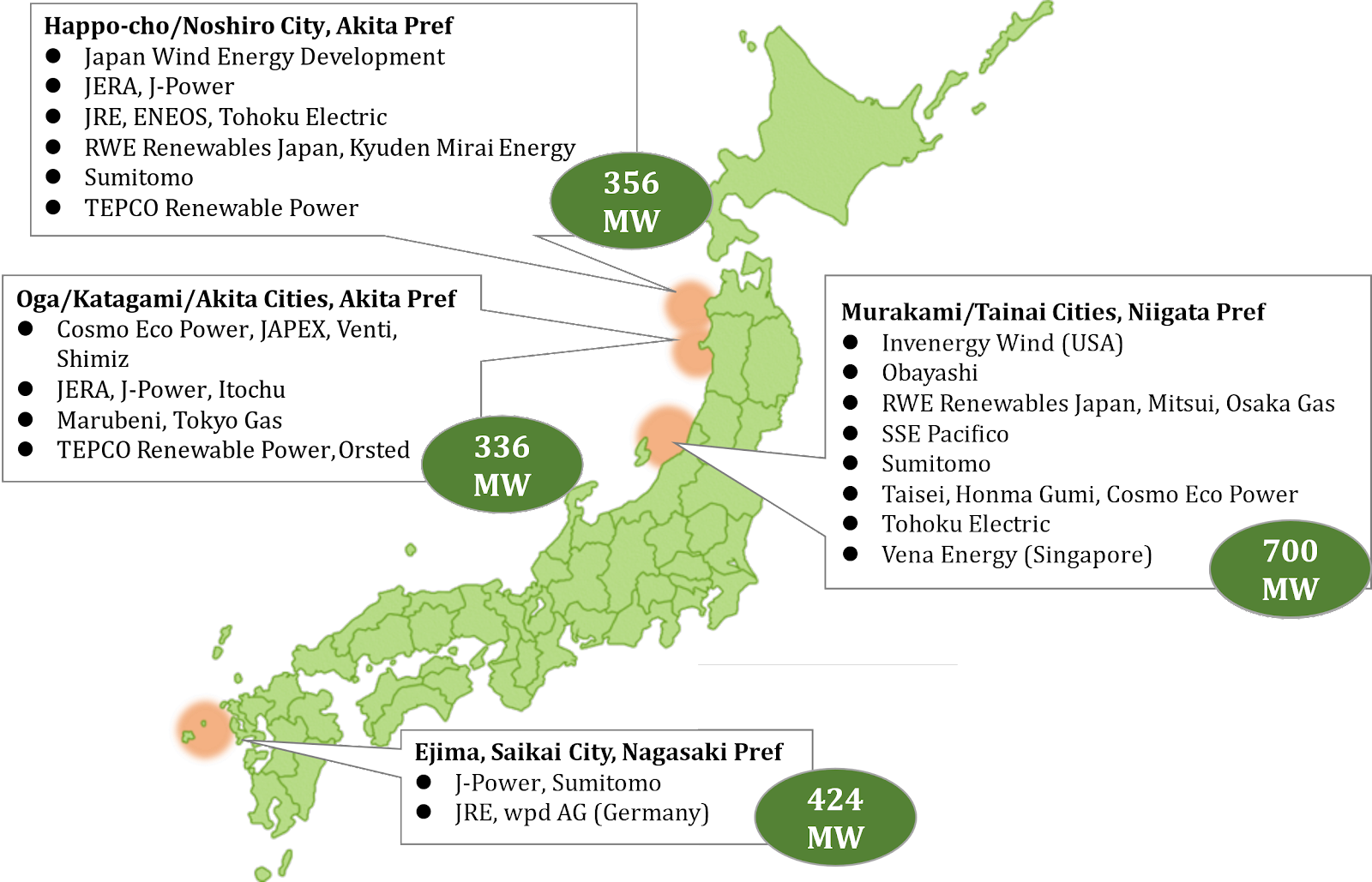
Cosmo Eco Power, JERA, J-Power, Kyuden Mirai Energy, Obayashi, Orsted, RWE (Germany), Sumitomo Corp, TEPCO Renewable Power, and Tohoku Electric
Bid only in
Round 2
ENEOS, Honma Gumi, Invernergy Wind (U.S.), Japan Renewable Energy (JRE), Japan Wind Energy Development, JAPEX, Marubeni, Mitsui, Osaka Gas, Shimizu, SSE Pacifico, Taisei, Tokyo Gas, Vena Energy (Singapore), Venti, and wpd AG (Germany)
Bid only in
Round 1
CTech, Equinor, Eurus Energy, JR East, JWPA, Mitsubishi, Mitsubishi Energy Solutions, Northland (Canada), and Renova
Given the furor over Mitsubishi’s success in Round 1, and the many complaints from both domestic and international players, METI paused further auctions for over a year in order to discuss how to change the rules going forward.
After substantial debates among industry experts, academia and state officials, the rules were updated for Round 2. The changes are aimed at attracting a diversity of winners and making sure there is an incentive for projects to be completed on schedule.
Bids were capped at ¥19/ kWh for Akita (both projects) and Niigata; and ¥29/ kWh for Nagasaki, due to the area’s more complex geological structures
“Zero Premium Standard” was introduced
As well as the offered prices, officials will focus on project feasibility and ability to complete on schedule
1 GW was the maximum capacity that one company or consortium could bid on
Other facets that judges will look at include the bidder’s proposals regarding a stable supply of electricity, the various contributions their projects will make to the region and local governments, the financing, and collaboration with local fishermen and port authorities, as well as the overall economic impact and O&M planning.
The 1 GW cap means that a single company cannot win a clean sweep of all the projects. For example, if a company bids for the Niigata Project, it will have to forgo the other three areas. By the way, since Niigata’s generation capacity is the largest, the government intends to start its operation before June 2029.
What’s next? Last time, there was a gap of about seven months between the bid deadlines and results announcement. For Round 2, there’s a similar number of projects and capacity on offer, but the number of applications is higher by as much as two-thirds. That could extend the bid review process compared with Round 1, though the government is committed to publishing results before April 2024, which is 9 months after the bidding deadline.
As far as the planned Round 3, METI hasn’t announced any details, but many interested parties are already expediting plans to join by going ahead with their own area assessments. If the government can keep up the current schedule, auctions will become an annual event or even more regular. That would expedite the capacity made available, helping to satisfy the vast interest from businesses. In return, it should lead to lower costs as greater experience and volumes lead to optimization.
Whoever wins Round 2, there will clearly be a large number of firms that do not succeed this time. For the government to keep the momentum going and retain high international interest in Japan’s offshore wind developments, it will need to tread carefully to anoint a variety of winners and also make sure new auction rounds come quickly to offer new opportunities.
(This is Part 2 of a two-part series about Japan’s climate-tech/ clean-tech sector. Part 1 appeared in the May 29, 2023 edition of the Weekly)
The primary vectors stipulated in the government’s action plan on economic revitalization indicate that climate tech is finally going mainstream in Japan. And while big business will be heavily involved, some of the most vibrant innovations in the technologies and services aimed at tackling climate change are carried by a wave of new startups.
In June, Prime Minister Kishida’s Cabinet approved an updated version of the “Grand Design and Action Plan for a New Form of Capitalism,” which will determine the country’s economic trajectory. The update includes a reference to climate-tech in a chapter on the overall promotion of startups, underscoring the potential that this technology could play in the energy transition.
Climate tech is a rather wide field, and includes innovations in a whole range of economic sectors: manufacturing, engineering, power generation, transportation, and the digital services sectors. To help accelerate R&D across the economy, the government has unveiled a five-year plan to encourage new ventures, supported with a ¥1 trillion budget and easier visa regimes for entrepreneurs, among other actions.
Though Japan’s climate tech scene is still in its infancy, there are promising startups across a number of sectors. Companies in nuclear fusion and carbon accounting have been making headlines with new funding and business deals, but other areas such as agritech are seeing a number of ventures with much potential. We examine some of the leading names in the Japanese scene and the investment funds involved.
Popular climate tech sectors
Most of the Japanese startups involved in climate tech can be broadly classified in five areas. Note that the Clean energy sector includes nuclear fusion and renewable energy. Carbon tech covers technologies related to CCUS and carbon accounting.
Two of the more interesting startups with potential for global reach are Regional Fish and Kyoto Fusioneering.
Regional Fish, founded by Kyoto University and Kinki University professors, develops next-generation aqua farming systems that use genome editing technology for the high-speed breeding of fish. It was the only Japanese company featured in the 2023 APAC Cleantech Company Map that’s published by Cleantech Group.
Kyoto Fusioneering (KF) is a spin-off from Kyoto University and was established to carry out R&D of solutions needed for the development of nuclear fusion energy, which promises an endless supply of clean energy if experiments will ever be successful. In May, KF raised ¥10.5 billion ($79 million) in a series C round from 17 investors, including JIC Venture Growth Investments, INPEX, Mitsubishi and a unit of Kansai Electric. (For more information about nuclear fusion in Japan, see the Oct 11, 2022 issue of JapanNRG). The company has offices in the UK and the U.S.
Govt grading
Picking out promising startups in any area can be tricky. To make the process easier and to help startups in climate tech gain more prominence, the government has created an awards program to highlight some of the innovations taking place.
Since 2021, the MoE has awarded the honor of “Most Promising Environmental Startups” to companies active in a range of fields, from agritech to water purification to data visualization to reduce GHGs. While there is no monetary prize for the winners, the event provides opportunities for them to connect with investors and company officials.
Chart 1: List of companies awarded by the MoE include:
Year
Prize
Company name
Technology
University affiliation
Other details
Feb. 2021
Minister’s prize
Pirika
Waste cleanup App
Kyoto University
Business Plan prize
Wota
Develops micro water recycling system, autonomous control system for water treatment
Honorable mention
Umitron
Developer and provider of data platform services for aquafarmers
Based in Singapore and Japan
Honorable mention
Polar Star Space
Provides data-driven, problem solving services for agriculture using microsatellites
Hokkaido University
Honorable mention
Gryllus
Edible cricket farming
Tokushima University
Honorable mention
Enephant
Free electricity housing
Feb 2022
Minister’s prize
EF Polymer
Super absorbent polymer made from bio-waste and natural plant material
Okinawa Institute of Science and Technology
Incorporated in India (2018) and Japan (2020)
Business Plan prize
Sagri
Smart agriculture using satellite data, AI
Honorable mention
Fracta Leap
Water treatment plant technology using AI
Set up by Fracta, a U.S.-based unit of Kurita Water Industries
Feb. 2023
Minister’s prize
Asuene
Cloud solution for carbon emission visualization, reduction
Business Plan prize
Biome
Biodiversity database, visualization
Honorable mention
Spacecool
Developer of durable, flexible optical film that blocks heat absorption from sunlight and the atmosphere and also release heat into space
49% owned by Osaka Gas
Honorable mention
Elephantech
Developer of technologies to reduce water, resources, and energy consumption of printed circuit boards
Honorable mention
Innoqua
Develops technology to reproduce the marine environment in an aquarium in a form close to nature
Honorable mention
Agile Energy X
Distributed computing using excess clean electricity
Fully-owned unit of TEPCO Power Grid
Sources: MoE website
Financing
The lifeblood of any startup is its ability to raise funding as it develops its product. In this regard, Japan has traditionally been slow to the global tech startup boom. However, the situation is changing as more financing mechanisms and funds have emerged in the last two-three years.
Across the entire economy, a record ¥877 billion was raised by Japanese startups last year, according to Bloomberg, citing data from INITIAL, a government-linked platform that offers information, analysis and support for new ventures.
Specifically in climate tech, one of the standout capital accumulations came earlier this year when Mitsubishi Corporation, the largest trading house, announced the launch of the Marunouchi Climate Tech Growth Fund. This was a clear sign that the investment appetite for new climate technologies among Japan’s most powerful corporations is on the rise. (For more information about Mitsubishi and its fund, see the May 29, 2023 issue of Japan NRG)
Mitsubishi’s fund isn’t the first major investor in climate tech startups, however. It was preceded by other funds such as:
In 2019, Japan Energy Fund (JEF) was established to invest in European and American climate tech startups. Today, it counts Enechange, Biprogy, Toshiba and Sumitomo Mitsui Trust Bank as partners. With total funds of $50 million, JEF has invested in technologies such as battery storage, smart meter data analysis, and demand response. It aims to bring the tech of its portfolio companies to Japan to contribute to the nation’s decarbonization efforts.
KDDI Green Partners Fund – Telecommunication giant KDDI set up the fund in 2021, along with SBI Investment, to support startups working on climate change technologies. The plan is to invest ¥5 billion for 12 years to 2033. It has so far invested in six companies including Helical Fusion, Biome and Lebo Robotics, which develops maintenance robots for wind turbines.
ANRI-Green No. 1 Fund – ANRI is an independent venture capital fund, and it launched this green fund in 2022 to invest in climate tech startups. The plan is to raise a war chest of ¥10 billion. Japan Investment Corporation (JIC), Japan Petroleum Exploration Co. (JAPEX), K4 Ventures are among the other investors.
Academia and government roles
In addition to the accolades, the MoE supports entrepreneurs and investors by developing a financial framework to promote investment in climate tech companies. In March, the ministry hosted the first meeting of experts to discuss how to assess the environmental impact of any new technology that a climate tech startup might have to offer.
By autumn, MoE’s panel of experts is expected to develop a framework to help investors and startups assess the potential for CO2 emissions reductions pre-investment, and manage reductions post-investment. This came as Kishida’s government designated 2022 as the kick-off year for startups across various sectors in order to boost the economy.
According to the action plan revised in June, Japan has an annual 4.4% startup rate – which is the percentage out of the total for all new businesses in a given year. This is far lower than the U.S. figure of 9.3%, and 12.4% in the UK. The percentage of businesses that close down in a given year out of the total in Japan is 3.1%, also lower than 9.4% in the U.S. and 11.1% in the UK. Countries with higher rates of starting and exiting a business have a higher economic growth rate per capita.
By 2027, Japan aims to boost investment in startups more than 10 fold, to ¥10 trillion, up from the current ¥800 billion. Another goal is to increase the number of tech ‘unicorns’, which are privately-held startups valued at more than $1 billion, up to 100 from about a dozen currently. Also, another goal is to boost the total number of startups to 100,000 and thereby make Japan the largest startup hub in Asia.
As for climate tech, METI will take the lead in finding ways to strengthen support and help develop the proper ecosystems and infrastructure. The government will look into easing regulations that have remained unchanged for a long time, such as the security distance for handling substances like ammonia.
Academics also play a key role in boosting entrepreneurship. Industry officials say a mechanism is lacking to effectively identify and evaluate promising technologies that universities and research institutes are developing. The government’s action plan calls for launching a highly specialized campaign – “one research university, 50 startups and at least one startup exit” – to foster technology entrepreneurship in universities.
The University of Tokyo is among the most active universities. In late June, it hosted Climate Tech Day, which brought together startup executives and researchers to discuss the state of climate tech in Japan. Topics of breakout sessions included Food/Agriculture, CCS, GHG accounting, Mobility, Buildings and Chemistry.
Looking outside Japan for ideas Since climate tech in Japan has lagged behind other countries, some major investors have been more active abroad. Billionaire Masayoshi Son’s Softbank Vision Fund invests in a variety of companies, in large part overseas. One of SoftBank’s climate tech successes is Plenty, an American startup for vertical farming. (For more information, see the July 10, 2023 issue)
Japan Energy Fund also says that its main investment targets are European and American startups, but that might change in light of the government’s growing interest in new ventures and the climate tech sector.
Perhaps even more crucial is the burgeoning societal awareness over the need to find viable solutions to the worsening impacts of climate change. Young people, those under 30, are more attuned to these issues. And it’s precisely that young generation which is always at the forefront of technological advances and disruption. Japan can capitalize on this youthful activism and channel its best and most innovative minds in that direction.
GLOBAL VIEW
BY JOHN VAROLI
Below are some of last week’s most important international energy developments monitored by the Japan NRG team because of their potential to impact energy supply and demand, as well as prices. We see the following as relevant to Japanese and international energy investors.
Africa/ Nuclear power
At the Russia-Africa Forum on July 27-28 in St. Petersburg, a session “Nuclear Technologies for Africa’s Development” will discuss the continent’s current nuclear projects and potential. The session is organized by Rosatom, Russia’s state-owned nuclear corporation.
Brazil/ Natural gas
Petrobras is discussing seven new potential natural gas contracts as part of efforts to increase domestic supply. The state oil and gas giant is under pressure to boost local gas supply from its offshore oil and gas projects and reduce domestic gas prices.
France/ Nuclear power
Nuclear power generation at EDF’s French reactors in June rose 12.4% YoY, to 22.7 TWh. EDF’s total nuclear generation in France since the start of the year was 158 TWh, up 2.6% YoY. This increase is due to the postponement of unit outages.
Germany/ Solar power
Renewables developer and services company MaxSolar secured €410 million for solar projects in Germany. The financing is provided by institutional investors Infranity, I Squared Capital and Rivage Investment (France).
Germany/ Wind power
BP will pay €6.8 billion for two licenses to develop 4 GW of offshore wind at two sites 150 km northwest of the Heligoland islands in the North Sea.This increases BP’s global offshore wind pipeline from 5.2 GW to 9.2 GW, an increase of more than 70%.
Norway/ Oil and gas
Norway’s oldest oil company, DNO, made its biggest hydrocarbon discovery in a decade. Located in the Carmen prospect in the North Sea, the site’s expected recoverable reserves is in the range of 120-230 million barrels of oil equivalent.
Renewable energy
Wind and solar projects are on track to account for more than one-third of the world’s total electricity supply by 2030, indicating that the energy sector can meet global climate goals, according to a report by the Rocky Mountain Institute.
Russia/ oil
Oil exports from western ports are set to fall by some 100,000-200,000 bpd next month from July levels, a sign that Moscow is making good on its pledge for fresh supply cuts in tandem with OPEC leader Saudi Arabia.
UK/ LNG
The UK’s biggest energy supplier signed a contract for 1 million tons of LNG a year with Houston-based Delfin Midstream. When the U.S. project starts production, the deliveries will heat 5% of UK homes for 15 years.
U.S./ Carbon capture
ExxonMobil will buy Texas-based oil and gas producer Denbury for $4.9 billion. The acquisition also gives ExxonMobil the largest owned and operated CO2 pipeline network in the U.S.
U.S./ utilities investment
There’ll be a “seismic shift” this year in utilities’ investment, said S&P Global. Those with the highest expected net plant growth, in terms of power producing capacity, are NextEra Energy at 98.3%, Eversource Energy at 48.3%, Idacorp at 35.6%, Allete at 32.9%, and PNM Resources at 28.5%.
2023 EVENTS CALENDAR
A selection of domestic and international events we believe will have an impact on Japanese energy
ASEAN-Japan summit to mark 50 years of cooperation
Last market trading day (December 30)
Disclaimer
This communication has been prepared for information purposes only, is confidential and may be legally privileged. This is a subscription-only service and is directed at those who have expressly asked K.K. Yuri Group or one of its representatives to be added to the mailing list. This document may not be onwardly circulated or reproduced without prior written consent from Yuri Group, which retains all copyright to the content of this report.
Yuri Group is not registered as an investment advisor in any jurisdiction. Our research and all the content express our opinions, which are generally based on available public information, field studies and own analysis. Content is limited to general comment upon general political, economic and market issues, asset classes and types of investments. The report and all of its content does not constitute a recommendation or solicitation to buy, sell, subscribe for or underwrite any product or physical commodity, or a financial instrument.
The information contained in this report is obtained from sources believed to be reliable and in good faith. No representation or warranty is made that it is accurate or complete. Opinions and views expressed are subject to change without notice, as are prices and availability, which are indicative only. There is no obligation to notify recipients of any changes to this data or to do so in the future. No responsibility is accepted for the use of or reliance on the information provided. In no circumstances will Yuri Group be liable for any indirect or direct loss, or consequential loss or damages arising from the use of, any inability to use, or any inaccuracy in the information.