
JAPAN NRG WEEKLY
JULY 24, 2023
JAPAN NRG WEEKLY
July 24, 2023
NEWS
TOP
- Japan proposes creating a global natural gas reserve;
pledges methane cuts in LNG sector - Miyagi Pref walks back some of its renewables tax proposals, offering exemptions and asking for feedback
- Mitsubishi Power and Keppel partner on Singapore’s first hydrogen-ready cogeneration plant
ENERGY TRANSITION & POLICY
- Itochu, Sumitomo to start $500 mln clean energy fund in America
- Japan and India to collaborate on semiconductors and hydrogen
- INPEX and Masdar to study e-methane production in UAE
- Tokyo Gas sells Japan’s first hydrogen from AEM electrolyzer
- Sojitz invests in turquoise hydrogen startup in Finland
- Hokkaido Electric starts hydrogen facility in Tomakomai
- National Spatial Strategy may impact renewables sector
- Marubeni launches EV charging management service
ELECTRICITY MARKETS
- Mitsubishi, Kyushu Electric launch battery storage system
- METI issues orders to a list of power companies over cartel issue
- Study: About 20% of solar farms are in areas with landslide risks
- Marubeni, Hamada to partner on reuse and recycling of solar PV
- Kansai Electric completes safety upgrades at Takahama NPP
- METI asked to offer FIT to operators that use recycled equipment
- Chubu Electric joins closed-loop thermal heat project in Germany
- Philippines seeks stronger ties with Japan in renewable energy
OIL, GAS & MINING
- Pledge to cut methane in LNG sector signed by major importers
- Japan to insure bank loans for LNG procurement
- June LNG, crude and thermal coal imports down by double digits
- LNG stocks of power utilities up slightly after METI revises data
ANALYSIS
FUKUSHIMA’S WATER RELEASE:
CONTROVERSY AND ECONOMIC IMPLICATIONS
The Fukushima Daiichi Nuclear Power Plant disaster in March 2011 was the result of the most devastating earthquake and tsunami ever recorded in Japan. It provoked a strong reaction from the global community that has subsided over time. Now, more than a decade later, the ghosts of Fukushima once again haunt Japan in the form of the decision to release one million tons of treated wastewater into the ocean. This has triggered a debate that again casts a pall over Japan’s international standing and reputation.
JAPAN SEEKS LEAD IN ENERGY FUTURE WITHOUT
ABANDONING PRESENT TIES
Within a single day last week, Prime Minister Kishida was pitching oil-rich Middle Eastern states on opportunities to invest with Japan in green energy and also delivering a video message of support for an LNG conference in Tokyo attended by dignitaries of the world’s top buyers and sellers of natural gas. In a world in which some oil & gas suppliers believe that demand for their product will last for decades beyond 2050, Japan is trying to thread the needle and find a pathway that will lead to a net-zero future without abandoning the trade and energy ties of today.
GLOBAL VIEW
A wrap of top energy news from around the world.
EVENTS SCHEDULE
A selection of events to keep an eye on in 2023.
JAPAN NRG WEEKLY
PUBLISHER
K. K. Yuri Group
Events
Editorial Team
Yuriy Humber (Editor-in-Chief)
John Varoli (Senior Editor, Americas)
Mayumi Watanabe (Japan)
Wilfried Goossens (Events, global)
Kyoko Fukuda (Japan)
Filippo Pedretti (Japan)
Regular Contributors
Chisaki Watanabe (Japan)
Takehiro Masutomo (Japan)
SUBSCRIPTIONS & ADVERTISING
Japan NRG offers individual, corporate and academic subscription plans. Basic details are our website or write to subscriptions@japan-nrg.com
For marketing, advertising, or collaboration opportunities, contact sales@japan-nrg.com For all other inquiries, write to info@japan-nrg.com
OFTEN USED ACRONYMS
|
METI |
The Ministry of Energy, |
mmbtu |
Million British Thermal Units | |
|
MoE |
Ministry of Environment |
mb/d |
Million barrels per day | |
|
ANRE |
Agency for Natural Resources and Energy |
mtoe |
Million Tons of Oil Equivalent | |
|
NEDO |
New Energy and Industrial Technology Development Organization |
kWh |
Kilowatt hours (electricity generation volume) | |
|
TEPCO |
Tokyo Electric Power Company |
FIT |
Feed-in Tariff | |
|
KEPCO |
Kansai Electric Power Company |
FIP |
Feed-in Premium | |
|
EPCO |
Electric Power Company |
SAF |
Sustainable Aviation Fuel | |
|
JCC |
Japan Crude Cocktail |
NPP |
Nuclear power plant | |
|
JKM |
Japan Korea Market, the Platt’s LNG benchmark |
JOGMEC |
Japan Organization for Metals and Energy Security | |
|
CCUS |
Carbon Capture, Utilization and Storage | |||
|
OCCTO |
Organization for Cross-regional Coordination of Transmission Operators | |||
|
NRA |
Nuclear Regulation Authority | |||
|
GX |
Green Transformation |
NEWS: ENERGY TRANSITION & POLICY

Miyagi walks back some of its renewables tax proposals; seeks feedback
(Japan NRG, July 18)
- Following the July 4 passage of the renewables tax system by the local assembly, the Miyagi Pref discussed its proposal to create a category called “promotional operators” that would be tax-exempt.
- Miyagi plans a 20% tax on the operating profit of solar, wind and biomass operators that cut down over 0.5 hectares of forest. Operators in renewables promotion zones will be exempt. If local stakeholders recognize the operators as “collaborative”, then they’ll be granted “promotional status” and be tax exempt.
- Miyagi drafted guidelines for the “collaborative/promotional status” and seeks feedback from the public and renewables operators.
- The prefecture hopes to start the new system by Jan 1.
- CONTEXT: Municipality taxes require approval from the Ministry of Internal Affairs and Communications. The Japan Wind Power Association is concerned that this will deter wind development and hinder national climate targets. The chances of ministry approval increases if the prefecture shows the plan can drive “collaborative engagements”.
TAKEAWAY: Miyagi’s approach shows the limitation of “renewables promotional zones”. Municipalities will define areas where solar and wind power are encouraged. As of April, nine municipalities set up promotional zones — mostly town halls and residential areas — to promote rooftop solar installation. Several officials told Japan NRG that zones are pointless because operators that aren’t accountable will raise issues anyway; and it’s not easy for municipalities to set up zones because they can face opposition from residents.
Mitsubishi, Keppel partner on Singapore’s first hydrogen-ready cogeneration plant
(Company statement, July 19)
- Keppel, Mitsubishi Power, and Jurong Engineering began construction for Singapore’s inaugural hydrogen-ready cogeneration plant, known as the Keppel Sakra Cogen Plant KSC). It will have a combined cycle gas turbine (600 MW capacity).
- KSC was built to co-fire with 30% hydrogen, and eventually run on 100% hydrogen.
- Completion is expected in early 2026; initially, it will utilize natural gas as fuel.
- Keppel is keen to collaborate with international partners to advance low-carbon hydrogen and hydrogen-derived fuels, such as green ammonia.
TAKEAWAY: Singapore aims to generate up to 50% of its power from hydrogen by 2050. Local companies like Keppel and Sembcorp Industries, along with Japan’s MHI, are leading efforts to build infrastructure for hydrogen-based energy. However, challenges remain, such as safety, turbine development, and transportation. While Singapore sees its small size as an advantage for developing hydrogen infrastructure, it may have to rely on imports, raising costs and supply worries. Thus, the jury is still out on the practicality and scalability of hydrogen-fired technology.
Itochu, Sumitomo to launch $500 mln clean energy fund in North America
(Nikkei Asia, July 21)
- Itochu and Sumitomo Mitsui Trust Bank will launch a $500 million fund for North American solar and wind projects, as well as for hydrogen and ammonia as fuel.
- Both will invest $50 million each; Tokyu Land Corp and Fuyo General Lease will invest $40 million.
- The fund will invest in as many as 10 projects over three years; each deal will average $50 to $100 million. The focus will be on operational or construction-stage projects, which are less risky.
- CONTEXT: This will be one of Japan’s largest funds for overseas renewable energy. Solar and wind accounted for 14% of total power generated in the U.S. last year. That will reach 20% by 2024, helped by govt subsidies under the Inflation Reduction Act.
Japan and India to collaborate on semiconductors and hydrogen
(Nikkei Asia, July 17)
- Japan and India will cooperate on developing semiconductors and hydrogen fuel. METI Minister Nishimura will visit India to meet with their Information Technology Minister and Minister for Power and Renewable Energy. They’ll sign an MoU to set up a framework for Japanese and Indian companies to cooperate.
- The two countries will share information on semiconductor technologies that are eligible for subsidies.
- In terms of hydrogen fuel, both nations seek safety regulations for transport. India considers green hydrogen as a key part of national strategy. However, a lack of hydrogen pipelines and strict regulations pose challenges.
- Japan will support India in infrastructure development, particularly in water and power, which are essential for the chip industry.
INPEX, Masdar to study e-methane production in UAE
(Company statement, July 18)
- INPEX and Abu Dhabi Future Energy (Masdar) will do a study to produce synthetic methane (e-methane) using carbon and green hydrogen in the UAE.
- They’ll also study the transport of e-methane from the Middle East to Japan, to cover the entire e-methane value value chain.
TAKEAWAY: The UAE participates in the Joint Crediting Mechanism (JCM), which allows INPEX to count some carbon offset credits derived from UAE projects. MoE is in negotiations with other govts about counting of e-methane-derived credits at the site of fuel consumption rather than production, but these talks have been deadlocked. Gas companies say such a system is essential for e-methane projects, notably in the industrialized economies that fall outside the JCM framework.
Masdar’s clean energy studies/projects with Japan to date
|
JERA |
Green hydrogen, renewables |
|
Cosmo Energy |
Hydrogen/ammonia, renewables, CCUS |
|
Tsubame BHB |
Green ammonia |
|
Sumitomo Corp. |
Waste to energy project |
|
Marubeni and other multinationals |
Green hydrogen and SAF |
|
INPEX |
E-methane |
Tokyo Gas sells Japan’s first hydrogen produced from AEM electrolyzer
(Company statement, July 13)
- Tokyo Gas started producing and selling Japan’s first hydrogen made from Anion exchange membrane (AEM) electrolyzer at its hydrogen refueling stations. The Senju station introduced the AEM electrolyzer from Enapter, (Germany) and switched its electricity to 100% renewables.
- The AEM electrolyzer is a new technology. Its simple configuration enables it to easily adjust hydrogen production volume by combining multiple small modules, which brings benefits for hydrogen stations with limited space.
- Tokyo Gas produces 15 Nm3/ h of hydrogen by using 30 modules of the AEM electrolyzer. Those modules are configured to have redundancy to continuously produce hydrogen. The machine will keep running during the night and store hydrogen in the tanks.
Sojitz invests in turquoise hydrogen tech in Finland
(Company statement, July 18)
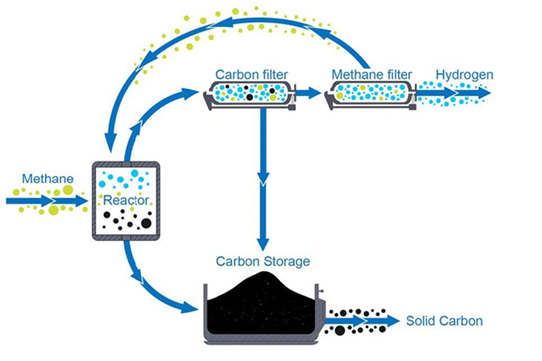
- Sojitz invested in Hycamite TCD Technologies, a start-up and developer of turquoise hydrogen production technology in Finland. Turquoise hydrogen is produced through methane pyrolysis, and Hycamite produces hydrogen and solid carbon via thermos-catalytic decomposition of methane.
- Hycamite raised €25 million through a third-party allotment of shares underwritten by Sojitz, the Finnish Climate Fund, and other investors. The company will build a demo plant to produce 2,000 tons of hydrogen that starts in mid-2024 in Finland.
- Hycamite’s zero-carbon emission production technology requires only 13% of the energy needed to produce hydrogen through electrolysis and makes carbon nanotubes and other solid carbon products with different crystalline structures. Thus, the hydrogen can be used in next-gen lithium-ion batteries and other composite materials.
Hokkaido Electric starts hydrogen production facility in Tomakomai
(Nikkei, July 18)
- Hokkaido Electric launched a hydrogen production facility in Tomakomai. It comes with a rectifier capable of transforming alternating current into direct current and an electrolytic cell that turns purified water into hydrogen and oxygen.
- Hokkaido has potential for renewable energy, but there may be imbalances between supply and demand. To fully utilize renewable energy, options include increasing electricity demand in Hokkaido or transmitting electricity to other regions with higher demand. A plan to build an undersea power transmission line to Honshu is underway.
- To address the issue of surplus electricity, storing it in batteries and producing electric hydrogen is being considered. However, the risk of freezing during winter poses a challenge in a cold region like Hokkaido.
National Spatial Strategy calls for measures to meet 30by30 targets
(Japan NRG, July 21)
- In July, the MLIT compiled the 8th National Spatial Strategy, calling for initiatives to meet “30by30” targets to conserve at least 30% of land and sea areas by 2030.
- Japan’s nature conservation rate is 20.5% of land and 13.3% of sea areas. MLIT wants to expand protected areas and add stricter conservation rules.
- MLIT plans a new category of conservation areas to enhance biodiversity. Potential areas are small lakes, hills, beaches and green space areas of businesses.
TAKEAWAY: National Spatial Strategy is a 10-year land-use development plan. Japan has 15 areas specified as Globally Important Agricultural Heritage, but renewables projects went ahead in some areas despite local opposition. It’s uncertain what kind of impact this new “nature conservation category” will have.
Marubeni launches charging management service for commercial EVs
(Company statement, July 19)
- Marubeni launched its Grid Optimization and Vehicle Authorization Network (GOVAN) charging management service that uses AC chargers and targets fleet owners with commercial EV holdings.
- The service was first deployed at Green Co-op Fukuoka.
- GOVAN offers full support for EV charging management, including consultations for charger adoption, installation layout, equipment selection, and charging schedules.
- The service allows flexible operations and simplifies parking concerns; the chargers automatically recognize vehicles and execute charging schedules.
- SIDE DEVELOPMENT:
Marubeni and Panasonic tests EV fleet management system in Nagano Pref
(New Energy Business, July 19)- Marubeni began testing an EV fleet allocation and recharging management system, partnering with Panasonic; at Nagano-Matsumoto govt office for 60 public cars, of which 20 are EVs.
- Marubeni’s “EV for Biz” and Panasonic’s recharging control system “Charge-ment” will work in liaison to optimize fuel costs and to lower peak electricity demand.
- The systems will work out drive distance upon reservation, allocate EVs taking into account their battery capacity, give sufficient time to recharge, and send alerts if the battery is low. The systems will help mitigate peak electricity demands so that consumption will be leveled.
- SIDE DEVELOPMENT:
Nissan to adopt Tesla’s EV charging standard in 2025
(Nikkei, July 20)- Starting 2025, Nissan Motor will adopt Tesla’s charging standards for its EVs sold in North America.
- Nissan will be the first Japanese automaker to use this quick-charging tech.
- CONTEXT: Tesla has installed over 12,000 charging stations around North America, roughly 60% of all charging points.
Hitachi Zosen receives order for green methanol-compatible test engine development
(Company statement, July 18)
- Hitachi Zosen won an order from MAN Energy Solutions (Germany) for a green methanol-compatible, dual-fuel test engine that reduces GHG emissions for international marine transport.
- It will convert heavy oil-fired engines into dual-fuel engines that can run on green methanol. It will be ready in Sept 2024, followed by land tests.
METI sustainability data panel releases mid-term report
(Government statement, July 18)
- A METI panel on collection and application of sustainability data has published an interim report on corporate sustainability disclosure and relevant data collection.
- The panel urges not limiting the data use to regulatory compliance and disclosures, but rather open it for strategic business planning. The report outlined major issues in collecting data throughout the value chain, and proposed solutions and best practices.
- The Financial Services Agency is studying a new requirement for businesses to obtain third-party certification of sustainability data.
Joyo Bank and TEPCO to cooperate on decarbonization
(Company statement, July 20)
- Joyo Bank, TEPCO Holdings, and TEPCO Energy Partner will collaborate on environmental, energy, disaster prevention, and urban development measures.
- Key plans call for promoting solar power at company offices and installing systems to charge and store EVs using solar power. The stored electricity in EVs can serve as an emergency power source.
- This is the first time TEPCO signed a carbon neutrality agreement with a regional bank. The three will also explore investments for renewable energy, Net Zero Energy Buildings, EV infrastructure, and environmental value-focused financial products.
PM appeals to China for scientific-based discussions over Fukushima water release
(Mainichi Shimbun, July 18)
- During his visit to Qatar, PM Kishida made an appeal to China over the discharge of treated water from TEPCO’s Fukushima Daiichi NPP.
- He emphasized discussions backed by scientific evidence, and highlighted that the International Atomic Energy Agency (IAEA) has concluded that the plant adheres to international safety standards.
TAKEAWAY: See this week’s Analysis section for details of the Fukushima water release issue.
JOGMEC awards CCS survey project to JAPEX, Idemitsu, and Hokkaido Electric
(Company statement, July 19)
- JOGMEC awarded a CCS project to a group consisting of JAPEX, Idemitsu Kosan and Hokkaido Electric to develop a “CCS hub and cluster” in the Tomakomai area.
- Idemitsu will identify steps to capture carbon at its Hokkaido oil refinery.
- Hokkaido Electric will write specifications of equipment at its Tomato Atsuma power station; and JAPEX will explore sites to store 1.5 million tons/ year of carbon.
- CONTEXT: Tomakomai is the site of Japan’s first and only CCS test project, which is considered to have successfully completed its trial period.
JFE Engineering tests new CO2 separation and recovery package equipment
(Company statement, July 20)
- JFE Engineering will test a new package, “GX-Marble”, which separates low-density CO2 in combustion exhaust gas (or flue gas) and recovers it as high-density CO2 using a facility that’s compact and consumes less energy.
- GX-Marble hybridizes membrane separation and absorption to increase concentration of CO2. It suppresses energy consumption by automated operation.
Obayashi starts testing B100 at Osaka Expo construction site
(Company statement, July 13)
- Obayashi, together with Nishio Rent-all, began testing 100% biodiesel (B100) refined from waste cooking oil to fuel construction machines at the site of Osaka Expo 2025.
- Obayashi will evaluate how B100 influences engines and see how to establish a supply chain of biofuel procurement to consumption.
- Obayashi tested B20 (20% of biodiesel mixture) for its machines with JR East (Japan Railway East) and verified that the fuel works well.
NEWS: POWER MARKETS

Mitsubishi, Kyushu Electric launch battery storage to manage solar power curtailment
(Company statement, July 19)
- NTT Anode Energy, Kyushu Electric, and Mitsubishi have launched a 1.4 MW / 4.2 MWh grid-scale battery storage system in Fukuoka Pref. It promotes renewable energy by reducing solar power curtailment.
- Since June 2022, the three companies have collaborated to develop a business model that utilizes surplus solar power and creates additional power reserves. They’ve successfully operated the grid-scale battery storage system, minimizing curtailment and ensuring power supply during times of high demand.
- Verification of the battery storage system includes testing the business model’s feasibility, exploring multi-use of batteries in various power markets, and validating synchronous operation of multiple solar plants connected to the system.
- CONTEXT: An abundance of solar power production in Japan has often created situations where the grid operator asks some operators to stop or curtail their output to the power network to avoid a mis-match between supply and demand. This also results in wasted energy and lost profits for operators.
TAKEAWAY: In FY2023, the Kyushu area alone will lose about 740 GWh of electricity, enough to power 170,000 households for a year. Finding solutions to curtailment has been tricky. Major utilities have started to install batteries to balance the supply peaks and troughs, though the storage capacity is still small. At this stage, battery projects like this one in Kyushu are testing the waters to better understand what impact storage will have. The biggest battery capacity is expected to initially in the Hokkaido region.
METI issues orders to a list of power companies over cartel issue
(Denki Shimbun, July 18)
- On July 14, METI’s minister Nishimura issued a business improvement order to five electric utilities over a power sales cartel. The companies must submit a business improvement plan by Aug 10.
- The five are Kansai Electric, Chubu Electric, Chugoku Electric, Kyushu Electric, and Kyuden Mirai Energy. This is the third improvement order issued under the Electricity Business Act.
- In addition to the five, 13 other utilities, including TEPCO Energy Partner and JERA, were sent instructions by the Agency for Natural Resources and Energy (ANRE).
- The Federation of Electric Power Companies (FEPC) was instructed to increase transparency to avoid more concerns about the electric utility sector. This is the first guidance from ANRE to FEPC.
- SIDE DEVELOPMENT
FEPC reports compliance improvement plans of power sector
(FEPC statement, July 19)- FEPC released a mid-term report on compliance improvement of 10 key power utilities (EPCOs) charged with unauthorized customer data access.
- From April to June, the EPCOs strengthened internal procedures following FEPC guidance. FEPC stressed the need to improve risk management, to clarify rules in writing, and monitoring.
- The EPCOs compliance systems will be reviewed and assessed after October.
NIES study: About 20% of solar farms are in areas with landslide risks
(Nikkei, July 18)
- The National Institute for Environmental Studies said that 1,658 out of 9,250 solar farms with over 500 kW capacity are built on land designated as “sediment disaster alert areas”, “landslide danger zone”, “steep slope collapse danger zone”, or “landslide prevention area” in times of heavy rain.
- For example, a 1.1 MW solar farm in Yokose town (Saitama Pref) was built in a sediment disaster alert area. The construction company cut trees outside the approved site; this lowered water retention capacity and required additional drainage. Between 2013 and 2022, similar cases were found across Japan, except in Gunma, Okayama, Kyoto, Akita, Fukui, Tokushima, Yamagata, and Tokyo.
- The Forest and Forestry Basic Act was revised in April to improve approval for new construction; the goal is to support local govts to ensure that solar farms are safe.
- CONTEXT: After the Great East Japan Earthquake in March 2011, the govt faced a power shortage and thus encouraged the growth of solar farms. Capacity grew from 6.6 GW in 2012 to 78.8 GW in 2022. In an effort to quickly build capacity, risk assessment sometimes was lax and the environment reviews were much easier than for other forms of energy, such as for wind power generation.
|
Regions |
No. of risky sites |
|
Hokkaido |
39 |
|
Tohoku |
98 |
|
South Kanto |
74 |
|
North Kanto & Koshin |
256 |
|
Hokuriku |
22 |
|
Tokai |
256 |
|
Kinki |
238 |
|
Chugoku |
214 |
|
Shikoku |
107 |
|
Kyushu & Okinawa |
354 |
|
Total |
1658 |
Marubeni and Hamada collaborate on reuse and recycling of solar panels
(Company statement, July 18)
- Marubeni and Hamada created a new company, Rexia, which will focus on providing reuse and recycling services for solar panels in Japan.
- Rexia will promote the reuse of panels through an inspection process, and sell them under a product warranty scheme. Additionally, they’ll recycle panels that are unsuitable for reuse by collaborating with solar panel recycling companies in Japan.
- CONTEXT: In the past decade, solar power has rapidly expanded in Japan; but not much thought was given to how to dispose of the panels once they’ve run their life. By the mid-2030s, about 800,000 tons of solar panels will be disposed of annually.
KEPCO starts Takahama NPP Unit 1’s specialized safety facility
(Denki Shimbun, July 18)
- KEPCO launched a specialized safety facility at Unit 1 of Takahama NPP. Units 1 and 2, which received a 20-year license extension on their original 40-year license, won approval from Fukui Prefecture to restart in 2021.
- However, they didn’t meet the deadline for installation of specialized safety facilities, and the restart had to be postponed. Unit 1 is now scheduled to start on July 28, and resume power generation and transmission on August 2.
- KEPCO began operation of specialized safety facilities at Mihama NPP Unit 3, Takahama NPP Units 3 and 4, and Ohi NPP Units 3 and 4. Takahama Unit 2 is scheduled to complete its safety facilities in late August.
TAKEAWAY: Soon, Kansai Electric will have completed the safety upgrades at all seven of its nuclear reactors, a milestone for the domestic nuclear industry. Takahama NPP Units 1 and 2 are currently some of Japan’s oldest operational reactors.
TEPCO and 12 companies join METI’s energy resource tests
(Company statement, July 12)
- TEPCO’s consortium was granted a METI subsidy via the Sustainable Innovation Initiative (SII) for testing the utilization of distributed energy resources, including storage batteries.
- It consists of stakeholders from various stages of the aggregation business; TEPCO is the coordinator. The experiment seeks an innovative energy management system and resource aggregation for renewable energy; it continues until Feb 2024.
- Other members are: TEPCO Power Grid, NEC, Honda Motors, Kyocera, Global Engineering, Kandenko, Sanix, and Tokyo Energy Partner.
REASP proposes FIT/FIP licenses to renewables operators using recycled equipment
(Government statement, July 18)
- The Renewable Energy Association for Sustainable Power Supply (REASP) proposed to METI to allow new renewables operators using recycled equipment to obtain Feed-in-Tariff (FIT) or Feed-in-Premium (FIP) licenses; this could boost recycling. Presently licenses are issued to operators with new equipment.
- 12% of solar operators recycle panels and most are exported. REASP also proposed a warehouse sharing system to allow multiple operators to deposit panels for reuse.
- A wider use of secondary components will speed up plant construction and reduce decommissioning costs, REASP said.
Chubu Electric joins closed-loop thermal heat project in Germany
(Company statement, July 14)
- Chubu Electric will participate in the Geretsried thermal heat project in Germany and signed a stock subscription agreement with Canadian startup Eavor Technologies and Eavor Erdwärne Gerestried, the project owner. Chubu Electric will have a 40% stake.
- Eavor is developing innovative closed-loop thermal heat tech that obtains thermal heat from 5,000 meters under the ground and generates 8.2 MW electricity or 64 MW of heat. Construction to install the first loop began and three more are in the works.
- Operation of the first loop starts in Oct 2024 and the other three by August 2026. The project is partly funded by the European Innovation Fund.
Philippines seeks stronger ties with Japan in renewable energy
(GMA News, July 12)
- President Ferdinand Marcos Jr. aims to strengthen ties between the Philippines and Japan in renewable energy. This came during the launch of the Lake Mainit Hydroelectric Power Plant in Agusan del Norte.
- The plant was a joint effort between the Philippine government, J-Power, and Markham Resources. Marcos highlighted the project’s potential to reduce carbon emissions and improve air quality.
- Also, the Philippine govt obtained a commitment from Mitsubishi UFJ Financial Group (MUFG) to support the country’s energy transition.
NEWS: OIL, GAS & MINING

Japan proposes a global natural gas reserve; pledges methane cuts in LNG sector
(Japan NRG, July 18)
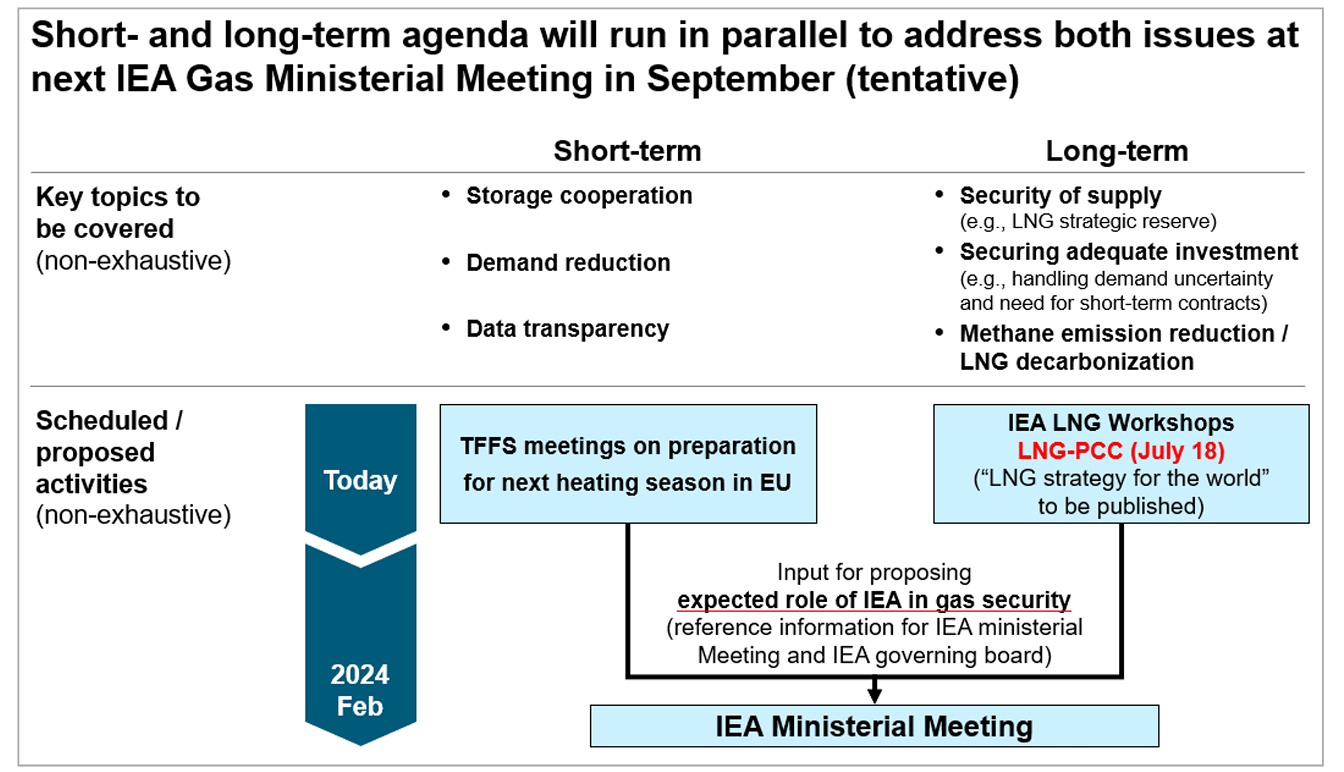
- Japan suggested to the IEA to create a global stockpile for natural gas that could act as a buffer in times of shortage and help stabilize prices.
- The proposal came as part of the 2023 LNG Producer-Consumer Conference hosted by METI in Tokyo. This year was the first time organized by METI and the IEA.
- “The increasing attention to the need for ensuring reserves of natural gas/LNG presents an opportunity to further discuss potential roles of the IEA in natural gas/LNG security, learning from its experiences in oil stockholding systems and building on its in-depth energy markets knowledge and analysis,” METI said.
- CONTEXT: IEA members, including Japan, are required to hold an oil reserve equivalent to at least 90 days of imports. Japan’s stocks are about double this volume.
- Japan sees merit in creating a global stockpile system for natural gas similar to the one for crude oil. METI wants the global reserves proposal to be discussed at the IEA ministerial meeting in February 2024.
TAKEAWAY: Japan’s LNG storage facilities allow for only about 2-3 weeks of supply as the chilled fuel tends to evaporate. Like its Asian neighbors, Japan doesn’t have an underground natural gas storage system like Europe. This leaves Asian importers more vulnerable to supply disruptions and sudden price hikes.
Earlier this year, Japan said it will form a “Strategic Buffer” system for LNG starting from the winter 2023/24. The system will see a state company purchase some “surplus” LNG cargoes from Japanese importers in case of weak domestic demand.
METI has also pitched an Asian LNG hub, but the response was tepid. Now, taking a similar idea to the IEA, Japan hopes for more traction. However, the logistics of operating a stockpile are complex, as are the questions of cost and ownership of such a facility. There’ll also likely be many questions over the stockpile’s impact on competition and market rules.
- SIDE DEVELOPMENT:
Pledge to cut methane in LNG sector signed by Europe, U.S., Japan, etc
(Government statement, July 18)- Japan and partners announced the launch of a new public-private framework to help reduce emissions – especially in methane – throughout the LNG supply chain.
- In part, this reiterates a commitment made at COP26 in Nov 2021 to cut methane emissions 30% by 2030 (compared to 2020). The framework will be voluntary but signatories pledge to encourage the use of independent verification and analysis by organizations such as the IEA and the International Methane Emissions Observatory.
- Japan and others will seek to collect data on emissions from each LNG portfolio, project, and cargo around the world and then incentivize project operators to end methane leaks, flaring and other actions that could reduce impact on the environment.
- In addition, the U.S., Australia, the EU, South Korea and Japan noted the formation of a Coalition for LNG Emission Abatement toward Net-zero (CLEAN); it was set up by KOGAS (Korea Gas Corp), JERA, and JOGMEC. The firms will aim to push forward the methane cuts program.
TAKEAWAY: South Korea and Japan are among the two biggest LNG buyers in the world, so their cooperation could have a significant impact. However, China and Middle East nations are not part of the group promoting the initiative. This indicates some political nuance.
Source: METI
Japan to insure bank loans for LNG procurement
(Nikkei Asia, July 17)
- Japan will provide insurance for bank loans used to purchase LNG under short-term contracts. Offered by Nippon Export and Investment Insurance (NEXI), the insurance will cover over 90% of the loan.
- The first insured loan will be from Sumitomo Mitsui Banking to a Singaporean unit of JERA that imports LNG. Previously, Japanese companies preferred long-term LNG procurement contracts to stabilize prices. However, due to Japan’s decarbonization goals, businesses are now shifting to short-term deals.
- These are susceptible to price fluctuations since they’re based on spot market prices at time of signing. NEXI’s trade insurance aims to reduce risks and promote energy supplies in short-term deals.
- CONTEXT: Japan is looking at options that would allow it to reduce its reliance on Russian supply over the longer term with Middle East producers among those that could provide alternatives.
June LNG, crude and thermal coal imports down in double digits
(Government data, July 20)
- June LNG imports were 4.53 million tons, down 22% YoY; crude oil imports were 10.3 million kiloliters (71 million barrels), down 14.8%; thermal coal was 7.26 million tons, down 17%.
- The total value of LNG imports was ¥394 billion, down 33.2% YoY; crude oil ¥740 billion, down 36.2%; thermal coal ¥230 billion, down 42.3%.
LNG stocks rise to 2.1 million tons
(Government data, July 19)
- LNG stocks of 10 power utilities stood at 2.1 million tons as of July 16, up 0.1% from 2.08 million tons a week earlier. The July 9 stocks were first reported at 2.07 million tons but METI corrected the figure.
- The end-July stocks last year were 2.28 million tons. The five-year average for this time of year was 2.08 million tons.
ANALYSIS
BY FILIPPO PEDRETTI
Fukushima’s Water Release: Controversy and Economic Implications
Although the Fukushima Daiichi Nuclear Power Plant disaster in March 2011 was the result of the most devastating earthquake and tsunami ever recorded in Japan, the fact remains that the country’s credibility in terms of technological prowess was also damaged.
The reaction from the global community was astonishment – how could a Pacific Ocean nation that sits on one of the planet’s most active fault zones not take sufficient measures to guard against earthquakes and tsunamis? Though unpleasant to face, this was a legitimate question.
Now, more than a decade later, the ghosts of Fukushima once again haunt Japan in the form of the decision to release one million tons of treated wastewater into the ocean. This has triggered a debate that again casts a pall over Japan’s international standing and reputation.
While Japan argues that this water release is necessary to address water storage limitations and environmental concerns, the plan has faced opposition both domestically and internationally over safety and the potential consequences for the regional economy.
What are the reasons behind Japan’s decision and the reactions from neighboring countries? And how will this impact the regional economy, as well as perceptions of Japan’s commitment to environmental safety?
Skepticism over dilution plans
Soon after the 2011 disaster, Fukushima NPP grappled with the challenge of managing contaminated water. Large volumes of groundwater enter the plant regularly, mixing with the molten fuel and becoming tainted. To mitigate the issue, the facility extracts and treats the tainted water, and is able to successfully eliminate almost all radioactive elements.
The bad news, however, is that treated water held in the 1000 plus on-site tanks has accumulated to almost 98% of storage capacity, requiring an urgent solution. The need to alleviate this situation convinced TEPCO, the operator of Fukushima, of the need to release the water into the ocean.
Among the few remaining radioactive components in the treated water, tritium poses a unique challenge. TEPCO has treated the water using an Advanced Liquid Processing System (ALPS) to remove most of the radioactivity. Tritium, however, cannot be removed through purification. Prior to discharge, Japan will dilute the water to ensure tritium levels are below regulatory standards.
The plan, which will be accompanied by the removal of storage tanks on the NPP site, has drawn criticism from Japan’s neighbor, China. In June, Chinese social media campaigns instigated a consumer boycott of Japanese cosmetics. Some companies, like Shiseido, saw their stock value take a beating.
Need to address legitimate concerns
The idea of releasing tritium-contaminated water into the ocean raises some concerns. However, to assess the situation fairly, it’s important to consider the broader context. The International Atomic Energy Agency (IAEA) emphasized that the planned dilution and filtration are common practices within the nuclear industry, and that other countries also release water containing specific radionuclides.
Many nuclear plants worldwide routinely release small quantities of tritium and other radioactive materials into rivers and oceans as part of standard procedure. Japan’s plan to annually release a maximum of 22 trillion becquerels of tritium falls below the levels released by other countries such as France, Canada, and neighbors China and South Korea.
Japan’s strategy involves diluting the water and releasing it gradually over four decades through a subsea tunnel that’s one kilometer in length. The IAEA has conducted an exhaustive two-year review of the plan, including regulatory activities, independent sampling, and data analysis.
The IAEA determined that the methodical, gradual release of treated water will have an inconsequential impact on humans and the environment, and thus endorsed its implementation. After receiving the IAEA report, Prime Minister Kishida stressed that the release will not pose any harm to humans or the environment, pledging to transparently explain the decision.
Resistance and perception management
After the IAEA’s assessment endorsing the safety of the water release plan, final approval from Japan’s Nuclear Regulation Authority (NRA) came on July 7, following a three-day inspection. After the approval, a discharge in August was greenlighted, but no clear timeline has yet been given.
Meanwhile, local fishing associations in Fukushima Prefecture have expressed apprehension. Residents and seafood exporters have also voiced opposition to the plan, concerned about potential damage to their businesses and reputations. That outside perception of risk is more material for local businesses than the physical realities of the release. And how to change popular perceptions is perhaps the main challenge that TEPCO and PM Kishida now face.
The damage from these perceptions, often fueled by rumors and hearsay, are very real. In early July, China suspended food imports from 10 Japanese prefectures, without giving any credible scientific justification. (What’s even more surprising, four of the prefectures are landlocked.) In response, companies such as Shiseido and Procter & Gamble issued statements reassuring the safety of their products in response to Chinese concerns.
The Japanese government is trying to reassure its neighbors about the project’s safety, citing the IAEA report as a basis for their explanation. A needed boost has also come from the U.S., which voiced support after the IAEA validated the safety standards involved. South Korea, following its own assessment and recent efforts to improve relations with Japan, has also acknowledged the IAEA’s review. A similar seal of approval came earlier in the year from the G7 Summit.
Nevertheless, South Korea’s ban on Fukushima food will stay in place, and the main opposition party still opposes the plan, with South Korean shoppers reportedly buying large quantities of sea salt prior to the water’s release.
Hong Kong’s leader, John Lee, said the city would ban seafood products from numerous prefectures if Japan proceeds with the release. Such opposition could have significant economic impact, as Hong Kong is the second-largest importer of Japanese food products after mainland China. Japan protested, explaining the process in detail and assured Hong Kong of the safety of Japanese food.
Half a world away, the EU has lifted restrictions on Japanese food imports in place since the 2011 nuclear accident. The EU had required pre-export testing of food products from certain Japanese prefectures to ensure they were not contaminated. Even after lifting the restriction, however, the EU called for Japan to continue monitoring for radioactivity and to share its findings.
Public concerns over the release of contaminated water have hit Kishida’s approval rating, which is down to 34.4% from 40% in June. According to one poll, about 80% of respondents say the government’s explanations of the water release are insufficient.
Moreover, 87.4% believe that regardless of government reassurances, the release of the water will bring economic damage, simply because of rumors and emotional responses. Once again, we see how the main problem is perception. Regarding the water release itself, about 43% of respondents were unsure whether they would approve or disapprove of it; while 31.3% approve and 25.6% oppose it.
While the opposition from regional neighbors is to a certain degree based on political calculations, the concerns of local residents and associations tend to reflect a widespread distrust of TEPCO and the government, especially how they handled the aftermath of the Fukushima disaster in 2011.
As TEPCO moves closer to implementing the water release, transparency, constructive dialogue, and considerations for the environment and the livelihoods of those affected are of utmost importance. These will have a tremendous impact on how regional partners view Japan. Hence, this issue goes far beyond environmental considerations and will have geopolitical ramifications regarding Japan’s international reputation and credibility.
ANALYSIS
BY YURIY HUMBER
Japan Seeks to Lead in the Energy Future
Without Abandoning Present Ties
Within a single day last week, Prime Minister Kishida was pitching oil-rich Middle Eastern states on opportunities to invest with Japan in green energy and also delivering a video message of support for an LNG conference in Tokyo attended by dignitaries of the world’s top buyers and sellers of natural gas.
After stops in Saudi Arabia and the UAE, where PM Kishida laid out a “Global Green Energy Hub” concept to turn the Middle East from a hydrocarbon powerhouse to one based on clean energy, he touched down in Qatar on July 18 to mend a relationship that has frayed over the years due to Tokyo’s dwindling LNG purchases. The same day, the Qatari minister for energy and CEO of the state’s main gas company, delivered a speech at the LNG Producer-Consumer Conference, arguing that LNG will be in high demand “for decades” after 2050.
A skilled diplomat, Kishida was Japan’s longest-serving foreign minister in postwar history before taking on the mantle of PM in late 2021. Still, even with this experience, Kishida and his officials are trying to thread the needle in an ever-more-volatile energy space in which climate, social, industrial and geopolitical pressures are testing Japan’s preference for a gradual, pragmatic shift away from fossil fuels.
Kishida’s proposal to the Middle East – and the broader global energy community – is almost a textbook example of good international relations. Japan’s top oil and gas producers are offered to invest in the new energy products that Tokyo wants to buy in the future, thus compensating for the inevitable drop in hydrocarbon sales. The investment menu Japan is putting in front of its partners includes clean hydrogen, batteries, critical raw materials, and even semiconductors.
The problem for Kishida, and Japan as a whole, is that the fruit of these labors and concepts will not ripen for years and possibly decades. Meanwhile, the next UN climate summit, COP28, is already less than four months away. At which, like at almost all previous editions, Japan will be berated by the environmental movement for maintaining a relationship with fossil fuels.
Shrinking oil trade
The Middle East region accounted for 96.7% of Japan’s crude oil imports in May 2023. Oil’s share of the nation’s primary energy mix has steadily declined since 1990, but it still makes up close to 40% of the total.
Just two suppliers, Saudi Arabia and the UAE, delivered over 80% of Japan’s oil imports in May. Qatar added another 5%. The Saudis alone earned ¥1.8 trillion ($12.9 billion) from the trade.
So, it’s little surprise that Kishida’s Middle East tour last week consisted of a stop in Saudi Arabia, the UAE, and then Qatar.
Naturally, these meetings started with an expression of gratitude for stable oil supplies over the years. But Kishida’s message focus was on what comes next with global decarbonization and Japan’s shrinking population almost ensuring further revenue declines.
The proposed Green Green Energy Hub would see oil-rich Middle East nations continue to play a major role in global energy systems. This would happen not only by converting their natural gas to hydrogen and ammonia, but also as investors in the “green materials sector” — in batteries and in key manufacturing industries such as semiconductor chips, according to Ministry of Foreign Affairs statements. Kishida’s audience reportedly “concurred” with the idea.
In recent years, Saudi Arabia in particular has shown interest in Japanese investments, but most have centered on the entertainment industry. The Saudi sovereign wealth fund, PIF, has taken sizable stakes in games firms Nintendo and CAPCOM, and movie maker Toei, among others.
Now, the government wants to turn foreign investor interest to its energy and industrial plans.
Seeing green
Kishida has plenty of green vision to sell. The PM’s decarbonization strategy, called the GX, is now enshrined in law and ready to deliver ¥150 trillion of investments in everything from new battery manufacturing facilities, to plants that make electrolyzers, clean fuels, renewable energy sources, and next-gen nuclear reactors.
The GX program is closely linked with a planned revival of the semiconductor industry, with new factories expected in the Hokkaido and Kyushu regions. Semiconductor production is highly energy intensive, however.
Beyond chips, the GX roadmap assumes a net-zero push across two dozen sectors, but also makes clear that the government will be able to provide only a portion of the headline ¥150 trillion. So far, Kishida has committed to financing ¥20 trillion of the amount, via a bond issuance that will presumably be bought by private and overseas institutions.
One aspect of the GX and energy transition that Japan wants Middle Eastern help with is creation of a critical raw materials supply chain independent of China. The latter dominates certain critical materials niches so completely that even when the metal ores are mined elsewhere, they are sent to China for processing.
From the point of view of economic competitiveness and energy security, Japan has sought to counter China’s dominance of these niches, such as rare earth metals, and believes that joint investment with Arab countries in both extraction rights and processing facilities are vital. Japan signed a similar critical raw materials agreement with the U.S. earlier this year.
True blue
While pitching for the future, Kishida knows he cannot abandon the relations that guarantee Japan’s energy security today. As with oil, demand for natural gas has gradually declined in the country in the last 20 years, and especially in the last five years, driven as much by the changing electricity market structures as well as climate considerations.
The UAE and Qatar are among the top seven to eight LNG sellers to Japan, and together with Saudi Arabia they’re all candidates to supply hydrogen or ammonia made from natural gas. In fact, Japan has avoided labeling its hydrogen strategies as “green” in part to allay concerns of Middle Eastern suppliers that their resources may no longer be welcome.
Japan used to be an even bigger buyer of LNG, especially from Qatar. However, over the years, as domestic demand has waned, Japanese buyers became reluctant to roll over long-term deals with Qatar and the UAE, both of which offer good prices but strict conditions on volumes, times of delivery and final port.
In late 2021, Japan’s biggest LNG importer, JERA, told Qatar that it won’t renew a large 5.5 million ton annual long-term LNG contract, citing a lack of flexible terms and uncertain demand outlook. This has caused friction not just on an economic but also on a political level. Japanese buyers have not signed any new LNG deals with Qatar since 2014 even as Chinese firms have stepped in to seal multi-decade commitments.
Kishida’s visit to Doha was the first by a Japanese premier in 10 years. As he promised Qatar to ensure stable supplies, he likely tested the waters for Japan to switch some of its Russian LNG volumes to Doha.
Still, tensions remain. As Saad Sherida Al-Kaabi, the Qatari Minister of State for Energy Affairs, and President & CEO of QatarEnergy, delivered his remarks at the LNG Produce-Consumer 2023 conference in Tokyo, he berated “emotional calls to cancel hydrocarbons” as unhelpful to the billions in emerging countries that seek a way out of energy poverty. He also forecasts that LNG will be in high demand beyond the 2050 net-zero target of most countries.
Speakers from the LNG supplier side also warned the conference that the natural gas and LNG sector is suffering from underinvestment that’s harming consumers and producers, and asked for a return to more long-term contracts.
These comments show the challenge of trying to offer a “green” future while major energy suppliers seek better terms for their product today.
Even the U.S. Ambassador to Japan, Rahm Emanuel, used his speech at the Tokyo conference to portray LNG as a major contributor to energy security and stability, and a fuel that can be a “major play in addressing climate change.”
The U.S. has produced arguably the most aggressive energy policy package to usher in clean energy technologies with the passing of the Inflation Reduction Act. But in the last year it has also vastly expanded its LNG capacity and is on course to become the world’s largest exporter, taking over from Qatar.
Considering the above, Kishida is not alone in trying to perform a balancing act in energy policies. He will, however, hope he can deliver a few green wins before facing a very different audience at the COP28 meeting in Dubai.
GLOBAL VIEW
BY JOHN VAROLI
Below are some of last week’s most important international energy developments monitored by the Japan NRG team because of their potential to impact energy supply and demand, as well as prices. We see the following as relevant to Japanese and international energy investors.
Brazil/ Oil production
Next month, state-run oil company Petrobras will update its 2024-2028 business plan. Analysts expect capital expenditures similar to the $78 billion in the 2023-2027 plan. There have been market concerns of a spending spree under the new leftist government.
Baltic States/ Power grid
In early 2025, the Baltic States will decouple from the Russian power grid. Three decades after splitting from the USSR, and 19 years since joining the EU, Estonia, Latvia and Lithuania still depend on Russia to ensure a stable power system.
China/ Oil imports
Oil refineries will increase Brazilian crude imports in Q3 to replace some of the lost Saudi supply. China, the world’s top crude importer, has booked nearly 1 mbpd of Brazilian crude for August and September delivery.
Global power demand
The energy crisis and global economic downturn is expected to slow the growth of global power demand in 2023, but a probable rebound in 2024 means more renewable capacity must be developed, said the IEA. The global growth rate for energy consumption is set to slow to less than 2% in 2023, down from 2.3% in 2022.
Europe/ Solar power
A heat wave is pushing solar electricity output to new highs. Electricity generation from solar sources in Europe climbed 11% in the first half of the year, (YoY), to a record 129 TWh, according to energy think tank Ember.
Morocco/ Natural gas
Shell will supply Morocco with an annual 0.5 bcm of LNG under a 12-year deal signed with utility ONEE. The gas will be transported from Spanish ports using a pipeline until Morocco builds LNG terminals. The LNG will help ONEE operate two power stations in northern and eastern Morocco that used to operate on Algerian gas.
Netherlands/ Green hydrogen
Strict controls on nitrogen emissions undermine EU climate change efforts, jeopardizing €10 billion of green tech investment in Rotterdam. The projects include green hydrogen and biofuels plants, and would reduce CO2 emissions by 10 million tons a year.
Poland/ Nuclear power
KGHM Polska Miedź and South Korea’s Samsung C&T Corp will cooperate on low and zero-emission technologies, including small modular reactors. Also, Daewoo Engineering & Construction signed an MoU with Poland’s ERBUD to build new projects, including nuclear power plants.
South Africa/ Renewables
Nearly half of the projects awarded under the relaunch of South Africa’s renewable power purchase program have failed, undermining plans to use wind and solar to ease the nation’s power crisis. President Cyril Ramaphosa said the country needs to fill a 4 to 6 GW electricity production deficit.
U.S./ Geothermal power
Houston-based Fervo made a breakthrough with a full-scale, 30-day well test at its Project Red site in north Nevada that generated 3.5 MW of electricity. Project Red will connect to the grid later this year and power Google’s data centers in Nevada.
Vietnam/ EVs
Automaker VinFast, a unit of Vietnam’s largest conglomerate, Vingroup, will start work on a $4 billion EV factory in the state of North Carolina next week. The plan calls for the start of production in 2025, a year later than initially planned.
2023 EVENTS CALENDAR
A selection of domestic and international events we believe will have an impact on Japanese energy
Disclaimer
This communication has been prepared for information purposes only, is confidential and may be legally privileged. This is a subscription-only service and is directed at those who have expressly asked K.K. Yuri Group or one of its representatives to be added to the mailing list. This document may not be onwardly circulated or reproduced without prior written consent from Yuri Group, which retains all copyright to the content of this report.
Yuri Group is not registered as an investment advisor in any jurisdiction. Our research and all the content express our opinions, which are generally based on available public information, field studies and own analysis. Content is limited to general comment upon general political, economic and market issues, asset classes and types of investments. The report and all of its content does not constitute a recommendation or solicitation to buy, sell, subscribe for or underwrite any product or physical commodity, or a financial instrument.
The information contained in this report is obtained from sources believed to be reliable and in good faith. No representation or warranty is made that it is accurate or complete. Opinions and views expressed are subject to change without notice, as are prices and availability, which are indicative only. There is no obligation to notify recipients of any changes to this data or to do so in the future. No responsibility is accepted for the use of or reliance on the information provided. In no circumstances will Yuri Group be liable for any indirect or direct loss, or consequential loss or damages arising from the use of, any inability to use, or any inaccuracy in the information.
K.K. Yuri Group: Hulic Ochanomizu Bldg. 3F, 2-3-11, Surugadai, Kanda, Chiyoda-ku, Tokyo, Japan, 101-0062.