
JAPAN NRG WEEKLY
AUG. 7, 2023
JAPAN NRG WEEKLY
Aug. 7, 2023
NEWS
TOP
- Japan to develop African supply chains for critical minerals and EV batteries as Tokyo seeks new mining partnerships
- Cabinet Office officially approves govt’s GX strategy, paving the way to ¥20 trillion bond issue and carbon pricing
- Regulator rules to abolish ‘gross bidding’ on power spot market
ENERGY TRANSITION & POLICY
- Tokyo GX Week to be held Sept 25 to Oct 5
- MIC might issue guidance to METI on solar regulations
- Tokyo Gas to trial first regional e-methane process via CCU
- ENEOS, Idemitsu, and Saudi Aramco ink MoU on e-fuel
- JOGMEC selects Mitsubishi, Nippon Steel for CCS study
- Air Water and Panasonic Industry utilize biomethane to halve CO2
- Tokyo picks firms for Japan’s first large-scale SAF project
- Toyota Tsusho begins to supply biodiesel to Hokkaido airport
ELECTRICITY MARKETS
- METI will add two new areas for Round 3 offshore wind tenders
- Lawmaker under probe for alleged bribery from wind developer
- Several new entrants appear in grid-storage battery sector
- Chugoku Electric to file claims against 3 execs over cartel issue
- EPCOs post record profits for April-June period
- KEPCO considers nuclear fuel storage with Chugoku Electric
- Western city mulls raising hand to host nuclear waste site
- Eurus Energy began replacement of wind turbines in Iwate
- TEPCO Renewable Power plans a new offshore wind farm
OIL, GAS & MINING
- Japan Gas Assoc launches clean energy certification committee
- LNG stocks fall to 1.93 million tons, down 3% from last week
ANALYSIS
The Analysis section will return next week after a short break.
SPECIAL REPORT
METI’s Battery Industry Strategy has finally taken its first steps with the certification of the first seven projects that will receive state backing and subsidies.
It will come as no surprise that among them is Toyota Motor’s ambitious plans to create 25 GWh of battery production capacity.
GLOBAL VIEW
A wrap of top energy news from around the world.
EVENTS SCHEDULE
A selection of events to keep an eye on in 2023.
JAPAN NRG WEEKLY
PUBLISHER
K. K. Yuri Group
Events
Editorial Team
Yuriy Humber (Editor-in-Chief)
John Varoli (Senior Editor, Americas)
Mayumi Watanabe (Japan)
Wilfried Goossens (Events, global)
Kyoko Fukuda (Japan)
Filippo Pedretti (Japan)
Regular Contributors
Chisaki Watanabe (Japan)
Takehiro Masutomo (Japan)
SUBSCRIPTIONS & ADVERTISING
Japan NRG offers individual, corporate and academic subscription plans. Basic details are our website or write to subscriptions@japan-nrg.com
For marketing, advertising, or collaboration opportunities, contact sales@japan-nrg.com For all other inquiries, write to info@japan-nrg.com
OFTEN USED ACRONYMS
| METI | The Ministry of Energy, Trade and Industry | mmbtu | Million British Thermal Units | |
| MoE | Ministry of Environment | mb/d | Million barrels per day | |
| ANRE | Agency for Natural Resources and Energy | mtoe | Million Tons of Oil Equivalent | |
| NEDO | New Energy and Industrial Technology Development Organization | kWh | Kilowatt hours (electricity generation volume) | |
| TEPCO | Tokyo Electric Power Company | FIT | Feed-in Tariff | |
| KEPCO | Kansai Electric Power Company | FIP | Feed-in Premium | |
| EPCO | Electric Power Company | SAF | Sustainable Aviation Fuel | |
| JCC | Japan Crude Cocktail | NPP | Nuclear power plant | |
| JKM | Japan Korea Market, the Platt’s LNG benchmark | JOGMEC | Japan Organization for Metals and Energy Security | |
| CCUS | Carbon Capture, Utilization and Storage | |||
| OCCTO | Organization for Cross-regional Coordination of Transmission Operators | |||
| NRA | Nuclear Regulation Authority | |||
| GX | Green Transformation |
NEWS: ENERGY TRANSITION & POLICY

Cabinet officially approves govt GX strategy, ¥20 trillion bond issue
(Denki Shimbun, July 31)
- The Cabinet Office has officially endorsed the govt’s Green Transformation (GX) Promotion Strategy, a comprehensive plan to transition the economy towards both decarbonization and growth.
- Key aspects include prioritizing energy conservation, shifting to decarbonized energy sources like renewables and nuclear power, and implementing growth-oriented carbon pricing.
- To facilitate investments, ¥20 trillion in GX Economic Transition Bonds will be issued over the next 10 years.
- CONTEXT: Over the next decade, the strategy aims to attract over ¥150 trillion in public and private investments. Subsidies will assist small and mid-sized businesses to implement energy conservation plans. Industries such as steel, chemicals, cement, paper, and automotive manufacturing will receive guidance towards adopting non-fossil energy sources.
- Initiatives will accelerate grid improvements, including undersea high-voltage direct current transmission connecting Hokkaido and Honshu by 2030. Funding will go to new technologies such as perovskite solar cells and offshore floating wind power.
- SIDE DEVELOPMENT:
Tokyo GX Week to be held from Sept 25 to Oct 5
(Government statement, Aug 4)- Tokyo GX Week, a series of international conferences hosted by METI to address climate and energy issues, will be held over Sept 25 to Oct 5.
- Main events include the hydrogen ministers meeting (Sept 25), Asia CCUS forum (Sept 27), carbon recycling conference (Sept 27), and ammonia conference (Sept 29).
- The event venues are hotels in Tokyo, Hiroshima City and Koriyama City, and Hitotsubashi University in Tokyo.
MIC might issue guidance to METI on solar regulations
(Japan NRG, Aug 3)
- The Ministry of Internal Affairs and Communications (MIC) might issue guidance to METI on regulating the solar power operators, a ministry official told Japan NRG.
- In June, MIC launched a review of METI’s regulations for the solar power sector following media reports about a rise in community conflicts. The review will end in October and guidance might be issued to the METI Minister by March 2024.
- CONTEXT: MIC randomly reviews regulatory enforcement by ministries. As the review seeks to improve enforcement, it might solicit opinions from municipalities that currently have community conflicts. Renewable operators, however, are excluded from the process.
Tokyo Gas leads Japan’s first regional e-methane production trial via CCU
(Company Statements, Denki Shimbun, July 31)
- Tokyo Gas, MHI and Yokohama City began a carbon capture and utilization demo. The goal is to produce synthetic methane (e-methane) by utilizing CO2 recovered from a waste incineration plant in Yokohama’s Tsurumi Ward.
- CO2 is separated and recovered from the exhaust of Yokohama City Resource Circulation Bureau’s waste incinerator. The recovered CO2 is then compressed and sent to Tokyo Gas’ Yokohama Techno Station, where it’s combined with hydrogen to produce e-methane.
- The project utilizes a small to medium-sized CO2 recovery device developed by MHI.
- The system has capacity to recover 200 kilograms of CO2 daily, generating 50 to 100 cubic meters of synthetic methane.
- CONTEXT: This marks the fifth installation of such a device and the first in a waste incinerator plant. It is the first “regional” project in Japan to produce e-methane, meaning the CO2 is captured in one area but then moved to a different area for production and use, according to the firms involved.
ENEOS, Idemitsu, and Saudi Aramco ink MoU on e-fuel
(Company statement, Aug 2)
- ENEOS, Idemitsu Kosan and Saudi Aramco signed a MoU to collaborate on synthetic fuel (e-fuel) made from renewable hydrogen and captured CO2.
- CONTEXT: INPEX signed a similar MoU with UAE’s Masdar to develop an e-methanol based value chain that’s one of the main net zero energy solutions in Japan.
TAKEAWAY: In addition to e-fuel and e-methanol, Japanese businesses are developing e-methane and chemical feedstock technologies such as “e-ethylene”. More such MoUs might be signed with Middle Eastern partners in the future.
- SIDE DEVELOPMENT:
Chiyoda was awarded a 1BD synthetic fuel test plant from ENEOS
(Company statement, July 31)- Chiyoda received an order to build a 1BD (one barrel per day) synthetic fuel pilot plant for ENEOS; the project is financed by NEDO’s Green Innovation Fund for CO2-to-fuel technology development.
- With this pilot, ENEOS explores cost reduction of producing synthetic fuel and improves liquid fuel production efficiency to 80% or more.
JOGMEC selects Mitsubishi, Nippon Steel and ExxonMobil for CCS study
(Company statement, Aug 3)
- JOGMEC selected Mitsubishi, Nippon Steel, and ExxonMobil Asia Pacific to conduct a feasibility study on establishing an overseas CCS value chain targeting CO2 emissions from multiple industries in the Ise Bay/Chubu region.
- The companies will examine CO2 separation and recovery destinations, overseas storage options, and related technologies, aiming to establish commercial value chains for CCS in the Asia Pacific region.
- CONTEXT: In January, Nippon Steel, Mitsubishi, and ExxonMobil signed an MoU to study and establish potential CCS value chains in the Asia Pacific region. The study focused on capturing CO2 emissions from Nippon Steel’s domestic steelworks and infrastructure development for CCS. Mitsubishi’s role was to evaluate overseas CO2 transportation and CCS value chain development.
- SIDE DEVELOPMENT:
Itochu, Nippon Steel, MHI and others to collaborate on CCS initiative
(Company statement, Aug 2)- Itochu, Nippon Steel, Taiheiyo Cement, MHI, Itochu Oil Exploration Co., INPEX, and Taisei have proposed the Tohoku Region West Coast CCS initiative.
- The study will focus on the separation, capture, ship transportation, and storage of CO2 emissions from hard-to-abate industries in Japan. Nippon Steel and Taiheiyo Cement join as CO2 emitting companies, and the study also seeks to identify technical and social acceptability issues throughout the CCS value chain.
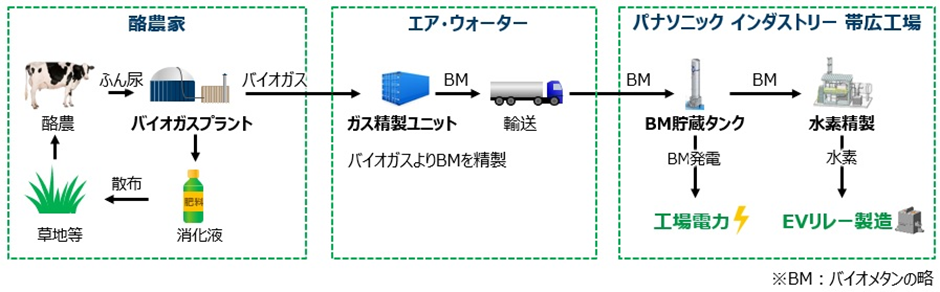
Air Water and Panasonic Industry utilize biomethane to halve CO2 emission in Hokkaido
(Company statement, July 28)
- Air Water and Panasonic Industry will establish an energy business model in Obihiro, Hokkaido to produce biomethane from livestock manure and use it as raw material to electrify a local factory. This is the first time that biomethane from livestock manure has been used in the electronics industry.
- The switch will reduce Panasonic’s CO2 emissions by 50% or more. The company produces EV relays in a factory where hydrogen gas is used in production.
- Air Water collects manure from dairy farmers; it will also build gas refining units at the dairy farms trying to reduce biomethane production costs.
JGC, Cosmo Oil and Revo selected for SAF project in Tokyo
(Company statement, Aug 3)
- The Tokyo Metropolitan Govt selected JGC, Cosmo Oil, and Revo International for Japan’s first large-scale domestic SAF project produced with cooking oil.
- Revo collects used cooking oil; Cosmo Oil evaluates it and then produces the SAF. The three companies will pursue: (1) recovery of used cooking oil; (2) educate the public on SAF production and use; (3) hold SAF information campaigns; and (4) study the use of cooking oil as a SAF feedstock.
- The companies plan a SAF supply chain to be ready for the 2025 Osaka Expo that will showcase Japan’s decarbonization success to the world.
- SIDE DEVELOPMENT:
Aviner and Chishima invested in DG Fuels in the U.S. to produce SAF
(Company statement, July 26)- Aviner & Co, a subsidiary of Fintech Global, and Chishima Real Estate invested in DG Fuels, an emerging leader in developing sustainable aviation fuel (SAF).
- When fully operational, the planned $4.2 billion DG Fuels facility in Louisiana will produce 180 million gallons of zero carbon emissions SAF.
- The SAF facility will be the template for other such facilities to be built across North America, Europe and Asia.
Toyota Tsusho supplies biodiesel at Hokkaido airport
(Company statement, Aug 1)
- Toyota Tsusho began supplying 100% concentration biodiesel fuel for a trial at New Chitose Airport, operated by Japan Airlines.
- The trial aims to verify the effects of using this biofuel for ground support equipment, reducing CO2 emissions by 2.62 kg per liter compared to the current fuel.
- The biofuel is made from waste cooking oil generated by the cooking system, contributing to the circular economy and local consumption.
JGC won a binary geothermal power generation project in the Philippines
(Company statement, Aug 3)
- JGC was awarded an engineering, procurement, and construction (EPC) contract from Energy Development Corp for a 28 MW geothermal generation project in the Philippines. The plant will apply organic Rankine cycle binary technology and recover thermal energy from the geothermal brine resource.
- The project was selected for the financing program of the Joint Crediting Mechanism (JCM) Model Projects in FY2022 that’s administered by the MoE and Global Environment Centre Foundation.
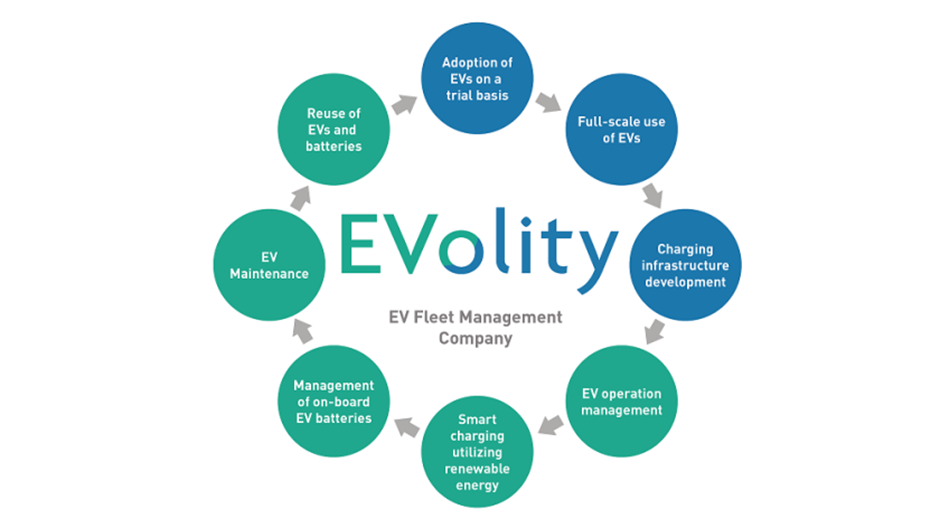
Marubeni and Panasonic start fleet management services
(Company statement, Aug 1)
- Marubeni and Panasonic founded EVolity to provide fleet management services for commercial EVs to major logistics companies.
- EVolity offers services from trial operations of EVs to centralize management of multiple charging stations and battery conditions.
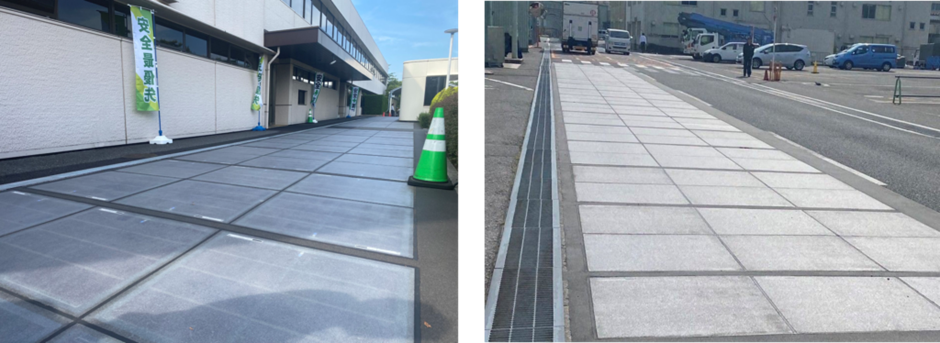
Mirai-Labo began experiment of autonomous solar road using used EV batteries
(Company statement, July 25)
- Mirai-Labo began testing an Autonomous Intelligent Road (AIR) – an energy infrastructure using EV repurposed batteries with “Solar Mobiway”. These solar panels are placed over the 100 m2 (x 2 locations) in Urayasu, Chiba Pref.
- When people walk or cars run over the solar panels their shadows may cause sudden changes in power generation capacity.
- NEDO financed the project to collect data and create a better algorithm for maximum power point tracker control. The test began in mid-July and goes until next July
NEWS: POWER MARKETS

Electricity surveillance committee to abolish ‘gross bidding’
(Denki Shimbun, July 31)
- The Electricity and Gas Trading Supervisory Committee will terminate “gross bidding” on the spot market, where former electricity providers had to offer volumes in wholesale power trading – including for internal transactions.
- As of March this year, the spot market accounted for 38.4% of Japan’s electricity sales. Of that, 6.2% came from gross bidding, which started in April 2017 and was applied nationwide, apart from in Okinawa.
- CONTEXT: The primary goals of gross bidding were to enhance market liquidity, manage price volatility, and improve transparency. While these aims were recognized as already accomplished as early as in 2021, the supervisory committee said at the recent meeting in July 2023 that further improvement in transparency around internal transactions at power utilities was needed.
- To assess the impact on the spot market, the system will be suspended from October, with full abolition planned if no issues arise.
Round 3 offshore wind projects will be in Aomori and Yamagata
(Nikkei, Aug 1)
- METI will add two new areas for Round 3 offshore wind projects – Aomori and Yamagata Prefs. The generation capacity will exceed 1 GW. Bidding starts later this year.
- In Aomori, METI nominated the Japan Sea side or western shore of the prefecture, for 600 MW of generation capacity. In Yamagata, it is expected to generate 450 MW.
- CONTEXT: By 2030, the govt plans to generate 5.7 GW of electricity from offshore wind. So far, after Round 1 and 2 of the auctions, a total of 3.53 GW from offshore wind has been planned. Round 3 will add another 1.05 GW. Altogether, it will yield 80% of the 5.7 GW target.
Lawmaker Akimoto under probe for alleged wind power bribery
(Japan NRG, Aug 4)
- Ruling party lawmaker Akimoto Masatoshi resigned as Parliamentary Vice Foreign Minister following Tokyo prosecutors’ raid of his offices for alleged bribery in wind power businesses. Akimoto has allegedly received financial contributions from Japan Wind Development Co.
- METI Minister Nishimura said while he recognizes that Akimoto was involved in the 2022 revision of offshore wind auction rules, the rule changes were unbiased.
- A JWD lawyer commented: “The allegation that JWD has bribed lawmakers and public officials is unfounded. Financial flows resulted because Akimoto and the JWD president were joint owners of a race horse.”
- CONTEXT: JWD is believed to have participated in the 2021 Round 1 offshore wind auctions, but these were all won by a Mitsubishi consortium. The landslide win provoked complaints and since then drove changes in auction rules.
TAKEAWAY: JWD is believed to have placed a bid for the 356 MW Happo Cho/Noshiro offshore wind auction whose results will be announced before April 2024. METI did not respond to Japan NRG’s query whether companies charged with corruption will be disqualified. Some govt tenders restrict participation from companies charged with violating the antitrust law.
The auction guidelines state:
| Auction participants are disqualified on the condition of: | Violation of the Electricity Business Act, or the Act on Special Measures to Procure Renewable Sources |
| Bankruptcy | |
| Subject to sanctions by METI, MLIT and/or local municipalities for cartel and other relevant charges. | |
| Non-payment of corporate taxes | |
| Capital and/or personal ties with other auction participants | |
| Contacts with community stakeholders resulting in non-transparent auction processes | |
| Other unfavorable conditions. | |
| Auction awards are canceled if: | The operator failed to install facilities as required by law |
| The project was awarded unlawfully. | |
| Public servants are penalized in a case of: | Taking part in price cartels with auction participants and other activities that impair the impartiality of the selection processes. Penalties are less than 3 years of imprisonment or fines of up to ¥2.5 million. |
Chugoku Electric will file claims against 3 former execs over cartel issue
(Company statement, Aug 3)
- Chugoku Electric plans to file claims against three former executives over the cartel issue related to corporate electricity sales. The company alleges that the executives violated their duty.
- Some shareholders had requested a lawsuit against 22 former and current executives, but only three are being sued.
- Chugoku Electric is also seeking the cancellation of a fine of around ¥71 billion imposed on the company by the Fair Trade Commission.
West HD and PowerX to collaborate on power storage and solar farms
(Company statement, Aug 2)
- West Holdings and PowerX will develop and operate grid-scale power storage and solar power farms. They’ll also collaborate on sales to promote West’s onsite solar PV experiences and PowerX’s storage batteries.
- West will adopt storage batteries from PowerX and place them in mid-scale storage stations across Japan, to reach a total 200 MWh storage capacity by 2025 spring.
- West will also develop solar power stations for PowerX targeting to reach 30 MW by 2025 spring. PowerX will distribute solar power from those stations to industrial and commercial consumers via corporate PPA.
Idemitsu joins grid-scale storage battery business with partners
(Company statement, Aug 1)
- Idemitsu joined with Renova, Nagase, and SMFL Mirai Partners to create Himeji Storage Station, to operate grid-scale storage batteries. The 15 MW Himeji Power Storage Station starts operation in Oct 2025.
- Idemitsu has a 51% stake and is in charge of operation, trade, and maintenance. Renova holds 22% and handles engineering, operation and finance. Nagase holds 22%; SMFL Mirai Partners has a 5% stake and is responsible for project finance.
- GS Yuasa will supply storage batteries and JGC will engineer and build the storage station. This project is financed by ¥1.6 billion in state subsidies.
Itochu joins grid-scale storage battery with partners
(Company statement, Aug 3)
- Itochu has partnered with PowerX, Shizen Energy, and Tokyu Land to build a grid-scale storage system to Tenoha Higashi-Matsuyama power storage station in Saitama Pref. This is the first time PowerX’s Japan-made storage battery (1.8 MW) was adopted domestically.
- Construction starts in FY2023 and operation starts early in FY2024. The companies plan to expand the power storage business in the future.
EPCOs post record profits for April-June 2023 period
(Mainichi Shimbun, Aug 3)
- Consolidated financial results of Japan’s top 10 electric power companies (EPCOs) in the April-June period show record profits for eight of them; this is a stark contrast to the previous year.
- The improved performance was attributed to a decrease in fuel price increases and regulated fee hikes for many households. Kansai and Kyushu Electric showed improved performance due to higher nuclear power plant operational rates.
- Seven other companies raised regulated fees in June after receiving METI approval. TEPCO reported a profit of ¥136.2 billion, thanks in part to fee increases in June.
KEPCO considers building nuclear fuel storage facility with Chugoku Electric
(Nikkei, Aug 2)
- Kansai Electric intends to review the possibility of building an interim storage facility for spent nuclear fuel in Yamaguchi Pref, together with Chugoku Electric.
- CONTEXT: In 1994, Japan set a policy to store spent fuel on the site of existing NPPs with the idea that the fuel rods would then be processed domestically. However, the then-Governor of Fukui Pref – which hosts all of Kansai Electric’s NPPs – opposed this plan and requested that spent fuel rods be moved outside of Fukui. This set in motion plans to create a new interim storage facility outside Fukui.
- KEPCO wants to build the new interim storage facility in Yamauchi, but delays and local opposition have made the process difficult so far. In June, KEPCO announced plans to send 200 tons of spent fuel from its Takahama NPP to France, but no final decision on this was announced.
- Chugoku Electric has one operational reactor. KEPCO has seven.
TAKEAWAY: KEPCO’s utilization rates for spent fuel pools are high, and it’s estimated that it may run out of storage at its NPPs in the next five to seven years. KEPCO began operation of Unit 1 of Takahama NPP on July 28, and Unit 2 is set to restart in September; thus the need to resolve the issue is as pressing as ever. Given the difficulties in gaining local consensus, it’s likely that KEPCO will have to rely on sending the spent fuel abroad for processing to reduce stockpiles, at least for the foreseeable future.
- SIDE DEVELOPMENT:
City in Nagasaki Pref mulls raising hand for nuclear waste storage site
(Denki Shimbun, Aug 3)- Officials from ANRE met with the Tsushima City Council (Nagasaki Pref) to discuss the municipality’s potential interest in raising its hand to host the nation’s long-term nuclear waste storage facility.
- The first step of the selection process, should the City decide to self-nominate, will be a so-called literature survey. ANRE officials noted that this step does not directly lead to the establishment of the radioactive waste disposal site, and reassured the City that no progress would be made without agreement from local governors and mayors.
- The City has received petitions from both sides of the debate. Hosting storage would bring economic benefits. However, some worry about the City’s potential proximity to geological fault lines.
TAKEAWAY: Japan has not yet found a site to store its long-term nuclear waste. So far, two small municipalities in Hokkaido have raised their hand to accept the first-stage literature survey. Allowing this survey alone brings economic benefit to the locality, but it is only the first of many steps towards creating a storage site. The Nuclear Waste Management Organization (NUMO) is in charge of finding a site and then maintaining it. NUMO is also holding various meetings around Japan, trying to explain the reasons why such a storage facility is needed, why it can be operated safely, and what benefits a locality would get by hosting it.
Eurus Energy began replacement of a wind farm in Iwate
(Company statement, Aug 1)
- Eurus Energy Kamaishi began modernization of its wind farms in Iwate Pref. They were built 20 years ago and were operational until March.
- The company will replace 43 turbines (1 MW each) with 11 Vestas turbines (4.2 MW each). Commercial operation will restart in April 2026 to generate electricity and sell it to Tohoku Electric.
TEPCO Renewable Power plans a new offshore wind power station in Chiba
(Company statement, July 31)
- TEPCO Renewable Power submitted to METI an environmental assessment for a new 660 MW offshore wind power farm off the coast of Isumi city, Chiba. The document is available for public viewing from Aug 1 to 31.
- Construction begins in 2028 and operation to start in 2030.
- The Isumi area is listed as “promising” for offshore wind; several other companies, including Mitsubishi Offshore Wind, are expediting their assessments.
JERA, J-Power, Itochu, and Tohoku Electric submit plan for offshore wind farm
(New Energy Business, July 31)
- JERA, J-Power, Itochu, and Tohoku Electric publicized an environmental assessment for offshore wind power projects in Oga, Katagami, and Akita cities in Akita Pref.
- The power station will be located off the coast of Oga city, using fixed-bottom wind turbines, with a 315 MW capacity.
- The planned area is listed as a renewable energy promotion area. The companies plan 21 turbines (each 15 MW), using 1,600-ton-class, self-elevating platforms (SEP).
Kansai Electric joins an offshore wind power project in Spain
(Company statement, Aug 1)
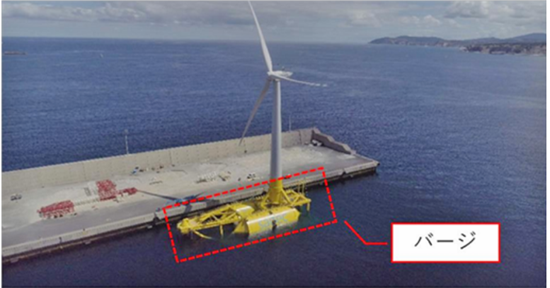
- Kansai Electric will participate in the DemoSATH offshore wind power project at Bilbao Port, north Spain, to test barge type floating wind turbines in association with Saitec Offshore Technologies and RWE Renewables.
- The companies will build a 2 MW wind turbine on a barge, place it 3 km from shore, and start testing in about two years.
- Kansai Electric expects to gain knowledge and experience for floating-type wind turbines to then be used for offshore wind power stations in Japan.
- The yellow object in the image below is the “barge” or foundation of the turbine.
Hokkaido Electric signed contract for the region’s largest-scale offsite PPA
(Company statement, Aug 4)
- Hokkaido Electric signed an offsite PPA agreement with Aeon Hokkaido through its affiliate Hare-bare, to maximize adoption of renewable energy at 10 of Aeon’s shops.
- Hare-bare will place solar power stations; Hokkaido Electric will supply electricity through its power grid to Aeon shops, starting Jan 2024. Its 12 MW power capacity means that it will be Hokkaido’s largest off-site PPA.
Digital Grid launched a corporate PPA matching platform
(Company statement, July 25)
- Digital Grid launched “RE Bridge”, a matching platform for promoting corporate PPA. It will connect power generators and consumers, offering everything from contracting to operations by handling the supply/demand management work.
- The first matching will be done in late Sept in the form of an auction where power generators offer preferred PPA price and consumer bids.
- CONTEXT: “Matching” is not contracting, but rather means generators and consumers agree to start negotiations.
Leben Clean Energy signed offsite corporate PPA agreement with TEPCO
(Company statement, July 26)
- Leben Clean Energy, a part of MIRARTH Holdings, signed with TEPCO Energy Partner to promote offsite corporate PPA with solar power farms.
- Leben has developed more than 200 high-voltage solar power farms in Japan and will sell the electricity to consumers through TEPCO Energy Partner.
NEWS: OIL, GAS & MINING

Japan to develop African supply chains for critical minerals and EV batteries
(Nikkei Asia, Aug 2)
- Japan plans to collaborate with Zambia, the Democratic Republic of Congo, and Namibia to develop supply chains for cobalt and other critical minerals used in EV batteries. This move is aimed at diversifying Japan’s sources of essential minerals, including lithium, and countering China’s increasing investment in Africa.
- JOGMEC will sign an MoU with Zambia and finalize plans with Congo and Namibia. Japan intends to explore African countries and provide remote sensing technology to identify potential mining sites using satellite imagery.
- In Congo, the focus will be on copper and lithium. In Namibia, the goal is to reinforce the supply chain for rare earths and other minerals.
- CONTEXT: Japanese interest in African mining resurged in the 2010s due to demand for steelmaking materials. In recent years, the strategic focus of Japanese raw material investments has shifted to batteries. However, African countries are more likely to assert national ownership of mines. While China persevered despite losses, Japan has been more cautious towards the African mining community.
TAKEAWAY: Politics and business are interconnected in Africa; infrastructure development is crucial for mining economies, requiring collaboration among multiple companies. Transparency is essential for Japanese investments in order to avoid selling metal products below market prices due to child labor concerns. Also, Japanese companies’ conservative approach might present challenges in forming long-term partnerships for high-risk projects.
Japan Gas Association launches clean energy certification committee
(Association statement, Aug 4)
- The Japan Gas Association launched the Clean Energy Certification Committee to set guidelines and rules to certify synthetic methane (e-methane) and biogas suppliers.
- The committee has three members: Yamaji Kenji, President of Research Institute of Innovative Technology for the Earth; Hondo Hiroki, Professor of Yokohama National University; and Kudo Hiroki, Director of the Institute of Energy Economics Japan.
- The IEEJ will serve as the committee secretariat.
LNG stocks fall to 1.93 million tons, down 3% from last week
(Government data, Aug 2)
- LNG stocks of 10 power utilities stood at 1.93 million tons as of July 30, down 3% from 1.99 million tons a week earlier. The July 23 stocks were first reported at 1.98 million tons but METI corrected the figure. The end-July stocks last year were 2.28 million tons. The five-year average this time of year was 2.08 million tons.
SPECIAL REPORT
BY JAPAN NRG
BASED ON MATERIALS BY
SHIN ENERGY SHIMPO
METI Certifies 7 Projects to Secure Rechargeable Battery Supply
Last year, METI unveiled a Battery Industry Strategy, Japan’s first detailed battery industry roadmap in a long time. The Strategy was a grand vision, outlining how a focus on lithium-ion chemistry and the all-solid-state technologies can propel Japanese firms to expand their capacity over the course of this decade and capture as much as 20% of the global market.
To move the Strategy forward, METI vowed to invest in new battery R&D along with private companies, helping Japanese manufacturers not only to create the technologies but also build the production facilities, train new talent, and forge global raw material supply chains.
As one of the first steps in this process, the government has now certified a wave of domestic projects that will receive initial backing; the certifications are split into two rounds. On June 16, METI confirmed the first seven projects that it believes can help industry provide a stable supply of rechargeable batteries. Subsidies totalling ¥127 billion will be distributed to support the production and technological development of batteries and their components.
Among the companies winning support is Toyota, whose initiative aims to set up 25 GWh of battery production capacity. Altogether, the certified projects are expected to boost domestic battery output to 45 GWh.
Background
METI’s Battery Industry Strategy estimated that Japan needs ¥3.4 trillion in both public and private investment to develop a manufacturing base for EV and storage batteries. A specialist panel tasked with formulating battery strategy has set targets for domestic production capacity of EV and energy storage batteries to reach 150 GWh by 2030, and for global capacity of Japanese makers to hit 600 GWh. It has also called for a full-scale commercialisation of all-solid-state batteries by 2030.
Such ambitious goals will also require vast natural resources. An annual production level of 600 GWh would utilize about 380,000 tons of lithium, 310,000 tons of nickel, 60,000 tons of cobalt, 600,000 tons of graphite and 50,000 tons of manganese, according to government estimates. Such figures will demand vast mining investments. For context, the world mined just 130,000 tons of lithium last year and produces only 1.3 million tons of graphite today.
The seven samurai
Toyota Motor Corp, in collaboration with Prime Planet Energy & Solutions, Prime Earth EV Energy, and Toyota Industries, plans to manufacture batteries for electric vehicles (EVs), such as onboard batteries, new structure batteries, and next-generation onboard batteries. Annual production capacity is expected to hit 25 GWh and will begin sequentially after October 2026. The project’s cost is about ¥330 billion, with METI providing about ¥118 billion in subsidies.
Tokai Carbon will establish a supply system for negative electrode active materials with an annual capacity of 5 GWh, starting its supply in April 2026. The project cost is about ¥3.7 billion, with about ¥1.3 billion coming from subsidies.
Kanto Denka Kogyo will develop the capacity to produce 65 GWh worth of electrolyte additives annually, starting its supply in October 2025. The project cost is about ¥4.6 billion, with about ¥1.5 billion in subsidies.
Ube Maxell Kyoto will start production of coating-type separators with an annual capacity of 5 GWh from June 2026. The project cost is about ¥2.7 billion, with ¥900 million in subsidies.
Nisshin Kogyo will establish a production base for positive and negative current collectors and external materials. The positive electrode current collector capacity will be 24 GWh annually, and the negative electrode current collector capacity will be 40 GWh annually; both should begin supply in October 2025. The project cost is about ¥2.5 billion, with subsidies of about ¥1 billion.
Denka will go ahead with the development and improvement of production technologies for conductive additives. The project cost is about ¥6.7 billion, with subsidies of ¥3.3 billion.
Aisan Industry will establish a production base for cell cases and cell covers. Annual production capacity will be 15.2 GWh for cell cases and 16.5 GWh for cell covers, with both supplies expected to begin in January 2026. The project cost is about ¥5.3 billion, with subsidies of about ¥1.8 billion.
First round of certifications
| Business operator | Production item | Output (GWh/ year) | Start date | Expected cost
(Billion yen) | Subsidy
(Billion yen) |
| Ube Maxell | Separator | 3 | Sept. 2026 | 3.3 | 1.1 |
| Honda
GS Yuasa Blue energy | Automotive and stationary lithium-ion batteries | 20 | Full-scale mass production Oct. 2027, sequential supply from April 2030 | 434.1 | 158.7 |
| Panasonic Energy | (Development and improvement of production technology) | 9.2 | 4.6 | ||
| Nichia Corporation | Positive electrode active material | 35 | Jan. 2025 | 12.4 | 4.2 |
| Asahi Kasei | Separator | 15 | Aug. 2025 | 17 | 5.7 |
| Kureha | Binder | 185 | Dec. 2025 | 19.9 | 6.8 |
| Mexichem Japan | Binder material
(R152a) | 310 | March 2027 | 5.1 | 1.7 |
| Resonac | Conductive agent | 10 | July 2026 | 5.1 | 1.7 |
Second round of certifications
| Business operator | Production item | Output (GWh/ year) | Start date | Expected cost
(Billion yen) | Subsidy (Billion yen) |
| Toyota Motor
Prime Planet Energy & Solutions / Prime Earth EV Energy Toyota Industries | Square liquid system LiB , Bipolar LFP battery, All-solid battery | 25 | Oct. 2026 | 330 | 117.8 |
| Tokai Carbon | Negative electrode active material | 5 | April 2026 | 3.7 | 1.3 |
| Kanto Denka Kogyo | Electrolyte additive | 65 | Oct. 2025 | 4.6 | 1.5 |
| Ube Maxell Kyoto | coated separator | 5 | June 2026 | 2.7 | 0.9 |
| Nissin Industry | – Positive electrode current collector
– Negative electrode current collector – External material | 24
40 10 | Oct. 2025
Oct. 2025 March 2027 | 2.5 | 1 |
| Denka | Conductive agent | Develop and improve production technology | 9.2 | 4.6 | |
| Aisan Industry | Cell case
Cell cover | 15.2
16.5 | Jan. 2026
Jan. 2026 | 5.3 | 1.8 |
GLOBAL VIEW
BY JOHN VAROLI
Below are some of last week’s most important international energy developments monitored by the Japan NRG team because of their potential to impact energy supply and demand, as well as prices. We see the following as relevant to Japanese and international energy investors.
Brazil/ Solar power
Portuguese power company EDP plans to invest $478 million in distributed solar energy generation plants in Brazil with 530 MW total capacity, focusing on “remote shared generation”. Distributed generation has driven growth of solar energy in Brazil, already reaching 20 GW.
Canada/ Oil
Oil producer Strathcona Resources will go public by acquiring rival Pipestone Energy in an all-stock deal to create a business with a market cap of C$8.6 billion. The combined company will retain its name and be led by its CEO Rob Morgan. It did not say when Strathcona plans to start trading in Toronto.
China/ Mining and metals
In the first half of this year, Chinese investments and new contracts in mining and metals — nickel, lithium and copper, as well as uranium, steel and iron — topped $10 billion. That’s more than the 2022 full-year total, and will exceed the previous record of $17 billion in 2018.
China/ Nuclear power
China approved construction of six nuclear power units – Units 5 and 6 of Ningde NPP; Units 1 and 2 of Shidaowan NPP; and Units 1 and 2 of Xudabao NPP. Investment totals $17 billion. China has the world’s third-largest nuclear fleet behind France and the U.S., and accounts for 23 of the 55 reactors now under construction globally.
Niger/ Uranium
Turmoil in Niger has only led to a slight uptick in the spot price for uranium, to $56.25 a pound. Niger is the world’s seventh largest producer, with a market share of about 5% of the global uranium trade. Niger has cut off supplies to France. Between 2005 and 2020, Niger supplied France with around 18% of its uranium.
Saudi Arabia/ Oil production
Saudi Arabia will extend a 1 mbpd voluntary crude output cut into September, the third month of such a decline. Saudi production for September will be about 9 mbpd. This adds to 1.66 mbpd of production cuts by other OPEC members planned through the end of 2024.
Turkmenistan / Natural gas
The country’s proposal to build a multibillion-dollar gas pipeline across the Caspian Sea faces major financing challenges, reports Bloomberg. Currently, there are no international discussions or contacts with Turkmenistan concerning future gas exports. This will make it difficult to get the Trans-Caspian pipeline off the ground.
UAE/ Net zero
State-owned ADNOC has brought forward emissions reduction targets as the UAE prepares to host COP28 in December. The UAE will now aim to achieve net zero emissions from operations by 2045 rather than 2050, and cut methane emissions to zero by 2030.
U.S./ LNG
LNG exports rebounded in July with a 9% jump from the previous month, as a number of plants along the Mexican Gulf coast resumed operations after planned maintenance.
U.S./ Oil
The White House nixed an offer to buy 6 million barrels of oil for the Strategic Petroleum Reserve, because prices are expected to keep rising after an output cut from Saudi Arabia. The U.S. made the latest solicitation to buy the crude for the SPR on July 7.
2023 EVENTS CALENDAR
A selection of domestic and international events we believe will have an impact on Japanese energy
Disclaimer
This communication has been prepared for information purposes only, is confidential and may be legally privileged. This is a subscription-only service and is directed at those who have expressly asked K.K. Yuri Group or one of its representatives to be added to the mailing list. This document may not be onwardly circulated or reproduced without prior written consent from Yuri Group, which retains all copyright to the content of this report.
Yuri Group is not registered as an investment advisor in any jurisdiction. Our research and all the content express our opinions, which are generally based on available public information, field studies and own analysis. Content is limited to general comment upon general political, economic and market issues, asset classes and types of investments. The report and all of its content does not constitute a recommendation or solicitation to buy, sell, subscribe for or underwrite any product or physical commodity, or a financial instrument.
The information contained in this report is obtained from sources believed to be reliable and in good faith. No representation or warranty is made that it is accurate or complete. Opinions and views expressed are subject to change without notice, as are prices and availability, which are indicative only. There is no obligation to notify recipients of any changes to this data or to do so in the future. No responsibility is accepted for the use of or reliance on the information provided. In no circumstances will Yuri Group be liable for any indirect or direct loss, or consequential loss or damages arising from the use of, any inability to use, or any inaccuracy in the information.
K.K. Yuri Group: Hulic Ochanomizu Bldg. 3F, 2-3-11, Surugadai, Kanda, Chiyoda-ku, Tokyo, Japan, 101-0062.