The Japan has long seen Australia as its most reliable energy partner, but cracks have opened in their relationship. The timing of their energy transitions varies. Japan would like to retain access to Australian fossil fuels – especially natural gas – until cleaner alternatives are in place. Australia is pushing for a faster transition. The two will need to find an optimal balance to transition their trade into the net zero era.
Two years ago, Japan set a new strategy to boost the role of renewables and cut in half natural gas and coal in power generation by 2030. But as the time approaches to update the strategy, some are urging a re-think. There are doubts about walking away from new LNG deals. The capacity that’s supposed to replace coal- and gas-fired power stations is not yet built. And so, Japan is starting to ask the question: Do we really need to rush our exit from gas?
GLOBAL VIEW
A wrap of top energy news from around the world.
EVENTS SCHEDULE
A selection of events to keep an eye on in 2023.
JAPAN NRG WEEKLY
PUBLISHER K. K. Yuri Group
Editorial Team Yuriy Humber (Editor-in-Chief) John Varoli (Senior Editor, Americas) Mayumi Watanabe (Japan) Wilfried Goossens (Events, global) Kyoko Fukuda (Japan) Filippo Pedretti (Japan) Tim Young (Japan)
METI won’t need to ask large power consumers to conserve energy in winter as the country has sufficient energy supplies. Power reserve margins are forecasted above 5%, said minister Nishimura.
For the first time in two years the govt didn’t request consumers to conserve energy.
Still, METI seeks to reduce reliance on old thermal power plants, while utilities need to decarbonize. Consumers may conserve power even more. The upcoming economic package will include budgets for these measures.
Also, Nishimura is pushing for the restart of Onagawa, Kashiwazaki Kariwa, Tokai No. 2, and Shimane nuclear power plants.
CONTEXT: The govt’s forecast does not take into account two new thermal power plants in the Tokyo area that will come onstream in Q1 of FY2024: the Yokosuka No. 2 coal power station (650 MW) and the Goi LNG power station (780 MW). Tokyo’s reserve margin will increase if they run successfully.
TAKEAWAY: The govt no longer needs to push businesses to conserve energy thanks to high fuel prices. Most large energy consumers are already motivated to cut their usage of fuels and electricity over the short term, and see the introduction of carbon credits trading as a signal to economize in the mid to long term. For a short while at least, state energy subsidies are protecting both business and individual consumers. Still, the scale of the subsidies is being scaled back from 2024.
Toyota Motor will invest an additional $8 billion in Toyota Battery Manufacturing, North Carolina (TBMNC). Total investment will be about $13.9 billion.
With eight additional production lines, the goal is to have 10 battery EV and plug-in hybrid vehicle battery lines by 2030. Annual production will be more than 30 GWh.
CONTEXT: This is the most significant investment by a foreign company in the U.S. automotive sector following incentives created by the Inflation Reduction Act. The state of North Carolina has offered multimillion-dollar incentives to Toyota, which are in addition to the federal ones.
TAKEAWAY: In June, Toyota revamped its EV strategy, improving range and reducing costs, which has led to a positive market response while also increasing hybrid sales. However, just like its competitors Nissan and Honda, Toyota faces challenges in China, where domestic EVs dominate, as well as in Southeast Asia, where Chinese investments are increasing due to high demand for EVs. Despite these challenges, hybrids remain a strong sector for Toyota, making up over 90% of its EV sales.
JERA, in collaboration with Toyota Motor, launched a demo project to operate a large-scale energy storage system using repurposed EV batteries.
This initiative, a world first, aims to connect the system to the extra-high-voltage transmission grid. The project was approved under the MoE’s 2023 grant program dedicated to optimizing renewable energy products.
The project seeks to harness these used batteries on a large scale, promoting domestic reuse over the battery’s life cycle.
CONTEXT: Since EVs are promoted as vital for the energy transition, a surge in used lithium-ion and other vehicle batteries is anticipated.
TAKEAWAY: The two companies have worked on such a battery system since at least 2018. The collaboration culminated last year with the start of a demonstration of what Toyota calls a “Sweep Energy Storage System”. This approach uses “sweep”, or the ability to line up various batteries of different size, performance, and age, into one system that can switch electricity flow on and off to control energy discharge. The benefits include lessening demand for raw materials for new batteries, and lowering the cost of electricity systems. According to Toyota, the “sweep” system eliminates the need for power conditioners that are used to convert AC output from batteries to DC power. Given the high cost of disposal of batteries and other devices in Japan, Toyota and JERA can expect to receive fresh supplies of used batteries for free or even charge a small amount to collect them.
The Japan Hydrogen Association (JHA), which includes Toyota Motor and Sumitomo Mitsui Financial Group (SMFG), will collaborate with the investment firm Advantage Partners to launch a fund focused on the hydrogen industry.
The fund will be operational early next year and it plans to raise tens of billions of yen initially, targeting domestic and overseas advanced technologies to develop infrastructure for hydrogen production and storage.
It would be Japan’s first such fund to focus solely on the hydrogen economy.
CONTEXT: The JHA launched in 2020, and is led by Toyota, SMFG, industrial gas company Iwatani Corp, etc. Membership totals about 370 entities from the private and public sectors.
TAKEAWAY: Over the past decade, Japanese companies have pioneered hydrogen-related technologies and were seen as world leaders. However, Asian and North American competitors have since taken the lead, partly thanks to access to ample financial resources. Now, with this new fund, the JHA believes that making high-risk investments can help Japanese hydrogen innovators gain an advantage in international rivalries.
Mitsui partnered with Fukui Pref and Hokuriku Electric on a feasibility study financed by METI for development of a hydrogen-ammonia supply chain at Tsuruga Port.
It will make use of a floating storage and regasification unit (FSRU) for storing and regasifying ammonia.
The goal is to centralize and industrialize hydrogen and ammonia usage in the region, with Tsuruga Port as the primary hub for offloading and supply facilities.
Japan’s second green ammonia demo plant to be completed in Feb 2025
(Japan NRG, Oct 30)
Japan’s second green ammonia demo plant will be completed in February 2025, a Namie Township (Fukushima Pref) official told Japan NRG.
Project operators are JGC Holdings and Asahi Kasei, whose alkaline water electrolysis (AWE) system will produce green hydrogen. Output is 4 tons/day.
Asahi Kasei plans to build a commercial-sized plant by 2027.
The launch was delayed from 2024 since the municipality took time to communicate with Tanashio Industrial Zone stakeholders where the plant will be built.
CONTEXT: The first demo plant is the 200 kg/day facility at the state-run Fukushima Renewable Energy Institute (FREA).
INPEX has taken a 30% stake in Japan Suiso Energy, a joint venture of Kawasaki Heavy Industries and Iwatani Corp, which is developing liquefied hydrogen transport systems to import hydrogen into Japan.
INPEX purchased the shares from Kawasaki, which still owns 36.6% of JSE after the sale. Iwatani has a 33.4% stake.
CONTEXT: In the past year, INPEX has participated in U.S. and UAE ammonia projects, but the company also seeks to be active in liquid hydrogen projects, to leverage its LNG operations in Australia and Indonesia. Liquefied hydrogen facilities have similarities with those of LNG.
TAKEAWAY: There are three major ways to transport hydrogen by ship: 1) convert the gas into liquid hydrogen; or 2) into ammonia; or 3) into methylcyclohexane (MCH). The cost of a liquefied hydrogen system is quite high as it requires specialized ships for hydrogen transport, as well as liquefaction plants at the loading site, and regasification plants at the delivery point. However, it does provide a gas purity of 99.999% and doesn’t need further reprocessing.
ENEOS and JFE Steel began studies on methanation-based steel production and other applications of hydrogen at the Mizushima industrial marine district (Okayama Pref).
Methanation is a carbon reuse process that combines hydrogen and CO2 to generate methane used for steelmaking and energy.
ENEOS plans to import renewables-derived hydrogen by converting the gas into methylcyclohexane (MCH). In 2029, JFE Steel plans to start a demo methanation-based steel furnace, which is located at Kurashiki Steel Works in the Mizushima area, and that’s dubbed the “carbon-recycling blast furnace”.
This innovative furnace will have an annual output of 50-60 tons of steel.
CONTEXT: There are two approaches to cutting CO2 in steelmaking: switching from blast furnaces to electric arc furnaces that use carbon-intensive coke, and using hydrogen instead of coke for treating iron ore in blast furnaces. The latter solution will require massive volumes of hydrogen. When converted to MCH, hydrogen can be transported in oil tankers at room temperature and pressure; unlike ammonia and liquefied hydrogen which require low-temperature ships. However, the process of converting hydrogen to MCH generates benzene and other chemical compounds.
TAKEAWAY: The current available technologies need to improve in efficiency as the amount of hydrogen required is massive. Companies also plan to nail down the type of hydrogen suitable for this application, which should be of interest to hydrogen suppliers since the demo steel furnace will eventually be expanded to 4 million tons/year.
Technical specs of hydrogen according to applications
Sharp achieved the world’s highest conversion efficiency of 33.66% in a 775 square centimeter stacked solar cell module in the laboratory.
The module has two-junction solar cells on the top layer, which is reduced to one-third of the conventional triple-layer cells, and silicon solar cells on the bottom.
CONTEXT: Sharp is developing solar cell modules to be mounted on mobile equipment. Installing solar cells on EVs will make it possible to supply electricity directly from renewable energy sources.
TAKEAWAY: In the early 2000s, Japan dominated the solar power market, but then starting about 2010, China quickly became ascendant and now completely dominates the market. Japan is eager to get back into the solar market, and has invested heavily in next-generation technologies. Sharp was one of the leaders of Japan’s solar technology in the past. Since 2016, it is owned by Taiwan-based manufacturer Hon Hai Precision Industry Co., better known as Foxconn.
Aeon Retail and Ichijo, a housing developer, agreed to develop a smart city in Hamamatsu, Shizuoka Pref.
About 180 net-zero energy houses (ZEH) will be equipped with a total 2 MW of solar panels and storage batteries, as well as vehicle to home (V2H) facilities.
CONTEXT: The smart city concept is not new, but few regions have built an entire community. Panasonic built one in Fujisawa city, Kanagawa Pref, but the town has only a residential area. This plan in Hamamatsu includes all functions of society such as shopping, schooling, medical care, and more.
Cosmo Energy and Toshiba Energy Systems & Solutions (Toshiba ESS) plan a study on CCU using CO2 electrolysis.
Toshiba ESS will provide a technology that efficiently converts CO2 into carbon monoxide (CO), which can be used to produce methanol and ethanol.
The collaboration aims to establish CCU using CO2 electrolysis in Cosmo’s facilities; the oxygen byproduct might be used for energy conservation and further CO2 emission reductions at refineries.
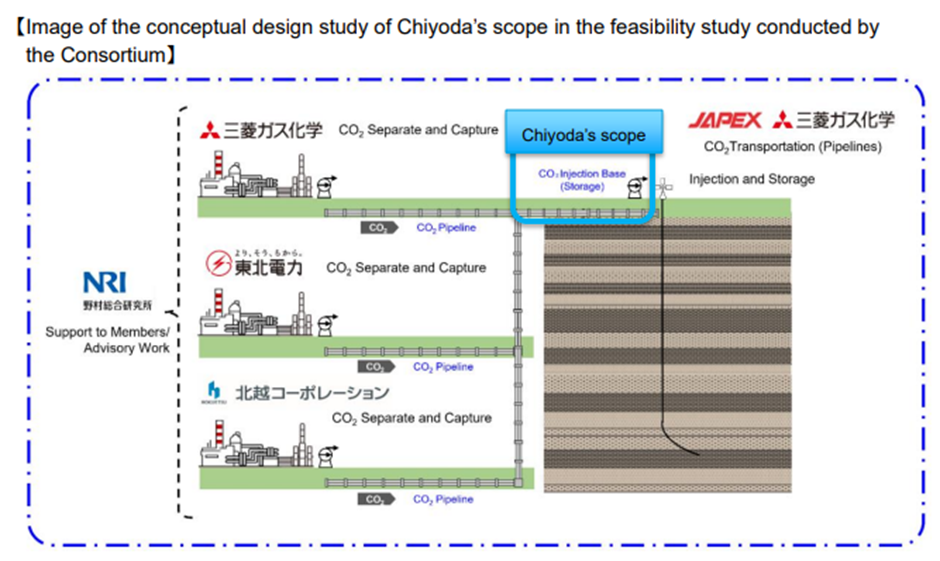
Engineering company Chiyoda won a contract from Mitsubishi to research CO2 liquefaction, storage, and shipping facilities toward the goal of establishing a CCS value chain.
This is part of JOGMEC’s “Feasibility study on establishing an overseas CCS value chain for CO2 emissions from multiple industries in the Ise Bay/Chubu Region”.
In August, JOGMEC tapped Mitsubishi for a CCS value chain feasibility study.
Kazakhstan became the 28th country to join the Joint Crediting Mechanism, to share credits issued to Japanese climate mitigation projects in Kazakhstan.
The September consolidated interim financial statements for ten major electric power companies shows that in contrast to September 2022, when many companies faced losses due to the energy crisis, eight companies (Hokkaido, Tohoku, Chubu, Hokuriku, Kansai, Chugoku, Shikoku, and Kyushu) now had record profits.
TEPCO said its net profit for the period was ¥350.8 billion, compared to a loss of ¥186 billion in September 2022. Hokuriku saw a positive financial result of about ¥50 billion, and Chugoku of ¥51.3 billion.
TAKEAWAY: The EPCOs improved financial results were primarily due to a decline in fuel costs, which had soared following the start of the war in Ukraine in February 2022 and the subsequent G7 sanctions against Russia. As energy costs soared, the EPCOs sought, and were given the green light to hike electricity rates. With rate hikes for households and businesses, financial balances improved across the board. However, with the yen at its weakest against the dollar in decades, it’s not clear whether utility profit levels will be sustained.
The carbon credits market launched a month ago with 188 participants. As of Oct 18, that figure stood at 206.
By Oct 27 a cumulative total of 10,127 tons of CO2 had been traded.
CONTEXT: The Tokyo Stock Exchange launched its carbon credit market on Oct 11. The first day of trading reached 3,689 metric tons of CO2. This market provides a platform for registered entities to buy and sell J-Credits. The goal is to bring more transparency to carbon pricing.
Mitsubishi Heavy Industries Engine & Turbocharger (MHIET) tested a single cylinder engine with a hydrogen admixture, achieving stable combustion at up to 50% volume hydrogen without a loss in rated output.
The goal is to adapt the KU series gas engine cogeneration systems, which are used in various industries, for lower carbon emissions while maintaining performance.
The system might meet the EU’s transitional CO2 emission standard for natural gas power plants.
The Japan Atomic Energy Agency (JAEA), MHI, Mitsubishi FBR Systems (MFBR), and TerraPower have expanded their existing MoU for development of sodium-cooled fast reactor (SFR) technologies.
In December 2022, Japan updated its strategic roadmap for fast reactor development, choosing a 650 MW pool-type SFR design from MFBR and MHI, with MHI designated as the manufacturer.
The revised MoU focuses on a common reactor design and upscaling of TerraPower’s Natrium reactor design to increase its size for cost effectiveness and enhanced safety.
CONTEXT: TerraPower is developing a 345 MW Natrium reactor, with support from the U.S. Dept of Energy; it’s expected to begin commercial operation in 2030.
TAKEAWAY: To achieve climate goals, more industrialized countries are looking at deploying advanced reactors starting in the 2030s. Proponents of Generation IV nuclear energy systems claim they have enhanced safety features, cost competitiveness, and produce less toxicity of high-level radioactive waste, etc. Japan’s strategic roadmap for fast reactor technology identifies SFR as a promising technology and toward that goal it’s cooperating closely with the U.S.
The NRA approved an extension for the operation of Units 1 and 2 of Kyushu Electric’s Sendai NPP (PWR, 890 MW each).
These reactors can now operate for an additional 20 years beyond their original 40-year operating period.
CONTEXT: This follows similar approvals for Kansai Electric’s Takahama Units 1 and 2, Mihama Unit 3, and Japan Atomic Power’s Tokai Daini Power Plant Units 5 and 6. Now, Sendai is the fifth nuclear plant to receive an extension. Unit 1 will reach 40 years of operation in July 2024 and Unit 2 in November 2025.
Removal of melted fuel from Fukushima Daiichi NPP’s reactor came to an impasse after the discovery that deposits block the inside of the lid to the reactor. The govt’s plan to start the removal this fiscal year is likely to be delayed for the third time.
The chairman of the Decommissioning Fukushima Daiichi Nuclear Power Plant Study Committee suggests that the removal of debris could take between 50 to 100 years, much longer than initially anticipated.
In October, TEPCO workers used remote-controlled robots to inspect the reactor’s interior, but were hindered by unexpected amounts of debris.
CONTEXT: The decommissioning work, which started in April and was expected to last a month, faced setbacks and took until October. Furthermore, changing the approach would require regulatory approval from the NRA.
CONTEXT: Rainwater comes into contact with debris and becomes a source of contaminated water. If the debris cannot be removed, the water will continue to flow, and the decommissioning process will be hard to complete.
TAKEAWAY: TEPCO and the govt have a phased plan for removing nuclear fuel debris, beginning with a small amount from Unit 2 and expanding to Units 1 and 3. However, some experts are skeptical about the findings from these preliminary extractions, since they’ll remove only a few grams of the total debris, estimated at around 800 tons. While there is a call for a clearer discussion on the overall decommissioning strategy, TEPCO’s action can be seen as a symbolic move into the final phase of decommissioning.
Renova postponed operation of the Ishinomaki Hibarino Biomass Power Plant (Miyagi Pref), which is one of the country’s largest such plants.
Initially, the plant was supposed to start in September, but it has been rescheduled to begin in January 2024.
The delay is due to the final set-up and testing of boilers and turbine equipment.
Its generation capacity is 75 MW; it now sells power on a trial basis via the FIT scheme.
CONTEXT: This isn’t Renova’s first biomass plant delay. It has also postponed the start of a biomass power plant in Tokushima Pref, from September to December.
ANRE will now require biomass power operators to disclose, on their website, the name of the third-party certification that verifies compliance to GHG standards.
This will apply to both operators using local and imported feedstock.
Erex, a renewable energy company, was awarded a project of “Studying high-ratio co-firing of biomass in a coal-fired plant in Quảng Nam, Vietnam”. This is part of NEDO’s goal to promote Japanese decarbonization technologies in Asia.
The company will explore how to use biomass for 50% of the plant’s fuel with a minimum investment in new equipment.
The MoE-backed Japan Green Investment Corp has provided subordinated loans to Clean Energy Connect, which plans to develop 40 MW of solar power. Its business model is to sell power to companies via offsite power purchase agreements (PPAs).
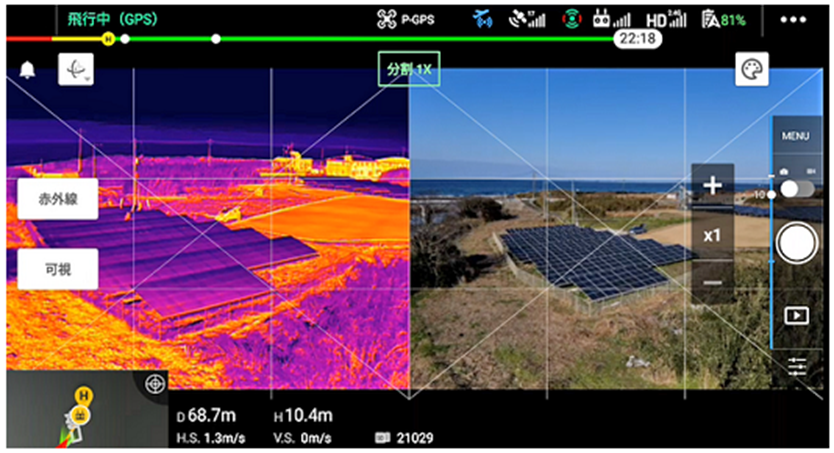
BLUERAY, a drone maintenance company in Osaka, started an AI image analysis service of solar panels using a drone with an infrared-camera.
Solar power stations that cover large areas require lengthy maintenance. By analyzing images shot by drones, the workload and time for maintenance can be halved or reduced even to one-tenth.
NEWS: OIL, GAS & MINING
U.S. sanctions on Russian LNG pit Japan’s geopolitics against its gas security
(Bloomberg, Nov 3)
On Nov 2, the U.S. sanctioned Novatek’s Arctic LNG 2 project, which includes Japan’s government as an investor and is set to start exports in a few months.
This is the first U.S. sanction to directly target an LNG export plant in Russia. Novatek is one of Russia’s leading gas companies.
The sanctions on Arctic LNG 2 will test Japan’s relationships with other G7 nations. Western sanctions so far have avoided Russian gas, which still supplies Japan and the EU.
CONTEXT: A consortium of Mitsui and state-owned JOGMEC have a 10% stake in Arctic LNG 2 and expect to receive 2 million tons per year from the facility, equal to roughly 3% of Japan’s total contracted long-term supply, according to Bloomberg.
TAKEAWAY: While Japan has vowed to phase out the import of Russian coal over time, it has not touched natural gas because of the fuel’s vital role in the country’s electricity system and heating. Japan gets about 10% of its natural gas from Russia. That’s why, with the government’s blessing, trading houses Mitsui and Mitsubishi Corp have retained investments in the Sakhalin-2 LNG facility in Russia.
Kyushu Electric’s president Ikebe Kazuhiro wrote to the U.S. Dept of Energy urging approval of Energy Transfer’s plan to export LNG from Lake Charles, Louisiana.
The letter said that Ikebe’s company and Energy Transfer have been discussing a long-term LNG contract and equity investment into the project. METI backs the deal since it enhances Japan’s energy security. The company seeks financial support from the Japan Bank for International Cooperation and JOGMEC.
The project is important for the energy security of Asia, attracting companies from Thailand and South Korea, Ikebe also said.
CONTEXT: Energy Transfer’s Lake Charles export license expires in 2025 and its request for an extension was turned down. The company has signed a non-binding agreement with a Japanese consortium for a 1.6 mtpa supply over a 20-year period.
LNG stocks of 10 power utilities stood at 2.18 million tons as of Oct 29, down 1.4% from 2.21 million tons a week earlier. METI initially reported the Oct 22 stocks as 2.23 million tons, but revised the figure.
The end-October stocks last year were 2.53 million tons. The five-year average for this time of year was 2.01 million tons.
ANALYSIS
BY JOHN VAROLI
Australian and Japanese Energy Relations Face Their Own Transition, Part 1
Recent geopolitical upheavals once again highlight how vulnerable Japan can be to ‘black swan’ events. Japan already faces a tricky situation with Russia, which is a major LNG and coal provider, and there’s the perennial worry that conflict in the Middle East could cause havoc in energy supply chains.
In contrast, Japanese companies have long seen Australia as their most reliable energy partner for everything from coal and LNG, to uranium, and most recently, hydrogen. As a nation that depends on imports to meet its energy needs, Japan prefers maintaining stable supplies with allied nations.
Recently, cracks have opened in those friendly foundations. Most of the energy deals that underpin $147 billion of annual trade between Japan and Australia relate to fossil fuels. Both countries have pledged to hit net zero emissions by 2050 and even wrote their commitments in law. However, the interim path and the timing of their energy transitions vary.
Net zero causes anxiety in Japan in ways that major allies often don’t fully appreciate. LNG, oil and coal still account for almost three-quarters of the country’s power mix. That figure will only drop to 40% by 2030, assuming Japan can even meet its near-term goals by accelerating the rollout of clean energy sources.
And so, Japan would like to retain access to Australian fossil fuels – especially natural gas – until cleaner alternatives are in place. Australia’s policies, however, are pushing for a faster resolution. The two will need to find an optimal balance to transition their trade into the net zero era.
Power: Coal and LNG
Unlike most advanced economies, in which the average age of coal-fired power plants is about 40 years, Japan has a relatively young fleet of thermal power plants with half the average years in operation. New coal plants are still being opened in the country, based on decisions made years ago.
Having vastly reduced its Russian coal supplies since last year’s Ukraine war, Japan relies on a clutch of suppliers including Indonesia and Canada. But Australia remains the key trade partner in this sector, providing about 73% of Japan’s thermal coal.
Australia’s reliable supply of high-quality coal has, however, come at a cost and Japanese utilities have long eyed cheaper alternatives. What’s more, this year Australia passed new regulations that require coal miners and other major polluters to cut their CO2 footprint by 4.9% a year or pay for carbon credits to reach the target. This is expected to push up the price of Australian coal even further and some mines are expected to close.
The regulatory change did not go unnoticed in Tokyo, and not only because of the coal. It will also affect new gas developments, with representatives of the Australian Greens party openly describing the new law as a tool to kill a significant portion of new fossil fuel projects.
For Japan, these are worrying signals. Super chilled natural gas, transported as LNG, remains king in the two countries’ relations. Over the past 30 years, Japanese investment has been crucial in developing Australia’s gas industry, propelling it to one of the world’s top LNG exporters. Japan takes a large portion of those sales and relies on Australia for 40% of its LNG needs.
The $45 billion INPEX-led Ichthys LNG project off the coast of Western Australia is one of the largest investments in the industry, producing 8.9 million tons a year, of which 70% goes to Japan. This investment alone accounts for close to 9% of Japan’s LNG imports, similar to the volumes shipped from Russia. INPEX owns 66.2% of Ichthys, TotalEnergies 26%, and the remainder with five other Japanese and one Taiwanese energy utility.
Any disruptions to Australian supply would have significant repercussions. For example, Tokyo Gas, with 12 million users in the Tokyo area, depends heavily on Australia’s LNG as a fuel source for power generation.
In an interview last month with the Australian Financial Review, former Tokyo Gas chairman Michiaki Hirose, now a current special advisor to the company, commented that: “We would like Australia to continue to provide us with a stable supply.”
That Hirose felt compelled to utter such words publicly reveals Japanese concerns about Australia’s reliability. Indeed, in late 2022, Tokyo Gas sold its equity stakes in four integrated Australian LNG projects to U.S. infrastructure fund EIG Global Energy Partners in a $2.15 billion cash deal. This was the first major Japanese sale of equity stakes in Australian LNG projects.
METI Minister Nishimura lodged a further note of protest a few months ago noting that the new law in Australia mandates net zero policies for new gas fields from day one of operations – including for projects that had taken their Final Investment Decision prior to the regulation coming into place. The minister said that both he and PM Kishida had asked Australian counterparts for more “flexibility”.
Australia’s production is actually headed into a period of gradual decline. The FY2022 LNG export figure of 82 mmt is followed by 81 mmt for FY2023, and a forecasted drop to 79 mmt in FY2024. This comes at a time of rising LNG demand from Asian partners, such as Japan; a reality that Australian natural gas producers have said Prime Minister Albanese’s decarbonization policy ignores.
That downward trend in LNG production is partly due to the fact that Australia has hurt investor confidence with the new regulations, and partly due to its own rising domestic demand. Western Australia banned all exports of natural gas in 2020 citing its own needs for the fuel amid a shift from coal, which local developers say has spooked new investment.
Japan’s LNG anxieties were further exacerbated by a discussion paper in early October released by Resources Minister Madeleine King that ignored the role of Australian gas in meeting the needs of Asian allies. This might seem like an accidental omission, but Japanese LNG buyers’ sense that Australia is “quietly quitting” LNG.
A few days later, Ms King backtracked and promised that Australia will “always be” a reliable exporter of gas to Japan.
The LNG volumes that come from Australia are nearly impossible to replace from other countries, and so, Japan’s interest in Australian gas won’t disappear. In fact, trading house Sumitomo recently inked a $500 million deal with Woodside Energy, Australia’s leading independent oil and gas company, to take a 10% stake in its massive Scarborough project.
But Australia may no longer be the go-to gas investment for Japanese firms. As JERA Global CEO Kani said earlier this year, the economics of Australian LNG are changing and greater diversification of suppliers may be needed.
Part 2 of this article in the next issue of Japan NRG Weekly will look at Australian-Japanese relations in the energy transition.
ANALYSIS
BY YURIY HUMBER
Does Japan Need to Rethink its Scaling Down of LNG?
Two years ago, Japan set a bold new Basic Energy Strategy, which vowed to boost the role of renewables and cut in half the allocation to natural gas and coal in power generation by 2030. But as the time approaches to update the Strategy, some are urging a re-think.
Based on the current 2021 edition of the Strategy, Japan’s LNG import volumes should decline by about a third come the end of this decade. With Japan as the world’s biggest buyer of LNG, this forecast carried global implications – not least for Japan itself, whose LNG buyers became reluctant to sign new long-term supply deals even as older contracts expired.
As the middle of the decade draws near, however, doubts are creeping in around the validity of walking away from new LNG deals. After all, the capacity that is expected to replace coal- and gas-fired power stations is not yet built. The momentum in the renewables sectors has slowed, while nuclear restarts are proceeding in a stuttering manner that is at odds with the ambitions voiced by Prime Minister Kishida last year.
Meanwhile, geopolitical instability, wars, and rising raw materials costs, among other factors, are pushing all countries to cherish energy security and accept that some usage of fossil fuels will be unavoidable for the time being. And so, energy planners, fuel importers and utilities in Japan are starting to ask the question: Do we really need to rush our exit from gas?
Timeline
METI revises the Strategy every three years. The latest, 6th edition, was passed in October 2021, but a draft version appeared in July of that year. This suggests that work to compile the next, 7th edition, will soon officially be underway, with all the usual subtle sectoral lobbying that goes on in the background.
Source: METI
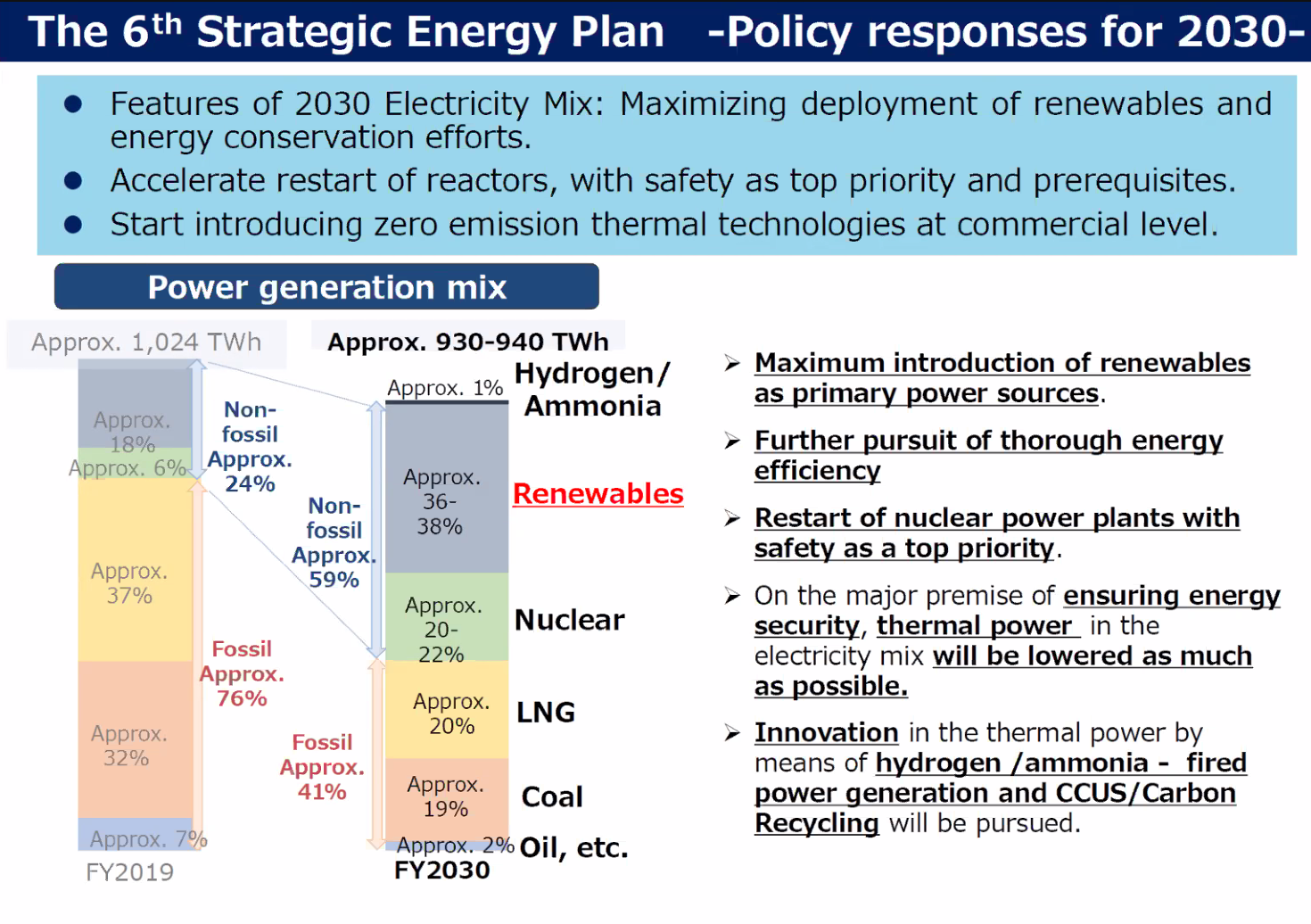
The 6th edition was widely criticized as unrealistic, but its emphasis on increasing the power mix in favor of non-fossil sources was vital to align with the country’s commitment to a 46% cut in CO2 emissions by 2030 (compared with FY2013 numbers).
One of the surprises of the 2021 edition, however, was the willingness by energy planners to sacrifice both coal and gas generation equally. Many assumed that coal would be cut first as the bigger polluter, with gas retained as an energy transition fuel.
Japan imports gas as LNG. In 2021, it brought 74.3 million tons (mt) of LNG into the country. Of that amount, 28.6 mt was shipped by the gas companies like Tokyo Gas, which use the fuel for heating and industrial customers. The import volumes of gas utilities barely change year to year.
The remainder of the LNG is bought by major power utilities, such as TEPCO and Kansai Electric, which use it for electricity generation. Diving the 2021 number by half and adding demand from gas firms, as per the Basic Energy Strategy forecast, assumes Japan will require just 50 mt at the end of this decade.
Last year, Japan’s LNG imports declined to 72 mt. This year, they are in line to drop to the mid-60s, mostly due to milder weather and increased energy conservation nationwide. Even if both of those factors hold, a further 23-25% drop in consumption within six years is a distinctly low-probability event. It would require, roughly speaking:
the restart of another 15 nuclear reactors, or
the construction and start of operations at 30 substantial offshore wind projects,
and a strong revival in solar capacity additions.
Nuclear: PM Kishida said in the summer of 2022 that he wants to have more reactors online by the following summer. At the time, 10 units were able to operate. Today, this number is 11.
More reactors look likely to be brought online in 2024-26, but few expect this to expand the share of nuclear power to the 20-22% range envisaged in the 6th Basic Energy Plan.
Renewables: Rooftop solar generation has picked up, but the sector’s net installations look set to decline this year. Onshore wind saw a spate of project cancellations in recent months due to community, environmental and political challenges. Offshore wind auctions should offer several gigawatts by the end of the decade, but the sector’s expansion looks set for the 2030s.
Coal: Three years ago, METI’s plan was to shutter the majority of coal-fired facilities during this decade. Then came the industry’s revolt. Today, operators of thermal plants see a path to carbon-neutrality through carbon capture and the gradual switching of the fuel to clean ammonia. Both of these would not have an impact until the early to mid 2030s.
Hydrogen: Currently accounts for just 1% of the 2030 mix, so its share may be expanded at the expense of coal. However, costs and infrastructure considerations won’t make it a major player in the 2030 power mix.
LNG Buyers/Users show concern
So, it’s little surprise then that in a space of a few weeks:
the Institute of Energy Economics Japan (IEEJ), which tends to reflect industry and METI views, voiced concern about under-investment in gas projects and called for $7 trillion in new gas infrastructure through 2050
Mitsubishi Corp executive vice president Nishizawa Jun said Japan will need “at least” 60 mt/year of LNG in 2030 and warned that the country’s LNG portfolio was becoming fragile
Trading house Mitsui was reported to be in talks with Qatar over a new LNG deal
Kyushu Electric is in talks with a U.S. LNG supplier, Energy Transfer, to secure a new deal
Foreign Minister Kamikawa asked Brunei for stable LNG supply
Japanese government and company officials voiced strong concerns about the future of Australian LNG exports (see the other Analysis section for details)
Japan’s next energy strategy is unlikely to say that LNG is back at the forefront of the nation’s power system. Still, without disturbing the allocation to CO2-free sources, it is likely to indicate a stronger role for natural gas. How that will be presented is still up for debate.
GLOBAL VIEW
BY JOHN VAROLI
Below are some of last week’s most important international energy developments monitored by the Japan NRG team because of their potential to impact energy supply and demand, as well as prices. We see the following as relevant to Japanese and international energy investors.
China/Power demand
China expects its peak winter power demand could rise by 12%, or by 140 GW. While it is certain that sufficient power supply is guaranteed, shortages could occur in the Yunnan province and Inner Mongolia. Last winter, peak power demand in China was 1,159 GW.
Finland/Rare earths
The Geological Survey of Finland identified two minerals — kukharenkoite and cordylite — the first such deposits found in the country. These two rare earths could be a boost to Europe’s supply of critical minerals necessary for the energy transition.
Germany/Wind power
Shares of Siemens Energy fell 35% after the company sought €15 billion in guarantees from the govt. The company sees a “substantial increase in failure rates of wind turbine components” at its wind division Siemens Gamesa.
India/Coal imports
India asked utilities to import 6% of their coal requirement until March, due to rising power demand and inadequate supply of domestic coal. The country has faced shrinking coal stocks at power plants, with inventories falling the fastest in the first half of October.
India/Green ammonia
Malaysia’s Petronas will invest $1.6 billion to take a 30% stake in Green Ammonia Holdings which was set up by the founders of renewables group Greenko, one of India’s largest wind and solar power producers and operators. The investment values GAH at roughly $5.5 billion.
Nigeria/Natural gas
German leader Olaf Scholtz visited Nigeria, discussing investments in natural gas. Experts, however, point out that Nigeria lacks the necessary technology and faces lawlessness that has shutdown energy pipelines. Also, production at state-owned Nigeria Liquefied Natural Gas Ltd has dropped from 3 bcf to 1.7 in recent years.
Oil and Gas subsidies
At an OECD meeting next month, the UK and EU will push the world’s richest countries to end subsidies for foreign oil and gas operations and coal mining. The proposal to cut off the main foreign source of public finance for fossil fuels is expected to spark heated debates.
Singapore/Clean energy
Companies linked to state investor Temasek are pursuing initiatives that will eventually allow Singapore to import electricity produced from green energy sources – that include hydrogen, wind and solar – from ASEAN countries like Vietnam, Malaysia and Indonesia.
UK/North Sea oil and gas
The North Sea Transition Authority awarded 27 new hydrocarbon exploration licenses. There were 115 applications from 76 companies.
U.S./Offshore wind
Orsted, the world’s largest offshore wind developer, halted development of the 2.25 GW Ocean Wind 1 and 2 projects off the coast of New Jersey. The company could take a $5.58 billion hit. The offshore wind industry faces a perfect storm of rising inflation, interest rate hikes and supply chain delays.
2023 EVENTS CALENDAR
A selection of domestic and international events we believe will have an impact on Japanese energy
ASEAN-Japan summit to mark 50 years of cooperation
Last market trading day (December 30)
Disclaimer
This communication has been prepared for information purposes only, is confidential and may be legally privileged. This is a subscription-only service and is directed at those who have expressly asked K.K. Yuri Group or one of its representatives to be added to the mailing list. This document may not be onwardly circulated or reproduced without prior written consent from Yuri Group, which retains all copyright to the content of this report.
Yuri Group is not registered as an investment advisor in any jurisdiction. Our research and all the content express our opinions, which are generally based on available public information, field studies and own analysis. Content is limited to general comment upon general political, economic and market issues, asset classes and types of investments. The report and all of its content does not constitute a recommendation or solicitation to buy, sell, subscribe for or underwrite any product or physical commodity, or a financial instrument.
The information contained in this report is obtained from sources believed to be reliable and in good faith. No representation or warranty is made that it is accurate or complete. Opinions and views expressed are subject to change without notice, as are prices and availability, which are indicative only. There is no obligation to notify recipients of any changes to this data or to do so in the future. No responsibility is accepted for the use of or reliance on the information provided. In no circumstances will Yuri Group be liable for any indirect or direct loss, or consequential loss or damages arising from the use of, any inability to use, or any inaccuracy in the information.