In June, METI updated the Basic Hydrogen Strategy announced in 2017. It was understood the Strategy would need to be updated periodically to align with developments in the energy sector and global markets. But changes in recent years have been significant, especially in the targeted timeframes for the energy transition. So, perhaps it was no surprise to see the Strategy shift emphasis towards renewables-produced hydrogen. In just the past four months, industries have been impacted significantly by this new strategy.
Japan looks to friendly countries that have either natural gas for conversion into hydrogen or large open spaces and ample sunlight to capture solar energy as green H2. For a country like Australia, which has both vast gas resources and a large and sparsely populated landscape, this suggests a natural fit. For now, Australia has the edge; but competitors are appearing, such as Canada and Indonesia. What projects can carry Japan-Australia ties into the net zero age?
GLOBAL VIEW
A wrap of top energy news from around the world.
EVENTS SCHEDULE
A selection of events to keep an eye on in 2023.
JAPAN NRG WEEKLY
PUBLISHER K. K. Yuri Group
Editorial Team Yuriy Humber (Editor-in-Chief) John Varoli (Senior Editor, Americas) Mayumi Watanabe (Japan) Wilfried Goossens (Events, global) Kyoko Fukuda (Japan) Filippo Pedretti (Japan) Tim Young (Japan)
Japan is set to launch the world’s first sovereign transition bonds to support the effort towards net-zero, seeking to raise ¥20 trillion ($133 billion) over a decade.
The goal is to spur up to ¥150 trillion in investment for technologies like hydrogen, carbon capture, synthetic fuels and nuclear reactors.
The Ministry of Finance is responsible for the marketing and sale of the bonds. For starters, it will raise ¥1.6 trillion in several tranches in the current fiscal year.
CONTEXT: Only 6.5% of Japanese govt bonds are currently held internationally. So, getting foreign investors to buy transition bonds may be a challenge.
Nathan Fabian, the chief sustainable systems officer at Principles for Responsible Investment said investors will be looking carefully at financing plans. While most issuers are not seeking “transition washing”, there are concerns about “hopeful commitments without a clear plan.”
However, Sean Kidney, CEO of the Climate Bonds Initiative in London said he can see international investors buying 25% of the sovereign GX bonds.
CONTEXT: Green transition bonds are issued with assurances from third-party verifiers. This process is to ensure that projects have solid plans for reducing GHG emissions. The verifier’s job is to offer investors a third-party opinion, not to take responsibility for the value of the securities it verifies.
TAKEAWAY: In general, foreign investors don’t see Japanese bonds as a lucrative market due to low rates. The same could extend to the new sovereign bonds, unless the govt actively markets them overseas. To do so, however, Japanese officials will need to offer more than a general national energy strategy. What’s more, international investors that own GX bonds may wish to have an input on Japan’s decarbonization roadmaps, something the govt is not currently used to dealing with.
SIDE DEVELOPMENT: UN head says “loss and damage fund” is vital issue at COP28 (Japan NRG, Nov 8)
Speaking at the Reuters NEXT conference in New York, UN Secretary General Antonio Guterres said that COP 28 must do everything to make sure that the “loss and damage fund” for developing countries will soon be fully operational.
CONTEXT: Developing countries want at least $100 billion a year by 2030 for the loss and damage caused by climate change.
Guterres added that he wants COP28 to produce “a very clear program” for the acceleration of renewable energy, as well as the “progressive” phaseout of fossil fuels.
Top risk for ammonia importers is delivery scheduling and alternatives: Itochu
(Japan NRG, Nov 8)
Japan is keen to shift to clean-burning ammonia to decarbonize, but there are several risks and challenges, said an executive from a top commodity importer in Japan.
The biggest risk to ammonia imports is how to schedule delivery so that it matches end-user needs, and there’s also a lack of clarity around the associated CO2 content of the cargos, said Itochu’s GM for hydrogen & ammonia projects, Fukui Ken, speaking at the Argus Japan Forum.
There needs to be an effort to standardize the contracts for ammonia purchasing, and more information on how it was made and its CO2 component, as well as punishments for those who don’t adhere to carbon standards, Fukui said. State mandates may be needed to push buyers to green ammonia cargos over other options with higher associated emissions.
Yet another factor that makes buyers in Japan hesitant about ammonia contracts is uncertainty over what other alternatives come to market, Fukui added. “The goal is to cut CO2, not use ammonia as such. So, we need to keep in mind different options.”
CONTEXT: Potential to supply countries including Japan with clean ammonia has led to strong interest among producers across the globe. In the U.S. alone, 55 ammonia production projects have been announced, says Argus.
Japan and South Korea will collaborate on a supply network for hydrogen and ammonia, aiming to enhance price negotiation power. This includes investments in the Middle East and U.S.
The Japan Bank for International Cooperation (JBIC) and others will give support. The plan will also aim to establish a hydrogen-ammonia value chain and develop a sea transport network by 2030.
Mitsubishi and Korean Lotte Chemical are collaborating with Germany’s RWE in the U.S. on fuel ammonia production. Mitsui and South Korea’s GS Energy are partnering with ADNOC in the UAE.
TAKEAWAY: This decision may be more indicative of a geopolitical strategy than a purely business one. Yet, it remains significant. In fact, it was Japan and South Korea who created the global market for LNG, before China’s recent rise in this sector. Thus, their expertise in LNG can help in adapting to hydrogen technologies and setting up a new supply chain.
ANRE will allow Tokyo Gas to launch hydrogen supply services in the second half of FY2023 without waiting for the legal framework on hydrogen safety to be set up.
Tokyo Gas has installed pipelines for hydrogen in the area that was the site of the 2022 Tokyo Olympics village. It plans to supply 99.97%-grade hydrogen to vehicle service stations.
In the absence of regulations on hydrogen safety standards, guidelines on commercial hydrogen filling stations will be applied to Tokyo Gas.
CONTEXT: Various hydrogen projects are planned. Toho Gas plans to supply hydrogen in Nagoya City. Kawasaki and Kitakyushu cities are conducting demos on hydrogen in pipelines. Some gas utilities plan to mix LP gas with 20% hydrogen.
Cosmo Engineering and Iwatani Corp set up Cosmo Iwatani Hydrogen Engineering to build large-scale hydrogen storage and transport infrastructure.
Cosmo has 60% and Iwatani 40% stakes.
TAKEAWAY: Iwatani is cementing alliances to build infrastructure to import, store, gasify and transport liquefied hydrogen at major ports. Iwatani is currently Japan’s sole supplier of liquefied hydrogen, and the technical specifications developed or adapted by the JV could become the de facto standards.
Tokyo Gas and Tree Energy Solutions (TES) signed a MoU on synthetic methane (e-methane), to design a global carbon counting mechanism for carbon neutral fuels, and to build an e-methane supply chain.
TES aims to produce and liquefy e-methane at locations where renewable energy is available at competitive cost and sell it in European and Japanese markets.
CONTEXT: Industries and markets are focusing on e-methane in recent months, because it can possibly be produced using existing LNG terminals, pipelines, city gas infrastructures, and facilities.
NGK Insulators will start a methanation demo project in December 2024 to produce synthetic methane, using CO2 captured at its Nagoya ceramics manufacturing plant, as well as hydrogen.
CONTEXT: CO2 intensity of non-power plants is low and makes CCUS cost inefficient. NGK started to collect the gas at the Nagoya plant in September and has been exploring available technologies for CCUS deployment in non-power industries.
MHI was chosen to provide CO2 capture technology for the EET Industrial Carbon Capture project at Essar Oil UK’s Stanlow Refinery.
This technology aims to make Stanlow the UK’s first low-carbon refinery by capturing around 860,000 tons of CO2 annually. It will be stored under the seafloor in Liverpool Bay; operations begin in 2028.
MHI will supply the design using its CO2 recovery process developed with KEPCO.
CONTEXT: Essar Oil UK is investing $1.2 billion over five years to reduce refinery emissions. This project is part of the UK’s strategy to achieve net zero carbon emissions by 2050, including the development of CCUS clusters like HyNet in which this project is included. As of today, MHI Group has equipped 16 plants with its CO2 recovery process.
Evero Energy Group, formerly known as Bioenergy Infrastructure Group, is partnering with MHI to implement InBECCS (Ince Bioenergy with Carbon Capture and Storage). Evero offers low-carbon waste-to-energy solutions.
The project involves retrofitting Evero’s Ince Bio Power site in northwest England, near the HyNet industrial cluster, with carbon capture technology.
The facility uses local waste wood, diverting it from landfill or export, and is poised to produce about 250,000 tons of carbon removal annually by 2029.
Starting January, major railway operator Seibu will use TEPCO’s renewable energy on all of its rail lines. In that case, the company says it would effectively end all CO2 emissions from the current amount of 157,000 tons per year.
Seibu will use the energy power menu of a TEPCO electricity retailer.
Japan may quit used cooking oil exports to secure own SAF volumes: Argus
(Japan NRG, Nov 8)
Japan is likely to consider quitting exports of its used cooking oil (UCO), which can be blended with petroleum fuels to lower overall emissions, in order to secure enough volume for its own use, Argus analysts said at the company’s Japan Forum.
METI has asked fuel suppliers to the aviation sector to make sure that 10% of the volumes consumed by domestic airlines in 2030 are made up of SAF (sustainable aviation fuel). While the details are not yet announced, it’s clear that to meet the target, Japan would need more volumes of clean oils, such as UCO, Argus said.
Japan air traffic requires 1.71 million kiloliters of jet fuel a year, with consumption split almost evenly between domestic and non-Japanese carriers, according to Argus.
Meanwhile, Japan exports about a third of its UCO. The rest of the volumes are used for chicken feed, soap, ink and other products.
Marine transport in Japan is also interested in blended biofuels as an option to lower their fuel emissions, but domestic infrastructure for storing and loading biofuels at ports is not available; the country has no large biofuel production plants; and airlines can pay more for biofuels than shippers, Argus said.
SIDE DEVELOPMENT: Asia will need to use different feedstocks for biofuels: Argus (Japan NRG, Nov 8)
The EU’s ReFuelEU program that specifies the kinds of biological oils deemed clean and sustainable allows only for a small number of feedstock sources. Those that most reduce GHGs (such as Used Cooking Oil) have the smallest supply, unable to cover global decarbonization needs, according to Argus, speaking at the Japan Forum.
Thus, feedstocks such as UCO and some animal fats approved by the EU are likely to be exported from Asia to the European market; while the Asian markets are likely to focus on other oil feedstocks that the EU does not currently certify as eligible for its clean fuels program. These include vegetable oils and palm oil, Argus said.
Daito Trust Construction and Energy tech company Enechange will promote installation of EV charging ports, developed by Enechange, in new condominiums.
Enechange is the market leader of EV charging ports in Japan.
CONTEXT: Japan seeks to phase out internal combustion engine (ICE) vehicles from new auto sales by 2035. This means that the country needs 300,000 EV chargers by 2030, of which 100,000 to 200,000 will be installed in condominiums.
Enechange’s app, EVsmart, will now be able to search locations across Japan to find an EV charging spot.
The current number of charging ports in Japan is about 30,000, only 10% of the govt target of 300,000 by 2030.
Sharp to commercialize solar-EV in 2025-2030
(Japan NRG, Nov 10)
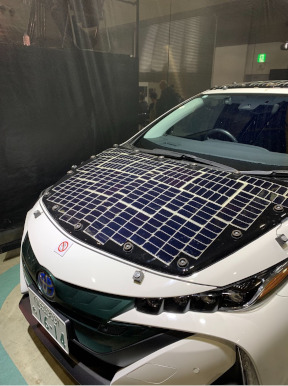
In 2025-2030, Sharp plans to commercialize EVs that are powered by its solar modules, and which have recorded the world’s highest efficiency of 33.7%. The modules feature double-junction silicon tandem cell structures.
Toyota Motor and Nissan Motor have test-driven the prototype vehicles. Around 1,000 units of 775 square cm modules were placed on top of the car.
On a sunny day, the modules generate 800 watts of power, enough for a 50 km drive.
Cost is the main challenge. The modules possibly cost more than the car.
TAKEAWAY: Sharp’s parent company Foxconn plans to release its own brand of an EV model in Taiwan in the coming weeks. Foxconn has separate strategies for Japan as EV market growth is likely to be slower in Japan. Company officials told Japan NRG they are open to various options for the Japanese market including the development of hybrid vehicles running on solar power and carbon neutral fuel.
SkyDrive and KEPCO will develop and install rapid charging facilities for electric vertical takeoff and landing aircraft (eVTOLs) in Osaka for the World EXPO 2025.
The first will be ready by year’s end at SkyDrive’s Flight Test Facility.
SkyDrive’s eVTOL seeks certification from the Japan Civil Aviation Bureau and is set to begin production in spring 2024 in collaboration with Suzuki Motor Co.
During a visit to Tokyo, Canadian Foreign Minister Joly emphasized Japan’s need to diversify its energy sources and called to increase trade with Canada, which has energy supplies and is rich in key minerals.
Joly also talked about Canada’s Indo-Pacific strategy, committing the equivalent of ¥250 billion over five years for peace and stability in the region.
Japan Renewable Energy (JRE) will change its company name to ENEOS Renewable Energy from April 1, 2024.
CONTEXT: Founded in 2012, JRE became ENEOS’ subsidiary in Jan 2022. JRE has over 1.2 GW of renewable energy in operation and under construction in Japan.
OCCTO began discussions to create a power supply and demand forecast through 2040. The study will review demand assumptions and supply capacity estimates, developing a supply-demand balance for 2040 and 2050 based on the data.
The Central Research Institute of Electric Power (CRIEPI), the Research Institute of Innovative Technology for the Earth (RITE), and Deloitte Tohmatsu Consulting will conduct the research and present the most likely outlook for the supply and demand scenarios.
On the demand side, factors such as economic growth rates, the amount of energy conservation, and the prevalence of electrification will be considered.
On the supply side, the focus will be on the prospects for development of renewable energy, forecasts for the operation of pumped storage and thermal power, etc.
This marks the first time that a public organization will formulate a supply and demand scenario for more than 10 years out in the future.
CONTEXT: OCCTO says Japan’s power consumption for 2030 should be about 818,000 GWh, down by 2% from 2019-20. But there’s no forecast for beyond 2030.
TAKEAWAY: Japan’s population is expected to decrease to somewhere between 100 and 106 million by 2050, from 125 million people today, unless the country reverses course and allows mass immigration. Were the only consideration demographics, demand would see a 20% drop. However, forecasters will need to consider potentially large new energy demand sources such as data centers, semiconductor factories, electric vehicles, and electrification of industrial processes. Against that will be efforts at greater energy conservation.
Hokkaido Electric said it selected several brokers to offer electricity volumes in its home region for the upcoming fiscal years (FY2024 and FY2025). The utility seeks to hold the so-called “zaraba” transactions to create non-discriminatory access to its wholesale electricity for both domestic and international buyers.
The utility will also offer monthly contracts for FY2024 and wholesale transactions with a fuel price adjustment for the FY2024 to FY2026 period.
Tullett Prebon’s Japan subsidiary announced that it was selected as an approved broker by Hokkaido Electric.
The Mayor of Kami, (Miyagi Pref), pledged to revise the contract inked between the township and the project operator for the planned onshore 42 MG wind farm. This is in response to a lawsuit filed against its construction.
The town has requested that the lawsuit be dismissed.
The plaintiffs – 15 residents of Kami – argue that the contract contains a provision limiting the town’s right to seize property if the operator goes bankrupt, and thus violates Japan’s Local Autonomy Act.
Full-scale operation was scheduled to begin in April 2024. Meanwhile, four of the 10 turbines to be used in the project are set to be built on town-owned land.
CONTEXT: Kami municipal govt signed the contract in 2020 with ENEOS-owned JRE Miyagi-Kami during the previous mayor’s term.
Hokkaido’s governor asked Eurus Energy to alter its plan to build a 650 MW onshore wind farm in the north Rumoi area. METI will review the project on Nov 13.
The governor said data in Eurus’ regulatory filings were inaccurate and that the proposed environment impact assessment methodology may have been written by people lacking sufficient professional credentials.
The company is advised to revise its project, unless it offers scientific evidence that proves the environmental impact won’t be harmful.
CONTEXT: While Eurus’ plan faces uphill battles, some businesses in the southern Rumoi area plan to attract new offshore wind projects.
A unit of rail operator JR-East won the most capacity in the latest round of auctions for onshore wind power. It secured three contracts with a total capacity of 225 MW.
The auction drew companies including Tokyu Fudosan and HSE, majority owned by Mitsubishi HC Capital. HSE offered the lowest FIT price of ¥13/ kWh in this auction round.
JR-East was among 20 firms that submitted 56 projects in this auction for a total of 1.41 GW capacity. Average bid was for ¥14.08/ kWh; the price ceiling was ¥15.
Rera Tech, a firm specializing in offshore wind power, Kobe University and Japan Weather Association have established a site for testing equipment that monitors weather conditions at offshore wind farms.
This is the first such facility in Japan; located in Rokkasho Village in Aomori Pref.
CONTEXT: Rokkasho borders on an active wind farm commissioned in 2008 and equipped with a large-capacity storage battery system, the world’s first. Simultaneously, Itochu selected another area facing the Pacific Ocean and the village for its 57 MW onshore wind farm slated to start operation around April 2026.
The MoE has opened to public consultation proposed changes to the survey process for national offshore wind project zones. Comments on the ministry’s proposal are accepted until Dec 8.
The MoE is proposing to conduct centralized surveys to determine environmental impact in areas seeking to become offshore wind promotion zones. This is to avoid overlap from multiple companies conducting surveys for potential projects in one area.
METI and MLIT, which have the authority to decide which areas become offshore wind promotion zones, will reflect the MoE survey results on their decisions.
A consortium led by engineering firm Kyudenko plans to build what would be Japan’s biggest solar farm on the remote islands of Ukujima and Terashima in Sasebo, Nagasaki Pref. Construction will start in spring 2024.
The 480 MW project will cover 10% of the two islands, which are located on the Goto archipelago. It will be developed by Ukujima Mirai Energy Holdings, a venture that includes investors like Kyocera.
CONTEXT: Solar farms of 40 MW in capacity and over are required to undergo an environmental assessment. However, this rule came into effect in April 2020, while the project was approved prior to the deadline and is thus exempt.
TAKEAWAY: This project has been in the works for over a decade, beset by many delays. It looks like it has found a new lease of life and is now moving ahead. As well as changes of ownership, which slowed the project development, the islands where it will be situated are prone to floods, especially after heavy rain. A 60 km HVDC subsea cable will be needed to connect the site to the grid in Kyushu. Investment is estimated at ¥200 billion. This project was one of the first major solar projects to be approved following the Fukushima disaster and still holds an attractive FIT tariff. One of the developers says it has a 17-year-three-month contract to sell power for ¥40/ kWh.
LONGi, a China-based PV module producer, formed a technical partnership with Solar Frontier, a Japanese PV firm specializing in solar development and installation. The two will enter Japan’s building-integrated solar PV (BIPV) market.
BIPV is still at an early stage of development. The partners will target commercial, industrial and public buildings as customers.
An agrisolar farm will be built in Shiranuka Township in Hokkaido that will combine solar generation with animal husbandry.
The project will cover 90 hectares and consist of 30,000 solar panels, as well as about 400 sheep and horses. Operation is scheduled to start in fall 2025.
The operator, which is based in Hyogo Pref, aims to create a profitable model for the hybrid business and then expand it across Hokkaido.
TAKEAWAY: In general, Japan has a large acreage of unused farmland due to its aging population. Meanwhile, converting farmland to other land-use categories, including those that allow for solar farm construction, is tricky. Finding a way to retain the farming specification, while also creating a side-business in solar generation can be an attractive model. Most farms in Hokkaido, however, do not have access to grid transmission lines so this is why they’re producing methane, methanol, and hydrogen instead of looking at electricity generation.
In a first, Tokyo-based Mitsubishi-owned glass manufacturer AGC succeeded in processing 24 tons of glass from covers of used solar panels into glass cullets for use as flat glass in new panels.
The recycling process uses special heat-treatment. The tech allows to reduce industrial waste and save raw materials like silica sand and soda ash.
CONTEXT: Several hundred thousand tons of panels are expected to be disposed of yearly in the 2030s, given the approaching expiration date of most units installed in Japan during the solar power boom in the wake of the Fukushima disaster. Cover glass accounts for about 60% of a panel’s total weight.
No end yet to Rokkasho reprocessing plant review: NRA chief
(Japan NRG, Nov 8)
There is no end date for the regulatory review of the plan to build the Rokkasho nuclear fuel reprocessing plant (Aomori Pref), said NRA Chairman Yamanaka, adding that the master plan requires further improvements.
Japan Nuclear Fuel (JNFL) wrote the master plan and the regulatory review lasted for months. This week, the NRA advised improvements on tornado protection plans.
Overall, the NRA advised JNFL to do more internal data sharing, noting recent improvements, but said the end of the review is not yet clear.
CONTEXT: Kansai Electric’s plan to move used nuclear fuel to the Rokkasho facility in FY2025 may be impacted if the prolonged review postpones construction.
Enechange, a Tokyo-based energy venture, and renewable energy firm Looop joined a number of other entities to invest $182 million in Eavor Technologies, a Canadian geothermal energy solutions firm.
The investment by Enechange and Looop was conducted via the Japan Energy Fund, which they set up for overseas projects. The investment gives them access to Eavor’s patented technology.
CONTEXT: Eavor is a pioneer in advanced geothermal energy solutions. Its proprietary technology connects two vertical wells with horizontal wellbores, creating a sealed underground system resembling a radiator, which brings heat to the surface.
TEPCO began the third release of treated water from the Fukushima Daiichi NPP. The daily release is about 460 cubic meters; that will mean a total of about 7,800 cubic meters is expected to be completed by around Nov 20.
Results from the analysis of the treated water revealed a tritium concentration of 97 becquerels per liter, which is below the standard limit of 1,500 becquerels per liter.
CONTEXT: Since late August, TEPCO has conducted two ocean releases, each of about 7,800 cubic meters of water. The release has met with much protest from China, which has banned seafood imports from Japan. However, the process was certified as within environmental norms by the IAEA.
Mitsu issued a statement regarding the U.S. sanctions on Arctic LNG 2, and that it will take appropriate measures based on its rights, obligations, and international law. The firm also said it will “respond in cooperation with stakeholders, including the Japanese government.”
CONTEXT: On Nov 2, the U.S. Office of Foreign Assets Control officially called for the end of transactions involving Arctic LNG 2 through Jan 31, 2024.
Dutch corporation J-Arc, (75% owned by JOGMEC and 25% by Mitsui), has a 10% stake in Arctic LNG 2.
Mitsui said it doesn’t see the need to adjust projected full-year earnings or its policy on shareholder returns for the current fiscal year.
As of Sept 30, Mitsui’s balance for investments and loans in Arctic LNG 2 stood at ¥17.2 billion, with a guarantee balance of ¥251.7 billion. After recording a provision of ¥19.9 billion for these guarantees, the net balance of investments, loans, and guarantees was ¥249 billion.
CONTEXT: Arctic LNG 2 launches next month, with Japan eligible for 2 mmt of LNG per year, or 3% of total imports, once fully operational. Asian clients such as China’s CNPC and CNOOC will receive 80% of the plant’s 19.8 million tons annual output. In response to U.S. sanctions, METI Minister Nishimura has said: “We will work with the G7 countries to make a comprehensive judgment and respond appropriately so as not to impair the stable energy supply to our nation.”
TAKEAWAY: Since the outbreak of war in Ukraine, Japanese firms and government have defended their decision to retain a stake in Russia’s Sakhalin-2 LNG project on the Pacific Ocean, citing its role in national energy security. The Sakhalin plant alone contributes about 9% of Japan’s LNG imports. The future of Arctic LNG 2 is less certain. On the one hand, there is a worsening situation in the Middle East, from where Japan obtains about 12% of its LNG. However, PM Kishida has been steadfast in following G7 sanctions towards Russia. It would be very difficult for Japan to negotiate an exemption from sanctions for Arctic LNG 2 at this stage, so most likely Japan will refrain from taking cargo from the project and in effect freeze its involvement while monitoring the geopolitical situation.
JOGMEC explored and assessed mineral resources in seafloor hydrothermal deposits, in Japanese waters, and found that they contain mainly copper, zinc, lead, gold, and silver.
JOGMEC has estimated a total mineral resource potential of around 52 million tons. This equates to a metal value of ¥2 trillion, and would need to be extracted over 15 years.
Previously, seafloor hydrothermal deposits were estimated at up to 7.5 million tons.
The explorations were carried out in Okinawa and Izu-Ogasawara.
METI and the Dept of Environment and Natural Resources (DENR) of the Philippines signed a MoC to push climate-smart mining, infrastructure development, and critical mineral research.
CONTEXT: The MoC lacks clarity on what exactly are the critical minerals and green metals. The Philippines is one of the world’s largest nickel producers, and has major copper and cobalt deposits.
TAKEAWAY: Mining companies plan to decrease revenue dependence on crude ore and increase refined products output, which would require infrastructure investments over the long term as waste management continues after plants are built. China is the Philippines’ largest customer and investment partner, but tends to operate on shorter business cycles.
Kito Shunichi, the president of Idemitsu Kosan and chairman of the Petroleum Association of Japan, said that together with private reserves and national stockpiling, Japan has an oil reserve sufficient for 236 days.
Kito’s statements were made in the context of the deteriorating Middle East situation due to the conflict between Israel and Hamas.
Furthermore, he added that the reserves are located throughout Japan, and the oil industry, together with METI, is conducting simulations on how to utilize these reserves in case of an emergency.
METI Minister Nishimura met with Rio Tinto’s CEO to discuss climate initiatives at the company’s Australian aluminum smelters as well as collaborating with Japanese businesses to secure critical raw materials in South America and Africa.
CONTEXT: Rio Tinto is the largest supplier of primary aluminum to Japan, exporting from Australia, Canada and the Middle East. The Australian plants are mostly powered by coal. The company also runs copper and lithium operations in South America.
TAKEAWAY: It is unusual for the METI minister to meet with a private mining company. In the traditional roles of METI officials, the ANRE commissioner would meet with mining executives. Including aluminum in a ministerial meeting is also not typical. Rio Tinto is a major exporter of iron ore, which has a bigger impact on the Japanese economy. This may suggest a shift in METI policy priority to focus more on non-energy resources, possibly with an eye on supply for batteries and other clean technologies.
Inpex announced that its full year net profit forecast is expected to be ¥340 billion. This would be a 26% decrease from the previous term and ¥20 billion higher than the previous forecast. The increase is attributed to a weak yen and higher sales prices for crude oil and natural gas produced in the Middle East and Australia.
Revenue is predicted to fall by 7% to ¥2.15 trillion, yet this surpasses earlier forecasts by ¥124 billion. Operating profit is expected to be ¥1.1 trillion, down 11% but revised upwards by ¥98 billion.
Despite challenges, such as losses in the Australia Prelude natural gas project due to stricter emission regulations, the company’s profit has been boosted by a weaker yen and strong sales, especially from the Ichthys project in Australia.
ENEOS said its FY2023 net profit will increase by about 67% YoY to ¥240 billion. This is an upwards revision from the original forecast of ¥180 billion.
The company raised its forecasts for operating profit to ¥420 billion (original forecast stood at ¥340 billion).
Over the first ten months of 2023, Indonesia’s exports of thermal coal surpassed 413 mmt, up 11.5%, YoY.
For the first time, Indonesia accounted for over 50% of global thermal coal exports.
CONTEXT: Japan, South Korea and Taiwan were major buyers, and are expected to increase their coal imports over the final months of the year as utilities stock up ahead of the seasonal climb in power demand for heating.
The Seagull block in the UK North Sea, jointly owned by Japan Petroleum Exploration (JAPEX), BP and Neptune Energy, started oil and natural gas production in November. JAPEX owns 15%.
The project is 230 km offshore of Aberdeen. At full capacity, it will produce 50,000 barrels of oil-equivalent/ day.
ANALYSIS
BY MAYUMI WATANABE
Japan’s New Hydrogen Policy – the Impact of Recent Updates
In June, METI updated the Basic Hydrogen Strategy that it first announced in 2017. It was always understood the Strategy would need to be updated periodically to align with developments in the energy sector and global markets. But the changes in recent years have been particularly pronounced, especially in the targeted timeframes for the energy transition.
So, perhaps it was no surprise to see the Strategy shift emphasis much more towards renewables-produced hydrogen. More than that, the update expanded the role that the clean-burning gas might play. If in 2017 it was portrayed merely as fuel, today, it is seen also as a component – an essential raw material for carbon recycling, synthetic fuels and even for ammonia.
However, one thing in the Strategy hasn’t changed – the June update maintained the key development targets. The 2030 goal for hydrogen cost remains at ¥30/Nm3; while the 2050 goal remains at ¥20/Nm3. Also, there’s the 2030 goal for 800,000 units of fuel cell vehicles.
In just the past four months, industries have been impacted significantly by this new strategy. An increasing number of power utilities, as well as major industries operating coal power stations, have begun to study coal-ammonia co-firing or plan to soon do so. The use of hydrogen for methanation and other industrial gas recycling processes is spreading outside the gas utilities sector.
Old World hydrogen scenario
The hydrogen strategy unveiled in 2017 described “green hydrogen” as a European concept of “premium-grade hydrogen” that’s renewables-driven, and went on to say that fossil-fuel derived “gray hydrogen” could possibly be classified as “the premium-grade” if carbon credits were used to offset emissions.
Japan’s annual “gray hydrogen” production is 1.9 million tons, derived as byproducts from production processes at oil refineries, chemical and steel plants. According to the Japan Hydrogen Association, only a meager 1.4 tons were sold in the market. The rest was consumed on-site mainly for industrial power generation.
Some believe the “gray hydrogen” market could grow because demand is there. According to Mizuho Research & Technologies, 30 caustic soda plants have the capacity to market 50,000 tons of 99.99%-purity gray premium grade hydrogen. Steel plants’ coke ovens produce hydrogen with 50-55% purity, which complicates its handling. But the supply is there.
Commercial supply of green hydrogen is as tiny as the supply of gray hydrogen. There are two producers, in Yamanashi and Oita prefectures, and the supply is expected to increase to 200 tons when the state-run Fukushima Hydrogen Energy Research Field (FH2R) begins commercial supplies, possibly in 2026.
METI 2030 hydrogen scenario
Local gray hydrogen
2 million tons
Local green hydrogen
marginal
Imports
1 million tons
Total
3 million tons
The government’s base scenario is 3 million tons/year of hydrogen becoming available by 2030. However, Japan NRG believes local gray hydrogen production will decline to less than 1.7 million tons due to plant closures and decreases in oil products demand. This METI model is a simplified picture with numbers rounded off.
Emphasis on hydrogen’s carbon intensity
The strategy also points out that hydrogen’s carbon intensity is an important feature and since the shift to cleaner hydrogen is an international trend Japan must also be a part of this process.
While METI has not changed its “3 million tons in 2030” scenario, its new hydrogen strategy is causing base assumptions to change. For example, there’s now a 15 GW electrolyzer capacity goal for 2030 in order to increase green hydrogen supply.
One official at Yamaguchi Prefecture told Japan NRG that this was a paradigm shift, suggesting that the 1.9 million tons of gray supply will no longer be something buyers in Japan can depend on being available. Regulatory constraints on exports of products that used gray hydrogen in any manner were also possible, he said.
Yamaguchi Prefecture is Japan’s largest producer of gray hydrogen with a 10% share, with a major gray ammonia production base. The prefecture has been driving carbon intensity cuts rather than leveraging gray hydrogen and ammonia supplies.
“The area will not survive if plants lose markets and are closed. We’re pinning hopes on ammonia,” said the Yamaguchi official.
Key businesses in Yamaguchi are Idemitsu Kosan, Tokuyama, Tosoh, and Zeon Corp. They plan to build a 1 million ton/year ammonia supply chain. Idemitsu will import and store ammonia in LPG tanks, transport the fuel via existing pipelines to Tokuyama and Tosoh, which then plan ammonia-coal co-firing at their power plants, possibly to start in 2025.
The chemical industry is exploring other ways to use ammonia for emission cuts. This year, Mitsui Chemicals started the “chemical recycling demo” in Osaka, which is replacing methane – fuel for 480,000 tons /year naphtha cracking – with ammonia. Mitsubishi Ube Cement is developing ammonia-fueled cement kilns.
Ammonia-coal co-firing is spreading faster in the power sector that runs larger coal power plants. This year, JERA and Kyushu Electric conducted co-firing demos, and three other regional utilities said they plan either ammonia or hydrogen co-firing. On October 26, Kobe Steel announced that its two 700 MW coal power plants will start 20% ammonia co-firing by 2030, and two other 650 MW plants will follow.
2030 ammonia demand of different transition scenarios (million tons/year)
Japan NRG slow transition scenario
Ammonia Assn scenario
Japan NRG fast transition scenario
Power
Chemical
Power
Power
Chemical
20% co-firing (JERA, Kyushu Electric, Kobe Steel)
20% co-firing (Tosoh, Tokuyama)
20% co-firing at plants where it is technically possible
Base assumptions: 500,000 tons of ammonia required for 20% co-fring at 1 GW coal power plant; 2.23 million tons of ammonia for 1 million ton /year naphtha cracker. One ton of ammonia is equivalent to 0.16 tons of hydrogen.
JERA, Tohoku Electric, Chugoku Electric, and Kyushu Electric each own 1 GW coal power plants, while the biggest coal plant operated by Shikoku Electric is 700 MW.
The Japan Clean Ammonia Fuel Association forecasts ammonia demand of 3 million tons by 2030, from just 20% co-firing alone (500,000 tons/year hydrogen-equivalent). This falls in the middle of Japan NRG’s slow and fast transition scenarios.
Hydrogen as carbon recycling raw material
The new strategy redefined hydrogen as fuel and raw material for synthetic methane (e-methane), synthetic fuel and other forms of carbon recycling. Expanding the hydrogen scope to carbon neutral material has spurred diverse industries to explore carbon recycling possibilities. Examples include making synthetic textiles and plastics.
Opening up hydrogen to non-fuel usage also means wider use of hydrogen of various grades. Hydrogen for fuel-cell vehicles (FCV) is strictly limited to premium-grade hydrogen with 99.97% purity. Suppliers aim for this since FCV is the only commercial hydrogen market today.
But if industries start using hydrogen from the 50-99.999% grades, hydrogen production will not be limited to electrolysis. It could be produced from chemical recycling and city waste. According to hydrogen and other gases producer Iwatani, residential FC systems can run on 75%-grade hydrogen.
The main users of hydrogen as carbon-neutral material feedstock are synthetic methane (e-methane) and synthetic fuel producers. Japanese gas utilities have a 2030 goal to raise the e-methane supply to account for 1% of total city gas supplies. Based on the 2020 figures, this translates as 360 million cubic meters of e-methane.
To supply e-methane of this volume, 130,000 tons of hydrogen are required, according to METI. E-fuel is called “carbon neutral gasoline” since it is a liquid fuel primarily for vehicles. E-fuel and e-methane have similar chemical compositions except that the former is liquid and the latter a gas. A 17,000 kiloliter /year e-fuel demo plant, to be built by ENEOS, is expected to come on stream in 2028.
The plant will require 8,170 tons of hydrogen. ENEOS and JFE Steel began studies on using the methanation process for steelmaking.
2030 hydrogen demand (tons)
H2 application
Type
H2 demand
Direct use as fuel
Power sector’s ammonia co-firing
280,000-530,000
Chemical transition using ammonia
120,000-300,000
FCV
~80,000
CN raw material
e-methane
~130,000
e-fuel
~8,170
Methanation-treated iron
~100,000
Total
~1,140,000?
Note: The figures are based on currently available transition plans, and are subject to change as markets develop.
Conclusion
The 2030 demand outlook is summarized in the table above. While it falls short of the three-million-ton hydrogen market, the regulatory push for a cleaner ecosystem will drive up hydrogen demand beyond these figures, Japan NRG believes.
For example, if petrochemical plants started to use ammonia instead of electricity for ethylene production, then 22-29 million tons/year of ammonia (3.66-4.83 million tons/year hydrogen equivalent) demand would be created, according to the Japan Chemical Industry Association.
Indeed, the Japan Hydrogen Association says the government is underestimating demand. The Association told a hydrogen safety panel in October that while the government currently forecasts 20 million tons of H2 demand in 2050, in reality, the number could reach 70 million tons by that time.
Japan’s hydrogen strategy will next face a review in 2027. It will likely be longer and more detailed than the recent 43-page report because many projects currently in the study phase will have come to fruition. In that case, there will be more clarity on what new technologies can do, as well as their limitations. Hopefully this will provide some clarity rather than more questions.
ANALYSIS
BY JOHN VAROLI
PART 2: Australia’s and Japan’s Clean Energy Relations
This article is Part 2 of a deep look at Australian-Japanese energy relations. The first part, which was published in the Oct 30 issue focused on coal and LNG.
As part of its energy transition, known as the GX, Japan plans to invest ¥150 trillion worth of public-private funds over the next ten years. A significant part of this will go towards clean hydrogen and ammonia value chains and infrastructure, most of which will be built overseas.
As a mountainous country about the size of California, but with three times the population, Japan has limited space on which to develop large-scale renewable power projects. Thus, the government has married efforts in renewables with the promotion of solutions around clean-burning hydrogen. As a result, it is looking to friendly countries that have either natural gas for conversion into hydrogen or large open spaces and ample sunlight to capture solar energy as green H2.
For a country like Australia, which has both vast gas resources, and a large and sparsely populated landscape, this suggests a natural fit. But Japan’s long-standing ally and one of its top energy suppliers is facing increasing competition, not least due to recent tensions over LNG exports.
Countries like Canada, Indonesia and possibly India have ample resources in both fossil and clean fuels, and are keen to tap into the lucrative opportunities that come with the energy transition of the world’s No. 3 economy.
For now, Australia has the edge. But what are the projects that hope to carry Japan-Australia ties into the net zero age?
Hydrogen
For many, the way to “evolve” Japan-Australia energy trade is simply to move it from coal and gas to hydrogen and batteries. After all, Japan was the first country to announce plans for a hydrogen-based economy, and Australia stepped up with a number of pilot projects in this sector. It has also worked with Japan to support the development of international hydrogen standards and supply chains.
The biggest collaboration to date has been in the Hydrogen Energy Supply Chain (HESC). Its backers, Kawasaki Heavy Industries (KHI), Iwatani, and very recently INPEX, pledged to create Japan’s first hydrogen supply chain between Victoria state and Kawasaki City. The three companies are investors in a venture known as Japan Suiso Energy (JSE), which will own and operate a hydrogen liquefaction and shipping facility at Port of Hastings.
In February 2022, JSE launched the world’s first liquefied hydrogen carrier that sailed to Japan from Victoria.
Other Japanese partners in HESC are J-Power and Sumitomo Corp, whose joint venture, JPSC, will supply 30,000 to 40,000 mmt/year of hydrogen to JSE facilities when it launches in the late 2020s.
HESC, however, is controversial because it will produce hydrogen extracted from coal with CO2 capture, utilization and storage (CCUS). Developers hope to mitigate environmental concerns by saying that the project will utilize long-term CO2 storage solutions.
While the HESC development was mainly driven by the desire to create a liquified hydrogen trade that mirrors the way that the LNG industry operates, other Japanese firms have sought to find greener pastures in Australia’s hydrogen landscape.
In May 2021, IHI Corp and Marubeni joined Woodside Energy to research green ammonia production made with hydro power in Tasmania. In mid-September 2023, IHI joined the North Queensland Clean Energy Project that plans to produce and export 500,000 tons of green ammonia made from solar and wind power.
Origin Energy, which is one of Australia’s LNG export leaders, is working with KHI on a project that aims to produce 36,500 tons per annum of green hydrogen. First export is targeted in the mid-2020s via the Port of Townsville.
Meanwhile, Idemitsu, in partnership with Macquarie Group’s Green Investment Group, is exploring green hydrogen and ammonia projects in the Port of Newcastle and Mitsui & Co has taken a 28% stake in industrial-scale renewable hydrogen projects in Western Australia.
CCS
Whether it’s “old” energy or hydrogen made from fossil fuels, new legislation in Australia calls for emissions to be trapped through carbon capture or similar mechanisms. This makes the development of Carbon, Capture and Storage (CCS) a key juncture for Japan-Australia energy relations.
By 2050, Japan seeks to build its CCUS value chain and capture 120-240 million tons of CO2. Australia is one of the countries Japan has invited into the Asia CCUS Network that it’s developing as an international platform to grow the sector. So far, the Network counts 13 members (ASEAN states, Australia, the U.S. and Japan) and over 100 companies and international organizations.
The introduction of CCS at Japan-related energy projects in Australia is supported by Tokyo-based state resources company JOGMEC. The company is involved in the CarbonNet CCS project in Victoria to store 5 million tons of CO2 per year for 25 years. In Western Australia, in a separate development trading house Mitsui is involved in a CCS feasibility study, exploring low carbon ammonia production and CO2 storage in depleted gas fields.
Sumitomo, Toho Gas, Kawasaki Kisen Kaisha (K Line) and Woodside Energy will begin a study to develop a CCS value chain connecting Japan and Australia, collecting CO2 emissions from Chubu Pref, liquefying them, and transporting them to Australia on specialized ships. Woodside Energy has a similar agreement with KEPCO.
CRMs
To cement Japan-Australia relations in the battery and renewables space, access to critical raw materials will be key.
Seeking to counter Chinese dominance in the global battery market, the U.S. and its allies are creating a “critical minerals buyers club” to source lithium and cobalt, which are needed in EV technology as well as other clean energy tech.
The Minerals Security Partnership includes the EU, UK, Japan, Australia and South Korea. In September 2021, Australia initiated a $2 billion loan facility for critical minerals projects, with strong support from Japan.
In October 2022, Australia and Japan signed their own critical minerals agreement to establish a framework to supply Japan with rare earths, lithium and other raw materials for green technologies.
Australia’s vast opportunities in mining are enticing for Japan. Idemitsu Kosan, for example, has already moved to secure lithium supplies, acquiring in June a 15% stake in Delta Lithium. The company runs two projects in Western Australia: the Mount Ida project that holds about 12.7 million tons of lithium reserves and the Yinnethara project.
Conclusion
In a rapidly changing global energy landscape exacerbated by geopolitical tensions, Australia and Japan are trying to evolve their energy ties from fossil fuels to clean energy.
Recent misunderstandings between the two countries are due to differing pathways for the energy transition and show that the process is not always going to be smooth. It will require trust and guarantees on both sides, as well as some compromise on the speed and breadth of net zero measures. And, for the first time in decades, Japan may have a stronger bargaining position as other countries court its energy transition trillions.
GLOBAL VIEW
BY JOHN VAROLI
Below are some of last week’s most important international energy developments monitored by the Japan NRG team because of their potential to impact energy supply and demand, as well as prices. We see the following as relevant to Japanese and international energy investors.
China/Solar power
After investing over $130 billion into solar power in 2023, China will remain dominant with more than 80% of the world’s polysilicon, wafer, cell, and module manufacturing capacity, said Wood Mackenzie. More than 1 TW of wafer, cell and module capacity will come online by 2024; thus, China’s capacity can meet annual global demand through 2032.
Egypt/LNG
Egypt shipped 80% of its LNG exports to Europe last year, but that figure will now drop dramatically. On Oct 10, Israel’s Tamar gas field was shut down by Chevron amid the Gaza conflict, impacting Egypt; Tamar’s natural gas exports go via a subsea pipeline between Israel and Egypt. Chevron is now shipping gas via an alternative pipeline through Jordan.
Germany/Energy crisis
Energy-intensive manufacturing industries saw production drop 17% in September, below the level at the start of 2022 and with no sign of recovering. Experts say that energy-intensive manufacturing can’t be competitive while gas and power prices remain high.
Indonesia/Energy transition
President Joko Widodo called on the West to release a promised $20 billion to finance his country’s energy transition. He said there was “tremendous” concern in Indonesia over the delay of the funds.
Mexico/Natural gas
State energy company Pemex and New Fortress Energy terminated a deal to develop the country’s first deepwater natural gas project that was signed a year ago. Pemex wants to continue with development in the Gulf of Mexico and is in talks with other companies.
Panama/Copper
Panama might annul the contract for one of the world’s biggest copper mines. This news has wiped out about 40% of the value of the $10-billion copper mine’s owner, Canada-based First Quantum Minerals. Copper is a critical metal for production of EVs.
Qatar/LNG
China’s state-owned Sinopec signed a 27-year LNG supply and purchase agreement with QatarEnergy. They’ll cooperate on the second phase of the Gulf state’s North Field expansion project, which will supply 3 mmt of LNG per year to Sinopec.
Russia/Diesel
The Kremlin told fuel producers to prepare to scrap all restrictions on the export of diesel and gasoline. Russia, the world’s top seaborne exporter of diesel, had introduced a ban on diesel exports on Sept 21 to tackle high domestic prices and shortages.
Texas/Grid
The state set up a new energy fund to offer low-interest loans for natural gas plants, microgrids, and grid modernization. A total of $7.2 billion will go to new construction or upgrades that results in at least 100 MW of dispatchable generation coming online before June 2029. Another $1.8 billion will support development of microgrids and backup power for critical facilities, and $1 billion will go to grid modernization, weatherization, etc.
U.S./DAC
BlackRock will invest $550 million into the world’s biggest direct air capture project in west Texas that’s being developed by Occidental Petroleum. Stratos, still under construction, aims to extract CO2 from the atmosphere. It’s one of the biggest-ever investments in DAC.
U.S./Natural gas
Natural gas production and demand will set records in 2023, said the EIA. Dry gas production will rise to 103.7 bcfd in 2023 and 105 bcfd in 2024, up from a high of 99.6 bcfd in 2022. Domestic gas consumption will rise from a record 88.4 bcfd in 2022 to 89.4 bcfd in 2023, before sliding to 89 bcfd in 2024.
2023 EVENTS CALENDAR
A selection of domestic and international events we believe will have an impact on Japanese energy
ASEAN-Japan summit to mark 50 years of cooperation
Last market trading day (December 30)
Disclaimer
This communication has been prepared for information purposes only, is confidential and may be legally privileged. This is a subscription-only service and is directed at those who have expressly asked K.K. Yuri Group or one of its representatives to be added to the mailing list. This document may not be onwardly circulated or reproduced without prior written consent from Yuri Group, which retains all copyright to the content of this report.
Yuri Group is not registered as an investment advisor in any jurisdiction. Our research and all the content express our opinions, which are generally based on available public information, field studies and own analysis. Content is limited to general comment upon general political, economic and market issues, asset classes and types of investments. The report and all of its content does not constitute a recommendation or solicitation to buy, sell, subscribe for or underwrite any product or physical commodity, or a financial instrument.
The information contained in this report is obtained from sources believed to be reliable and in good faith. No representation or warranty is made that it is accurate or complete. Opinions and views expressed are subject to change without notice, as are prices and availability, which are indicative only. There is no obligation to notify recipients of any changes to this data or to do so in the future. No responsibility is accepted for the use of or reliance on the information provided. In no circumstances will Yuri Group be liable for any indirect or direct loss, or consequential loss or damages arising from the use of, any inability to use, or any inaccuracy in the information.