
JAPAN NRG WEEKLY
DEC 4, 2023
JAPAN NRG WEEKLY
DEC 4, 2023
NEWS
TOP
- COP28: PM Kishida pledges to terminate new unabated coal-fired power plants in Japan
- Solar capacity auction dips below ¥8/ kWh level for the first time
- Iwatani Corp acquires Cosmo Energy stake from activist to become largest shareholder
- Rapidus chip plant in Hokkaido to need as much as 600 MW of power capacity
- JERA: on track for 20% ammonia co-firing at coal plant in March
- Mitsubishi to develop EU’s first ammonia-fired power facility
- 47 major firms to disclose decarbonization data in 2025
- Ex-PM Suga says offshore wind, PSC key to Japan 2050 goals
- China pushes PSC, but Panasonic leads in patent applications
- METI to write new regulations for carbon transport and storage
- MoE to propose regulatory framework for offshore carbon storage
- Tokyo governor announces plans to launch hydrogen exchange
- OCCTO begins discussions on 2040 and 2050 demand forecasts
- Watchdog to revise guidelines of balancing power market
- JERA plans steps to secure power capacity and fuel this winter
- BP enters Japan’s electricity market after METI approval
- Sharp drop in non-FIT, non-fossil certificates trading; prices low
- Renova to issue tracked FIT non-fossil certificates next year
- Aomori, Ibaraki Pref plan to hike nuclear fuel taxes
- Ministry asks Renova to review wind farm plans in Akita
- Cosmo Energy to increase outside directors to over half of board
- Japan to diversify as China tightens rare metals exports
- Japan to expand annual strategic buffer LNG to 840,000 tons
ANALYSIS
JAPAN TARGETS ROOFTOP SOLAR TO DRIVE INDUSTRY REBOUND
After almost a decade of rapid growth, solar power installations have stagnated. Now Japan is determined to revive the market. With land-based solar projects facing numerous headwinds, officials are turning to rooftops to lead the charge. This includes new tariffs for rooftop solar. Municipalities led by Tokyo are also supporting the sector with new programs.
JERA BOOSTS OFFSHORE WIND CREDENTIALS WITH ACQUISITIONS AND FLOATING TECH
Japan’s top LNG buyer and biggest thermal utility, JERA, has decided to pursue both the fossil and renewables route at full tilt, with an aggressive expansion strategy in offshore wind, investing in the sector both at home and abroad. JERA has embarked on a M&A drive to build a stronger team and asset base, and it seeks to vigorously compete in upcoming offshore wind auctions.
GLOBAL VIEW
A wrap of top energy news from around the world.
EVENTS SCHEDULE
A selection of events to keep an eye on in 2023.
JAPAN NRG WEEKLY
PUBLISHER
K. K. Yuri Group
Events
Editorial Team
Yuriy Humber (Editor-in-Chief)
John Varoli (Senior Editor, Americas)
Mayumi Watanabe (Japan)
Wilfried Goossens (Events, global)
Kyoko Fukuda (Japan)
Magdalena Osumi (Japan)
Filippo Pedretti (Japan)
Tim Young (Japan)
Regular Contributors
Chisaki Watanabe (Japan)
Takehiro Masutomo (Japan)
SUBSCRIPTIONS & ADVERTISING
Japan NRG offers individual, corporate and academic subscription plans. Basic details are our website or write to subscriptions@japan-nrg.com
For marketing, advertising, or collaboration opportunities, contact sales@japan-nrg.com For all other inquiries, write to info@japan-nrg.com
OFTEN-USED ACRONYMS
|
METI |
The Ministry of Economy, |
mmbtu |
Million British Thermal Units | |
|
MoE |
Ministry of Environment |
mb/d |
Million barrels per day | |
|
ANRE |
Agency for Natural Resources and Energy |
mtoe |
Million Tons of Oil Equivalent | |
|
NEDO |
New Energy and Industrial Technology Development Organization |
kWh |
Kilowatt hours (electricity generation volume) | |
|
TEPCO |
Tokyo Electric Power Company |
FIT |
Feed-in Tariff | |
|
KEPCO |
Kansai Electric Power Company |
FIP |
Feed-in Premium | |
|
EPCO |
Electric Power Company |
SAF |
Sustainable Aviation Fuel | |
|
JCC |
Japan Crude Cocktail |
NPP |
Nuclear power plant | |
|
JKM |
Japan Korea Market, the Platt’s LNG benchmark |
JOGMEC |
Japan Organization for Metals and Energy Security | |
|
CCUS |
Carbon Capture, Utilization and Storage | |||
|
OCCTO |
Organization for Cross-regional Coordination of Transmission Operators | |||
|
NRA |
Nuclear Regulation Authority | |||
|
GX |
Green Transformation |
NEWS: ENERGY TRANSITION & POLICY

COP28: PM Kishida pledges to terminate new unabated coal-fired power plants
(Government statement, Dec 2)
- At COP28 in Dubai, Prime Minister Kishida pledged to reduce Japan’s reliance on coal-fired power generation, and to terminate new construction of coal-fired power plants that have no emission-reducing measures in place. He did not specify the timeline or mention the scrapping of existing plants.
- Kishida added that Japan plans to enhance financial support for international lenders to aid developing nations in securing funds to tackle environmental issues.
- Also, the PM said Japan will help establish a new fund within the African Development Bank, and is ready to expand loan capacities for the World Bank and the Asian Development Bank by around $9 billion.
- CONTEXT: Japan has pledged to achieve carbon neutrality by 2050. Japan will host the first summit on reducing carbon emissions with ASEAN states later this month, as part of its “Asia Zero Emission Community” framework.
- SIDE DEVELOPMENT:
JERA confirms it’s on track for 20% co-firing ammonia at coal plant in March
(Company news, Nov 29)- JERA President Okuda said the company is on track to meet its March 2024 goal to be co-firing 20% of ammonia with coal at its 1 GW Unit 4 in Hekinan thermal power station.
- CONTEXT: The project began in 2021 with small volumes of ammonia at another Hekinan unit; the goal is to cut CO2. It’s the world’s first test of 20% co-firing at a commercial plant.
- SIDE DEVELOPMENT:
Centrica, Mitsubishi Power to develop Europe’s first ammonia-fired power facility
(Company statement, Nov 30)- Centrica and Mitsubishi Power Europe inked an MoU to explore development of Europe’s first-ever ammonia-fired power generation facility at Bord Gáis Energy’s Whitegate Combined Cycle Gas Turbine power station in Cork, Ireland.
TAKEAWAY: Ammonia has a higher volumetric density than hydrogen, making it easier to transport and store. Also, as a fuel it has no carbon emissions at point of use. However, its production does release emissions if made with fossil fuels. When those emissions are captured and stored, the ammonia (or hydrogen) is classified as blue.
47 firms including Mitsubishi, Nippon Steel to disclose decarbonization data in 2025
(Nikkei, Nov 26)
- Starting 2025, about 47 major companies agreed to disclose the actual use of electricity generated from renewables and other sources.
- The initiative will ease evaluating corporate progress in decarbonization.
- The 47 leading firms include Kubota, Nippon Steel, Mitsubishi Corp, Tokyo Gas, Chugoku Electric, Fujifilm and Mazda.
- CONTEXT: The revised Energy Conservation Law that took effect in April requires 12,000 firms that annually consume the largest amount of power to report the percentage of electricity and other energy from renewable sources to METI starting in FY2024. Companies whose energy consumption amounts to 1,500 kiloliters of crude oil equivalent or more are subject to this requirement.
Parliament passes FY2023 supplementary budget of ¥13 trillion
(Government statement, Nov 29)
- Parliament passed the ¥13 trillion supplementary budget for FY2023.
- Energy related items include power and gas subsidies, EV and FCV promotion, battery supply chain building, and securing LNG supplies. Energy efficient home programs are encouraged with subsidies for heating systems.
Key budget items | Amount (¥ billion) |
|
Power and gas subsidies |
¥641.6 |
|
Gasoline and fuel oil subsidies |
¥153.2 |
|
Household/condominium heating systems |
¥77 |
|
Clean energy vehicles (EV, PEV, FCV, etc) |
¥129.1 |
|
Battery supply chain building |
¥265.8 |
|
LNG supplies |
¥33 |
|
Advanced CCS projects |
¥20.4 |
Wind power and PSC are key to Japan’s decarbonization: former PM Suga
(Bloomberg, Nov 27)
- Former PM Suga said Japan’s decarbonization efforts are in a “transitional phase” and the country will “definitely achieve” its goal of zero CO2 emissions by 2050.
- He believes offshore wind power and perovskite cells could become mainstream. Japanese industry has “made a major turn toward decarbonization” and tech leaders will speed up efforts in the next three years.
- CONTEXT: Under PM Suga, Japan declared a goal of zero GHG emissions by 2050, but has been criticized overseas for using hydrogen and ammonia made from fossil fuels for thermal power. Suga believes the country should seek understanding of the international community by promoting environment-friendly tech. He also led the effort to create the Green Innovation Fund.
- SIDE DEVELOPMENT:
China pushes perovskite development, but Panasonic leads in patent applications
(Nikkei, Nov 28)- Japan filed 19 patent applications related to perovskite solar cells in 2021, lagging behind China which filed 70 and South Korea with 39.
- Japan leads in the number of cumulative patents in the last 20 years. Japan made 274 applications, followed by the U.S. at 231, South Korea at 228, and China at 196.
- Among companies, Panasonic made the largest number of 44 patent applications in the last 20 years, followed by Germany’s Merck at 36 and Toshiba at 29.
METI to write new regulations for carbon transport and storage
(Government statement, Nov 28)
- Instead of amending current laws on high-pressure gas and mining, METI plans new regulations on carbon transport and storage safety.
- To a certain extent, the new regulatory framework will resemble current mining and gas safety guidelines and procedures. New requirements, such as setting up a third-party technical panel to advise on technologies, will be added.
- SIDE DEVELOPMENT:
MoE to propose regulatory framework for offshore carbon storage
(Government statement, Nov 28)- An MoE panel will propose a regulatory framework for offshore carbon storage; the public will be invited to comment. The panel is headed by Prof Otsuka Tadashi of Waseda University.
- The proposal will address the structure of state oversight, environmental impact assessment methodologies, and carbon storage in overseas offshore facilities.
- CONTEXT: The MoE will oversee offshore CCS, following the guidelines of the London Convention on Marine Pollution; METI will oversee onshore CCS.
Tokyo governor announces plans to launch hydrogen exchange
(FNN, Dec 1)
- Tokyo Governor Koike Yuriko said that the city plans to launch the world’s first hydrogen exchange.
- She was speaking at the Local Climate Action Summit, a program at COP28 in Dubai.
- The Tokyo govt will liaise with global hydrogen organizations to launch the exchange and promote hydrogen consumption in the private sector, Koike said.
- CONTEXT: Japan’s present hydrogen demand is roughly 170 million cubic meters (14,000 tons), according to the sole producer Iwatani Corp. Among liquid organic hydrogen carriers (LOHC) for transporting massive amounts into Japan, ammonia is likely to hold the largest share due to coal ammonia co-firing planned by JERA, Kobe Steel, Tokuyama and Tosoh.
TAKEAWAY: Large-scale imports of hydrogen in methylcyclohexane (MCH) compounds are expected to start in 2025 and liquefied hydrogen in 2030. So, the question is, which suits the Japanese market, an ammonia exchange or hydrogen exchange.
MCH hydrogen carrier set to achieve METI’s target: Chiyoda official
(Japan NRG, Nov 30)
- Chiyoda Corp is set to achieve METI’s 2030 hydrogen cost target of ¥30/NM3, said Okada Yoshimi, a research fellow at the company.
- Okada has developed the key catalysts for the methylcyclohexane (MCH) carrier. Shipping costs from overseas to Japan using the MCH technology are ¥30-45/ NM3, provided that the cost of hydrogen is ¥10/ NM3. The costs would vary on travel distances and the availability of legacy oil facilities that could be used to convert the hydrogen gas into MCH, and back to hydrogen.
- Chiyoda plans to commercialize the MCH transport system in 2025.
- CONTEXT: Ammonia and liquefied hydrogen are other hydrogen carriers. MCH’s key advantage is it can be stored in room temperatures and pressures, and legacy tankers can be used to transport it. Liquefied hydrogen requires ships with tanks kept at -253 C, and ammonia also requires to be kept below zero degrees.
TAKEAWAY: METI supports all three hydrogen carrier options but is likely to offer stronger backing of the technology that will have more traction in the global market. Chiyoda is forming alliances with overseas stakeholders and is in talks with Singapore, the Netherlands and 13 other countries to deploy its technology.
- SIDE DEVELOPMENT:
Iwatani to install hydrogen capture system at R&D center
(Company statement, Nov 24)- Iwatani Corp seeks to improve energy efficiency of hydrogen power, installing hydrogen capture systems and fuel cell batteries, and integrating them with solar power systems.
- Its R&D Center has installed 20 units of Panasonic’s 5kW fuel cell systems. The hydrogen feed for the cells will come from liquefied hydrogen tanks, as well as from the in-house gas capture system that recovers gasses from tests and boil off processes, and stores them in metal hydrides.
TAKEAWAY: The system could be of interest to end-users. Energy is lost when hydrogen is liquefied for transport and converted back to gas. If the hydrogen capture and storage system recovers a large amount of the gas, then overall system costs and efficiency will improve.
Hitachi to switch to “decarbonized aluminum” on rising EV demand
(Nikkei, Nov 28)
- Hitachi will switch to aluminum smelted by hydropower for all its products using aluminum, in response to growing EV demand.
- The company sources 10,000 tons/ year of aluminum. It plans to buy the metal from New Zealand and Brazil.
TAKEAWAY: A housing or beverage can manufacturer consumes over 10,000 tons each month, so Hitachi is a small consumer. Still, this is encouraging for hydropower-based aluminum producers that have been marketing green aluminum in Japan for over a decade with little success. The question is how will aluminum with low-carbon footprint be priced against Australian and South African aluminum that use coal power. Also, how will Hitachi and other consumers take into account emissions for shipping from South America, and the carbon footprint of other materials in the aluminum supply chain.
Aluminum carbon footprint, 2021
(tons of CO2 equivalent for a ton of aluminum)
|
Mining bauxite |
0.04 |
|
Alumina refining |
2.7 |
|
Anode production |
0.9 |
|
Electrolysis |
12.9 |
|
Casting |
0.1 |
|
Total |
16.6 |
Source: International Aluminium Institute
Nissan to invest ¥370 billion in EVs at UK plant with wind, solar power use
(Company Statement, Nov 27)
- Nissan Motor will make a new £2 billion (¥370 billion) investment at its Sunderland plant in central England to boost EV production. The firm plans to build three fully EV models at the UK plant: Qashqai, Juke, and the next-gen Leaf.
- Both vehicle and battery manufacturing will be powered by the EV36Zero Microgrid. It will incorporate wind and solar farms at Nissan and will have the capability to deliver 100% renewable electricity to the firm and its neighboring suppliers.
- CONTEXT: This announcement follows Nissan’s statement that all its new cars in Europe from now will be fully electric.
KEPCO to launch EV chargers service in FY2024, targeting commercial facilities
(Company statement, Nov 27)
- KEPCO will launch a service for the installation and management of public EV chargers, scheduled to start in Feb 2024, followed by a nationwide expansion in April 2024. The goal is to set up 1,500 charging stations by March 2025.
- For customers, the service will include a system for managing hourly charging reservations and implementing variable pricing based on the time of the day.
- Also, KEPCO will assist installation companies with the construction, installation, operation, and energy management of the entire facility, chargers included.
Toshiba develops li-ion battery using cobalt-free 5V-class cathode
(Company statement, Nov 28)
- Toshiba developed a new lithium-ion battery that utilizes a cobalt-free, 5V-class high-potential cathode. It addresses the issue of performance degradation caused by gas generation. The innovative cathode employs reduced nickel.
- The battery can achieve high voltage of 3V, an 80% charge within 5 minutes, and performs well at 60°C. It is suitable for high voltage in compact packages.
- Toshiba will introduce it in compact, high-voltage applications, and then expand use to larger modules for vehicles. Commercialization is anticipated by 2028.
TAKEAWAY: The problematic issue of cobalt’s supply chain has made cobalt-free batteries a desired goal for many manufacturers. Some cobalt-free batteries are capable of boasting high energy density, increased voltage, and enhanced durability. Still, challenges remain in ensuring their safety and longevity, particularly for demanding applications.
- SIDE DEVELOPMENT:
Nippon Shokubai to mass produce zinc battery components, alternative to lithium
(Nikkei, Nov 25)- Nippon Shokubai will increase production of a key component used in reusable zinc batteries starting in 2024. This new separator reduces crystal buildup on zinc battery electrodes and will lower costs.
- In general, zinc batteries face rapid degradation after repeated charging. Zinc batteries are suited for applications requiring a steady discharge over long periods. Lithium batteries are better for high-output, short-duration discharges.
- CONTEXT: This development is a step towards zinc batteries as a low-cost competitor to li-ion batteries, which have high energy density but safety concerns due to fire risks. China dominates lithium processing, but zinc is more available globally.
Idemitsu, HIF U.S.A. to collaborate on synthetic methanol business
(Company statement, Dec 1)
- Idemitsu Kosan and HIF U.S.A., a subsidiary of HIF Global, will collaborate in synthetic methanol (e-methanol) businesses.
- Idemitsu will procure e-methanol from the HIF group.
- CONTEXT: E-methanol, made from CO2 and hydrogen, is feedstock for e-gasoline, SAF and other types of synthetic fuel, and oil refineries have been actively seeking its supplies. The HIF group signed a similar agreement with ENEOS in October.
Air Water and JFE partner with Hokkaido town in low-cost, bio-coke tech project
(Company Statement, Nov 27)
- Air Water, a producer of industrial gasses, along with steelmaker JFE and petrochemical trading firm Tomoe Shokai launched a consortium for biomass utilization. The plan is in cooperation with Horokanai, a town in Hokkaido, and a local agricultural cooperative.
- The project, subsidized by Hokkaido, will showcase low-cost, bio-coke production tech using buckwheat hulls as raw material. They’ll be 60 mm in diameter x 60 mm in length, an equivalent to coal coke, with a production capacity of 1 ton per day.
- Commercial operation of the bio-coke plant starts in FY2026 and will sell between 300 and 600 tons per year.
- CONTEXT: Horokanai has Japan’s largest production of buckwheat, with 96.4% of the nation’s 2,900 tons of buckwheat produced annually.
Toyota Tsusho supplies biofuel to Toyofuji Shipping’s oceangoing vessel
(Company statement, Nov 29)
- Toyota Tsusho began supplying biofuel for an oceangoing vessel operated by Toyofuji Shipping at the Port of Nagoya and for a test voyage to Oceania. Before, Toyota Tsusho had only supplied biofuel to a domestic vessel.
- The biofuel is waste cooking oil blended with heavy oil.
- CONTEXT: This follows the company’s full adoption of biofuel for its domestic fleet earlier in April. The biofuel, constituting 24% of the mix with heavy oil, reportedly cuts CO2 emissions by 20% relative to the sole use of heavy oil. The combustion of biofuel releases CO2 but the plants that serve as its source can absorb CO2.
Indian state Gujarat seeks collaboration with Japan on hydrogen
(Nikkei, Nov 29)
- Gujarat Chief Minister Patel seeks to attract investment in various sectors, especially for semiconductors and green hydrogen. Patel’s trip to Japan included a visit to hydrogen-related facilities in Yamanashi Pref. He expressed hopes for Japanese technological cooperation on green hydrogen.
GC and MHI partner on a carbon neutral petrochemical complex in Thailand
(Company statement, Dec 1)
- PTT Global Chemical and Mitsubishi Heavy Industries Asia Pacific signed an MoU to develop a large-scale, carbon neutral petrochemical complex in Thailand.
- The 4-year MoU will assess the use of hydrogen and ammonia as low-carbon fuels in gas turbines, and explore the use of CCS technologies
Mizuho invests in Singapore’s CIX to boost Japan’s carbon credit market
(Company statement, Nov 28)
- Mizuho Financial Group has invested in Climate Impact X (CIX), a Singapore-based entity that operates a marketplace, auction house, and exchange for carbon credits. It was founded by GenZero, DBS Bank, SGX Group, and Standard Chartered.
- The investment aims to scale the carbon credit market in Asia, particularly in Japan. The two companies seek to enhance the availability and credibility of carbon credits.
NEWS: ELECTRICITY MARKETS

Round 18 solar auctions: lowest bid under ¥8/ kWh for the first time
(Japan NRG, Nov 24)
- OCCTO held Round 18 of solar auctions. The solicited volume was 105 MW; the auction price cap was ¥9.35/ kWh. There were a total of 61 bids; successful ones were 33, and the awarded capacity was 177.8 MW.
- The lowest bid was ¥7.94/ kWh, under the ¥8 level for the first time. The highest was ¥9.19. The weighted average bid was ¥8.55. The biggest was 25.87 MW.
- The next bidding, round 19, will offer 134.10 MW of capacity.
- CONTEXT: In June, OCCTO held Round 16 of solar auctions, when the auction was a unified system for the first time. Previously, bids were split between FIT and FIP. Round 17 was held in Aug, and the lowest bid fell under ¥9/ kWh for the first time.
TAKEAWAY: Despite materials and panel cost inflation, the auctions continue to push down the price of solar power. Dropping below ¥8/ kWh is a psychologically important level for the govt and industry. Still, the capacity that gets distributed via auctions is a fraction of the total rolled out. The number of bidders too has narrowed.
Rapidus chip plant in Hokkaido to need as much as 600 MW of power capacity
(Hokkaido Shimbun, Nov 24)
- Rapidus says its semiconductor factory under construction in Chitose, Hokkaido, will require around 100 MW of power capacity when it starts production in 2027.
- Demand, however, will jump to 600 MW when all four buildings are working at full capacity, a Rapidus executive said.
- CONTEXT: Rapidus is a METI-led project with investments from major companies, including Toyota Motor and SoftBank. The semiconductor factory will have to use only clean electricity because potential clients, such as global IT majors, demand it.
TAKEAWAY: The factory will be one of several semiconductor industry facilities in the Hokkaido area and is likely to be an anchor client for renewables projects, as well as a factor in the restart of the local Tomari NPP. Also, Rapidus could become an offtaker for a number of new offshore wind projects in and around Hokkaido.
OCCTO begins discussions on 2040 and 2050 demand forecasts
(Government statement, Nov 30)
- OCCTO discussed demand forecasts at a meeting of experts that will be tasked with formulating power supply and demand scenarios for 2040 and 2050. OCCTO wants the future scenarios within this fiscal year.
- The secretariat identified elements such as energy conservation and electrification, which have a significant impact on demand assumptions.
- The three expert entities tasked with forecast demand for 2040 and 2050 are: Central Research Institute of Electric Power Industry (CRIEPI); Research Institute of Innovative Technology for the Earth (RITE); and Deloitte Tohmatsu Consulting.
- In addition to basic demand estimates for residential, commercial, and industrial sectors, other factors to be evaluated include advancing energy conservation, electrification, changes in industrial structures such as steel and automobiles, etc.
- New technologies, including hydrogen production and Direct Air Capture (DAC), will also be considered.
- CRIEPI forecast a 10.1% increase in electricity demand in 2050 compared to 2021 due to electrification and additional energy-intensive facilities such as data centers and hydrogen production.
- SIDE DEVELOPMENT:
Panel on power futures market holds inaugural meeting
(Government statement, Nov 28)- A new METI panel on power futures trading held its inaugural meeting, aiming to make power futures trading more liquid. This is in response to growing risk hedging needs and demand management of power suppliers.
- Prof Ohashi Hiroshi of Tokyo University heads the 10-member panel of power utilities, commodity brokers and academics. The panel will assess current market conditions and explore ways to expand trading.
TAKEAWAY: Robust trades will result from understanding and addressing what exactly market participants need from futures contracts. If the panel sets a goal of increasing market liquidity, it might fail as it is likely to hammer out policies reflecting only the interests of big players. Intensive dialogs with market participants of all tiers and unbiased analysis will be important to gain market trust.
Electricity watchdog seeks revision of supply-demand market guidelines
(Kankyo Business, Nov 27)
- The Electricity and Gas Market Surveillance Commission (EGC) has requested METI to revise its guidelines on the supply-demand adjustment (ie. balancing) market.
- The watchdog suggested revision of the ex-ante measures that require operators with significant market dominance to conduct bidding based on specified norms. It urged to revise the public procurement process to improve transparency and fairness, and said the imbalance fee system needs to be revised.
- The EGC said that starting FY2024, nine power market regions (excluding Okinawa) will procure regulating power for frequency adjustment and supply-demand adjustment through the balancing market.
JERA plans steps to secure power capacity and fuel this winter
(Company Statement, Nov 29)
- To avert an electricity supply-demand crunch, JERA plans steps to secure power capacity and fuel; new thermal power facilities will be built in tandem with planned replacements.
- The company has already secured additional supply capacity with the start of commercial operations at 6 units (4.32 GW) and cancellation of the shut-down at Hirono Thermal Power Station Unit 2, an aging thermal power facility.
- The company also plans inspections of power stations and generation facilities, including boilers and other priority equipment to prevent power outages.
- CONTEXT: On Nov 24, METI approved JERA as an authorized supplier under the Strategic Buffer LNG. Between December 2023 and February 2024, JERA will secure one cargo of SBL per month to be supplied as requested by the ministry.
- SIDE DEVELOPMENT:
BP enters Japan’s electricity market after METI approval
(Company statement, Nov 27)- BP has officially entered Japan’s electricity market as a registered retailer under the name “bp energy Japan”. This comes just after METI’s approval.
- The move is part of BP’s efforts to transform from a fossil fuel company into an integrated energy company.
- CONTEXT: BP has been active in Japan since 1960, partnering with Chubu Electric, Marubeni, NYK Line, etc on offshore wind, clean fuels, and new transport solutions.
Sharp decrease in non-fossil contract volumes; price stays at lowest limit
(Denki Shimbun, Dec 1)
- CONTEXT: The second auction for non-fossil certificates was held this fiscal year on Nov 30. Non-fossil certificates represent electricity that’s generated without emitting CO2 but also outside of the FIT program. This includes nuclear and renewables.
- Contracts for non-FIT, non-fossil certificates traded at the lower limit of ¥0.6/ kWh in both the “unspecified renewables” and “specified renewables” categories. The contract volume sharply decreased compared to the previous round in August.
- There are still two more auction rounds left in FY2023.
- The Renewable Energy Value Trading Market, which trades FIT certificates in response to increased buyer interest, continues to be lively. Traded volume increased by 3%. The contract price was ¥0.4 – the minimum limit.
- SIDE DEVELOPMENT:
Renova to issue tracked FIT non-fossil certificates next year
(Company Statement, Nov 24)- Renova will offer tracked FIT, non-fossil certificates for its own power plants starting in May 2024.
- In preparation, the firm has joined the Japan Electric Power Exchange (JEPX) to trade physical electricity and also act as a non-fossil broker.
Baseload market – Third session of FY2023, two-year contracts in Tokyo area
(Denki Shimbun, Dec 1)
- The third round of baseload market trading took place on the JEPX on Nov 30.
- CONTEXT: This market represents baseload power generated at large hydro, coal and nuclear stations. It was established in 2019 to help new market entrants, who claimed that EPCOs have an unfair advantage because they have access to these cheaper baseload electricity volumes. The market trades four times a year.
- Trades were based on one-year and two-year contracts. The former was further split into fixed price and post-adjustment contracts.
- The total capacity sold via one-year contracts was 36.2 MW in Tokyo at ¥15.4/ kW; 81.5 MW in Kansai at ¥12; and 6.5 MW in Kyushu at ¥11.76.
- The two-year contract, which did not trade in the round two session in October, saw trades only for the Tokyo area this time; 24 MW of capacity was sold at ¥17.07.
TAKEAWAY: Price and volume variations make it unclear if this market segment is operating successfully. There are also large variations in pricing between trading rounds, a factor that has been noted by the electricity market regulator and which may now get more attention.
Aomori, Ibaraki Pref plan to hike nuclear fuel taxes
(Japan NRG, Nov 28)
- Aomori and Ibaraki Pref plan to raise local taxes on nuclear fuel. All 12 prefectures with NPPs levy nuclear taxes and their rates are reviewed every five years.
- Aomori plans to raise the rate by 84% on spent nuclear fuel stored in Rokkasho Village. The head of Japan Nuclear Fuel said the plan was acceptable.
- Ibaraki plans to raise the rate on nuclear fuel tax and introduce a new tax on spent nuclear fuel temporarily stored in the prefecture.
- The prefectural assemblies will review the proposals, which will be implemented in April 2024 if approved. The Ministry of Internal Affairs has to approve any new tax.
ANRE, Aomori municipalities launch nuclear power working group
(Government statement, Nov 28)
- ANRE and four municipalities in the Aomori Pref with nuclear facilities set up a working group. The four are — Rokkasho Village, Mutsu City, Oma Township, and Higashidori Village.
- The goal is a vision of Aomori 30 years from now, and identify issues to attain the goal, such as enhancing safety measures and attracting new businesses.
- A similar framework was created in Fukui Pref in 2021.
Municipality | Nuclear facilities (operator) |
|
Rokkasho Village |
Fuel reprocessing plant (Japan Nuclear Fuel Limited), Rokkasho Fusion Institute (Japan Atomic Energy Agency) |
|
Mutsu City |
Interim fuel storage (Recyclable Fuel Storage Company) |
|
Oma Township |
Nuclear power plant (J-Power) |
|
Higashidori Village |
Nuclear power plant (Tohoku Electric) |
- CONTEXT: In order to drive ammonia and hydrogen supply chain projects, METI promotes collaboration between national and local governments, businesses, and sometimes academia. It’s now applying this scheme to nuclear supply chains.
MoE urges Renova to reassess environmental impact of planned wind farm in Akita
(Government statement, Nov 21)
- MoE minister Ito has urged Renova to conduct a “proper investigation, and assessment” of the environmental impact for its planned power plant in Akita Pref.
- The Yurihonjo-Iwaki wind farm, (max output of 106 MW), plans for 16 to 24 wind turbines on 9.4 km2 in Yurihonjo City.
- Construction is set for May 2029; launch in December 2032.
- CONTEXT: The site chosen by Renova is close to several other wind farms in operation or those undergoing environmental impact assessment process.
- SIDE DEVELOPMENT:
J-Power issue environmental impact statement for wind farm in Ishikawa Pref
(Company Statement, Nov 24)- J-Power released an environmental impact statement for its 90 MW wind farm in Wajima City, Ishikawa Pref. It plans to install 21 turbines.
- Construction just began; launch is planned for January 2028.
- CONTEXT: Competitors Looop and Chubu Electric plan a wind farm nearby.
Plans for Hokkaido’s biggest solar plants on Ainu land emerge
(Mainichi Shimbun, Nov 28)
- A 50 MW solar facility, the largest in Hokkaido, might be built on privately-owned land on the west side of Pashikuru.
- The area has long been inhabited by the Ainu, Hokkaido’s aborigines.
- A Tokyo-based developer plans the solar farm in a mountain forest that would use between 53 to 84 hectares. The area includes a natural preserve, and in the environmental assessment the operator acknowledged that the plan may impact nature and local people.
- The assessment of the project’s environmental impact is expected to take around two years; the study by the prefectural Govt, MoE and METI begins in June.
JOGMEC to subsidize geothermal projects by JAPEX and Nittetsu Mining
(Japan NRG, Nov 28)
- JOGMEC will subsidize a geothermal resource survey in FY2023 for two projects run by Japan Petroleum Exploration (JAPEX) and Nittetsu Mining.
- JAPEX will work on electromagnetic exploration and environmental impact assessment in Akan-Mashu National Park in Teshikaga, Hokkaido; Nittetsu Mining will conduct ancillary work for the well drilling in Kirishima-Kinko Bay National Park in Kagoshima Pref.
Tohoku Electric to increase co-firing of black pellets to reduce CO2 emissions
(Company statement, Nov 29)
- Tohoku Electric will increase the co-firing of carbonized “black pellets” in its Noshiro coal power plant, from the current 1% to 20% at the most by spring 2024.
- The company aims to halve its CO2 emissions by FY2030 compared to 2013 levels.
NEWS: OIL, GAS & MINING

Iwatani acquires Cosmo Energy stake from activist to become largest shareholder
(Company statement, Dec 1)
- Iwatani Corp paid ¥105 billion to acquire a 19.69% stake in Cosmo Energy Holdings from shareholder activist City Index Eleventh and its affiliates. Previously a minority stakeholder, Iwatani’s stake in Cosmo rose to 19.76%, now the largest shareholder.
- Pending approval of the Japan Fair Trade Commission (JFTC), Iwatani plans to acquire an additional 250,000 shares from the activist.
- Iwatani said it can increase value with synergies in hydrogen projects.
- CONTEXT: Iwatani is Japan’s sole producer of hydrogen and JFTC concerns would be how this acquisition will affect competition in the FCV filling station segment.
TAKEAWAY: As Cosmo has a small share of service stations, Iwatani will not gain a dominant market position in the retail of hydrogen for FCVs. But, if Iwatani sells hydrogen at cheaper prices than ENEOS and Idemitsu, that could be a legal violation.
|
Oil refinery |
Number of service stations |
|
ENEOS |
about 12,000 |
|
Idemitsu |
about 6,000 |
|
Cosmo |
about 2,700 |
- SIDE DEVELOPMENT:
Cosmo Energy to increase outside directors to over half of the board
(Company statement, Nov 25)- Cosmo Energy plans to increase the number of outside directors to account for over half of the board in 2024.
Japan to diversify sources as China tightens exports on rare metals
(Nikkei Asia, Nov 28)
- China now requires export permits for some shipments of graphite, as well as gallium, germanium and other rare earths. This might impact Japan, which sources over 80% of its natural graphite (essential for EVs) from China.
- Mitsubishi Chemical considers increasing electrode material production in China, and explores partnerships in Mozambique, Norway, and Australia to diversify its graphite supply. Panasonic Energy and a Canadian graphite company are working on mass production of electrode material.
- Nissan seeks to source graphite and other vital EV materials from different regions.
- PM Kishida and President Xi have set up an export control dialogue. METI has proposed support for domestic production of storage batteries and critical minerals.
- CONTEXT: Global graphite production was 1.3 million tons last year. China accounted for 70% of it and is a major exporter of both natural and artificial graphite.
TAKEAWAY: China’s decision seems to be a response to U.S. sales restrictions on certain types of technology. It is expected that China will further restrict rare earth exports, similar to what happened for a few months in 2010. Just like 13 years ago, Japanese companies (which have already stepped up graphite imports, anticipating a future decline) are focusing on resource diversification. The price of graphite will most likely rise, especially considering that Russia was a major supplier before the war in Ukraine.
Japan to expand annual strategic buffer LNG to 840,000 tons
(S&P Global, Nov 27)
- METI plans to expand the Strategic Buffer LNG (SBL) fourfold to 840,000 tons /year by the mid-2020s.
- The initial target volume is a minimum of 210,000 tons over a three-month period. The SBL system formally launches this month.
- CONTEXT: The SBL is additional LNG cargoes financed by the govt in case of an emergency. Supply disruptions, inventory shortages and procurement schedules are the basis for determining the SBL’s volumes.
LNG stocks down slightly to 2.33 million tons
(Government data, Nov 29)
- LNG stocks of 10 power utilities was at 2.33 million tons as of Nov 26, down 6.4% from 2.49 million tons a week earlier. This is also 8.6% down from October end in 2022, but 9.9% higher than the 5-year average of 2.01 million tons.
ANALYSIS
BY MAGDALENA OSUMI
Japan Targets Rooftop Solar PV to Drive Industry Rebound
After almost a decade of rapid growth, solar power installations in Japan have stagnated. Now the government is determined to revive the market, as local and national authorities try to engineer an industry rebound with the help of new rooftop capacity.
Last year, commercial-scale solar projects delivered their lowest installed capacity since Japan kicked off a renewables construction boom in the wake of the 2011 Fukushima disaster. At the same time, the number of new residential solar arrays has jumped to their highest level since 2014. The latest data for panel shipments suggests that this recovery continues in 2023, partly driven by new municipal regulations and public projects.
Japan was a global leader in solar installations in the early 2010s, almost matching the capacity brought online by China in 2014 and 2015. Since then, the U.S., and later India, have surpassed Japan’s volumes. Germany also overtook Japan in terms of new solar capacity added to the grid in 2022, according to IEA data.
The downward trend is bad news for Japan’s targets to cut emissions and meet its Basic Energy Plan, which says that solar power should account for about a sixth of the FY2030 national energy mix. To do that, METI calculated that the solar market must expand at a Compound Annual Growth Rate of 9.2%.
So, with land-based solar projects facing headwinds, officials are turning to rooftops to lead the charge. This includes new tariffs for rooftop solar. Municipalities led by Tokyo are also supporting the sector with new programs.
Background
FY2022 installations of solar capacity under the FIT and FIP programs fell to 3.5 GW, the lowest to date, according to data submitted at the end of October by the Japan Photovoltaic Energy Association (JPEA). While some of the new solar projects are supported by PPAs and other non-FIT business models, even data covering the entire sector suggests that there has been a slowdown in new capacity rollout over the past three to four years.
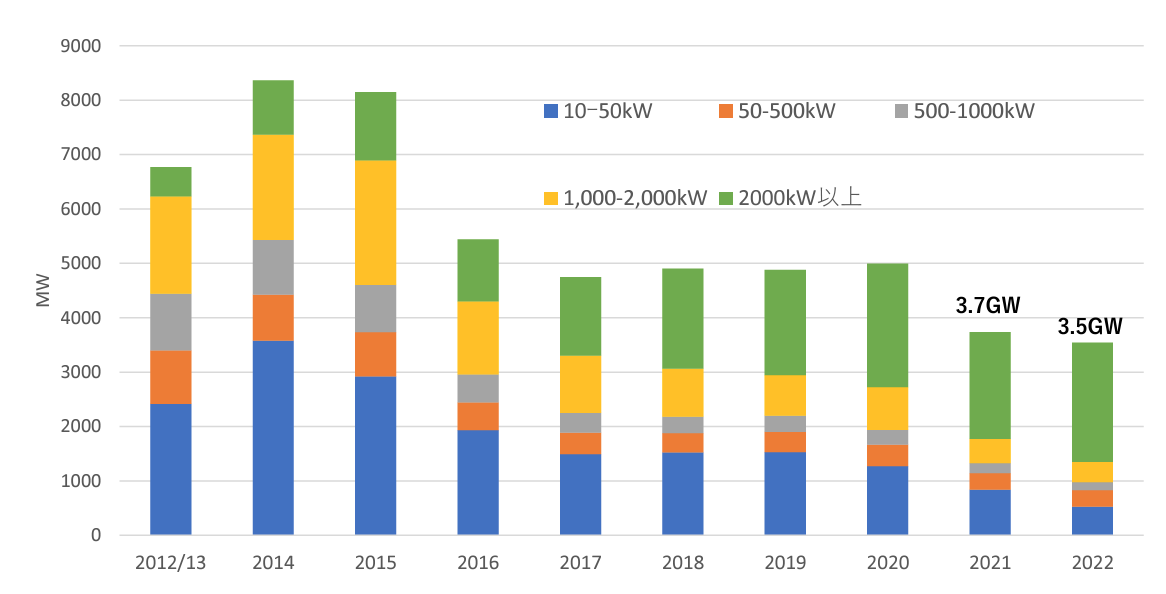
Source: JPEA
The Association warned METI that without some steps to stimulate the motivation of solar developers, the number of new projects will continue to decline.
Government officials have found it difficult to turn the tide of discontent amid local communities towards a number of solar and wind projects in recent years, driven by a mixture of real and perceived slights. A recent decision by Miyagi Prefecture to introduce a first ever renewables tax is another challenge for developers, even if the prefecture officials argue that the main aim of the levy is to prevent deforestation and engage with communities.
Still, the government has made progress in stimulating demand, targeting roof-mounted solar systems to be on 60% of new housing by 2030. In January, METI announced a new FIT specifically designed for rooftop systems. It will offer ¥12/ kWh for solar power produced on the roofs of corporate buildings from FY2024, which is about 40% more than the average weighted price secured by developers in the latest round of solar capacity auctions.
National regulations have taken time to filter through. However, solar panel shipments are finally on the rise. More than 400 MW of panels were shipped in November, the most since March 2023. (March orders tend to reflect a last-minute surge in buying before the start of the next fiscal year from April.)
Official reports on a rise in business activity will come later, but media reports are already suggesting that sales are supported by PV installations on office and commercial buildings, as well as condominiums. There’s also been a new wave of local government initiatives to switch public buildings to solar power and to compel new houses to install panels.
Municipalities lead the way
In 2012, Kyoto was the first locality to mandate solar panels on rooftops, making it a rule for all houses of at least 2,000 square meters. In 2022, the requirement was expanded to cover smaller buildings. In April 2023, Gunma Prefecture introduced a similar regulation, and now other municipalities are planning to follow suit.
The most ambitious plans today, however, are with the Tokyo Metropolitan Government. In December 2022, it began to require businesses to install rooftop solar panels on all large structures, such as office or apartment buildings. This measure takes effect in April 2025.
Tokyo now produces 646 MW of solar power annually, and it hopes to increase output by 6% as part of its strategy to halve its emissions by 2030. The city is intensifying efforts to promote new PV installations with incentives for home developers and by outfitting its own offices, such as Tokyo Metropolitan Archives that reopened at a new location in 2020.
Older buildings that cannot support rooftop systems will be modernized so that they can be equipped with PVs and other energy-saving facilities. This is part of the city’s commitment to the “ZEB Ready” (Zero-Emissions Building) program. Tokyo will also require smaller structures, such as detached houses, to install solar panels from 2025. Buildings account for 70% of the city’s CO2 emissions.
Tokyo has around 2.67 million buildings and houses. However, only 4%, or around 100,000, are equipped with solar panels. It’s estimated that new regulations will lead to an additional 40 MW or more per year.
The city of Kawasaki, (Kanagawa Prefecture), plans to install solar systems based on the total floor area, similar to Tokyo and Kyoto Prefecture. Yokohama, ranked as leader of Asian cities for decarbonization, now requires homeowners to consider a solar system or other renewables solution in plans for new buildings with a floor area of at least 2,000 square meters.
Yokohama is working on other ideas. Last month, the city adopted a self-reliant power system for public schools and their facilities. It reuses solar power generated on the rooftops of six designated schools, with the surplus transmitted to the Yokohama City Central Library, which is expected to receive about 170 MWh/ year.
The number of schools will be gradually added, and eventually 25 are expected to supply around 452 MWh/ year to affiliated facilities. This is around 23% of the Yokohama Library’s annual electricity consumption.
Challenges
One obvious issue with a focus on rooftops is that Japan’s demographics are not in favor of a continuously growing market. Japan has also seen an apparent decrease in the number of new buildings since 2018 and that is likely to continue. Rising costs are also an issue. Based on a recent survey by JPEA, the cost of new systems with capacity larger than 250 kW is on a downward trend, but prices for smaller installations are not expected to drop until 2025.
Installing solar panels could raise the price of a detached house by just over ¥1 million based on a 4.5 kW system, which generates enough electricity for an average household of four. A 4 kW system usually requires between 16 and 29 panels, or about 20 to 36 square meters. And while panel prices are down compared with a decade ago, upfront costs of solar PV is one of the challenges for new buyers.
The rooftop sector has plenty of runway outside of the residential housing. Japan has 7,600 square kilometers of space available on top of and around factories, warehouses, industrial parks and commercial facilities where solar panels could be installed, according to the Center for Low Carbon Society Strategy.
METI’s own estimates suggest that at least 5-7 GW of solar capacity could be installed on the roofs of public buildings, such as hospitals, schools, and government offices. There’s also potential for additions at airports and railway stations.
To tap into this potential, the government will need to foster expansion of its special rooftop tariff and also add further incentives for businesses. The emerging carbon credits market could be one of them.
ANALYSIS
BY YURIY HUMBER
Partly based on materials
by Shin Energy Shimpo
JERA Boosts Offshore Wind Credentials with Acquisitions and Floating Tech
Many traditional energy firms waver on whether to shift to renewables, arguing that their expertise lies elsewhere. Japan’s top LNG buyer and biggest thermal utility, JERA, has decided to pursue both the fossil and renewables route at full tilt. Toward that goal, it’s following an aggressive expansion strategy in offshore wind, investing in the sector both at home and abroad.
For a newbie in offshore wind, JERA performed well in the first round of auctions in Japan, even if it didn’t win. Together with project partners Equinor of Norway and domestic utility J-Power, JERA’s bids came second in a crowded field for the two big areas auctioned in Round 1.
To make sure it fares better in the next rounds, JERA has embarked on a M&A drive to build a stronger team and asset base, echoing the strategy of Mitsubishi Corp, which won all three of the major auctions in Round 1. It’s also bolstering renewables staff in-house.
Further down the road, JERA plans to develop home-grown technology for floating wind projects and quietly support the buildout of solar generation in Japan, while making a constant stream of investments in Southeast Asian utilities with strong renewables potential.
Recently, JERA has become synonymous with Japan’s strategy to replace coal-fired power with ammonia fuel. But the firm has a number of irons in the fire, renewables being one of them.
Background
Founded in 2015, JERA is a joint venture between TEPCO and Chubu Electric. The two utilities carved out their coal, gas and oil power stations into the 50-50 venture, seeking a new home for their thermal power business that was separate from nuclear and other assets.
Operating these thermal power plants requires purchases of fossil fuel, so it’s no wonder that JERA almost immediately became one of the world’s biggest buyers of LNG, handling about 40 million tons of the fuel annually – more than half the import volumes of Japan.
Despite its advantages in fossil fuel markets, JERA started looking at opportunities in renewables even before Japan announced a commitment to net-zero emissions. Planning for entry into renewable energy markets started not long after the company’s creation, according to Matsuda Ken, the head of Renewable Energy Planning Department in JERA’s Global Renewable Energy Division.
“Renewable energy is essential for future growth,” he emphasized, sharing a sentiment that is far from universally accepted among major fossil fuel businesses.
The company agreed to acquire 32.5% of the Formosa 1 offshore wind project in Taiwan in late 2018, when it was still an 8 MW asset. The project then developed into the first utility-scale offshore wind farm in Taiwan, ramping up to 128 MW of capacity by December 2019. But even before it was completed, JERA was already busy with new investments.
A 49% stake in Formosa 2 (376 MW) was announced in October 2019. This deal would boost JERA’s renewables capacity through its equity holdings to 1.2 GW, the company said at the time, acknowledging that it was also at an early stage of talks about an investment in Formosa 3. The latter investment was finally agreed in March 2020, giving JERA a 43.75% stake in a multi-site, 2 GW offshore development near Taiwan’s central-western coast.
All this happened before Japan announced its 2050 net-zero commitment in October 2020.
In the last year, however, some of this progress has been scaled back. JERA sold its interest in Formosa 3, citing rising costs and geopolitical uncertainties around the Taiwan Strait. But this is not a retreat from the sector, the company insists. JERA’s Global Renewable Energy Division now has 111 members in Japan.
The company continues to own and operate the first two Formosa projects, both of which are now in operation. The Taiwan market has helped the company accumulate industry knowledge in a geography that’s close in climate conditions to Japan, say JERA officials.
Next stage: Japan
JERA took part in Round 1 of fixed-bottom offshore wind tenders in Japan, the results of which were announced at the end of 2021. The company used the know-how gained in Taiwan to submit competitive bids that secured second place behind eventual winner Mitsubishi Corp.
The positives were that JERA’s consortium also managed to offer below ¥20/ kWh, but it fared poorly in terms of a realistic assessment of its business plan.
819 MW Yurihonjo City, Akita Prefecture
|
Bidder |
¥/ 1 kWh offer |
Price (grade out of 120) |
Realism of business case (grade out of 120) |
Total score (grade out of 240) |
|
Mitsubishi Corp, C-Tech |
13.26 |
120 |
88 |
208 |
|
JERA, J-Power, Equinor |
18.18 |
87.5 |
73 |
160.5 |
|
Sumitomo Corp, TEPCO RE, JR East |
16.97 |
93.8 |
64 |
157.8 |
|
JWD, Eurus Energy, Osted |
22.3 |
71.4 |
78 |
149.4 |
|
Obayashi, Tohoku Electric, Northland Power |
26.95 |
59 |
68 |
127 |
479 MW Noshiro City, Mitane Town, Oga City project, Akita Prefecture
|
Bidder |
¥/ 1 kWh offer |
Price (grade out of 120) |
Realism of business case (grade out of 120) |
Total score (grade out of 240) |
|
Mitsubishi Corp, C-Tech, Venti |
11.99 |
120 |
82 |
202 |
|
JERA, J-Power, Equinor |
17.2 |
83.7 |
73 |
156.7 |
|
Renova, Cosmo Eco Power, Tohoku Electric, JR East |
24.5 |
58.7 |
91 |
149.7 |
|
Kyushu Electric, RWE |
18.4 |
78.2 |
66 |
144.2 |
|
JWD, Eurus Energy, Osted |
22.99 |
62.6 |
78 |
140.1 |
391 MW Choshi City, Chiba Prefecture
|
Bidder |
¥/ 1 kWh offer |
Price (grade out of 120) |
Realism of business case (grade out of 120) |
Total score (grade out of 240) |
|
Mitsubishi Corp, C-Tech |
16.49 |
120 |
91 |
211 |
|
TEPCO RE, Osted |
22.59 |
87.6 |
98 |
185.6 |
Yuihara Atsushi, the head of JERA’s Renewable Energy Division’s domestic offshore wind business, admits a certain lack of preparation. “We didn’t quite read all the rules, and there were more discrepancies than expected in both positive and negative aspects.”
For Round 2, JERA expects to do better, based on lessons learned from Round 1 and a closer review of the new tender criteria. JERA also supports the changes to auction rules. However, Yuihara worries that if Round 3 opens before Round 2’s results are announced, it won’t be possible to learn from any mistakes.
The government asked Round 2 participants not to disclose information about their bid. Still, it’s known that over 20 entities submitted environmental assessment reports for the auction. If all of these turn into a bid, it means a two-thirds increase in the number of participants from the previous round. JERA once again is collaborating with Equinor.
Another change for Round 2 is the introduction of the FIP system (as opposed to the FIT system previously). This seeks to lower the costs shouldered by the public, but Yuihara says he was still shocked to see the zero-premium price set at ¥3/ kWh.
M&A drive
JERA announced several acquisitions related to offshore wind, seeking to improve the competitiveness of its workers, bringing in talent that can handle the entire value chain from development to construction and operation. In July, JERA completed its acquisition of Parkwind, a Belgian offshore wind farm operator.
Parkwind operates four offshore wind power projects in Belgium (771 MW) and completed the 257 MW Arcadis Ost in Germany’s Baltic Sea. Parkwind says it has a further 4.5 GW of projects under development, mainly in Europe. In August, JERA completed acquisition of Green Power Investment (GPI), a U.S. renewables developer, from Pattern Energy.
GPI has a considerable renewables asset base in Japan. It owns and operates six renewables projects totaling 337 MW, and has two projects under construction (192 MW). In 2020, GPI completed the 122 MW Wind Farm Tsugaru (Aomori Pref), then Japan’s largest onshore wind power plant. The company is also in charge of the 112 MW Ishikari Bay New Port offshore wind farm in Hokkaido that’s expected to be completed this month.
Floating wind
JERA, together with Mitsui Ocean Development, Toyo Construction, and Furukawa Electric, has been working to verify the viability of floating wind turbines using the TLP (Tension Leg Platform) method as part of a NEDO-funded project. Verification of the technology could start next fiscal year.
The floating structure is meant for depths of more than 70 meters. In the case of 100 meters, the area under the surface can be reduced to 1/1,000th of that of other mooring methods, and the impact on fishing and ship operations will be reduced.
JERA is doing research off the coast of Ishikari Bay in preparation for a demonstration with large wind turbines. JERA aims to commercialize the floating technology in the early 2030s.
Offshore wind offers the size and scale that some traditional energy companies seek in the renewables arena. However, JERA’s green investments are more spread out than many realize.
JERA is also:
- Involved in the 300 MW El Sauz onshore wind power project in Texas.
- Invested in ReNew Power, one of India’s top renewables utilities.
- Acquired 35.1% in Gia Lai Electricity (GEC), a Vietnamese renewables company.
- Bought a stake in Japanese solar developer West Holdings to jointly develop 1.1 GW of solar capacity.
While some are betting on particular innovative technologies to win out in the energy transition, JERA has spread its bets widely in the hopes that some, or perhaps all, will eventually pay dividends.
ASIA ENERGY REVIEW
BY JOHN VAROLI
This new weekly column will replace Global View and will focus on energy events in Asia and those that directly impact markets in the region.
Asia / LNG prices
Asian spot LNG prices fell this week to a 7-week low despite cold weather, as demand remains flat and global supply eases. The average LNG price for January delivery into northeast Asia fell 6% to $15.7 mmBtu, the lowest since mid-October.
Australia / Renewables
Through its Green Investments team, Macquarie Asset Management, has launched an onshore renewable energy business called Aula Energy. The portfolio has a projected capacity of 4 GW, with large onshore wind farms in early stages of development.
Cambodia / Natural gas
Cambodia abandoned plans to build a $1.5 billion, 700 MW coal-fired power plant and will build an 800 MW natural-gas fired plant instead. Also, the country is mulling an LNG terminal to supply the power plant.
China / Renewables
By year’s end, China will reach 230 GW of installed wind and solar projects, according to Wood Mackenzie. Installation this year is more than double the total deployment in the U.S. and Europe combined, with total investments reaching $140 billion.
Coal power
With the exception of China, in 2023 new coal power plant construction will hit a nine-year low, with total capacity of just under 2 GW, which is far below the annual average of 16 GW from 2015 – 2022. Of the 67 GW under construction outside China, as of July about 84% was in India (30 GW), Indonesia (15 GW), Bangladesh (6 GW) and Vietnam (6 GW).
India / Energy transition
India needs additional funding of $100 billion to meet its targets under the IEA’s net-zero emission roadmap that expects the country to triple its target with 32% of its power coming from solar and 10% from wind by 2030.
India / Coal power
The govt will add 80 GW of thermal capacity by 2032 due to rising demand. Some 30 GW is already under construction. India currently has 214 GW of required coal and lignite-based installed capacity.
Nuclear power
According to the IAEA, the global total of nuclear reactors – about 400 units – must double to achieve the Paris climate goals. Ten countries are in the decision phase; 17 in the evaluation phase. A dozen countries will soon join the nuclear power club. Three are in Asia – the Philippines, Kazakhstan and Uzbekistan.
South Korea / Nuclear power
Seoul signed nine MoUs with the UK on nuclear energy cooperation. One MoU focuses on collaboration between Korea Electric Power Corp and the UK Atomic Energy Authority.
Southeast Asia / Renewables
With only 27 GW of solar power and 6.8 GW of wind currently installed, ASEAN member states still have over 99% of untapped wind and solar power potential, said think tank Ember, and that the region has potential capacity of about 30,523 GW of solar and 1,383 GW wind.
2023 EVENTS CALENDAR
A selection of domestic and international events we believe will have an impact on Japanese energy
Disclaimer
This communication has been prepared for information purposes only, is confidential and may be legally privileged. This is a subscription-only service and is directed at those who have expressly asked K.K. Yuri Group or one of its representatives to be added to the mailing list. This document may not be onwardly circulated or reproduced without prior written consent from Yuri Group, which retains all copyright to the content of this report.
Yuri Group is not registered as an investment advisor in any jurisdiction. Our research and all the content express our opinions, which are generally based on available public information, field studies and own analysis. Content is limited to general comment upon general political, economic and market issues, asset classes and types of investments. The report and all of its content does not constitute a recommendation or solicitation to buy, sell, subscribe for or underwrite any product or physical commodity, or a financial instrument.
The information contained in this report is obtained from sources believed to be reliable and in good faith. No representation or warranty is made that it is accurate or complete. Opinions and views expressed are subject to change without notice, as are prices and availability, which are indicative only. There is no obligation to notify recipients of any changes to this data or to do so in the future. No responsibility is accepted for the use of or reliance on the information provided. In no circumstances will Yuri Group be liable for any indirect or direct loss, or consequential loss or damages arising from the use of, any inability to use, or any inaccuracy in the information.
K.K. Yuri Group: Hulic Ochanomizu Bldg. 3F, 2-3-11, Surugadai, Kanda, Chiyoda-ku, Tokyo, Japan, 101-0062.