E3G has become one of the most prominent and vocal climate change think tanks in Europe and the U.S. This year, the organization plans to get more involved in Japan, continuing on its mission to encourage government and corporate decision-makers to scale up funding for the energy transition and cease public financing for fossil fuels. Hanna Hakko, a Senior Associate with E3G, spoke with Japan NRG about its aspirations for Japan’s energy space.
Coal ignited the industrial revolution in the UK about 250 years ago but its combustion is now seen as the leading threat to the Earth’s climate. However, it also powers over a third of the world’s manufacturing and supplies over half of Asia-Pacific’s electricity. The industry’s main voice, the World Coal Association, recently rebranded itself as “FutureCoal” arguing that coal has a place in the future of energy. Japan NRG spoke with its CEO, Michelle Manook, on her outlook for coal in Asia.
ASIA ENERGY VIEW
A wrap of top energy news that impacts other Asian countries.
EVENTS SCHEDULE
A selection of events to keep an eye on in 2024.
JAPAN NRG WEEKLY
PUBLISHER K. K. Yuri Group
Editorial Team Yuriy Humber (Editor-in-Chief) John Varoli (Senior Editor, Americas) Mayumi Watanabe (Japan) Wilfried Goossens (Events, global) Kyoko Fukuda (Japan) Magdalena Osumi (Japan Filippo Pedretti (Japan) Tim Young (Japan)
On Dec 24, METI minister Saito and Saudi Energy Minister Abdulaziz agreed on the need to expand bilateral ties in order to drive the Lighthouse Initiative for Clean Energy Cooperation. Saito visited Riyadh for energy and investment discussions.
Minister Saito suggested Saudi Arabia to engage in more active dialogue with oil consuming countries on supply stability.
Minister Saito and Investment Minister Al Falih discussed collaborations in energy, water, and other sectors.
CONTEXT: The Lighthouse Initiative, launched by PM Kishida and Crown Prince Mohammed in July 2023, supports Saudi Arabia’s 2060 carbon neutrality goal. The initiative identified the focus areas, which are hydrogen, ammonia, e-fuel, circular economy (carbon recycling), critical minerals, direct air capture, sustainable advanced materials, relevant R&D and knowledge sharing.
TAKEAWAY: This was Minister Saito’s first mission abroad only 10 days after he assumed his new position. He’ll follow the energy policies of his predecessor, Nishimura, to strengthen clean and fossil energy supply chains, but his negotiation style won’t be the same. Nishimura was a “hard bargainer”, remembered for directly negotiating with Malaysia’s Petronas to continue LNG supply to Japan despite the 2022 force majeure. Japan NRG also noted that among the various focus areas, DAC was not included in this ministerial meeting.
In 2024, the Tokyo metropolitan govt will launch a green hydrogen user certification system. Users can file applications starting April; results will be announced in Sept.
There are two certification categories: On-site and off-site consumption. System details and definitions will be disclosed by late March.
The system covers only locally produced green hydrogen.
Green hydrogen user category
On-site
Renewables and hydrogen are produced and used at a site in Tokyo
Renewable energy supplies of third parties are used to produce hydrogen in Tokyo and consumed at the site
Off-site
Green hydrogen is produced elsewhere in Japan and transported to Tokyo via an FCV or EV
CONTEXT: In 2023, Aichi, Mie and Gifu prefectures in central Japan launched a “low-carbon hydrogen certification system” to certify producers rather than consumers. The central Japan system includes biogas as a means to produce hydrogen and the use of non-voluntary credits to offset carbon, whereas the Tokyo system only recognizes renewables as a power source.
TAKEAWAY: The differences in the Tokyo and central Japan approaches may be a good case study to gain insights on effective certification schemes. Japan seeks to lead in international standardization around hydrogen (and other new technologies). So, it’s crucial for these two (or more) H2 schemes to come to a compromise so that Japan can form a common standard. The more ambitious approaches, such as the Tokyo scheme, may be seen as “forerunners” at first, but they could lose traction if their ideas are deemed to be impractical. Presently, Japan has only two green hydrogen producers — in Yamanashi and Oita — with a combined annual production of about two tons. New producers will emerge as demand rises in Tokyo.
ENEOS and Sumitomo inked an agreement with Malaysia’s SEDC Energy to establish a hydrogen supply chain using renewable energy.
The group plans to produce around 90,000 tons of hydrogen annually, using electricity from hydropower. They aim to start hydrogen production by 2030.
Of the 90,000 tons planned, 2,000 tons will be produced in the state of Sarawak.
CONTEXT: Sarawak has abundant hydroelectric potential, with 3.5 GW of hydro capacity already in operation. The Bintulu area of Sarawak, the proposed site for the project, is home to a large-scale petrochemical industrial park, and ENEOS and Sumitomo are expected to benefit from shipping facilities in the area, including ports. ENEOS and Sumitomo are also engaged in aluminum smelting and manganese ferro-alloy production in Sarawak.
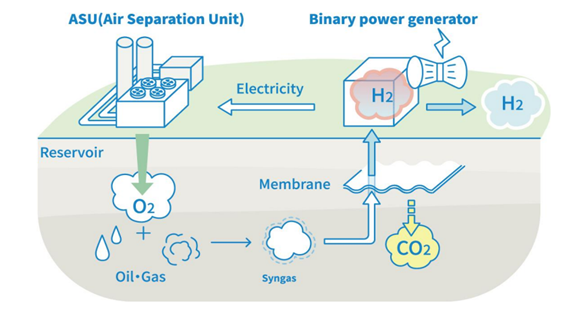
State-run research hub NEDO tapped JX Nippon Oil and Gas Exploration to research underground hydrogen production, using hydrocarbon molecules in depleted oil fields as feedstock.
The goal is to determine whether it’s possible to produce hydrogen from the leftover hydrocarbons, and recover it efficiently above ground, while separating and keeping CO2 underground. JX Exploration plans to conduct studies in the southern U.S.
In Sept, the company will file a preliminary feasibility report. Pending approval, it will seek a U.S.-based partner to help conduct the studies possibly from 2025.
CONTEXT: The costs of the hydrogen supply chain, from production to carbon storage, could be reduced if the entire process could be performed underground in depleted oil fields.
Yokohama City, Maersk and Mitsubishi Gas Chemical signed a MoU to promote green methanol to decarbonize Yokohama port.
They plan to use methanol for bunkering and ship fuel, and will share with each other relevant technologies, demand, supply, safety, and other data.
CONTEXT: Yokohama is Japan’s first city to promote green methanol as a carbon neutral fuel. Composed of carbon and hydrogen, methanol allows recycling of carbon captured at industrial plants. But, some shipping companies see ammonia as a more realistic fuel for the industry since green methanol production is not expected to be commercialized until the 2040s; green ammonia is likely to be widely available earlier.
METI is set to launch an environmental survey in spring for construction of floating wind farms, including two areas off Hokkaido.
The study will start ahead of a planned trial of floating offshore wind power systems scheduled for May. Research will be done in waters deeper than 50 meters.
The two-year study will gauge wind conditions and the conditions of the seafloor.
In March, Japan will launch a nuclear fusion power industry organization, the Fusion Energy Forum. It will unite companies, govt, and academia, and aim to enhance the development of fusion technology and its commercial viability in the country.
Participants include IHI, JGC Holdings, Obayashi, Inpex, Kyoto Fusioneering, and EX-Fusion. It also includes materials makers and trading houses. The group will identify technological needs and advise the govt on safety and standards.
Fusion Energy Forum will also represent Japan abroad and develop partnerships.
Honda Motor, Tokuyama, and Mitsubishi set up a project to decarbonize data centers. They plan to use by-product hydrogen and a stationary fuel cell power station that will reuse fuel cell systems from fuel cell electric vehicles (FCEVs).
NEDO supports the project, located in Shunan City, Yamaguchi Pref. Lower costs should result from using stationary fuel cell systems.
If the project is deemed a success, the partners will look to expand the business model to other parts of Japan and abroad.
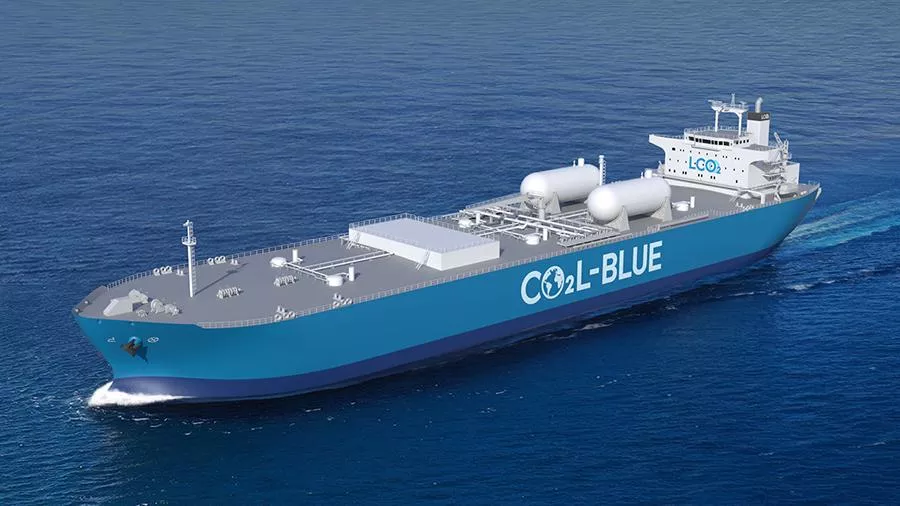
Mitsubishi Shipbuilding and Nihon Shipyard signed an MoU with trading houses Mitsui and Mitsubishi Corp to study ocean-going liquified CO2 (LCO2) carriers; this can help large-scale international transportation of CO2 for CCS projects starting 2028.
The initiative is in response to JOGMEC’s feasibility study on the Japanese Advanced CCS Project. The project aims to standardize the specification and design of LCO2 carriers to establish a production supply chain.
Mitsubishi Shipbuilding wants to promote the use of LCO2 carriers and establish a CCS value chain. Nihon Shipyard will work on commercialization of LNG and ammonia-fueled ships. The two companies already began studying construction of carriers.
Mitsui OSK Lines inked a deal with Yara Clean Ammonia Switzerland for the ammonia carrier Green Pioneer that will sail mostly in the Pacific region.
CONTEXT: In 2022, MOL and Yara Group inked a MoU on decarbonization projects including ammonia. Built in 2010, Green Pioneer has a cargo capacity of 34,500 m3.
Marubeni and Vietnam’s VinFast Trading and Production signed an MoU to repurpose used EV batteries in Vietnam.
The firms will utilize tech developed by U.S. startup B2U Storage Solutions, which enables inexpensive and easy reuse of used EV batteries as stationery batteries, without dismantling, retesting and repackaging them.
CONTEXT: Marubeni is B2U’s investor. The partnership was signed by Marubeni’s wholly-owned subsidiary Marubeni Green Power Vietnam and the Vingroup firm.
The B2U tech is expected to help alleviate the growing burden on the power grid due to the increase in renewable energy sources and stabilize it, as well as prolong EV batteries’ lifetime.
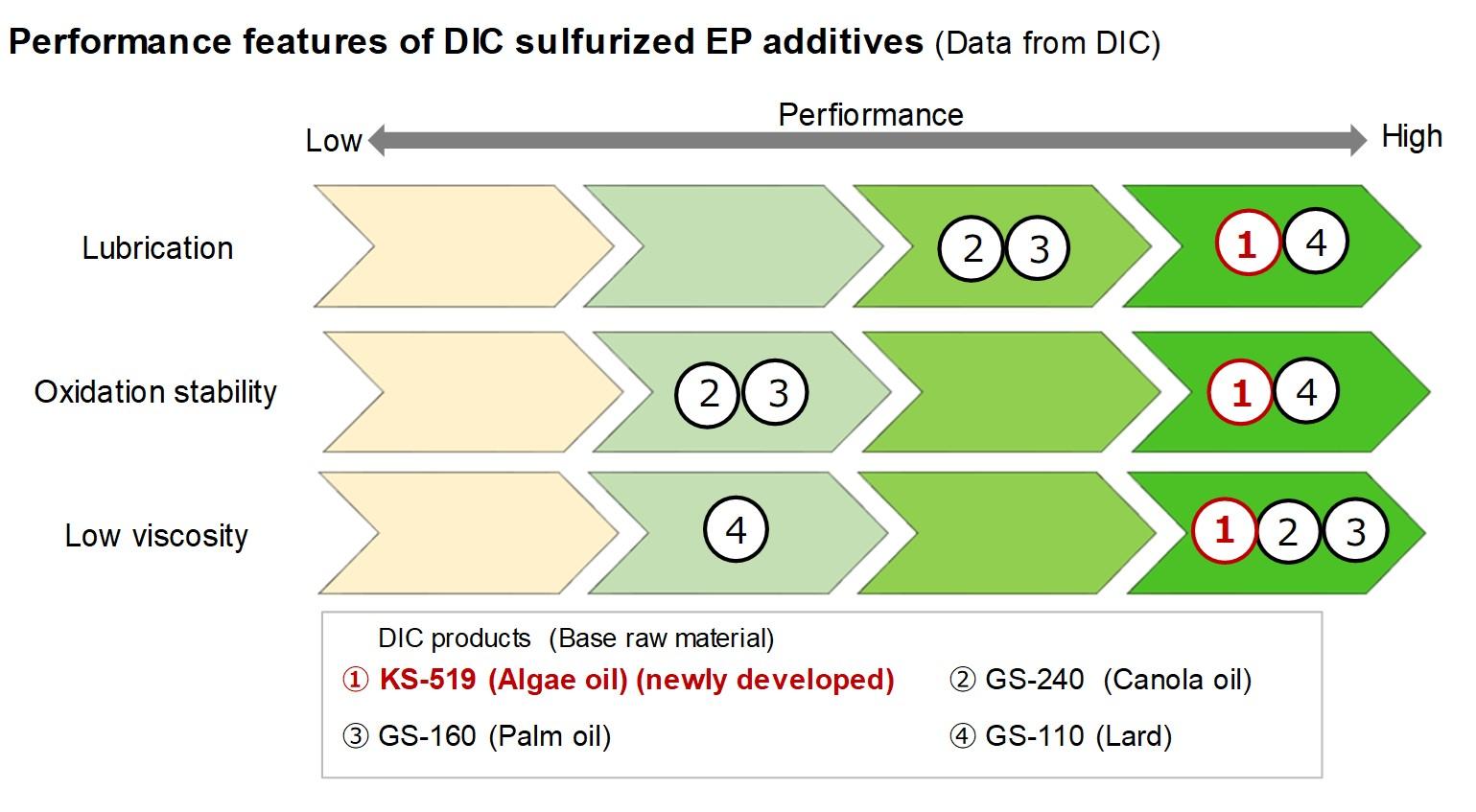
Tokyo-based chemical firm DIC developed the world’s first algae oil-type sulfur extreme pressure additive, which is highly effective in reducing CO2 emissions.
The algae oil type KS-519 is a new product in the company’s DAILUBE line, a series of high functioning sulfide olefins that control chain length of sulfur.
CONTEXT: The newly developed product is a type of lubricant additive used to prevent wear and improve the durability of mechanical parts. Such compounds can be applied in high pressure settings in gear assembly, metalworking processes and metal cutting, as well as as stabilizers in petroleum refining. DIC currently has 20%-30% market share of EP additives.
The Kishida govt plans to offer Ukraine biofuel production technologies in a bid to support its economic recovery, taking advantage of its farm resources.
Full details will be disclosed at the Japan-Ukraine Conference for Promotion of Economic Reconstruction to be held on Feb 19.
Gasoline and oil products broker Sinanen launched sale of Susteo-brand biofuel produced by Euglena at its Yokohama outlet. The company plans nationwide sales.
Susteo biofuel will replace diesel oil for trucks and buses.
NEWS: ELECTRICITY MARKETS
Earthquake cripples Hokuriku region, power stations suspend operations temporarily
(Japan NRG, Jan 6)
A 7.6 earthquake hit Noto peninsula (Ishikawa Pref.) at 16:10 on Jan 1, leading to at least 100 mortalities and damaging energy infrastructure.
Hokuriku Electric shut two Ishikawa Pref-based coal power plants immediately and reduced output of two other coal-fired units, in Toyama Pref.
METI ordered Kansai Electric to provide backup supply in case of shortages, but canceled the order when the area appeared to have enough power.
Erex, which operates the 147 MW Itoigawa unit (Niigata Pref), suspended power generation but is expected to restart soon as it did not suffer damage.
INPEX suspended gas supplies from the Naoetstu LNG terminal immediately after the quake but resumed operation on Jan 3.
As of Jan 6, 23,000 households in Ishikawa Pref still had no power. Hokuriku Electric reported to the Nuclear Regulation Authority oil leaks at transformer units of Shika No. 1 and No. 2 NPP. The oil, which was radioactively contaminated, was removed on Jan 5. The NRA inspector then confirmed that there was no environmental damage following an on-site inspection.
Officials at TEPCO’s Kashiwazaki-Kariwa NPP said that there was a water spill from a spent nuclear fuel pool. KEPCO reported that there were no accidents at its three NPPs in Fukui Pref. No problems were detected at the Tsuruga NPP in Fukui Pref, operated by Japan Atomic Power Co.
Affected facilities
Name
Status
Hokuriku Electric; thermal power
Rikuden Nanao Ota Unit 1 (500 MW); Unit 2 (700 MW)
Suspended after suffering damage
Toyama Shinko Unit 1 (250 MW); Unit 2 (250 MW)
Running at a reduced rate of 300 MW combined
Erex; thermal power
Itoigawa (147 MW)
Suspended but due to restart soon; no damage reported
Hokuriku Electric; nuclear
Shika No. 1 and No. 2 nuclear power plants
Oil leaks due to transformer damage; reactors not operating at time of quake
Gas
1 LP gas retailer (Fukui Pref)
Gas leakage due to damage in an underground pipe; Leakage stopped
Gasoline service stations
53 closed
About 500 service stations opened but some ran out of supplies
The 112 MW offshore wind farm built by Tokyo-based Green Power Investment began operation on Jan 1.
One of Japan’s largest wind farms, it’s located in Ishikari Bay New Port, and uses 14 Siemens Gamesa turbines measuring 196 meters in height.
The power generated will be sold to Hokkaido Electric, supplied via the substation that has a storage battery capacity of 180 MWh, a unique feature of this facility.
CONTEXT: Last year, GPI was acquired by JERA and NTT for ¥300 billion, the largest ever acquisition of a Japanese renewable energy firm. JERA and GPI plan to jointly operate the offshore wind power business.
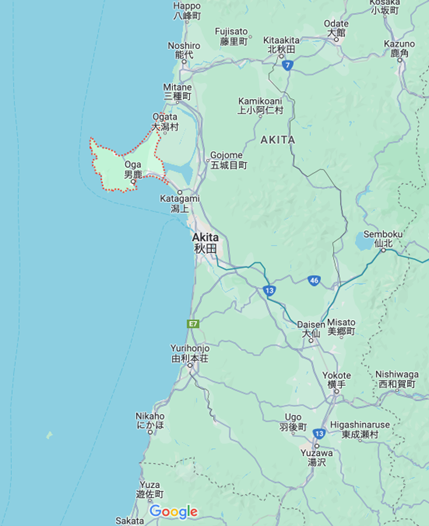
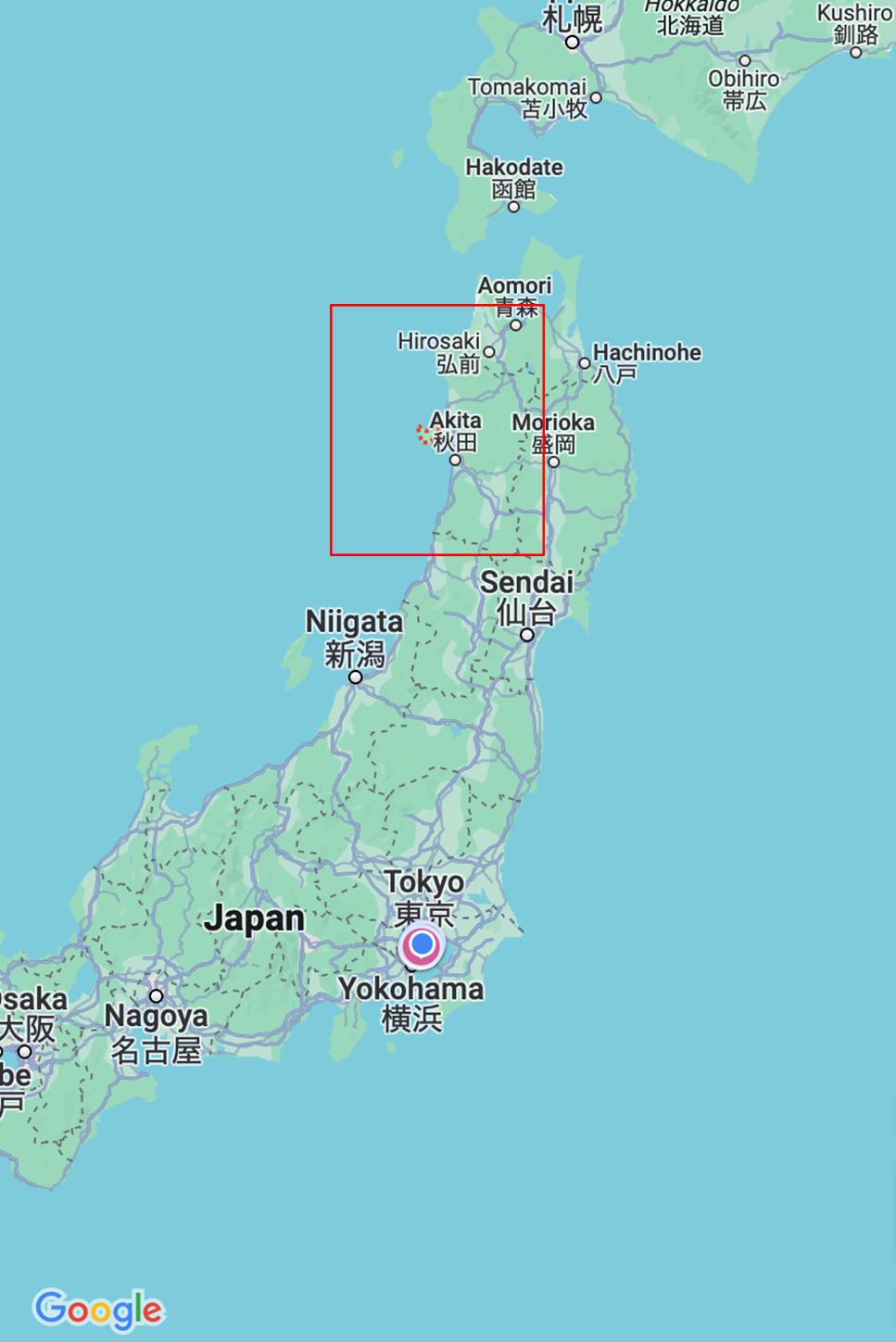
Akita City is increasing efforts to have the area off the city’s south coast designated as an “offshore wind promotion zone”.
Four areas off the coast of Akita Pref have already been designated as “promotion zones”, including the coast stretching from the cities of Oga and Katagami to Akita City. At least 120 turbines in total are to be built on the prefecture’s coast by 2030.
While an area off Akita city was designated as such, the more southern part is not covered. This prompted the local authorities to seek a decision on designating it as suitable for offshore wind.
CONTEXT: In Nov, the city said it would seek to have the city’s main coast (also called the southern coast) designated as a national offshore wind promotion zone. It is soliciting public feedback on its overall energy strategy, including the offshore wind plans, until Jan 14.
TechLab, a tech startup in western Tokyo, set up a carbon fiber reinforced plastic (CFRP) plant in Tome city, (Miyagi Pref), to make components for so-called lens wind turbines.
The plant will be fully operational in early 2024. The company has an order from Riamwind, a Kyushu University startup that designs and develops wind turbines, to make the blades and circular diffusers with a diameter of 26 meters.
A demo wind turbine will be made in the first half of FY2024.
CONTEXT: Conventional wind turbines have a noise problem, while lens wind turbines do not. The height of a lens wind turbine is about 13 to 20 meters, making it easy to install in places where large wind turbines can’t be. Also, it helps birds to recognize the wind turbine as a structure, preventing bird deaths.
NRA lifted its de facto ban on the operation of TEPCO’s Kashiwazaki-Kariwa NPP in Niigata Pref. This decision comes more than two years after the NRA ordered the utility to improve counterterrorism measures.
The NRA confirmed that security measures were improved. Yet, it’s still uncertain whether the NPP will resume operations as TEPCO must now get local consent.
CONTEXT: The seven-reactor complex had faced restrictions since April 2021, including a ban on the transportation or loading of reactor fuel.
SIDE DEVELOPMENT: Kashiwazaki-Kariwa NPP’s water spills due to earthquake, no damage reported (Japan NRG, Jan 2)
TEPCO reported that water from the fuel pools on the upper floors of the No. 7 and No. 2 reactors at Kashiwazaki-Kariwa NPP overflowed following earthquakes. No damage has been confirmed.
TAKEAWAY: The restart of its only operable NPP is essential for TEPCO to reduce operating expenses, but the utility has faced a litany of problems around this facility, not least due to internal issues. Recently, shares in TEPCO rose due to the plant’s expected restart. With Japan’s LNG imports expected to decrease 8.6% for FY2024, the NPP restart is seen as a way to reduce fossil fuel consumption; thus, it’s a matter of importance at the national level. However, the final decision on the restart rests with local (city and prefectural) consent. And while the Jan 1 major earthquake off the coast of the nearby Ishikawa area did not cause any notable damage to the country’s NPPs, it did spark some alarmist comments, including from former PM Hatayama. Public opinion will play a major role in the restart of this NPP.
Chubu Electric to request NRA to delay decommissioning of Hamaoka NPP
(Japan NRG, Dec 31)
Chubu Electric sent a request to the NRA for approval to alter plans to decommission Units 1 (515 MW) and Unit 2 (806 MW) of Hamaoka NPP.
The utility would like to start dismantling in FY2024, which is a one-year delay. The target completion year for decommissioning remains 2036.
Hamaoka has five units, and in early 2009, Units 1 and 2 were permanently shut. They are the oldest reactors at the NPP, having been built in the mid 1970s.
CONTEXT: Hamaoka is built directly over the subduction zone near the junction of two tectonic plates. The facility was shuttered entirely in the aftermath of the 2011 Fukushima quake at the orders of then PM Kan, who followed advice form prominent geologist, Prof Ishibashi, a former member of a state panel on nuclear reactor safety. Ishibashi has long claimed that an accident at Hamaoka NPP would pose a major risk to the Tokyo and surrounding area.
TAKEAWAY: Chubu Electric has agreed to retire two older units, but has three more at the Hamaoka NPP site, which were opened between 1983 and 2000. The three younger units in total amount to about 3.5 GW of capacity, which is significant. Their restart alone could ease the capacity crunch around the Japanese capital, but despite the utility spending billions of yen on new equipment and safety upgrades, the future of this station remains uncertain.
In December, Yokohama Bank granted a loan to Pacifico Energy for its solar power project in Shunan, Yamaguchi Pref. Construction starts in Oct 2025; with commercialization slated for Nov 2027.
The firm plans to build a plant with a DC output of 120 MW, a maximum AC output of 77 MW, as well as storage batteries for the grid.
The site is currently used as a golf course in Shunan, Yamagata. The firm plans to install up to 2.21 million solar modules (0.54 MW each).
Pacifico Energy will install 30 storage batteries, each with a 60 MWh capacity.
Japan court rejects lawsuit over solar power farm in Kagawa Pref
(Japan NRG, Dec 28)
A first instance court dismissed a case filed by residents of Teshima Island in Kagawa Pref demanding that a solar power generation facility be removed on the grounds that the panels could scatter in case of a disaster.
The Takamatsu District Court ruled that the adjacent land owned by the plaintiffs is rarely used and it does not generate any revenue. The court ruled the degree to which the value of their property would be affected is very low.
CONTEXT: The community claimed that the ground selected for the construction site is soft and could collapse, and the materials are not strong enough.
TAKEAWAY: Local opposition to projects involving renewable power generation are not uncommon. The residents have claimed, since before the start of construction in 2020, that the operator had not given them a satisfactory explanation on how it would act in an emergency. However, the court pointed out that community members purchased the adjacent land aware of a possibility of inflow of soil and sand from the construction site. The operator is Hiroshima-based solar power company Japan Housing Service.
A consortium comprising Sumitomo Corp, France’s EDF and TotalEnergies inked an agreement with Mozambique to develop a hydroelectric power plant.
“Mphanda Nkuwa Hydroelectric Project” will involve construction of a 1.5 GW flow-in hydroelectric plant. It will be located along the Zambezi River, 60 km downstream of the capital.
Sumitomo and TotalEnergies will each hold a 30% stake, while EDF will hold 40%.
CONTEXT: If realized, the project will increase Mozambique’s electricity production by more than 50%. Sumitomo will be responsible for financing.
TESLA Forecasting Solutions, which provides electricity demand forecasts to power utilities, including EPCOs in Japan, was acquired by Colorado-based Yes Energy, which specializes in power market data.
TESLA has been active in the Japanese market since 2017; since last year it also offers solar and wind generation forecasts, as well as OCCTO demand and capacity forecasts. Together with Yes Energy, the merged entity will expand the forecast and data visualization services in the Japanese electricity market.
CONTEXT: Japan’s traded power volumes have expanded substantially since the full market liberalization in 2016. Trading in futures contracts hit a record in 2023.
NEWS: OIL, GAS & MINING
Japan and Saudi Arabia to invest in critical raw materials for the energy transition
(Japan NRG, Jan 4)
During METI Minister Saito’s visit to Riyadh late last month, Japan and Saudi Arabia, together with companies from both sides, signed a Memo of Cooperation to explore investments into mining raw materials that are critical for the energy transition.
CONTEXT: Such collaboration, which will focus on investments in third-countries, was initially discussed by PM Kishida during a visit to Saudi Arabia in July. Media reports mentioned Africa as a likely destination.
State-backed companies JOGMEC and Manara Mineral Investment joined the MoC. JOGMEC said it will contribute technical expertise in mining and work with the Saudi partners to explore and develop raw materials.
Early in 2023, Saudi Arabia set up Manara Minerals Investment dedicated to investment in raw materials used in renewable energy facilities and in battery storage.
Investment proposals should arrive in the next two years, according to Nikkei, which suggested that rare earths are among the critical minerals of interest to both countries.
According to the Middle East media, a high-ranking Japanese official stressed the importance of “Saudi Arabia as Japan’s most significant strategic partner (in the region).” Neither side, however, has provided the details of the agreement.
TAKEAWAY: Japan supports Saudi Arabia’s shift away from fossil fuels while also recruiting strong partners to jointly develop the critical raw materials that are needed for clean energy alternatives. Japan has signed similar agreements around critical raw materials supply chains with the U.S. and the EU last year. Security of supply for these elements is important not only for national security but also business competitiveness. Today, many clean energy technologies like wind turbines, solar panels and EV batteries, are reliant on China-controlled supply chains. China is both the dominant supplier of many rare earth elements and the biggest manufacturer of equipment used at renewable energy facilities.
JERA agreed with the Association for Overseas Technical Cooperation and Sustainable Partnerships (AOTS) to provide system design and support for the adoption of LNG in the Philippines.
JERA’s tasks include supporting the development of regulations for LNG storage and regasification terminals, gas transportation systems, and third-party access.
The Philippines has growing demand for electricity amid economic growth and the need for LNG adoption due to a decline in domestically produced natural gas.
CONTEXT: This is an opinion piece by Ryan Neelam, Director of the Public Opinion and Foreign Policy Program at the Lowy Institute, and Michelle Lyons, Research Fellow at the Indo-Pacific Development Centre of the Lowy Institute.
Over the past 30 years, Japanese investment has been crucial in developing Australia’s gas industry, propelling it to one of the world’s top LNG exporters. Japan takes a large portion of those sales and relies on Australia for 40% of its LNG. Also, Australia accounts for 73% of Japan’s thermal coal consumption.
Japan aims for a 43% reduction in GHG emissions by 2030 and envisions Australia as a renewable energy superpower. Yet, tensions have arisen with Japan, which is dependent on Australian fossil fuel exports.
Japan has to recognize the need to speed up domestic renewable energy production if it wants to meet decarbonization goals.
New opportunities may arise from restructuring the relationship, including mining and production of critical minerals, green hydrogen production and clean energy services. Geopolitical competition with China adds incentives for countries like Australia and Japan to collaborate in building clean energy supply chains.
CONTEXT: In March, Australia’s Parliament imposed more stringent emission rules on large fossil fuel projects. This move prompted reactions from Japanese officials and investors, as they perceived Australia as scaling back its LNG business. In July, the Australian Climate Change and Energy Minister visited Tokyo to reassure Japanese investors of Australia’s commitment to stable energy supplies.
Nippon Steel (NS) bought a 20% interest in Elk Valley Resources (EVR), a steelmaking coal business partnership.
NS acquired the interest through a subsidiary, and also inked an offtake agreement with EVR for long-term supply of steelmaking coal.
CONTEXT: In late December, Nippon Steel made a nearly $15 billion bid for U.S. Steel, which was twice more than what a competitor offered in autumn. U.S. Steel has already approved the bid, but there are still issues with U.S. regulators.
ANALYSIS
BY YURIY HUMBER
Exclusive Interview: Hanna Hakko, a Senior Associate with Think Tank E3G
E3G is an independent climate change think tank with offices in London, Brussels, Berlin and Washington DC, as well as associates in countries that include Japan. The organization has become more involved in Japan over the last few years.
E3G has successfully encouraged government decision-makers to scale up funding for the energy transition and cease public financing for fossil fuels. It provides secretariat support for a number of international energy transition initiatives such as the Powering Past Coal Alliance and the Energy Transition Council. Hanna Hakko, a Senior Associate with E3G, spoke with Japan NRG about its aspirations for Japan’s energy space.
JAPAN
E3G has become one of the most prominent environmentalist voices globally in recent years. The think tank covers a lot of ground and topics. But when did the team start specifically looking at Japan and what drew your attention?
Given Japan’s size and influence in the world, understanding its stance on climate and energy has always been important for E3G. We have had dedicated, Japan-focused staff in the country since 2018. One focus has been the need to end coal power in order to align with global climate goals. We publish a constantly updated tracker of OECD and EU countries’ progress on coal phaseout. Another product that has received attention in Japan is our earlier G7 Coal Scorecard series, comparing how these major economies have progressed in their transitions away from coal. Unfortunately, Japan has consistently fared poorly in these rankings.
We have also worked with other civil society organizations to help end international public finance to coal projects, an area that was once dominated by China, Japan and South Korea. A breakthrough was finally achieved in 2021 when the three countries announced their respective decisions to end overseas coal finance.
Today, E3G’s work includes analysis of the detrimental aspects of Japan’s coal-ammonia co-firing strategy and its broader overseas financing of fossil fuels, as well as an assessment of the public banks as regards their alignment with the Paris Agreement.
What about Japan’s energy space (policy / industry / markets) needs tackling first? What specific changes would you like to see implemented either at government or industry level?
Japan has made several climate and energy commitments at the G7 and COP28 that it must now deliver on. There is the opportunity to do this via the 7th Basic (Strategic) Energy Plan in 2024. The policy update should provide answers on how Japan will:
Phase out coal in alignment with the 1.5-degree pathway,
End permitting and construction of new unabated coal facilities (including a robust definition for abatement),
Accelerate renewables deployment and energy efficiency improvements.
Academic research shows Japan has great potential to ramp up renewable energy capacity, thereby improving energy security. Also, the G7 agreed that the use of ammonia and hydrogen in the power sector must be aligned with the group’s objective of fully or predominantly decarbonized power sector by 2035. So, Japan needs to proceed with a strategic rethink and regulation to achieve this.
What kind of action do you plan in Japan in 2024? What would you like to achieve?
In 2024, E3G will continue to work with civil society, diplomats and government, academia and business to support the acceleration of Japan’s energy transition. This will include research collaboration on particular issues; dialogue on policy recommendations, including towards the Basic (Strategic) Energy Plan review; and thought leadership on how best Japan can step up its domestic energy transition and better support international momentum.
E3G will make recommendations on areas where Japan and other G7 governments can strengthen policies towards decarbonizing their power sector by 2035. Coal phase-out continues to be central to this, and the pressure on Japan to take action is steadily increasing. This is especially true now that the U.S., which has the world’s third biggest coal fleet, decided to join the Powering Past Coal Alliance, making Japan the last G7 country not to sign up.
One domestic issue that we will also monitor is the government’s approach to implementing Prime Minister Kishida’s promise at COP28 to end construction of new unabated coal power plants. There is currently one pre-permit, pre-construction coal project, the Genesis Matsushima project, which plans to build a new facility inside an old plant, essentially giving it new operating life. If this proceeds, it risks going against Japan’s commitments at COP28 and the G7.
Which industries / entities or individual companies do you think set the right example for Japan’s energy transition? And which do the opposite?
We are concerned about whether Japanese power companies and related industries have fully grasped the required scale and pace of the energy transition. Analysis by Bloomberg NEF and others shows that major policy changes are needed, first and foremost in the power sector, to meet Japan’s 2030 and 2050 climate targets.
To match those changes, many power companies will need to make rapid strategic changes to prioritize already commercialized and deployable clean energy technologies. The current overemphasis on over-the-horizon options like coal-ammonia co-firing risks making the transition more complicated and expensive, and could prolong the use of coal plants and see Japan miss its targets.
Recommendations from non-state actors like the Japan Climate Initiative and Japan Climate Leaders’ Partnership offer valuable insights on what the government could do better and faster.
ASIA
Asia’s well-known reliance on coal has been hard to shift over the years because countries don’t want to sacrifice economic growth or stability and energy security? How do you tackle this mindset and change people’s thinking?
Things are changing already. Real progress on diminishing construction of new coal, as well as pledges made at COP28, suggest many Asian countries increasingly recognize that clean energy is an opportunity to improve economic and energy security, as well as air quality.
At COP28, Asian countries including Japan, South Korea, Brunei, the Philippines, Singapore, Thailand, Malaysia, Bangladesh and Bhutan signed the Global Renewables and Energy Efficiency Pledge in support of tripling global renewables and doubling the rate on energy efficiency improvements by 2030. The pledge also recognizes that this action needs to be accompanied by a phase down of unabated coal and ending investment in unabated coal-fired power plants.
Even before this COP, many countries in Southeast Asia actively began considering how to achieve a coal phaseout. It’s critical that Japan and other wealthy countries continue supporting that through means such as the Asian Development Bank’s Energy Transition Mechanism (ETM) and Just Energy Transition Partnerships (JETP).
GLOBAL
What were your impressions of COP28 and its achievements, and what do you expect next?
Our overall assessment is quite positive. COP28 concluded with countries agreeing to transition away from fossil fuels and to triple global renewables capacity, deliver on global targets on adaptation, and take new steps to scale up finance for climate action, including setting up a new ‘loss and damage’ fund. There was room for improvement, but the fact that over 130 countries signed the Global Renewables and Energy Efficiency Pledge managed to send a historical signal that the end of the fossil fuel era is starting.
When looking at Japan’s announcements at COP28, our evaluation is less positive. While it is good that Japan signed the Pledge, its G7 peers took a much more proactive role, including the U.S., by joining the Powering Past Coal Alliance and France by championing the Coal Transition Accelerator. In comparison, Japan’s promise to end construction of new coal, while welcome, was very modest.
It is also concerning that the outcomes for the Japan-led Asia Zero Emission Community (AZEC) initiative meeting, convened immediately after COP28, did not reflect the latter’s positive signals. Going forward, the AZEC agenda will need to reform from a fossil-heavy focus to one that prioritizes renewables.
ANALYSIS
BY JOHN VAROLI
Exclusive Interview: CEO of FutureCoal, Michelle Manook
Coal is one of the most contentious energy sources in recent years. The fuel that helped ignite the industrial revolution in the UK about 250 years ago is now seen by many as the leading threat to Earth’s climate through its CO2 emissions. However, it is also a fuel that powers over a third of the world’s manufacturing and still supplies over half of the electricity in the Asia-Pacific.
Promoting coal as an energy source today is no easy task. And yet the industry’s main voice, the World Coal Association, has not only embraced the challenge, it has rebranded itself as “FutureCoal: The Global Alliance for Sustainable Coal,” arguing that this fossil fuel has a place in the future energy mix of many countries, such as Japan. Last month, Japan NRG spoke with the CEO of FutureCoal, Michelle Manook, on the group’s outlook and prospects in Asia.
GLOBAL INDUSTRY GOALS
The G7 nations are leading an aggressive push to close coal capacity. The IEA says fossil fuels need to be phased out. But the World Coal Association has rebranded as FutureCoal, indicating you believe the industry has a strong future. What is the aim of the rebrand?
FutureCoal exists to ensure a balanced, rational and science-based approach to the debate about the necessary role coal must play in driving growth, providing energy security, and delivering a lower emissions future.
The launch of FutureCoal has not been a sudden decision. It’s been three years in the making as part of our Evolving Coal strategy, which aims to lift the knowledge among governments, regulators, financiers and other external stakeholders of coal’s total contribution to solving today’s pressing global issues. We call this “raising the coal IQ”. It is up to us and the coal value chain to demonstrate that coal can deliver economically and environmentally.
After 38 years of the World Coal Association, a structural shift was needed to signal a new era and demonstrate our openness to emerging and developing markets within the global coal value chain. Previously, the World Coal Association was primarily recognized as an organisation centred in Western countries and for coal producers.
You describe your mission as following a “Sustainable Coal Stewardship (SCS) philosophy”. What does this mean in practice?
SCS describes our commitment to advocating for and embracing the diverse abatement opportunities within the coal value chain. We see three main areas for change. The first is pre-combustion, which involves the adoption of efficient and innovative mining processes, practices, and equipment.
The second area is combustion. This will rely on the range of efficiency technologies that exist and can abate and capture up to 99% of emissions. The third area is beyond combustion. This embraces a vision where future business opportunities focus on transforming coal into new higher value products, such as Coal-to-Liquids (CTL), hydrogen, agriculture, steel, cement, aluminium, and critical minerals.
JAPAN’S ROLE IN THE COAL SECTOR
Japan is often shamed at international climate conferences for continuing to rely on coal-fired generation. How do you view Japan within the coal industry?
Japan is a flagbearer for a coal value chain that has embraced innovation to deliver abatement technologies and novel coal applications that extend beyond its role in combustion. Abatement is the future of coal and Japan serves an example to the world of what is possible when engineering trumps ideology.
Prime Minister Kishida told COP28 that Japan will only build new coal power plants that abate emissions. Japan already has one of the most efficient coal fleets in the world, so the Prime Minister’s comments send a strong message that there is ample room for coal innovation in a modern economy if governments and financiers are willing to fund the development of technologies across the coal value chain.
Japan focuses on extracting more value per tonne of coal, extending value beyond the coal used in the power sector or producing steel. This approach is aligned with our Sustainable Coal Stewardship (SCS) philosophy that believes coal’s versatility can contribute to many innovative applications, such as hydrogen.
Is your organization active in Japan?
We collaborate with key stakeholders, including the Japan Carbon Frontier Organisation (JCOAL) who share the belief in coal’s total contribution and role in the clean energy transition. With the launch of FutureCoal, we will work with Japan’s coal value chain innovators to advance the important role coal will play for many decades to come.
FutureCoal’s outlook for Japan’s energy markets envisions a continued significant role for coal through 2030 and 2050. The forward-thinking approach of Japanese stakeholders towards coal abatement technologies, such as “high efficiency low emissions” (HELE), and beyond combustion uses such as hydrogen and co-firing with ammonia, highlights their understanding of coal’s total contribution and long-term view of coal’s role in the clean energy transition.
Why do you support Japan’s efforts to shift coal power plants to co-fire with ammonia?
Ammonia co-firing in coal plants is proven to reduce carbon emissions. Activists’ opposition to ammonia co-firing highlights an ideological obsession with eliminating coal rather than bringing down emissions.
Ammonia has several advantages including high energy density, low energy storage costs and well-established storage and transport infrastructure. It is particularly suitable for large-scale use in existing pulverised coal-fired power plants, allowing less coal to be used and delivering lower emissions.
Ammonia co-firing not only offers benefits for the coal value chain. The ammonia industry could stand to be a big winner from a possible $100 billion market by 2050 should the use of 10% ammonia co-firing drive a 50% increase in demand by mid-century.
Another example of Japan’s leadership in coal abatement technologies is the recent announcement that Japan’s top power generator, JERA, aims to demonstrate 20% co-firing at a large commercial power plant in central Japan in March 2024.
ASIAN MARKETS OUTLOOK
Asia accounts for about three-quarters of global coal power generation even as it’s being shunned in Europe and North America. Do you see a split forming geographically around coal or will Asia eventually follow the same policies as most G7 countries in this regard?
Coal will play a crucial role in addressing the energy trilemma encompassing security, reliability, and affordability, a reality that no nation can afford to ignore. Embracing this role entails finding a delicate balance between economic considerations and sustainability, recognising that there is no one-size-fits-all approach.
Based on my discussions with ministers and stakeholders across the world, especially in India and China, there is no attempt to slow down coal’s production. India and China have publicly stated their intention to ramp up coal production as they believe it is vital to their growing economies.
China, especially, is the leader in renewables manufacturing but the base of that manufacturing stems from the coal industry. Each turbine requires 260 tonnes of steel made from 170 tonnes of coking coal and 300 tonnes of iron ore.
So, Asia is locked in with coal for the long-term?
Asia for the foreseeable future views coal as a vital resource that will help with their clean energy transition. India’s main coal producing companies, including our Alliance member Coal India Limited, have planned to invest substantially, with $54.5 billion earmarked for abated coal projects over the next decade.
The approaches adopted by India and China align with our SCS philosophy, underscoring their recognition of the crucial role of coal abatement. This emphasises a shared commitment to mitigating the environmental impact and promoting sustainable practices within the coal sector.
India announced a major coal investment program just before the start of the COP28 summit. This felt almost like an act of geopolitical defiance. How do you see it?
India’s decision is less an act of geopolitical defiance than a display of energy self-determination. FutureCoal supports a sovereign nation’s right to make decisions that best suit their energy needs and development path.
India’s commitment acknowledges that coal will retain an indispensable role in providing affordable, reliable, and secure power. India plans to produce 1.4 billion tonnes of coal by 2027 and over 1.5 billion tonnes by 2030. These vital resources are needed to build an additional 80 GW of electricity capacity by 2030, which is greatly needed in an economy destined to become the world’s fourth largest in coming years.
Despite the vital role set to be played by coal in lifting living standards in India, biased views against the coal value chain have seen traditional sources of funding dry up for coal abatement technologies. This will require the Indian government to work closely with the private sector to ensure funding so that India can get on with the task of growing its economy and lowering its emissions.
Securing funding for India and Asia’s development and energy security must align with the reality that coal will play a lasting role in the coming decades. This approach should be agnostic, acknowledging and accelerating the positive contributions of SCS across pre-combustion, combustion, and beyond combustion.
ASIA ENERGY REVIEW
BY JOHN VAROLI
This weekly column focuses on energy events in Asia and the Pacific, and all that impact markets in the region.
Bangladesh / Coal power
Coal-powered electricity generation tripled to a record 21,000 GWh in 2023, up from 7,900 GWh in 2022, said the Bangladesh Power Grid Company. This helped the country deal with the worst power shortages in over a decade.
Bangladesh / Rooftop solar
Installing 2 GW rooftop solar capacity will help Bangladesh save up to $1 billion annually, said the Institute for Energy Economics and Financial Analysis. However, the country’s rooftop solar sector is lagging due to lack of awareness, high import tariffs, etc.
China / EVs
BYD, China’s leading EV company, said that in Q4 of 2023, sales surpassed Tesla for the first time and the company took over the world’s No. 1 spot. In 2023, BYD had cumulative EV sales of 3.02 million units.
China / LNG imports
China was the world’s No. 1 LNG importer in 2023, surpassing Japan. Shipments rose 12% to almost 71 Mt. China will see a 20% rise in demand over the next two years, with the annual total reaching 84 Mt in 2025, possibly hitting 136 Mt by 2030, said Rystad Energy.
India / Solar and wind power
Adani Green Energy launched its 1 GW venture with TotalEnergies, which contributed an equity investment of $300 million. AGEL added operational 300 MW, under construction 500 MW, and 250 MW of under-development solar and wind power projects.
Indonesia / Wind power
PT Barito Wind Energy and ACEN Investments inked a deal to acquire the late-stage wind assets of UPC Renewables Asia Pacific Holdings in Indonesia (320 MW). Barito Wind will hold a 51% stake, whilst ACEN will own the remaining 49%.
Nepal / Hydroelectric power
A deal was inked where Nepal will export 10 GW of hydroelectricity to India over the next 10 years. Nepal’s rivers have the potential to generate about 42 GW of electricity, but, due to the lack of technical know-how and funds, the country produces less than 3 GW.
Russia / LNG exports
Despite U.S. sanctions, Russia’s biggest LNG venture, the Arctic LNG 2, began production; first shipments are expected in Q1. Located above the Arctic Circle, the project is key for Russia to triple its LNG production to 100 Mt by 2030.
Saudi Arabia / Green hydrogen
The kingdom’s ACWA Power inked a deal to invest $4 billion as part of the second phase for a major green hydrogen project in Egypt; (target annual capacity 2 Mt). This follows a previous deal in late 2022 for the project’s first phase, (annual capacity 600,000 tons).
Singapore / Hydrogen power
Natural gas-dependent Singapore seeks to develop its National Hydrogen Strategy for use across industrial, maritime, and aviation sectors. As far as the power sector, hydrogen is expected to supply half of Singapore’s needs by 2050.
2024 EVENTS CALENDAR
A selection of domestic and international events we believe will have an impact on Japanese energy
January
First market trading day (Jan 4)
Japan’s Diet convenes (January)
The first Long-Term Decarbonization Power Source Auction
Renewable Energy Exhibition (Jan 31 – Feb 2)
Taiwan presidential election (Jan 13)
February
India Energy Week 2024 (Feb 6-9)
Smart Energy Week (Feb 28-Mar 1)
Lunar New Year (Feb 10-17)
CFAA International Symposium (Feb 2)
Indonesia presidential election (Feb 14)
FIT/FIP solar auction (Feb 19 – March 1)
Japan-Ukraine Conference for Promotion of Economic Reconstruction (Feb 19)
March
Announcement of the last auction result for Offshore Wind Round 2 (for Akita Happo-Noshiro area)
Onshore wind auctions (March 4-15; results on March 22)
International LNG Congress (LNGCON) 2024, Milan (March 11-12)
Russian presidential election (March 15-17)
Ukraine presidential election (due before March 31)
World Petrochemical Conference, Houston, TX, (March 18-22)
End of Japan’s fiscal year 2023 (Mar 31)
April
Details of 2024 capacity auction results released
Japan Atomic Industrial Forum (JAIF) Annual Conference
Global LNG Forum (Apr 15-16), Madrid, Spain
Global Hydrogen & CCS Forum (Apr 17-18), Madrid, Spain
World Energy Council (WEC), Rotterdam, Netherlands (Apr 22-25)
May
May Golden Week holidays (May 3-6)
World Hydrogen Summit (May 13-15)
June
Japan Energy Summit & Exhibition (June 3-5)
G7 Summit in Italy
International Conference on Oilfield Chemistry and Chemical Engineering (IOCCE), Tokyo (June 10-11)
American Nuclear Society (ANS) Annual Conference, Las Vegas (June 9-12)
Happo Noshiro, Murakami-Tainai, Oga-Katagami-Akita and Saikai-Eshima wind project auctions close (June 30)
July
Tokyo governor election (July 7)
7th Basic (Strategic) Energy Plan draft published (expected)
August
7th Basic (Strategic) Energy Plan draft presented to Cabinet (expected)
September
The United Nations Summit of the Future (Sept 22-23)
Gastech 2024, Houston, TX, USA (Sep 17-20)
IAEA General Conference
GX Week in Tokyo (expected late Sept to October)
Asia Green Growth Partnership Ministerial Meeting
Asia CCUS Network Forum
International Conference on Carbon Recycling
International Conference on Fuel Ammonia
GGX x TCFD Summit
October
IEA World Energy Outlook 2024 Release
BP Energy Outlook 2024 Release
Innovation for Cool Earth Forum (expected)
Connecting Green Hydrogen Japan 2024 (Oct 16-17)
Japan Wind Energy 2024 Summit (Oct 16-17)
Solar Energy Future Japan 2024 (Oct 16-17)
Japan Mobility Show (Oct 25-Nov 5)
November
U.S. presidential elections (Nov 5)
COP 29 in Azerbaijan (Nov 11-22)
Abu Dhabi International Petroleum Exhibition Conference (ADIPEC) 2024, Abu Dhabi, UAE (Nov 11-14)
International Conference on Nuclear Decommissioning (TBD)
G20 Rio de Janeiro Summit (Nov 18-19)
Biomass & BioEnergy Asia Conference (TBD)
European Biomethane Week 2024
December
Last market trading day (December 30)
Disclaimer
This communication has been prepared for information purposes only, is confidential and may be legally privileged. This is a subscription-only service and is directed at those who have expressly asked K.K. Yuri Group or one of its representatives to be added to the mailing list. This document may not be onwardly circulated or reproduced without prior written consent from Yuri Group, which retains all copyright to the content of this report.
Yuri Group is not registered as an investment advisor in any jurisdiction. Our research and all the content express our opinions, which are generally based on available public information, field studies and own analysis. Content is limited to general comment upon general political, economic and market issues, asset classes and types of investments. The report and all of its content does not constitute a recommendation or solicitation to buy, sell, subscribe for or underwrite any product or physical commodity, or a financial instrument.
The information contained in this report is obtained from sources believed to be reliable and in good faith. No representation or warranty is made that it is accurate or complete. Opinions and views expressed are subject to change without notice, as are prices and availability, which are indicative only. There is no obligation to notify recipients of any changes to this data or to do so in the future. No responsibility is accepted for the use of or reliance on the information provided. In no circumstances will Yuri Group be liable for any indirect or direct loss, or consequential loss or damages arising from the use of, any inability to use, or any inaccuracy in the information.