After three years promoting energy transition finance, next month Japan debuts sovereign transition bonds. The goal is to raise up to ¥20 trillion over 10 years to support areas of the energy transition not covered by more specific ‘green bonds.’ If successful, Japan will set a precedent for countries in Southeast Asia and elsewhere to raise funds for decarbonization projects outside of traditional ‘green’ sectors, such as renewables.
The global economy has matured since the energy shocks of the 1970s and mid 2000s, but the perception remains that geopolitical crises in the Middle East could send energy prices soaring at any moment. Risk from conflict is now accepted as an inherent feature of trade with the Middle East. In fact, Japan, the world’s fourth-largest oil buyer, has increased its share of Middle Eastern oil, from 77% of total imports in 1973 to nearly 95% today.
ASIA ENERGY VIEW
A wrap of top energy news that impacts other Asian countries.
EVENTS SCHEDULE
A selection of events to keep an eye on in 2024.
JAPAN NRG WEEKLY
PUBLISHER K. K. Yuri Group
Events
Editorial Team Yuriy Humber (Editor-in-Chief) John Varoli (Senior Editor, Americas) Mayumi Watanabe (Japan) Wilfried Goossens (Events, global) Kyoko Fukuda (Japan) Magdalena Osumi (Japan Filippo Pedretti (Japan) Tim Young (Japan)
The govt will induce businesses to join in emissions trades; for example, making it compulsory for companies funded by the ¥20 trillion GX financing program.
METI will amend the GX Promotion Act to incorporate these changes and submit it to the Diet in 2025.
Currently, 568 companies plan to participate in emission trades. However, companies set their own reduction goals and participation in trades are on a voluntary basis.
The govt will tighten requirements to cut emissions, by writing sector-specific emission reduction targets; those failing to meet the targets will receive advisories.
CONTEXT: Japan’s national emissions trading platform is the carbon credit market operated by Japan Exchange. The market has about 200 participants and daily turnover is less than 3,000 lots. Every year, industrial associations make presentations to METI on a sector-wide carbon strategy. Recommendations are made to the associations but some are not compulsory.
TAKEAWAY: At the ANRE panel meeting on the national energy strategy in Dec last year, one panelist suggested more stringent net zero commitments for companies receiving funding under the GX Promotion Act. During last week’s METI review of power, oil and gas sector emissions, one panelist proposed companies to buy local credits rather than from overseas in order to raise liquidity of the local carbon market.
CONTEXT: Japan’s revival of the domestic semiconductor industry is partly focused on a new company called Rapidus, created to produce cutting edge chips. Ground broke on a factory in Hokkaido and pilot production is slated for April 2025.
The article suggests that one “hidden” goal of METI’s strategy for the semiconductor industry is to bring back online Tomari NPP in Hokkaido. Rapidus will need power from non-CO2 emitting sources to appeal to major IT clients.
METI also hopes to create a long-term nuclear waste storage facility in Hokkaido, something the current governor has openly opposed.
Two senior METI officials are key to Rapidus: Nishikawa Kazumi (head of Economic Security Office); and Nohara Satoshi (head of Commerce and Information Policy)
These two METI officials have said that Rapidus’ headline goal – to mass produce two-nanometer chips – will take many years. So, short-term goals are a priority; to create enough new industrial facilities around Rapidus to create demand for a high volume of power supply, thereby forcing the issue of the NPP restart.
Hokkaido’s governor won’t be able to reject the national govt’s desire to restart the Tomari NPP. According to a leading figure in Hokkaido’s business community, METI will also pressure the governor to permit a nuclear waste disposal site.
Japan signed an MoU with Uzbekistan and Kazakhstan, following the launch of the “Economic and Energy Dialogue of Central Asia plus Japan” last September.
Japan will provide support in net zero roadmaps and to implement JCM schemes.
The parties will collaborate in energy conservation, renewables, hydrogen, ammonia, e-fuel, carbon recycling and CCUS, efficient power generation and other technology.
TAKEAWAY: Japan’s net zero philosophy is “to allow various pathways” as opposed to plans to totally move away from fossil fuels. Asia Net Zero Emission Community was founded to embody the various pathway approaches and METI started a Central Asian version.
METI minister Saito and the U.S. Secretary of Commerce Raimondo agreed over a teleconference that officials engaged in building resilient and sustainable supply chains need to meet as soon as possible. The formation of the supply chain task force was agreed at the Economic 2+2 ministerial meeting last November.
The two ministers also confirmed that the first Japan-U.S.-Korea Commerce and Industry Ministers’ meeting will be held at the earliest possible time.
TAKEAWAY: The Biden administration launched a probe on whether Nippon Steel’s acquisition of U.S. Steel will have national security implications. Observers believe the takeover is likely to be discussed at the supply chain task force meeting.
The MoE launched a program to support development of tech contributing to CO2 emission cuts in five areas: transportation, housing and buildings, renewables, biomass and recyclable resources and social system innovation.
The ministry seeks proposals from private companies, public research institutes and universities. Applications will be accepted until Feb 7. The decision will be made by a third-party committee.
The budget for a single year, per project, is set at ¥30 million to ¥500 million for commissioned projects. Meanwhile, proposals for subsidized projects will receive grants of up to 50% of the cost, ranging from ¥15 million to ¥250 million.
Proposals must contribute to development and application of next-gen tech; expansion of the use of renewables; reduce energy consumption; and help gauge the status of energy use through e.g. CO2 diagnostics or energy management.
CONTEXT: This is an interview with Maeda Tadashi, Chairman of the Japan Bank for International Cooperation (JBIC). The topic is Japan’s role in AZEC.
AZEC aims to develop decarbonization measures with the public and private sectors of 10 Southeast Asian countries and Australia. They claim the impracticality of replacing over 60% of the region’s existing power sources, mostly coal-fired, with renewable energy in a short period.
The interview mentions AZEC projects in Indonesia and Vietnam that use Japanese technology for coal-fired power plants.
Maeda outlines four AZEC goals:
☐ Reshaping international decarbonization rules to align with Asia’s reality
☐ Enhancing the economic viability of fuel ammonia
☐ Establishing mechanisms for profitable emission credit businesses
☐ Creating new LNG market benchmarks through the consolidation of Japan and Asia’s buying power.
TAKEAWAY: Japan sees itself as a leader within AZEC, proposing a path towards transition different from other G7 countries. During an AZEC summit last year, Japan proposed a CCS regulatory framework. Also, next month Japan will issue the world’s first sovereign transition bonds to help finance technologies for decarbonization of high-emitting sectors. While Japan’s strategy faces criticisms from activists, other Asian countries support it as a feasible way to combine economic development and green initiatives.
Tokyo Metropolitan Govt to double hydrogen budget
(Japan NRG, Jan 10)
The Tokyo Metropolitan Govt (TMG) plans to double its hydrogen budget to ¥20 billion in FY2024, to build three green hydrogen production sites, to subsidize fuel cell trucks, and to launch the Green Hydrogen Exchange.
Production sites will be located at state-owned properties in Tokyo. One site will launch in FY2024. The TMG plans subsidies for fuel cell truck purchases and to mitigate fuel costs.
Trading on the exchange begins on a trial basis in FY2024. Using subsidies, the TMG will fill in gaps between exchange traded prices and what consumers want to pay.
CONTEXT: The full budget proposal will be released on Jan 26 at the earliest. Usually, the TMG assembly approves the budget in mid-March. Governor Koike announced plans for a hydrogen exchange in early December 2023 while attending the COP28 climate summit.
Key budget items (proposal)
Budget item
Amount
Green hydrogen production
¥3 billion
Hydrogen transport
¥40 million
Subsidies to purchase fuel cell trucks (up to ¥13 million for a small truck) and to procure hydrogen (up to ¥2 mln / year for a small truck)
Mitsubishi Corp plans to invest ¥100 billion to build a 80,000 tons / year green hydrogen production plant in the Netherlands, with electrolyzer capacity expected to be “30 times bigger than the biggest one today”.
Eneco Diamond Hydrogen, a Mitsubishi JV with Dutch renewable operator Eneco, will produce the hydrogen. Construction of the electrolysis facility begins in 2026 and production launches in 2029.
Eneco’s offshore wind power will be the electrolyzer energy source.
Hydrogen will be supplied to European users via pipelines and other sales channels.
TAKEAWAY: In theory, a 80,000 tons / year production requires 4 GW of electrolysis capacity. A Chinese chemical company is said to be running a 150 MW electrolyzer, which is possibly the world’s largest. Some of Mitsubishi’s competitors are starting green hydrogen production this year. Everfuel, owned partly by Itochu and Osaka Gas, will launch a 20 MW (400 tons / year) plant in Denmark, and Mitsui & Co and France’s ENGIE will launch a 10 MW (200 tons / year) plant in Australia. Mitsubishi, however, plans to outpace competitors with its capacity size.
Kawasaki Heavy Industries, Toyo Engineering, JGC Corp, and Chiyoda Corp formed a JV to develop FEED services for a liquefied hydrogen supply chain led by Japan Suiso Energy (JSE).
Led by Kawasaki, the goal is to conduct FEED for hydrogen liquefaction facilities in Australia; to determine requirements and costs for the commercialization of JSE’s liquefied hydrogen supply chain.
Tokyo Bay area hosts its first floating solar system
(Japan NRG, Jan 10)
Dutch-Norwegian cleantech firm SolarDuck is set to install a floating solar PV platform in the Tokyo Bay Area.
It’s part of the Tokyo Bay ESG Project with Tokyo Metropolitan Govt.
Designed and patented by SolarDuck, it’s a triangular platform that can withstand offshore conditions, high waves and hurricane speed winds.
The project was selected along with another by Sumitomo Mitsui Construction.
Sumitomo Mitsui Construction completed installation of power generation facilities on the surface of Tokyo Bay.
The operator will verify the durability of a floating power system in an offshore environment, verify the effects of salt damage on equipment, and compare the amount of power generated by floating systems onshore and offshore.
The firm installed a 55.2 kW offshore solar power system produced by Jinko Solar.
CONTEXT: The installation is part of the technical verification of floating solar power under the Tokyo Bay ESG Project. These systems encounter different conditions from floating solar platforms in lakes and reservoirs. The company plans to use the trial to design and install multiple floating and mooring systems for offshore locations.
Sumitomo Corp plans production of biodiesel and biochemicals in Japan by 2027. Sugar cane waste and wood will be feedstock.
The company partners with U.S.-based Solariant Capital, which this year will build a demo plant on Tanegashima Island (Kagoshima Pref).
TAKEAWAY: In 2021, domestic biodiesel production was 9,653 kiloliters (7,000-8,000 tons), according to Japan Organics Recycling Association. Used cooking oil (UCO) was the main feedstock, but domestic supplies are 400,000 tons per year, not enough for skyrocketing demand from the aviation fuel sector. UCO is also used as livestock feed, which causes conflicts with the food sector. This forces market entrants to explore UCO-free biodiesel.
By 2025, when it launches commercial production, Sekisui Chemical plans to double the endurance of perovskite solar cell (PSC) modules to 20 years.
TAKEAWAY: This is a highly ambitious goal as PSCs in early development stages tend to degrade fast. Power conditioners connected to the modules have life cycles of 15 years. Legally prescribed life cycles for solar panels are 17 years.
By 2030, Nissan Chemical aims to commercialize the manufacturing of chemicals used for the transport hole layer of perovskite solar cell (PSC) modules.
TAKEAWAY: Typical PSC layers consist of gold or silver electrodes, perovskite crystals, seals, transport hole layers, etc. Chemicals used for the transport holes cost more than gold.
Israeli startup NT-Tao plans to create mini fusion power generation facilities for EV charging. The goal is to make demo facilities by 2029. Commercialization is set for the 2030s, with output ranging from 10 to 20 MW.
The facilities could charge 1,000 vehicles at the same time. The investment for a 20 MW facility is $70 to $100 million.
CONTEXT: Honda Motors, Mitsui Sumitomo Insurance and others have invested $28 million in NT-Tao.
Shizen Energy bought a 33% stake in eMotion Fleet, a Tokyo-based startup focusing on EVs and decarbonization in Japan and across Asia.
The company aims to develop a unique EV support service for transportation infrastructure and other industries.
CONTEXT: Recently, Shizen aims to build carbon-free infrastructure including for transportation, and has a JV with Nishitetsu, one of Japan’s major private railway companies.
Dohoku Wind Farm LLC, a Eurus Energy group firm, completed construction of the north subsection of the Ashikawa Wind Farm in Toyotomi Town, Hokkaido.
It will be Japan’s largest wind farm on land, with 129 MW total capacity.
Commercial operation of the first section (69 MW) began on Jan 4. Operation of the southern section (60 MW) launches in spring 2025.
CONTEXT: The wind farm is a part of Dohoku Wind Power Generation project that will install 107 turbines across six farms in north Hokkaido. Ashikawa Wind Farm has two subsections and will use 31 Siemens Gamesa turbines, each with an output of 4.3 MW. Power generated will be sold to Hokkaido Electric.
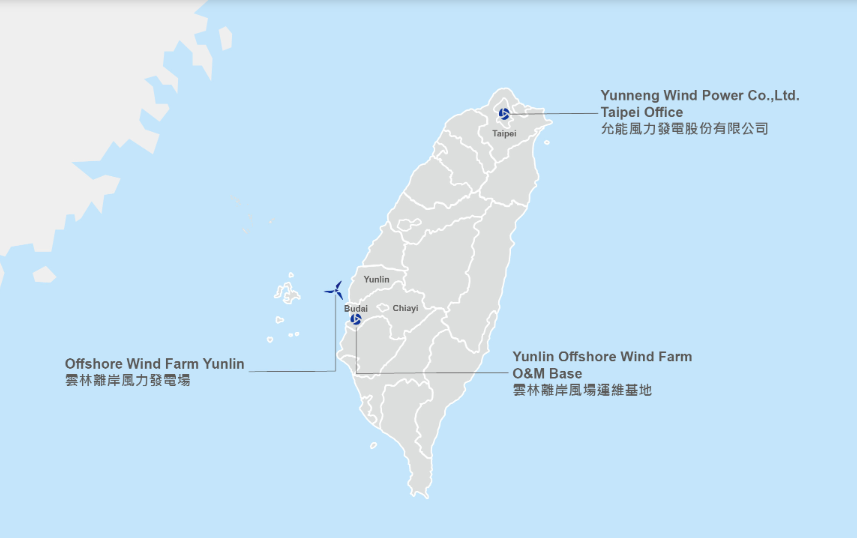
Yunneng Wind Power, which is developing the 640 MW Yunlin offshore wind farm, secured approval for financial restructuring from Taiwan’s Ministry of Economic Affairs and Energy Administration.
The project is run by TotalEnergies, Skyborn Renewables (Yunneng Wind Power is a subsidiary), Electricity Generating Public, and a Japanese consortium comprising Sojitz, Chugoku Electric, Chudenko, ENEOS and Shikoku Electric.
Located in the Taiwan Strait, at depths of 7 to 35 meters, the wind farm covers 82 km2. So far, 34 of the 80 Siemens Gamesa turbines are online. Generated electricity will be sold to Taipower under two 20-year power purchase agreements.
CONTEXT: The secured financing and regulatory approvals will enable Yunlin’s operators to proceed with the remaining installations this year, before launch of commercial operations. Investors include Japanese banks Mizuho, MUFG, and Sumitomo Mitsui Banking Corp.
In April, a consortium comprising shipping firm Nippon Yusen and Nippon Kaiyo, a surveying services provider, will open a training center for marine crew and operators of offshore wind power plants in Oga, Akita Pref.
The consortium plans to train around 1,000 people per year.
CONTEXT: The area off Oga’s coast and two other cities, Akita and Katagami, was selected for a 315 MW offshore wind farm, whose construction begins in June 2028.
Danske Commodities (DC) completed its first trade in Japan’s power futures market via the firm’s desk in Singapore. This is the company’s second market entry in the APAC region, following Australia, where it has been active since 2018.
Owned by Norwegian oil and gas producer Equinox, DC is active in 40 power markets across Europe, the U.S., Australia, Brazil and now in Japan.
CONTEXT: Japanese power demand is estimated to be twice the size of Germany’s, Europe’s largest. DC’s competitors such as RWE and Shell are also active in Japan.
Japanese companies tapped for UK offshore transmission link
(Japan NRG, Jan 10)
Kyushu Electric Transmission and Distribution, Kyuden International and U.K. infrastructure fund Equitix were chosen as the ‘preferred bidder’ for the transmission project of the 1.08 GW Seagreen Phase 1 offshore wind farm, (114 turbines).
The subsea and underground power cables (220kV) will be around 84 km in length and have 1.08 GW transmission capacity.
Scotland’s largest offshore wind farm, the $4 billion Seagreen became fully operational in October. It has the world’s deepest wind farm fixed-bottom foundations, at nearly 200 feet.
Currently, power is exported via around 19 km of underground cables from landfall at Carnoustie to a new substation at Tealing near Dundee.
CONTEXT: The Kyuden Group was selected from three bidders in the final tender stage. The ‘preferred bidder’ still needs to meet requirements to become a ‘successful bidder’. Next, Ofgem (the licensing organization) must decide whether the selected bidder meets all requirements before finally awarding the license.
TAKEAWAY: The Kyuden Group is expanding into overseas markets, and it was recognized in October 2023 with a global ESG energy transition award for its subsea DC transmission project in the UAE. This shows that Japanese power engineering companies have ambitions to become global leaders in the energy transition and not just in the domestic market.
By 2030, chemical company Kaneka plans to triple annual production capacity of solar panels integrated into the sides of buildings, so-called BIPVs, anticipating an increase in demand. The panels consist of high-performance solar cells placed between panes of glass.
Kaneka plans to increase the production capacity at its factory in Toyooka, Hyogo Pref and is considering building a new factory.
Current annual sales of all types of solar panels are estimated at ¥10 billion. But the company’s goal is to boost sales of BIPVs alone to ¥10 billion by 2030.
CONTEXT: The MoE will subsidize up to two-thirds of the cost of installing BIPVs in FY2024, which will start in April.
TAKEAWAY: Amid decarbonization efforts and a push for renewables, demand for PV panels, including for buildings in urban areas, is expected to increase by 2030. The BPIVs and other flexible PVs, such as perovskites (PSCs), are viewed as the backbone of the govt-backed campaign to reduce CO2 emissions through construction of net zero energy buildings (ZEB) and zero-energy housing (ZEH) and buildings with a net-zero annual primary energy consumption. The tech can be used in new and existing buildings.
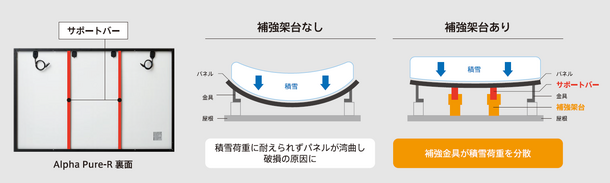
Solar module producer REC Solar Japan has developed a reinforced mount for solar modules in cooperation with Niigata Seihan, a manufacturer of products like metal doors with know-how of product application in snowy areas.
The frame is compatible with REC’s Alpha Pure-R solar panels that have a power output of 400-430 W and a panel conversion efficiency of 20.7% to 22.3%.
The panels are designed to withstand up to 2.3 meters of snow and salt-affected areas. This means they can be installed in heavy snow areas such as Hokkaido, Tohoku, and Hokuriku, where the maximum snow accumulation is 2.6 meters.
CONTEXT: Solar panel installation in snowy regions is problematic due to the lack of uniform guidelines for panel and mount installation. The frame developed jointly by REC Solar Japan and Niigata Seihan resembles a system used for gable roofs, and was developed to maximize load specifications while minimizing frame costs.
OCCTO set requirements for expansion of the Chubu-Kansai interconnection line. It also plans a new route separate from the existing Mie-Higashi-Omi line.
The ¥45 billion plan calls for building new switchyards in the Chubu and Kansai areas and installation of two 500kV transmission lines connecting the facilities. Capacity will double from 3 GW to 6 GW with the AC loop; construction will take 6 years.
Chubu Electric Power Grid and Kansai T&D will be responsible for the project and will submit an implementation plan by late Feb.
CONTEXT: Chubu Electric Power Grid, Hokuriku Electric T&D, and Kansai T&D already began construction work of the AC loop since Minami Fukumitsu connection station is set to cease operation in 2026.
In the wake of the quake that hit Noto peninsula on Jan 1, OCCTO issued an order for Kansai Transmission and Distribution to supply power to the Hokuriku region amid disruptions to Hokuriku Electric’s supply system.
The Kansai firm offered the following capacity via interconnection lines between Kansai and Hokuriku in three phases:
600 MW between 5 p.m. and 6 p.m.
another 600 MW between 6 p.m. and 10:30 p.m.
up to 550 MW from 10:30 p.m. until midnight.
On Jan 2, Hokuriku Electric secured enough power from the Spot Market and Intraday Market and did not require assistance from Kansai T&D that day.
As of Jan 4, the areas’ power reserve ratio exceeded 10%, which means the firm secured enough power for a stable supply.
During Japan’s deadly New Year earthquake, Shika NPP (Ishikawa Pref) experienced shaking beyond safety levels. Units 1 and 2 were not operating and there were no problems with operations such as cooling the pool with spent fuel rods.
The buildings also sustained no damage. Yet, six out of the 116 radiation monitoring posts set up within the premises could not operate properly on Wednesday.
A 3-meter tsunami hit the plant following the quake. Some of the power transformers in Units 1 and 2 were damaged and leaked oil, making some external power supplies unusable. The utility says it does not know when they can be repaired.
CONTEXT: Unit 2 of the Shika plant has been undergoing a safety review in preparation for restarting operations.
TAKEAWAY: While the govt declared that no accidents happened due to the earthquake, a new analysis by Hokuriku Electric brought up minor issues. Shika Unit 2, which ceased operations in 2011, was set to restart earlier but that was postponed to 2026. Now, the NRA is requiring Hokuriku Electric to further assess the impact of the recent earthquake. This will likely result in another delay of the restart.
The Tokai Village Assembly will submit a statement urging an early restart of Tokai NPP Unit No 2 (Ibaraki Pref). When asked about the matter, Governor Oigawa emphasized improving safety measures and effective evacuation plans.
In Nov 2023, Ibaraki Pref presented a simulation showing that in case of a nuclear accident at Tokai NPP, up to 170,000 people need to be evacuated. The simulation assumed the failure of all cooling and power facilities.
Critics said that the simulation is unrealistic. The evacuation plan does not take into account the lessons of the Fukushima nuclear disaster, as indoor shelter should be prioritized over mass evacuation.
CONTEXT: In March 2021, Mito District Court ordered Japan Atomic Power to suspend operations at Tokai NPP Unit 2 due to concerns about evacuation plans.
TEPCO began removing deposits from inside the lid of Unit 2 at Fukushima Daiichi NPP. The goal is to start debris removal using a robotic arm by late March.
TEPCO is also developing a thin tool that can be inserted into narrow gaps inside, in case the robotic arm cannot enter.
An estimated 880 tons of debris are in the building of the NPP.
TAKEAWAY: Removal of molten fuel is perhaps the most important part of the NPP’s decommissioning. While TEPCO has set a deadline for the trial removal, it’s likely that removing deposits from the lid will cause delay. Also, TEPCO has yet to establish a detailed plan for debris removal. While it’s considering other options besides the robotic arm, changing methods will require NRA approval, thus further delaying the plan.
The Fire and Disaster Management Agency launched a fact-finding survey of biomass power plants in the wake of increasing fire incidents at plants that use wooden pellets.
Plant operators include JERA, Osaka Gas and Kansai Electric. Imports, which doubled from 2018 to 2021, dominate the wooden pellet supplies. They can ferment and absorb moisture if not managed properly, causing fire from chemical reactions.
TAKEAWAY: In Dec 2023, the Fire Agency issued new pellet guidelines for storage. Municipalities, however, must enforce the guidelines, not the Fire Agency. The fact-finding survey was launched to seek effective solutions.
Tokyo Gas plans to complete the sale of four stakes in its Australian LNG portfolio at the end of Feb, for about ¥3.1 trillion.
The deal includes the Ichthys project, in which Tokyo Gas has about a 1.5% stake. After the sale, Tokyo Gas’ purchase contracts for LNG will remain in place.
Kyushu Electric seeks a 10% stake in Lake Charles LNG in Louisiana, and is also in talks with other Japanese companies to buy 1.6 mpta of LNG for 20 years.
Lake Charles LNG plans annual production of 16.5 mpta. Operations start in 2028. Financing may come from JOGMEC and Japan Bank for International Cooperation.
CONTEXT: In accordance with western sanctions, Japan needs to find alternative options to its Russian energy supplies, even though deliveries from the Sakhalin projects are exempt. Still, current LNG contracts with Sakhalin-2 are due to expire around 2030 and without that volume the Japanese economy would suffer. In 2022, U.S. LNG production became the world’s largest, driven by the EU’s soaring demand as it slashed imports of Russian pipeline gas.
Hitachi Zosen Marine Engine (HZME) inked an agreement with Saibu Gas for supply of 46 tons of “carbon neutral” LNG.
HZME plans to use “carbon neutral” LNG in an onshore four-cylinder test engine in March 2024. The goal is to achieve a CO2 reduction of 65 tons per day compared to conventional LNG and 86 tons per day compared to heavy oil-fired engines.
CONTEXT: “Carbon neutral” LNG involves offsetting GHG emissions generated throughout the process from natural gas extraction to combustion using CO2 credits. It allows LNG buyers to say that through their purchase and use of the fuel they are not contributing to additional CO2 emissions.
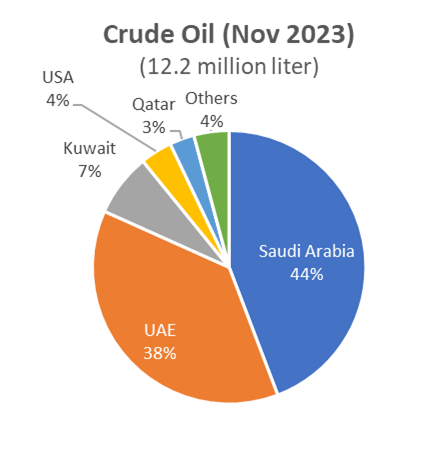
In Nov, Japan imported 12.2 kiloliters of crude oil, nearly 80% accounted for by Saudi Arabia and UAE. Together with Kuwait, Qatar, and Oman (0.6%), Japan still depends on over 90% of crude oil from the Middle East. Others in the graph include Ecuador, Oman, Australia, Vietnam, Indonesia, Vietnam, Colombia, and South Sudan.
Imports
Volume
YoY
Value (Yen)
YoY
Crude oil
12.206 million kiloliters (76.3 million barrels)
-18.3%
¥1,083 billion
-12.16%
LNG
5.33 million tons
-12.1%
¥494 billion
-39.5%
Thermal coal
8.314 million tons
-21.55%
¥223 billion
-60.1%
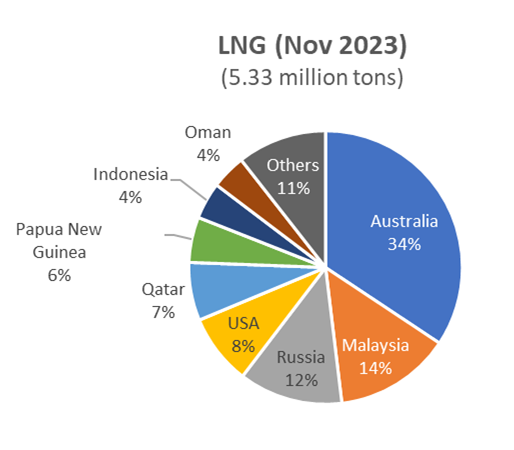
LNG imports in Nov totaled 5.33 million tons, of which 34% came from Australia. Import volume increased 12.1% YoY, but the value decreased drastically (-39.5%). Others in the graph include UAE, Brunei, Nigeria, Algeria, and China.
Asia saw a record-high import of seaborne thermal coal in Dec, driven by China’s increased demand during peak winter consumption.
Despite robust demand, prices remained muted due to strong exports from Indonesia and Australia.
Japan and South Korea had subdued demand, contributing to the muted prices. While Japan’s imports rose in Dec, they still fell short of the same month in 2022.
LNG stocks of 10 power utilities at end Dec was 2.7 million tons, up from 2.49 mt a week earlier. This is 6.7% up over end Nov in 2022, and 31.1% higher than the past five-year average of 2.06 mt.
As of Jan 7, LNG stocks were down to 2.51 mt, 5% up from end Dec in 2022, and 31.4% higher than the five-year average of 1.91 mt.
ANALYSIS
BY FILIPPO PEDRETTI
Japan Bets Big on Green Finance, Prepares World’s First Sovereign Climate Bonds
After nearly three years promoting energy transition finance, next month Japan will finally issue sovereign transition bonds for the first time. Officially known as Japan Climate Transition Bonds, they’re popularly known as “GX bonds”. The goal is to raise up to ¥20 trillion over 10 years through this new instrument to support areas of the energy transition not covered by the more specific ‘green bonds’.
The debut of the GX bonds would be the first time any country issues such a financial instrument with international third-party verification. If successful, Japan will set a precedent for countries in Southeast Asia and elsewhere to raise funds for decarbonization projects outside of the traditional green sectors, such as renewables.
The bond sale faces obstacles, however. Those investors most interested in financial products linked to decarbonization tend to focus on activities that are widely accepted as “green” across the various national taxonomies. Japan’s emission reduction strategy, however, relies in part on new technologies such as ammonia-firing at coal power plants. That approach is under heavy criticism from environmental groups and some energy consultancies like BNEF, which see it as a means to prolonging the use of coal.
As Japan’s finance ministry prepares the first two tranches of GX bonds (a 10-year and then a 5-year note), PM Kishida’s government will need to “sell” its energy strategy to a largely skeptical international investor community. That’s further complicated by uncertainty around the future course of the yen and the inevitably low yields of Japanese sovereign bonds.
Meanwhile, a GX bond issuance that draws interest only from domestic investors could hamper Japan’s hopes to take the lead in decarbonization across Asia.
Global standards for sustainability bonds
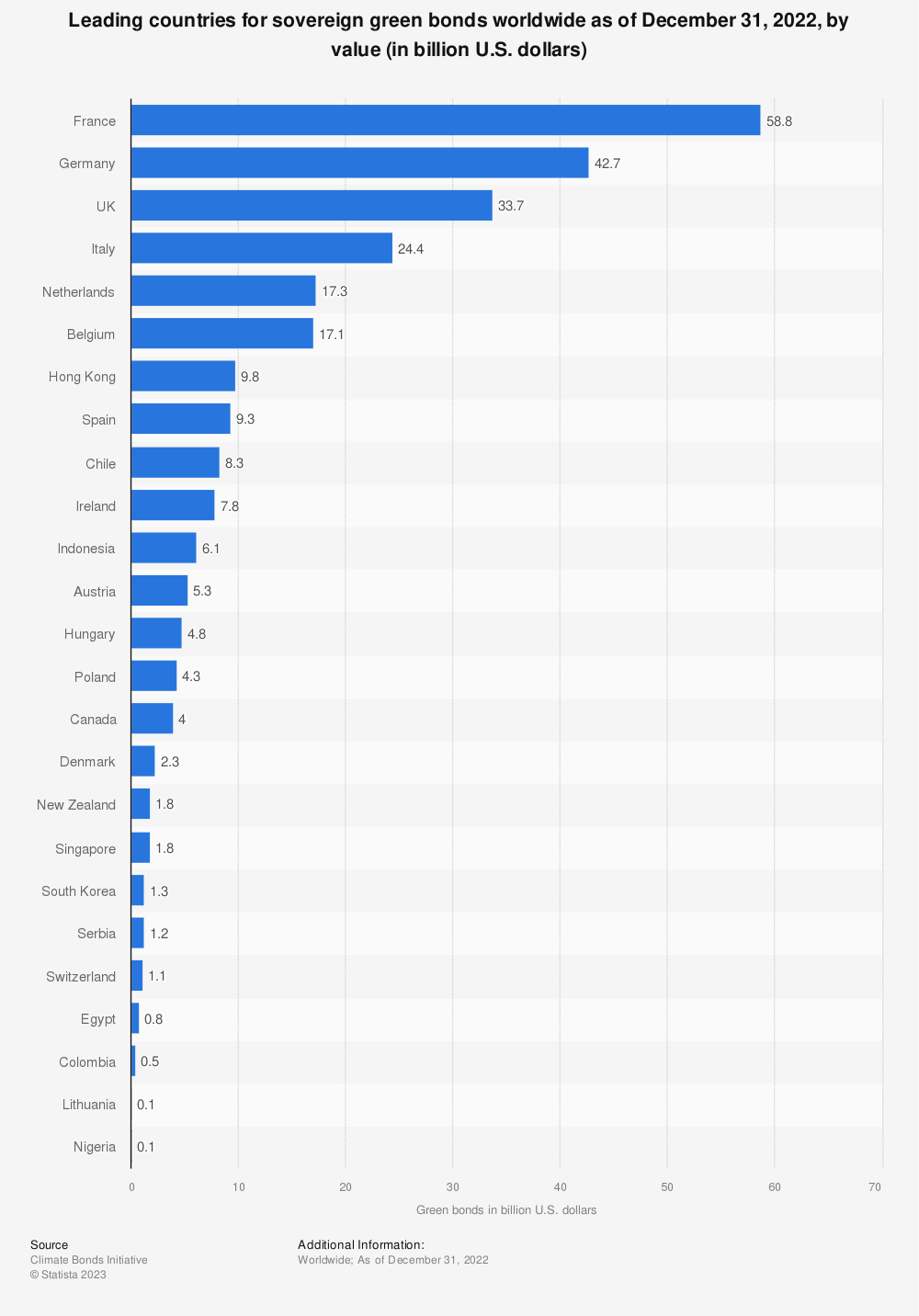
As of the end of 2022, at least 25 countries had issued sovereign debt designated as a “green bond” by the Climate Bonds Initiative, with European nations the overwhelming leaders in this field. In Asia, only Hong Kong has sold any sizable amount of green bonds.
Japan, as a nation, has never sold green bonds, although municipalities such as the Tokyo Metropolitan Government and a number of corporations have done so. Instead, Japan’s government has put its support behind the broader “transition” financing schemes, which has culminated in the GX Bonds sale. That said, the government is keen to point out that it aims to apply a similarly strict approach for its GX offering similar to that utilized in green bonds.
Globally, the International Capital Markets Association (ICMA) provides guidelines that constitute the basis for sustainability bonds worldwide. Such standards require that issuers clearly identify the use of proceeds and ensure transparency in financial management that’s distinct from non-sustainability bonds.
Furthermore, specific criteria for evaluating and selecting projects must be followed, with regular reports provided to investors on the progress of a project. Of the G7 members, only the U.S. and Japan have not issued green bonds that comply with ICMA standards.
In fall 2023, Japan established a framework for the issuance of Japan Climate Transition Bonds as specified in the GX Promotion Law that was ratified in June 2023. The guidelines seek to facilitate the labeling of low-carbon and decarbonization investments as “transition bonds / loans.”
The government claims it adheres to ICMA’s global standards and outlines both the application of funds and the transition strategy. Japan has received two Second Party Opinions (SPOs) from independent external evaluators and acquired SPOs from Japan Credit Rating, and from DNV, a Norway-based classification body that also specializes in risk management.
Within this framework, the government is preparing to launch a public auction for transition bonds in February: an ¥800 billion 10-year tranche on Feb 14 and a similar size 5-year tranche on Feb 27. The bulk of this money, or ¥1.1 trillion, will actually be used to “refund” existing government spending on GX-related projects that was paid for originally through the issuance of 6-month government debt.
Going forward, bonds with duration of two, five, 10 and 20 years will be issued. Details such as maturity date, interest payment dates, coupon rates, and more, will be similar to regular Japanese government bonds. The government has chosen a series of investment banks with experience in the Environmental, Social and Governance (ESG) to help with marketing the sales.
BNP Paribas Securities (Japan) Limited
Citigroup Global Markets Japan Inc.
Daiwa Securities Co. Ltd.
Mitsubishi UFJ Morgan Stanley Securities Co., Ltd.
Mizuho Securities Co., Ltd.
Nomura Securities Co., Ltd.
SMBC Nikko Securities Inc
Source: METI
The broader GX plan is to use these sovereign bond issuances to stimulate further public and private investment into decarbonization projects to the tune of ¥150 trillion over the next decade. That’s the amount METI estimates as necessary to help reach the nation’s climate goals by 2050.
Green bonds, Transition bonds, and Govt bonds
Standard government bonds and transition bonds have different purposes. Unlike other government bonds whose interest repayment is funded primarily from taxes, the transition bonds will pay back investors thanks to a new surcharge on fossil fuels starting FY2028 and the introduction of a cap on carbon emissions and a related emissions trading system (ETS).
The GX Promotion Act has already designated the new bonds for use in transition and decarbonization goals. Such purposes also differentiate transition bonds from green bonds. While the latter are more specific around what technologies they can allocate the funds for and regulated by the ICMA’s ‘’Green Bond Principles’’, transition bonds represent a broader commitment to decarbonization and sustainability. In short, as long as the project cuts emissions or increases sustainability, it can pass muster.
Examples of the use of green bonds include funding the production of energy from renewable sources, zero impact transport, and waste recycling. Transition bonds, however, could help to support a shipping firm’s shift from oil-fueled vessels to ones that run on the less-polluting natural gas, or help refit a power plant to use gas instead of coal.
According to the government, GX bonds money will be used for technologies including hydrogen, CCUS, synthetic fuels and small nuclear reactors. The investments will be decided on several principles, first and foremost the dual goal of economic growth and emission reductions (especially for high emission sectors).
Analysis of emission reduction consequences, such as marginal abatement cost and profit analysis, will also be taken into account. Details will be decided by the GX Implementation Council that’s chaired by the Prime Minister.
Potential areas for GX financing
Manufacturing Industry
Introduction of technology for direct reduction of iron ore using hydrogen, carbon circular production system
Transportation sector
Next-generation vehicles, aircraft and zero-emissions vessels
Carbon recycling, CCS
R&D on carbon-recycled fuel
Energy saving
Insulated windows
Renewable energy
Perovskite, floating offshore wind
Next-generation reactors
New reactors with enhanced safety mechanisms
Hydrogen and ammonia
Establishment of domestic and international supply chains, R&D for hydrogen production from renewables
Electricity and gas markets
Promotion of zero-emission thermal power generation, submarine DC power transmission
Source: METI
Challenges ahead
As noted earlier, Japan has no sovereign green bond, but the issuance of such bonds by local governments, albeit small and illiquid, will now prove useful as they will act as a pricing reference. Over the previous year, these bonds have shown a “greenium,” (the premium that investors are willing to pay in order to acquire a green bond.) Likely, the GX bonds will also benefit from a similar greenium.
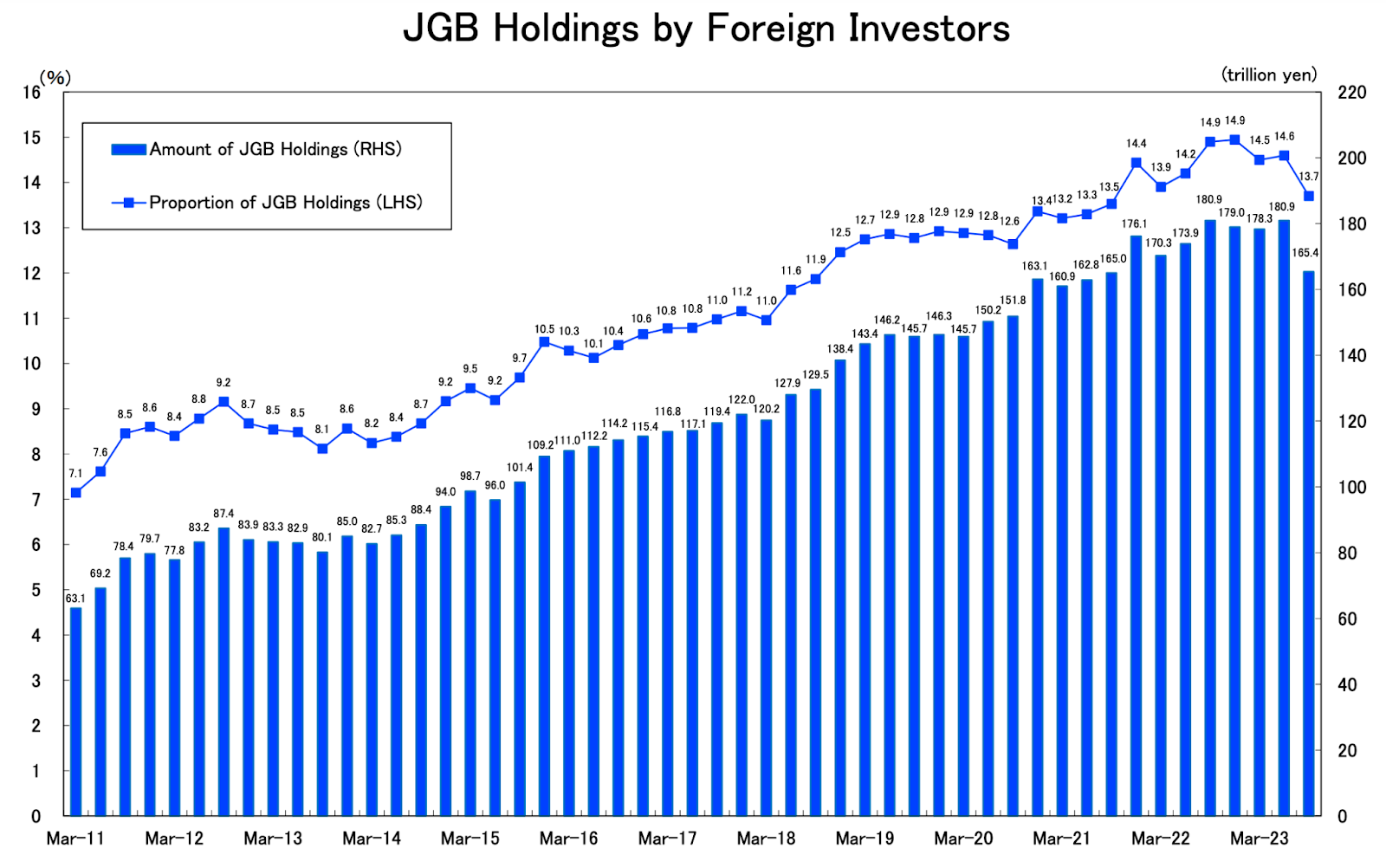
Coupon rate will also be key to attract foreign investor interest. Foreign owners held just 13.7% of (treasury) JGBs and other government debt in the fall of 2023, twice the proportion of a decade ago, but still relatively low for sovereign issuances due to the deliberate actions of the Bank of Japan to depress interest rates.
Japan will likely need to market the bonds to investors attracted by the environmental angle of the product, and who could accept a lower coupon in return for the reputational and social impact. This group of investors will be most keen to monitor the spending of the bonds and will be most sensitive to civil society critique, such as claims of ‘greenwashing’.
Source: Ministry of Finance
Yet, while Japan might find skepticism among some western investors, it will be worth keeping an eye on the level of interest that GX bonds will receive from Middle East sovereign wealth funds and Asian capital. The reaction of Asian Zero Emission Community (AZEC) countries will be particularly important for Japan.
After the inaugural summit meeting in Tokyo last year, the AZEC group released a statement underscoring the significance of “transition finance” as an instrument to achieve transition throughout all segments of the economy. Many within AZEC will hope that Japan can break through the limitations of green financing to normalize its much smaller cousin, transition financing.
If GX bonds succeed, Tokyo may finally have pioneered a product on which to build its aspirations to become a financial hub for Asia’s energy transition.
ANALYSIS
BY JOHN VAROLI
Japan: Energy Supplies and Living with Tumult in the Middle East
The global economy has matured since the energy shocks of the 1970s and mid 2000s, but the perception remains that geopolitical crises in the Middle East could potentially send energy prices soaring at any moment. During last week’s Global Energy Outlook Forum 2024 hosted in Tokyo by Gulf Intelligence, 56% of participants surveyed said that geopolitical events are likely to disrupt Middle Eastern energy supplies in 2024, while 44% disagreed.
Perception is one thing and reality another. The fact is that since the end of the Arab oil embargo in the 1970s, Middle Eastern energy supplies to global markets have not faced serious disruption. Even during the U.S. war in Iraq (2003-2011), energy exports from the region remained stable.
Risk from armed conflict is now accepted as an inherent feature of trade with the Middle East. In fact, Japan, the world’s fourth-largest oil buyer, has increased its share of Middle Eastern oil, from 77% of the country’s total imports in 1973 to nearly 95% today.
U.S. strikes on Yemen
Tensions in the Middle East rose a notch early Friday morning when a coalition led by the U.S. fired missiles to subdue Houthi militants that target ships heading to Israel via the 30-kilometer-wide Bab al-Mandab strait that flows past Yemen.
The U.S. seeks to contain Houthi attacks, but the militant group said it remains determined to target ships destined for Israel. That’s not mere bluster – the Houthis have already beaten back Saudi Arabia and the U.S. in a seven-year war.
So far, the U.S. strikes have had minimal impact on energy markets, with Brent crude rising a measured 4.3% to $80.75 a barrel; that’s still far below the $93.68 high on September 27, 2023. One main reason for the subdued market response is growing U.S. production. S&P Global Commodity Insights reported that in the fourth quarter of 2023, the U.S. produced a global record of 13.3 million barrels per day of crude and condensate.
“Oil prices have stabilized and it’s only because of the American energy revolution,” said Mike Sommers, CEO of the American Petroleum Institute. “American oil and gas producers should be thanked for ensuring that volatility hasn’t gone in an upward direction. Ten years ago, if this same situation was occurring, we’d be dealing with significantly higher oil prices.”
Caught in the crossfire
Nevertheless, Japan has found itself caught in the crossfire. In November, while travelling from India to Turkey the Galaxy Leader, a ship owned by an Israeli businessman and operated by Japan’s NYK Line, was seized by Houthi militants. That incident was enough to spook major global shippers.
So far, more than $280 billion in goods have been diverted to longer routes around South Africa, and so, since December the average cost of shipping a 20-foot container from Shanghai to Rotterdam has more than doubled to $3,103.
While as much as 91% of container ship traffic now avoids sailing past Yemen, oil tankers are willing to take the risk. Oil research firm Vortexa says that, on average, nearly 8.2 mbpd of oil and oil products transit the Red Sea. Russian oil is the single largest transit flow, accounting for 2.8 mbpd, or 34% of the total, but the Houthis aren’t interested in these ships.
Before Friday’s U.S. missile attack, there were “no confirmed diversions” among transiting oil tankers via the Red Sea, said Vortexa. Following Friday’s missile strike, however, the International Association of Independent Tanker Owners, which represents almost 70% of all internationally traded oil, gas and chemical tankers, warned members to “stay well away” from the Bab al-Mandab strait. How this might impact oil prices remains to be seen.
Fossil fuel purchases set to decrease
Japan’s Middle East energy supplies come via the Persian Gulf, not the Red Sea. But that doesn’t mean they’re safe; Houthi missiles can reach ships in the Persian Gulf. While the U.S. Navy has a strong presence in the region, it can’t escort each of the hundreds of ships that pass within Houthi range each day.
Of the 2.75 mbpd of oil that Japan imported in August, the biggest suppliers were Saudi Arabia (1.14 mbpd), the UAE (1.12 mbpd) and Kuwait (200,000 bpd). While the U.S. is the world’s biggest oil producer, it’s a small supplier to Japan, delivering only 42,000 bpd. As far as LNG, about 40% of Japan’s imports come from Australia, while 12% come from Qatar, Oman and the UAE.
In the event of a short term supply disruption, Japan could tap its strategic oil reserves, which total about 480 million barrels and that METI estimates to be about 236 days’ worth of average consumption. Meanwhile, Japan has only recently launched plans to create an LNG reserve. In any case, storage of the chilled gas in Japan beyond a few weeks isn’t an option.
Overall, Japan’s fossil fuels demand is declining since the country is determined to meet climate goals and power conservation measures are having an effect. According to the International Energy Agency, in 2021 Japan’s petroleum demand dropped to 3.3 mbpd down from 4.2 mbpd in 2010; that’s expected to fall to 2.7 mbpd in 2030. Also, Japan plans to cut LNG’s role in the power sector to 20% by 2030, down from 37% in 2019.
As Japan brings dormant nuclear power back online, encourages more energy conservation, and builds more solar and wind capacity, it’s likely that the impact of Middle Eastern geopolitics on energy supplies will notably ease. In the short term, however, Tokyo will be monitoring the events with a strong degree of concern.
ASIA ENERGY REVIEW
BY JOHN VAROLI
This weekly column focuses on energy events in Asia and the Pacific, and all that impact markets in the region.
Australia / Battery storage
Recurrent Energy, a solar power company, sold its Mannum energy storage project in South Australia to Epic Energy. This is the third Mannum energy storage unit that Recurrent sold to Epic. Mannum Stage One has a 7 MW capacity, and Mannum Stage Two has a 39 MW capacity.
China / Solar power
Solar production costs reached $0.15 per power watt in 2023, declining 42% YoY, giving manufacturers in China a cost advantage, reports Wood Mackenzie, adding that costs in the EU and the U.S. were at $0.30 and $0.40 / watt, respectively. In India, solar production prices were $0.22 / watt
Coal imports
Asia’s imports of seaborne thermal coal reached 83.69 million tons in Dec, up from 78.87 MT in Nov and the highest registered by analysts Kpler since early 2017. Top buyer China scooped up cargoes amid peak winter demand.
India / Solar power
India installed 13 GW of renewable energy capacity in 2023, of which 10 GW was solar PV, a 28% annual drop in PV additions and an 18% drop in overall renewables capacity additions. India’s total renewable energy capacity is now 134 GW, of which solar has a 55% share.
Kazakhstan / Uranium production
Kazatomprom, the world’s largest producer of uranium with more than 20% of global output, warned that its production this year would be lower than expected because of shortages of sulphuric acid, which is essential to extract uranium from ore.
LNG imports
Asia’s LNG imports rose to a record high in Dec, but spot prices remained subdued as shipments from Australia and the U.S. also hit record highs. Asia saw imports reach 26.61 million tons in Dec, according to Kpler. This was up from Nov’s 23.35 MT, eclipsing the previous high of 26.15 MT in Jan 2021
Malaysia / Renewables
Sunview Group inked a MoU with Vision Ambassadors Company (Saudi Arabia). The main focus is identifying and investing in opportunities for renewable energy. Both will work as principal investors. Sunview will also handle engineering, procurement, and construction.
South Korea / Nuclear fusion
The Korea Superconducting Tokamak Advanced Research (KSTAR) upgraded its divertor from carbon to tungsten to longer withstand super hot temperatures. Since the fusion industry achieved “ignition,” the next step is designing components that can withstand plasma many times hotter than the Sun. The divertor handles the hottest surface temperatures in fusion devices known as tokamaks.
Thailand / Wind power
TotalEnergies sold a 25.5% stake in the Seagreen offshore wind farm (UK) to Thailand’s national oil and gas company, PTTEP, for £522 million. TotalEnergies will retain 25.5% of Seagreen, and SSE Renewables will maintain its 49% stake.
Uzbekistan / Clean energy
The UAE’s renewables developer, Masdar, inked a deal with Uzbekistan to develop a 2 GW wind farm and 500 MWh of battery energy storage, as well as 1.15 GWh of battery energy storage capacity on five Masdar projects. The company has over 1.4 GW worth of clean energy projects connected to Uzbekistan’s power grid.
2024 EVENTS CALENDAR
A selection of domestic and international events we believe will have an impact on Japanese energy
January
First market trading day (Jan 4)
Japan’s Diet convenes (January)
The first Long-Term Decarbonization Power Source Auction
Renewable Energy Exhibition (Jan 31 – Feb 2)
Taiwan presidential election (Jan 13)
February
India Energy Week 2024 (Feb 6-9)
Smart Energy Week (Feb 28-Mar 1)
Lunar New Year (Feb 10-17)
CFAA International Symposium (Feb 2)
Indonesia presidential election (Feb 14)
FIT/FIP solar auction (Feb 19 – March 1)
Japan-Ukraine Conference for Promotion of Economic Reconstruction (Feb 19)
March
Announcement of the last auction result for Offshore Wind Round 2 (for Akita Happo-Noshiro area)
Onshore wind auctions (March 4-15; results on March 22)
International LNG Congress (LNGCON) 2024, Milan (March 11-12)
Russian presidential election (March 15-17)
Ukraine presidential election (due before March 31)
World Petrochemical Conference, Houston, TX, (March 18-22)
End of Japan’s fiscal year 2023 (Mar 31)
April
Details of 2024 capacity auction results released
Japan Atomic Industrial Forum (JAIF) Annual Conference
Global LNG Forum (Apr 15-16), Madrid, Spain
Global Hydrogen & CCS Forum (Apr 17-18), Madrid, Spain
World Energy Council (WEC), Rotterdam, Netherlands (Apr 22-25)
May
May Golden Week holidays (May 3-6)
World Hydrogen Summit (May 13-15)
June
Japan Energy Summit & Exhibition (June 3-5)
G7 Summit in Italy
International Conference on Oilfield Chemistry and Chemical Engineering (IOCCE), Tokyo (June 10-11)
American Nuclear Society (ANS) Annual Conference, Las Vegas (June 9-12)
Happo Noshiro, Murakami-Tainai, Oga-Katagami-Akita and Saikai-Eshima wind project auctions close (June 30)
July
Tokyo governor election (July 7)
7th Basic (Strategic) Energy Plan draft published (expected)
August
7th Basic (Strategic) Energy Plan draft presented to Cabinet (expected)
September
The United Nations Summit of the Future (Sept 22-23)
Gastech 2024, Houston, TX, USA (Sep 17-20)
IAEA General Conference
GX Week in Tokyo (expected late Sept to October)
Asia Green Growth Partnership Ministerial Meeting
Asia CCUS Network Forum
International Conference on Carbon Recycling
International Conference on Fuel Ammonia
GGX x TCFD Summit
October
IEA World Energy Outlook 2024 Release
BP Energy Outlook 2024 Release
Innovation for Cool Earth Forum (expected)
Connecting Green Hydrogen Japan 2024 (Oct 16-17)
Japan Wind Energy 2024 Summit (Oct 16-17)
Solar Energy Future Japan 2024 (Oct 16-17)
Japan Mobility Show (Oct 25-Nov 5)
November
U.S. presidential elections (Nov 5)
COP 29 in Azerbaijan (Nov 11-22)
Abu Dhabi International Petroleum Exhibition Conference (ADIPEC) 2024, Abu Dhabi, UAE (Nov 11-14)
International Conference on Nuclear Decommissioning (TBD)
G20 Rio de Janeiro Summit (Nov 18-19)
Biomass & BioEnergy Asia Conference (TBD)
European Biomethane Week 2024
December
Last market trading day (December 30)
Disclaimer
This communication has been prepared for information purposes only, is confidential and may be legally privileged. This is a subscription-only service and is directed at those who have expressly asked K.K. Yuri Group or one of its representatives to be added to the mailing list. This document may not be onwardly circulated or reproduced without prior written consent from Yuri Group, which retains all copyright to the content of this report.
Yuri Group is not registered as an investment advisor in any jurisdiction. Our research and all the content express our opinions, which are generally based on available public information, field studies and own analysis. Content is limited to general comment upon general political, economic and market issues, asset classes and types of investments. The report and all of its content does not constitute a recommendation or solicitation to buy, sell, subscribe for or underwrite any product or physical commodity, or a financial instrument.
The information contained in this report is obtained from sources believed to be reliable and in good faith. No representation or warranty is made that it is accurate or complete. Opinions and views expressed are subject to change without notice, as are prices and availability, which are indicative only. There is no obligation to notify recipients of any changes to this data or to do so in the future. No responsibility is accepted for the use of or reliance on the information provided. In no circumstances will Yuri Group be liable for any indirect or direct loss, or consequential loss or damages arising from the use of, any inability to use, or any inaccuracy in the information.