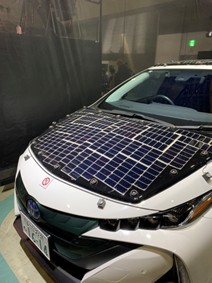
A year ago, the Kawasaki city authority launched a zero-emission EV station that charges with solar power generated from panels installed on the garage rooftop. However, a half-day was needed to fully recharge a Toyota Motor vehicle. But what if there was another option. What if an EV driver had a solar-powered car with panels on the car’s roof? This revolutionary idea would forgo the need for charging stations, and could potentially upend the current EV business model and its charging paradigm.
Japan seeks to make hydrogen work as a decarbonization pathway for homes, even if the approach differs from that of overseas. The government is keen to bring examples of hydrogen use into visibility for ordinary citizens to build support for the clean-burning fuel. A central Tokyo district is playing host to an experiment of using hydrogen to power communal facilities and transport, with families already moving in. Similar lifestyle applications of hydrogen are being tested elsewhere in Japan.
ASIA ENERGY VIEW
A wrap of top energy news that impacts other Asian countries.
EVENTS SCHEDULE
A selection of events to keep an eye on in 2024.
JAPAN NRG WEEKLY
PUBLISHER K. K. Yuri Group
Editorial Team Yuriy Humber (Editor-in-Chief) John Varoli (Senior Editor, Americas) Mayumi Watanabe (Japan) Wilfried Goossens (Events, global) Kyoko Fukuda (Japan) Magdalena Osumi (Japan Filippo Pedretti (Japan) Tim Young (Japan)
The Ministry of Finance announced the results of bidding for the inaugural sale of Japan’s 10-year Climate Transition Bonds. These bonds will support CO2 emission reduction in specific high-polluting sectors.
On offer were ¥799.5 billion of bonds. The bidding amount was three times greater: ¥2.32 trillion.
These bonds have an interest rate of 0.74%; the redemption date is Dec 20, 2033.
CONTEXT: Regular 10-year Japanese government bonds yielded 0.755% on Feb 14, according to Reuters.
TAKEAWAY: This is the first sale in a ¥20 trillion, decade-long program envisaged by PM Kishida as a way to kickstart an even larger ¥150 trillion wave of spending to transform the Japanese economy by reducing its carbon footprint. The proceeds are expected to go towards projects in wind, hydrogen, batteries, nuclear, SAF and cutting-edge hardware and software that will power developments in digital and AI. Contrary to some media reports, the remit of the bonds also includes ammonia-related projects.
Climate transition bonds are a new class of bonds created by Japan to promote steps towards CO2 reduction that fall outside of the remit of traditional green bonds, which focus primarily on renewable energy. The bond category will bring financing to hard-to-abate sectors, but not only. Many will be watching these bonds to see whether these sales stimulate interest in a new sub sector of financial instruments related to decarbonization.
The ANRE Director for Energy Conservation and Renewable Energy, and his counterpart in the Hydrogen Economy Policy Bureau of South Korea’s Ministry of Trade, Industry and Energy agreed to set up a framework for hydrogen / ammonia cooperation.
Cooperation will include global supply chain building and application development, setting codes and standards, and sharing experiences for policy implementation.
CONTEXT: In November, PM Kishida proposed to South Korean President Yoon to build hydrogen and ammonia supply chains together.
TAKEAWAY: There is clearly a geopolitical angle to this given the rapprochement between the two countries since President Yoon took office. However, there is also a valid business case for the two countries to collaborate in the formation of the new hydrogen and ammonia sector; Japan and South Korea were the leaders in LNG and spearheaded its growth from a niche into one of the world’s largest energy markets. There are also some who believe that hydrogen transportation and storage will follow similar engineering solutions to that of natural gas / LNG.
Mitsui OSK Lines (MOL) joined a consortium studying the use of liquefied hydrogen in marine transportation in Asia. The study is conducted by Woodside Energy, HD Korea Shipbuilding and Offshore Engineering, and Hyundai Glovis.
If the project goes ahead, then Woodside would produce and deliver hydrogen to ports; HD KSOE would design and build a vessel with a 80,000 m3 tank.
Hyundai Glovis and MOL would provide input on vessel design regarding propulsion and handling of liquefied hydrogen. The first ships could start operation by 2030.
CONTEXT: The 80,000 m3 tank will have a capacity to carry 4,800 tons of liquefied hydrogen. The ship is half the size of the CC61H hydrogen carrier developed by Kawasaki Heavy Industries, which is possibly the world’s largest.
The PM’s Cabinet approved the proposed CCS Business Act, and the Act to Promote Low-Carbon Hydrogen Supply and Drive Green Transformation.
The CCS Business Act defines rights and liabilities associated with carbon capture and storage, and a new licensing system.
The Low-Carbon Hydrogen Act will set subsidies to build hydrogen and ammonia hubs, and to fill the gap between costs and end-user prices.
CONTEXT: The House of Representatives will discuss the proposals in coming weeks.
TAKEAWAY: The swift passing of the Cabinet stage shows the importance that Japan’s govt places on the development of a CCS industry. Several CCS projects in Southeast Asia are waiting on this legislation to serve as a framework for their own development.
The ruling LDP lawmakers’ council on the energy transition, and related next-gen tech, held a general meeting on Feb 14.
Deputy PM Aso, an advisor to the group, said focus should be on tech such as floating offshore wind power and new types of solar modules that can attach to walls.
Aso suggested hearing from experts on recent developments in wind and solar power generation; ANRE and other experts stressed the importance of domestic production of wind turbines, given the absence of Japanese manufacturers.
TAKEAWAY: There are several LDP lawmaker groups on the energy transition. This is the newest group, formed last year. The Lawmakers Federation to Promote and Expand Renewables, which was formed about a decade ago, has been advocating floating offshore wind and perovskite solar tech development but the group lost steam following the arrest of the federation secretary general Akimoto Masatoshi for alleged bribery.
Sumitomo Corp of Americas will partner with Louisiana Green Fuels (a subsidiary of Strategic Biofuels) to develop a $700 million biorefinery project. Construction on the project is expected to begin in early 2025.
Sumitomo agreed to a 20-year offtake for renewable fuels produced by LGF.
SAF will be the main renewable fuel product, and annual production could reach 2.4 mln metric tons. The biorefinery will utilize sequestered carbon.
Sumitomo will lead in organizing a Japanese consortium to help fund the biorefinery. The State of Louisiana is pledging a $200-million tax-free bond allocation.
On Feb 14, the NRA began discussions on updating indoor sheltering and evacuation guidelines to brace for nuclear incidents.
The Jan 1 earthquake near the Noto Peninsula showed that increased incident preparedness is required as the quake resulted in community isolation and major damages, chairman Yamanaka said.
The NRA plans to set up a task force to review the guidelines within this fiscal year, aiming to update them in FY2024.
The task force is expected to study combining temporary shelters and evacuations to flexibly cope with diverse situations, as well as issues like when to lift emergency procedures, etc.
Sekisui Chemical and the Ministry of Economy of Slovakia signed an MoU to study the implementation of perovskite solar cells (PSC), including regulatory issues.
Slovakia will engage with its agencies and universities to identify challenges and possible solutions, and assess PSC’s potential in carbon neutrality, as well as business strategies in the EU market.
TAKEAWAY: METI’s approach to PSC has been protectionist, calling it the “rising sun technology” and discouraging cooperation with foreign firms. But now METI is changing its tune and seems open to international collaborations. In January, another PSC tech firm EneCoat Technologies delivered a presentation to investors in Singapore.
Sekisui’s R&D goal is to set up automated mass manufacturing of one-meter wide modules. However, these have low power efficiency of 15% and need large installation areas to be a reliable power source. Some researchers question Sekisui’s research, saying small modules could be fastened together for large installations. European PSC firms address the performance issue by developing “tandem modules”, which combine perovskite and silicon or another material to raise power efficiency to over 20%.
Global Thermostat, a U.S. startup offering tech for direct air capture (DAC), began full operations in Japan in cooperation with Tokyo Gas and Sumitomo Corp.
Global Thermostat will sell DAC equipment in Japan and also aims to adopt its products for CCS and CCU projects.
Tokyo Gas was the first Japanese energy company to invest in and collaborate with Global Thermostat. Trading house Sumitomo also invested in the company.
CONTEXT: Global Thermostat’s DAC tech utilizes solid adsorbents and honeycomb materials for CO2 capture. A commercial-scale DAC facility capable of capturing over 1,000 tons per year was launched in 2022. The firm says it is capable of building a million-ton recovery facility.
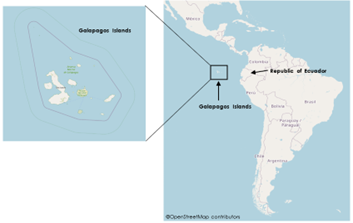
Chubu Electric, consultancy firm Nippon Koei, and SeED Okinawa inked a consulting service agreement with the Japan International Cooperation Agency (JICA) for a decarbonization project on the Galapagos Islands.
The firms will work with the government of Ecuador to set roadmaps for a fossil fuel-free Galapagos, including through the use of geothermal and other renewables, and also by combining diesel generation with renewables, storage batteries, etc.
The project will run from Feb 2024 to Feb 2027.
CONTEXT: Thermal power generation (mainly diesel), accounts for the majority of electricity produced on the Galapagos. Local power demand is expected to rise as the population increases.
Sharp has launched a converter for EVs, creating a V2H system that connects EVs with home appliances.
The system links solar power generation, storage batteries, and EVs, enabling integrated control of EV recharge / discharge.
The company claims that the EV converter is the smallest and lightest (505 × 194 × 347 mm; 23 g) available and can be installed on the wall of a house.
METI has approved moving suitability reviews at Suttsu and part of Kamoenai, both in Hokkaido Pref, to the second stage. The localities are under assessment as potential hosts of a national hub for the final disposal of highly radioactive waste.
CONTEXT: Both candidate sites passed the first stage of review, a so-called literature survey. The next stage is an “overview” survey. The third and last stage is an “elaborate survey”. Each stage is a multi-year process.
In the first stage, which started in late 2020, the Nuclear Waste Management Organization (NUMO) collected data about each area’s geological stability based on existing documentary evidence. NUMO will now proceed with the second phase, which requires on-the-ground work, such as boring.
TAKEAWAY: While naming the two sites is good news for NUMO, the entire process can take up to 20 years, and approval is never guaranteed. Also, geological inquiries have shown that only a tiny part of Kamoenai (near an active volcano) is actually feasible as a waste site, which limits potential development. But beyond the geology, NUMO will need to navigate local politics. Hokkaido’s current governor, whose approval is needed for continuing the selection work, has previously expressed strong opposition to the prefecture hosting a nuclear waste hub. In a Feb 13 statement, Gov. Suzuki repeated his opposition, saying that the current surveys were allowed without any intention of accepting the import of nuclear waste to Hokkaido and that he intends to “take appropriate measures after the NUMO report is compiled and the necessary national procedures are completed.” However, it is unlikely that METI sees no hope of winning over Hokkaido authorities in the future.
CONTEXT: Asahi Shimbun is one of Japan’s main left-leaning newspapers.
The govt must recognize the complexities of nuclear waste disposal, especially in earthquake-prone Japan. NUMO’s survey indicated potential sites. Yet, the issue of natural disasters must be sufficiently addressed.
Some scientists have raised doubts about plans for site selection in areas with significant tectonic activity.
Municipalities hesitate to commit to surveys, due to fears of irreversible decisions and reliance on government subsidies. Overall, there are concerns over transparency and accountability in decision-making.
Electricity futures trading on the European Energy Exchange (EEX) in Japan saw record volumes in January. Around 5.58 TWh of futures contracts traded in the first month of 2024, up from the 2.8 TWh volume of Dec 2023.
The full year 2023 volume was 18.3 TWh and January 2024 reached a third of this total.
Seasonal trading remains active, accounting for 60% of the total.
CONTEXT: According to EEX, February’s trading volume continues increasing and is approaching January levels. EEX plans to introduce USD-denominated TTF gas futures in April to improve convenience for European and Japanese power generators.
TAKEAWAY: The futures market, which EEX dominates in Japan, has grown rapidly in the last three years even if the recent acceleration has taken some by surprise. The EEX trading volume is now equivalent to over a quarter of the spot volume (which is traded on the JEPX). But in most countries, the derivatives market is bigger than the wholesale spot market, which makes traders believe there is still room for further volume expansions. New players are joining the market on a regular basis. In January, Danske Commodities joined as a new participant and the latest name linked by the media with market entry is Vitol Group. As of Feb 1, there were 68 market participants.
Average daily trading volume on the electricity spot market (JEPX) in January was 681 GWh, an increase of 1.5% MoM.
January saw unusually high temperatures, which led to lower heating demand, with the highest price only barely rising above ¥20/ kWh. The Noto Peninsula earthquake that occurred on New Year’s Day did not cause any noticeable price spikes.
January’s total traded spot volume reached 21.14 TWh, or 26.7% of total electricity demand. This was a decrease of 0.8 percentage points compared to December.
NRA conducts operation extension inspection at Takahama NPP’s Units 3 and 4
(Japan NRG, Feb 13)
On Feb 9, in consideration of an operating period extension, the NRA conducted an on-site inspection of Units 3 and 4 at the Takahama NPP.
Commissioner Sugiyama said no issues were found in the submitted information. KEPCO has applied for an operation extension beyond 40 years. In order to enhance reliability, the company plans to replace all steam generators.
CONTEXT: Kansai Electric (KEPCO) runs Takahama NPP. Units 3 and 4 will reach the end of their 40-year operating lives in 2025. The utility made a special inspection between Sept and Nov 2022 and found no problems preventing a 20-year extension.
Kansai Electric (KEPCO) said Unit 3 (826 MW capacity) at Mihama NPP resumed full operation on Feb 14. In October, it began routine inspections that ended in January.
CONTEXT: KEPCO now has five operational reactors out of a total of seven. These are: Unit 3 of Mihama NPP; Units 1 and 2 (each 826 MW), and Unit 3 (870 MW) at Takahama NPP; and Unit 4 of Oi NPP (1.18 GW).
Mitsubishi Heavy Industries will supply one of its gas turbines for the Navoi 3 Power Plant project (600 MW) in Uzbekistan.
CONTEXT: This is MHI’s third order for GTCC equipment at Navoi. The company now holds around 90% market share in Uzbekistan’s large-scale gas turbine sector. Navoi will produce electricity and heat through gas turbine combined cycle (GTCC) technology. Operations start in 2026.
Canadian-based investment group CDPQ acquired an 80% stake in the Inuyama solar farm (31 MW) in Aichi Pref that went online last week.
The acquisition marks the first co-investment with Japanese renewables developer Shizen Energy. It’s part of a ¥50 billion investment. Over the next 3-5 years, the firms plan a 3 GW pipeline of renewables projects in Japan.
CONTEXT: In October 2022, CDPQ invested ¥20 billion in Shizen Energy, which has signed a 20-year VPPA with Microsoft for the Inuyama solar project. This is Microsoft’s first PPA in Japan, and as of October 2023 it’s the largest single asset solar power plant contracted under a corporate PPA in Japan to reach financial close.
The MoE minister cited the future operator of HOKA7, a solar plant on Hokkaido, for failing to carry out a diligent environmental assessment and failing in its obligation to explain the project to the community.
CONTEXT: In November 2023, the project operator, Sakura2 GK, filed the results of a preliminary scoping environmental impact study. MoE minister comments refer to this study.
The minister said power developer Sakura2 violated the Forest and Forestry Basic Act since it ignored the status of the designated site, and its surroundings, as “wetlands of high importance in terms of biodiversity.”
The firm plans to build a solar farm (50 MW capacity) in Kushiro City, which is known for Japan’s largest marshland.
The minister also urged a plan for recycling waste, especially for the solar cell equipment containing hazardous substances.
Tokyu Power Supply, Mitsubishi HC Capital, and Mitsubishi HC Capital Energy inked an off-site PPA to collaborate on a solar farm set to launch in April.
The solar farm is the first of several to be developed with a total capacity of 20 MW; the project seeks to promote self-consumption of renewables.
The power generated will supply Tokyu Group facilities (railroads, buildings, etc).
CONTEXT: Mitsubishi HC Capital Energy owns 132 solar plants with a total capacity of 528 MW online in Japan. This project does not use the FIT system.
The Mori Building Chikusei-shi Kuwayama Farming Solar Power Plant in Chikusei City (Ibaraki Pref) began operation on Feb 13.
This is the first such power plant run by Mori Building, an operator of commercial complexes such as Azabudai Hills in Tokyo.
The facility will generate 2.8 GWh annually, to be supplied to Toranomon Hills Mori Tower via an off-site PPA system under a contract with TEPCO. It is expected to provide about 10% of the facility’s electricity consumption.
Engineering services provider Fudo Giken Industry will launch a rental service of portable acoustic devices that detect wind turbine blade defects.
The Android-type device “Chokai” is equipped with a mic and an app that enables real-time analysis in the vicinity of wind turbines.
The firm plans to release the service for onshore wind farms in FY2025; likewise, the company plans to develop such a service for offshore wind power systems.
Panasonic Energy inked a binding off-take agreement with Novonix, an Australian battery materials firm, for the supply of synthetic graphite, which is the main component in anodes of Panasonic lithium ion batteries for EVs.
Shipments from Novonix’s facility in the U.S. state of Tennessee will start in 2025.
Panasonic Energy will procure 10,000 tons of graphite over four years.
CONTEXT: By 2031, Panasonic Energy aims for a 50% reduction in the carbon footprint of its entire EV lithium-ion battery supply chain over 2022, not only in battery production but also in the supply chain. Synthetic graphite helps maintain high battery durability; its energy cost and CO2 emissions are low, according to Panasonic.
LNG stocks of 10 power utilities stood at 2.06 mln tons as of Feb 11, down 10% from 2.29 mln tons a week earlier.
This is down 16.9% from end Feb 2023 (2.48 mln tons), and down 3.3% on the five-year average for end of Feb (2.13 mln tons).
TAKEAWAY: So far, Japan has had a mild winter. Last week, Tokyo temperatures reached a high of 19°C and have yet to drop below zero in February. Over the next four weeks, most of the country has a 60% chance for higher-than-average temperatures, according to the Japan Meteorological Agency.
On Feb 2, shipping rates for LPG from the Middle East to Asia hit a three-year low, declining 80% to under $32 / ton. In 2022, rates were over $180 / ton.
This drop is due to rising U.S. propane prices caused by a cold snap. Thus, Middle Eastern propane is more competitive. Also, disruptions in the Panama and Suez Canals have forced ships to take longer routes, raising transportation costs.
Another factor was lower demand for LPG in Asia, due to warm winter temperatures and low demand from China.
ANALYSIS
BY MAYUMI WATANABE
Can Solar Cars Jump from Promising Experiment to the Real Road
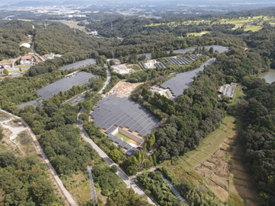
A year ago, the Kawasaki city authority launched a zero-emission EV station that charges with solar power generated from the panels installed on the garage rooftop. However, a half-day was needed to fully recharge a Toyota Motor model C-Pod, which is a two-seat EV. Needless to say, this frustrated the driver.
The city authority could only suggest multiple recharges, which clearly isn’t a viable option in everyday life. But what if there was another option. What if an EV driver had a solar-powered car with panels on the car’s roof. This revolutionary idea would forgo the need for charging stations, and could potentially upend the current dominant EV model and its charging paradigm.
Across the globe, inventors and engineers have already made test drives of such prototype solar cars. The same is true in Japan, which could lay claim to being one of the leaders in this area, and is making significant strides thanks to state support.
Several miles of uninterrupted drives have been clocked, but getting such a solar-powered vehicle to travel long distances on a single charge remains a challenge. If the technical and cost issues can be solved, then solar cars could trigger the next mobility revolution. But what is the current status of the technology?
Solar car as state project
Japan’s ambition is to lead the global effort to create standards for mobility systems, which explains why solar car development has been taken under the wing of the New Energy and Industrial Technology Development Organization (NEDO).
During FY2015-2019, NEDO conducted research to develop high-performance solar batteries for cars. In 2019, the project moved onto the field study phase. Nissan Motor and Toyota Motor test drove mini-vans and sedans mounted with solar modules on public roads. Then, in November last year, Sharp, which developed the modules, announced plans to commercialize solar-powered cars.
Sharp’s solar modules posted a power efficiency of 33.7%, a world record for a 775 square-centimeter-sized module. It’s made of gallium arsenic compound, which is very expensive, and silicon. Resembling a film, the module’s thickness is 0.03 mm, and it can be set up on curved vehicle surfaces, resulting in a total power capacity of 1.15 kW. On a sunny day, the modules generate 800 watts of power, enough for a 50 km drive.
The 33.7% efficiency is also close to the theoretical limit of silicon module power generation. Hence, Sharp decided to pursue the module commercialization, rather than doing more R&D to raise the power efficiency further. The commercialization target for the solar car is 2025-2030.
As Japan NRG reported (Nov 13, 2023 issue), the major commercialization challenge is cost. About 1,000 pieces of 775-sq-cm modules were put on top of the car’s bonnet, rooftop and rear. While Sharp wouldn’t comment, one source familiar with the car said the modules alone cost about ¥25 million, which is more expensive than the car itself.
Startup PXP develops cheaper solar car
In January, PXP Corp, a solar startup, began test-driving a solar car with much cheaper modules. The company was founded in 2020 by a former executive of Solar Frontier, an Idemitsu Kosan affiliate that pioneered the CIGS (copper, indium, gallium, selenium) module development.
Solar Frontier researchers joined PXP after Idemitsu terminated its CIGS business, attributing it to a lack of market potential. For commercial reasons, PXP dubbed its CIGS products as “chalcopyrite”.
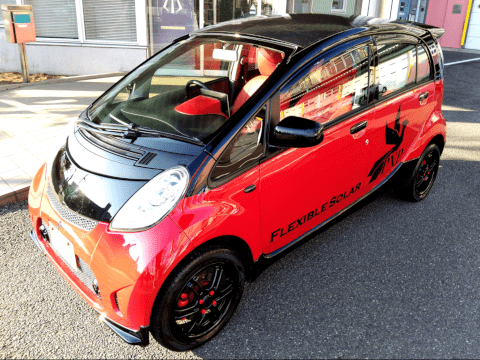
The PXP team installed 332 stamp-sized CIGS modules on the roof of an i-MiEV, a Mitsubishi EV model. The precise module cost data was not available, but Japan NRG estimates that the module to cost less than ¥200,000 based on market data. The module recorded power conversion efficiency of 18% when driving in the city of Sagamihara close to Tokyo. The module power output was 360 W, allowing travel for 16 km.
A company official said that less than five grams each of copper, indium, selenium and gallium powders were needed to form a 50-microns-thick-layer with an area of 2 sq meters. The CIGS layer was put on a thin titanium sheet. The module’s total weight was 1 kg. PXP plans an upgrade to achieve a power efficiency of 45% in about two years. Last year, they built a pilot CIGS module plant to make modules for more tests.
Module performance needs to improve
An EV from the automaker Nissan, the model Leaf, travels over 400 km on a single charge. Sharp’s car, which travels 50 km, and PXP’s vehicle, with its 16 km range, are far behind in terms of this performance. But the latter are showcasing one direction in which EVs can evolve.
As there is a limit to the number of solar modules a car can hold, each module’s output needs to increase by multiple times. And yet, elements have theoretical power efficiency limits. Hence, the current R&D is focused on a stacking approach: putting several power-generating devices on top of one other to form a “tandem module”.
Tandem modules, however, must be light and thin if they are to survive on the top of a passenger vehicle. After all, extra weight reduces vehicle performance. So, what might be the solutions here?
PXP and others see potential in combining CIGS with perovskite solar cells (PSC) – 1 micron thick, bendable devices made of perovskite crystal layers. Both PSC and CIGS could be made using sputtering equipment, which sprays nano-sized powder on a substrate in a vacuum container. Using the same production method cuts costs. The PSC-CIGS tandem module could, theoretically, achieve a 45% power efficiency or higher.
Struggles against heat
Life would be easier if modules produced only power. But recent module field studies showed that super-thin modules also release heat that would affect storage battery performance and safety. Silicon module temperatures rise up to 90°C, and thin film modules could take this even higher.
According to one perovskite researcher at a separate company, a postcard-sized module recorded temperatures rising to “alarming levels” in a summer trial last year. The module’s energy efficiency was 10-15% and the rest of its energy possibly manifested itself as heat, according to his theory. This is critical since heat would not only affect the material that’s in contact with the module, it could destroy the module itself, he said.
Other perovskite researchers contend that the modules are not heat-emitting devices; there is no room to absorb or release heat as the modules are so thin. But heat control remains a challenge should these modules end up being installed on a car. Even without solar modules, temperatures on a car bonnet and roof tend to surge to unbearable levels on a sunny summer’s day. For the modules, this would be even worse due to their black or dark coloring, which absorbs heat.
One solution is to put the modules on heat-insulating sheets made of chlorinated polyvinyl chloride or other materials, which are used for some of the lithium-ion battery packs to block heat. But these degrade over time and need regular replacing. The degradation speeds up if temperatures rise above 80°C.
A need for incentives
Various breakthroughs are needed to make solar cars a reality. Are there incentives to make them happen? The engineers at PXP are excited because they believe in their mission to create unprecedented value for society. Cynics, however, point to the slow takeoff of EV sales in Japan.
If a normal EV is not yet whetting consumer appetite, what demand is there for a “solar car”, which offers much lower range performance, among other issues? Even engineers at Sharp, with its world’s best-performing solar module, believe that a hybrid vehicle that has both a solar and other power sources, would have better marketing potential.
The gaps between expectation and reality defeats some people, while others use it as inspiration. Correctly assessing the gaps is perhaps the first important step.
ANALYSIS
BY MAYUMI WATANABE
Hydrogen Fueling Homes – a New World of Residential Energy Services
Hydrogen’s role in decarbonizing homes has so far proved contentious. It was tested as a fuel for home heating in the UK, with experiments also held in Sweden, the U.S. and elsewhere. Opposition to the trials from various independent regulators and experts has meant that widespread usage of hydrogen in homes is, for now, unlikely.
In Japan, which is among the most bullish countries for hydrogen energy usage, there is an appetite to make hydrogen work as a decarbonization pathway for homes, even if the approach differs from most countries.
Homes contribute to about 15% of Japan’s carbon footprint and the country has a modern gas infrastructure that took decades to complete. Equally, the government is keen to promote examples of hydrogen for ordinary citizens in order to help build wider support for the clean-burning fuel as a future alternative to fossil fuels.
And so, in January, the doors opened on Japan’s first “hydrogen town”. A central Tokyo district is playing host to an experiment of using hydrogen to power communal facilities and transport, with families already moving in. Meanwhile, other lifestyle applications of hydrogen are tested elsewhere in Japan, hoping to demonstrate that the gas that’s lighter than air can support ground-level needs.
Harumi Flag project
The land that formerly housed athletes during the Tokyo Olympic Games 2020 (held in 2021), is now the site of a “hydrogen town”. On January 19, families started to move into the Harumi Flag “hydrogen town”, a 18-hectare residential-commercial complex built on the site of the former Olympic Village in Tokyo.
After the 2020 Tokyo Olympic Games (held in 2021), the Tokyo Metropolitan Government (TMG) decided to sell the property in the Harumi district of Chuo City to 11 private developers. These include Mitsui Fudosan, Tokyu Land Corp, Sumitomo Corp, and Tokyo Tatemono.
The district was reborn as an urban community with 24 high-rise condominiums and malls, but developers also promised to promote the project as a smart town. And so the idea of testing the potential application of hydrogen in a community took root.
Some 12,000 people are expected to live in the 5,362 apartments built over the 13 hectare residential area. Each has an Ene-Farm fuel cell system that’s connected to storage batteries, and hydrogen gas flows to the buildings via pipelines. Ene-Farm is a two square meter system that generates electricity through a chemical reaction between oxygen in the air and hydrogen from city gas services.
Heat, produced as a byproduct of power, can be used for home heating. Since the electricity is generated and used right from the home, there’s no loss from grid transmission.
Panasonic manufactures the Ene-Farm systems, which were developed by Tokyo Gas, Osaka Gas and ENEOS. Panasonic says users can cut around ¥50,000-¥60,000 from annual utility bills, and CO2 emissions by about 1.5 tons / year.
In March, Tokyo Gas is expected to begin piping hydrogen supplies to the area. Pipelines will carry hydrogen to buildings to fuel generators that will then supply electricity to shared facilities.
Meanwhile, ENEOS will open local hydrogen service stations to offer H2 for transport. Fuel cell vehicles will be available via car sharing schemes for local residents. ENEOS will likely get the hydrogen from Tokyo Gas.
Given the experimental nature of the district, the pricing of apartments (which range between 50 to 120 square meters) is slightly below central Tokyo rates. The Harumi Flag developments cost ¥58 million to ¥96 million each. The average price of new condominiums built last year in central Tokyo topped ¥100 million for the first time. Nearly 2,700 flats have been sold. Some are only now on sale and other condos are still under construction. All 5,632 flats will be completed by the end of the year.
The unbearable lightness of H2
New residents can expect a steep monthly management fee of as much as ¥68,000. While this fee includes a plethora of amenities (internet, television subscriptions, building and street maintenance fees, etc), there’s no line item for hydrogen because the government is keen to keep the cost of the local hydrogen economy away from the public eye, according to an ENEOS official.
“The properties are privately owned, but the Tokyo government has had a large influence since it started the project,” the official said, adding that the developers are making hydrogen costs invisible.
“For fuel cell vehicles, [inside the district] hydrogen is sold at around ¥100 / nm3, the government recommended price. This is a level equivalent to gasoline prices. Other hydrogen supplies will be offered below the ¥100 / nm2 threshold. Harumi Flag residents are getting a real bargain,” he added.
The cost of hydrogen for ENEOS and other companies in the project will be in red. “There will be financial losses, but this is an investment for the future,” the official said. The companies are also limiting the pipeline hydrogen supply to building power systems during night hours, and the systems will generate power for shared facilities, not to the individual flats.
At this level of consumption, the hydrogen cost can be recovered from the monthly management fee. “It is so small that it cannot be itemized,” said the official.
Last-mile H2 delivery
Hydrogen is being tested in other residential settings around Japan. There are hotels with hydrogen-fueled boilers installed in Kawasaki City and Namie Township (Fukushima Pref), and a hotel with a hydrogen-fueled kitchen system in Hakone Township (Kanagawa Pref).
In Minamisoma City (Fukushima Pref), Iwatani Corp and Soma Gas group plan a field study for delivering propane gas mixed with hydrogen through city gas pipelines. Transmission will start by January 2025 and continue to March 2026.
Unlike the Harumi Flag project, Minamisoma is deeply rural. Rice growing is the main income source for the 53,000 people in the city. Just 80 homes will participate in this study.
In contrast to Harumi Flag’s new buildings and smart systems, the Minamisoma study will utilize legacy systems, such as propane gas pipelines to transport hydrogen-propane gas. Homes will continue to use their kitchen ovens and heating systems.
One of the study’s main purposes is to identify the optimal ratio of hydrogen to propane that can be supported by legacy infrastructure, which uses pipes made of SUS316-grade nickel-chrome-molybdenum stainless steel. This is the same steel quality that’s used for hydrogen pipelines.
Conclusion
Hydrogen projects are burgeoning nationwide on the back of the national government’s plans to create a real hydrogen economy. With eight hydrogen and ammonia hubs set to be created, they should accelerate the use of these fuels in industrial zones clustered around the fuel import terminals.
But many are wondering if hydrogen can also be applied outside of heavy industry and the so-called hard-to-abate sectors. This will involve trialing its use in more residential and commercial settings, which is sure to bring up a different set of challenges.
Unlike plans to develop hydrogen demand among industrial users through regulation, carbon pricing, subsidies and tax breaks, the residential hydrogen economy will likely be driven by a desire to improve living standards or the climate etc., rather than profit alone.
The urban Harumi Flag and the rural Minamisoma projects will provide an interesting study on whether regular citizens will learn to value the hydrogen way.
ASIA ENERGY REVIEW
BY JOHN VAROLI
This weekly column focuses on energy events in Asia and the Pacific, and all that impact markets in the region.
China / Renewable energy
In 2023, the country’s net installed solar capacity grew by over 50% YoY, reaching 609 GW, according to the National Energy Administration. It said that China’s solar capacity rose by over 215 GW – 25% of which came online in December 2023 alone.
India / Coal power
A total of 19 coal-based units across 10 power plants, with a total capacity of 2.34 GW, were retired from 2021 to January 2024. Nearly all are in the northeast regions of Jharkhand, Odisha, Maharashtra, Bihar, West Bengal, etc.
India / Natural gas
Natural gas consumption in India will more than triple by 2050, says the U.S. Energy Information Agency, with annual growth of 4.4% over that period. This is more than twice the 2% annual rate in China, the next-fastest-growing country. Ammonia production, as well as a growing oil refining sector, will drive most of India’s growth in natural gas consumption.
India / Solar power
Adani Green Energy began operations of 551 MW capacity of the world’s largest renewable energy park, located in Gujarat. By 2030, the project is targeted to have a total of 30 GW of renewable energy capacity.
LNG
In 2023, roughly 67% of U.S. LNG exports went to Europe, and 26% went to Asia, according to LSEG data. The Biden administration has a pause on pending and future permits to export LNG to non-Free Trade Agreement countries until the Dept of Energy finishes a new review of climate impacts.
Nuclear power
In 2022, global nuclear production declined 4% YoY, to reach 2,546 TWh of electricity, the steepest decline in a decade, according to the World Nuclear Industry Status Report. Outside of China, which is the world’s second largest nuclear producer, nuclear energy production fell by 5%, reaching a “level last seen in the mid-1990s.
Oil markets
An effort to restore depleted oil stocks — notably in China, the U.S. and Europe — could boost demand and prices in coming months. Morgan Stanley raised its quarterly outlook for Brent crude to an average of $82.50 / barrel in Q1 and Q2 – compared with $80 and $77.50, previously. A tight oil market is now expected this year.
Philippines / Renewable energy
In August, the Dept of Energy will conduct the third round of the Green Energy Auction for hydropower and geothermal projects (total capacity 4.4 GW). The project is intended for non-Feed-In-Tariff eligible technologies, such as geothermal and pumped-storage hydro.
Singapore / IEA
The IEA will set up a regional cooperation center in Singapore, the first office outside its headquarters in Paris. The regional IEA office will work with all countries in Southeast Asia, and beyond, to improve energy security and energy transition.
Uzbekistan / Hydro power
The state hydro power company, Uzbekhydroenergo, issued a tender to develop five new hydropower plants (total capacity of 47 MW). This is in response to the country’s growing demand for electricity and clean energy commitments.
2024 EVENTS CALENDAR
A selection of domestic and international events we believe will have an impact on Japanese energy
January
First market trading day (Jan 4)
Japan’s Diet convenes (January)
The first Long-Term Decarbonization Power Source Auction
Renewable Energy Exhibition (Jan 31 – Feb 2)
Taiwan presidential election (Jan 13)
February
India Energy Week 2024 (Feb 6-9)
Smart Energy Week (Feb 28-Mar 1)
Lunar New Year (Feb 10-17)
CFAA International Symposium (Feb 2)
Indonesia presidential election (Feb 14)
FIT/FIP solar auction (Feb 19 – March 1)
Japan-Ukraine Conference for Promotion of Economic Reconstruction (Feb 19)
March
Announcement of the last auction result for Offshore Wind Round 2 (for Akita Happo-Noshiro area)
Onshore wind auctions (March 4-15; results on March 22)
International LNG Congress (LNGCON) 2024, Milan (March 11-12)
Russian presidential election (March 15-17)
Ukraine presidential election (due before March 31)
World Petrochemical Conference, Houston, TX, (March 18-22)
End of Japan’s fiscal year 2023 (Mar 31)
April
Details of 2024 capacity auction results released
Japan Atomic Industrial Forum (JAIF) Annual Conference
Global LNG Forum (Apr 15-16), Madrid, Spain
Global Hydrogen & CCS Forum (Apr 17-18), Madrid, Spain
World Energy Council (WEC), Rotterdam, Netherlands (Apr 22-25)
May
May Golden Week holidays (May 3-6)
World Hydrogen Summit (May 13-15)
June
Japan Energy Summit & Exhibition (June 3-5)
G7 Summit in Italy
International Conference on Oilfield Chemistry and Chemical Engineering (IOCCE), Tokyo (June 10-11)
American Nuclear Society (ANS) Annual Conference, Las Vegas (June 9-12)
Happo Noshiro, Murakami-Tainai, Oga-Katagami-Akita and Saikai-Eshima wind project auctions close (June 30)
July
Tokyo governor election (July 7)
7th Basic (Strategic) Energy Plan draft published (expected)
August
7th Basic (Strategic) Energy Plan draft presented to Cabinet (expected)
September
The United Nations Summit of the Future (Sept 22-23)
Gastech 2024, Houston, TX, USA (Sep 17-20)
IAEA General Conference
GX Week in Tokyo (expected late Sept to October)
Asia Green Growth Partnership Ministerial Meeting
Asia CCUS Network Forum
International Conference on Carbon Recycling
International Conference on Fuel Ammonia
GGX x TCFD Summit
October
IEA World Energy Outlook 2024 Release
BP Energy Outlook 2024 Release
Innovation for Cool Earth Forum (expected)
Connecting Green Hydrogen Japan 2024 (Oct 16-17)
Japan Wind Energy 2024 Summit (Oct 16-17)
Solar Energy Future Japan 2024 (Oct 16-17)
Japan Mobility Show (Oct 25-Nov 5)
November
U.S. presidential elections (Nov 5)
COP 29 in Azerbaijan (Nov 11-22)
Abu Dhabi International Petroleum Exhibition Conference (ADIPEC) 2024, Abu Dhabi, UAE (Nov 11-14)
International Conference on Nuclear Decommissioning (TBD)
G20 Rio de Janeiro Summit (Nov 18-19)
Biomass & BioEnergy Asia Conference (TBD)
European Biomethane Week 2024
December
Last market trading day (December 30)
Disclaimer
This communication has been prepared for information purposes only, is confidential and may be legally privileged. This is a subscription-only service and is directed at those who have expressly asked K.K. Yuri Group or one of its representatives to be added to the mailing list. This document may not be onwardly circulated or reproduced without prior written consent from Yuri Group, which retains all copyright to the content of this report.
Yuri Group is not registered as an investment advisor in any jurisdiction. Our research and all the content express our opinions, which are generally based on available public information, field studies and own analysis. Content is limited to general comment upon general political, economic and market issues, asset classes and types of investments. The report and all of its content does not constitute a recommendation or solicitation to buy, sell, subscribe for or underwrite any product or physical commodity, or a financial instrument.
The information contained in this report is obtained from sources believed to be reliable and in good faith. No representation or warranty is made that it is accurate or complete. Opinions and views expressed are subject to change without notice, as are prices and availability, which are indicative only. There is no obligation to notify recipients of any changes to this data or to do so in the future. No responsibility is accepted for the use of or reliance on the information provided. In no circumstances will Yuri Group be liable for any indirect or direct loss, or consequential loss or damages arising from the use of, any inability to use, or any inaccuracy in the information.