For a country famously short of hydrocarbon resources, Japan has a surprising number of upstream firms. While most of these are private, two of the bigger players — INPEX Corp and JAPEX — are state-backed. Over the mid-to-long term, METI believes that the costs associated with hydrocarbons will increase and, along with decarbonization, put a strain on the companies. Rather than waiting for the hard times, the ministry is reportedly seeking preemptive action.
There’s an age-old question of generalization vs specialization, and there will always be arguments for and against. The correct answer for the purpose of maximizing your value is to do both! Let’s dig deeper into the topic of maximizing your value, both for the purpose to be recognized as a key asset for internal career development and making yourself a prime target for external opportunities.
ASIA ENERGY VIEW
A wrap of top energy news that impacts other Asian countries.
EVENTS SCHEDULE
A selection of events to keep an eye on in 2024.
JAPAN NRG WEEKLY
PUBLISHER K. K. Yuri Group
Editorial Team Yuriy Humber (Editor-in-Chief) John Varoli (Senior Editor, Americas) Mayumi Watanabe (Japan) Wilfried Goossens (Events, global) Kyoko Fukuda (Japan) Magdalena Osumi (Japan Filippo Pedretti (Japan) Tim Young (Japan)
The Kishida Cabinet has approved amendments to the Act on Promotion of Global Warming Countermeasures, to strengthen the Joint Crediting Mechanism (JCM) system and to foster more renewable promotion zones.
The amendment will clarify the processes that the seven ministers with oversight on JCM need to take in order to issue credits and manage accounts. A new organization dedicated to credit and account management will be set up.
Currently, only cities, towns and villages are able to set renewable promotion / decarbonization zones. The amendment will allow prefectural authorities to set the zones when the area covers multiple municipalities.
If passed by the Diet, the proposed effective date of the amendments is April 1, 2025.
TAKEAWAY: As covered in last week’s NRG report, carbon credit programs like the JCM have proved to be an effective way to stimulate new clean energy projects by Japanese firms. As tariff-based pricing for renewable energy is phased out to ease the public’s direct contributions to new green projects, carbon credits-based solutions are seen as alternative financing mechanisms that also shift the burden more to industry.
METI plans to set higher Feed-in-Tariff (FIT) rates to power operators using Perovskite solar cells (PSC) compared to legacy solar panels; it’s hoped that this will incentivize investments in the PSC market.
From FY2025, METI will set the PSC-related FIT purchase rate at over ¥10/kWh. Other details will be decided in FY2024.
TAKEAWAY: Due to limited PSC supplies and a lack of objective data on module performance, launching large-scale commercial PSC services next year would be challenging. METI’s offer does not appear to be a major boon as the FIT rate for small solar installations (ie. those with a capacity below 10 kW) is set at ¥15/ kWh for 2025. On the other hand, PSC demand from power users in the manufacturing sector is high. They may import the modules and build their own power supply schemes outside the FIT system.
A MoE group tasked with reviewing the environmental impact assessment system for wind power generation sites has called to strengthen efforts to protect biodiversity and natural resources.
CONTEXT: The group’s discussions are held in the framework of the Act on Promotion of Utilization of Sea Areas for the Development of Marine Renewable Energy Generation Facilities.
TAKEAWAY: The MoE group was concerned by cases when operator assessments ignored the existence of rare bird species. This includes a recent MoE opinion on the 465 MW offshore wind farm to be built by a TEPCO group firm off Kujukuri City, Chiba Pref.
The Environment Minister urged TEPCO Renewable Power, which is conducting assessment work for its 465 MW Kujukuri offshore wind farm (under development), to include surveys, forecasts, and assessments regarding the impact on local birds.
The minister also advised to take additional measures to minimize impact on the habitats of sea life and seaweed beds during construction.
METI announced plans to establish a calculation method for CO2 capture tech, (such as Direct Air Capture, or DAC), and then to trade the value of the removed CO2 in J-credits.
The policy will distinguish between CO2 removed from the atmosphere after it was created through the process of burning fossil fuels (i.e. Carbon Capture), and CO2 removal unconnected to hydrocarbon combustion. “It is important to strictly distinguish the origin of the carbon”, according to a METI proposal. The ministry plans to define DAC as a process of CO2 removal from “the atmosphere that is unaffected by fixed emission sources.”
Two methods of procuring renewable electricity to power DAC systems were presented: DAC providers can generate the electricity themselves, or procure it from power producers using non-fossil certificates or green power certificates.
CONTEXT: Experts say the world needs to annually remove as much as 10 billion tons of CO2 from the atmosphere by 2050. The DAC market is expected to expand, with up to 500,000 tons per year of DAC projects to launch in the U.S. by 2025.
TAKEAWAY: In December 2023, ENEOS said it had installed a DAC system by Swiss startup Climeworks for testing under the “ environment unique to Japan”. It was the first installation of the Swiss maker’s system in the Asia Pacific and points to a growing interest in DAC among Asian fuel suppliers. Marrying CO2 acquired through a ‘green’ capture process with recycled methane or other fossil gasses opens up the pathway to production of synthetic fuels. That’s an industry that METI and others see huge potential for in the next decade.
ANRE will revamp “the energy saving communication ranking system”, aiming to encourage power and gas retailers to boost energy saving awareness among customers and spread demand response (DR) programs.
Presently, ANRE rates operators based on their data submitted on a voluntary basis.
Retailers will be required to disclose data related to energy saving education initiatives. Examples include energy saving services such as DR, promotion of energy-efficient equipment, etc.
There will be an index to measure the retailers’ energy saving engagements. Details will be announced later.
Macnica has developed an air quality sensor prototype powered by perovskite solar cells (PSC) and semi-solid state batteries as backup. EneCoat Technologies made the PSC modules, while NGK Insulators made the semi-solid state lithium ion batteries.
The sensors measure CO2, temperatures, humidity, particulate matter (PM) and hazardous substances.
CONTEXT: This is the first PSC-embedded appliance unveiled in Japan. The sensor is twice as large as usual since the PSC needs to be installed in large areas to provide sufficient power, due to its low power efficiency of 13-15%.
TAKEAWAY: The commercialization of the sensor hinges on when EneCoat will be able to mass produce the modules, and if it successfully develops PSCs using tin-iodide instead of lead-iodide. Tin has lower power performance than lead; but lead-containing PSC might eventually be replaced by lead-free PSC.
Energy services provider iGrid Solutions is set to launch quick EV charging stations in Tokyo that will use surplus power from its solar power plants.
iGrid owns and operates solar power facilities, mainly on roofs of retail stores and logistics facilities, at 822 facilities nationwide with a total capacity of about 187 MW. It uses the PPA contract for many of the facilities and claims that its subsidiary, VPP Japan is among the leaders in onsite PPA deals in Japan.
CONTEXT: In 2021, the firm launched the Surplus Power Circulation Model that specifically aims to install more solar capacity at a location than is required for on-site consumption. Using AI, the company then optimizes generation so as to capture surplus volumes and allocate them elsewhere.
JAPEX and Invest Alberta signed an MoU to work on energy projects in Canada’s region of Alberta.
The four main focus areas include CCS and CCUS, bioenergy with carbon capture and storage (BECCS), and blue hydrogen/ammonia.
CONTEXT: Alberta accounts for about 80% of the country’s oil production, and has about 40% of its known oil reserves. Decarbonizing the oil industry is a key goal for Canada’s net-zero ambitions by 2050.
Energy Resource Aggregation Business Association (ERA) has formed five working groups to write policy proposals on market systems, storage battery systems, low-voltage power resources, renewables and cybersecurity.
Group activities to identify issues and to build solutions will begin in April. Potential topics include participation in power supply and the demand adjustment market, capacity market, sharing data from aggregation field studies, etc.
ERA was established in October by 87 companies in the aggregation business.
The article is based on an interview with Kubota President Kitao Yuichi.
Agricultural machinery maker Kubota is considering in-house production of batteries for electric versions of its farm machinery, to meet demand in Japan, the U.S. and EU.
CONTEXT: Kubota makes diesel engines for its farm equipment in Thailand and Japan, and ships them to the U.S. or Europe for assembly. Kubota plans to commercialize the country’s first unmanned tractors and other farming equipment capable of remote monitoring as early as 2026, and plans to introduce small and midsize electric tractors, mowers and carriers into the U.S. and EU markets by 2030.
JERA, Chubu Electric, Qatar General Electricity & Water and Qatar Electricity and Water (QEWC) signed MoUs for technical collaboration in Qatar’s energy sector.
JERA will work on safety management, and environmental protection. Chubu will focus on technical cooperation such as smart grid, human resources and green transformation.
Iwatani Corp acquired Taihei Kozai, a stainless steel products retailer, and Taihei Metal, a stainless steel scrap dealer.
TAKEAWAY: Stainless steel is a key material used throughout hydrogen supply chains. Impacted by the recent electrical cable shortage, energy companies might make more effort to strengthen the supply base of components.
A research institute that is part of the Japan Railway (JR) group will start delivering electricity this week on a commercial rail line using a “superconducting power transmission system,” a world first.
The technology allows for electricity to be sent across distance without loss by maintaining zero electrical resistance when cooled. Usually, carrying power over long distances results in a loss of about 5% of the electricity.
The trial will run from March 13 on a section of the Izu Hakone Railway in Shizuoka. A 100-meter-long superconducting power cable, chillers, pumps, and other equipment will be installed and operating near Ohito Station on the railroad’s Sunzu Line.
From March 25 to April 2, the International Atomic Energy Agency (IAEA) will inspect Kashiwazaki-Kariwa NPP.
CONTEXT: In December, the NRA lifted an operational ban on Kashiwazaki-Kariwa, which had faced problems with anti-terrorism measures. The NPP’s operator, TEPCO, has rectified the matter.
TAKEAWAY: While TEPCO can restart the NPP, it still needs public support. The IAEA has little oversight powers over the Kashiwazaki-Kariwa facility, but it can provide a general analysis of the plant’s status. A positive IAEA evaluation could help persuade the public of TEPCO’s ability to run the NPP safely. Likely, the utility and METI are hoping to win over local government leaders to allow for a restart by mid-summer.
SIDE DEVELOPMENT:TEPCO to hold meetings in four towns ahead of Kashiwazaki-Kariwa restart(Asahi Shimbun, March 4)
In early April, TEPCO will hold explanatory meetings for citizens in Niigata, Nagaoka, Joetsu, and Mitsuke on the restart of Kashiwazaki-Kariwa NPP.
Meetings have already been held in Kashiwazaki City and Kariwa Village.
The Nuclear Damage Compensation and Decommissioning Facilitation Corp (NDF) outlined methods for extracting melted fuel debris from the Fukushima Daiichi NPP.
They propose the “gas-phase method” that involves water spraying during extraction, and suggest combining it with solidification before crushing for removal.
The gas-phase method is considered practical but it raises concerns about radiation levels. Another option may be the submergence method that surrounds the reactor building with a structure and flooding. However, its feasibility remains uncertain.
CONTEXT: The trial extraction has been delayed three times already. Since the nuclear accident 13 years ago, no debris has been extracted.
TEPCO aims to extract melted fuel debris from Unit 2 of Fukushima Daiichi NPP by October, said executive vice president Ono Akira. This process has faced delays due to challenges in developing the required robotic arm.
TEPCO plans to use a fishing rod-like device for extraction, with further plans to use robotic arms in the late 2020s. Tank dismantling associated with treated water release is expected to begin around the latter half of FY2024.
On Feb 29, production started at the Orano Melox plant (France) of the fourth batch (32 units) of MOX fuel for Units 3 and 4 of KEPCO’s Takahama NPP.
KEPCO is sending employees to Orano to ensure quality.
CONTEXT: The Orano facility produces MOX fuel derived from a mixture of uranium oxide and plutonium obtained from spent nuclear fuel. MOX is utilized in some light water reactors for generating electricity. The MOX produced in the fourth batch will be used from 2026 onwards.
TAKEAWAY: Since Japan still lacks a domestic nuclear fuel reprocessing plant, sending spent fuel to France is one small way for KEPCO to try to meet its spent fuel storage goals. However, the amount to be sent to France equals only about 5% of KEPCO’s overall spent fuel.
An OCCTO expert panel assessed the electricity supply-demand balance for 2040 to 2050, and said it sees the expansion of data centers as a lead driver of power demand.
The experts examined power demand changes in the structure of industry. They were from: CRIEPI; Deloitte Tohmatsu Consulting; and the Research Institute of Innovative Technology for the Earth (RITE).
Their study also showed a significant impact from steel, automobiles, and chemicals production on the demand side, as well as from semiconductors.
CRIEPI assumed that the power increase (at the transmission end) would be between 24 and 198 GWh in 2050; but this will depend on variables such as the processing capacity of data centers and energy conservation measures by the public.
Deloitte Tohmatsu estimated a power demand increase of as much as 96 GWh; while RITE put that figure at up to 76 GWh.
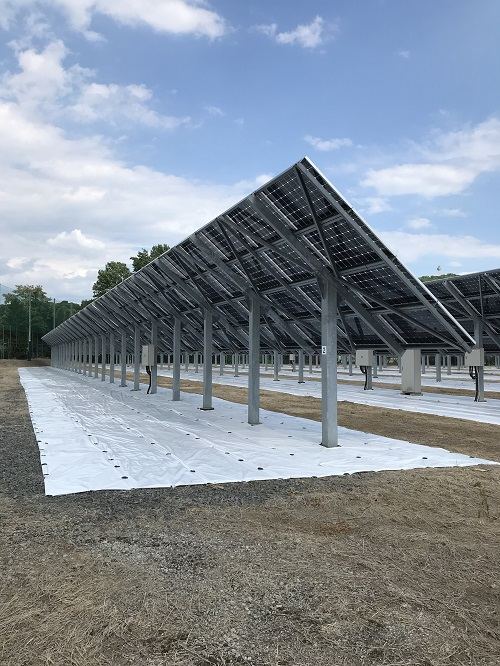
NTT Data inked a solar PPA with TEPCO by which three newly built solar farms in Saitama and Tochigi Prefs will indirectly power NTT’s 40 MW data center in Mitaka City, western Tokyo.
The project will begin in August, and the electricity generated will cover 20% of the center’s demand. It is TEPCO’s first PPA with a data center as customer.
CONTEXT: NTT Data Group plans to expand green-related menus for customers. By 2030 it aims to increase the rate of PPA adoption from the current level of 1-2% to 10%.
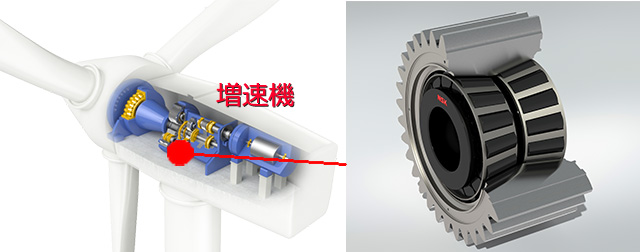
NSK has developed upgraded tapered roller bearings for large-scale wind turbines that could help lower the cost of installation and maintenance of wind power turbines.
The bearings are suitable for 15 MW-class turbines used in offshore wind projects.
The load capacity has been increased by around 25% compared to conventional products. The design change enabled a weight reduction of at least 30%.
The firm expects to begin mass production in FY2024, and to tap into the Chinese market this year. NSK estimates sales of the new bearings at ¥4 billion by 2026.
TAKEAWAY: Wind turbines are increasing in size. China is pushing the boundaries on their capacity with a plan by Sany that eyes 30 MW turbines, which are likely to hit global markets by 2030. The new trend will stimulate demand for new tech for offshore wind, providing an opportunity for component producers like NSK.
Eurus Energy and JAXA-accredited space venture Tenchijin have developed a search platform for potential sites suitable for wind farm development. The platform covers Japan, Australia and France.
The Tenchijin Compass is a WebGIS service using algorithms built by Tenchijin. It analyzes and visualizes data based on more than 230 maps, such as data from earth observation satellites related to topography, precipitation and wind conditions.
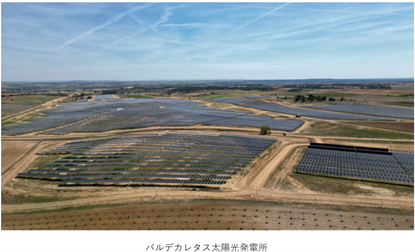
Property developer Tokyu Land and Renewable Japan acquired the 37.8 MW Valdecarretas solar farm in Toro, Spain.
Tokyu Land has a 90% stake; Renewable Japan has the remaining 10%.
CONTEXT: In October 2023, the two companies announced plans to invest ¥200 to ¥300 billion over the next five years to acquire and develop renewable power assets. Their goal for Europe is a renewables portfolio of 1 GW.
Tokyu Land, Matsumae Wind Farm, the Matsumae municipal govt and Hokkaido Electric launched the Matsumae Regional Microgrid.
It will supply renewable power from a local wind farm to Matsumae in case of an emergency, supplying electricity to the town hall, evacuation centers, etc.
Mitsubishi Heavy Industries Asia Pacific and Thailand’s PTT Public Company signed an MoU to develop 100% ammonia firing for gas turbines.
They will assess the economical aspect of full ammonia firing, demand for ammonia-fueled power, and study logistics, safety, building supply chains, etc.
TAKEAWAY: PTT is an oil and gas firm and power is not its main business. Thailand’s power operators, Electricity Generating Public Co and BCLP Power, are first testing co-firing rather than jumping into full-ammonia firing. Japanese power companies are also starting with co-firing since ammonia supplies are not stable enough, and they want the option to use coal in case of supply disruptions.
IHI Corp, Sumitomo Corp and Taiwan Power inked an MoU to explore ammonia co-firing at the Talin Power Plant in Taiwan. They plan a test of up to 5% ammonia in the fuel mix by 2030.
Talin consists of two 800 MW coal-fired units.
CONTEXT: Taiwan will be Asia Pacific’s seventh country to study the use of ammonia co-firing — following Indonesia, Malaysia, Vietnam, Thailand, Philippines and Singapore.
Hokkaido Electric will build ammonia storage facilities in FY2024 on a 400 hectare site that’s west of the 1.65 GW Tomato Atsuma coal power station.
The ammonia, which will be imported possibly from North America, will be used for co-firing, and any balance will be sold to third parties.
CONTEXT: Neither the fuel mix ratio nor the timetable of the trial co-firing are known. Tomato Atsuma has three turbines: the 350 MW Unit 1; the 600 MW Unit 2; and the 700 MW Unit 4.
Kyoto University researchers said a simulation study on hydrogen and ammonia co-firing showed that the molecules will account for up to 1% of global power supply in 2050 and is unlikely to be a major climate solution.
Coal-fired power will decrease, and an increasing number of power stations will accommodate hydrogen co-firing.
Hydrogen will be used when variable renewable output declines; but it won’t be used extensively due to its high costs.
Appi Geothermal Energy, a JV between J-POWER, Mitsubishi Materials and Mitsubishi Gas Chemical, has begun commercial operation of Appi Geothermal Power Plant (capacity 14.9 MW) in Iwate Pref.
All power generated will be sold under the Feed-in Tariff (FIT) system.
Work was completed on the 5 MW Oguni Machiokoshi geothermal power plant (Kumamoto Pref) built by Machiokoshi Energy.
The firm aims to develop more geothermal power projects using a “franchise” model with small-scale power plants that can be installed quickly. The founder Numata Shoji is a former supermarket mogul.
Marubeni partners with ACEN to develop battery storage system in Australia
(Company statement, March 5)
Marubeni Asian Power Singapore agreed with ACEN Australia to develop a 200 MW battery storage project in New South Wales.
SmartestEnergy Australia, another subsidiary of Marubeni, is looking into offtaking electricity charged from the NSW battery storage system.
Mitsubishi Corp will form a JV with Frontier Lithium to develop the PAK Lithium site in Canada.
Production of spodumene concentrate is set to begin by 2027, and the production of battery grade chemicals by 2030.
Mitsubishi will have a 7.5% stake in the JV, with the right to increase that to 25%. This is the trading house’s first ever investment in a lithium mine.
CONTEXT: The project is expected to run more than 20 years with annual production of 20,000 tons of lithium carbonate equivalent. PAK Lithium contains North America’s highest-grade lithium. Mid-to-long-term demand for lithium is expected to grow with demand for batteries.
The Japan Fair Trade Commission has determined that Chubu Electric, Chubu Electric Power Miraiz and Toho Gas colluded in the city gas and LNG markets in Aichi, Gifu and Mie prefectures.
Chubu Electric faces a penalty of ¥193 mln and Chubu Miraiz ¥7.45 mln. Toho Gas already asked for leniency and won’t face penalties.
The companies were accused of exchanging sales-related data, and coordinating gas and LNG deals.
CONTEXT: Last year, the JFTC determined that Chubu Electric and Chubu Miraiz had taken part in a cartel, though the companies challenged the accusation. This time, the two companies admitted the charges. In addition to the penalty, they’ll be banned from taking part in tenders by the national govt and municipalities for several months.
Tokyo LNG Tanker (TLT), a subsidiary of Tokyo Gas (TG), signed a long-term charter contract with Mitsui O.S.K. Lines for an LNG carrier, the 11th such vessel.
The engine has improved fuel efficiency and reduces GHG emissions. Delivery is set for 2026 and will be utilized for TG Group’s LNG procurement and trading.
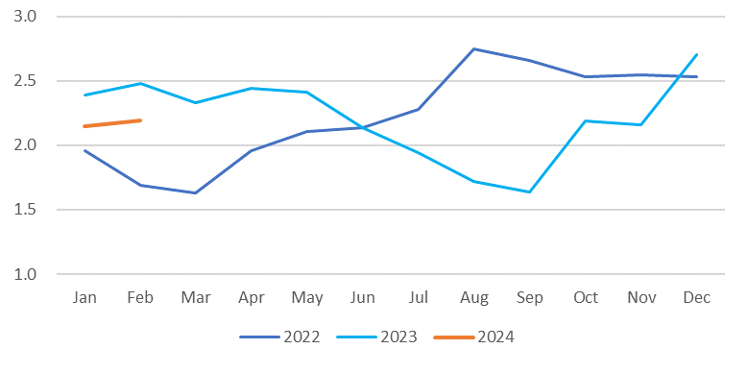
As of March 3, LNG stocks of 10 power utilities were 1.95 mln tons, down 9.7% from 2.16 mln tons a week earlier.
This is 21.4% down from the end of February 2023 (2.48 mln tons), and 8.5% down over the past 5-year average of 2.13 mln tons.
Month-end LNG stockpiles of power utilities
(millions of tons)
ANALYSIS
BY YURIY HUMBER
METI Might Allow Merger of State-backed Oil Firms
For a country famously short of hydrocarbon resources, Japan has a surprising number of upstream firms. At least 10 sizable players and domestic firms supply around a third of the nation’s oil and gas. That’s no small feat for the world’s No. 2 LNG importer and No. 4 oil buyer.
According to a recent media report, however, state officials feel that it may be time for an industry consolidation. While most of Japan’s exploration & production (E&P) firms are private, two of the bigger players are state-backed. METI is both the top shareholder and has oversight over CEO appointments at INPEX Corporation and Japan Petroleum Exploration Co, better known as JAPEX.
The two companies have enjoyed bumper profit recently thanks to high oil and gas prices. Net income at INPEX, Japan’s top E&P firm, jumped 97% to a record ¥438 billion in 2022. But over the mid-to-long term, METI officials believe that the costs associated with hydrocarbons will increase and, along with decarbonization, put a strain on the companies. Rather than waiting for the hard times, the ministry is reportedly seeking preemptive action.
Unlike their oil & gas peers in Europe and North America, Japanese upstream firms have so far faced little overt pressure from activists or the media to decouple from hydrocarbons. And while both INPEX and JAPEX have announced net-zero 2050 pledges, in line with the national commitment, as well as investments in renewables and other clean energy areas, the bulk of their business remains focused on oil and gas.
Corporate background
INPEX Corp is Japan’s only developer and operator of an LNG production facility. The company spent $40 billion, an industry record at the time, to develop the Ichthys LNG project in western Australia. The project is due to export 70% of its total production to Japan over the course of 40 years.
Next, INPEX is hoping to repeat its success in Indonesia, where it helped to discover the natural deposits that will feed into the $20 billion Abadi LNG project. Operations there could begin as soon as the end of this decade or in the early 2030s, CEO Ueda Takayuki said in January. The company owns 65% of the Abadi project, with the Indonesian government keen to support the development despite its relatively high-cost basis.
INPEX is also an investor in numerous oil fields around the world, including in Abu Dhabi. The company even produces natural gas in Japan, at the Minami Nagaoka field, Niigata Pref.
METI owns about 20% of INPEX and holds a single special class share, which allows government officials to vet major corporate decisions and top personnel appointments. CEO Ueda himself is a former METI official, who had reached the rank of Vice-Minister for International Affairs after a 35-year career at the ministry. Ueda joined INPEX initially only in 2017, moving quickly through the top ranks before his appointment as President & CEO in June 2018.
JAPEX also owns about 4.2% of INPEX common shares. In tandem, INPEX owns 5.25% of JAPEX. Meanwhile, METI’s direct ownership in JAPEX is 35.8% with domestic corporates owners of another 10.1% of the equity.
JAPEX is a much smaller player. Its net assets are now about a tenth that of INPEX (¥570 billion vs. ¥6.5 trillion). However, in addition to its oil field stakes in Iraq, the UK and Indonesia, it develops domestic oil and gas fields in the Hokkaido, Akita and Niigata areas.
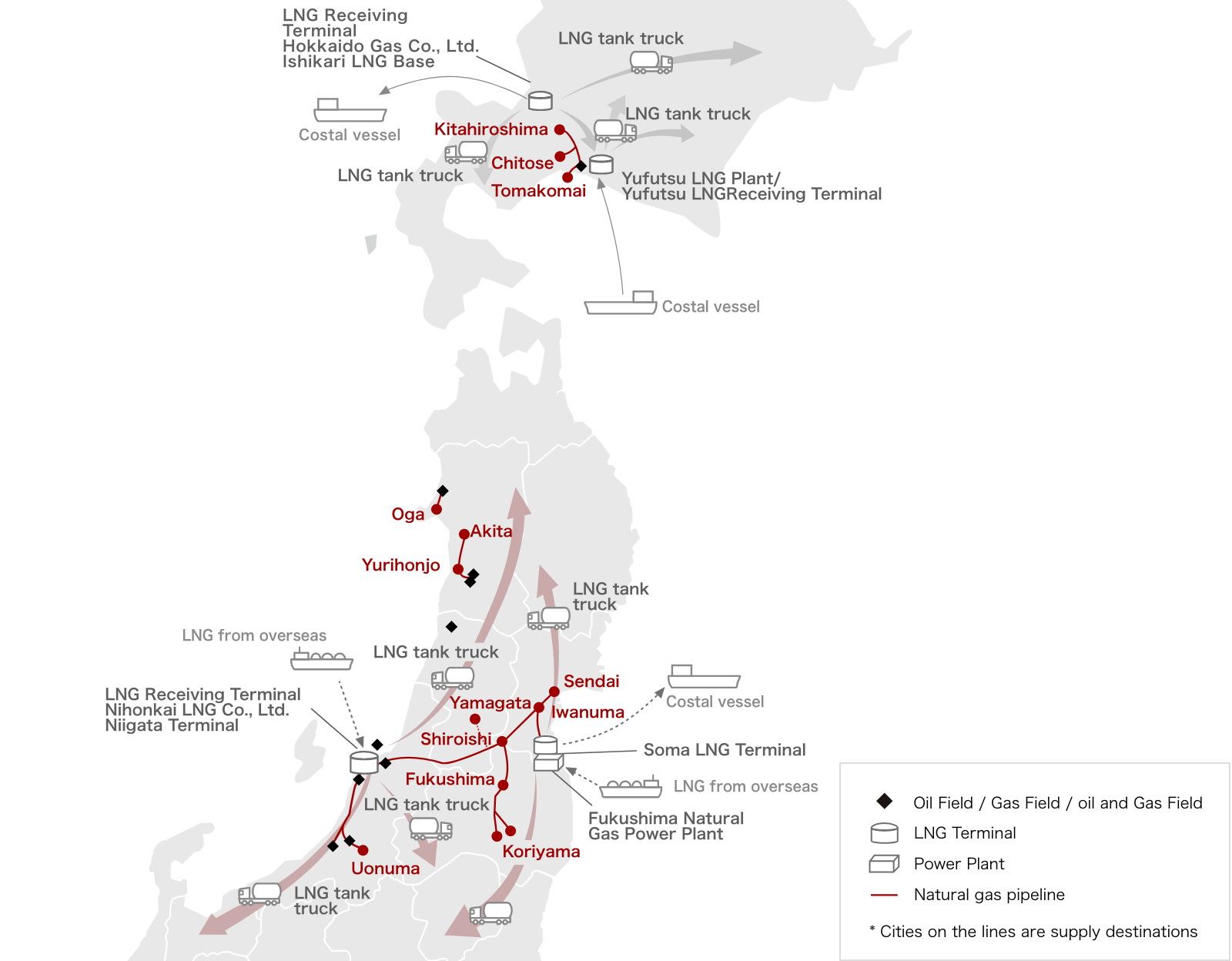
JAPEX’s domestic gas supply network
Source: JAPEX
JAPEX recently invested heavily in a new LNG terminal and LNG-fired power plant in the Fukushima Prefecture (Soma), and manages part of the domestic gas supply network and gas underground storage in the Hokuriku area.
The company is also part of the Japanese consortium invested in Russia’s Sakhalin-1 oil and LNG project, and seeks to become a major Carbon Capture and Storage player in the domestic and Asian markets, with a number of projects under development.
Producers and refiners: JX Nippon Oil and Gas Exploration (ENEOS), Idemitsu, Cosmo Energy
Investors and Traders: Mitsui & Co, Marubeni, Mitsubishi Corp, Sumitomo Corp, and Itochu
Japan’s upstream needs
Japanese upstream companies are invested in oil and gas fields all around the globe, from Idemitsu’s involvement in an upstream petroleum business in Norway, to Cosmo’s E&P efforts in the UAE, to Marubeni’s production projects in India, and Itochu’s equity stakes in Azeri, Russian, Qatari and Oman projects.
That’s because despite a gradual decrease in domestic demand for fossil fuels due to energy conservation, a shrinking population, and decarbonization efforts, Japan remains a major consumer of fossil fuels. Together with a belief in the sanctity of energy security, METI has continued to promote Japanese investment in overseas oil and gas fields even after the nation made the net-zero 2050 pledge, noting that demand for the fossil fuels will continue for many years to come.
In the latest version of the Basic Energy Plan (due to be updated this year), officials forecast that 31% of the country’s primary energy supplies in 2030 will be sourced from oil and 18% from natural gas. In addition, the Plan targets 50% of oil and gas imports to be sourced from Japanese-owned projects, up from the previous goal of 40%. The 2019 ratio was 34.7%.
Put simply, METI officials clearly believe that Japanese energy security is strengthened when its fuel imports are handled by domestic firms.
And, as the industry moves into a more complex business environment, METI seems to believe in the need for further industry consolidation.
According to the April issue of Zaiten magazine, METI is moving forward with plans to engineer an INPEX-JAPEX merger. The magazine, which can be on the sensational side, claims that much of the rationale for the action is personnel-driven. With many top government officials keen to finish their career at a plush corporate post (a practice known as amakudari), the article says that METI vice-ministers want to protect their future employment opportunities by securing the future of state-backed upstream firms.
Among the gossip, however, Zaiten relates serious concerns within METI and other ministries about how INPEX and JAPEX will fare financially once the notoriously cyclical oil and gas prices decline again. The government’s resource self-sufficiency targets have encouraged continued investments in oil and gas.
Only last year, Tokyo Gas agreed to spend $2.7 billion on U.S. shale producer Rockliff, which the Japanese firm said will make it one of the largest shale gas producers in Texas and Louisiana. It was less than a decade ago that Sumitomo Corporation booked impairment losses of a similar level after the downturn in commodity prices convinced the trading house it could not recoup money spent on overseas bets, such as a shale oil project in the U.S. It took Sumitomo until 2021 to offload the last of its interests in shale in the U.S. – just as oil prices were starting to nudge upward.
JAPEX itself incurred ¥90 billion in losses from an investment in a Canadian oil sands project when oil prices were low from 2018 to 2021.
Who’s the new boss?
From April, current JAPEX president Fujita Masahiro (a former director-general at METI’s Trade and Economic Cooperation Bureau) is due to move upstairs to be chairman, passing the baton to career JAPEX employee Yamashita Michiro. The latter will be the first president in the company’s 69-year history to rise through the company ranks, rather than be a government appointee. But this is not a sign of METI loosening control.
At INPEX, from March 26 Chairman Kitamura Toshiaki will move to an advisory role, leaving his post vacant. According to the company, President Ueda (68) will remain in his post for the seventh year.
The rationale for keeping the chairman position at INPEX empty, according to Zaiten’s government sources, is because there are expectations of a merger. Once that is complete, Ueda will take over as chairman of the joint company.
The new president of the merged entity is expected to be former Agency for Natural Resources and Energy Commissioner and current METI Assistant Vice-Minister Hosaka Shin. Incoming JAPEX President Yamashita will be given the Vice Chairman position as consolation, but it is said to be mainly a title without powers. Current JAPEX Chairman Watanabe Osamu will be allowed to stay as a director and special advisor to the new entity.
A merger between INPEX and JAPEX has been discussed in the media for years. Yet it was resisted especially from the JAPEX side through Tanahashi Yuji, who was JAPEX chairman and president for 15 years, stepping down only in 2016. A former Vice-Minister of International Trade and Industry, Tanahashi held great influence within the bureaucracy but is now 90 and has little sway.
A merger of INPEX with JAPEX will create a substantial Japanese upstream player, with greater resources and scope, and could be among the top 10-15 global firms in its field. That should translate into better price leverage domestically, and it might also help Japan finally embark on the development of domestic offshore hydrocarbon resources.
Despite all these advantages, how the possible future joint entity will cope in the age of net-zero is still far from clear and will need to be addressed.
ANALYSIS
BY ANDREW STATTER
Energy Jobs in Japan: Maximizing Your Value in a Fast Evolving Market
Last month, I touched upon how professionals in the energy space can enhance their value in the market, regardless of the inherent risk of whether or not their company is able to secure projects. Some of the key takeaways were:
Take on roles that give you a wider exposure, rather than have a focus that’s too narrow.
Gain experience across multiple phases of a project, from early stage feasibility and due diligence, into bid preparation, later stage development and execution.
If possible, take on multiple work-streams to hedge your risk of being an asset attached only to a single project.
Collect small wins to put on your CV, whether this is signing an MoU with a business partner, getting investment approval, or developing smaller projects; real achievements count.
Today, let’s dig deeper into the topic of maximizing your value, both for the purposes of being recognized as a key asset for internal career development and making yourself a prime target for external opportunities.
Work widely, or work deeply?
There’s an age-old question of generalization vs specialization. This is a question that will never go away, and will always have arguments for and against. Let me say that the correct answer for the purpose of maximizing your value is to do both!
For highly technical and engineering-focused professionals, leaning toward specializing and working deeply is advisable. In order to effectively lead a key technical project or engineering package, a high level of technical understanding and expertise is required, and often we will see professionals who have the right academic background miss out on job offers because they have not spent enough time honing their craft and working on real products / projects.
On the other side of this, building some commercial acumen is a value multiplier. The engineer who can interface with the JV partner or the customer, who looks good in a suit and can speak with authority, will command much higher value than the genius in the lab.
As for commercial professionals, skills such as running an RFQ, negotiating a contract, and managing JV relationships will be more transferable across different segments of the energy industry. Therefore, a lean toward generalization opens up wider opportunities and allows you to shift with the market.
Do be mindful that gaining depth of experience and measurable results is key here. As an example, those who have spent a long time in advisory often struggle to move to the developer / owner side. Even though they have excellent high-level understanding, they’ve not had the chance to execute on contracts, manage relationships through tough times and critically lack the experience in influencing internal stakeholders and gaining approval from all necessary departments, which often have conflicting interests.
Scale versus complexity
An APAC head of a Fortune 500 company told me years ago when looking at business leaders: “never confuse scale with complexity – a $10 million business is not necessarily easier to run than a $500 million business”.
Consider the energy market with its various areas of transition, where many projects and technologies are still in early stages. Many BESS projects being developed are under 10 MW; floating offshore wind is at demonstration scale <30 MW; both blue and green hydrogen production are small-scale and figuring out the logistics; MHC or ammonia are all still under research.
The challenges in developing and commercializing that first small-scale BESS project, commissioning that first three-turbine floating wind farm, or shipping liquid hydrogen safely will not be dissimilar to subsequent projects which are orders of magnitude larger.
Influence decisions
The difference between the following bullet points on a resume is significant:
Analyzed all possible supplier solutions and provided a roadmap and recommendations to management.
Created a solid business case for optimal solution, gained investment approval and signed binding agreement with supplier.
One main focus in interviews with large, complex organizations is around how the candidate can manage internal stakeholders and support decision-making. A subject matter expert, whether internal or an external consultant who does quality work in analyzing the market, will hit a limit if their interface is only their manager or a single-point contact in the client organization.
Much more value is gained from presenting and defending a business case, gaining alignment across all stakeholders, and ultimately getting approval to move forward. The communication, logical thinking, problem-solving skills that are necessary to make this happen are all highly valued. This is not the exclusive realm of senior management either. Even for professionals in their 20s and 30s, getting themselves in the room and obtaining this experience makes a difference.
Become a global talent
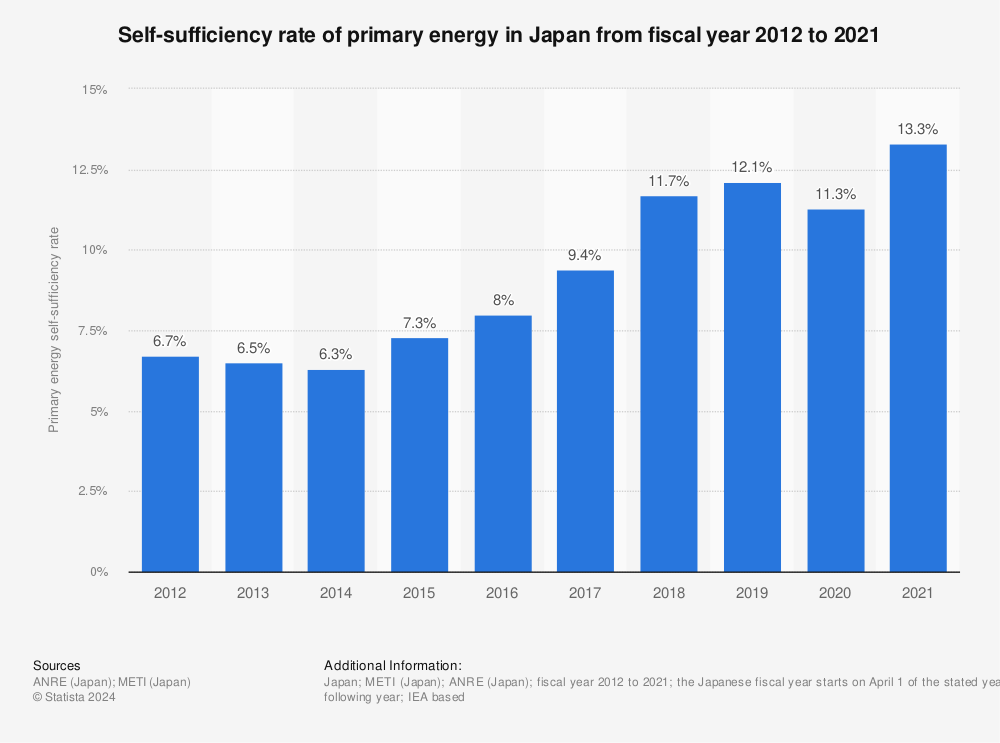
Japan imports roughly 75% of its primary energy; hence professionals in oil and gas tend to be quite globalized and used to partnering with overseas companies. The power side, though, has been a more domestic affair until the last decade or so due to the acceleration of renewables, and now, flexible assets such as energy storage. Investing in language skills builds a clear advantage for yourself as a professional, both as Japanese learning English and vice-versa.
Beyond language, gaining experience in markets other than Japan can boost your longer-term career value. Most multinational companies view APAC as the growth region to invest in – rather than Japan as a single country market. Hydrogen and ammonia, for example, will not scale with the value chain in Japan alone; it will require a regional approach.
Renewable power generation investments are also subject to priority shifts from a HQ perspective depending on policy shifts, geopolitical risks, market economics, etc. By gaining experience working on projects or markets outside of the home shores of Japan, you can hedge your risk of potential market exits, and longer term position yourself as a competitive talent for wider-ranging regional positions.
What can you do now versus what can you do anytime?
Japan can be elitist, and some job changes can be more of a one-way street than in other countries. The major trading houses are very often someone’s first company, very seldom someone’s fourth. The move from the developer / owner side to a consulting / advisory role is relatively easy compared to the move back.
There are exceptions to every rule, of course, and each case is up to the individual and the stakeholders in the hiring company. As a general rule, however, while you may gain more valuable experience moving to a smaller or less prestigious firm, making the move back to top-tier companies later on means greater pressure on you to perform, gain maximum value, and then communicate it into a clear and compelling story.
When considering a move, whether as an internal department change, a secondment to a subsidiary or an external shift, it is important to think about your career value and potential exit plan at 3.5- and 10-year intervals in the future.
In summary, the energy market is diversifying, and the pace of change is accelerating. Japanese firms are investing more globally, and Japan is becoming a more attractive investment destination for foreign capital again.
Putting yourself in a position to ride the waves of change by diversifying your skill set, banking measurable achievements, investing in skills including languages, and strategically stacking your skills / experience is the best way to add long-term value to yourself as a professional.
ASIA ENERGY REVIEW
BY JOHN VAROLI
This weekly column focuses on energy events in Asia and the Pacific, and all that impact markets in the region.
Asia / Renewable energy
Renewable energy costs in Asia last year were 13% cheaper than coal and are expected to be 32% cheaper by 2030, according to a new study by Wood McKenzie.
China / Crude processing
Crude oil processing averaged 14.8 mbpd in 2023, an all-time high. China has increased refinery capacity more than any other country, partially to meet its transportation fuel needs but also to produce feedstocks for its petrochemical industry.
China / Oil and gas
CNOOC has discovered a new reserve in the South China Sea containing over 100 mln tons of oil equivalent. The reserve is located at CNOOC’s Kaiping South oilfield in the Pearl River Delta near Guangdong province, and contains light crude.
China / Green hydrogen
China has 1.2 GW in installed green hydrogen capacity, about half of the global total, reports the IEA. In 2020 that figure was barely 10%; but rose to 30% in 2022. Production of green hydrogen is concentrated in inland regions, such as Inner Mongolia, soon to become a top producer, with a planned annual output of 500,000 tons.
India / Natural gas
India expects companies to invest $5 billion to build natural gas pipeline infrastructure in the states of Kashmir and Ladakh. By 2030, the govt seeks to raise the share of natural gas in India’s energy mix to 15% from the current 6.2%.
India / Coal power
NTPC officially launched the 1.6 GW stage-1 of Lara Super Thermal Power Station and began work on stage-II. Investment for each stage is about $1.9 billion. Firms plan to build at least 10 GW of coal-fired power capacity over the next 10 years. Coal-fired power plants account for half, or about 215 GW, of India’s total installed capacity of 430 GW.
Kazakhstan / Lithium
South Korean researchers have discovered significant lithium reserves in Kazakhstan, with potential resources worth up to $15.7 billion. This makes the country an emerging source of the critical metal.
Philippines / LNG
Aboitiz Power and a subsidiary of Manila Electric will invest in the LNG-fired power plants of a unit of San Miguel Corp – the 1.28 GW Ilijan power plant and a new 1.32 GW facility set to start operating later this year. The investment is about $3.3 billion.
Southeast Asia / Energy transition
The EU said it is committed to mobilizing $11 billion for ASEAN members for sustainable projects. Also, this past week Australia pledged $2 billion to help finance the energy transition in the region.
UAE / Nuclear power
Emirates Nuclear Energy Corp launched Unit 4 at the Barakah Nuclear Energy Plant that will account for 25% of the UAE’s electricity. Barakah NPP will have 5.6 GW capacity when built.
2024 EVENTS CALENDAR
A selection of domestic and international events we believe will have an impact on Japanese energy
Newly added as of Feb 22, 2024
January
First market trading day (Jan 4)
IEA “Renewables 2023: Analysis and Market Forecast to 2028” released (Jan 11)
Renewable Energy Exhibition (Jan 31 – Feb 2)
Taiwan presidential election (Jan 13)
Japan’s Diet convenes
IEA “Electricity 2024 / Analysis and Forecast to 2026” released (Jan 24)
February
CFAA International Symposium (Feb 2)
India Energy Week 2024 (Feb 6-9)
Lunar New Year (Feb 10-17)
Indonesia presidential election (Feb 14)
Japan-Ukraine Conference for Promotion of Economic Reconstruction (Feb 19)
FIT/FIP solar auction (Feb 19 – March 1)
Smart Energy Week (Feb 28-Mar 1)
March
Announcement of auction result for Offshore Wind Round 2 (for Akita Happo-Noshiro Project)
Onshore wind auctions (March 4-15; results on March 22)
International LNG Congress (LNGCON) 2024, Milan, Italy (March 11-12)
Russian president election (March 15-17)
World Petrochemical Conference, Houston, TX, USA (March 18-22)
IAEA Nuclear Energy Summit @ Belgium (March 21)
Ukraine presidential election (due before March 31)
Happo Noshiro, Murakami-Tainai, Oga-Katagami-Akita and Saikai-Eshima wind project auctions close (June 30)
July
Tokyo governor election (July 7)
7th Basic (Strategic) Energy Plan draft published (expected)
August
7th Basic (Strategic) Energy Plan draft presented to Cabinet (expected)
September
Global Offshore Wind Summit Japan 2024, Sapporo, Hokkaido (Sept 3-4)
The United Nations Summit of the Future (Sept 22-23)
Gastech 2024, Houston, TX (Sept 17-20)
IAEA General Conference
GX Week in Tokyo (expected late Sept to October)
Asia Green Growth Partnership Ministerial Meeting
Asia CCUS Network Forum
International Conference on Carbon Recycling
International Conference on Fuel Ammonia
GGX x TCFD Summit
October
IEA World Energy Outlook 2024 Release
BP Energy Outlook 2024 Release
Innovation for Cool Earth Forum (expected)
Connecting Green Hydrogen Japan 2024 (Oct 16-17)
Japan Wind Energy 2024 Summit (Oct 16-17)
Solar Energy Future Japan 2024 (Oct 16-17)
Japan Mobility Show (Oct 25-Nov 5)
November
US presidential election (Nov 5)
COP 29 in Azerbaijan (Nov 11-22)
Abu Dhabi International Petroleum Exhibition Conference (ADIPEC) 2024, Abu Dhabi, UAE (Nov 11-14)
APEC 2024 @ Lima, Peru
International Conference on Nuclear Decommissioning (TBD)
G20 Rio de Janeiro Summit (Nov 18-19)
Offshore Energy Exhibition & Conference (OEEC) 2024, Amsterdam, the Netherlands (Nov 26-27)
Biomass & BioEnergy Asia Conference (TBD)
European Biomethane Week 2024
December
Last market trading day (December 30)
Disclaimer
This communication has been prepared for information purposes only, is confidential and may be legally privileged. This is a subscription-only service and is directed at those who have expressly asked K.K. Yuri Group or one of its representatives to be added to the mailing list. This document may not be onwardly circulated or reproduced without prior written consent from Yuri Group, which retains all copyright to the content of this report.
Yuri Group is not registered as an investment advisor in any jurisdiction. Our research and all the content express our opinions, which are generally based on available public information, field studies and own analysis. Content is limited to general comment upon general political, economic and market issues, asset classes and types of investments. The report and all of its content does not constitute a recommendation or solicitation to buy, sell, subscribe for or underwrite any product or physical commodity, or a financial instrument.
The information contained in this report is obtained from sources believed to be reliable and in good faith. No representation or warranty is made that it is accurate or complete. Opinions and views expressed are subject to change without notice, as are prices and availability, which are indicative only. There is no obligation to notify recipients of any changes to this data or to do so in the future. No responsibility is accepted for the use of or reliance on the information provided. In no circumstances will Yuri Group be liable for any indirect or direct loss, or consequential loss or damages arising from the use of, any inability to use, or any inaccuracy in the information.