The electricity grid always needs balance. As Japan shifts its power systems to renewables, achieving that balance is very complex. After years of tinkering with market rules, electricity trading and policy to address this, Japan’s bureaucrats have decided to pause and take stock. The review comes at a time when METI is preparing the next iteration of the Basic Energy Strategy. The result of the two processes may have a profound impact on the nation’s energy map over the next decade.
Japan’s efforts to combat climate change have spurred development of highly innovative products and services. But setting their market price is proving to be a sensitive challenge given the near impossibility of near-term commercial scale. The easiest option is to wait. And so, dozens of talks related to new energy developments are on hold. Some businesses, however, are willing to take on risks and forge ahead. Japan NRG investigated how firms try to bridge buyer-seller differences and agree on a value for innovation.
ASIA ENERGY VIEW
A wrap of top energy news that impacts other Asian countries.
EVENTS SCHEDULE
A selection of events to keep an eye on in 2024.
JAPAN NRG WEEKLY
PUBLISHER K. K. Yuri Group
Events
Editorial Team Yuriy Humber (Editor-in-Chief) John Varoli (Senior Editor, Americas) Mayumi Watanabe (Japan) Wilfried Goossens (Events, global) Kyoko Fukuda (Japan) Magdalena Osumi (Japan Filippo Pedretti (Japan) Tim Young (Japan)
The Cabinet proposed an amendment to the Act on Promoting the Utilization of Sea Areas for the Development of Marine Renewable Energy Power Generation Facilities, to include exclusive economic zones (EEZ) in its scope.
The proposal added a new chapter four on offshore wind projects in the EEZ:
Defining prohibited acts;
Defining the METI Minister as the sole authority to designate project locations in the EEZ;
The Environment Minister can conduct environmental impact surveys upon METI Minister’s request;
METI and MLIT ministers can issue project licenses and set up stakeholder councils.
The amendment also reaffirms that developing renewables in the EEZ is Japan’s right as stated in the U.N. Convention on Law of the Sea.
CONTEXT: Japan government targets seek 10 GW of offshore wind projects by 2030, and 30-45 GW by 2040. The current law has no provisions for projects in EEZ waters.
TAKEAWAY: The amendment aims to promote offshore wind installations in the EEZ but is not limited to that. The law would be applicable to any renewable projects in the EEZ. Separately, the Defense Ministry has proposed a new law to set aside zones that are crucial for defense wireless communications. Defense officials want the power to mandate that wind facilities that are cited with their zones also meet the Defense Ministry’s requirements.
The govt approved a 10-year development plan to expand renewables and create bases for advanced industries such as semiconductors and data centers in Hokkaido.
The main goal is for Hokkaido to support revitalizing the national and regional economies by ensuring food security, tourism revival and carbon neutrality, as well as urban development of Hokkaido.
CONTEXT: The plan will also address socioeconomic changes due to COVID-19, including the loss of tourism, soaring energy and food prices, supply concerns, as well as the need to meet 2050 net-zero goals. The govt plans to invest further in wind and hydrogen power generation.
Over Feb 6-8, Idemitsu Kosan conducted an ammonia co-firing test at the Tokuyama refinery, using fuel with over 20% ammonia content, to run a commercial naphtha cracker for ethylene production. It proved ammonia can be used to run crackers.
Idemitsu also said the release of nitrogen oxide compounds met environmental standards. The ammonia had no negative impact on the cracker performance.
This was Japan’s first operation of an ammonia-fueled naphtha cracker.
CONTEXT: The Tokuyama cracker has an annual ethylene production capacity of 623,000 tons and is a key ethylene production site. Idemitsu did not say what was mixed with ammonia, but methane is the usual fuel for naphtha crackers.
TAKEAWAY: Naphtha crackers have the potential to be the second largest ammonia consumers after coal power stations. Japan’s total annual ethylene output capacity comes to 6.2 mln tons, and ten companies including Idemitsu own naphtha crackers. Idemitsu runs an older cracker in Chiba and it will be interesting to see if ammonia can be introduced there.
Idemitsu Kosan acquired a stake in Jet Zero Australia, a SAF producer with projects in Queensland.
Details of the investment, including a percentage share, were not disclosed.
In Q1 2027, Jet Zero plans to bring onstream the 100,000 tons / year PJ Ulysses plant, producing SAF from bioethanol using the alcohol to jet (ATJ) process.
Sekisui Chemical President Kato Keita said that capacities, the number of manufacturing lines and other details of Perovskite solar cell investments will be finalized in one or two years. The company plans to commercialize PSCs in 2025.
He needs to determine whether state support is possible if his company were to provide a large amount of PSC module supplies from the launch phase.
TAKEAWAY: METI plans to add PSC-derived solar power service to the FIT starting in 2025. Unlike industrial plants introducing PSC systems for in-house use, power service providers need to ensure accountability of their services to customers. Hence, the role of Sekisui and other module manufacturers goes beyond simply supplying modules. Providing reliable performance data for revenue forecasts and insurance policies is also important.
CONTEXT: This is an interview with Matsuo Kazuki, the CEO of EX-Fusion, a startup specializing in laser-powered fusion energy.
Matsuo explains laser-powered nuclear fusion, which involves using high-powered lasers to heat and compress fuel pellets to induce fusion reactions.
Japan has a notable presence in laser fusion research, alongside the U.S. and France. Matsuo emphasized Osaka University’s research on the fast-ignition method, which involves compressing fuel before heating it with more laser beams.
Despite the potential of laser fusion, Matsuo admitted significant technical obstacles to commercialization. He sees broader application for high-intensity laser technology beyond fusion.
Matsuo highlighted positives such as upcoming state support, in particular a program to boost fusion regardless of reactor type.
Hitachi Zosen Corp and Hitachi Zosen Inova inked an MoU with Oman LNG to install methanation equipment in LNG plants and to use emitted CO2 as a resource.
The MoU involves the study and potential construction of a small pilot plant next to an existing LNG plant, aiming to produce 1,200Nm³/h of e-methane.
Hitachi Zosen can count on METI’s FY2024 subsidy program to support oil refining technology projects in major oil-producing countries.
CONTEXT: Inpex and Osaka Gas set a goal of producing e-methane starting from FY2025. Tokyo Gas and Mitsubishi Corp have plans for starting a large-scale manufacturing plant in the U.S. in 2029.
TAKEAWAY: It is not clear if Japan will import the e-methane produced by the project since discussion on price and other factors are ongoing. Oman has a smaller output compared to other nations that produce oil and gas.
Hitachi Zosen Inova (HZI) acquired a majority stake in Schmack Biogas, an Italian supplier and constructor of biogas and biomethane plants. The deal saw PLC selling its 51% stake, while the remaining shareholders retained a minority share.
Schmack Biogas has built around 70 biogas/biomethane plants in Italy and other countries.
Mitsubishi Kakoki Kaisha will deliver hydrogen manufacturing equipment to Nippon Steel to study if it’s feasible to replace coke with hydrogen in the process of separating metallic iron from iron ore.
The company will provide two hydrogen production systems, each with a capacity to make 37,500 Nm3/ hour of hydrogen, enough to supply 1,200 FCVs. Nippon Steel will build a small pilot blast furnace that will link with the hydrogen equipment.
JFE Steel, Kobe Steel and Japan Research and Development Center for Metals also take part in the study.
CONTEXT: The study is funded by NEDO’s Green Innovation Fund, and its goal is to develop iron reduction processes that will cut emissions by over 50% by 2030.
TAKEAWAY: Mitsubishi Kakoki’s equipment employs a process called steam reforming that uses natural gas as feedstock and releases carbon while producing hydrogen. However, the current cost of green hydrogen makes steelmaking much more expensive and metal firms fear their customers will not accept such price increases.
Tanaka Precious Metal will install two 500 kW hydrogen fuel cell systems at its Shonan plant. They’ll supply 25% of power when the plant launches in April 2026.
Tanaka chose H2Rex systems made by Toshiba Energy Systems & Solutions, which will possibly be Japan’s largest hydrogen-derived power generation systems in the private sector, said Tanaka.
CONTEXT: Tanaka believes that annual emission cuts of 1,979 metric tons will result from the ¥2 billion investment into the FC systems.
TAKEAWAY: Tanaka’s base assumption is that the FC systems release zero carbon, which is currently the national carbon accounting rule applied to FC vehicles. However, this rule may change as METI plans to promote the use of hydrogen with a low carbon footprint, rather than just any hydrogen.
Mitsubishi Heavy Industries (MHI) secured a license from Kellogg Brown & Root (KBR) to provide carbon capture technology for a low carbon hydrogen production plant in Cheshire, UK.
This plant, part of the HyNet CCUS cluster, will have an annual production of 230,000 tons. The captured CO2 will be sequestered into depleted subsea gas fields.
Epson is intensifying efforts to develop technology for capturing and fixing CO2. The goal is to achieve “carbon minus” status by 2050 where it absorbs more CO2 than emitted. Epson plans to use thin-film technology for CO2 recovery and is focusing on fine algae for CO2 fixation.
Additionally, the firm aims to use the recovered CO2 as a resource for new products. Epson intends to operate a biomass power plant in Nagano Pref by 2026, and sees this as an opportunity to use CO2 separation technology.
Chemical firm Toray Industries developed an ion-conductive polymer membrane for next-gen batteries that has 10 times higher ion conductivity than existing products.
The polymer membrane has been designed to speed up the practical application of metallic lithium anode batteries – all solid-state and air batteries. It can also be used in EVs, industrial drones and urban air mobility (UAM).
CONTEXT: As the electrification of mobility progresses, LIBs are required to achieve higher energy density, prompting firms to develop next-gen batteries using metallic lithium. However, due to its traits such as strong surface reactivity, metallic lithium can easily lead to short circuits, and partly for that reason it has yet to be applied to anodes in all-solid-state batteries.
IHI and the Industrial Estate Authority of Thailand signed a MoU to study energy transition, carbon neutrality and manpower reduction at industrial zones in Thailand.
METI Minister Saito met with John Podesta, senior advisor to the U.S. President and discussed the possible synergy between Japan’s Green Transformation (GX) and the U.S. Inflation Reduction Act, to build sustainable clean energy supply chains.
TEPCO suspends treated water release after earthquake
(Kyodo, March 15)
TEPCO suspended the release of treated water into the sea after a 5.8 earthquake hit Fukushima Pref and other areas in northeastern Japan. The Fukushima Daiichi NPP facility and other local NPPs were unaffected.
METI’s Minister Saito Ken met with Rafael Grossi, head of the International Atomic Energy Agency, to discuss the safety of discharging ALPS-treated water into the sea from the Fukushima Daiichi NPP.
Saito stated efforts to maintain safety and to cooperate with IAEA reviews. Both parties emphasized the need for reliable information based on scientific evidence.
NEWS: ELECTRICITY MARKETS
14 Japanese firms partner on floating wind power generation
(Japan NRG, March 15)
Fourteen Japanese firms launched a consortium to promote offshore wind power, working on tech to be used for platforms and platform components.
Their work will be partly financed by METI, with members also set to invest. They include NTT Anode Energy, J-Power, Eurus Energy, Kansai Electric, TEPCO and Marubeni and Mitsubishi Corp.
CONTEXT: Formation of this group comes right after the govt approved the draft amendment to the law governing Japan’s EEZ. The govt has allocated ¥4 billion to support floating offshore wind tech, with an additional ¥400 billion to be funded through GX bonds for supply chains. With further development, the govt aims to select operators for up to 45 GW of offshore wind power facilities by 2040, and floating platforms are expected to be the main technology.
There are four major types of floating platforms under development in Japan and overseas. The consortium is set to work on tech compatible with all those types – spar buoy, tension leg platform, semi-submersible platform and barge.
TAKEAWAY: Conditions in the EEZ require structures suitable for deep waters as wind turbines can’t be fixed to the seabed. Such tech is costly, and since it’s still fledgling a much deeper understanding of environmental conditions is required to select adequate structures; each of the four types of floating turbine platforms impacts motion characteristics and the entire wind turbine from nacelle to dynamic cables. Such know-how in Japan is still limited and cooperation in developing such tech will be crucial to future progress.
METI Minister Saito will next week request Niigata Governor Hanazumi Hideyo to endorse the restart of Unit 7 of TEPCO’s Kashiwazaki-Kariwa nuclear power station. The minister is planning a visit to the prefecture on March 21 to explain the central government’s position face to face.
The governor’s approval is one of the last hurdles before the nuclear plant can resume operations. Late last year, it was cleared for operation by the regulator.
Minister Saito met with TEPCO President Kobayakawa on March 15 and said he would soon convey his support for the restart and stress its necessity to “the leaders of the prefecture, Kashiwazaki City, and Kariwa Village.”
TAKEAWAY: Local media reported this as the first time the national govt directly requested the restart of a nuclear power plant (after the NRA signed off on it). In some ways, METI might be keen to appear more assertive and believes the time is right to put more pressure on local authorities to green light nuclear restarts. In reality, the Tokyo bureaucracy does not need local approval, but tradition has dictated that this ritual be observed. In the case of the Kashiwazaki-Kariwa facility, the situation is far more delicate than at any other NPP in Japan because it’s TEPCO’s only operable nuclear plant. TEPCO has made a number of small and not-so-small errors in recent years in trying to get the station back online. So, consciously or otherwise, the Niigata governor has tried to stall his approval for as long as possible. His latest idea was to call for a local election so he could ask for a local mandate for the restart. But METI and the Cabinet are clearly uninterested in allowing local intrigues to play out further. How Minister Saito addresses the Niigata governor could send a message to other “holdout” governors with NPPs nearby.
The regional electric power utilities, (EPCOs), forecast higher renewables output curbs in FY2024 compared to the previous year, with the exception of Kyushu Electric. They cite lower power demand and an increase in nuclear power supplies as the reasons for higher curtailment projections.
Kyushu Electric, however, expects a lower curb rate due to fewer sunny days forecast for FY2024.
An ANRE expert meeting on March 13 discussed the reform and full liberalization of the electricity retail market.
In light of rising power prices in the market over the past two years, TEPCO Energy Partners President Nagasaki requested the review of regulated rates to be accelerated so that utilities can respond more flexibly to changes in market conditions. Without this, it is difficult to make new investment decisions, she said.
A managing executive officer from Osaka Gas also raised the issue of regulated rates, saying, “We need a mechanism to reflect fuel price increases in regulated rates.”
ANRE and regulator EGC officials aired results of market feedback around how the sector is functioning since its full liberalization in 2016. Among the opinions gathered were calls for an early abolition of regulated tariffs and a review into the impact of major power utilities moving to non-discriminate / equal wholesale sales of electricity to retailers and PPS (naigai musabetsu).
AU Energy Holdings President Nakagiri said that “progress in liberalization has stalled,” especially calling into question the situation in the low-voltage segment.
TAKEAWAY: There’s a lot of frustration building up in the electricity sector because prices and tariffs are not entirely reflecting the rising costs of generation. METI was supposed to move the electricity sector to an entirely market footing, but has kept a number of mechanisms in place from earlier, such as regulated tariffs for a portion of the electricity sales by major utilities. This simultaneous existence of market prices and government-approved rates has shielded consumers from extreme costs, but has also made the power generation business more risky. For a more detailed look at the discussions going on within METI and industry on electricity prices, see this week’s Analysis section.
From March 18, TOCOM will offer a weekly electricity futures contract in addition to the monthly product. The exchange seeks to capture growing demand for short-term hedging and trades.
The weekly baseload contract covers a seven-day period starting from Saturday. The weekly intraday contract starts on Monday. Both weekly contracts cover the same area as their corresponding segments on the JEPX wholesale marketplace.
Trading in the weekly baseload contract is open within a five-week window that includes the week in question. One unit of trading is equivalent to 16.8 MWh, representing 24 hourly slots over seven days at 100 kWh each. The weekly intraday contract covers 6 MWh.
TOCOM will also add a market maker system for a limited period from April to June to increase liquidity in the futures market. This will allow designated securities firms and others to simultaneously issue bids and offers at a set time.
CONTEXT: The move is in response to calls mainly from new power companies, for the creation of shorter-duration products. The major utilities can also benefit by using the weekly contracts to cover power plant shutdowns.
In January, TOCOM’s electricity futures market saw a 62.5% MoM decline in contract volume to 15.24 GWh, the lowest since listing in April 2022.
Electricity demand decreased due to warmer weather. This, combined with a softening LNG market and low prices in the spot market, dampened the need for hedging.
TOCOM’s East Baseload contract for January averaged ¥10.39; it was ¥9.39 for West Baseload.
Off-auction trading dropped below 30% of contract volume. Only three deals were executed at 100 lots. Open interest at January end was 175.35 GWh, down 27.3% from the previous month.
OCCTO picked FS Japan Project 41 (capacity 19.9 MW) with a price offer of ¥0/ kWh as the winner of the 19th auction for solar power generation under the FIP.
The highest successful bid was ¥6.98/ kWh, well below the cap of ¥9.28/ kWh.
The latest auction round saw 127 bids totaling 311.7 MW, more than 2.3 times the solicited capacity of 134.1 MW.
The weighted-average bid was priced at ¥5.11/ kWh. In the previous round, the weighted-average bid was ¥8.55/ kWh, and the highest bid was ¥9.19/ kWh.
CONTEXT: The bidding was for FIP PV installations with an output of 500 kW or more, and FIT PV installations with an output of between 250 kW and 500 kW. All successful bids exceeded 500 kW.
TAKEAWAY: FS Japan Project 41 looks like a project entity of developer First Solar Japan, which since 2022 is part of PAG Renewables. Starting from FY2024, PV auction winners will be subject to power generation-side charges under a new provision to be added to the Act on Special Measures Concerning Procurement of Electricity from Renewable Energy Sources by Electricity Utilities. Also, the results of the latest auction, including the 19th round show that prices trend downward.
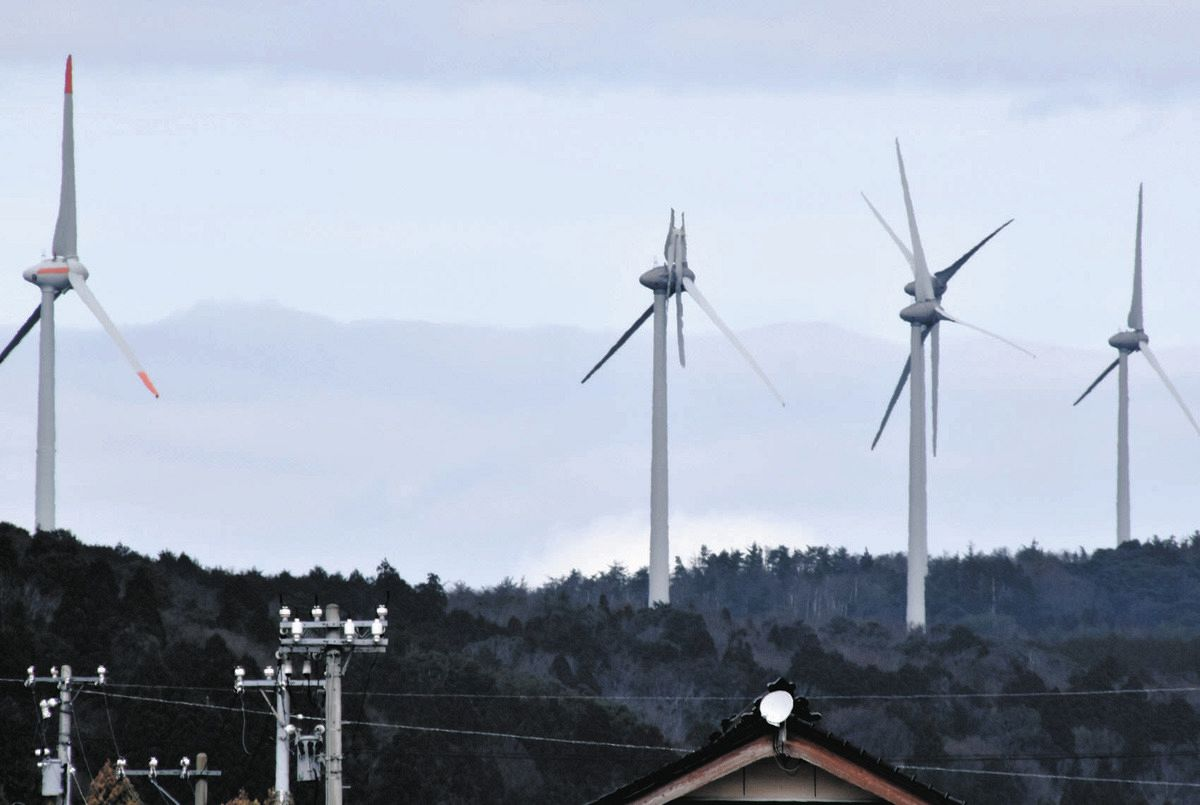
Most of the 73 wind turbines (capacity 130 MW) on the Noto Peninsula, Ishikawa Pref, which went offline in the wake of the Jan 1 quake, have yet to restart. Only 9 have been switched back on so far.
It’s even unclear when at least half of the rest will become operational. The halt also impacts projects still in the pipeline – 181 turbines with a total capacity of 730 MW are slated to be built in the area.
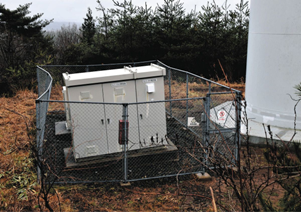
CONTEXT: Ishikawa has 74 wind farms, of which 73 are in the Noto area. The remaining one has been offline since 2017. This is reportedly the first time that a quake has left broken blades. Access to most of the area’s wind farms, particularly in Suzu and Wajima cities, is limited and the situation can be only confirmed by using drones or a zoom lens.
Broken blade at wind farm in Shika Town in Ishikawa Prefecture (left);
A substation in Nanao City that suffered damage seen on March 7 (right).
Eurus Energy launched its Eurus Tokoro-Notoro wind farm (capacity 30 MW) in western Hokkaido. Eurus also operates 15 wind farms in northern, central and southern Hokkaido.
The farm uses seven Siemens Gamesa turbines, each with a 4.3 MW capacity. The power will be sold to Hokkaido Electric.
With this launch, east Hokkaido has hit the 500-MW capacity milestone.
CONTEXT: Nationwide, Eurus owns a total wind power capacity of 1 GW.
The Ministry of Internal Affairs and Communications approved a plan by Aomori Pref to raise nuclear fuel taxes by 29%, effective April 2024. The new rates will apply until March 2029.
J-Power suspended operations at Unit 1 at its Tachibanawan thermal power plant due to a steam leak. Inspections revealed a crack in the pipe. Repairs will start and the power plant is expected to resume operation by March 2025.
The plant is in Anan City, Tokushima Pref, and it operates on coal capacity of 1.05 GW per unit.
The Institute for Energy Economics and Financial Analysis forecast that Japan’s LNG demand is likely to continue declining, which will lead to excess supply for utilities through 2030.
Utilities like JERA, Tokyo Gas, Osaka Gas, and Kansai Electric will face an over-contracted position of roughly 11 mtpa of LNG, according to the Institute’s calculation.
Japanese players are focusing on resale of excess LNG abroad due to a saturated domestic market. Increased nuclear and renewable energy generation has led to a decline in demand.
The Institute’s conclusion is that if Japanese utilities cannot resell excess LNG volumes, they will need to renegotiate their supply contracts.
CONTEXT: The Institute for Energy Economics and Financial Analysis is a U.S.-registered NPO that promotes the transition away from fossil fuels to renewable energy sources.
Saudi Aramco told Japanese LPG wholesalers that it will maintain the March loading prices for LPG exports. This is due to the end of the heating season, despite a slight increase in crude oil prices.
The price for propane remains at $630 per ton. Butane is still at $640 per ton. This represents the end of a two-month upward trend.
CONTEXT: Brent crude oil futures rose by 2% compared to the end of January, and reached the mid $80s per barrel by the end of February. A slowdown in heating demand in East Asia is expected.
LNG stocks of 10 power utilities were 1.83 million tons as of March 10, down 6.2% from 1.95 million tons a week earlier. This is down 21.5% from end March 2023 (2.33 million tons), and 14.5% down on the 5-year average of 2.14 million tons.
CONTEXT: Tokyo had a snowy day in early March, but power utilities have lowered LNG stocks further, anticipating a rising temperature trend.
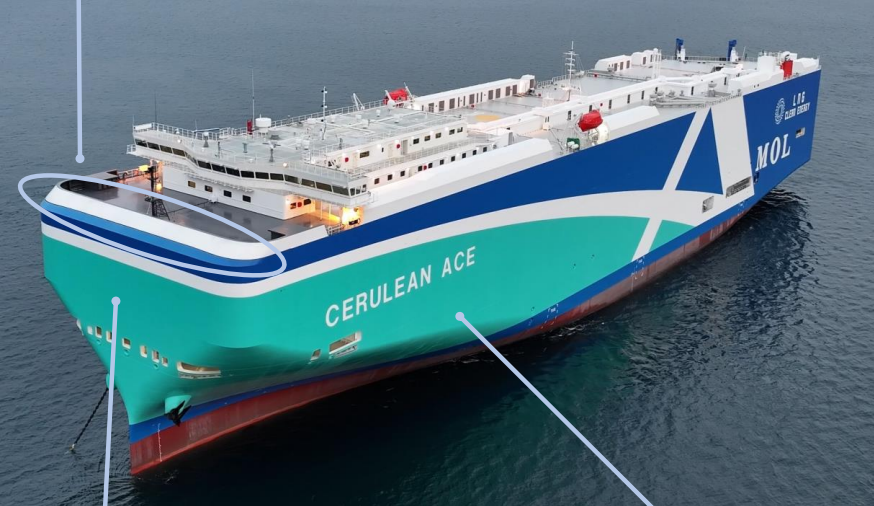
Mitsui O.S.K. Lines (MOL) delivered a new LNG-fueled car carrier, the first of 11 planned to be built in Japan under the Blue series.
CONTEXT: MOL plans to operate a total of 14 new LNG-fueled car carriers, to reduce CO2 emissions by 25-30%, to reduce SOx emissions by about 98% and NOx emissions by about 85% compared to vessels using conventional fuel oil.
ANALYSIS
BY MAGDALENA OSUMI AND YURIY HUMBER
Japan Looks to Reform Electricity Markets to Accommodate Renewables. Again.
The electricity grid always needs balance. As Japan looks to shift its power systems away from fossil fuels to renewable sources, achieving that balance has become an increasingly complex exercise. And yet, after years of tinkering with market rules, electricity trading, and policy to address this, the nation’s bureaucrats have decided to pause and take stock.
In August 2023, METI launched a comprehensive review of all electricity market reforms to date. This introspection aims to assess everything from how today’s various electricity market platforms perform, to operating conditions for renewables, to ways that the energy landscape will change with a planned multi-trillion-yen upgrade of the grid. The latter is a step to delivering more green power to central cities / industry from regions further afield.
The mother of all electricity sector reviews is chaired by renowned energy economist Kanemoto Yoshitsugu and has an 8-person core panel filled with some of METI’s most favored academics. It also carries 10 ‘observer’ members from the major utilities, energy brokers, regulators and trading platforms. Representatives from OCCTO and relevant ANRE departments complete the grouping, which has tentatively promised to complete the review by fall of this year.
With such a scope and ambition, it would not be unusual to see the review process spill over into a third year. However, according to Japan’s largest business lobby, the Keidanren, there is little time to lose. The nation’s place as one of the leaders among industrial nations is under threat should it fail to transfer its economy to a cleaner footing by 2030. This invariably will require a reorientation of power markets and systems to allow for a greater contribution from renewables, along with other carbon-free power sources.
The review comes at a time when METI is also busy preparing the next iteration of the Basic Energy Strategy. The result of the two processes may have a profound impact on the nation’s energy map over the next decade.
Group background
In Japanese the review group is called 回同時市場の在り方等に関する検討会, which translates into the rather unwieldy “Study Group on the State of the Simultaneous Market”. The name refers to the need to have all the various electricity players, platforms and structures work in sync. In other words: for the power markets to be in balance.
The group acknowledges in its formation statement that its genesis owes to the fact that the increased rollout of renewables – together with the unbundling of former regional utilities, and a full liberalization of power retail and generation – have created a complex set of conditions. As a result, electricity trading and generation assets are not always managed in an efficient manner.
The inefficiency is non-trivial. It presents risks to the stability of the nation’s energy system and complicates an expedient expansion of renewables in Japan.
“We discussed specific measures from the perspective of stable power supply and the pursuit of merit order [to address] the uncertainty in supply-demand through a further integration of renewable energy throughout Japan and its maximum possible rollout while maintaining a supply-demand system and a market system,” the group said in the formation statement.
The predecessor of this expert group was METI’s Working Group on Practical Considerations for the Realization of an Ideal Wholesale Electricity Market, Supply and Demand Balancing Market and Supply and Demand Operations. That group was formed in mid-2022 and presented its findings to the ministry in April 2023.
The ideas presented by the earlier working group were carried into the new iteration of the working group and are now looked at both more broadly and in more detail. The new group is led by Visiting Professor at the National Graduate Institute for Policy Studies, Kanemoto Yoshitsugu. He’s better known as the first head of the Organization for Cross-regional Coordination of Transmission Operators (OCCTO), which is the industry-backed entity that oversees the power system and liaisons with the government / regulators.
Kanemoto had previously taught economic analysis of public policy at Tokyo University’s Graduate School of Public Policy before joining OCCTO when it was formed in 2015. In the ‘Simultaneous Markets’ study group, he is joined by:
Akimoto Keigo, senior researcher from Research Institute of Innovative Technology for the Earth (RITE);
Isogawa Daiya, associate professor at Osaka Metropolitan University, Graduate School of Economics;
Ichimura Takuto, attorney at Mori, Hamada and Matsumoto with expertise in energy, infrastructure and financial services;
Watanabe Kenichi, assistant professor at Tokyo Institute of Technology, Department of Electrical and Electronic Engineering;
Komiyama Ryoichi, professor at the University of Tokyo, Graduate School of Engineering, specializing in quantitative analysis of energy security;
Matsumura Toshihiro, professor at Tokyo University’s Institute of Social Science, specializing in green transformation in oligopoly markets under common ownership and common ownership in a delivered pricing duopoly;
Yokoyama Ahikiro. Tokyo University professor emeritus.
Observers
Ishizaka Tadashi, Tokyo Gas, Executive Officer, GM of Power Business Division;
Ichimura Takeshi, CEO of Energy Pool Japan;
Kunimatsu Ryoichi, General Manager, Japan Electric Power Exchange (JEPX);
Saito Koji, KEPCO, Director, GM of the Energy & Environment Planning Office;
Shinkawa Tatsuya, Director of the Market Surveillance Division at the Electricity Market Surveillance Commission under METI;
Nishiura Hiroshi, Japan Wind Power Association (JWPA), Vice Chairman, Policy Subcommittee;
Nozawa Ryo, CEO of enechain;
Higashitani Tomoyuki, JERA, Research Dept., Planning & Coordination Division;
Masukawa Takeaki, Japan Photovoltaic Energy Association (JPEA), Deputy Secretary General and Director of Planning Dept;
Yamamoto Ryutaro, Director of TDGC (Transmission & Distribution Grid Council).
This group has met six times since August 2023, and its planning documents show that the review process should be completed in “about a year”. The arrow that points to 3Q 2024 on the timeline, however, is perforated, suggesting that the timing is provisional and the process may be extended.
Point of focus
The liberalization of the power sector led to over 700 new entrants joining the industry since 2016 to generate and / or retail electricity. That plethora of market players, and the high number of individual generation units inherent in distributed power systems, like solar and wind, have made the job of central coordinating parties like regulators and grid operators very challenging.
The complexity is enhanced by the different characteristics of thermal and renewable sources. A solar farm is quick to stop and start generation, but cannot easily guarantee certain volumes over extended periods of time. Nuclear power plants provide steady volumes over many months, but require weeks of planning to restart from cold.
In the eyes of METI and the energy experts involved in the current study group, to make the electricity industry more efficient and stable, a market mechanism should be formed that would allow “all electricity to be traded at the same time, regardless of supply capacity and regulating capacity”. This is what the group calls a “Simultaneous Market”.
In short, this is an attempt to combine the functions of various electricity trading platforms so that, for example, spot and balancing trades are in sync.
In January 2023, Ichimura Takuto, a lawyer from Mori, Hamada and Matsumoto, who is part of the ‘Simultaneous Markets’ study group, made a presentation at the Meet Japan Power 2023, a forum organized by Japan NRG together with EEX and Volue. At the time, Ichimura was seconded to the Electricity and Gas Industry Dept at METI’s Agency for Natural Resources and Energy (ANRE).
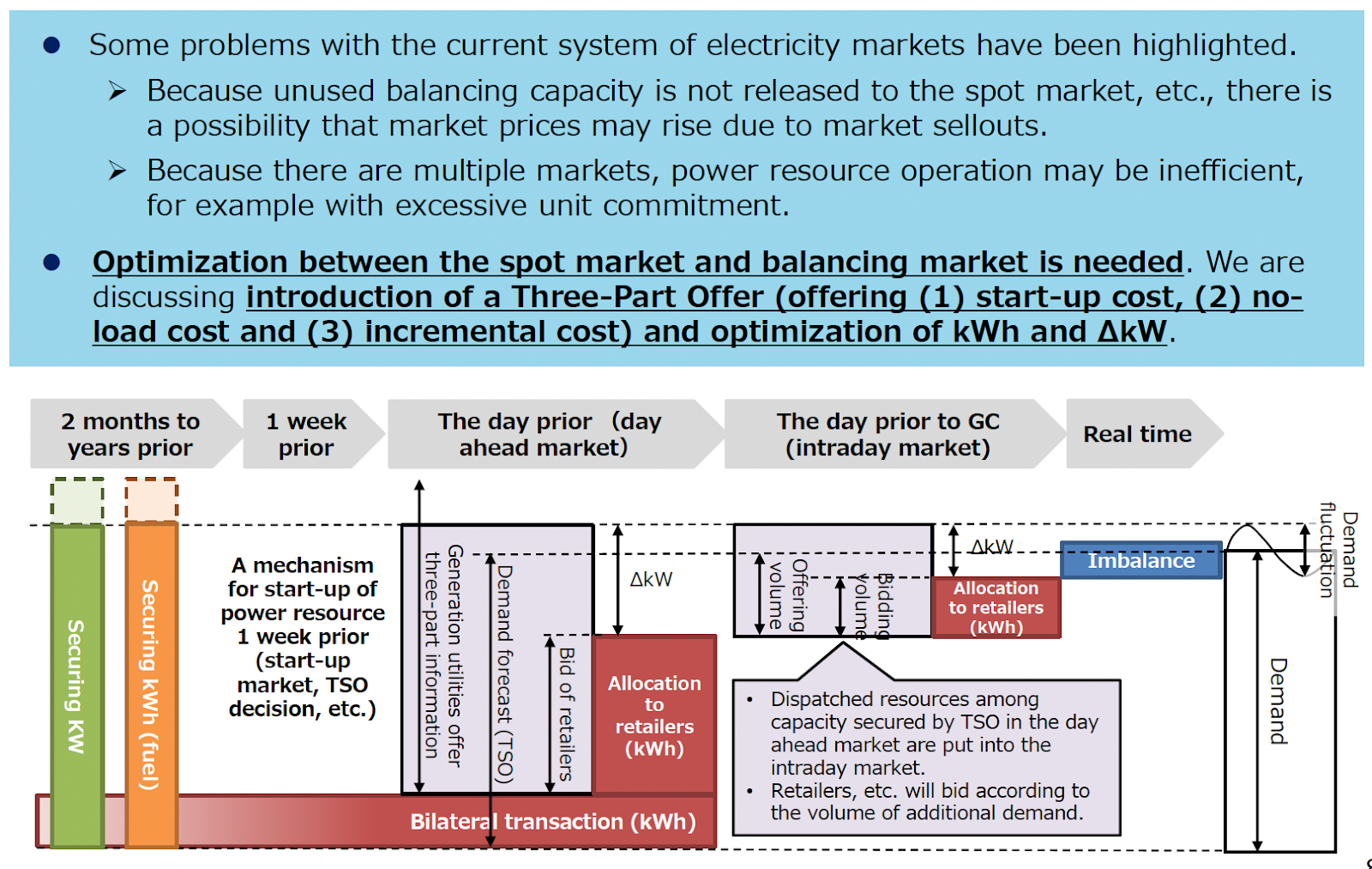
Ichimura unveiled a METI-backed idea of creating a “Three-Part Offer,” a new electricity market design that would act as an enhancement of today’s balancing marketplace.
The design takes into consideration the three key factors that govern whether you can secure electricity in the market: availability of capacity, availability of volume, and the cost and time involved in getting this electricity to hand.
While Japan has various platforms that handle different types of power sales, such as kW (Capacity Market), kWh (Spot, Intraday, Baseload, and Futures Markets) and ΔkW (delta kilowatts, Balancing Market), the market platforms are not always able to work smoothly, Ichimura explained. This is partly due to intricate relations that these markets have with global fuel markets and financial markets, and partly because of the ways in which the grid limits physical movement of electricity between Japan’s regions.
To simplify or unify the various complexities, Ichimura argues that Japan could adopt the Three-Part Offer approach, which would combine within one bid all the core factors relevant to power production.
This market design in some ways mirrors the North American PJM and NYISO mechanisms, but adjusts the conditions to fulfill METI’s objective of creating a system that balances out the diverse and distributed aspects of a modern electricity industry.
From METI presentation at the Meet Japan Power 2023 event
Source: METI
Conclusion
According to Keidanren, the big-business lobby group, Japan needs to address four core challenges this decade:
Significant reliance on fossil fuels that continues to draw criticism from the international community;
Transmission constraints and other limitations hindering expansion of renewables;
Delayed restart of nuclear power facilities, and
Relatively high electricity prices compared to other nations.
The comprehensive review process instigated by METI partly addresses these issues but is also heavily preoccupied with the design of electricity market trading. That assumes all generators will gravitate to market-based pricing, including the renewables sector that until recently relied mostly on a state tariff system, the FIT.
While the FIT was phased out almost two years ago, it did not prompt a wholesale shift to market-based electricity sales. In fact, both renewables developers and buyers of green electricity are increasingly turning to the Corporate Power Purchase Agreement (CPPA) business model. Effectively, this makes many renewables projects client-led rather than market-price-driven. If that proliferates then the influence that METI and its experts see renewables having on power markets may not materialize.
Once again, the bureaucrats are keen to create the perfect market design to fit the increased role of renewables in Japan. And, once again, the renewables sector is finding its own solution.
ANALYSIS
BY MAYUMI WATANABE
How Japanese Players Approach Pricing Strategy for New Climate Solutions
Japan’s efforts to combat the impact of climate change have spurred the development of new, highly innovative products and services. But setting their market price is proving to be a tricky and sensitive challenge given the near impossibility of near-term commercial scale.
Climate business leaders say they are facing a number of vital questions: How many years of R&D costs should the initial clients cover in the starting price? Or should the price reflect the potential value customers hope to extract? Benchmarking against related products is a tried and tested approach, but even if this is agreed on, talks over the premium are far from simple.
In an uncertain world, the easiest option is to wait. And so dozens of talks related to new energy developments are currently on hold, none more so than in the hydrogen and ammonia offtakes space. Privately, those involved in the talks fear that many projects will never make it outside the conference room.
Some businesses, however, are willing to take on risks and forge ahead. Japan NRG has spoken with a number of representatives of firms across several sectors operating in Japan to hear about how they managed to bridge buyer-seller differences and agree on a value for innovation.
Pricing turnkey solutions
In the climate solutions space, there are currently more Business-to-Business (B2B) than Business-to-Consumer (B2C) offerings. In part, this is natural for energy and infrastructure, but it also reflects the way in which the energy transition is playing out: New solutions are often created specifically to address known issues at partner or client operations.
In this sense, the B2B deals are a reflection of long-term business relations, which have developed over years and decades, and seek to extend into the net-zero era. In such a situation, the solutions have come about from years of R&D, based on regular talks and information exchanges. But the long-term nature of this process is being undermined by ever-faster shifting industry trends.
Here are a few examples.
Kawasaki Heavy Industries is building a ship with four 40,000 m3 tanks to transport liquid hydrogen, with construction to be completed about 2030. Up until around two years ago, hydrogen was generally considered in Japan as a successor to LNG, and it was thought that the production, transport and pricing of the fuel would mirror that of its ‘predecessor.’
The thinking in industry and government discourse changed, however, and recently it is ammonia as a fuel or a hydrogen carrier that is portrayed as the optimal solution for Japan. The demand for specifically ammonia from JERA and other power utilities has raised its profile and business case far above that of liquid hydrogen, making some say that the latter has few prospects.
But just as Kawasaki Heavy continues its multi-year development of vessels that carry liquid H2 across the seas and oceans, so others in the supply chain say that they are not willing to turn their backs on the technology. In fact, they believe liquid H2 will make a comeback.
One official said his company’s strategic focus is very much on making hydrogen tanks because they forecast that hydrogen will dominate the net zero future while interest in ammonia and methanol will phase down. The official hopes that no innovation will appear that would drastically upend his industry forecast, but there’s no guarantee that won’t happen.
Another player betting big on hydrogen is Asahi Kasei. The chemical company had worked with ammonia for decades, but in 2021 decided to invest heavily in green hydrogen. Its first 10 MW electrolysis system was installed in Fukushima Pref. in 2022.
Since then, Asahi Kasei has looked for new electrolyzer clients while preparing to double its output capacity to 2 GW a year from 2025. Officially, orders for electrolyzer units are supposed to start in 2025, but with a year required for delivery of the 10 MW system, sales talks cannot wait despite changing technological trends, policies and price expectations.
Long delivery time does not always allow negotiation time for the potential buyer and seller to agree on how to value the product. Buyers usually have emission cut goals and deadlines. Sellers are under pressure to increase orders because they want to scale up production. Both hope to lock in a deal before new trends emerge, or face starting from scratch.
Buyers and sellers of turnkey infrastructure solutions – such as turbines to combust hydrogen, LNG, and biogas – agree that an ‘environmental value’ (also known as a green premium) needs to be reflected in the price. That value could, and should, reflect the amount of fossil fuel cuts, emission cuts, water conservation, waste reduction, nature conservation, improved noise and odor control, etc. But not all buyers are willing to pay on such a basis.
As a compromise, some talks are moving their pricing to a benchmark that takes into consideration the cost of equipment and then adds on a green premium.
Locking in a price is vital for manufacturers to prepare capacity, but often buyers are mindful of accepting terms that are too stringent and long-term. After all, over the coming decade, the price of carbon, the cost of water supply, and other feedstocks will surely change. Some of these changes cannot easily be covered by a formula, because they could include policy U-turns and market design revamps.
A “market price” holds little meaning in a shifting sands environment.
And so suppliers of new products are trying to get creative. One engineering firm official said that his company has launched a project to develop open and transparent pricing platforms for clean energy commodities such as hydrogen. Another tech startup says that it’s willing to accept fluid payment terms. Meaning, that in addition to the old-fashioned bank transfers, it will consider payment in power or carbon credits, or even hydrogen.
Less capital intensive B2B solutions
With less capital intensive B2B solutions, new products are now being packaged with service offerings. Providers discovered that adoption was slow mainly due to the difficulty that clients had in getting staff trained in new tools. As many firms in Japan testify, labor shortages are a bottleneck and new tech is sometimes seen as a resource drain.
“At the end of the day, if the total cost of introducing a new solution is more expensive than the legacy way of doing things, customers won’t want it. But it becomes a win-win deal if we send experts to customers to serve their needs,” said a Nippon Koei official.
Nippon Koei has developed a biological soil crust (BSC), which consists of soil algae. Derived from sugar cane, the algae traps and captures seeds, and consolidates them on the surface. The process reduces the number of seeds blown away by wind, and speeds up greening. BSC also converts barren land and desert into green land.
For the last ten years, Nippon Koei has been offering its soil algae to municipalities that use it for soil erosion control and to maintain vegetation in parks. In expanding its market scope to the private sector, the company decided to offer BSC as a service. The chosen pricing strategy was to align with other greening services.
B2C pricing
In 2021, Tokyo-based Green Display Co. and Saitama-based Nisoul began marketing botanical lighting systems that make use of electric currents flowing from plant roots as a source of light. Their first targets were urban developers and the strategy was successful. Innovative developers jumped on it, including Shibuya Hikarie, a popular shopping mall near Shibuya Station.
Now, Green Display and Nisoul plan to widen their market to general consumers and have developed a botanical power system that consists of electrodes to capture electric currents from plants.
The electrodes are thrust into a flower pot with plants. Electrical wires connect the electrodes to a power charging device, to charge pen lights. A kit consisting of an electrode, a cable, a charging system, and a pen light was priced at ¥9,790. In comparison, a portable solar kit with a small solar panel and a cable costs ¥890-¥3,000 on Amazon.
“Our pricing approach was simple. We have a cost that we want to recover in a few years, and then split it up by the target units to sell,” said an official at Green Display. He added that the speed of mass market penetration was key to a successful consumer business.
Conclusion
Innovations need to be monetized in order to survive. What Japan NRG’s anecdotal review has found, however, is that while most firms pursue innovation in the B2B sector, their pricing power is often weaker than those engaged in the B2C space.
Ultimately, judging winners and losers in the pricing game is a thankless task. Innovations do not live within the constraint of an annual balance sheet. Their success lies in opening markets and creating new demand. A ‘loss’ today could be a ‘win’ in five years’ time. Or, the precursor to an even bigger loss.
One commonality that does emerge, especially in the capital-intensive side of the B2B space, is strong interest in linking prices to public commodity price indices. That has moved forward many offtake discussions, but the bottleneck then becomes the size of the premium and its tenure. (Sellers lean towards somewhere around 15 years, while buyers prefer single-digit durations.)
The No. 1 question most have is what will be the price of CO2. That may be key to the creation of a trusted ‘climate value’ index. But putting together such a product and marketing it may take just as long as developing new climate technologies. It will involve identifying the transaction norms, geographical flows, standardizing attributes, crafting new rules, and a continuous dialog with the markets.
For those keen to move faster, there has to be a readiness to be both creative and comfortable with market risk. It also requires the confidence to ride out the fast-fashions and bumps of the energy transition.
ASIA ENERGY REVIEW
BY JOHN VAROLI
This weekly column focuses on energy events in Asia and the Pacific, and all that impact markets in the region.
Australia / Renewable energy
Research by the Clean Energy Council determined that in 2023 renewable energy comprised 39.4% of Australia’s total electricity, with 6 GW of clean energy projects added to the country’s total generation capacity in 2023 alone.
Asia / Coal
Exports of seaborne coal from Russia to Asia have been weakening in recent months, with lower shipments of both thermal grade and metallurgical coal used to make steel. February exports were also some 21.6% below the 10.81 mln tons for February 2023.
India / BESS
Tata Power Solar Systems began operation on a 100 MW solar PV project coupled with a 120 MW-hour utility-scale battery storage system (BESS), the largest in India.
India / Coal and solar power
The Ministry of Coal plans to boost renewable energy capacity, planning to install over 9 GW by 2030 to support net-zero goals in the coal industry’s power consumption. More precisely, rooftop and ground-mounted solar projects will be promoted at mining facilities.
Indonesia / Solar power
A new regulation will encourage solar power, setting an annual target of 1 GW rooftop solar connected to the PLN network and 500 MW from non-PLN sources. This plan aims to utilize Indonesia’s silica sand resources to produce solar cells, encouraging growth in the domestic solar module industry.
Philippines / Power
The country’s value-added output, and electricity power generation and distribution, are forecasted to increase 7% YoY, with gas, renewables, and transmission development as potential growth drivers.
SMRs
The small modular reactors (SMR) project pipeline reached 22 GW in Q1 2024, increasing 65% since 2021; but it requires an investment of $176 billion. Of the five leading countries in this pipeline, South Korea is the only Asian nation. The other four are the U.S., Poland, Canada, and the UK.
South Korea / Offshore wind
Thai-based multinational B. Grimm Power will expand its renewable energy business through investments in Nakwol Wind and Hanbit Wind, two offshore wind projects in South Korea with a combined installed capacity of 740 MW.
Solar power
From 2022 to 2033, the Middle East and North Africa (MENA) is forecasted to increase its solar capacity by 99 GW, reflecting an annual growth average of 21% growth, according to BMI.
Vietnam / Energy transition
Copenhagen Infrastructure Partners inked a MoU with PetroVietnam, the Vietnamese oil, gas, and renewable energy group. The companies plan to launch a collaboration on renewable energy and offshore wind.
2024 EVENTS CALENDAR
A selection of domestic and international events we believe will have an impact on Japanese energy
January
First market trading day (Jan 4)
IEA “Renewables 2023: Analysis and Market Forecast to 2028” released (Jan 11)
Renewable Energy Exhibition (Jan 31 – Feb 2)
Taiwan presidential election (Jan 13)
Japan’s Diet convenes
IEA “Electricity 2024 / Analysis and Forecast to 2026” released (Jan 24)
February
CFAA International Symposium (Feb 2)
India Energy Week 2024 (Feb 6-9)
Lunar New Year (Feb 10-17)
Indonesia presidential election (Feb 14)
Japan-Ukraine Conference for Promotion of Economic Reconstruction (Feb 19)
FIT/FIP solar auction (Feb 19 – March 1)
Smart Energy Week (Feb 28-Mar 1)
March
Announcement of auction result for Offshore Wind Round 2 (for Akita Happo-Noshiro Project)
Onshore wind auctions (March 4-15; results on March 22)
International LNG Congress (LNGCON) 2024, Milan, Italy (March 11-12)
Russian president election (March 15-17)
World Petrochemical Conference, Houston, TX, USA (March 18-22)
IAEA Nuclear Energy Summit @ Belgium (March 21)
Ukraine presidential election (due before March 31)
Happo Noshiro, Murakami-Tainai, Oga-Katagami-Akita and Saikai-Eshima wind project auctions close (June 30)
July
Tokyo governor election (July 7)
7th Basic (Strategic) Energy Plan draft published (expected)
August
7th Basic (Strategic) Energy Plan draft presented to Cabinet (expected)
September
Global Offshore Wind Summit Japan 2024, Sapporo, Hokkaido (Sept 3-4)
The United Nations Summit of the Future (Sept 22-23)
Gastech 2024, Houston, TX (Sept 17-20)
IAEA General Conference
GX Week in Tokyo (expected late Sept to October)
Asia Green Growth Partnership Ministerial Meeting
Asia CCUS Network Forum
International Conference on Carbon Recycling
International Conference on Fuel Ammonia
GGX x TCFD Summit
October
IEA World Energy Outlook 2024 Release
BP Energy Outlook 2024 Release
Innovation for Cool Earth Forum (expected)
Connecting Green Hydrogen Japan 2024 (Oct 16-17)
Japan Wind Energy 2024 Summit (Oct 16-17)
Solar Energy Future Japan 2024 (Oct 16-17)
Japan Mobility Show (Oct 25-Nov 5)
November
US presidential election (Nov 5)
COP 29 in Azerbaijan (Nov 11-22)
Abu Dhabi International Petroleum Exhibition Conference (ADIPEC) 2024, Abu Dhabi, UAE (Nov 11-14)
APEC 2024 @ Lima, Peru
International Conference on Nuclear Decommissioning (TBD)
G20 Rio de Janeiro Summit (Nov 18-19)
Offshore Energy Exhibition & Conference (OEEC) 2024, Amsterdam, the Netherlands (Nov 26-27)
Biomass & BioEnergy Asia Conference (TBD)
European Biomethane Week 2024
December
Last market trading day (December 30)
Disclaimer
This communication has been prepared for information purposes only, is confidential and may be legally privileged. This is a subscription-only service and is directed at those who have expressly asked K.K. Yuri Group or one of its representatives to be added to the mailing list. This document may not be onwardly circulated or reproduced without prior written consent from Yuri Group, which retains all copyright to the content of this report.
Yuri Group is not registered as an investment advisor in any jurisdiction. Our research and all the content express our opinions, which are generally based on available public information, field studies and own analysis. Content is limited to general comment upon general political, economic and market issues, asset classes and types of investments. The report and all of its content does not constitute a recommendation or solicitation to buy, sell, subscribe for or underwrite any product or physical commodity, or a financial instrument.
The information contained in this report is obtained from sources believed to be reliable and in good faith. No representation or warranty is made that it is accurate or complete. Opinions and views expressed are subject to change without notice, as are prices and availability, which are indicative only. There is no obligation to notify recipients of any changes to this data or to do so in the future. No responsibility is accepted for the use of or reliance on the information provided. In no circumstances will Yuri Group be liable for any indirect or direct loss, or consequential loss or damages arising from the use of, any inability to use, or any inaccuracy in the information.