
JAPAN NRG WEEKLY
JUNE 24, 2024
JAPAN NRG WEEKLY
JUNE 24, 2024
NEWS
TOP
- Panasonic and green tech suppliers seek to create “avoided emissions” standards
- METI proposes strategy to expand DAC market overseas
- Hokkaido Electric says it can power Rapidus without Tomari NPP
- Green hydrogen network may supply chip plant in 2030
- Mitsubishi to build Japan’s first methanol-fueled car carriers
- Japan, South Korea to launch three hydrogen working groups
- Canon to begin sample shipments of material for PSCs
- Toshiba, Sojitz unveil ultra-fast charging electric bus prototype
- Mitsubishi HC Capital explores green hydrogen production
- Sapporo City to launch hydrogen production startup
- REI says Japan won’t need fossil fuels for stable power supply
- Hokkaido business leaders petition to restart Tomari NPP
- INPEX reaches FID on PV and BESS project in Australia
- ANRE offers proposal to replace partial supply system
- ANRE wraps up talks for revamping balancing market
- Power spot prices increases on higher temperatures
- March electricity trading: new power players’ sales up 4.9%
- J-Power announces closure of coal-fired Tosa Power Plant
- Vietnamese TPP to be completed ahead of schedule
- Large discovery of critical metals made off remote Japan island
- JAPEX takes full stake in oi exploration/ development firm
- LNG stocks increased 1.9% over last week
ANALYSIS
CO2 EXPORTS IN APAC: JAPAN’S APPROVAL OF KEY AMENDMENT TO THE LONDON PROTOCOL
Last month the Diet approved the 2009 Amendment to the London Protocol relevant to the international shipment of CO2. This step will facilitate Japan exporting CO2 for overseas storage. Japan is betting on CCUS to become a vital part of its energy transition. Hence, the need to build out a CCS supply chain overseas. This article looks at how Japan has approached the issue from a technical perspective and within the framework of international law.
HOW ELECTRIC VEHICLES CAN HELP BUILD RELIABILITY INTO THE GRID
Japan seeks to use EVs for purposes other than driving. The pace of EV adoption has been slow, but the government is exploring how to optimize the potential of EV batteries. As more intermittent energy sources are added to the grid, there’s a need to balance electricity supply and demand. Energy storage is one solution to shift the time of electricity use, and batteries in EVs are emerging as a promising storage device.
ASIA ENERGY VIEW
A wrap of top energy news that impacts other Asian countries.
EVENTS SCHEDULE
A selection of events to keep an eye on in 2024.
JAPAN NRG WEEKLY
PUBLISHER
K. K. Yuri Group
Events
Editorial Team
Yuriy Humber (Editor-in-Chief)
John Varoli (Senior Editor, Americas)
Mayumi Watanabe (Japan)
Kyoko Fukuda (Japan)
Magdalena Osumi (Japan
Filippo Pedretti (Japan)
Tim Young (Japan)
Regular Contributors
Chisaki Watanabe (Japan)
Takehiro Masutomo (Japan)
SUBSCRIPTIONS & ADVERTISING
Japan NRG offers individual, corporate and academic subscription plans. Basic details are our website or write to subscriptions@japan-nrg.com
For marketing, advertising, or collaboration opportunities, contact sales@japan-nrg.com For all other inquiries, write to info@japan-nrg.com
OFTEN-USED ACRONYMS
| METI | The Ministry of Economy,
Trade and Industry | mmbtu | Million British Thermal Units | |
| MoE | Ministry of Environment | mb/d | Million barrels per day | |
| ANRE | Agency for Natural Resources and Energy | mtoe | Million Tons of Oil Equivalent | |
| NEDO | New Energy and Industrial Technology Development Organization | kWh | Kilowatt hours (electricity generation volume) | |
| TEPCO | Tokyo Electric Power Company | FIT | Feed-in Tariff | |
| KEPCO | Kansai Electric Power Company | FIP | Feed-in Premium | |
| EPCO | Electric Power Company | SAF | Sustainable Aviation Fuel | |
| JCC | Japan Crude Cocktail | NPP | Nuclear power plant | |
| JKM | Japan Korea Market, the Platt’s LNG benchmark | JOGMEC | Japan Organization for Metals and Energy Security | |
| CCUS | Carbon Capture, Utilization and Storage | |||
| OCCTO | Organization for Cross-regional Coordination of Transmission Operators | |||
| NRA | Nuclear Regulation Authority | |||
| GX | Green Transformation |
NEWS: ENERGY TRANSITION & POLICY

Panasonic and green tech suppliers seek to create “avoided emissions” standards
(Nikkei Asia, June 17)
- Panasonic is pushing for international standards to calculate “avoided emissions”. This means measuring GHGs prevented by adopting a specific clean energy product or service.
- Panasonic supplies EV batteries to Tesla. Advocates of the new standards include Panasonic and the Japan Electrical Manufacturers’ Association (JEMA). They seek adoption by the end of FY2024.
- The standards must be transparent and coherent in calculation. And third-party verification will be needed.
- CONTEXT: “Avoided emissions” are not included in Scope 1, 2, 3 emissions. The proposed method will instead include suppliers’ role in reducing emissions. This is important for manufacturers of EV components and energy-saving technologies. The International Electrotechnical Commission (IEC) is discussing global standards.
TAKEAWAY: Panasonic defines “avoided emissions” as the reduction in CO2 emissions achieved outside of the value chain. This is possible using energy-saving products and digital technologies. In FY2023 Panasonic said it achieved 37 million tons of avoided emissions across 49 businesses. This was up from 23.5 million tons in FY2021. Contributing products include EV rechargeable batteries, energy-efficient air conditioners and lighting systems. Panasonic aims to achieve 93 million tons of avoided emissions by FY2031.
METI proposes strategy to expand DAC market at home and overseas
(Denki Shimbun, June 17)
- METI’s DAC Working Group proposed a strategy to jumpstart markets for Direct Air Capture (DAC), a technology that removes CO2 from the atmosphere.
- The proposal includes promoting demos using suitable sites overseas and investment in R&D, while also evaluating domestic potential and the use of renewables to power DAC. Sites with CO2 storage potential are seen as most suitable for early-stage commercialization.
- With current technology, CO2 capture requires a large amount of energy, so the ministry wants to focus the R&D to find innovative energy-saving, low-cost technologies.
- The govt will consider expanding the use of the J-Credit system in DAC projects that certifies GHG reductions as credits.
- CONTEXT: DAC was first proposed in 1999. Currently, 18 DAC facilities are in operation in the U.S., Canada, and Europe, but most are small-scale. The largest DAC plant is in Iceland, capturing 4,000 tCO2/ year for storage in basaltic formations. The IEA says that DAC will be a key technology in the fight against climate change, but it faces challenges like low technology readiness levels and scarce investment. The U.S. Department of Energy is funding four regional DAC hubs with seed money.
Kishida says power subsidies will resume
(Reuters, June 21)
- PM Kishida said power and gas subsidies that were terminated in May will resume to mitigate the impact of increased energy consumption in summer.
- The govt plans to subsidize energy bills from August to October.
Green hydrogen network could supply state-backed semiconductor plant in 2030
(Nikkei, Denki Shimbun, June 17-18)
- Mitsubishi Corp is leading a group of companies, including Hokkaido Electric and Air Water, to conduct a feasibility study on building a renewable energy network with green hydrogen in Chitose (Hokkaido).
- By 2023, they plan to provide 3,000 tons of hydrogen a year to New Chitose Airport and the Rapidus semiconductor plant under construction nearby.
- The plant and associated factories could use the gas in production as a clean substitute for ‘gray’ hydrogen derived from fossil fuels.
- Hokkaido Electric would be in charge of providing the renewable energy to power the electrolyser. Takasago Thermal Engineering would be in charge of hydrogen production, and the Hokkaido unit of Air Water would handle transport.
- ANRE is partially subsidizing the feasibility study.
- SIDE DEVELOPMENT:
Sapporo City to launch hydrogen production startup
(Nikkei, June 19)- Sapporo together with Hokkaido Gas, Hokkaido Electric and Air Water, will launch a new company for the manufacture and sale of hydrogen.
- The city will provide more details to the local assembly when it convenes Sept 18.
- The city also plans to update the Hydrogen Utilization Principles.
- CONTEXT: This month, Sapporo became a deregulated zone to attract foreign investment into hydrogen-focused green transformation businesses.
- SIDE DEVELOPMENT:
Kose plans to use green hydrogen as heat source
(Company statement, June 14)- Kose plans to use green hydrogen as a heat source for its cosmetics manufacturing plant to be built in the city of Minami-Alps (Yamanashi Pref).
- The plant is expected to launch in 2026.
Japan, South Korea to launch three hydrogen working groups
(Government statement, June 14)
- Japan and South Korea held the inaugural hydrogen/ ammonia cooperation dialog in Seoul, and agreed to set up working groups on carbon intensity and its certification, synchronizing the standardization of mobility and other areas, as well as safety issues related to hydrogen and other materials.
- The govt and private sector will participate.
- CONTEXT: In February 2024, Japan and South Korea agreed to launch a dialog on hydrogen and ammonia. Top-ranking officials with direct oversight on hydrogen and ammonia issues are participating. Aside from ANRE and the South Korean Ministry of Trade, Industry and Energy, 11 organizations participated in the inaugural meeting.
TAKEAWAY: Japanese-South Korean cooperation has just started and no joint statement was issued at the meeting. To compare, Japan’s hydrogen cooperation framework with the EU goes back to 2021 and is more robust. But their cooperation on ammonia is limited to study of its potential as a hydrogen carrier. The Japan-South Korean dialog will likely address broader ammonia related issues.
Mitsubishi HC Capital explores green hydrogen production
(Company statement, June 21)
- Mitsubishi HC Capital, Central Research Institute of Electric Power Industry (CRIEPI), and Nextems will begin feasibility studies to produce green hydrogen in Miyako Island in Okinawa pref in 2026.
- Miyako-jima Mirai Energy, a joint venture between Mitsubishi HC Capital and Nextems, will supply solar power for green hydrogen production.
- The companies will study the possibility of hydrogen purchase agreements (HPA) with the hotel and resort facilities on the island.
- CONTEXT: If realized, this would be the country’s first on-site green hydrogen supply business. The island is not connected to the grid and the two thermal power stations on the island are the main power sources. The island’s renewables capacity is 48 MW and this could possibly double with increases in rooftop solar installations.
TAKEAWAY: Excess renewables power generation during peak sunshine hours could potentially be utilized for hydrogen production. However, the cost and scale of attempting such a system would be considerable. It will be interesting to see if this kind of power system can work on a microgrid / small-island scale.
Toyofuji and Mitsubishi to build Japan’s first domestic methanol-fueled car carriers
(Company statement, June 18)
- Toyofuji Shipping inked a deal with Mitsubishi Shipbuilding to build two domestic car carriers that use methanol as primary fuel.
- They’ll be completed in FY2027 and will be the first domestic car carriers to use methanol as the main fuel.
- The MoE and MLIT selected the project for the “FY2024 Maritime Sector Decarbonization Promotion Project”.
- CONTEXT: Methanol fuel can reduce CO2 emissions by over 10% compared to traditional heavy oil and has high storage efficiency.
Canon to begin sample shipments of protective material for PSCs
(Company statement, June 18)
- Canon has developed a protective material for perovskite solar cells (PSC). It will begin a sample shipment this month and plans to commercialize it in 2025.
- The material is made of gallium phthalocyanine hydroxide, and is placed over the cell’s halide perovskite layer. This prevents ions from moving outside the perovskite layer and creates hollow spaces in the layer, which affects durability and performance.
- The material will improve cell endurance and allow stable mass production of cell modules with large surface areas.
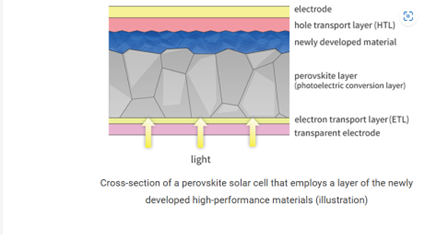
- CONTEXT: The perovskite layer is vulnerable to moisture, heat, oxygen, etc., which can cause low power efficiency and short life cycles. Glass and thin films have been used as protective materials, but glass made the modules less flexible, while thin films were costly – over ¥100,000/ square meter, according to one researcher. Other approaches include passivation, which is eliminating the defects of the grains in the perovskite layer, pre-treating or post-treating the layer, etc.
TAKEAWAY: Recently, various efficiency and durability solutions have emerged: Sekisui Chemical and Moresco developed protective sealing technologies; and Mitsubishi Chemical Group developed a “universal” passivation method, etc. But Canon is the first to announce its plan to mass produce its material in 2025, at the time when Sekisui Chemical brings onstream the country’s first commercial PSC production site. Canon is likely to achieve the PSC material production cost that meets METI’s cost target of ¥14/ kWh or less.
- SIDE DEVELOPMENT:
ENEOS to double iodine production on perovskite demand
(Nikkei, June 17)- ENEOS Holdings plans to double iodine production in Niigata prefecture to 440 tons / year in the next five years on perovskite demand.
- The company plans to invest over ¥10 billion for the expansion.
Toshiba, Sojitz and CBMM unveil ultra-fast charging electric bus prototype
(Company statement, June 20)
- Toshiba, trading house Sojitz, and CBMM, a Brazilian producer of niobium, have developed a next generation lithium-ion battery that uses niobium titanium oxide (NTO) in the anode.
- They also unveiled a prototype E-bus powered with the new battery, which allows for an ultra-fast charge time of around 10 minutes and delivers high energy density.
- The firms are doing a field test in Araxá, Brazil.
- They plan to start selling the next-gen Li-ion battery with NTO anodes in spring 2025.
- CONTEXT: NTO has twice the theoretical volume density of the graphite-based anode generally used in Li-ion batteries. In 2021, the three firms agreed to extend their collaboration to mass production processes of next-gen batteries, mainly for commercial e-vehicles.
ENEOS Renewable and Mitsubishi Research Institute work on battery optimization
(Company statement, June 17)
- ENEOS Renewable Energy, and Mitsubishi Research Institute are developing a scheme to optimize the use of grid-scale battery systems and help create optimal bids for the power balancing market.
- ENEOS will contribute with its grid-scale battery connection and power generation volume forecasts, as well as power marker data with information available for 30-minute slots.
PM Kishida creates new AZEC ambassador position
(Government statement, June 19)
- PM Kishida created a new position, Asia Zero Emission Community ambassador, and appointed Yamada Takio, Japan’s ambassador to Vietnam, to the position.
- Yamada will coordinate with partners in 11 countries for the AZEC ministerial meeting to be held in Jakarta in August.
- Separately, the Conference for AZEC Promotion, a multi-ministerial framework, was launched for AZEC-related policy coordination in the Japanese govt.
- CONTEXT: AZEC’s core activities are establishing the Asia Zero Emission Center in Indonesia for day-to-day collaboration and creating transition financing schemes. The Kishida govt estimates ¥4,000 trillion is needed for net zero projects in the region.
METI, Norwegian officials discuss offshore wind, CCS and economic security
(Government statement, June 17)
- METI Parliamentary Vice Minister Ishii met with Norway’s State Secretary of Foreign Affairs Kravik to discuss offshore wind, CCS and other topics related to the energy transition, as well as economic security.
REI says Japan won’t need fossil fuels to ensure stable power supply in 2035
(Organization statement, June 19)
- In a new report, the Renewable Energy Institute said that by 2035 Japan will be able to ensure stable power supply even with 80% of its electricity coming from renewable energy sources.
- REI says the key to achieving decarbonization, low-cost, and stable supply is the mass introduction of solar power, wind power, and storage batteries. The institute is against Japan relying on nuclear power or coal, which it says are not needed.
- REI says that Japan can reduce CO2 emissions 66% by 2035, compared to 2019 levels, without compromising the global competitiveness of its domestic industry.
- By 2035, REI says it is possible to increase renewables capacity to 3.3 times the current level, while keeping electricity generation cost to about ¥11.2/ kWh. That would be slight below the ¥11.9 level before 2022.
METI joins sector-wide initiative to promote training of offshore wind workers
(Government statement, June 21)
- METI will work in partnership with the newly established Offshore Wind Power Human Resources Development Promotion Council (ECOWIND) to support the development of new professionals for the industry. ECOWIND is a collaboration of industry, academia and research institutions.
- ECOWIND aims to systematize skills and create educational materials for the offshore wind power sector by the end of this fiscal year. The program will bridge the gap between students and companies, enhancing training efforts by utilizing facilities such as those at Nagasaki University and Akita Prefectural Oga Marine High School.
NEWS: ELECTRICITY MARKETS

Hokkaido Electric says it can power Rapidus without Tomari NPP
(Nikkei, June 18)
- Hokkaido Electric said it can power the Rapidus semiconductor plant that’s now under construction without restarting the local Tomari NPP.
- However, the utility said it won’t have enough spare capacity to cover demand from any future expansion of the plant or new data centers in Hokkaido.
- The utility provided regulators with data on how earthquakes might impact Unit 3 (912 MW), which is now being reviewed ahead of Units 1 and 2 (each 550 MW). By mid-Oct, it will explain the plan to protect Unit 3 from volcanic eruptions/ tsunamis, and how it will secure sea vessels carrying spent nuclear fuel during a tsunami.
- CONTEXT: Hokkaido Electric is building a ¥180 billion seawall slated for completion in 2027, the year the Rapidus plant is expected to go online.
- Tomari NPP is now in the first of the NRA’s three-part review to approve: (1) changes to a reactor’s basic design; (2) a construction plan; (3) operational safety provisions.
- SIDE DEVELOPMENT:
Hokkaido business leaders petition utility to restart Tomari NPP soon
(Denki Shimbun, June 17)- On June 12, local business leaders, including the heads of nine chambers of commerce and industry, visited Hokkaido Electric’s HQ in Sapporo to submit a request to promptly restart Tomari NPP.
- Businesses said that a restart will ease high energy rates.
- Hokkaido Electric President Saito said restarting the NPP is needed to power Rapidus and data centers, boosting energy security and the economy.
INPEX reaches final investment decision on PV and BESS in Australia
(Company statement, June 14)
- INPEX reached a final investment decision (FID) on a PV and BESS project in New South Wales that’s being developed by Enel Green Power Australia, in which it has a 50% stake.
- The Quorn Park Hybrid Project will combine 98 MW of solar power capacity and 20 MW/ 40 MWh BESS connected to the grid. It will be one of Australia’s most advanced hybrid projects.
- This is INPEX’s first FID in Australia’s renewable energy sector since it acquired 50% of shares in EGPA from Rome-based Enel Green Power in Sept 2023.
- CONTEXT: EGP was founded in 2008, and operates 64 GW of clean energy capacity globally; in Australia, it has been active in hybrid power generation combining PV and wind power with BESS.
ANRE proposal for split-supply scheme to replace partial supply system
(Government statement, June 17)
- ANRE unveiled a proposal for a new system to replace the partial supply system that requires retail electric utilities (the retail arm of the former major electric utilities) to compensate for supply shortfalls caused by new power market players known as shin denryoku.
- The govt plans to introduce bunkatsu–kyokyu, which roughly translates as “split supply” system, where a single point of demand can be supplied by two parties, which are not limited to the designated retailer.
- With the start of the split supply scheme, the existing contracts for partial supply will be given a certain amount of leeway.
- CONTEXT: The partial supply guidelines were revised on March 15.
ANRE wraps up preliminary talks for revamping power balancing market
(Government statement, June 19)
- ANRE completed preliminary discussions for revamping the power balancing market, aiming to create a so-called simultaneous market mechanism to allow all electricity in the wholesale and balancing markets to be traded at the same time, regardless of supply capacity and regulating capacity.
- The direction that the govt is considering include:
- Introduction of a three-part auction system on a weekly basis.
- Holding day-ahead auctions where kWh and ΔkW are bid simultaneously.
- Using the Three-Part Offer method so that power generators register power supply parameters: (1) start-up cost; (2) minimum output cost; (3) incremental cost curve in the market (Three-Part Offer method), and retail electricity suppliers bid based on the purchase price and quantity (kWh).
- In this simultaneous market, power supply would start up and deliver without excess or shortage, according to the next-day demand forecast.
- The plan also envisions scenarios where:
- Power supplies secured by the general transmission and distribution firms in the previous day’s market are put into a pre-time market;
- Retail electricity suppliers will buy and sell in the intraday market based on demand forecasts that are refined as actual supply / demand approaches.
- CONTEXT: The reform is an attempt to combine the functions of various electricity trading platforms so that, for example, spot and balancing trades are in sync. The study group intends to prepare a final report later this year.
JEPX trade for June 8-14 shows price increases linked to higher temperatures
(Japan NRG, June 20)
- The daily spot market prices for June 8-14 (delivery scheduled for June 9-15) went as high as ¥14.21/ kWh for delivery on June 14 (daytime average), ¥3.31 more that the high in the previous week.
- The lowest trade was ¥9.35, for delivery on June 10 (peak average). This was ¥9.13 higher than the lowest trade a week earlier.
- The volume of sell bids dropped over 10%, while buying bids volume climbed 7.6%. The average daily contract volume was 647.5 GWh, up 1.7% YoY.
- The increased activity and prices are seen as due to a rise in temperatures, leading to more demand for air-conditioning.
- In June, many power facilities face regular inspections in preparation for the high load period later in the summer. This triggered concerns in the market that if inspections continue, supply capacity may become tight.
- SIDE DEVELOPMENT:
May spot contracts rose due to increase in solar power
(Japan NRG, June 21)- Japan Electric Power Exchange (JEPX) reported that its daily average trade volume in May was 628.5 GWh, up 2.1% MoM.
- Solar power output expanded mainly during the long holiday in early May.
- Also, many thermal power sources entered inspection and repair, and fuel prices remained high, so the price level was generally firm.
- The 24-hour average price was ¥9.62, up 18% MoM.
March electricity trading: sales by new power market players up 4.9%
(Organization statement, June 17)
- According to the latest electricity trade report by the Electricity and Gas Market Surveillance Commission (EGC), sales in March increased 6.8% YoY to 70.2 TWh (down 3% MoM).
- Of this total, the sales attributed to new power market players (shin denryoku) were up 4.9% to 12.17 TWh (but this was down 5.1% MoM).
- The number of retail electric utility contracts at the end of March rose 0.2% YoY to nearly 9 million (up 0.1% MoM).
J-Power announces closure of coal-fired Tosa Power Plant
(Company statement, June 19)
- Tosa Power Plant will end operations on March 31, 2025, due to high coal prices, weak power market conditions and govt policies to phase out inefficient coal power.
- Tosa (coal-fired, 167 MW capacity) in Kochi City has been operational since April 2005, serving the Shikoku region.
- Tosa’s major shareholders include: J-Power, (45%); Shikoku Electric, (35%); and Taiheiyo Cement, (20%).
Vietnamese thermal power plant to be completed ahead of schedule
(The Investor Vafie Magazine, June 18)
- The 1.32 GW Vung Ang II thermal power plant in Vietnam will complete its first and second turbines ahead of schedule – in June and Oct 2025.
- Developed by Vung Ang II Thermal Power (VAPCO), the $2.4 billion project is partly funded by JBIC. Shareholders are: Mitsubishi Corp (40%); Chugoku Electric (20%); and Korea Electric (40%).
- CONTEXT: The plant is part of Vietnam’s power development plan to build six coal-fired plants that will contribute 6.1 GW by 2030. All coal-fired plants in Vietnam are planned to transition to biomass and ammonia fuels by 2050.
J-Power to speed up ammonia co-firing for coal-fired power
(Nikkei, June 19)
- J-Power plans to revamp nine out of its 16 coal-fired power plants to possibly accommodate ammonia co-firing. Three to five units will be decommissioned.
- The company plans to import 1 mln tons/ year of ammonia for co-firing, with 20% ammonia mix as a start, as well as to install DAC equipment at the power plants.
TAKEAWAY: In January, Hokkaido Electric, JERA and Kobe Steel won the Long Term Decarbonization Power Source Auction for coal-ammonia co-firing. J-Power may participate in the next auction since the winner will receive state financing for the next 20 years.
Pacifico Energy to build solar farm in Hiroshima Pref
(Company statement, June 14)
- Pacifico Energy will build a solar farm (135 MW capacity) in Miyoshi City, Hiroshima Pref.
- The firm disclosed its environmental impact study and seeks feedback until July 16.
- The site is a former golf course, about 140 hectares.
- Construction begins in FY2027; commercial operation could begin in FY2029.
Eurus Energy to invest in offshore wind project in Scotland
(Company statement, June 18)
- Eurus Energy UK will acquire a minority share in Highland Wind, developer of the Pentland Floating Offshore Wind Farm in Scotland.
- This is Eurus’ first investment in an offshore wind power generation project.
- The Pentland Floating Offshore Wind Farm will be located 7.5 km off the coast of Dounreay in Caithness and will have a 100 MW capacity.
- The project is being developed by Highland Wind, which is majority owned by CIP with Swedish renewables firm Hexicon as a minority shareholder.
ENEOS Renewable joins floating offshore wind R&D collective
(Company statement, June 14)
- ENEOS Renewable Energy Corp has joined the Floating Offshore Wind Technology Research Association, an R&D collective comprising major power utilities and developers to promote floating offshore wind tech.
- Members of FLOWRA include: Chubu Electric, Eurus Energy, Hokuriku Electric, JERA, Marubeni Offshore Wind Development, Mitsubishi Offshore Wind, NTT Anode Energy, and TEPCO Renewable Power.
NEWS: OIL, GAS & MINING

Large discovery of critical metals made off remote Japan island
(Asia Nikkei, June 22)
- Large volumes of cobalt and nickel deposits were discovered near an isolated island in Japan’s exclusive economic zone. The find includes around 230 million tons of manganese nodules on the seabed around Minami-Torishima, located roughly 1,900 km southeast of Tokyo.
- The Nippon Foundation and the University of Tokyo conducted a survey earlier this year that identified the deposit. The highly concentrated nodules are the size of a fist and are said to contain about 20% manganese and up to 1% cobalt and nickel. That’s enough to cover Japan’s demand for years.
- CONTEXT: These metals are used in batteries and other key clean energy technologies.
- The researchers said they plan to begin extraction on a trial basis in 2025, before forming a private-sector consortium that would go on to commercialize the project as soon as 2026.
TAKEAWAY: This does seem to be a sizable find, but the researchers’ timeline for extraction seems overly optimistic. It’s unclear if the technology to perform the task of extraction from the seabed is readily available, while completing the environmental and other assessments required to begin mining takes many years. It will be interesting to see how Japanese businesses will react to this project.
JAPEX acquires full stake in Norwegian petroleum exploration and development firm
(Company statement, June 17)
- JAPEX will acquire the remaining shares (50.1%) in Longboat Japex Norge (LJN) from Longboat Energy (LBE) based in the UK.
- With LJN as a wholly-owned subsidiary, JAPEX can boost North Sea operations.
- This acquisition will have a minor impact on JAPEX’s financial results for FY2024.
- CONTEXT: LJN was set up in 2019 for offshore oil exploration, development, and production.
LNG stocks increased 1.9% over last week
(Government data, June 19)
- LNG stocks of 10 power utilities were 2.14 million tons as of June 16, up 1.9% from the previous week (2.1 million tons). This is 2.9% up from end June (2.08 million tons) in 2023, and 6.5% over the past 5-year average of 2.01 million tons.
- While temperatures are forecasted this summer to be higher than in 2023, LNG stocks have remained nearly flat.
May gas and coal trade statistics
(Government data, June 19)
| Imports | Volume | YoY | Value (Yen) | YoY change |
| Crude oil | 10.7 million kiloliters (67.2 million barrels) | -8.5% | 928.4 billion | 8.1% |
| LNG | 4.9 million tons | 5.6% | 449.2 billion | 9.1% |
| Thermal coal | 6.1 million tons | -1.5% | 145.8 billion | -28.8% |
ANALYSIS
BY MICHAEL ARRUDA,
DAN FELDMAN,
MARK DAVIES, and
FRED LAZELL
CO2 Exports in APAC: Japan’s Approval of a Key Amendment to
the London Protocol
Last month the Diet approved the 2009 Amendment to the London Protocol that is relevant to the international shipment of CO2. This move is a critical step to facilitate Japan exporting captured CO2 for overseas storage.
Through this amendment, Japan is betting on carbon capture, utilization, and storage (CCUS) to become a vital part of plans for its energy transition. This specifically concerns decarbonizing hard-to-abate industries such as cement production, chemical manufacturing, fertilizers, and steel production. It would also strongly influence the power sector.
Japan’s geography, however, doesn’t allow for the easy and plentiful storage of CO2. While the country has identified several domestic storage projects, it is looking overseas to the Southeast Asian region, Australia, and elsewhere as locations that are better suited for carbon sequestration due to a plethora of depleted oil and natural gas reservoirs, untapped geologic structures, and saline aquifers.
Hence, the need to build out a CCS supply chain overseas and the importance of shipping CO2 abroad. This article looks at how Japan has approached the issue from a technical perspective and within the framework of international law.
The London Protocol and amendments
In October 2020, Japan announced plans to reduce greenhouse gas emissions 46% by 2030 over 2013 levels, eventually aiming to achieve net zero emissions by 2050. In March 2023, METI issued Japan’s Long-Term Roadmap for CCS to “promote the sound development of CCS business in Japan with minimal social costs”.
The roadmap contemplates domestic and international CO2 storage solutions, beginning with seven projects identified in JOGMEC’s June 2023 Advanced CCS Projects for support. While most storage sites in the Advanced CCS Projects are located in Japan, the program includes two major export projects to countries with sub-seabed geologic structures capable of permanently storing CO2. These are Malaysia and somewhere in “Oceania”, presumably Australia.
The 1996 Protocol to the Convention on the Prevention of Marine Pollution by Dumping of Wastes and Other Matter 1972 (“London Protocol”) prohibits its signatories (contracting parties), such as Japan, from the international offshore storage of CO2. It prohibits “dumping or incineration at sea of waste or other matter” (Article 2) as well as exports of CO2 for sequestration in sub-seabed geological formations across international borders (Article 6).
In 2009, however, signatories to the London Protocol adopted an amendment to Article 6 that allows exports of CO2, as long as there is an agreement or arrangement by the exporting and receiving countries to ensure that the London Protocol’s environmental goals are observed.
To take effect, however, the 2009 amendment must be ratified by two-thirds of the 53 signatories. This has not yet happened. So, in 2019 the contracting parties adopted a resolution allowing each country to file a “declaration of provisional application” of the amendment with the International Maritime Organization (IMO) that allows the export of CO2 pending full ratification of the amendment.
London Protocol’s impact on Japan
As a result of the original London Protocol’s ban on CO2 exports Japan has had to:
- Approve the 2009 amendment;
- File a declaration on provisional application of the amendment with the IMO; and
- Ink bilateral agreements with the countries to which CO2 is proposed to be exported for sequestration.
With that in mind, on May 24, the Diet adopted a motion for approval of the 2009 amendment, and the government is expected to:
- File the “instrument of acceptance” to the 2009 amendment with the IMO once the Cabinet amends the Trade Control Ordinance to accommodate CO2 export; and
- File the declaration of provisional application with the IMO.
Requirements for bilateral agreements
To conclude the process regarding the 2009 amendment, Japan will have to enter into bilateral “agreements” or “arrangements” with each country receiving CO2. The contents are broadly described in Article 6.2 of the 2009 amendment and supplemented by the 2013 Guidance on Implementation of Article 6.2 on the Export of CO2 Streams for Disposal in Sub-seabed Geological Formations for the Purpose of Sequestration.
As the title implies, the guidance includes recommendations on how the 2009 amendment may be implemented, including suggested provisions for inclusion in the agreement or arrangement.
What is the difference between an “agreement” and “arrangement”? According to Article 3.2, an “agreement” refers to a “legally binding agreement” that could take the form of a “memorandum of agreement or a treaty,” while an “arrangement” refers to “something non-binding, such as a memorandum of understanding.”
Neither the protocol nor guidance mandates a particular template or format, but they impose minimum requirements, depending on the receiving country’s activities.
Minimum requirements
Regardless of whether CO2 exports from Japan are to a contracting party or a non-contracting party, Article 6.2.1 of the 2009 amendment requires that the agreement or arrangement allocate “permitting responsibilities between the exporting and receiving countries, consistent with the provisions of the London Protocol and other applicable international law.” (See 2009 amendment, Article 6.2.1; and guidance, Article 3.5.)
The guidance also recommends several additional provisions for inclusion in an agreement or arrangement regardless of the role of the contracting party.
Where the receiving country is not a contracting party (such as Malaysia or Indonesia), Article 6.2.2 of the 2009 amendment requires that the agreement or arrangement include, “at a minimum”, provisions that are “equivalent to those contained in [the] protocol, including those relating to the issuance of permits and permit conditions for complying with the provisions of annex 2, to ensure that the agreement or arrangement does not derogate from the obligations of contracting parties under [the] protocol to protect and preserve the marine environment.” (See 2019 amendment, Article 6.2.2)
The guidance adds several clarifications and recommendations regarding conformance of the agreement or arrangement with Article 6.2.2. (See Guidance, Article 3.6)
Expected outcomes
The processes to reach agreements or arrangements between Japan and countries in the region will differ depending on the status of each potential destination country as a contracting party (or not).
In addition, the domestic regulatory schemes for sequestration in these countries are in different stages of development and may need to be aligned with the London Protocol.
Japanese companies considering CO2 export will most likely be monitoring the progress of the agreements or arrangements once negotiations begin in order to ensure that they comply with Article 6.2 and the guidance. And then to provide clear standards for CO2 export approval by the government and storage approval in receiving countries.
Japan’s approval of the 2009 amendment, along with the domestic CCUS Business Bill that recently passed, are major steps to adding CCS to the suite of options available to help industry achieve its decarbonization goals. Concluding bilateral agreements or arrangements with countries to which Japanese companies plan to export and store CO2 will be the final legal hurdle to facilitate such exports. Getting to the regulatory finish line, however, will require the collective effort of all stakeholders in the cross-border CCS value chain.
Michael Arruda and Mark Davies are at King & Spalding in Tokyo; Dan Feldman is the firm’s Global Head of Energy; and Fred Lazell is based in London. The firm’s 1300 lawyers include a globally integrated team of 300 energy lawyers working on a wide range of new and conventional energy matters, including LNG, hydrogen and its derivatives (including ammonia), carbon capture, utilization, and storage.
ANALYSIS
BY CHISAKI WATANABE
How EVs Can Help Build Reliability Into the Grid
Japan increasingly seeks ways to use electric vehicles for purposes other than driving. The pace of EV adoption has been slow so far, but government task forces are exploring how to optimize the potential of the batteries in the EV to help balance the nation’s power grid.
There are more than 400,000 EVs in Japan – both battery electric vehicles (BEV) and plug-in hybrids (PHEV). In FY2022, BEV and PHEV accounted for less than 3% of all new car sales in the country. With 410,000 units sold as of 2022, Japan is a far smaller market than countries such as China (14 million), or the U.S. (nearly 3 million).
By 2030, Japan is targeting to increase the share of new BEV/ PHEV sales to between 20% and 30%, or 800,000 to 1.2 million cars. All new sales are slated to be electric by 2035. To achieve these targets, the government plans to increase the number of charging spots (including fast chargers) to 300,000 by 2030, according to a guideline published in October 2023. That compares with about 40,000 units including more than 10,000 fast chargers currently in Japan.
As more intermittent energy sources such as wind and solar power are added to the grid, there is an increasing need to balance electricity supply and demand. Energy storage is one solution to shift the time of electricity use, and batteries in electric cars are emerging as a promising storage device along with storage batteries and pumped hydro.
What EVs offer to the grid
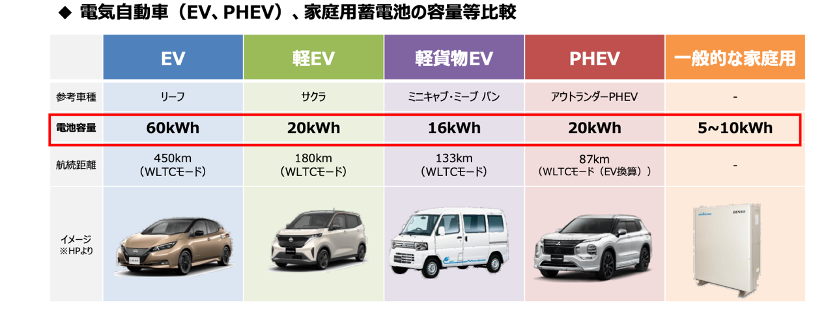
One of the advantages of EV batteries is their larger capacity – from 16 to 60 kWh – compared to 5 to 10 kWh for residential storage systems.
“EV is called a mobile storage battery and it’s a key piece of infrastructure for transportation and a distributed energy source that has the potential to contribute to the grid,” stated a METI document presented at the initial meeting of the EV-Grid Working Group in 2023.
Still, the ministry acknowledged the limits of EV batteries. Since their primary purpose is transportation, the capacity available for balancing may be limited, and their availability is uncertain when needed for charging and discharging. Even so, EVs can contribute by charging and discharging when and where their services are most needed.
 Source: METI
EVs can help stabilize the grid by charging batteries when there is excess electricity generated by solar and wind farms, and also by shifting the time of charging to avoid peak time. Using EV batteries could help reduce capital investment in transmission lines.
The chart below shows how EV batteries can address different needs for different players.
Potential Contributions from EV Batteries
| Categories | Needs | Potential contributions |
| Grid | Balancing supply and demand | Charging/discharging to help balance the grid
Shifting time of charging/discharging |
| Distribution | Voltage regulation
Easing grid congestion, avoiding cost of grid buildout | Shifting time of charging/discharging to address grid congestion, avoid grid buildout |
| Retail | Securing power supply | Procuring cheap power supply through shifting time of charging/discharging |
| Consumers | Reducing electricity bill
Improving resilience vs natural disasters, etc. | Reducing electricity bills through shifting time of charging/discharging
Using EV as emergency power source |
Source: METI
Balancing market in the mix
Furthermore, a planned change in the balancing market rules will give EV owners a chance to be compensated in the balancing market. METI plans to allow the participation of low-voltage resources (homes and stores) in the balancing market starting 2026.
This will allow an aggregator to bundle multiple electricity sources such as storage batteries and fuel cell batteries at home, as well as EV charging/ discharging devices.
More work has to be done for EVs to be fully integrated in the grid. In February, the EV Grid Working Group set milestones for 2030 and 2040 regarding what needs to be done for EVs.
The group categorized the values that EVs can offer into three groups:
(1) The same level of convenience as ICE cars;
(2) Values unique to EVs;
(3) Additional economic value in the form of contribution to the grid.
According to a February report by the group, to achieve the same level of convenience, by 2030 Japan needs to install enough charging devices. By 2040, long-distance driving should become reality with improvements in charging infrastructure and services.
To unlock the values unique to EVs, all stand-alone houses of EV owners, and more than a half of apartment buildings, will need to install charging devices by 2030.
By 2040, the WG suggests all houses and apartment buildings should be equipped with charging devices. Also, by 2030, some EV owners at stand-alone houses should be able to use EV batteries as a backup power source. More houses and apartment buildings should be able to do the same in the following decade as the cost of V2X (vehicle-to-everything) equipment drops.
The chart on page 23 includes some of (3) Additional economic values.
Bottlenecks to realization
The WG also identified key issues to achieve the three types of values.
For (1), bottlenecks are mainly economic challenges such as the higher cost of installing a charger for older houses than new ones. Other issues include a longer time to charge an EV than filling an ICE vehicle and higher running costs for charging businesses.
For (2), there are institutional and technological challenges. For example, V2X devices are expensive. Many EVs use electricity derived from fossil fuels. The WG said a mechanism is needed to remotely control the timing of charging when the share of non-fossil power is bigger.
For (3), challenges encompass many aspects:
For “the optimization of electricity cost,” the mechanism to incentivize EV owners is not sufficiently developed. More clarity is needed regarding the level of compensation. The group also pointed out that remote controlling functions for DER are underdeveloped.
For “the income,” the report pointed out that EVs cannot take part in the balancing market until 2026. A cost-benefit analysis is needed due to few incentives available for EVs.
Other challenges include high cost of remote controlling devices, and battery degradation through charging and discharging upon orders, a lack of visual information about grid congestion, and a mismatch between grid congestion and EV availability.
| 2030 milestones | 2040 milestones | ||
| 1 Optimization of electricity cost thru charging/discharging | Retail | A variety of smart charging plans to pick from
Users can reduce electricity cost by smart charging, V2X | Achieved in 2030 |
| Distributed Energy Resources (DER) services | Mechanism in place for power providers to pay for EV’s contributions to the grid | Achieved in 2030 | |
| 2-1 Income from contribution to the grid (balancing)
2-2 Income from contribution to the grid (supply capacity) | DER business
(balancing) | EV among reliable supply resources in balancing market with installation of metering devices
EV owners receive compensation | More EVs on the road
EVs among key supply resources in the balancing market Guaranteed profit for EV owners |
| DER business (supply capacity) | EV supplies capacity
EV owners receive compensation | More EVs on the road
Improved EV reliability as supply capacity (during peak demand periods and when less generation from solar/wind) | |
| DER business (easing congestion) | In some areas, EVs (mainly corporate cars) help easing grid congestion, contributing to reduce future capital investment in the grid | More areas use EVs for easing grid congestion
Collaboration between EV users and service providers to use more EVs to ease grid congestion Optimizing investment to match increase/ decrease in power demand from EV use |
Source: compiled by Japan NRG based on METI information
Solutions in the works
Some companies are working together to address technological and financial issues. TEPCO, Kansai Electric, Kyocera, and other companies, as well as the University of Tokyo have teamed up for a pilot project to test the feasibility of using DER sources such as EVs and storage batteries to improve flexibility of grid management.
Earlier this month, Honda and Mitsubishi Corp announced a new mobility service venture, ALTNA, which will utilize batteries that are no longer used in cars as secondary storage batteries for the power grid.
The venture combines Honda’s expertise in EV and battery control and connected technologies with Mitsubishi’s know-how in power generation using batteries and smart charging. The final goal is to reduce the cost of EV use.
The venture will lease EVs while retaining ownership of the batteries to monitor their use and increase their reliability. Older batteries will be repurposed for ALTNA’s storage battery business. The new company will also offer automatic charging plans to charge EVs when it is cheaper to do so.
Conclusion
EV deployment in Japan is still in the early stage and it is uncertain whether the number of EVs will meet the targets set by the government. EVs need to be cheaper and more charging spots should be set up.
Although it is hard to see such projects working at scale for now, as the number of electric vehicles increases it could turn into a viable business model. Improving the technologies that manage batteries, as well as the decline in the cost of the batteries themselves, should help make them a regular part of local and regional energy grid operation.
As automakers are starting to realize, EVs, in particular, because of the longer lifespan of their battery units, have as much to offer at rest as in motion.
ASIA ENERGY REVIEW
BY JOHN VAROLI
This weekly column focuses on energy events in Asia and the Pacific
BESS
Battery energy storage systems (BESS) capacity is estimated to expand globally at an annual rate of 24% until 2030, and reach a cumulative capacity of 1,848 GWh, said consulting company EY.
China / Energy consumption
In 2023, China’s per capita energy surpassed Europe’s for the first time, on the back of rising demand from technology and manufacturing industries, especially the expansion of data centers, 5G infrastructure and car charging.
Hong Kong / Hydrogen power
The city launched its Hydrogen Strategy to help reach carbon neutrality. There are four major vectors: improve legislation, establish standards, align with the market, and create an environment conducive to hydrogen energy development.
India / Coal power
Demand for coal-based power rose 7.3% in FY2023 to an all-time high, the govt said. More than 75% of India’s power generation was from coal, while gas-fired plants accounted for only 2%; this is largely due to the high cost of gas relative to coal.
Indonesia / Energy transition
Over the next five years, state oil and gas giant Pertamina will invest $6.2 billion in clean energy and technology ranging from hydrogen to EV batteries. The company is pursuing a “double growth strategy” to strengthen its existing oil and gas business, and to develop low-carbon energy businesses.”
Malaysia / Hydrogen power
SEDC Energy and Gentari will form a JV to set up the Sarawak H2 Hub, supporting the country’s goal to be a commercial hydrogen producer by 2027. The hub will utilize a “plug and play” concept, using a modular approach to integrate hydrogen production units.
Singapore / Floating solar power
Construction on the city-state’s largest planned floating solar farm (in the Kranji Reservoir) is set to begin in 2025; operation will start in 2027. Projected capacity is 141 MW.
Singapore / Low-carbon power
The Energy Market Authority approved 4.2 GW of import power projects for seven companies. Malaysia’s large-scale solar and battery energy storage systems, as well as hydropower, will be the cheapest source of power import due to to lower transmission costs.
South Korea / Hydrogen fuel
Nikkiso Clean Energy & Industrial Gases Group announced a series of contracts to build and maintain about two dozen liquid-based hydrogen fueling stations in South Korea over the next 12 months.
Vietnam / Russia
President Putin visited Vietnam, with an eye to develop energy relations, which he said was “an area of strategic importance in bilateral cooperation”. Russia and Vietnam already have JVs on fossil fuels in the South China Sea and in north Russia.
2024 EVENTS CALENDAR
A selection of domestic and international events we believe will have an impact on Japanese energy
| January |
|
| February |
|
| March |
|
| April |
|
| May |
|
| June |
|
| July |
|
| August |
|
| September |
|
| October |
|
| November |
|
| December |
|
Disclaimer
This communication has been prepared for information purposes only, is confidential and may be legally privileged. This is a subscription-only service and is directed at those who have expressly asked K.K. Yuri Group or one of its representatives to be added to the mailing list. This document may not be onwardly circulated or reproduced without prior written consent from Yuri Group, which retains all copyright to the content of this report.
Yuri Group is not registered as an investment advisor in any jurisdiction. Our research and all the content express our opinions, which are generally based on available public information, field studies and own analysis. Content is limited to general comment upon general political, economic and market issues, asset classes and types of investments. The report and all of its content does not constitute a recommendation or solicitation to buy, sell, subscribe for or underwrite any product or physical commodity, or a financial instrument.
The information contained in this report is obtained from sources believed to be reliable and in good faith. No representation or warranty is made that it is accurate or complete. Opinions and views expressed are subject to change without notice, as are prices and availability, which are indicative only. There is no obligation to notify recipients of any changes to this data or to do so in the future. No responsibility is accepted for the use of or reliance on the information provided. In no circumstances will Yuri Group be liable for any indirect or direct loss, or consequential loss or damages arising from the use of, any inability to use, or any inaccuracy in the information.
K.K. Yuri Group: Hulic Ochanomizu Bldg. 3F, 2-3-11, Surugadai, Kanda, Chiyoda-ku, Tokyo, Japan, 101-0062.