
JAPAN NRG WEEKLY
JULY 8, 2024
JAPAN NRG WEEKLY
JULY 8, 2024
NEWS
TOP
- GX Promotion Organization launched operations, will drive ¥150 trillion of investments into Japan’s energy transition
- ANRE proposes to attract more nuclear businesses into Aomori Prefecture to build local supply chain
- Portugal’s EDP plans to invest ¥20 billion in Japan’s renewables market, with focus on solar power
- Kishida proposes steps to drive Asia zero emission initiatives
- ITER fusion energy reactor to face 8-year delayed start
- New EV sales slump 39%, but EV imports jump 29%
- Battery Association proposes li-ion battery safety rules
- ANRE solicits feedback on proposed LTDA guideline revision
- Central Japan Ammonia Assn agree on infrastructure plans
- Yamanashi Pref to develop green hydrogen for farms
- Idemitsu record in ammonia production in room temperature
- PXP Corp makes tandem PSC cell with 26.5% efficiency
- Enechange could be delisted from TSE over violations
- Solar power potential estimated at 529 GW by 2050
- Japan to support ASEAN power grid development
- METI plans measures to improve balancing market
- May hourly market transaction volume reached a new high
- Tohoku Electric phases out oil-fired power plants
- Shimane NPP Unit 2 set to restart in December
- METI lifts debarment due to corruption charges
- METI officials meet with ADNOC and UAE
- METI agrees with UAE to extend oil stockpiling in Japan
- Sumitomo to capitalize on U.S. shale oil and gas
ANALYSIS
TEPCO UNIT PITCHES BITCOIN MINING AS A WAY TO ROLL OUT MORE RENEWABLES IN JAPAN
Bitcoin mining was never welcomed in Japan. High electricity costs, along with the volatility of cryptocurrencies and environmental impact, mean that there’s a negligible amount of Bitcoin mining in Japan. That might soon change. Agile Energy X, a TEPCO Power Grid unit, claims that Bitcoin mining can spur a new boom in renewables. The firm is moving ahead with a model that will see Bitcoin mining create the kind of flexible electricity consumer that can help solar and wind projects solve their grid access problems.
ENERGY JOBS IN JAPAN: INVESTING IN EDUCATION
Japan faces a shortage of talent across various growth segments of the energy sector. This is compounded by language barriers and low mobility of talent. We can solve talent shortage issues for individual companies by headhunting experienced talent. But when we look at the wider industry and project forward, then it becomes clear that much wider, systematic change is required. State investment in education for the renewable energy sector must be a priority.
ASIA ENERGY VIEW
A wrap of top energy news that impacts other Asian countries.
EVENTS SCHEDULE
A selection of events to keep an eye on in 2024.
JAPAN NRG WEEKLY
PUBLISHER
K. K. Yuri Group
Events
Editorial Team
Yuriy Humber (Editor-in-Chief)
John Varoli (Senior Editor, Americas)
Mayumi Watanabe (Japan)
Kyoko Fukuda (Japan)
Magdalena Osumi (Japan
Filippo Pedretti (Japan)
Tim Young (Japan)
Regular Contributors
Chisaki Watanabe (Japan)
Takehiro Masutomo (Japan)
SUBSCRIPTIONS & ADVERTISING
Japan NRG offers individual, corporate and academic subscription plans. Basic details are our website or write to subscriptions@japan-nrg.com
For marketing, advertising, or collaboration opportunities, contact sales@japan-nrg.com For all other inquiries, write to info@japan-nrg.com
OFTEN-USED ACRONYMS
|
METI |
The Ministry of Economy, Trade and Industry |
mmbtu |
Million British Thermal Units | |
|
MoE |
Ministry of Environment |
mb/d |
Million barrels per day | |
|
ANRE |
Agency for Natural Resources and Energy |
mtoe |
Million Tons of Oil Equivalent | |
|
NEDO |
New Energy and Industrial Technology Development Organization |
kWh |
Kilowatt hours (electricity generation volume) | |
|
TEPCO |
Tokyo Electric Power Company |
FIT |
Feed-in Tariff | |
|
KEPCO |
Kansai Electric Power Company |
FIP |
Feed-in Premium | |
|
EPCO |
Electric Power Company |
SAF |
Sustainable Aviation Fuel | |
|
JCC |
Japan Crude Cocktail |
NPP |
Nuclear power plant | |
|
JKM |
Japan Korea Market, the Platt’s LNG benchmark |
JOGMEC |
Japan Organization for Metals and Energy Security | |
|
CCUS |
Carbon Capture, Utilization and Storage | |||
|
OCCTO |
Organization for Cross-regional Coordination of Transmission Operators | |||
|
NRA |
Nuclear Regulation Authority | |||
|
GX |
Green Transformation |
NEWS: ENERGY TRANSITION & POLICY

GX Promotion Organization launched, will drive ¥150 trillion into energy transition
(Government statement, July 1)
- The GX Promotion Organization, which was established on May 15 to execute the GX Promotion Act, became operational on July 1. Its roles include:
- Drive ¥150 trillion worth of energy transition investments from the public and private sectors to realize carbon neutrality in 2050;
- Guarantee debts of private businesses engaged in the energy transition;
- Buy corporate bonds of businesses engaged in transition projects;
- Run the emissions trading and carbon pricing systems;
- Collect charges levied on fossil fuels starting in 2028;
- Conduct research and advise METI, etc.
- The organization will be the social infrastructure essential for Japan to win the global competition for decarbonization, PM Kishida said.
- CONTEXT: The METI minister makes decisions on the amount of fossil fuel charges, emission allowances, emission allowance auction details, etc. The Promotion Organization runs day to day operations including fossil fuel charge collection.
TAKEAWAY: The Organization is starting with about 40 staff to manage a ¥100 billion fund. The amount will grow and so will the organization. Until its launch, govt offices received inquiries from municipalities and businesses if there were ways to make use of subsidies for nuclear and other energy projects to decarbonize, a state official told Japan NRG. METI hopes the organization will strengthen financing of high-risk transition projects.
- SIDE DEVELOPMENT:
KHI invests in GX Promotion Organization
(Company statement, July 2)- Kawasaki Heavy Industries invested an undisclosed amount in the GX Promotion Organization, seeking to help realize the mission to drive the green transformation.
- Its clean energy focus is hydrogen and carbon capture.
- On July 3, KHI reported accounting frauds over Ministry of Defense contracts, and the Ministry launched a probe. The incident appears to be irrelevant to METI.
TAKEAWAY: The GX Promotion Organization has the right to seek private sector shareholders as stated in Article 28 of the GX Promotion Act. However, the Act does not elaborate on how conflicts of interests among business stakeholders are prevented.
ANRE to attract more nuclear businesses into Aomori Pref to build local supply chain
(Government statement, July 1)
- ANRE proposed to attract nuclear components makers and maintenance service providers to Aomori Pref to build a local nuclear supply chain that’s integrated with fuel reprocessing, storage and power generation facilities.
- Aomori has facilities but they’re not well linked with the local economy since companies involved in the nuclear supply chain are not located there.
- The proposal was made during a dialog between ANRE and the municipalities. Aomori Governor Miyashita expressed support for ANRE’s plan.
- CONTEXT: On July 2, a series of public briefings about the fuel storage facility began. The project requires a safety agreement between the prefecture, Mutsu City, and the Recycled Fuel Storage Company (RFS). Public opinion plays an important role in forming this agreement. Attendees included Aomori Governor, national government and prefectural officials, and representatives from RFS.
Aomori’s nuclear facilities:
|
Municipality |
Nuclear facilities (operator) |
|
Rokkasho Village |
Fuel reprocessing plant (Japan Nuclear Fuel Ltd), Rokkasho Fusion Institute (Japan Atomic Energy Agency) |
|
Mutsu City |
Interim fuel storage (Recyclable Fuel Storage Co) |
|
Oma Township |
Nuclear power plant (J-Power) |
|
Higashidori Village |
Nuclear power plant (Tohoku Electric) |
Kishida proposes steps to drive Asia-wide zero emission initiatives
(Government statement, July 5)
- PM Kishida proposed three steps to drive energy transition initiatives among the Asia Zero Emission Community members, which are:
- To advance emission cuts in power, transport and industrial sector, launch sector-specific collaboration framework;
- To establish Asia Zero Emission Center in Economic Research Institute for ASEAN and East Asia (ERIA), the “Asian OECD”;
- To create cross border decarbonization rules and infrastructure.
- In the AZEC ministerial meeting in Laos this autumn, Kishida hopes for an agreement on specific net zero action policies for the next 10 years.
- CONTEXT: AZEC was formed in March 2023, participated by 9 ASEAN nations, Australia and Japan.
ITER fusion energy reactor to face 8-year delayed start
(Nikkei, July 4)
- ITER will face delays of at least eight years, postponing the initial operation of its fusion reactor from 2025 to 2033. The reason is a problem with components. Costs will rise, bringing total operating costs to Є25 billion.
- Cracks were found in the cooling pipes of a thermal shield attached to the outside of the vacuum vessel. South Korea is responsible for producing the parts.
- ITER believed it could compensate for the error through welding, but French regulators didn’t approve.
- CONTEXT: Located in southern France, ITER is the world’s largest experimental nuclear fusion reactor project. Its seven main partners are: Japan, the EU, the U.S., Russia, South Korea, China, and India.
TAKEAWAY: This long delay and cost overrun comes as a major setback for the fusion energy community. Much hope has been placed on ITER in pioneering innovation and progress in fusion. Sceptics of fusion energy — and there are many — will feel justified. Also, it’s clear that one strength of ITER — international cooperation — has turned out to be a weakness. The ITER partners produce the required components at home, sending them to southern France where they’re assembled. Thus, possible defects are discovered too late.
New EV sales slump 39%, but EV imports jump 29%
(JADA data, July 4)
- Japan registered 29,282 EVs sold in January to June, down 39% YoY, according to the Japan Automobile Dealers Association.
- Of this number, 10,689 were imports, up 29% YoY.
- The EVs had a 1.6% share of the new passenger vehicle registration total.
- In this same period, FCV registration doubled to 442 from 200 in 2023.
Battery Association of Japan proposes lithium ion battery safety rules
(BAJ statement, July 4)
- The Battery Association of Japan proposed to METI expanding lithium ion battery safety requirements, such as the use of insulation sheets in battery packs to prevent flammable gas release and tests measuring performance in pressure variations.
- CONTEXT: Japanese batteries have only a 14% share of the domestic stationary storage battery market. The association said stringent safety requirements will boost demand for locally produced batteries.
ANRE solicits public feedback on proposed LTDA guideline revision
(Government statement, July 2)
- ANRE is soliciting public feedback on a proposed revision of the Long-term Decarbonization Power Source Auction (LTDA) guidelines. Feedback is accepted until July 31.
- Revisions include:
- Raising the minimum capacity of a power transmission terminal to 30 MW from 10 MW;
- Adding existing nuclear power compliant to the latest safety guidelines to the stable power source category;
- Clarifying the scope of Electricity and Gas Market Surveillance Commission data gathering.
Central Japan Ammonia Assn members agree on infrastructure plans
(Nikkei, July 2)
- The members of Central Japan Hydrogen and Ammonia Association agreed on the outline of ammonia and hydrogen production, storage and transport infrastructure building plans in the Aichi, Gifu and Mie prefectures.
- Kinuura port near JERA’s Hekinan power station will be the ammonia import and storage base; about 1 million tons/ year of ammonia are to be delivered there by 2030.
- Dehydrogenation and ammonia cracking facilities will be located in the ports of Nagoya and Mikawa, to retrieve hydrogen from ammonia. The hydrogen will be transported to FC stations and end users via pipelines and trucks.
- CONTEXT: The Association consists of JERA, Toyota Motor, the regional METI offices, local business associations and 12 municipalities. By 2030, it forecasts annual ammonia demand of 1.5 million tons and hydrogen demand of 0.23 million tons.
TAKEAWAY: JERA alone will likely consume most of the ammonia and its supply chain will be tightly integrated with the Kinuura port and JERA’s power stations 10 km away. Hydrogen demand is one fifth that of ammonia but its supply chain will cover a wider area as consumers are more spread out. In the case of central Japan, hydrogen’s economic performance would likely be lower than ammonia.
- SIDE DEVELOPMENT:
METI decides that Osaka Expo to run on ammonia power
(Government statement, July 5)- METI decided to showcase ammonia-coal co-firing at the Osaka Expo next year by using ammonia-derived power to run the event.
- The co-firing is positioned as a part of the Green Innovation Fund initiative to deploy clean energy technologies.
Yamanashi Pref to develop green hydrogen applications for farms
(Government statement, July 2)
- The Yamanashi Pref govt is exploring the development of green hydrogen applications for farms that want to replace fossil fuels with carbon-neutral energy.
- Governor Nagasaki told the prefectural assembly he was studying a joint R&D scheme with a humidifier manufacturer.
- CONTEXT: Yamanashi Pref produces solar-derived green hydrogen and has attracted Kose, Suntory, and Sumitomo Rubber Industries as users of the Yamanashi P2G (Power to Gas) systems. Its approach is the complete opposite of Aichi and Yamaguchi prefectures that are building infrastructure for existing energy players.
TAKEAWAY: Some say hydrogen’s potential is in local production and consumption, since its transport costs are high. Presently, Yamanashi delivers its hydrogen to users in Tokyo by truck and one wonders how the cost of delivery to local farms scattered in mountains will compare with selling in distant Tokyo that has more users.
Idemitsu sets record in ammonia production at room temperatures
(Company statement, July 4)
- Idemitsu Kosan, together with three research institutes, achieved a world record in ammonia production at room temperatures and pressure, using molybdenum catalyst.
- They developed the electrolytic synthesis technology that increased the amount of ammonia generation per unit area of electrodes by 20 times compared to the Haber-Bosche technology that’s the present dominant process.
- Idemitsu, Tokyo University, Osaka University and the National Institute of Advanced Industrial Science and Technology will continue researching ways to establish cost-competitive mass production of carbon-free ammonia.
- CONTEXT: This project has Green Innovation Fund support through FY2028. Nikkei reports that Idemitsu plans 1,000 tons of domestic ammonia production by 2032.
TAKEAWAY: Ammonia production at room temperatures, if commercialized, would be a game changer boosting Japan’s energy self-sufficiency. However, there are challenges. Idemitsu told Japan NRG in 2021 that the molybdenum-nitrogen-water reaction generates not just ammonia but chemicals that require further treatment before disposal as industrial waste.
PXP Corp makes tandem PSC cell with 26.5% efficiency
(Company statement, July 2)
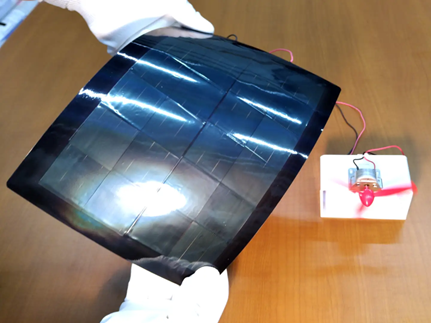
- PXP Corp produced a sample tandem perovskite solar cell (PSC) module sized 4 cm2 with a power efficiency of up to 26.5%.
- The tandem module consists of two layers: perovskite and chalcopyrite (copper, indium, gallium selenium). The double layer boosts power efficiency.
- PXP aims to increase the cell size to 16 cm2 by March 2025. It is also developing a new perovskite cell structure to increase resistance against heat.
- CONTEXT: Tandem PSC is the mainstream technology overseas, and silicon has been used as the second layer. Japanese developers have avoided silicon because the aim of PSC development has been to rely less on silicon imports. However, single PSC modules developed by other Japanese manufacturers have power efficiency of about 15%. PXP claims 40% is possible with a tandem structured module.
TAKEAWAY: A power efficiency of 15% suggests that the remaining 85% have been converted into heat and other energies. PXP is one of the few Japanese developers who have recognized the risky aspect of heat causing PSC material erosion. Understanding the heat mechanism of PSC is important for user safety.
Tandem PSC module
Tokyo Gas gets clean gas certification for Yokohama e-methane facility
(Company statement, July 1)
- Tokyo Gas said its synthetic methane (e-methane) production and demo facility in Yokohama (Kanagawa Pref) was certified under the Clean Gas Certificate program.
- The facility has the capacity to produce 12.5 nm3 of e-methane/ h. The company is considering selling the environmental value of the certificates to businesses that want to decarbonize their gas.
- The e-methane is mostly produced from CO2 derived from exhaust gas generated at a waste plant in Yokohama, and hydrogen obtained from renewables by electrolysis.
- This year, the firm also plans to produce e-methane using digestion gas generated at Yokohama City’s sewage center.
- CONTEXT: The Clean Gas Certificate system was launched in April by the Japan Gas Appliances Inspection Association. The environmental value of the clean gas produced at certified facilities can be converted into certificates after authorization.
MOL inks Japan’s first sustainability-linked ship lease agreement
(Company statement, July 2)
- Mitsui O.S.K. Lines’ subsidiary, Singapore-based MOL Chemical Tankers, inked Japan’s first sustainability-linked ship lease (with a purchase option) with Tokyo Century. The chemical tanker Bonita Ana is equipped with a marine-gas oil-only engine that reduces NOx emissions and lower CO2 emissions.
- The deal sets performance targets for GHG emissions, and lease payments are reduced in accordance with reaching targets.
- Tokyo Century established Japan’s first “Sustainability-Linked Finance and Transition-Linked Finance Framework” to offer support under a Japanese Operating Lease with Call Option (JOLCO). This is the first project under the framework.
Govt solicits feedback on expanding wireless applications to power
(Government statement, July 3)
- The Ministry of Internal Affairs and Communications is soliciting public feedback on its policy to expand commercial use of radio frequency waves to develop wireless power transmission and other digital markets. Feedback submission closes on Aug 2.
- CONTEXT: Commercial use of wireless power transmission includes EV chargers and building power systems.
TAKEAWAY: Licence fee payments for basic wireless technologies, which have been patented, have been disputed because users, notably automakers, claimed the fees were too high. Similar issues may be raised among power users.
NEWS: ELECTRICITY MARKETS

Portugal’s EDP plans to invest ¥20 billion in Japan’s renewables market, focus on solar
(Nikkei, July 2)
- EDP, a major Portuguese renewable energy firm, plans to make a full-scale entry into Japan’s renewables market, with a ¥20 billion investment by 2026.
- In 2025, Its subsidiary EDP Renovaveis (EDP Renewables), will launch a large solar power plant with a 44 MW total capacity in Fukushima City.
- EDP plans to invest in solar PV and electricity storage in other areas, to develop a total of 200 MW of solar power generation and other projects. EDP will sell the electricity directly to firms based on PPAs.
- In response to protests against large solar projects in Japan, Miguel Fonseca, CEO of EDPR’s APAC division, said the firm will acquire land not prone to natural disasters.
- CONTEXT: EDP owns 950 MW of renewable energy sources in Asia, including solar power; and plans to increase this to 5 GW by 2030. Currently, about half of the capacity is generated in Vietnam; but Hanoi’s policies holding down the price at which power can be sold have prompted the firm to invest in Japan.
TAKEAWAY: In the wake of the Fukushima disaster in March 2011, Japan quickly built solar capacity, but that slowed in 2020. Now the govt is making a push to build clean energy capacity across the board, especially solar and offshore wind. Japan’s high demand for electricity, its relatively clear regulations — with incentives and funding schemes such as recently introduced long-term decarbonized power sources auction that guarantee a long-term fixed revenue —- have helped Japan to boost attractiveness as a renewables market.
TSE designates Enechange as ‘stock under supervision’, might be delisted
(Denki Shimbun, July 1)
- On June 27, the Tokyo Stock Exchange announced that Enechange was designated as a “stock under supervision” (under review).
- Enechange revealed that it wouldn’t be able to submit its securities report for the fiscal year by the deadline of June 28. If the securities report cannot be submitted by July 10, it will be delisted.
- Enechange said it will submit and disclose the necessary reports as soon as possible.
- CONTEXT: Enechange received a notice that a SPC that owns EV charging equipment should be included in the scope of consolidation. Enechange had been working to include the SPC in the scope of consolidation, but the securities report was not submitted in time.
JPEA estimates potential for solar power at 529 GW by 2050
(Organization statement, July 1)
- The Japan Photovoltaic Energy Association (JPEA) released estimates for potential solar power capacity, on the premise that Japan will see an expansion of EV and BIPV tech, as well as agrisolar and floating PV projects.
- 125 GW (AC) by 2030
- 173 GW (AC) by 2035
- 400 GW (AC) or 529 (DC) by 2050
- JPEA said Japan has so far installed only 3.6% of potential total capacity, estimated to be 2.38 TW. In late 2022, Japan had installed 71 GW (AC) or 87 (DC) of solar power.
- According to the JPEA, even the projected capacity of 529 GW in 2050 will account for only 22% of the total potential capacity.
- The organization says that agriculture offers the most opportunities for growth, with potential capacity estimated at up to 1.59 TW (DC), followed by commercial buildings at 391 GW.
Japan to support ASEAN power grid development, aims to counter China
(Nikkei, July 1)
- The Japanese govt will offer financial assistance to companies, including KEPCO, for an inter-island power transmission project in Indonesia as part of Tokyo’s efforts in SE Asia’s grid development.
- KEPCO was tapped to do a study for Indonesia’s state-led project to build the inter-island power grid. Japan will cover about 50% of the costs.
- Japan will participate in a cross-regional power grid project, the ASEAN Power Grid (APG), which began in 1997; but development has stalled, especially in southern areas with remote islands.
- The govt will also fund a project by Kyudenko, a Kyushu Electric affiliate, which will help bring renewables to remote islands in Indonesia’s North Kalimantan province.
- CONTEXT: The move is seen as a response to China’s interest in SE Asia’s energy infrastructure, promoting its Belt and Road Initiative. In Indonesia in particular, islands suitable for power generation are located far away from Jakarta and other major cities, and require connection via subsea cables.
METI: additional measures to improve procurement of tertiary power in balancing market
(Government statement, June 28)
- An ANRE study group approved additional measures to improve procurement efficiency of the tertiary adjustment power in the balancing market:
- Reduction of the amount of solicitation in the day-ahead market and coverage of any shortfall by utilizing surplus capacity;
- Giving the right to operate some pumped storage resources to general transmission and distribution firms.
- The govt decided to suspend trade shortages of the secondary and tertiary weekly capacities on the previous day, together with the tertiary weekly capacity.
- On July 1, the govt introduced a plan to reduce the amount of auctioned tertiary capacity using a formula with the capacity multiplied by a reduction factor calculated based on past procurement rates.
- According to ANRE, the measure has helped increase the average contract rate to 34.3% in April; and it exceeded 90% by mid-June.
- The effect of the reduction was also reflected in procurement costs, with the daily total for the nine utilities in June dropping 66% compared to May.
The May volume of transactions in the hourly market reached a new high
(Denki Shimbun, July)
- The average daily volume of transactions in the JEPX hourly market in May increased 24.3% from the previous month to 25.27 GWh, reaching a new record high for the second consecutive month.
- Although the volume of transactions fell during the holiday period, it remained at a high level. The number of transactions reached 10,000 on May 8 and 29. The highest value exceeded ¥100 for two consecutive months.
- The ratio of transactions to the amount of electricity demand in the nine areas increased 0.3 points from April to 1.3%. The average number of transactions per day was 7,289, up 11.4% MoM.
- The monthly contract volume rose by 28.5% to 783 GWh and the number of monthly contracts rose by 15.1% to 225,960. The monthly average contract price increased by ¥42 to ¥10.24, which is ¥62 higher than the system price in the spot market.
Tohoku Electric completely phases out oil-fired power plants, Akita Unit 4 closure
(Denki Shimbun, July 2)
- Tohoku Electric will shut Akita Thermal Power Plant Unit 4 (Akita City, heavy and crude oil, 600 MW).
- After completing work to disconnect the equipment from the grid, the power plant will be phased out in October, and work to remove Unit 4 will begin.
- Now, all Akita Thermal Power units 1 to 5 have been phased out.
- CONTEXT: With the closure of Akita Unit 4, all of Tohoku Electric’s oil-fired power plants have been phased out. Unit 4 was scheduled to be decommissioned in March 2023, but operations were extended due to rising fuel prices such as LNG.
Shimane NPP Unit 2 set to restart in December
(Nikkei, June 28)
- Chugoku Electric announced that safety measures for Shimane NPP Unit 2 are 70% complete. Restart is set for December.
- The restart was originally set for August, but there was a delay of four months due to safety measure issues and unforeseen repairs.
- The plant’s emergency response HQ will support up to 150 personnel for a week without external aid.
- SIDE DEVELOPMENT:
TEPCO and Fukushima Medical Univ cooperate on radiation exposure incidents
(Company statement, July 4)- TEPCO inked an agreement with Public University Corp Fukushima Medical University to collaborate in case of radiation exposure or contamination incidents.
METI issues guidance to JWD and lifts debarment due to corruption charges
(Government statement, July 5)
- METI issued administrative guidance to Japan Wind Development requiring the company to implement compliance improvement plans.
- The company’s former president provided illegal financial contributions to a lawmaker to expand his wind business. JWD submitted compliance plans on June 27.
- Effective June 28, METI’s nine-months long debarment, disqualifying the company from subsidy grants and entering business contracts with METI, was lifted.
MOL company inks third deal on SOV to service offshore wind farm in Taiwan
(Company statement, June 28)
- Mitsui O.S.K. Lines and Ta Tong Marine (TSS) said their joint venture, Ta San Shang Marine (TSSM), will build a new service operation vessel (SOV) with Dutch maritime services firm Damen Group.
- This will be TSSM’s third SOV. It will be Taiwan-flagged, designed to be methanol-ready as a future fuel, and slated for delivery in late 2026.
- It will service offshore wind farms in Taiwan that launch in the late 2020s.
- CONTEXT: MOL and TSS both seek to expand the POV fleet in Asia. TSSM is expected to become a dominant SOV player in Taiwan, and will help the firms advance development of MOL’s SOV business in Asia, including in Japan.
- SIDE DEVELOPMENT:
Tadano to collaborate with Vestas on developing cranes for offshore wind turbines
(Company statement, July 4)- Construction crane maker Tadano and Danish wind turbine producer Vestas will develop a maintenance crane to be mounted on the nacelle portion of Vestas’ V236 wind turbine for offshore use.
- The first unit is to be delivered in 2026.
NEWS: OIL, GAS & MINING

METI officials meet with ADNOC and UAE
(Government statement, July 4)
- METI’s Minister Saito and METI’s Parliamentary Vice-Minister Yoshida met with the CEO of the Abu Dhabi National Oil Company (ADNOC) and UAE Minister of Industry and Advanced Technology.
- They discussed various topics, including the stable supply of crude oil to Japan. They also emphasized expanding cooperation in areas beyond oil and natural gas.
- Two agreements were signed. The first is an MoU for oil stockpiling between ANRE and ADNOC. The second is a general agreement on project development financing between JBIC and ADNOC.
- SIDE DEVELOPMENT:
METI inks agreement with UAE to extend oil stockpiling in Japan
(Denki Shimbun, July 5)- METI signed an MoU with ADNOC on joint oil stockpiling. With the current agreement set to expire in December this year, the project period has been extended until December 2027.
- ADNOC will continue to lease the ENEOS Kirei Base (Kagoshima City) with a tank capacity of about 1.3 million kiloliters.
- CONTEXT: The joint stockpiling project with ADNOC started in 2009, and this is the fourth extension of the agreement. The system allows major oil-importing countries to lease oil tanks in Japan to national oil companies. These tanks are commercially used as supply and stockpiling bases for Japan and Asia. In emergencies, Japanese oil companies have priority access to purchase the oil stored.
TAKEAWAY: This agreement will maintain and strengthen the relationship with the UAE and enhance Japan’s energy security.
Sumitomo to capitalize on U.S. shale oil and gas
(Bloomberg, July 1)
- Sumitomo Corp intends to capitalize on the U.S. shale oil and natural gas boom with sales of pipelines used in shale fields. The company wants to do so despite having exited production in the region three years ago.
- Sumitomo aims to leverage its strengths in related businesses, seeking to reduce carbon emissions by focusing on renewable energy and natural gas.
- SIDE DEVELOPMENT:
Sumitomo renews OCTG supply contract with Norway’s Equinor
(Company statement, July 3)- Sumitomo Corp secured a long-term contract to supply OCTG (Oil Country Tubular Goods) produced by Nippon Steel to Equinor for up to nine years.
- For 35 years Sumitomo has procured OCTG from Nippon Steel for oil and gas development and CCS projects. Besides natural gas, the company has recently been active in CCS, hydrogen, ammonia, and offshore wind projects.
Hokuriku Gas to increase gas rates from October
(Company statement, July 1)
- Hokuriku Gas will increase gas rates by an average of 12% based on meter readings in October. Targeted areas are Niigata, Nagaoka, Koshiji, Mishima-Yoita, Tochio, Sanjo, Kawaguchi, and Kashiwazaki.
- They’ll limit the rate increase for the months covering October to March 2025 to about 8%.
- CONTEXT: The company has tried to absorb rising costs due to increases in city gas raw material prices and inflation. But it had operating losses for FY2022 and FY2023, and expects to incur operating and ordinary losses again in FY2024.
LNG stocks for major power utilities remains flat
(Government data, July 3)
- LNG stocks of 10 power utilities were 2.09 million tons as of June 30, up just under 1% from the previous week (2.07 million tons). This is 0.5% up from a year ago (2.08 million tons), and 4% up from the past 5-year average of 2.01 million tons.
- Since the third week of April, LNG stocks have hovered around 2 million tons, with occasional adjustment to cope with weather changes. It means the consumption of LNG is under control with aid from other sources to meet the summer power demand.
May oil/gas/coal trade statistics
(Government data, June 27)
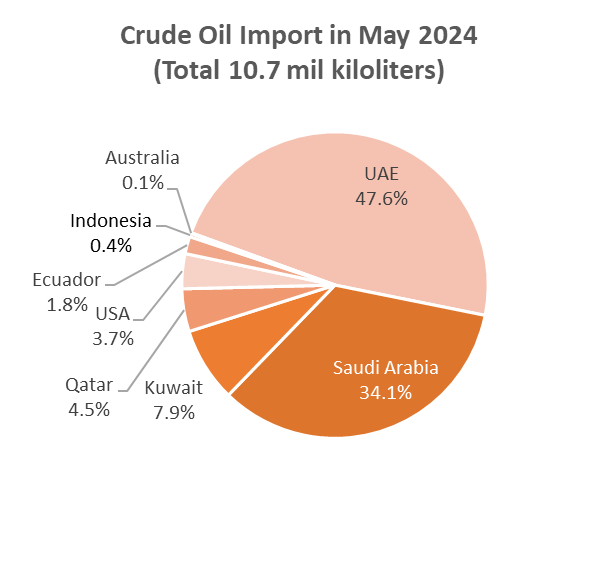
- In May, crude oil imports from the UAE exceeded Saudi Arabia by 39.7%. The UAE remains the top supplier this year. The total import was 10.7 million kiloliters, a 13.3% drop MoM; the import value dropped 7.9% MoM. Over 94% of the crude was from the UAE, Saudi Arabia, Kuwait, and Qatar.
|
Imports |
Volume |
YoY |
Value |
YoY |
|
Crude oil |
10.7 million kiloliters |
-8.5% |
¥928.3 billion |
8% |
|
LNG |
4.9 million tons |
5.6% |
¥449.2 billion |
9.1% |
|
Thermal coal |
6.1 million tons |
-1.5% |
¥145.8 billion |
-28.8% |
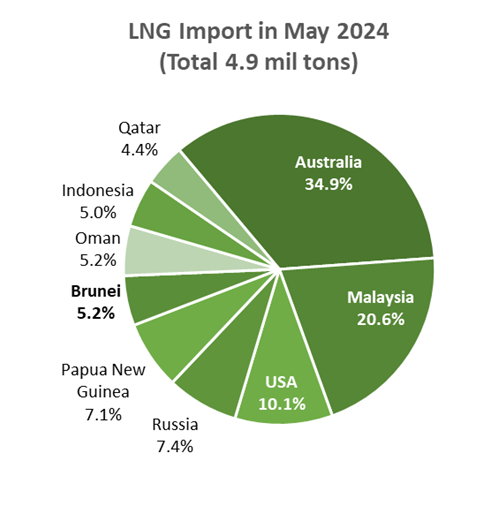
- LNG imports were 4.9 million tons in May, down 7.8% MoM. A little over 72% came from Asia Pacific. Australia remains the top supplier, followed by Malaysia.
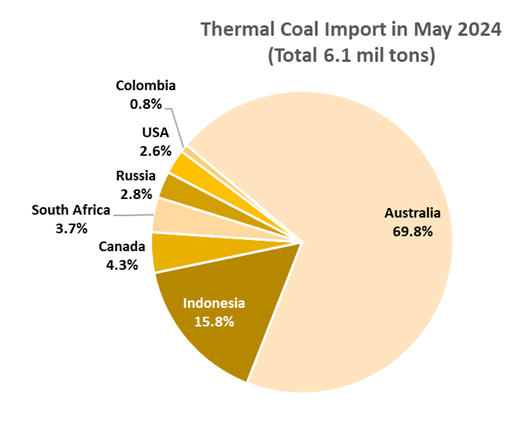
- Thermal coal imports in May were 6.1 million tons, down 20.3% MoM; the value was down 23% MoM. Nearly 70% of the thermal coal came from Australia, followed by Indonesia. Imports from Russia tripled from 49 million tons in April to 173 million tons in May. U.S. purchases decreased from 423.4 million tons to 160.5 million tons.
ANALYSIS
BY WILL FEE
TEPCO Unit Pitches Bitcoin Mining as a Way to
Roll Out More Renewables in Japan
The following is a condensed version of a report that was published as part of our company’s GxxD series, which examines the nexus between decarbonization (GX) and digitalization (DX) trends in Japan. To read the report in full, please check: https://www.yuri-group.co.jp/gxxd
Bitcoin mining never quite found a welcome mat in Japan. High electricity costs, coupled with the volatility of cryptocurrencies and concern about its environmental impact, mean that there’s a negligible amount of Bitcoin mining in Japan. That might soon change.
Agile Energy X, a TEPCO Power Grid unit that transports about a third of Japan’s electricity, claims that Bitcoin mining can spur a new boom in renewables. The firm is moving ahead with a Proof of Concept (PoC) model that will see Bitcoin mining create the kind of flexible electricity consumer that can help solar and wind projects solve their grid access problems.
The timing is fortuitous. Since spring 2024, Bitcoin’s price has risen and many fans see a new bull run due to a technical event known as ‘halving’. To capitalize, Agile Energy X wants to install a nationwide distributed computing network capable of monetizing excess renewable energy via Bitcoin mining.
This network would soak up electricity from the hundreds of solar farms that get curtailed when the system has excess power generation. The plan would give solar operators a new income stream; the grid would find a flexible offtaker to help it balance; and Agile Energy X would monetize green electricity that otherwise would be wasted. With fewer grid chokepoints, there would be more incentive to invest in new renewables capacity.
Agile Energy X says this approach can be more efficient than batteries or hydrogen as a way to mop up and store surplus power. It would also be cheaper and easier to handle than existing energy management systems. But will the government support the arrangement?
“A lot of people see Bitcoin mining as a waste of electricity. But we took the opposite approach. We combined Bitcoin mining, which consumes a large amount of electricity, with renewable energy, which is often wasted. This introduces a far more profitable use of renewable energy.”
– Agile Energy X CEO, Tateiwa Kenji
Tacit government approval
Agile Energy X’s approach has already attracted government interest. METI set up a study group to develop a trading market for distributed energy and Minister for Digital Transformation Kono Taro has inquired about the potential to apply Agile Energy X’s technology to renewables other than solar and wind.
Bitcoin mining is energy intensive and, if a country, it would be the world’s 24th biggest consumer of electricity at 170.5 Terawatt hours (TWh) a year, slightly less than Egypt and more than Poland. It also emits 86.4 metric tons of carbon dioxide equivalent (MtCO2e) of greenhouse gasses a year, less than Morocco and slightly more than Israel.
Japan accounts for 0.23% of the global amount of computing power employed by Bitcoin miners on the blockchain. That compares to 21.11% in China and 37.84% in the U.S. (China banned crypto trading and mining in 2021, but clearly not everyone got the memo.)
Curtailment and congestion
Jump-started by the world’s most lucrative tariff for renewables, solar generation capacity rose from a negligible amount to over 72 GW in just about a decade, making Japan the world’s No. 3 in terms of installations.
But the solar boom has come unstuck due to the lagging update of Japan’s energy infrastructure. Local and regional grid operators now struggle to accommodate the large volume of smaller, intermittent, and distributed power sources alongside large thermal power plants. The two main issues for the grid are congestion and curtailment.
Curtailment is the act of shutting down a power source at times of oversupply. In theory, clean energy options and especially renewables are supposed to be prioritized when the grid operator decides on which power plants should temporarily close. In practice, flipping the on-off switch on older, large thermal power plants is impractical. Nuclear reactor operations, for example, are planned months in advance.
Thus, it’s the most flexible power sources, such as solar and wind, that get temporarily cut off from the grid. The panels still absorb sunlight and the turbines still turn, but it’s not converted into electricity. Particularly in spring when demand is low, solar power suffers high levels of curtailment. Electricity generation via solar reaches a peak during daytime, causing repeated temporary surpluses. This waste of energy is a cost burden for solar farms, and can impact investment decisions.
The waste is huge. Japan ‘lost’ a record 1.92 TWh in renewable energy to curtailment in 2023. Kyushu, the area most suited to solar energy generation, sees the largest levels of curtailment nationally.
Congestion occurs due to issues with grid configuration or equipment performance. Transmission lines sometimes struggle to transport electricity from a particular supplier to a buyer due to overheating or a loss of system stability. The transmission operator may then advise the supplier to limit their dispatch levels, obstructing the transmission of electricity to a willing buyer, which can then lead to increased costs for the consumer.
Think different
Agile Energy X tackles both issues with reverse logic. Rather than reducing power supply at source (i.e. curtailment), it proposes boosting demand at the user end through installation of Bitcoin mining operations at critical grid points. As a self-styled “solutions integrator” and supplier of both the operating system and mining sites and rigs, the company would control this network of Bitcoin mines using distributed computing technology.
Problem 1: Financial losses from renewable energy curtailment
Solution: Waste renewable energy powers crypto mining, producing Bitcoin
- Mining rigs installed within vicinity of a renewables facility
- Excess energy is directed to Bitcoin mining
- The higher the market price of Bitcoin, the greater the reward
- Portion of this revenue is returned to local governments for use in decarbonized town development, etc
Problem 2: Higher consumer costs caused by grid congestion
Solution: Mining creates flexible demand, consuming excess energy anytime and anywhere at points of oversupply
- Distribution lines deliver power to mining rigs at point of congestion
- Pressure valve mechanism of distributed mining operations manages supply and demand
- Consumption of excess electricity for Bitcoin mining reduces losses, lowering costs for power firms
- Unrelated to Bitcoin market price
The business case
Demand for a solution is growing with each year. OCCTO predicts that renewable energy could account for 50-60% of Japan’s power mix by 2050. If that proves correct, Agile Energy X anticipates that under existing infrastructure, there’d be a renewable energy surplus of 240 TWh per year.
Considering renewable Bitcoin mining operations in the U.S., Agile Energy X believes it could direct 10% of that surplus energy to Bitcoin mining. Earning around ¥15/ kWh in mining rewards, depending on the price of Bitcoin, the operation could generate revenue of ¥360 billion per year.
The company has yet to calculate total costs, but it argues they should be considered part of the ¥6-7 trillion needed to optimize the grid for the 50-60% share of the energy mix that renewables would occupy by 2050.
From concept to company
Agile Energy X launched in 2020 as the so-called MegaWatt To MegaHash project at TEPCO Power Grid offices and was spun off as a company in 2022. Since then, it has gradually increased the overload capacity of its mining rigs. With the introduction of distributed computing technology controlled using Triple-1 semiconductors, the advanced stages of the PoC process demonstrate an increased ability to flexibly monitor and manage grid capacity through remote Bitcoin mining operations.
Additionally, Agile Energy’s latest PoC demonstrations confirm a capacity to convert heat and CO2 emissions from mining into additional green value, such as carbon capture and aquaponics, which further reduces Bitcoin mining’s environmental impact .
June 2022 to March 2024 – TEPCO Power Grid, Kisarazu Branch
- About 1,300 mining devices deployed in seven portable shipping containers,
- Confirmed impact on the grid of a 1.5 MW overload countermeasure system,
- Demonstrated the possibility for remote control, monitoring, and management.
August 2023 to present – TEPCO Renewable Power solar panel plant, Showa Village, Gunma Prefecture (50 kw)
- Containerized data center fitted with Bitcoin mining devices,
- Demonstrated possibility of monitoring solar power generation in real time + load capacity of Bitcoin mining equipment,
- Through automatic control, demonstrated the ability to use the solar power without it flowing back into the grid.
Implications
Should the startup succeed and help to ease congestion and curtailment, it would create an additional incentive to invest in solar and wind farm operators, and create a backup client to the current PPAs / market-trading / FIT or FIP revenue channels.
The ‘side effect’ is that the new system would encourage greater adoption of digital currencies such as Bitcoin. However, developments in the global financial system suggest this is already happening. Net inflows for Bitcoin ETFs stand at $13 billion in just four months since such investment instruments were introduced.
CEO Tateiwa says billions of dollars are needed to build a national Bitcoin mining network with the kind of load bearing capacity he envisages for Agile Energy X. A stable national system – such as a distributed energy market, still in the embryonic stages – is also a necessary precursor to monetize the rewards obtained by ‘digi-green’ mining.
If Japan can overcome its aversion to Bitcoin mining, there’s digital gold aplenty waiting to be accessed. Tateiwa: “Once people come around to the idea that Bitcoin mining, this power guzzler, can be used to solve energy issues, it becomes an ‘Aha!’ moment. Those people are increasing by the day.”
To read the full report in the GxxD series, please check our website: https://www.yuri-group.co.jp/gxxd
ANALYSIS
BY ANDREW STATTER
Energy Jobs in Japan: Investing in Education
Often we have written about the shortage of talent across various growth segments of the energy sector. This is a global challenge, with LinkedIn sharing in a report that the increase in job postings requiring at least one green skill was 22.4% in 2023, compared to a 12.3% increase in talent with said skills.
In Japan, the challenge is compounded by language barriers, and low mobility of talent compared to European markets. At the micro level, we can solve talent shortage issues for individual companies by headhunting experienced talent. This has various implications on the wider industry, companies and professionals including:
- Vicious competition for talent;
- Increased cost of hire for experienced professionals;
- Challenges for firms to avoid having employees poached by competitors.
When we zoom out and look at the wider industry, and look beyond the immediate needs and then project forward, it becomes clear that much wider, systematic change is required.
Rate of demand will continue to grow
Over the past decades, skills directly related to renewable energy deployment have grown steadily in Japan. Engineers, construction managers, project managers and finance professionals have been moving from other industries into the renewables space as Japan has boosted its renewable energy capacity from nearly zero in 2011 to over 65 GW today.
As Japan plans to increase the share of renewable power in the energy mix from today’s 22% to 36~38% by 2030, this growth will accelerate. Beyond renewables though, the demand for ‘green talent’ is expanding with increased complexity in our energy mix; and as energy related business seeps into wider industries new skill needs are created.
Some notable areas of growth include:
- Carbon and GHG accounting;
- Energy procurement and energy efficiency planning;
- Supply chain management and Scope 2 & 3 emissions measurement;
- Data science and machine learning operations;
- R&D and manufacturing of cutting edge technologies.
Educate the next generation
METI has taken steps to invest into the next generation of young Japanese coming through the university system. In June of this year, METI announced that offshore wind power generation will be added into the National Institute of Technology (KOSEN)’s COMPASS 5.0 initiative.
The goal is to set up a new curriculum for ‘next generation core technology education’ that includes battery technologies, AI, semiconductors, data science, among others. METI has also established the Education Council for Offshore Wind (ECOWIND) which is a group of Japanese power generation and EPC companies, as well as key educational institutions.
Japan’s education system for clean energy and sustainability has lagged compared to other advanced global peers; this has resulted in many Japanese professionals seeking higher education from overseas educational institutions. This seems to be changing, however. One of the nation’s leading university preparation schools, J-PREP, is significantly investing into and developing research papers, educational materials focused on energy, as well as energy systems to give high school students a strong foundation early on.
Green reskilling
Better university education is great, but we need people now – cries the industry! As automation, artificial intelligence and other technologies continue to mitigate labor demand in certain sectors or even make jobs redundant, there is a need to reskill mid-career professionals into new areas.
Nagasaki Ocean Academy (NOA) is one of the pioneering institutions for ocean energy, and it predicts that the demand for engineers and technicians will rise from the current 2,000 to over 8,600 by 2030, especially as the Round 1, 2 & 3 offshore wind projects come online. NOA provides various courses on project management, development, HSE etc. including on site programs.
Green Talent Hub, a startup that focuses on green reskilling business, runs programs for mid-career professionals, leveraging experts from industry and academia focused on various topics such as carbon management, renewable energy development, decarbonisation and more.
These are positive steps, but the challenge is speed and scalability as these are smaller, industry specialized players offering solutions. Japan will need to see more mainstream educational institutions developing postgraduate programs.
Industry driven investment
The energy industry seems to be in a comparable situation to the software engineering boom of the early 2000s. At that time, companies fought over the little talent available by offering higher salaries, free relocation, increasingly attractive fringe benefits and long-term incentives.
As in the Japanese energy industry today, this only served the software companies with the will and resources to attract experienced talent. But it failed to solve the underlying shortage. As a natural evolution, companies started to hire less experienced talent, footing the bill for their training, education and also creating in-house apprenticeship style programs.
In Japan, global firms can leverage their overseas expertise to educate and train local talent, potentially setting up local or regional centers of excellence. On the other hand, Japanese firms facing the same challenges can look to the global marketplace to hire experienced talent, and invest time and money into supporting their language education to allow qualified, highly skilled foreign workers to operate smoothly in Japan.
Both require Japan to be an attractive place to work in the long-term; however with a weak yen and increasing number of young Japanese looking to work abroad, this is a bigger challenge and a topic for another day.
In summary: Invest for the future
The current supply demand challenge in the talent market for energy or green skills is but a symptom of a larger, underlying and systemic issue.
Without focused investment in education and skills development from all levels of industry, academia and government, Japan’s skill gap is only going to increase.
Andrew Statter is a Partner at Titan GreenTech, an executive recruitment agency focused on the clean energy space.
ASIA ENERGY REVIEW
BY JOHN VAROLI
This weekly column focuses on energy events in Asia and the Pacific
Asia / Oil imports
Asia’s imports of crude oil were lower in the first half of 2024 over the same period last year. Asia imported 27.16 mbpd of crude in the January to June period, down 130,000 bpd from the 27.29 mbpd in the same period in 2023, according to LSEG Oil Research.
Australia / Oil and gas
Saudi Aramco and ADNOC are separately considering bids for Santos, which has oil and gas assets stretching across Australia to Alaska. The company produced 91.7 mmboe last year and had proven reserves of 1,661 mmboe.
China / Oil and gas
China set up an entity to search for ultra-deep oil and gas reserves and hard-to-extract non-conventional resources. In addition to CNPC and Sinopec, the partners in the new entity include China Aerospace Science and Industry Corp, steel group Baowu, equipment builder Sinomach, etc.
China / Renewables curtailment
China appears to have stopped publishing data that highlight the extent to which power generated by solar and wind plants is wasted due to constrained grids. Beijing already changed its rules to allow renewable power plants to have as much as 10% of generation curtailed, compared with a previous 5% cap.
China / SAF
The Civil Aviation Authority launched China’s first technical center for sustainable aviation fuel (SAF) that focuses on standard setting and product research. China is the world’s second-largest aviation market, consuming about 11% of jet fuel globally.
India / Coal
India asked power companies to order equipment worth $33 billion this year to fast track capacity additions of coal-fired power in the years ahead. The country is struggling to meet booming electricity demand.
India / Nuclear power
Minister Dr. Jitendra Singh said India’s nuclear power generation capacity will increase 70% in the next five years. India’s installed capacity is now at 7.5 GW and will grow to 13 GW by 2029 with the addition of seven new reactors.
India / Solar power
The Asian Development Bank and ENGIE India inked a long-term loan to build and operate a 400 MW solar farm in Gujarat state. The ADB is the lead arranger for the $176 mln loan, which will be equally funded by ADB and Asian Infrastructure Investment Bank.
Philippines / Coal
The Philippines was ranked as SE Asia’s most coal-dependent country in 2023, surpassing Indonesia in percentage. The country saw a sharp 2.9 percentage point annual coal share increase, from 59.1% in 2022 to 61.9% in 2023, an Ember report said.
Philippines / Renewable energy
The Philippines’ renewable energy market will see annual growth of 22.6% through 2029, driven by the elimination of the requirement for energy assets to be solely owned by Filipinos. The govt also approved incentives to attract investment, including tax holidays, duty-free equipment imports, etc. The country aims for 35% renewable energy in the national power mix by 2030, increasing to 50% by 2040.
2024 EVENTS CALENDAR
A selection of domestic and international events we believe will have an impact on Japanese energy
|
January |
|
|
February |
|
|
March |
|
|
April |
|
|
May |
|
|
June |
|
|
July |
|
|
August |
|
|
September |
|
|
October |
|
|
November |
|
|
December |
|
Disclaimer
This communication has been prepared for information purposes only, is confidential and may be legally privileged. This is a subscription-only service and is directed at those who have expressly asked K.K. Yuri Group or one of its representatives to be added to the mailing list. This document may not be onwardly circulated or reproduced without prior written consent from Yuri Group, which retains all copyright to the content of this report.
Yuri Group is not registered as an investment advisor in any jurisdiction. Our research and all the content express our opinions, which are generally based on available public information, field studies and own analysis. Content is limited to general comment upon general political, economic and market issues, asset classes and types of investments. The report and all of its content does not constitute a recommendation or solicitation to buy, sell, subscribe for or underwrite any product or physical commodity, or a financial instrument.
The information contained in this report is obtained from sources believed to be reliable and in good faith. No representation or warranty is made that it is accurate or complete. Opinions and views expressed are subject to change without notice, as are prices and availability, which are indicative only. There is no obligation to notify recipients of any changes to this data or to do so in the future. No responsibility is accepted for the use of or reliance on the information provided. In no circumstances will Yuri Group be liable for any indirect or direct loss, or consequential loss or damages arising from the use of, any inability to use, or any inaccuracy in the information.
K.K. Yuri Group: Hulic Ochanomizu Bldg. 3F, 2-3-11, Surugadai, Kanda, Chiyoda-ku, Tokyo, Japan, 101-0062.