
JAPAN NRG WEEKLY
JULY 29, 2024
JAPAN NRG WEEKLY
JULY 29, 2024
NEWS
TOP
- Japan Suiso Energy to build liquefied hydrogen import terminal in Kawasaki by FY2028
- AT TOKYO and partners ink PPA with TEPCO EP for renewable energy supply to data center
- Hokkaido Electric aims to be Japan’s first supplier of 100% ammonia-fired power, earlier than JERA
- Toyota to set up EV battery plant in Kyushu
- Govt mulls subsidies, tax incentives for decarbonized power
- KF secures ¥1 billion in latest funding round
- Tokio Marine to offer insurance for greenwashing claims
- Sekisui Chemical, Cosmo trial PSCs on tanks at industrial sites
- JGC begins search for perovskite solar farm partners
- METI and Aomori discuss interim spent nuclear fuel facility
- Tokyo Century to invest ¥20 bln in Sustainable Battery HD
- OCCTO to float first backup power auction in Aug-Sept
- METI highlights issues in EPRX market
- Discrepancy in regional reserve ratios impacts balancing
- TEPCO Power Grid faces highest demand of the summer
- New power companies boost their share by 15.3%
- METI forecast shows critical supply-demand in Tokyo, Tohoku
- NRA says Tsuruga nuclear plant doesn’t meet standards
- JNFL’s reprocessing plant nears final stages of completion
- Toho Gas makes first foray into natural gas sales in Indonesia
- Australia awards offshore acreage for petroleum exploration
- Chiyoda consolidated net profit falls, hit by LNG project
ANALYSIS
HYDROGEN HUBS TO SHINE A LIGHT
ON JAPAN’S ‘GREEN’ FUTURE
Japan’s hydrogen strategy has had more emphasis on ‘blue’ hydrogen projects due to the speed and scale they can deliver. But this may change as the country’s regional hydrogen hub strategy picks up pace. Several green hydrogen production sites are expected to go online in the next few years. This analysis is Part 2 of our look into Japan’s major hydrogen projects.
MODERNIZING PORT INFRASTRUCTURE IS KEY TO JAPAN’S WIND POWER DEVELOPMENT
The success of offshore wind power projects can hinge on good port infrastructure. Japan has plenty of ports but few that can handle the logistics and transport required to receive, store, and assemble wind farm components, as well as to support the installation and maintenance of offshore wind facilities. The government is heeding industry calls for a revamp of domestic ports and what it will take to allow them to cope with today’s larger vessels, wind turbines, etc.
ASIA ENERGY VIEW
A wrap of top energy news that impacts other Asian countries.
EVENTS SCHEDULE
A selection of events to keep an eye on in 2024.
JAPAN NRG WEEKLY
PUBLISHER
K. K. Yuri Group
Editorial Team
Yuriy Humber (Editor-in-Chief)
John Varoli (Senior Editor, Americas)
Mayumi Watanabe (Japan)
Kyoko Fukuda (Japan)
Magdalena Osumi (Japan
Filippo Pedretti (Japan)
Tim Young (Japan)
Regular Contributors
Chisaki Watanabe (Japan)
Takehiro Masutomo (Japan)
Events
SUBSCRIPTIONS & ADVERTISING
Japan NRG offers individual, corporate and academic subscription plans. Basic details are our website or write to subscriptions@japan-nrg.com
For marketing, advertising, or collaboration opportunities, contact sales@japan-nrg.com For all other inquiries, write to info@japan-nrg.com
OFTEN-USED ACRONYMS
|
METI |
The Ministry of Economy, Trade and Industry |
mmbtu |
Million British Thermal Units | |
|
MoE |
Ministry of Environment |
mb/d |
Million barrels per day | |
|
ANRE |
Agency for Natural Resources and Energy |
mtoe |
Million Tons of Oil Equivalent | |
|
NEDO |
New Energy and Industrial Technology Development Organization |
kWh |
Kilowatt hours (electricity generation volume) | |
|
TEPCO |
Tokyo Electric Power Company |
FIT |
Feed-in Tariff | |
|
KEPCO |
Kansai Electric Power Company |
FIP |
Feed-in Premium | |
|
EPCO |
Electric Power Company |
SAF |
Sustainable Aviation Fuel | |
|
JCC |
Japan Crude Cocktail |
NPP |
Nuclear power plant | |
|
JKM |
Japan Korea Market, the Platt’s LNG benchmark |
JOGMEC |
Japan Organization for Metals and Energy Security | |
|
CCUS |
Carbon Capture, Utilization and Storage | |||
|
OCCTO |
Organization for Cross-regional Coordination of Transmission Operators | |||
|
NRA |
Nuclear Regulation Authority | |||
|
GX |
Green Transformation |
NEWS: ENERGY TRANSITION & POLICY

JSE to build liquefied hydrogen import terminal in Kawasaki by FY2028
(Japan NRG, July 25)
- Japan Suiso Energy plans to build a liquefied hydrogen import terminal in the Kawasaki waterfront (Kanagawa Pref) on a 21-hectare property owned by JFE Steel.
- The terminal will have at least one tank sized 50,000 m3, and port facilities accommodating ships sized between 60,000-160,000 m2.
- JSO signed a property lease with JFE Steel. Tanks, loading and gasification facilities will be built by FY2028.
- Bulkships will begin offloading liquefied hydrogen imports on a trial basis in FY2029, and will begin commercial operations by FY2030.
- CONTEXT: JSO currently runs a small terminal with a 150-ton tank in Kobe for testing. The Kawasaki facility would be Japan’s first liquefied hydrogen import terminal. The company is also building a liquefied hydrogen export terminal in Hastings, Australia.
TAKEAWAY: This is an ambitious plan. Tank manufacturer Toyo Kanetsu, which is building a 5,000 m3 tank for liquefied hydrogen storage, said the biggest challenge in building larger tanks is securing the necessary raw materials to maintain temperatures at -253 C.
AT TOKYO inks PPA with TEPCO EP for renewable energy supply to data center
(Company statement, July 18)
- AT TOKYO, a data center operator, signed an offsite physical corporate PPA with Advance Maintenance and Tokyo Electric Power Energy Partner (TEPCO EP) to supply renewable energy to its data center.
- The agreement involves supplying about 3.8 GWh/ year from three solar farms in Tochigi and Ibaraki prefs that are owned by Advance Maintenance Co; their total nameplate capacity is 3.6 MW.
- This supply will account for about 10% of the annual electricity consumption of AT TOKYO’s third data center, with the remainder covered by non-fossil certificate services from TEPCO EP.
- SIDE DEVELOPMENT:
ENEOS starts supplying green power under corporate PPAs
(Company statement, July 18)- ENEOS Renewable Energy began supplying renewable energy to Japan Wool Textile Co via Kansai Electric using a corporate PPA.
- The energy is sourced from about 1.5 MW of low-voltage solar power plants in the Kansai area, jointly developed by ENEOS Renewable Energy and Takahashi.
Toyota to set up EV battery plant in Kyushu near its car factory
(Nikkei, July 26)
- Toyota Motor is reported to plan a EV battery plant in Kyushu. The company will position Kyushu, which is home to many auto and chip plants, as a central part of its EV supply chain and an export base to Asia.
- Toyota’s battery manufacturing subsidiary, Primearth EV Energy, will operate the plant. METI is expected to provide subsidies for its construction.
Govt mulls subsidies, tax cut incentives for decarbonized power
(Nikkei, July 23)
- The govt is studying subsidies and corporate tax cut incentives to businesses consuming decarbonized power, to drive creation of clusters of businesses around regions with renewables and clean energy supplies.
- Typical targets are AI-driven businesses, data centers and other businesses with strong demand for decarbonized power. These consumers are expected to build operational bases in Hokkaido, Kansai, Kyushu, Akita and Aomori areas with renewable supplies.
- The govt plans amending the GX Promotion Act next year to allow financing by state transition bonds.
TAKEAWAY: Providing demand-side incentives hasn’t been a major part of the support ecosystem for renewable energy projects, although this is one of the main approaches driving the rollout of hydrogen. Demand-side incentives will certainly be welcome, although non-Japanese businesses that seek to buy green electricity often quote the availability of necessary volumes as the major issue, rather than the costs.
This news also chimes with the recent shift to a GX 2.0 energy policy that tries to marry development of clean energy with investment in new industrial capacities.
Kyoto Fusioneering secures ¥1 bln in latest funding round
(Company statement, July 23)
- Kyoto Fusioneering (KF) secured ¥1.07 billion from four new investors in the second close of its Series C extension round.
- This brings the total raised in Series C to ¥13.1 billion, with a cumulative total of ¥14.8 billion raised since the company’s start in 2019.
- The new funds will be used to speed up investment in R&D (including projects UNITY-1 and UNITY-2), promote global business development and recruiting efforts, as well as secure working capital for large project orders and business expansion.
- CONTEXT: UNITY-1 is KF’s fusion power generation test facility, which focuses on high-temperature heat transportation. UNITY-2 is a fusion fuel cycle test facility to advance fuel cycle technologies
Tokio Marine to offer insurance for greenwashing claims
(Company statement, July 19)
- Tokio Marine Nichido Fire Insurance has introduced “Carbon Credit Reputation Expense Insurance” for companies purchasing carbon credits, covering crisis management and risk assessment costs.
- The insurance addresses those costs related to crisis management consulting, legal fees, the expense of a media and online response, and other crisis response measures in case the purchase of the credits leads to greenwashing accusations.
- CONTEXT: The introduction of the GX voluntary carbon credit trading scheme on the Japan Stock Exchange last year is due to lead to a more formalized carbon credits market in coming years. Globally, Tokio Marine says that the carbon credits market could be worth $50 billion by 2030.
Sekisui Chemical, Cosmo trial PSCs on tanks at industrial sites
(Company statement, July 19)
- Cosmo Oil and Sekisui Chemical began joint demos with Asahi Etic Co, a company in the construction industry, to install film-type perovskite solar cells (PSC) on the roofs of service stations and on the walls of tanks at business sites.
- Over the course of a year, starting this July, the demo will verify installation and construction methods on vertical curved surfaces, such as the tank walls of industrial facilities; while Asahi Etic will also install PSC on roofs with low load-bearing capacity, such as of service stations.
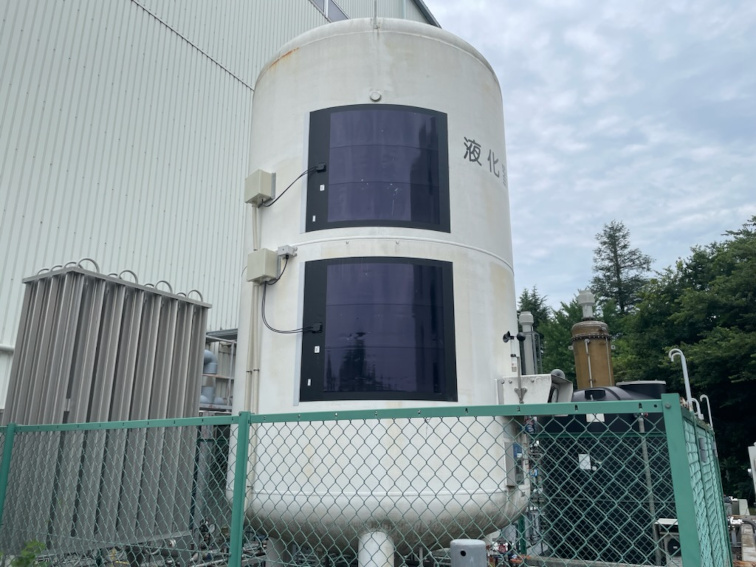 TAKEAWAY: The number of PSC trials is proliferating this year. This month, JGC Corp is another to trial the technology on the roof of a park facility in Enoshima, in collaboration with EneCoat Technologies. Most of the demos are for locations that would not necessarily be open to solar panels due to weight or uneven surfaces. This suggests that there is an understanding in the market that PSC is not coming to directly challenge existing polysilicon-based solar PV, but rather, is a potential option in new use cases. These trials should give an idea of how feasible PSC will be as a commercial technology in the coming years. In this context, the govt’s targets to have PSC operate on a commercial basis starting 2025 or 2026 might be overly optimistic.
Source: Cosmo Energy
JGC begins search for perovskite solar farm partners
(Japan NRG, July 24)
- JGC Corp began recruiting agriculture farms for solar power stations using perovskite solar cells (PSC) supplied by EneCoat Technologies.
- JGC has developed a plastic sheet with a PSC module layer that can be placed on top of crops, or used as curtains of greenhouses.
- CONTEXT: PSC sheets are easier to install compared to silicon panels, which need to be mounted securely on racks.
TAKEAWAY: Farmers are interested in wavelength-selective PV cells that are colorless and transparent. However, they tend to push back against solar modules that are colored black, as they think the modules will block plants’ photosynthesis. EneCoat products are black.
- SIDE DEVELOPMENT:
Panasonic pushes forward perovskite commercialization
(Nikkei, July 26)- Panasonic plans to commercialize glass-mounted perovskite solar cell (PSC) modules in 2026, two years ahead of its original plan.
- This fall, the company will begin running prototype production lines of building-integrated modules at its Osaka R&D facility.
METI and Aomori discuss Mutsu interim spent nuclear fuel facility
(Jiji Press, July 23)
- During a meeting with the Aomori Pref Governor, METI’s Minister Saito discussed plans for an interim spent nuclear fuel facility in Mutsu. He suggested that the Rokkasho Reprocessing Plant could be a potential processing destination.
- CONTEXT: The Mutsu facility now under construction will be Japan’s first interim storage facility for spent nuclear fuel. It’s built to store fuel for up to 50 years. The operating company, which is partially funded by TEPCO, aims to launch by late Sept.
- The governor’s decision on a safety agreement between the company, Aomori pref and the city, is a crucial factor. Local assemblies are worried about the potential extension of the 50 years timeline, and so they emphasize the need for a clear plan for future disposal.
TAKEAWAY: The success of Mutsu’s facility is closely intertwined with the fate of Rokkasho’s reprocessing plant that’s expected to be the next place to store spent fuel after the Mutsu facility’s 50-year limit. However, many in the municipal and prefectural assemblies fear that the Rokkasho plant, which has already seen 26 delays, will face another delay as the operators try to fulfill the NRA’s requirements. Until the govt can secure a concrete plan and the proposed facilities are already operational for spent nuclear fuel, interim storage facilities will always be met with resistance by locals.
Tokyo Century will invest ¥20 bln in Sustainable Battery Holdings
(Company statement, July 23)
- Leasing company Tokyo Century, via its subsidiary TC Investment Partners, will invest in Sustainable Battery Holdings (SBH) alongside Advantage Partners and Furukawa Electric; SBH will acquire the Furukawa Battery Co (FBC).
- AP78, an SBH subsidiary, will hold a tender to acquire all outstanding shares of FBC from shareholders for about ¥19.6 billion.
- Furukawa Electric will own about 20% of SBH; AP Fund 60% and TC Investment Partners 20%. FBC will delist as a consolidated subsidiary of Furukawa Electric.
CCS site exploration rules take effect Aug 5
(Government statement, July 23)
- The Cabinet approved METI’s proposal to bring into force, effective Aug 5, CCS exploration rules defined in the CCS Business Act.
- CONTEXT: METI has selected nine Advanced CCS Projects for Commercialization to receive support from carbon capture to storage, aiming to realize their commercialization before 2030. Their total storage capacity is 6-12 mln tons/ year of CO2.
Wind Association proposes relaxing forestry law
(JWPA statement, July 25)
- Before an ANRE panel studying ways to increase renewables installations, the Japan Wind Power Association proposed relaxing forestry law.
- Such projects are banned in protected forest areas. The govt should find ways to allow projects in the protected areas, said the JWPA.
- It also urged stronger measures to increase “renewable promotion zones” by the national govt, the municipalities and developers working closer together.
TAKEAWAY: A number of prefectures have either passed a law or say they will try to do so restricting the cutting of trees for solar and wind power projects. It would be odd for the national govt to relax forestry law at a time when regional authorities are seeking to tighten regulation in this area. However, the wind industry lobby group may be able to use this approach to push the national govt to help find new areas where onshore wind projects are welcome, similar to the zoning for offshore wind.
Govt prepares plan for agricultural version of AZEC
(Japan NRG, July 24)
- The Ministry of Agriculture, Forestry and Fisheries officials proposed to PM Kishida to organize an agricultural version of the Asia Zero Emission Community.
- Akiba Kazuhiko, head of Tokai Regional Agricultural Administration Office, said that new rules are needed to build cross-border food value chains.
- “PM Kishida appeared keen on the idea of spreading the concept of varied zero emission pathways to agriculture”, said Akiba.
- CONTEXT: MAFF aims for a carbon neutral agricultural sector by 2050. Akiba was one of the MAFF task force members for writing the “Green Strategy for Sustainable Food Systems”.
TAKEAWAY: Low-methane rice growing now being developed in Japan could be the hydrogen/ ammonia/ CCS equivalent technologies shared among AZEC members.
Marubeni leads testing used tires as battery material for street lighting
(Company statement, July 22)
- Marubeni and 17 partner companies launched a pilot using so-called ‘tire batteries’ to support continuous operation of solar-powered street lights. The demo will run to late October.
- CONTEXT: Used tires are decomposed and processed to extract useful substances, which are then added to ionic materials (such as eggshells) to create electrodes for a storage battery.
- About 10 tons of used tires are required to meet the electricity needs of 42 households at the current stage of this battery development, but the firms involved plan to improve the technology’s efficiency.
- The technology has been in development for 12 years. It is meant to be paired with renewable energy sources.
- Other firms involved in the Tire Battery Project are Renesas, ENEOS Materials, and Sangyo Denko.
Tokyo govt offers subsidies up to ¥100 mln for next-gen renewables demos
(Government statement, July 19)
- The Tokyo Metropolitan Govt began accepting applications for a subsidy program to support demos of next-gen renewable energy technologies. Up to ¥100 million will be provided, covering two-thirds of the expenses.
- Grants will be awarded to power generation projects in solar, wind, biomass, hydro, geothermal and other forms of renewable energy that have passed the R&D stage but are yet to be put into practice.
- The proposal deadline is Aug 23. Total budget for “Next-Generation Renewable Energy Technology Social Implementation Promotion Project” is ¥320 million.
Chubu Electric Miraiz to offer CO2-free electricity as part of tax gift
(Company statement, Japan NRG, July 19)
- Chubu Electric Miraiz will work with Otari village to provide CO2-free electricity as a ‘thank-you’ for those residents who donate part of their local tax to the village.
- CONTEXT: Japan’s furusato nozei (Hometown Tax) scheme allows taxpayers to allocate some local tax payments to municipalities other than the one in which they live. In return, the municipalities often provide a gift as a ‘thank you’. This is the first instance of a locality offering electricity.
- Otari Village has two local hydropower plants run by Chubu Electric. The company says that for every ¥10,000 donated to Otari, taxpayers will get some CO2-free electricity (150 kWh) and a ¥2,500 discount on their power bill.
NEWS: ELECTRICITY MARKETS

Hokkaido Electric aims to be first supplier of 100% ammonia-fired power
(Government statement, July 23)
- Hokkaido Electric plans for 100% ammonia-fired power generation at Tomatoatsuma Unit 5 by the middle of 2040’s; this would be earlier than JERA, which recently completed its own 20% ammonia co-firing trial at a coal-fired power plant.
- Hokkaido Electric aims for 100% green ammonia-fired power, while other ammonia players – JERA and Kobelco Power Kobe – plan to blend blue and green ammonia.
- Tomatoatsuma Unit 5 has not been built yet. Its capacity was initially planned at 350 MW, but that might change.
- Ammonia firing will start at Tomatoatsuma Unit 4 (700 MW) in FY2030, with a blending ratio of 20%, but that will rise to 50% several years later.
- JERA and Kobelco Power Kobe also plan 100% ammonia-firing in the late 2040’s.
- In FY2027, JERA will commercialize 20% ammonia firing at its Hekinan Unit 4 (1 GW); and in FY2029, JERA’s Hekinan Unit 5 (1 GW) and Kobelco’s Kobe units 1 and 2 (each 700 MW) will also begin 20% ammonia co-firing.
- CONTEXT: This week, OCCTO unveiled the decarbonization plans of power utilities that were awarded supply contracts following the FY2023 long term decarbonized power auction (LTDA). Hokkaido Electric and Kobelco won 132 MW contracts for each ammonia-firing facility; while JERA won for a 187 MW facility.
TAKEAWAY: Ammonia applications are expanding and diversifying as they replace fossil fuels not only in the energy but in the manufacturing sectors. A gas inspector told Japan NRG that the safety regulations may need to be rewritten if small-scale ammonia burners begin to spread. Two ammonia slip incidents were reported so far this year due to errors by contractors. It seems that some ammonia users may not have the capacity to manage and train contractors, a local ammonia supplier said.
- SIDE DEVELOPMENT:
CEFH2 to begin 35% hydrogen-fired power in FY2029
(Government statement, July 23)- CEFH2 plans hydrogen-coal co-firing at Miike Unit 2 (175 MW) in FY2029, and a shift to 100% hydrogen firing at Unit 3 that will be built around 2032.
- The company was awarded a 55 MW supply contract during the FY2023 LTDA (long-term decarbonization capacity auction).
- Kansai Electric plans hydrogen-LNG co-firing at three power stations in about 2039-2040, at a blending ratio of 20-50%.
- Tohoku Electric and Chugoku Electric also plan a 20-50% hydrogen co-firing in about 2039-2040.
- Tokyo Gas and Osaka Gas each plan power partly fueled by synthetic methane (e-methane) in the 2040’s.
OCCTO to float first backup power auction in Aug-Sept
(OCCTO statement, July 24)
- OCCTO will hold the first backup power auction for a total capacity of 2 GW, to be available during FY2025-2026. Bids can be submitted from August to late Sept.
- The backup power system covers power supplies that fall outside the scope of capacity auctions as such facilities have been mothballed. They are activated in times of power supply crunches.
- Auction results will be released in late December.
- CONTEXT: The backup power system is designed to sustain thermal power generation capacities by keeping them under care and maintenance rather than dismantling them.
TAKEAWAY: On average, thermal power units are operating fewer hours as non-fossil power sources increase; but their total annual output has not declined since there are days when demand far exceeds forecasts.
METI highlights issues in EPRX market
(Denki Shimbun, July 24)
- METI held a meeting indicating worsening supply-demand balance issues in the Electric Power Reserve Exchange; it focused on the underbidding problem.
- Measures such as reducing bid volumes have decreased shortages, but there is still a need to rely on backup power.
- METI plans to refine requirements for backup power and incentivize bids, particularly for facilities that can be brought online quickly.
- SIDE DEVELOPMENT:
Govt proposes to end partial power supply scheme
(Government statement, July 24)- ANRE and the Japan Fair Trade Commission are soliciting public feedback on a plan to end the “Partial Power Supply” scheme for independent service providers with limited supply sources.
- Feedback is accepted until Aug 22.
- CONTEXT: The scheme began in 2013 to support small retailers hit by tight power supplies following the March 2011 earthquake and tsunami.
TEPCO Power Grid faces highest demand of the summer
(Denki Shimbun, July 23)
- On July 22, TEPCO Power Grid faced its highest demand of the summer, at 55 GW, due to a heatwave.
- Emergency measures improved reserve rates from 1.6% to over 8%, avoiding extra supply directives.
- Nationally, power demand hit a summer peak, highlighting the strain on the grid during high temperatures.
- CONTEXT: Hotter temperatures tend to lead to higher gas / LNG consumption in Japan, which also pushes up power prices. The TEPCO coverage is especially reliant on gas-fired generation as additional baseload as there are no nuclear power plants available at this moment.
- SIDE DEVELOPMENT:
New power companies boost their share by 15.3%
(Denki Shimbun, July 23)- April’s electricity sales increased by 5% YoY, with new power companies boosting the volume they sold by 15.3% in the same period.
- Retail contracts were stable, with new power companies holding 17.5% of the market.
- The largest growth was seen in special high-voltage and high-voltage categories.
- Compared to the March power sales, however, April numbers for total electricity sold were 10.8% lower.
TAKEAWAY: The power retail market is in recovery mode after the tumultuous 2021/22 period that saw new power companies (shin denryoku) lose market share, face financial difficulties, and the former regional utilities take over many of the delivery contracts. At one point, new power entrants held about 22-23% of the market, and while their share is lower today it again seems to be on an upward trajectory.
Discrepancy in regional reserve ratios causes issues in balancing market
(Denki Shimbun, July 26)
- From April 2024, the use of regional reserve ratios for balancing has highlighted discrepancies between weekly forecasts and actual supply-demand balances. The reasons are that some of the calculations have to be done manually due to the data collection methods and also the complicated nature of monitoring timely responses.
- The quality of forecasts improves as actual demand time approaches, but weather-affected power generation, such as solar, which now has over 10 GW of capacity in the Tokyo area alone, makes exact forecasting difficult.
- CONTEXT: Regional reserve ratios serve as a guideline for implementing additional supply measures during demand crunches. Backup sources like pumped hydro, however, require more accurate and timely directives to be utilized effectively. The risks of imbalance rise as the reserve ratio drops to the ‘minimal’ 3% level.
- The current display and interpretation of regional reserve ratios are problematic. Extremely low figures in weekly forecasts may mislead the public, despite their utility to businesses. There is a growing demand for improved accuracy and better communication of reserve ratios to prevent misunderstandings.
METI’s July 22-26 forecast shows critical supply-demand in Tokyo, Tohoku
(Denki Shimbun, July 22)
- METI’s forecast for July 22-26 showed critical supply-demand conditions in Tokyo and Tohoku.
- The reserve margins dropped to 1.6% and 1.4%. Measures such as generator maintenance rescheduling will likely maintain a stable supply.
- CONTEXT: The discrepancy between weekly forecasts and actual supply-demand conditions is a challenge for energy providers.
Tohoku Electric updates supply plan including for Higashi Niigata Unit 6
(Company statement, July 23)
- Tohoku Electric updated its 2024 supply plan to include the development of Higashi-Niigata Unit 6. It made a bid in a recent decarbonization auction.
- In March 2028, the utility will decommission Higashi-Niigata Units 1 and 2. The changes were submitted to OCCTO.
- CONTEXT: Unit 6 (capacity 650 MW) will be fueled by LNG, just like Units 1 and 2. But Tohoku Electric will consider eventually switching to ammonia or hydrogen.
NRA chairman inspects Shimane NPP ahead of planned restart
(Nikkei, July 22)
- NRA chairman Yamanaka inspected Shimane NPP that’s set to restart Unit 2 in December. L
- Yamanaka confirmed that safety measures were nearly complete. He discussed the restart with local governors and mayors.
- Unit 2’s restart, following new post-Fukushima safety standards, will be Chugoku Electric’s first. Similar boiling water reactors (BWRs), like those at Fukushima, are also preparing for restarts, such as Tohoku Electric’s Onagawa Unit 2 in November.
- Shimane Pref Governor urged careful planning, not driven by schedules. The Chugoku Electric president emphasized safety-first preparations.
NRA says Tsuruga NPP Unit 2 doesn’t meet new standards
(Nikkei, July 26)
- The NRA said it cannot exclude the presence of an active fault beneath the No 2 reactor at Japan Atomic Power Company’s (JAPC) Tsuruga NPP in Fukui Pref.
- This reactor has not met the new regulatory standards, preventing its restart.
- CONTEXT: If confirmed, it will be the first time a plant has been disqualified in a review since the NRA’s founding.
- The NRA will report its conclusion to Chairman Yamanaka and other commissioners July 31, and then they’ll make a formal decision.
- The NRA did not accept JAPC’s repeated assertions that the fault is not active. JAPC had planned to continue research but the NRA commissioner rejected further research, saying that after a year of work it reached a final conclusion.
TAKEAWAY: The debate over the fault under the Tsuruga plant has focused on two main issues. First, whether the “K fault” about 300 meters north of the plant is active; the NRA concluded at the end of May that it’s difficult to deny this. The second issue is whether the fissure extending from the fault to under the Unit 2 reactor should also be considered an active fault.
- The background to these debates, however, is that the NRA halted the review of the Tsuruga plant last year claiming that the operator numerously submitted documents that contained errors. The regular claimed these were not just mistakes but also some instances of data tampering. The situation was so bad that the NRA mulled forcing the operator to withdraw its restart application. As such, there is perhaps little surprise that the regulator decided against accepting further research from JAPC. For the operator, however, this will be a major blow, with the Tsuruga site seen as a hub for new reactor developments in the future.
MHI gets KEPCO order to replace reactor internals in Takahama NPP
(Company statement, July 25)
- MHI received an order from KEPCO to manufacture and replace two reactor internals for Takahama NPP Units 1 and 2.
- Reactor internals are crucial for holding fuel assemblies, and will be produced at Mitsubishi’s Kobe Shipyard. The advanced designs will enhance long-term reliability and prevent bolt damage.
- CONTEXT: KEPCO applied to the NRA for approval of the substitution plan. Similar work is underway at Mihama NPP Unit 3. Replacement is required as a preventive measure.
- SIDE DEVELOPMENT:
KEPCO applies for permit of in-vessel structures at Takahama NPP
(Company statement, July 25)- KEPCO applied to the NRA for approval of work at Takahama NPP to replace in-vessel structures in Units 1 and 2.
- Also, the utility plans to replace the turbine-driven auxiliary feedwater pumps of Units 1 to 4, as well as Unit 3 of the Mihama plant.
- CONTEXT: Before the application, KEPCO notified Fukui Pref and Takahama Town on May 28 seeking their understanding. On July 9 they obtained approval.
Kyushu Electric applies to revise tsunami risk assessment for Genkai NPP
(Company statement, July 25)
- Kyushu Electric applied to the NRA to revise the tsunami risk assessment for its Genkai NPP.
- Kyushu Electric reassessed a potential tsunami impact based on the latest long-term evaluation of active faults by the Headquarters for Earthquake Research Promotion.
- It confirmed that the revised evaluation won’t affect plant safety. There is no need for extra safety measures.
JNFL’s Aomori reprocessing plant nears final stages of completion
(Nikkei, July 23)
- Japan Nuclear Fuel Ltd (JNFL) will make a final decision on whether it can achieve its “September completion” target for a reprocessing plant of spent nuclear fuel in Rokkasho, Aomori Pref.
- A decision will be made after the next NRA review meeting.
- The company is now undergoing the NRA’s review for “approval of the design and construction plan”.
- JNFL will try to submit the plan by September.
JFE Engineering is first to focus electricity retail on geothermal generation
(New Energy Business News, July 25)
- JFE Engineering’s subsidiary, Urban Energy, set up a new regional electric power company, Hachimantai Geo Power C, which may be the first local electricity retailer to focus on geothermal energy.
- The new entity is based in Hachimantai City, Iwate Pref, and it will procure electricity from the locally based Matsuo Hachimantai and Appi geothermal power plants. The electricity will be sold to local businesses and public facilities, starting February.
- Aside from JFE Engineering’s 85% stake, investors in Hachimantai Geo Power include Hachimantai City, Iwate Bank, Kitakanto Bank, etc.
NEWS: OIL, GAS & MINING

Toho Gas makes first foray into natural gas sales in Indonesia
(Company statement, July 22)
- Toho Gas began industrial natural gas sales in Indonesia via a special purpose company, Sakura Indonesia Energy, which was set up with LNG Japan Corp.
- This marks Toho Gas’s first foray into industrial natural gas sales in Indonesia.
- CONTEXT: Toho Gas has also recently launched natural gas projects in Vietnam, Singapore and Thailand.
Australia awards offshore acreage for petroleum exploration and CCS
(Petroleum Australia, July 25)
- Australia awarded new offshore sites for petroleum exploration and CCS, hoping to enhance long-term energy security amidst concerns of potential gas supply shortfalls.
- Awarded companies include INPEX, Esso, Beach Energy, Chevron, Melbana, and Woodside Energy. The decision relates to exploration of areas such as the Otway and Sorrell Basins, and areas off Australia’s west coast.
- CONTEXT: This is the first time that Australia’s Labor-led govt, which has been in power since 2022, granted new offshore gas exploration permits.
TAKEAWAY: Australia is attractive for Japanese companies active in CCS because its govt promotes policies to develop the industry. Given Australia’s geological storage potential and its geography, more Japanese companies will likely take part in CCS projects there, if more permits are granted.
Chiyoda consolidated net profit falls, hit by LNG project
(Nikkei, July 26)
- Chiyoda Corp’s consolidated net profit for April-June fell 20%, YoY, to about ¥4 billion.
- The drop is due to the bankruptcy of its U.S. JV partner, Zachry Industrial.
- CONTEXT: Golden Pass LNG, one of the largest LNG projects in the U.S., faced significant hurdles after Zachry filed for bankruptcy in May.
- Chiyoda had set aside ¥37 billion for this project, which caused a net loss in FY2023.
TAKEAWAY: Overall, Chiyoda’s financial performance showed resilience despite the challenges posed by Zachry’s bankruptcy. This is due to diversification of Chiyoda’s project portfolios. Yet, future profitability relies on solving issues surrounding Zachry’s departure and, most of all, the LNG project’s progress.
LNG stocks jumped 6.8% as hot summer boosts power demand
(Government data, July 24)
- LNG stocks of 10 power utilities were 2.35 million tons as of July 21, up 6.8% from the previous week (2.2 million tons). This is 21.1% up from end July 2023 (1.94 million tons); and 7.3% up from the past 5-year average of 2.19 million tons.
- LNG stocks grew in preparation for the hot summer. The JMA said that the rainy season was over in the Tokyo area last week, and the weather suddenly turned hot; the temperature reached nearly 35 C.
June oil / gas / coal trade statistics
(Government data, July 18)
|
Imports |
Volume |
YoY |
Value (Yen) |
YoY |
|
Crude oil |
9.1 million kiloliters |
-14.0% |
¥787.7 billion |
3.3% |
|
LNG |
4.6 million tons |
0.8% |
¥424.9 billion |
8.1% |
|
Thermal coal |
6.8 million tons |
-6.9% |
¥161.1 billion |
-28.6% |
ANALYSIS
BY MAYUMI WATANABE
Hydrogen Hubs to Shine a Light on Japan’s ‘Green’ Future
Until recently, Japan’s hydrogen strategy has been largely colorblind. If anything, there’s been more emphasis on ‘blue’ hydrogen projects due to the speed and scale that they can deliver in comparison to most of the production plans linked to renewable energy. However, this may change over time as the country’s regional hydrogen hub strategy picks up pace.
Several green hydrogen production sites are expected to go onstream in Japan in the middle of this decade, which adds some ‘craft’ supply for local economies, boosting their sustainability levels. All ‘blue’ hydrogen in Japan is expected to be imported.
This analysis is Part 2 of our two-article series looking into major hydrogen projects in the pipeline in Japan.
Yamanashi and Hokkaido, the green hydrogen hubs
Green hydrogen has been produced at a small scale of several hundred tons / year in total since 2020 at:
- FH2R plant in Fukushima Prefecture,
- Obayashi geothermal plant in Oita,
- Yamanashi Hydrogen Co (YHC) in Yamanashi.
Because of the higher costs of domestic green hydrogen projects, they were labeled as dream / demo works with little or no market potential. The costs often cited for the above projects were 100 times or more above the 2030 national goal of producing hydrogen at ¥30 / NM3.
The FH2R facility, launched in time for the Tokyo Olympic Games 2020, enjoyed positive feedback when it opened. But the cost of transport and failure to attract industrial-scale users has made the FH2R uneconomic, operating more like a demonstration center for the technology than a business.
Despite this, in 2025, several new green hydrogen productions are coming on-stream: a 2,200 tons / year plant in the city of Hokuto, Yamanashi Prefecture; and a 10,000 tons / year plant in the city of Tomakomai, Hokkaido.
Municipal governments are driving the green hydrogen industry. They want to monetize excess renewables electricity, which is made redundant due to a lack of transmission cable bandwidth. From May to September, renewable operators in Japan are often asked to curb output as too much solar power is generated.
The municipalities also learned from the Namie example that green hydrogen by itself is not enough to attract end-users. They need to help set up workable means of transporting the fuel and support the development of new hydrogen applications.
YHC, a joint venture between Yamanashi Prefecture, Toray and seven other companies, has been a pioneer of not just green hydrogen production but also in creating demand. On the production side, it conducts R&D of PEM electrolysis technologies. On the demand side, it sells green hydrogen outside of Yamanashi’s boundaries. It’s also developing off-grid application of H2 at local farms, as well as exploring the potential for overseas sales.
The city of Sapporo in Hokkaido has unique plans, too. In June, it was awarded by the Financial Services Agency a special business zone status to attract foreign investment into clean energy. There will be new visa categories, support for opening bank accounts, relaxing bank rules for financing startups, local tax cuts and subsidy offers, and deregulation.
The Sapporo government seeks to attract operators of offshore wind turbine installation ships from overseas by relaxing ship ownership rules. It aims to speed up offshore wind projects along the Ishikari coast, and encourage green hydrogen production. To drive up consumption, it plans to relax rules on hydrogen storage, such as raising the storage volume limit.
The Hokkaido government decided to position Sapporo as the region’s clean energy hub, because the city has the island’s largest population. Sapporo, Tomakomai and Muroran comprise the core of the Hokkaido hydrogen supply chain, which is expected to be set up by 2030. The area will not only produce hydrogen but will also act as a demand center, with major local construction activity under way to build semiconductor plants and data centers.
In the Tomakomai region 50 km south of Sapporo, a consortium led by Sparx will bring onstream a new hydrogen production plant in January 2025. It will power electrolysers with solar panels and industrial waste. Also in Tomakomai, Hokkaido Electric, ENEOS and Idemitsu Kosan plan a 10,000 tons/ year green hydrogen plant.
In Chitose, which lies between Sapporo and Tomakomai, a consortium of Mitsubishi Corp, Takasago Thermal Engineering, Hokkaido Electric and Air Water Hokkaido have launched green hydrogen supply chain feasibility studies.
In May, the city of Muroran began a trial run of green hydrogen supply services, using power from the 500 kW Shukutsu wind power station owned by the city. The aim is to spread hydrogen use to homes and small customers by repurposing the wind station without new capital investment into infrastructure, such as pipelines.
Green hydrogen projects
|
Location |
Key Players |
Description |
Status |
|
Cities of Kofu, Hokuto, etc. (Yamanashi Pref) |
Yamanashi Hydrogen Co, Yamanashi Pref, TEPCO, Toray, Suntory, Toshiba, Tomoe Shokai |
Producing solar-derived green hydrogen, attracting industrial users to the prefecture, developing hydrogen applications |
Green hydrogen production started in June 2021; Construction of a 16 MW (2,200 tons/ year) electrolyzer plant started in 2024 |
|
Namie Hydrogen Supply Chain for Homes and Industries (Fukushima Pref) |
Fukushima Hydrogen Energy Research Field (FH2R), Hitachi |
Delivering compressed hydrogen to homes, supplying hydrogen-generated power to power utilities |
FH2R has been producing green hydrogen since 2020. Its capacity is 200 tons/ year. Hitachi has completed studies on hydrogen transport and applications in April 2024. |
|
Sapporo, Ishikari coast (Hokkaido) |
City of Sapporo |
Attract foreign ships to conduct offshore wind installations, produce hydrogen from redundant wind power and supply to major commercial facilities |
In May, the government designated as special deregulation zone to attract foreign investment |
|
Tomakomai (Hokkaido) |
Sparx, Hitachi, City of Tomakomai, Sumitomo Mitsui Trust Bank, Toyota Motor Hokkaido |
Off-grid 7,000 – 10,000 tons/ year green hydrogen supply system using solar and waste-generated power |
Plant construction began in May, supplies to end-users Hokkaido Soda, city’s spa and Toyota start in Jan 2025 |
|
West Tomakomai area (Hokkaido) |
Hokkaido Electric, ENEOS, Idemitsu Kosan |
Producing 10,000 tons/ year of green hydrogen; developing power supply management system to supply power to industrial users |
Three companies signed MoU in Feb 2024 |
|
Muroran (Hokkaido) |
City of Muroran, Air Water Hokkaido, Muroran Gas, Taisei Corp, Kitakoudensha, etc. |
Users including homes, community stores, offices and hotels, will receive metal hydride charged with hydrogen. They will extract hydrogen from the metal to run hydrogen boilers. |
Trial started in May 2024 |
The next steps
Supply chains are organic. They continue to grow. The Central Japan consortium plans to build ammonia cracking and dehydrogenation facilities in the ports of Nagoya and Mikawa, to convert ammonia to hydrogen and to supply FCV fueling stations. They’re also developing the Yokkaichi Port as a backup, in case the JERA Kinuura port closes due to emergencies.
Resonac plans a 100 MW hydrogen-fueled power plant. As its plastic recycling plant is not capable of generating enough hydrogen, it will also import the fuel.
ENEOS is not limiting hydrogen opportunities to MCH. It is building another supply chain on the Kawasaki waterfront area, consisting of liquid hydrogen, with Iwatani Corp, Japan Suiso Energy and Kawasaki Heavy Industries. The liquid hydrogen supply chain consortium aims to hit the government hydrogen price target of ¥30 / NM3 in 2030.
Some say that the ultimate goal of the national hydrogen strategy is to run several GW-size power plants fully fueled by hydrogen or ammonia, or both. The spread of hydrogen via regional hubs could also see a kind of decentralization of power supply structures.
Green hydrogen producers in Yamanashi and Hokkaido are developing off-grid services for homes and farms, because it is more efficient to consume the energy source close to home than to transport it to faraway demand centers. The Muroran test is also off-grid. A wide variety of community-based suppliers may develop.
Conclusion: Everything hinges on METI subsidies
The bottom line is that neither super hydrogen power stations or supply diversity will happen unless hydrogen costs fall to around the government target or less, or the costs of incumbent energy sources rise due to carbon taxes or other factors.
For now, many advanced hydrogen projects exist thanks to subsidies from the feasibility study phase. At what point will they be able to stand on their own commercial feet?
There are already signs of a “decarbonization divide” between municipalities active in climate issues and those limiting their scope to rooftop solar and energy saving system installations. The latter are small municipalities, suffering from depopulation, staff shortage and tight budgets.
Outsourcing of community services has become common and local authorities are often happy to contract out the management of solar, FCV, EV and storage battery programs to save their dwindling human resources. According to the government’s Population Strategy Council, 40% of municipalities may cease to exist in 2050 due to depopulation.
If the above scenario plays out, then there is only a certain time window during which local authorities will be able to support new hydrogen supply chains and demos. After that, only those municipalities with large populations and industrial centers will continue. Meanwhile, the repurposing of existing facilities into cleaner alternatives will become the zero emission driver, if it isn’t already.
ANALYSIS
BY JAPAN NRG
Modernizing Port Infrastructure is Key to
Japan’s Wind Power Development
Japan has over 1,000 ports, yet when it came to selecting winners of the most recent offshore wind auction, a decision on one of the four projects offered was delayed for over three months due to concerns over port access. And this was only Round 2 of national offshore wind tenders.
With ambitions of building 45 GW of offshore wind capacity in the next two decades, Japan faces an unusual predicament. The country is well known for excellent infrastructure and plenty of ports, but few can handle the logistics and transport required to receive, store, and assemble wind farm components, as well as to support the installation and maintenance of offshore wind facilities.
The success of multi-billion-dollar offshore wind power projects can hinge on the availability of suitable port infrastructure. A port’s geographic proximity to an offshore wind project, for example, is a key factor impacting overall costs and efficiencies. Ports also determine the range and length of deployment of installation vessels, as well as those used for operations and maintenance. Investors determine their interest in a project partly based on port access.
As Japan’s offshore wind industry moves from tenders to the practicalities of managing multi-hundred-MW projects, the government has heeded to industry calls for a revamp of port facilities and began to assess the scale of modernizations, as well as what it will take to allow Japanese ports to cope with today’s larger vessels, wind turbines, and other equipment.
Since these challenges are too complex for individual developers to solve, the government is supporting public and private action, and corralling stakeholders for sector-wide cooperation.
Improving port infrastructure
Japan’s coastal geography and deep waters present challenges and opportunities for offshore wind development. Traditionally, Japanese ports have been geared towards supporting the fishing industry, trade, and fossil fuel imports. As a result, Japan has some of the world’s most advanced LNG terminals, but the ports will require significant upgrades to receive and then store 100-meter-long wind turbine towers and blades, or 300-ton nacelles.
Upgrades require investment to improve function as a hub for manufacturing, assembly, and maintenance of offshore wind components. For example, it takes around three days to install just one turbine, depending on the distance between the port and the project site.
As an island nation, Japan has many ports, totaling 1,020; but about 90% of these are small. The total breaks down as: 22 special-purpose major ports, 106 standard major ports, and 892 local ports.
Only a fraction of these, however, can be utilized to service the offshore wind industry, and only a handful are currently doing so on a commercial basis. That’s despite the fact that METI and the Ministry of Land, Infrastructure, Transport and Tourism (MLIT) have studied the port and harbor needs of offshore wind power generation facilities since 2016.
Still, in recent years, there’s been some progress. In 2023, the government updated the framework of the Port Improvement Promotion Act, pledging to support the development of port facilities nationwide. This ensured funding for wharves and other facilities at 70 ports nationwide.
With a budget of ¥79.8 billion for FY2023, the government has committed to funding not only the land for wharves themselves, but also to the construction of sheds and cranes, and the development of adjacent waterfront areas used for logistics.
As part of the wharf funding program, 62 ports were selected. These include ports where offshore wind power generation projects are planned or under consideration: Ishikari Bay New Port (Hokkaido); Akita Port, Noshiro Port (Akita Prefecture); Sakata Port, Kashima Port (Ibaraki Prefecture); Niigata Port, Fushiki-Toyama Port (Toyama Prefecture); Kitakyushu Port (Fukuoka Prefecture); and Nagasaki Port.
Japan currently has seven operational offshore wind farms, with three deemed large-scale: the 112 MW Ishikari Bay New Port Wind farm; the 84 MW Noshiro Port; and the 54.6 MW Akita Port projects. Akita Port was put into commercial operation in January 2023 while Noshiro Port has been in commercial operation since December 2022. Ishikari Bay consists of 14 wind turbines, each 8 MW; it began commercial operation on January 1, 2024.
Base ports
The outsized parameters of offshore wind power components and foundations require ports that can accommodate large vessels and have appropriate logistics facilities. To kick-start the upgrade of domestic ports to work with the wind sector, the government introduced a “base ports” program.
Such a port should have a pier that can handle heavy, large-scale materials and has sufficient load-bearing capacity and space to handle the components needed for the installation and maintenance of offshore wind power generation facilities. A base port agrees to set aside its harbor and specific wharves for a time during the first stage of wind farm construction.
In turn, project developers are asked by the government to state which port they plan to use as their base port when tendering bids in the offshore wind auctions.
In 2022, eleven ports applied for the official status of an Offshore Wind Hub Port, and two existing ports already designated as such expressed a wish for expansion.
The problem is, only seven locations passed the bar to receive the “base port” designation. In April, the MLIT added Aomori and Sakata to a list that contains port facilities in Kitakyushu, Niigata, Akita, Noshiro, and Kashima. And these ports have to handle the eight sea areas already selected by the government to move ahead with project development. 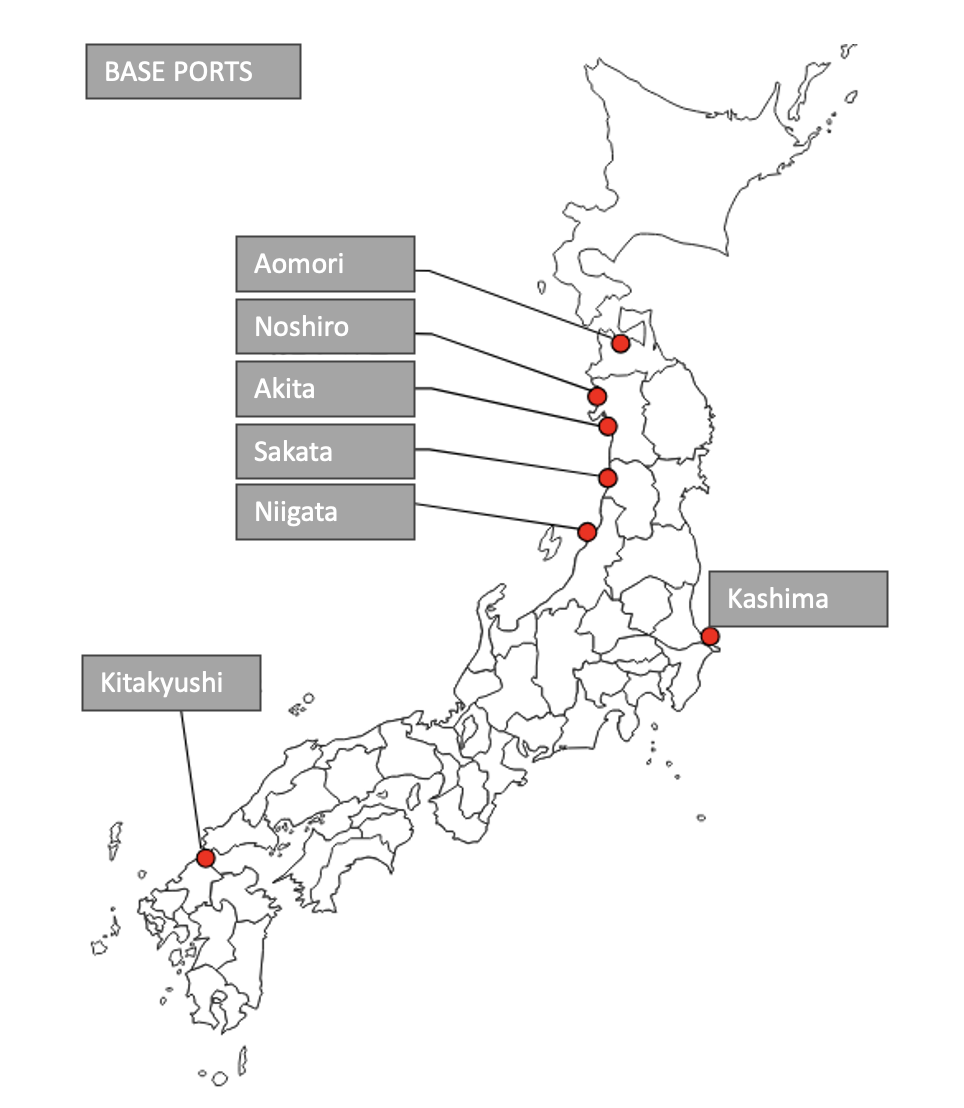
What’s more, the ports selected to date are aligned with existing projects and do not take into account other areas that have significant offshore wind potential. Perhaps the most glaring omission is not having any port that can service Hokkaido, the northern region with Japan’s greatest offshore wind resources.
The port of Muroran, on the southern coast of Hokkaido, is being promoted by an industry group that includes Mitsubishi Steel Group as another base port candidate. The Muroran Offshore Wind Promotion Association (MOPA) already counts 114 companies among its members, including offshore wind developers, and regularly hosts and supports wind sector forums and other events. But it has yet to clinch the official base port designation.
Source: MLIT
Among the challenges faced by ports is that they’re already busy servicing other industries. Muroran, for example, is key for Japan’s steel industry. Also, the ports are often located in densely populated coastal areas, limiting the availability of space for expansion. This makes it difficult to add things like specialized cranes, heavy-lift equipment, and facilities for the assembly of large wind turbine components.
Nonetheless, unless new base ports are added, they are unlikely to play a role in expanding the offshore wind project pipeline this decade. Due to the complex regulatory frameworks around port infrastructure at both the national and level levels, and the construction work itself, it takes about four years to upgrade the ports to fit with sector requirements.
Most offshore wind projects in the pipeline are set to begin commercial operations in 2029 or 2030.
The next frontier
Despite the above efforts, ports may need to go through yet another round of upgrades to accommodate floating wind power generation projects, the structures and turbines of which have different parameters from fixed bottom turbines.
To avoid this becoming a bottleneck to the wind power sector’s development in the future, the government is trying to get ahead of the issue.
In May, MLIT set up a new public-private forum to consider how floating wind power structures will impact land-based facilities such as ports, as well as vessels. The forum’s role is to get “various entities to work together to systematically design systems and conduct technical reviews on a range of issues related to offshore construction, such as the assembly and installation of floating bodies, and related ships.”
So far, the forum has held two meetings, and attracted a wide range of participants, from oil major INPEX, to EDF Renewables, Tokyo University, and floating wind promotion groups. Discussions have focused on measures that will update ports for the assembly and storage of floating foundations and related structures.
The ministry expects the forum to bring industry wide solutions to fruition by around the start of the next decade.
Meanwhile, in March, a public-private research hub for floating wind power was created to act as a kind of clearing house for various sector designs and technologies. The Floating Offshore Wind Technology Research Association [FLOWRA] seeks to standardize the domestic infrastructure and supply chains, and members include most of Japan’s major power utilities and large wind players like Mitsubishi Corp and Marubeni.
With the government and many domestic players involved in the above discussions, the development of floating offshore wind port infrastructure is expected to occur faster and smoother. It should also help not only the ports, but also other supply chain players such as those involved in vessel lease, charter, and operations.
Development of port infrastructure for offshore wind in Japan has had a slow start, but with the appropriate action by the government and private sector stakeholders, it should look significantly better towards the end of this decade.
ASIA ENERGY REVIEW
BY JOHN VAROLI
This weekly column focuses on energy events in Asia and the Pacific
Australia / Electricity market
The West Australian govt seeks bids for dispatchable capacity projects in its wholesale electricity market. The tender aims to deliver 500 MW of 4-hour equivalent, or 2 GWh of clean dispatchable capacity. This will help support the state’s energy system to reach 82% renewables by 2030.
Australia / Natural gas
The govt is set to issue new offshore gas exploration permits to ensure a stable energy supply and move away from coal-fired power facilities.
China / Solar power
Leading solar panel makers are setting up in the U.S. to take advantage of the Inflation Reduction Act. These include Illuminate, a JV between Longi (China) and U.S. energy developer Invenergy. Trina (China) is investing $200 million in a 5 GW solar module plant in Texas. Jinko (China) opened a 400 MW panel factory in Florida in 2018.
India / Biomass
The Ministry of New and Renewable Energy announced new financial incentives for biomass pellet manufacturing in order to promote cleaner air quality and green energy sources
India / Energy transition
The country aims to achieve 50% non-fossil fuel-based energy by 2030. India’s renewable energy capacity has reached 190 GW as of April, according to the Economic Survey. This accounts for 43% of the nation’s total installed generation capacity.
India / Rooftop solar
The Asian Development Bank approved a $240 million loan to boost rooftop solar systems, helping India expand energy access and achieve its target of about 50% of cumulative electric power installed capacity from non-fossil fuel energy sources by 2030.
Malaysia / CRESS
In September, the govt will launch the Corporate Renewable Energy Supply Scheme (CRESS) in order to facilitate open grid access, allowing third parties to supply or purchase electricity through the grid system under agreed terms.
Philippines / Oil spill
A marine tanker carrying industrial fuel sank in rough seas, causing an oil spill that could spread to waters off the capital Manila.
South Korea / EV batteries
LG Energy Solution is in talks with about three Chinese suppliers to produce low-cost EV batteries for Europe, as competition is expected to intensify after the EU hit Chinese-built EVs with extra tariffs.
Thailand / Hydrogen power
Saudi Arabia is considering investing in Thailand, particularly hydrogen energy. Thailand’s Energy Minister was in Riyadh last week. Also, there is a proposal to extend cooperation to the transfer of Saudi know-how and energy technology, and assistance in establishing Thailand’s strategic oil reserve infrastructure.
2024 EVENTS CALENDAR
A selection of domestic and international events we believe will have an impact on Japanese energy
|
January |
|
|
February |
|
|
March |
|
|
April |
|
|
May |
|
|
June |
|
|
July |
|
|
August |
|
|
September |
|
|
October |
|
|
November |
|
|
December |
|
Disclaimer
This communication has been prepared for information purposes only, is confidential and may be legally privileged. This is a subscription-only service and is directed at those who have expressly asked K.K. Yuri Group or one of its representatives to be added to the mailing list. This document may not be onwardly circulated or reproduced without prior written consent from Yuri Group, which retains all copyright to the content of this report.
Yuri Group is not registered as an investment advisor in any jurisdiction. Our research and all the content express our opinions, which are generally based on available public information, field studies and own analysis. Content is limited to general comment upon general political, economic and market issues, asset classes and types of investments. The report and all of its content does not constitute a recommendation or solicitation to buy, sell, subscribe for or underwrite any product or physical commodity, or a financial instrument.
The information contained in this report is obtained from sources believed to be reliable and in good faith. No representation or warranty is made that it is accurate or complete. Opinions and views expressed are subject to change without notice, as are prices and availability, which are indicative only. There is no obligation to notify recipients of any changes to this data or to do so in the future. No responsibility is accepted for the use of or reliance on the information provided. In no circumstances will Yuri Group be liable for any indirect or direct loss, or consequential loss or damages arising from the use of, any inability to use, or any inaccuracy in the information.
K.K. Yuri Group: Hulic Ochanomizu Bldg. 3F, 2-3-11, Surugadai, Kanda, Chiyoda-ku, Tokyo, Japan, 101-0062.