JOGMEC finishes test to extract gas from methane hydrate
LNG stocks up 3.7% over last week; up double digits YoY
Green LPG demo plant begins construction in Hokkaido
ANALYSIS
JAPAN’S DECARBONIZATION DRIVE SEEKS NEW IMPETUS VIA HYDROGEN AND BATTERIES
With Japan facing the prospect of a new prime minister later next month, the successor to Kishida Fumio will face a barrage of social and economic issues. The new PM will also play a major role in Japan’s energy planning with a number of key policy documents due inside the next six to seven months. To get a sense of the state of affairs that Kishida’s successor will inherit, here is an outline of the status of the energy landscape in Japan today.
ASIA ENERGY VIEW
A wrap of top energy news that impacts other Asian countries.
EVENTS SCHEDULE
A selection of events to keep an eye on in 2024.
JAPAN NRG WEEKLY
PUBLISHER K. K. Yuri Group
Editorial Team Yuriy Humber (Editor-in-Chief) John Varoli (Senior Editor, Americas) Mayumi Watanabe (Japan) Kyoko Fukuda (Japan) Magdalena Osumi (Japan Filippo Pedretti (Japan) Tim Young (Japan)
The GxxD reports series follows the mega-trends, business models, and innovations that sit at the crossover between our society’s shift to digital tech and clean energy. With stories on topics as diverse as AI, the CO2 economy, robotics, and fusion, we share intelligence that anyone with an eye on Japan will want to explore further.
We will be hosting a GxxD event in the coming months. Look out for more details.
SUBSCRIPTIONS & ADVERTISING
Japan NRG offers individual, corporate and academic subscription plans. Basic details are our website or write to subscriptions@japan-nrg.com
METI published the standards of the GX Promotion Organization for financing private sector transition projects. They include:
Compliance with the Climate Transition Bond Framework;
Being instrumental in social deployment of new tech owned by Japanese companies, among others;
Need to support projects with risks too big for private sector investments;
Need to have wider social impact including the use of new types of blended financing, etc;
Accountability of project operators.
CONTEXT: The GX Promotion Organization’s main mission is to drive ¥150 trillion in transition investments not just from the govt but also from the private sector. The financing goal is not limited to speeding up the energy transition, but also calls for increasing Japan’s industrial competitiveness. The Organization will primarily finance domestic projects, although it doesn’t rule out the possibility of financing overseas projects involving Japanese companies.
TAKEAWAY: There is no clear cut definition of “Japanese-owned technology”. METI told Japan NRG that a patent application is one way to establish proof, but a lack of patent records would not automatically disqualify companies since the GX Promotion Organization is open to discussion.
The Development Bank of Japan announced conditions for its 190th corporate bond, its first transition bond. The DBJ issued Japan’s first green bond in 2014.
¥10 billion in bonds will be offered, with a 5-year maturity, and a coupon rate of 0.511%.
CONTEXT: The cumulative domestic financing for the energy transition reached about ¥1.6 trillion in December 2023. While companies have already issued transition bonds, and the govt issued GX economic transition bonds in February, such a transition bond issue is a first for a financial institution.
Fifteen Japanese companies, including Isuzu Motors and Sojitz, will set up supply chains in the ASEAN region, focusing on semiconductors and biofuels.
METI has a ¥100 billion budget to support companies willing and able to create new supply chains to counter China’s rapid business expansion in Southeast Asia.
The ministry plans to back 13 major projects in the ASEAN region.
Initial projects selected include:
Sojitz and Green Power Development’s venture to build a pilot production plant for sustainable aviation fuel (SAF) in Southeast Asia
A plan by Toyo Engineering and Itochu to supply green hydrogen to ammonia production facilities in Indonesia
Semiconductor production facilities in the Philippines;
Japan will coordinate policy with Southeast Asian countries and Australia to reduce carbon emissions.
Cabinet-level officials from the 11-member Asia Zero Emission Community (AZEC) meet in Indonesia on Wednesday. METI Minister Saito will attend.
Officials are expected to adopt a statement addressing electricity, transportation and industry. For electricity, the focus will be on decarbonizing thermal power generation.
CONTEXT: Coal makes up more than half of Asia’s power mix.
Chubu Electric and BP advance giant CSS project in Indonesia
(Japan NRG, Aug 16)
Chubu Electric and BP completed a feasibility study for an international CCUS value chain based at the Port of Nagoya and the Tangguh gas field in Indonesia, with an eye on starting operations in 2030.
The project aims to capture 5 to 20 million tons of CO2 equivalent emissions annually, to be transported and stored at Tangguh, which is Indonesia’s largest gas field and LNG facility.
The two companies plan 20 liquefied CO2 ships to transport the emissions. However, the business model remains unclear as the project will largely rely on state subsidies. The firms will do a more detailed study before making a final investment decision.
CONTEXT: In 2023, Chubu Electric and BP signed an MoU to explore opportunities for decarbonization in Japan and across Asia.
Tokyo-based Creattura is trying to reduce methane emissions from rice paddies, generating carbon credits.
Creattura intends to develop this project in the Philippines and other Southeast Asian countries, and has to date raised $2.3 million.
This project will be part of Japan’s Joint Crediting Mechanism (JCM).
Creattura also plans a service using AI and satellite technology to measure emissions reductions. It aims to increase its carbon credit trading from 400,000 tons per year to millions by 2028.
CONTEXT: Methane has an atmospheric impact equal to 20 times that of CO2. Southeast Asian countries are among the biggest emitters.
Japanese companies are struggling to expand the recycling of materials, blaming a lack of legal clarity on the definition of waste/ garbage.
As an example, Dai Nippon Printing and the Fukuoka Research Commercialization Center For Recycling Systems cooperated for two years to develop tech to recycle pharma bottles, but discovered that bringing it to market is difficult due to an inspection required to determine if the bottles are a “valuable resource” or can be classified as “waste”.
CONTEXT: According to Mizuho Research & Technologies, Japan’s waste recycling market in the materials industry alone is now worth ¥6 trillion; and if plastic and metal recycling accelerates, it could expand further.
Experts advocate changes to regulations to specify how used items should be treated to be classified as “valuable material”.
Sumitomo Corp will partially power its smart city under development in Hanoi by tapping solar and biomass power generation facilities in a nearby industrial park to cover 30% to 40% of electricity needs.
The smart city is developed with Vietnamese real estate developer BRG Group. Construction begins in 2025, with residents moving in from 2026.
The Japan Bank for International Cooperation and the Development Bank of Kazakhstan inked an MoU to finance projects in decarbonization and environmental preservation in Kazakhstan.
CONTEXT: PM Kishida had planned to attend the summit with leaders of Central Asian countries this week, but the trip was cancelled as the threat of a major earthquake loomed. This MoU is Japan’s first energy-related development financing scheme in Central Asia.
TAKEAWAY: JBIC and DBK will unlikely develop projects from scratch, but Japanese companies that plan to transfer climate tech will make proposals. If both banks approve, then there’ll be separate MoUs among the project stakeholders and the banks.
In Q1 FY2024, power trader and biomass plant operator Erex posted a profit of ¥1.7 billion. This is a sharp recovery in the firm’s electricity retail business. FY2023 was difficult due to high procurement costs.
The company changed its procurement strategy by shifting from securing long-term energy contracts to a more flexible approach. It now purchases energy in line with retail sales needs at appropriate prices.
The firm also strengthened coordination between retail and market trading departments. It now offers fixed-price plans backed by electricity futures.
Erex is also expanding renewable energy projects overseas, such as a biomass power plant in Vietnam that’s set to launch in December.
Starting mid-September, Toyota will conduct a demo of large, hydrogen-powered trucks in Europe, in collaboration with Coca-Cola and France’s Air Liquide.
The project aims to assess the efficiency of fuel cell (FC) technology and feasibility of heavy cargo transport using hydrogen.
Toyota will provide FC trucks equipped with modules that generate electricity by reacting hydrogen with oxygen.
Air Liquide will supply hydrogen produced from renewables, allowing for the testing of both vehicles and infrastructure.
CONTEXT: Heavy cargo transport using large trucks accounts for about a quarter of Europe’s freight transport. Switching commercial trucks to hydrogen fuel would support the need to build hydrogen fueling stations and other infrastructure. Toyota has been developing FC technology for large trucks since at least 2019.
In cooperation with the Hydrogen Value Chain Promotion Council, NEDO selected Mizuho Research & Technologies to develop a competitive hydrogen supply chain.
The project will study how to create a simulation to model domestic hydrogen transportation costs, which is key to the rollout of supply chains.
The study will share findings with companies involved in domestic supply chains and gather feedback to refine the future simulation model.
CONTEXT: In May, Mizuho committed to providing ¥2 trillion for the production of hydrogen, ammonia and e-methane by 2030, including for setting up supply chains.
Oil refining major Idemitsu Kosan has formed a partnership with Swiss materials and cleantech capital firm, Emerald Technology Ventures, to invest in startups in renewable energy and new materials.
Through 2026, Idemitsu has allocated $56 million for venture investing. It also recently created a dedicated team to oversee venture investing, with two people in Switzerland and one in the U.S.
CONTEXT: Idemitsu formerly invested in a fund managed by Emerald that invested in startups in Europe and the U.S.
Mitsui & Co will set up Polska-Mit Steel, an electrical steel sheet processing firm in Skarbimierz, Poland. The firm launches in April 2026.
The electrical steel sheets will be used to manufacture motor cores for hybrids and EVs, as well as transformer cores for power plants and substations.
CONTEXT: The new firm will help Mitsui expand its steel sheet processing production in Europe, to help meet demand for EVs. Mitsui already has a processing firm in neighboring Czechia.
TEPCO signed an agreement on technical cooperation with the Republic of Palau to provide qualified personnel and conduct a joint project to optimize power grid management with the installation of renewables.
The deal is in line with the Joint Action Plan drafted in July during the 10th Pacific Islands Leaders Meeting that called for more cooperation in clean energy to curb diesel dependence and to improve infrastructure.
CONTEXT: Palau’s leader visited Fukushima Daiichi NPP in June 2023, the first head of state to do so.
TAKEAWAY: Palau’s support for Japan’s planned release of treated water from Fukushima can be seen as a political alignment. Palau has diplomatic relations with Taiwan and has strong ties with the U.S., which provides security guarantees and economic help. Thus, by supporting TEPCO’s treated water release, Palau distances itself from China, which has been opposing TEPCO’s plan and tried to convince other Pacific nations to oppose it as well.
The MoE seeks public feedback on its plan to designate a total of four areas in Aomori, Tottori and Okinawa prefectures as special wildlife protection zones where installation of buildings and other structures will require state approval.
The feedback is welcome until Sept 7.
CONTEXT: Mori Building Co and Ken Corp plan a 42 MW wind project close to the proposed protection areas in Aomori.
The Japan Meteorological Agency issued an alert about the Nankai Trough, warning of a possible ‘mega-sized’ earthquake that’s forecast to occur off the southern coast of central Japan at some point in the coming decades.
Infrastructure companies are preparing in those regions that are expected to be impacted.
KEPCO set up an “Emergency Disaster Countermeasures HQ” to coordinate with its nuclear and thermal power plants.
Chubu Electric set up a “Contact Office” to centralize information, and it also inspected power plant facilities and hazardous materials sites.
CONTEXT: This decision follows the earthquake on Aug 8 in the Hyuganada region that measured 7.1.
Kyushu Electric and Kyushu Electric Power Transmission and Distribution set up an Emergency Disaster Response Headquarters.
The utility also set up a Nankai Trough Earthquake Countermeasures HQ.
TAKEAWAY: The official alert for the so-called megaquake was lifted on Aug 15 after no additional seismic activity was detected. However, the authorities were clearly keen to raise public awareness of such a potential natural disaster, and laws on the matter suggest that they had a duty to do so. Still, preparing for a quake that scientists say occurs every couple of centuries is far from straightforward. For now, the nuclear plant operators have tried to show that they are on alert and diligently checking all systems and processes. But the fact of the alert may spook public opinion that has recently tended to favor nuclear energy returning as a bigger part of the energy mix.
A new agreement on safety was signed for the interim spent nuclear fuel storage facility in Mutsu City, set to launch next month.
The agreement stipulates a 50-year storage period for spent fuel, with an initial storage capacity of 3,000 tons. A second 2,000-ton storage area is also planned.
A supplementary agreement was signed to ensure that spent fuel will be removed from the facility in case of complications at the interim storage.
About 25 tons of water leaked inside the Unit 2 building at TEPCO’s Fukushima Daiichi NPP, and it may have mixed with contaminated water in the basement floor.
On Aug 9, it was detected that the water level in the skimmer surge tank had dropped. TEPCO said that no contaminated water leaked outside the building.
TEPCO plans to deploy a robot to measure radiation levels and investigate the leak’s exact source and cause.
Itochu will increase its solar and other renewable power generation in the U.S., aiming to build a total capacity of 10 GW.
Currently, the company has 27 solar power plants under development in the U.S., but that number is expected to increase along with construction of wind farms.
Itochu plans to increase investment for land acquisition and power plant construction from ¥800 billion to ¥2 trillion.
The firm launched its first fund for renewables in the U.S. in 2023, and will increase the investment amount to $500 million by September.
CONTEXT: The U.S. offers subsidies and tax breaks for investments in renewables via the Inflation Reduction Act that passed in August 2022. Other Japanese firms are also increasing investments in renewables in the U.S., with Mitsubishi Corp set to double its solar power generation capacity to just over 1 GW by late 2025.
July power spot trading volumes rise 19% amid record heat; avg price up 30%
(Exchange data, Japan NRG, Aug 15)
July’s average daily contracted volume in the spot market (JEPX) rose 19% from the previous month to hit 762.7 GWh (monthly total: 23.6 TWh).
Bids to buy electricity were up for the third straight month as the country recorded its hottest July on record.
Average daily electricity demand across Japan’s nine regions increased 23.3% from the previous month and 3% YoY.
July’s 24-hour (system) price daily close was in the range of ¥10.5/ kWh to ¥18.8. The monthly average was ¥14.15, up almost 30% from the previous month’s ¥10.92.
The July average price was the highest since November 2023.
Tokyo prices were the highest, while Kyushu and Shikoku regions had the lowest.
EEX sees surge in power futures trading in early August
(Japan NRG, Aug 16)
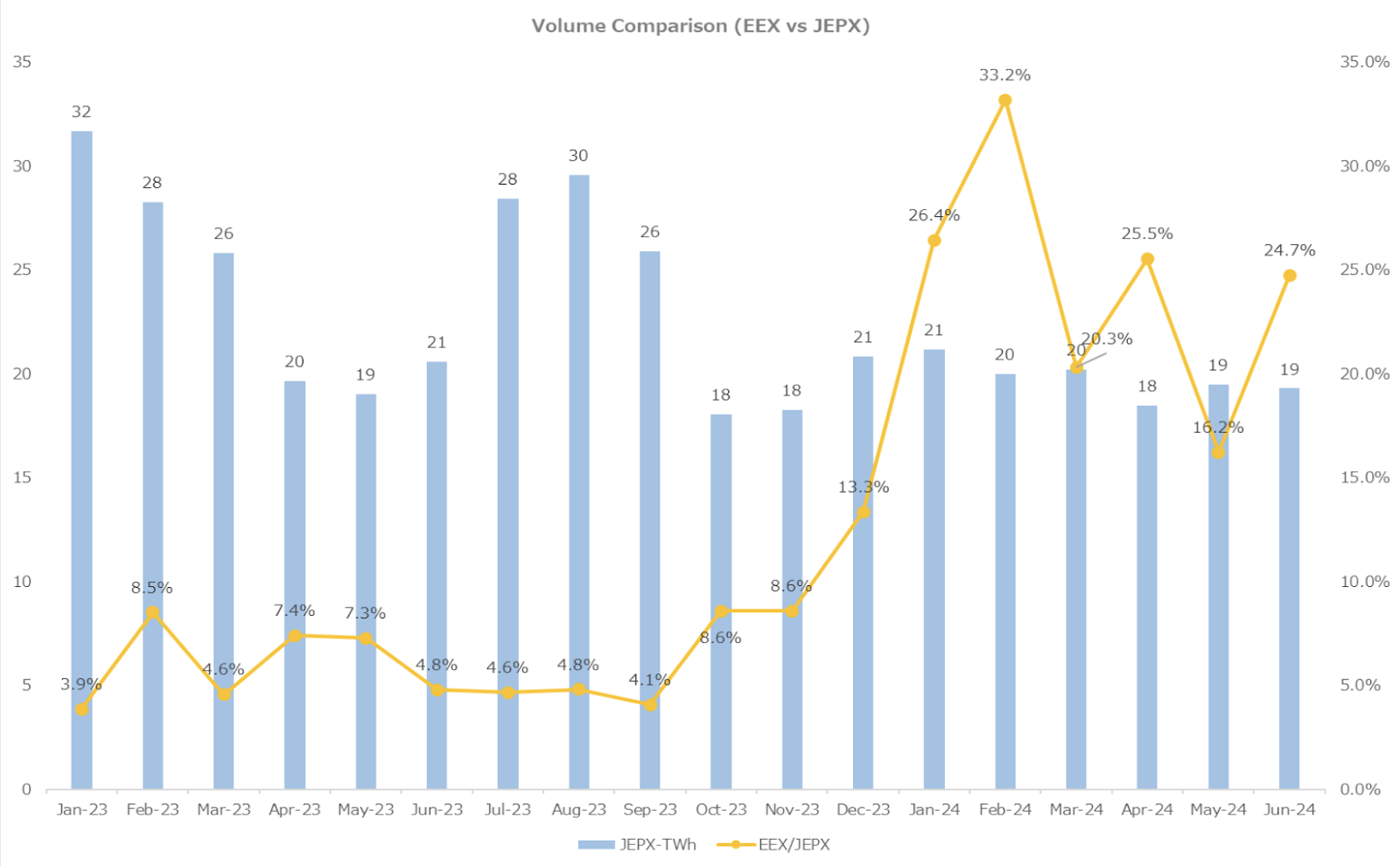
After a 3.4 times YoY growth in the volume of electricity traded in the first half of this year, the EEX continues to grow.
The exchange said that EEX had processed 2.297 TWh of electricity trades in just five days during the second week of August.
This was a record volume for one week, despite the onset of the Obon holiday period. The surge in trading was attributed to high temperatures, concerns about supply disruptions due to two recent earthquakes and a national ‘megaquake’ alert, as well as rising natural gas prices in Europe.
CONTEXT: Futures are used as a risk-hedging instrument to protect buyers against surges in the price of the underlying commodity – in this case, electricity. In Japan, power futures are about a quarter of physical spot sales, but in mature electricity markets the size of derivatives trading is often much bigger than the spot market.
First-half 2024 volumes reached 28.9 TWh, compared with 8.6 TWh in the same period a year earlier and surpassing the 2023 annual total of 18.3 TWh.
EEX has 80 companies registered as trading counterparties.
So far, the record monthly volume was in February 2024 with 6.6 TWh. In June, the number of trades executed inside a month surpassed 1,000 for the first time and that number grew again in July to a record. The products most actively sold on the EEX are the quarterly and monthly futures contracts.
Kansai Electric plans to enter the electricity futures market by late 2024 to hedge against price fluctuation risks at retailer subsidiary, Kenes.
Kenes will register as a trading counterparty on the EEX, Japan’s dominant platform for these derivatives. Kenes procures electricity from the spot (JEPX) market.
CONTEXT: KEPCO Energy Solution has been trading futures on TOCOM since 2021, but decided to join EEX to prevent losses caused by price fluctuations due to changing weather conditions, operating status of power plants and geopolitical risks.
About 80 companies trade Japanese electricity futures on the EEX. The Tokyo Commodity Exchange (TOCOM) also lists electricity futures products, but the trading volume in 2023 was estimated at 978 GWh, which is only 1/19 of the EEX.
Seven & i Holdings will enter Japan’s electricity retail market to provide renewable power to its 7-Eleven convenience stores and other group stores nationwide.
The retail group set up a wholly owned subsidiary to handle the new power business. It will source renewable energy directly from producers.
Power supply and demand management will be handled by a Mitsui & Co subsidiary.
CONTEXT: Renewable energy is expected to make up just 10% of Seven & i’s domestic electricity consumption in FY2024. But the firm intends to raise that to 40% for FY2030. Seven & i already receives electricity for about 400 stores from solar power plants built for the company by NTT Anode Energy and Hokuriku Electric.
Osaka Pref was hit by a power outage at about 4 a.m. on Aug 15, affecting 244,600 households. Power was restored at 7:45 a.m. using alternate transmission routes.
KEPCO’s Kansai Transmission and Distribution said the outage was caused by an underground transmission line malfunction.
SIDE DEVELOPMENT: TEPCO PG dispatched emergency staff to Chiba, Ibaraki ahead of typhoon (Japan NRG, Aug 16)
TEPCO Power Grid dispatched 30 employees in advance to Chiba and Ibaraki prefs to restore facilities in case of possible damage from Typhoon Ampil on Aug 16.
The company expected power outages and other issues in coastal areas, but in the end, damage was minimal. The typhoon didn’t make landfall.
Chiyoda Corp completed earthquake restoration work on Units 1 and 2 of the Nanao-Ota Thermal Power Station owned by Hokuriku Electric.
The flue gas desulfurization system was damaged during the Noto Peninsula earthquake in January. The system was installed by Chiyoda to purify exhaust gas.
CONTEXT: Nanao-Ota is a key power plant for Hokuriku Electric. Full restoration before peak summer power demand was vital. Nanao-Ota Unit 2 resumed operation in May, followed by Unit 1 in July.
J-Power and Chugoku Electric are exploring ‘advanced coal power’ technologies on Osakikamijima Island (Hiroshima Pref), converting coal into high-temperature gas in a process known as Integrated Gasification Combined Cycle (IGCC).
Currently, IGCC can reduce CO2 emissions by 15%, but future advancements could allow for 90% CO2 capture. There’s also potential to achieve carbon-negative power generation by incorporating biomass fuels.
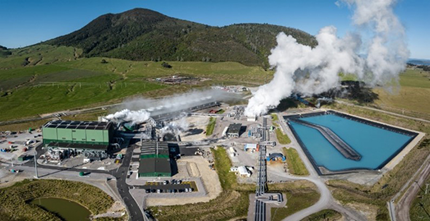
The Tauhara Geothermal Power Station in north New Zealand began commercial operation. Trading house Sumitomo was the plant’s builder.
CONTEXT: The power plant is located near Lake Taupō, North Island, one of NZ’s best sources of geothermal energy.
It has the world’s largest single-shaft geothermal steam turbine generator (capacity 184 MW). It accounts for 3.5% of NZ’s total electricity generation.
CONTEXT: Sumitomo is a major construction and equipment supplier for geothermal power projects globally. It was the first Japanese firm contracted for the engineering, procurement, and construction of a geothermal plant in New Zealand – Kawerau GPP launched in 2008.
JOGMEC, in collaboration with the U.S. Department of Energy’s National Energy Technology Laboratory, completed a 10-month gas production test from methane hydrate layers in Alaska.
This was the first case of extracting gas from methane hydrate and using it as an energy source, said JOGMEC.
The test provided critical data on long-term production and the challenges associated with commercializing methane hydrates as a source of fuel.
CONTEXT: Methane hydrate is formed when methane gas and water combine under specific conditions of low temperature and high pressure to form an ice-like solid.
JOGMEC plans to analyze the data and apply the findings to future offshore production tests and commercialization efforts in Japan.
TAKEAWAY: Japan has small amounts of oil and gas resources on land, and imports most of its needs in those fuels. But, the existence of methane hydrate has been confirmed in the seabed in Japan’s waters. Several tests have been made in areas with the most potential, such as around the Daini–Atsumi Knoll. However, starting production from an element that has not traditionally been utilized as a source of hydrocarbon is tricky, and the fact that these sites are offshore makes the technical/ engineering challenges even greater. As such, Japan is trying to advance carefully, including by testing production approaches in similar conditions. When (or even whether) these advances will lead to commercial-scale methane production is unclear.
LNG stocks of 10 power utilities were 1.98 million tons as of Aug 11, up 3.7% from the previous week (1.91 million tons); up 15.2% from end August 2023 (1.72 million tons); and down 2% over the past five-year average of 2.02 million tons.
CONTEXT: Typhoon #7 passed through Kanto on Aug 16-17, bringing a lot of heavy rain but less damage than anticipated. Still, the Japan Coast Guard asked large vessels in the Yokohama Port area to evacuate outside of Tokyo Bay. Bullet trains and local trains stopped or reduced operations. Once a typhoon passes, temperatures quickly rise again.
Furukawa Electric began construction of a green LPG demo plant in Shikaoi Town, Hokkaido, which will run on biogas and produce as much as 100-200 tons a year.
The pilot will start green LPG output in 2026, collecting local resources for feedstock, such as methane emitted by cows.
Astomos Energy Corp and Iwatani Corp will be in charge of distributing the end-product to local factories, for city gas use, cars and other consumers. The project is financed by NEDO’s Green Innovation Fund.
ANALYSIS
BY YURIY HUMBER
Japan’s Decarbonization Drive Seeks New Impetus via Hydrogen and Batteries
With Japan facing the prospect of a new prime minister later next month, the successor to Kishida Fumio will face a barrage of social and economic issues. The new PM will also play a major role in Japan’s energy planning with a number of key policy documents due inside the next six to seven months.
Kishida’s successor will preside over:
Japan’s participation in the latest United Nations Climate Change Conference, the COP29 in Azerbaijan (November);
Formation of a new roadmap that will seek to align industrial and clean energy developments (GX 2.0) (year-end);
Update to the strategic Basic Energy Policy, which will outline focus areas through 2035 (latest, March 2025);
Revision of Japan’s Nationally Determined Contributions (NDC), which will set new and stricter targets on emission reductions (expected Feb or March 2025).
There are many other sector-specific developments that may be influenced by a new face in the PM’s office, but just as Kishida continued many of the policies of his predecessor, while rebranding the net-zero commitments as ‘GX’ (green transformation), the next PM is unlikely to significantly alter course in the near future.
To get a sense of the state of affairs that Kishida’s successor will inherit, here is an outline of the status of the energy landscape in Japan today. The slides are based on developments covered in the Japan NRG Weekly reports and a presentation delivered to the American Chamber of Commerce, Japan (ACCJ) last month.
Preface
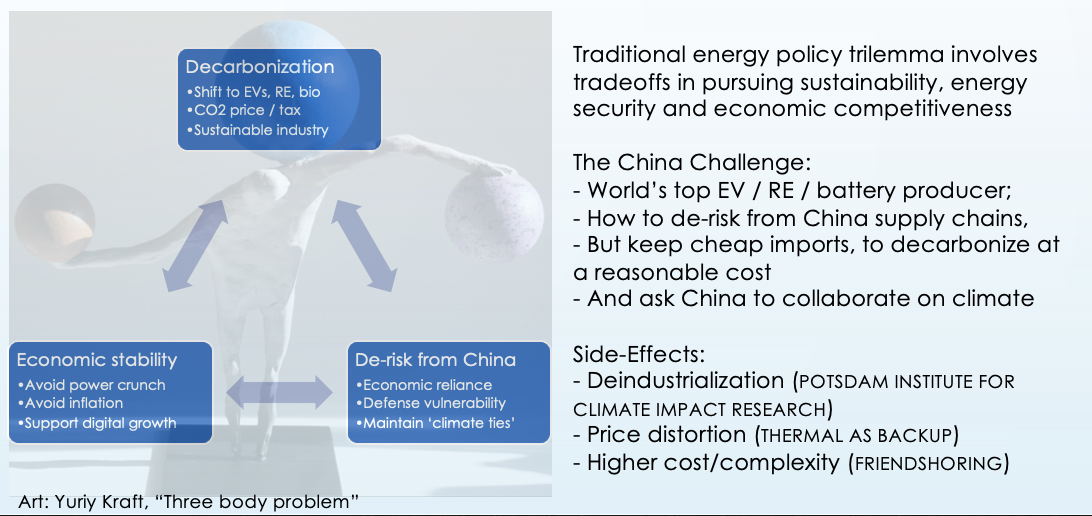
Energy policymaking faces at least three major challenges, often described as the energy trilemma: balancing between decarbonization, economic stability, and security. The trilemma could also be depicted as the “three-body problem”, in which each of the three (or more) issues exerts gravitational pull on the actor (national government/ corporation). Those actors that veer too closely to one of the ‘bodies’, thus losing touch with the others, often goes through turmoil. The challenge is to retain a stable course between the ‘bodies’. Nations that do this best are most likely to execute a successful energy transition, which requires multi-decade efforts.
Japan-specific trilemmas
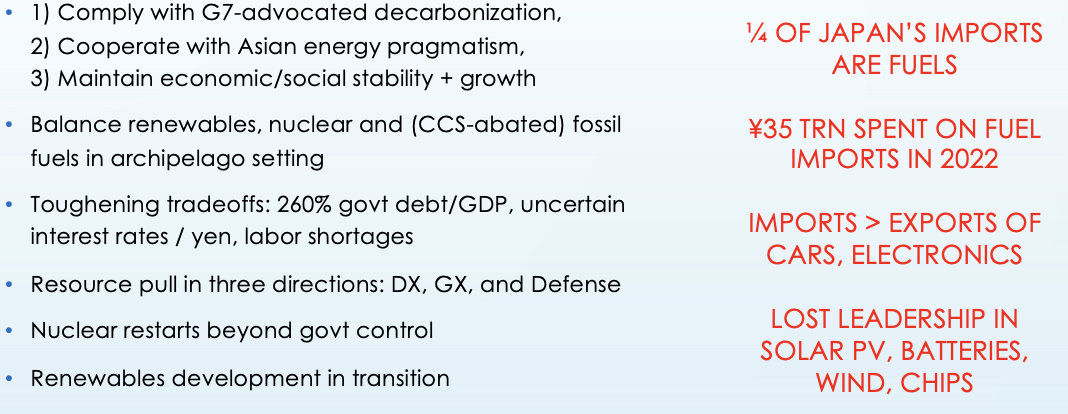
Japan is attempting to thread the needle on several fronts and placate several stakeholders at once. Traditionally, it has sought to create a consensus that helped policy and industry move in lockstep. However, today’s more global and diversified energy markets are testing the ability of Tokyo bureaucrats to manage multi-stakeholder relations across many regions.
And yet, keeping the status quo is also not an option. The macro-economic environment is telling the government that it must bring down the cost of energy imports or increase the value of Japan’s industrial output. It will be hard to achieve the latter in the energy sector if Japan champions only the clean technologies widely utilized today (i.e., PV solar panels, fixed-bottom wind turbines, etc.) Thus, policymakers and domestic industry are reviewing other clean energy pathways.
Revival of Industrial output … via chips
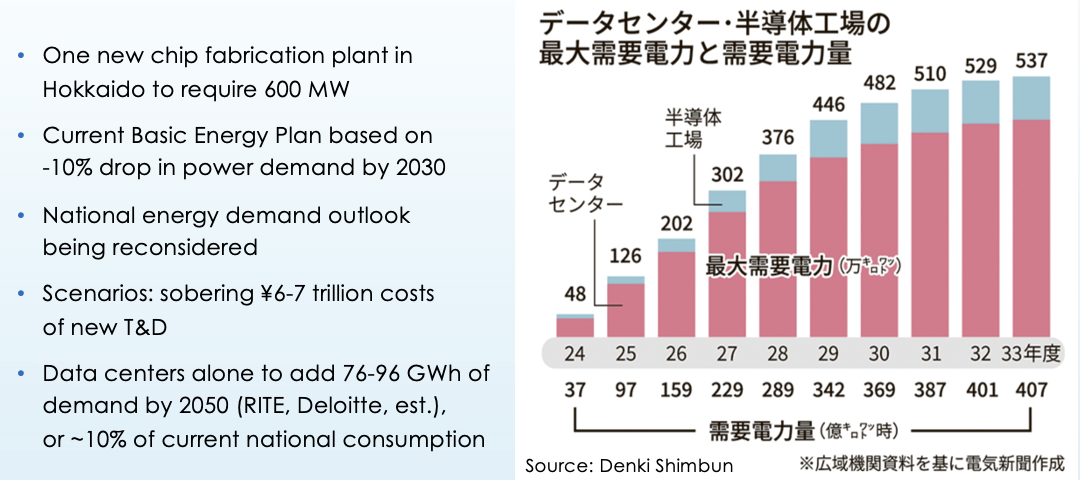
To make the economy balanced, Japan has decided to pour state subsidies into boosting its industrial output and aggressively revive a flagging semiconductor sector. This should secure additional export revenue (and geopolitical status), but it will come at a considerable energy cost. Semiconductor fabrication plants require lots of power, as do data centers, another focal point of Japan’s digital-heavy industrial strategy. Belatedly, the government has realized that the industrial jump-start will quash earlier assumptions of energy demand decline in Japan over the course of this decade. It also requires a more careful consideration of where inside Japan the industrial output will take place in order to align with clean energy growth. Kyushu’s electricity demand, for example, is already up this year and the most likely reason is the opening of a local plant by the Taiwan Semiconductor Manufacturing Corporation.
Another thing to keep in mind is that the push into Generative AI, which Japan is also embracing, will further drive energy demand. Several researchers have demonstrated that an AI-powered online search utilizes 10-15 times more electricity than a regular online query.
Main developments in policy
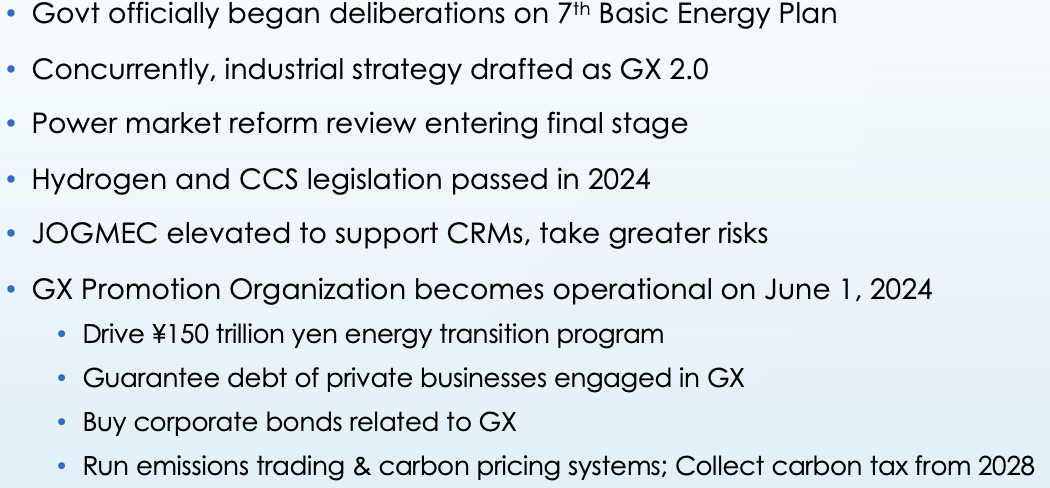
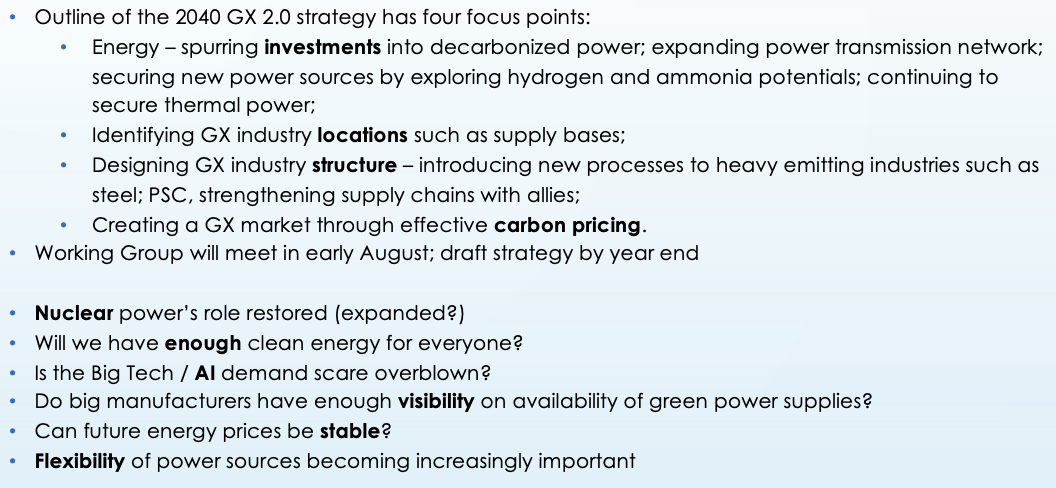
As a result, the government is trying to synchronize updates of the Basic Energy Plan and industrial strategies. Other policy momentum is in hydrogen, CCS, and critical raw materials.
What is keeping Japanese experts up at night? Here is a summary of recent discussions:
Policy mismatch with energy sector developments
One reason for the sudden activity in updating various policy documents is that on-the-ground realities are not following the government’s policy plans of recent years.
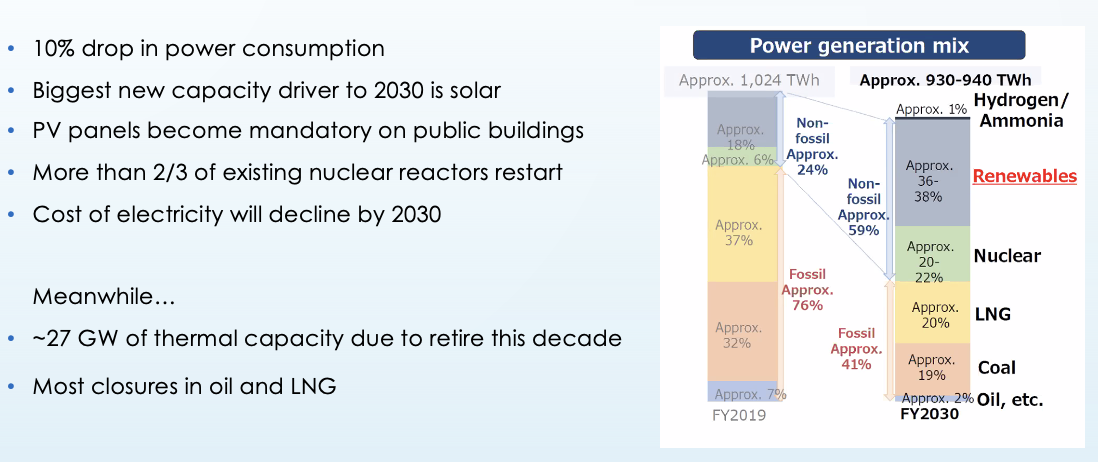
These are some of the assumptions in the current Basic Energy Plan:
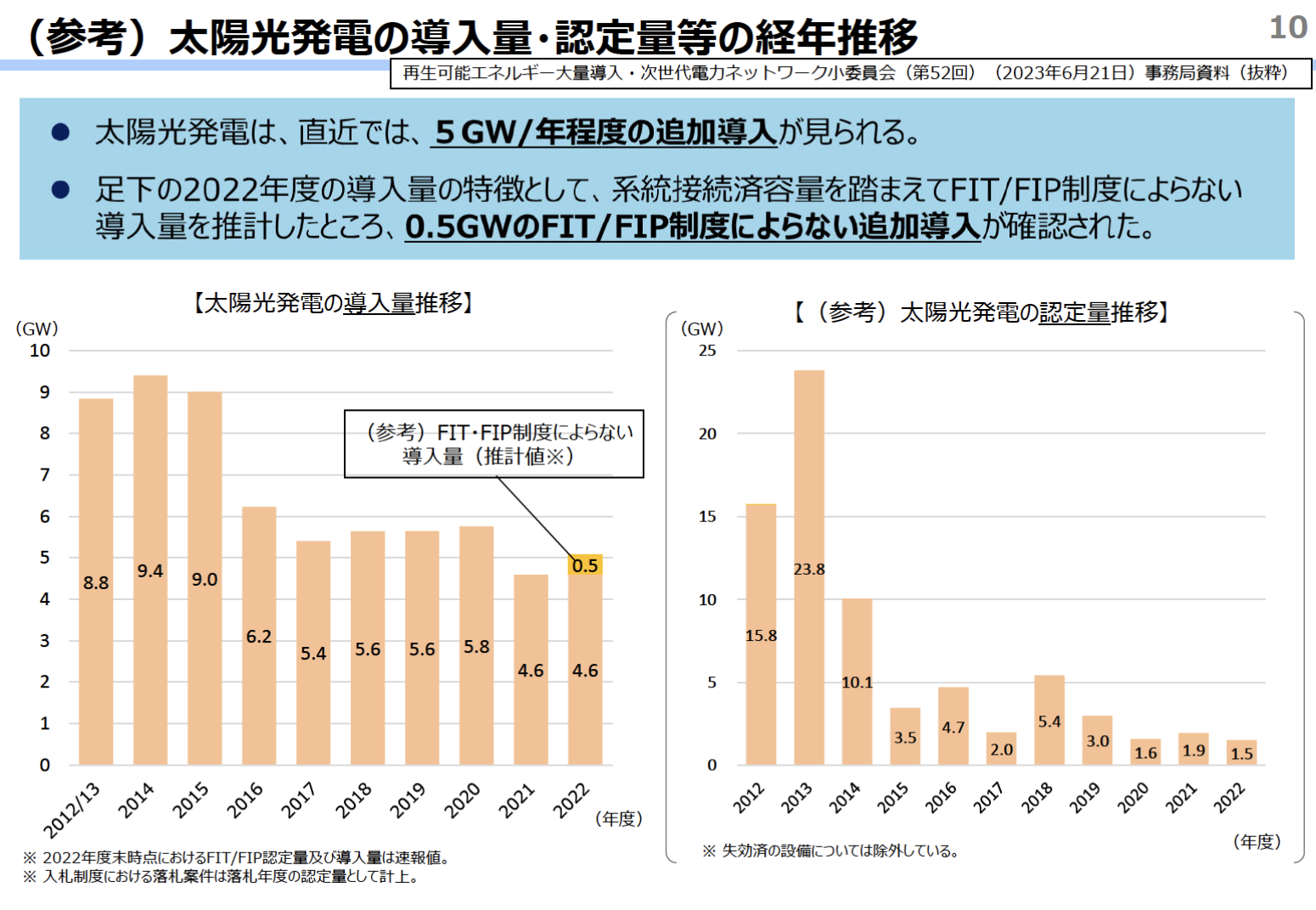
So, we should be seeing a strong uptick in new solar capacity. Instead, the total is starting to drop. Below, on the left is a chart showing total additions, and on the right the capacity based on FIT/ FIP approvals.
Source: METI
Of course, FIT/ FIP no longer make up the entire solar market, but they are a useful indicator.
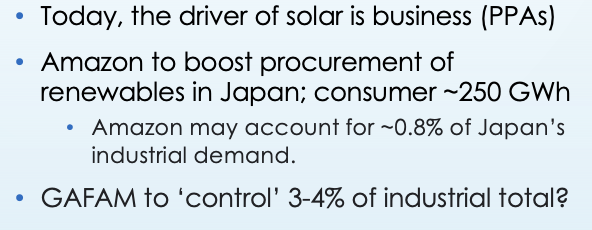
In the last two-three years, a booming market in PPAs (Power Purchase Agreements) has developed in Japan, and this is likely just the beginning. This makes for an interesting juncture, as the ‘paymaster’ for new solar shifts from the general consumer to the business / industrial user. This will allow large energy buyers to have a greater influence on what new power generation sources get built. U.S. tech giants such as Amazon and Google will have a stronger voice in Japan’s energy policies than before.
New solar?
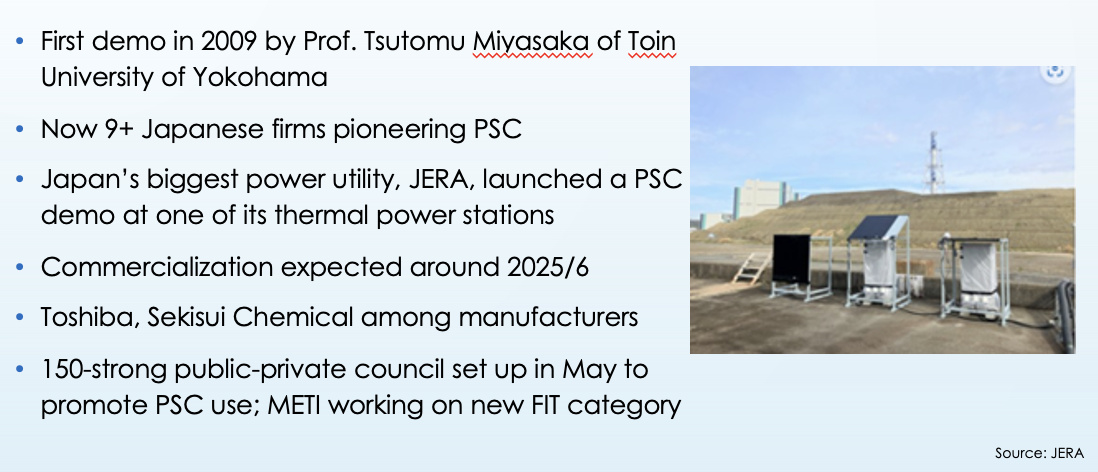
As mentioned earlier, from the government’s point of view it’s not just an energy policy issue – it’s an industrial issue. So, Japan favors promotion of next-generation solar tech, such as Perovskite solar cells (PSC) over support for sales of existing (99%-Chinese manufactured) solar panels. There are plenty of industrial users that are excited about the potential for this kind of flexible film-like solar devices, but the technology may not be ready for market just yet due to lower efficiency versus polysilicon panels and other issues.
OFFSHORE WIND
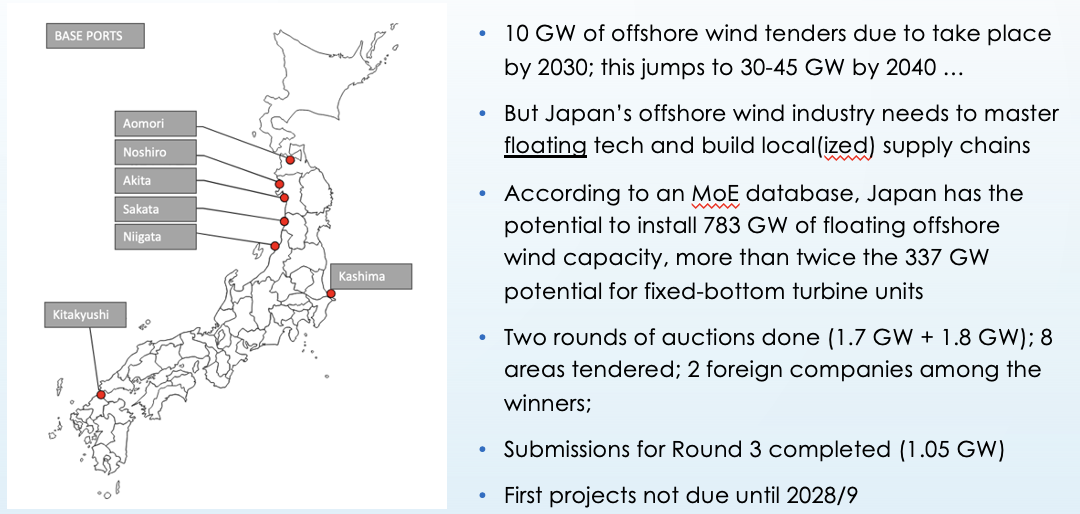
There is brighter news in the offshore wind sector. Here, too, Japan’s focus is on trying to leapfrog industrial development and secure a foothold in floating turbines, rather than building projects quickly based on current technologies. But there are other bottlenecks for the country to navigate in the offshore wind space.
Over to hydrogen
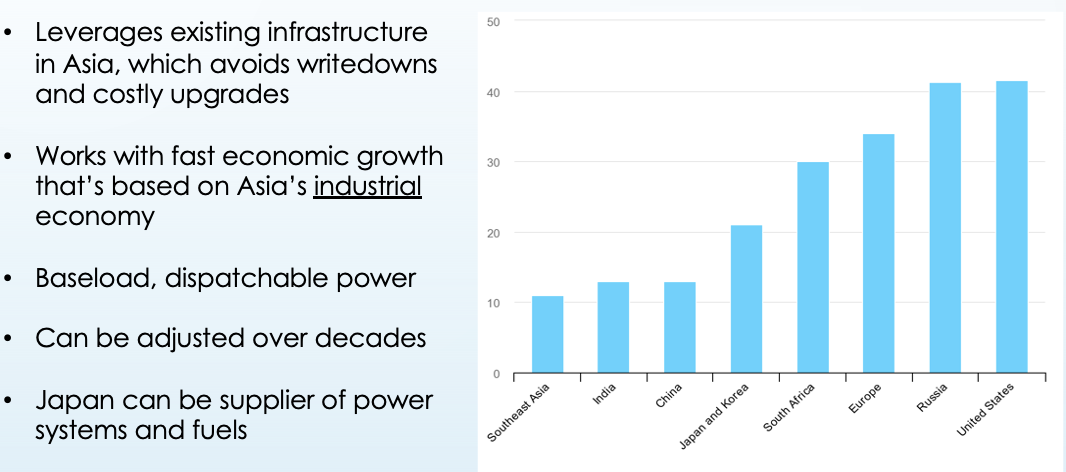
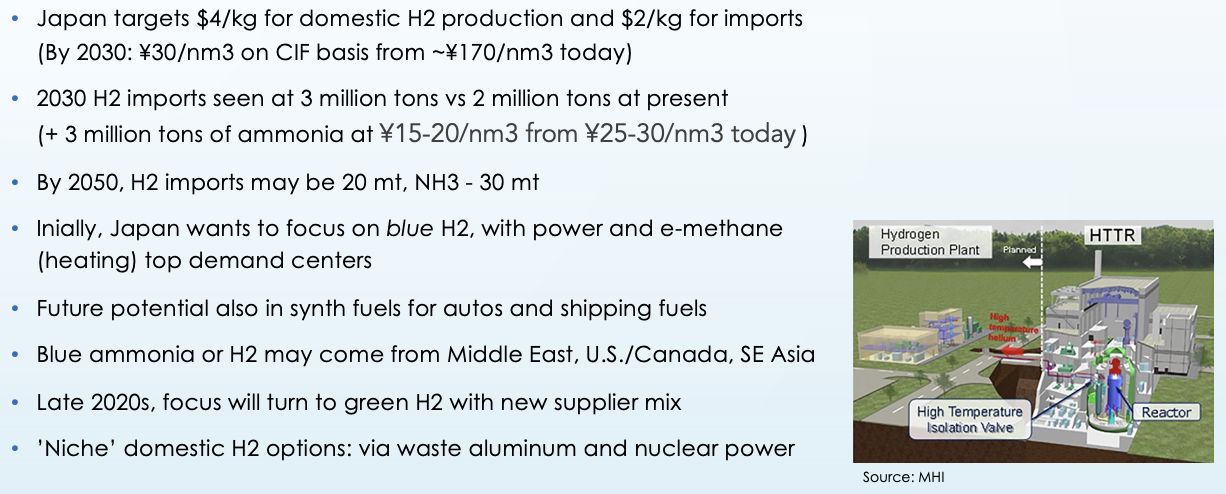
The struggles above in the solar and wind sector partly aim to show why so much hope is now placed on the development of an ammonia-fired (or hydrogen-fired) power sector. For Japan, hydrogen as a fuel in the power sector works thematically for several reasons:
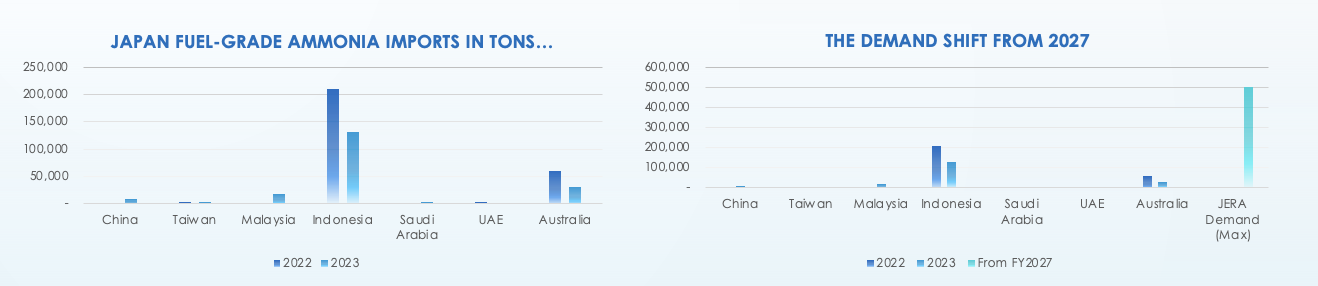
The details may change over time, but this is what the provisional timeline on ammonia and hydrogen may look like:
This would create massive demand for ammonia as a fuel in just a few years. The start of commercial-scale operations at just one unit of a thermal power plant operated by JERA, as planned for FY2027, will boost demand several fold.
That is only the beginning, however, with several other major utilities committing to trialing co-firing and exploring options in ammonia and hydrogen generation. Chemical companies are another demand center looking to switch earlier rather than later, which could easily push Japan’s consumption above the 2030 national target of 3 million tons of hydrogen (assuming the cost issues are resolved).
Missing pieces: balanced power markets and energy storage
Whether it be the renewables sector or ammonia-fired generation, new development needs funding and state subsidies are far from limitless, especially in light of the macro-economic troubles outlined at the start of this presentation. This makes it imperative to develop a more efficient private financing model for new power capacity – one that would encourage banks to lend outside of state-guaranteed business models.
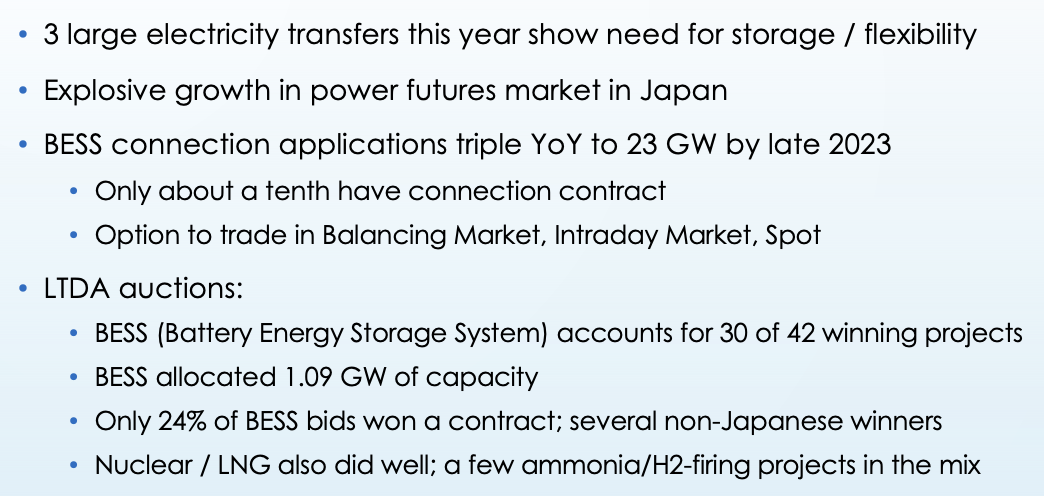
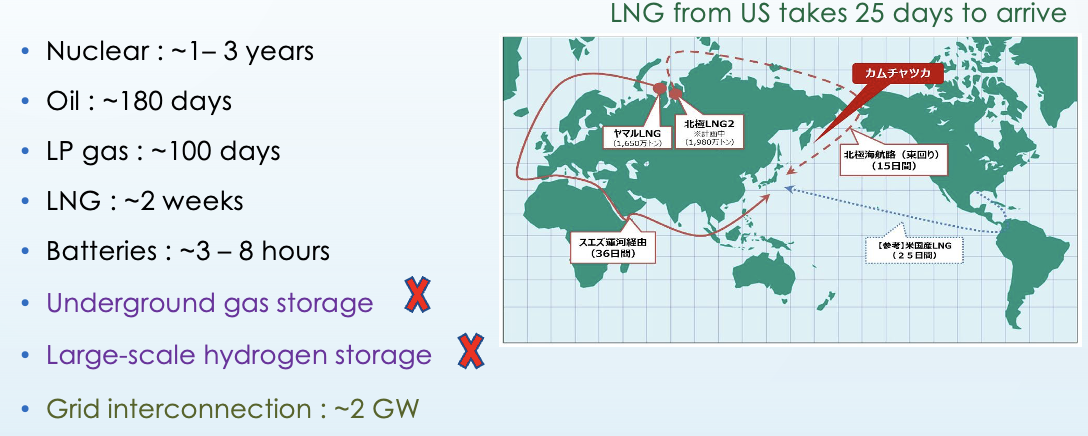
The other bottleneck for decarbonization in Japan, and especially for the rollout of more solar and wind capacity, is a relative dearth of energy story options outside of pumped hydro plants. Without this, balancing the power grid will be ever more difficult and curtailments will be rife. That’s why so many of the recent state auctions and power market schemes have focused on promoting the construction of new batteries / BESS and other energy storage facilities.
After all, energy storage is pretty much the same as energy security, and Japan is not as secure on this front as many imagine.
Conclusions
The energy landscape in Japan today isn’t without its challenges, but therein lie the business opportunities. Not all the trends active today will last. One that appears in most danger of constraint is the Generative AI revolution due to limited energy resources. Another trend that seems unlikely to survive is the expectation for energy prices to decrease. Geopolitics, higher data use, the need to fund energy transition projects and many other reasons point to an up arrow on prices mid to long term. Countries that are able to win a general acceptance from the public on this point will likely move forward in the energy transition. But expect plenty of chaotic moments on the journey to decarbonization. The sudden announcement of PM Kishida’s decision to step down is just one of the many incidents to come.
ASIA ENERGY REVIEW
BY JOHN VAROLI
This weekly column focuses on energy events in Asia and the Pacific
Australia / Nuclear power
Rising consumer energy prices have dampened enthusiasm for Labor’s renewables agenda and opened the door for nuclear as an alternative. Opposition Liberals have pledged to abandon the 2030 renewables target and scrap large-scale wind farm projects. They say nuclear energy could deliver power from the middle of next decade.
China / Natural gas
In 2023, 7%, or 2.6 Bcf/d, more natural gas was consumed than in 2022, after a decline of 1.1% in 2022 when economic growth was slower due to COVID policies. In 2023, China’s natural gas imports averaged 16 Bcf/d and accounted for 42% of total supplies, compared with 15% in 2010. Natural gas is imported into China by pipeline and LNG.
China / Solar power
Solar company Tongwei plans to buy a 51% stake in competitor Runergy for about $700 million, allowing the Chinese company to gain a presence in the U.S. In Alabama, Runergy is building a 5 GW solar module plant.
India / Energy transition
The share of coal-based plants in India’s power generation is seen to decrease to around 67% by FY2026 as the country further advances its renewable energy capacity, said CRISIL Ratings.
Indonesia / Solar power
Implementing renewable programs and replacing coal plants with solar power installations could create 100,000 new jobs, claims energy think tank Ember.
Jet fuel and Oil
Global jet fuel demand will soften due to a slowdown in consumer spending, which could weigh on oil prices in the months ahead. Global oil demand has not met expectations in the first half of 2024 due to weaker-than-forecast consumption in the U.S. and China.
Laos / Renewable energy
Laos inked a deal with China General Nuclear for a renewable energy base in the country’s northern region. This adds a second phase of the project that will include a 580 MW wind and solar plant in Luang Namtha province and a 420 MW solar plant in Oudomxay province. It follows on an initial agreement signed by the two sides last September to build a renewable energy base in the north of the country.
Philippines / Renewable energy
Ayala Group firm ACEN has an ambitious target of 20 GW of renewable energy by 2030. ACEN has a pipeline – by 2030, 40% of its capacity will be in the Philippines, about 25% in Australia, and some in Vietnam, India, and Indonesia. So far, ACEN has a total capacity of 4.8 GW, of which 65% is in full operation.
South Korea / AI and Renewables
Renewable energy gaps should be addressed to prevent fast-growing industries, such as semiconductor and artificial intelligence, from suffering adverse effects, said the Institute for Energy Economics and Financial Analysis.
2024 EVENTS CALENDAR
A selection of domestic and international events we believe will have an impact on Japanese energy
January
First market trading day (Jan 4)
IEA “Renewables 2023: Analysis and Market Forecast to 2028” released (Jan 11)
Renewable Energy Exhibition (Jan 31 – Feb 2)
Taiwan presidential election (Jan 13)
Japan’s Diet convenes
IEA “Electricity 2024 / Analysis and Forecast to 2026” released (Jan 24)
February
CFAA International Symposium (Feb 2)
India Energy Week 2024 (Feb 6-9)
Lunar New Year (Feb 10-17)
Indonesia presidential election (Feb 14)
Japan-Ukraine Conference for Promotion of Economic Reconstruction (Feb 19)
FIT/FIP solar auction (Feb 19 – March 1)
Smart Energy Week (Feb 28-Mar 1)
March
Announcement of auction result for Offshore Wind Round 2 (for Akita Happo-Noshiro Project)
Onshore wind auctions (March 4-15; results on March 22)
International LNG Congress (LNGCON) 2024, Milan, Italy (March 11-12)
Russian president election (March 15-17)
World Petrochemical Conference, Houston, TX, USA (March 18-22)
IAEA Nuclear Energy Summit @ Belgium (March 21)
Ukraine presidential election (due before March 31)
Happo Noshiro, Murakami-Tainai, Oga-Katagami-Akita and Saikai-Eshima wind project auctions close (June 30)
July
Tokyo governor election (July 7)
7th Basic (Strategic) Energy Plan draft published (expected)
August
7th Basic (Strategic) Energy Plan draft presented to Cabinet (expected)
September
Global Offshore Wind Summit Japan 2024, Sapporo, Hokkaido (Sept 3-4)
The United Nations Summit of the Future (Sept 22-23)
Gastech 2024, Houston, TX (Sept 17-20)
IAEA General Conference
GX Week in Tokyo (expected late Sept to October)
Asia Green Growth Partnership Ministerial Meeting
Asia CCUS Network Forum
International Conference on Carbon Recycling
International Conference on Fuel Ammonia
GGX x TCFD Summit
October
IEA World Energy Outlook 2024 Release
BP Energy Outlook 2024 Release
Innovation for Cool Earth Forum (expected)
Connecting Green Hydrogen Japan 2024 (Oct 16-17)
Japan Wind Energy 2024 Summit (Oct 16-17)
Solar Energy Future Japan 2024 (Oct 16-17)
Japan Mobility Show (Oct 25-Nov 5)
November
US presidential election (Nov 5)
COP 29 in Azerbaijan (Nov 11-22)
Abu Dhabi International Petroleum Exhibition Conference (ADIPEC) 2024, Abu Dhabi, UAE (Nov 11-14)
APEC 2024 @ Lima, Peru
International Conference on Nuclear Decommissioning (TBD)
G20 Rio de Janeiro Summit (Nov 18-19)
Offshore Energy Exhibition & Conference (OEEC) 2024, Amsterdam, the Netherlands (Nov 26-27)
Biomass & BioEnergy Asia Conference (TBD)
European Biomethane Week 2024
December
Last market trading day (December 30)
Disclaimer
This communication has been prepared for information purposes only, is confidential and may be legally privileged. This is a subscription-only service and is directed at those who have expressly asked K.K. Yuri Group or one of its representatives to be added to the mailing list. This document may not be onwardly circulated or reproduced without prior written consent from Yuri Group, which retains all copyright to the content of this report.
Yuri Group is not registered as an investment advisor in any jurisdiction. Our research and all the content express our opinions, which are generally based on available public information, field studies and own analysis. Content is limited to general comment upon general political, economic and market issues, asset classes and types of investments. The report and all of its content does not constitute a recommendation or solicitation to buy, sell, subscribe for or underwrite any product or physical commodity, or a financial instrument.
The information contained in this report is obtained from sources believed to be reliable and in good faith. No representation or warranty is made that it is accurate or complete. Opinions and views expressed are subject to change without notice, as are prices and availability, which are indicative only. There is no obligation to notify recipients of any changes to this data or to do so in the future. No responsibility is accepted for the use of or reliance on the information provided. In no circumstances will Yuri Group be liable for any indirect or direct loss, or consequential loss or damages arising from the use of, any inability to use, or any inaccuracy in the information.





 Source: EEX