Japan is betting big on perovskite solar cell tech to boost green energy capacity and to become a global leader. Any surface of buildings, bridges, etc can be used as zero-emission power stations by simply applying these film-like modules. But it has a few major drawbacks: low power efficiency of less than 20%, and more. Still, the government wants to make PSC commercially viable, and it’s encouraging businesses to do field trials to identify problems and to find solutions.
At least three times this summer, large volumes of electricity had to be transferred quickly between the major regions. The technical aspect of this has so far not caused notable issues, but there are questions around how this electricity is procured. The balancing marketplace was set up in 2021 to help TSOs manage their local grid and system security. The problem is that almost half of TSOs barely use this market. So, can the energy planners and power industry players make the balancing system work?
ASIA ENERGY VIEW
A wrap of top energy news that impacts other Asian countries.
EVENTS SCHEDULE
A selection of events to keep an eye on in 2024.
JAPAN NRG WEEKLY
PUBLISHER K. K. Yuri Group
Editorial Team Yuriy Humber (Editor-in-Chief) John Varoli (Senior Editor, Americas) Mayumi Watanabe (Japan) Kyoko Fukuda (Japan) Magdalena Osumi (Japan Filippo Pedretti (Japan) Tim Young (Japan)
The government sees a total of about ¥1.6 trillion fiscal budget for green transformation initiatives in coming years, of which ¥1.2 trillion will be for FY2025, said METI and GX Minister Saito during the GX Implementation Council meeting.
The key FY2025 budget plans are:
¥255 billion for building domestic supply chains of GX solutions including perovskites, offshore wind, storage batteries, FC systems, electrolyzers, etc;
¥144 billion for EV, PHV and FCV;
¥188 billion for homes;
¥87 billion for hard-to-abate sectors;
¥84 billion for SAF;
¥83 billion for innovative nuclear reactors.
The government plans to amend the GX Promotion Act to mandate that major emitters take part in the national emission trading scheme from 2026.
It will push a synergy of GX and digitization (DX), integrating power and communication infrastructures and building data centers to support the AI sector.
Japan will continue to rely on gas-fired power as low carbon thermal power sources. It will work with LNG producers to cut methane emissions.
The government will allocate about ¥3 trillion to build hydrogen supply chains as defined in the Hydrogen Society Promotion Act, said METI and GX Minister Saito during the GX Implementation Council.
Support includes the contract for difference scheme for low-carbon hydrogen, which calls for subsidizing the difference between the actual production cost and market prices (when they are lower than costs).
PM Kishida led the 12th Green Transformation (GX) Implementation Meeting, emphasizing the need to accelerate Japan’s shift towards a sustainable economy.
Kishida outlined the main policies: AZEC; ¥150 trillion GX investment strategy; ¥20 trillion GX economic transition bond plan; creation of a GX Promotion Organization to foster public-private collaboration; and he stressed the importance of enhancing renewable energy and nuclear power.
Kishida emphasized the need to restart existing nuclear power plants in Eastern Japan, particularly Kashiwazaki-Kariwa NPP, in order to reduce dependency on thermal power and to address regional power cost disparities. He also called for ensuring safety and local support before proceeding with the restart.
Kishida noted that Western Japan, where NPP restarts have progressed well, has found it easier to accept applications for grid connections from new data centers.
Kishida said a ministerial meeting will be held on nuclear power in early September.
TAKEAWAY: Kishida has less than a month left as PM. While he seeks to push through the restart of TEPCO’s only operable NPP, the main stumbling block – the governor of Niigata Pref – knows there’s only a few weeks of pressure to navigate. A new PM, with many issues to deal with, is unlikely to fight for the Kashiwazaki-Kariwa NPP restart early in his term. The Niigata governor is balancing the pro-restart voices of several municipalities connected to the NPP with ambivalence or opposition from the rest of nearby towns and cities.
METI requested a ¥2.36 trillion budget for FY2025, up 24% from the current FY.
Energy spending is spread out between the Special Accounts for Energy Measures, which include upgrades of existing infrastructure, and the GX Accounts, which are new projects such as nuclear reactor R&D.
The MoE has requested ¥450.2 billion for the Special Accounts for Energy Measures including GX, which is an increase of 137% from ¥189.7 billion for the current term.
The NRA requested ¥70.7 billion, up 25% from ¥56.3 billion.
The GX Promotion Agency, which manages public-private cooperation of the GX, will provide full debt guarantees for bank loans to firms developing cutting-edge clean energy technologies. The Agency aims to launch its first project by 2025.
The Agency will focus on risk mitigation by offering guarantees and equity support in areas where private financial institutions may hesitate to take risks. Agency head Tsutsui Yoshinobu said the guarantee could cover up to 100% of debt.
Key areas of support include: Hydrogen/ ammonia; Chemical complexes; Sustainable aviation fuel (SAF), and Renewable energy businesses. The Agency may also support next-gen nuclear reactor development.
Overall, it wants to support projects with significant regional economic impact.
In FY2025, the MoE plans to launch a new scheme to promote the installation of perovskite solar cell (PSC) systems on municipality facilities.
The MoE seeks a ¥11.9 billion budget for FY2025 to support municipalities introducing PSC, storage batteries and other clean energy systems.
CONTEXT: Urban municipalities are interested in PSC systems because they lack space for wind or solar farms. PSC films are thin, light and can be integrated into windows, attached on walls, etc.
TAKEAWAY: In addition to helping producers of PSC modules, the subsidy will assist inverter and other component makers while they work on establishing product standards, developing solution-specific product suites, and boosting quality levels to sell to private sector users.
SIDE DEVELOPMENT: Chiyoda City plans PSC window installations on local facilities (Japan NRG, Aug 27)
Chiyoda City (Tokyo) will install windows covered with PSC films on community facilities, if the three-month trial yields positive results.
Tokyo-based architectural products company YKK AP provided the window prototype that’s now displayed publicly.
METI Minister Saito Ken said he will run in the LDP leadership race set for Sept 27.
He pledged to step up efforts in semiconductor tech and the shift to clean energy amid strong global competition. Saito also wants to restore public confidence in the LDP.
CONTEXT: Saito started his political career at METI in 1983, and served as director of the electric power infrastructure development division at ANRE. He also served as Minister of Agriculture, Forestry, and Fisheries and Minister of Justice.
CONTEXT: Saito was elected five times since the 2009 lower house election. He was first elected to the Diet in the same year as Koizumi Shinjiro, the 43-year-old former environment minister. Saito was once a member of the faction led by Ishiba Shigeru, the former LDP secretary-general who also plans to run in the LDP leadership election. Now, Saito doesn’t belong to any LDP faction.
TAKEAWAY: While Saito doesn’t belong to a faction, he’s running in response to calls from fellow lawmakers. The recent scandal over fundraising kickbacks, which resulted in 39 LDP members held responsible and the majority expelled, may have strengthened Saito’s position as an impartial lawmaker. Several LDP factions have been accused of kicking back a portion of fundraising ticket sales to members without reporting. Other candidates – Koizumi and Ishiba – have gained support from veteran members like former PM Suga and Aso. Saito would tout his experience as vital for economic revival, especially on the energy policy front.
Seven companies, including Imabari Shipbuilding and NYK Line, are developing vessels for liquefied CO2. This aims to standardize designs to reduce costs and help mass production across Japan.
Other companies involved are Japan Marine United, Mitsubishi Shipbuilding, and Nihon Shipyard. They are working with major maritime firms such as NYK Line, Mitsui O.S.K. Lines, and Kawasaki Kisen.
The plan includes standardizing CO2 storage tanks with capacities of over 20,000 m3. The firms will also explore vessels powered by ammonia.
CONTEXT: Japan seeks a leading global market share in next-gen ship orders. The CCS industry is of major importance for Japan, as it aims to store between 120 million to 240 million tons of CO2 per year by 2050. A significant chunk of the CO2 will have to be sent overseas. Yet, Japan faces challenges in building and designing LCO2 carriers and storage tanks. The existing fleet is limited, with only a few vessels in operation. Also, competition with Chinese companies like Dalian Shipyard adds pressure. Dalian recently launched advanced LCO2 carriers for the Northern Light Project, and intends to become the leader in the sector.
TAKEAWAY: Japan has limited suitable storage sites for CO2 storage. Thus, maritime transport to distant locations is necessary. Japan now needs to build reliable means of transport to countries such as Malaysia and Australia for storage. This is also evident by the two new overseas CCS projects added to the Japanese CCS Advanced Projects.
Tsubame BHB received an order for its second small-scale ammonia production facility in Japan. The startup seeks to help create domestic production of the clean-burning gas.
The new facility, using Tsubame BHB’s low-temperature, low-pressure Electride catalyst technology, will produce 500 tons of ammonia annually.
The basic design work started in January and the firm will now make a detailed design. Ammonia production is due to begin in summer 2026.
CONTEXT: Tsubame’s selling point is that its tech can synthesize ammonia at low temperatures and pressures. This would be simpler to manage than the Haber-Bosch process that’s widely used to make ammonia, and which requires high-temperature, high-pressure reaction conditions, as well as large-scale production.
On Aug 23, the world’s first ammonia-fueled tug boat, Sakigake, launched in Tokyo Bay. It’s operated by Shin Nippon Kaiyosha, a subsidiary of NYK group.
BESS developer Energy Concierge set up several sites in the service area of Shikoku Electric where it has secured connection slots for storage batteries for the power grid.
The firm plans to build a 50 MW/ 200 MWh storage battery facility on a high-voltage scale by April 2025.
The firm plans to establish an integrated service system — from overall project planning to EPC, optimal operation, and maintenance management.
Itochu subsidiary TRENDE will acquire ONE Energy’s renewables business.
The acquisition includes battery storage rental, solar leasing, and rooftop solar generation businesses. The deal is set to close on Oct 1.
CONTEXT: TRENDE develops renewable energy solutions for residential customers. ONE Energy was founded in 2013 as a JV of ORIX, NEC, and EPCO Inc as Japan’s first firm to launch the rental of power-grid-integrated home storage battery systems as a service.
Chiyoda Corp plans to be the first to commercialize a process that uses CO2 to produce paraxylene, a key ingredient in resins for clothing and automotive parts, reducing CO2 emissions across the supply chain.
The process, developed with Toyama University, aims to build a large-scale demo plant by 2026, with the goal of launching a commercial plant by the 2030s. This could potentially cut emissions by 40,000 tons per 10,000 tons of production.
Despite higher production costs compared to oil-based methods, Chiyoda anticipates demand for CO2-derived paraxylene in industries like fashion, where reducing environmental impact is now critical.
CONTEXT: Paraxylene is produced by reacting CO2 and hydrogen using a substance made from a mixture of metal catalysts and zeolite catalysts.
Euglena has partnered with Malaysian oil major Petronas to research and develop biofuels from microalgae.
The collaboration will focus on various aspects such as algae cultivation and the extraction of their oil, with research mainly in Malaysia. By 2025, the firms will assess progress and decide on trial production of biofuel.
The partnership also plans to invest in a biofuel plant in Malaysia, with operations expected to start in late 2028, initially using waste cooking oil but potentially shifting to algae as a raw material.
The MoE is soliciting public feedback on its proposal to include used electronic and electric equipment in the definition of e-scrap.
The Act for the Control of Export and Import of Specified Hazardous and Other Wastes bans unlicensed trade of electrical and electronic components and scrap, but not used equipment.
The feedback period ends on Sept 23.
CONTEXT: Used EVs and used car batteries are not included in the scope of the proposed trade control. But EV motors with rare earth magnets are.
Hokkaido Electric wants to restart the Tomari NPP in December 2026, but this seems unlikely due to: 1) Major changes in plans for preventing spent fuel on transport ships running adrift in case of a tsunami; 2) Extensions to the inspection schedule.
Aside from the spent-fuel matter, the utility will report to the NRA at the end of 2024 on protecting the plant from tsunamis and volcanic activity.
A top NRA official said that at the regulatory review’s current pace, the plant won’t be online in time to cope with the ramp up in energy demand in Hokkaido once the state-backed semiconductor manufacturer Rapidus starts mass production in 2027.
TAKEAWAY: The semiconductor factory being built by Rapidus is forecast to require 600 MW or more in power capacity. That could be covered by the restart of Tomari NPP’s Unit 3, which is also a relatively new reactor. However, a regulatory review of the facility is in its 12th year, and progress is negligible. That indicates a huge power demand gap in Hokkaido for non-CO2 emitting generators. Rapidus said it wants to use electricity that doesn’t cause GHG emissions.
Hokkaido Electric will build a new port outside the premises of the Tomari NPP as a tsunami countermeasure. The port would receive vessels transporting nuclear fuel.
The utility is also considering the use of existing ports outside the facility. The NRA did not oppose this plan.
Hokkaido Electric has considered mooring ships within the plant’s premises. The NRA raised concerns in April about the feasibility of such measures in a tsunami. The new port is planned along the coastline within Tomari Village. Specifics like location, construction period, and costs are still under discussion.
TEPCO Power Grid plans to invest ¥470 billion by FY2027 to strengthen its transmission network, focusing on expanding large substations, particularly in the Tokyo metropolitan area, where data center demand is rising.
Nationally, 18 new or expanded substations are planned by 2030; eight will be in the Tokyo area. Inzai (Chiba Pref), Tama and Sagamihara are of particular focus.
CONTEXT: TEPCO’s outlay represents a tripling of investments in transmission infrastructure over the next five years compared to the previous period.
Similar challenges are faced in Kyushu and Hokkaido, where power companies are upgrading substations to support new semiconductor factories.
Kyushu Electric is expected to invest ¥10 billion in substations at two locations; and Hokkaido Electric will build a substation near Rapidus in 2027.
TAKEAWAY: The investments are expected to be funded from wheeling charges paid by generators. These charges were raised nationwide last fiscal year to fund infrastructure upgrades. Debates over who will shoulder more of the infrastructure investments continue, with some interest in tapping into state GX funding.
Digital Transformation Minister Kono Taro wants to boost electricity supply amid growing power demand due to expansion of data centers and AI tech.
Following his Aug 26 announcement on joining the ruling LDP leadership race, Kono said he’ll also promote renewables, hydrogen and ammonia.
However, he’s concerned that doubling the volume of renewables might not meet growing power demand by 2050.
He said Japan will need other clean tech such as CCS, nuclear fusion, as well as replacing old nuclear units with next-gen reactors.
CONTEXT: This will be the third time that Kono will run in the LDP leadership race; he also ran in 2009 and 2021. Some of his previous policies included phasing out nuclear power, which contradicted the LDP’s stance. While this garnered some public support, it alienated Kono from veteran party members. After joining the Cabinet in 2015, Kono removed past blog posts criticizing nuclear reactor restarts. In the 2021 LDP race, Kono discarded his earlier stance and stated that offline nuclear reactors certified as safe should resume operations.
Japan Nuclear Fuel (JNFL) president Masuda said completion of the Rokkasho nuclear fuel reprocessing plant will be postponed to FY2026; an extra two and a half years are needed to address issues related to NRA regulatory reviews.
Aomori Governor Miyashita said the repeated delays have eroded trust in Japan’s nuclear fuel cycle policy. He expressed doubts in JNFL’s management.
JNFL’s Masuda said he’s committed to completing the facility.
CONTEXT: This is the 27th delay since construction began in 1993. The reprocessing plant is now undergoing NRA reviews, such as regarding seismic design.
JNFL proposed seismic evaluations to extend until November 2025.
TAKEAWAY: Even if JNFL meets the new targets, the plant’s completion will be 30 years behind the original 1997 goal. Rokkasho is the center of Japan’s nuclear fuel cycle, which aims to reprocess and reuse spent nuclear fuel. As completion is delayed, spent nuclear fuel is accumulating at NPP sites and they need to resort to other storage options, such as on-site interim storage facilities. Yet, this poses challenges such as gaining local consensus, and casts doubts over the country’s nuclear policy.
The NRA approved a draft review deeming Unit 2 of the Tsuruga NPP as “failing”; which means it won’t be able to restart.
This would be the first restart denial since the NRA’s founding in 2012.
The NRA concluded that “K Fault,” about 300 meters north of the NPP, might be active.
The NRA will invite public feedback before a final decision, expected in autumn.
CONTEXT: The review has been long and troubled by JAPC’s mishandling, with cases of unauthorized data changes. Currently, out of the 27 reactors that have applied for restarts, 17 have passed NRA review, and 12 are in operation.
TEPCO completed the eighth release of treated water from the Fukushima Daiichi NPP. This is the fourth in FY2024.
There were no abnormalities detected in seawater around the NPP.
CONTEXT: The release of treated water began on Aug 24, 2023, and so far about 62,600 tons have been released. The release still faces criticism by China, which imposed an embargo on food imports. TEPCO estimates it needs ¥75.3 billion to compensate the local fishing industry.
Japan allocated 33.67 MW of solar PV capacity in its latest auction. A total of 27 projects (38.32 MW) were submitted, and 22 were successful.
CONTEXT: The bid volume was significantly lower than the maximum capacity on offer: 107 MW.
Weighted average bid price was ¥8.08/ kWh; the lowest bid for a 650 kW solar project was ¥5/ kWh. Prices for other bids ranged from ¥5.55/ kWh to ¥9.13/ kWh.
Lowest price was awarded to Sun Village (Ashikaga City, Tochigi Pref) for a project with an output of 650 kW.
Only one bid for a special high-voltage project over 2 MW was awarded to Oboro Solar Grazing Power Plant (Hyogo Pref) at ¥8.50/ kWh for a project with a capacity of 13.33 MW.
These prices were all higher than in the previous round (lowest at ¥4.55/ kWh, highest at ¥8.84/ kWh, weighted average at ¥6.84/ kWh).
CONTEXT: Starting FY2024, only FIP solar power generation of 250 kW or more are subject to the bidding system, except for roof-mounted solar power generation.
West HD, one of Japan’s largest solar power plant developers, will start a solar panel recycling business by the end of FY2024.
The firm will cooperate with logistics firm Kinki Denden Yuso to recycle panels from about 70,000 solar sites with which it has maintenance contracts or has itself built.
Kinki Denden Yuso will sort panel components into aluminum frames, silver-containing sheets, and glass. The latter will be processed and exported to Morocco and Dubai.
CONTEXT: The recycling facility will have an annual capacity of 50,000 panels.
July’s TOCOM power futures volume fell to 67.3 GWh, a 32.2% drop over June; overall, the April to June period was bullish.
Japan had record-breaking heat in July, but the electricity spot market avoided extreme price moves, which decreased interest in hedging via futures. Most trades were focused on the East Area Base Load and October contracts.
The number of contracts traded in July was 1,003, almost half the previous month’s figure. Off-bourse trading (used for large-scale transactions) declined to around 10%.
CONTEXT: While spot market prices were relatively stable, JEPX’s intraday market saw a 20% MoM surge in trading volume, and peak prices neared ¥100/ kWh. The monthly average settlement price rose by ¥4.31 to ¥15.65, which is ¥1.50 higher than the system price on the spot market.
Miyagi Pref approved a wind power project by a Tohoku Electric Group firm in Shiroishi City as the area’s first “tax-exempt” project.
Renewables projects in Miyagi are subject to taxation if they involve large-scale forest development.
The project will install eight wind turbines on nine hectares of forested land, with a generating capacity of 33.6 MW, and plans to start operation in or after FY2026.
CONTEXT: In April, the Miyagi Ordinance imposed a non-statutory tax on owners of renewables facilities (solar, wind or biomass) installed with development of forest areas larger than half a hectare, in proportion to power output. But the tax won’t be levied on projects agreed upon by the local community. Projects that began construction before the effective date are also exempted.
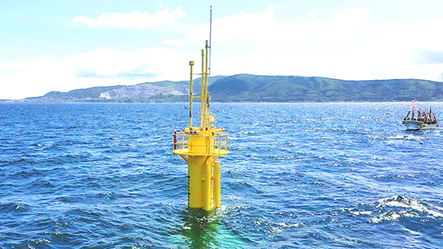
Construction firm Obayashi installed a tension-leg mooring type (TLP) floating wind turbine offshore of Iwaya, Aomori Pref.
The TLP is a fifth of the size of a floating structure that can accommodate a 15 MW class wind turbine. It will be monitored for a year to confirm stability and durability.
Obayashi is using a hybrid structure made of reinforced concrete and steel parts to reduce production cost.
CONTEXT: This is the first TLP floating structure to be installed in Japan.
Obayashi’s TLP structure installed off Aomori Pref
The Environment Minister urged Tokyu Land to either cancel or relocate the firm’s planned wind farm in Matsumae Town (Hokkaido) due to potential impact on white-tailed sea eagles, a rare species.
The comment was in response to Tokyu Land’s environmental impact assessment.
The project’s planned capacity is 51.6 MW, with 12 turbines. The site would cover 740 hectares.
CONTEXT: Nearby, Tokyu Land operates the ReENE Matsumae wind farm (41 MW capacity). In cooperation with the Matsumae government and Hokkaido Electric, earlier this year Tokyu Land launched a local microgrid to transmit power generated at the ReENE Matsumae wind farm in case of a massive power outage, and to ensure access to stable power supply for local government offices, shelters, etc.
On Aug 26, during hotter than expected temperatures that resulted in greater power demand, Kansai Transmission and Distribution had to turn to Chubu Electric Power Grid for extra supply.
After OCCTO issued a formal request, Chubu Electric sent 2.01 GW of electricity in three installments between 1 p.m. and 8 p.m.
Trouble at a local power plant also contributed to the tight supply-demand situation. KEPCO has not revealed which power plant had the problem.
CONTEXT: The reserve ratio in KEPCO’s service area temporarily fell below the 3% required for stable supply.
Hokuriku Gas is partnering with Tohoku Electric to offer discounted gas and electricity bundles.
In the past, the companies were rivals, but this partnership aims to prevent customer loss in the face of market liberalization.
Hokuriku Gas will manage contracts, billing, and gas supply. Tohoku Electric will handle electricity supply and meter readings.
TAKEAWAY: The financial benefits for Hokuriku Gas are modest. Yet, the initiative strengthens customer relations. Tohoku Electric has a plan to switch to all-electric homes, but this partnership is a way to compete with other energy providers by appealing to households that use both gas and electricity.
In a UK court, Sumitomo Corp filed a debt restructuring plan for the Ambatovy nickel mine and refinery in Madagascar.
The plan aims to address facility problems that occurred in FY2023.
The mining company, Ambatovy Minerals, and the refining company Dynatec Madagascar are owned 54.71% by Sumitomo; and Korea Mine Rehabilitation, and Mineral Resources Corp own the rest.
TAKEAWAY: Sumitomo did not elaborate on the “facility problems” but told Japan NRG that the mine and the refinery are operating as usual. BHP, which has nickel supply contracts with Tesla, will suspend its Australian mine operation in October due to market oversupply. BHP produces 82,000 tons/ year of nickel.
China’s export curb pushes up antimony prices
(Japan NRG, Aug 30)
Prices of antimony, which are used for solar glass, have surged 20% after China announced new export rules for 12 antimony products, requiring export approval starting Sept 15.
According to Shanghai Metals Market, ingot prices are about to hit $25,000/ ton, compared to $21,000/ ton before the announcement on Aug 15.
International antimony prices have been at historical highs since spring due to shortages of antimony concentrates as miners focused on gold production. Antimony is a byproduct of gold.
CONTEXT: The export control covers 99.99%-grade antimony trioxide used for solar glass, and antimony hydroxide for semiconductors; but not antimony scrap, which is hardly traded.
TAKEAWAY: China accounts for about 90% of Japan’s antimony trioxide imports, but antimony hydroxide import sources are spread out among 14 countries. After Sept 15, trades with China will likely slow until there is clarity on the Commerce Ministry’s approval criteria. On the other hand, historically high prices will motivate mines to increase output.
As of Aug 25, LNG stocks of 10 power utilities were 2.06 million tons, a 19.8% rise over the previous week (1.93 million tons). This is also up 19.8% from end Aug 2023 (1.72 million tons), and up 2% from the past five-year average of 2.02 million tons.
CONTEXT: The typhoon season has begun, and one hit Japan hard late last week, bringing much rain and causing damage. LNG stocks are on an uptrend in preparation. Temperatures are still over 30oC during the day.
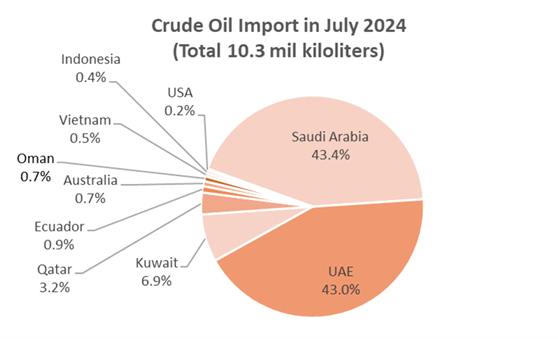
In July, Japan imported 10.3 million kiloliters of crude oil. Saudi Arabia returned to the position of top exporter to Japan. Also, this is the second time Japan imported oil from Vietnam in 2024.
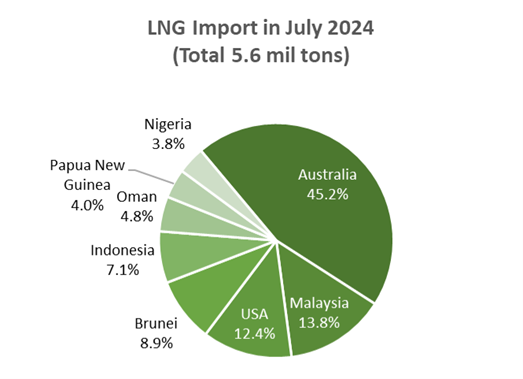
LNG imports increased 23% over June. Imports from Russia decreased 82.9%, by 0.46 mil tons. To fill in the gap, Australia’s volume gained over 30%, by 0.56 mil tons, and Indonesia’s rose over 35%, 0.19 mil tons. LNG imports suddenly surged, but the 5.6 million tons is about the same as the March volume, and less than in January and February.
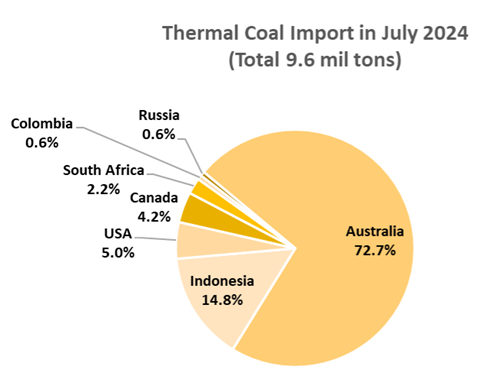
Thermal coal imports in July jumped 41.9% to 9.6 million tons, up from 6.8 million tons in June. Volume from Australia grew 47.8%, or 2.2 million tons, and from Indonesia supplies rose 68.1%, some 0.6 million tons.
ANALYSIS
BY MAYUMI WATANABE
The Perovskite Boom Is Not Without Setbacks
Japan is betting big on perovskite solar cell (PSC) technology to boost green energy capacity and to become a global leader in one of the most innovative new clean energy technologies.
The electrical characteristics of perovskite compounds, verified by Professor Miyasaka of Toin University in Yokohama in 2009, hold the promise of having the ability to significantly magnify solar energy potential.
Some PSC modules are less than 1 mm thick, weighing under 1.5 kg/ m2, and do not require the extreme heat (about 1,000°C) with which current silicon-based solar panels are produced.
Any surface of buildings, bridges, cars, etc can be used as zero-emission power stations by simply applying these film-like modules, according to Dr. Miyasaka.
This technology, however, has a few major drawbacks: low power efficiency (less than 20%); difficulties in establishing systematic mass production; vulnerability to moisture and heat; and more.
Solutions have yet to be found. And yet, the government wants to make PSC commercially viable as soon as possible, and towards that goal it’s encouraging businesses to do field trials to quickly identify any problems and then to find solutions.
Over 30 field studies
Perovskite compounds consist of divalent-structured metals such as lead and halogen group elements, such as iodine. To make a cell, transport layers, electrodes, electricity conducting layers, protective sealants, etc, are stacked on and under the compounds.
Still, PSC has unresolved issues. Unstable behaviors such as hysteresis, which makes it difficult to measure electricity, are unexplained. EneCoat Technologies has achieved a 20% power efficiency, which equals that of silicon cells, for a 7.5 cm x 7.5 cm sized module, but performances of bigger modules are lower.
Despite all the challenges, field trials in Japan are proliferating, with over 30 tests currently running. Core test organizers are PSC module manufacturers – Sekisui Chemical, EneCoat Technologies, Toshiba Energy Systems & Solutions, Ricoh and Peccell Technologies.
The government strategy is to focus on PSC-derived energy solutions, not just bringing to market high-performance solar modules. This is why field studies are encouraged even though there’s still no uniform way to measure PSC performance.
These companies recruit test partners at trade shows and make cold calls to partner candidates. On the other hand, Panasonic, Aisin and Kaneka have been secretive, working mostly within their own corporate groups.
There will be more field trials. The Green Innovation Fund will provide a total of ¥37.8 billion for tests starting this year through FY2030. To receive funding, the projects will need to meet the production cost target of ¥14/ kWh, which is at the level of other photovoltaic technologies. NEDO is not the sole funding source.
The Tokyo Metropolitan Government and the city of Yokohama have launched field test grants. Companies are discussing collaborations with municipalities without subsidy programs.
In addition to PSC manufacturers, peripheral component makers, construction engineering firms, tech startups, etc, will be conducting tests. Right now, the tests are concentrated in space-constrained Tokyo desperately seeking solar installation space, but will spread out more geographically.
Field tests organically evolve
Toshiba ESS launched the first public PSC field test in February 2023 in a Tokyu Group railway station in Yokohama. A month later, Sekisui Chemical and JERA set up several PSC-film covered panels in JERA thermal power plants in Yokosuka and Kashima.
The Sekisui panels were installed at different angles, to compare performances. Similarly, EneCoat and JGC placed their prototypes at Yokohama and Hokkaido sites, but their modules were more refined. They made removable PSC films that were tucked into plastic sheets which resembled curtains. The goal was to see how wind affects performance and endurance required to survive typhoons.
In the second half of 2023, more tests began to simulate usage situations. There were installations on stable building walls, on fragile rooftops, on or near water, and indoors. Some were connected to storage batteries to understand ways to integrate PSC and storage battery systems. Most tests run for a year, but some last longer as they are a part of long-term efforts to develop new product lines.
The most common tests are PSC-film covered building walls, taking advantage of the PSC’s lightweight characteristic. However the walls, if in direct contact with heat-generating PSC films for a long period of time, may erode. The films were placed on top of sheets or plates, and in some cases, were framed in aluminum for increased stability.
In a bid to develop easy-to-install products, Sekisui and Senko Group measured the time to install the systems. Performance on cylinder pillars, electric poles, and other curvy objects, as well as the sun’s best and worst directions during different times of the day, were scrutinized as lights refract on spherical surfaces.
The PSC power efficiency is lower on walls compared to rooftops, due to the sunlight angles. However, there is more wall than roof space. The walls might not make the building self-sufficient, but they might reduce offsite PPA purchase volumes.
Most PSC walls are on building exteriors but there are tests for indoor installations where sunlight is often blocked. Self-chargeable lighting systems, sensors and data transmission devices are also being developed.
First movers emerge
“Perobusukaito” is fast becoming a household term thanks to Sekisui’s TV commercials. The growing public recognition is incentivising businesses to study market entries.
First movers are emerging. In August, the Miyagi-based glass substrate processing firm, Kuramoto, announced it will launch the country’s first mass PSC production plant in northeast Japan in February 2025. The company has produced inverted thin-film organic solar panel prototypes, but has no track record in perovskites. It will license relevant technologies from developers in and outside Japan.
Market entrants
Company
Core business
Perovskite product/ service
Kuramoto Co
Glass processing
PSC
Nissan Chemical
Chemicals
Hole transport layer material
Chemipro Kasei
Insecticides
New raw material
Nippon Zeon
Chemical materials
Electrodes made of carbon nano tube
Shin-Etsu Chemical
Silicones
Coating materials to protect PSC from moisture
Toray Industries
Synthetic fiber
Canon
Electronics
Nippon Sheet Glass
Glass manufacturing
Reinforced glass for perovskite windows
Nippon Electric Glass
Glass manufacturing
Ceramic-glass with no water absorption
Kishu Giken Kogyo
Printers and ink
Inkjet printer for PSC manufacturing
NPC, Mitsuboshi Diamond Industrial
Photovoltaic manufacturing machines
PSC manufacturing machines
Chemitox
Product testing services
PSC prototype manufacturing service
Denken
System integrator
PSC quality testing service
Nichicon
Power systems
Inverters accommodating PSCs
Urban municipalities also count as first movers. Tokyo needs perovskites on and around buildings to increase green energy capacity. Yokohama is aiming for a carbon neutral port, capitalizing on warehouse roofs to install perovskites. Other municipalities are watching if demand is strong enough to fuel improvements.
There is, currently, little incentive for end-users because perovskite advantages over other thin-film photovoltaic products are not clear. There are monocrystalline silicon and cadmium telluride solar panels that are over 1 mm thick but are bendable and nearly rollable. Their power efficiencies are higher, they’re resistant to seawater and moisture, and have greater endurance.
The above raises the question: Other than for publicity and to meet municipality zero-emission building requirements, is there a point in investing in PSC systems if they are not fully reliable power sources?
Darkest before dawn
A lack of reliable data on performance, heat release and erosion speed does not help interested users. The companies conducting the tests have not disclosed their findings, claiming this is sensitive data closely related to product development. Municipalities are not pushing their disclosure either.
The government’s ¥14/ kWh cost target has disincentivized metallography researchers who feel it is too ambitious. Funding has become difficult unless a pathway to ¥14/ kWh is shown. But the PSC industry desperately needs a new lead-free raw material mix to replace the presently utilized lead iodide-based perovskites.
There are encouraging signs of PSC technology advances. A year ago, PSC films sized 25 x 30 cm were considered ‘large’. PSC film at tests launched in the past two months are over 1 meter in length. While the successes of first movers are creating a positive mood, there are still uncertainties on whether demand prospects alone will speed up product developments.
The purpose of robust government support for perovskites was to be self-sufficient in photovoltaic panels, which today Japan almost entirely imports. But if domestic manufacturers are not able to deliver the quality, price and quantity that users need, the dominance of imports won’t change.
This suggests a few hard moments of truth are coming. Public and private stakeholders will need to identify more specifically which issues will require further funding. Encouraging healthy growth of both the quality of PSC systems and their demand are essential in making perovskites a new green energy success story.
Major PSC field trials (excludes awareness campaign / one-day demos)
Companies
Test overview
Details
Sekisui Chemical
PSC-mounted on walls of head office building
Outdoor, with storage battery system
Sekisui Chemical, JERA
Several PSC panels installed at Yokosuka and Kashima thermal power plants
Outdoor, testing performance of panels in various angles, impact of seawater
Sekisui Chemical, NTT Data
PSC on building walls, eyeing PSC-equipped data centers
Outdoor, connected to storage batteries to power a parking lot lighting system
Sekisui Chemical, Tokyo Metropolitan Govt,
PSC-equipped water recycling systems
Outdoor
PSC films wrapped around cylinder-shaped pillars at a ferry terminal, generating power for the lighting system
Outdoor, measuring impact of seawater and moisture; integrating storage battery system; largest PSC system as of August
Sekisui Chemical, Senko
PSC equipped warehouse walls
Outdoor, focus on easy-to-install product package
Sekisui Chemical, MMB, Koei-D, City of Kita, (Tokyo)
Floating PSC system in swimming pool
Outdoor, measuring impact of moisture
Sekisui Chemical, JR West
PSC-equipped railway station
Outdoor
Sekisui Chemical, TERRA
Solar farm, growing barley under PSC-mounted panels
Two-year outdoor test, with storage batteries. Perovskite greenhouse planned
Sekisui Chemical, Cosmo Oil, Asahi Etic
Cylinder oil tank walls with PSC, rooftop PSC
Outdoor
Sekisui Chemical, TEPCO Holdings
PSC building walls
Outdoor, 1 MW output capacity
Toshiba Energy Systems & Solutions (Toshiba ESS), Okuma Township
Box-shaped PSC power stations installed at the town hall parking area to power its lighting and other systems.
Outdoor
Toshiba ESS, City of Yokohama
Temporary installation in an exhibition hall (finished)
Indoor
Toshiba ESS, Tokyo Metropolitan Govt
PSC power station
Indoor, with storage batteries
Toshiba ESS, Tokyu Group
PSC-equipped railway station
Outdoor
EneCoat Technologies, JGC, Kanagawa Pref
Greenhouse rooftop
Outdoor
EneCoat, KDDI
PSC equipped mobile base station
Outdoor
EneCoat, Mitsui Fudosan Residential
PSC-equipped public space in condominiums
Indoor
EneCoat, Macnica, Tokyo Metropolitan Govt
PSC-powered air quality monitoring system (finished in June 2024)
Indoor, with backup lithium-ion batteries to run the system
EneCoat, JGC
Roof and wall installations in a warehouse in Tomakomai, and a dorm in Yokohama
Outdoor
EneCoat, JGC, Kanagawa Pref
Greenhouse rooftop
Outdoor
Panasonic
PSC-equipped homes
Outdoor
Peccell Technologies, Reiko, Macnica
Ports
Outdoor
Peccell, Notas
PSC power station to power electric fences at a farm
Outdoor
Aisin
Head office visitor center building walls, to expand to manufacturing plant walls in 2025
Outdoor
Marubeni Eneble
Glass mounted PSC panels in condominiums using PSC imports
Indoor
Ricoh, Japan Aerospace Exploration Agency
Perovskite balloon
(finished in 2021)
Outdoor
Ricoh, Inaba Denki Seisakusho, Ota City (Tokyo), etc
Night-time school entrance lighting system
Outdoor, connected to storage battery system
Ricoh, Inaba Denki Seisakusho, City of Atsugi, etc
Night-time street lighting system
Outdoor, connected to storage battery system
Ricoh, Tokyo Metropolitan Govt
Air quality monitoring sensor
Indoor, testing data transmission wholly powered by perovskite power; no backup batteries
PXP Corp
Solar car with tandem CIS/ perovskite cells
Outdoor
YKK AP, AkibaTV, Chiyoda City (Tokyo)
PSC-integrated window
Outdoor for three months
Niigata University Group
Outdoor tandem PSC panels
Outdoor in Kagoshima
Suzuka Group, Hanwa Corp
PSC system performance, environmental impact (planned)
Outdoor
Kanazawa University, Hokuriku Electric Biz Energy Solution
PSC panel in the campus solar park (planned)
Outdoor
EneCoat, Toyota Motor
PSC-equipped cars (planned)
Outdoor
EneCoat, Toyoda Gosei
PSC-equipped cars (planned)
Outdoor
Sekisui Chemical, Osaka Pavilion 2025
250 meters long PSC-mounted bus terminal roof (planned)
Outdoor
Ricoh, JAXA, Kansai University
Perovskite-powered satellite Denden-01 (planned)
Outer space, a six-months test on PSC performance and endurance in space
ANALYSIS
BY JAPAN NRG TEAM
Power Companies Ignore New Balancing Market Set Up By METI
At least three times this summer, large volumes of electricity had to be transferred quickly between the major regions into which Japan’s power system is split. The technical aspect of this has so far not caused notable issues, despite ongoing concerns over the country’s aging and segregated power grid. But there are questions around how this electricity is procured.
As part of the liberalization of the electricity sector over the past decade, METI oversaw the unbundling of regional power utilities (EPCOs) and the creation of several market platforms to facilitate non-discriminatory trading in electricity. But one area where this free-market push has struggled to yield results is ‘balancing’, which is the system under which regional transmission operators (TSOs) procure electricity when output fails to meet scheduled levels due to weather, natural disaster, or other reasons.
The balancing marketplace, also known as the Supply-Demand Adjustment Market, was set up in 2021 to help TSOs manage their local grid and system security. This platform was meant to bring together the nine TSOs that cover all of Japan (aside from Okinawa), thus making it easier – and cheaper – to source generation resources from another region when in need. The problem is that almost half of TSOs barely use this market.
The situation has implications beyond power market design. A number of battery operators entering the Japanese market are looking at options to sell power (i.e., outside of bilateral agreements). In addition to the established spot and futures power markets, there’s interest in tapping into revenues from balancing.
What’s more, METI envisions an evolution of Japan’s electricity markets that would include the adoption of something akin to the PJM Ancillary Services Market in the U.S., a nodal structure and a three-part offer system in which balancing is one of the components.
So, can the energy planners and power industry players make the balancing system work?
Basic background
Japan has 10 regional transmission and distribution (T&D) companies. Both the transmission operators (TSO) and distribution operators (DSO) were once part of the 10 vertically integrated, regional power utilities (EPCOs).
The utilities have formed holding or group structures in which the power generation and retail businesses compete with new market entrants. The transmission of electricity, however, is supposed to be a neutral space, with TSOs and DSOs acting independently of the interests of their generation or retail group firms.
Note, the Okinawa Prefecture grid has also been deregulated, but it does not have a spot market. The region operates separately from the others because Okinawa is not connected to the other nine TSOs.
Generation Business
TSO
Hokkaido Electric (HEPCO)
Hokkaido Electric Power Network
Tohoku Electric (Tohoku-EPCO)
Tohoku Electric Power Grid
Tokyo Electric (TEPCO)
Tokyo Electric Power Grid
Chubu Electric
Chubu Electric Power Grid
Hokuriku Electric
Hokuriku Electric Power Transmission Distribution
Kansai Electric (KEPCO)
Kansai Transmission and Distribution
Chugoku Electric (Energia)
Chugoku Electric Network
Shikoku Electric
Shikoku Electric Power Transmission & Distribution
Kyushu Electric
Kyushu Electric Power Transmission & Distribution
In 2015, to facilitate coordination between the TSOs, the Organisation for Cross-regional Coordination of Transmission Operators (OCCTO) was created. It helps manage the technical and logistical side of the transport of electricity between different regions. It also acts as an information hub, sharing data with METI and the TSOs, which helps to gain a sense of the reserve margins in each region, which are the priority power users, which users can be asked to reduce consumption in an emergency, or how best to coordinate during a natural disaster.
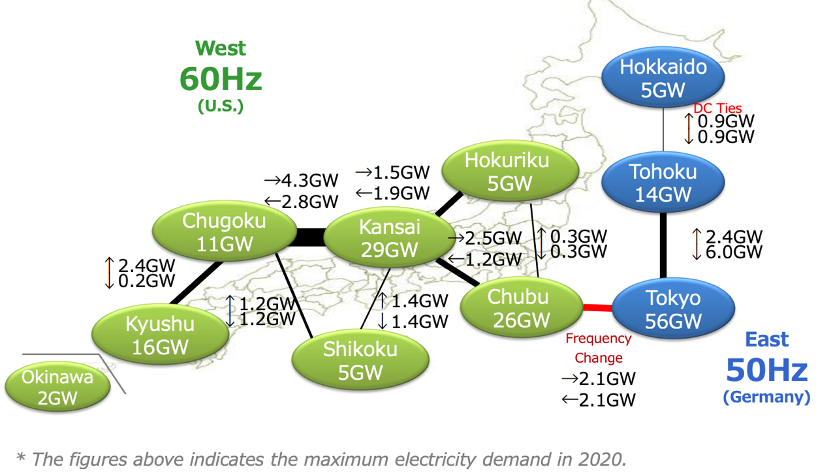
OCCTO is also in charge of the cross-regional interconnections plan, which is a roadmap to improving the power grid and the connections between the nine main regions. Coordination is vital in a country where the grid is not only split between regions but is also divided into two separate frequency zones due to the historical development of electricity infrastructure.
Source: METI
Shifting of the balance
TSOs are in charge of maintaining a balance of power supply and demand in their region at any one time. This involves forecasting and monitoring seasons, weather, and fluctuations on any given day, hour, or even five-minute interval.
This task has grown ever more complex with the rapid expansion of the number of power generation sources as more solar, wind, biomass and small hydro plants are brought online. The weather dependence of solar and wind generation in particular, as well as more volatile weather conditions, require a faster and more precise TSO response.
To address the situation, METI created a balancing market that would allow TSOs easier procurement of power as needed. Available generation capacity is offered according to four types of adjustment (primarily split by the speed of response, its source, and how quickly the facility can start to provide electricity). Units of trade are three-hour increments (although, the Tertiary Balancing Reserve② option is expected to change to 30 minutes from FY 2025). The buyers are, of course, the TSOs. That makes this market different from the spot (JEPX) market, where the consumers are electricity retailers or large users, or futures markets, where power generators and financial players trade.
The supply-demand adjustment marketplace is operated by EPRX (Electric Power Reserve eXchange), which involves all nine of the main TSOs. The current representative director is from Tokyo Electric Power Grid.
The counterpart to the EPRX is the Imbalance System, which is a penalty levied on power providers when generation deviates from scheduled volumes. When that or a demand spike incurs an imbalance between demand and supply, TSOs are tasked with securing the difference. As of April 2022, the imbalance fee is based on the cost of securing alternatives.
Bug in the system
A nationwide balancing/ ancillary services marketplace should make the supply-demand adjustments easier and likely cheaper. To give an example, if one large power generator suddenly fails, then other generators automatically detect the change of frequency, and adjust output to restore to original state.
Therefore if the power grid is small, and only limited generators are operating, they may not have adequate capacity in reserve to cover the shortfall. The more potential facilities in reserve, the more stable the system. Equally important, a larger power grid can absorb marginal errors in demand forecast, defraying costs.
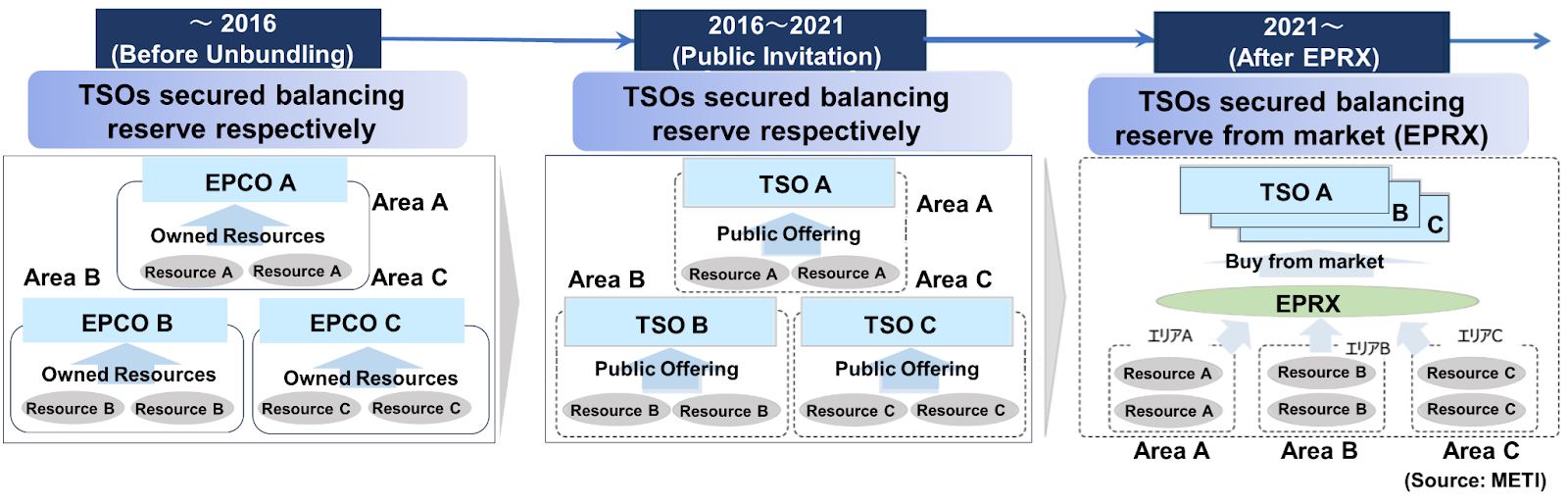
METI first allowed TSOs to start public offering of ancillary services back in 2016, the same year as the full liberalization of electricity retail sales.
However, a problem emerged. TSOs are part of EPCOs. Most of the resources that TSOs want to access for balancing are still owned by EPCO groups. As such, there’s little benefit for TSOs in a public offering system. In fact, securing adjustment capacity via the market creates extra work and bureaucracy for TSOs.
With most of the power facilities equipped with automatic frequency detection, grid operators can easily tap into pumped storage hydro power when there is a shortage, or adjust power demand upward by letting these same plants draw power to pump water to a higher reservoir.
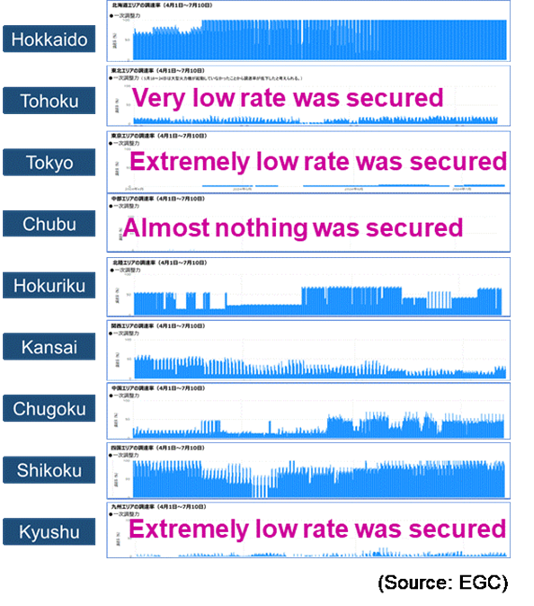
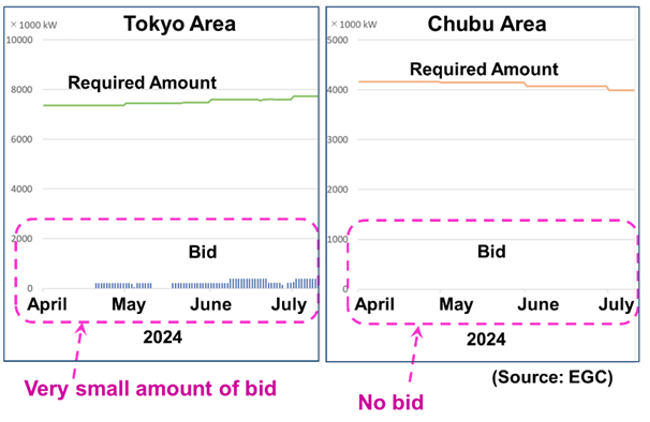
In theory, EPCO unbundling has made each of the group’s assets independent and any power sales between them is a “trade”. In practice, at least four TSOs seem to barely utilize the EPRX, and that can’t be put down only to the EPRX being slow to expand its product range.
Rate of Primary Balancing Reserve Secured from the EPRX by TSOs (April to July 2024)
Trade Record of Primary Balancing Reserve on the EPRX, April to July 2024 (Tokyo and Chubu areas)
It should be noted that balancing per se is taking place. It’s just that half of the TSOs are not reaching out to the EPRX to do so. Instead, they’re securing adjustments via the old relief system (“Utilize Remaining Capacity”) that existed before the arrival of EPRX.
METI pressure
If TSOs don’t utilize the EPRX, then there will be little point in new power facilities seeking to offer their services there. It will also impact the more complex “three-part” trading offer system that METI seeks to introduce in markets in the coming years, which include inputs for intraday (kW) and adjustment (delta kW) power.
That’s why METI has started discussing reforms via advisory councils and also reported its findings to Tokyo and Chubu EPCOs. According to the 99th session of System Design Council of Advisers hosted by power sector regulator EGC on July 30, Tokyo and Chubu EPCO officials said that they’re not using EPRX because “It is difficult to precisely forecast power demand and supply due to unexpected changes of weather, especially for solar generation.”
They also pushed back against government overtures to utilize EPRX, noting that contracts between power suppliers and retailers do not specify that all balancing reserves are procured via tEPRX, and so each TSO will use the best options that it has at hand.
Government pressure may yet pay off. Tokyo and Chubu grid operators agreed to try purchasing more balancing reserves via EPRX.
With METI expected to introduce its “three-part offer” system by 2028, there are only a few years left to resolve the situation.
ASIA ENERGY REVIEW
BY JOHN VAROLI
This weekly column focuses on energy events in Asia and the Pacific
Australia / Solar power
The Australian Electricity Market Operator said that 1.2 GW of new large-scale solar projects were brought online and connected to the National Electricity Market in the past 12 months.
Australia / Transmission lines
The Australian Energy Market Operator said that about 10,000 km of new transmission lines are required to support the country’s ambitions to produce all of its electricity with renewable sources by 2050.
China / Energy transition
The country’s total energy transition investment reached $676 billion, making it the world’s leader, claims a government white paper titled “China’s Energy Transition”. Since 2013, China has been responsible for over 40% of annual additions to global renewable energy capacity.
India / Natural gas
Small and medium-sized businesses are among the largest consumers of natural gas, said the Institute for Energy Economics and Financial Analysis. These include tea plantations and manufacturing, as well as fertilizer industries. Their gas use grew 136% in 2023.
Indonesia / Solar power
Aslan Energy Capital (Singapore) and PT Calypte Sugi Power (Indonesia) inked a MoU to develop a 2 GW power generation hub, creating a large-scale solar and clean energy facility in the Riau Islands. By the end of 2026, they plan to produce 1 GW of solar power, and to reach 2 GW by 2028.
Indonesia / Wind power
Philippines-based ACEN inked a partnership with PT Barito Renewables Energy to develop wind energy projects across Indonesia.
Malaysia / Solar power
Insufficient infrastructure may hinder the growth of solar power because the grid is not flexible enough to accommodate growing supply, said think tank Ember. Malaysia has abundant solar energy promise, with 269 GW of potential capacity.
Malaysia / Natural gas
Malaysia’s national upstream company Petronas Carigali has brought on stream its Kasawari giant gas field on Block SK 316 offshore Sarawak. Discovered in 2011, about 200 km off the Sarawak coast, the field contains about 10 trillion cubic feet of gas.
New Zealand / Fossil fuels and Hydro
Think tank Ember said the total fossil fuel-fired electricity generation from January through July was 4.36 TWh, 67% higher YoY, and nearly matching the 1.86 TWh drop in generation from the country’s hydroelectric projects in the same period.
Southeast Asia / Solar power
Levanta Renewables acquired six solar PV projects: three sites are in Malaysia, two in Indonesia, and one in Thailand. These add 9.5 MWp to Levanta’s portfolio and will generate over 13 GWh annually.
Sri Lanka / LNG
Sri Lanka opened its first power plant fuelled primarily by LNG – the Sobadhanavi 350 MW LNG Combined Cycle Power Plant at Kerawalapitiya. Sri Lanka has generated around 60% of its electricity from coal and oil in recent years but is looking to gas.
2024 EVENTS CALENDAR
A selection of domestic and international events we believe will have an impact on Japanese energy
January
First market trading day (Jan 4)
IEA “Renewables 2023: Analysis and Market Forecast to 2028” released (Jan 11)
Renewable Energy Exhibition (Jan 31 – Feb 2)
Taiwan presidential election (Jan 13)
Japan’s Diet convenes
IEA “Electricity 2024 / Analysis and Forecast to 2026” released (Jan 24)
February
CFAA International Symposium (Feb 2)
India Energy Week 2024 (Feb 6-9)
Lunar New Year (Feb 10-17)
Indonesia presidential election (Feb 14)
Japan-Ukraine Conference for Promotion of Economic Reconstruction (Feb 19)
FIT/FIP solar auction (Feb 19 – March 1)
Smart Energy Week (Feb 28-Mar 1)
March
Announcement of auction result for Offshore Wind Round 2 (for Akita Happo-Noshiro Project)
Onshore wind auctions (March 4-15; results on March 22)
International LNG Congress (LNGCON) 2024, Milan, Italy (March 11-12)
Russian president election (March 15-17)
World Petrochemical Conference, Houston, TX, USA (March 18-22)
IAEA Nuclear Energy Summit @ Belgium (March 21)
Ukraine presidential election (due before March 31)
Happo Noshiro, Murakami-Tainai, Oga-Katagami-Akita and Saikai-Eshima wind project auctions close (June 30)
July
Tokyo governor election (July 7)
7th Basic (Strategic) Energy Plan draft published (expected)
August
7th Basic (Strategic) Energy Plan draft presented to Cabinet (expected)
September
Global Offshore Wind Summit Japan 2024, Sapporo, Hokkaido (Sept 3-4)
The United Nations Summit of the Future (Sept 22-23)
Gastech 2024, Houston, TX (Sept 17-20)
IAEA General Conference
GX Week in Tokyo (expected late Sept to October)
Asia Green Growth Partnership Ministerial Meeting
Asia CCUS Network Forum
International Conference on Carbon Recycling
International Conference on Fuel Ammonia
GGX x TCFD Summit
October
IEA World Energy Outlook 2024 Release
BP Energy Outlook 2024 Release
Innovation for Cool Earth Forum (expected)
Connecting Green Hydrogen Japan 2024 (Oct 16-17)
Japan Wind Energy 2024 Summit (Oct 16-17)
Solar Energy Future Japan 2024 (Oct 16-17)
Japan Mobility Show (Oct 25-Nov 5)
November
US presidential election (Nov 5)
COP 29 in Azerbaijan (Nov 11-22)
Abu Dhabi International Petroleum Exhibition Conference (ADIPEC) 2024, Abu Dhabi, UAE (Nov 11-14)
APEC 2024 @ Lima, Peru
International Conference on Nuclear Decommissioning (TBD)
G20 Rio de Janeiro Summit (Nov 18-19)
Offshore Energy Exhibition & Conference (OEEC) 2024, Amsterdam, the Netherlands (Nov 26-27)
Biomass & BioEnergy Asia Conference (TBD)
European Biomethane Week 2024
December
Last market trading day (December 30)
Disclaimer
This communication has been prepared for information purposes only, is confidential and may be legally privileged. This is a subscription-only service and is directed at those who have expressly asked K.K. Yuri Group or one of its representatives to be added to the mailing list. This document may not be onwardly circulated or reproduced without prior written consent from Yuri Group, which retains all copyright to the content of this report.
Yuri Group is not registered as an investment advisor in any jurisdiction. Our research and all the content express our opinions, which are generally based on available public information, field studies and own analysis. Content is limited to general comment upon general political, economic and market issues, asset classes and types of investments. The report and all of its content does not constitute a recommendation or solicitation to buy, sell, subscribe for or underwrite any product or physical commodity, or a financial instrument.
The information contained in this report is obtained from sources believed to be reliable and in good faith. No representation or warranty is made that it is accurate or complete. Opinions and views expressed are subject to change without notice, as are prices and availability, which are indicative only. There is no obligation to notify recipients of any changes to this data or to do so in the future. No responsibility is accepted for the use of or reliance on the information provided. In no circumstances will Yuri Group be liable for any indirect or direct loss, or consequential loss or damages arising from the use of, any inability to use, or any inaccuracy in the information.