In an effort to find a temporary solution for Japan’s growing volume of spent nuclear fuel, some utilities plan to build dry storage on their power plant premises. This stop-gap measure would run until the spent fuel could be sent to an intermediate storage, and from there, to a reprocessing plant if one is ever built. The situation is dire, and a solution must be implemented in the next five years. If delayed, then the promise of nuclear energy’s benefits will be in doubt.
As Japan seeks to expand wind power generation, the demand for skilled and certified workers to operate and maintain those facilities is growing. However, students in technical programs are concerned that the current curricula hinders acquiring skills necessary to work at wind farms. Practical training has yet to become a fixture of university programs. Thus, to meet this demand, private training centers are opening that offer professional safety and technical courses.
ASIA ENERGY VIEW
A wrap of top energy news that impacts other Asian countries.
EVENTS SCHEDULE
A selection of events to keep an eye on in 2024.
JAPAN NRG WEEKLY
PUBLISHER K. K. Yuri Group
Editorial Team Yuriy Humber (Editor-in-Chief) John Varoli (Senior Editor, Americas) Kyoko Fukuda (Japan) Magdalena Osumi (Japan Filippo Pedretti (Japan) Tim Young (Japan) Tetsuji Tomita (Japan)
New Energy and Industrial Technology Development Organization
kWh
Kilowatt hours (electricity generation volume)
TEPCO
Tokyo Electric Power Company
FIT
Feed-in Tariff
KEPCO
Kansai Electric Power Company
FIP
Feed-in Premium
EPCO
Electric Power Company
SAF
Sustainable Aviation Fuel
JCC
Japan Crude Cocktail
NPP
Nuclear power plant
JKM
Japan Korea Market, the Platt’s LNG benchmark
JOGMEC
Japan Organization for Metals and Energy Security
CCUS
Carbon Capture, Utilization and Storage
OCCTO
Organization for Cross-regional Coordination of Transmission Operators
NRA
Nuclear Regulation Authority
GX
Green Transformation
NEWS: ENERGY TRANSITION & POLICY
In first policy speech PM Ishiba vows to accelerate decarbonization
(Japan NRG, Oct 4)
In his first policy speech at a plenary session of the Lower House of the Diet on Oct 4, the newly appointed PM Ishiba pledged to accelerate decarbonization.
While taking into account the drastic increase in electricity demand in the age of AI, and in order to boost energy self-sufficiency, the PM said he will promote energy conservation. He also plans to advocate for nuclear power in the energy mix, albeit with improved safety at NPPs.
Ishiba said he wants to accelerate the Green Transformation (GX) and the decarbonization initiatives that were launched by PM Kishida.
Ishiba will also focus on regional revitalization, naming the Tohoku region stricken by the 2011 quake, tsunami and nuclear disaster as a priority. He plans to double subsidies for regional revitalization projects.
Ishiba also vowed to pull the country out of deflation, and make the economy and state finances more resilient to crises, as well as attract more investment in innovation and digitalization efforts.
TAKEAWAY: Ishiba’s policy vision on energy and digitization initiatives, which often complement decarbonization projects, has been largely echoed in the inaugural speeches of the new METI and MoE ministers. In fact, slightly couched language on nuclear aside, the only addition that could be seen in his comments is a greater emphasis on distribution of state capital to the regions, away from Tokyo and the big cities.
Environment Minister Asao said reconstruction and revitalization of areas affected by the quake in March 2011 will be one of his key policies.
Based on PM Ishiba’s instructions, he’ll focus on combating global warming, ending plastic pollution and strengthening the nuclear disaster prevention system.
Asao stressed that the govt will take responsibility for the recycling of soil from decontamination work in Fukushima Pref and its final disposal outside the prefecture, and will keep monitoring the ALPS-treated water following discharge in the sea.
He also called for lifestyle changes, stressing that reform will play a significant role towards carbon neutrality, along with use of renewables.
TAKEAWAY: Demand-response, recycling and circular economy technologies will benefit from the additional emphasis by the minister.
During a meeting of the Industrial Council, METI emphasized the importance of technology to improve the efficiency of ammonia and hydrogen combustion, and electric furnaces to help decarbonize industrial furnaces.
Electric furnaces are a viable option for decarbonization because they do not require exhaust gas treatment and are more compact, but their energy costs are about twice as much as those of natural gas-fired furnaces.
CONTEXT: Decarbonization of thermal processes used in industrial furnaces is an urgent issue, and the “Decarbonization of Thermal Processes in the Manufacturing Sector Project” is under the auspices of the Green Innovation Fund. The current focus is on industrial furnaces fueled by ammonia or hydrogen for the use in steelmaking, but development of efficient electric furnaces is also planned.
METI and the Cabinet Secretariat stated in the GX Expert Working Group that the availability of clean energy, such as renewables, will be an important factor in determining the location of new energy/ GX-related industries.
A key policy will be to encourage investment in areas rich in clean energy sources with direct incentives. Also, the government wants investments to focus on job creation in rural areas.
TAKEAWAY: Along with updating the Basic Energy Plan, PM Kishida launched the GX 2.0 plan to map new power demand centers based on a forecast for new industrial development. The idea is to synchronize sites of new industries with areas that’ll have an available supply of clean energy to ensure that the additional power demand is met with low carbon energy.
ANRE seeks to promote the Feed-in Premium (FIP) to transition away from the Feed-in Tariff (FIT) for all renewable energy sources.
The agency believes a shift to FIP is possible through:
Disclosure of more information about the FIP
Increasing the installation of grid-scale batteries alongside FIP power sources
Reviewing the rules for price calculations in cases where batteries are installed
Measures to support the shifting of power supply to non-peak times, and
Increasing direct trading of non-fossil fuel certificates.
In addition, measures were proposed to:
Revitalize the aggregation business, since aggregators coordinate power supply/demand for small-scale sources;
Establish a matching platform for aggregators and FIP operators.
CONTEXT: Batteries installed alongside FIP-linked power generation facilities can be charged from the grid as well as from adjacent farms of solar/wind/other renewables. This dual option improves the operating rate of the batteries and allows them to contribute effectively to the power supply-demand balance.
ANRE has begun discussing ways to promote biofuels and synthetic fuels as decarbonized fuels. The first topic was SAF (Sustainable Aviation Fuel).
A key agency subcommittee agreed that the target for Japan’s SAF supply should be based on the impact of its GHG emissions, and should be equivalent to at least 5% of the GHG emissions of jet fuel produced and supplied in Japan in FY2019. In other words, this assumes a 10% SAF blend rate.
ANRE will support SAF production and raw material supply chains, as well as development of SAF production technology.
CONTEXT: The Decarbonized Fuel Policy Subcommittee was previously interested in hydrogen and ammonia, but it’s now turning its attention to biofuels and synthetic fuels. Also, measures to expand SAF supply have been discussed at the SAF Public-Private Study Council launched jointly by METI and MLIT.
ENEOS Holdings began production of synthetic fuel, which is supposed to have a smaller environmental impact than fossil fuels. This is Japan’s first integrated production of synthetic fuels at one site.
The production facility has been set up at the ENEOS research hub in Yokohama.
The production capacity is 1 barrel/ day (around 159 liters). In FY2027, ENEOS plans to operate a large-scale demo facility with a production capacity of 300 barrels/ day. It aims for commercial production at 10,000 barrels/ day by 2040.
The liquid fuel can be used in cars and aircraft powered by conventional engines. The firm hopes to blend it with gasoline and gradually increase the blending ratio.
MoE has selected nine more regions leading the nation’s decarbonization initiatives.
The nine are: Assabu Town, Hokkaido; Rikuzentakata City and Kamaishi City, Iwate Pref; Tokai Town, Mie Pref; Kobe City, Hyogo Pref; Higashihiroshima City, Hiroshima Pref; Shimonoseki City, Yamaguchi Pref; Fukuoka City, Fukuoka Pref; and Goto City, Nagasaki Pref.
The ministry aims to select at least 100 leading decarbonization regions by FY2025, establish a roadmap for decarbonization initiatives in accordance with regional characteristics, and implement them by FY2030.
China will account for just under 70% of total installed capacity of green hydrogen-producing electrolyzers, according to the International Energy Agency.
The number of electrolyzer projects globally that have reached FID now totals 20 GW. Production of green hydrogen is forecast to increase fivefold by 2030.
In 2023, there were 700 MW of electrolyzers in operation, of which 80% were in China and 12% were in Europe.
As of 2020, China’s share was not even 10%. This share is forecast to grow and Chinese dominance in the market to increase.
CONTEXT: China has positioned hydrogen as a “strategic emerging industry” and is promoting the introduction of electrolyzer manufacturing facilities through public support. Beijing is also focused on overseas expansion. This includes offering one-stop contracts for the design, installation, and maintenance of large-scale hydrogen production systems.
TAKEAWAY: From a Japanese perspective, China’s dominance of the green hydrogen market looks like a repeat of what has happened in other cleantech sectors. Japan’s focus to date has been on securing hydrogen volumes from overseas, and that has helped create new blue and green projects. However, few deploy Japanese equipment and there is only one domestic electrolyzer supplier of note. The situation is in contrast with the leadership outlined in the second edition of the Hydrogen Strategy that the government published last year.
The Japan Research Institute (JRI) launched the “Council on Smart Use of EV Batteries” that unites companies, academia, ministries, and local governments. The goal is to create a circular economy for EV batteries.
Main council members include Kansai Electric, NTT Docomo, NTT East, Yokogawa Solution Service, Hioki, SMBC, METI, MoE, and Fukuoka Pref.
They will create standards and benchmarks to accelerate the recycling of EV batteries and also provide support for verification of new tech.
CONTEXT: There is a growing push in Japan to promote the circular economy in order to improve resource efficiency and lower environmental impact. For batteries, this is an especially acute issue since Japan is highly reliant on critical raw materials from overseas, and the processing of the majority of such materials is done in China.
Honda inked a virtual PPA with Invenergy Wind for wind power generation. Invenergy will supply power from the 63 MW Rusutsu wind farm in Rusutsu Village, Hokkaido. Supply starts in Sept 2025.
This is one of Hokkaido’s largest virtual PPAs, and the first for Honda in Japan.
The deal follows the 200 MW V-PPA contract inked by a Honda Group firm in North America for the Samson Solar Energy Center under development and that will be operated by Invenergy in the U.S.
The emissions of the vast majority of Japan’s power generators for FY2023 totaled 311 million tons. This is a 4.8% decrease YoY, and the lowest level since such measurements began in 2015, according to research by the Electric Business Council for a Low Carbon Society.
CONTEXT: The Council has 61 major power utilities (EPCOs) and new power suppliers among its members and they account for the majority of power generation in the country.
The Council said that the average CO2 emissions per kWh dropped 3.6% to 0.42 kg. The reduction is attributed to increased NPP restarts and the expansion of renewable energy. The council aims to lower CO2 emissions to 0.25 kg/ kWh by FY2030.
During FY2023, KEPCO’s Takahama NPP Units 1 and 2 restarted. This brought the total number of operational nuclear reactors in Japan to 12.
The National Institute of Advanced Industrial Science and Technology (AIST) has developed what it claims to be the world’s first automated fabrication system for perovskite solar cells (PSC).
It performs all processes from cleaning the substrate electrodes to the layering of materials, vapor deposition of the back surface electrodes, and cell separation.
CONTEXT: This will speed up R&D since prototypes can be produced easily under various cell fabrication conditions. Automation also eliminates operator error and reduces variability in solar cell performance.
Companies in the PSC field supported by the Green Innovation Fund will be able to use this system, seeking to improve the performance of PSC products.
ClassNK issued the world’s first classification of a vessel using green steel for the dry bulk carrier Bright Queen that’s operated by NYK Bulk & Projects Carriers. The notation signifies that green steel has been used in the vessel’s construction.
Bright Queen, which was built by HIGAKI Shipbuilding, uses JFE Steel’s certified green steel product “JGreeX.”
In a world first, Panama Maritime Authority, Evergreen, 711 Research Institute, and ClassNK will operate an onboard CO2 capture system on the cargo ship Ever Top.
In April, CO2 was captured from the vessel’s exhaust, unloaded at a land facility, and reused. ClassNK confirmed the CO2 volume. Under the Panama Maritime Authority’s guidance, this amount was deducted from the ship’s annual CO2 emissions.
OCCTO is revising power supply measures for the high-demand winter period, focusing on improved use of pumped storage power and activation thresholds.
The following issues were identified: 1) Inefficient approach to calculating reserve margins; 2) Poor utilization of reserve capacity of pumped storage power generation; 3) Need to improve effectiveness of market signals.
To address these, OCCTO would like to make changes ahead of winter. These include possibly raising the 5% activation threshold for pumped storage power and reordering supply measures to prevent the capacity reserve ratio from falling below 8%
Other reforms include addressing communication gaps between power companies and consumers, as well as ensuring that reserve signals better reflect demand and available resources.
CONTEXT: OCCTO has been reviewing pumped storage rules since it’s concerned about declining reserve capacity ratios in certain parts of the country during the hot summer. One reason is the major gap in forecasts, as made by the regional grids (week-ahead projections) and actual supply-demand balance. These discrepancies led to inefficient management of pumped storage stations, which OCCTO now wants to resolve before the winter peak.
In April 2025, Toyota Tsusho will merge its subsidiaries: Eurus Energy, Japan’s largest wind power generation firm, and Terras Energy, a renewables developer.
The total power supply capacity of the integrated company’s facilities will be around 4.3 GW, making it the largest wind and solar power company in Japan. Through the integration of the two companies, Eurus will operate in 16 countries and regions.
Eurus will be the surviving company.
CONTEXT: Eurus was set up as the electric power division of Toyota Tsusho’s predecessor, Tomen, which was funded by TEPCO in 2002. But in 2010 Toyota Tsusho invested ¥185 billion to make it a wholly-owned subsidiary. Terras Energy was established in 2011 as SB Energy, a wholly-owned subsidiary of SoftBank Group. The company is mainly involved in development of solar power generation and is active in the storage battery business. Toyota Tsusho spent ¥102 billion in 2011 to acquire 85% of the shares from Softbank Group.
TAKEAWAY: The merger is an expected step that follows the acquisitions of stakes in the two companies over recent years. It does, however, create a renewables-only firm that can rival in size some of the EPCOs. That will provide strong support for the renewables sector at the government level, as there will now be a major player that is domestic and well versed in how to lobby for its interests.
Itochu’s energy storage fund raised over ¥8 billion from the Tokyo Metropolitan Govt and 10 major firms, including Tokyu Fudosan, Japan Post, Honda, Mitsubishi Estate, Mori Trust and Yokohama Bank.
Launched in February with Gore Street Capital, a British fund manager specializing in grid storage batteries, the fund is Japan’s first dedicated to the development and operation of battery storage.
It will be managed by a 50-50 JV between Itochu and Gore Street Capital, which will launch the first battery storage by FY2025. They’ll oversee the entire project from site selection to design and operation.
TAKEAWAY: A growing number of companies have vowed to join efforts to stabilize Japan’s power grid while expediting adoption of renewables. However, grid-scale storage batteries are still in their infancy and financing options are surprisingly limited. Under these circumstances, funds like Itochu will be crucial to speed up the efforts to advance BESS tech.
A Japanese subsidiary of UK-based battery storage firm Eku Energy began construction of grid storage batteries in Miyazaki City, Miyazaki Pref. The facility launches in July 2026.
The 30 MW/ 120 MWh battery will be Eku’s first BESS in Japan; the company inked a 20-year offtake with Tokyo Gas.
Mitsubishi UFJ Bank led the financing, which totaled ¥8.5 billion.
CONTEXT: The Japanese storage battery market is expected to grow at an average annual rate of 17.5% over the next six years, from 4 GW/ 10 GWh in 2024 to around 10 GW/ 27 GWh in 2030.
Incoming METI Minister Muto stressed the need to restart Kashiwazaki-Kariwa NPP, saying electricity price disparities between east and west Japan must be addressed.
He said the new government will work closely with local authorities, particularly Niigata Pref, to gain support for the restart.
Asked about his earlier stance, which was perceived as anti-nuclear, Muto said that while he supports the expansion of renewable energy, he also believes it will be necessary for Japan to use nuclear power as much as possible, but with strict safety conditions. Muto also vowed to look at the next Basic Energy Plan “with the development of next-gen nuclear reactors in mind.”
CONTEXT: Muto said in the past that Japan should rely less on nuclear power and instead focus on building renewable energy generation.
TAKEAWAY: Three weeks away from a general election, and on the back of a surprise win for PM Ishiba in the LDP election, the new administration is cautious about making noticeable changes in major policies. PM Ishiba himself walked back his anti-nuclear rhetoric part of the way into the LDP leadership campaign, so it’s too early to assume what stance the new government will eventually take. Strong volatility in global fuel markets and / or domestic power prices may persuade the post-general-election government to support the nuclear restarts irrespective of ideology.
Kyushu Electric President Ikebe said the govt’s next Basic Energy Plan should include not only the expansion of nuclear power plants, but also the construction of new ones.
He stressed the complexity and time needed for such projects, adding that Japan should prepare for rising electricity demand.
Ikebe mentioned the nuclear Regulated Asset Base (RAB), a UK method of funding future nuclear projects that provides support for design, construction, and operation.
He said that to maintain stable electricity supplies Japan needs nuclear and geothermal power, as well as thermal power with effective CCS.
CONTEXT: The central govt is set to revise its Basic Energy Plan by the end of FY2024. The new consensus is that demand for electricity will increase in the near future, driven by new data centers and semiconductor factories.
In March 2026, Kyushu Electric will shut 500 MW Unit 2 of Buzen Power Plant (Fukuoka Pref), which is fueled by heavy crude oil.
In June 2026, the utility will also decommission the 360 MW coal-fired Unit 1 of Karita Power Plant (Fukuoka Pref).
CONTEXT: In April 2022, Kyushu Electric closed Sendai Power Plant, an oil-fired power plant in Kagoshima Pref. After the closure of Buzen Unit 2, Kyushu Electric will have no oil-fired power plants.
TEPCO President Kobayakawa Tomoaki was tapped as the next President of the World Association of Nuclear Operators.
Kobayakawa will help WANO to prepare for its next meeting, in Tokyo in 2026. TEPCO will arrange a tour of Fukushima NPP.
CONTEXT: WANO was founded in 1989. Its more than 125 members are from more than 30 countries and regions, and operate over 460 civil nuclear power reactors. WANO works to improve nuclear safety and reliability. Kobayakawa is the second Japanese citizen to head WANO. TEPCO president Nasu Sho held the post in 1991.
TEPCO said cameras used in the trial retrieval of melted fuel debris at Fukushima Daiichi NPP Unit 2 remain non-functional. The issue was first detected on Sept 17.
The two cameras attached to the tip of the debris retrieval device stopped transmitting images. TEPCO said the high radiation levels inside the reactor containment vessel may have caused the malfunction.
TEPCO EP starts recruiting wholesale buyers for FY2025
(Denki Shimbun, Oct 1)
TEPCO Energy Partner began soliciting wholesale power buyers for FY2025, offering two options: “Standard wholesale power sales”, and “Balancing Group participation wholesale power sales,”; availability and pricing weren’t disclosed.
The standard option allows transfer of base or mid-range power within BGs, while the BG option offers full supply and demand management for participating companies.
TEPCO EP may also purchase the supply capacity held by applicants covering all regions except Okinawa.
TEPCO EP will revise its standard rate plans for high voltage customers starting April 2025, increasing base fees but reducing electricity usage fees for certain plans.
Plans that reflect only 0% or 30% market price fluctuation will see base rate hikes, while plans that are fully linked to market price moves will have lower base rates, benefiting high usage customers with lower overall costs.
Customers with lower load factors may see higher costs.
The number of “local power companies” backed by municipalities reached 103 in FY2023. Local authorities set up their own utilities to utilize local energy sources, such as geothermal and waste processing facilities, and serve the community rather than sell the electricity elsewhere.
These companies also help the local power generation mix to decrease its carbon footprint as most operating assets are renewables or based on waste-to-energy.
CONTEXT: The govt has a nationwide program aimed at promoting local energy production and consumption (地産地消). In the last five years, local power companies have doubled the amount of power they handle.
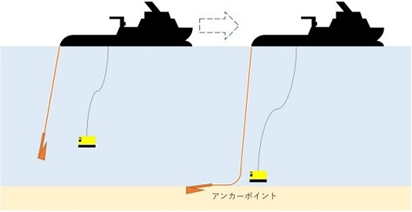
Ship classification society Nippon Kaiji Kyokai, or Class NK, and “K” Line Wind Service, published guidelines for floating towing and mooring construction used in floating offshore wind power facilities.
The document has seven chapters — covering risk management, staffing, detailed work execution, and weather forecasting.
CONTEXT: The initiative seeks to reduce the manufacturing and construction cost of floating offshore wind turbines and equipment. Mooring construction, a common installation method, requires the handling of extensive weight and high tensile force in the unstable environment of offshore locations.
Toda was selected by NEDO to develop next-gen tech for floating offshore wind.
The goal is to develop and commercialize tech that lowers the cost of spar-type floating turbines by installing wind turbines at once. It will be launched in FY2026.
CONTEXT: Toda is the operator of a 16.8 MW floating offshore wind farm being built with ENEOS Renewable Energy and other domestic partners off the coast of Goto City, Nagasaki Pref. The project was halted due to defects in two floating structures under construction. Its launch has been pushed to January 2026.
TAKEAWAY: Toda is one of the very few Japanese firms that managed to advance a floating wind power project to the installation stage, raising hopes for a speedier advancement of related tech. Japan is now seeking to expand wind power in its territorial waters with floating wind tech, which at this point is still in early stages of development. On top of that, options allowing to install several wind turbines simultaneously or within a shorter time frame will be crucial to lower project costs, which are high partly due to logistics requiring transporting turbine units to the site. If successful, Toda’s know-how on to install turbines “in bulk” may speed up Japan’s installation of wind power capacity.
Kansai Electric (KEPCO) admitted to falsely reporting information on contamination of distribution transformers on utility poles with hazardous substances.
The firm was aware the transformers were tainted with polychlorinated biphenyl (PCB) but failed to report it for about 20 years.
Kansai Transmission and Distribution President Hakugin issued an apology on Oct 1, and said the contaminated transformers must be replaced or disposed of. VP Takaichi, head of power distribution and who ordered the false reports, resigned.
INPEX is considering an investment of ¥3 trillion in the Abadi gas field in Indonesia. The firm targets an Internal Rate of Return of over 15% as a deciding factor.
Gas fields usually have single-digit IRRs, but INPEX has a higher threshold due to the huge investment, rising costs, and geopolitical risk. Exploratory drilling to confirm reserves and production levels is underway. A FID will be made in 2027.
Abadi has a projected LNG production capacity of 9.5 million tons per year, INPEX intends for this project to rival its core Ichthys gas project in Australia.
TAKEAWAY: In an unusual set of circumstances for Japanese upstream firms, INPEX was actually the entity that made the Abadi discovery, back in 2000. Since then, it has taken substantial time to advance the project in part due to the higher costs involved for this asset compared to other known gas fields globally, and also because the Indonesian government has stipulated several conditions about the sale of a portion of Abadi’s resources to the domestic market at lower prices. The complications spooked Shell, which was INPEX’s original partner in Abadi, but sold its stake in 2023 to Indonesia’s Pertamina and Malaysia’s Petronas energy companies. However, with Japan’s interest in future gas supplies remaining strong, INPEX may be tempted to take on Abadi as another mammoth project similar to Ichthys.
NYK Line and Pertamina International Shipping (PIS) will form a JV for the LNG carrier business, especially to service the Tangguh LNG project in Indonesia that’s being developed by BP and Mitsubishi.
PIS said its goal is to triple the company’s revenue to $9 billion by 2034, and to expand its fleet from 320 to 500 vessels.
CONTEXT: PIS and NYK set up a partnership in 2022, with NYK making a minor investment in PIS. To further appeal to investors, PIS plans to list on the stock market by spring 2026. While PIS has a strong presence in oil transportation, this will be its debut on the LNG shipping market.
Chairman of the Japan Gas Association and of Tokyo Gas, Uchida Takashi, discussed Japan’s difficulties in securing flexible LNG supply contracts. This is due to “destination clauses” that restrict the ability to resell shipments. He said it’s difficult for Japanese firms to commit to long-term contracts, particularly with Qatar.
Uchida has called on the govt to help negotiate more favorable terms. Japan’s utilities are reluctant to sign new contracts with Qatar, and have sought alternative suppliers in Australia and the U.S.
Around 40% of Japan’s long-term contracts could still include restrictive destination clauses by 2030. This issue comes as Japan reviews its Basic Energy Plan to determine its power mix beyond 2030.
Toyo Engineering India will set up a Global Capability Centre in India. It will do so with Offshore Frontier Solutions, a JV with MODEC.
Operations begin in spring 2025. The center will provide FEED and detailed engineering, as well as procurement support for Floating Production, Storage, and Offloading units.
JGC Corp and Technip Energies won the Front-End Engineering Design (FEED) contract for Rovuma LNG in Mozambique; it’s a JV of ExxonMobil, Eni, and CNPC.
The LNG plant will have a production capacity of 18 million tons per year.
Toyobo has developed an energy-saving device to recover lithium contained in wastewater from Li-ion batteries and their components. Toyobo MC plans to finalize the product by the end of 2024 in cooperation with a Japan-based BESS producer.
The device is equipped with a treatment membrane that concentrates lithium and other substances, extracting them in solid form.
The firm expects demand for lithium recovery and reuse to increase with the spread of EVs, and is eyeing sales in China and other overseas markets.
CONTEXT: Toyobo MC is a JV between Toyobo and Mitsubishi that deals with functional materials. Recovery from industrial wastewater has not yet spread partly due to the high cost and high amount of energy required to evaporate the water.
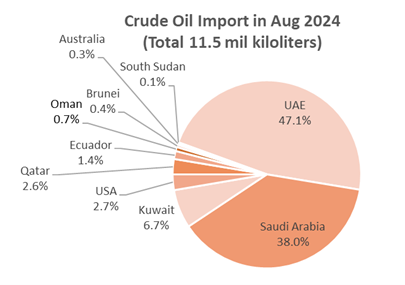
Japan imported 11.5 million kiloliters of crude oil in August. Nearly half of the total came from the UAE, followed by Saudi Arabia. Over 95% of the total came from the Middle East. South Sudan has been added as a new source for crude imports.
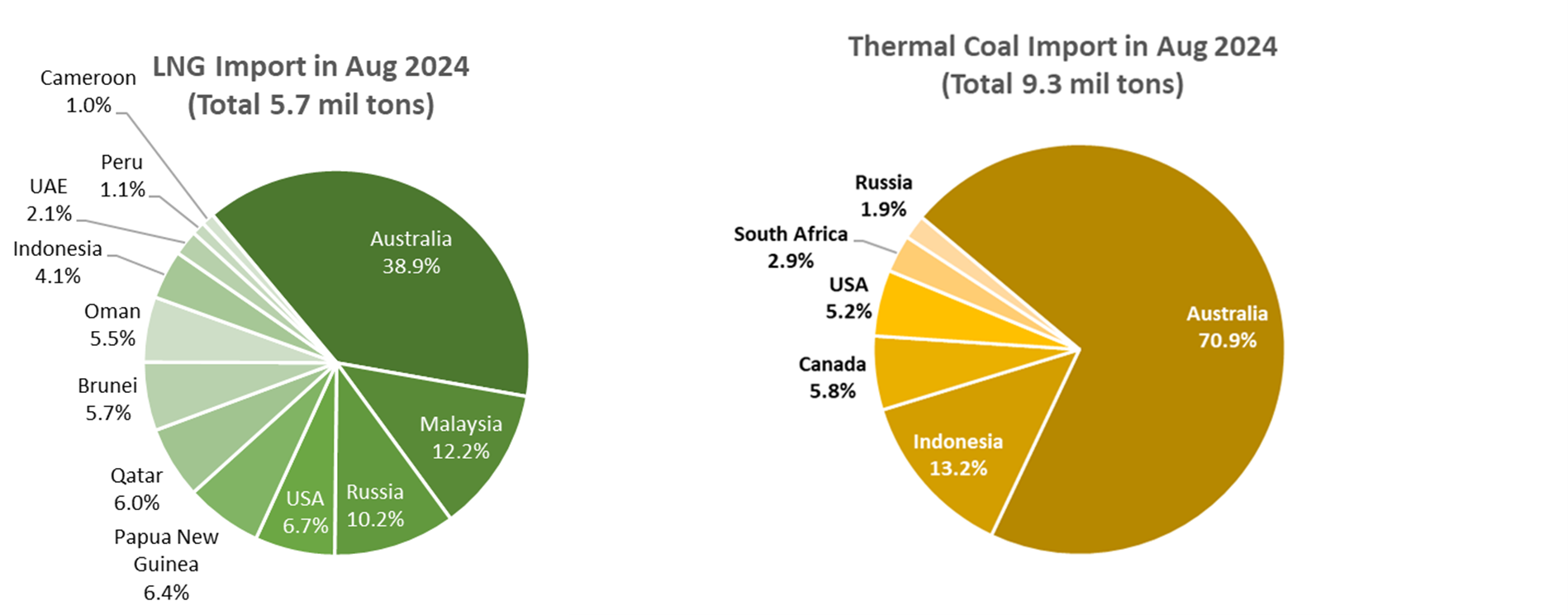
LNG imports were about the same as in July, just a 1% increase. Imports from Russia increased about five-fold (0.58 mil tons) and returned to the same level as in June. Imports from Qatar increased 85% from 0.19 mil tons to 0.35 mil tons, and supplies from the U.S. decreased 40% from 0.64 mil tons to 0.38 mil tons. Cameroon was added as a new source.
Thermal coal imports in August dropped 3.5% to 9.3 million tons. Imports from Russia tripled from 0.06 tons to 0.18 tons; those from Canada and South Africa rose by over 30%. Australia still accounts for 70% of total imports, followed by Indonesia.
LNG stocks of 10 power utilities were 1.99 million tons as of Sept 29, rising 22.1% from the previous week (1.63 million tons). This is up 21.3% from end Sept 2023 (1.64 million tons), and the same as the past 5-year average of 1.99 million tons.
CONTEXT: Electricity demand for the next two months should decline from the summer peak as temperatures cool, but early forecasts from the JMA indicate that Japan may have a colder-than-average winter.
ANALYSIS
BY FILIPPO PEDRETTI
Dry Cask Storage: Japan’s ‘Plan B’ for the Nuclear Fuel Cycle
In an effort to find a temporary solution for Japan’s growing volume of spent nuclear fuel, some utilities plan to build dry storage on their power plant premises. This stop-gap measure would run until a time when the spent fuel could be sent to an intermediate storage, and then from there, ideally, sent to a reprocessing plant if one is ever built in the country.
For decades, Japan’s nuclear industry has pursued a vision of a ‘closed cycle’, where nuclear fuel would be recycled and reused in a nearly continuous process. Yet, such plans are far from materializing. Japan’s planned nuclear fuel reprocessing facility in the village of Rokkasho is the central point of this strategy, but it has faced 27 construction delays and it’s still not clear if it will ever be built.
In the past year, efforts by nuclear power operators suggest that while they still believe in the validity of the closed cycle concept, they’re preparing for a sort of “Plan B” that involves storing spent nuclear fuel temporarily – that is, for several decades – without relying on the completion of the Rokkasho reprocessing plant.
This Plan B is led by KEPCO, the utility with the most nuclear power plants currently online. To maintain public trust in both itself and the entire nuclear sector, KEPCO is pursuing the dry cask option, especially since it can no longer delay removing spent fuel from on-site storage pools.
The situation is dire, and a solution must be implemented in the next five years, say industry insiders. The government has declared nuclear power to be essential to Japan’s energy independence and as a source of carbon-free energy. If the industry’s Plan A (closed fuel cycle and Rokkasho) fails and Plan B (dry casks) is delayed, then the promise of the benefits of nuclear energy for Japan in the coming decade will be in doubt.
What is dry storage?
In October 2023, KEPCO had to present to Fukui Prefecture a roadmap for the removal of spent fuel stored at its nuclear power plants. Ahead of removal, KEPCO announced a plan to build so-called dry storage for spent fuel at Takahama, Mihama and Oi NPPs. Such facilities would store the spent fuel in casks, after a period of cooling in the water pools.
In Japan, this method is already used at Tokai No. 2 NPP, while overseas it can be found in Switzerland and the U.S. where it was first licensed in 1986. Fukushima Daiichi also has a dry storage facility that was left unscathed by the March 2011 earthquake and tsunami.
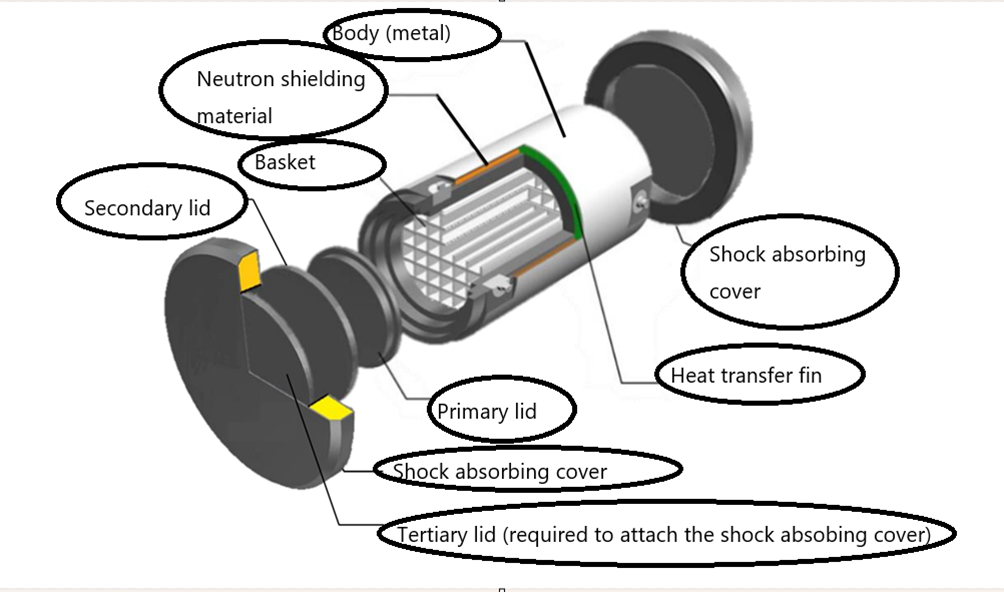
Dry storage involves placing some spent fuel, previously cooled in a pool, into a sturdy metal container called a “cask,” which allows fuel to cool by air. It doesn’t require electricity, unlike wet storage that needs power for circulating the water. This technology has four functions that are regulated:
Heat removal: The heat of the spent fuel is transferred to the cask’s surface, and is cooled by the air.
Containment: The cask’s structure seals and prevents leakage of radioactive material.
Shielding: The cask’s layers neutralize gamma rays and neutron radiation to one-millionth of its original level.
Criticality prevention: The structure of the cask prevents a fission chain reaction.
Before storing in dry casks, the fuel is held in wet storage because it’s still highly radioactive. At Tokai No. 2 NPP, the spent fuel is stored in water for at least seven years. KEPCO plans to store it for at least 15 years, but in the initial phase at Takahama NPP, the fuel will be cooled for at least 25 years before transfer to casks; at Mihama it will be 16 years.
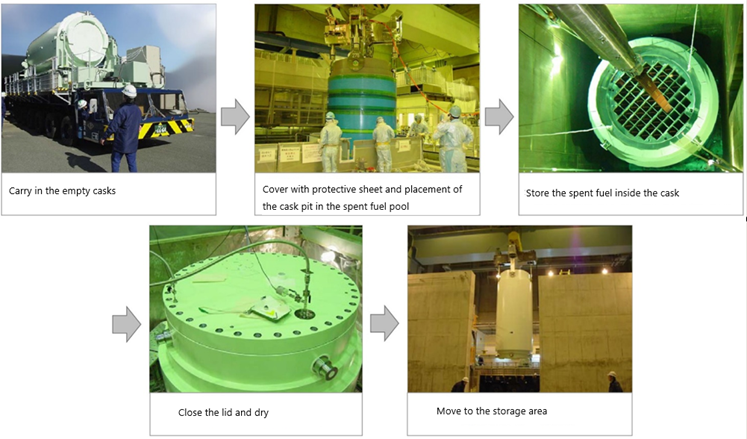
Empty casks are then moved to the reactor building, placed in a “cask pit” in the spent fuel pool, and then submerged underwater. Finally, it’s transported to the “storage area.” In KEPCO’s case, the storage period at all three plants will be 60 years.
Source: METI
Radiation levels around the cask are reduced to a level safe for workers. The cask’s surface temperature is warm but not hot. Ultimately, the goal is to transport casks from the dry storage facility to an intermediate storage facility.
KEPCO has a plan
In January, the Federation of Electric Power Companies said that in four to five years KEPCO’s spent fuel storage will reach 90% at Mihama, 98% at Oi and 100% at Takahama. To begin construction of the dry storage at its plants, KEPCO is awaiting NRA approval for reactor installation modifications.
At Mihama NPP, dry cask work will take place between 2026 and 2030; at Takahama NPP there’ll be two overlapping phases during 2025 to 2027, and 2025-2030. Finally, dry cask construction at Oi NPP is slated between 2025 and 2030. By 2030, the storage in casks will be operational at all three locations.
Mihama NPP will have 100 tons of storage, with up to 10 casks. Takahama will have 350 tons, or about 32 casks. KEPCO will deploy 22 casks (240 tons) in the first phase and 10 casks (about 110 tons) in the second. At Oi NPP, the capacity will be 250 tons, or about 23 casks.
KEPCO says that the spatial radiation dose rate outside the site boundary, including radiation from the reactor facility, will not exceed 50 μSv per year. Therefore, no negative impact is expected on the nearby environment from the dry storage facility.
The casks used by KEPCO will be about 5.2 meters long and have an outer diameter of around 2.6 meters. At Takahama, the fuel type stored will be 15×15 uranium fuel/ 17×17 uranium fuel, and will store 24 assemblies per cask. At Mihama, the type will be 15×15 type uranium fuel, and they’ll store 21 assemblies per cask. Finally, at Oi, the type will be 17×17 uranium fuel, and will store 24 assemblies per cask.
Source: KEPCO
Conclusion
Dry casks can be viewed as the utilities’ Plan B attempting to cope with the fact that Plan A looks increasingly implausible. Dry casks offer a relatively easy and seamless solution, without having to worry about the Rokkasho saga.
This solution is finding favor among other NPP operators too. In addition to KEPCO, at least five operators (Tohoku, Tokyo, Chubu, Shikoku and Kyushu) are reported to have such plans. Other NPPs considering this solution are Hamaoka, Ikata, and Genkai.
Having dry storage on an NPP’s premises can help to avoid delays and other complications related to third-party facilities, such as Rokkasho.
Dry storage means less problems with state regulators, permits and reviews. Also, spent fuel management is simplified as operators don’t have to move the fuel far from the pools.
One other advantage of dry casks is that they provide a way for operators to sidestep commitments to communities. KEPCO, for example, has breached agreements on waste management and must reckon with irate locals and municipal governments.
But while advocates tout dry storage as a proven and reliable method for nuclear waste disposal, one must remember that it’s presented as a temporary solution. The fuel is meant to be stored for about 60 years, but then it still needs a permanent storage site.
Sooner or later, the utilities will need to tackle the root problem of long-term nuclear power waste management. They’ll also have to come to terms with the viability of Plan A (the closed cycle), and face the stakeholders to whom they made promises.
ANALYSIS
BY MAGDALENA OSUMI
With Rising Wind Power Demand, Training Programs Become an Issue
As Japan seeks to expand wind power generation both offshore and onshore, the demand for skilled and certified workers capable of operating and maintaining those facilities is growing rapidly. To meet this demand, training centers are opening that offer professional safety and technical courses for engineers and other skilled workers.
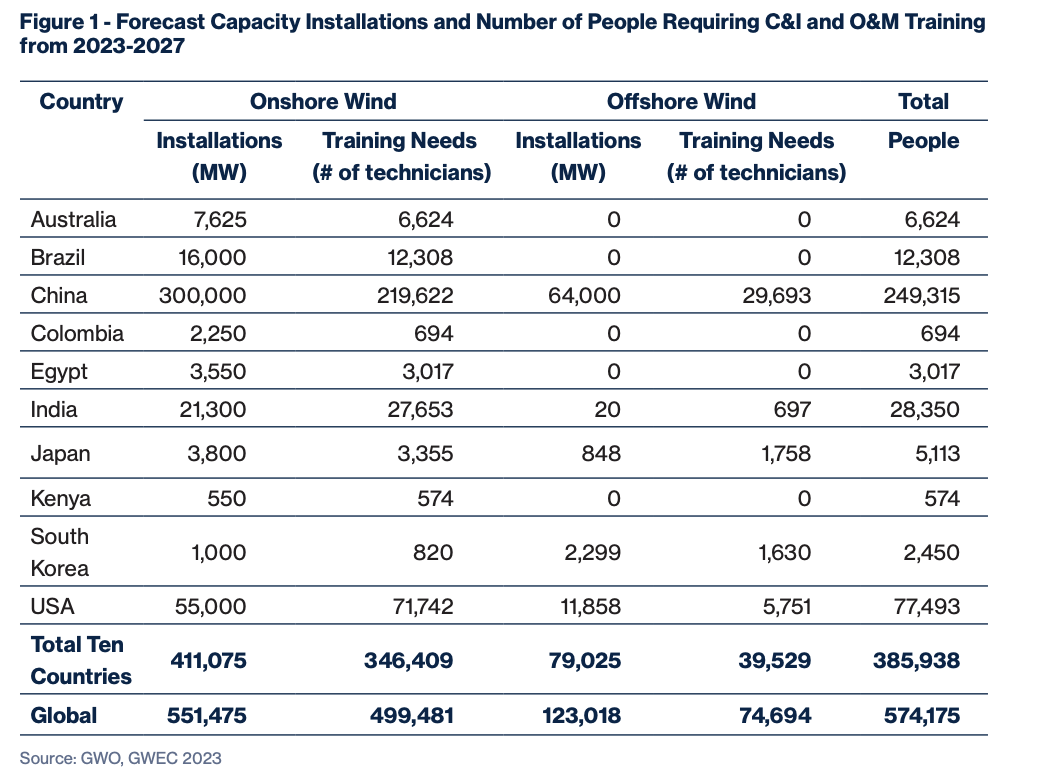
Against the backdrop of increasing demand for wind power, the Global Wind Energy Council estimates that worldwide in the next five years more than 574,000 technicians will have to be hired, with almost 43% as new talent to the industry.
In Japan, young engineers see the wind power sector as an attractive career opportunity, but students in technical programs are concerned that the current university curricula hinder acquiring skills necessary for employment at wind farms. Practical training has yet to become a fixture of university programs.
In a first, last week the Japan Wind Power Association (JWPA), the industry’s most influential organization, published guidelines aimed at standardizing training for technicians. The JWPA expects this will clarify requirements for seeking talent, especially helping to attract young professionals from other industries.
In the meantime, the private sector is picking up the slack. Mitsui O.S.K. Lines (MOL) and Hokutaku, Japan’s largest wind turbine maintenance business, are building a training center specializing in practical operation and maintenance for offshore wind facilities.
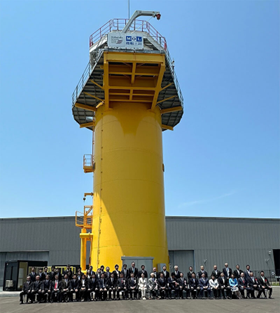
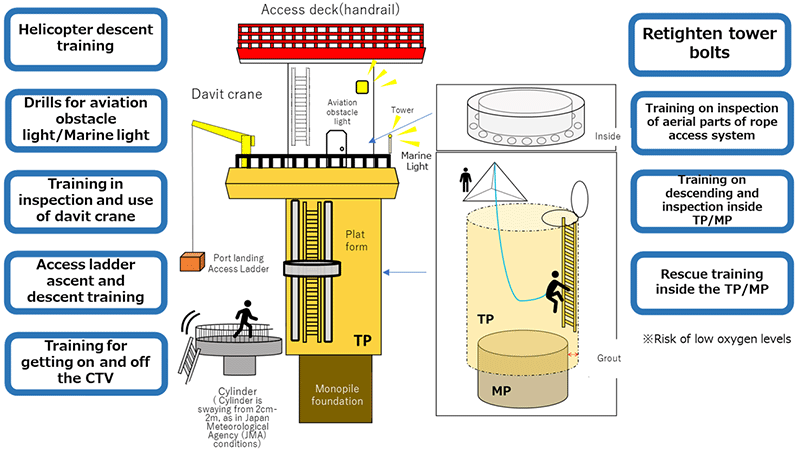
This will be Japan’s first such facility using an actual wind turbine foundation, a transition piece that connects the monopile to the wind turbine tower. Planned on the site of Hokutaku’s Kitakyushu base, this facility could become a leading center to train employees for the wind sector.
A scene from a ceremony commemorating the completion of MOL and Hokutaku’s training center.
Source: Mitsui O.S.K. Lines (MOL)
MOL/ Hokutaku training
Source: MOL
Offshore boom
As an island nation, surprisingly Japan has barely tapped into its offshore wind potential. Currently, the country only has 136 MW of offshore wind capacity installed, a minuscule fraction of the UK’s nearly 14 GW, and China’s 31 GW.
That is about to change, however, as Japan embarks on a plan to become a top producer of offshore wind energy. Japan aims to have up to 10 GW of offshore wind capacity approved by 2030 when the first projects are slated to begin commercial operations. That figure could reach 45 GW by 2040.
By 2027 alone, Japan will need at least 5,000 engineers and other trained staff capable of installing, operating and performing maintenance and repair works. German renewables giant RWE, a member of one of the consortia awarded a 684 MW project with Mitsui and Osaka Gas off the coast of Niigata Prefecture, is among those seeking to bolster staff both in Japan, as well as its other project locations.
With RWE’s Niigata project expected to come online in 2029, the German firm requires more skilled staff in the country. But it’s not the only one racing to secure talent with other firms awarded projects through public tenders are on a hiring spree. Japan’s largest utility, JERA, which leads a consortium with Itochu, Tohoku Electric and J-Power to build a 315 MW offshore wind farm near Akita Prefecture, has posted a number of job openings linked to the project. Finding skilled personnel, however, is a tremendous challenge.
To help renewables firms and developers, some local governments like Akita Prefecture are launching subsidy programs to support the growth of wind power and related sectors. Assistance is specifically given for the manufacture of wind turbine components and the development of human resources.
Source: Japan NRG
Simulating a real-life crisis
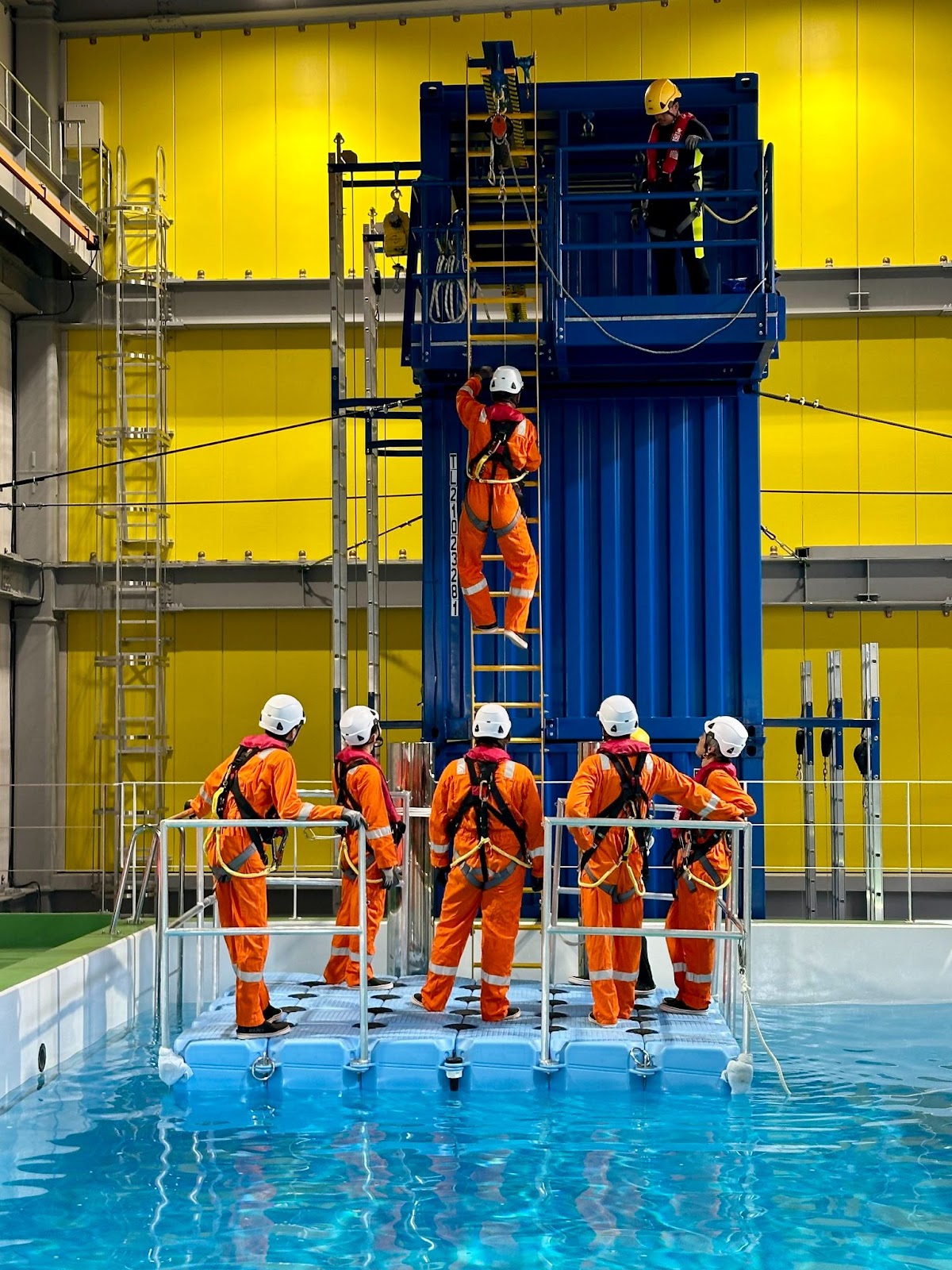
Sporting an immersion suit, a life jacket and a harness kit as part of their survival gear, one man after another descended the ladder connected to a 4-meter-high compartment. After inflating their life jackets, the men formed a human chain, stretching their legs to pull the others away from the turbine unit.
This was a simulation of an emergency to prepare workers to evacuate an offshore turbine in treacherous conditions. It took place at a training center run by GiraffeWork near the port of Kawasaki. The firm offers a full spectrum of Global Wind Organization-approved courses that equip wind industry workers with basic and advanced safety and technical skills, as well as certifications.
A subsidiary of Daikyo Kenki, a crane operator service, GiraffeWork offers training under a partnership with Danish shipping firm Maersk. The center opened in March and can accommodate up to 1,000 trainees annually. Programs cater to both onshore and offshore wind power projects.
Workers learn about height safety and rescue, as well as various emergencies such as fires. The program also includes safety and survival in sea waters such as rescue operations that require descending a turbine with injured staff.
By late FY2024, the center will have a structure resembling the conditions at a real turbine unit. While GiraffeWork isn’t Japan’s only training center for the wind power sector, it’s one of the few equipped to prepare trainees for offshore operations. GiraffeWork’s program includes fire awareness, working at heights, sea survival, electrical and hydraulic systems, advanced rescue training from nacelles, basic and enhanced first aid and other sessions. In contrast, a center run by Eurus Technical Service in Chiba Prefecture focuses on four training options: first aid, manual handling, fire awareness, and working at heights.
Estimates for skilled staff in the wind power industry
Currently, Japan has nine centers with GWO accreditation.
The programs are gaining traction thanks to efforts by the Japan Wind Power Association, the industry’s most influential organization, to standardize training. On September 30, the group published guidelines drafted in cooperation with the GWO. The instructions, issued both in English and Japanese, outline skills and requirements for novices in the operation and maintenance of wind power generation facilities, with focus on offshore wind farms.
MOL, which has a fleet that includes crew transfer vessels needed for turbine installment, operation and maintenance, will begin training workers to operate ships equipped with Dynamic Positioning System (DPS). The program offers courses that have basic approval by Class NK. The center will use a DP simulator as the first training center in Japan accredited by the Nautical Institute. Several other firms are seeking approval for their training programs.
New wind power projects will obviously require a full scope of training programs at hubs with easy access and various course options. The current number of training centers is, at this moment, inadequate to fill the job openings needed to rapidly develop the wind sector in Japan. Since most certifications have a two-year validity, even those already in the sector will need to renew their skill assessments.
The private training sector should be supported going forward with courses at universities, though the academia-private link is at a nascent stage. The development of wind sector skills at Japanese universities will be coming in an upcoming Analysis story.
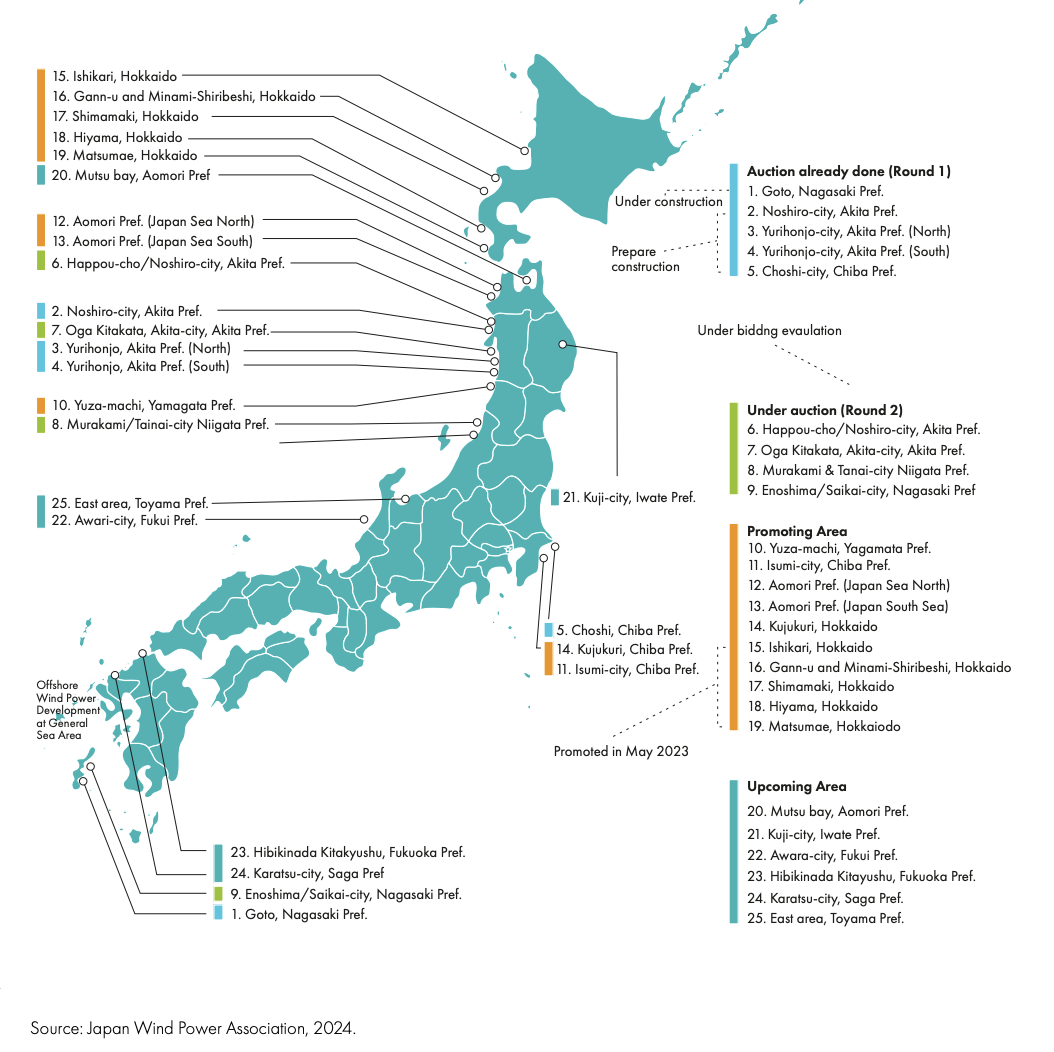
Japan’s advancement of offshore wind power generation
ASIA ENERGY REVIEW
BY JOHN VAROLI
This weekly column focuses on energy events in Asia and the Pacific
Australia / Hydrogen power
Origin Energy, the country’s second-largest power producer, will exit a hydrogen development project in the A$207 million Hunter Valley Hydrogen Hub (HVHH) in New South Wales. The utility said that while it will cease all hydrogen projects, it remains open to other options at the HVHH.
Australia / Renewables workforce
Australia needs to triple its clean energy workforce from 21,500 to about 60,000 to build and operate the infrastructure needed to achieve its 82% target for renewable energy share by 2030, said the Clean Energy Council. The country lacks workers such as electricians, mechanical trades, and electrical engineers.
China / Renewable energy
China’s outbound investment is rising from already-record levels, as the country’s clean energy tech sector is looking to set up more manufacturing operations abroad in the face of U.S. and EU tariffs. In the first eight months of 2024, investment from China into other countries rose 12.5% YoY to $112 billion.
East Asia / Renewable energy
The World Bank announced its $2.5 billion Accelerating Sustainable Energy Transition Program to support the energy transition across East Asia and Pacific. The program will add 2.5 GW of renewable energy capacity, equal to 50 utility-scale solar farms or more than 1,000 wind turbines.
Energy transition
About $115 trillion is needed to transition the global power sector and achieve net zero emissions by 2050, said Accenture Research. Broken down, $53 trillion is needed for clean power generation, $42 trillion in transmission and distribution, and $20 trillion in interim fossil fuels and alternative technologies such as carbon capture.
India / Nuclear power
The govt approved the Anushakti Vidhyut Nigam (ASHVINI), a JV of Nuclear Power Corporation of India (NPCIL) and NTPC that will build, own and operate nuclear power plants. The govt also allowed the transfer of the 4×700 MW Mahi Banswara Rajasthan Atomic Power Project from NPCIL to ASHVINI.
Singapore / Offshore wind
Enterprise Singapore, the Association of Singapore Marine & Offshore Energy Industries, and the Global Wind Energy Council inked an MoU to link Singapore with the global offshore wind sector. They will work on initiatives to expand the global offshore wind ecosystem, and fuel innovation to support the supply chain.
South Korea / Carbon-free energy
President Yoon Suk Yeol and Slovak PM Robert Fico inked a MoU on energy cooperation during Fico’s visit to South Korea. It covers carbon-free energy sources, including nuclear power, renewable energy and hydrogen.
Taiwan / Electricity rates
Home to some of the world’s biggest chipmakers, Taiwan will raise electricity rates again. Industries will see an average 12.5% hike in power prices from Oct 16. Semiconductor firms will see tariffs rise about 14%,
Thailand / Renewable energy
Global Power Synergy Public Co inked three loans worth $217 million to advance its renewable energy businesses. By 2026, GPSC aims for 65% of its total power generation capacity from renewables. The firm is expanding domestically and internationally, aiming to be one of SE Asia’s major players.
2024 EVENTS CALENDAR
A selection of domestic and international events we believe will have an impact on Japanese energy
January
First market trading day (Jan 4)
IEA “Renewables 2023: Analysis and Market Forecast to 2028” released (Jan 11)
Renewable Energy Exhibition (Jan 31 – Feb 2)
Taiwan presidential election (Jan 13)
Japan’s Diet convenes
IEA “Electricity 2024 / Analysis and Forecast to 2026” released (Jan 24)
February
CFAA International Symposium (Feb 2)
India Energy Week 2024 (Feb 6-9)
Lunar New Year (Feb 10-17)
Indonesia presidential election (Feb 14)
Japan-Ukraine Conference for Promotion of Economic Reconstruction (Feb 19)
FIT/FIP solar auction (Feb 19 – March 1)
Smart Energy Week (Feb 28-Mar 1)
March
Announcement of auction result for Offshore Wind Round 2 (for Akita Happo-Noshiro Project)
Onshore wind auctions (March 4-15; results on March 22)
International LNG Congress (LNGCON) 2024, Milan, Italy (March 11-12)
Russian president election (March 15-17)
World Petrochemical Conference, Houston, TX, USA (March 18-22)
IAEA Nuclear Energy Summit @ Belgium (March 21)
Ukraine presidential election (due before March 31)
Happo Noshiro, Murakami-Tainai, Oga-Katagami-Akita and Saikai-Eshima wind project auctions close (June 30)
July
Tokyo governor election (July 7)
7th Basic (Strategic) Energy Plan draft published (expected)
August
7th Basic (Strategic) Energy Plan draft presented to Cabinet (expected)
September
Global Offshore Wind Summit Japan 2024, Sapporo, Hokkaido (Sept 3-4)
The United Nations Summit of the Future (Sept 22-23)
Gastech 2024, Houston, TX (Sept 17-20)
IAEA General Conference
GX Week in Tokyo (expected late Sept to October)
Asia Green Growth Partnership Ministerial Meeting
Asia CCUS Network Forum
International Conference on Carbon Recycling
International Conference on Fuel Ammonia
GGX x TCFD Summit
October
IEA World Energy Outlook 2024 Release
BP Energy Outlook 2024 Release
Innovation for Cool Earth Forum (expected)
Connecting Green Hydrogen Japan 2024 (Oct 16-17)
Japan Wind Energy 2024 Summit (Oct 16-17)
Solar Energy Future Japan 2024 (Oct 16-17)
Japan Mobility Show (Oct 25-Nov 5)
November
US presidential election (Nov 5)
COP 29 in Azerbaijan (Nov 11-22)
Abu Dhabi International Petroleum Exhibition Conference (ADIPEC) 2024, Abu Dhabi, UAE (Nov 11-14)
APEC 2024 @ Lima, Peru
International Conference on Nuclear Decommissioning (TBD)
G20 Rio de Janeiro Summit (Nov 18-19)
Offshore Energy Exhibition & Conference (OEEC) 2024, Amsterdam, the Netherlands (Nov 26-27)
Biomass & BioEnergy Asia Conference (TBD)
European Biomethane Week 2024
December
Last market trading day (December 30)
Disclaimer
This communication has been prepared for information purposes only, is confidential and may be legally privileged. This is a subscription-only service and is directed at those who have expressly asked K.K. Yuri Group or one of its representatives to be added to the mailing list. This document may not be onwardly circulated or reproduced without prior written consent from Yuri Group, which retains all copyright to the content of this report.
Yuri Group is not registered as an investment advisor in any jurisdiction. Our research and all the content express our opinions, which are generally based on available public information, field studies and own analysis. Content is limited to general comment upon general political, economic and market issues, asset classes and types of investments. The report and all of its content does not constitute a recommendation or solicitation to buy, sell, subscribe for or underwrite any product or physical commodity, or a financial instrument.
The information contained in this report is obtained from sources believed to be reliable and in good faith. No representation or warranty is made that it is accurate or complete. Opinions and views expressed are subject to change without notice, as are prices and availability, which are indicative only. There is no obligation to notify recipients of any changes to this data or to do so in the future. No responsibility is accepted for the use of or reliance on the information provided. In no circumstances will Yuri Group be liable for any indirect or direct loss, or consequential loss or damages arising from the use of, any inability to use, or any inaccuracy in the information.
NEWS
・New PM vows to accelerate decarbonization; MoE minster to focus on post-Fukushima revitalization, calls for lifestyle reforms
・Japan reviews power supply measures ahead of winter to avoid shortages
・Toyota Tsusho to merge subsidiaries Eurus Energy and Terras Energy