
JAPAN NRG WEEKLY
OCTOBER 15, 2024
JAPAN NRG WEEKLY
OCTOBER 15, 2024
NEWS
TOP
- Agrisolar leader CEE bets on business model, calls for improved legal framework to foster expansion
- OCCTO discusses future grid operating capacity, load restrictions in time of emergencies, etc
- Vaclav Smil: by 2050 the global community is still likely to rely on fossil fuels for 40-60% of total energy demand
- METI announces documents adopted at G20 ministerial meeting
- Strategy proposal drafted for subsidizing PSC use
- Cabinet approved ordinances for Hydrogen Promotion Act
- South Hokkaido area eyed for 4th round of offshore wind tender
- Google might buy power from Japanese nuclear plants
- FEPC mulls receiving high-level nuclear waste from France
- RFS postpones launch of Mutsu spent fuel interim storage
- Sumitomo, K Line and Hilcorp feasibility study on CCS in Alaska
- Thermal power producers don’t bid on OCCTO’s reserve auction
- JEPX spot market prices rise, but avoid extreme spikes
- TOCOM power futures volumes plummeted in August
- Marubeni retailer signs MoU with GHRE for wind-derived power
- enechain launches automated wholesale electricity transactions
- Sala Energy to launch its first BESS with solar PV
- Tohoku Electric to restart Onagawa NPP Unit 2
- JBIC to finance power grid development in Vietnam
- S&P’s Yergin says LNG market tightness set to continue
- Japan mulls expanding LNG stockpiling to 12 cargoes a year
- IEA says could be open to stockpiling for CRMs
ANALYSIS
HARRIS VS. TRUMP: THEIR ENERGY AND CLIMATE POLICIES, AND THE IMPACT ON JAPAN
The 2024 U.S. presidential race reveals a deep divide on energy. Voters in ‘swing’ states, like Pennsylvania, where natural gas fracking is important for the local economy, are almost evenly split. The election’s outcome will have a strong impact on global energy markets and climate dialogue. As far as Japan, among the items to watch will be the new White House’s policy on LNG exports, as well as the future of ‘green’ tax credits related to clean tech investment.
POSITIVE IMPACT OF CO2 – CLIMATE VILLAIN BECOMES AGRICULTURE’S HERO
Elevated levels of CO2 are disrupting the Earth’s regular climate patterns, but this often discussed and vilified gas is also vital for the proliferation of plant life and the entire food chain on earth. Japan NRG sheds light on the under-appreciated contribution of CO2 in agriculture and how its significance is greater than ever as Japanese farms scale-up, transforming into agro-corporations.
ASIA ENERGY VIEW
A wrap of top energy news that impacts other Asian countries.
EVENTS SCHEDULE
A selection of events to keep an eye on in 2024.
JAPAN NRG WEEKLY
PUBLISHER
K. K. Yuri Group
Editorial Team
Yuriy Humber (Editor-in-Chief)
John Varoli (Senior Editor, Americas)
Kyoko Fukuda (Japan)
Magdalena Osumi (Japan
Filippo Pedretti (Japan)
Tim Young (Japan)
Tetsuji Tomita (Japan)
Regular Contributors
Chisaki Watanabe (Japan)
Takehiro Masutomo (Japan)
Mayumi Watanabe (Japan)
Events
SUBSCRIPTIONS & ADVERTISING
Japan NRG offers individual, corporate and academic subscription plans. Basic details are our website or write to subscriptions@japan-nrg.com
For marketing, advertising, or collaboration opportunities, contact sales@japan-nrg.com For all other inquiries, write to info@japan-nrg.com
OFTEN-USED ACRONYMS
|
METI |
The Ministry of Economy, Trade and Industry |
mmbtu |
Million British Thermal Units | |
|
MoE |
Ministry of Environment |
mb/d |
Million barrels per day | |
|
ANRE |
Agency for Natural Resources and Energy |
mtoe |
Million Tons of Oil Equivalent | |
|
NEDO |
New Energy and Industrial Technology Development Organization |
kWh |
Kilowatt hours (electricity generation volume) | |
|
TEPCO |
Tokyo Electric Power Company |
FIT |
Feed-in Tariff | |
|
KEPCO |
Kansai Electric Power Company |
FIP |
Feed-in Premium | |
|
EPCO |
Electric Power Company |
SAF |
Sustainable Aviation Fuel | |
|
JCC |
Japan Crude Cocktail |
NPP |
Nuclear power plant | |
|
JKM |
Japan Korea Market, the Platt’s LNG benchmark |
JOGMEC |
Japan Organization for Metals and Energy Security | |
|
CCUS |
Carbon Capture, Utilization and Storage | |||
|
OCCTO |
Organization for Cross-regional Coordination of Transmission Operators | |||
|
NRA |
Nuclear Regulation Authority | |||
|
GX |
Green Transformation |
NEWS: ENERGY TRANSITION & POLICY

Agrisolar leader CEE bets on business model, calls for improved legal framework
(Japan NRG, Oct 11)
- In an exclusive meeting with Japan NRG, Chiba Ecological Energy (CEE) said it will expand its agrisolar model that it believes can boost Japan’s food and energy security. Revenue is generated from both farm and electricity sales.
- CEE is testing the use of solar power generation with one-sided and double-sided PV cells and a ratio of inclination from 31% to 48%.
- CEE determined that crops suitable for agrisolar include satsumaimo (Japanese sweet potato), eggplants, soybeans, figs and even eucalyptus.
- CONTEXT: CEE, which is owned by tech entrepreneur Magami Takeshi, launched its first agrisolar farm in 2018, and now operates four plants across roughly two hectares in Chiba Pref with total capacity of 1 MWp. It sells the electricity via off-site PPAs.
- CEE is a member of a local consortium working on decarbonization, and cooperates with universities, public research institutions and energy firms on the use of tech to help address issues such as labor shortages.
- CEE’s study includes an analysis of a village energy management system. The firm has helped more than 300 businesses launch agrisolar farms. The company is fully electrifying farming, using different battery storage systems, including EVs and portable batteries for its equipment.
- CONTEXT: Since Japan heavily relies on food imports, and has a rapidly aging and decreasing farming population, the agrisolar model offers hope to improve food security and lower costs of local farm produce.
TAKEAWAY: While CEE’s business model is gaining interest from entrepreneurs and firms that seek to set up similar agrisolar plants, the sector faces bureaucratic obstacles. The legal framework is unfavorable given that agricultural and energy generation businesses are overseen by separate bodies (METI and MAFF). Thus, agrisolar businesses struggle with strict requirements and targets for agriculture yields and electricity generation that don’t allow for simultaneous land use for different purposes. CEE also said smaller businesses would benefit from a framework that enables them to secure funding; under the current system – companies may lose permits for use of farmlands if they do not meet crop yields even if they are also producing an additional product in the form of electricity.
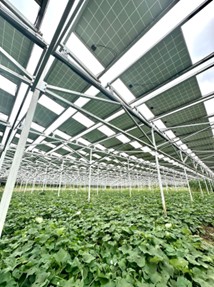
CEE’s agrisolar farm in Chiba Pref
Source: Japan NRG
METI announces documents adopted at G20 ministerial meeting
(Government statement, Oct 7)
- METI announced the documents adopted at the G20 Energy Transition Ministerial Meeting held in Brazil on Oct 4.
- The meeting focused on: 1) financing the energy transition in developing countries; 2) social aspects of the energy transition; and 3) sustainable fuels.
- METI emphasized the need to achieve climate change measures, ensure energy security and economic growth, and made the following remarks:
- All member countries must work towards the common goal of net zero.
- Japan will promote use of technologies via the Green Transformation (GX).
- Japan will foster decarbonization with technology, funding, and human resources.
- CONTEXT: The G20 Energy Transition Ministerial Meeting discussed energy policy, and aims to strengthen policy coordination and cooperation on the energy transition.
- SIDE DEVELOPMENT:
METI drafts strategy proposal to subsidize PSC use
(Jiji Press, Oct 8)- METI outlined a strategy proposal to promote the use of perovskite solar cells through subsidies to users.
- Since the price of perovskite solar panels is higher than that of conventional solar panels, METI plans to subsidize the difference. The subsidies would be offered at locations with a large area per PSC installation, such as roofs of public facilities.
- The draft includes a plan for a production system for iodine, the primary material used in PSC, and other raw materials, as well as support for international standards to promote overseas development of PSC.
ANRE reviews progress of electricity system reform for next Basic Energy Plan
(Government statement, Oct 8)
- Taking note of international experience, ANRE listed the issues vital to electricity system reform in the context of revising the Basic Energy Plan.
- The following concepts need to be addressed:
- Promote decarbonization of power sources while ensuring reliable supply.
- Establish a system for efficient use of power sources, including grid development, and flexible supply-demand management.
- Create a market for retail businesses that has stable prices.
- CONTEXT: The Basic Policy Subcommittee of METI’s Energy Council is discussing the next Basic Energy Plan, examining the ongoing electricity system reform, taking into account opinions from various industries and overseas experience. Europe, for example, has seen some declines in industrial competitiveness since it drastically reduced piped Russian natural gas in spring 2022 and sought to expedite the increase of clean energy’s share in the bloc’s energy mix.
TAKEAWAY: Essentially, the Energy Agency wants to say that the stability of supply and price are its main concerns during the transformation of the power grid and wider power sector to a decarbonized one. The Agency is concerned that rapid moves to net zero in other countries have led to increased volatility of energy systems.
Cabinet approved ordinances for Hydrogen Society Promotion Act
(Government statement, Oct 8)
- The Cabinet approved ordinances and enforcement measures for the Hydrogen Society Promotion Act, to take effect on Oct 23.
- Revisions were made to ordinances that needed to be updated, such as hazardous materials regulations, disaster prevention, earthquake measures promotion, etc.
- The application fee for the production of high-pressure low-carbon hydrogen and other gasses was set.
- CONTEXT: The Hydrogen Society Promotion Act was enacted in May, and the official regulations and other criteria were determined based on council members’ opinions and public feedback. However, the METI ordinance that defines the standards for low-carbon hydrogen, etc, has not yet been published.
Area in southern tip of Hokkaido eyed for 4th round of offshore wind tender
(Nikkei, Oct 7)
- The area off Matsumae, on the southern tip of Hokkaido, will be added to a list of suitable sites for offshore wind power projects for public tender.
- By late March 2025, METI will start accepting applications for the fourth round of offshore wind power development.
- Total capacity to be auctioned will be about 300 MW.
- CONTEXT: Hokkaido is gaining more attention from energy companies and investors partly due to plans locally for a Rapidus plant that aims to manufacture cutting-edge chips, and a data center for Softbank. Both projects will require vast amounts of electricity.
- CONTEXT: KEPCO is considering building a large-scale offshore wind farm in the area, and is assessing the project’s environmental impact. On July 31, KEPCO submitted a proposal to the Hokkaido govt.
TAKEAWAY: Since Hokkaido accounts for about 29% of Japan’s total potential for offshore wind power capacity (via fixed foundation and floating turbines), the Matsumae site is likely to draw attention from major developers. For the Matsumae offshore area to prosper, however, the govt will need to invest heavily in grid upgrades with congestion and reserve capacity shortages among local issues. And in general, as more wind power capacity is added off the coast of Hokkaido, installing more power lines from Hokkaido to the main island will be vital.
- SIDE DEVELOPMENT:
MoE urges KEPCO to reassess environmental impact of planned Hokkaido wind farm
(Government statement, Oct 11)- Environment Minister Asao called on KEPCO to revise its environmental assessment of a planned large-scale offshore wind farm near Matsumae City, Hokkaido.
- The minister requested KEPCO to:
- Ensure that the facilities are separated from residences with respect to noise and wind turbine shadows.
- Conduct surveys, forecasts, and assessments based on advice from experts in order to minimize the impact on wildlife, marine organisms and seaweed beds.
- Minimize the impact on the landscape and maintain the characteristics of the view from main viewing sites and facilities.
- The utility plans to build a 360 MW plant and considers using 15 to 25 turbines (capacity of 14 to 22.6 MW each). The site is within one of five promising zones designated by the govt in 2023.
- CONTEXT: In late July, KEPCO submitted a document on primary environment impact to the Hokkaido Pref govt and METI. This is the first official statement on environmental impact issued by minister Asao who assumed the office on Oct 1.
Google CEO: Tech giant might buy power from nuclear plants
(Nikkei Asia, Oct 3)
- Google is mulling buying electricity from nuclear power plants for use at its data centers, said the company’s CEO Sundar Pichai in an interview.
- Pichai said Google is also exploring investments into solar, thermal, and SMRs.
- The company faces major challenges as its AI operations have led to a 48% increase in GHG emissions from 2019 to 2023.
- Pichai said Google will cooperate with regulators such as Japan’s Fair Trade Commission, which began an investigation into the generative AI market.
- CONTEXT: No details have been given when or from where Google might start sourcing nuclear energy. Amazon and Microsoft are also exploring the purchase of nuclear-generated power.
FEPC mulls receiving high-level nuclear waste from France, to store at Rokkasho
(Nikkei, Oct 10)
- The vice-president of the Federation of Electric Power Companies visited the Aomori Prefectural Office, proposing a change in plans for accepting low-level radioactive waste (CSD-C) returned from France.
- FEPC proposed that an equal amount of high-level radioactive waste (HLW) is also received from France and then stored at Japan Nuclear Fuel’s facility in Rokkasho. But, the governor is opposed.
- CSD-C is regulated by an agreement between France and Japan that sets a deadline for completion of the spent fuel’s return by 2033. Since there is a large quantity involved – 1,800 units – meeting the deadline will be difficult.
- FEPC suggested exchanging the CSD-C for 20 units of HLW that are equal in terms of radiation levels. The advantage is that this would greatly reduce transport costs.
- SIDE DEVELOPMENT:
RFS postpones launch of Mutsu spent fuel interim storage
(Nikkei, Oct 4)- Recyclable Fuel Storage Co will postpone the start of its spent nuclear fuel interim storage in Mutsu.
- Originally set to launch on Oct 31, it’s now postponed to Nov 20.
- The delay is due to prolonged inspections. The facility received its first metal storage cask from TEPCO’s Kashiwazaki-Kariwa nuclear power plant on Sept 26.
Waseda Univ, TEPCO promote DR market for low-voltage consumers
(University/Company statement, Oct 4)
- Waseda University and TEPCO Holdings will cooperate in forming a demand response (DR) market for low-voltage consumers.
- To turn home appliances into stable DR power sources, compatible products and network control systems will be standardized, and manufacturers will be encouraged to develop them.
- With an eye to overseas expansion, TEPCO and Waseda Univ will draft international standards and train professionals in standardization.
- CONTEXT: This project is made possible thanks to METI’s newly established OCEAN (Open & Close strategy Exploiting Academic kNowledge), which is a certification system to promote strategies that integrate standardization and intellectual property for R&D carried out jointly by companies and universities.
Japan and Canada hold talks on battery supply chain
(Government statement, Oct 10)
- Japan and Canada state representatives held their first high-level talks in connection to the MoU signed in Sept 2023 between METI and Canada’s ministries of industry, natural resources, and foreign affairs, trade and development.
- The two sides discussed measures for:
- exchange of policy information,
- trade and investment promotion measures,
- R&D, with a view to establishing a sustainable global battery supply chain from upstream to downstream in Japan and Canada.
JERA invests in startup that pilots hourly renewables data management solution
(Company statement, Oct 10)
- Japan’s largest utility JERA invested around €1 million in French startup Granular Energy that analyzes the status of power generation from renewable energy sources.
- Granular Energy is developing a system that can determine, on an hourly basis, whether the electricity generated by both the utility and the user comes from renewable energy sources. The system has been installed in more than 10 countries.
- JERA will trial the tech, aiming to help companies monitor their CO2 emissions.
- JERA’s subsidiary JERA Cross will test the system. It plans to offer services, such as hourly certification on the use of renewable energy sources, to Japanese companies.
Sumitomo, K Line and Hilcorp to do a feasibility study on CCS in Alaska
(Company statement, Oct 11)
- Sumitomo Corp, K LINE, and Hilcorp Alaska agreed to conduct a feasibility study on CCS in Alaska. The study aims to develop a cross-border CCS value chain.
- CO2 is collected in Japan and then transported by large liquefied CO2 vessels to Alaska for storage. This is the first collaboration between Japan and the U.S. on such a project, with the goal of commercialization.
- The agreement was inked at the 4th Japan-U.S. CCUS Working Group.
- CONTEXT: Alaska, with its oil and gas development and infrastructure, is considered a prime location for CCS. It has a storage capacity of 50 gigatons, enough to store Japan’s CO2 emissions for 50 years.
- SIDE DEVELOPMENT:
Cosmo Oil, KEPCO win bid for engineering work at CCS project in Malaysia
(Company statement, Oct 8)- Cosmo Oil and KEPCO, along with several partners, won a bid for engineering design work on a CCS project in offshore Peninsular Malaysia. This project was initiated by JOGMEC, and involves designing a CCS value chain.
- The project calls for CO2 separation and capture from Cosmo’s Sakai Refinery and KEPCO’s Sakaiko Power Station. The captured CO2 will be liquefied, stored, and shipped. The study aims to design a larger facility and set up a regional CCS network.
JOGMEC and Woodside ink MoU on methane emission management
(Organization statement, Oct 7)
- JOGMEC and Woodside signed an MoU to collaborate on methane emissions management in the LNG value chain.
- JOGMEC will direct Japanese firms to Woodside to develop tech for detection and quantification of methane emissions.
- CONTEXT: The announcement comes after Woodside and Japan’s largest utility, JERA, inked a long-term LNG supply deal. Woodside will supply around 400,000 tons of LNG per year over the course of 10 years starting April 2026. Also, JERA will acquire a 15.1% stake in Woodside’s Scarborough gas field off Western Australia’s coast. The deal will be completed by December.
Nippon Light Metal, Amaz to work on low-cost, low-carbon footprint battery
(Company statement, Oct 2)
- Nippon Light Metal and Amaz Technology Consulting began developing mass production tech for li-ion batteries at low cost and with reduced carbon footprint.
- The companies plan to use oxide-based materials that do not contain rare metal elements, and have low economic risk in terms of raw material procurement.
- The firms aim to complete development of the tech by late FY2025.
Tokuyama Corp works on soda ash production from CO2
(Company statement, Oct 8)
- Tokuyama Corp is developing a process to make soda ash that uses CO2.
- Tokuyama improved the carbonation tower, aiming to increase CO2 absorption efficiency by 17%. Also, it wants to reduce electricity consumption for the carbonation reaction by 24%.
- CONTEXT: Soda ash is a chemical used in products such as glass and detergents. Tokuyama is now the only domestic soda ash supplier in Japan. Conventional soda ash production involves extracting CO2 from limestone by calcining it in a kiln.
NEWS: ELECTRICITY MARKETS

OCCTO discusses future grid operating capacity, load restrictions in emergencies, etc
(OCCTO statement, Oct 10)
- The following topics were discussed at OCCTO’s working group:
- Impact of large-scale introduction of renewable energy on operational capacity;
- Load restriction in emergencies;
- Improving the reliability of emergency power presetting switch (EPPS) operations.
- Regarding the impact on grid operating capacity due to large-scale introduction of renewable energy, the key issues were presented through an analysis from the perspective of balancing capacity and security.
- Load restriction is needed — in emergencies where the supply/demand balance collapses — in order to maintain the frequency of the power system; but further study is needed on how to respond to such situations and the technical issues involved.
- EPSS is a function that allows instantaneous power transfer from the healthy side to the deficient side when the frequency drops, but it may not work reliably under current conditions, so the set values have to be reviewed.
- CONTEXT: To discuss the optimal operational capacity, the Working Group on the Future Operational Capacity was set up under OCCTO’s Committee on the Assessment of Balancing Capacity and Supply-Demand Balance.
Thermal power producers fail to bid on OCCTO’s reserve power sources
(Denki Shimbun, Oct 9)
- As of Oct 1, OCCTO said it received no bids from thermal power producers for 1 GW of reserve power sources in the eastern and western areas for FY2025-2026, when the system will take effect.
- The reason is that power producers don’t expect to make a profit even if they win in the bidding, because it’s difficult to maintain the reliability of shuttered plants.
- It seems that ANRE is confused by the unexpected results. The agency will now re-examine not only its cost projects, but also the system’s conditions.
- CONTEXT: The reserve power source system maintains standby power that can be activated within a short period of time to provide the necessary supply capacity. The system is intended to secure future capacity alongside mechanisms such as the capacity market and the long-term decarbonization power auction.
JEPX electricity spot market prices rise, but avoids extreme spikes in Q3 2024
(Denki Shimbun, Oct 9)
- The average spot market price on JEPX during the July to September period rose to ¥14.20/ kWh, up ¥2.48 from the same period in 2023. This reflected higher demand due to record summer heat, but did so largely without extreme price movements.
- The most that prices jumped was during September, when more than half of the days saw the price surpass ¥30 due to supply constraints and high demand.
- The highest spot price for the quarter, at ¥100, occurred on Sept 23 in the Chubu area due to ongoing transmission work and lingering heat.
- SIDE DEVELOPMENT:
TOCOM power futures volumes plummeted in August
(Exchange data, Denki Shimbun, Oct 9)- Trading volumes in August fell 38.9% to 41.1 TWh, despite record-high temperatures and increased electricity demand. Without price spikes in the spot market, hedging activity remained muted.
- For the first time in nearly two years, LNG futures were traded in August, with 51 contracts settled, which is likely to fix power generation margins via spark spreads.
Marubeni’s retailer signs MoU with GHRE for supply of wind-derived power
(Company statement, Oct 7)
- Marubeni Power Retail Corp inked an MoU with Ghrepower Green Energy in Shanghai to cooperate in underwriting power from wind farms.
- The firm will negotiate a deal for supply to Marubeni New Power’s subscribers.
- GHRE and affiliates will transfer wind farms they develop to power generation firms, and Marubeni New Energy Power will exclusively negotiate until December 2026 to purchase rights for up to 50 MW for 20 years from the start of power generation.
- CONTEXT: The two companies previously collaborated in trading of renewable power from wind farms. Marubeni Power Retail is one of the new market players, referred to as shin denryoku.
Itochu firm to introduce tool for forecasts of renewables-derived electricity generation
(Company statement, Oct 3)
- Itochu Techno-Solutions will launch a forecast system to predict electricity volumes generated by wind and solar farms, ranging from a few hours to 10 days ahead.
- The service will be deployed to firms seeking to expand the use of renewables, aggregators and power generation firms. The forecast data can be used for operation planning and power generation.
- The E-PLSM Forecast uses meteorological information – wind speed and direction, solar radiation intensity, temperature, power generation records, etc.
enechain launches automated wholesale electricity transactions
(Company statement, Oct 9)
- enechain, an online wholesale power exchange, has launched a platform for automated transactions. The first was executed on Sept 9.
- The firm added a function to its eSquare exchange to enable trading participants to use algorithms to optimize power procurement.
- Until now, each seller and buyer had to make an offer, bid and conduct transactions manually. These procedures can now be swiftly completed online when power generation firms and retailers meet all requirements.
- CONTEXT: The function was added in expectation of a rise in transaction volume.
Power-X installs BESS at Okayama post office to reduce electricity cost
(Company statement, Oct 9)
- Power-X, a start-up in the storage battery sector, has installed a large-scale storage battery at a post office in Soja City, Okayama Pref.
- To reduce electricity consumption, the batteries will be used during times of high power use.
- The firm also supplies electricity derived from wind and solar power, and expects to reduce the post office’s total cost of electricity by 10-20%.
- This is the first time Power-X has installed both its own large stationary BESS and power supply service at the same location. Full-scale operation began on Oct 9.
TAKEAWAY: The move confirms the trend of co-location and hybrid projects using battery storage by combining it with, for instance, solar power generation or other services. However, it will take more time to introduce such projects on a larger scale due to the high cost of existing BESS technology.
- SIDE DEVELOPMENT:
Sala Energy to launch its first BESS with solar PV
(Company statement, Oct 4)- In summer 2025, electricity and gas supplier Sala Energy will launch its first battery storage with solar PV generation in Toyohashi City, Aichi Pref.
- It will be Japan’s first non-FIT, non-FIP co-located facility with BESS and solar. Eneres will trade the generated power.
- The 2 MW/ 7.52 MWh facility will be on the site of the firm’s biomass power plant.
TAKEAWAY: While BESS can enhance grid stability and power system flexibility, storage systems will require energy-efficient and stable grid networks. The existing networks have not yet been tested in large-scale BESS projects – Sala Energy is set to use a small-scale capacity BESS. Japan is still grappling with limited grid network capacity, since grids are not unified and need a major overall to support new renewables capacity.
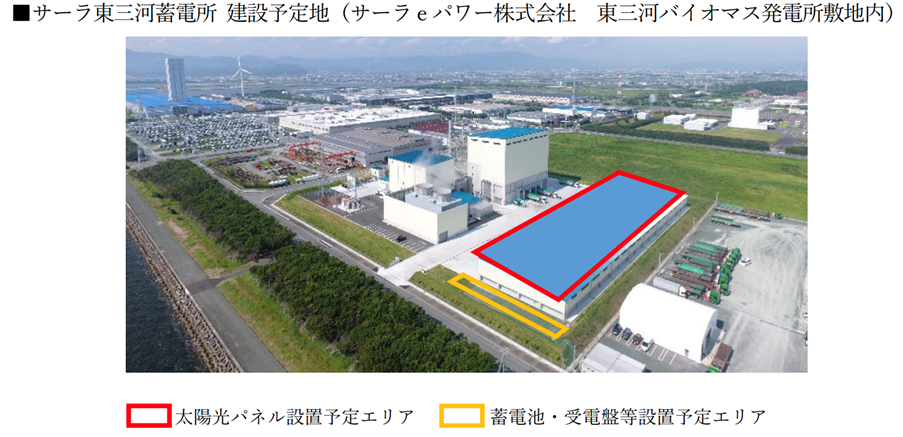
Red – solar PV; Yellow – BESS area | Source: Sala Energy
Tohoku Electric to restart Onagawa NPP Unit 2
(Nikkei, Oct 7)
- Tohoku Electric plans to restart Onagawa NPP Unit 2 (Miyagi Pref) on Oct 29.
- It would be the first BWR reactor brought back online since 2011. Power generation will begin in early November.
- CONTEXT: On Oct 5, the Miyagi Pref governor, Onagawa Town mayor, and Ishinomaki City mayor visited Onagawa NPP. They inspected safety measures completed in May, reviewing the new seawall and devices to reduce radioactive emissions in case of an accident. This was their first joint visit since August 2020, when the governor gave permission for the restart.
- SIDE DEVELOPMENT:
Kansai Electric shuts down Mihama NPP Unit 3 over piping issue
(Company statement, Oct 10)- Kansai Electric will shut Mihama NPP Unit 3 due to an incident during a routine inspection on Oct 5. Salt deposits were found at two locations on the seawater system main pipe, as well as two minor holes and thinning.
- CONTEXT: The primary system uses seawater in cooling. It removes heat from pumps and motors.
TAKEAWAY: NPPs shut down automatically in case of a radiation leak or an abnormality in the control rods. KEPCO had to shut down the reactor even though the incident does not constitute an emergency. Still, as per NRA regulations, when abnormalities occur it’s necessary to halt operation and check the piping to determine the cause.
Chubu Electric’s tsunami estimate for Hamaoka NPP approved
(Kyodo, Oct 11)
- The NRA approved Chubu Electric’s estimate of a maximum potential tsunami height of 25.2 meters above sea level for the Hamaoka NPP.
- The estimated tsunami height exceeds the current seawall height of 22 meters, indicating that additional protective measures will be required.
- Chubu Electric’s estimate is based on the scenario of a massive Nankai Trough earthquake followed by an underwater landslide off Enshu-nada, 68 km west of the plant. The NPP sits on the Pacific Ocean coast.
- CONTEXT: Chubu Electric applied for safety reviews of Hamaoka units 3 and 4 in 2014-2015, and the seawall was completed in March 2016. But it has struggled to gain regulatory approval for a restart since. The plant’s Units 3 and 4 have been offline since 2011, and tsunami height has been a key focus of the ongoing review.
Hamamatsu taps into private market as part of circular economy
(Nikkei, Oct 10)
- Hamamatsu Energy, a public-private power retailer from Hamamatsu City, Shizuoka Pref, will increase the supply of power from renewables to SMEs in the region.
- The power supply from the city’s solar power and biomass power generation at the waste treatment plant was about 39 GWh in FY2023; the company aims to double that to 78 GWh by FY2030.
- About 90% of the 520 power contracts signed in FY2023 were for public facilities such as schools, while only about 60 were for private ones.
- CONTEXT: The firm aims to introduce other renewables sources, such as hydroelectric and wind power, to bring the ratio of locally produced energy from the current 70% closer to 100%.
- CONTEXT: Hamamatsu Energy was founded in 2015 as the first municipal new power market player. The city has set up a system to provide support for decarbonization management through public-private partnerships. Hamamatsu has long been viewed as a pioneer in implementing new frameworks and business models, for instance, through projects aimed at integration of non-Japanese residents into the local community with support for schooling and employment.
JBIC to finance power grid development project in Vietnam
(Organization statement, Oct 9)
- The Japan Bank for International Cooperation (JBIC) will finance a power grid development project in Vietnam.
- JBIC and Vietnam Prosperity Commercial Bank inked a $150 million deal to support a company affiliated with state-run Electricity of Vietnam Corp (EVN).
- JBIC will provide $90 million; private banks will provide the remaining $60 million.
- CONTEXT: Northern Vietnam is experiencing severe power shortages amid increasing foreign investment in manufacturing. The country seeks to increase the share of solar and other renewables, but it has limited room for development. Electricity demand in Vietnam is expected to increase at a rate of about 9% annually.
- SIDE DEVELOPMENT:
Power firm eRex to add two more biomass plants in Vietnam
(Nikkei, Oct 10)- Japanese private power supplier eRex is building two 50 MW biomass power plants in Vietnam. Located in Yen Bai and Tuyen Quang provinces, they’re expected to be operational by 2027, and will be fueled by wood waste and other organic materials.
- Investment is about ¥15-18 billion per project, and is partly sponsored by the govt under the Joint Crediting Mechanism (JCM).
- The company will sell the generated electricity under the FIT program, alongside renewable energy credits.
- In December, eRex plans to launch Vietnam’s first biomass plant, with a capacity of 20 MW, in the country’s south.
- CONTEXT: Economic growth is spurring Vietnam’s demand for electricity, and by 2030 the govt plans to build 18 biomass power plants across the country.
Mitsubishi Power completes GTCC project in Thailand
(Company statement, Oct 09)
- Mitsubishi Power completed work on the eighth and final M701JAC unit of a 5.3 GW natural gas power plant in Thailand. This project is a JV between Gulf Energy Development and Mitsui & Co.
- The project includes two gas turbine combined cycle (GTCC) plants located in Chonburi and Rayong Provinces. They have a total capacity of 5.3 GW.
- These GTCC plants offer 64% power generation efficiency, helping to reduce fuel costs and carbon emissions.
Mie gov asks Pacifico Energy to reassess environmental impact of planned solar plant
(Government statement, Oct 9)
- Mie Governor Ichimi urged Pacifico Energy to reassess the environmental impact of its planned 89.6 MW (AC) solar plant in Tsu City.
- In his official opinion, Ichimi said the water area on the site is home to rare species such as the Baikal teal (squawk duck).
- Pacifico Energy should take measures to preserve the pond and surrounding forest.
NEWS: OIL, GAS & MINING

Vaclav Smil: by 2050 world to rely on fossil fuels for 40-60% of total energy demand
(Japan NRG, Oct 9)
- The world will still likely require fossil fuels for at least 40-60% of its primary energy production despite the vast increase in renewable energy and decarbonization efforts, said Vaclav Smil, a renowned Czech-Canadian scientist and energy policy analyst and author of several books on the sector.
- The difficulty of moving on from fossil fuels even by 2050 is that new cement, steel and chemicals factories that run on coal, oil or natural gas are being brought online today, and these facilities usually operate for at least 15-20 years. In the case of furnace-based production, facilities are not easily stopped and cannot switch to alternative fuels at scale or within budget.
- “The problem we have is not with the money or policies, it’s the scale of what we’re trying to achieve,” Smil said at the ICEF conference in Tokyo. About 40% of final energy demand is hard or impossible to electrify with current tech.
- In 2023, the world consumed nearly 55% more fossil carbon than it did in 1997 (the year of the Kyoto agreement), Smil noted.
- To hit net-zero emissions by 2050, Smil advocated for
- Using green hydrogen for only the most energy-intensive industrial processes,
- Focus decarbonization on final uses that are easy to electrify today,
- Intensify recycling of concrete and plastics
- Introduce more cellulose-based substitutes for plastics.
S&P’s vice chair Yergin says LNG market tightness will be extended
(Japan NRG, Oct 6)
- Daniel Yergin, vice chair of S&P Global and renowned energy author, forecasts that the current tightness in supply in the LNG market, which was expected to dissipate in a year or two as new production projects come onstream, will now likely extend for “another year or so”.
- Some of the U.S. projects that were expected to be ready by 2025/26 are taking more time; meanwhile, there’s additional demand from data centers, which “provide an exciting market growth opportunity for the LNG industry.”
- Yergin told the LNG Consumer-Producers Forum in Hiroshima that he believes “the world is moving in a more pragmatic energy transition in which LNG will play a role.”
- Yergin’s optimism for the sector contrasted with the more cautious outlook by Japan energy agency commissioner Murase Yoshifumi, who said the LNG sector faces a highly uncertain future due to trends in electrification, macroeconomics, and renewables development; and that both buyers and sellers need to do more to reduce GHGs throughout the LNG value chain to win support from outside the industry.
- Murase was more optimistic about the outlook for integrating LNG with biomethane, e-methane, and similar options to help with seasonal energy balancing needs and infrastructure utilization.
Japan mulls expanding LNG stockpiling scheme to 12 cargoes a year
(Reuters, Oct 11)
- Japan may expand its emergency LNG purchasing mechanism to at least 12 cargoes a year from three, said METI director energy resource division, Hasegawa Yuya. Japan wants to guard against unexpected supply shocks.
- This would boost the annual emergency stockpile buying to at least 0.84 million tons per year, from 0.21 million tons now.
- CONTEXT: China overtook Japan recently as the world’s largest LNG importer. But Japan still sees a major role for LNG buyers to trade the fuel in the global market, especially in Asia.
TAKEAWAY: Last year, METI introduced the emergency stockpile mechanism, known as the Strategic Buffer LNG, and put JERA in charge of its administration. The mechanism was implemented only during the peak power demand period of December to February, but it seemed likely that it would be expanded since three cargoes are too small to make a difference in case of a major supply chain disruption. Effectively, Japan could administer an LNG hedging mechanism simply by signing options contracts with LNG portfolio players to supply the country in times of need (or face stiff penalties). However, there were times when such options had been reneged on because the price of LNG surged, making it more lucrative to pay the fine and resell the cargo. From a Japanese standpoint, that scenario is too much of a risk. METI is pushing for a stronger stockpile mechanism to combat supply disruptions in case of extreme weather, heavy traffic in global shipping lanes or a cold weather snap at home. The majority of LNG imports take at least 10-14 days to arrive in Japan and the country lacks fuel storage facilities.
IEA could be open to stockpiling for critical raw materials: Agency director
(Japan NRG, Oct 9)
- The IEA, which was created in 1974 to provide oil supplies to member countries in case of emergency, would consider creating similar reserves for critical raw materials, said Sadamori Keisuke, IEA’s director of energy markets and security, speaking at the ICEF conference.
- “We aim to explore various cooperation among member countries to enhance security of critical minerals. In some cases, stockpiling may be the answer. Japan and South Korea already have such mechanisms. But, these critical materials are much more complicated than oil [in terms of storage]. They are basically an industrial material. So, it depends on what industrial base each country has” and whether they can accommodate such stockpiling, Sadamori said.
Japan explores further LNG cooperation with South Korea, Italy
(Japan NRG, Oct 6)
- Japan, South Korea, and Italy are studying some form of cooperation that could help in LNG procurement, seeking to join forces to enhance the importing countries’ energy security and flexibility.
- JERA and Korea Gas Corp (KOGAS) are already collaborating on joint procurement and cargo swaps, while JOGMEC and Italy’s Eni signed a preliminary agreement for LNG cooperation at the LNG Consumer-Producers Forum in Hiroshima.
- Tokyo Gas confirmed its desire to have more flexibility in its LNG contracts as the company bulks up its fleet to deliver more of the fuel to third countries. This expansion will help to increase the stability of the market, especially in times of emergency, a company executive said.
- SIDE DEVELOPMENT:
Italian energy firm Eni in talks with Japan for LNG supply
(Reuters, Oct 6)- Eni is in discussions to expand its LNG supply to Japan, aiming for both short- and long-term agreements, Cristian Signoretto, Eni’s director for global gas, said at the LNG Consumer-Producers Forum in Hiroshima.
- The company plans to increase its LNG portfolio to 18 MMT per year by 2027 and hopes to allocate some to Japan.
- Japanese buyers prefer flexible contracts without destination clauses, but the specifics of the deal are still under negotiation.
Chevron might sell its east Texas natural gas holdings to Tokyo Gas
(Japan NRG, Oct 9)
- Chevron is considering selling its east Texas natural gas holdings in Haynesville Shale to Tokyo Gas for around $1 billion. Chevron owns 72,000 acres of land in the area.
- CONTEXT: Acquiring these assets would expand Tokyo Gas’ presence in the U.S. shale market, growing its potential natural gas reserves. The company recently made a $2.7 billion acquisition of Rockcliff Energy, which produces about 1.3 billion cubic feet of gas per day.
JERA to recover critical metals from used EV batteries
(Nikkei, Oct 7)
- JERA, Japan’s largest utility, will recover critical metals from used EV batteries, such as cobalt and nickel. JERA’s goal is to raise the recovery rate to around 90%.
- It will set up a dedicated plant for this extraction in the 2030s.
- CONTEXT: Japan is heavily reliant on imports from China for such metals. Hence, the country must find ways to recycle.
- JERA’s tech does not include a heat treatment process, which halves the amount of CO2 emissions during recycling. It plans to apply high voltage in water and generate shock waves. The most conventional tech for extracting nickel and cobalt from used EV batteries is via steaming, but the recovery rate is limited to about 60% as the materials deteriorate in the heat.
LNG stocks up 1.5% over last week, and almost 8% YoY
(Government data, Oct 9)
- LNG stocks of 10 power utilities were 2.02 million tons as of Oct 6, rising 1.5% from the previous week (1.99 million tons). This is 7.8% down from the end of October 2023 (2.19 million tons), and the same as the past 5-year average (1.99 million tons).
- CONTEXT: The first half of FY2024 ended in September; power utilities adjusted their stock levels, and starting October they’ll start growing LNG stocks in preparation for winter.
ANALYSIS
BY JOHN VAROLI
Harris vs Trump: Their Energy and Climate Policies, and the Impact on Japan
The 2024 U.S. presidential race is more than just a clash of two very different personalities. When it comes to energy policy, the divide is just as deep, and may have an indirect impact on how Japan tilts its next strategic energy plan.
Voters in crucial battleground states like Pennsylvania and Michigan, where natural gas fracking is a lifeline for many local economies, are almost evenly split. Their opinion on energy and climate issues might even decide the results in those swing states, which in turn will sway the entire election. Pennsylvania is the No. 2 gas producing state in the U.S., which relies on fracked wells for over 90% of its natural gas.
As during his time in the White House, Donald Trump remains a staunch supporter of the nation’s fossil fuel industry and is skeptical of clean energy initiatives pioneered and led by G7 partners. In contrast, Vice President Kamala Harris is a loyal follower of the Democratic Party’s climate-oriented policies that have wide support among global institutions such as the United Nations, a body that Trump detests.
How that translates into voting, however, is less straightforward. For example, the majority of American states with a high percentage of wind power generation tend to vote Republican, even if overall support for renewable energy has slackened across the U.S. over the last five years.
Whatever the outcome of the Nov 5 election, it will have a strong impact on the narrative in global energy markets and climate dialogue. As far as Japan, among the items to watch will be White House policy on LNG exports, as well as the future of ‘green’ tax credits related to clean tech investment.
Meet Kamala Harris
As Attorney General in California from 2011-2017, Harris forged an aggressive track record in tackling the fossil fuel industry, winning hefty settlements against Chevron and BP over pollution violations from underground fuel storage tanks.
Then in 2019, while still a senator, Harris supported a Democratic resolution to create the “Green New Deal,” which was the first major progressive effort to shift the country toward renewable energy. During her failed effort to run for president in 2020, she went as far as to pledge a ban on fracking.
While that track record is applauded in liberal circles, today it’s costing her votes in crucial swing states such as Pennsylvania where fracking and other forms of oil and gas drilling add over $9 billion, or around 1.2%, to the local GDP. How to appeal to working class voters in the shale gas heartland without alienating her urban coastal base is the daunting challenge.
Pennsylvania was the first state outside of Texas to embrace fracking and plays host to one of the country’s biggest shale formations, the Marcellus. It is also a state where the Democratic Party is struggling to hold ground. Earlier this year, Biden paused all new LNG export permits, and Harris won’t say whether she will lift the pause.
She’s also grown shy about commenting on fracking and won’t publicly support a ban. Her opponents have seized upon this and lambasted her for flipping on the issue since she was tapped as the Democratic Party’s nominee in late July.
But are Biden and Harris really such opponents of the fossil fuel industry? Biden has been kinder to the industry than many think. While he talks tough on fighting Big Oil, he’s done little to restrict output. In fact, under Biden, U.S. oil and LNG output soared to record highs, and energy companies enjoyed vast profits. Unlike some major EU states, Biden never imposed a windfall tax on earnings made when oil and gas prices skyrocketed in 2022.
Nevertheless, this mini-boom in oil and gas was achieved while simultaneously passing historic climate legislation such as the Inflation Reduction Act, the $369 billion initiative that’s propelling America’s energy transition. If she becomes president, Harris has promised to finish implementing the IRA and accelerate the transition to clean energy.
Despite the current election rhetoric, the Democratic Party is clearly open to both fossil fuels and clean energy growth that can complement each other in a world of rising energy demand.
Harris’ activist liberal base will be disappointed if they’re expecting her to prosecute the oil and natural gas industry as she did in California. When it comes to politics on the national and international levels, life is more complicated due to geopolitical considerations and America’s obligations to allies across the globe.
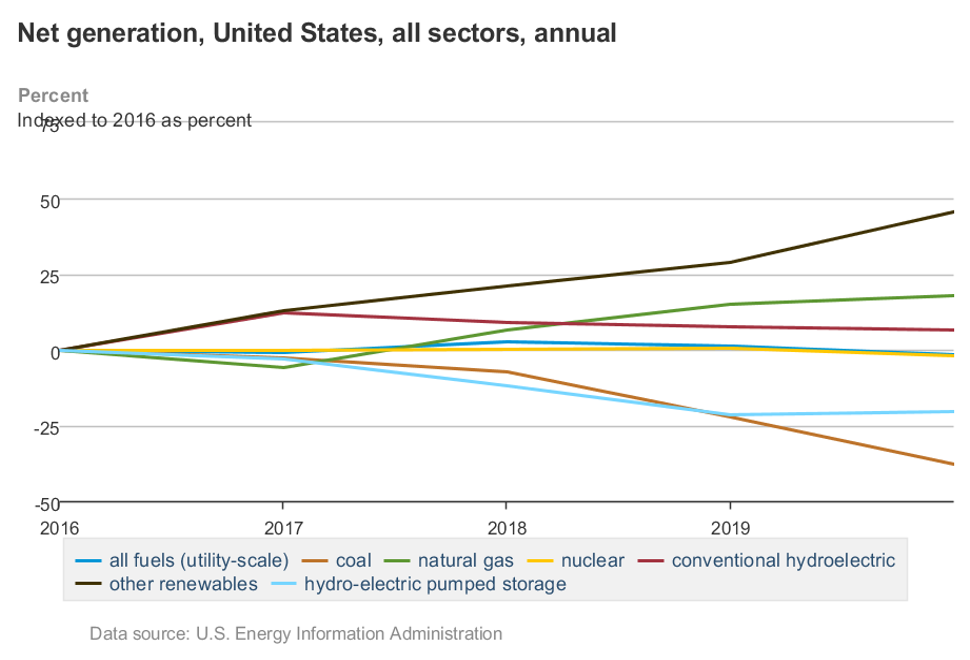
How the U.S. energy mix changed under Trump’s first presidency
Trump: What you see is what you get
Donald Trump is not shy about his plans to bring back the glory days of fossil fuels. Among his energy goals are boosting domestic oil output, refilling the strategic petroleum reserve, and expediting permits for drilling and leases on federal lands. He hammers this home with the mantra “Drill, baby, drill”.
When he was in the Oval Office, Trump launched an offensive to deregulate in favor of fossil fuels, and the U.S. became the world’s largest oil producer in 2018.
In his many recent campaign speeches, Trump paints a bleak future if Harris wins – the fossil fuel industry will collapse, to be replaced by windmills and solar panels that he claims are unreliable and will put the U.S. at an economic disadvantage. Trump also wants to roll back the IRA, claiming that it’s been a “disaster”. He wants the U.S. to regain “energy dominance” by pulling out of international climate agreements like the Paris Accord.
Even if elected president, however, that won’t be easy, and he’ll need more than his bully pulpit to push through his full energy agenda. Congress plays a big role, and many Republican Congressmen support the IRA, noting that energy tax credits have sparked technological innovation, investment, and created jobs, even in conservative areas.
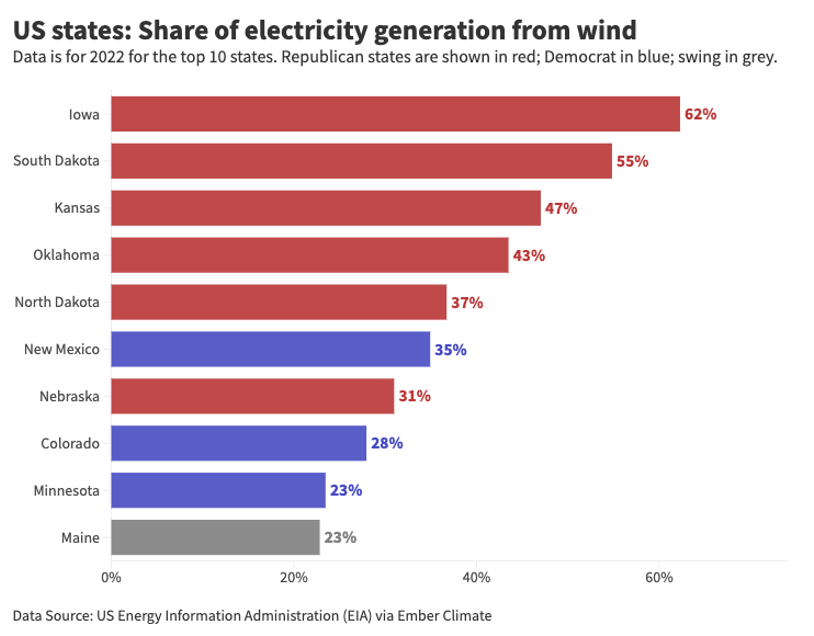
Source: Sustainability by Numbers / Hannah Ritchie
Trump dismisses wind and solar as expensive and inefficient, and he’s promised to halt offshore wind development. When it comes to EVs, Trump initially opposed Biden’s subsidies and vehicle efficiency standards, claiming they hurt the auto industry. However, after gaining the support and financial backing of Elon Musk, naturally he has modified his stance to be more open-minded on this topic.
On nuclear energy, Trump differs little from Biden and Harris, advocating for the continued operation of existing reactors and supporting small modular reactor development (SMRs).
Conclusion
As head of the world’s leading oil and gas producer, the next man or woman in the White House will have enormous power and influence to decide the course of both domestic and international policies on energy and climate.
Striking the right balance is challenging and crucial. Too much focus on climate carries the risk of alienating voters who fear higher energy prices; however, too much emphasis on drilling will undermine global sustainability goals and climate mitigation, which will complicate relations with key allies.
The next president must find a way to unify the nation around an energy policy that ensures security, fosters economic growth, and addresses the need to combat climate change. As Japan currently reviews its own strategic energy vision to 2035 and maybe 2040, it will look at what kind of cooperation and to what extent the U.S. will be able to offer.
While President Biden’s pause on LNG export approvals was understood in Tokyo as political maneuvers ahead of a closely contested election, ongoing volatility in U.S. energy policies and tax credits will surely have a significant impact on Japanese expectations for imported energy supply security and collaboration.
ANALYSIS
BY MAYUMI WATANABE
Positive impact of CO2 – Climate Villain Becomes Agriculture’s Hero
The world would be a more efficient place if carbon dioxide that factories emit was captured and transported to farms without escaping into the atmosphere.
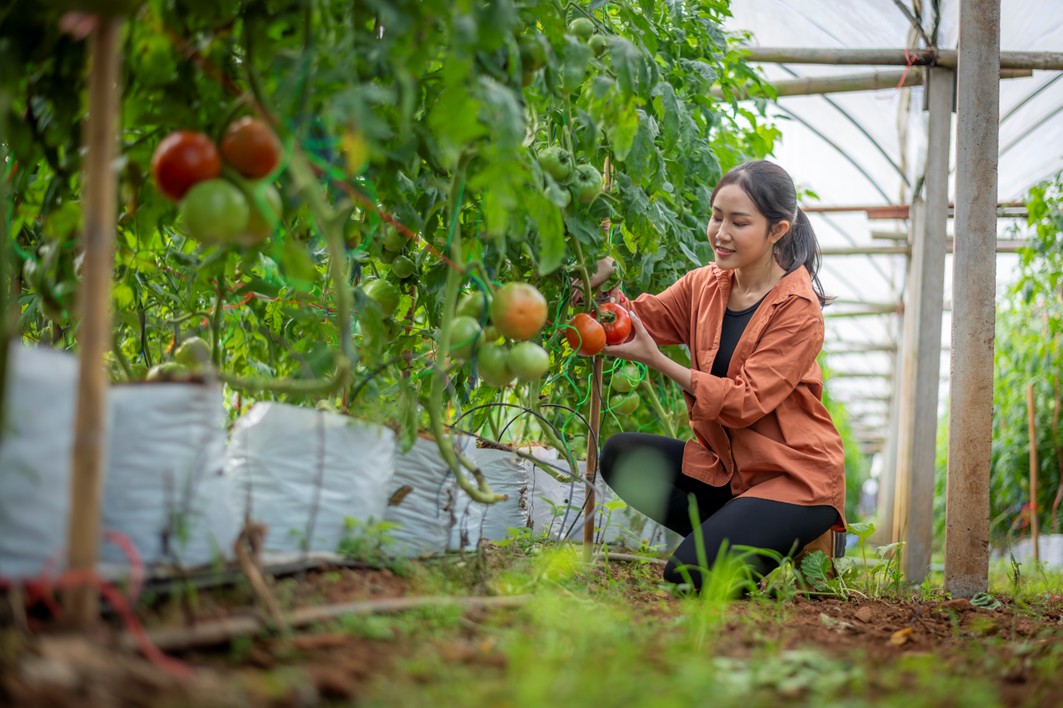
In fact, greenhouse CO2 supplementation, which is the process of feeding plants grown in greenhouses extra CO2 to enhance photosynthesis, has been practiced in Japan for 60 years. In 2018, there were 1,440 hectares of CO2-supplemented greenhouses, a figure that rose to 2,120 hectares in 2022.
Scientists say that elevated levels of CO2 are disrupting the Earth’s regular climate patterns, but this vilified gas is also vital for the proliferation of plant life and the entire food chain for all creatures on earth.
Japan NRG sheds light on the underappreciated contribution of CO2 in agriculture and how smart tech is making a difference. New solutions are spilling over into hard-to-abate sectors resulting in negative emission projects. The tightening of farm/ beverage-grade CO2 supply in the market is accelerating emission recycling not just in agriculture but also in petrochemicals.
Tomatoes love CO2
In 2022, Japan’s agricultural sector emitted 14 million tons of CO2, excluding methane and other GHGs. The emitted CO2 primarily comes from greenhouses burning fuel-oil for heating. The fuel-oil derived CO2 can’t be fed to crops because it contains over 100 parts per million (ppm) of NOx that damages plants. CO2 from factories can’t be reused for growing plants either.
Industrial-grade CO2 standards
|
Standard |
Minimum CO2 purity |
Applications |
|
K1106 Type I |
99.5% (higher moisture) |
Various |
|
K1106 Type II |
99.5% |
Various |
|
K1106 Type III |
99.9% |
Agriculture, medical |
|
Z3253 |
99.8% |
Welding |
|
FA043600, etc. |
99.5-99.95% |
Beverages, food |
|
Steel, coal power plant emissions |
10-30% (rest CO, SOx, NOx, etc) |
Steel |
|
CO2 recycled from factory emissions |
10-90% (rest CO, SOx, NOx, etc) |
Petrochemicals |
CO2 supplementation tech was imported from the Netherlands in the 1960’s. In the early days of its spread, WTI crude traded below $30/ barrel and farms were burning off kerosene or liquefied petroleum gas just to generate CO2 with low NOx. Back then, they called such CO2 “clean gas”.
Japan’s CO2 supplemented farm areas in hectares:
|
CO2 supplemented greenhouse areas |
Total greenhouse and other indoor farming facility areas |
% of CO2 supplemented area | |
|
2018 |
1,440 ha |
46,449 ha |
3.1% |
|
2022 |
2,120 ha |
37,894 ha |
5.6% |
Source: Ministry of Agriculture, Forestry and Fisheries
Today, farms use CO2 from their kerosene or LPG-fueled heating systems during winter, and in warmer seasons buy compressed 99.9%-grade CO2 from industrial gas suppliers such as Iwatani Corp.
There’s no data on CO2 system installations by crops, but the agricultural ministry believes tomatoes have the highest share. Tomatoes are also the most popular indoor crop. Kumamoto Prefecture leads Japan with the largest CO2 enriched area, as it’s also the top tomato producer. Kumamoto is not blessed with sunshine, and so CO2 supplementation gained traction.
“We didn’t promote it, there was no subsidy; it spread organically because it worked…and before we knew it, we were the forerunner of CO2 tech,” said a prefecture official. Kumamoto also has clusters of big farms that seek to streamline labor intensive processes, and are technology hungry.
Strawberries come in second, and eggplants are possibly the third. Kochi Prefecture, with the second largest CO2 supplemented area, is the country’s top eggplant producer. Tomatoes and strawberries grow well at about 2,000 ppm of CO2 intensity; lettuce at 1,800 ppm; and other crops in lower intensities.
At dawn when plants begin to perform photosynthesis, CO2 measures 500-900 ppm. CO2 starts to flow into the greenhouses from the roofs or sidewalls. The feeding stops before noon or continues into the afternoon. The procedures vary depending on the greenhouse structure and size, crop varieties and growth stages, weather, etc. The process is automated at farms with hectare-sized greenhouses.
Plant CO2 consumption rises in summer when photosynthesis is most active, but slows when it gets too hot. The threshold temperatures vary according to plants.
CO2-supplemented greenhouse area by prefecture:
|
Prefecture |
Hectares |
|
Kumamoto |
518 |
|
Kochi |
251 |
|
Fukuoka |
218 |
|
Miyazaki |
203 |
|
Aichi |
114 |
|
Tochigi |
112 |
|
Miyagi |
110 |
|
Kagawa |
67 |
|
Tokyo, Osaka, Shizuoka, Mie, Tottori, Okayama, Yamaguchi, Okinawa |
zero |
Source: Ministry of Agriculture, Forestry and Fisheries
CO2’s other heroic moments
In the last ten years, CO2 application has spread to insect control. Farms fill the ground of greenhouses with CO2, shutting them for up to one day to suffocate the insects. The CO2 pest control equipment was commercialized in the late 2010’s, but sales didn’t take off. Investment in equipment and staff training is not effective if used only once or twice a year.
CO2 is also used for post-harvest treatment of crops. Fruits contain tannins causing bitterness, but the taste becomes mellow after reacting with CO2. Also, CO2 is used to prevent worms and weevils in dry crops. CO2-based insect control techniques, however, are more widely applied in medicine than agriculture.
There are no official statistics on CO2 consumption at farms. One farmer with a hectare-sized open-roof and wall tomato greenhouse said he consumes 20 tons/ month. The consumption tends to be greater for airtight greenhouses. The total demand of CO2 for supplements, insecticides and post harvest treatment adds up to several thousand tons per month, Japan NRG estimates. This is roughly 10% of the total CO2 consumption in industries.
CO2 packed in cylinders is truck-delivered to farms, and the vehicle emissions could offset the volume absorbed for photosynthesis. Gas suppliers drive to customers in the mountains where the sun sets at 3 p.m. The state awards carbon offset credits to farms using CO2 from their heating systems, but not for the use of CO2 purchased from third parties.
“Positive impact CO2” to grow
In 1999, Japan’s total indoor farms covered 53,516 hectares, decreasing to 37,895 hectares in 2022. The decline is due to family-owned farms retiring, but state data also shows a rise in farms incorporated or owned by non-family groups; and they own larger plots of land.
Experts believe that the indoor farm space will keep stable at about 40,000 hectares. Because Japan is exposed to typhoons, farms plan greenhouses discreetly. But a new breed of tech savvy farmers, who have larger investment capacities, are emerging.
Manufacturers and energy companies are starting to farm, seeing opportunities in smart-farm solutions which are presently imported. Power utilities were at first helping farms switch to electricity from fuel oil, and some ties developed into joint ventures. The farms are test beds for analysis tools of CO2 supplementation parameters, robots for CO2-based insect control, heat pumps, etc.
Power utilities involved in the smart-farm business:
|
Affiliates |
Crops | |
|
Shikoku Electric |
Aguribon |
Strawberries |
|
Aitosa |
Shishito bell peppers | |
|
Kyushu Electric |
Kamidera Ichigo En |
Strawberries |
|
Kansai Electric |
Kanso Technos |
Strawberries |
|
Chubu Electric |
Newgreen |
Rice |
|
Tsunagu Community Farm |
Lettuce | |
|
Hokkaido Electric |
Plants Laboratory |
Lettuce, herbs |
|
Tohoku Electric | ||
|
Hokuriku Electric |
FreDelish |
Lettuce |
|
Tokyo Electric |
Saisai Seikatsu Godo |
Lettuce |
|
Shirohato Farm |
Sweet potatoes |
A system that combines CO2 recycling, utilization and automated management went on-stream in 2020. Food manufacturer Kagome started to feed CO2 emissions, via pipelines, from its LNG-fueled factory to its tomato greenhouses in Nagano Prefecture.
CO2 recycling is spreading to biomass power plants. In 2021, SymEnergy and Omnia Concerto began to study lettuce with CO2 from a biomass power station. Omnia Concerto together with Sumitomo Osaka Cement developed a bioenergy with carbon capture and storage (BECCS) model: the CO2 from the power station, after removing NOx and SOx, will feed the cedar tree plants, and when the plants grow to trees, they are used as fuel. Sumitomo launched the BECCS pilot study in August 2024.
High-grade CO2, the new heroes
CO2 has been a hero for 60 years in the agriculture sector, and other sectors are recognizing its virtues thanks to the “CO2 supply crunch”.
Presently, Japan’s CO2 demand outstrips supply as the domestic “raw gas” feedstock is becoming scarce. In 2023, the country’s CO2 imports swelled to 22,536 tons from 9,364 tons a year earlier. Prices shot up. Strong demand and prices are incentivising recycling. Cosmo Energy and Tokai Carbon, the buyers of CO2 for petrochemical products, plan to recycle their emissions for in-house consumption.
Recycling CO2 for petrochemicals products is more ambitious than for plants because of the high carbon density required. Plants can take any CO2 so long as NOx and SOx are removed.
The recycling process is simpler for NOx/SOx-free CO2: filter the emissions through desulfurization, denitration and air purifier equipment, rather than treating the gas with amine chemicals that absorb NOx and SOx, and filtering it multiple times to reach a high CO2 density. Factories already have desulfurization and denitration equipment as required by law.
The spread of “re-use” culture across industries will boost the supply of high grade CO2 and its utilization, making an overall positive impact.
ASIA ENERGY REVIEW
BY JOHN VAROLI
This weekly column focuses on energy events in Asia and the Pacific
AI / Renewable energy
The IEA predicted that artificial intelligence and data centers will sharply increase demand for renewable power, possibly tripling to 262 TWh by 2026 compared to 2023. AI’s share of demand in renewable power generation could double to 18%.
Australia / Waste power
The country’s first commercial-scale waste plant, the Kwinana Energy Recovery facility south of Perth, has launched. It can burn 460,000 tons of non-recyclable waste a year, equivalent to about 25% of Perth’s annual landfill waste,
Australia/ Solar power
Pilot Energy, an oil and gas explorer, said it received an offer from EDP Renewables APAC to take full ownership of the 376 MW Three Springs solar farm in Western Australia. The deal is estimated to be about USD 8 million.
China / Petrochemicals
China Energy Investment, one of the country’s largest miners, will begin building a $24 billion facility to turn coal into oil products and provide feedstocks to the nation’s petrochemicals industry. Located in Xinjiang, the facility will come online in 2027, and will be powered by renewable energy.
China / Renewable energy
The IEA said that China will account for almost 60% of all renewable energy capacity installed worldwide through 2030. Globally, over the next six years renewable energy projects will roll out at three times the pace of the previous six years, led by China and India.
Floating offshore wind
The global pipeline of floating offshore wind farms rose 9% YoY to a capacity of 266 GW, said RenewableUK; and the number of projects rose from 285 to 316. Currently, only 245 MW of floating wind is fully operational across 15 projects in seven countries. Globally, 102 MW is under construction, with 203 GW in various planning stages. South Korea and the Philippines have the most projects in the pipeline.
India / Oil & Gas
India will reform regulations and invite foreign oil majors to explore both onshore and offshore as it races to extract as much oil as possible while there remains a market for crude, the country’s oil and gas minister has said.
Indonesia / Biofuel
New higher biodiesel mandates in the world’s biggest palm oil producer are likely to tighten supplies of the vegetable oil. Indonesia has a mandatory 35% blend of palm oil-based fuel in biodiesel and seeks to ramp that up to 40% to cut energy imports. The plan, if implemented, could see biodiesel consumption rise to 16 million kilolitres next year.
Malaysia / BESS
Leader Solar Energy II and Plus Xnergy Services will deploy Malaysia’s first sodium-sulfur battery energy storage system (BESS). PXS will install the 1.45 MWh capacity BESS in LSE’s large-scale solar farm at Bukit Selambau, Kedah.
South Korea / Renewable energy
The IEA said that in 2023 less than 10% of the country’s electricity generation was from renewable sources, falling far short of global (30.25%) and Asian (26.73%) averages. Renewable energy accounted for less than 6% of South Korea’s total energy supply in 2022.
2024 EVENTS CALENDAR
A selection of domestic and international events we believe will have an impact on Japanese energy
|
January |
|
|
February |
|
|
March |
|
|
April |
|
|
May |
|
|
June |
|
|
July |
|
|
August |
|
|
September |
|
|
October |
|
|
November |
|
|
December |
|
Disclaimer
This communication has been prepared for information purposes only, is confidential and may be legally privileged. This is a subscription-only service and is directed at those who have expressly asked K.K. Yuri Group or one of its representatives to be added to the mailing list. This document may not be onwardly circulated or reproduced without prior written consent from Yuri Group, which retains all copyright to the content of this report.
Yuri Group is not registered as an investment advisor in any jurisdiction. Our research and all the content express our opinions, which are generally based on available public information, field studies and own analysis. Content is limited to general comment upon general political, economic and market issues, asset classes and types of investments. The report and all of its content does not constitute a recommendation or solicitation to buy, sell, subscribe for or underwrite any product or physical commodity, or a financial instrument.
The information contained in this report is obtained from sources believed to be reliable and in good faith. No representation or warranty is made that it is accurate or complete. Opinions and views expressed are subject to change without notice, as are prices and availability, which are indicative only. There is no obligation to notify recipients of any changes to this data or to do so in the future. No responsibility is accepted for the use of or reliance on the information provided. In no circumstances will Yuri Group be liable for any indirect or direct loss, or consequential loss or damages arising from the use of, any inability to use, or any inaccuracy in the information.
K.K. Yuri Group: Hulic Ochanomizu Bldg. 3F, 2-3-11, Surugadai, Kanda, Chiyoda-ku, Tokyo, Japan, 101-0062.