After years of planning, new hydrogen and ammonia projects were expected to get the green light in 2024 with the rollout of state subsidies. Progress remains uneven, however. Key details on when the application process for state subsidies begins, and some other parameters, remain unclear. As the next steps for PM Ishiba are uncertain, few see METI signing off on any major hydrogen developments in the immediate future.
To realize the government’s clean energy goals for 2030 and beyond, the offshore wind power sector is in dire need of tens of thousands of qualified and motivated workers. Existing private training centers can only partly fill the void. The lack of structured university programs to prepare a permanent offshore wind power workforce is raising concerns about whether Japan is ready to build and maintain large-scale projects for decades to come.
ASIA ENERGY VIEW
A wrap of top energy news that impacts other Asian countries.
EVENTS SCHEDULE
A selection of events to keep an eye on in 2024.
JAPAN NRG WEEKLY
PUBLISHER K. K. Yuri Group
Editorial Team Yuriy Humber (Editor-in-Chief) John Varoli (Senior Editor, Americas) Kyoko Fukuda (Japan) Magdalena Osumi (Japan Filippo Pedretti (Japan) Tim Young (Japan) Tetsuji Tomita (Japan)
The Hydrogen Society Promotion Act passed by the Diet in May went into force on Oct 23. ANRE also published initial guidelines for applications for hydrogen/ ammonia purchasing subsidies, which are often referred to as the Contract for Difference (CfD) scheme.
ANRE said the timetable will be disclosed “in a little while” with the start and deadline for subsidy applications unclear.
CONTEXT: Earlier this year the government announced the allocation of ¥3 trillion to subsidize the purchase of low-carbon hydrogen or ammonia. The CfD subsidies would pay the price difference between buying conventional fuel and clean hydrogen/ ammonia alternatives.
CONTEXT: The Act is meant to support the creation of several hydrogen hubs nationwide that would include infrastructure for importing, storing, moving and utilizing hydrogen and related clean fuels.
Overseas producers of low-carbon hydrogen or ammonia won’t be able to apply for the CfD subsidies directly. Only domestic producers or Japan-based entities engaged in importing and/or distributing the fuel in the country can apply. Overseas producers can partner with domestic partners on hydrogen supply chains in Japan.
Also, companies involved in storage and domestic transport of hydrogen will be able to apply for subsidies to cover part of the FEED engineering and construction costs.
TAKEAWAY: See this week’s Analysis section for a detailed breakdown of the subsidies and their outlook.
KGC, 51% owned by Kitahama Capital Partners, signed an MoU with Hydrexia Singapore to develop hydrogen supply solutions in Japan.
Initial efforts focus on the Ninja Energy Data Center where hydrogen-fueled cells provide power, improving energy efficiency through heat recovery and facilitating a sustainable power source for RE100 clients.
Hydrexia will provide magnesium-based, solid-state hydrogen storage technology, offering a safer alternative to compressed hydrogen and enabling efficient hydrogen production, transport, and storage.
METI and MoE drafted a report on legal issues and concepts for the CO2 emissions trading system to be launched in FY2026.
The report addresses concerns about “carbon leakage,” where companies might relocate to countries with lower carbon costs, and suggests that the government provide support to prevent industries like steel and chemicals from moving abroad.
To ensure fair emissions pricing, it advocates for mandatory centralized trading to avoid market fragmentation and imposing fines proportional to emission allowances.
Further discussions on the trading system’s design, including mandatory corporate participation and certification systems, are ongoing in a dedicated carbon pricing working group led by the Cabinet Office.
The main points to codify in civil law are rights pertaining to emission allowances, rules for the trading of emission allowances, and the relationship with existing laws such as the Civil Execution Act and Bankruptcy Act.
In emission trading allowances, major issues are discipline for traders and brokers, discipline for emission allowance exchanges, and measures against unfair trading.
For a smooth operation of the emissions trading system, accounting must ensure stability, predictability, and transparency between companies.
CONTEXT: A legal review is necessary because the purpose of Japan’s emissions trading system is to reduce GHGs in an economical manner, to “promote a smooth transition to a decarbonized, growth-oriented economic structure” as stated in the GX Promotion Act, and to “contribute to the improvement of people’s lives and the sound development of the national economy.”
TAKEAWAY: Once Japan’s carbon credits market is fully operational, it could easily become as large as any of the existing domestic energy markets. The move toward this, however, will be gradual as numerous adjustments will need to be made in the operation and reporting of manufacturing and other businesses.
ANRE updated its estimates for thermal and nuclear generation costs in FY2040.
Thermal power generation includes conventional thermal power, thermal power with CCS, and co-firing and exclusive use of hydrogen and ammonia. The main differences from the previous estimates set in FY2021 are:
Coal-fired and oil-fired power plants are only a reference in 2040 due to the difficulty of building new plants.
Shipping will also be included in the reference cost because vessels are expected to be used to transport CO2 from power plants with CCS.
Co-firing is set at 10% hydrogen, and 20% and 50% ammonia, and it’s assumed that “blue” fuels will be imported from overseas and “green” fuels will be produced largely domestically.
Nuclear generation assumptions have been updated as follows:
Capital and O&M costs are calculated based on the latest plant data.
Additional safety measure costs reflect the latest estimates.
Accident risk response costs are expected to decrease due to new safety measures, but will be further quantified.
Nuclear fuel cycle costs are estimated to increase.
Renewable energy and cogeneration systems/ fuel cells were discussed at the second WG meeting in August; a major discussion will take place at the next meeting.
CONTEXT: As the government moves forward with its review of the Basic Energy Plan, the “Power Generation Cost Verification Working Group” was launched in July to estimate the power generation cost of each power source. Before the current Sixth Basic Energy Plan was finalized in October 2021, the cost of power generation was examined in the same way.
ANRE proposed a revision of FIT/ FIP certification in order to be compliant with a new Ministry of Defense rule to prevent radio interference from wind turbines.
When installing onshore wind turbines, it’s necessary to notify the Minister of Defense before the start of construction; and if there’s an impact on defense radar, construction is prohibited for up to two years.
FIT/ FIP certification for onshore wind will be “conditional” while any possible radio interference is investigated; if any is found, certification can be revoked.
CONTEXT: This new regulation is due to the large number of wind turbines that could potentially interfere with radar used by the Self-Defense Forces, as well as with radio communications between satellites and ground stations.
The Institute of Energy Economics, Japan released its “IEEJ Outlook 2025”, a forecast of global energy supply/ demand through 2050.
The assessment is made using both a “Reference Scenario” that assumes a continuation of past trends, and an “Advanced Technologies Scenario” that assumes the maximum possible deployment of new energy and environmental technologies.
Global primary energy demand will increase 14% (over 2022 levels) in the Reference Scenario; but would decline 6% after peaking in 2030 in the Advanced Technologies scenario.
In both scenarios, primary energy demand in developed countries and China is on a downward trend; meanwhile, other emerging and developing countries, including India and ASEAN, are the main drivers of increased demand.
Energy conservation, renewable energy, and CCUS are particularly effective means of reducing CO2 emissions.
Demand for fossil fuels is highly uncertain.
The report examines the role of LNG and natural gas, and energy security risk scenarios as ways of dealing with the uncertainty of the energy transition.
LNG will continue to play an important role and demand will grow.
Various risks impact the stability and security of energy supply; and the risks of underinvestment in fossil fuels, geopolitics, destabilization of electricity supply, critical minerals supply, and cyber-attacks are particularly important.
CONTEXT: The IEEJ publishes its global energy supply/ demand outlook annually using its own energy model that’s also used in ANRE’s Long-term Energy Supply/ Demand Outlook and in calculations of power generation costs. The IEA’s “World Energy Outlook” and the U.S. Energy Information Administration’s “International Energy Outlook” are both well-known global energy outlooks. Since the three outlooks are based on different scenarios, they’re used as a reference for comparison.
TAKEAWAY: The IEEJ is the closest think tank to METI so it is safe to assume that its forecasts will be reflected in the upcoming new Basic Energy Plan. Among the many takeaways, one that stands out is the support for continued usage of LNG, which is expected to gain stronger support in the next Plan.
ANRE proposed requirements for certification as a “long-term stable qualified solar power operator” that will consolidate and efficiently operate small low-voltage solar power businesses.
The requirements include:
It must be a responsible entity that can earn local trust;
Long-term business operations are expected;
Projects can be implemented without the FIT/ FIP systems.
TAKEAWAY: Starting spring 2025, the government plans a system to certify operators that can carry out renewable energy power projects as “long-term stable qualified solar power operators”, and to discuss measures to promote business consolidation. There are several ways to read this. One is that a certification will raise the barrier for entry, further filtering out the operators without strong experience or desire to invest in the solar industry over the long term. The initial result may be a drop in the total number of developers in Japan. However, this certification may also be used to improve trust in new projects with local communities, which should help to improve the rollout of new capacity over the mid to long term.
ANRE proposed to strengthen cyber security measures for distributed power sources.
Due to their limited impact on the grid, distributed power sources have not faced strict cyber security measures compared to large-scale power plants; but there have been cyber-attacks probing their vulnerabilities.
Even in the case of small-scale solar power generation, it is necessary to strengthen cyber security because any device connected to the Internet may become a target.
CONTEXT: As DX progresses, the threat of cyber-attacks is on the rise, and the electricity sector requires ongoing efforts to improve cybersecurity. METI’s Power Sub-Working Group of the Industrial Cyber Security Study Group is charged with this task.
Idemitsu and Mitsubishi Corp will explore efficient operations for clean ammonia carriers and shipment terminals, as well as participation in ExxonMobil’s low-carbon hydrogen and ammonia project in Baytown, Texas, and the offtake of ammonia.
The Baytown project aims to capture 98% of CO2 emissions, with FID expected in 2025 and production set to begin by 2029. It will produce 900,000 tons of hydrogen and over 1 million tons of ammonia per year.
Idemitsu plans to use its Tokuyama Complex in Yamaguchi Pref as a key ammonia import hub, with a target of supplying over 1 million tons annually by 2030 as a fuel and a raw material.
Mitsubishi is considering converting its Namikata LPG Terminal in Ehime Pref into an ammonia terminal, setting up a supply hub to serve end-users from the power, transport, and chemicals industries.
INPEX and Chubu Electric will study a CCS value chain for Japan and Australia. CO2 would be captured in Japan and sent from Nagoya port to Australia for storage.
The goal is to start CO2 injection around 2030. INPEX, along with TotalEnergies and Woodside, holds a GHG storage permit in Australia’s Bonaparte Basin. INPEX is targeting 2.5 million tons of CO2 injection per year by 2030.
CONTEXT: INPEX operates the Ichthys LNG Project off the coast of Northern Australia and has plans for CCS projects to store its CO2 emissions.
Akita Pref held a seminar on CCS to encourage local companies to participate. About 70 representatives from Akita-based companies attended.
A representative from Itochu Corp’s CCS business unit reported on the progress of the “CCS Project for the Japan Sea-side Tohoku Region.” The project proposes capturing and transporting up to 1.5 million tons of CO2 per year.
The CO2 to be captured is from the Nippon Steel Oita Works and Taiheiyo Cement’s DC Kawasaki Plant. Storage will be on Akita’s coast, with Akita and Funakawa ports serving as potential liquefied CO2 receiving bases.
The project is still in a research phase. An FID is expected by late FY2026. Seven companies, including Itochu and Nippon Steel are overseeing the project.
Osaka Gas is developing DAC technology to extract CO2 from the atmosphere, completing a prototype using materials with micro-scale pores; this increases the surface area for more efficient CO2 absorption.
The device is being tested at a research facility in Osaka, and incorporates a porous material called metal-organic frameworks (MOFs) combined with amines.
Thanks to MOFs, the device can reduce energy consumption by 50% compared to existing DAC technologies.
Ventuno seeks certification for carbon credits for CO2 absorbed by seaweed. The Fukuoka-based beauty industry company specializes in health foods and cosmetics. The seaweed is farmed in Itoshima City, Fukuoka Pref and is used as an ingredient.
Discussions center on using “J Blue Credits” to certify CO2 absorption by seaweed. Itoshima City and the Itoshima Fisheries Cooperative are also participating.
Cosmo Oil Marketing is testing “Cosmo Zero Carbon Credit” that uses the J-Credit scheme to offset CO2 emissions from fuel oil consumption.
Cosmo Oil plans to launch the service in 2025 and will allow customers to offset emissions without registering for J-Credit trading themselves.
TAKEAWAY: Cosmo Oil’s initiative is an attempt to open the carbon credit market to a wider range of participants, such as smaller businesses and municipalities. In general, the market faces high costs and complex regulations, discouraging smaller players.
Japan’s airlines have a jet fuel shortage problem, leading to cancellation of flights and entire routes. Narita airport has had about 60 flights canceled each week.
The issue stems from reduced oil refining and shipping capacity due to declining gasoline demand. Only 19 refineries remain in Japan, half the number in 2000.
There are also problems with logistics. The consolidation of petroleum products distributors has reduced the number of transport vehicles.
The govt seeks to improve logistics and asks airlines to post fuel needs in advance.
CONTEXT: Declining refinery capacity is directly related to the effort to transition away from fossil fuels to clean energy. For example, the push to expand the public’s fleet of EVs has led to a decrease in demand for petroleum products. In this context, the jet fuel scarcity is not surprising, though certainly unintended.
TAKEAWAY: The jet fuel shortage is impacting tourism. The number of international flights are still down 30% compared to pre-pandemic levels. Meeting Japan’s goal of 60 million annual inbound visitors by 2030 will be difficult if the jet fuel deficit isn’t solved. But the other major issue involved here is logistics. Moving the fuel from refineries to airports and between terminals requires a large fleet of trucks. A shortage of truck drivers and this year’s new restriction on overtime hours have strongly affected the fuel supply chain.
The head of the Petroleum Association of Japan called for regulations to urge airline companies to use sustainable aviation fuel (SAF).
The existing policy requires oil wholesalers to supply a certain amount of SAF, but it does not require airlines to use it.
Kito Shunichi, who is also the president of petroleum firm Idemitsu Kosan, said on Oct 24 that “Regulations and systems are needed to promote understanding among airlines and (encourage) the use of SAF.”
He added that the cost of building SAF production facilities has been rising, and called for more state support.
A new working group on clean energy industry policy comprising members from EU and Japan held its first meeting on Oct 24, with the participation of METI’s coordinator for international decarbonization policy, and the head of the European Commission’s Energy Platform Task Force.
This is a forum to discuss building a clean energy supply chain, as based on an agreement reached at the EU-Japan Hydrogen Business Forum in June.
Consumer electronics firm Yamada Holdings began selling Powerwall, a compact home storage battery made by Tesla. The company expects demand for home-use storage batteries to increase with the spread of solar power.
Powerwall has an energy storage capacity of 13.5 kWh and a rated output of 5 kW.
NEWS: ELECTRICITY MARKETS
EEX to launch electricity options from Q1 2025, add new contracts
(Japan NRG, Oct 23)
The EEX said it will roll out new derivatives contracts in Japan starting Q1. Option on electricity prices, as well as daily futures contracts for the Kansai area, will be added to the offering.
The exchange is also looking at adding long-term duration contracts, for up to five or six years, to cater to generators looking to hedge cash flows over the longer period.
The options contract price will be calculated as the average of electricity spot prices during the delivery month (average price options). This will be available for both the Tokyo and Kansai area, and up to nine months expiries.
The EEX will also switch its annual futures contracts from calendar year to fiscal year (starting April 1) to accommodate common practice in Japan. Fiscal year contracts will be available for both base and peak loads, and for the Tokyo and Kansai areas.
Finally, the EEX plans to open an exchange order book for Japan power futures (between 4-6pm Tokyo time) to pool liquidity with traders and brokers operating in EU electricity markets. Demo testing of the new function starts in December. CONTEXT: The EEX electricity futures market has seen rapid growth since launched about four years ago. TOCOM also offers electricity futures trading, but EEX has a dominant market share.
TAKEAWAY: Options have been something that a large number of power traders have asked for in Japan, and such contracts have considerably bolstered trading volumes in other countries. In this sense, the news has been well received by market participants. Almost as significant will be the opening of the order book to pool liquidity with capital trading during European hours. This should continue to bolster overall volumes and incentivize “integration” of Japanese and European electricity trading, if not from a price-setting perspective then from an operational standpoint and in terms of capital allocation.
SIDE DEVELOPMENT: Citadel-owned Energy Grid says its new owner will help expand volumes (Japan NRG, Oct 23)
Energy Grid, a Japanese power wholesaler acquired by U.S. hedge fund Citadel, will be able to tap into its parent company’s capital strength to expand the scale of its trading transactions and offer more opportunities to hedge long-term price fluctuations, said Kinoshita Yohei, president of Energy Grid.
The firm currently has “flat” exposure in the power futures market, Kinoshita said.
The Intercontinental Exchange (ICE), owner of the New York Stock Exchange, plans to enter the Japan market to offer trading in electricity futures contracts.
Trading is due to start on Dec 9, subject to regulatory approval.
The exchange described a 24-hour base and an (8am-8pm) peak load contract in each of the Tokyo and Kansai areas. The financially settled contracts will trade in yen. Unit of trading is 1 MW; the minimum price change will be ¥ 0.01/ kWh.
The trading in Japanese contracts will be operated by ICE’s Futures Europe Rulebook.
CONTEXT: Currently, the power futures market in Japan is split between Germany’s EEX, which has the dominant volume share, and the Tokyo Commodity Exchange, or TOCOM, which is a unit of the Japan Exchange Group (JPX).
CONTEXT: According to EEX, as of September, the number of clients trading more than 100 GWh per month on the exchange had increased to 25, which is 3.6 times that of a year earlier. The number of clients trading more than 500 GWh has also increased from zero to nine.
TAKEAWAY: This year’s power futures trading volumes will exceed those of last year by several times amid growing interest in hedging risks and locking in future electricity prices against volatility in weather, politics, and fuel costs. Still, ICE is one of the world’s biggest marketplace operators and its entrance to Japan has caused a stir among market players. Yet, it starts about five years behind the EEX and TOCOM. Another U.S.-based exchange, the CME, already tried to enter the Japanese futures market without gaining traction. Should ICE attract a new pool of capital that’s currently not invested in Japanese power derivatives, then it will likely do well, essentially replicating the approach of the EEX. Otherwise, it may need to battle with the EEX for clients. While the market is growing rapidly, there are plenty of revenue opportunities for all exchanges. Building a client base in Japanese power, however, is not so simple. Meanwhile, the existing players have evolved their products and are adding new contracts, such as options. This is definitely an area to watch.
METI wants power retailers to take on greater responsibilities: Terazawa
(Japan NRG, Oct 23)
Recent policy discussions inside METI aim to increase the responsibility that power retailers have to their customers – the end-users of electricity, said Terazawa Tatsuya, CEO of the Institute of Energy Economics, Japan (IEEJ), during Power Week.
CONTEXT: METI is anxious to avoid a repeat of the 2022 situation when a sudden surge in prices left a significant minority of power retailers unable to secure the necessary electricity volumes on the wholesale market and then filed for bankruptcy or simply abandoned the sector altogether. Around a fifth of firms with a power retailer license exited this business, which forced the major power utilities to take on those customers as providers of last resort. The situation caused confusion and concern among end-users, power suppliers and energy officials.
How METI will seek to increase the scrutiny on retailers is as yet undecided, but according to Terazawa, who sits on several government energy committees, one solution could come through encouraging retail firms to have a varied portfolio for their electricity procurement.
Retailers should avoid relying on the wholesale market for all of their volumes and instead aim to ensure that a portion of their supply comes via long-term contracts, etc. Retailers should also actively use the futures and other derivatives contracts to hedge their positions, Terazawa said.
TAKEAWAY: To date, METI has issued over 700 power retail licenses amid a rush to increase competition in the sector since the 2016 electricity market liberalization. METI somewhat regrets its fully open approach after some retailers left consumers stranded. Today, acquiring a new license to retail electricity in Japan is said to be increasingly difficult and some companies entering the market chose to buy existing license holders as a way to cut through the bureaucracy. The upside from stronger regulation of retailers will mean that firms that currently hold a license, but are largely dormant, will likely find it unattractive to maintain it. As a result, they will either seek to sell out or cancel their permit. Either way, the quality of the remaining retailers should improve and a greater percentage will be active.
JEPX announced results of the second base load market auction for FY2024, showing increased one-year contract prices in Tokyo and Kansai regions for FY2025.
Tokyo’s price per kW reached ¥15.65 (up ¥0.05) and Kansai’s reached ¥13.31 (up ¥0.34), though total contract volumes declined significantly. Tokyo’s volume dropped by 39.6 MW and Kansai’s by 4.1 MW.
Contracts for two-year delivery remained unfulfilled across all three regions for the second time this fiscal year.
High summer spot prices in western Japan contributed to buyers’ increased willingness to pay, while updated wholesale regulations led to decreased supply obligations, impacting the overall contract volume.
SIDE DEVELOPMENT: Kyushu Electric opens FY2025 wholesale electricity contract options (Denki Shimbun, Oct 21)
Kyushu Electric released the outline for FY2025 wholesale electricity contracts, offering “base” and “customized” options through private negotiations.
The base option provides 24-hour electricity year-round, while the customized option allows buyers to set requirements based on minimum demand.
The latter also includes flexible monthly peak demand settings and allows for reductions with a 10% notification margin.
OCCTO convened the Demand-Supply Adjustment (i.e. Balancing) Market Study Subcommittee, chaired by Professor Yokoyama Akihiko of Tokyo University to discuss “institutional measures” that would require specific businesses to submit bids to the balancing market.
The focus will be narrowed to day-ahead transactions to stimulate activity in correlation with the spot market. The decision on whether to introduce new measures will also be based on a parallel review of actions such as loosening bid requirements and price discipline.
Initially, the committee reviewed the scope of contracts covered, based on a survey conducted among all 75 trading members, with 39 responding.
When asked why supply was challenging, the top response (from thermal operators) cited “output reduction across multiple units.” Among pumped storage operators, the main reason was “reservoir capacity limitations.”
Topics for future discussion include how to calculate cross-regional reserve margins and the timing of startup decisions for power sources with lengthy activation times.
Battery producer NGK Insulators and energy tech company Sustech might create an energy storage investment fund. NGK also plans to invest in Sustech.
The fund would raise capital and set up a special purpose company to operate storage facilities using NGK’s storage battery tech and Sustech’s energy management platform ELIC that uses AI for managing and operating renewable energy sources, power generation forecasting, battery control, and repowering.
CONTEXT: Matsuo Hirofumi is a senior commentator at Nikkei who has covered energy, trading companies, METI and the Ministry of Foreign Affairs.
Tech companies are relying on nuclear power, including next-gen reactors like SMRs, hoping to meet carbon-neutral goals amidst investor pressure to decarbonize.
U.S. tech giants such as Microsoft and Google are investing in nuclear energy to meet growing power demands from data centers. Microsoft, for example, plans to source power from a currently shuttered NPP in Pennsylvania (Three Mile Island).
Tech companies in Japan are also demanding clean energy. Yet, memories of the Fukushima disaster remain fresh. Japan must offer low-carbon energy, or risk losing investments from major tech players.
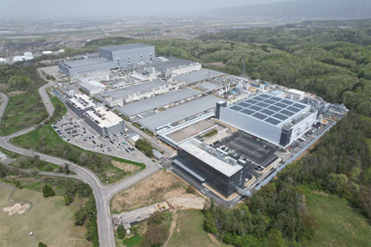
Toshiba Device & Storage Corp installed a solar PV power system at its new 300 mm wafer chip production facility in Nomi, Ishikawa Pref.
This is the second Toshiba Group chip plant to utilize renewable energy, following Japan Semiconductor Corp’s Oita operations. The system has an on-site PPA.
The solar power system will generate 1.08 GWh of electricity annually.
In June 2025, Tokyu Corp and Suzuyo Shoji, a producer and distributor of petroleum products, will start solar power generation at the Shizuoka Airport.
The plan is to supply the airport building, aiming to become carbon neutral by 2050.
Tokyu will invest in the airport’s operator. The project will have a generating capacity of 1 MW and will be an on-site PPA, with the airport acting as the purchaser.
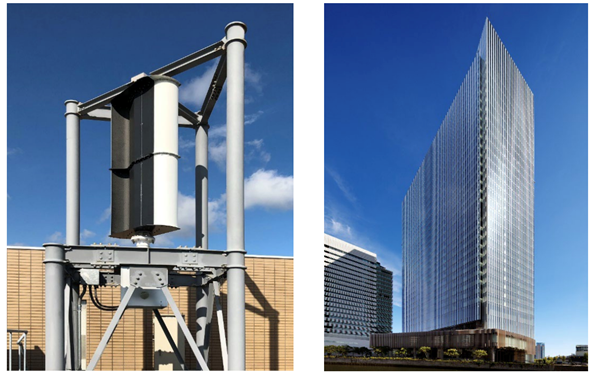
Taisei Corp, wind power startup Challenergy and real estate firm Mitsui Fudosan will conduct the first field study of vertical-axis Savonius-type wind turbines on the rooftops of high-rise buildings.
The system will be installed on the roof of the 152-meter-high Yokohama Mitsui Building (Yokohama City) to study its use as an emergency power source. The test will run from April 2025 until March 2026, seeking data on wind volume and power generation, and clarifying requirements for installation.
The main body of the Savonius turbine is smaller than common propeller turbines and can be installed on about three m3. It weighs 290 kg, and its structure can be assembled without heavy machinery.
It is designed to generate little wind noise, and motor vibration is minimal, making it suitable for installation on rooftops and in urban areas.
TAKEAWAY: The noise and vibration generated by the current generation of wind turbines during operation and installation have long been raised as concerns by nearby residents. Offering more Savonius-type wind turbines could help developers offer an alternative while also opening new locations for unit installations.
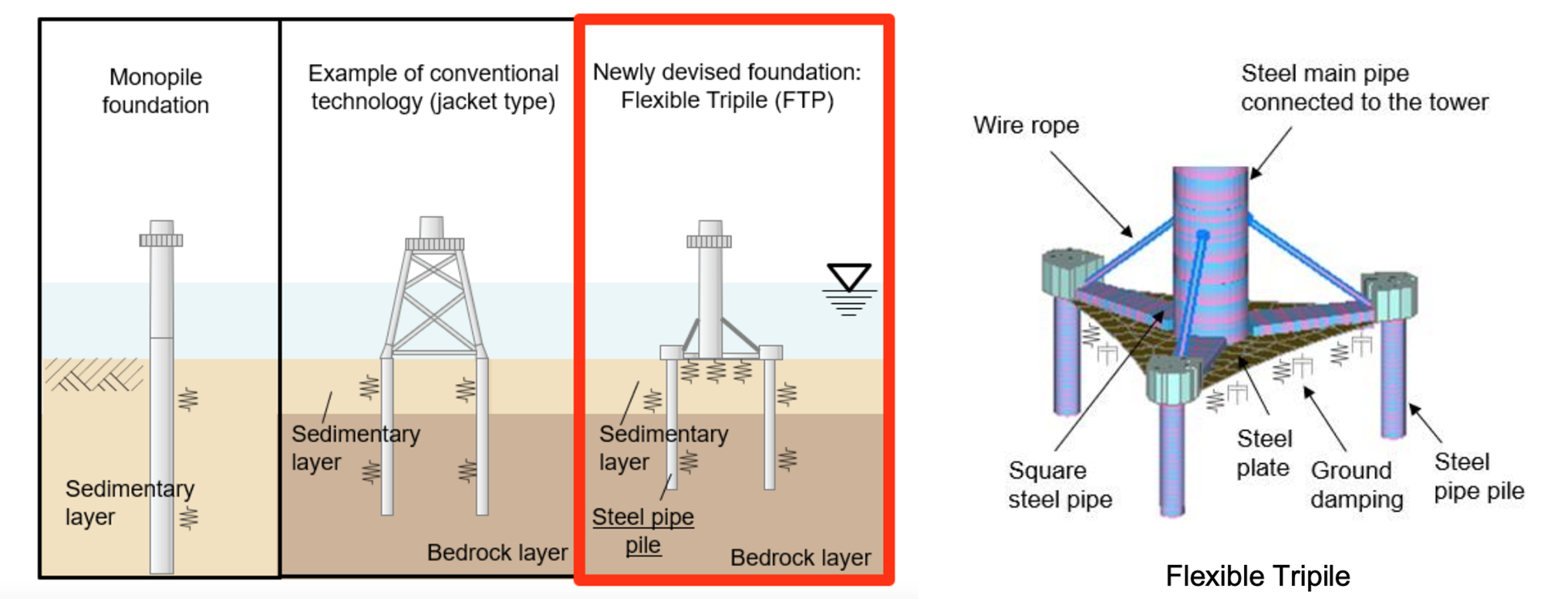
J-Power and Tokyo University developed and patented the “Flexible Tripile,” a foundation for bottom-fixed offshore wind turbines suited to Japan’s topography.
It consists of three piles and a pipe that supports the structure, and incorporates square steel pipes and plates in the base, creating flexibility. It can be easily installed in shallow bedrock areas.
This structure has been equipped with seismic isolation that reduces vibration caused by earthquakes. The use of simplified foundation components allows for lower construction costs compared to conventional tech.
Tohoku Electric made its second application to the NRA for approval of the design and construction plan at Onagawa NPP Unit 2. It relates to the Specific Severe Accident Response Facility (SSARF).
CONTEXT: The SSARF serves to protect the reactor containment from damage in case of terrorist threats. The facility must be built within five years of the main facility construction approval, thus by Dec 22 2026.
CONTEXT: Tohoku Electric will restart the unit on Oct 29. The reactor is set to begin power generation in early November and commercial operation in December.
TAKEAWAY: Monitoring the situation at Onagawa NPP Unit 2 is important for two reasons. The first is it will play a key role in meeting increased energy demand in the winter. The second is that it will be the first restart of a boiling water reactor (BWR) in Japan since the 2011 Fukushima Daiichi accident. BWR reactors are still assumed to be less safe simply because this was the type used at the Fukushima Daiichi NPP. There have been numerous advances in BWR reactors since the models at Fukushima were installed. In any case, this will be an important step for the nuclear industry.
Toyo Engineering’s Indonesian subsidiary, Inti Karya Persada Tehnik, won a contract for the design, procurement, and construction of Unit 3 of Wayang Windu Geothermal Power Plant in West Java.
The project is owned by Star Energy Geothermal, a subsidiary of Indonesia’s Barito Renewables Energy, and is slated for completion in 2026. The steam turbine and generator will be made by Toshiba Energy Systems. The power generation output will be 30 MW.
Shell and Mitsubishi Corp plan to start production at their “LNG Canada” project by mid-2025. They said it’s now 95% complete.
Shell is also considering doubling the production capacity, and might invest as much as $5 billion annually in upstream gas and oil development through 2030.
Production capacity will be about 14 mtpa. JERA, Tokyo Gas, and Toho Gas are expected to import about 15% of the output.
Shell also plans to source LNG from a Mexico Pacific project on the country’s west coast if it launches in 2029 as planned.
TAKEAWAY: While LNG demand tightness is expected to ease in 2025-2027, a rebound is expected as more Asian countries turn to the fuel. Japan, China and South Korea will be competitive markets for companies like Shell or QatarEnergy. Shell’s strategic location in Canada and Mexico avoids the Panama Canal, offering a faster and cheaper route to East Asia than from the Middle East.
Qatar is struggling to secure new LNG deals with key Asian buyers such as Japan and South Korea, due in large part to competition from the U.S., UAE, and Oman.
These rivals offer more flexible, short-term contracts. Qatar continues to insist on the use of destination clauses and long-term agreements, limiting buyer flexibility to resell cargoes.
CONTEXT: Japan’s demand for LNG is declining, driven by nuclear restarts, renewables, and a slowing economy. Thus, Qatar’s market share in Japan has dropped.
TAKEAWAY: While Qatar is expanding LNG production, only 48% of its future output has been contracted. Thus, Qatar might find itself forced to be more active in the spot market. Some in the market also believe that Qatar will start to offer more flexibility in its contracts as its new capacity under construction comes closer to operating.
Mitsui O.S.K. Lines (MOL) inked a long-term charter contract with Singapore LNG Corp for the city-state’s first Floating Storage and Regasification Unit (FSRU).
Delivery date is 2027; storage capacity will be 200,000 m3, with a regasification capacity of 5 mtpa.
CONTEXT: About 95% of Singapore’s power generation relies on natural gas. It already has an LNG terminal (10 mtpa capacity). The FSRU will bring total capacity to 15 mtpa on forecasts of rising demand in the coming years.
As of Oct 20, the LNG stocks of 10 power utilities were 2.12 million tons, rising 1.9% from the previous week (2.08 million tons), but down 3.2% from end Oct 2023 (2.19 million tons), and 5% up from the past 5-year average (2.02 million tons).
CONTEXT: The weather has been unusual recently. Fragrant olive trees usually bloom in September, but they appeared in October this year; and in some areas gingko nuts have already fallen to the ground.
ANALYSIS
BY YURIY HUMBER
Hydrogen Project Rollout in Japan Waylaid by Choppy Politics and Cost
After years of planning, new hydrogen and ammonia projects in Japan were expected to get the green light in 2024 with the rollout of state subsidies. Industry expectations were high and potential exporters from Asia, the Middle East, North America and Australia have been on high alert to sales opportunities.
Progress remains uneven, however. While the Diet passed the Hydrogen Society Promotion Act in May, taking effect last week, on Oct 23, before the promised November deadline, key details on when the application process for state subsidies begins, and some other parameters, still remain unclear. According to ANRE, these will take “a little longer.”
Example sheets in the application forms suggest that METI still envisages subsidies to flow into the hydrogen and ammonia supply chains in the near future. People familiar with the subsidy procedures, however, now admit that recent political upheaval in Japan, and to a small extent the upcoming U.S. election, have put progress on pause. It would be a major, positive surprise if even one subsidy is awarded this year.
Since Kishida’s August announcement not to seek reelection as head of the ruling LDP, politics have taken priority over policy considerations in Tokyo. Ishiba won the most crowded LDP leadership race in recent decades, only to face lukewarm popularity soon after taking office. Ishiba immediately called for a general election to cement his position, but early indications show that the Oct 27 election could weaken the LDP’s control of the Diet.
As the next steps for Ishiba and his Cabinet are uncertain, and the U.S. presidential vote due in a week, few see the METI minister signing off on any major hydrogen developments in the immediate future.
Act in action
Switching to hydrogen or ammonia from fossil fuels is in most cases more expensive, and demanding a green (i.e. renewables-powered) version of the former is especially so. As such, the government vowed earlier in 2024 to offer a subsidy often referred to as a Contract for Difference (CfD) scheme.
The CfD, already deployed in the UK and a few other nations, offers to pay buyers of fuel the difference between the cost of a hydrocarbon-based product and a hydrogen or ammonia alternative.
Japan’s subsidy program offers support for two use cases. One is to plug the price gap between, say, the cost of securing coal to burn in a thermal power plant and that of buying low-carbon ammonia. Japan’s definition of what qualifies as “low-carbon” ammonia, hydrogen and synthetic fuels such as e-methane is spelled out in the documents related to the Hydrogen Society Promotion Act.
In short, it allows for hydrogen to cause emissions of no more than 3.4 kg of CO2 equivalent in the making of one kilo of hydrogen. This carbon intensity measure is applied on a “well to gate” basis, which means it includes the emissions from upstream and transportation, but excludes some others, such as in the storage and service segments.
The subsidy program is also aimed at covering part of the Front-End Engineering Design (FEED) of infrastructure facilities that will transport and store low-carbon hydrogen and its derivatives.
Both use cases essentially reward the Japan-based demand side players, covering additional costs that they’ll incur from importing, storing, moving and utilizing low-carbon hydrogen and ammonia.
The subsidies won’t be awarded directly to overseas manufacturers of hydrogen and its derivatives (although domestic producers of the same can apply). However, overseas producers would benefit from their Japanese importers securing the funds to pay for the premium that hydrogen-based alternatives demand compared to conventional fuels.
The subsidies are offered for as long as 15 years but can only apply for imports or domestic production that will begin ammonia / hydrogen supply before or in 2030.
With the Hydrogen Society Promotion Act in force as of Oct 23, METI posted its initial documents to explain the subsidy application procedure and offer examples of how to do so.
How much will subsidies cover?
At the start of 2024, the government announced that ¥3 trillion would be set aside in the budget to cover the CfD and related support measures for hydrogen. According to METI comparisons, that’s significantly more than what other countries have offered to hydrogen suppliers to date.
The ¥3 trillion, however, will barely cover 0.5 million tons of annual hydrogen equivalent supply, according to ENEOS calculations. Tanaka Hideaki, the GM of the hydrogen business department at the oil wholesaler, voiced concerns that this amount is six times less than what the government sets as the country’s low-carbon hydrogen demand goal for 2030.
By 2040, METI forecasts that Japan will be utilizing 12 million tons of hydrogen a year. So, how would the current subsidy budget enable this when domestic demand at present is at just 2 million tons and nearly all of that is gray hydrogen, asked Tanaka at a recent industry event. In other words, it is made from fossil fuels without any carbon capture and doesn’t qualify as “low-carbon”.
From the government viewpoint, ¥3 trillion is already a large amount and more than ample to get things going, countered a representative of the Development Bank of Japan. After all, the CfD and related measures seek to inject money into regions that want to position themselves as hydrogen hubs. If these areas truly wish to achieve this goal, rather than simply benefit from the latest available subsidy, then they and associated local industries need to think how to create a commercially viable infrastructure and trade around hydrogen, the state banker said. “State institutions cannot fund all interested parties.”
State-owned resource company JOGMEC is in charge of administering the CfD and related hydrogen subsidy scheme and is now evaluating 10 hydrogen hub / supply chain proposals. Eight of those are tied to specific locations and three are near major cities.
JOGMEC senior vice president Yamamoto Koji said at a hydrogen industry event last month that “¥3 trillion is not enough but it’s relatively large compared to other countries,” citing budget allocations from Germany, the UK, and Australia as at least eight times smaller.
JOGMEC is open to supporting blue and other types of hydrogen, and sees CfD funding starting “soon” and projects launching in 2030, according to Yamamoto.
Financiers of Japan’s hydrogen supply chains are more sanguine. A banker in charge of hydrogen financing at the Japan Bank for International Cooperation (JBIC) explained that their team had reviewed more than 100 hydrogen or related projects in the last two years, but despite signing 30+ MoUs, “we closed only one deal”. The reason is that hydrogen prices are too expensive for most Japanese buyers to jump into long-term offtake supply deals.
The DBJ banker said they may need to accept that some projects won’t secure offtake for more than five years following launch because of the uncertainty around hydrogen supply volumes and prices in the 2030s. The banker said there are other options aside from CfD that hydrogen suppliers and buyers should consider, including LTDA power capacity auctions.
Conclusion
Factors that should help to alleviate concern on the demand side will be the introduction of real carbon pricing, according to an official from trading house Marubeni, but this is not expected until at least 2026.
Meanwhile, firms involved in hydrogen hub projects are concerned about securing licenses to operate amid public anxiety over hydrogen and ammonia safety issues. Construction costs are also high due to rising interest rates and raw material prices, which means that timing for a Final Investment Decision (FID) of local hydrogen projects is becoming crucial.
“The government should raise awareness that going green will increase prices. People should understand it and be motivated to accept higher prices,” said Ikushima Wataru Marubeni’s GM for its new energy business development department.
At times of political upheaval, however, the government is less keen to trumpet higher prices and announce big spending on energy subsidies. If there is even one subsidy award announced before 2025, we should take it as a pleasant Christmas gift.
ANALYSIS
BY MAGDALENA OSUMI
Building an Offshore Wind Workforce: Japan Struggles to Train Skilled Talent
This is the second article looking at measures to foster skills needed to advance the expansion of wind power generation in Japan.
In the next five years, Japan’s preparedness for the expansion of offshore wind power generation will be put to the test with a number of large-scale projects set to come online that would account for an estimated 3-5 GW in capacity if built.
However, to realize the government’s clean energy goals for 2030 and beyond, the offshore wind sector is in dire need of attracting tens of thousands of qualified and motivated workers.
Recently, a growing number of private training centers have started offering programs for established technical workers, raising expectations that wind power projects already in the pipeline have a good chance of completion on time. But the lack of structured university programs to prepare a permanent wind power workforce is raising concerns about whether Japan is ready to build and maintain large-scale offshore wind projects for decades to come.
Private training centers can only partly fill the void. Japan must step up its game in terms of both fostering and securing top talent for a wide range of jobs, from technological innovators to on-site wind installation and maintenance technicians, as well as experts in industrial health, safety inspections, search and rescue operations, as well as maritime and shipping.
Japan NRG takes a look at recent initiatives aimed at rectifying the current deficit of essential skilled workers that could impede the growth of the nation’s wind energy industry.
Where are the university programs for wind?
Japan has a total of 796 universities, and of these, 114 private and public universities offer technology training courses that feature renewable energy generation as part of their curricula. But what does this mean for the offshore wind industry?
University students currently enrolled in technological studies are concerned that existing programs aren’t sufficiently relevant for their career in the sector. Several students attending the recent Global Offshore Wind Summit in Sapporo City said they’re worried that the curriculum doesn’t prepare them to gain employment in the wind power industry.
To be fair, given that the industry is in its infancy and wind technology is still developing, it’s not surprising that Japan’s universities have not had enough time to adequately structure programs to foster all the skills that the wind power industry currently needs.
Nevertheless, to address the issue, several universities have set up a consortium that aims to establish an educational framework that will upgrade existing curricula and target students who might later want to find employment in the offshore wind industry.
Among the consortium’s leading members are Nagasaki University, Akita University, Akita Prefectural University, the University of Kitakyushu and Chiba University. These institutions are in close vicinity to planned offshore wind projects, or in zones designated by the government for possible future wind power systems development. The group is working with major utilities such as JERA, TEPCO Renewable Power, Kyuden Mirai Energy, and Chubu Electric, trading house Mitsubishi Corp and academic and research institutions, as well as the non-governmental ship classification society, Class NK.
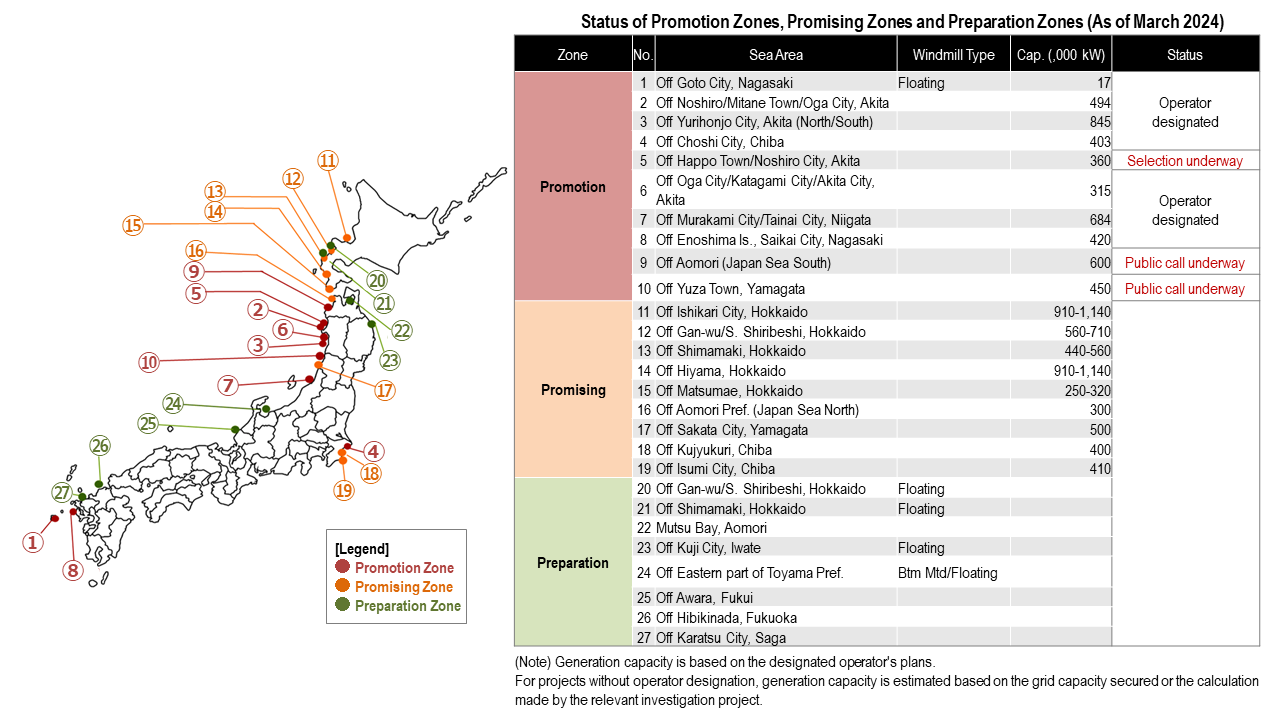
Japan currently has ten so-called promotion zones designated as ready for offshore wind project development. The government has selected developers for eight out of the ten of those areas, with the remaining two expected to be announced by the end of 2024. Other areas selected as suitable for wind farms – another nine promising zones, and 11 preparation zones in the more preliminary stages – are concentrated around coastal areas of Hokkaido, the Tohoku region and southernmost Kyushu island. The list below does not include the three recently added preparation zones off the coast of Wakayama and Akita prefectures.
Source: METI
Looking to the UK and EU for inspiration
The consortium is drafting a scheme based on the UK’s educational program called the Industrial Doctoral Centre in Offshore Renewable Energy (IDCORE), which helps students acquire technical skills and other transferable expertise. The group plans to set up internships at existing offshore wind farms to help students gain practical real-world skills, similarly to the IDCORE program.
The private sector is also joining forces in utilizing internships to foster new talent. During the Global Offshore Wind Summit, an official from Denzai, a heavy lifting and transportation firm, said his company plans to offer internships to help students get a glimpse into a wind farm’s real working environment.
This is crucial because work on an offshore wind farm can be grueling, where workers face a wide range of professional challenges and hazards that they wouldn’t encounter in land-based wind projects. From raging seas to moving heavy equipment that doesn’t allow any margin for error, the offshore wind sector demands a category of workers who are rugged and resilient in character, as well as proficient in their work.
The offshore wind industry will also have to engage transportation and other logistics firms, as well as preparing staff how to act in emergencies, as well as rescue operations. Towards a solution, the Japan Wind Power Association is collaborating with international organizations such as Global Wind Organization, as well as firms from EU countries with operational offshore wind farms, to grasp the industry’s complex and novel employment needs.
One crucial step is compiling guidelines on skill sets for technical workers. So far, JWPA in collaboration with GWO have issued guidelines only for entry level technicians. The industry needs more detailed guidance to cover an advanced and a broader range of skill sets.
As offshore wind power generation starts to take off, Japanese companies that are slow to plan the skill set of their human resources in this field will later struggle to find skilled professionals to fill key positions. What adds to the challenge is that Japanese firms need to restructure their organizations to adjust to the current needs of the market.
Most Japanese corporations have long relied on the lifetime-employment model where staff commit to the company until retirement, while acquiring skills on the job. This model, which contradicts employment practices in Western countries, has also placed focus on collective responsibility, and has resulted in more expectations placed on company loyalty over the advancement of skill sets that are needed in emerging industries like the wind sector.
Traditional Japanese firms face difficulties in reforming their hiring systems to introduce positions for highly skilled individuals that will be needed for large-scale operations; these cadres will demand to be paid accordingly and have career expectations that don’t naturally slot into the current job progression at such firms.
For now, most job openings in Japan lack a clear job description that would appeal to people with expertise in specific areas, as they often correspond with the skills of job-seekers.
Conclusion
Japan has little time to train and build a workforce. Work is now commencing on offshore wind farms that are slated to be completed in 2030. The first generation of such workers are going to have to take a crash course in order to meet that deadline. Otherwise, Japan will need to rely largely on talent from outside of Japan, and while this option seems sensible in the short term, it’s a band-aid solution that also assumes overseas talent will not be tempted by offshore wind jobs elsewhere in Asia / around the world.
Compounding the challenge is the government’s goal of as much as 45 GW of offshore wind capacity by 2040. While that target seems far away, the fact remains that installing such a massive amount of capacity is going to require a small army of skilled workers. And those technicians need to be prepared years in advance.
Whatever progress Japan makes in offshore wind technologies, be it in fixed or floating turbines, and in terms of perfecting project management, will count for little if there are not enough people to install and operate the facilities. Policy and business planners often zero in on the supply chain bottlenecks. This time they need to check on the people.
ASIA ENERGY REVIEW
BY JOHN VAROLI
This weekly column focuses on energy events in Asia and the Pacific
Australia / BESS
Swedish technology group Wärtsilä was selected to deliver its second energy storage project in South Australia. Located in Bungama, stage 1 of this project will supply Amp Energy. The BESS will have a 150 MW / 300 MWh capacity.
China / Electricity
Electricity generation surged to a seasonal record of 802 TWh in Sept, up from 746 TWh a year earlier. Most extra generation came from thermal power (46 TWh), mostly fuelled by coal. There were small additions from wind farms (+20 TWh) and solar farms (+8 TWh).
China / Russian gas
In the first nine months of 2024, Russian pipeline gas exports to China surged 23% YoY, reported China’s General Administration of Customs. The value of Russian gas deliveries reached $6.1 billion, testifying to stronger ties between the two countries in energy.
India / Clean energy
India and the U.S. plan to establish a supply chain for a clean energy ecosystem, said Commerce Minister Piyush Goyal, adding that the economic relations between the two nations will achieve new heights in coming years.
India / Oil
By 2030, India’s energy consumption is forecasted to rise from the current 5.4 mbpd to 7 mbpd. Nearly 25% of the increase in global energy demand over the next two decades will originate from India.
Indonesia / Oil & Gas
The new government aims to revive oil and gas production, with plans to cut regulations, reactivate idle wells and enhance output at producing assets in hopes of reversing a decades-long decline in output, state officials said.
Singapore / Clean energy
The Energy Market Authority approved the importation of 1.75 GW of low-carbon electricity from Australia via Sun Cable’s Australia-Asia PowerLink that stretches 4,300 km. The electricity will be generated from solar power in the Northern Territory.
Southeast Asia / Power demand
Through 2035, Southeast Asia is forecasted to account for more than 25% of global energy growth. This increase is due to strong economic expansion, population growth, and Southeast Asia’s position as a global manufacturing and industrial hub.
Taiwan / Wave power
Israel-based Eco Wave Power will sell the first wave-energy generation unit to I-Ke International Ocean Energy. The 100 KW pilot project will be installed on Taiwan’s east coast. An additional 83 potential sites have been identified for expansion.
Vietnam / Nuclear power
Vietnam will amend its national power development plan, (PDP8), to include options for nuclear energy and hydrogen, the Minister of Industry and Trade said. The PDP8 also calls for more renewables such as solar and wind.
2024 EVENTS CALENDAR
A selection of domestic and international events we believe will have an impact on Japanese energy
January
First market trading day (Jan 4)
IEA “Renewables 2023: Analysis and Market Forecast to 2028” released (Jan 11)
Renewable Energy Exhibition (Jan 31 – Feb 2)
Taiwan presidential election (Jan 13)
Japan’s Diet convenes
IEA “Electricity 2024 / Analysis and Forecast to 2026” released (Jan 24)
February
CFAA International Symposium (Feb 2)
India Energy Week 2024 (Feb 6-9)
Lunar New Year (Feb 10-17)
Indonesia presidential election (Feb 14)
Japan-Ukraine Conference for Promotion of Economic Reconstruction (Feb 19)
FIT/FIP solar auction (Feb 19 – March 1)
Smart Energy Week (Feb 28-Mar 1)
March
Announcement of auction result for Offshore Wind Round 2 (for Akita Happo-Noshiro Project)
Onshore wind auctions (March 4-15; results on March 22)
International LNG Congress (LNGCON) 2024, Milan, Italy (March 11-12)
Russian president election (March 15-17)
World Petrochemical Conference, Houston, TX, USA (March 18-22)
IAEA Nuclear Energy Summit @ Belgium (March 21)
Ukraine presidential election (due before March 31)
Happo Noshiro, Murakami-Tainai, Oga-Katagami-Akita and Saikai-Eshima wind project auctions close (June 30)
July
Tokyo governor election (July 7)
7th Basic (Strategic) Energy Plan draft published (expected)
August
7th Basic (Strategic) Energy Plan draft presented to Cabinet (expected)
September
Global Offshore Wind Summit Japan 2024, Sapporo, Hokkaido (Sept 3-4)
The United Nations Summit of the Future (Sept 22-23)
Gastech 2024, Houston, TX (Sept 17-20)
IAEA General Conference
GX Week in Tokyo (expected late Sept to October)
Asia Green Growth Partnership Ministerial Meeting
Asia CCUS Network Forum
International Conference on Carbon Recycling
International Conference on Fuel Ammonia
GGX x TCFD Summit
October
IEA World Energy Outlook 2024 Release
BP Energy Outlook 2024 Release
Innovation for Cool Earth Forum (expected)
Connecting Green Hydrogen Japan 2024 (Oct 16-17)
Japan Wind Energy 2024 Summit (Oct 16-17)
Solar Energy Future Japan 2024 (Oct 16-17)
Japan Mobility Show (Oct 25-Nov 5)
November
US presidential election (Nov 5)
COP 29 in Azerbaijan (Nov 11-22)
Abu Dhabi International Petroleum Exhibition Conference (ADIPEC) 2024, Abu Dhabi, UAE (Nov 11-14)
APEC 2024 @ Lima, Peru
International Conference on Nuclear Decommissioning (TBD)
G20 Rio de Janeiro Summit (Nov 18-19)
Offshore Energy Exhibition & Conference (OEEC) 2024, Amsterdam, the Netherlands (Nov 26-27)
Biomass & BioEnergy Asia Conference (TBD)
European Biomethane Week 2024
December
Last market trading day (December 30)
Disclaimer
This communication has been prepared for information purposes only, is confidential and may be legally privileged. This is a subscription-only service and is directed at those who have expressly asked K.K. Yuri Group or one of its representatives to be added to the mailing list. This document may not be onwardly circulated or reproduced without prior written consent from Yuri Group, which retains all copyright to the content of this report.
Yuri Group is not registered as an investment advisor in any jurisdiction. Our research and all the content express our opinions, which are generally based on available public information, field studies and own analysis. Content is limited to general comment upon general political, economic and market issues, asset classes and types of investments. The report and all of its content does not constitute a recommendation or solicitation to buy, sell, subscribe for or underwrite any product or physical commodity, or a financial instrument.
The information contained in this report is obtained from sources believed to be reliable and in good faith. No representation or warranty is made that it is accurate or complete. Opinions and views expressed are subject to change without notice, as are prices and availability, which are indicative only. There is no obligation to notify recipients of any changes to this data or to do so in the future. No responsibility is accepted for the use of or reliance on the information provided. In no circumstances will Yuri Group be liable for any indirect or direct loss, or consequential loss or damages arising from the use of, any inability to use, or any inaccuracy in the information.
NEWS
・Hydrogen Act that unlocks state subsidies goes into force, but deadline for applications unclear
・METI, MoE draft report on legal issues and concepts for emissions trading system
・EEX to launch electricity options from Q1 2025, add new contracts