The power sector is staring down a winter of possible blackouts. That’s odd because the Capacity Market, which became effective this year, was conceived by the nationwide grid oversight body, OCCTO, specifically to ensure that adequate capacity was on hand. With utilities struggling to keep up with demands on days with extreme weather, grid operators have been blindsided, issuing energy alerts at unprecedented rates. The weather has undermined OCCTO’s best-laid plans, while a resurgence in power demand from industry was clearly not on the grid oversight body’s bingo card for this year.
In 2023, Dr. Morishita Masao discovered a compound that solidifies ammonia at room temperature. If ammonia can be stored and transported in solid form, which is much easier and cheaper to handle, energy firms could move it across the globe without specialized cryogenic tanks. This opens the possibility of tapping into vast clean ammonia production resources overseas and shipping it for domestic use without the need for a trillion-yen industry supply chain. But, developers in ammonia supply projects have mostly dismissed it, claiming that it will require vast amounts of energy. Japan NRG reviews.
ASIA ENERGY VIEW
A wrap of top energy news that impacts other Asian countries.
EVENTS SCHEDULE
A selection of events to keep an eye on in 2024.
JAPAN NRG WEEKLY
PUBLISHER K. K. Yuri Group
Editorial Team Yuriy Humber (Editor-in-Chief) John Varoli (Senior Editor, Americas) Kyoko Fukuda (Japan) Magdalena Osumi (Japan Filippo Pedretti (Japan) Tim Young (Japan) Tetsuji Tomita (Japan)
Aiming to promote sustainable finance, the MoE published 2024 guidelines for green bonds and sustainability-linked bonds, along with guidelines for green loans and sustainability-linked loans.
The guidelines distinguish international principles from Japan-specific explanations, improving alignment with evolving global standards and enabling rapid updates.
They now reflect recent revisions by the Loan Market Association and International Capital Market Association, and offer additional domestic guidance, especially for sustainability-linked loans used by financial institutions for client financing.
To ensure clarity and consistency, the MoE held a public comment period and sought input from international bodies, whose feedback was incorporated.
CONTEXT: The majority of sustainability-linked loans in Japan are procured through the “SLL Framework”, which financial institutions have developed as a financial product for customers, rather than for their own funding purposes.
TAKEAWAY: The plethora of taxonomies around the world make it complicated for investments to flow into clean energy projects because the definitions of ‘green’ or ‘transition-linked’ vary. Japan has hitherto left its banks and financial services to decide by themselves on the validity of green investments. That voluntary approach, however, has made it difficult for domestic financial firms to explain and justify their investments to international stakeholders. The latest government guideline updates aim to bridge the gaps between domestic and international understandings.
The Ministry of Land, Infrastructure, Transport and Tourism (MLIT) began a new committee charged with analyzing how Japan can create a port infrastructure to facilitate hydrogen and ammonia imports.
The Carbon Neutral Port initiative seeks to lower emissions of marine infrastructure; it will look at factors for handling hydrogen and ammonia at terminals. Discussions will focus on safety, facility planning, and transport systems able to cope with large-volume imports.
The committee’s first meeting is Nov 11. Attendees include Miyake Atsumi, Professor at the Institute of Advanced Sciences, Yokohama National University; Aoyama Katsuhiro of the Clean Fuel Ammonia Association; and Hiroshi Fukushima of the Japan Hydrogen Association; as well as local officials in charge of port management in Kawasaki City and Aichi Pref.
By the end of 2024, the government will present its draft GX2040 Vision at the GX Implementation Council, maintaining its schedule for the announcement.
Accelerating investment in new fields of decarbonization, such as local renewable energy, was emphasized. This is expected to have a ripple effect on the local economy and will improve the environment. It was also noted that accelerating DX through the use of AI could optimize GX’s impact.
The MoE plans to submit the next GHG reduction target to the UN by Feb 2025, and will also review the Global Warming Countermeasures Plan on reducing emissions.
CONTEXT: The GX2024 Vision will serve as the basis for the Basic Energy Plan and the Global Warming Countermeasures Plan, and will set out the energy and GX industry location, GX industry structure, GX market creation, and global awareness and rules that should be achieved by around 2040.
TAKEAWAY: The idea for this “vision”, which is separate from the Basic Energy Plan, was first floated by then PM Kishida, who dubbed it GX 2.0. It arrived as a response to the sudden realization in government that a new way of AI, data center, semiconductor and other tech infrastructure in Japan will massively increase electricity demand. This new document was touted as a blueprint for mapping where the new tech demand would appear and help synchronize the rollout of more clean energy facilities with it. As such, logically the “vision” has to come before the Plan is published and the end-of-year announcement was flagged earlier in the process.
Poland to cooperate with Japan on nuclear power
(Japan NRG, Nov 6)
METI and Poland’s Ministry of Industry inked agreements on nuclear energy, aiming to provide Japanese nuclear technology, build supply chains, and train specialists. Discussions are also underway on managing radioactive waste.
Poland, which relies on coal for 70% of its power, faces energy challenges due to halted oil and gas imports from Russia. Seeking to diversify its energy sources, Poland plans to build its first nuclear power plant by 2030.
The countries will promote SMRs developed by GE Hitachi Nuclear Energy, with Japan providing expertise in HTGRs. Poland also plans to build 6 large light-water reactors by 2043, which would meet about 23% of the country’s power needs. Japan is promoting Toshiba’s steam turbines and IHI’s containment vessels.
CONTEXT: SMRs are smaller and, in theory, more cost-effective than traditional reactors because they are designed as modules that can be assembled at a factor rather than onsite. HTGRs, which use helium gas instead of water for cooling, can be applied to both power generation and hydrogen production.
TAKEAWAY: Japanese collaboration on HTGRs is managed by the Japan Atomic Energy Agency (JAEA). Poland plans to use this tech as a heat source for its chemical sector, and might build a research reactor with an output of 30 MW. But Poland isn’t relying only on Japan’s nuclear tech as it seeks to install up to 9 GW of nuclear capacity by 2040. Its first NPP will be built by Westinghouse based on AP1000 tech. For Japan, it’s important to be involved in the construction of new reactors overseas as it supports the business case for domestic manufacturers to retain their nuclear divisions.
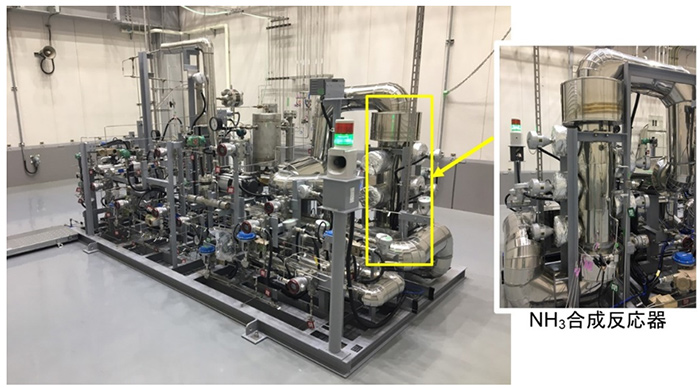
IHI said it successfully tested a green ammonia production system at its Soma IHI Green Energy Center (Fukushima Pref) that delivers just 1kg/ day.
The system uses IHI’s Power-to-X tech to produce ammonia using renewable energy. IHI wants to scale up production and commercialize it.
CONTEXT: IHI’s goal is to convert renewable energy into heat and hydrogen. The same Power-to-X tech at the Soma center was used to produce synthetic methane fuel, then utilized by a local bus in a pilot phase. The center was opened in 2018.
Toshiba Energy Systems has developed a new service for solar farm operators – an integrated PV management service.
This is a service in the “TOSHIBA SPINEX for Energy” lineup, which provides centralized power facility monitoring services.
Since it’s built on Toshiba’s cloud system, it can acquire data from monitoring systems made by other companies and centrally manage multiple solar farms.
The system displays the operational status of multiple power plants in real time, and also has an incident response function that contributes to rapid on-site response
CONTEXT: The number of solar farms has increased rapidly due to the FIT system, but in many cases the monitoring systems and O&M operations differ from plant to plant; power generation companies that own multiple solar farms need services to integrate power plant monitoring systems and enable efficient operation.
Sumitomo Mitsui Financial Group and Enechain set up a new company, eXtend, to provide hedging services against fuel price fluctuations for power generation and electricity retail firms. It will help clients secure fuel at fixed prices, regardless of international market volatility.
Launched with ¥1 billion in capital, eXtend is led by Enechain’s Arai Tomoya. It will trade LNG, crude oil, and coal on international markets, including ICE and CME.
The company will generate revenue through service fees from power utilities, which benefit from fixed procurement prices, mitigating the impact of fuel price volatility.
TEPCO launched a VPP pilot at Tokyo region municipal facilities.
As an initial test, the electricity generated by solar power at a municipal apartment building will be supplied to the Tokyo Metropolitan Art Museum; the usefulness and reliability of Area Energy Management Systems (AEMS) will be evaluated.
In 2025, the Tokyo Metro Govt will step up efforts to upgrade and optimize energy use through AEMS at a wide range of municipal facilities, such as schools, parks and apartment complexes, and to allow these facilities to share electricity.
CONTEXT: In June 2022, TEPCO agreed with the Tokyo Govt to promote carbon neutrality initiatives.
Mitsui Chemicals and startup Sustech will cooperate to reuse discarded solar panels amid an anticipated surge in discarded panels by the mid-2030s.
The project involves evaluating old panels for reuse, constructing power plants with viable solar cells, and selling generated electricity directly to businesses.
The initiative aims to reduce environmental impact, costs, and waste associated with solar panel disposal, and to explore scaling up reused-panel power plants.
CONTEXT: Solar power adoption rose following the introduction of the Feed-in Tariff (FIT) in 2012. With FIT 20-year terms expiring, the replacement of solar panels is on the rise. However, currently most discarded panels are landfilled rather than reused. By the mid-2030s, panel waste is expected to rise sharply.
Shikoku Electric will build its fourth floating solar power plant on Taniike Pond (Takamatsu City, Kagawa Pref). Operations are set to start in September 2025.
The facility is expected to generate 2 GWh annually and will operate under a PPA.
Toshiba has developed a lithium-ion battery, the SCiB Nb, designed for ultra-fast charging, and will commercialize it by spring 2025, targeting global sales for electric buses and other EVs.
The SCiB Nb uses niobium titanium oxide (NTO) in its anode, which improves conductivity and enhances battery performance. This tech has less performance degradation, even after repeated ultra-fast charging.
The company says the battery can recover about 70% of its capacity with just five minutes of ultra-fast charging, and maintains over 80% of capacity after more than 15,000 ultra-fast charge-discharge cycles. It also performs well in extreme temperatures, ranging from -30°C to 60°C.
Since June, Toshiba has been testing the battery in collaboration with Sojitz and CBMM, a niobium producer in Brazil.
The Heat Pump & Thermal Storage Technology Center of Japan published survey results about introducing heat pump water heaters in new residential apartments.
To expand their use it’s necessary to revise the performance evaluation standards and introduce preferential treatment for users, in addition to resolving issues such as cost and availability of installation space.
As an incentive, new standards are proposed that emphasize energy-saving, and subsidies and tax incentives for homes built to such standards.
CONTEXT: Hot water production accounts for about 30% of CO2 emissions in the residential sector; thus it has a high reduction potential, and the use of heat pumps can promote decarbonization. Compared to conventional water heaters, the heat pump can reduce CO2 emissions in hot water supply by about 60%.
Due to uncertainty over restarting the Kashiwazaki-Kariwa NPP, TEPCO Holdings faces delays in drafting its next Comprehensive Special Business Plan. The Nuclear Damage Compensation and Decommissioning Facilitation Corp, which oversees these plans, has not held a committee meeting since July.
The delay stems from unclear mid- to long-term profit targets, which are highly contingent on the NPP’s restart date. Previous plans included multiple scenarios based on potential restart timelines; but setting realistic dates is challenging due to the unpredictable positions of Japan’s government and that of Niigata Pref.
The next Business Plan is supposed to provide profit projections through FY2035, with varying scenarios based on potential restart timings. TEPCO HD needs to complete the plan by the end of this fiscal year but feels unsure how to proceed until it has guidance from the state.
TEPCO successfully conducted a trial retrieval of melted nuclear fuel debris from Unit 2 at Fukushima Daiichi NPP — a 5mm piece of debris was removed from a metal box linked to the reactor’s containment vessel.
This retrieval is the first of its kind outside of Three Mile Island’s Unit 2 reactor after its 1979 meltdown.
TEPCO plans to analyze this debris to develop methods for large-scale recovery; an estimated 880 tons of debris remains across Units 1–3.
CONTEXT: The retrieval has faced multiple setbacks, including equipment misconnection in August and camera issues in September.
TAKEAWAY: After overcoming technical challenges and delays, this step is a milestone in the complex decommissioning process. It’s a morale booster for TEPCO and the academics involved, and seeks to reassure the public that the Fukushima Daiichi NPP site can be fully decommissioned in time.
Japan’s first interim storage facility for spent nuclear fuel began operations, (located in Mutsu City, Aomori Pref). Operated by Recyclable-Fuel Storage Co, it received official clearance from the NRA on the same day.
CONTEXT: In late September, the facility accepted its first metal cask from the Kashiwazaki-Kariwa NPP, capable of holding 69 spent fuel assemblies. The storage facility currently holds 288 casks. It has a total uranium weight capacity of 3,000 tons. Planned expansion for a second building will bring the total capacity to 5,000 tons, with each structure able to hold waste for up to 50 years.
CONTEXT: It will store spent fuel from TEPCO’s Kashiwazaki-Kariwa NPP where storage is nearing 80% capacity. So, moving fuel off-site is essential for reactor operation. The mayor of Kashiwazaki has set a storage limit of 80% or less as a condition for reactor restarts.
TAKEAWAY: This facility is a unique opportunity for the Kashiwazaki-Kariwa NPP, since it now can count on an interim storage facility, which is not possible for other NPPs that must resort to building on-site facilities. But Chugoku Electric and KEPCO are surveying for such a facility in Kaminoseki, Yamaguchi Pref. Either way, the facility is a mid-term solution that delays the need to identify and create a long-term nuclear waste storage hub by a few decades.
Mitsubishi Electric is investing ¥16 billion to boost production of switchgear and power electronics.
Of that amount, ¥12 billion will be allocated for expanding facilities and adopting decarbonization practices in the U.S.; the construction of the new facility has been supported by a $6.75 million grant proposal from Pennsylvania.
The U.S. investment includes transitioning to environmentally friendly vacuum circuit breakers from traditional SF6 gas circuit breakers.
The remaining ¥4 billion will be used to increase production in Japan. It will reorganize the layout of production areas within its Amagasaki substation systems factory to increase the production of switchgear, including key components.
TOCOM hits record daily trading volume on Nov 7
(Exchange statement, Nov 8)
The TOCOM power futures market hit a record-high daily trading volume of 153.72 GWh on Nov 7, surpassing the previous record set on May 13, 2022 (142 GWh).
CONTEXT: TOCOM has struggled to replicate the EEX’s success in the electricity market; the recent entrance of more international players to TOCOM has improved liquidity.
Hokuto Bank (Akita City, Akita Pref) set up Fidea Energy to support regional decarbonization efforts. Fidea is the first firm in the banking industry’s advanced services sector to handle electricity retailing.
Fidea will use renewables such as wind power. It will also operate businesses in renewable energy generation and carbon credit trading.
TAKEAWAY: Several major banks have ventured into electricity trading in various forms but none have considered making electricity retailing as a business opportunity. For an Akita based bank, a region where the offshore wind sector is expected to grow significantly, this may be more about scoring green points than profit. It will be curious to see how serious this venture becomes.
A transfer of electricity between regions was first ordered then abandoned on Nov 3 as the Kansai area struggled to balance supply with demand.
CONTEXT: The warm and sunny fall weather helped increase power output, but Nov 3 was a Sunday and a day before a Monday national holiday. Hence, demand was low.
On Nov 3, Kansai Electric sent a forecast to OCCTO that indicated it will produce too much electricity between 10:30 am and 11 am.
OCCTO advised the utility to transfer 78 MW of power to Hokuriku Electric.
OCCTO warned of “insufficient lowering capacity,” indicating a supply-demand imbalance risk, especially on days when renewable output is high, and demand is low.
Upon reassessment, the Kansai grid operator (Kansai T&D) determined the transfer was unnecessary, having achieved the needed capacity reduction by maximizing adjustments within its area. Fossil fuel generation was minimized, and renewable energy sources were curtailed by around 1.7 GW from 8 a.m. to 4 p.m.
OCCTO’s directive cancellation due to self-managed adjustments is rare, underscoring the effectiveness of Kansai T&D’s renewable energy output control measures in balancing power demand locally.
TAKEAWAY: Similar directives to transfer surplus power from Kansai to other regions were issued in June 2023 and June 2024 under comparable conditions. While this time curtailment helped to bring the grid into balance, the large volume of ‘lost’ electricity indicates the role that batteries and other forms of energy storage can play during low-demand periods, such as holidays, especially when sunny weather boosts solar output.
During a test for restarting Unit 2 of the Onagawa NPP, a calibration device used to measure neutrons inside the reactor stopped moving. Preparations are now underway to shut down the reactor to inspect the device.
CONTEXT: The reactor was restarted on Oct 29 and reached criticality on Oct 30, with fuel loading beginning on Oct 28 and concluding on Nov 3. Commercial operations are planned to start in December.
CONTEXT: The malfunctioning equipment is used to monitor neutron detectors that verify the reactor’s critical state.
TAKEAWAY: Minor malfunctions are expected, particularly since the plant is coming back online after a 13-year dormancy. However, this issue could be challenging. While the procedure is standard for plant restarts, this particular malfunction is unprecedented, which may require additional time to address and could impact the planned December restart.
Chugoku Electric completed loading nuclear fuel into Shimane NPP’s Unit 2 reactor in Matsue City. The restart is planned for early December.
Next steps involve assembling the reactor pressure vessel and containment vessel. If NRA pre-use inspection approval is granted, the reactor will restart, the first time since Jan 2012; commercial operation is expected in early January 2025.
CONTEXT: Shimane Unit 2, like TEPCO’s Fukushima Daiichi, is a BWR reactor. This will mark the second BWR restart since the Fukushima incident. The first was Tohoku Electric’s restart of Onagawa NPP.
Hokkaido Electric sent the NRA its tsunami measures for the planned restart of Tomari NPP’s Unit 3. And the NRA approved them.
The utility confirmed its estimated tsunami heights exceeded both past tsunami records and state figures.
CONTEXT: Seismic and plant-related reviews are still pending. Even if they receive the permits, Hokkaido Electric will need the consent of Hokkaido’s governor to restart the plant. The utility also plans to develop a harbor outside the plant grounds for nuclear fuel transport.
TAKEAWAY: Tomari NPP is the only nuclear power plant in Hokkaido. Its Unit 3 has been waiting for restart approval for 11 years. There are many reasons for the delay, including the utility’s lack of personnel able to correctly report safety measures to the NRA, and the necessity of reinforcing the ground beneath a seawall at the plant, as well as elevating its height. The restart is critical for the regional economy, where semiconductor producer Rapidus plans to start production at its factory in Chitose using renewables. In the company’s plan, Tomari NPP may be used as a backup power source.
eRex will start co-firing biomass fuel at coal-fired power plants in Vietnam, and will build a biomass-dedicated power plant in Cambodia.
eRex will co-fire biomass at six power plants owned by the state-run Vietnam National Coal and Mineral Industries, with a combined capacity exceeding 1.5 GW.
By spring 2025, it will conduct trials at two plants, using about 20% locally sourced biomass fuel. The project will receive support from organizations including NEDO.
eRex is considering selling the environmental value generated through biomass co-firing as carbon credits in Japan.
Though eRex is already constructing three biomass-only plants in Vietnam, this marks its first co-firing initiative in the country.
In Cambodia, eRex will build a power plant that combines solar and biomass power, with a total capacity of 90 MW. The project, expected to cost around ¥10–20 billion.
CONTEXT: Southeast Asia, with rising electricity demand, remains heavily reliant on coal-fired power. According to the IEA, Vietnam’s power generation in 2022 was double that of a decade ago. Both Vietnam and Cambodia are pursuing cleaner energy options. SE Asia’s abundant wood resources present an opportunity to enhance energy self-sufficiency through biomass power.
TAKEAWAY: Although eRex’s primary business is in Japan, it has increased investments in SE Asia. In Vietnam, eRex plans to expand its biomass power plants to 19 locations by 2035. In May, it formed an alliance with JFE Engineering, Kyudenko, and other firms to support its overseas expansion. On the one hand, it’s natural for a company to look for projects in other countries, but perhaps this also suggests that one of Japan’s biggest biomass power generation companies is running out of profitable opportunities in the domestic market. Which could be due to a shortage of available biofuel materials within Japan.
Tohoku Electric began commercial operations at a new biomass power plant in Yuzawa Town, Yamagata Pref. The plant is powered by imported wood pellets, capacity 53 MW.
This is the first dedicated biomass power plant in the Tohoku Electric Group that does not use coal or other fossil fuels.
This is part of the firm’s strategy to expand renewables use, aiming to develop 2 GW of capacity by the early 2030s. The firm has already reached 800 MW.
Abalance Group’s subsidiary Toyo Corp plans to build a solar panel manufacturing plant in Awasa, central Ethiopia, as part of its global supply chain expansion.
Abalance primarily focuses on solar energy solutions.
The facility will have a 2 GW capacity. Construction is set to begin this month, with completion by March 2025. The project, fully funded by Toyo, totaled $60 million.
CONTEXT: Toyo selected Ethiopia for its new facility as part of a strategy to establish a global solar panel and cell supply chain. While its main manufacturing base is in Vietnam, Toyo is exploring new sites with an eye on the U.S. market.
CONTEXT: With the continent’s population growth in mind, several Japanese companies see Africa as highly promising, particularly in the solar energy sector.
Weathernews introduced a service that utilizes AI to predict solar farm output every 30 minutes, factoring in snowfall effects.
The company aims to improve forecast accuracy and expand its coverage, targeting a total of 1 GW in serviced solar power plants by the end of FY2025.
CONTEXT: Snow cover can significantly reduce solar panel performance. Japan’s solar power generation forecasting market is expected to grow in coming years, with market research group Fuji Keizai projecting it to exceed ¥50 billion by 2040, four times its current size. This growth is driven by the end of the FIT system and the push to adopt the FIP system, which requires detailed power generation planning.
CONTEXT: Diamond magazine regularly publishes rankings and indexes. This is part of their monitoring of the power and gas sector.
The latest bankruptcy risk rankings for electricity and gas companies were released, listing 15 firms as “high-risk” despite record profits in FY2024.
This was largely due to stabilized fuel prices and increased electricity rates.
Renewable Japan Co. ranks as the top risk, followed by Kyushu Electric and Chugoku Electric. Utilities like KEPCO and TEPCO saw a turnaround from substantial losses in FY2023, but they still appear in the risk rankings, at 13th and 6th, respectively.
Although the major utilities have improved profits, high debt levels persist due to past challenges, including fluctuating fuel costs and yen depreciation.
Chugoku Electric and Kyushu Electric were profitable in 2024 but are still recovering from prior severe losses and low capital ratios. Additionally, Chugoku Electric faces a legal challenge related to fines from a price-fixing scandal.
CONTEXT: Renewable Japan, a smaller company specializing in solar, wind, and hydropower, ranks highest on the risk list despite improved finances. Its low capital ratio and other financial indicators contribute to its high-risk classification, according to the magazine.
LNG stocks of 10 power utilities were 2.12 million tons as of Nov 3, up 2.4% from the previous week (2.07 million tons). This is 1.9% down from Nov end in 2023 (2.16 million tons), and 0.5% down from the 5-year average of 2.13 million tons.
Tokyo is enjoying beautiful autumn days with clear blue skies and no rain. It may not last long, but it’s a short break between the hot summer and winter. People began preparing nabe soup dishes of cooked meat or fish with vegetables.
ANALYSIS
BY JAPAN NRG TEAM
To Keep the Lights on, New Energy Market Rules Collide With Reality
The power sector is staring down a winter of possible blackouts and strained resources at peak demand. That’s odd because the Capacity Market, which became effective this year, was conceived by the nationwide grid oversight body, OCCTO, specifically to ensure that adequate capacity was on hand.
Originally designed to ensure adequate power supply four years in advance, OCCTO’s main Capacity Market was launched in 2020. It even attracted higher-than-forecast prices to keep the major power utilities from mothballing expensive older power plants that OCCTO saw as vital for retaining stable market supply during peak periods.
Four years on, and OCCTO’s forecasts appear to have fallen short of today’s electricity needs. With utilities struggling to keep up with demands on days with extreme weather, the grid operators (TSOs) have been blindsided. This year, the TSOs have issued energy alerts at unprecedented rates. Based on current rules, the grids may run out of their alert allocations.
The weather has undoubtedly undermined OCCTO’s best-laid plans, while a resurgence in power demand from industry and a data center boom was clearly not on the grid oversight body’s bingo card for this year.
Japan recorded its hottest summer this year since comparable data collection started in 1989. Average temperatures between June through August were 1.76 degrees Celsius higher in 2024 than during the same period between 1991 and 2020.
Solution, maybe?
In theory, the capacity market should have prevented the disbalance in power supply and volatility within and between regions. Under OCCTO projections, the percentage of power capacity held in reserve, known as the reserve margin, was supposed to comfortably meet peak demand nationwide.
Recent weather, natural disasters and consumption-side shocks have disrupted these assumptions. In mid-September, Tokyo and Tohoku regions saw reserve margins fall to a negative 1.6%, prompting the issuance of a Power Supply Emergency Alert. This shortfall arose as the big utilities, also known as EPCOs, took plants offline for maintenance after the summer’s peak, only for an unexpected heatwave to spike air-conditioning usage.
TSOs in Hokuriku, Chubu, Chugoku, Shikoku and Kyushu have faced similar difficulties, issuing multiple alerts as demand surged. The system’s design has only compounded the problem. TSOs can issue alerts twelve times per year, but with erratic weather patterns, many have already issued nine or ten alerts. If severe winter conditions emerge, they may not have any alerts left to call.
Seeing the severity of the situation, METI has recently loosened the alert thresholds from the previous 8% margin to 5%. In addition, OCCTO has even asked TEPCO Power Grid to postpone their maintenance schedule — a rare move that signals doubts about the Capacity Market’s efficacy.
EPCOs, meanwhile, find themselves shouldering new costs from delayed infrastructure maintenance, exacerbating their already thin margins.
A standby system on standby
The Capacity Market relies on three pillars: a primary market for capacity four years in advance; the Long-Term Decarbonization Power Source Auction (LTDA) to fund new low-emissions power sources; and the Standby Power Source System that taps idle power sources to backfill shortages.
The latter, a safeguard for large-scale outages, is essential as Japan phases out thermal power plants and brings online more intermittent renewable energy facilities. The Standby System’s goal is to ‘stockpile’ dormant generation assets of 100 MW in capacity or larger that could restart within three months to a year. Yet the first auction held in 2024, which was meant to secure 1 GW of capacity across east and west Japan for operation in FY2025 to FY2026, ended without a single bid.
The major utilities that own the older generation plants that OCCTO hoped to secure via this standby system balked at the maintenance fees that the grid oversight body proposed for retired oil-fired plants. These were deemed simply insufficient to compensate utilities’ costs. What’s more, the skilled technicians that are critical to upkeep these aging units are also scarce.
Worse still, OCCTO’s ever-more-complex rules and expanded Capacity Market systems may have disqualified some of the power plants it sought to retain. The Standby System is only available for units that were not selected in two successive capacity market rounds. But why would a utility keep spending on maintenance for an aging power plant if it was unable to secure any OCCTO fees over two years?
The LTDA section of the Capacity Market has justifiably won praise from BESS operators and certain other energy storage facilities. But in terms of securing the capacity that a TSO may need to maintain stable supplies in times of peak load, LTDA has fared little better.
Barely a day after the announcement of the first round of LTDA results, in early 2024, JERA signaled that it might actually abandon the contract it secured in the auction to cover the costs of building new units at its Chita Thermal Power Plant. JERA seemed willing to pay the penalties rather than meet the auction’s stringent revenue-sharing terms.
The LTDA promises fixed revenue for up to 20 years, thus de-risking the initial investment in new capacity. But in return, successful bidders must return 90% of profits generated from any other electricity sales or transactions made outside of the capacity-guarantee contract. Thus, the upside is capped.
For now, JERA has proceeded with an Environmental Impact Assessment (EIA) for the Chita investment, but has not yet confirmed that it would go ahead with the plans. Perhaps JERA is holding out for concessions from METI, but either way it sets a risky precedent and puts OCCTO’s plans to secure capacity under further strain.
Conclusion
The precise requirements of the Capacity Market framework are now working against OCCTO. And a desire to restrain payments to older thermal capacity, which is seen as only a stop-gap before the transition to cleaner facilities, has also played against the national grid manager, hobbling the reliability of Japan’s power network.
The fixes for this winter are currently debated among METI policy committees. These include allowing TSOs to issue more alerts and the loosening of regulations around pumped hydro stations for EPCOs.
Yet these are only the immediate responses, and broader reforms are needed to align the incentives for generators and TSOs while ensuring robust competition. In structuring the mechanisms for standby and capacity auctions, OCCTO may have overlooked the old truism: Nothing is more permanent than a temporary solution.
ANALYSIS
BY MAYUMI WATANABE
Accidental Ammonia Discovery Makes Solid Case for its Use in Energy Storage
Ammonia, a fuel free from carbon emissions when burned, has long tantalized scientists but left them with a dilemma: it’s both toxic and troublesome to handle. In its natural gaseous state, it must be stored at a frigid -33°C to remain liquid, and even then, storage tanks corrode, and a single leak can be deadly.
Yet, such impossible challenges have often led to breakthroughs, and the one that could potentially catapult ammonia into the top tiers of the energy transition is no different. It came from an unlikely corner of Japan’s academia.
In 2023, Japanese chemist Dr. Morishita Masao discovered a compound — borane — that solidifies ammonia at room temperature, sidestepping the perils of handling the gas.
Researchers were startled. Until Morishita’s findings, attempts to store ammonia in solid form largely involved trapping it in metal-organic frameworks, absorbing it into metal hydrides, or converting it into safer compounds like fertilizers. Yet Morishita solidified it in a pure form.
The implications are clear: if ammonia can be stored and transported in solid form, which is much easier and cheaper to handle, energy firms could move it across the globe without specialized cryogenic tanks. For Japan, it opens the tantalizing possibility of tapping into vast clean ammonia production resources overseas and shipping it for domestic use without the need for a new, trillion-yen industry supply chain based on highly specialized equipment.
Still, engineers and business developers in ammonia supply projects have mostly dismissed it. They claim that converting vast amounts of ammonia from solid to liquid or gas form will consume huge amounts of energy, rendering it impractical for large-scale deployment in power plants or industry.
So, will this discovery live on only in textbooks, or does it have a chance of commercial success? JapanNRG spoke with dozens of industry players to piece together the behind-the-scenes story of this development.
Accidentally on purpose
Morishita stumbled upon his discovery by chance. In 2023, his lab at the University of Hyogo was testing borane solutions to develop cheaper production methods for ammonia boron, a hydrogen carrier, when a student made an unexpected observation. A glass-like substance had formed, crystallizing ammonia in a stable matrix.
“My student came running, like, ‘Oh dear, what have I done…,’” Morishita recalls. With a retirement in sight in 2024, Morishita’s plans were abruptly shelved when the National Institute of Material Sciences (NIMS) quickly offered him a position to pursue this curious reaction further.
Scientists may have celebrated the advance, but the business world was indifferent. Globally, firms have largely focused on ammonia utilization inside fuel cells to convert its energy into power, not as an energy-absorbing storage structure. IHI Corp, one of Japan’s leaders in the ammonia supply chain, confirmed to Japan NRG that it has “zero research” planned on solid-state ammonia, and only KRI, an Osaka Gas subsidiary, has ever attempted such an approach. KRI’s trials, however, failed due to swelling in the storage medium, making it infeasible.
NIMS is now courting industry players to explore partnerships in ammonia solidification, hoping to crack its mechanism and clarify recovery processes. Morishita’s findings hint that solid-state ammonia crystals start releasing gas at 52°C and stay solid until 100°C, bypassing the liquid phase altogether and minimizing flammability.
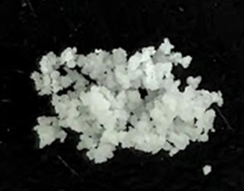
Ammonia in glass matrix
Source: University of Hyogo
The promise of boric glass
In existing applications, ammonia breaks into hydrogen, nitrogen, and oxygen at temperatures between 400°C and 600°C, depending on the catalyst used. Morishita aims to lower this threshold by developing a new catalyst, seeking a breakthrough in materials science.
“The boric glass matrix is not the only ammonia carrier,” he suggests. “Finding the right combination could revolutionize the field.”
Solid-state ammonia has a high energy density — over 1,000 Wh/kg in gas form — but compresses to just 1/1000 of its gaseous volume when solid, with a density comparable to its liquid state, according to the Ammonia Energy Association.
Morishita has two use case scenarios in mind: to directly produce hydrogen from solid-state ammonia on board vehicles, and to store ammonia in a solid state at manned premises of power generating plants so that it can then be blended with coal for co-firing.
Onboard hydrogen conversion from solid-state ammonia could enable safer storage in vehicles and ships. Chemical engineers estimate that for cars, conversion must occur below 100°C to allow rapid start and shutdown of internal combustion systems.
Pursuing this goal has not only an economic rationale, it could also boost safety. At power plants, ammonia in a solid state would reduce risks from leaks from gas or liquid tanks. A rupture in a liquid ammonia tank could release hazardous fumes.
The burning question
Not all eyes, however, are on boric glass. Another group at Japan’s National Institute of Advanced Industrial Science and Technology (AIST) headed by Kawamoto Tohru is working on solidifying ammonia as ammonium bicarbonate, a compound commonly used in fire extinguishers and baking powder.
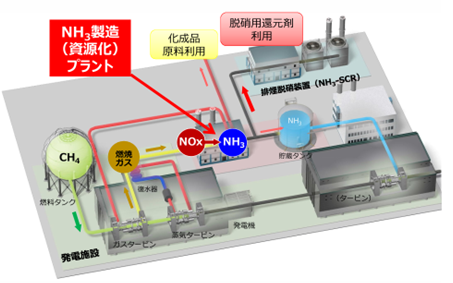
Their technology, initially aimed at capturing nitrogen oxides (NOx), produces ammonia that’s later converted into ammonium bicarbonate for storage. In the lab, ammonium bicarbonate releases ammonia at around 60-70°C.
Bench trials of AIST’s approach, known as NOx-to-ammonia (NTA), are already underway across Japan, and Ube Corp, a chemical producer, plans to run a pilot.
Conceptual image of an NTA system at a chemical plant
NOx turns to NH3, and is reused as chemical feedstock, desulfurizing agent, or fuel for power generation.
Source: NEDO
The bottom line
For energy firms, the key question remains: how much energy does it take to shift ammonia from solid to gas and back?
“If ammonia is too stable in room temperatures and pressures, it may require huge energy to take it out of the glass matrix,” said one researcher.
The real answer is that few companies in Japan are actually doing the research to make any conclusions, but at least flickers of interest are there.
It’s clear that solid-state ammonia could reduce transport costs and risks. A sector that could be among the first to embrace this energy solution is shipping.
One fuel tank manufacturer says that solid-state ammonia as a storage method has appeal for ammonia-fueled ships. Early designs for vessels powered by ammonia were made with the idea that they would be unmanned, due to safety risks. Ammonia in solid form changes the calculus.
Companies that have suffered from ammonia incidents in the past welcome any new ideas to enhance safety, including solid-state ammonia. Most incidents occur due to process errors of contractors and subcontractors.
But state funding would be required to cover the initial R&D costs, as companies feel it’s too premature to develop any business case.
The misconceptions around this technology are equally daunting. There’s a widely held idea even among those working in ammonia-related projects that solid-state ammonia must liquefy before gasifying. This is not actually the case. Equally, others assume that a solid-state ammonia product is aimed to replace ammonia gas. In the absence of reliable data and sufficient information, most in the industry are making misguided guesses.
For now, the Education Ministry funds Morishita’s research, and he plans to pursue additional grants from the government, hoping to turn borane glass into a viable hydrogen carrier and expand Japan’s clean energy portfolio. AIST’s Moonshot Program is funding the NOx-to-ammonia project.
If this unconventional treatment of ammonia proves viable, it could tackle some of the thorniest issues in hydrogen and hydrogen-related transport and storage, helping usher in a new alternative for clean energy. But for the moment, the journey has just begun.
ASIA ENERGY REVIEW
BY JOHN VAROLI
This weekly column focuses on energy events in Asia and the Pacific
Asia / Clean energy
Capital allocation in the energy sector is increasingly prioritizing clean energy, with 75-85% of funds raised in Asia in 2022-2023 directed toward the energy transition, says Kelvin Wong, global head of renewables, and infrastructure at DBS Bank.
Australia / Rooftop solar
Each year, Australia needs to deploy about 3 GW of rooftop solar PV, and between 6-7 GW of utility-scale renewable energy, said Kane Thornton, head of the Clean Energy Council.
China / Crude imports
Crude oil imports fell 9% in October, a sixth consecutive monthly decline; a plant closure at a state oil refinery added to weaker demand from independent refiners. The world’s largest crude oil importer brought in 44.7 MMT last month, or about 10.53 mbpd, down from 11.07 mbpd in Sept and 11.53 mbpd in Oct 2023.
Energy / Global investment
Energy investments globally are expected to reach $3.1 trillion this year, a 5% annual growth from $2.4 trillion in 2018, according to the World Investment Report. Clean energy investment alone is expected to nearly double that of fossil fuels, increasing from $1.2 trillion in 2018 to $2 trillion by the end of 2024.
India / Renewable energy
The govt approved 50 solar parks with a combined capacity of nearly 37.5 GW, said Minister of Renewable Energy Pralhad Joshi, adding that the country has identified potential offshore wind sites to reach its 30 GW goal by 2030.
Pakistan / Grid
Oracle Power announced completion of its transmission and grid interconnection study for its proposed 1.3 GW hybrid renewable energy plant in Sindh region.
South Korea / Nuclear power
The U.S. and South Korea pledged greater cooperation in civilian nuclear energy industries, and they signed an MoU on topics affecting nuclear exports and cooperation.
Taiwan / Electricity
Chipmaker TSMC will pay more for its power in Taiwan than in any of the other countries in which it operates due to the increasing domestic price of energy. The cost of electricity in Taiwan has doubled in the past few years, as subsidizing power is untenable for the government. TSMC also has chip plants in the U.S. and Japan.
Vietnam / Wind power
NMDC Group and Vingroup signed an MoU that covers strategic partnerships in various areas, including the development of offshore wind in Vietnam.
2024 EVENTS CALENDAR
A selection of domestic and international events we believe will have an impact on Japanese energy
November
US presidential election (Nov 5)
COP 29 in Azerbaijan (Nov 11-22)
Abu Dhabi International Petroleum Exhibition Conference (ADIPEC) 2024, Abu Dhabi, UAE (Nov 11-14)
APEC 2024 @ Lima, Peru
International Conference on Nuclear Decommissioning (TBD)
G20 Rio de Janeiro Summit (Nov 18-19)
Result of solar auction #22 (Nov 26)
Offshore Energy Exhibition & Conference (OEEC) 2024, Amsterdam, the Netherlands (Nov 26-27)
APAC Wind Energy Summit (Nov 26-28)
Biomass & BioEnergy Asia Conference (TBD)
European Biomethane Week 2024
December
Last market trading day (Dec 30)
January 2025
First market trading day (Jan 4)
FIT/FIP solar auction #23 (Jan 6-24)
World Forum Offshore Wind (WFO) Global Summit 2025, Barcelona, Spain (Jan 21-22)
Offshore Technology & ENEX Exhibition @ Tokyo Big Sight (Jan 29-31)
February
Result of solar auction #23 (March 7)
Disclaimer
This communication has been prepared for information purposes only, is confidential and may be legally privileged. This is a subscription-only service and is directed at those who have expressly asked K.K. Yuri Group or one of its representatives to be added to the mailing list. This document may not be onwardly circulated or reproduced without prior written consent from Yuri Group, which retains all copyright to the content of this report.
Yuri Group is not registered as an investment advisor in any jurisdiction. Our research and all the content express our opinions, which are generally based on available public information, field studies and own analysis. Content is limited to general comment upon general political, economic and market issues, asset classes and types of investments. The report and all of its content does not constitute a recommendation or solicitation to buy, sell, subscribe for or underwrite any product or physical commodity, or a financial instrument.
The information contained in this report is obtained from sources believed to be reliable and in good faith. No representation or warranty is made that it is accurate or complete. Opinions and views expressed are subject to change without notice, as are prices and availability, which are indicative only. There is no obligation to notify recipients of any changes to this data or to do so in the future. No responsibility is accepted for the use of or reliance on the information provided. In no circumstances will Yuri Group be liable for any indirect or direct loss, or consequential loss or damages arising from the use of, any inability to use, or any inaccuracy in the information.
NEWS
・MoE releases updated guidelines for green bonds, sustainability-linked bonds, and loans
・TEPCO’s next business planning stalls amid uncertainty over reactor restarts
・MLIT committee starts discussing port infrastructure for hydrogen and ammonia imports