The contentious COP29, the COP of “climate finance,” went into overtime. The event was a success for some, including Japanese officialdom. The key achievements were a New Collective Quantified Goal on Climate Finance (NCQG) and a tentative agreement on long-debated Article 6 rules for carbon markets. Overlooked in the media coverage is the fact that Japan has played a central role in mobilizing action on Article 6 carbon markets. Let’s take a look at COP29, why assessments are polarized, and why many Japanese and other climate realists are content with the results.
LinkedIn. The leading job website globally that purports not to be a job website is the first port of call for many companies expanding into new markets, hiring key experienced and skilled professionals across many levels. Japan is a bit different though. With an 8% market penetration of working age Japanese, LinkedIn doesn’t have the depth of coverage it does elsewhere. Let’s look at where LinkedIn has problems, as well as other online platforms to find talent in Japan.
ASIA PACIFIC REVIEW
This column gives a brief overview of last week’s top energy stories from across the region
EVENTS SCHEDULE
A selection of events to keep an eye on in 2024.
JAPAN NRG WEEKLY
PUBLISHER K. K. Yuri Group
Editorial Team Yuriy Humber (Editor-in-Chief) John Varoli (Senior Editor, Americas) Kyoko Fukuda (Japan) Magdalena Osumi (Japan Filippo Pedretti (Japan) Tim Young (Japan) Tetsuji Tomita (Japan)
Starting FY2026, the government plans to mandate corporations emitting over 100,000 tons of CO2 annually to offset emissions with carbon allowances.
CONTEXT: The same news was reported Nov 21 and also covered by Japan NRG. This news item tracks official publication of the initiative on METI’s website after a meeting of the Study Group on Legal Issues Related to the Emissions Trading System for the Realization of GX.
CONTEXT: About a year ago, Japan launched an emissions trading system, operated by the Japan Exchange Group. The carbon credit products traded are limited to the domestic J-Credits and JCM units. Trading is in ‘trial’ mode, supported by over 400 companies on a voluntary basis. The pilot phase is also referred to by METI as the “GX League initiative”.
At the Dec 4 online meeting, METI’s study group on the subject discussed:
Price discovery in carbon credits;
Legal issues involved;
Impact of overseas carbon pricing/ tax schemes such as EU’s CBAM.
At first, METI wants the country’s big emitters to set a total emissions target for a three-year period. If a company fails in this, it will have to publicly disclose the reasons (i.e. “comply or explain”). Companies will also be asked to consider the impact on their business from international measures such as CBAM.
Later, there will be emission quotas allocated to companies. Those that exceed them, will need to purchase credits or face penalties. Price caps and floors will be set to stabilize trading prices, based on input from experts.
Among concerns voiced by study group members is the potential for big companies to ‘offload’ their emissions to SMEs through outsourcing or geographical relocation of equipment/ machinery.
TAKEAWAY: To enforce participation by FY2026, the government will submit legal amendments to the Diet next year, with trading expected to begin in FY2027. This would be a major change and there is a chance that big emitters will seek to lobby lawmakers for delays or weaker penalties, claiming the need for a longer adjustment period. PM Ishiba has yet to give clear comments to indicate his stance on carbon credits and carbon taxes.
Japanese companies will start exploratory drilling next year to store CO2 underground with the help of government subsidies.
METI aims to select candidate sites for funding by March, with drilling starting that year. Carbon storage projects are being planned at five government-selected locations.
Japan hopes to begin commercial operations of carbon storage by fiscal 2030. To meet the deadline, companies involved must decide on investment by around 2026.
CONTEXT: The five locations include one in Hokkaido’s Tomakomai region led by energy company Idemitsu, a Tohoku site on the Sea of Japan coast led by trading house Itochu, and another in eastern Niigata region led by Tohoku Electric. Nippon Steel and others are pursuing a project in the Greater Tokyo area, while ENEOS and others are planning a storage site off the coast of Kyushu.
The government plans two drilling locations per site, with cost at about ¥10 billion per drilling. METI set aside ¥32 billion in the FY2024 supplementary budget.
The plan is to store around 1% of domestic annual emissions in 2030, raising the share to between 10% and 20% in 2050. Carbon will be captured from fossil-fuel power plants and elsewhere before being stored underground.
SIDE DEVELOPMENT: Govt to start developing a support system for CCS business (Japan NRG, Dec 4)
Keino Yoshinori, director of the CO2 Capture and Storage Policy Office, (ANRE/ METI), presented CCS plans at the Japan CCS Forum on Dec 4.
He said the govt is working on a preliminary framework for a CCS support system, as the cost of CCS is still too high for emitters. It will be outlined later this month.
MoE and METI unveiled a new draft proposal for Japan’s next GHG reduction target, to be submitted to the United Nations by February 2025. The draft calls to reduce GHG emissions by 60% in FY2035 compared to FY2013.
The key update is the roadmap between 2030 and 2050, based on reducing emissions 46% by FY2030 and reaching net-zero in 2050.
There are different views on reduction targets and pathways beyond 2030; some experts call for a certain reduction percentage each year, helping to achieve both emission reductions and economic growth.
If calculated from the 2013 base-year CO2 emissions of 1.41 billion tons, then emissions will drop 60% by FY2035, and 73% in FY2040. The end goal is net zero in 2050.
CONTEXT: Under the Paris Agreement, countries are required to submit a Nationally Determined Contribution (NDCs) to the UN by 2025 for the 2035 target, and by 2030 for the 2040 target. Japan is working on a reduction target for 2035 in conjunction with work on its Seventh Basic Energy Plan and the GX2040 Vision.
TAKEAWAY: The 60% number was leaked to the media a few weeks ago, so this is not a major surprise. The officials’ notes around the targets are more illuminating. While the officials admit that the outcome may not be as rosy as they suggest, the general trend of the forecasts is an assumption that agriculture and energy intensive industries will accelerate their decarbonization at a later, undefined point in time. For now, these industries must go slowly in order to maintain a “virtuous cycle of economic growth and environmental action.” While this may seem logical enough, it also puts great expectations on unstated future innovations. The proposal also says a “certain degree of flexibility” is required in this target setting, but also plots future GHG numbers in a manner that suggests there will be aggressive action to cut emissions in the late 2020s / early 2030s.
Another point of interest should be the phrase: “In addition to achieving net zero in the future, it is necessary to consider contributions to other countries, while keeping in mind the concept of carbon budgets and the idea of early emission reductions.” This speaks directly to the influence of Article 6 of the Paris Agreement. For further details on this issue, please see this week’s Analysis section.
ANRE announced a policy to use multiple case scenarios to calculate power generation costs as it revises the Basic Energy Plan and prepares a draft energy mix for FY2040.
Officials said the cost of integrating the different sources in the overall energy system varies greatly depending on the ratio of variable renewables (namely, solar and wind). As such, the costs will be calculated based on the variable renewables making up 40% of the total power mix, as well as 50% and 60%.
The energy sources to be examined by ANRE in its assessment include commercial solar, onshore wind, offshore wind, nuclear, LNG thermal, and ‘decarbonized’ thermal, as well as demand-response using grid storage batteries and hot water heaters. The energy agency will also study balancing capacity and its impact on smoothing out supply and demand forecasting errors.
Since the costs of experimental perovskite solar cells and floating offshore wind turbines aren’t yet clear, the yen-per-kilowatt-hour calculations for these energy sources will be treated as reference values.
CONTEXT: In the previous Basic Energy Plan, set in 2021, the costs of running various power sources were calculated with a different methodology. The latter assumed that the power mix forecast for 2030 would be achieved and that all developments after that would be incremental to the 2030 scenario.
ANRE received reports, from six expert organizations, analyzing energy supply and demand in FY2040, which will be used as a reference for writing the next Basic Energy Plan.
While comparing the results of the different scenarios and analyses, the energy agency will keep the following in mind:
One of the scenarios will look at the possibility of a linear emissions reduction pathway from FY2013 to FY2030 (down 46% GHG); and from FY2030 to net-zero in 2050;
National energy policy will maintain its “S + 3E” focus: Safety, Energy Security, Efficiency, and Environment;
All actions will avoid excessive damage to economic activity;
New specifications will be consistent with those of previous govt councils;
Technology and cost innovations continue for renewables, hydrogen, CCS, etc;
Total GHG emissions and international differences in energy prices will play a role in Japan’s actions.
ANRE will present several scenarios in its own report. These will be differentiated by the degree of technological progress in renewables, hydrogen, and CCS.
CONTEXT: The expert organizations are the National Institute for Environmental Studies, the Research Institute of Innovative Technology for the Earth (RITE), the Institute for Global Environmental Strategies, Deloitte Tohmatsu Consulting, the Institute of Energy Economics, Japan (IEEJ), and McKinsey & Co. Each has its own energy economic model and has published results in the past; but this time, results were obtained by using parameters requested by ANRE.
METI plans to revise the upcoming Basic Energy Plan by allowing NPPs to be rebuilt on sites other than their original location. Current rules limit the construction of a new reactor to replace an older unit to the same site.
This shift aims to provide utilities with more flexibility for investment, and also addresses potential increases in electricity demand.
Among the first to take advantage of the new rules could be Kyushu Electric as it looks to build a new reactor at the Sendai NPP.
CONTEXT: The new plan aims to maintain nuclear power’s 20% share in the 2040 national energy mix, which is also the 2030 goal. Currently, nuclear power accounts for only 8.5% of Japan’s energy supply, which requires more reactors to restart. The govt is also considering measures to encourage investment in reconstruction of NPPs.
In April 2025, ANRE will implement temporary measures to facilitate early grid connection of storage batteries (BESS).
These will allow a connection to be approved even when there are concerns about the local energy balance. To alleviate the concerns, BESS operators will be asked to agree to charging restrictions during certain periods.
Until recently, a N-1 charging shutdown device had been used to prevent the grid from exceeding its operating capacity. This measure had staved off the immediate need for grid upgrades, but it has recently been judged as insufficient.
BESS operators will have to install their own equipment with a system safety feature that restricts charging during relevant time periods. The grid lines to which new additional measures will be applied are the trunk and the local lines. TSOs will decide whether to apply the measures.
CONTEXT: Japan’s total capacity of grid-connected BESS is at around 90 MW, but the capacity of connection applications under review is almost 100 times higher at 88 GW. Due to subsidies and long-term decarbonization power auctions (LTDA), BESS grid connection requests are expected to increase. The capacity of contracted BESS that’s applying for a grid connection has more than doubled since the end of 2023 to 6.2 GW.
TOCOM was selected by the Tokyo Metropolitan Govt to operate its Green Hydrogen Trial Trading Project that takes place this month through March.
CONTEXT: The TMG sees green H2 as a key tool for decarbonization, and is working to promote its use.
TOCOM will design and implement the project that’s based on trading two contracts: delivery of a trailer of green H2 (2,484 Nm3), and a cradle pack of green H2 (263 nm3).
A website for the project was set up, and applications for registration will be accepted from those wishing to supply or use green H2.
Applications by suppliers closed on Dec 4; for buyers it runs until Dec 16. Bids will be made and decided by Dec 19. Contracts will be signed by the end of January 2025. Delivery will be completed by the end of March.
Nippon Steel and IHI among potential hydrogen offtakers in Japan
(BNEF, Dec 5)
Companies likely to become hydrogen offtakers in Japan include top steelmaker Nippon Steel, engineering firm IHI, Mitsubishi Chemical and liquid hydrogen supplier Iwatani Corp, according to BNEF estimates.
CONTEXT: Potential buyers of hydrogen are grouping into clusters that will apply for government subsidies under the Contract for Difference (CfD) program that aims to bridge the price gap between the cost of buying fossil fuels and the clean-burning hydrogen, and its related derivatives.
Applications for the CfD program are due by March, with proposals submitted by January receiving priority.
CONTEXT: Subsidies will go to buyers, not sellers of hydrogen. To qualify for the ¥3 trillion government CfD fund, the supply of the clean energy source needs to continue for a 25-year period. Of that, only the first 15 years are covered by subsidies.
TAKEAWAY: The BNEF story initially caused a great deal of commotion because it said power utilities would not be eligible for CfD subsidies. It was later amended to say that CfD can cover the purchase of hydrogen for use as fuel at power plants, but that can’t be the only demand case in a hydrogen cluster application. In other words, CfD will sponsor clusters that include steel, chemicals, transport and other sectors as well. This is in line with government comments over the past year. Companies mentioned by BNEF, such as Nippon Steel, have announced 2030 hydrogen-related targets and hope for some of the CfD money.
JTEKT Corp joined the Japan Hydrogen Association (JH2A). The company is working on hydrogen-related solutions for applications in passenger cars, commercial vehicles, construction machinery, railways, ships, and drones.
CONTEXT: JH2A was established in April 2022 to support the creation of new demand centers for hydrogen, to cut the cost of hydrogen energy through innovation, and to offer financing to companies in related fields. As of June, 448 companies and organizations are members.
Yokohama City concluded a 10-year demo of a self-sustaining hydrogen fuel cell system that balances fluctuations in renewable energy and as part of VPP projects.
The H2One was introduced in 2015 as the first of its kind in public offices. It was Yokohama City’s first step in hydrogen policy development, paving the way for projects like hydrogen-powered forklifts at the Mizue Pier and mobile hydrogen stations at Osanbashi Pier.
Panasonic has launched a test project to cover the electricity needs of a microwave oven assembly plant in the UK by combining pure hydrogen fuel cells (FCs) with solar cells and storage batteries.
The overall energy efficiency will be 95% thanks to cogeneration, which uses the waste heat from FCs for heating and hot water in the factory.
CONTEXT: By 2030, Panasonic Group aims to reduce its own CO2 emissions to virtually zero. The firm is promoting the concept of “Panasonic HX” as a term for energy solutions using hydrogen. These include three-cell linkage control that combines pure hydrogen fuel cells with solar cells and battery cells.
Kyuden International, a Kyushu Electric firm, inked an MoU with ACWA Power Co in Saudi Arabia to focus on renewable energy and green hydrogen.
The companies will cooperate on renewable energy and green hydrogen projects overseas, including in Central and Southeast Asia.
CONTEXT: ACWA Power develops power generation and desalination projects in 13 countries and has 65.2 GW of power generation and 8.05 million m3 of desalination capacity per day.
Nippon Yusen, Knutsen NYK Carbon Carriers, and JFE Shoji Corp concluded a feasibility study to transport and store liquefied CO2 under elevated pressure.
It confirmed the availability of production facilities, production capacity, and the cost-effectiveness of using versatile carbon steel for the tanks.
The tanks are designed to store and transport LCO2 at 0–10°C and 35–45 bar. It allows easier handling of CO2 and less energy for pressurization and liquefaction.
On Nov 26, Japan CCS launched a demo for maritime transportation of liquefied CO2. The first ship carried around 400 tons of LCO2.
It departed from KEPCO’s Maizuru coal-fired power plant (Kyoto Pref), sailing toward a receiving base at Hokkaido Electric’s Tomakomai power plant.
TAKEAWAY: Promoting maritime transportation of LCO2 is crucial for Japan’s CCS plans. Six out of nine of the Advanced CCS projects will involve this means of transportation. Together with Japan’s ambitions of building a cross-border CCS value chain, advancing LCO2 maritime transportation from research to the commercial phase is imperative.
Toshiba Energy Systems & Solutions acquired full ownership of Next Kraftwerke Toshiba (TNK) by purchasing all shares from Next Kraftwerke (Germany).
TNK, established in 2020 as a JV, provided aggregator support services for Japan’s renewable energy ecosystem and launched a Virtual Power Plant (VPP) business.
Toshiba ESS will independently operate the VPP business.
Mitsui & Co, Mitsubishi Corp, Japan Airlines, etc are investing in Heirloom Carbon Technologies, a U.S. start-up specializing in direct air capture (DAC).
Heirloom raised $150 million in this round, bringing total funding to over $260 million. The company uses limestone to capture CO2.
Heirloom’s first DAC facility in California captures 1,000 tons of CO2 a year. It plans a larger facility in Louisiana.
Battery producer NGK Insulators won an order for sodium-sulfur (NAS) batteries from Hungarian renewable energy provider Greenergy Triotechnik.
The batteries will be installed inside Greenergy-Power’s solar power station to curb wastage of surplus power by charging with renewables when the power grid is full.
CONTEXT: Hungary aims to convert 90% of its generated power to low-carbon sources by 2030. The country plans to increase solar power generation from the current level of around 5 GW/ year to around 12 GW by 2030. As the European energy grid suffers from shortages of available capacity, there is growing use of high-capacity storage batteries, such as NAS batteries. NGK Insulators has received several other orders for NAS batteries from Hungary.
In 2025, METI will promote the rollout of next-gen solar technology, perovskite solar cells (PSC), aiming to spur between 20 GW and 40 GW of PSC installations in Japan and overseas by 2040.
Recognizing the smaller size of the domestic market, a METI group proposed a rollout strategy to incorporate international markets from the start. The upper, 40 GW is based on the premise that the tech achieves “significant cost reductions.”
CONTEXT: Most regular solar PV panels today are made with polysilicon. In 2004, Japan had more than a 50% global share in the production of solar panels. Today, that stands at 0.2% and Chinese companies hold all top 10 spots globally.
Japan’s new target seeks to encourage manufacturers to invest and mass-produce PSC and continue with R&D. The government wants to spur a domestic market through measures such as a new FIT specifically for PSC-based solar projects.
METI sees PSC costs to drop to ¥14-¥20/ kWh by 2030, and ¥10 to ¥14 in 2040.
CONTEXT: Solar’s share of the national electricity mix stood at 9.8% in FY2023, but the government wants this to expand to 14-16% by 2030.
TAKEAWAY: PSC tech will most likely be mentioned in the next Basic Energy Plan and even have a number assigned to it as a proportion of the total energy mix by 2040, similar to the way that e-methane and hydrogen were included in previous Plans. However, most pilot projects for PSC are not yet at the MW scale. Envisioning at least 20 GW of PSC capacity in 15 years is a big leap. Yet, Japan installed over 70 GW of solar power capacity in the 12 years since the FIT system was introduced. The difference is that silicon-based solar PV was already a mature, commercially viable technology with utility scale operations in other countries. While flexible, PSC film is still less energy efficient than regular panels and not suitable for solar farms in their current form. PSC may work well as supplementary energy sources covering industrial buildings or residential blocks.
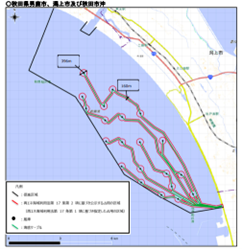
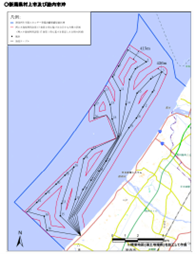
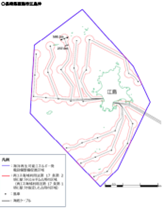
The ministries approved the plans submitted by the operators. These outline the use of sea areas, specifying the designated zones and duration of occupancy:
(1) Nov 1, 2026 – Dec 5, 2054
(2) June 24, 2026 – Dec 5, 2054
(3) Sept 1, 2027 9 Dec 5, 2054
CONTEXT: The Akita Hachimori and Noshiro offshore areas faced overlapping port usage. The highest-scoring bidder revised its plan and, after further evaluation by a third-party committee, Happo-Noshiro Offshore Wind, was selected on March 22, 2024. Approval is forthcoming.
OCCTO announced the assumed load curve for 2040-2050. In addition to increased demand due to electrification, these scenarios also consider demand shifts, compared to other time periods, owing to the expansion of demand response (DR).
It was predicted that during the weekday daytime hours in August, a peak demand period, the effect of reducing demand through DR would be significant. During the weekday daytime hours and weekends in May, when there is a lot of solar generation, demand could increase due to increasing DR.
CONTEXT: OCCTO’s study group was launched in November 2023 to formulate a long-term electricity supply and demand scenario for 2050, and use it as a reference for the smooth implementation of long-term decarbonized power auctions and the systematic power source development. Three expert organizations, the Central Research Institute of Electric Power Industry (CRIEPI), the Research Institute of Innovative Technology for the Earth (RITE), and Deloitte Tohmatsu Consulting, are each conducting technical reviews.
ANRE has set FY2026-2027 as the start for changing the order of output control (i.e. curtailment) for FIT/FIP power sources by revising priority power supply rules.
Originally scheduled to start in FY2026, it was postponed due to the specific timing of the TSO control system renovation.
The output control of FIT-based projects is expected to be performed first. The frequency of curtailment at FIP-based projects should be reduced.
Under the revised rules, the working group will calculate the output control rate for FIT according to the FIP deployment ratio based on the long-term forecast of renewable energy output control by TSOs.
CONTEXT: As areas subject to output control are expanding nationwide due to the increased introduction of renewables, there has been discussion about differentiating the order of output control between FIT and FIP power sources to favor curtailing the former over the latter. The prices of FIP power sources are linked to the market, so their operations are seen as more in accord with the physical supply-demand balance; this makes their operations more likely to balance the market than FIT sources.
OCCTO experts discussed “institutional measures” that would make it mandatory to supply electricity to the supply and demand adjustment (i.e balancing) market.
Power sources that only have contracts for the utilization of excess capacity will be subject to the measures.
As for the discrepancy between the planned and actual adjustment capacity, which is one of the bidding constraints, the plan will aim to resolve this by encouraging early use of the time-ahead market through pumped hydro, and by speeding up the time that adjustment capacity providers check water levels.
The officials want to encourage applications / bids based on contract type, without distinguishing between the scale and type of power source.
Operators are expected to bid for all surplus capacity.
The third session of Japan’s FY2024 base load electricity market closed with Tokyo area prices reaching ¥16.05/ kWh, a ¥0.4 increase from the previous session.
Prices in Kansai and Kyushu were ¥13.36 and ¥13.53, respectively. No trades occurred for two-year contracts in any area.
Compared to FY2023 weighted average prices, Tokyo saw a slight ¥0.42 drop, while Kansai experienced a notable increase of ¥2.10.
Trading volumes surged significantly but still were modest in Tokyo (60 MW), Kansai (113 MW), and Kyushu (under 10 MW).
The fourth and final FY2024 trading session will run from January 21-31, 2025, focusing on one-year, fixed-price products.
Five companies, including ocean transport firm Kyowa Kisen, set up a new firm to develop floating observation devices for offshore wind power site surveys.
It will use laser beams to collect real-time wind data at altitudes of 40–300 meters, measuring humidity, air pressure, solar radiation, and sea surface temperature.
A demo project began in November off the coast of Rokkasho Village, Aomori Pref, and will run until May 2025. The device’s data will be compared to land-based observation systems to validate accuracy.
CONTEXT: Traditionally, wind conditions for offshore wind power projects in Japan were observed from land, as most projects utilized fixed-bottom turbines in shallow coastal areas. With offshore wind power projects moving further from the coast, the demand for such innovative observation services is expected to grow.
GPSS Group’s Japan Wind-Power Service plans to develop an onshore wind power plant near Kaminokuni Town, Hiyama District, Hokkaido, (240 MW max capacity).
The project will span 3,380 hectares, with 30 to 40 turbines, (each 4.2 MW to 6.1 MW). Construction will take about three years.
KEPCO began a feasibility assessment to upgrade the Himeji No. 1 Thermal Power Plant, and submitted a draft environmental consideration to METI.
The Himeji No 1 is an LNG-fired power facility in operation for about 30 years. An upgrade is planned with a combined-cycle power generation system to improve power generation efficiency and reduce CO2 emissions.
CONTEXT: The plant has 1.44 GW capacity, with a power generation efficiency of 54% (based on lower heating value). After the upgrade, the plant will have a total 1.95 GW capacity from three new units, each 650 MW. This upgrade will boost generation efficiency to approximately 63%. The plant will continue to run on LNG.
The upgraded facility should be ready in FY2033.
TAKEAWAY: This effort is part of KEPCO’s bigger plan to modernize its power plants. It’s also upgrading the Nanko Power Plant in Osaka. Reaching an increased generation efficiency of 63% is among the highest rates for thermal power plants.
Zero Watt Power totally acquired Sado Sojitz Thermal Power, and will now operate the power plant, renamed Sado Power Plant, instead of the trading house Sojitz.
This thermal power plant supplies about 15% of Sado Island’s electricity.
The electricity generated will continue to be supplied to Tohoku Electric. Zero Watt also plans to set up solar power facilities in the area.
Japanese researchers launched an experiment to collect solar energy in space and transmit power to Earth.
As a first step, Japan Space Systems (JSS) will operate aircraft equipped with solar panels flying 5-to-7 km above sea level and beam back microwaves to the ground to be converted into electricity. The project is commissioned by METI.
If successful, the project will advance to space-based solar power tests in 2025. Plans include deploying a 150-kg satellite with solar panels and a transmission antenna to beam energy from hundreds of kilometers above Earth’s surface.
CONTEXT: Advantages of space-based solar power include 24/7 operation that is unaffected by weather or daylight. However, the tech is costly; a solar farm in space is expected to cost in excess of ¥1 trillion, including launch costs. Two square km of panels (10,000 tons) are needed to produce the same energy as a nuclear reactor.
Shimane NPP Unit 2, operated by Chugoku Electric, restarted on Dec 7. Power generation and transmission will begin later this month. Commercial operations will resume in early January. The reactor is a BWR, 820 MW.
CONTEXT: This marks the first reactivation of a nuclear reactor for Chugoku Electric since Fukushima in March 2011. This is the 14th reactor to restart in Japan post-Fukushima.
TAKEAWAY: The restart of Onagawa NPP Unit 2, also a BWR, marks a significant step for Japan’s nuclear industry. Efforts to restart Kashiwazaki-Kariwa NPP stagnate, and there is no timeline for other restarts. The government still needs to face several challenges before it can boost nuclear power’s share to 20–22% by FY2030, as planned.
Kyushu Electric completed the storage capacity modification work (re-racking) for the spent fuel pool at Genkai NPP Unit 3.
CONTEXT: Unit 4 shares the pool with Unit 3. Thanks to the re-racking, external fuel shipment will not happen until 2029. The company also plans to build a dry storage facility for spent fuel.
Enerbank, which operates renewable electricity trading systems, has raised ¥580 million through a third-party allocation of new shares to investors including JIC Venture Growth Investments, a state-linked fund.
Other investors include Japan Venture Capital, and Spiral Capital. The funds will be used to grow businesses and launch new ones.
CONTEXT: Enerbank operates an auction-based intermediary system of electricity trading that can eliminate the hassle of choosing an electricity supplier when procuring renewable energy and also reduce costs. Its main customers are medium-sized companies and local governments.
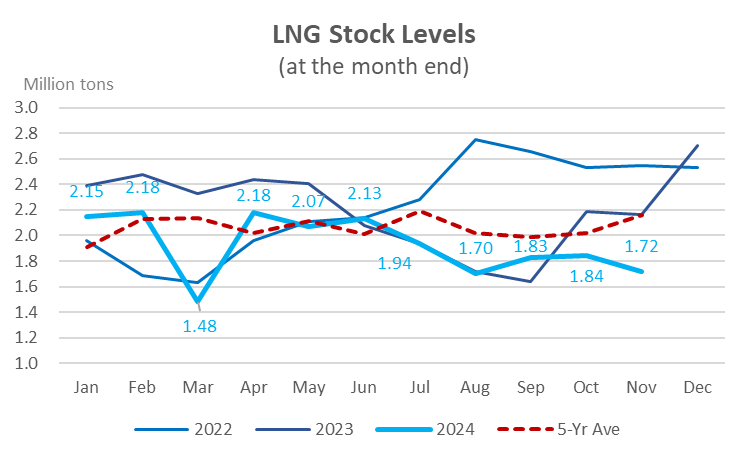
ANRE announced that LNG inventory data for the period from the end of March to November 17 this year has been revised due to errors in the past inventory data.
CONTEXT: One of the operators reporting to the agency had discovered a mistake in its calculations. The issue is now being investigated.
The updated numbers have the LNG reserves accumulated by the 10 major power utilities down 8.3% WoW to 1.89 Mt on Dec 1. The number is 12.5% down from the 5-year average of 2.16 Mt.
The Dec 1 stockpile number is the lowest in seven weeks; on Oct 13, the inventory was at 1.83 Mt. The Oct 13 inventory was the most significant data restatement, down from the 2.09 Mt originally reported by ANRE. That figure was already down 5% YoY (2.19 Mt), but the revised number is more than a 16% YoY drop.
While the errors were most notable during peak power demand periods, the majority of the revised data is only about 3.5% lower than originally reported.
TAKEAWAY: ANRE/ METI revises previous weeks’ LNG stockpiles data on a regular basis, though they’re often small. This error is more pronounced in that it would have given a misleading picture to spot LNG buyers and sellers by showing a rosier picture of Japan’s reserves at the time. Still, in the context of the global market and the multitude of factors involved in LNG prices, the mistake is unlikely to cause much fuss.
LNG stock levels at the month end after adjustment
Mitsui Oil Exploration Co (MOECO), a subsidiary of Mitsui & Co, will change its name to “Mitsui Energy Resources Development Co”, effective Jan 1, 2025.
The company is expanding into renewable energy sectors such as geothermal, and thus is keen to drop the word “oil” from its name.
After the name change, the abbreviation “MOECO” will continue to be used domestically and internationally.
ANALYSIS
BY PROF. ANDREW DeWIT
Why Japan is Happy About Climate Finance at COP29
The contentious and protracted COP29, the COP of “climate finance,” concluded on November 24, hours into overtime in Azerbaijan, a country that derives half its GDP from oil and gas. The event was a success for some, including Japanese officialdom and many astute observers.
The key achievements were a New Collective Quantified Goal on Climate Finance (NCQG) and a tentative agreement on long-debated Article 6 rules for carbon markets. Overlooked in the media coverage is the fact that Japan has played a central role in mobilizing action on Article 6 carbon markets. The latter could become a vital source of finance for the $300 billion/ year (by 2035) climate mitigation and adaptation envisioned by the NCQG.
COP29, however, has also been derided as an abject failure by commentators who want the forum to be a venue where political will transcends the hard economic and electoral realities of the present. Let’s take a look at the event, why assessments are polarized, and why many Japanese and other climate realists are content with the results.
Dark cloud over COP29
COP29 was deemed to be doomed even before it began by those who insist COP talks must aim at exiting fossil fuels so as to keep climate change below 1.5 degrees Celsius. The meeting unfolded in Azerbaijan, a country of 10 million that earns about 90% of its export revenues from hydrocarbons and has emerged as a key current and future supplier of gas to the European Union.
Then the November 4 reelection of Donald Trump as U.S. president cast a long, dark cloud over the proceedings, which extended from November 11 to the 24th in the Azerbaijani capital, Baku. On November 5 the activist NGO Global Witness made headlines with a “gotcha” moment, posing as oil and gas investors who beguiled Elnur Soltanov, the Azerbaijani chief of COP29 and the country’s deputy energy minister, into remarking that: “We have a lot of gas fields that are to be developed.”
The Azerbaijanis then doubled-down. Speaking as much to his own constituents and European investors, as well as COP delegates, the Azerbaijani President opened the COP29 Day 2 World Leaders Climate Action Summit by boldly declaring oil and gas to be a “gift from God.”
That proud assertion predictably outraged the idealists, leading former UN climate chief Christiana Figueres and others to send in a mid-COP open letter declaring the venue “no longer fit for purpose” and insisting the presidency be reserved only for countries that support phasing out fossil fuels. Figueres later toned down her remarks, but perhaps never before has a COP so starkly highlighted the messy realities of a world still over 80% dependent on fossil fuels.
In sharp contrast to previous iterations, COP29 saw virtually no presidents and prime ministers, nor bold declarations from the developed world, save for the UK’s Keir Starmer and his curiously precise promise of an 81% emissions cut by 2035.
Starmer’s commitment was the only major announcement of increased climate ambition in a conference that failed to mention how to actually implement the previous COP28 commitments to triple renewable capacity and double energy efficiency.
Attendance was also down from the record high of 83,000 participants at last year’s COP28 meeting in Dubai. Even so, COP29 included at least 70,000 participants, thus greatly exceeding the 50,000 at COP27 in Egypt and even more than the 30,000 at COP21 in Paris.
Japan went to Baku in force, with a delegation of 595 representing all the relevant government ministries and ranking among the top 10 national delegations. The Japanese were there to do business on international initiatives, and secured what they believe are genuine successes. Japanese officialdom proudly points out that they participated in no fewer than 10 major initiatives, such as methane reductions in agriculture. But the evidence indicates they were particularly interested in carbon trading/ finance.
Doing business on carbon trading
The good news for Japan began with the Day 1 adoption of Article 6 of the Paris Agreement, itself decided at COP21 in 2015. Put simply, Article 6 includes a UN-backed global carbon market that’s expected to foster a global regime of trading carbon credits to incentivize investment in mitigation and adaptation. Toward this outcome, since 2022 Japan has led the Paris Agreement Article 6 Implementation Partnership, which launched its first report on challenges and opportunities at COP29.
Article 6 carbon-trading could work in tandem with the new joint numerical target (NCQG) on climate finance of at least $300 billion per year by 2035, steering finance to developing countries for climate action. This figure tripled the previous goal of $100 billion a year of transfers to developing countries and opened it up to all public and private sources. The NGQC also aspires to further increase funding to at least $1.3 trillion per year by 2035.
Japan is very keen on enhanced carbon-trading because it already uses Article 6.2 mechanisms that permit bilateral agreements. Under Article 6.2, Japan has set up its Joint Crediting Mechanism (JCM), incentivizing Japanese public/ private finance for projects that use Japanese decarbonization technologies.
Japanese firms face carbon taxes that they pay to some extent with credits. In turn, Japan uses JCM credits to meet its climate target of reducing emissions 46% (compared to 2013) by 2030. Japan’s main problem with the current regime is complexity, as the lack of consistent rules means each project takes considerable time to negotiate such details as standards for measurement.
Japan’s goal is 100 million tons of JCM carbon credits by 2030, and to this end it has worked with 29 partner countries on over 250 projects. But Japan’s MoE reported in 2024 that JCM projects have only achieved about 20 million tons of CO2 reductions, about one-fifth of the 2030 goal. Moreover, not all of the reduction is booked on Japan’s balance sheet, with the CO2 cut usually split between the project’s host nation and that of the donor.
Meanwhile, progress on Article 6.4 opens the door to a UN-backed centralized carbon market, with comprehensive rules. Some observers expect that it could mobilize as much as $1 trillion annually by 2030 in private/ public climate finance. Harvard University’s Belfer Center for Science and International Affairs is less confident but concedes that the prospect of carbon border taxes (such as the EU’s unfolding Carbon Border Adjustment Mechanism), which were discussed at COP29, could dramatically incentivize the expansion of carbon markets.
In short, Japan secured progress on carbon-trading items that it has considered important for many years and will almost certainly increase in significance. For example, METI recently announced that starting April 2026 it will impose a carbon emissions trading system that targets up to 400 firms – in aviation, steel, and automobiles – annually emitting at least 100,000 tons of CO2.
The initial quotas will be free, but firms emitting in excess of their emissions quota will have to secure additional ones. A stable regime of international carbon trading is very appealing to Tokyo and Japan’s private sector.
Gripes about the emergent regime
There are plenty of critics of the NCQG and the expanding role of carbon trading. For example, the Carbon Market Watch lamented in a much-quoted press release that the Article 6 agreements risk the result of “cowboy carbon markets at a time when the world needs a sheriff.”
The Secretary-General of UN Trade and Development chimed in with a warning that carbon markets “are not a substitute for official development assistance or for climate finance flows.”
Many observers are incensed that the NCQG aim of $300 billion is far less than actual finance requirements, as implied by the agreement to aspire to $1.3 trillion by 2035. The developing countries were predictably outraged at the gap between NGQC language and the assessed needs for investment.
Nigeria, Bolivia, India and the Group of Least Developed Countries made much of this issue during the COP29 closing plenary. Representatives of small island states even walked out of a meeting with developed countries. They all want far higher levels of funding from developed countries and insist that the finance be grants rather than loans.
It is easy to sympathize with developing countries. Even if achieved, the proposed tripling of climate finance to $300 billion/ year almost certainly means more debt finance for developing countries. But roughly 3.3 billion people live in countries that already spend more on servicing debt than on education and health. And their borrowing costs are about four to eight times that of the developed countries.
The OECD’s recent “Bridging the Clean Investment Energy Gap” warns that low and low-middle income countries’ credit ratings are generally speculative or low-investment grade, exacerbated by the hangover from COVID-19 measures and ever-present political risks. Even the otherwise optimistic IEA concedes that developing countries’ clean-energy investment financing costs are roughly twice that of Europe and the U.S.
But there is little likelihood that the developed countries will ramp up climate finance to $300 billion/ year and beyond, and even less that they will offer increased grants. Such generosity would be fiscal and electoral suicide in light of their own debt levels, especially in the wake of COVID. No amount of rhetoric about climate justice can overcome these patent facts, and indeed Canada and Germany are likely to see regime-change to much less sympathetic governments. No wonder the EU insisted that Paris Agreement-defined “developing countries” like China and Saudi Arabia be deemed “developed” and added to the list of contributors to the NCQG.
But again, relying on more debt to finance developing countries’ climate measures is massively expensive for them, since many have high debt costs and already spend more on servicing debt than health and education. Similarly, the private sector isn’t going to provide the funds, without the prospect of profits or some other tangible return.
So there’s a big gap that a robust regime of carbon trading could help fill. And that’s why Japan is happy.
Andrew DeWit is a Professor in the School of Economic Policy Studies at Rikkyo University and an Asia-Pacific Journal editor.
ANALYSIS
BY ANDREW STATTER
Energy Jobs in Japan: Finding and Engaging Talent Online
LinkedIn. The greatest job website globally that purports not to be a job website is the first port of call for many companies expanding into new markets, hiring key experienced and skilled professionals across many levels. This is a great tool across geographies, industries and has been relied upon by companies hiring directly and agency recruiters alike.
Japan is a bit different though. With an 8% market penetration of working age Japanese, LinkedIn doesn’t have the depth of coverage it does elsewhere. But then, Japan has always been a bit different online – Yahoo is still more popular than Google for early millennials and older, and local e-commerce player Rakuten is tied for market share with global behemoth Amazon.
Let’s look at where LinkedIn has problems, as well as other online platforms to find talent in Japan.
How the Japanese see LinkedIn
LinkedIn brands itself as a professional networking site, and as in most Western markets, people will use it as a platform to build a professional brand. People will carefully select a profile picture, fill in details, write an entertaining bio introducing themselves and actively like and follow companies in their industry, even including competitors.
This is not so much the case in Japan. Not only does far less of the professional population have an account (<10% compared to >60% in US), but the profiles seem bare. No picture, just company names, dates and job titles is the norm. Most Japanese refrain from commenting and engaging with the community, the profile seems as good as dormant from the outside. It is also common for profiles to disappear, often after the person changes jobs.
Why? The reason is simple: Japanese view LinkedIn as a job search site. Unlike any of the local job boards though, they can’t easily hide their identity and therefore can be found by their boss, colleagues or HR. It is not uncommon for Japanese professionals, upon having their LinkedIn discovered by colleagues, to be asked if they are not happy and looking to leave the company.
A Japanese version of LinkedIn?
Bizreach is sometimes referred to as the Japanese version of LinkedIn. This platform, as well as Doda X, Rikunavi, Recruit Agent and others are more accurately Japan’s answer to Indeed or Monster.com. They are job boards, where professionals create a clear profile outlining their background, including age, income levels, desired working conditions and locations with the intent to apply to job postings, or be approached by scout messages. Privacy rules in Japan, and the fact that professionals can mask their identity until they decide to respond to an incoming message is the #1 trump card these services hold over LinkedIn.
For the energy industry, Bizreach has the largest general talent pool available, and other niche specific sites — i.e. for construction, or IT — can be worth looking at as well. Wantedly would be the #1 site for startups and tech focused companies, including energy and climate tech.
Like many things in Japan, these can get very domestic very quickly. Websites are in Japanese, English language support is almost non-existent, and the candidate volume rated as business proficient in English or above is around 10% or less site by site. Most large sites require job posters and agencies to prove that they have a local entity existing in Japan, and therefore these might not be accessible channels for those who are looking at market entry or in the early stage of launch.
Cost is another factor to consider. Most of these sites will charge an account establishment fee, monthly or annual subscription fees and also a percentage fee once a hire is made, similar to a recruitment agency. These fees are typically 10~20% for direct hiring companies, depending on the hiring volume, and often higher for third-party agencies.
Social media as a channel
Both Facebook and X (Twitter) are channels that can be leveraged for online recruitment in Japan. As these are not socially viewed as job change sites, there is less stigma around publicly sharing where you want, commenting on industry related topics, joining industry related groups etc. Facebook Groups are actually one of the most active platforms in Japan for the startup community, whereas they’ve dropped off in popularity in other regions as people have favoured other channels for discussion and networking.
As community-focused platforms, they don’t provide instant access to active talent the same way Japanese job boards or LinkedIn do. You will need to build a corporate brand with a corporate page, and will get better response rates if the person in charge of outreach has a professionally focused account to connect with people.
If you have a longer term growth strategy and will be making consistent hiring, investing into social media corporate branding, sharing information about company events, culture, being active in group discussions etc and actively expanding industry networks can yield results. However, it will take significantly longer and a higher investment of consistent effort.
Business card registration sites
Data. He who has it will monetize it. Japan has multiple services that were originally branded as a tool to collect, organize and manage your business cards, update your professional network with promotions, etc. This is useful in Japanese businesses where people rotate positions often and meetings with Japanese companies usually have anywhere from two to eight participants.
Services such as 8card, Sansan and Skypce have been battling for market share and looking to expand revenue streams. Including a job hunting and scouting section is one area that’s increasingly common.
On the plus side, these services actually have a large volume of people who are not to be found on sites such as LinkedIn or Bizreach. After all, they are using these sites to organize the mess of hundreds of business cards accumulated over years of work and networking. Before shelling out for the recruitment subscription plans, which look a lot like Bizreach and etc in terms of pricing structure, remember that privacy and trust are paramount in Japan.
These companies know most of their customers are not using their service to get scouted for new roles, therefore usually those who are visible, able to be searched and scouted have to opt in to do so. Rates of total users to those who have opted in is close to that magic 10%, so be wary of jumping too quickly to purchase when you see the total user data.
Well, that all sounds like a lot of work…
For a company GM, APAC Head or hiring manager for whom recruitment is a fraction of their role, yes it is. Access to most of the market, high response rates and detailed profiles found on LinkedIn in other markets don’t have the depth in Japan for a quick search to yield results.
Investing in either hiring local dedicated talent acquisition staff, partnering with a recruitment process outsourcing (RPO) firm or niche search firms who will use a blend of the industry specific channels may cost more on the balance sheet, but as the old saying goes – time is money.
Andrew Statter is a Partner at Titan GreenTech, an executive recruitment agency focused on the clean energy space.
ASIA ENERGY REVIEW
BY JOHN VAROLI
This column provides a brief overview of the region’s main energy events from the past week
Australia / Battery storage
New South Wales approved the $1 billion Mount Piper battery energy storage system, one of Australia’s biggest, which will store excess energy from the electricity grid during non-peak periods. The project is being developed by EnergyAustralia and will use the company’s existing electricity infrastructure. It will store up to 500 MW / 2,000 MW/h of power, enough for over 200,000 homes during high demand.
China / Coal
Coal power permits fell 83% in the first half of this year, with no new coal-based steelmaking projects approved. Also, 52% of experts surveyed by the Centre for Research on Energy and Clean Air in Finland, and the International Society for Energy Transition Studies in Australia, said they expect China’s coal consumption to peak next year.
China / Ocean energy
China General Nuclear Power Group (CGN) plans to build an integrated facility that will experiment with deep-sea renewable energy off the coast of Guangdong province. CGN will lead a tech consortium to build an offshore “integrated energy island,” which is regarded by scientists as one of the country’s 10 most challenging engineering projects.
India / Green hydrogen
India is facing challenges in the rollout of green hydrogen. According to CareEdge Ratings, the estimated levelised cost of green hydrogen, which includes both capital expenditure and operational expenditure per unit of production, is currently around 1.75 times that of grey hydrogen and around 1.50 times that of brown hydrogen.
India / Solar power
India will add 22.4 GW of solar capacity in 2024, according to JMK Research. This includes 17 GW from utility-scale projects, 4 GW from rooftop solar installations, and 1.4 GW from off-grid systems. In the wind sector, about 3.6 GW of new capacity is projected this year. From January to September 2024, India added 13.2 GW of utility-scale solar capacity, a 161% YoY increase.
India / Renewable energy
Tata Power and the Asian Development Bank inked a MoU to allocate $4.25 billion for the company’s renewable energy projects in India. Financing for some projects will be evaluated. These include a 966 MW solar wind hybrid project and pumped hydro storage project, as well as others that focus on the energy transition, decarbonization, and battery storage.
LNG
The second term of Donald Trump will benefit LNG markets as he is expected to accelerate the expansion of LNG infrastructure in the U.S. through deregulation and fast-permitting. This will reverse the Biden administration’s regulatory pauses and increase leases on federal land for gas production.
Philippines / Renewable energy
Meralco PowerGen Corp (MGen) said it plans to increase its power generation portfolio through the addition of 1.5 GW of renewable energy.
Singapore / SMRs
Singapore should avoid becoming a test bed for small modular reactors (SMRs) in a push to diversify its energy mix away from oil; the problem with SMRs is their high cost and safety risks, according to energy analysts.
Thailand / Renewable energy
The Asian Development Bank and Gulf Renewable Energy inked an $820 million loan to build 12 renewable energy projects; this includes eight ground-mounted solar PV plants with contracted capacity of 393 MW and four ground-mounted solar PV plants with battery energy storage that have contracted capacity of 256 MW and 396 MW/h of energy storage.
2024 EVENTS CALENDAR
A selection of domestic and international events we believe will have an impact on Japanese energy
November
US presidential election (Nov 5)
COP 29 in Azerbaijan (Nov 11-22)
Abu Dhabi International Petroleum Exhibition Conference (ADIPEC) 2024, Abu Dhabi, UAE (Nov 11-14)
APEC 2024 @ Lima, Peru
International Conference on Nuclear Decommissioning (TBD)
G20 Rio de Janeiro Summit (Nov 18-19)
Result of solar auction #22 (Nov 26)
Offshore Energy Exhibition & Conference (OEEC) 2024, Amsterdam, the Netherlands (Nov 26-27)
APAC Wind Energy Summit (Nov 26-28)
Biomass & BioEnergy Asia Conference (TBD)
European Biomethane Week 2024
December
Last market trading day (Dec 30)
January 2025
First market trading day (Jan 4)
FIT/FIP solar auction #23 (Jan 6-24)
World Forum Offshore Wind (WFO) Global Summit 2025, Barcelona, Spain (Jan 21-22)
Offshore Technology & ENEX Exhibition @ Tokyo Big Sight (Jan 29-31)
February
Result of solar auction #23 (March 7)
Disclaimer
This communication has been prepared for information purposes only, is confidential and may be legally privileged. This is a subscription-only service and is directed at those who have expressly asked K.K. Yuri Group or one of its representatives to be added to the mailing list. This document may not be onwardly circulated or reproduced without prior written consent from Yuri Group, which retains all copyright to the content of this report.
Yuri Group is not registered as an investment advisor in any jurisdiction. Our research and all the content express our opinions, which are generally based on available public information, field studies and own analysis. Content is limited to general comment upon general political, economic and market issues, asset classes and types of investments. The report and all of its content does not constitute a recommendation or solicitation to buy, sell, subscribe for or underwrite any product or physical commodity, or a financial instrument.
The information contained in this report is obtained from sources believed to be reliable and in good faith. No representation or warranty is made that it is accurate or complete. Opinions and views expressed are subject to change without notice, as are prices and availability, which are indicative only. There is no obligation to notify recipients of any changes to this data or to do so in the future. No responsibility is accepted for the use of or reliance on the information provided. In no circumstances will Yuri Group be liable for any indirect or direct loss, or consequential loss or damages arising from the use of, any inability to use, or any inaccuracy in the information.