
JAPAN NRG WEEKLY
FEBRUARY 10, 2025
ANALYSIS
WHAT’S NEXT AFTER MITSUBISHI CORP’S THREAT TO WALK AWAY FROM OFFSHORE WIND?
- In 2021, Mitsubishi Corp won Japan’s first-ever public tender for large-scale offshore wind farms.
- Today, the firm might withdraw from the three projects it secured and the domestic offshore wind sector in general, due to rising costs.
- For the government, the threat of a Mitsubishi pullout has grave consequences. None of the options before METI are easy.
NUCLEAR POWER OVERVIEW: WHICH UNITS ARE DUE TO RESTART NEXT, AND WHEN?
- In the past year, only one nuclear reactor in Japan received approval to restart. Even that does not guarantee that the facility will go online.
- Which reactors are likely to be brought back online next? Japan NRG takes a close look.
NEWS
- PM Ishiba meets Trump at the White House to discuss LNG, trade, investment
- Power companies face profit decline amid resource price stability
- Nissan scraps merger talks with Honda
- JERA and Toho Gas to build and operate thermal power units
- J-Power sells U.S. thermal power assets
- Shikoku Electric to study building LNG-fired unit
- Breakthrough in hydrogen extraction from organic compounds at room temperature
- Daigas develops stable ammonia co-firing burner
- Mitsubishi Capital Energy to develop grid-scale BESS
- ORIX launches largest airport onsite PPA
WIND POWER AND OTHER RENEWABLES
- INPEX acquires 1 GW of renewables in Australia
- Eurus Energy launches wind farm in Hokkaido
- Lawsuit to halt Kansai Electric’s NPPs concludes
- KEPCO to resume Takahama NPP unit
- Canada pitches LNG to Japan as faster option compared with the U.S.
- Tokyo Gas expands American gas and renewable energy investments
CARBON CAPTURE & SYNTHETIC FUELS
- Mitsubishi GC partners with U.S., EU firms on methanol
ASIA PACIFIC REVIEW
- This column provides a brief overview of the region’s main energy events from the past week
EVENTS
| Feb 11-14 | India Energy Week @ New Delhi, India |
| Mid-Feb | METI to update draft of 7th Strategic Energy Plan |
| Feb 19-21 | Smart Energy Week 2025 @ Tokyo Big Sight |
| Mar 5 | “REvision2025” International Symposium hosted by Renewable Energy Institute @ Tokyo, Japan |
SUBSCRIPTIONS & ADVERTISING
Japan NRG offers individual, corporate and academic subscription plans. Basic details are our website or write to subscriptions@japan-nrg.com
For marketing, advertising, or collaboration opportunities, contact sales@japan-nrg.com For all other inquiries, write to info@japan-nrg.com
JAPAN NRG WEEKLY
PUBLISHER
K. K. Yuri Group
Editorial Team
Yuriy Humber (Editor-in-Chief)
John Varoli (Senior Editor, Americas)
Kyoko Fukuda (Japan)
Magdalena Osumi (Japan
Filippo Pedretti (Japan)
Tim Young (Japan)
Tetsuji Tomita (Japan)
Regular Contributors
Chisaki Watanabe (Japan)
Takehiro Masutomo (Japan)
Mayumi Watanabe (Japan)

OFTEN-USED ACRONYMS
METI | The Ministry of Economy, Trade and Industry | mmbtu | Million British Thermal Units |
MoE | Ministry of Environment | mb/d | Million barrels per day |
ANRE | Agency for Natural Resources and Energy | mtoe | Million Tons of Oil Equivalent |
NEDO | New Energy and Industrial Technology Development Organization | kWh | Kilowatt hours (electricity generation volume) |
TEPCO | Tokyo Electric Power Company | FIT | Feed-in Tariff |
KEPCO | Kansai Electric Power Company | FIP | Feed-in Premium |
EPCO | Electric Power Company | SAF | Sustainable Aviation Fuel |
JCC | Japan Crude Cocktail | NPP | Nuclear power plant |
JKM | Japan Korea Market, the Platt’s LNG benchmark | JOGMEC | Japan Organization for Metals and Energy Security |
CCUS | Carbon Capture, Utilization and Storage | ||
OCCTO | Organization for Cross-regional Coordination of Transmission Operators | ||
NRA | Nuclear Regulation Authority | ||
GX | Green Transformation |
NEWS: GENERAL POLICY AND TRENDS

PM Ishiba meets Trump at the White House to discuss LNG, trade, investment
(Japan NRG, Feb 8)
- In a meeting with PM Ishiba at the White House on Feb 7, President Trump said he wants to slash the U.S. trade deficit with Japan.
- He added that Japan was looking to invest more in the U.S., and that Japan will soon begin importing a record amount of new shipments of LNG from U.S. producers.
- Trump also said the two nations plan to cooperate on Alaska oil and gas development.
- CONTEXT: Ishiba made a 24-hour trip to the U.S. to ensure that Japan stays on solid footing with Trump and his “America First” agenda. Both countries fear China’s growing economic and military might and have concerns over North Korea.
- CONTEXT: The U.S. has a $68 billion trade deficit with Japan. But over the last five years Japanese companies have held the top spot for total FDI in the U.S.
- While Trump said he won’t take the possibility of levying tariffs against Japan off the table, he believes the issue can be resolved without punitive action.
- “We have a trade deficit of over $100 billion but we’re going to work that out, very quickly,” said Trump.
- Trump plans to sign a deal on reciprocal trade next week. He seemed appeased by Ishiba’s pledge that Japan would seek to invest another $1 trillion in the U.S.
- Trump said that Nippon Steel was dropping its $14 billion takeover of U.S. Steel and would instead make an “investment, rather than a purchase.” He even volunteered to mediate such a deal.
- CONTEXT: President Biden, before leaving office last month, blocked the U.S. Steel purchase, citing national security concerns.
- Ishiba and Trump “agreed to cooperate more closely to combat Chinese economic aggression, which is quite aggressive.”
TAKEAWAY: For all the anxiety, Ishiba had a largely positive meeting with Trump, winning security guarantees, keeping the talking points to those favorable to Japan, and even receiving some praise from the U.S. president. Trump downplayed any conflicts between the U.S. and Japan, and pledged to use “the full strength of American deterrence” to maintain security in the Indo-Pacific.
Now, however, Ishiba will need to follow through with his pledge for Japanese companies to invest even more in the U.S.. That may placate Trump’s “America First” policy, but it could also make it harder to deliver on reducing the trade deficit. We expect the energy sector to be one of the key investment areas for Japanese firms.
Power companies face drop in profits; those without nuclear plants fare worst
(Company statements, media reports, Feb 7)
- The 10 major power companies reported a 28% drop in net profit, April–Dec 2024, and which totaled ¥1.26 trillion. Companies with operating nuclear plants showed stronger financial stability, while those without saw their debt rise.
- Five companies, including Tohoku Electric and Chugoku Electric, restarted their nuclear reactors, reducing reliance on more costly coal- and gas-fired thermal power. Kansai, Kyushu, and Shikoku Electric decreased debt by 2%. Utilities without operable NPPs saw debt increase by the same percentage.
- Kansai Electric’s stock price gained on nuclear restarts, allowing it to raise about ¥377 billion in capital and boost its equity ratio to 30.7%, the highest since 1994.
- TEPCO struggles with rising debt and negative cash flow due to the delay in bringing online its Kashiwazaki Kariwa NPP and costly safety upgrades.
- CONTEXT: Bank of Japan interest rate hikes are expected to amplify debt burdens.
Nissan scraps merger talks with Honda
(Kyodo, Feb 7)
- In the coming days, Nissan will end its talks with Honda around a potential merger, citing disagreements over terms, including shareholding ratios. Honda proposed making Nissan a subsidiary, which the latter resisted.
- The merger, which aimed to form the world’s third-largest automotive group, was set to be finalized by June 2025 under a holding company structure.
- Honda’s demand for faster and deeper restructuring at struggling Nissan, including further cost-cutting beyond calls for 9,000 job cuts and a 20% production capacity reduction, created friction.
- Negotiations on shareholding ratios also stalled, with Honda favoring a 5:1 valuation in its favor. As a result, Honda proposed a direct takeover, further straining relations.
- CONTEXT: While merger discussions are off the table for now, Nissan and Honda may still collaborate on vehicle software and parts. Mitsubishi Motors, where Nissan is the top shareholder, is expected to continue its cooperation with both companies. Taiwan’s Foxconn may also revive its interest in buying Nissan.
AIST simulates Japan’s energy supply-demand in 2050
(Institute statement, Feb 3)
- The National Institute of Advanced Industrial Science and Technology, or AIST, said it simulated Japan’s energy supply and demand using a new mathematical model targeting carbon neutrality by 2050.
- The model includes the impact of new technologies, such as hydrogen reduction steel production and ammonia fuel, which weren’t included in previous models.
- The simulation shows the amount of hydrogen and ammonia needed in 2050, and the amount of CO2 removed through CCS in two cases with different demand conditions: high demand and low demand.
- In the high-demand case, the amount of imported hydrogen and ammonia is 26 million tons in hydrogen equivalent, the same level as domestic production targets in the “Hydrogen Basic Strategy for” and “Basic Policy for Realizing GX”; and the amount of CO2 removed is 169 million tons.
- In low-demand, the amount of imported hydrogen and ammonia is 15 million tons (hydrogen equivalent); the amount of CO2 removed is 141 million tons.
- The amount of CO2 removed in the previous model was 215 million tons, so the amount of CO2 removed is down in both cases.
- CONTEXT: AIST developed the “AIST-MARKAL (Market Allocation)” model that can simulate the entire Japanese energy system, and has so far analyzed various scenarios for achieving carbon neutrality in Japan by 2050. However, it didn’t take into account innovative technologies. The new mode, “AIST-TIMES,” was developed to analyze Japan’s energy system based on the TIMES energy framework provided by the IEA.
NEWS: ELECTRICITY MARKETS
JERA and Toho Gas to build and operate thermal power units
(Company statement, Feb 4)
- JERA and Toho Gas created Chita Energy Solutions to build, operate and maintain Chita Thermal Power Station Units 7 & 8.
- JERA Power Investment has a 75% stake in the JV; Toho Gas, 25%. The JV signed an EPC contract with Toshiba ESS, Toshiba Plant Systems, and Taisei Corp.
- Units 7 & 8 will run on a 1650°C class LNG gas turbine combined cycle system; total capacity 1.32 GW (660 MW each) with a generation efficiency of 64%.
- Construction begins in 2026, with Unit 7 to be commissioned in October 2029 and Unit 8 in January 2030.
- CONTEXT: The Chita Thermal Power Station is in the coastal industrial zone of Nagoya and began operation between 1966 and 1978. Units 1 to 4 were heavy fuel oil-fired, but were converted to LNG fuel in the 1980s. Units 4 to 6 (700 MW each), are steam turbine plants fueled by LNG.
TAKEAWAY: The JV allows JERA to expand its domestic baseload capacity but also minimize the risks. In recent years, it has been Japan’s most aggressive utility in terms of investment and new business creation. JERA has said previously that it seeks to become a publicly listed company.
J-Power sells U.S. thermal power assets
(Nikkei, Feb 3)
- J-Power USA sold its stakes in four thermal power plants on Long Island, New York, including the Pine Lawn and Edgewood plants.
- The buyer was U.S.-based Hull Street Energy; the deal’s value wasn’t disclosed.
- Total generation capacity of the assets amounts to 300 MW.
- CONTEXT: As part of decarbonization, J-Power is restructuring its U.S. assets; sale proceeds will go to renewables development overseas. Previously, J-Power held stakes in 11 U.S. thermal power plants, but it’s selling off low-efficiency assets.
Shikoku Electric to study building LNG-fired unit
(Nikkei, Feb 3)
- Shikoku Electric began a study to build Unit 5 at Sakaide Power Station (Kagawa Pref). Fueled by LNG it will use a combined cycle system to reduce CO2.
- The new unit (600 MW) will launch in FY2031, with thermal efficiency of 63%.
- This month, Shikoku Electric submitted an Environmental Impact Assessment to METI, the Governor of Kagawa Pref, and mayors of local cities.
- CONTEXT: Sakaide Power Station has four units (total capacity 1.38 GW). Units 1 and 2 were modernized in the 2010s. This will be the utility’s first new thermal power station construction project in a quarter of a century.
METI announces FIT/ FIP for after FY2025
(Government statement, 3)
- METI’s Procurement Price Calculation Committee issued its opinions and FIT/ FIP for after FY2025.
- One of the main features for FY2026 is significantly increasing initial investment support for installing rooftop solar power systems.
- For the first five years, the support price for commercial systems will increase 60%, compared to FY2025; as well as for the first four years for residential systems. After that, it will be reduced by 30-40%.
- Since there are no recent bids and the supply/ demand for fuel is tight, support for FIT/ FIP will be terminated from FY2026 for woody biomass power of 10 MW or more, and for liquid fuels.
- Geothermal is expected to face less development risk as JOGMEC expands studies.
- For hydropower, the price for each target category won’t change.
- CONTEXT: The Procurement Price Calculation Committee discussed FIT procurement and FIP standard prices from a medium- to long-term perspective, and by considering a reduction of the public burden and impact on the power system.
Energy Type | Category | FIT/FIP Price (JPY/kWh) | Remarks | ||
FY2025 | FY2026 | FY2027 | |||
Solar | Rooftop – Less than 10 kW | 15.0 | 24.0 (initial 4 years) 8.3 (after 5th year) | FIT only | |
Rooftop – 10 kW or more | 11.5 | 19.0 (initial 5 years) 8.3 (after 6th year) | FIT/FIP same | ||
Ground – 10 kW to less than 50 kW | 10.0 | 9.9 |
| FIT/FIP same | |
Ground – 50 kW or more | 8.9 | 8.6 | FIT/FIP same | ||
Ground – 250 kW or more | Bidding | Bidding | FIP only | ||
Wind (onshore) | New – Less than 50 kW | 13.0 | 12.0 | 11.8 | FIT only |
New – 50 kW or more | Bidding (13.0) | Bidding (12.0) | Bidding (11.8) | FIP only / ( ) shows upper limit | |
Replace | 12.0 | FIT/FIP same | |||
Wind (offshore) | Embedded type | Bidding | Bidding | FIP only | |
Floating type | 36.0 | 36.0 | 36.0 | FIT/FIP same | |
Biomass | Wood – Less than 2 MW | 24.0 | 24.0 | FIT/FIP same | |
Wood – 2 MW to less than 10 MW (wood) | 24.0 | 24.0 | FIP only | ||
Wood – 10 MW or more / Liquid | Bidding | Support will end after 2026 | |||
Unused material – Less than 2 MW | 40.0 | 40.0 | FIT/FIP same | ||
Unused material – 2 MW or more | 32.0 | 32.0 | FIP only | ||
Construction waste | 13.0 | 13.0 | FIT/FIP same | ||
Municipal waste | 17.0 | 17.0 | FIT/FIP same | ||
Methane fermentation biogas | 35.0 | 35.0 | FIT/FIP same | ||
METI publishes report on hedge accounting for electricity futures
(Government statement, Feb 6)
- METI, together with power and commodities exchange TOCOM, published a report examining the application of hedge accounting to electricity futures, aiming to defer unrealized gains and losses until physical settlement.
- The report clarifies the “buy hedge” approach for fixing spot market procurement prices, and highlights the role of TOCOM and JEPX’s “JJ-Link” service in linking futures and spot transactions for better transparency.
- Key challenges include the mismatch between 30-minute spot market intervals and monthly futures contracts, and uncertainty in estimating future spot transaction volumes, which complicates hedge accounting eligibility.
- The study suggests that if future contracts match spot transactions in area, timing, and quantity, then effectiveness assessments could be waived. Industry participants emphasized the need for monthly hedging units rather than individual time blocks.
EEX registers first trade in new electricity options contracts
(Company statement, Feb 4)
- The European Energy Exchange (EEX) began trading electricity futures options for Tokyo and Kansai, expanding its risk management offering.
- The first transaction involved a call option for April with a strike price of ¥15/ kWh, a premium of ¥0.3, and 50 contracts (50 MW), with Tohoku Electric’s trading arm as the seller. Vanir Global Markets brokered the trade.
- CONTEXT: EEX became the first of the four electricity trading exchanges offering futures in Japan to diversify into options.
TAKEAWAY: Trading options have been often requested by financial players involved in Japan’s power markets because such contracts can help facilitate price discovery. Wider adoption of options could also enable new retail electricity pricing models as market-linked plans would be able to include certain price ceilings. So far, there’s been limited appetite among households to experiment with market-linked pricing, but an increasing number of corporations that are big power users, such as IT firms, are looking at ways to optimize their energy procurement costs.
ANRE – balancing capacity procured via Reserve Capacity Utilization Contract
(Government statement, Feb 3)
- ANRE made changes to the cost of securing balancing capacity to deal with forecast errors in renewable energy.
- CONTEXT: This refers to the Replacement Reserve-for FIT (RR-FIT) or 三次調整力② in Japanese, which is sometimes translated as “tertiary adjustment capacity (type 2)”. It is used to cover errors in forecasts for supply of renewable energy. Trading of this balancing / adjustment capacity is conducted on the EPRX. The costs are covered by FIT subsidies as per the Renewable Energy Special Measures Act.
- A FIT subsidy has only been available for RR-FIT in the balancing market, but it will also now include balancing capacity procured through the Reserve Capacity Utilization Contracts that TSOs conclude with power generation companies.
- The change will be made retroactively to June 2024.
- Since April 2024, procurement costs for delta kW (ΔkW), particularly for resources such as storage batteries and DR, were judged by government experts to be very high and this caused a mismatch between bids and offers. In order to reduce procurement costs, the amount of delta kW offered to the market was reduced and the shortfall covered via Reserve Capacity Utilization Contracts.
- The measures as above did not lead to higher procurement costs but did help push the contract rates in the balancing market to 80-90%, up from around 50%. Thus it was judged appropriate to make the Reserve Capacity Utilization Contracts eligible for FIT.
ANRE further reviews bidding requirements for reserve power supply system
(Government statement, Feb 5)
- ANRE is discussing revisions to bidding requirements for the second round of reserve power supply auction. Current bids are limited to power sources that were unsuccessful or didn’t bid for two consecutive years in the main auction round of the capacity market.
- Power generation companies want the cap to be changed to “one year” but there won’t be such a change because it was judged that the impact would be limited.
- On the other hand, the existence of an upper limit to the bid price, the so-called “reference price”, is considered a bigger issue and will be discussed.
- CONTEXT: The reserve power system provides a certain amount of backup power in case power supply is unstable, or a major power outage occurs. However, because there were no bids in the first auction to secure power capacity for the reserve system, the government initiated talks with thermal power plant operators to see how the system can be improved.
TAKEAWAY: A reserve power supply is important for the proper functioning of the entire energy system, so energy officials have to find a way to entice the utilities to participate. As of now, there have been no major changes to the auction framework and if that continues the likelihood of zero bids is high.
NEWS: HYDROGEN
Breakthrough in hydrogen extraction from organic compounds at room temperature
(Nikkei, Feb 1)
- Researchers at University of Tokyo developed a light-activated catalyst system that efficiently extracts hydrogen from organic compounds under ambient conditions.
- The system uses photocatalysts and cobalt-based catalysts, enabling the extraction of more hydrogen from methylcyclohexane (MCH) compared to previous methods.
Daigas develops Japan’s first stable ammonia co-firing burner
(Company statement, Feb 6)
- Daigas Energy, a subsidiary of Osaka Gas and Shoei Manufacturing, successfully developed Japan’s first ammonia co-firing burner with an integrated heat exchanger, achieving stable combustion at ammonia blending ratios ranging from 0% to 100%.
- The burner recovers and preheats combustion air using exhaust heat, increasing combustion speed.
Hitachi PS develops hydrogen co-firing unit for gas cogeneration systems
(Company statement, Feb 5)
- Hitachi Power Solutions has developed a hydrogen co-firing unit that can work in conjunction with gas cogeneration systems that have an output of 500 kW–1,300 kW.
- The unit allows for up to 20% hydrogen blending with natural gas.
- It’s compact and designed for easy installation without major modifications to the existing cogeneration system.
- CONTEXT: Since 2020, Hitachi Power Solutions has been engaged in hydrogen efficiency projects, including 50% hydrogen co-firing trials.
Kirin begins hydrogen production for brewery
(Company statement, Feb 7)
- Starting June 2026, Kirin will replace 23% of its natural gas usage with green hydrogen to power steam boilers used in beer production at its Chitose facility.
- Mitsubishi Corp will oversee commercial aspects and operations. Takasago Thermal Engineering will provide solar-powered electrolysis equipment; and Miura Industries will design and deliver the hydrogen-fueled boilers.
- The first 10 years in operation will be a testing period. If successful, the tech will expand to other Kirin factories.
- CONTEXT: This is Mitsubishi’s first domestic green hydrogen supply project. Other manufacturers using on-site green hydrogen production facilities to fuel boilers include Kirin’s rival, Suntory, and auto parts maker Denso.
NEWS: SOLAR AND BATTERIES
Battery industry faces security risks and cost pressures: execs say
(Japan NRG, Feb 5)
- Former Maxell Chairman Senzai Yoshihiro warned that low-cost foreign batteries, especially from China, are starting to dominate Japan’s market despite security concerns, such as vulnerabilities in remotely controlled systems.
- Chinese models are cheaper but there is a gap with domestic products in terms of quality, Senzai said at the ZET Summit for cleantech in Kyoto. These imports are also a cyber security risk.
- Future trends for batteries include a move to a dry-process tech that simplifies production, improves safety, and maintains discharge rates better.
- CONTEXT: Tesla acquired Maxwell Technologies in 2019 to access the dry battery electrode (DBE) process for producing large cylindrical batteries such as the 4680. DBE is seen as demanding less energy input and a smaller factory footprint.
- At the same ZET Summit, GS Yuasa head Murao Osamu explained the difficulty that Japan’s battery manufacturers face in catering to the grid energy storage sector. He stressed that state subsidies are needed to support domestic production of grid-connected batteries.
- With the EV battery market 10 times larger than that of energy storage systems, manufacturers must align unit designs with EV needs to be commercially viable.
- SIDE DEVELOPMENT:
- GS Yuasa develops improved solid-state battery
- (Nikkei, Feb 5)
- GS Yuasa developed a solid-state battery with 1.5 times the energy density of current lithium-ion batteries, achieving 750 Wh/L and 300 charge-discharge cycles.
- The company aims to increase density to 875 Wh/L and extend cycle life to over 1,000 by FY2027, targeting commercial production by 2030.
- A pilot production line will be introduced by 2030.
- CONTEXT: GS Yuasa invested ¥7.2 billion in R&D from 2022 to 2027; with ¥4.39 billion in subsidies from NEDO.
- SIDE DEVELOPMENT:
- GS Yuasa deploys lithium-ion storage for Honda
- (Company statement, Feb 6)
- GS Yuasa installed a 20 MWh lithium-ion battery system at Honda’s Kumamoto plant, the largest of its kind for a private-sector user in Japan.
- The system integrates with solar power under Tokyo Gas Engineering Solutions’ “IGNITURE” platform to optimize renewable energy use.
Tesla to supply large storage batteries for ORIX
(Company statement, Feb 4)
- Tesla will supply Megapack batteries (capacity 134 MW/ 548 MWh) to a power storage plant owned by ORIX in Maibara, Shiga Pref.
- The facility launches in 2027. ORIX won a govt auction to promote investment in decarbonized power sources.
- CONTEXT: Interest in facilities that help manage power supply and demand has been growing with the spread of renewables, and Tesla hopes to capitalize on this.
TAKEAWAY: Businesses run by Trump’s close ally Elon Musk face headwinds in the EU that is boycotting Musk-owned services and products. In Japan, Tesla has made positive headway in the grid scale batteries sector and political relations may sway more interested parties.
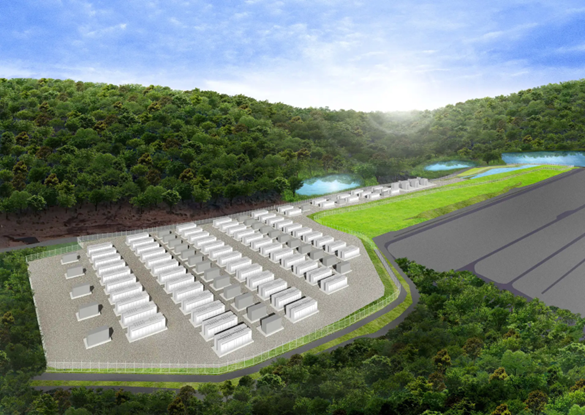
Mitsubishi Capital Energy to develop grid-scale BESS
(Company statement, Feb 4)
- Mitsubishi HC Capital Energy, a subsidiary of Mitsubishi and solar power provider Sun Village (Ashikaga City, Tochigi Pref), will develop grid-scale battery storage under a fully market-based model.
- The goal is to develop battery facilities with a total storage capacity of 100 MW, and energy capacity of 400 MWh. Estimated total investment exceeds ¥20 billion.
- CONTEXT: The project will focus on high-voltage-scale development in areas with high demand for the supply-demand adjustment market. The company is also developing a project with Samsung C&T in Hokkaido (25 MW/ 50 MWh).
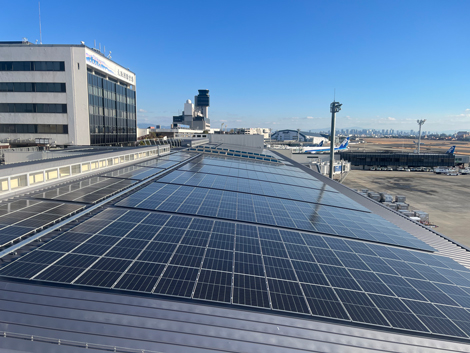
ORIX launches largest airport onsite PPA
(Company statement, Jan 31)
- ORIX began supplying power to Kansai International Airport and Osaka International Airport, one of the largest onsite PPAs in Japan.
- The electricity is generated at solar farms with roughly a 23 MW capacity. The power will be consumed onsite.
Sharp launches new series of residential solar modules
(Company statement, Feb 4)
- On April 16, Sharp will launch eight new residential monocrystalline solar modules in three series, with a planned monthly production of 60,000 units.
- The flagship Blacksolar Zero series now includes a new slim rectangular type, allowing for more efficient installation on roofs with limited vertical space.
- They also have enhanced temperature characteristics, which can help reduce efficiency loss due to heat by 3–15% compared to previous models, improving summer performance.
NEWS: WIND POWER AND OTHER RENEWABLES
INPEX acquires 1 GW of renewables capacity in Australia
(Company statement, Feb 6)
- INPEX will acquire a total of 1.1 GW of renewables generation capacity in Australia, taking stakes in nine projects, including solar and wind farms, purchased from European investment funds.
- The assets were acquired through Potensia Energy, a JV with Italy’s Enel. Of the total, 0.7 GW are already operational.
- CONTEXT: INPEX entered the Australian renewables market in 2023 by taking a stake in an Enel subsidiary; INPEX aims to expand its renewables capacity to 2 to 4 GW by 2030.
Eurus Energy launches wind farm in Hokkaido
(Company statement, Feb 3)
- Dohoku Wind Farm, a firm owned by Eurus Energy, completed work on the 72 MW Yuchi wind power plant in Wakkanai City, Hokkaido.
- The project is part of the Dohoku Wind Power Generation Project that plans to install 107 wind turbines at six wind farms in north Hokkaido. Yuchi is the fifth wind farm.
- It consists of 18 GE Vernova turbines (each 4.2 MW). The electricity generated will be sold to Hokkaido Electric Power Network.
- CONTEXT: North Hokkaido has strong wind power potential, but limited transmission capacity hinders development. To address this, Eurus Energy and other firms have set up the North Hokkaido Wind Energy Transmission Corp, which in April 2023 launched a govt-backed power grid and battery storage.
Mitsuuroko GE and Toshiba ESS launch renewables aggregation service
(Company statement, Feb 3)
- Mitsuuroko Green Energy and Toshiba Energy Systems & Solutions (ESS) began supplying power through a renewable energy aggregation service, transitioning the 10 MW Kamisu Wind Farm (Ibaraki Pref) from FIT to the FIP system.
- It integrates the wind farm into the wholesale electricity market (JEPX), with Toshiba ESS as an aggregator. The PPA runs from February 2025 to February 2028.
- CONTEXT: Toshiba ESS, leveraging expertise in renewable aggregation, will manage power forecasts and trading. It aims to ensure stable revenue for Mitsuuroko GE while enhancing prediction accuracy using AI and advanced weather modeling. Both companies aim to refine FIP-based wind power business models and expand renewable energy adoption.
Taiwan offshore wind farm launches with help from Sojitz
(Company statement, Feb 3)
- Trading house Sojitz completed installation of 80 wind turbines at Yunlin Offshore Wind Farm (off the coast of west Taiwan).
- Other partners in the project include Skyborn Renewables, TotalEnergies, and Electricity Generating Public Co.
- CONTEXT: The 640 MW project is one of Taiwan’s largest offshore wind farms. Sojitz has positioned essential infrastructure as a strategic focus area under its Medium-term Management Plan 2026.
- SIDE DEVELOPMENT:
- Sojitz acquires Australia’s major infrastructure developer
- (Company statement, Jan 31)
- In a ¥47 billion deal, Sojitz will acquire shares in infrastructure developer Capella Capital Partnership and an investment platform managed by Capella — both subsidiaries of Lendlease, an Australia-based real estate group.
- Capella and the investment platform will become Sojitz subsidiaries. The deal will be completed by June.
- CONTEXT: Sojitz seeks to strengthen its large-scale infrastructure development capability in the energy, social, and transportation sectors in Australia.
Tohoku Electric completes repowering of unit at hydropower plant
(Company statement, Jan 30)
- Tohoku Electric completed repowering of Unit 3 at the Horai Hydropower Plant in Fukushima City, resuming commercial operation.
- The plant, (38.5 MW output across three units), upgraded Unit 3 starting August 2022, replacing key equipment such as turbines and generators.
- The facility, a dam-and-conduit-type plant on the Abukuma River system, has been in operation for over 80 years.
- CONTEXT: A similar repowering project for Unit 2 is planned from February 2025 to September 2027. Neither unit qualifies for FIT/FIP subsidies.
Rhinoflux to cut biomass power costs with new tech
(Japan NRG, Feb 5)
- At the ZET Summit in Kyoto for clean-tech, local startup Rhinoflux said it developed a chemical process that generates electricity from biomass with minimal power loss, avoiding the inefficiencies of combusting biomass as fuel.
- The process produces 99.9% pure industrial CO2, enabling negative carbon emissions while cutting electricity costs to ¥10–12/ kWh, half the usual cost of biomass power.
- Rhinoflux touts compact facilities that allow for deployment in distributed power networks, enhancing scalability.
- CONTEXT: The company seeks ¥1.5 billion in Series A funding for commercialization, having no direct competitors in the market.
TAKEAWAY: The startup was one of several pitching innovations at ZET, with more well-known names like Tsubame BHB and TopoLogic also present. The biomass sector has drawn little attention from Japanese innovators, but now might be taken more seriously since lower solar tariffs pushes renewable energy firms to look at other green generation options.
Renova and partners complete biomass facility
(Company statement, Feb 5)
- Renova, Chubu Electric, Mitsubishi Electric Financial Solutions, and Suzuyo Shoji completed construction of a biomass power plant in Omaezaki, Shizuoka Pref, through their jointly funded Omaezaki Port Biomass Energy.
- The plant (capacity 75 MW) is expected to generate around 530 GWh/ year. Electricity will be sold under Japan’s FIT program at ¥24/ kWh.
- Ownership stakes are: Renova (38%), Chubu Electric (34%), Mitsubishi Electric Financial Solutions (18%), and Suzuyo Shoji (10%); with Renova holding the right to repurchase an 18% share from its partners.
- The plant uses wood pellets and palm kernel shells (PKS) as fuel and benefits from good transport links via sea, road, and air.
- CONTEXT: The firms anticipate positive economic impact on Omaezaki and Makinohara, including increased port utilization and job creation.
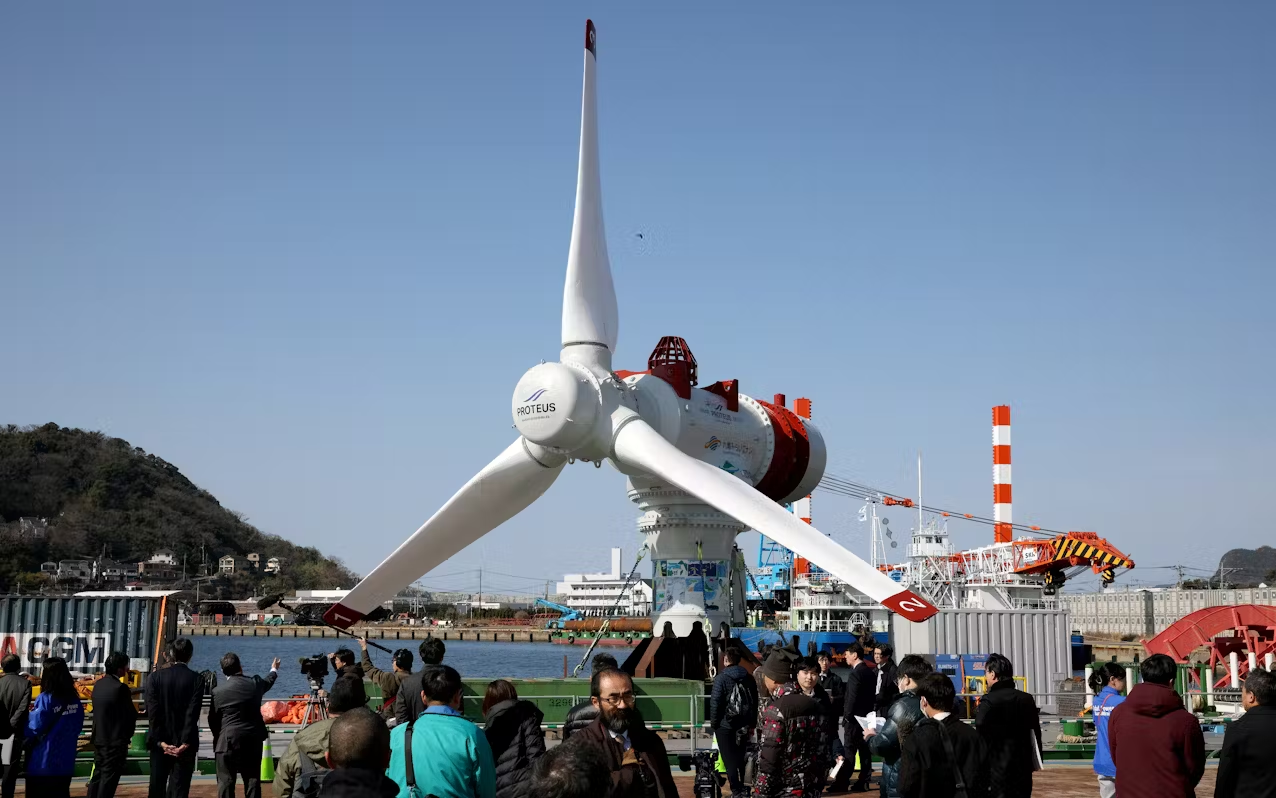
Kyushu Electric unveils Japan’s first MW-sized tidal power project
(Company statement, Feb 4)
- Kyuden Mirai Energy, a subsidiary of Kyushu Electric, unveiled a new 1.1 MW tidal generator off the coast of Nagasaki Pref.
- This is Japan’s first installation of a 1 MW-class tidal generator; it will be 40 meters deep in the Naru Seto strait.
- CONTEXT: Tidal power, which harnesses tidal currents, offers stable output unaffected by weather and does not impact scenery. Europe leads in the commercialization of this technology, but Japanese firms have also tested tidal power’s potential for years.
NEWS: NUCLEAR ENERGY
Lawsuit to halt Kansai Electric’s nuclear plants concludes
(Jiji, Feb 6)
- A lawsuit to halt operations at Kansai Electric’s NPPs along Fukui Pref’s Wakasa Bay has ended in Otsu District Court, with a ruling scheduled for Dec 25.
- Filed by 47 residents of Shiga and Osaka, the lawsuit targets Mihama Unit 3, Ooi Units 3 & 4, and Takahama Units 1–4, citing aging reactors and seismic risks.
- Plaintiffs argued that the plants, operating for over 30 years, are at risk due to active faults in the area and criticized the NRA’s safety standards as unreasonable.
- Kansai Electric countered that safety measures, including inspections and tsunami countermeasures, meet regulatory standards and urged the court to dismiss the case.
TAKEAWAY: Despite the moderate success in restarting more reactors in Japan, the risk of citizen lawsuits against operating and idled facilities has not receded. While most suits have not been upheld and don’t impede operations, they have an effect. In May 2022, a Sapporo district court ordered Hokkaido Electric to keep its Tomari NPP offline due to safety concerns from 1,000 citizen plaintiffs. While the court did not demand the decommissioning of the facility, the ruling complicated approval from local authorities. The Tomari NPP remains under regulatory review for a restart.
KEPCO to resume Takahama NPP unit
(Company statement, Feb 7)
- On March 7, KEPCO will fully resume operations of Unit 2 at the Takahama NPP in Fukui Pref, following a periodic inspection.
- The pressurized water reactor with a capacity of 826 MWe was scheduled to be restarted on Feb 8. Unit 2 at Takahama entered periodic inspection on Nov 6, 2024.
- During past inspections, thinning was detected in pipes, prompting a replacement. Ultrasonic testing was newly implemented to measure pipe thickness.
Tohoku Electric to raise site at Hihashidori NPP
(Nikkei, Feb 6)
- Tohoku Electric will raise certain parts of the Higashidori NPP site (Aomori Pref) by up to 5 meters as a tsunami countermeasure.
- The site is 13 meters above sea level; the “standard tsunami” height is forecast at 12.1 meters.
- CONTEXT: Higashidori NPP applied for a regulatory compliance review in 2014, but it’s still ongoing. Safety measures work has been delayed six times. The company will present a new completion timeline by late Sept 2025.
NEWS: TRADITIONAL FUELS
Canada pitches LNG to Japan as faster alternative to U.S.
(Japan NRG, Feb 6)
- A Canadian delegation visited Japan last week to promote LNG exports as a faster, reliable alternative to U.S. supply. The group included government officials, the Energy for a Secure Future Canada group and First Nations LNG Alliance.
- Canada says that shipments from its west coast, British Columbia, take just 10 days to reach Asia, compared to 25-30 days from the Gulf Coast via the Panama Canal.
- CONTEXT: Japan, which imports about 90% of its primary energy, can store LNG for only 2-3 weeks, making delivery speed a critical factor in securing stable supplies. The nearest LNG seller to Japan is Russia with its Sakhalin 2 project.
- Canadian LNG proponents say its projects offer additional advantages, including lower emissions due to hydroelectric-powered production, a colder climate that improves efficiency, and tighter regulatory oversight compared to the U.S.
- Canadian officials met with representatives from JERA, JOGMEC, and the government to discuss future collaboration.
TAKEAWAY: As Trump seeks to boost U.S. exports of LNG and other energy, Asian nations are among the top prospective buyers. However, as retaliation against Trump’s blanket tariff on Chinese goods entering the U.S., Beijing put 15% levies on American gas. China buys 6% of its LNG from the U.S. but with the tariffs in place its importers intend to resell their cargos and look for alternatives. It also means future Chinese offtakes from U.S. projects are very unlikely. U.S.-China tensions potentially raise the value of Canadian LNG projects. It will be important for Canada’s first export facility to start shipping cargo this year to enhance the reputation of Canadian projects.
Tokyo Gas expands U.S. gas and renewable energy investments
(Company statement, Jan 31)
- In the U.S., Tokyo Gas will invest in both upstream (extraction) and midstream (processing, transportation) gas assets while also expanding into renewable energy and energy storage projects.
- To fund new investments, Tokyo Gas plans to divest underperforming assets, including real estate holdings, and has set a Return on Equity (ROE) target of 8% by FY2025, aiming for over 10% by 2030.
- CONTEXT: The company has a ¥40 billion share buyback program for FY2024, with further repurchases planned in the next fiscal year to enhance shareholder returns.
Kansai Electric to absorb LNG subsidiary
(Company statement, Feb 4)
- Kansai Electric will absorb its wholly owned subsidiary, KE Fuel International (KEFI), to streamline operations.
- KEFI, which handles LNG trading and transportation, will be merged into Kansai Electric through an absorption-type merger as of April 1, 2025.
LNG stocks up from last week, and up YoY
(Government data, Feb 5)
- As of Feb 2, the LNG stocks of 10 power utilities were 2.41 Mt, up 12.1% from the previous week (2.15 Mt), up 10.6% from end Feb 2024 (2.18 Mt), and up 10.6% from the 5-year average of 2.18 Mt.
- CONTEXT: It snowed in many places across Japan last week, pushing up energy demand. The nation’s temperature outlook for the next two weeks is in line with seasonal average, but lower than average in the Kansai area, according to JMA.
Toyota Tsusho & Toho Gas to produce sugarcane-based biomethane in Brazil
(Company statement, Feb 7)
- Toyota Tsusho, Toho Gas, and partners plan to produce biomethane from sugarcane. The project involves Brazilian sugarcane producer Ferrari Agroindústria and biogas producer Sebigas Cótica Bioenergia.
- Production will begin in Brazil in 2026, with plans to assess processing and quality. The goal is to export biomethane to Japan as a city gas alternative.
- CONTEXT: Biomethane, refined from biogas derived from organic waste, is considered carbon-neutral and a key tool for cutting greenhouse gas emissions.
NEWS: CARBON CAPTURE & SYNTHETIC FUELS
Mitsubishi GC partners with U.S., EU firms on methanol
(Company statement, Feb 4)
- Mitsubishi Gas Chemical signed an MoU with Methanol Reformer (Spain) and U.S.-based Element 1 to develop and commercialize modular hydrogen generators that utilize methanol reforming technology.
- Mitsubishi Gas Chemical will supply methanol, while Methanol Reformer will produce generators under a license from Element 1.
- CONTEXT: Converting hydrogen into methanol allows for easier storage and transportation at ambient temperature and pressure, avoiding the high costs and challenges of compressing or liquefying hydrogen for transport.
ANALYSIS
BY MAGDALENA OSUMI
What’s Next After Mitsubishi Corp’s Threat to
Walk Away from Offshore Wind?
In 2021, Mitsubishi Corp won Japan’s first-ever public tender for large-scale offshore wind farms. Technically, it was picked due to offering the lower price. Many suspected that it was the trading house’s financial muscle, huge network and trusted ties with METI officials that swung the deal.
Fast forward to today and the firm is indicating a potential withdrawal from the three projects it secured, as well as the domestic offshore wind sector in general. Mitsubishi and its partner Chubu Electric claim the challenges and costs they face far exceed their expectations and cannot simply be endured.
On Feb 6, Mitsubishi announced ¥52 billion ($344 million) in writedowns on its three domestic offshore wind projects. Chubu Electric faces ¥18 billion in writedowns on the same.
The common assumption was that if anyone was able to navigate the bureaucratic, technical and financial complexities of building a new sector in Japan it would be Mitsubishi. The challenges have, however, piled up: post-pandemic supply chain shocks; war and sanctions; the weakest yen in four decades; a labor crunch; NIMBY and an anti-renewables backlash.
The result has been massive cost inflation, what Mitsubishi called “material changes in the macroeconomic environment.” Both Mitsubishi and Chubu Electric said they have put the business plans for the three projects under review.
For the government, the threat of a pullout by the operators has grave consequences. The rollout of offshore wind capacity is already behind schedule. The nation’s CO2 reduction goals, enshrined in international commitments, hinge on multi-GW additions of clean power, and offshore wind farms seem to be the only options to deliver on such scale.
None of the options before METI are easy. Can the government offer Mitsubishi and partners additional subsidies? Or more time to complete the projects? If so, what about other auction winners or future bidders? If Mitsubishi does quit, will the next-best bidders take their place? And, most importantly, can Japan afford to leave these projects or let Mitsubishi sink given the message that it would send on offshore wind opportunities in the country?
The ultimatum and what’s behind it
A consortium led by Mitsubishi’s subsidiary Mitsubishi Corporation Offshore Wind is developing offshore wind projects in three Japanese sea areas off the coast of: (1) Noshiro City, Mitane Town and Oga City in Akita Prefecture, (2) Yurihonjo City in Akita Prefecture, and (3) Choshi City (Chiba Prefecture). The wind farms have a total projected capacity of 1.76 GW and come online 2028-2030.
Mitsubishi’s group offered the following strike prices for the projects:
- (1) Noshiro-Mitane-Oga: ¥13,260/ MWh;
- (2) Yurihonjo: ¥11,990/ MWh;
- (3) Choshi: ¥16,490/ MWh.
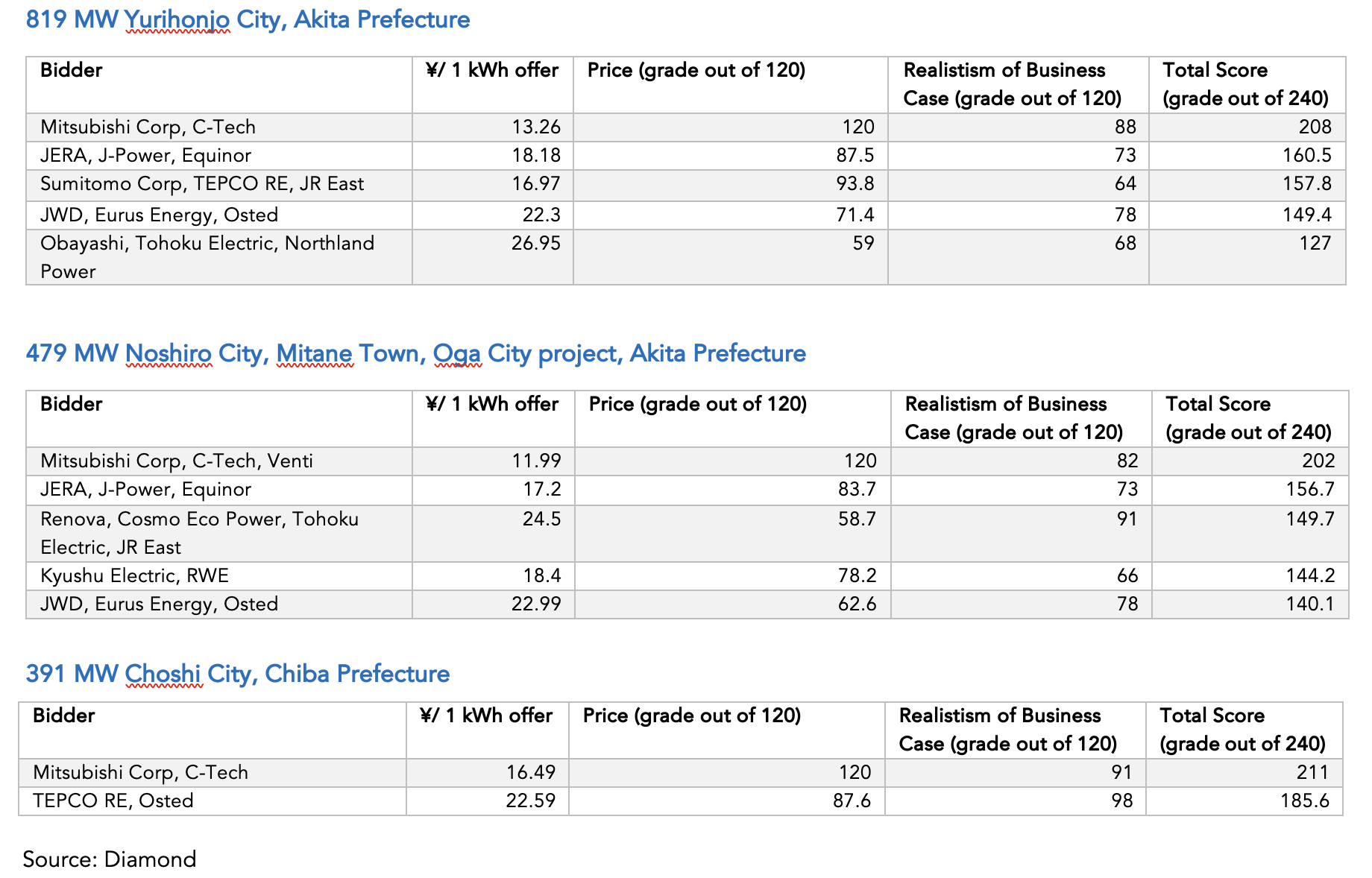
The wind industry has been looking closely at the progress of Mitsubishi’s projects, wondering if the 2028 deadline was feasible. Mitsubishi’s win was not scandal-free. It bid prices notably lower than rival consortiums, sweeping all three large Round 1 projects. The scale of the win prompted a review of the bidding scheme and a shift in the scoring system to favor project feasibility over pricing.
On Feb 6, as Mitsubishi announced the large-scale writedowns, President Nakanishi Katsuya confirmed that inflation, the yen weakness and geopolitical risks have caused damage “far beyond our initial expectations.” Further impairment losses are possible.
Construction of the three wind farms has stalled, he said, and “it is not possible to say anything about the delivery date.” The price tag of a wind power project is dominated by upfront capital costs for the wind turbines. It can be as much as 84% of the total installation outlay, covering blades, the tower and transformer; civil works; grid connection fees; and other construction and planning expenses.
Almost all wind turbines in Japan are imported or assembled with largely overseas parts. And yet, between January 2021 and June 2024, the yen depreciated by over 50% against the U.S. dollar. Add to this the surge in raw material prices and EPC fees, and the math on Mitsubishi’s projects has been turned on its head. With offtakers that signed up for long-term PPAs linked to the projects unwilling to revise their terms, the viability of the offshore wind farms was put into question.
Both Chubu Electric and Mitsubishi announced significant hits to their revenue for the nine-month period of 2024. Mitsubishi had engaged in months of talks with officials to find other ways to compensate for the mounting costs. Officials relented but only in part – METI and MLIT on Jan 29 promised to revise offshore wind tender guidelines to include enhanced risk scenario assessments and other adjustments to cover currency, inflation and other macro factors. Higher costs will be partly incorporated into the electricity purchase price.
This helps bidders in the next round, which is expected to be announced in a few months. But the changes are not retroactive. Mitsubishi’s threat to quit its three projects is a law-straw ultimatum to METI and MLIT to pressure the government to shoulder some of the rising costs in order to save the projects and prevent delays. Officials will fear the consequences of not meeting the requests, as it could discourage future bidders. However, revisiting adjudicated bids is also a Pandora’s box that METI seeks to avoid.
Mitsubishi is not the only developer raising issues with global inflation, supply chains, and rising interest rates. Similar factors led to a wave of project downsizing and withdrawals in Europe and the U.S. even before President Trump renounced the sector’s value.
Danish offshore wind developers were set to pay $125 million in penalties to New Jersey for the cancellation of a 2.25 GW Ocean Wind 1 & 2 project in 2023. The Japanese tender scheme does not currently envision penalties for withdrawals.
What happens next?
There are several potential scenarios:
-
-
- The Mitsubishi-led consortium withdraws from the projects which are then offered to runners-up from Round 1. That would potentially open the door to JERA, J-Power and Equinor to take two of the sites, and TEPCO RE and Orsted the other. However, Orsted and Equinor have already left the Japanese market. The legal ramifications of this are also unclear: Would the runners-up be obliged to deliver and stick to their original bid price?
- The government allows bid price revisions or offers other subsidies to recover inflated costs. The challenges would be in setting a fair compensation formula and in firewalling the support. The fourth tender in Round 1 was for a smaller, floating wind turbine project and that also faces cost and time problems. The consortium in charge, led by Toda Corp, could request a similar review. Bidders from Round 2 and 3 would also have a case for renegotiations. Mitsubishi’s support would act as a precedent for future discussions.
- A state-aligned actor agrees to invest in or to provide cheap loans at the project level, helping to co-finance the construction and share the liabilities. Alternatively, the Mitsubishi consortiums form ventures with new investors, who inject capital. The state-aligned actors could include JOGMEC, JBIC, the Development Bank of Japan, or maybe a repurposing of the Green Innovation Fund or one of the GX budgets. The commercial aspect involved would be tough for officials to engage with and, again, METI has to be careful to avoid perception of favoritism.
- The projects are delayed to allow developers time to negotiate new terms for equipment, construction, and potentially to revisit offtake contracts.
-
None of the options are straightforward or appealing to the government, but the fact that Mitsubishi and Chubu Electric have decided to voice their concerns in public suggests that they believe they have a strong negotiating position and can muster wider industry support. What’s more, METI needs Mitsubishi’s support in other energy sectors, such as with future American LNG and ammonia investments.
For Mitsubishi, the stakes are high, and not just because of the valuation writedowns. If the company quits a domestic project, bids in overseas offshore wind tenders will be questioned. The fallout would affect partners such as Chubu Electric, GE, Kajima, and local businesses.
It’s also likely METI was made aware of the upcoming ultimatum and is already in talks to find a solution that helps all sides avoid losing face. The offshore wind generation sector in Japan is about to undergo major changes.
ANALYSIS
BY FILIPPO PEDRETTI
Nuclear Power Overview: Which Reactors are in Line to Restart?
In the past year, only one nuclear reactor in Japan has received regulatory approval to restart. Even that does not guarantee that the facility will go online – a situation TEPCO knows all too well. Each year the country’s biggest utility announces plans to switch on its nuclear units and each year it fails to do so.
The stasis in Japan’s nuclear power sector was masked by a recent period of mild success: in each of the last two years, two reactors were restarted, bringing the total number of units able to generate electricity to 14. The outlook for the next two years is more problematic.
Since shutting all nuclear stations in the wake of the Great East Japan Earthquake in March 2011, Japan has struggled to revive the sector. Despite bursts of progress, the restart of the 33 reactors designated as operable is going slower than planned, mired in inspections and continuing upgrades. The cost of care and maintenance and new safety upgrades alone runs into trillions of yen.
Still, the government’s belief in the necessity of nuclear power in Japan has remained and has even strengthened based on the latest Basic Energy Plan draft, submitted in December 2024. Other commitments to nuclear energy were made at international forums such as COP28.
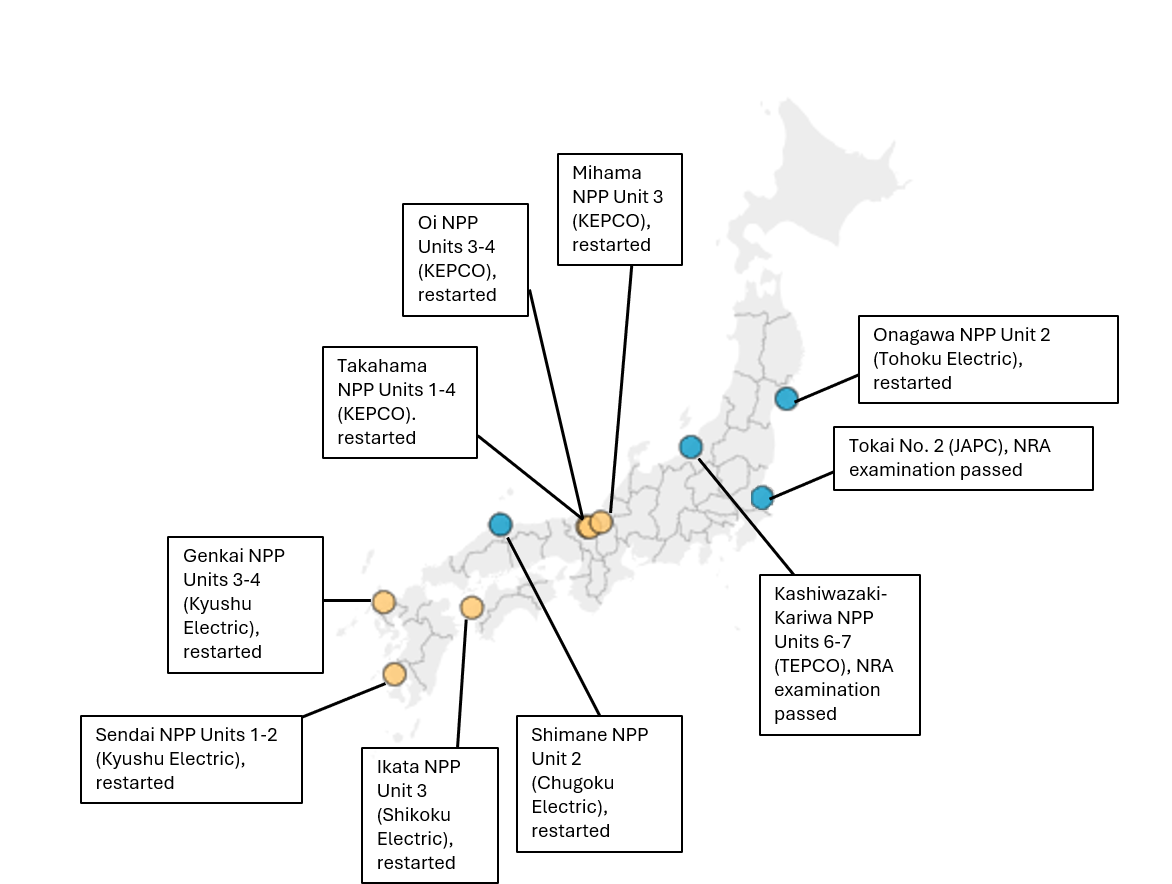
Last year, Tohoku Electric’s Onagawa Nuclear Power Plant Unit 2 (825 MW) restarted, shortly followed by Chugoku Electric’s Shimane Nuclear Power Plant Unit 2 (820 MW). Both are both BWRs, the same type as Fukushima Daiichi, marking the first BWR restart since 2011. These two reignited hope for the quicker restarts of other NPPs.
Given state backing, which reactors are likely to be brought back online next? Japan NRG takes a close look at how much of the nearly 20 GW in nuclear capacity that sits idle is likely to deliver electrons to the market in the near and mid-term future.
Reactor status report
Currently, there are 33 reactors that are classed as operable and 3 more under construction. But the number actually in operation as of Feb 4 was 12. Another two are offline for maintenance.
The remaining 19 reactors are classed as operable but lack either approval from the nuclear regulator, the NRA, or the local authorities (i.e. prefectural governors and local mayors). Both regulatory and political approvals have no specific deadlines. In some cases, the NRA has conducted a review of a reactor’s application in excess of a decade.
At present, 11 of the 19 idled units could be described as “in the process” of restarting, with three of those having obtained regulator approval. The final eight operable units have not even applied to the NRA.
Of the 19.8 GW in nuclear power still offline, the reactors at Kashiwazaki-Kariwa NPP, operated by TEPCO account for about 40% – 8.2 GW. With power demand in the Tokyo-centered region one of the most constrained in the country, a restart of at least one of Kashiwazaki-Kariwa’s units seemed to be on the cards a year ago. But it has yet to proceed.
METI’s plan
According to METI’s draft Basic Energy Plan unveiled at the end of 2024, nuclear power’s share in the energy mix should reach about 20% by 2040. Hitting such a target will require the full operation of nearly all Japan’s existing reactors.
This robust and ambitious restart policy is best confirmed by the removal of the call in the previous Plan to “reduce dependence on nuclear power as much as possible’’.
At COP28, METI announced a joint declaration with 23 countries to “triple the global nuclear power generation capacity by 2050 compared to 2020 levels.” Japan aims to contribute by developing and constructing reactors and strengthening the nuclear supply chain.
Domestically, METI is promoting the replacement of decommissioned nuclear power plants. It’s also introducing new regulations on the operational period of nuclear plants in 2025. For plants in operation for more than 30 years, operators will conduct a technical assessment of equipment deterioration every 10 years. Based on the results, they must develop a “Long-Term Facility Management Plan” and get approval from the NRA. Additionally, METI is working to improve the run rates of existing nuclear plants.
While that’s overall good news for the nuclear sector, TEPCO is struggling financially due to rising construction costs for nuclear and power transmission facilities, as well as increased competition in electricity sales. The utility requires an annual ¥500 billion to cover Fukushima disaster-related decommissioning costs and compensation.
Kashiwazaki-Kariwa NPP, Units 6-7
When it comes to restarting nuclear power plants, all eyes are on TEPCO. The company is working toward reactivating Units 6 and 7 at Kashiwazaki-Kariwa NPP. Operation of one unit could improve annual revenue by about ¥100 billion.
TEPCO already fitted Unit 7 with nuclear fuel, but the plant’s reactivation timeline is contingent on obtaining local support. While TEPCO seeks reactivation in FY2025, it is also now considering a delay to FY2026 and beyond. That would be 3-4 years later than what the utility announced in its previous business plan, made in FY2021. TEPCO’s lenders are also starting to raise concerns.
The delayed scenario anticipates a local decision after the Niigata gubernatorial election in 2026. On the restart, Niigata Governor Hanazumi Hideyo did not specify a timeline, only saying that he was monitoring public opinion. His approval is essential, but the process also requires local business groups and prefectural assemblies to acquiesce. In Niigata, support in the assembly is lacking, but there are voices for a referendum on the issue.
In the meantime, the plant was again in the news recently for all the wrong reasons. Small malfunctions at communication devices happened three times in the last three months. While the issues are not dangerous, they still constitute deviations from regulated norms.
In any case, local authorities declared that the plant will not restart before FY2025. As a consequence, no restart is likely to happen before early summer.
Restarted | Passed review | Under review | Under construction | Planned | Not applied to NRA | Slated for decommissioning since 2011 |
Mihama NPP Unit 3, Ohi NPP Unit 3, Ohi NPP Unit 4, Takahama NPP Unit 1, Takahama NPP Unit 2, Takahama NPP Unit 3, Takahama NPP Unit 4, Genkai NPP Unit 3, Genkai NPP Unit 4, Sendai NPP Unit 1, Sendai NPP Unit 2, Ikata NPP Unit 3, Shimane NPP Unit 2, Onagawa NPP Unit 2 | Kashiwazaki-Kariwa NPP Unit 6, Kashiwazaki-Kariwa NPP Unit 7, Tokai No.2 NPP | Shika NPP Unit 2, Tsuruga NPP Unit 2, Higashidori-Tohoku NPP Unit 1, Tomari NPP Unit 1, Tomari NPP Unit 2, Tomari NPP Unit 3, Hamaoka NPP Unit 3, Hamaoka NPP Unit 4, | Ohma NPP Unit 1, Higashidori-Tokyo NPP Unit 1, Shimane NPP Unit 3 |
Tsuruga NPP Unit 3, Tsuruga NPP Unit 4, Higashidori Tohoku NPP Unit 2, Higashidori – Tokyo NPP Unit 2, Kaminoseki NPP Unit 1, Kaminoseki NPP Unit 2, Sendai NPP Unit 3, Hamaoka NPP Unit 6 (construction deferred indefinitely) |
Onagawa NPP Unit 3, Hamaoka NPP Unit 5, Shika NPP Unit 1, Kashiwazaki-Kariwa NPP Unit 1, Kashiwazaki-Kariwa NPP Unit 2, Kashiwazaki-Kariwa NPP Unit 3, Kashiwazaki-Kariwa NPP Unit 4, Kashiwazaki-Kariwa NPP Unit 5 |
Onagawa NPP Unit 1, Fukushima Daiichi NPP Unit 1, Fukushima Daiichi NPP Unit 2, Fukushima Daiichi NPP Unit 3, Fukushima Daiichi NPP Unit 4, Fukushima Daiichi NPP Unit 5, Fukushima Daiichi NPP Unit 6, Fukushima Daini NPP Unit 1, Fukushima Daini NPP Unit 2, Fukushima Daini NPP Unit 3, Fukushima Daini NPP Unit 4, Tsuruga NPP Unit 1, Mihama NPP Unit 1, Mihama NPP Unit 2, Ohi NPP Unit 1, Ohi NPP Unit 2, Shimane NPP Unit 1, Ikata NPP Unit 1, Ikata NPP Unit 2, Genkai NPP Unit 1, Genkai NPP Unit 2 |
Tokai NPP No. 2
In 2018, another reactor received NRA restart approval — Japan Atomic Power’s Tokai No.2. Changes to the reactor installation and other requirements followed the post-Fukushima regulations. TEPCO holds over 28% of JAPC’s shares based on voting rights.
This 1.1 GW boiling-water reactor resisted the 2011 earthquake with an automatic shut down and faced the ensuing tsunami unfazed. But Tokai No. 2 is one of the oldest units in Japan, having entered operation in 1978.
The electricity generated by the plant was sold to TEPCO and Tohoku Electric. Soon after the restart approval, the then 40-year-old reactor was given the green light to extend operation for an extra 20 years. Despite all these, the plant is still idle.
It faced a series of hardships that have hindered the restart. First, it needs to complete new safety measures, but their completion was delayed until the end of 2026. The issue revolves around deficiencies in the seawall, currently under construction. The completion of the reinforcement works led to a third restart postponement in 2024.
Relations with the public have grown tense. In 2021, the Mito District Court ordered the plant’s suspension. It sided with 224 plaintiffs claiming that disaster preparedness was inadequate and that the company underestimated potential earthquake intensity.
The court also reviewed whether the reactor was fit for continued use, despite the 20-year extension granted in 2018. The biggest issue is with evacuation plans for areas within a 30-kilometer radius. There is a need for plans to evacuate 940,000 residents, the largest number for any nuclear plant in Japan.
This implies the need to coordinate with 14 municipalities, which have to prepare their own plans. The complexity of a safe evacuation in case of emergency was also stressed at the end of 2023. The Ibaraki government estimated that up to 170,000 people would need to evacuate in case of an accident.
Tokai No. 2 has experienced five fire incidents since 2023, prompting preventive measures in May 2024. In December 2024, a fire broke out during welding work, injuring a worker. JAPC confirmed no radiation exposure or radioactive material release.
Also, the dire situation at JAPC’s Tsuruga NPP No. 2, deemed unfit for restart due to an active fault, makes the utility’s financial situation risky. This could also impact restarting Tokai No. 2.
Map of reactors that restarted and of those that passed NRA inspection.
Yellow is for PWRs, blue for BWRs.
Other plants
As Ishiyama Kazuhiro prepares to take over the presidency of Tohoku Electric, he emphasized the company’s commitment to restarting reactors. Specifically, the company is targeting the restart of Higashidori Unit 1 in Aomori Prefecture and Onagawa Unit 3 in Miyagi Prefecture.
Onagawa Unit 2’s restart is expected to boost annual profits by about ¥60 billion. Tohoku Electric needs this since it has a low equity ratio of 17.5% as of December 2024.
Chubu Electric is also advancing plans to restart the Hamaoka NPP in Omaezaki City, Shizuoka Prefecture. In November 2024, the NRA initiated a plant inspection, and Chubu Electric announced plans to raise the height of the existing seawall from 22 meters to 28 meters to counter potential tsunamis from the Nankai Trough.
The company aims to complete the plant inspection by 2026. The financial strategy for funding the seawall, potentially costing around ¥180 billion, is under consideration, including options like issuing new corporate bonds.
In the northern region of Hokkaido, Hokkaido Electric (HEPCO) is progressing toward the restart of its Tomari NPP’s Unit 3. At the end of 2024, HEPCO completed its explanations to the NRA regarding the plant’s safety measures.
HEPCO is building a new seawall, aiming for completion by March 2027, with plans to restart Unit 3 thereafter. The timeline, however, is uncertain due to regulatory reviews.
Conclusion
The average capacity factor of domestic NPPs in FY2024 was 30.6%, up 2.6 points from FY2023. In the same timeframe, nuclear facilities delivered 88.87 TWh of electricity (up 9.6% from the previous year).
These numbers are at their highest since 2015: coupled with clear political support, Japan’s nuclear industry seems on the verge of a revival. The 14 reactors restarted since 2015 have brought an extra 13.3 GW of capacity to the grid.
The next steps are the hardest though. Kashiwazaki-Kariwa NPP is a political challenge as much as a technical one. Tokai No.2 continues to delay its works, and its operator is in a weak financial situation. But these two are the most likely candidates.
Most idled reactors in Japan have a scheduled restart date that’s a couple of years beyond FY2025. Unless the government is able to muster new powers of persuasion in Niigata or Hokkaido, no additional restarts look likely this year, and maybe even the next.
ASIA ENERGY REVIEW
BY JOHN VAROLI
A brief overview of the region’s main energy events from the past week
Australia / Clean finance
Australia is setting aside an additional $2 billion for the Clean Energy Finance Corp (CEFC) to develop renewable energy sources. In 2024, the CEFC invested more than $4 billion in local projects, unlocking around $12 billion in private investment that went to regional areas.
Australia / Solar and wind energy
Studies continue for the planned Western Green Energy Hub that spans 22,700 sq km, and which will house 60 million solar panels and 3,000 next-gen wind turbines, each capable of producing up to 20 MW, with plans to generate annually 200 TWh of clean energy – almost as much as Australia’s entire electricity output.
China / LNG
President Trump’s emerging trade war with Beijing poses a new threat to billions of dollars in planned U.S. LNG export projects, many of which rely on China as a key buyer, according to analysts.
India / Renewable energy
About 50 GW of renewable energy was installed in India in 2024, of which nearly half are from solar power, said JMK Research & Analytics. Solar energy added 24.6 GW of capacity, while wind added 3.4 GW.
India / PPAs
Amazon has signed two PPAs for a combined 199 MW across two wind projects. The first was signed with CleanMax for a 100 MW wind under development in Karnataka. The second PPA was signed with BluPine Energy, an Indian renewable energy developer, for a 99 MW wind project.
Indonesia / Nuclear power
Indonesia, the most populous nation in SE Asia, is expected to deploy the first small modular nuclear reactor (SMR) in the region by 2030.
South Korea / Oil and Gas
Hopes for a major oil and gas project may not be economically feasible, the energy ministry said. Recent drilling showed some signs of gas prospects but the amount was not believed to be meaningful. The project was announced in June 2024, when the area was thought to hold as much as 14 billion barrels of oil and gas. The site is off the southeastern port of Pohang.
Thailand / Decarbonization
Thailand seeks to be a regional leader in low-carbon innovation, driven by its 2050 carbon neutrality and 2065 net-zero targets. Atoms for Peace is one framework to support the development of nuclear power plants. The cabinet has also approved solar energy expansion.
Vietnam / Gas and offshore wind
Ten-year power-production targets for gas and offshore wind have been lowered, with coal and other renewables expected to fill the gap until nuclear reactors are included in the energy mix by 2035.
Disclaimer
This communication has been prepared for information purposes only, is confidential and may be legally privileged. This is a subscription-only service and is directed at those who have expressly asked K.K. Yuri Group or one of its representatives to be added to the mailing list. This document may not be onwardly circulated or reproduced without prior written consent from Yuri Group, which retains all copyright to the content of this report.
Yuri Group is not registered as an investment advisor in any jurisdiction. Our research and all the content express our opinions, which are generally based on available public information, field studies and own analysis. Content is limited to general comment upon general political, economic and market issues, asset classes and types of investments. The report and all of its content does not constitute a recommendation or solicitation to buy, sell, subscribe for or underwrite any product or physical commodity, or a financial instrument.
The information contained in this report is obtained from sources believed to be reliable and in good faith. No representation or warranty is made that it is accurate or complete. Opinions and views expressed are subject to change without notice, as are prices and availability, which are indicative only. There is no obligation to notify recipients of any changes to this data or to do so in the future. No responsibility is accepted for the use of or reliance on the information provided. In no circumstances will Yuri Group be liable for any indirect or direct loss, or consequential loss or damages arising from the use of, any inability to use, or any inaccuracy in the information.
K.K. Yuri Group: Hulic Ochanomizu Bldg. 3F, 2-3-11, Surugadai, Kanda, Chiyoda-ku, Tokyo, Japan, 101-0062.