
WEEKLY
JUNE 23, 2025
ANALYSIS
AGAINST THE CLOCK: IS KASHIWASAKI-KARIWA NPP READY TO RESTART?
- Japan’s nuclear revival is hostage to politics and public opinion. Hope flickered in April when one reactor unit won support under a state subsidy scheme.
- Accounting for 40% of offline nuclear capacity, the success of Kashiwazaki-Kariwa NPP is crucial to Japan’s nuclear revival.
GREEN STEEL GOES GLOBAL: JAPAN, EU, AND SWEDEN ON DIFFERENT PATHS TO SAME GOAL
- Governments and businesses from Tokyo and Luleå (Sweden) to Brussels are vying to demonstrate that ‘green steel’ is not just feasible but also scalable.
- As projects move from pilot to industrial scale, there are multiple complexities to navigate.
ASIA PACIFIC REVIEW
This column provides a brief overview of the region’s main energy events from the past week
NEWS
- Energy White Paper 2025 approved by Cabinet
- METI and JERA discuss role of LNG at conference
- LNG futures jump 10% amid concerns of shipment delays as Iran war intensifies
- Rising electricity demand drives up wholesale price
- Tokyo, Chubu face tight supply-demand balance
- ANRE looks to rework wheeling charge calculations
- TEPCO aims for green H2 production in FY2028
- IHI wins prestigious award for ammonia engine
- 50% hydrogen co-firing successfully tested at U.S. power plant
- Mitsubishi to triple U.S. solar capacity by 2028
- Hokkaido firms to promote solar panel recycling
- Nozomi Energy acquires 10 solar farms in Japan
- Peak Energy acquires solar portfolio in Japan
WIND POWER AND OTHER RENEWABLES
- Japan’s largest wind farm to launch in Sept
- MoE issues several EIA statements on wind farms
- Tokyo-based startup secures financing for floating nuclear plants
- Japan and UK to collaborate on nuclear fusion
- JERA CEO discusses LNG purchases from the U.S. and mulls the pros and cons of Alaska project
- Woodside signs unique seasonal LNG deal with JERA amid rising winter demand
- Shell, TotalEnergies CEOs give gas sector outlook
CARBON CAPTURE & SYNTHETIC FUELS
- JAPEX, K Line discuss challenges for the CCS industry at Energy Summit
- JERA and KHI to launch CCUS demo at coal plant
- ENEOS looks to Hokkaido for blue carbon projects
EVENTS
June 18-20 Japan Energy Summit & Exhibition ` Tokyo Big Sight
June 19-21 International Electric Vehicle Technology Conference @ Pacifico Yokohama
June 28-30 New Environmental Exposition 2025 @ Tokyo Big Sight
July 2-4 Smart City Expo @ Tokyo Big Sight
Aug 27-28 Asia-Pacific Economic Cooperation / Energy Ministerial Meeting @ Busan, South Korea
PUBLISHER
K. K. Yuri Group
Editorial Team
Yuriy Humber (Chief Editor)
John Varoli (Senior Editor, Americas)
Kyoko Fukuda (Data, Events)
Magdalena Osumi (Renewables & Storage)
Filippo Pedretti (Thermal, CCS, Nuclear)
Tetsuji Tomita (Power Market, Hydrogen)
George Hoffman (Sales, Business Development)
Tim Young (Design)
SUBSCRIPTIONS & ADVERTISING
Japan NRG offers individual, corporate and academic subscription plans. Basic details are our website or write to subscriptions@japan-nrg.com
For marketing, advertising, or collaboration opportunities, contact sales@japan-nrg.com For all other inquiries, write to info@japan-nrg.com

NEWS: GENERAL POLICY AND TRENDS
Energy White Paper 2025 approved by Cabinet
(Government statement, June 13)
- The Cabinet approved the FY2024 Annual Report on Energy, also known as the Energy White Paper 2025.
- Data on domestic and international energy trends, previously included under Energy Trends until last year, was excluded from this year’s White Paper. Instead, this content will now be published on ANRE’s website.
- The White Paper now has two parts:
- Part 1: Current Energy Situation and Major Measures
- Part 2: Status of Measures Taken for Energy Supply and Demand
- Part 1 focuses on three key topics:
- Progress in Fukushima’s reconstruction.
- Japan’s efforts toward GX and achieving carbon neutrality by 2050.
- Trends in carbon neutrality in major countries and regions.
- Part 2 focuses on several crucial points related to energy security, supply, and markets with particular emphasis on decarbonization, including:
- Significantly expanding renewables, including ammonia and hydrogen.
- Promoting structural reforms to reduce market barriers.
- Strengthening cooperation for technology development and supply security.
- Other key insights:
- Despite improved conservation efforts, Japan’s energy usage is expected to rise from 806 TWh this year to 852.4 TWh by 2034; due to data centers and semiconductor factories.
- Therefore, emphasis is on development of six clean energies: photonics-electronics convergence; perovskite solar power; offshore floating wind power; next-gen geothermal power; next-gen nuclear reactors, and other alternatives like hydrogen or ammonia.
- CONTEXT: The Annual Report on Energy (Energy White Paper) is submitted to the National Diet and outlines govt measures for energy supply and demand.
METI and JERA discuss role of LNG in Japan at conference
(Japan NRG, June 20)
- At the LNG Producer-Consumer Conference in Tokyo last week, Wakuda Hajime (METI’s head of natural resources & fuel) spoke about the role of LNG in the 7th Strategic Energy Plan. Japan has a 2050 target for net-zero emissions, but Wakuda stressed that ensuring stable energy supply remains a national priority.
- Technologies such as hydrogen, ammonia, and CCS are part of the strategy. But, there are still uncertainties surrounding large-scale deployment.
- METI has five potential decarbonization scenarios. In the most pessimistic one, decarbonization technologies fail to advance, making LNG an even more vital part of the energy mix. Under this scenario, by 2040 Japan’s LNG imports could increase from the current 66 Mtpa to 70 Mtpa or more.
- Wakuda noted that energy companies often need around 25 years to develop and operate major LNG projects. To support them, the govt seeks greater transparency in the LNG market and is encouraging firms to lock in long-term contracts.
- Tsugaru Ryosuke (JERA senior MEO) said that while the spot market has grown, long-term agreements are crucial again because they help to avoid price volatility and ensure a stable supply.
- JERA’s current LNG procurement is concentrated in the Asia-Pacific region (mostly in Australia and Southeast Asia). Tsugaru emphasized the need to diversify supply sources in terms of geography, with North America offering both the volumes and contract flexibility that Japanese buyers want.
- Japan’s electricity demand and supply have become more volatile due to the absence of oil-fired power generation. This often makes LNG the only reliable option, said Tsugaru. To manage this complexity, JERA seeks to optimize LNG flows on a global scale. JERA’s energy and trading hub in Singapore plays a key role in this strategy.
- Despite the focus on LNG, Tsugaru said JERA is committed to decarbonization, and pursuing a balanced energy portfolio. This includes LNG, low-carbon fuels like hydrogen and ammonia, and renewables.
LNG futures up nearly 10% amid concerns of shipment delays as Iran war intensifies
(Exchange data, various media reports, June 19)
- As fighting between Israel and Iran intensifies, LNG and natural gas futures prices, along with crude oil futures, have jumped.
- On June 17, ICE Futures Europe’s August futures of Asia LNG spot price Platts JKM, which has a high correlation with Japan’s wholesale electricity market (JEPX) spot prices, closed at $14.04 (per million BTU), surpassing $14 for the first time in about three months.
- This marks a 9.2% increase compared to June 12’s close, just before Israel began airstrikes on Iran. It’s also 3% higher than the close on June 16.
- JOGMEC interprets the rise in Platts JKM prices as primarily due to supply concerns for LNG stemming from the Israel and Iran conflict.
- CONTEXT: The IEA said that all LNG shipments from Qatar and UAE pass through the Strait of Hormuz, and there are no alternative routes.
TAKEAWAY: Shipments from these two countries account for around 20% of global LNG trade, with approximately 80% destined for major Asian importers such as China and India, and the remaining 20% for the EU market. Recent increases in JKM spot prices reflect market concerns over potential disruptions or delays to LNG shipments amid rising geopolitical tensions in the Middle East. What’s more, about 95% of Japan’s oil imports are sourced from the Middle East region.
METI director outlines hydrogen funding push beyond initial targets
(Japan NRG, June 19)
- Japan aims to build a diversified hydrogen portfolio beyond the initial 3 Mtpa target set for 2030, with Contract for Difference (CfD) subsidy proposals received already surpassing METI’s ¥3 trillion budget, said Hirota Daisuke, head investment strategist for ANRE’s Hydrogen & Ammonia Division, speaking at the Japan Energy Summit & Exhibition in Tokyo.
- METI plans to announce successful “first mover” hydrogen projects in the second half of this fiscal year, noting intense competition due to high demand for funding.
- With a nod to inflationary pressures, Hirota said initial funding won’t foster the scale needed to build robust hydrogen supply chains, prompting METI to suggest that suppliers also look at a second support scheme (the LTDA). The latter is focused specifically on power-generation projects, covering both capital and operating expenditures upstream.
- Hirota stressed that Japan would take a careful approach to hydrogen-related regulations, avoiding overly strict measures that could raise project costs.
- Speaking on the same panel at the Japan Energy Summit, ENEOS Senior VP and CTO, Fujiyama Yuichiro, echoed concerns on strict hydrogen safety regulations hindering market growth, urging regulatory relaxation to facilitate widespread adoption and global hydrogen supply chain development.
KEPCO to use ChatGPT in management and energy production
(Company statement, June 17)
- KEPCO will partner with OpenAI to utilize ChatGPT Enterprise for management and customer relations, and to develop digital power plants.
- Operations, power generation planning, and maintenance work will be coordinated and automated for efficiency.
- KEPCO is the first Japanese energy company to partner with the U.S. tech giant.
NEWS: ELECTRICITY MARKETS
Surging electricity demand drives up wholesale prices
(Denki Shimbun, June 19)
- Amid scorching heat during a break in the rainy season from June 17–19, wholesale electricity market prices trended upward.
- The JEPX spot price for June 19 delivery peaked at ¥30.56/ kWh in West Japan between 6:00 p.m. and 7:30 p.m. On that same day, the 24-hour system price average reached ¥14.42/kWh, the highest since March.
- On June 17, when supply-demand tightness was a concern, a power plant issue in West Japan exacerbated the situation, leading to a sharp increase in trading in the intraday market during peak hours.
- With persistent heat, the 24-hour system price average rose to ¥14.14/ kWh on June 18, and ¥14.42/ kWh on June 19.
- CONTEXT: Considering the risk of sudden power plant outages, there is reason for concern in the supply-demand situation.
- SIDE DEVELOPMENT:
- Intra-day market average price falls below ¥10 for first time in 13 months
- (Denki Shimbun, June 16)
- The average daily volume in May on JEPX’s intra-day market (時間前市場, also “hour-ahead”) rose 7.2% MoM to 19.6 GWh, an increase after two months of decline.
- During the latter half of Golden Week holidays (May 3–5), daily transaction volumes exceeded 30 GWh, driven by active economic load dispatching amid increased power plant outages for maintenance.
- Clear weather boosted solar power generation, leading to lower prices. The monthly average transaction price fell below ¥10 for the first time in 13 months (since April 2024) reaching ¥9.83/ kWh.
- The daily average number of transactions rose 8.9% to 8,524.
- Monthly transaction volume grew 10.8% to 608.2 GWh, and the number of transactions increased 12.6% to 264,254.
Tokyo and Chubu areas face tight supply-demand balance
(Denki Shimbun, June 19)
- Amid intense heat during a break in the rainy season, electricity demand has surged.
- Maximum power demand across all 10 areas reached 138 GW between 2:00 p.m. and 3:00 p.m., surpassing the previous day’s monthly peak.
- In particular, the Tokyo and Chubu areas were projected to have a wide-area reserve margin below 8%, prompting additional supply measures for the second consecutive day, including switching the operation of pumped-storage power generation.
- TEPCO Power Grid and Chubu Electric Power Grid took additional supply measures early due to tight supply-demand conditions.
TAKEAWAY: With summer near and many thermal power plants still facing maintenance or repairs, rising temperatures and increased cooling demand appear to be the driving factors in the tight supply-demand conditions.
Wheeling charges: ANRE proposes measures to reduce burden during construction
(Government statement, Denki Shimbun, June 16)
- METI and ANRE proposed to increase the inclusion of construction work in progress (CWIP) in the calculation of business compensation – for electricity transmission and distribution utilities – up from the current 50% to 100%.
- The goal is to encourage investment in T&D even during times of rising interest rates. The proposal aims to start from the second regulatory period of the revenue cap system (FY2028–2032).
- Business compensation, which covers the funding costs of general T&D utilities, is calculated by multiplying the “rate base” (equivalent to the value of business assets) by the business compensation rate.
- Currently for assets under construction, which are incomplete and not yet benefiting grid users, only 50% of CWIP is included in the rate base.
- CONTEXT: Amid growing need for T&D investment due to expansion of renewable energy and building new data centers, maintaining the current system may not adequately cover the interest burden during construction, raising concerns about delays in large-scale grid development. Including 100% of assets under construction in the rate base aims to address this issue.
- Also proposed was a mechanism to allow cost recovery through wheeling charges at the start of grid construction. This would reduce financing costs and mitigate the interest burden, lowering wheeling charges and easing costs for consumers.
- SIDE DEVELOPMENT:
- ANRE launches new working group for updating electricity system design
- (Government statement, June 13)
- ANRE launched a new System Design Working Group under the Subcommittee on the Development of Next-Generation Electricity and Gas Business Infrastructure.
- The group will tackle issues that come to light thanks to the review of electric power system reform.
- The WG plans to report on the status of its discussions in autumn and finalize its report by the end of 2025.
- CONTEXT: The Subcommittee on the Development of Next-Generation Electricity and Gas Business Infrastructure only launched at the end of May to discuss institutional, business, market, and competitive aspects of the electricity and gas industries. It is the successor to the Electricity and Gas Basic Policy Subcommittee.
JERA might equip Sodegaura Thermal Power Station with GTCC
(Company statement, June 18)
- JERA began evaluating plans to modernize the Sodegaura Thermal Power Station in Chiba Pref, which has been operating since the 1970s.
- The new facility will begin operation in or after FY2032. The number of units would drop from four to three, and total capacity to 2.6 GW from the original 3.6 GW.
- CONTEXT: The company plans an upgrade with a gas turbine combined cycle (GTCC) system that would improve generation efficiency by about 20%. This system would combine gas and steam turbines, recovering waste heat from natural gas. The changes would boost the efficiency rate to 64% from 43%.
- SIDE DEVELOPMENT:
- MoE comments on JERA’s plans for LNG-fired units at Chita Power Station
- (Government statement, June 20)
- JERA plans to replace part of the Chita Thermal Power Station with two LNG-fired units (Units 7 and 8; 1.32 GW total capacity).
- MoE stresses that the utility must align with Japan’s commitment to net-zero by 2050. This includes meeting intermediate emissions reduction targets set for 2035 and 2040.
TAKEAWAY: While METI has refocused squarely on energy security and affordability, the MoE is trying to ensure that the government’s decarbonization commitments are not overlooked. In fact, both ministries continue to stress that net-zero remains a part of Japan’s energy strategy, and as such new thermal capacity must answer questions around how it will lower emissions over time. Abatement (through CCUS) or low-carbon fuels (such as hydrogen) are among the main options discussed today.
Groove Energy defaulted, missing May deadline
(Denki Shimbun, June 19)
- OCCTO said electricity retailer, Groove Energy, defaulted on its capacity contribution payment for January. No payment was made by the May 9 deadline.
NEWS: HYDROGEN
TEPCO selected by Tokyo City to build green hydrogen production facility in FY2028
(Company statement, June 20)
- TEPCO HD was selected by Tokyo’s Bureau of Industrial and Labor Affair to build a green hydrogen production facility. TEPCO will develop more than 1 MW of solar capacity at a landfill site outside the central breakwater in Koto-ku, Tokyo.
- The basic design will be carried out in FY2025, construction will begin in FY2027 and operation will begin in FY2028. The site will include solar panels, electrolyzers, hydrogen storage tanks, trailers for transportation, and fixed compression stations.
- Output will be a modest 100 Nm3/ h.
TAKEAWAY: This project can be safely described as pilot-sized. With the announced hydrogen production rate, it would be producing less than 80,000 kg of hydrogen a year. In practical terms, assuming an average fuel-cell (FC) vehicle consumption of around 1 kg per 100 km, and an annual driving distance of 15,000 km per vehicle, this output would only serve about 525 FC vehicles. Since FC trucks require ten times that volume, the facility would only serve about 50 trucks. Still, the idea of creating small, local hubs to serve local needs – for a fuel that is hard to store and transport over large distances – makes sense at this stage of market development. It will be interesting to see if this project also aligns with the Green Hydrogen Exchange trading scheme that Tokyo City is pioneering with the Tokyo Stock Exchange.
IHI and IHI Power win prestigious award for ammonia-fueled engine development
(Company statement, June 18)
- IHI and its subsidiary IHI Power Systems received the President’s Award at the CIMAC Congress 2025 in Zurich, the first time a Japanese university, research institution, or company has won the honor.
- The firms’ presentation on ammonia-fueled engine development stood out among over 200 global technical papers.
- The award-winning work centers on the 6L28ADF engine for the world’s first ammonia-fueled tugboat, KAI, which began demo voyages in Yokohama in August 2024, achieving ammonia co-firing rates and GHG reduction of over 90%, with post-treatment emissions of ammonia and N₂O reduced to near zero.
- Development began in 2020 with fundamental ignition tests using rapid compression expansion machines (RCEM).
Miura develops specialized testing facility for ammonia-fueled marine boilers
(Nikkei, June 18)
- Miura, a major boiler manufacturer, completed a test facility for ammonia-fueled marine boilers at its Horie Plant in Matsuyama, capable of burning up to 500 kg of ammonia per hour.
- Ammonia combustion presents safety and environmental challenges due to nitrogen oxides (NOx) emissions. Miura’s facility incorporates systems to eliminate them.
- Following small-scale combustion tests completed in February, Miura seeks to develop practical-size marine boilers, aiming for full commercialization.
- CONTEXT: Ammonia is gaining attention as a zero-carbon alternative to heavy fuel oil, the dominant energy source in marine boilers; this in line with the International Maritime Organization’s target of net-zero in international shipping by around 2050.
50% hydrogen blend successfully tested at U.S. power plant
(Company statement, June 16)
- Mitsubishi Power and Georgia Power successfully tested a 50% hydrogen and natural gas fuel blend in an M501GAC natural gas turbine.
- The blend reduces CO2 emissions by 22% compared to natural gas use.
Nisshin OiliO and JFE launch hydrogen-ready cogeneration at Yokohama plant
(Company statement, June 17)
- Nisshin OiliO and JFE began operating a 8 MW gas turbine cogeneration system at their Isogo, Yokohama plant, where edible oil is manufactured.
- This is Japan’s first hydrogen-mixed combustion gas turbine generation system with an output of over 5 MW.
NEWS: SOLAR AND BATTERIES
Mitsubishi to triple U.S. solar capacity by 2028 amid shifting regulatory landscape
(Nikkei, June 20)
- Mitsubishi Corp will expand its U.S. solar power capacity 2.6 times by 2028, investing around ¥550 billion through its U.S. affiliate Nexamp.
- The firm plans to grow from its assets from the current 1.1 GW to 2.9 GW, including its first large-scale project in the U.S. Southwest by 2027, combining solar with battery storage for stable power supply to data centers and other users.
- To reduce tariff exposure, Nexamp is shifting procurement from SE Asia to domestically produced solar panels.
- CONTEXT: As electricity demand surges in the U.S, especially from data centers, Japanese trading houses are ramping up solar investments, drawn by lower development costs and ongoing tax credits. Itochu is aiming for 10 GW by 2030, while SoftBank is expanding its U.S. portfolio beyond 4 GW. Solar power, easier to localize than wind and more cost-effective than nuclear, is the preferred option.
TAKEAWAY: While these projects align with trading houses’ ambitious goals, the expansion of solar power in the U.S. faces challenges due to a wave of anti-solar regulations, as well as rising procurement and financing costs.
Firms in Hokkaido to promote the recycling and reuse of solar panels
(Company statement, June 12)
- A group of 21 firms and organizations set up a consortium in Hokkaido to promote recycling and resource circulation for used solar panels.
- The consortium includes firms from various sectors – industrial waste processors, power producers, and glass manufacturers – such as AGC, Tokuyama, Hokkaido Electric, trading house Toyota Tsusho, etc.
- The group will gather and analyze basic data (panel capacity and installation locations), studying technical issues related to collection, transport, and storage, proposing regulatory reforms and policy recommendations, public outreach, etc.
- CONTEXT: Hokkaido, especially its Pacific coast, is a major site for solar power, but there’s growing concern over the future mass disposal of used solar panels.
TAKEAWAY: The consortium faces several challenges: the timing and location of panel disposal are hard to predict; the region has few recycling facilities; and there are technical and cost-related hurdles, such as collecting panels from remote areas and effectively recycling materials like glass, copper, and silver.
Nozomi Energy acquires 10 solar farms in Japan
(Company statement, June 18)
- Nozomi Energy, a Japan-focused renewable energy firm backed by the infrastructure investment firm Actis, has acquired 10 operational solar farms with 120 MW output from Thailand-based Banpu NEXT Co.
- The move boosts the firm’s energy portfolio to about 900 MW, of which 500 MW is operational, after launching just two years ago in May 2023.
- This moves the firm closer toward achieving its goal of a 1.1 GW solar, wind, and BESS portfolio by 2027.
Singapore’s Peak Energy acquires solar portfolio in Japan
(Kyodo News PRWire, June 17)
- Singapore-based Peak Energy has acquired a portfolio of ready-to-build, high-voltage solar farms in Tokyo and Tohoku with a 48 MW total output.
- The facilities, equipped with BESS and set to be operational from 2026 to 2028, will supply power through long-term PPAs to corporate customers.
Hokuriku Electric secures first solar contract in Indonesia
(Hokkoku Shimbun, June 18)
- Hokuriku Electric secured its first solar deal in Indonesia to build a 13 MW rooftop solar system for the Bank of Indonesia.
- This marks the company’s first contract in the country.
Cosmo Eco Power signs 16-year PPA with Eneglobal
(Company statement, June 18)
- Cosmo Eco Power inked a 16-year physical PPA with renewables firm Eneglobal to buy electricity from seven solar farms in Ibaraki Pref, totaling 7.2 MW.
- As an aggregator, Cosmo Eco Power will supply the energy to its retail arm, Cosmo Energy Solutions.
TAKEAWAY: This news reflects growing interest in physical PPAs, along with increasing flexibility in contract durations. Japanese firms – especially utilities, investors, and trading houses – prefer long-term PPAs, often aiming for 20 years or more, particularly for large-scale renewable projects. This is consistent with Japan’s preference for stable revenue structures and mirrors how the FIT scheme previously locked in 20-year contracts. The trend is in contrast to the development of the market in Europe, where most deals are VPPAs.
Urban Energy’s solar PPA capacity surpasses 100 MW as installations accelerate
(Company statement, June 16)
- Urban Energy, a JFE Engineering subsidiary, said it exceeded 100 MW in cumulative solar PPA capacity since launching in 2021, doubling in just two years.
- The service has expanded from only on-site to include diverse off-site models with a 60:40 service ratio, and aims to reach 200 MW capacity by 2027.
- SIDE DEVELOPMENT:
- Hokuriku Electric and Marubeni ink PPA with Kaga Toshiba Electronics
- (Company statement, June 17)
- Hokuriku Electric and Marubeni Power began supplying energy from solar farms to Kaga Toshiba Electronics in Ishikawa Pref via a 20-year PPA.
- The system has a 24 MW generation capacity.
- SIDE DEVELOPMENT:
- U-Power launches Kyushu solar farm business
- (Company statement, June 17)
- U-Power launched a new business in Kyushu, focusing on solar farms via two schemes: providing free large-scale storage batteries for solar farms and purchasing solar farms in lump-sum payments.
150 MW BESS to be built near Fukushima Daini NPP
(Various media reports, June 11)
- Naraha Town in Fukushima Pref will purchase land – including the site of a former MoE decontamination facility – to host a 150 MW BESS.
- It will be developed by Naraha Sustech. Operations are set to start in 2027. The facility will store surplus renewable energy and sell it during peak demand.
- CONTEXT: Located near Fukushima Dainia NPP, the facility will be among the largest of its kind in Japan, and will connect to TEPCO and Tohoku Electric’s grids.
- SIDE DEVELOPMENT:
- Mitsubishi HC Capital starts work on grid storage battery in Hokkaido
- (Company statement, June 16)
- Construction began on a 25-50 MWh grid storage battery in Chitose, Hokkaido
- Investors include Mitsubishi HC Capital, Samsung C&T, and Osaka Gas.
- Operation is slated to begin in January 2027
Keiyo Gas invests in U.S. grid storage battery project
(Company statement, June 18)
- Keiyo Gas inked its first grid storage battery project, partnering with Excelsior Energy Capital in the 521 MW Pintail project in Texas.
- The company aims to gain experience and expand its grid battery storage business abroad, which can then prove useful for battery development at home.
- SIDE DEVELOPMENT:
- TEPCO EP and AI Power research next-gen batteries
- (Company statement, June 6)
- TEPCO Energy Partners and Tokyo-based AI Power K.K. will cooperate to find ways to utilize AI to develop new durable materials, develop battery designs and prototypes, and optimize performance, cost, and safety.
NEWS: WIND POWER AND OTHER RENEWABLES
Japan’s largest wind farm on schedule to launch in Sept
(Mainichi Shimbun, June 19)
- Hibiki Wind Energy began installing wind turbines at Kitakyushu Hibikinada offshore wind farm, with work due to finish in September.
- The 25-turbine wind farm will be Japan’s largest, with an output of 220 MW.
MoE makes environmental impact statement for Akita Satogahira wind farm
(Government statement, June 10)
- The MoE minister recommended the 60 MW Satogahira wind farm (14 turbines) to take action to protect rare bird species, as well as potential impact on the Yagen Bird and Animal Protection Area in Akita and Aomori Prefs.
- SIDE DEVELOPMENT:
- MoE urges environmental impact assessment for Akita Yurihonjo wind farm
- (Government statement, June 6)
- The MoE minister recommended Akita Pref’s 50 MW Yurihonjo wind farm (20-25 turbines) to ensure environmental protection for several species of prey birds, as well as disaster prevention measures for the surrounding conservation forests, and to ensure adequate distance from residential areas.
NEWS: NUCLEAR
Advanced Float secures ¥100 mln to develop floating nuclear plants
(Nikkei, June 20)
- Tokyo-based startup Advanced Float, founded in 2024 by former TEPCO executive Anegawa Hisashi, has received a ¥100 million pre-seed investment from venture capital firm Mirai Creation Investments to develop floating nuclear power plants.
- The concept — discussed by Council on Competitiveness-Nippon since 2020 — offers a seismic-resistant, offshore alternative to land-based reactors, with precedents in Russia and development underway in the U.S., Canada, and others.
- Advanced Float is working with Mitsui Ocean Development on structural design, with construction costs expected to exceed ¥400 billion. The company aims to begin test operations in the 2030s, continuing to raise funding.
TAKEAWAY: Advanced Float is not the only floating nuclear power project where Japanese funding has been channeled. UK-based startup Core Power raised about $80 million from more than a dozen Japanese firms in 2013, including Onomichi Dockyard and Imabari Shipyard. Core Power, which aims to mass-produce molten-salt floating NPPs, last year also partnered with Mitsubishi Research Institute to assess Japan’s maritime nuclear market. The sector is still very much in the early stages of development, but investment flows suggest that interest among businesses and government entities is growing.
Japan and UK agree on nuclear fusion collaboration
(Government statement, June 19)
- Japan and the UK will sign a MoU for nuclear fusion collaboration; this will unite the UK’s robotic maintenance technology with Japan’s manufacturing strengths, aiming for a demo reactor by the 2030s.
- The agreement will diversify Japan’s international fusion cooperation beyond the multinational ITER project, which faces significant delays
Geographical range of towns receiving support for hosting NPPs to be expanded
(Nikkei, June 17)
- The LDP and Komeito parties plan to expand the geographic range for towns near NPPs that qualify for state subsidies; rising from a distance of 10 km to 30 km.
- Large state subsidies are given to such communities to develop infrastructure.
- This comes as TEPCO seeks local permission to restart Kashiwazaki Kariwa NPP.
NEWS: TRADITIONAL FUELS
JERA’s CEO Kani Yukio discusses LNG purchases from the U.S.
(Japan NRG, June 18)
- CONTEXT: JERA Chairman and CEO Kani Yukio discussed the company’s LNG procurement strategy from the U.S., noting the urgent need for the company to diversify its largely Asia-Pacific-based LNG procurement portfolio of contracts. The utility has only 10 days worth of gas inventory in Tokyo Bay, making diversity of suppliers and contract types vital for energy security, said Kani.
- By the early 2030, JERA plans to increase U.S. imports to 10 Mpta.
- LNG from the U.S. offers price competitiveness and flexibility, in contrast to Australia or the Middle East, which often have destination restrictions.
- Talks with the U.S. Dept of Energy began under Biden, but Kani sees a more supportive environment under Trump for LNG exports.
- The Panama Canal is the fastest route to Japan but poses logistical risks as back-ups are possible. JERA assessed the competitiveness of alternative routes.
- En route, JERA may sell LNG to countries like India, SE Asia, or Europe in order to manage risk and maximize profit.
- CONTEXT: Electricity demand in Japan has surged over the past year, driven by data center development. With oil-fired power plants phased out, LNG is vital for stable, low-carbon energy supply.
- Kani sees declining LNG demand in the long-term, but the fuel will remain crucial for Japan’s energy security.
TAKEAWAY: As already covered (see analysis section of the April 14 and April 21 issues), JERA has been eyeing U.S. imports for a while. The company purchases about 30 Mtpa, and aims for 36 Mtpa by around 2035. The U.S. could eventually supply a third of JERA’s total LNG purchases. With no destination clauses, this LNG could be traded across Asia.
Woodside signs unique seasonal LNG deal with JERA amid rising winter demand
(Japan NRG, Reuters, June 20)
- Woodside Energy will supply Japan’s largest power generator, JERA, with about 200,000 Mtpa of LNG, exclusively during December to February, starting FY2027; this is a 5-year agreement.
- The seasonal arrangement, signed at the LNG Producer-Consumer Conference in Tokyo, co-hosted by Japan’s industry ministry and the IEA, gives JERA flexibility to forego deliveries during unusually warm winters.
- METI director Hasegawa described the deal as unusual but beneficial, noting it could help stabilize Japan’s energy procurement and encouraged similar seasonal supply agreements with other producers.
- Separately, Woodside CEO Meg O’Neill forecasts global LNG demand rising 50% by 2030, driven by population growth and increased energy flexibility needs, especially amid tensions near critical supply routes like the Strait of Hormuz.
TAKEAWAY: Japan is suffering from greater than ever variance in power demand between peaks and troughs on a seasonal basis. The demand volumes are sometimes twice that of trough volumes and that ratio could get more extreme by 2030, according to JERA forecasts. This has led the company to look at more seasonal and flexible contracts.
JERA CEO says Alaska LNG project to be evaluated in terms of costs
(Japan NRG, June 18)
- JERA is evaluating the Alaska LNG project, citing its logistical advantages – only a seven‑day voyage to Japan. But it waits for the due diligence outcome before committing to offtake volumes.
- After a 15-month LNG market study, JERA sees the need to grow procurement contracts due to uncertainty over the nuclear sector’s inability to meet its own mid and long-term national targets.
- With new LNG capacity post‑2030 largely limited to Qatar and the U.S., Kani said that now is perhaps the “last round” to lock in cost‑effective LNG contracts amid rising EPC costs.
- JERA is also leveraging land adjacent to its power plants to host data centers, and offers LNG‑based cooling solutions integrated with planned offshore wind and cross‑border CCS to pitch this as having decarbonization credentials.
TAKEAWAY: Alaska is on track to require gas imports this decade due to its own growing local demand and depleting resources, which is one reason a new local gas/ LNG project could take off. Also, the federal govt might offer guarantees or cover a significant part of the gas pipeline construction costs, the project’s biggest investment portion. Optimists say the project could move towards FID quickly – even as early as this year, based on a few offtake contracts and U.S. federal guarantees. But many potential Japanese buyers worry about not only the large investment amounts and LNG cost-competitiveness, but also whether the project would be completed – within the estimated time frame – after the next change of presidents in Washington.
Mitsubishi begins negotiations to buy U.S. Aethon Energy
(Nikkei Asia, June 17)
- Mitsubishi Corp seeks to buy U.S. firm Aethon Energy Management in a deal that could be valued at $7 billion. This would be Mitsubishi’s largest-ever acquisition.
- Aethon Energy is active in natural gas development in Texas and Louisiana.
- CONTEXT: Mitsubishi is Japan’s largest LNG producer, with pro-rata captive production of 12.8 Mtpa in countries across the globe. That figure will likely rise to 15 Mtpa by 2026, with the start of its Canadian LNG project. In the early 2030s, the trading house aims to expand to 18 Mtpa.
ENEOS extends contract for LNG project in Malaysia with Petronas
(Company statement)
- ENEOS Xplora Malaysia, an ENEOS subsidiary, agreed with Petronas to extend its operation of the SK10 gas block from 2028 to 2038.
- Gas produced from SK10 accounts for about 4% of annual LNG imports to Japan.
- SIDE DEVELOPMENT:
- JERA and Petronas expand collaboration in LNG
- (Company statement, June 17)
- Petronas and JERA will expand collaboration across the gas value chain, inking an MoU to provide LNG for Japan. The MoU was signed during Energy Asia 2025.
- CONTEXT: Petronas has sold LNG to Japan for over four decades; the companies have a partnership since 1983.
- SIDE DEVELOPMENT:
- Idemitsu acquires stake in Malaysian oil and gas field
- (Company statement, June 19)
- Idemitsu Kosan launched its first project in Indonesia since 1990, taking a stake in two undeveloped gas fields off Sarawak, with production to begin in 2030.
- The company aims to tap into growing SE Asian energy demand and may also explore CCS opportunities in the region.
Tokyo Gas CEO confirms LNG-led energy strategy amid net-zero push
(Japan NRG, June 19)
- Tokyo Gas CEO Sasayama Shinichi reaffirmed LNG as the company’s strategic foundation, highlighting its central role in Japan’s 7th Basic Energy Plan. He spoke at the Japan Energy Summit & Exhibition in Tokyo.
- Sasayama said Tokyo Gas will expand projects in e-methane, renewables, and hydrogen, positioning the company for a “third birth” focused on net-zero energy. He called for deeper industry dialogue on integrating LNG with emerging energy sources.
- CONTEXT: Late in the last decade and early 2020s, Tokyo Gas flirted with a more aggressive shift into renewable energy, before refocusing on its gas and electricity core pillars. The company faces pressure from activist investors to exit non-core businesses, such as real estate development.
TotalEnergies CEO warns against swapping one gas dependency for another
(Japan NRG, June 18)
- “Diversification is the only answer,” said CEO Pouyanné, warning that market unpredictability demands a broader LNG supply portfolio, including Qatar, Mozambique, Oman, the U.S. and Canada.
- He flagged a strategic shift: Europe has “lost trust in Russia” as a supplier, but cautioned against swapping one dependency for another, in the form of the U.S.
- TotalEnergies is advancing its Mozambique LNG project, expecting to restart development this summer; poised to add ~13 Mtpa – part of the 30% capacity growth planned for 2027–29.
- The firm accelerated U.S. LNG export packages, including the Cameron and Rio Grande projects, but noted rising costs via the Panama Canal and sees Canadian LNG offering a competitive advantage, especially due to lower CO2 emissions of local liquefaction plants.
- Pouyanné praised Japan’s leadership in e‑methane and ammonia; Total is collaborating on e‑methane projects in the U.S. and acknowledges offshore wind’s role, though best suited for mature markets.
Shell CEO eyes Asia for LNG expansion, talks down big M&A push
(Japan NRG, June 19)
- Shell CEO Wael Sawan forecasted global LNG demand growth of 60% by 2040, reaching 700 Mtpa, driven also by shipping industry expansion – with over 2,000 dual-fuel (LNG-capable) ships currently on order.
- China’s natural gas demand is rising significantly, set to climb from single digits to 20% of its energy mix, while Japan remains a critical market and strategic player.
- Shell intends to “double down” on LNG investments, targeting Asia alongside deeper positions in the U.S., but seeks a careful, long-term investment horizon of 10+ years.
- While Shell has assets targeted for divestment, Sawan said the firm is cautious and prefers repurchasing its own shares to major acquisitions, allocating around $1–2 billion of their annual $20–22 billion capital spending toward selective M&A.
- Shell is exploring advanced energy solutions, including solar-traded electrons, biofuels, and bio/e-methane projects, especially in Japan where LNG-to-e-methane conversations are progressing.
LNG stocks down from previous week, up YoY
(Government data, June 18)
- As of June 15, the LNG stocks of 10 power utilities were 2.14 Mt, down 8.5% from the previous week (2.34 Mt), up 0.5% from end June 2024 (2.13 Mt), and up 1.9% from the 5-year average of 2.10 Mt.
- CONTEXT: While the rainy season has officially begun in the Tokyo region, the days are hot, with temperatures of over 30 C; this has led to increased AC usage.
May Oil/ Gas/ coal trade statistics
(Government data, June 18)
Imports | Volume | YoY | Value (Yen) | YoY |
Crude oil | 11.1 million kiloliters | 3.5% | 753.7 billion | -18.9% |
LNG | 4.7 Mt | -4 | 404.2 billion | -10.1% |
Thermal coal | 5.8 Mt | -3.5% | 99.9 billion | -30.6% |
NEWS: CARBON CAPTURE & SYNTHETIC FUELS
JAPEX, K Line discuss challenges for the CCS industry at Energy Summit
(Japan NRG, June 19)
- During the Japan Energy Summit, JAPEX and K Line discussed hurdles facing the CCS industry. Yamada Tomomi (JAPEX’s MCO) said shipping is the biggest hurdle for cross-border CCS transport.
- To address storage needs, JAPEX selected depleted oil and gas fields as potential storage sites. It could help offset some of the associated costs.
- Yamada said govt initiatives are crucial in advancing feasibility studies. Still, he stressed the importance of moving beyond this phase.
- Under the CCS Advanced program, JAPEX leads three of the nine national projects. Yamada also called for bilateral agreements with other countries, to allow cross-border CO2 storage under the London Protocol.
- Kanamori Satoshi (K Line’s MCO) discussed the role of the shipping industry in enabling CCS. He said that standardization of practices and regulations are needed to lower expenses, simplify logistics, etc.
- Ships built only for LCO2 are more cost-effective, but their limited cargo versatility makes them viable only with firm, long-term usage agreements.
JERA and KHI to launch CCUS demo at Yokosuka coal plant
(Company statement, June 19)
- JERA and KHI inked an MoU on CCUS to study installation of CO2 capture equipment at Yokosuka Thermal Power Station in Kanagawa. This will be the first such initiative at a coal-fired plant on Tokyo Bay.
- The project aims to prove KHI’s sorbent-based CC tech by 2030. The goal is to build a domestic CCUS value chain.
- CONTEXT: This follows ammonia co-firing tests at JERA’s Hekinan Power Station. The pilot will use waste heat for low-cost CC and explore effective CO2 use.
ENEOS collaborates with town in Hokkaido to create blue carbon
(Company statement, June 16)
- ENEOS agreed with Okushiri Town, Hokkaido, to develop ‘blue carbon’ that absorbs and stores CO2 using seaweed.
- They plan demo tests while collaborating with local fisheries stakeholders, with the goal of expanding seaweed production.
- Okushiri Town has abundant marine resources such as sea urchins and sea cucumbers.
- CONTEXT: The MoE chose Okushiri Town as a leading decarbonization area and is promoting initiatives that utilize local resources to reduce CO2 emissions. Japan has a blue carbon credits category, which ENEOS has experience in.
ANALYSIS
BY FILIPPO PEDRETTI
Against the Clock: Is Kashiwazaki-Kariwa NPP Ready to Restart?
Electricity prices in the Tokyo region remain stubbornly high, and the reason is not just a weak yen. TEPCO, the main power supply to the most populous and industrial region in Japan, continues to operate without a single nuclear reactor – all while national plans call for nuclear’s share to be at 20% of the mix within five years.
The situation is unlikely to change for the next six months, and may not shift for a year or more. Japan’s nuclear revival is still hostage to politics and public opinion, and nowhere is this more apparent than in the Niigata Prefecture, which hosts the reactors that supply Tokyo. Governor Hanazumi’s ability to draw out his decision on the restart of TEPCO’s Kashiwazaki-Kariwa NPP is nothing if not impressive.
This absence carries a hefty price tag. Without the NPP, TEPCO must rely more heavily on LNG and coal-fired power. In FY2024, the firm’s profits plunged 40% and free cash flow remained deeply negative for a seventh year. A restart of even one reactor could swing the balance: by TEPCO’s own estimates – one unit would add ¥100 billion in annual profit and ease pressure on spot electricity prices.
Hope flickered in April when Kashiwazaki-Kariwa’s Unit 6 won support under OCCTO’s LTDA, a subsidy scheme for zero-emission capacity. For the first time, the auction opened up to reactor safety upgrade work at existing sites; three reactors were selected: Kashiwazaki-Kariwa Unit 6; Tokai No. 2 (JAPC); and Tomari Unit 3 (Hokkaido Electric). From FY2027, the winners will receive 20 years of guaranteed revenue.
For TEPCO, which also owns a 28.2% stake in JAPC, the auction offers a lifeline. But local political resistance, reputational scars from Fukushima, and unfinished anti-terrorism upgrades stand in the way, exposing the fragility of Japan’s nuclear policy. For now, Tokyo’s nuclear revival remains more promising than power.
TEPCO’s finances and national policy
In FY2024, TEPCO saw profit drop 40% to ¥161.2 billion, capping seven straight years of negative free cash flow. In addition, the utility had to pay out ¥557 billion in Fukushima-related compensation.
The restart of Kashiwazaki-Kariwa NPP is vital on several levels; both on a corporate level for TEPCO and for overall national energy policy. The government is eager to see the NPP restart in order to help raise the share of nuclear power from roughly 10% today to about 20% by 2030. With an 8.2 GW capacity, Kashiwazaki-Kariwa accounts for about 40% of the nearly 20 GW in nuclear power still offline.
Repeated delays have increased Kashiwazaki-Kariwa’s maintenance and staffing costs, driving up TEPCO’s fossil fuel expenses for replacement power sources. Further delays in restarting either unit 6 or 7 will negatively affect TEPCO’s financial recovery.
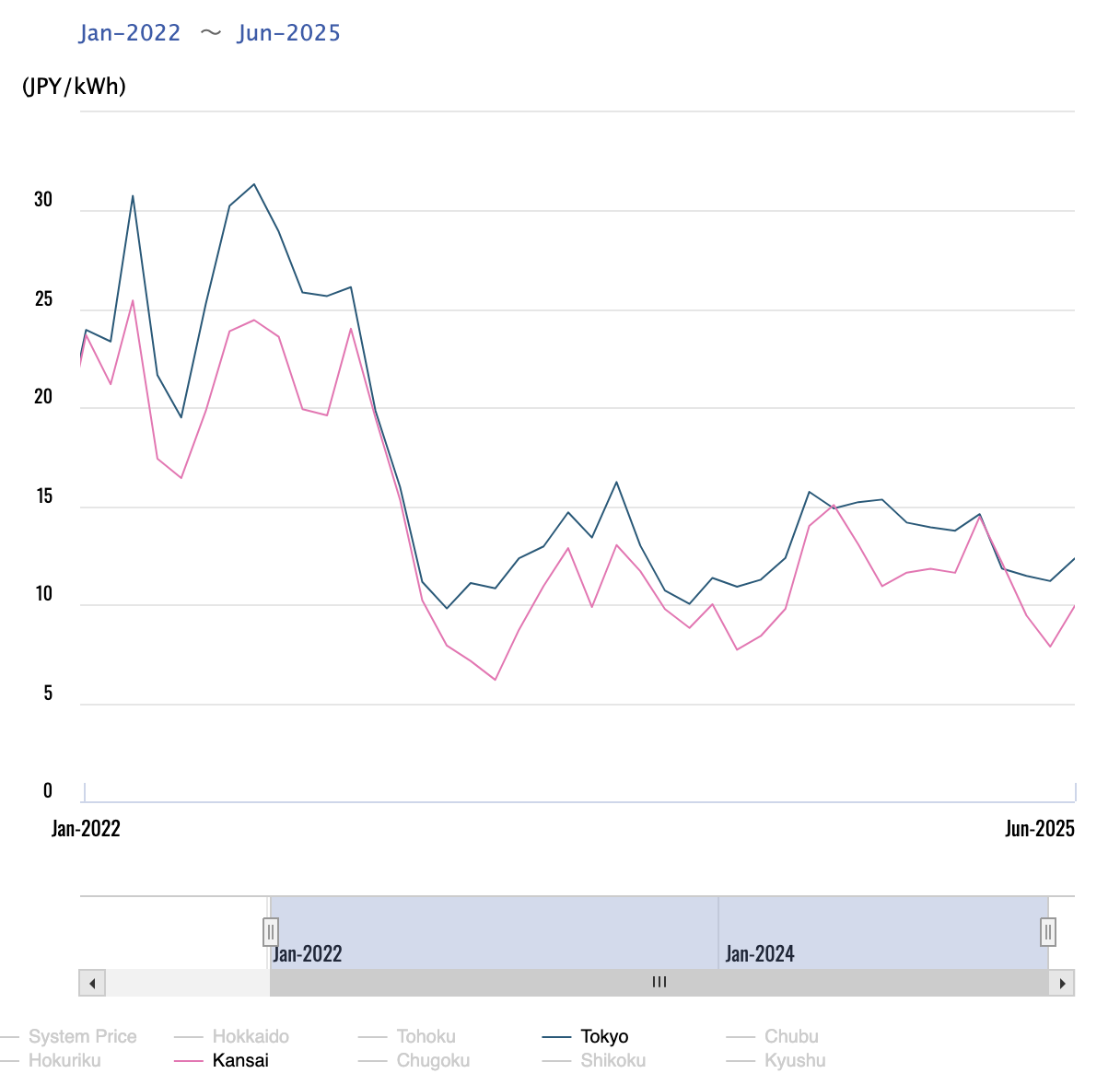 Tokyo area vs Kansai area electricity spot prices
Source: JEPX
Under the gun, the utility will be happy to restart even one reactor in FY2025, which is in contrast to earlier plans for two units online by FY2024. In this context, the inclusion of Unit 6 in OCCTO’s results came as welcome news for TEPCO.
Unit 7
At the end of May, TEPCO said it was still betting on Unit 7’s restart over Unit 6. But Unit 7, which is already loaded with nuclear fuel, won’t be able to operate after October 13 2025. The main problem is the need to complete construction work on an anti-terrorism facility mandated by the NRA, and that work is expected to take 3–4 years.
The Niigata Prefecture will hold public hearings through August 31, and Governor Hanazumi Hideyo won’t make a decision on the restart before September. Still, regulatory inspections and test runs at Unit 7 would push full operation beyond the Oct 13 deadline.
Potential restart would most likely be impractical or short-lived. The NPP’s director said that Unit 7 would take about two months from restart approval to reach actual operation.
This delay has induced TEPCO to switch gears and prioritize the restart of the other eligible reactor, Unit 6, which was selected under the LTDA. Nevertheless, it still needs the same local approval and will be subject to inspection.
Unit 6
Unit 6’s main advantage is that it will shut for anti-terrorism facility construction work only in September 2029. That’s a lot of breathing room. By that time, the work on Unit 7’s will have been completed and it can be put into operation.
So, TEPCO confidently began loading nuclear fuel on June 10. On that same day, TEPCO received NRA approval to conduct tests of safety systems. With safety equipment installation completed, TEPCO doesn’t expect any more major delays.
Kashiwazaki-Kariwa Nuclear Power Plant. Source: TEPCO
This move produced immediate results, fueling hopes among TEPCO’s investors. Share price on the Prime Market rose sharply on June 10, at one point gaining +4.22%.
Sentiment toward Kashiwazaki-Kariwa’s restart is less polarized than a simple “yes or no” poll-framing might suggest. While the business community sees restart as a profitable endeavor, TEPCO’s persistent reputational fallout from Fukushima still stokes opposition.
Unlike other EPCOs, many people are wary of letting TEPCO manage critical infrastructure in light of its recent weak record on safety and transparency. TEPCO could probably find itself bound by strict conditions that other NPP operators don’t face. But hammering out those hypothetical conditions, and determining how to monitor them, will take much time.
Finally, local politics is an important factor that’s often overlooked by analysts and investors. Governor Hanazumi’s current term is nearing its end, and there are signs he may let these issues linger unresolved until his term is over, thus escaping responsibility for any unpopular decision. All of this guarantees that the restart will be pushed further into the future.
Summary of important future deadlines in light of recent developments
Public hearings on Kashiwazaki-Kariwa NPP’s restart | Until the end of August |
Earliest possible decision by Niigata Governor | Around September |
Unit 7 becomes inoperable due to anti-terrorism facility’s completion deadline | October 13 |
Earliest possible operation start date (in case of local approval) | Around December |
Niigata gubernatorial election | 2026 |
Unit 6 becomes inoperable due to anti-terrorism facility’s completion deadline | September 2029 |
Conclusion
While Japan’s strategy to reinvigorate nuclear power took off in late 2022 in the wake of that year’s energy crisis, those efforts are now coming up against the hard realities on the ground, which include local community approval and state regulations.
Nationwide, 14 of 17 NRA-approved reactors have restarted since 2015. KEPCO accounts for seven operational reactors, while TEPCO has none. Political friction, coupled with a widespread distrust in TEPCO, keeps key plants idle. The OCCTO auctions, by underwriting nuclear upgrades, send a signal of commitment and support to the industry, but so far its impact has been limited.
The EPCOs are stuck between rising costs and political bottlenecks. This outcome dictates profitability: utilities with restarted reactors (KEPCO, Kyushu Electric) thrive financially. Meanwhile, those that don’t secure a restart (TEPCO, Hokkaido Electric) find themselves in financial hot water.
Japan’s nuclear revival is struggling. While there are promises and subsidies, the fact is that these efforts have proceeded much slower than expected. The inability to build a strong consensus among all stakeholders is Japan’s greatest challenge to repowering its NPPs.
Finding a way to bridge the divide – which is mostly an issue of public perception – is perhaps more important than any technological or bureaucratic hurdle. To date, ministries in Tokyo seem unable or unwilling to confront this challenge.
ANALYSIS
BY KALEA EMA
Green Steel Goes Global: Japan, EU and Sweden on
Different Paths to Same Goal
Long one of the world’s most energy and emissions-intensive industries, the steel sector is slowly starting to embrace ways to become ‘green’.
Governments and businesses from Tokyo and Luleå (Sweden) to Brussels are vying to demonstrate that ‘green steel’ is not just feasible but also scalable. The objective is to make steel with as little negative impact (i.e. emissions) on the environment as possible.
Three of the flagship projects pioneering this new direction are HYBRIT in Sweden; Green Steel for Europe (EU); and COURSE50 (Japan). Each is influenced by their respective industrial tradition, regulatory incentives, and regional limitations.
While still in pilot phases, they collectively chart a path toward decarbonizing a sector responsible for roughly 7% of global CO2 emissions. All three approaches also share the common element of hydrogen as a central solution. But as they move from pilot to industrial scale, there are complexities to navigate. Can the national and regional steel sectors follow?
Fostering international cooperation and uniform standards for green steel, as well as creating distinct markets for such products – which Japan categorizes as GX (green transformation) goods – will be crucial in order to economic success.
Criteria | HYBRIT (Sweden) | COURSE50 (Japan) | GREENSTEEL (EU) |
Premium over regular steel | 35–100% | 35–100% | 35–100% |
Hydrogen required per ton of steel | 50–60 kg | 10–30 kg | 50–60 kg |
Timescale | Pilot completed 2021; Demo plant (1.3 Mt/ year) by 2027 | Full-scale industrial trials by 2026; phased rollout to 2050 | Roadmap concluded in 2021; ongoing EU-wide rollout of ~30 projects aiming for major milestones by 2030 and 2050 |
Developments in Japan
Japan’s steel industry, long reliant on coal-fired blast furnaces (BFs) and basic oxygen furnaces (BOFs), faces growing pressure to cut carbon emissions. With few domestic energy resources, it has struggled to pivot away from coal – a fuel that’s relatively easy to source and store. But in the mid-2000s, the country’s major producers – Nippon Steel, JFE, and Kobe Steel – launched a new program to reduce emissions from existing BFs as a transitional step.
In partnership with the government and academia, in 2008 the firms created COURSE50 (short for “CO2 Ultimate Reduction System for Cool Earth 50”) as an R&D project that set a goal to cut emissions 30% by injecting hydrogen-rich gases into blast furnaces and capturing the CO2.
Through the 2010s, Japanese steelmakers built a 12 m³ test blast furnace at Kimitsu Steel Works in Chiba Prefecture and gradually improved the hydrogen injection and carbon capture methods. By 2022, COURSE50’s initial phase concluded, having demonstrated an over 10% CO2 reduction via hydrogen (using coke oven gas), plus ~20% via CO2 capture.
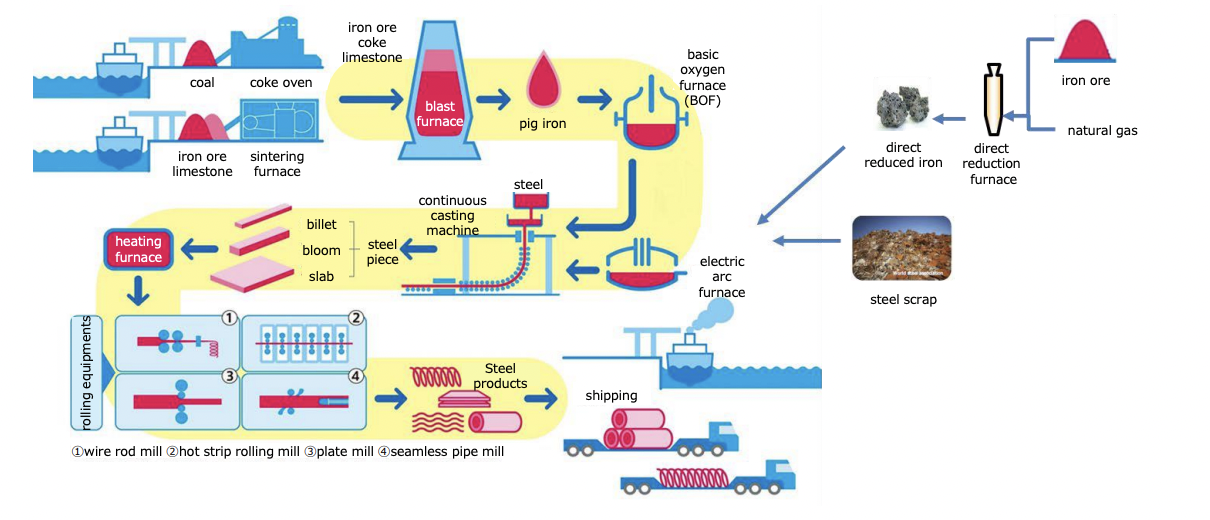
This was followed by an upgraded “Super COURSE50” program (2022 onward) targeting a 50% emission reduction by using externally sourced hydrogen and advanced heat management in blast furnaces.
After a slow start, the project has seen its progress accelerate in the 2020s. Nippon Steel reported a 22% CO2 reduction in 2022 tests; 33% in 2023; and 43% in late 2024 – a world record for blast furnaces.
Developments in Europe
Rather than building a specific steel plant, the Green Steel for Europe (GREENSTEEL) project convened stakeholders to chart decarbonization pathways for the EU’s entire steel sector. Its comprehensive roadmap explores multiple technologies (from hydrogen direct reduction to carbon capture and even electrolysis), and has outlined mid- and long-term trajectories to achieve the EU’s 2030 and 2050 climate goals.
GREENSTEEL also assessed investment needs and policy impact, concluding that transitioning EU steel would require massive funding and policy support. The initiative wrapped up by 2021 with recommendations that continue to shape EU industrial and climate policy.
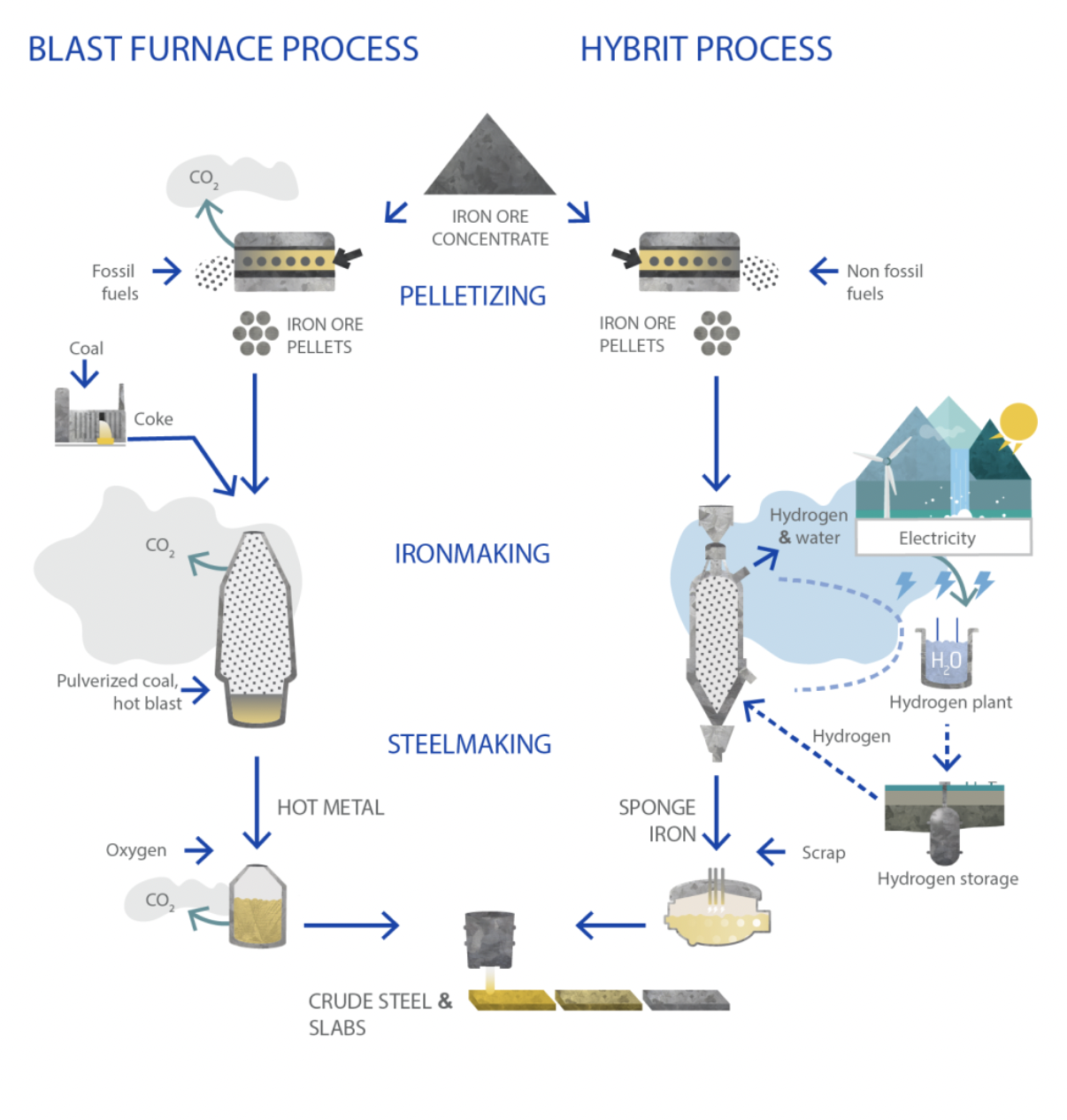
In Sweden, HYBRIT made history by moving quickly from concept to pilot, as part of the country’s ambitious commitment to achieve a net-zero carbon economy by 2045. Construction of a pilot direct reduction plant in Luleå began in 2018, and by July 2021, HYBRIT produced the world’s first batch of steel made with 100% green hydrogen instead of coal, delivered to Volvo.
In 2022, HYBRIT also opened an innovative underground hydrogen storage cavern to buffer supply. By late 2024, Sweden was poised to produce the world’s first truly zero-carbon steel at an industrial scale, a major milestone in steel history.
Sourcing hydrogen
The amount of hydrogen required to replace coal as a reducing agent in the steelmaking process is one factor that distinguishes the different decarbonization methods.
Hydrogen is the primary enabler of a completely fossil-free process in HYBRIT, which reduces emissions over 95% by substituting hydrogen-based direct reduction for the blast furnace. According to its own data, 50–60 kg of hydrogen is needed to make one ton of green steel using this method. Only water vapor is released when the hydrogen, which is created by electrolysis with renewable electricity, combines with iron ore to form sponge iron.
In comparison, Japan’s COURSE50 has a more gradual ecological benefit strategy: it aims to refit blast furnaces with carbon capture and hydrogen injection devices rather than getting rid of them altogether. While the more recent “Super COURSE50” attempts to inject externally produced hydrogen, the earlier model used hydrogen-rich gas from coke furnaces.
The amount of hydrogen required per ton of steel is less, usually 10–30 kilograms, depending on the extent of CO2 capture. (Hydrogen can’t completely replace coke in a standard blast furnace.)
With GREENSTEEL, hydrogen-based direct reduction combined with electric arc furnaces became a top candidate. Similar to HYBRIT, this approach utilizes about 50–60 kg of hydrogen per ton, making it a viable option, especially for nations with a lot of green electricity.
The takeaway is clear: all three programs are centered on hydrogen as the foundation of green steel, and illustrate different backgrounds: Japan’s focus on retrofitting current processes; the EU’s broad policy-driven coordination; and Sweden’s push for revolutionary process change.
The steel industry’s carbon-neutral roadmap calls for using hydrogen and extensive carbon capture, but achieving this will require sustained state incentives and new policies to deploy infrastructure (e.g. hydrogen supply networks and CO2 storage sites).
Policy comparisons
Policy frameworks in each region have significantly shaped the initiatives. Japan’s approach relies on government-industry collaboration without heavy carbon pricing. Japan supported COURSE50 through state agencies like NEDO and METI, and with support from the Green Innovation Fund for breakthrough projects. However, Japan lacks a rigorous carbon tax/ ETS for industry; instead, it uses voluntary benchmarks and industrial roadmaps.
The goal of Super COURSE50 is to upgrade current blast furnaces with CO2 capture and hydrogen injection. After the test results at the Kimitsu plant showed a 43% drop in CO2 in 2024, the aim is to pursue full-scale trials in 2026.
Should that be successful, the goal is to deploy a hybrid decarbonization model nationwide that would see a third of Japan’s steel production coming from Super COURSE50 blast furnaces, a third from hydrogen DRI, and a third from increased electric arc furnace recycling.
Meanwhile, the EU has implemented an integrated policy mix that combines “sticks” and “carrots”. The stick is the EU’s ETS carbon price and the incoming carbon border tariff (CBAM), which put financial pressure on steelmakers to cut emissions or pay hefty penalties.
The carrots include large-scale funding programs: the EU’s Innovation Fund has already allocated over €2 billion to support hydrogen-based steel projects. One major example is the €143 million grant awarded to HYBRIT’s demo plant in 2022. Additionally, the EU launched a public-private Clean Steel Partnership to invest in R&D up to 2030, and is aligning standards and procurement policies (e.g. green public purchasing) to create demand for low-carbon steel.
For its part, Sweden complements EU policy with national measures. Through the Swedish Energy Agency, the government co-financed HYBRIT’s pilot phases and set an ambitious national net-zero 2045 target.
In summary, EU and Swedish policies actively shape a market for green steel, whereas Japan’s support is more focused on R&D subsidies and future infrastructure planning.
Conclusion
Depending on the process, producing green steel can still cost anywhere from 35 to 100% more per ton than conventional steel. Additional commercial validation comes from early offtake agreements with industrial buyers and automakers like Volvo.
Nevertheless, with sufficient state support, millions of tons of low-CO2 steel are expected to enter the market across several countries by the late 2020s. Achieving this goal hinges on scaling hydrogen supply and carbon capture and storage (CCS) infrastructure. For Japan, this transitional model might also be exportable to steel-heavy economies such as China and India, or at least to overseas mills operated by Japanese companies.
Decarbonizing steel is crucial for achieving broader climate goals. The more than 30 EU-based low-carbon steel projects, COURSE50’s industrial trials at Nippon Steel’s Kimitsu works, and HYBRIT’s 1.3 million-ton demonstration plant all clearly indicate that the shift from concept to reality is now fully underway.
Green Steel Progress Outside the EU and Japan
Country | Notable developments |
China | Aims to become top green primary steel producer by 2030, tapping its abundant renewables & H₂ production capacity |
India | Yet to launch large-scale green steel, but with expansion plans looming, it represents a major pivot point – 92% of capacity still under development . |
UK | Ramping up low-carbon steel via clean energy strategies; Port Talbot expected to cut emissions by 75% with new electric arc furnace by 2027 . |
U.S. | Growing pilot scale efforts (e.g., Electra, Boston Metal) in electrochemical steel and MOE low-emission pathways . |
ASIA ENERGY REVIEW
BY JOHN VAROLI
A brief overview of the region’s main energy events from the past week
Australia / Renewable energy
New South Wales is investing $115 million to build the Newcastle Logistics Precinct that will support delivery of renewable energy across the state.
Australia / Renewable energy
Global investment firm KKR acquired power producer Zenith Energy from a consortium including Pacific Equity Partners, OPSEU Pension Trust, and Foresight Group.
China / Electricity
All electricity demand growth in the first five months of 2025 was met by non-fossil sources. China’s total power generation rose by 70 GWh in the same period in 2024. Most growth came from wind, solar, and nuclear.
China / Oil
Oil demand will peak in 2027, two years earlier than forecasted, said the IEA. China’s robust domestic sales of EVs, high-speed rail and gas-fueled trucks will “help displace crude oil”.
Coal
Global Energy Monitor said that 312 surface coal mines have been idled since 2020. These cover about 2,090 km², the size of Luxembourg.
India / Renewable energy
India issued over 2 GW of renewable energy tenders in May. The biggest was Adani securing REC Power’s 1.5 GW transmission project.
Indonesia / Solar power
The govt launched its largest solar cell and panel module factory, PT Trina Mas Agra Indonesia, with an annual production capacity of 1 GW.
Philippines / Renewable energy
Citicore Renewables and Pertamina New & Renewable Energy completed a $120 million share subscription that gives the Indonesian company a 20% stake in the former.
Singapore / Refinery
Chevron seeks non-binding bids in the sale of its 50% stake in Singapore Refining Co, including from its partner PetroChina.
South Korea / Energy policy
The govt is accelerating plans for a nationwide renewable energy infrastructure upgrade, with a transformative “Energy Highway” at the center of its strategy.
Disclaimer
This communication has been prepared for information purposes only, is confidential and may be legally privileged. This is a subscription-only service and is directed at those who have expressly asked K.K. Yuri Group or one of its representatives to be added to the mailing list. This document may not be onwardly circulated or reproduced without prior written consent from Yuri Group, which retains all copyright to the content of this report.
Yuri Group is not registered as an investment advisor in any jurisdiction. Our research and all the content express our opinions, which are generally based on available public information, field studies and own analysis. Content is limited to general comment upon general political, economic and market issues, asset classes and types of investments. The report and all of its content does not constitute a recommendation or solicitation to buy, sell, subscribe for or underwrite any product or physical commodity, or a financial instrument.
The information contained in this report is obtained from sources believed to be reliable and in good faith. No representation or warranty is made that it is accurate or complete. Opinions and views expressed are subject to change without notice, as are prices and availability, which are indicative only. There is no obligation to notify recipients of any changes to this data or to do so in the future. No responsibility is accepted for the use of or reliance on the information provided. In no circumstances will Yuri Group be liable for any indirect or direct loss, or consequential loss or damages arising from the use of, any inability to use, or any inaccuracy in the information.
K.K. Yuri Group: Hulic Ochanomizu Bldg. 3F, 2-3-11, Surugadai, Kanda, Chiyoda-ku, Tokyo, Japan, 101-0062.