
WEEKLY
JULY 22, 2025
ANALYSIS
MAJOR UTILITIES ADJUST INVESTMENT PLANS TO CHIME WITH NEW NATIONAL GOALS
- In February, the Cabinet approved three sweeping energy and climate initiatives. Since then, some of the major utilities have outlined new business plans, offering the first insights into how the nation’s traditional energy sector is responding.
- While nearly every company reaffirmed a low-carbon future, the degree of scale, scope, and choice of technologies vary significantly.
JCM TIGHTENS CONDITIONS TO REFOCUS CARBON CREDITS SUPPORT SCHEME
- The JCM shifted gears, signaling a move away from traditional solar power installations toward more selective support for innovative technologies.
- The latest auctions significantly limit support for conventional crystalline silicon-based PV projects. This underscores Japan’s intent to achieve deeper emissions cuts per investment.
ASIA PACIFIC REVIEW
This column provides a brief overview of the region’s main energy events from the past week
NEWS
- ANRE presents approach for next-gen geothermal energy roadmap
- New research vessel planned to boost deep-sea rare earth exploration
- Cobalt price hikes likely to affect battery makers
- GX-ETS: benchmarking for power sector will aim for balance
- KEPCO Nanko Power Plant: all units to begin operation in 2030
- JBIC inks $626 million loan for U.S. low-carbon ammonia project
- FDK develops alloy for hydrogen storage tanks
- Itochu to build new ammonia bunkering vessel
- METI approves Pacifico Energy plans in Mie Pref
- Kyuden Mirai Energy acquires three solar plants
- Japan’s first co-located solar battery fund launches
- ERE to acquire 50 small-scale solar power plants
WIND POWER AND OTHER RENEWABLES
- American Bureau of Shipping and FLOWRA to support floating wind
- Germany’s wpd signs CPPA for first grid-connected wind project in Japan
- KEPCO plans to build a new NPP at Mihama site
- Japan launches platform to speed up use of ATF
- Alaska LNG developer to launch pipeline before liquefaction plant
- LNG stocks down from previous week, down YoY
CARBON CAPTURE & SYNTHETIC FUELS
- Up to $1 billion worth of carbon credits needed for Japan’s ETS
- NEDO’s GIF projects operate at specific CCUS cost target
- METI opens subsidy projects for decarbonization of coastal shipping
EVENTS
Aug 27-28 Asia-Pacific Economic Cooperation / Energy Ministerial Meeting @ Busan, South Korea
Sept 9-12 Gastech 2025, Milan
Sept 15-19 IAEA General Conference 2025
Sept 16-18 APAC Wind Energy Summit @ Melbourne, Australia
Sept 17-19 Smart Energy Week Autumn 2025 / EV-HV-FCV Expo / Green Factory Expo / H2 & FC Expo / PV Expo / Battery Japan / Smart Grid Expo / Wind Expo / CCUS Expo / Decarbonization Expo / Circular Economy Expo @ Makuhari Messe
PUBLISHER
K. K. Yuri Group
Editorial Team
Yuriy Humber (Chief Editor)
John Varoli (Senior Editor, Americas)
Kyoko Fukuda (Data, Events)
Magdalena Osumi (Renewables & Storage)
Filippo Pedretti (Thermal, CCS, Nuclear)
Tetsuji Tomita (Power Market, Hydrogen)
George Hoffman (Sales, Business Development)
Tim Young (Design)
SUBSCRIPTIONS & ADVERTISING
Japan NRG offers individual, corporate and academic subscription plans. Basic details are our website or write to subscriptions@japan-nrg.com
For marketing, advertising, or collaboration opportunities, contact sales@japan-nrg.com For all other inquiries, write to info@japan-nrg.com

NEWS: GENERAL OUTLOOK AND TRENDS
ANRE presents approach for next-gen geothermal energy roadmap
(Government statement, July 15)
- ANRE stated its intention to draw up a roadmap for next-gen geothermal. The govt plans to hammer out a roadmap by October, followed by approval via the Subcommittee on Resources and Fuel.
- The targeted cost for next-gen geothermal power should be at a level equivalent to or lower than conventional geothermal, or within the range of ¥12-19/ kWh.
- While the potential for conventional geothermal capacity in Japan is estimated at 23.5 GW, in theory, with next-gen geothermal it could be 77 GW.
- The estimated economic impact of next-gen geothermal, assuming development of even 10% of its potential (7.7 GW), is about ¥29 to ¥46 trillion.
- CONTEXT: To expand geothermal power, in April, ANRE launched the “Council for Next-Generation Geothermal” to facilitate discussions between public and private sectors and to develop a roadmap. Next-gen geothermal refers to tech that overcomes the limitations of conventional geothermal power and is both more efficient and environmentally friendly. These technologies include “supercritical geothermal,” “closed-loop systems,” and “EGS (Enhanced Geothermal Systems).”
New research vessel planned to boost deep-sea rare earth exploration
(Asia Nikkei, July 16)
- Japan will build a new research support ship carrying multiple deep-sea probes, including crewed submersibles such as the Shinkai 6500, reducing voyage durations.
- The new ship will lower research costs and manpower by enabling stationary surface observations and supporting autonomous vehicles.
- The existing 35-year-old research vessel Yokosuka can carry only one probe.
- CONTEXT: Japan aims to begin rare-earth mining by FY2028, tapping an estimated 16 Mt near Minamitorishima, to decrease dependence on China, which controls 70% of global rare earth production.
TAKEAWAY: Japanese media increasingly discuss deep-sea or seabed mining. For example, pilot mining of rare earth minerals from seabed mud near Minami-Torishima Island, 1,950 km southeast of Tokyo, would start in January 2026 and a larger trial would kick off a year later. The ambition to turn this entirely new form of mining into a near-commercial venture by 2028 seems overly optimistic, but we believe it could be possible to see moderate quantities of minerals mined on a consistent basis from the end of this decade. Japan’s seabed is known to hold nickel and cobalt ores, as well as rare-earth elements. JOGMEC is the main state entity involved in searching and mining such elements.
- SIDE DEVELOPMENT:
- Cobalt price hikes likely to affect battery manufacturers
- (Nikkei, July 17)
- Cobalt prices, critical for EV batteries, are rising sharply due to a supply halt by the world’s top producer, the Democratic Republic of Congo, which supplies over 70% of cobalt globally.
- CONTEXT: Cobalt-free, lower-cost LFP (lithium iron phosphate) batteries are popular in China, drawing interest from Japanese automakers and battery manufacturers seeking to reduce costs and supply chain risks.
TAKEAWAY: Japan imported some 7,000 tons of cobalt in 2023, with over 60% used in rechargeable batteries, including those for EVs and electronics. As cobalt prices have risen by about 50% since early 2025, manufacturers face mounting cost pressures and growing supply chain risks. The continued surge in cobalt prices could accelerate Japan’s transition toward cobalt-free technologies, such as LFP batteries, which are cheaper and increasingly adopted globally. It could even reshape Japan’s EV battery strategy, prompting more investment in alternative chemistries and domestic battery innovation to reduce imports.
MODEC and Norway’s Eld Energy to install offshore fuel cell pilot
(Company statement, July 16)
- Mitsui Ocean Development & Engineering (MODEC) inked a deal with Norway’s Eld Energy to design and make a 40 kW solid oxide fuel cell (SOFC) pilot plant.
- The system will be installed aboard one of MODEC’s floating production storage and offloading (FPSO) vessels operating offshore.
- CONTEXT: SOFCs offer higher efficiency and lower CO2 emissions compared to traditional combustion-based systems and can use fuels other than hydrogen due to their high operating temperature. The goal is to develop multi-MW power plants able to replace gas turbines offshore by 2030.
- SIDE DEVELOPMENT:
- Hitachi develops next-gen SOFC tech
- (Company statement, July 10)
- Hitachi has developed a next-gen solid oxide fuel cell (SOFC) with high power output at low temperatures.
- It claims to reduce the number of thermal insulation components required, lowering costs, while offering broad application potential in industrial and portable power sources, from factory in-house generation to disaster-response supplies.
- CONTEXT: This tech applies Hitachi’s expertise in semiconductors to make each fuel cell layer from separately-manageable partitioned cells, enabling evaluation of each cell and elimination of defective ones, reducing failure risk.
Power retailer Groove Energy fails again to settle overdue fees
(Government statement, July 11)
- METI said power retailer Groove Energy failed to pay the renewable energy surcharge by the June 30 deadline and also ignored a follow-up notice due by July 10.
- METI says the firm has been in default on surcharge payments since Dec 2024.
- CONTEXT: Groove Energy operates in retail power, energy system planning, and sales of residential energy equipment. The firm positions itself as a next‑gen energy provider in the deregulated power market.
NEWS: ELECTRICITY MARKETS
GX-ETS: benchmarking for power sector will aim for balance, says METI
(Denki Shimbun, July 17)
- Ito Sadanori, head of the GX Group at METI, said the GX-ETS will adopt a balanced approach when setting benchmarks for the power sector. It won’t highlight “winners and losers” among companies.
- Starting FY2026, the GX-ETS will ask companies emitting over 100,000 tons of CO2 a year to join. The govt will divide free emission allowances among power companies based on benchmarks aligned with reduction targets.
- Ito is concerned about a possible “double burden” that could happen when both paid emissions auctions (from FY2033) and fossil fuel surcharges (from FY2028) launch. He said there’ll be adjustments to avoid charging for the same carbon twice.
KEPCO Nanko Power Plant: all units to begin operation in FY2030
(Denki Shimbun, July 18)
- The Kansai utility submitted to METI a draft environmental impact statement for upgrades at its Nanko Power Plant. This is the third stage in Japan’s four-step environmental assessment process.
- At the time of the second stage (submission of report on methods) the plan was for Unit 1 to begin operations in FY2029, and Units 2 and 3 in FY2030. Now, after reviewing the schedule, KEPCO plans for all three units to start in FY2030. The company aims to begin construction in FY2026.
- Each unit will have a capacity of 621 MW, bringing the total to over 1.8 GW.
- CONTEXT: In 2024, KEPCO announced upgrades to replace the current thermal system with a combined cycle system, improving power generation efficiency by 40% and reducing CO2 emissions by 30%.
Chugoku Electric launches VPP test at Hiroshima Univ
(Company statement, July 17)
- Hiroshima University and Chugoku Electric will make a Virtual Power Plant (VPP) demo as part of their smart city initiative.
- Running from Feb to Dec 2026, it will simulate a city using campus facilities, including solar panels, EVs, and AC systems, to test energy management using Chugoku Electric’s VPP system.
- The aim is to optimize energy use, reduce carbon emissions, and cut electricity costs by using solar power and stored EV energy during peak hours.
- CONTEXT: Higashihiroshima City and Hiroshima Univ seek to promote regional revitalization and development by combining the city’s resources with the university’s research strengths under the Town & Gown concept.
Hokkaido and Kansai utilities ink pumped storage deal to secure grid capacity
(Company statement, July 11)
- Hokkaido Electric Power Network and Kansai T&D inked contracts to directly procure adjustment capacity from pumped storage power plants.
- Both units overseeing power transmission and distribution are affiliated, respectively, with Hokkaido Electric and KEPCO.
- The deals covering 340 MW and 470 MW, respectively, run through March 2026 and aim to supplement shortfalls in Japan’s balancing market.
- The contracts, following a similar move by Chubu Electric in FY2024, allow utilities to borrow operational rights from generators.
Erex forms business alliance with Global Engineering
(Company statement, July 1)
- Erex took a stake in power retailer Global Engineering, to collaborate across aggregate power management, retail electricity, and trading operations.
- Details of the business alliance and new shareholding were not disclosed.
- Global Engineering provides services including electricity retail, demand response options, and engineering for on-site power generation.
- The firms also plan to cooperate in electricity trading, such as bilateral and futures transactions, to support its retail operations.
NEWS: HYDROGEN
JBIC inks $626 million loan for U.S. low-carbon ammonia project
(Company statement, July 1)
- JBIC inked a loan co-financed with Mitsui & Co for up to $626 million to Blue Point Number One, a Louisiana firm, to support its low-carbon ammonia production.
- This loan will be implemented as a syndicated loan with Sumitomo Mitsui Banking Corp, with the total syndicated loan amount at around $1.04 billion.
- The money will finance trading house Mitsui’s investment in Blue Point Number One, LLC as part of the government’s strategy to support the building of a global hydrogen supply chain.
- The project will utilize CCS to reduce emissions by over 95% during production. Mitsui will buy a portion of the low-carbon ammonia and supply it to Japan’s power and chemical sectors.
- CONTEXT: The financing is separate from a Contract for Difference (CfD) subsidy scheme set up to support the demand side in Japan. Results of the CfD are expected within this year.
FDK develops alloy for hydrogen storage tanks
(Company statement, July 17)
- FDK developed an alloy as a new material in hydrogen storage tanks. Sample provision began this month, with mass production planned starting October.
- While AB5-type alloys (made of rare earth metals and transition metals such as LaNi₅) have been used in nickel-metal hydride batteries, the new product is an AB2-type alloy (combinations of transition metals such as ZrV₂ or TiMn₂).
- AB2-type alloys are more suitable for hydrogen tanks as they use lighter materials, have a higher hydrogen storage capacity, and consist of cost-effective elements.
- CONTEXT: FDK has produced and sold nickel-metal hydride batteries since 1991. Hydrogen storage alloys are used in the negative electrodes of nickel-metal hydride batteries. These alloys offer a volumetric hydrogen storage efficiency about twice that of liquid hydrogen and seven times that of compressed hydrogen gas. Because these alloys can stably store hydrogen at near room temperature and atmospheric pressure, FDK has been developing them for use in hydrogen storage tanks.
TAKEAWAY: Currently, the main methods for hydrogen storage are high-pressure gas, liquefied hydrogen, and liquid organic hydrogen carriers (LOHCs). But, hydrogen storage alloys were once considered a prominent storage method because they offer advantages in safety and transportability. Issues remain regarding weight, cost, absorption/ desorption rates, and storage capacity.
Tokyo Gas to study building high-pressure hydrogen pipeline
(Company statement, July 15)
- The Tokyo Metro Govt selected Tokyo Gas to develop a hydrogen pipeline covering the airport waterfront area, to be implemented in three stages:
- Stage 1: Create hydrogen demand points through applications such as hydrogen boilers, mobility, industrial use, and hydrogen stations.
- Stage 2: Expand hydrogen demand at those points by generating additional surrounding demand and involving various business operators.
- Stage 3: Establish a hydrogen supply system by connecting the hydrogen demand points from Stage 2 with pipelines and other infrastructure.
- This marks the first initiative to consider the construction of high-pressure hydrogen pipelines in the Tokyo metropolitan area.
- CONTEXT: In April 2024, the TMG set up the “Tokyo Hydrogen Supply System Council Including Pipelines” to expand hydrogen demand and future imports of the energy source.
TAKEAWAY: Japan is in the early stages of commercializing hydrogen pipelines, with demo projects and conceptual planning under way. Pipelines are usually the cheapest means of transport for large volumes of gas or liquid, and would be ideal to move hydrogen from production point or import terminal to demand centers. However, hydrogen causes embrittlement in some metals, making them brittle and prone to cracking, especially at high pressures. This is a concern for pipelines used to transport hydrogen, as it can lead to failures. New alloys are required to make the pipelines suitable for long-term hydrogen transportation.
Governor exchanged views with companies at green hydrogen roundtable
(Government statement, July 14)
- At the 8th Tokyo Green Hydrogen Roundtable, under the theme of the social implementation of green hydrogen, Governor Koike heard from five companies.
- Itochu Corp is implementing numerous hydrogen, ammonia, and e-fuel projects both in Japan and abroad.
- Obayashi has a hydrogen demo project in Namie Town and a green hydrogen production project in New Zealand.
- KHI contributes to every stage of the hydrogen supply chain: production, transportation, storage, and utilization.
- Toyota Motor is working with the Tokyo city govt to promote the adoption of fuel cell (FC) buses and improve efficiency of hydrogen stations.
- JGC plans large-scale hydrogen supply by producing clean hydrogen and ammonia in large quantities overseas and importing the ammonia to Japan for dehydrogenation.
- CONTEXT: Tokyo aims to expand demand for hydrogen energy and achieve early implementation. Toward that goal, the Tokyo Green Hydrogen Roundtable was launched in August 2022, where discussions and exchanges of views are held with companies engaged in advanced initiatives.
Itochu to build new ammonia bunkering vessel
(Company statement, July 14)
- Itochu, via its Singapore subsidiary Clean Ammonia Bunkering Shipping (CABS), will build a 5,000 m³ ammonia bunkering vessel.
- CABS inked a contract with Sasaki Shipbuilding, as well as a contract with Izumi Steel Works for making the ammonia tank.
- CONTEXT: This will be the world’s first newly built ammonia bunkering vessel, slated for completion in Sept 2027.
MHI wins contract for Turkmenistan’s largest fertilizer plant
(Company statement, July 17)
- Mitsubishi Heavy Industries inked a three-year after-service contract with a state-owned company operating Turkmenistan’s largest fertilizer plant.
- The company will supply parts and equipment such as gas turbine generators. The plant, built by MHI in 2018, produces 3,500 tons of fertilizer per day.
NEWS: SOLAR AND BATTERIES
METI approves Pacifico Energy’s plans in Mie Pref
(Government statement, Japan NRG, July 18)
- METI reviewed the environmental impact assessment submitted by Pacifico Energy’s SPC for a solar farm in Hakusan and said no changes were necessary.
- The company plans to build a solar farm on a former golf course in Tsu City, Mie Pref, with a capacity of 128 MW (or 89.6 MW AC).
- CONTEXT: The project was selected through OCCTO’s public tender in its 16th round, announced June 23, 2023. The price for electricity generated at the planned solar farm is set at ¥9.34/ kWh.
TAKEAWAY: In July 2024, Pacifico Energy secured a loan from Mitsubishi HC Capital and Tokyo Century to fund the project. It’s the company’s second project using the FIP with an offsite PPA. Governor of Mie Pref requested updates to the EIA if the project’s design changes. Authorities call for preserving ponds and forests together, limiting solar panel installation to the existing golf course, and minimizing deforestation.
Looop Aims for IPO, eyes 1 million customers by 2028
(Denki Shimbun, Company statement, July 18)
- Renewables retailer Looop plans to go public and grow its customer base from 340,000 to 1 million by 2028, doubling revenue to ¥100 billion and increasing gross profit to ¥22.3 billion – 2.3 times the 2024 level. IPO date not yet set.
- The firm, originally rooted in solar power, has about 100 MW of renewable capacity (including wind), and aims to expand that to 1 GW.
- It also plans to accelerate grid-scale battery deployment, and might acquire and repower post-FIT solar plants.
- On the retail side, Looop is focusing on promoting dynamic pricing plans and enhancing its customer app with AI-powered smart home integration, automatically running appliances during low-cost, solar-abundant periods.
Kyuden Mirai Energy acquires three solar plants
(Company statement, July 16)
- Kyuden Mirai Energy acquired three FIT-era solar plants – 6.6 MW in total capacity – from Mitsui Matsushima in Fukuoka Pref.
- This is Kyuden’s first acquisition of operational solar assets and comes as its parent company, Kyushu Electric, aims to expand its renewables portfolio to 10 GW by 2035.
- SIDE DEVELOPMENT:
- PAG Renewables to build solar farm in Iwate
- (Company statement, July 8)
- PAG Renewables launched the environmental impact assessment for an approx. 80 MW solar farm in Iwate Town, Iwate Pref.
- Construction is planned to start in 2028, commercial operation in 2031. EIA statement is available for viewing until Aug 8.
Japan’s first co-located solar battery fund launches
(Company statement, July 15)
- Mizuho Securities, Nishimu Electronics (Kyuden Group), and Blue Sky Solar are launching Japan’s first fund to deploy large-scale batteries at solar power plants.
- The fund plans to install systems at four sites in Oita and Kagoshima by March 2026, with a total capacity of 8 MW and 30 MWh of storage.
- SIDE DEVELOPMENT:
- Energy Power wins grid-scale battery contract
- (Company statement, July 14)
- Osaka-based Energy Power secured a contract for the installation of a grid-scale storage battery system, valued at about ¥530 million.
- This follows another major contract in May, worth around ¥1.7 billion, as the company expands its engineering business focused on battery installations.
- SIDE DEVELOPMENT:
- Nissin Electric wins order for grid storage in Suzuka
- (Company statement, July 10)
- Nissin Electric won an order for a 1.9 MW / 8.1 MWh battery grid storage system connected to a 6.6 kV line in Suzuka City, Mie Pref. Operations to start in June 2026.
- SIDE DEVELOPMENT:
- Sumitomo Electric wins order for long-duration redox flow batteries
- (Company statement, July 10)
- Sumitomo Electric won its third order from Kashiwazaki Ai-R in Niigata for a 1 MW/ 8h redox flow battery, bringing the total installed capacity locally to 24 MWh.
- Construction of the new system is expected to finish in spring 2026.
ERE to acquire 50 small-scale solar power plants in Tohoku
(Company statement, July 16)
- ENEOS Renewable Energy will acquire 50 small-scale solar power plants being developed by West Holdings in the Tohoku region.
- Each will have a capacity of around 100 kW, totaling 5 MW. Operations will begin from December, as sites are completed.
- CONTEXT: With large-scale solar sites scarce in Japan due to limited flat land, ERE is shifting toward a decentralized model, sourcing from multiple small solar projects. West Holdings has contracted with several big energy users or developers to offer a similar service.
- SIDE DEVELOPMENT:
- PXP and Tokyo Gas selected for lightweight solar panels project
- (Company statement, July 16)
- PXP and Tokyo Gas’s jointly developed ultra-lightweight chalcopyrite film solar panel was selected under Kanagawa Pref’s FY2025 Carbon Neutral R&D Program.
- CONTEXT: The project targets a commercial rollout by FY2026, and focuses on low-load industrial roofs and aims to tap into underutilized rooftop potential by helping work around rooftop load limits —a critical bottleneck in solar deployment.
TESS Holdings, Kansai Electric firm to partner on solar-battery aggregation
(Company statement, July 10)
- TESS Engineering inked a deal with E-Flow on aggregation services.
- The project involves transitioning an FIT solar farm in Kagoshima Pref to FIP and adding battery storage. E-Flow is a Kansai Electric firm.
- CONTEXT: Both companies offer aggregation services to support customers shifting from FIT to FIP with batteries. This helps manage solar output, especially as Japan expands output control areas nationwide.
- SIDE DEVELOPMENT:
- GSSG and Vision Ridge launch Japan-based BESS developer
- (Japan NRG, July 16)
- GSSG and sustainable assets investor Vision Ridge Partners launched GSSG Chikuden, a new utility-scale BESS developer, backed by $400 million.
- CONTEXT: The new company aims to develop as much as 2 GW of battery capacity in Japan through its own projects and with partners.
NEWS: WIND POWER AND OTHER RENEWABLES
American Bureau of Shipping and FLOWRA to support floating wind
(Company statement, July 2)
- Japan’s FLOWRA, an industry association to promote development of floating offshore wind projects, inked an MoU with the American Bureau of Shipping.
- They’ll collaborate on developing new tech tailored to Japan’s marine conditions.
- CONTEXT: FLOWRA has been working with overseas organizations to research and develop new technology for floating offshore wind to reduce costs and risks.
TAKEAWAY: As Japan accelerates floating wind into its EEZ, industry collaboration with global partners is essential to develop innovative tech, reduce costs and risks, and strengthen competitiveness.
Germany’s wpd signs CPPA for first grid-connected wind project in Japan
(Company statement, July 15)
- German renewables developer wpd, in cooperation with GPSS Group, inked a corporate PPA with Nomura Real Estate for an onshore wind farm in Higashi-Izu Town, Shizuoka Pref.
- This is wpd’s first grid-connected project in Japan. It will have a 7.48 MW capacity and is scheduled to launch in May 2026.
- CONTEXT: The company is expanding across Asia, with a pipeline of 19.3 GW in wind and 5 GW in solar projects. In addition to Taiwan and Japan, wpd is active in the renewable energy markets of South Korea, Vietnam, Indonesia, and Philippines.
Akita Bank invests in offshore wind consulting firm
(Company statement, July 14)
- Akita Bank’s venture fund will back East Bridge Renewable, an Akita-based startup specializing in consulting and vessel development for offshore wind power.
- CONTEXT: The investment comes as Akita becomes a leading focus area for wind energy in Japan, with four METI-designated “promotion zones” (the highest level) and one “preparation zone” targeted for wind power development.
JFE Shoji and partners open scour protection venture for offshore wind
(Company statement, July 11)
- JFE Shoji and seven local firms created JFE Shoji Akita Offshore Materials, based in Oga City, Akita Pref.
- The new firm will produce and sell scour protection materials for offshore wind turbines, using local natural stone and JFE Steel’s artificial stone. The materials will help prevent turbine tilting by protecting the seabed.
Green Power, GPSS among winners of JOGMEC funding for geothermal surveys
(Organization statement, July 14)
- Green Power Engineering, a geothermal and hydro power developer, and renewables firm GPSS Holdings, won a subsidy from JOGMEC for geothermal surveys.
- Both aim to study geothermal energy potential.
- Green Power will survey in Inawashiro Village, Fukushima Pref.
- GPSS will survey in Ebino City, Miyazaki Pref.
- The other two firms awarded JOGMEC subsidies are: Cenergy (Chugoku Electric Group) for a project in Gifu Pref, and a consortium comprising Japan Heavy Chemical Industry, Chubu Electric and Kashima Construction for a survey planned in Nagano Pref, around Mount Fusuburi.
- Eight of 13 overall survey sites are in the Tohoku region and Hokkaido.
- CONTEXT: The subsidies mainly help fund surface surveys and well drilling.
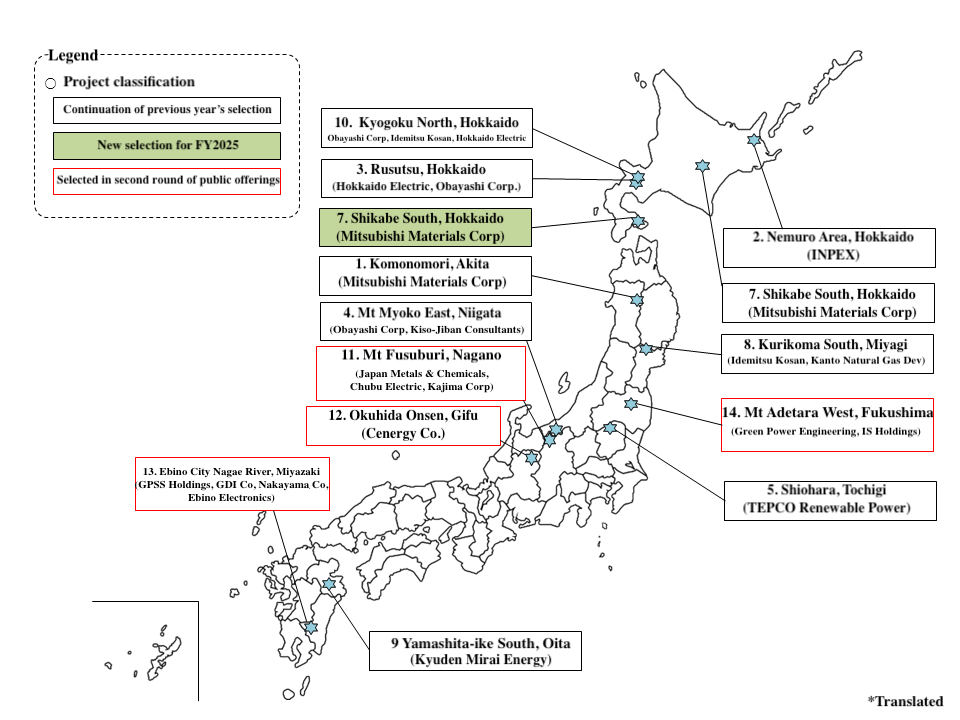 Source: Japan NRG translation of JOGMEC materials
Erex becomes equity-method affiliate of Hikari Tsushin
(Nikkei, July 16)
- Hikari Tsushin, a diversified telecom, utility, and insurance firm, increased its stake in renewable energy firm erex to 20.39%, becoming an equity-method affiliate.
NEWS: NUCLEAR
KEPCO plans to build a new NPP at Mihama site
(Nikkei, July 18)
- KEPCO will push forward with plans to build a new nuclear power plant at the site of Mihama NPP in Fukui Pref, starting with community outreach next week.
- This is the first time a major power company has specifically discussed building new nuclear power plants in Japan since the Fukushima disaster in March 2011.
- KEPCO will soon begin geological and environmental surveys on the site and plans to inform local authorities next week. This move revives plans first started in 2010 but halted after the Fukushima accident.
- The planned NPP will use an advanced light-water reactor (ALWR) design, and is estimated to require 20 years from the survey stage to operation, including regulatory reviews and approvals.
- CONTEXT: Mihama Unit 3 is operational; the older Units 1 and 2 at the site are being decommissioned. The NRA approved an extension of Unit 3’s operational life until 2036 (when it will mark 60 years of operation).
TAKEAWAY: KEPCO sees replacing aging reactors (like Mihama-3 that will hit 50 years in 2026) as crucial for energy stability. Extension of Mihama-3 is a short-to-medium-term solution only. The long-term strategy clearly includes new builds. The utility plans an entirely new NPP on the Mihama site, but not at Unit 3’s exact location. The govt energy strategy requires new NPPs to be built to keep nuclear’s 20% share in the country’s energy mix.
It’s also telling that the utility leaked the news to Japan’s largely pro-nuclear business newspaper, the Nikkei, on Friday evening ahead of a three-day weekend during which there is also a national upper-house election. Clearly, the nuclear sector is still concerned about a public pushback. Another issue that KEPCO will need to navigate is what to do with storage of spent nuclear fuel. The ‘final’ solution for that is not yet available in Japan, and yet the utility will undoubtedly be asked about its plans during the consultation process. As KEPCO indicated in the Nikkei article, the entire process will take a couple of decades so there is time for the issues to be ironed out. Still, KEPCO and other nuclear utilities will need more active support from the national government – not least in terms of financing and power rate plans – if they are to make good on the national target of keeping nuclear energy at 20% of the electricity mix going forward.
Japan launches platform to speed up use of ATF
(Denki Shimbun, July 18)
- Japan launched a platform to promote the practical use of Advanced Technology Fuel (ATF), uniting academia, industry, and govt agencies to discuss technical issues.
- All relevant Japanese organizations, such as METI and NRA, have already joined. The Japan Atomic Energy Agency serves as the secretariat.
- The platform has four sub-working groups, with a strong focus on chromium-coated cladding for PWRs, Japan’s most advanced area of research.
- CONTEXT: Usually, “ATF” refers to Accident Tolerant Fuel. But the platform adopts the broader interpretation of Advanced Technology Fuel, to refer to a new class of nuclear fuel designed to improve safety in nuclear reactors. Reflecting this trend, the platform uses “new-type fuel” as its official name.
NEWS: TRADITIONAL FUELS
Alaska LNG developer to launch pipeline before liquefaction plant
(Nikkei, July 14)
- Alaska LNG developer Glenfarne plans an accelerated the project’s start, launching the pipeline before completing the liquefaction plant.
- This phased approach aims to prove early progress, and attract investment, securing offtake deals from buyers in Japan and South Korea.
- Glenfarne (75% owner) targets pipeline operations by 2028, two to three years ahead of the LNG plant’s completion. The 1,300 km pipeline will supply gas to Anchorage (currently facing gas shortages) and later feed the $44 billion LNG export facility.
LNG stocks down from previous week, down YoY
(Government data, July 16)
- As of July 13, the LNG stocks of 10 power utilities were 1.88 Mt, down 5.5% from the previous week (1.99 Mt), down 3.1% from end July 2024 (1.94 Mt), and down 12.6% from the 5-year average of 2.15 Mt.
- CONTEXT: Over the past week, Japan has experienced high temperatures and humidity, coupled with storms, driving AC usage.
NEWS: CARBON CAPTURE & SYNTHETIC FUELS
Up to $1 billion worth of carbon credits needed for Japan’s ETS
(Nikkei, July 18)
- BloombergNEF released a report on Japan’s emissions trading system, to be implemented in FY2026, estimating a need for up to $1 billion (about ¥150 billion) worth of carbon credits. Current credit supply is insufficient, so further investment in renewable energy is necessary, according to the report.
- Under the planned ETS system, companies emitting over 100,000 tons of CO2 per year will be subject to emission caps. If they exceed these limits, they must offset the excess by purchasing credits or allowances from companies with a surplus.
- The govt will allow carbon credits to cover up to 10% of emissions. Based on this limit, BloombergNEF says demand for carbon credits will rise to 54 Mt by 2030, possibly costing up to $1 billion, depending on carbon prices.
NEDO’s GIF projects look to ¥2,000/ ton as CCUS cost target
(Japan NRG, July 18)
- New low carbon technology projects sponsored by NEDO aim for CCUS costs of ¥2,000/ ton, according to a number of presentations made at the reporting day for Green Innovation Fund backed projects in Yokohama.
- Most sessions focused on hydrogen / ammonia, CCUS, geothermal and biomass, followed by solar and then wind power tech.
- Other technologies that took center stage at the event were floating wind turbines and innovations related to perovskite solar cells.
- CONTEXT: The ¥2,000 per ton (about $20 USD) target is for the cost of separating and capturing CO2, not the full CCUS process including transportation and storage. The Green Innovation Fund was established in 2021 to distribute ¥2 trillion in subsidies for R&D into clean energy technologies. Most projects are expected to develop technology that’s commercially viable by 2030.
METI opens subsidy projects for decarbonization of coastal shipping
(Government statement, July 17)
- METI and MLIT launched a second public call for applications for FY2025 subsidies to support energy-saving and non-fossil energy in domestic coastal shipping.
- The program offers up to a 50% subsidy for capital and implementation costs of pilot projects, combining hardware measures like energy-efficient hulls, propellers, and engines, and software measures like optimizing operations and fleet planning.
- CONTEXT: The 7th Basic Energy Plan released earlier this year raised the 2030 emissions reduction target for the domestic shipping sector from 480,000 kl in crude oil equivalent to 620,000 kl.
KHI begins building CO2 capture demo facility
(Company statement, July 14)
- Kawasaki Heavy Industries began building a demo facility at its Kobe plant to test a low-concentration CO2 separation and capture technology.
- The facility, expected to be completed in October, will test two types of CO2 capture technologies using the Kawasaki CO2 Capture (KCC) system. One will be Direct Air Capture (DAC); the other, Post-Combustion Capture (PCC).
- The system uses a solid absorbent that can separate CO2 at 60°C, which results in lower energy consumption compared to traditional methods.
- The DAC module is scalable and will be Japan’s largest.
Mitsubishi UFJ consulting announces results of JCM study
(Company statement, July 14)
- Mitsubishi UFJ Research & Consulting selected proposals for the FY2025 Joint Crediting Mechanism Infrastructure Feasibility Study commissioned by METI.
- Seven projects were chosen, including those led by Mitsubishi and Kanadevia, focusing on renewables deployment and waste-to-energy initiatives.
- CONTEXT: The JCM is a bilateral scheme that enables Japan to earn emission reduction credits by supporting low-carbon tech in partner countries. The feasibility studies aim to support the development of JCM-creditable projects.
TAKEAWAY: See this week’s Analysis for the latest on the JCM.
ANALYSIS
BY ANDREW SMALL
Major Utilities Adjust Investment Plans to Chime With New National Goals
In February, the Cabinet approved three sweeping energy and climate initiatives: the 7th Basic Energy Plan, the Plan for Global Warming Countermeasures, and the GX 2040 Vision. Since then, major power utilities and gas companies have outlined their yearly, short-term, or medium-term business management plans, offering the first insights into how Japan’s energy industry is responding to the new goals.
While nearly every company reaffirmed a commitment to a low-carbon future, the degree of scale, scope, and choice of technologies varies significantly. Beyond a few standouts, most plan to keep thermal power as a critical part of the generation mix.
By far the biggest trend among the nation’s biggest energy firms was a re-commitment to embrace LNG as a replacement for coal, as well as support for co-firing ammonia and hydrogen fuels and the long-term implementation of CCS technologies as the pathways to reduce thermal power’s carbon footprint.
Still, the utilities’ decarbonization plans differed in the extent to which thermal power would remain and the “complementary” thermal-related decarbonization measures. The stance on expanding renewables was also far from unanimous.
Bolstering renewables infrastructure
The government’s new goals target a national energy mix of 40-50% renewables, 20% nuclear, and 30-40% thermal power, alongside deep investments in next-generation fuels and carbon management.
Several EPCOs have since announced additional investments to bolster renewable energy infrastructure, such as Kyushu’s ¥1.5 trillion by 2035, Hokkaido’s ¥250 billion by 2035, and Tohoku’s ¥300 billion by 2030.
Despite the ambitious goals set by some EPCOs in response to the new national strategy, the degree of scale varies sharply between firms. While Hokkaido, for example, plans to generate nearly all of its electricity with renewables and nuclear by 2050, Chubu plans to rely on thermal assets for at least half of its output in 2040, while TEPCO has not announced any updated concrete decarbonization plans.
Of Japan’s ten major EPCOs, six have indicated specific expansion goals for renewable energy over the next decade for a combined total of 16.4 GW by 2035. Kyushu Electric set by far the largest goal of 10 GW by 2035, far outpacing any other EPCO, with Chubu Electric a distant second at 3.2 GW.
No information on strategy updates from the EPCOs of Tohoku, Tokyo, Kansai, and Okinawa was found since the publication of the 7th Basic Energy Plan.
Most major utilities defined their interest in renewable energy as limited to solar, wind, and geothermal, while also listing nuclear as a clean energy source.
EPCO Name | New target for additional renewables rollout | Target year |
Hokkaido | 1 GW | 2030 |
Hokuriku | 1 GW | Early 2030s |
Chubu | 3.2 GW | 2030 |
Chugoku | 0.7 GW | 2030 |
Shikoku | 0.5 GW | 2030 |
Kyushu | 10 GW | 2035 |
Tohoku | – | |
Tokyo | – | |
Kansai | – | |
Okinawa | – | |
TOTAL | 16.4 GW |
Lack of coordination
Overall, the industry isn’t poised for coordinated, fundamental change to power generation. Every EPCO that released its plans announced an intention to transition thermal power production to “low carbon fuels” through integrating LNG in their model and introducing hydrogen and ammonia co-firing.
However, the specificity in plans and commitment varied. For example, Hokuriku and Hokkaido committed to fully decarbonized thermal output by 2050, while Chubu only described its goal as ‘heavy integration’ with low carbon fuels by 2040.
Still, the majority of utilities set 2050 as their net-zero target, in line with the current national strategy and law.
Several EPCOs – namely Hokuriku, Hokkaido, Chubu, Kyushu, and Chugoku – also announced a commitment to invest in CCS as a means to offset emissions from their remaining thermal stations. However, firms that announced such intentions refrained from setting specific targets related to implementation beyond saying that it was part of their 2050 decarbonization strategy.
The restart of NPPs nationwide will also play a crucial role in utility decarbonization plans. In particular, roughly half of Hokkaido Electric’s planned decarbonized energy by 2035, as per its updated plan, will be from the Tomari NPP, which has yet to restart.
In Chubu Electric’s mid-term plan, nuclear power also plays a sizable, though significantly smaller, role by 2040. At that point, the central Japan utility expects the bulk of its electricity to come from thermal stations running on “low carbon fuels.”
Conversely, TEPCO appears unable to fully set out decarbonization plans stemming from the uncertainty surrounding its restart of the Kashiwazaki-Kariwa NPP.
Gas utilities’ weak efforts
Japan’s updated national energy strategy had less of an impact on the four major gas utility companies – Tokyo, Osaka, Saibu, and Toho. The latter announced a ¥50 billion investment in renewable energy over the next three years, aiming for an additional 500 MW of capacity by 2030.
Saibu Gas, meanwhile, plans to invest ¥100 billion over the same timeline, aiming to roll out 130 MW of capacity. Saibu’s plan suggests that it will pay significantly more per MW of renewables (over ¥769 million) compared to Toho (¥100 million).
These moves come as the gas industry as a whole strongly embraces the development of LNG and supply diversification, and looks overseas – especially in Southeast Asia – for new demand centers to absorb surplus contracted volumes from Japan.
Still, there are plenty of firms outside of the major power and gas utilities with extensive renewable energy plans announced since the passing of the new national strategy. For example, take the Toyota group’s trading house, Toyota Tsusho Corp. Through a series of acquisitions in the past two-three years, Toyota has emerged as Japan’s biggest renewable energy operator with assets at home and overseas. That momentum won’t stop as Toyota Tsusho has business plans to invest ¥1.2 trillion in further wind, solar, and battery developments over the next two years.
Meanwhile, solar developer Renova has committed to a ¥340 billion investment to add another 5 GW of renewables capacity by 2030. And Kyudenko, a power infrastructure construction business affiliated with Kyushu Electric, has announced ¥200 billion in further green investments as it prepares to start operations at the 480 MW Ukujima solar farm that is set to be Japan’s largest.
Conclusion
The energy sector response to the government’s updated energy strategy and CO2 reduction makes two points clear. First, there are huge discrepancies between EPCOs and gas companies. Second, the sector’s interpretation of government strategies has been to largely confirm the need to retain thermal assets and infrastructure as the core energy system in Japan over the coming decades.
With the recent re-commitment to LNG, amid fuzzy timelines on integration of low carbon fuels and CCS technologies, achieving net zero goals seems far from certain; especially since the technologies and fuels are in an early phase of commercialization. In fact, no CCS projects in Japan are due to start operation until 2030. The rollout of ammonia and hydrogen co-firing is also not expected until the next decade.
All this bodes poorly for CO2 reduction planning. The degree to which new technologies will be able to offset the utility sector’s carbon emissions will only become clear well into the 2030s. By then, the investments planned today will already be online and part of the nation’s energy system for decades to come.
ANALYSIS
BY YURIY HUMBER
JCM Tightens Conditions to Refocus Carbon Credits Support Scheme
The Joint Crediting Mechanism (JCM) recently shifted gears, signaling a strategic move away from broadly funding traditional solar power installations toward more selective support for innovative, higher-impact technologies.
The latest auctions reveal a notable tightening of conditions, significantly limiting support for conventional crystalline silicon-based solar projects. This underscores Japan’s intent to push technological boundaries to achieve deeper emissions cuts per investment.
Since its inception in 2013, the JCM has successfully funded numerous solar projects across partner countries, notably in Asia. However, as standard solar installations reach saturation in regions like Thailand and Indonesia, Japan’s Ministry of the Environment is keenly aware of the diminishing returns on emission reductions from repeating similar deployments.
Since 2018, the carbon credits mechanism – which is aligned with Article 6 of the Paris Accord – has evolved from supporting projects that upgrade local tech to cleaner alternatives and improved energy efficiency to rewarding initiatives that involve technology transfer and new solutions. The end goal of the JCM program, however, remains unchanged: help Japan accumulate credits that represent a CO2 reduction of 100 million tons by 2030.
Shift to higher-impact tech
The shift in JCM’s strategy means the MoE is now prioritizing projects incorporating newer technologies such as perovskite solar cells, hybrid storage solutions, and advanced heat battery systems. The new direction is evident in the recent 67th round of the JCM subsidy funding, where MinebeaMitsumi secured backing for two sizable solar+BESS projects in Thailand. In Ayutthaya province’s Bang Pa-in, the firm plans to establish a 104 MW solar array coupled with a 129 MWh battery storage facility, designed to power its local manufacturing plant.
Another project by the same company in Lopburi province includes a 48 MW solar installation paired with 60 MWh of storage. These ventures reflect the ministry’s support for energy storage to enhance renewable energy’s impact.
Another illustrative case from the same round is Tokyo Century’s innovative installation at a packaging facility in Songkhla province, Thailand. Instead of simply installing solar panels, the firm is deploying a combined solar and heat battery system. Renewables-generated electricity will power the battery, creating stored heat energy to provide stable steam supply to the plant day and night, significantly reducing fossil fuel usage from conventional boilers.
Kansai Electric also secured funding for an innovative project in Indonesia, installing a 0.7 MW rooftop solar system on an automotive parts factory in Bekasi. It aims to reduce grid dependency, utilizing solar energy for self-consumption, enhancing environmental sustainability. Another Indonesian project, led by Tokyo Century, involves a 2.7 MW solar system at a steel-wire products factory, again emphasizing renewable self-consumption.
These recent projects contrast sharply with earlier JCM rounds that predominantly focused on standalone solar panel deployments without storage or heat utilization components. This led to limited impact beyond immediate electricity generation. The latest initiatives emphasize deeper integration of renewables with industrial processes and grid stability solutions.
Looking for scale
Since its establishment over a decade ago, the JCM has been central to Japan’s international climate strategy. Partnering now with 30 countries across Asia, Africa, Europe, and the Americas, the Japanese government has sponsored over 265 projects. The overwhelming majority (200+) are concentrated in Asia, especially in Thailand, Indonesia, and Vietnam, reflecting both regional potential for emission cuts and close economic ties. However, the scale of the projects remains moderate, with one exception – a 400 MW solar farm in the Rabigh Region of Saudi Arabia, selected in 2020 and operated by Marubeni.
Japan has also boosted funding for the JCM with NEDO calling for more allocation. The total budget for JCM projects is expected to be ¥11.4 billion over a three-year period starting in FY2025. This compares with a total of ¥6.2 billion in the six years from FY2018 to FY2013.
Historically, JCM projects focused on straightforward renewables solutions like solar PV arrays and small hydro facilities. Japanese officials, however, have recently tightened eligibility criteria. For example, traditional crystalline silicon PV systems now face strict limitations: only three such projects per partner country annually will qualify for funding. This reduction aims to funnel resources into emerging technologies, and seeks to create greater emissions reductions per project while supporting innovation.
As such, next-generation perovskite solar cells, despite being solar-only projects, retain eligibility for funding. This newer solar tech, now a focus of intensive R&D globally, uses distinctive materials and methods, promising lower cost and greater adaptability in challenging climates and locations. Japanese firms such as Macnica are deploying perovskite cells through JCM-backed demonstration projects in subtropical regions like Thailand, testing their resilience against intense heat, humidity, and air pollution.
Conclusion
The refined JCM approach fits with Japan’s wider policy ambitions, which aim not only at achieving domestic climate targets but also at boosting the international competitiveness of Japanese tech.
However, challenges accompany JCM’s pivot. Advanced technologies often entail higher upfront investments and elevated technical risks. Ensuring these more ambitious projects deliver on their promises will require more monitoring, validation, and support mechanisms. The higher budget allocation to JCM seeks to partly address these concerns.
JCM’s new trajectory underscores a dual ambition: reducing GHG emissions globally while advancing Japanese technology and competitiveness. As more pioneering projects are selected, Japan’s approach will serve as a showcase for other nations seeking to promote their innovations in developing economies, and could lead to new standards in international climate financing.
For those Japanese firms too conservative to implement clean tech at home, JCM offers a cost-effective option to trial innovations overseas, booking credits for CO2 reductions and also business efficiency gains.
FY2024 projects selected for JCM subsidies:
Partner Country | Company name (representative participant) | Project | Sector | Estimated GHG reduction(tCO2/ year) |
Chile | Farmland | 12 MW Solar Power and 33 MWh Storage Battery Project in Rancagua City | Renewable Energy | 9,692 |
Thailand | Nippon Steel Engineering | Introduction of Biomass Co-generation System to Chemical Factory | Renewable Energy | 48,429 |
Thailand | Daiki Aluminium Industry | Productivity Improvement of Aluminium Ingots Using High Efficiency Furnace System | Energy Efficiency Improvement | 3,859 |
Mongolia | Asian Gateway Corp | 15 MW Solar Power and 80 MWh Storage Battery Project in Erdene, Dornogovi Province | Renewable Energy | 16,396 |
Indonesia | Kansai Electric | Introduction of 0.8 MW Rooftop Solar Power System to Automotive Parts Factory | Renewable Energy | 681 |
Palau | SeED Okinawa | Introduction of 0.6 MW Solar Power and 0.3 MWh Storage Battery to Resort Hotel | Renewable Energy | 506 |
Thailand | Macnica | Demonstration Project of Perovskite Solar Cell System in Subtropical Region | Renewable Energy | 1 |
Indonesia | AGC | Energy Saving Project in the Automotive Glass Manufacturing Process | Energy Efficiency Improvement | 10,715 |
Indonesia | Kansai Electric | Introduction of 1.5 MW Rooftop Solar Power System to Food and Automotive Parts Factories | Renewable Energy | 1,244 |
Cambodia | MinebeaMitsumi | 20 MW Solar Power Project in Krakor, Pursat Province | Renewable Energy | 14,135 |
Cambodia | Chugoku Electric | 10 MW Solar Power and 3MWh Storage Battery Project in Pursat Province | Renewable Energy | 7,975 |
Philippines | Tokai | 4.5 MW Mini Hydro Power Plant in Piapi River, Luzon | Renewable Energy | 13,701 |
Thailand | MinebeaMitsum | 104 MW Solar Power and 129 MWh Storage Battery Project in Bang Pa-in, Ayutthaya Province | Renewable Energy | 43,577 |
Thailand | MinebeaMitsum | 48 MW Solar Power and 60 MWh Storage Battery Project in Lopburi Province | Renewable Energy | 21,545 |
Thailand | Tokyo Century | Introduction of Solar Power and Heat Battery to Packaging Factory | Renewable Energy | 2,969 |
Tunisia | Eurus Energy | 100 MW Solar Power Project in Sidi Bouzid Region | Renewable Energy | 91,118 |
Indonesia | Tokyo Century | Introduction of 2.7 MW Solar Power System to Steel Wire Products Factory | Renewable Energy | 2,173 |
Indonesia | Kansai Electric | Introduction of 0.7 MW Rooftop Solar Power System to Automotive Parts Factory | Renewable Energy | 545 |
ASIA ENERGY REVIEW
BY JOHN VAROLI
A brief overview of the region’s main energy events from the past week
Australia / Offshore wind
The developer of a proposed $10 billion Victorian offshore wind farm has abandoned the project. Gippsland Dawn was to be a 2 GW offshore wind farm built on the Gippsland coast.
China / Crude oil
In June, China accelerated crude oil stockpiles since the strongest imports in almost two years outweighed a rise in refinery processing. Surplus crude amounted to 1.42 mbpd in June, up from 1.40 mbpd in May, and the fourth straight month above 1 mbpd.
China / Emissions
Surging clean power supplies have allowed utilities to reduce emissions to record lows in H1 2025 – CO2 emissions/ kWh of electricity averaged 492 grams.
China / Power
Days of record-breaking heat across the country have pushed power demand to an all-time high in excess of 1.5 billion kilowatts on July 16.
India / Renewables
India said it achieved 50% of installed electricity capacity from non-fossil fuel sources — five years ahead of its 2030 target under the Paris Agreement.
Indonesia / Solar power
Solar PV will extend beyond replacing coal-based electricity generation; it will also include the production of e-fuels for hard-to-abate segments, reports Lut University.
Malaysia / Coal
Malaysia is boosting coal-fired power output and importing the fuel at record levels, reports Reuters, taking advantage of low prices even as it pledges to increase use of gas-fuelled electricity generation in the longer term.
South Korea / Green hydrogen
YPP Corp will invest up to $3 billion in a large-scale green hydrogen and ammonia production facility in Kazakhstan.
Taiwan / Offshore wind
UK Export Finance said it will guarantee financing for Orsted’s Greater Changhua 2 offshore wind farm off the coast of Taiwan.
Disclaimer
This communication has been prepared for information purposes only, is confidential and may be legally privileged. This is a subscription-only service and is directed at those who have expressly asked K.K. Yuri Group or one of its representatives to be added to the mailing list. This document may not be onwardly circulated or reproduced without prior written consent from Yuri Group, which retains all copyright to the content of this report.
Yuri Group is not registered as an investment advisor in any jurisdiction. Our research and all the content express our opinions, which are generally based on available public information, field studies and own analysis. Content is limited to general comment upon general political, economic and market issues, asset classes and types of investments. The report and all of its content does not constitute a recommendation or solicitation to buy, sell, subscribe for or underwrite any product or physical commodity, or a financial instrument.
The information contained in this report is obtained from sources believed to be reliable and in good faith. No representation or warranty is made that it is accurate or complete. Opinions and views expressed are subject to change without notice, as are prices and availability, which are indicative only. There is no obligation to notify recipients of any changes to this data or to do so in the future. No responsibility is accepted for the use of or reliance on the information provided. In no circumstances will Yuri Group be liable for any indirect or direct loss, or consequential loss or damages arising from the use of, any inability to use, or any inaccuracy in the information.
K.K. Yuri Group: Hulic Ochanomizu Bldg. 3F, 2-3-11, Surugadai, Kanda, Chiyoda-ku, Tokyo, Japan, 101-0062.