The ‘Mitsubishi Shock’ as the Japanese media has dubbed it has instigated worry and schadenfreude in equal measure, as well questions about impact on the nation’s offshore wind sector and more.
The govt has, however, signaled that it will aim to move quickly to re-auction the sites and improve business conditions to ensure the sector can develop and keep investors onside.
Japan seeks tocreate a new electricity market under which retailers would be mandated to secure large parts of customers’ projected power demand several years in advance.
The aim is to bolster investment in power plants and prevent panic-buying. The so-called Mid- to Long-Term Electricity Market will help shift the retail industry from “just-in-time” procurement to more stable purchasing.
ASIA PACIFIC REVIEW
This column provides a brief overview of the region’s main energy events from the past week
At meetings of the Watt-Bit council, the govt discussed selection criteria for data center (DC) cluster-type areas.
Requirements for new DC hubs will be based on infrastructure needs, fostering competitiveness, decarbonization, and cooperation with communities.
While assessing local conditions of each region, the working group will lead in detailing evaluation methods based on those requirements.
CONTEXT: In June, Summary 1.0 of the Public-Private Advisory Council on Watt-Bit Collaboration was published to guide policy. Creating new DC hubs is also under discussion by the GX Industrial Location Working Group of the GX Implementation Council.
METI began soliciting proposals from local governments, companies, and other stakeholders for the GX Strategic Region initiative.
GX industrial location policies are categorized into three types: 1) Complex revitalization type (GX new business creation); 2) Data center cluster type; and 3) Decarbonized power source utilization type.
The GX Strategic Region plan will implement regulatory and other reforms, alongside support measures, as an integrated package for all categories.
Applications will be accepted until Oct 27, and based on the proposals received, another public call will be held at a later date.
CONTEXT: In the GX 2040 Vision approved by the Cabinet in February, the govt presented the GX Industrial Location Policy as part of efforts to realize a GX industrial structure.
The Finance Ministry will request a record ¥32.39 trillion in debt-servicing costs for FY2026, up from ¥28.22 trillion in FY2025, due to rising long-term interest rates.
The assumed bond rate will be raised from 2% to 2.6%, pushing interest payments up by ¥2.52 trillion.
With rates climbing, government bond costs could exceed ¥30 trillion for the first time in the initial budget.
Total general budget requests from government ministries and agencies reached the ¥120 trillion range, marking a record high.
METI finalized its draft budget request for FY2026, allocating ¥767.1 billion for GX measures – a 52% increase from FY2025.
¥181 billion (+130%) will be for subsidies to promote energy-saving investments. They will also support the shift from fossil fuels to electricity and low-carbon fuels.
¥47.2 billion (+210%) are for power storage systems such as grid batteries, also supporting hydrogen electrolyzers. ¥127.3 billion (+43%) are for next-generation innovative reactors. They include fast reactors, high-temperature gas reactors etc.
¥2 billion will be for new hydropower introduction projects.
¥63.5 billion (+35%) are for Fukushima reconstruction. They include ¥8.7 billion for decommissioning and water treatment measures. Also, out of the ¥63.5 billion, ¥4.8 billion will be for radioactive materials research facilities.
The ministry also seeks tax reforms to incentivize domestic investment over the next five years. They aim to strengthen corporate competitiveness and wage growth.
CONTEXT: This is a feature that lists examples of manufacturers scaling down or slowing decarbonization projects, and portrays it as an effect of the second Trump admin.
Kobe Steel cut its three-year investment target for decarbonization to ¥150 billion, half of its initial plan, delaying electric-arc furnace installation due to weak steel prices from Chinese overproduction.
Mitsubishi Gas Chemical scrapped a green methanol project in Australia, citing high green hydrogen costs, while ENEOS dropped its 2030 production and supply targets for hydrogen and synthetic fuels in favor of smaller pilots.
Company execs warned further large-scale CO2 reductions are constrained by limited available technology. Steel and chemical sectors account for 20% of national emissions.
TAKEAWAY: There’s been a change in attitudes to net zero in the past year, in part due to the strong pro-oil / gas stance of the Trump administration. But it’s not the only factor. The price gap between fossil fuels and clean alternatives, especially those related to hydrogen, remains large – as seen in the recent green hydrogen trial on the Tokyo Exchange. Competition with Chinese companies also remains acute and Japanese manufacturers are reluctant to embark on clean energy projects unless clients pay a premium to cover these investments or there are state subsidies. Still, some firms are eagerly pursuing a switch to hydrogen and renewables – see examples below. The start of the carbon credits program next year will also help.
Sony Group has asked its major first-tier suppliers to shift to 100% renewable energy by fiscal 2030 for the products they send to the conglomerate. While not mandatory, the request is expected to carry weight given Sony’s supply-chain influence.
The policy is part of Sony’s new fiscal 2030 environmental action guidelines and supports its broader goal of achieving net-zero GHG emissions, including Scope 3 (supply chain), by 2040.
Sony’s own operations will push toward 100% renewable power by installing solar panels at factories in Japan and the U.S.; the company targets a 60% emissions cut by FY 2030 compared with 2025.
Few Japanese companies have set similar supplier goals, though global peers like Apple have required it; experts called Sony’s move “ambitious” given Japan’s slow supply-chain decarbonization.
Panasonic invested ¥45 billion ($306 million) to expand its Pilsen, Czech Republic plant, raising annual heat pump capacity to 700,000 units – 4.7 times its previous level.
The facility, originally a TV factory, has shifted fully to heating equipment, reflecting soaring European demand for low-carbon heating solutions.
The new wing will produce air-to-water heat pumps, which replace fossil fuels by using electricity to extract heat from outdoor air, lowering CO2 emissions.
Despite historic heat, with July average temperatures 2.89°C above normal and August highs reaching 41.8°C, Japan’s power supply remained stable thanks to 15 GW of added capacity in July and reserve margin management.
Nationwide power demand rose 1.9% YoY in July to 84.7 TWh, though August demand through the 24th fell 3.7% due to several cooler days.
Spot market prices peaked at ¥50/ kWh in Hokkaido, where interconnection work constrained supply, while other regions maxed at around ¥40–41; far below the ¥200 spikes of winter 2021 and summer 2022.
Ample sell-side bids, rising FIT-covered solar generation, and lower LNG import prices (down 39% this summer compared with three years ago) kept market prices in check.
The JMA forecasts above-average temperatures into mid-September, with forecasters warning that even slight shifts in rainfall or sunlight could quickly alter power demand and strain supply-demand balance.
OCCTO projected reserve margins as low as 5.9% on Aug 25 in Hokkaido, Tohoku, Tokyo and Chubu – below the 8% benchmark needed for stability.
Margins were expected to remain at 7.2% in those areas on Aug 26, prompting OCCTO to issue its first supply-capacity preparation notice in three weeks.
Private weather forecasts point to ongoing extreme heat in Tokyo and Nagoya, likely keeping power demand high.
Factoring in additional start-up capacity, the reserve margins in Tohoku, Tokyo and Chubu reached 9.1% on Aug 25, while for other days and regions the margin was expected to remain above 12%.
METI and ANRE, along with OCCTO, said they’ll begin finalizing a draft framework for the “simultaneous market.”
A second interim report will systematize past discussions and serve as the basis for moving into the “preparation phase” for market introduction.
To finalize the framework, the roles of power generation, retail, and transmission/distribution operators will be clarified. The markets to be established have been categorized as “weekly operation,” “day-ahead market,” “intraday market,” and “last-minute market”.
Outstanding issues include technical aspects of bidding/settlement, uplift cost treatment, and treatment of pumped storage and distributed energy resources.
Despite calls to reexamine cost-benefit analysis, METI says the simultaneous market promises significant benefits relative to costs.
CONTEXT: After discussing key issues of the simultaneous market, such as bidding, contracts, pricing, and settlement, the govt study group must decide whether to move to the “preparation stage”. Since this reform could affect many stakeholders, including those not involved in past discussions, the group’s findings should be presented so that potential new stakeholders can easily understand the overall picture.
TEPCO EP and Energy Pool Japan – in conjunction with Yamanashi Pref, Yamanashi Hydrogen Co and Toko Takaoka – entered the balancing market with the use of a water electrolysis system.
The megawatt-class PEM electrolyzer serves as a high-responsiveness demand response (DR) facility.
It began operating as the primary reserve to help stabilize the grid. The group integrated key equipment like rectifiers and electrolyzers for the primary reserve, and used a high-speed controller and energy management system.
CONTEXT: YHC is Japan’s first Power-to-Gas (P2G) company, established in February 2022 by Yamanashi Pref, TEPCO Holdings, and Toray Industries. P2G produces hydrogen through the electrolysis of water using electricity derived from renewable energy sources.
CONTEXT: The primary reserve in the balancing market is the regulating power used to maintain frequency, which is essential for ensuring power quality. Until now, it has been provided mainly by large thermal power plants and grid-scale storage batteries. The use of an electrolysis system is seen as new for regulating power.
TAKEAWAY: At the Yamanashi Energy Storage Technology Research Site, a P2G facility conducts field tests for producing, storing, transporting, and using green hydrogen. In March 2023, the Next-Generation Energy System R&D Village (Nesrad) was set up as a hub for global experts in hydrogen and fuel cells, aiming to foster new industries and regional growth. Leveraging solar, hydrogen, and other resources, along with collaboration among resident institutes, the site supports next-gen energy system R&D. As a hub for such research, it is expected to drive further development of green hydrogen-related technologies.
Japan, an early mover on ammonia co-firing, plans to secure contracts to import blue ammonia from the U.S. and potentially green ammonia from China and India, helping to offset limited domestic production capacity.
The govt will announce winners of its contract-for-difference (CfD) scheme early next year, providing further subsidies to scale ammonia use in power generation and support emissions reduction targets.
Ammonia co-firing remains costly. Rystad estimates that with a low-carbon H2 price of $5/ kg, which would be around $1,000/ ton of ammonia, the levelized cost of electricity of blending 10% ammonia with coal would increase fuel costs of coal-fired power plants by 50%.
Meanwhile, China seeks to catch up in ammonia-firing. It embedded ammonia in its 2024–2027 NDRC action plan, mandating upgraded coal plants to halve emissions from 2027 by combining 10% ammonia/biomass co-firing with CCUS. Envision Energy already commissioned a 0.32 Mtpa green ammonia plant in Inner Mongolia, with expansion to 1.5 Mtpa by 2028.
Asia as a whole faces an ammonia supply shortfall of around 8.8 Mtpa by 2030, thus building new import terminals and offtake agreements is crucial.
TAKEAWAY: As CfD winners have yet to be announced, it’s too early to say whether some projects will utilize Chinese or Indian fuel, even though at least one U.S. project is likely to get the green light. The cost of transporting the fuel from China could be an advantage, but with huge domestic demand on the horizon, it’s unclear if Chinese suppliers would be able to offer more than minor volumes to Japan.
Tsubame BHB signed an MoU with Mizuho Bank to collaborate on commercialization of green hydrogen and ammonia projects in Africa.
Many African countries rely on fertilizer and energy imports, leaving them vulnerable to market fluctuations.
Thus, their goal is to build local green hydrogen, ammonia, and low-carbon fertilizer production using regional resources.
CONTEXT: Tsubame BHB focuses on global environmental and food challenges through sustainable on-site ammonia production; and is expanding across South America, Europe, Asia, and Africa.
Japan Suiso Energy made a third-party allocation to develop a liquefied hydrogen supply chain.
JSE secured investments from six companies across industrial sectors: Ebara Corp, Obayashi Corp, Tokyo Century, Development Bank of Japan, etc.
CONTEXT: JSE is funded by Kawasaki Heavy Industries and Iwatani Corp, and plays a central role in the Green Innovation Fund’s Project for the Liquefied Hydrogen Supply Chain Commercialization Demonstration.
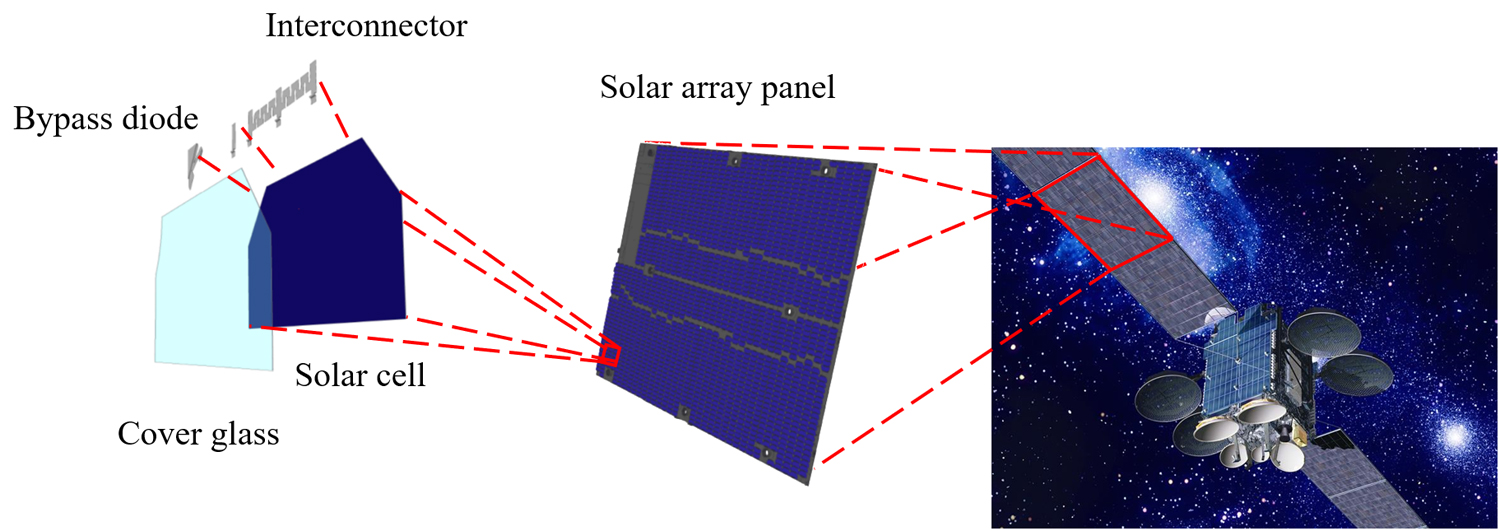
Mitsubishi Electric was selected by JAXA under the Space Strategy Fund to lead development of domestically produced solar cells, cover glass, and solar arrays for satellites.
Partnering with solar cell specialist PXP, the company aims to create low-cost, mass-producible perovskite/ CIGS tandem solar cells that can achieve efficiency while offering greater radiation resistance in space.
The project will also test terrestrial glass for use in space, develop mass-producible cover glass, and integrate these components into new satellite solar arrays, establishing a full domestic supply chain.
This effort seeks to reduce costs, strengthen supply capacity, and address global shortages of satellite solar cells and materials.
CONTEXT: With the expansion of the satellite market, including low earth orbit satellites, demand for solar cells onboard and cover glass has increased. A global supply shortage has led to high prices and long delivery times.
Taiwan’s HDRE to launch grid battery in Sapporo by late 2025
(Japan NRG, August 19)
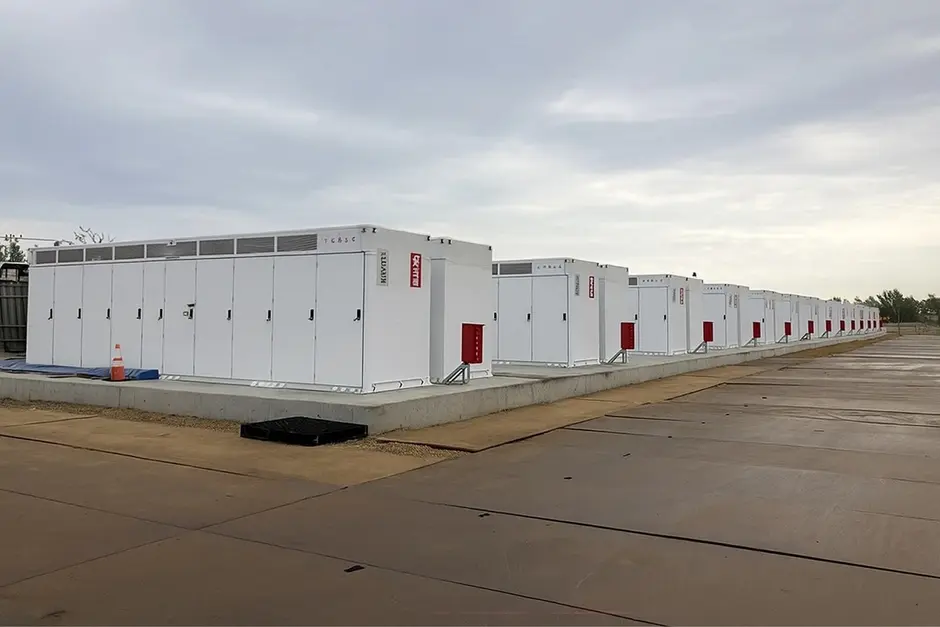
Taiwan’s HD Renewable Energy, together with Brawn Capital, completed grid connection for a large-scale storage battery in Sapporo, Hokkaido.
The system has a capacity of 50 MW/ 104 MWh with an investment of about ¥5.9 billion and is set for full operation by the end of 2025.
Operation will be handled by group company Star Trade, which will use its AI-powered trading platform to participate in Japan’s capacity, spot, and balancing markets under a dual model of fixed long-term revenue.
CONTEXT: HDRE is also expanding its storage business in Japan through projects with Mitsubishi Electric and Tokyu Land, and has secured 400 MW of capacity in the long-term decarbonized power sources (LTDA) market for 2028–2029.
Japan Benex equipped its solar farm, Benex Solar Port, at its headquarters in Isahaya, Nagasaki Pref, with a 320.2 kW/ 774 kWh storage battery and transitioned it from the FIT to the FIP.
This marks the company’s first solar-plus-storage project under FIP. Of its 48 plants totaling about 64 MW, some 24 plants (43mMW) have already shifted to FIP. Toshiba ESS is the project’s aggregator.
The company plans to use insights from this project to support other firms in adopting storage systems, helping stabilize power supply and advance renewables as a main energy source.
Smart Energy, Japan’s largest solar power maintenance firm, set up a JV with NCS RE Capital to acquire and operate small-scale solar farms.
They plan to invest about ¥6 billion to purchase existing facilities, mainly from individuals and small businesses. The goal is to collect around 400 sites totaling 25 MW within two years.
The new company will handle centralized operation and maintenance, selling power under the FIT and continuing sales even after FIT periods end.
CONTEXT: This initiative addresses the challenge of managing small aging solar farms, aiming to prevent abandonment while maximizing profitability through large-scale operation.
Governor of Tochigi pref gave an opinion on the environmental assessment for a 120 MW solar project planned by PAG Renewables in Motegi Town.
Construction is set to begin in 2028, operations in 2030. The plan includes installing about 182,000 solar panels to generate up to 80 MW of electricity.
The governor requested stronger biodiversity surveys, with focus on waterfowl, as well as monitoring of nocturnal species in breeding seasons.
NEWS: WIND POWER AND OTHER RENEWABLES
‼️Mitsubishi’s Exit From Offshore Wind Has Govt Scrambling to Improve Conditions
See our Analysis section for a detailed review of this important development.
Laos began commercial operation of the Monsoon Wind Power Project, a 600 MW onshore wind farm, the largest in SE Asia.
The $950 million project is backed by Mitsubishi Corp, JICA, etc, and has 133 turbines in Sekong Province. It will supply power to Vietnam’s state utility under a 25-year contract.
CONTEXT: The project strengthens Laos’s vision as the battery of SE Asia, expanding from hydropower into wind, while also helping meet Vietnam’s growing energy demand. It is seen as a model for cross-border renewable energy trade.
Kansas Electric (KEPCO) will launch a funding program to donate ¥5 billion a year to municipalities hosting its NPPs, especially Fukui Pref.
The goal is to support regional development such as healthcare and infrastructure. For FY2025, an extra ¥15 billion will be added, making the first-year total ¥20 billion.
Municipalities will apply for funds via a trust bank, and a third-party panel will review it.
CONTEXT: The program replaces KEPCO’s previous small-scale donations of ¥100–200 million a year and expands financial support. This reflects the full operation of seven reactors in Fukui.
TAKEAWAY: KEPCO is also exploring new reactor construction, making this program a potential model for regional engagement in national nuclear policy. This effort is clearly a way to bolster support for nuclear energy among local communities, many of which are reluctant to support reactor restarts.
KEPCO told Fukui Pref it plans to remove spent fuel from its dry storage facilities by the end of 2035, and transfer it from reactor pools to on-site dry storage facilities (in 2028-2030).
KEPCO intends to install dry storage facilities at the Mihama, Takahama, and Oi NPPS. This is to store spent fuel in air-cooled metal casks, separate from traditional water-filled pools.
CONTEXT: Interim storage facilities hold spent fuel from NPPs. Japan has only one interim storage site, in Mutsu, Aomori, operated by TEPCO and JAPC since November 2024. After the temporary storage, operators should ship the fuel to the Rokkasho reprocessing plant in Aomori Pref. But the latter, slated for completion in FY2026, has faced constant delays.
TAKEAWAY: With nuclear restarts expanding due to rising power demand, the need for spent fuel storage is dire. Chugoku Electric reported to Kaminoseki Town that it seeks to build an interim storage facility for spent nuclear fuel. The work should be in cooperation with Kansai Electric, which could make it the final destination for spent fuel. If realized, this would be Japan’s second such facility.
A consortium of 12 Japanese companies, including Mitsui & Co and Mitsubishi Corp, invested several billion yen in Commonwealth Fusion Systems, a U.S.-based nuclear fusion startup. This marks the first investment by Japanese firms in CFS.
The company is one of the most well-funded players in the fusion industry, having raised over $2 billion from investors as of 2024.
Other Japanese investors include KEPCO, JERA, JGC Holdings, Mitsui O.S.K. Lines, and Fujikura. The latter is a company specializing in high-temperature superconducting wires for fusion reactors.
The consortium plans to collaborate on material supply, technology sharing, and development. It also hopes to leverage CFS’s know-how to nurture Japan’s domestic fusion-related industries.
CONTEXT: Many consortium members, including Mitsui, are already investors in Kyoto Fusioneering. The investment is also expected to promote cooperation between Kyoto Fusioneering and CFS.
TEPCO will begin removing nuclear fuel from Unit 7 of Kashiwazaki-Kariwa NPP on Oct 21. Due to delays in building the required anti-terrorism facilities, it postponed Unit 7’s restart. TEPCO plans to start preparations on Oct 14 and needs two weeks to transfer 872 fuel assemblies into the spent fuel pool.
CONTEXT: The anti-terrorism facility for Unit 7 faces a completion delay, pushed back to August 2029, making an early restart impossible. Meanwhile, delays plague efforts to restart Unit 6. TEPCO began loading fuel into Unit 6 in June, aiming for an early restart, but discovered a malfunction in the control rod drive system. Now, it aims for completion after September.
TAKEAWAY: Besides technical issues, TEPCO still needs approval from locals. Niigata Pref will conduct a public opinion survey by mid-to-late September. The Governor’s decision on whether to approve the restart will come only after reviewing the survey results.
Canada’s Alberta province might invest in Japan’s refining sector to boost oil exports and reduce heavy reliance on the U.S.
Alberta is in early-stage talks with several Japanese refiners about a possible JV to fund a coker unit.
This refinery upgrade would allow Japanese facilities to process Alberta’s heavy, high-sulfur crude oil from its oil sands.
CONTEXT: The U.S. takes about 90% of Canadian crude (around 4M barrels/day). Last year’s Trans Mountain pipeline expansion tripled export capacity. They total 890,000 barrels/ day, opening Asian market opportunities. The coker could help reduce Japan’s reliance on Middle Eastern oil and routes through the South China Sea. Japan rarely imports Canadian oil.
TAKEAWAY: Canada’s PM Carney is backing new infrastructure projects to expand crude exports to Asia and position Canada as an energy superpower. The Trans Mountain pipeline expansion already opened new routes to Asian markets, and narrowed the price gap between Western Canadian Select and U.S. West Texas Intermediate crude. Still, analysts estimate it could take five years for Canada to diversify its markets. If successful, the U.S. could face reduced access to Canadian oil and higher energy prices. Yet, new pipelines could face opposition from environmental groups and Indigenous communities.
Regional gas companies are taking a major role in disaster preparedness, and will upgrade energy infrastructure.
These include decarbonization and renewable energy projects; also, more municipalities have set targets for net-zero emissions by 2050.
Nippon Gas is using biogas from waste facilities. Shizuoka Gas is supplying renewable electricity to public facilities. Shimada Gas promotes local energy circulation via solar aggregation. Karatsu Gas is investing in renewable-powered regional energy companies.
Others too are diversifying. Kyushu Gas is expanding into renewable energy, construction, and real estate sectors. Nippon Gas is creating new services such as home maintenance, cleaning, and sports facilities.
Facing population decline, the govt promotes “compact city” planning.
CONTEXT: Regional gas companies face significant challenges due to demographic decline, natural disasters, rising prices, and the need to decarbonize. According to the MLIT, more than 60% of residential areas will see their population halved by 2050 compared to 2010. Growth will be limited to about 2% of locations, such as in metropolitan areas. This threatens the customer base and operational sustainability of local gas providers.
Japan Gas Association formulated Gas Vision 2050 and Action Plan 2030 to guide the city gas industry toward carbon neutrality by 2050.
The plan calls to expand e-methane and biogas use as primary energy sources. These will work with CCUS, DAC, and other negative-emission solutions.
Hydrogen will also play a key role in regions with existing infrastructure.
The plan also calls for LNG purchases through many supply sources, routes, and flexible contracts.
Innovation is another key factor and will promote new methanation technologies, DX, and AI-powered predictive maintenance.
By 2030, the industry aims to scale up e-methane production and expand renewable energy integration.
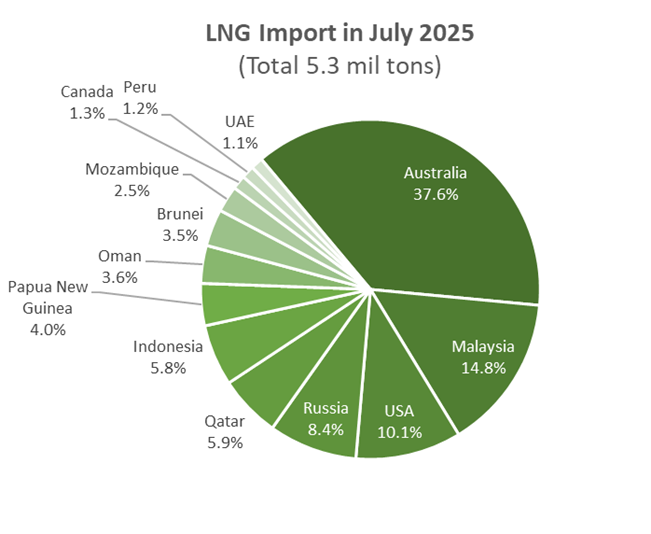
CONTEXT: The plan by JGA touches upon different areas related to gas. The call for diversified LNG supply comes amidst heavy reliance on Australian imports (roughly 38% of FY2024 total imports) and a geopolitically tense situation. Also, ANRE is open to obtaining an extra 20 Mtpa of long-term LNG contracts by 2040, possibly as a measure against slower-than-expected growth in wind and solar capacity.
TAKEAWAY: Renewables and nuclear are the main decarbonization levers in the power industry, but the gas sector must replace LNG with synthetic and low-carbon fuels, while maintaining stable supply. The roadmap aligns with METI’s long-term strategy, but it highlights industry-specific tools. They mention methanation, biogas, and CCUS; and need large-scale demo and cost reduction before becoming viable.
Tokyo Gas is in talks with U.S.-based Venture Global LNG to buy 1 Mtpa of LNG under a potential 20-year contract.
The LNG would come from the second phase of Venture Global’s CP2 export facility in Louisiana that should start operations by late 2028.
The CP2 plant will have a total export capacity of 28 Mtpa and would be the second-largest LNG facility in the U.S. It would also make Venture Global the largest American LNG exporter.
Venture Global already inked long-term deals with Petronas, Eni, and Germany’s SEFE, securing 13.5 Mtpa of CP2’s output.
CONTEXT: The company is competing on price, offering liquefaction fees of $2.35/ mmBtu, below the typical market range of $2.50–$2.75, which is attracting buyers.
Sakaide LNG, a subsidiary of Shikoku Electric, will expand LNG facilities at its terminal at the Bannosu Industrial Complex in Sakaide City.
The goal is to meet expected increase in LNG demand after the planned start of operations at Shikoku Electric’s new power plant.
The project includes adding one 180,000-kiloliter LNG storage tank and one new regasification unit. The regasification facility should begin operations in FY2029, and the new LNG tank in FY2031.
After completion, the LNG storage capacity will double, and regasification capacity will increase by about 1.3 times.
Sakaide LNG handles reception, storage, and regasification for Shikoku Electric, supplying natural gas to the Sakaide Power Station.
CONTEXT: Shikoku Electric plans a new Unit 5 (600 MW) at Sakaide Power Station after FY2031. It will adopt a high-efficiency combined-cycle system using both gas and steam turbines.
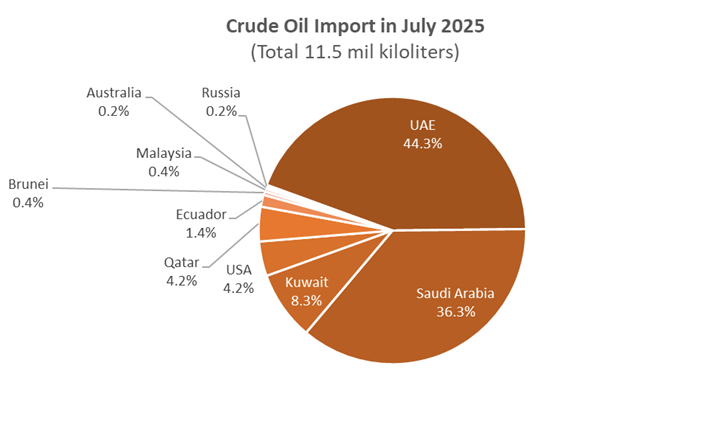
Japan imported 11.5 million kiloliters of crude oil in July, 12.3% more than in June and 11% more YoY, of which 93% came from the Middle East. For the past three months (May-July), none came from Oman and Canada. The volume from Kuwait was up 27%, from the UAE up 16%, and from Qatar up 12%. The volume from Saudi Arabia was about the same as previous months, about 4 million kiloliters.
LNG imports totaled 5.3 Mt, up 18.6% over June (4.4 Mt) but down 6.3% YoY (5.6 Mt). Australia is the biggest LNG exporter to Japan, but its July volume was down 9.7%. Malaysia was the second biggest exporter, and its volume rose 45.6% over June, after drops in May and June. Imports from the U.S. nearly doubled over June, and were the highest volume this year. Japan also received its first volumes of LNG from Canada.
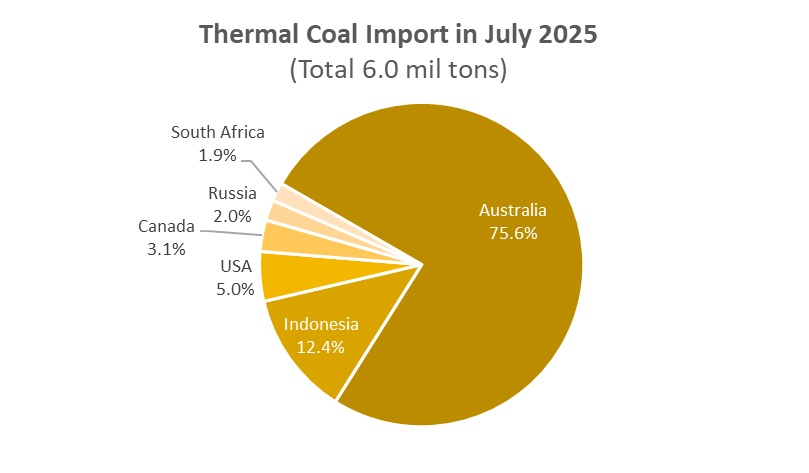
Thermal coal imports rose in July to 9.7 Mt, up 60.9% over June but up just 1.2% YoY. Three-quarters of the volume came from Australia. The volume from Russia increased by almost 2.5 times, but its share was not significantly high. In preparation for the hot summer, utilities ramped up thermal coal imports.
As of Aug 24, the LNG stocks of 10 power utilities were 2.18 Mt, up 7.9% from the previous week (2.02 Mt); up 28.2% from end Aug 2024 (1.7 Mt); and up 6.9% from the 5-year average of 2.04 Mt.
Sekisui Chemical agreed with U.S.-based Velocys to develop tech for producing e-SAF (sustainable aviation fuel made from CO2).
This will combine Sekisui’s CO2-to-CO chemical looping tech with over 90% conversion efficiency and Velocys’s Fischer-Tropsch (FT) tech using microchannel reactors (90–95% CO conversion).
CONTEXT: Sekisui has proven its process in small-scale trials; Velocys brings decades of FT expertise and commercial-scale project experience. Together, they aim to build a next-gen eSAF production that uses CO2 as a resource.
ANALYSIS
BY MAGDALENA OSUMI
Mitsubishi’s Exit from Offshore Wind Has Govt Scrambling to Improve Conditions
Immediately after Mitsubishi Corp announced a shock exit from Japan’s offshore wind sector METI Minister Muto vowed to re-auction the trading house’s three projects “as soon as possible,” while officials pledged measures to improve business conditions.
The ministry has a lot at stake – more than the writedowns and reputational hit taken by Mitsubishi and its partners, including Chubu Electric. Japan’s top trading house had been expected to lead the creation of an offshore wind industry that METI saw growing to 30-45 GW by 2040 – surpassing the domestic nuclear fleet’s capacity.
The three Mitsubishi-led projects, totalling 1.76 GW, were expected to pave the way to rebuild Japan’s wind power supply chain, to contribute to the aggressive CO2 cuts promised to the UN, and encourage further investment in the nascent sector. Indeed, two more auction rounds followed with three international firms joining Japanese partners to develop projects.
As the remaining offshore wind developers look on with concern, the debacle may yet have a silver lining in highlighting the need for stronger government support for the sector. METI has so far avoided making big changes to the conditions of already auctioned projects, in part fearing it would lead to higher electricity prices. But the government cannot afford further cancelations.
The sector’s future, the CO2 targets, the industrial supply chain development – as well as regional revitalization plans – are all on the line. What happens next will be critical for the struggling sector’s fate. Japan NRG reviews.
How Mitsubishi won and lost
In 2021, Mitsubishi together with Chubu Electric stunned Japan’s power sector by sweeping the country’s first bottom-fixed offshore wind auction.
The consortium secured:
Yurihonjo (819 MW) – off the coast of Akita Prefecture Originally planned start: December 2030
Noshiro-Mitane-Oga (479 MW) – off the coast of Akita Prefecture Originally planned start: December 2028
Choshi (391 MW) – off the coast of Chiba Prefecture Originally planned start: September 2028
Only a year earlier, most industry players were telling the government that for a completely new sector to emerge, offshore wind pricing should begin in the ¥30s/ kWh. Mitsubishi bid less than ¥12/ kWh for one of the projects. Its highest bid – for the Choshi site – was ¥16.5.
Beyond a price level that stunned rivals, it was clear why METI entrusted the first three big projects with Mitsubishi. The trading house has financial muscle, political ties, connections with domestic and overseas supply chains, and was seen as a loyal business that would raise the profile of the offshore wind sector and attract major companies as buyers of green electricity. Indeed, Kirin Holdings and Amazon were among the partners announced by Mitsubishi, hinting at their future interest in signing PPA deals with the wind projects.
But optimism quickly unraveled and by February 2025 Mitsubishi had booked ¥52 billion ($344 million) in impairments; Chubu took another ¥18 billion. Project costs skyrocketed well beyond early assumptions, forcing the partners to reconsider.
Mitsubishi bid aggressively low at a time when Japan was in its third decade of a deflationary environment. Central banks rates were negative. The yen traded at close to 100 to the USD.
In the aftermath of Covid and global energy markets turmoil that followed the war in Ukraine, macroeconomic shocks followed one after another. Global inflation soared. The yen weakened by around 50%. Interest rates climbed – even in Japan. Meanwhile, a surge in energy projects globally led to supply chain disruptions; add to that local challenges such as labor shortages and regulatory delays.
Mitsubishi had some experience in offshore wind overseas, but when it came to managing the projects in Japan it came upon a number of problems. The sea area surveys for the bids reportedly had to be redone, which took time and money, and initial engineering plans had to be redrawn.
Mitsubishi’s biggest missteps, however, may have been delays in locking in pricing for major components, such as turbines, and for construction work contracts. Mitsubishi planned to use 134 GE Vernova Haliade-X units across the three projects and to assemble nacelles domestically with Toshiba. The prices were agreed, but final commitments were not locked in.
When Mitsubishi finally came back to GE on firm orders, the price environment had changed substantially, effectively crippling the project economics. In fact, GE was no longer keen to sell the turbines at all due to a global strategic decision to take a pause on supplying the wind sector due to the cost environment. Negotiations to get the American supplier on board in recent months failed.
The story was repeated with the general contractor – Kajima Corp, the exit of which was finally leaked to the media just days before Mitsubishi’s final announcement.
Mitsubishi will now lose its ¥20 billion security deposit for the projects and be barred from participating in the upcoming Round 4 wind auction.
Policy fallout
Offshore wind was meant to deliver gigawatts of new capacity in the 2030s — a central pillar of Japan’s decarbonization strategy. Mitsubishi’s exit has undoubtedly sent a warning: even Japan’s biggest firms cannot absorb the sector risks unless business conditions improve.
The government insists “offshore wind power is a vital source for making renewable energy the mainstay of Japan’s energy mix,” said Fukuoka Noriyoshi, head of wind energy at METI. He added the government “will continue to make every effort” to realize its goals of up to 50% renewable energy, and 30-45 GW of offshore wind power, by 2040. The government “will revise relevant systems where necessary”.
The original auction rules for offshore wind tenders focused on cost, rewarding low bids over project viability and speed of execution. This was in part due to METI’s experience of offering lucrative FIT prices to early solar projects, which drew criticism for being overly generous to developers at the expense of electricity consumers.
Mitsubishi saw that the Round 1 tender awarded half the scoring points to price and, in accordance, bid aggressively low, sweeping all three sites. In fact, its original agreements with GE and Kajima, among others, were predicated on a discount from a bulk order from all three projects.
But the price-heavy scoring system created a trap: it left the winners with little to no buffer to cover unexpected cost increases, and also didn’t strongly penalize late commissioning. In subsequent rounds, METI revised the rules to put more weight on project feasibility.
Other rule changes have been proposed for the next auction, Round 4, as industry players called for better terms to encourage future investment. These include extending seabed lease periods, improving the scoring system, again, and strengthening domestic supply chains to ensure project realization.
METI is also considering allowing cost pass-through to power prices, and extending site-use periods beyond 30 years to improve project economics. But it now needs to decide whether to extend the subsidy periods or alter project timelines.
Other changes need to be made to alleviate cost burdens on Round 2 and 3 projects, as well as future developments, according to industry players. The government needs to be less focused on price – at least at this stage of the sector’s development, which would avoid the situation where companies bid low to score a win but cannot execute on the terms once the macro or other factors go against them.
Other options could be to introduce government-backed PPAs to reduce financing risk or two-way Contracts for Difference (CfDs) to provide stable, bankable revenue streams for developers. Additional state support around transmission infrastructure or port investments, as well as debt guarantees or tax relief could also help.
While the government considers what it can offer without triggering an increase in electricity prices, one area it can tackle is regulation. Japan NRG has concluded in previous studies that the environmental impact assessment for offshore wind projects in Japan takes 3-4 years on average, which affects the start of construction and other preparatory works.
Re-auction
With Mitsubishi’s withdrawal, there is a possibility that second-best bids from Round 1 are rewarded. In reality, that is highly unlikely. The second-best bids included TEPCO and Ørsted for the Chiba project, Renova for Yurihonjo, and Obayashi for Noshiro-Mitane-Oga. Yet with most of these firms having since scaled back or left the sector. METI Minister Muto has also signaled a determination to re-auction the sites.
How soon the re-auction takes place is unclear, with METI and Mitsubishi explaining that there are various wind-down procedures that need to take place, especially at local level in the townships that were to host the facilities. However, the ministry cannot wait too long or investor morale will sink.
Still, new bidders will take a close look at the current price, regulatory and supply chain environment, and this is where METI and the rest of the government has much to do.
Japan does not have its own wind turbine manufacturers and GE’s cooling on the sector has left Toshiba stranded. Other domestic manufacturers, however, are speaking with international turbine players to create joint ventures. It’s notable also that METI has signed MoUs in recent months with major western turbine players.
These moves must come quickly. Already, some suppliers in Japan are giving up. Bearing manufacturer NTN plans to close one of its factories for wind power by March 2027 due to the dominance of Chinese rivals.
Lacking a strong domestic supply chain, Japan’s projects are vulnerable to currency moves. Also, METI continues to insist on a 60% share of domestic components in offshore wind farms for energy security reasons. This has led to some calls for the government to directly invest in rebuilding a domestic supply chain for wind power.
The Big Picture and next frontiers
While Japan’s offshore wind ambitions stumble and falter, this year China will install nearly three out of every four of the world’s new offshore turbines, according to BloombergNEF. Such neighborly competition, however, should serve as an inspiration.
Despite pessimistic headlines, the impact of Mitsubishi’s exit on Japan’s overall energy balance is limited — the three projects would have displaced less than 1% of LNG imports. The greater risk lies in credibility: repeated delays, rule changes, and high costs are testing both investors and supply chains.
The turmoil around Mitsubishi has affected other projects and project developers. There are questions around ports, supply chains, and how to price offtake agreements. The Round 4 auction has also been delayed.
So far this year, METI has tried to show its enduring commitment to offshore wind by passing the EEZ Law that should allow project development in deeper waters. For the first time, it added promotion zones off Hokkaido; and the Tokyo government is keen to open up new areas of its own. Subsidies continue to pour into floating offshore wind technologies, and discussions about bringing floating projects into upcoming auction rounds are heating up.
The pivot to deep waters and floating wind is certainly welcomed. But investors will judge the government on the measures it takes in the coming months to provide relief for developers that are already involved with Round 2 and 3. That’s where revisions to port fees and lease durations, among other items, will make an impact.
Minister Muto said that Mitsubishi’s exit delays the rollout of offshore wind in Japan and is “deeply regrettable”. He now needs to act, showing how the various steps proposed by the government are part of a wholesale effort to drive the next phase of sector development.
ANALYSIS
BY JAPAN NRG TEAM
Japan Mulls New Mid-Term Power Market to Push Retailers to Secure Supply
In Japan’s electricity market, many retailers shop for power as if buying dinner ingredients on the way home from work: they head to the store, basket in hand, hoping prices are kind. Most of the time everything is fine. But when the price of ‘eggs’ – or, in this case, LNG – soars, they have to either swallow the cost or exit the business. The government now wants electricity retailers to stock their ‘pantries’ instead.
The latest discussions inside the energy agency point to the potential creation of a new electricity market and a system under which retailers would be mandated to secure large parts of their customers’ projected power demand several years in advance. The aim is to smooth bills, bolster investment in power plants, and prevent the sort of panic-buying that has at times left Japan’s electricity shelves half-empty.
The reform targets two weaknesses that have become glaring since Japan’s power market was fully liberalised in 2016. First, too many of the 700+ retailers are small, asset-light sector newbies without the means or knowhow to structure long-term contracts, and who rely on the liquidity of the electricity spot market with all the volatility that this entails. Second, this short-termism leaves power generators with inadequate demand signals about future sales, dampening their incentive to invest in new capacity or secure long-term fuel supply.
This is where the so-called Mid- to Long-Term Electricity Market (MLEM) comes in. Japan’s energy planners hope that the mechanism will help to shift the retail industry from “just-in-time” procurement to mature and more stable purchasing, pointing to similar schemes overseas. But will stricter oversight of electricity retail – one of the directions endorsed by the 7th Basic Energy Plan – work in the Japanese context? Or, will it favor the larger industry players and potentially weaken price signals in a liberalized market?
Top 10 new power firms in Japan by sales
(as per March 2025 results)
Tokyo Gas – 1,265 GWh
Osaka Gas – 737 GWh
Ennet – 683 GWh
Marubeni New Power – 608 GWh
ENEOS Power – 588 GWh
SB Power – 496 GWh
Mitsui & Co. Green Energy – 481 GWh
CD Energy Direct – 472 GWh
Haruen – 396 GWh
au Energy & Life – 391 GWh
Policy steps
Discussions on this topic, which was also raised in the Power System Reform Review in March 2025, are driven by the Next Generation Electricity and Gas Infrastructure Subcommittee at ANRE. The committee only started work in June, but has already met four times.
As energy planners see it, the retail industry has become over-reliant on the short-term spot market to secure electricity it supplies to end-users. Many retailers procure the majority of their share on JEPX; spot prices are volatile and sensitive to fuel price swings; and in periods of extreme supply-demand tightness, such as during the 2021-22 fuel shortage, prices surged quickly, pushing some retailers to exit the business and even declare bankruptcy. That had a dramatic impact on the rest of the market, reversing the trend that had hitherto seen new entrants (shindenryoku or “PPS”) steadily take market share of sales away from major power utilities (EPCOs).
JEPX spot market volumes have risen from 2% of total power demand in 2016 to over 27% in 2024 – even after the gross bidding system was phased out. And yet, according to ANRE, the minimal load in each grid area has never dropped below 50% since full market liberalization, which suggests there’s a substantial baseload requirement that could be met through long-term contracts. In France, ANRE argues, retailers must hedge at least 97% of their forecast demand.
For power generators that run on imported fuel, this situation is less than ideal. While Japan’s capacity (kW) market system provides some future guidance, it does not ensure that retailers secure a certain electricity volume (kWh) over time. This makes thermal power plant owners anxious about how much fuel they should secure on long-term contracts or invest in new capacities.
As such, the committee proposes that METI changes the system. The idea is for retailers to lock in at least half of expected demand three years ahead, rising to 70% a year before delivery. For retailers with small trading volumes, the target would be 25% three years ahead, and 50% a year before. The system would start with deliveries in FY2030, to be in addition to existing kW-based capacity obligations.
Currently, JEPX operates a baseload market and a forward market, which allow for mid- to long-term power procurement. But, there are issues with this setup, such as a lack of options to secure supply capacity in the shorter term.
Under the proposed new framework, retailers would retain flexibility over their contract type to preserve competitive variety. Compliance would be verified through retailers’ annual supply plan filings, and if a company is found to be below the required procurement levels, the regulator would issue a corrective order. Continued non-compliance could trigger orders under the Electricity Business Act, with potential deregistration for repeated breaches.
In short, the energy agency wants to ensure that retailers take more direct responsibility for energy supply, not just peak capacity. But to ease the burden on smaller retailers, experts suggest METI to be flexible on implementation or phased-in targets.
New market to support procurement
To help retailers meet these new obligations, the expert committee suggests creating an expanded mid- and long-term trading markets to make such hedging feasible. This Mid- to Long-Term Electricity Market (MLEM), planned to start operation in FY2028, would work alongside the existing JEPX and OCCTO platforms (kWh and kW).
The new market may focus on standardized contracts with delivery periods extending multiple years into the future. The idea is to address the weaknesses of existing markets, such as infrequent auctions or low volumes, as well as trades often done close to delivery.
Japan’s current forward and baseload markets have limited trading beyond one-year contracts. In FY2024, for example, no two-year baseload contracts were traded, and the overall forward market covered less than 0.01% of monthly demand. This lack of long-term liquidity is a major barrier to stable procurement.
The new market segment aims to solve this by offering transparent long-term price signals. Contracts will be designed to support a variety of load types (base, mid, peak), with product offerings aligned to seasonal and operational needs.
The goal is to develop a widely referenced long-term price index that can guide investment and provide retailers with better planning tools. However, some retailers, especially smaller firms without generation assets, have expressed concern about the cost and flexibility of entering multi-year contracts. They warn that rigid obligations could limit innovation and create entry barriers. Energy policy talks indicate that officials have acknowledged these concerns and are exploring whether a phased rollout or partial exemptions could help balance regulatory goals with market diversity.
Additionally, the government is considering mechanisms to strengthen the bilateral trading environment, including clearer rules for electricity brokers and possibly publishing price benchmarks to increase transparency in over-the-counter transactions.
Next steps and considerations
So far, this is a discussion that will require much work on market product design, trading methods and formats, as well as ideas on how to ensure there is adequate liquidity to make the new platform a success. How MLEM’s price formation will align with long-term investment planning is also an issue that will take time to clear.
Once these are decided, legislative work to amend the Electricity Business Act will be required. Options to combine the new platform with an existing one – say, the JEPX – are also on the table.
Also importantly, the government will need to convince industry participants that the promotion of longer-term thinking is not at odds with support for spot and balancing markets, which are key components of the solar, wind and battery businesses. The implementation of any price stability measures is something that battery developers in particular will likely want to follow closely.
As METI sets its sights on creating a better investment environment for power capacity, the ministry will also need to consider how various sectors will respond. Officials want to see more predictable and stable power and fuel procurement. This could reduce the threat of price shocks. It’s also crucial not to stifle more immediate price signals, or overcomplicate an electricity market that already has several platforms and is in the process of adding yet others.
ASIA ENERGY REVIEW
BY JOHN VAROLI
A brief overview of the region’s main energy events from the past week
Australia / Natural gas
Santos said key natural gas projects are closed to completion. These include Pikka phase 1, Darwin LNG and the Barossa floating production, storage, and offloading.
Australia / BESS
UK-based Pacific Green Technologies has secured an AU$77 million debt facility for BESS projects in Australia.
China / Natural gas
PetroChina proposed buying three natural gas storage companies for 40 billion yuan. China’s natural gas demand is expected to rise 40% through 2050, said the IEA.
China / Offshore wind
This year China will install nearly three out of every four of the world’s new offshore turbines, according to BloombergNEF
India / Natural gas
India is exploring use of gas-fired power plants only to meet electricity demand surges in peak months of May and June, said the power ministry.
Indonesia / Energy transition
The Lowy Institute said western pledges to support SE Asia’s energy transition “have yet to translate into more projects”. Meanwhile, Chinese companies are expanding across Indonesia’s green-energy value chain such as solar and hydropower.
Pakistan / LNG
Pakistan will ask Qatar to delay delivery of LNG supply over the next five years due to weak demand and mounting import costs. This concerns two LNG shipments per month in 2026, to be rescheduled to after 2031.
Taiwan / Corruption
Green Energy Industry Promotion official Cheng Yi-Lin is accused of using bank accounts under relatives’ names to accept bribes from Tungwei Construction and HD Renewable Energy as “consulting fees”.
Thailand / LNG
Economic expansion is powering a rise in electricity demand. Gas will retain a dominant share in the power mix, accounting for more than 60% of generation.
Vietnam / Ethanol
Vietnam plans to switch completely to ethanol-blended gasoline, opening up the possibility to import more ethanol and corn from the U.S.
Disclaimer
This communication has been prepared for information purposes only, is confidential and may be legally privileged. This is a subscription-only service and is directed at those who have expressly asked K.K. Yuri Group or one of its representatives to be added to the mailing list. This document may not be onwardly circulated or reproduced without prior written consent from Yuri Group, which retains all copyright to the content of this report.
Yuri Group is not registered as an investment advisor in any jurisdiction. Our research and all the content express our opinions, which are generally based on available public information, field studies and own analysis. Content is limited to general comment upon general political, economic and market issues, asset classes and types of investments. The report and all of its content does not constitute a recommendation or solicitation to buy, sell, subscribe for or underwrite any product or physical commodity, or a financial instrument.
The information contained in this report is obtained from sources believed to be reliable and in good faith. No representation or warranty is made that it is accurate or complete. Opinions and views expressed are subject to change without notice, as are prices and availability, which are indicative only. There is no obligation to notify recipients of any changes to this data or to do so in the future. No responsibility is accepted for the use of or reliance on the information provided. In no circumstances will Yuri Group be liable for any indirect or direct loss, or consequential loss or damages arising from the use of, any inability to use, or any inaccuracy in the information.
NEWS:
・Govt discusses selection of data center hub sites
・METI begins soliciting proposals for GX Strategic Region
・As Japan’s debt-servicing costs climb, METI asks for major increase in GX funding for next year
・Sony urges suppliers to adopt 100% renewabl


 July Oil/ Gas/ Coal trade statistics