
WEEKLY
April 27, 2026
ANALYSIS
METI OPENS A NEW FRONT ON GRID FLEXIBILITY: DEMAND RESPONSE
- Japan’s power-price swings are increasingly at a very specific time of day: just as solar output fades. That creates a growing balancing problem.
- Since major grid reinforcement projects are not due until the 2030s, policymakers seek ways to manage current imbalances. DR is one of the main interim tools, but there is one problem. To make DR work, they first need to make it visible.
ENERGY STARTUPS IGNITE INNOVATIONS AT SUSHI TECH TOKYO 2026
- Japan’s leading startup event, SusHi Tech Tokyo 2026, opens today.
- A number of startups seek to ignite innovation in Japan’s energy and clean tech sectors. Japan NRG provides an overview of this key event.
ASIA PACIFIC REVIEW
This column provides a brief overview of the region’s main energy events from the past week
NEWS
- Ruling party pressures PM Takaichi for stronger response to Hormuz energy crisis
- Japan to invest ¥1 trillion in recycling for critical minerals and plastics
- Japan’s three megabanks wary of U.S. investment push over dollar funding strain
- JOGMEC to help with coal mine development abroad
- NTT Data to build one of Japan’s largest data centers to meet AI demand
- JEPX balancing payments fall as regional price gaps narrow
- Japan-backed coal plant begins operations in Vietnam
- Govt promotes hydrogen via public–private collaboration
- Gifu Univ and partners test zero-carbon energy system with ammonia/ hydrogen
- Govt tightens agrivoltaics rules to ensure farming focus remains
- GBP launches anti-theft system for solar facilities
- Sharing Energy’s total funding increased to develop solar PPAs
- CHC Japan to build BESS with novel funding scheme
WIND POWER AND OTHER RENEWABLES
- Daiwa Can signs deal for large geothermal PPA
- Wind turbine blade failure prompts inspections
- Municipality agrees to literature survey for nuclear waste repository
- Fast experimental reactor restart faces further delay
- JAPEX plans to quadruple oil and gas production
- INPEX to focus on oil sales to Japan amid Iran war
- Japan secures extra Mexican crude supply amid Middle East disruptions
CARBON CAPTURE & SYNTHETIC FUELS
- METI explores measures to expand use of biofuels
- ANA, JAL hike surcharges early as jet fuel prices surge
EVENTS
May 3-6 Golden Week (many companies will close from April 29 to May 6)
May 26-28 Japan Energy Summit @ Tokyo Big Sight
June 3 South Korea – Local Elections
June 23-25 “Summer Davos” in Dalian, China
September 14-18 IAEA General Conference 2026
October International Maritime Organization –
Net-zero Discussions
Nov 2-5 ADIPEC 2026 @ Abu Dhabi
Nov 3 U.S. Midterm Elections
Nov Publication of International Energy
Agency – World Energy Outlook 2026
PUBLISHER
K. K. Yuri Group
Editorial Team
Yuriy Humber (Chief Editor)
John Varoli (Senior Editor, Americas)
Kyoko Fukuda (Data, Events)
Magdalena Osumi (Renewables & Storage)
Filippo Pedretti (Thermal, CCS, Nuclear)
Tetsuji Tomita (Power Market, Hydrogen)
Aglaé Bange (Renewables and Biomass)
George Hoffman (Sales, Business Development)
Tim Young (Design)
SUBSCRIPTIONS & ADVERTISING
Japan NRG offers individual, corporate and academic subscription plans. Basic details are our website or write to subscriptions@japan-nrg.com
For marketing, advertising, or collaboration opportunities, contact sales@japan-nrg.com. For all other inquiries, write to info@japan-nrg.com
NEWS: GENERAL OUTLOOK AND TRENDS

Ruling party pressures PM Takaichi for stronger response to Hormuz energy crisis
(Party statement, April 24)
- CONTEXT: The ruling party’s policy chief, Kobayashi Takayuki, met with Prime Minister Takaichi on April 24 and delivered a series of proposals that push the government to adopt a stronger response to the Hormuz crisis. Japan relies on the passage of ships through the Strait of Hormuz to deliver ~93% of its crude oil and ~40% of its naphtha.
- The policy committee of the ruling LDP proposed a comprehensive package to secure fuel supply and contain prices. These include:
- Oil: aggressive diversification + stockpile management
- Alternative crude procurement is accelerating:
- April: >20% replacement vs normal levels
- May: well over 50% replacement expected
- Policy focus:
- Expand sourcing beyond the Middle East to US, Central Asia, Latin America, Africa
- Develop non-Hormuz routes and infrastructure (e.g. pipelines)
- Improve transparency on supply outlook to reduce market uncertainty
- Strategic reserves are being deployed flexibly:
- Make further releases depending on procurement progress
- Longer term:
- Upgrade refining capacity to handle non-Middle Eastern crude – Accelerate synthetic fuels and biofuels (E10/E20, SAF)
- Alternative crude procurement is accelerating:
- LNG:
- Near-term outlook:
- No immediate physical supply disruption expected due to spot procurement and alternative supply, though risks remain
- Contingency measures:
- Maximise output from restarted nuclear plants
- Increase use of older coal-fired capacity to reduce LNG demand
- Structural proposals:
- Secure upstream LNG equity and long-term contracts
- Build flexibility in LNG allocation across regions and firms
- Strengthen international coordination on supply
- Near-term outlook:
- Naphtha:
- Non-Middle East procurement has already doubled, with further increases targeted
- Policy emphasis:
- Maintain domestic refining output
- Expand imports from alternative regions
- Increase imports of intermediate petrochemical products
- Structural gap identified:
- Unlike oil, no strategic naphtha stockpiles exist
- Proposed response:
- Build minimum private inventories
- Promote recycling and circular use of plastics to reduce dependence
- Coal and power mix:
- Coal highlighted as a resilient fuel:
- Not dependent on the Middle East
- Easier to store than LNG
- Policy direction:
- Consider increasing inventories
- Expand role of high-efficiency coal + ammonia co-firing + CCS
- Coal highlighted as a resilient fuel:
- Prices and demand-side measures:
- Government subsidies already in place:
- Fuel price caps (gasoline ~¥170/ litre)
- Support extended to diesel, kerosene, heavy fuel oil, jet fuel
- Additional risks:
- Jet fuel prices rising faster than subsidies, which puts pressure on airlines and regional transport
- Policy response:
- Maintain flexible, large-scale subsidy framework (>¥1 trillion)
- Expand support to electricity, gas, transport costs
- Government subsidies already in place:
- TAKEAWAY: This proposal goes well beyond short-term crisis management. While oil substitution and stockpile use are immediate priorities, the party wants to push for a broader shift toward structural energy security. This means, diversifying crude supply, reducing LNG dependence through nuclear and coal, addressing overlooked vulnerabilities like naphtha, and extending policy into logistics, insurance, and supply chains. Once the conflict is over, some of these ideas may fall away, but there’s no doubt at all that Japan will embark on a broad reassessment of its energy and security supply structures as a result of the Iran war.
- SIDE DEVELOPMENT:
- Japan secures 60% of crude via alternative routes for May
- (Yomiuri Shimbun, April 24)
- The govt expects ~60% of May crude imports (vs normal levels) to be secured via non-Hormuz routes, as diversification efforts accelerate.
- PM Takaichi stressed that overall supply is sufficient, but ordered ministers to address distribution bottlenecks affecting critical sectors such as healthcare.
- METI tasked with further diversification, targeting higher alternative procurement levels in June than in May.
- Cabinet ministers instructed to use upcoming overseas trips to develop new supply sources and strengthen oil procurement ties
METI shortlists 38 regions for GX strategic zone program
(Government statement, April 24)
- METI selected 38 candidate regions that passed the first screening for its GX strategic zone program, aimed at creating new industrial clusters around industrial complexes and decarbonized power sources.
- The shortlisted areas cover three categories: industrial complex redevelopment (6 regions), data center clusters (9 regions), and decarbonized power utilization (23 regions / 44 sites).
- CONTEXT: Selected regions may receive support via GX transition bonds, regulatory reforms, and coordination with the national strategic special zone framework.
- METI will further review project competitiveness, feasibility, business demand and local government commitment, with final GX strategic zones to be certified around this summer.
Japan to invest ¥1 trillion in recycling to secure critical minerals and plastics supply
(Asia Nikkei, April 21)
- The govt plans to invest ¥1 trillion ($6.3 billion) by 2030 to expand recycling of critical minerals and plastics, including subsidies, AI-based sorting tech, and financing via public-private funds.
- Targets include sourcing 40% of aluminum and 30% of rare-earth-based magnet materials from recycling by 2030, alongside capacity to process 2 million tons (Mt) of steel scrap annually into high-grade materials.
- The plan mandates increased use of recycled plastics through phased quotas to FY2028 and promotes domestic processing of imported e-waste from ASEAN.
- Funding may include GX bonds, while regulatory changes will tighten controls on waste exports and support recycling frameworks in SE Asia.
- CONTEXT: Japan needs to reduce reliance on imports, particularly from China, to improve energy security and economic competitiveness.
- TAKEAWAY: Recycling cannot meet all of Japan’s raw material needs, but what it can contribute is unclear. For now, the govt targets focus on materials that are likely to be recycled, such as aluminum and magnets, where recycling infrastructure is already in place. Recent investments into materials recycling were unveiled by firms including Mitsubishi Materials. Mitsubishi is investing in the U.S.-based ReElement Technologies for rareearth and rare-metal recycling to strengthen critical mineral supply chains.
Japan’s top three banks wary of U.S. investment push over dollar funding strain
(Toyo Keizai, April 15)
- Japan’s three ‘megabanks’ are cautious over the state-backed $550-billion U.S. investment initiative, citing difficulties in securing sufficient dollar funding.
- The first tranche moves forward, with JBIC and the three megabanks financing three projects: 1) a gas-fired power plant in Ohio; 2) an oil export terminal in Texas; and 3) a synthetic diamond facility in Georgia – via SPVs. Initial lending will total ~¥250 billion, scaling up over ¥5 trillion.
- The largest project is a $33.3-billion gas-fired power plant aimed at supplying electricity to data centers, led by SoftBank Group with participation from Toshiba, Hitachi and Mitsubishi Electric.
- Financing will follow a JBIC-to-megabank ratio of roughly 1:2, with private bank exposure partly de-risked through NEXI guarantees, but still requiring substantial long-term dollar funding.
- The key constraint remains the need to raise large volumes of long-term dollar financing, far beyond normal issuance and swap-based funding capacity.
- Future rounds may stall without stronger public support.
- TAKEAWAY: Japan’s outbound investment push risks a feedback loop: financing U.S. projects requires largescale dollar funding, which can weaken the yen – in turn raising the cost of imported fuels and reinforcing domestic inflation pressures. Given that this is only the first tranche of projects and all the investments should be agreed before 2029, these flows could prolong yen depreciation pressure at the margin.
JOGMEC to help companies with coal mine development abroad
(Japan NRG, April 22)
- JOGMEC will relax requirements for surveying overseas coal mines to help companies diversify supply amid rising geopolitical risks. It will explore on behalf of firms, focusing on regions like South Africa and Peru.
- The project will cover operations where JOGMEC, based on proposals from power and trading companies, enters into contracts with overseas coal mine operators to conduct surveys. This will involve drilling and other methods to investigate the quantity and quality of coal.
- Coal used for thermal power generation is the main focus. If a mine proves promising, domestic companies will enter into offtake agreements with overseas operators.
- JOGMEC will temporarily cover the survey costs, to be reimbursed by the companies from the profits.
- CONTEXT: Currently, companies acquiring rights must bring most of the coal back to Japan. This will be amended to “prioritize bringing [fuel] to Japan.” The specific ratio will be discussed on a case-by-case basis.
- SIDE DEVELOPMENT:
- FEPC chairman calls to relax decarbonization efforts
- (Nikkei, April 24)
- Mori Nozomu, chairman of the Federation of Electric Power Companies of Japan, said that in light of the energy crisis, “we should pause and reconsider our efforts toward decarbonization.”
- He called for easing the obligation to reduce CO2 emissions and prioritizing a stable supply of electricity. “We need to reassess the pace of decarbonization while taking into account the balance with a stable supply.”
- Mori said “even in Europe, which was ahead in decarbonization, the relaxation of CO2 emission obligations is progressing.” He warned that “if Japan continues to strictly enforce CO2 emissions, it could lead to the outflow of industries overseas.”
NEWS: ELECTRICITY MARKETS

NTT Data to build one of Japan’s largest data centers to meet AI demand
(Company statement, April 17)
- NTT Data will develop the “Tokyo TKY12” data center campus in Chiba, with a total IT capacity of ~200 MW, making it one of Japan’s largest facilities.
- The project will consist of six buildings, with service starting 2030, located near the existing TKY11 site (50 MW, due online in 2027).
- The facility is designed for hyperscaler and enterprise demand, with scalable architecture and highefficiency power and cooling systems to accommodate rapid growth in cloud and generative AI workloads.
- CONTEXT: The Inzai–Shiroi area has emerged as Japan’s largest data center cluster, driven by strong demand from global tech firms.
- NTT Data aims to align the project with its net-zero strategy, targeting carbon neutrality across operations by 2040.
- SIDE DEVELOPMENT:
- Marubeni launches AI efficiency service to cut data center power use
- (Nikkei, April 24)
- Marubeni will partner with Spain’s Multiverse Computing to offer a service to reduce generative AI power consumption by 50–80%, targeting Japanese firms running private AI servers.
- The tech simplifies large language model (LLM) processing by identifying key parameters, lowering computational load without sacrificing performance.
- Deployments in Europe showed ~75% reductions in data center power use and faster response times, allowing cost savings in electricity and cooling.
- The service aims to address energy demand from AI, as increasingly complex models drive up data center power consumption and infrastructure costs.
- TAKEAWAY: Rather than only expanding power supply, Japanese firms are focused on reducing AI-driven electricity demand at source. Alongside Marubeni’s model-compression approach, efforts include more efficient semiconductors (e.g. Rapidus and others), research at the University of Tokyo into how to cut power loss during voltage and frequency switching, advanced cooling technologies such as liquid cooling (e.g. Getworks), and workload optimization via cloud and EMS systems. Together, efficiency options are emerging as solutions to the data center power crunch.
TEPCO taps Japan Investment Corp. chief as chairman in shift toward restructuring
(Asia Nikkei, April 25)
- TEPCO Holdings plans to appoint JIC CEO Yokoo Keisuke as chairman, pending government approval, marking its first finance-sector appointment to the role.
- The move signals a stronger focus on capital alliances, including potential outside investment and partnerships with funds to support restructuring.
- With Fukushima-related costs still weighing on finances, Yokoo is expected to lead partner selection and investment framework development to stabilize the utility’s balance sheet.
- Yokoo, 74, will succeed Kobayashi Yoshimitsu.
JEPX balancing payments fall as regional price gaps narrow
(Denki Shimbun, April 22)
- JEPX’s FY2025 interim balancing payments – that compensate for inter-regional price differences before indirect auctions – fell 3.5% YoY to ¥47.7 billion.
- The decline reflects fewer cross-regional trades using interconnectors, reducing the pool of congestion-related revenues used for payouts.
- Spot market conditions also eased: the system price averaged ¥11.06/ kWh, down ¥1.23 YoY, with prices falling across all nine regions.
- Regional price divergence narrowed in some areas, with market splitting rates dropping by nearly 10% in key corridors such as Chubu–Hokuriku and Chugoku–Kyushu.
- Of 32 eligible firms, 22 received adjustments, and 10 got zero payments; payouts were concentrated, as 11 firms each received over ¥2 billion.
- SIDE DEVELOPMENT:
- JEPX revises indirect transmission rights system
- (Exchange data, April 21, Denki Shimbun, April 23)
- JEPX revised its Indirect Transmission Rights market, expanding products and changing pricing to reflect real inter-regional price spreads caused by grid congestion.
- CONTEXT: ITRs function as a financial hedge: market participants moving power between regions can lock in price differences, receiving payouts when destination prices exceed source prices.
- Key changes include:
- New routes added (e.g. Hokkaido→Tohoku, Tohoku→Tokyo, Chugoku→Kansai) reflecting persistent congestion flows;
- Dynamic auction pricing, replacing the previous flat ¥0.01/ kWh, now linked to historical price spreads;
- Planned introduction of longer-term products to support hedging;
- The reform comes as the interim compensation scheme tied to indirect auctions has ended, paying ~¥360 billion over eight years to legacy interconnector users.
- Under the old system, firms reserving interconnector capacity were compensated for price differences; the shift to ITRs formalizes this into a market-based hedging tool tied to spot trading.
- SIDE DEVELOPMENT:
- JEPX announces results for indirect transmission rights for June delivery
- (Exchange data, April 22, Denki Shimbun, April 23)
- JEPX announced results for indirect transmission rights for June delivery.
- Prices rose in line with widening inter-area price spreads:
- New routes cleared at over ¥3/ kWh.
- Tohoku → Tokyo bids (1.57–2.57 GW/ week) were accepted at ¥1.6–3.62, reflecting a sharp increase in spreads (from ~¥2 last year to over ¥5 in April).
- Shikoku → Kansai/Chugoku also saw spreads of ¥5–6, with clearing prices in the ¥2–3 range.
- Other routes cleared at much lower prices:
- Hokkaido → Tohoku: about half cleared at ¥0.01.
- Chugoku → Kansai: fully cleared at ¥0.18.
METI includes electricity system review in report on economic/ industrial policy
(Government statement, April 22)
- In the fifth interim report draft on economic and industrial policy, METI included issues under discussion regarding electricity system reform.
- To promote AI Transformation (AX), METI supports GX-oriented industrial siting and ensuring access to energy, particularly decarbonized energy sources.
- Japan will pursue integrated GX and energy policies to foster security, growth, and decarbonization while meeting rising power demand with clean energy.
- The govt aims for reforms to build a next-gen power system by improving the revenue cap system for wheeling charge, strengthening rules for retailers, and more coordination among utilities to ensure supply and protect consumers.
- CONTEXT: The interim report specifies challenges to achieve the 2040 industrial vision, and outlines policy directions for Japan’s Growth Strategy, which promotes public-private investment and identifies winning sectors for global competitiveness.
OCCTO repeatedly dispatched power to Hokkaido amid volatile spring conditions
(Agency statement, April 24)
- Hokkaido required frequent emergency inter-area transfers this April, reflecting tightening supplydemand balances driven by weaker renewables output and weather-driven demand swings.
- Peak transfers reached ~350–370 MW in single events, mainly from Tohoku and TEPCO areas, with multiple dispatches occurring on the same day
- The pattern highlights reliance on mainland support during periods of low solar and wind generation, rather than a single large-scale shortage.
- CONTEXT: OCCTO operates the Inter-area power interchange to adjust actual power flows between regions when real-time supply-demand deviates from initial plans.
- Example:
- Apr 7, 14:30–17:30: Up to 370 MW; 17:30–20:30: Up to 350 MW (19:00–20:00 Up to 250 MW) from Tohoku and Tokyo to Hokkaido;
- TAKEAWAY: One factor contributing to unpredictable local weather is that spring in Hokkaido often sees unstable weather patterns due to low-pressure systems and temperature fluctuations. This causes significant variations in solar and wind power generation output, which in turn leads to large errors in demand forecasts. OCCTO interventions underscore the real-time balancing challenges when adding more renewables to a system that has limited interconnection capacity.
KEPCO power supply plan looks to efficiency upgrades, selective fossil phase-out
(Denki Shimbun, April 22)
- KEPCO outlined its FY2026 power supply plan, with focus on efficiency upgrades and schedule adjustments.
- The upgrade of turbines at Kurobe River No. 4 Hydropower Plant Units 1 and 2 will increase total output by 4.88 MW to 172.4 MW. Operations will begin in FY2028.
- The Gobo Oil-fired Power Plant Unit 1 will be decommissioned in June.
- The planned Shinminato LNG-fired plant (Unit 1) is now expected to start in FY2030, a year later than scheduled.
- Shintakaoka Hydropower Plant will start in Nov 2027, two years later than planned. Shin-Ayabe Hydropower Plant will launch six months earlier, in March 2028.
Japan-backed coal plant starts operations in Vietnam
(Index Vietnam, People’s Army Newspaper, April 8-19)
- Mitsubishi Corp launched operations at Vietnam’s 1.3-GW Vung Ang II coal plant, supplying about 3% of national electricity demand as power shortages intensify.
- The plant will import 3.6–4 Mtpa of coal from Indonesia and Australia under 25-year contracts, reducing reliance on Middle East energy.
- CONTEXT: Developed at a cost of $2.2 billion, the project is Japan’s last new overseas coal-fired plant, backed by Mitsubishi, Chugoku Electric and Japanese public financing (including JBIC).
- TAKEAWAY: Pressure on Japan to exit coal led to promises to phase out support for new coal-fired power plant construction overseas. This appears to be the last major project completed before state financing dried up. However, this year’s U.S./ Israeli war on Iran is making many Asian countries reconsider coal strategies. Vietnam still relies on coal for ~58% of generation, but now local LNG projects face delays or investor withdrawal amid cost pressures. Renewables and, longer-term, nuclear power will be the other winners if LNG loses competitiveness in Asian markets due to geopolitical shocks. In the short term the biggest switch in construction plans will likely be from gas to coal.
NEWS: HYDROGEN

Govt promotes hydrogen via public–private collaboration
(Government statement, April 21)
- ANRE will advance a so-called “Hydrogen Backbone Initiative,” focusing first on mobility hubs in key regions (e.g. Tokyo, Aichi, Fukuoka) and major transport corridors to concentrate demand and infrastructure, aiming to break the “three-way deadlock” between vehicle supply, refuelling infrastructure, and end-user uptake.
- The strategy prioritizes early-stage demand aggregation and cost reduction through scale, before expanding nationwide by linking regional hubs with emerging hydrogen projects and broader industrial uses.
- Policy emphasis reflects a shift toward commercial deployment, targeting hard-to-abate sectors such as power generation, industry and transport, while leveraging existing advantages of ammonia as a near-term carrier with established supply chains.
- ANRE reiterated that govt support will combine price-gap subsidies, infrastructure buildout and coordinated public–private investment, addressing the core challenges of high costs and weak demand that continue to delay full-scale market formation.
- CONTEXT: The main challenges for hydrogen and ammonia are cost reduction and demand creation. To address these, the Japan Hydrogen Association, including more than 500 firms and municipalities, proposed the Hydrogen Backbone Initiative.
- TAKEAWAY: Japan’s hydrogen policy is moving incrementally from technology development toward practical market formation, with the Hydrogen Backbone Initiative representing another step in a longer process of aligning supply, infrastructure and demand. By concentrating early deployment in specific regions and corridors, the government is attempting to build scalable demand clusters that can gradually lower costs and support wider adoption – though meaningful expansion will still depend on sustained policy support and private-sector follow-through over time.
Gifu Univ and partners test zero-carbon energy system with ammonia / hydrogen
(University statement, April 21)
- Gifu University, Resonac, Mitsubishi Kakoki, Tokyo Gas, and Miura launched a demo hub for a zerocarbon energy system utilizing ammonia and hydrogen.
- This hub at Gifu University is now one of Japan’s leading platforms for ammonia utilization demos.
- A key feature is its ability to safely supply 200 Nm³/h of ammonia gas for reforming and to flexibly mix reformer gas with ammonia.
- This large-scale demo environment allows different industries to quickly validate their technologies. The responsibilities are as follows:
- Distributed cogeneration system using ammonia and hydrogen (EMS-integrated): Gifu University;
- Ammonia reformer unit: Resonac, Mitsubishi Kakoki;
- Zero-carbon industrial furnace: Tokyo Gas;
- Zero-carbon boiler: Tokyo Gas, Miura;
- TAKEAWAY: Gifu University built an early advantage by targeting the overlooked niche of ammonia-based systems, while others focused on mainstream hydrogen technologies. Its strength is system-level, engineeringdriven R&D, supported by close collaboration with industrial partners for rapid prototyping and real-world validation.
NEWS: SOLAR AND BATTERIES

Ministry to tighten rules on agrivoltaics to ensure farming focus
(Nikkei, April 23)
- The Agriculture Ministry will tighten regulations on agrivoltaics, targeting operators prioritizing power generation over farming.
- New standards will set requirements on panel height (≥3m), spacing (≥4m) and limit shading to below 30%, while requiring projects to show viable agricultural output.
- Projects will be denied approval if crop production is not expected, with local govts coordinating reviews with national and prefectural authorities.
- About 24% of total projects have agricultural issues as of FY2023.
- TAKEAWAY: With accessible land for solar farms at a premium, agrivoltaic is touted as a solution. Ministry actions, however, show how zealously the govt will guard against the misuse of agrivoltaic models to install solar farms on farmland with minimum effort put into the agricultural side of the project. Agrivoltaic (also known as agrisolar) has been practiced in Japan since the mid 2000s, but in 2018 the Ministry of Agriculture, Forestry and Fisheries (MAFF) relaxed rules regarding the temporary conversion of farmland to solar sharing. As of March 2022, the MAFF permitted 4,349 projects on 1,007 hectares of farmland across Japan.
GBP launches anti-theft system for solar facilities
(Company statement, April 16)
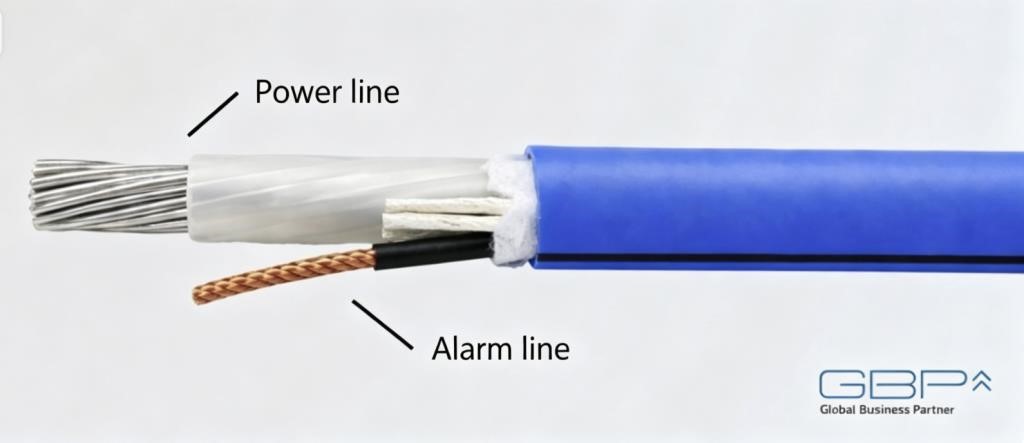
- GBP will sell an aluminium cable for solar farms with a built-in alarm.
- If the cable is cut an alert is triggered to notify security or police.
- CONTEXT: Although cable theft has declined since passage of a 2025 crime law and lower copper prices, such thefts persist, even when made of aluminium; (less sought-after, aluminium is much cheaper than copper).
- TAKEAWAY: This innovation is significant because detection originates from the cable rather than external sensors or CCTV. This solution, which enables immediate detection of the exact location of the theft, could be an easy-to-install option for solar operators.
Sharing Energy’s total funding reaches ¥27 billion to develop solar PPAs
(Company statement, April 17)
- Sharing Energy raised a second round of Series C – ¥862 million in a third allotment of new shares – bringing final funding to ¥27.6 billion.
- CONTEXT: Sharing Energy developed “Share Denki”, a PPA without initial fees, specializing in residential solar power.
- Investors include Daiichi Life, Global Brain, Mitsui Chemicals, Tokyu Construction, and Kiraboshi Capital.
- SIDE DEVELOPMENT:
- J-Power, Mizuho, etc complete hourly matching project compatible with PPAs
- (Company statement, April 17)
- J-Power, Mizuho Bank, Mizuho Lease, Mizuho Securities and data company Scalar confirmed that 24/7 hourly matching can be compatible in PPAs after successfully completing a demo.
- Hourly alignment between generation and consumption, matching across multiple power sources, and the reliability and traceability of environmental values, were checked; electricity consumption data was collected and matched against power supply data from non-fossil generation sources such as solar and wind supplied by ML Power and J-Power.
- An environmental value platform developed by J-Power and Scalar was used to create certifications verifiable by third parties.
- Based on these positive results, the companies plan to develop solutions for a constant supply of decarbonized energy under PPAs.
(Company statement, April 17)
- CHC Japan will build a 49 MW / 231 MWh BESS station in Ojiya (Niigata Pref), with Tokyo Gas, signing a 20-year tolling agreement.
- Operations should start in 2029. The project is owned by a SPC that raised ¥10 billion in project bonds arranged by Mizuho.
- CONTEXT: CHC Japan is a JV between CATL, Hartree Partners, and Cathay Fortune. The company recently commissioned its first BESS in Ehime Pref and secured several assets in the last two LTDA rounds, totaling 479 MW of awarded capacity for CHC Japan and its partner Stonepeak.
- TAKEAWAY: This is the first use of a project bond for a BESS project in Japan, highlighting the vibrant and growing market. A project bond is a fixed-income instrument used to finance specific infrastructure or industrial projects such as large-scale BESS. It typically provides long-term, fixed-rate financing and can be more efficient than traditional bank loans, as it allows to raise larger amounts of capital per investor. Repayment is supported by the project’s cash flows, in this case the tolling agreement.
Chugoku Electric and Asahi Kasei ink MoU on battery operation optimization
(Company statement, April 23)
- Chugoku Electric and Asahi Kasei inked an MoU on battery operation optimization system that impacts condition and lifespan.
- Asahi Kasei, as a battery material maker, has ample relevant data and will contribute to software development which will enable the system to be applied to a wide range of lithium-ion batteries.
- From FY2026 to 2029, both companies will leverage their technologies and expertise to develop new software for planning battery charge and discharge, based on Asahi Kasei’s battery degradation diagnostic software.
- CONTEXT: Chugoku Electric seeks to expand renewable energy and secure balancing capabilities, including development of solar and wind power.
ShinDengen to sell EV charge/ discharge device to ensure constant power supply
(Company statement, April 20)
- Shindengen will sell a V2X charge/ discharge device compatible with EVs.
- It charges excess power into the vehicle and automatically discharges when power generation is insufficient, for instance due to lack of sunlight.
- The device can also be used during power outages, and can supply more than 10 kW to residences, factories, or commercial facilities.
- SIDE DEVELOPMENT:
- Tsubakimoto Chain launches EV charge/ discharge device
- (Company statement, April 20)
- Tsubakimoto Chain launched a new model in its series of compatible charging and discharging devices. The “eLINK TP” has a three-phase power supply and a rated AC production of 12 kW for charging and 9.4 kW for discharging.
- It uses an EV battery, charging the vehicle under normal conditions, and supplying power from the EV to buildings in case of power outage, including three-phase equipment (elevators, water pumps, refrigeration equipment).
- The system can operate in conjunction with EMS, and can be integrated with solar power generation systems and BESS.
Mitsubishi Electric launches EMS demo in Poland
(Company statement, April 20)
- Mitsubishi Electric began a field test for an EMS using its digital platform Serendie® for tramways in Krakow, Poland.
- The system is powered by storage batteries installed along tram lines to supply power.
- Mitsubishi Electric’s EMS analyzes electricity consumption, surplus power, and voltage stability on the tramway’s overhead lines.
Eku Energy starts operation at BESS with direct trading
(Company statement, April 23)
- This month, Eku Energy started operations at its Kami-Tonno BESS in Nogata City, Fukuoka Pref. This is the first BESS facility for which the company will undertake electricity market trading directly.
- Eku Energy seeks to build up in-house operation and trading of BESS assets in Japan.
NEWS: WIND POWER AND OTHER RENEWABLES

Daiwa Can inks deal for ~ 200 MW of geothermal PPA
(Company statement, April 15)
- Daiwa Can signed an off-site geothermal PPA with Kyuden Mirai Energy and TEPCO Energy Partner.
- Electricity and environmental value are sourced from four geothermal power plants in Oita and Kagoshima Prefs, with a combined capacity of 198 MW.
- Kyuden Mirai Energy supplies the electricity while TEPCO is the retailer; it’s the company’s first geothermal PPA.
- Daiwa Can cited two reasons for geothermal:
- As baseload, it aligns with the company’s varying electricity demand between daytime and nighttime operations;
- One of its factories in the Tokyo area faces site constraints, with a roof unsuitable for onsite solar installations.
- CONTEXT: Kyuden Energy Mirai signed three other major PPAs sourcing electricity from the same four geothermal facilities, with Panasonic, Kyocera and Nippon Steel.
- TAKEAWAY: While the deal’s scale shows gradual openness to geothermal, the contract is limited to five years, well below the typical 10–20 years of solar PPAs. Geothermal PPAs are new compared to solar, with the first deals signed only last year. The shorter duration may reflect a preference for flexibility considering the limited long-term offtake visibility.
Wind turbine blade failure prompts emergency inspections
(Government statement, Company statement, April 16)
- A blade failure accident occurred at Kazenokoku Oga wind farm in Akita, involving an ENERCON turbine maintained by Hitachi Power Solutions, which began emergency inspections of similar turbines.
- METI told the project owner to investigate and take preventive measures.
- TAKEAWAY: While wind turbine accidents are rare relative to the installed base, they’re not exceptional. Blade issues are among the more common failure types. The occurrence rate is similar between Europe and Japan, but downtime is much longer in Japan, according to the University of Tokyo. That reflects the harsher weather, complex terrain and maintenance challenges in Japan. This time, officials are treating the accident with heightened concern to ensure it does not lead to mounting public concern, particularly for onshore projects near communities.
Shimizu develops system to optimize onshore wind access roads
(Company statement, April 22)
- Shimizu Corp developed a system to automate and optimize access road design for onshore wind projects, targeting shorter design timelines.
- The system uses terrain data and turbine layouts to generate routes that minimize distance and earthworks.
- It can replicate human design logic, grouping turbines and reportedly reduce planning time for a 30turbine project from weeks to ~4 hours.
- TAKEAWAY: Japan’s onshore wind sector faces complex, mountainous sites; and logistical issues sometimes determine not only the size and siting of facilities but even if a project can go ahead at all. Digital tools should help cut design time.
NEWS: NUCLEAR ENERGY
Key municipality agrees to conduct literature survey for nuclear waste repository
(Nikkei, April 21)
- The mayor of Ogasawara Village agreed to a literature survey, to assess Minamitorishima’s viability as a nuclear waste repository.
- He met with METI Minister Akazawa and requested a guarantee from the govt that conducting the survey does not absolutely mean a facility will be built.
- He urged the govt to also engage other municipalities, ensuring Ogasawara is not singled out. Advancing to the second stage needs the governor’s consent.
- The mayor plans meetings to hear villagers’ opinions. Municipalities that accept these surveys are eligible for up to ¥2 billion in state subsidies.
- CONTEXT: Minamitorishima is the targeted place for the repository. It is an uninhabited, state-owned island located about 2,000 km from Tokyo and 1,200 km from the inhabited islands of Chichijima and Hahajima. The island is administratively part of Ogasawara Subprefecture.
- TAKEAWAY: The repository selection process consists of three stages: 1) a literature survey; 2) field research involving drilling; and 3) a deep-underground surveying. Literature surveys have completed or are ongoing in three other municipalities (two in Hokkaido and one in Saga Pref). Ogasawara is the first time the national govt has requested a survey rather than waiting for a municipality to apply.
Operation of fast experimental reactor Joyo faces another delay
(Nikkei, April 24)
- The restart of Japan’s fast experimental reactor “Joyo” in Oarai, Ibaraki Pref, faces a setback.
- The Japan Atomic Energy Agency aimed to resume operations by mid-FY2026, but extra investigation into equipment during earthquakes is now required.
- The new restart date hasn’t been decided. This is the second delay; the reactor shut down in 2007 and has not restarted yet.
- CONTEXT: Joyo is a test sodium-cooled fast reactor, a step toward development of a commercially viable fast reactor. Earlier this month, the govt released a roadmap for advanced nuclear reactors, including fast ones. The design stage will run until 2028, with operations planned to start in the 2040s.
NEWS: TRADITIONAL FUELS

JAPEX plans to quadruple oil and gas production
(Company statement, April 22)
- JAPEX seeks to boost crude oil and gas production from an estimated 45,000 bpd in FY2025 to 100,000 bpd by 2031, and 180,000 bpd by 2035.
- Despite the focus on fossil fuels, JAPEX says it will continue investing in CCS, aiming to store more than 8 Mt of CO2 by 2035.
- JAPEX plans investments totaling ¥1.5 trillion by 2035.
- About ¥1.16 trillion (80% of the total) will go toward oil and gas development. JAPEX will also consider investing in natural gas projects in the U.S. for export to Japan – a business it’s not currently involved in.
- The firm forecasts that fossil fuel businesses will account for 60% of profits by 2035, and aims to boost net profit to ¥100 billion by 2035 and return on equity to over 12%.
- CONTEXT: In February, JAPEX acquired tight oil and gas assets from Verdad located in the DenverJulesburg Basin in Colorado.
- TAKEAWAY: This represents a shift away from the previous strategy where JAPEX emphasized renewable energy and reducing dependence on fossil fuels. Now, energy security is the central theme. While a complete reversal of the decarbonization goals is unlikely, the main bulk of initiatives in that space seems to be reserved for carbon capture technologies.
INPEX to focus on oil sales to Japan amid Iran war
(Nikkei, April 22)
- INPEX president Ueda said exports from its UAE operations are affected by the war in Iran. Some shipments continue from ports that bypass the strait, but exports from the Persian Gulf have ceased. If storage tanks fill up due to unsold oil, production might halt.
- So far, there has been no physical damage to production sites. Many contracts are FOB, and if buyers cannot pass through the strait, they may declare force majeure.
- INPEX also produces oil in Azerbaijan, Kazakhstan, and Australia. But shipping from these regions takes more time and is more expensive, so these supplies are usually sold to Europe. In this emergency, INPEX is willing to focus on sales to Japanese refiners like ENEOS, Idemitsu, Cosmo Energy, and Taiyo Oil.
- TAKEAWAY: Japan depends on the Middle East for over 90% of its crude oil. The risk of disruption in the Strait of Hormuz was always known, but deemed unlikely. The reason for the huge Middle Eastern oil dependency is due to the fact that it’s the most cost-effective. Japan’s refineries have a design for this type of oil, making a rapid shift to other sources difficult. Diversification of supply is important, but significantly reducing reliance on UAE or Saudi oil is not realistic.
Japan secures extra Mexican crude supply amid Middle East disruption
(Jiji Press, April 24)
- Mexico agreed to export 1 million barrels of crude oil to Japan, following a phone call between President Sheinbaum and PM Takaichi.
- CONTEXT: The deal comes as Japan faces supply risks from the Strait of Hormuz closure; over 90% of its crude imports are usually sourced from the Mid East.
- The request was initiated by Japan, with exports to be handled via Mexico’s state oil company; timing has not yet been disclosed.
- TAKEAWAY: The move aligns with broader Japanese efforts to diversify procurement, including alternative routes and suppliers outside the Middle East. Mexico is the world’s 11th-largest oil producer. The small volume agreed highlights that spot diversification options are limited. Japan consumes about 1.7 million barrels each day.
JAPEX takes stake in Norwegian gas sector
(Company statement, April 20)
- JAPEX Norge agreed to take a 20% participating interest in Production License PL1119 from OKEA.
- Located in the Norwegian Sea, it includes the undeveloped Mistral South gas field and Mistral North exploration prospect.
- An exploration well is planned for early 2027. As for Mistral South, the target is production to start in the early 2030s.
- CONTEXT: Equinor Energy is the operator, with a 50% stake. JAPEX Norge has 20%, INPEX Idemitsu Norge 20%, and DNO Norge 10%.
- TAKEAWAY: Equinor is Norway’s largest oil company. The move is part of efforts to diversify fuel sources amidst the Iran war. Calls for more diversification rose predominantly after the initial shock due to the war, and major companies are taking the initiative.
LNG stocks down from previous week, up YoY
(Government data, April 22)
- As of April 19, the LNG stocks of 10 power utilities were 2.22 Mt; down 3.1% from the previous week (2.29 Mt); up 11% from end April 2025 (2 Mt), and up 4.7% from the 5-year average of 2.12 Mt.
March Oil/ Gas/ Coal trade statistics
(Government data, April 22)
| Imports Volume YoY Value (Yen) YoY | ||||
| Crude oil | 11 million kiloliters (69.4 million barrels) | 2.5% | 747.4 billion | -7.3% |
| LNG | 5.9 million tons | 13.9% | 517 billion | 10.7% |
| Thermal coal | 8.5 million tons | 2.2% | 164.7 billion | 1.4% |
- For the past several years, when winter heating demand concludes, the import volume of the three major energy sources drops. This did not happen this year due to the Iran war. Both import volumes and value went up, especially for LNG.
- Thanks to long-term contracts, the price of crude oil remains at a moderate level. Most LNG and thermal coal come from the Asia Pacific.
NEWS: CARBON CAPTURE & SYNTHETIC FUELS

METI explores measures to expand use of biofuels
(Government statement, April 17)
- METI discussed measures to promote biodiesel (FAME, HVO) and bioethanol, including taxation treatment, new fuel standards (JIS), and raising blending ratios in conventional fuels.
- For biodiesel, the government is considering:
- Raising the current B5 FAME blend to B7 for road use (i.e. % of FAME blended in)
- Establishing JIS standards for higher blends (B20, B30) for off-road applications
- Introducing standards for HVO100 and assessing allowable blending ratios with diesel
- Reviewing fuel tax treatment, including whether exemptions apply to the biofuel portion or the full blended fuel
- CONTEXT: Tax-exempt businesses include, for instance, some railway operators.
- TAKEAWAY: HVO is seen as more flexible than FAME, as it is a drop-in paraffinic fuel compatible with existing diesel engines and infrastructure, whereas FAME (an oxygenated ester) faces blend limits and storage stability constraints, restricting its use to lower blends. When stored for more than a few months, bacteria grow at the interface between FAME and free water, clogging tank filters.
- For bioethanol, Japan currently mandates oil companies to supply 500,000 kL/ year (FY2023–2027) for transport use, with volumes under review.
- ANRE is also assessing lifecycle emissions and overseas supply chains.
- Brazil and Thailand are key supply candidates:
- Brazilian sugarcane ethanol benefits from high sugar yields, while corn ethanol offers cost advantages and scalable production.
- Thai ethanol, largely molasses-based, has relatively lower yields.
- TAKEAWAY: Japan is moving gradually to expand biofuel use by raising blending limits and standardising fuel specifications, while also addressing tax and supply-chain constraints. In the near term, HVO is likely to play a larger role due to its compatibility with existing diesel systems, while bioethanol policy will hinge on securing stable, low-cost imports from major producers. Today, Japan imports most of its corn and this is only increasing partly due to domestic rice price inflation, with forecasts for nearly 16 Mt of corn imports by late 2026. Importing Brazilian biofuels in addition to sourcing from the U.S., could lead to more Japanese firms active in the Americas. So far, Japan has focused on sugarcane, with firms such as Asahi Kasei planning to produce plastics using sugarcane-derived bioethanol as a raw material.
BYWILL and Mitsui Sumitomo Insurance register J-Credit project for EVs
(Company statement, April 22)
- BYWILL and Mitsui Sumitomo Insurance registered “EV-Lab”, a J-Credit project for EVs, which will aggregate the environmental value of EV adoption nationwide through both Mitsui’s and BYWILL’s customer bases and partner networks, aiming to obtain J-Credit certification.
- TAKEAWAY: EVs offer opportunity within the J-Credit scheme, as the emissions gap compared to conventional vehicles can be traded and sold to firms to meet their ESG goals. Some EV companies have shown interest in the mechanism, such as eMotion Fleet, which joined a J-Credit consortium in 2025. The J-Credit has also published methodologies applicable to EVs, marine vessels, and trucks. However, NFCs are more commonly used to help companies offset emissions as they directly certify the consumption of decarbonized electricity. For example, PowerX offers a solution for EV fleets that includes NFCs issued after each charging session under its RE100aligned plan.
ANA, JAL hike fuel surcharges early as jet fuel prices surge
(Company statements, April 21)
- ANA and JAL will bring forward by one month fuel surcharge hikes, with higher rates on international tickets purchased from May 1, as jet fuel costs spike.
- Long-haul surcharges (Europe/ North America) will jump to ¥56,000, up ~93% MoM, while shorthaul routes like South Korea will more than double to ~¥6,500–6,700.
- TAKEAWAY: The move follows a sharp rise in the benchmark Singapore kerosene prices to ~$147/ bbl (Feb– March average), exceeding assumptions under the existing pricing system and forcing both carriers to raise surcharge caps. Airlines warn higher fares could dampen demand and weigh on performance, with potential impacts on capacity and service levels.
Sumitomo Forestry tests bioethanol made from Vietnamese agricultural residues
(Company statement, April 15)
- Sumitomo Forestry will test production of sugar for bioethanol from cashew apples in Vietnam, hoping to use it as a biodiesel and SAF feedstock.
- CONTEXT: Vietnam will mandate the blending of bioethanol into gasoline starting June. Cashew apples, which are typically discarded after the nuts are harvested, can serve as a non-edible feedstock for biofuels.
- SIDE DEVELOPMENT:
- Tokyu Bus adopts Euglena’s biofuel
- (Company statement, April 21)
- Tokyu Bus now fuels 65 buses with “Susteo 51”, a biofuel consisting of 51% HVO (Hydrotreated Vegetable Oil) and 49% conventional diesel, supplied by Euglena.
- CONTEXT: HVO is produced through hydrogenation using used cooking oil, vegetable oils, or animal fats. Hydrogenation improves fuel quality by removing impurities, enhancing stability and performance compared to conventional biodiesel. It is also suitable for heavy-duty vehicles such as buses and trucks, with properties equivalent to diesel and compatibility with standard diesel engines.
Erex and Vietnamese firm ink MoU to commercialize biomass co-firing
(Company statement, April 17)
- Erex signed a MoU with Vinacomin Power in Vietnam to study the commercialization of biomass cofiring at Vinacomin’s existing coal-fired power plants.
- This MoU moves the company to the commercialization study phase based on the results of co-firing tests at the Na Duong and Cao Ngan power plants.
- CONTEXT: Vietnam’s electricity demand is rising at an annual rate of about 10%; about half of the power source relies on coal-fired power plants. The country’s 8th National Basic Plan for Electricity includes a policy to begin co-firing of biomass, ammonia, and other fuels in coal-fired power plants in operation for over 20 years.
- From 2025 to 2026, Erex and Vinacomin held biomass co-firing tests at two coal-fired power plants owned by Vinacomin; both tests yielded favorable results.
ANALYSIS
BY YURIY HUMBER
METI Opens a New Front on Grid Flexibility: Demand Response
Japan’s power-price swings are increasingly arriving at a very specific time of day: just as solar output fades. In one recent day-ahead curve, the Tokyo area saw prices spike to around ¥60/ kWh in the late afternoon, while Hokkaido and Tohoku fell to around ¥3 near midday before climbing sharply into the evening.
This familiar pattern is starting to worry policymakers. Sun-soaked volatility creates technical and economic strain. While the national strategy calls for renewables to supply 40–50% of electricity by FY2040, up from 23% in FY2024, there is no rush to phase out thermal generation.
Variable renewables must therefore be integrated with plants that can take hours – or even days – to ramp up. That creates a growing balancing problem. Meanwhile, thermal assets, particularly nuclear, risk running at near-zero prices during peak solar hours, undermining utility economics.
That helps explain why METI launched a new working group ostensibly to promote “distributed energy.” Formally, the group spans everything from grid batteries to cybersecurity. In practice, its early meetings point to a more specific task: turning demand response, or DR, into a usable flexibility tool for the power system.
Leaning into demand-side “carbon-free flexibility,” as the group describes, is less about environmental positioning than system necessity. With major grid reinforcement projects not due until the 2030s, policymakers seek ways to manage imbalances within the existing system. DR is emerging as one of the main interim tools.
There is one problem. After several months of analysis, METI’s experts concluded that DR remains hard to see, count, and scale. To make DR work, they first need to make it visible.
Checking in on demand
The “Distributed Energy Promotion Strategy Working Group” was launched in December 2025 and has convened three times so far, most recently on April 15.
At the outset, the group framed distributed energy resources (DER) as a way to reduce the system’s total social cost while providing the flexibility needed for a renewablesheavy grid. Its initial task was to assess demand-side and supply-side options separately, before considering how to allocate resources across DER as a whole.
At the second meeting in March, METI invited OCCTO, McKinsey & Co and Mitsubishi Research Institute (MRI) to present their 2040 outlooks for distributed resources. OCCTO and McKinsey put potential DR at roughly 7.5–15 GW, while the three institutions showed a much wider 8–33 GW range for demand-side batteries. This compared with a more modest 2.8–10 GW outlook for supply-side batteries.
These variations reinforced a central issue: DR could become material, but its scale remains uncertain, and that has pushed METI to prioritize improving visibility.
Broadly defined, DR involves shifting, reducing, or increasing electricity consumption in response to system needs. In practice, this means lowering demand during evening tightness while increasing it during midday solar oversupply.
Unlike batteries, however, DR is not a single asset class but a collection of behaviors, devices, and services. That makes it harder to track. Battery projects can be counted, queued for connection, regulated and subsidized. DR, particularly low-voltage DR, depends on device readiness, aggregation, pricing signals, and user participation.
To address this, METI has focused first on measuring the presence of DR and especially of “economic DR,” where retailers or service providers shift demand to avoid high procurement costs or take advantage of cheap electricity.
One proxy for DR activity is the growth of aggregation. The number of registered specific wholesale suppliers (i.e. aggregators) has risen from 46 in 2022 to 129 by November 2025; and aggregate supply capability rose from roughly 3.6 GW to 5.3 GW. Participants now include manufacturers, telecom firms, trading houses, and oil and gas companies, with some firms specializing exclusively in aggregation. This suggests a maturing commercial layer around DR.
DR is more visible in formal markets. In the capacity market, activation-command power including DR reached 6.39 GW in the auction for FY2028 delivery. In the Power Source I balancing auction for FY2023, DR accounted for 2.52 GW of awarded capacity – roughly 70% of the total.
Still, the underlying resource remains only partially visible.
Barely invisible, but influential
Despite the lack of clear measurement, policymakers suspect DR is already affecting the system.
At the April meeting, officials noted that peak demand was not revised upward in some areas during recent hot summers, despite weather conditions that might have justified it. One explanation is that economic DR may already be suppressing peaks.
If so, DR is beginning to influence system planning, affecting the assumptions used for supply adequacy and capacity procurement, without being fully captured in official data.
Power system data from TEPCO Power Grid supports this theory. Compared with April 2025, April 2026 shows more aggressive use of pumped hydro to absorb midday surplus and release energy later in the day. The region also recorded its first instances of renewable curtailment, which have quickly become more frequent. At the same time, LNG and coal use has declined.
The system is already working harder to shift energy across the solar curve. That is the role DR is expected to play. Historically, DR focused on reducing peak demand during summer afternoons. Increasingly, it is about two-way flexibility: increasing demand when solar is abundant and reducing it when supply tightens.
Market activity reflects this shift. In Kyushu, residential batteries are tested for midday charging and evening discharge. In Okinawa, thermal storage is used to shift demand into solar-heavy hours. Panasonic’s new Ene-Farm systems include both upward and downward DR functions. Tokyo Gas and others are rolling out DR-enabled control systems.
Next steps
METI’s latest discussions suggest the policy framework is now catching up. The ministry is focusing on three main areas: expanding the installed base of DR-capable devices, strengthening incentives, and improving participation.
This includes support for IoT upgrades to make devices dispatchable, particularly in the low-voltage segment where individual resources are small but collectively significant. Existing DR-ready standards for water heaters and home batteries are extended to fuel cells and EV chargers.
In parallel, METI is looking to strengthen incentives. Current DR participation still relies heavily on manual response or limited service offerings. The aim is to move toward automated, machine-driven DR supported by clearer compensation.
Upcoming market reforms will support this. Low-voltage small resources and devicelevel measurement are to begin in the balancing market from FY2026, while highvoltage and extra-high-voltage device-point participation follows from FY2027. This is a prerequisite for scaling DR into a resource that can be reliably measured and dispatched.
Finally, policymakers are turning to communication. Low participation reflects not just technical constraints, but limited awareness. Expanding DR will require clearer messaging and broader engagement with households and local governments.
Conclusion
Batteries remain the more straightforward tool for shaping power demand. They can be counted, subsidized, and regulated with relative ease. DR is more diffuse and harder to control. But batteries alone are unlikely to solve Japan’s flexibility challenge. Grid connection bottlenecks, speculative development, and uneven deployment mean supplyside solutions have limits.
The forecasts reviewed by METI suggest DR and batteries could ultimately play comparable roles. For now, these remain estimates rather than firm targets, reflecting uncertainty over how far DR can scale.
DR has been tested in Japan for years, but largely as a niche tool. METI is now trying to move it into the mainstream. If that effort succeeds, DR could provide a broader and more cost-effective way to manage solar-driven volatility. If it does not, the system will continue to rely more heavily on the flexibility it can already see: pumped hydro, thermal balancing, and batteries.
ANALYSIS
BY RADA KUZNETSOVA
Energy Startups Ignite Innovation at SusHi Tech Tokyo 2026
Japan’s leading startup event, SusHi Tech Tokyo 2026, opens today with the ambition to turn the city into “a hub where the world’s leading technologies meet.” For three days, the event’s venue, Tokyo Big Sight, Japan’s largest international exhibition center, will host over 500 startups and welcome up to 60,000 visitors.
The main draw is physical AI and robotics – Japan’s answer to the demographic crisis and immigrant labor. Entertainment is also garnering interest. Most likely, Kokuho, the critically acclaimed historical drama, has something to do with it. Video games are amply represented, a tribute to Japan’s enduring reputation in this industry.
Energy and clean tech startups are also out in force, but their number this year shows only a slight increase over last year. Their tally has held flat for several years, which testifies to the fact that innovation in Japan’s energy sector remains in the hands of major corporations.
Yet there is a small number of startups seeking to ignite innovation in the domestic clean energy scene, primarily in technologies related to hydrogen, carbon and solar. So, what do these new businesses tell us about the direction of travel for Japan’s energy sector?
Discrepancy in the numbers
Event organizers say that 72 startups, or 13% of the 535 total in attendance, are classified as energy or clean tech. Oddly, there is a discrepancy between the official list of exhibitors — 770 — and what one can count manually on the web site (535).
Either the remaining 135 startups decided not to publicize themselves on the website, or SusHi Tech rounded up the number of participating startups a bit too generously. Until proven otherwise, Japan NRG will go with 535 as the total number of startups attending.
So, how does this compare to previous editions of SusHi tech?

When launched in 2023 as “City-tech. Tokyo”, only 13% of participating startups fell under the clean tech and energy categories. That 13% figure held steady for 2024’s edition, but dipped to 10% in 2025, possibly because food tech was that year’s focus. This year the percentage is back up to 13%, suggesting energy has yet to break out as a dominant area of interest for entrepreneurs in Japan.
Types of Startups
A few trends become clear when looking closely at the 72 clean energy startups. More than half position themselves specifically as “clean tech”, which is a good way to appeal to a larger number of environmentally-minded investors.
Of those, the majority use an AI-based platform to either optimize energy performance, or mitigate and calculate carbon emissions. Asuene, a startup covered in a previous issue of Japan NRG, is one such case.
Others focus on repurposing waste and climate-resilient agriculture – largely in response to unpredictable climate conditions. Aether Fuels seeks to convert waste carbon into drop-in liquid fuels, and BioPhenolics produces high-value phenolic compounds for a greener chemical industry.
The other 35% fall under more defined energy categories such as solar, fusion, biomass, etc.
SusHi Tech is not simply a space for international and Japanese startups to gather and present their projects. It acts as the face of Japanese startup ambitions and reflects the government’s focus for the upcoming year.
For example, officials might talk a lot about hydrogen, but low representation at this year’s event may suggest they are no longer as invested in the idea. On the other hand, solar power startups represent a noticeable footprint despite China’s dominance in the sector.
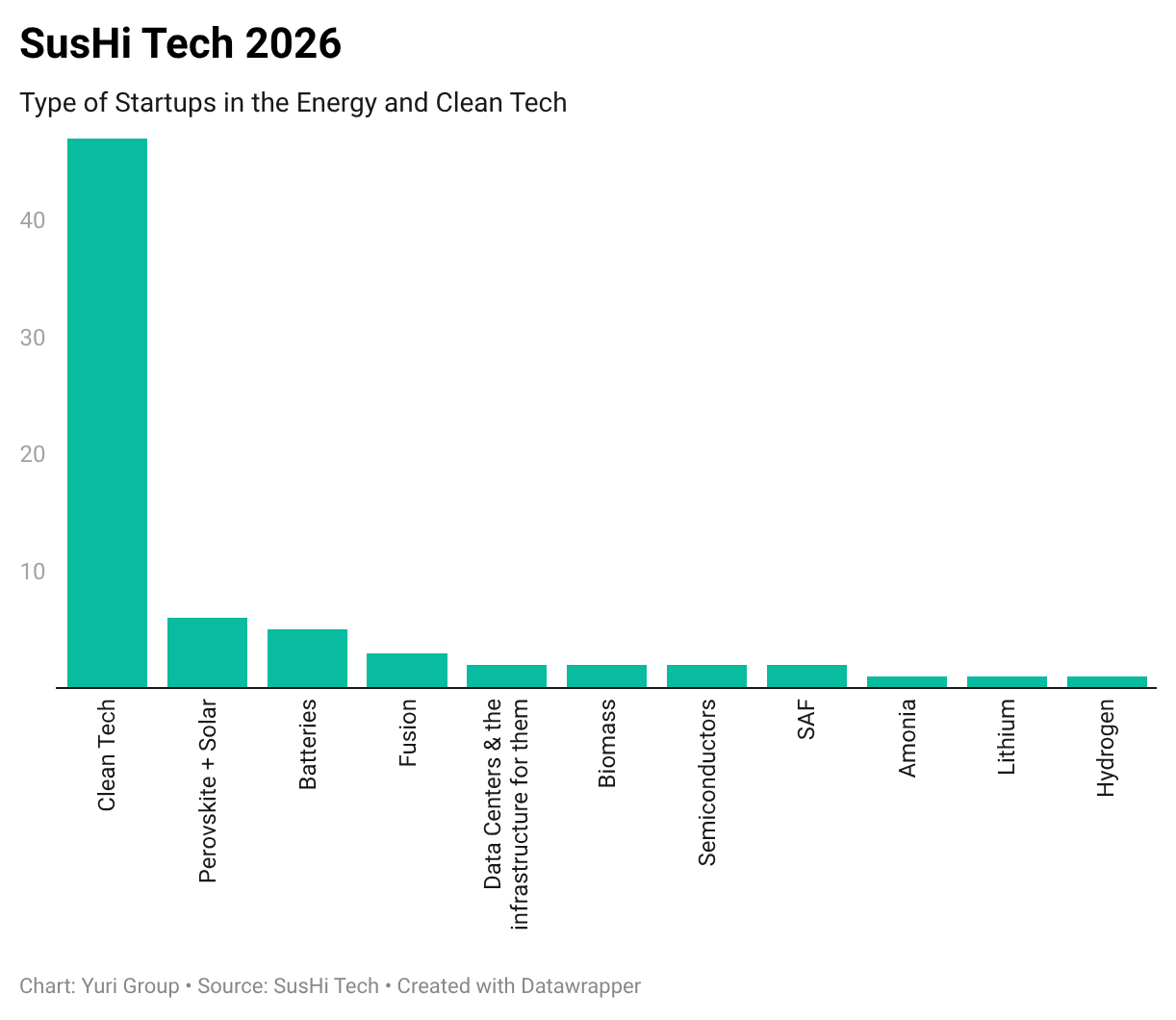
About 30% of the 72 startups aim to generate or store energy; the remainder seek to measure or optimize emissions and/or performance, or grapple with other facets of sustainability, such as agritech.
For example, companies like Atierra and Tagaddod are dedicated to SAF technology. Granular Energy, Faeger, and Creattura focus on carbon credits. None of them seek to be entirely disruptive, but rather, offer relatively simple drop-in solutions that enhance existing infrastructure.
That focus on optimization draws fewer headlines than, say, nuclear fusion – which is also on display at the effect. However, the former could offer near-immediate impact, while fusion remains a technology with promise but also commercialization timelines that stretch into the mid-century. Most startup investors tend to prioritize solutions that can be enacted within a decade.
Hydrogen
Despite the Japanese government’s heavy promotion of a future ‘hydrogen society,’ only one startup at SusHi Tech 2026 is focused on this clean-burning fuel: Okuma Tech. The company is developing compact hydrogen fuel cell stacks, portable hydrogen generators, and high-efficiency hydrogen fuel cell systems for drones.
Another, iAC, works with hydrogen fuel cells, as well as with perovskite solar cells and conductive carbon paste. A diversified strategy provides the startup with higher chances of attracting investment.
Since SusHi Tech is a Tokyo Metropolitan Government initiative and startups exhibiting are carefully selected, the sparse offering indicates either a lack of interest among entrepreneurs or a shortage of opportunities for startups in this field where large industrials dominate.
It may also be a case of hydrogen slipping down the list of near-term priorities for the government. The Tokyo government’s green hydrogen exchange pilot project has attracted few buyers and sellers and only further demonstrated the gap between what consumers are willing to pay for the fuel and the cost of its manufacture.
Carbon
Carbon tracking and trading platforms at this year’s SusHi Tech can expect significant interest from investors. Starting April 1, Japan legally obliges major companies to calculate and report their carbon footprint, as well as set reduction targets. The date also saw the GX-ETS nationwide carbon trading scheme move into its mandatory phase, which obliges the top emitters to act or face penalties.
Carbmee from Germany is an environmental intelligence platform; while Atierra from Okinawa converts captured CO2 into low carbon oils using programmable microalgae. Unravel Carbon from Tokyo develops AI agents to manage data collection and carbon intelligence.
Solar
Startups working on Perovskite solar cells (PSC), such as EneCoat Tech, constitute about 30% of the energy startups attending. This reflects the Japanese government’s big plans to develop this solution as a way to break back into the market for solar power generation – a technology the country dominated in the first decade of this century. Today, Chinese firms account for well over 90% of the global supply chain for solar panels.
Another area in solar drawing interest from entrepreneurs is solar recycling. German startup Solar Materials and Singapore-based EtaVolt offer panel recycling, which is expected to emerge a large market in Japan around the start of the 2030s – two decades after the start of the nation’s solar boom.
Noticeably, none of the solar startups at SusHi Tech are Chinese.
Fundraising
In 2025, according to Speeda, Japan’s clean tech sector raised over ¥600 billion. The only two other sectors with higher numbers were generative AI and SaaS. Considering how many of the clean tech startups at SusHi Tech are in AI and SaaS, it seems they’re putting their eggs in the most profitable baskets, labeling themselves under the three most promising categories to optimize fundraising.
AI, SaaS, and clean tech might bring in the most investment, but there are risks associated with AI-based technology, such as ensuring sufficient cybersecurity to prevent hacks is a major challenge. Some experts claim that, for example, a Grok bot can be hacked in under 10 minutes.
A BBC technology journalist claims to have hacked ChatGPT and Google’s AI in 20 minutes. Climate tech startups with AI-based platforms need to be mindful of this.
As AI generally gains access to the company’s supply chain and purchasing data in order to calculate its emissions, the ease with which hackers can potentially disrupt that process needs to be recognized and addressed.
AI-powered solutions will also need to demonstrate that their usage will reduce more energy than they require to operate. There are few calculations today on the total impact of greater AI use – from data center additions to semiconductor manufacturing – on power demand and the associated emissions.
Conclusion
If SusHi Tech is meant to signal the future direction of Japan’s energy sector, this year’s edition sends a mixed message. Clean energy startups are present, but not growing; innovation is visible, but largely incremental; and government priorities – such as hydrogen and nuclear – find only limited reflection on the ground.
What emerges is not a surge of disruptive energy entrepreneurship, but a layer of startups working around the edges of an industry still dominated by major corporates. For investors and policymakers alike, the question is whether this model can deliver the speed of change Japan’s energy transition ultimately demands.
ASIA ENERGY REVIEW
BY JOHN VAROLI
A brief overview of the region’s main energy events from the past week
Australia / BESS
About 74% of battery storage projects in the National Electricity Market pipeline are confirmed to be equipped with grid-forming inverters. A grid-forming BESS equipped with advanced inverters can independently maintain grid voltage and frequency.
Australia / Grid
The Australian Energy Market Commission released a draft rule to modernize distribution network planning in response to the rapid uptake of consumer energy resources. It proposes long-term planning and data reporting requirements to improve grid visibility.
China / Green exports
Green technology exports rose significantly. Exports of EVs jumped 77.5%; lithium batteries up 50.4%; and wind turbines and components were up 45.2%.
China / LNG
Kplr estimates China’s LNG imports at 3.36 Mt in April, the lowest since 3.18 Mt in April 2018, and down from the winter peak of 7.66 Mt in December 2025.
India / Renewables and grid
Adani Green is holding back renewable capacity additions due to transmission bottlenecks. The firm could add 7–8 GW of renewable capacity a year, but is restricting annual additions to around 4.5–5 GW. The firm lost about 5 billion rupees last year as it could not send power generated to the grid due to transmission constraints.
LNG
In April, Asia’s imports of LNG will be 19.03 Mt, down from 20.69 Mt in March, as well as from the winter peak of 26.34 Mt in December 2025. Spot Asian LNG jumped from $10.40/ mmBtu on Feb 27 to a high of $25.30 by March 20. The price has since eased to $16.05/ mmBtu in the week to April 17, leaving it 54% higher than pre-war levels.
Singapore / Jet fuel
Jet fuel prices doubled to an average around $166 per barrel so far in April compared with $82 in January.
South Korea / Oil
South Korea will purchase 273 million barrels of crude oil from the Middle East and Kazakhstan by year’s end, and also secured 2.1 Mt of naphtha.
Taiwan / Coal
After being mothballed in 2025, Taiwan’s base load power facility, Mailiao coal-fired power station, will re-start Units 1 and 3. The restart will take place from May to July.
Disclaimer
This communication has been prepared for information purposes only, is confidential and may be legally privileged. This is a subscription-only service and is directed at those who have expressly asked K.K. Yuri Group or one of its representatives to be added to the mailing list. This document may not be onwardly circulated or reproduced without prior written consent from Yuri Group, which retains all copyright to the content of this report.
Yuri Group is not registered as an investment advisor in any jurisdiction. Our research and all the content express our opinions, which are generally based on available public information, field studies and own analysis. Content is limited to general comment upon general political, economic and market issues, asset classes and types of investments. The report and all of its content does not constitute a recommendation or solicitation to buy, sell, subscribe for or underwrite any product or physical commodity, or a financial instrument.
The information contained in this report is obtained from sources believed to be reliable and in good faith. No representation or warranty is made that it is accurate or complete. Opinions and views expressed are subject to change without notice, as are prices and availability, which are indicative only. There is no obligation to notify recipients of any changes to this data or to do so in the future. No responsibility is accepted for the use of or reliance on the information provided. In no circumstances will Yuri Group be liable for any indirect or direct loss, or consequential loss or damages arising from the use of, any inability to use, or any inaccuracy in the information.
K.K. Yuri Group: Hulic Ochanomizu Bldg. 3F, 2-3-11, Surugadai, Kanda, Chiyoda-ku, Tokyo, Japan, 101-0062.