
WEEKLY
August 10, 2026
ANALYSIS
JAPAN EYES FLOATING LNG TO HELP STABILIZE ENERGY SUPPLIES
- Japan is deploying capital, engineering expertise and shipping capabilities to develop floating LNG projects in Africa and the Gulf of Mexico.
- These efforts aim to standardize FLNG construction and reduce its high costs. Japan NRG examines the advantages of FLNG projects.
STRATEGY FOR SMRs REVEALS PARADOX IN NUCLEAR SECTOR
- Japan is a leader in SMR nuclear tech, active in global projects. While these projects benefit foreign firms, they don’t benefit Japanese consumers since the technology won’t be deployed at home any time soon.
- Japan’s strict regulation of the nuclear power sector hinders growth.
ASIA PACIFIC REVIEW
This column provides a brief overview of the region’s main energy events from the past week
NEWS
- Govt to accelerate oil supply diversification, aims to restore national stockpiles
- UAE eyes investment in ¥2 trillion Akita data center
- TEPCO to expand household battery DR services
- China cuts rare-earth exports to Japan in half
- EEX futures volume picks up again in July
- METI makes further proposals on mid- to long-term electricity market design
- Kyushu Electric to offer 4-yr wholesale power
- Japan produces first reduced-iron prototype using green hydrogen
- Tokyo selects businesses for waterfront hydrogen pipeline project
- Tanaka Precious Metals invests in quantum hydrogen research
- Digital Grid’s BESS aggregation assets reach 150 MW
- Renova secures financing for 100 MW BESS
- PowerX unveils new stackable BESS series
- Nomura, Mitsubishi set up fund for solar power PPAs
- Asuene and SMFL Mirai to expand solar-related business
WIND POWER AND OTHER RENEWABLES
- Kansai Electric buys stake in major hydro project in the Philippines
- JR East signs biomass virtual PPA with Osaka Gas
- Hexa Energy invests in geothermal energy
- NRA to revise regulations for Rokkasho facility
- Mutsu mayor backs study on accepting spent fuel from more utilities
- June crude imports rose as U.S. barrels offset Middle East decline; but American supply under strain
- ENEOS to invest $6 billion in global expansion
- Chiyoda to chart roadmap to rebuild world’s largest LNG export and processing facility
- KHI in talks to resume building LNG carriers
EVENTS
August 27-28 Asia-Pacific Economic Cooperation / Energy Ministerial Meeting
Sept 7-10 APPEC 2026 @ Singapore
Sept 9-11 Smart Energy Week (Autumn) 2026 @ Makuhari Messe (co-exhibiting H2 & FC Expo, Battery Japan, Smart Grid, Wind Expo, CCUS Expo, etc.)
Sept 9-11 Automotive World @ Makuhari Messe
Sept 14-18 IAEA General Conference 2026 @ Vienna, Austria
Sept 14-17 Gastech @ Bangkok
Oct 8 Innovations for Cool Earth Forum (ICEF) @ Westin Tokyo
Oct 13-15 Global Offshore Wind Summit – Japan 2026 @ Nagasaki
Nov 2-5 ADIPEC 2026 @ Abu Dhabi
Nov 3 U.S. Midterm Elections
Nov Publication of International Energy Agency – World Energy Outlook 2026
Nov 18-19 Asia-Pacific Economic Cooperation – Leaders Meeting @ Shenzhen, China
PUBLISHER
K. K. Yuri Group
Editorial Team
Yuriy Humber (Chief Editor)
John Varoli (Senior Editor, Americas)
Kyoko Fukuda (Data, Events)
Filippo Pedretti (Thermal, CCS, Nuclear)
Tetsuji Tomita (Power Market, Hydrogen)
Aglaé Bange (Renewables, Biomass & Energy Storage)
Gillian Sawyer (Renewables)
George Hoffman (Sales, Business Development)
Rada Kuznetsova (Clients Accounts, Website)
Tim Young (Design)
SUBSCRIPTIONS & ADVERTISING
Japan NRG offers individual, corporate and academic subscription plans. Basic details are our website or write to subscriptions@japan-nrg.com
For marketing, advertising, or collaboration opportunities, contact sales@japan-nrg.com. For all other inquiries, write to info@japan-nrg.com
NEWS: GENERAL OUTLOOK AND TRENDS

Govt to accelerate oil supply diversification, aims to restore national stockpiles
(Government statement, August 7)
- CONTEXT: Since March, Japan has secured sufficient alternative oil supply, but this emergency transition triggered severe financial strains. Procurement costs surged due to steep premiums above market indices and escalating freight rates. In April, spot charter rates for Very Large Crude Carriers skyrocketed to 11 times their rate YoY. This caused extreme market volatility for shipping operators relying on spot contracts. Existing pipelines in Saudi Arabia and the UAE that bypass the Strait of Hormuz remained operational, exporting despite the crisis.
- A govt working group is designing a new regulatory support system, to reduce choke-point dependence at the procurement stage of the supply chain. Oil and naphtha importers who pursue diversification can submit strategic plans.
- After ministerial approval, JOGMEC will subsidize the extra costs of alternative routes. This support scheme implies a “diversification levy” to be collected from all domestic oil and petroleum product importers.
- By FY2027, the govt aims to restore national oil stockpiles to a 90-day supply. It is reviewing whether to integrate naphtha into the stockpiling framework.
- TAKEAWAY: The recent crisis has shown that stockpiling alone is not enough to manage extreme changes in supply. Japan must balance sufficient emergency reserves with peacetime procurement diversification. While sourcing crude from outside the Middle East increases transport distances and shipping costs, it flattens price spikes during crises, optimizing long-term costs for society. To make this sustainable, the govt must properly structure JOGMEC’s funding mechanism, and distribute national security costs across operators.
UAE eyes investment in ¥2 trillion Akita AI data center
(ABS Akita news, Nikkei, Aug 6)
- Japanese and U.S. companies, together with Akita Pref and Akita City, plan to build one of Japan’s largest AI data centers (DC) in Akita City.
- The project will cost about ¥2 trillion, with operations to start in the early 2030s.
- UAE investors, including sovereign fund Mubadala Investment, are in talks to invest as much as half of the total.
- The plan is led by American AI startup BITGRIT and Akita-based IT firm S2.
- The data center could have a grid-receiving capacity of up to 500 MW. The candidate site is an industrial park in Akita City.
- CONTEXT: Akita is emerging as Japan’s top location for offshore wind power generation, which could supply green electrons to data centers. Also, the central govt is promoting regional data-center deployment to reduce concentration around Tokyo and Kansai, improve energy security and support AI infrastructure.
- TAKEAWAY: At 500 MW grid-receiving capacity, this would be one of Japan’s largest DCs, if completed. Traditionally, DCs have sought locations around large urban centers due to latency issues, but improving fiber optics technology is changing the outlook. Meanwhile, availability of land, renewable energy, water resources, and local govt goodwill is higher in areas like Akita than in and near Tokyo. It will be interesting to see if UAE’s funds will also flow into the energy facilities that would service this DC.
China cuts rare-earth exports to Japan by half in 1H2026
(Asia Nikkei, Aug 9)
- China’s exports of seven rare earths subject to export controls fell sharply in Jan–June, dropping 51% YoY to Japan, 14% to the U.S. and 16% globally.
- The decline was especially severe for Japan in June, when exports fell 81% YoY. Exports of dysprosium and terbium, key materials for EV motors and high-performance magnets, have been zero since January.
- Yttrium exports to Japan also fell to zero in June, raising concern for high-tech uses such as semiconductor equipment and heat-resistant coatings for aircraft engines.
- CONTEXT: The restrictions show Beijing continuing to use rare earths as economic leverage, especially against Japan and the U.S., while selectively approving exports in cases where supply disruption could halt major industrial operations.
TEPCO to expand household battery DR services
(Denki Shimbun, Aug 5)
- Electricity retailers are expanding demand-response (DR) services that use household batteries to adjust power demand.
- TEPCO Energy Partner has already secured around 1,000 controllable batteries and EcoCute water heaters under its Eco / Energy Saving Challenge device-control option.
- The company aims to expand the number of controllable devices to around 10,000 units by running campaigns to encourage customers to participate.
- The service supports both downward DR, in which batteries discharge to reduce grid demand, and upward DR, in which batteries are charged or EcoCute units are operated to create demand. Upward DR is intended to absorb surplus solar.
- Similarly, Tokyo Gas plans to provide capacity to the capacity market in FY2027 using 200 batteries capable of reverse power flow.
- CONTEXT: Household DR can help minimize solar curtailment while lowering procurement costs for retailers and creating new revenue sources. Retailers also see DR as a way to deepen customer relationships in a highly competitive market.
- TAKEAWAY: With the balancing market opening to low-voltage resources, the retail race has begun, partly echoing the 2016 electricity market liberalization, though on a smaller scale. This time, retailers hope to sell not only electricity to households, but also storage, offering customers better use of solar power beyond daytime hours while building sizeable aggregated portfolios for trading. TEPCO EP’s advantage is customer scale, with around 7 million members on its Kurashi TEPCO web platform. Also, it can identify households with batteries or EcoCute units, then encourage equipment replacement or DR participation. New entrants may need to offer free batteries to win customers and assemble enough controllable capacity.
J-Power targets ¥70 billion in overseas recurring profit
(Denki Shimbun, Aug 6)
- J-Power aims to boost recurring profit from overseas operations to more than ¥70 billion by the mid-2030s, more than 40% above its FY2026 overseas recurring profit forecast of ¥48.5 billion.
- The firm said global operations account for about half of J-Power’s recurring profit and 25% of sales.
- J-Power sees the U.S. and Australia as priority markets, focusing on renewable energy greenfield development and asset-rights sales in developed power markets.
- In 2024, J-Power made Australian renewable developer Genex Power a wholly owned subsidiary. In the U.S., it is developing the 394 MW Charger solar project in Texas, which starts commercial operation in November.
- In Asia, J-Power’s main overseas earnings come from gas-fired IPP projects in Thailand and coalfired IPP projects in Indonesia. The utility is also expanding in Laos, to develop the 770 MW Pak Lay hydropower project on the Mekong River.
- TAKEAWAY: J-Power’s overseas strategy is shifting from mainly conventional IPP assets toward more active capital-recycling. In the U.S. and Australia, it wants to develop renewable projects from an early stage and recover capital through asset-rights sales, improving capital efficiency while building a renewables-heavy portfolio. But in Japan and parts of SE Asia, the firm is still largely an operator of thermal power generation, with diversification into renewables piecemeal and uneven despite a FY2030 target of increasing green electron output by 4 TWh over FY2022 levels.
NEWS: ELECTRICITY MARKETS

EEX power futures volumes rise in July as producers hedge higher prices
(Exchange statement, Aug 3)
- In July, EEX Japan power futures trading rose, a second consecutive month; volume reached 16.5 TWh from 11.4 TWh in June; trades totalled 1,875 up from 1,398.
- July trading volume was also a 53% YoY increase.
- EEX said higher futures prices, amid renewed U.S.-Iran tensions, likely boosted short hedging by power producers, supporting trading volume. Strong activity in short-term products also pushed up the number of trades.
- Fiscal-year contracts continued to grow strongly; hedging activity shifted from summer products toward winter. Some trades were already targeting summer 2027.
- Short-term products increased for a fourth consecutive month, and daily contracts set another record for a third straight month.
- Trading volumes in Tokyo and Chubu recovered to levels seen before the U.S./Iran-war market shock, while Kansai remained smaller but continued to develop after the launch of new short-term products.
- EEX futures volume rose, but JEPX spot volume also surged as Japan entered peak summer demand. As a result, the EEX-to-JEPX ratio increased only slightly, to 43.9% from 39.9% in June.
- Two international power traders entered the market in July, bringing the number of participants with trading records to 131.
- CONTEXT: EEX plans to add Chubu day and week futures and European-style options as target products. From Sept 7, clearing hours and the Japan Power orderbook window will expand to 9:00– 18:00 JST. ECC has also started offering margin offsets between Japan Power, JKM LNG and European energy contracts.
- TAKEAWAY: July’s futures activity shows the market reacting to the opposite risk dynamic from June, when falling prices after the ceasefire helped buyers lock in lower costs. In July, renewed geopolitical risk and higher forward prices appear to have pulled out more producer-side selling, as generators used the market to hedge elevated price levels. The shift from summer to winter products is also interesting, suggesting participants have largely addressed immediate summer exposure and are now looking toward the next demand season.
METI continues discussions on mid- to long-term electricity market design
(Government statement, August 3)
- METI discussed further details for the planned Mid-to-Long-Term Market, including product design, market-area rules and measures to increase supply volume.
- No limit would be placed on the number of products with post-delivery fuel price adjustments; these are products designed to reflect indices used in long-term fuel contracts.
- As far as market scope, four options are considered: a single national market, multiple regional markets, nine area markets, and a single order book where buyers can specify eligible delivery areas.
- Generators with total installed capacity of 5 GW or more would and dominant suppliers in specific areas could also be covered.
- Generators subject to the rule would in principle be required to offer 10% of their power volume into the market. The required amount would be allocated among generators based on their actual generation volume.
- Adjustments will be made for variable renewable generation, pumped-storage, batteries, and FIT generation.
- METI proposed calculating the overall mandatory supply amount based on retailers’ annual demand volumes in their supply plans.
- Options are being considered for allocating supply between three-year-ahead and one-year-ahead products, as well as how to treat unsold volumes.
- METI proposed excluding solar, wind, pumped hydro and batteries from the calculation, since these resources are less suitable for baseload / middle-load products.
- FIT power would also be excluded because it is sold under specific contracts, while FIP power would not be excluded because there is no restriction on its sales destination.
- METI introduced a new option for market-area design: a single trading board in which buyers can specify the delivery area of acceptable sell bids, while sellers’ bid areas are not displayed. This would let buyers avoid contracting with power sources outside their preferred area, while preserving some anonymity for sellers.
- TAKEAWAY: METI appears to be moving faster on the Mid-to-Long-Term Market than on the parallel process for the simultaneous market. The former is a more controlled approach to power sales, giving the ministry greater oversight of physical power transactions and steering retailers toward a more regulated procurement environment. Officials may see the 10% supply obligation as a way to reassure retailers that the new framework is not a retreat from liberalization. This almost echoes gross bidding and the “marginal-cost surplus-power offer” rules of the 2016 retail liberalization to force some incumbent utility supply through JEPX, boosting spot-market liquidity. The new Mid-to-Long-Term Market applies a similar philosophy to longer-dated procurement: rather than relying only on voluntary bilateral deals, METI wants large generators to make part of their supply available through an open market. But its impact on retail competition is still unclear. Interest in gross bidding waned over time before the system was phased out, and the same risk applies here if the new market becomes largely a compliance exercise.
Kyushu Electric offers first four-year wholesale power product
(Company statement, Aug 6)
- Kyushu Electric will sell a long-term wholesale power product for FY2027 delivery via auction, its first wholesale product with a four-year contract, running from April 1, 2027 to March 31, 2031.
- The planned sales volume is 1 GW (1,000 MW) and applications can be made in 0.1 MW units, with a 24-hour baseload supply pattern and a minimum unit of 0.1 MW. The contracted capacity must be flat across the year, with 24-hour baseload delivery.
- Delivery will be through the Kyushu area balancing group or JEPX.
- The product uses a two-part tariff structure, consisting of a basic charge and an energy charge. Buyers outside the Kyushu area will bear area price spread costs.
- Document requests are open from Aug 5 to 21, and applications will be accepted from Aug 24 to 26. Applicants will be notified of the results by Aug 28, with contract procedures from Aug 31 to late Sept.
- Eligible applicants can submit up to two bids. Kyushu Electric will award contracts in order of higher bid prices, until the planned volume is filled.
- Prices will be determined through a multi-price auction. Details of the single-year FY2027 wholesale product will be announced in September.
- CONTEXT: EPCOs have been under pressure to provide wholesale access to support retail competition and prevent discrimination between their retail arms and external buyers. Kyushu Electric’s retail division will be allowed to participate in the auction.
- TAKEAWAY: The arrival of a four-year product is a small but important sign that Japan’s wholesale market is becoming more structured, and that it is starting to anticipate the kind of framework METI wants to establish via the Mid-to-Long-Term Market. The idea is to give retailers longer-term procurement visibility while giving generators and major utilities more predictable offtake, helping them plan fuel purchases and thermal plant O&M. Open auctions of this kind could also help EPCOs show non-discriminatory access while locking in stable baseload sales over several years. The product will favor larger retailers, since multi-year procurement requires credit strength and the ability to manage volume and price risk.
- SIDE DEVELOPMENT:
- Kyushu Electric revises fuel cost adjustment calculation method
- (Company statement, Japan NRG, August 3)
- Kyushu Electric revised its fuel cost calculation method for corporate electricity rates.
- Starting with November billing, the fuel cost calculation will stop using a three-month average and will use the single-month fuel price from three months prior.
- For corporate customers with a contract capacity of 500 kW or more, the reference will be August’s fuel prices.
- The revision applies to high-voltage and extra-high-voltage contracts. Low-voltage contracts, which represent households, will remain the same.
- CONTEXT: TEPCO Energy Partner and Chubu Electric Miraiz began similar calculations in April.
- TAKEAWAY: The existing three-month average smoothed out short-term fluctuations, but it suffered from a significant time lag that made electricity rates difficult for customers to understand. For Kyushu Electric, this also mitigates the financial impact of time-lag spread profit/loss on company earnings.
OCCTO proposes lower primary balancing procurement in eastern Japan
(Organization statement, Aug 3)
- OCCTO proposed reducing part of the primary balancing power procurement volume in eastern Japan, to start from Oct 1 to the Hokkaido, Tohoku and Tokyo areas.
- Primary balancing power is procured to respond both to short-term supply-demand fluctuations and to abnormal events such as generation-unit trips.
- Under the current approach, abnormal-event requirements are based on the largest single generatorunit outage in the system. OCCTO proposed revising the calculation by reflecting demand reduction caused by frequency decline after a generator trip.
- The proposed formula deducts this demand-reduction effect from the abnormal-event primary balancing requirement. OCCTO said the demand-reduction amount would be calculated using load frequency characteristics, frequency drop and system capacity.
- In a 50 Hz system, OCCTO estimated this effect can reduce abnormal-event primary requirement by ~300 MW compared with the current method.
- Western Japan will be considered separately. OCCTO said applying the same approach to the 60 Hz system is difficult because reducing primary balancing power could affect assumptions used in grid stabilization systems.
- CONTEXT: The proposal fits a wider balancing-market trend of officials trying to reduce procurement costs and improve liquidity while keeping enough fast-response resources available.
NEWS: HYDROGEN

Japan succeeds in producing first reduced iron prototype using green hydrogen
(Company statement, July 31)
- NEDO’s Direct Hydrogen Reduction Technology initiative produced Japan’s first reduced iron prototype using green hydrogen.
- The green H2 was created at Komekurayama Electric Power Storage Technology Research Site (Yamanashi Pref) and was used at the JFE Steel East Japan Works where experiments began in Dec 2024.
- Hydrogen reduction experiments at the end of June resulted in 1 ton of reduced iron product, confirming iron ore production using green H2 was possible.
- CONTEXT: By 2050, NEDO aims for carbon neutrality in iron production, the most CO2-intensive of all industries, accounting for about 14% of Japan’s total emissions. To address this, in 2022, Nippon Steel, JFE Steel, Kobe Steelworks, and JRCM (Japan Research and Development Center for Metals) formed the Hydrogen Steelmaking Consortium that develops technology for reducing CO2 emissions.
Tokyo selects businesses for hydrogen pipeline project
(Government statement, July 27)
- The Tokyo Metropolitan Govt chose three firms for feasibility studies and preliminary design of pipeline facilities in the airport waterfront area for large-scale supply and use of hydrogen. Applications were accepted from May 18 to June 25.
- The three are: NTT Data Research Institute, Japan Airport Terminal, and OHH2.
- NTT Data Research Institute will study setting up a system to supply hydrogen through a pipeline that uses underground infrastructure in the airport waterfront area.
- Japan Airport Terminal will study utilizing hydrogen at Haneda Airport.
- Hydrogen pipeline maker OHH2 will do feasibility studies and preliminary design of low pressure hydrogen supply models for forklifts in logistics facilities.
- CONTEXT: The hydrogen pipeline is part of an initiative aimed at early implementation and demand expansion of hydrogen in Tokyo to maintain a stable energy supply and meet decarbonization goals.
NEDO adopts JR East and Iwatani hydrogen fuel cell train project
(Company statement, August 7)
- JR East and Iwatani’s joint proposal to develop next-gen hydrogen fuel cell-powered trains was chosen for NEDO’s hydrogen supply chain initiative.
- JR East will develop hybrid fuel management technology and hydrogen storage units, and Iwatani will develop a system for high-speed replenishment of high-volume hydrogen containers.
Okinawa Electric to start hydrogen cofiring at Yoshinoura power plant
(Company statement, August 4)
- Okinawa Electric began hydrogen cofiring at its Yoshinoura multi-gas turbine power plant using hydrogen domestically produced via water electrolysis by Ryuseki Co.
- In NEDO field tests held between FY2023-FY2025, hydrogen was cofired at a maximum volume ratio of 30%, and hydrogen co-firing technology for adjustable power sources was created for use in the current initiative.
METI adopts BTW-H2 waste-derived hydrogen project
(Company statement, August 5)
- METI chose BTW-H2 (BIOTECHWORKS-H2), a hydrogen-focused renewable energy company, for a Global South development grant.
- It will conduct a waste-derived hydrogen feasibility study on commercialization feasibility of using city waste from Penang state (Malaysia) as a source material for hydrogen manufacturing, aiming to begin plant construction by 2027 and start operation by 2028.
- In collaboration with Hualang Energy, a Malaysian green energy firm, BTW-H2 plans a mechanism to make high-purity hydrogen by using pre-processing technology to transform waste into homogeneous raw material and then convert it to gas.
- TAKEAWAY: Japan NRG’s parent company, Yuri Group, covered the BTW-H2 technology and its business model as part of a special series of GxxD reports. See here for more details.
NEDO adopts Aisin hydrogen station study for Hydrogen Society model
(Company statement, August 6)
- Aisin’s proposal for a feasibility study of on-site hydrogen manufacturing was chosen for the survey phase of NEDO’s Hydrogen Society Model.
- The study will consider technological, business, and demand parameters.
- Aisin will choose an inland site separated from the hydrogen base harbor for a commercial vehicle hydrogen station.
- Focus will be on-site manufacturing with small-scale package-type PEM water electrolysis devices.
- CONTEXT: Aisin is a global components supplier and systems developer for the automotive industry that has been involved in exploring hydrogen manufacturing methods and hydrogen-driven technologies.
- TAKEAWAY: On July 30, NEDO chose 12 projects for a survey of their Development and Demonstration of Advanced Technologies to Establish a Hydrogen Society Model. This is one of them. The projects will be carried out between FY2026 and FY2028. Despite the cost challenges, it’s clear that Japan’s technical and production capabilities in the sector continue to be supported by the government, which signals that moderate-sized hydrogen fuel demand should appear by the end of this decade.
Tanaka Precious Metals invests in quantum hydrogen research
(Company statement, July 30)
- Tanaka Precious Metals invested in Clean Planet that seeks to develop QHe (quantum hydrogen energy).
- Tanaka aims to combine expertise in precious metal materials technology with Clean Planet’s QHe technology.
- CONTEXT: Clean Planet collaborates with Tohoku University to develop QHe as an emission-free, heat-generating technology with a significantly higher heat density per gram than alternatives like methane and hydrogen combustion. The company claims it could produce more heat with less material. The project started in 2012 and this year entered phase 4 – product completion and testing for mass production.
NEWS: SOLAR AND BATTERIES

Digital Grid’s BESS aggregation portfolio exceeds 150 MW
(Company statement, Aug 3)
- Grid-scale BESS capacity handled through Digital Grid’s aggregation service exceeded 150 MW as of end-July.
- The milestone was reached 19 months after the service launched.
- CONTEXT: The company works with owners of grid-scale batteries and provides aggregation services that control and operate multiple BESS assets as a portfolio. It also offers market analysis, price forecasting and risk management.
- TAKEAWAY: Digital Grid is positioning itself as a manufacturer-agnostic operator that can connect different BESS systems to the balancing market and optimize revenue. The field is becoming crowded: Japan now has over 160 registered aggregators, though many are not specialist grid-scale BESS operators. That makes Digital Grid’s 150 MW portfolio a notable size that would capitalize on the company’s listing last year to promote the brand as one of the go-to companies especially for non-energy entrants that seek to own or develop BESS assets. The company’s pitch is that asset owners can choose equipment freely while outsourcing market operation to a specialist.
Renova secures ¥7.2 billion for 100 MW BESS
(Company statement, July 31)
- Renova secured ¥7.2 billion in financing from Mizuho Bank for a 100 MW / 280 MWh BESS in Fukuroi (Shizuoka Pref).
- Scheduled to begin operations in 2029, Renova owns 40% while NCE RE Capital and SMFL Mirai Partners each hold 30%.
- This is Renova’s second large-scale BESS, following a 90 MW / 270 MWh project in the same prefecture.
- Renova plans another extra-high-voltage station, and together with this project, its total installed BESS capacity will reach 527 MW by 2030, with projected revenue of ¥13.5-14.5 billion.
- SIDE DEVELOPMENT:
- Eku Energy and Kinden deliver BESS for 30 MW station
- (Company statement, August 4)
- Eku Energy and Kinden delivered 32 Tesla Megapack 2 XL BESS units for Eku Energy’s Hirohara 30 MW / 120 MWh BESS in Miyazaki Pref.
- The project begins operations in 2027.
- CONTEXT: The project is supported by a 20-year tolling deal with Tokyo Gas; Kinden is the system integrator for the station (installation of transformers, cabling).
PowerX unveils new stackable BESS series
(Company statement, August 3)
- PowerX unveiled its new BESS series, “MegaPower 4000”, featuring two LFP configurations: a 4.68 MWh and a 4.23 MWh model.
- It offers a max energy storage 1.7 times greater than the firm’s products of the same size. Two units can be stacked on the footprint of a single container, saving space.
- The systems are housed in 20-foot containers that can be transported by both road and sea. PowerX plans to export the new series to Australia and SE Asia in addition to serving the Japanese market.
- Production starts in May 2027 in Tamano (Okayama Pref) and in January 2028 in Tomakomai (Hokkaido).
- PowerX plans to obtain JC-STAR ★3 certification for these containers.
- CONTEXT: JC-STAR is Japan’s cybersecurity certification scheme for connected devices. The ★3 level requires third-party evaluation and is intended for equipment used in more sensitive systems, including large corporate and public-sector infrastructure. For grid-connected BESS, higher cybersecurity assurance is becoming more important because batteries are increasingly operated remotely, aggregated across markets and linked to power-system control functions.
- TAKEAWAY: These products are intended to support PowerX’s expansion in overseas markets as the company increases production capacity through its second factory in Tomakomai. The planned JC-STAR ★3 certification should also strengthen credibility in Japan, where cybersecurity requirements for remotely operated grid assets are becoming more important. In June, PowerX sold its first BESS units outside Japan to Vietnam. The new series adds several commercial advantages, including reduced land requirements through stacking, an optional noise-reduction package and compatibility with PowerX’s integrated deployment package described below.
- SIDE DEVELOPMENT:
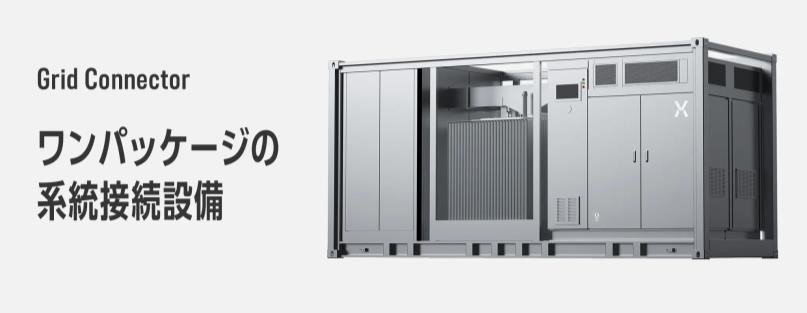
- PowerX unveils integrated grid connection unit for BESS
- (Company statement, August 3)
- PowerX unveiled its “Grid Connector” series, an integrated grid-connection solution containing all the equipment required to connect a BESS unit to the grid.
- The system includes PCS, transformers and high-voltage switchgear, all integrated into a single unit that can be connected to either the new Mega Power 4000 series or the standard Mega Power 2500 series.
- By enhancing compatibility between PowerX’s BESS systems and grid-connection equipment, the integrated solution reduces installation costs and provides a centralized cybersecurity system.
- As for data centers, the firm also plans to add a cooling system to the package. o The Grid Connector series will be commercialized in 2027.
Asuene agrees with SMFL Mirai to expand solar-related business
(Company statement, July 30)
- Asuene agreed with SMFL Mirai Partners to introduce the latter’s on-site PPA services to customers of its AI platforms for energy management and carbon emissions visualization.
- CONTEXT: SMFL Mirai Partners provides on-site solar PPA services, targeting firms that own factories or plan to install solar PV systems. Asuene operates two AI platforms: Asuene, a sustainability and carbon emissions management platform, and NZero, an energy optimization platform.
- Companies referred by Asuene will also be able to use NZero to simulate the carbon emission reduction and cost-effectiveness of installing solar PVs.
- SIDE DEVELOPMENT:
- Asuene raises ¥13.5 billion via third-party allotment
- (Toyo Keizai, August 7)
- Asuene Co. raised ¥13.5 billion through a third-party share allotment.
- Funds will strengthen AI capabilities and product development. o Investors include Decarbonization Partners, Twin Towers Ventures, Ricoh Innovation Fund, Incubate Fund, and Daikin.
- CONTEXT: Asuene aims to accelerate M&A across Japan, the U.S., Europe, and the rest of Asia. It recently acquired all shares of 2degrees, a UK-based company that offers Secaro, a platform for visualizing carbon emissions across supply chains, for ¥6 billion. Secaro and Asuene Europe are expected to be merged by the end of 2026. Last month, Asuene also raised $87 million in a Series D funding round.
Nomura Real Estate and Mitsubishi set up fund for solar power PPAs
(Company statement, August 3)
- Nomura Real Estate Investment and Mitsubishi HC Capital created a private placement fund to develop rooftop and ground-mounted solar energy and a renewable energy supply platform business for Nomura Real Estate Group.
- The equivalent of 100 MW of solar energy generated will be supplied to real estate properties owned by Nomura Real Estate Group through off-site or virtual PPAs.
JICA, World Bank, ADB finance Timor Leste’s first solar and BESS
(Company statement, July 28)
- JICA, the World Bank, and the Asian Development Bank invested in Timor-Leste’s first utility-scale solar and battery energy storage project, to be operated by Manatuto Renewables Power, a JV between EDF and Itochu.
- The project will consist of a 74 MW solar farm and an 80 MWh BESS. In addition to financing construction and operation of generation facilities, the banks will also support the construction of transmission lines and ancillary equipment.
- Electricity will be sold to Timor-Leste’s national utility under a 25-year PPA.
- The total financing amounts to $86 million.
- TAKEAWAY: Timor-Leste’s power system is dependent on diesel, leaving the country highly exposed to imported fuel costs and energy security risks. This led the govt to set a target of 50% share of renewables in the energy mix by 2050. The facility is expected to generate electricity to power about 80,000 households; the country has 1.4 million inhabitants.
Toyota selects GS Yuasa’s lithium-ion battery for its hybrids
(Company statement, August 4)
- Toyota selected Blue Energy’s lithium-ion battery for the hybrid Lexus ES model.
- The company, a subsidiary of GS Yuasa, manufactures and sells “EHW4GA”, a lithium-ion battery for automotive applications.
- Compared with regular batteries, it offers a 10% improvement in charge/ discharge.
LONGi achieves new solar cell conversion efficiency record
(Company statement, July 31)
- China’s LONGi achieved a new record for energy conversion efficiency thanks to its next-gen perovskite-silicon tandem solar cell, reaching a 35.5% rate.
- The firm received certification from the European Solar Test Installation, confirming this is the highest conversion efficiency ever for this type of solar cell.
- CONTEXT: Last June, LONGi achieved a conversion efficiency of 34.82%.
Kanagawa Pref selects five demos of PSCs and CSCs
(Organization statement, July 28)
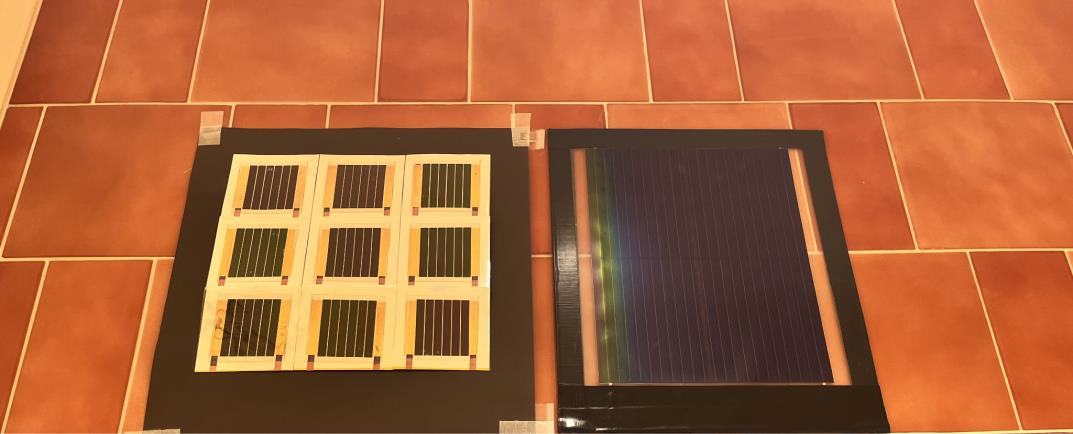
- Kanagawa Pref chose five PSCs and CSCs to test installation on difficult surfaces.
- PSC cells are provided by Enecoat Technologies, while CSCs are provided by PXP.
- The demos begin this fall.
| Applicant | Cell | Installation details |
| Fujiki EEM | PSC | Roof of a warehouse in Keihin coastal area in Yokohama, to power measuring devices |
| Tokyo Gas Ecomo | PSC | Roof and walls of a business office in Yokohama, to power BESS |
| Daichi Kotsu Sangyo | CSC | Roof of a taxi carport in Yokohama, to power lighting |
| Suzuki | CSC | Roof of a car park in Yokohama, to power lighting and small-sized EVs |
| Green Life | CSC | Roof of a canopy in two stores in Fujisawa and Sagamihara, to power nighttime lighting and security lighting |
- TAKEAWAY: The first demo will test PSCs in places prone to damage, as the warehouse is by the bay. Kanagawa Pref has held numerous demos of next-gen flexible solar cells across a wide range of applications, highlighting the region’s commitment to the technology.
- SIDE DEVELOPMENT:
- Kobe City selects Tokyo Gas for a CSC demo
- (Company statement, August 4)
- Tokyo Gas was selected by Kobe City (Hyogo Pref) for deployment of next-gen solar cells, and signed a deal with the city to hold a demo at buildings where conventional solar PV installation is difficult.
- CSCs provided by PXP will be installed by Tokyo Gas on public facilities such as exhibition halls and bicycle parking structures, leveraging the firm’s experience in solar PV deployment through its Hinatao Solar PPA service.
Toin Gakuen and Tokyu launch indoor PSC demo
(Company statement, August 4)
- Toin Gakuen Educational Foundation and Tokyu launched a demo using film-type PSCs to evaluate performance in indoor lighting conditions.
- PSCs made by Toin Gakuen will be installed in Yokohama in popular shops. The data collected will help assess potential applications inside buildings or railway stations.
- TAKEAWAY: Indoor solar power generation refers to PV devices that generate electricity from artificial light sources like LEDs. They are primarily intended for low-power IoT devices. Compared with outdoor PV, indoor units operate in a more stable environment, extending the life expectancy of cells, while also limiting the need for BESS since lighting can be available continuously. Currently, indoor PVs remain at an early commercial stage.
UPDATER becomes BESS aggregator
(Company statement, July 31)
- UPDATER will enter the BESS aggregation market after being qualified to trade electricity in the balancing market.
- The firm aims to aggregate 1 GW of BESS capacity by 2030, building a nationwide network comprising low- and high-voltage, residential, and co-located BESS; and combining electricity with the environmental value of renewable NFCs to supply 100% renewable energy.
- TAKEAWAY: UPDATER will focus on very small BESS units (under 50 kW) before gradually expanding into larger projects, including co-located BESS installations that could become extra-high-voltage. This appears to be a deliberate strategy to gain operational experience and a solid position in the BESS aggregation market, rather than focusing from the outset on the acquisition or development of larger assets, which typically involve longer project timelines.
Nozawa and AGC launch structure for vertical PV installation
(Company statement, July 30)
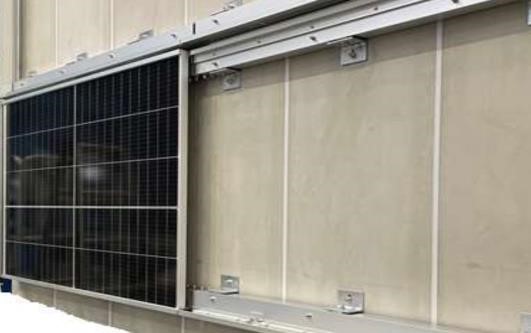
- Nozawa and AGC launched SUNBRICK™, an installation method for solar PVs.
- This method fixes the PVs in a steel frame, enabling vertical installation on walls, and is able to withstand earthquakes.
- CONTEXT: This method has been developed by both firms since 2022, which then held demos to test power generation and construction.
NEWS: WIND POWER AND OTHER RENEWABLES

KEPCO buys stake in 600 MW hydro project in the Philippines
(Company statement, July 29)
- KEPCO bought a 12.18% stake in the Wawa hydroelectric project in the Philippines.
- Other stakeholders are Prime Infrastructure Capital (51.13%) and First Gen (24.69%).
- The project, a pumped-storage hydropower plant, will start operation in 2030, with a total capacity of 600 MW.
- TAKEAWAY: This project is part of the Philippines’ hydropower development plan. In 2025, the country had 3.8 GW of installed hydropower, including 736 MW of pumped-storage, a segment that’s highly promoted. In Feb 2025, the Dept of Energy auctioned 4.25 GW of pumped-storage capacity, but bids reached 6.95 GW. The projects are expected to start operation between 2030 and 2035 across the Luzon and Visayas island grids. Overall, the Philippines aims for a 40% share of renewables in the energy mix by 2040.
KHI to optimize biomass equipment at JERA’s cofiring power plant
(Company statement, July 31)
- KHI won an order to optimize biomass equipment at JERA’s Taketoyo co-firing thermal power plant (1.125 GW) in Aichi Pref.
- Fire prevention measures will be implemented, including monitoring systems that can detect fires at an early stage and automatically suppress them.
- The work is expected to be completed by June 2028.
- TAKEAWAY: Fires at biomass and cofiring power plants are a significant operational and financial risk, especially for a facility of this size. Such risk led Chubu Electric to withdraw from the biomass power generation business last January, following the Sept 2023 fire at Yonago biomass power plant (Tottori Pref), citing the high cost of improved safety measures.
JR East signs biomass virtual PPA with Osaka Gas
(Company statement, August 5)
- JR East signed a virtual PPA with Daigas Energy, a subsidiary of Osaka Gas, to receive the environmental value equivalent to 530 GWh of electricity from the 75 MW Hirohata biomass power plant in Himeji (Hyogo Pref).
- Electricity consumed by JR East will continue to be supplied by retail electricity providers; the environmental value will be transferred under the virtual PPA. The agreement covers the equivalent of about 12% of JR East’s annual carbon emissions.
- TAKEAWAY: With JR East targeting carbon neutrality by 2050, it will need other high-scale PPAs, in addition to rooftop solar installations and other initiatives. Beyond solar and wind PPAs, biomass-based PPAs could become increasingly important for large industrial electricity consumers and railway operators, as biomass offers dispatchable baseload and a long-term, stable source of renewable energy and environmental value.
Hexa Energy invests in geothermal energy in Kumamoto
(Company statement, July 30)
- Hexa Energy Services agreed with Furusato Thermoelectric on a potential investment in the company’s geothermal projects in Kumamoto Pref, leveraging Hexa’s experience in asset management, PPAs, and fundraising.
- CONTEXT: Furusato Thermoelectric operates two geothermal projects in the prefecture: Waita No. 1 (2 MW) and Waita No. 2 (5 MW).
- TAKEAWAY: Hexa has historically focused on solar power plants and BESS. Its move into geothermal comes amid growing activity in geothermal PPAs and exploratory drilling to assess potential resources, suggesting that renewable energy developers now view geothermal as an attractive financial opportunity.
NEWS: NUCLEAR ENERGY
NRA to revise regulations for Rokkasho reprocessing plant
(Nikkei, August 4)
- In 2027, the NRA plans a major revision of the Act on the Regulation of Nuclear Source Material, Nuclear Fuel Material and Reactors.
- This is the first major regulatory overhaul in 10 years, and will address the three core pillars of regulation: Safety, Security, and Safeguards.
- An independent agency will oversee safeguards, to verify that nuclear materials are not for military use. It will take over IAEA inspection responses and equipment blueprint verifications. The latter are now managed by NRA officials.
- This move anticipates the launch of JNFL’s reprocessing plant in Rokkasho (Aomori Pref). If completed in FY2026, the plant will process up to 8 tons of plutonium a year. It will require continuous readiness for strict, unannounced IAEA inspections.
- Also, seismic data fabrication was discovered at Chubu Electric’s Hamaoka NPP. The law will introduce penalties for operators who submit false applications to the NRA.
- TAKEAWAY: These regulatory adjustments align with policy approved in July and the 2025 Basic Energy Plan. It seeks to maximize nuclear power and promote the nuclear fuel cycle. These measures are vital for safety and operational efficiency, as many NPPs are nearing the limit for how much spent fuel they can store. An operational Rokkasho plant is the next big step for the nuclear sector. For more info see our July 6, 2026 Analysis section.
Mutsu mayor backs study on accepting spent fuel from more utilities
(Nikkei, August 7)
- The mayor of Mutsu City in Aomori Pref approved a proposal to study whether the city’s interim spent-fuel storage facility should accept fuel from utilities other than TEPCO and Japan Atomic Power.
- The facility has storage capacity of 5,000 tons, but current estimates suggest TEPCO and Japan Atomic Power would not use all of it under the existing framework.
- The mayor asked for a revised long-term transport plan that includes other power companies. The city council also supported the move.
- The facility is still awaiting final approval from Aomori Gov. Miyashita to begin operations in FY2026, partly because of continuing delays at the Rokkasho reprocessing plant.
- CONTEXT: The Mutsu facility was built as an interim storage site for spent nuclear fuel before eventual reprocessing. Expanding the number of eligible utilities could improve its utilization and give other nuclear operators more storage flexibility. But the issue is politically sensitive because local acceptance depends on confidence that the fuel will not remain in Mutsu indefinitely, a concern made harder by repeated delays at the Rokkasho reprocessing plant.
NEWS: TRADITIONAL FUELS

Crude imports rise as U.S. barrels offset Middle East decline; but U.S. supply strained (Government data, media reports, July 31-Aug 6)
- Japan’s crude oil imports rose 5.9% YoY to 10.03 million kl in June, the first increase in four months, according to METI survey data.
- The Middle East share fell to 62.3%, down 11.6 percentage points from May, while the U.S. share rose to 32.3%, up 9.9 points.
- The shift reflects Japan’s effort to diversify crude procurement after the U.S. / Israeli war with Iran raised concerns over the Strait of Hormuz. Japan normally relies heavily on Middle East crude, so the June data show how quickly refiners adjusted procurement when regional risk rose.
- CONTEXT: The figures differ from Japanese Customs data because the two datasets record imports differently. Customs data are based on cargoes cleared through customs, while METI’s figures are based on company reports. Timing differences mean the same cargo can appear in different months, and METI’s figures are preliminary.
- Still, the shift toward U.S. crude may not be easy to sustain. U.S. crude exports fell after a record high in May, with exports to Japan down 20%, as tighter American inventories pushed up export prices.
- The latest U.S. crude stocks data also shows reserves at a 45-year low, with the AP reporting that the country has only 43 days of supply in its Strategic Petroleum Reserve.
- Higher U.S. crude prices also complicate Japan’s diversification strategy. Japanese refineries are generally optimized for Middle East grades, so using more U.S. crude can improve supply security but may raise costs or require operational adjustments.
- TAKEAWAY: The good news is – June’s METI data suggest Japan’s crude diversification effort worked in the short term: Middle East dependence fell sharply, and U.S. crude filled much of the gap. But this adjustment also shows the limits of diversification. U.S. barrels can reduce exposure to Hormuz risk, but they bring their own vulnerabilities, including price volatility. There are also the realities of a much-declined U.S. inventory over the past five years and potential political pressure in Washington to prioritize domestic fuel prices. What Japan needs now is a mid- and long-term strategy, which will inevitably be more costly than the pre-Iran-war setup and more complex than merely pivoting to U.S. purchases.
ENEOS to invest $6 billion in global expansion
(Nikkei Asia, August 5)
- In a $2.17 billion deal with Chevron, ENEOS bought petroleum product marketing businesses in SE Asia and Australia, including 12 oil depots and refineries.
- ENEOS plans to boost its worldwide growth investments by about $6.36 billion.
- The acquisition establishes footholds in Singapore, Malaysia, the Philippines, Australia, Vietnam, and Indonesia. ENEOS secured 7.2 million barrels of storage capacity. ENEOS aims to play a key role in Japan’s “POWERR Asia” framework for regional energy supply cooperation, to use these regional bases for production and for distribution of decarbonized fuels, such as sustainable SAF and biofuels.
- CONTEXT: ENEOS’s net debt-to-equity ratio of 0.48 (well below its target limit of 0.7 to 0.9) leaves significant room for further M&A. But many of the acquired Chevron assets are in the red.
- TAKEAWAY: The push to have a more global footprint comes as Japan is forecast to lose 11% of petroleum products demand between FY2024 and FY2030. Hence, the ENEOS plan to increase overseas sales ratio from 16% in FY2024 to 30% in FY2027, and 50% by FY2030. A major challenge, however, is pursuing the volume game while also engaging in a transition to decarbonized fuels, which is a capital-intensive strategy. How ENEOS intends to use the newly acquired assets to distribute SAF, for example, given feedstock shortages is unclear.
- SIDE DEVELOPMENT:
- ENEOS cuts industrial fuel oil prices, while gasoline stays flat
- (Japan NRG, July 7)
- ENEOS cut its Q2 price for high-sulphur C fuel oil, used in general industrial boilers, to ¥106,570/ kl, down ¥11,960, or 10%, from Q1. The reduction lowers fuel costs for factories and other industrial users that still rely on heavy oil.
- ENEOS also cut its Q2 price for low-sulphur C fuel oil, used by utilities for thermal power generation, to ¥120,930/ kl, down ¥10,130, or 8%. This matters for power companies because fuel oil is often used for backup or peak thermal generation, so lower prices can reduce marginal generation costs when oil-fired units are dispatched.
- ANRE said the national average retail price for regular gasoline was ¥170.1/ liter, unchanged from the previous week’s survey. The flat price reflects the government’s fuel subsidy scheme, which is keeping retail gasoline close to ¥170/ liter despite volatility in underlying fuel costs.
- METI said the balance of the gasoline price-suppression subsidy fund stood at ¥210 billion as of late July. Subsidy payments for June sales totaled about ¥170 billion, while the payout for July sales could fall to around ¥80 billion as crude-related cost pressure eases.
- CONTEXT: The C fuel oil cuts reflect a recent decline in reference crude prices after Middle East tensions had pushed Q2 prices to their highest level since 1985. Industrial and utility users are therefore seeing cost relief more directly. Retail gasoline prices, by contrast, remain shaped less by market movement and more by the government subsidy, which is smoothing prices for consumers.
- TAKEAWAY: Industrial and power-sector fuel users are beginning to benefit from lower crude-linked prices, while gasoline consumers remain insulated by policy. Without subsidies, regular gasoline would be closer to ¥189/ liter, compared with the current ¥170/ liter level. That means the fiscal burden is easing as crude pressures fall, but the government is still absorbing a large part of the price shock that would otherwise hit households and drivers.
JAPEX buys oil and gas field stakes in the U.S.
(Company statement, Japan NRG, August 6)
- JAPEX announced a $320 million acquisition of oil and gas field stakes in Colorado and Wyoming from Fundare Resources.
- This could boost operating profits by over ¥1 billion in FY2027 and ¥15 billion in FY2028.
- JAPEX raised its FY2026 net profit forecast to ¥65 billion (up 22% YoY).
- TAKEAWAY: This deal follows the purchase of adjacent Verdad Resources in February, aiming to cut costs and boost efficiency. JAPEX sees room to expand around those assets, and may consider further U.S. tight oil/gas acquisitions, plus assets in other countries.
Chiyoda wins contract to chart roadmap for rebuilding Qatar’s Ras Laffan LNG
(Nikkei, August 3)
- Chiyoda Corp won a contract to chart a roadmap for rebuilding Qatar’s Ras Laffan Industrial City, with many of its facilities offline since March.
- Chiyoda will identify damaged equipment across two production lines (trains) of Ras Laffan LNG. QatarEnergy and ExxonMobil will fund the project.
- If Chiyoda secures the full contract to rebuild and replace equipment, the total could reach tens of billions of yen in value.
- In March, Qatar’s Energy Minister estimated that restoration would take three to five years. Actual rebuilding could begin by early 2027.
- Chiyoda won the roadmap contract because it originally built the plant.
- CONTEXT: The damaged plant has a 12.8 Mtpa production capacity, about 20% of Qatar’s total export volume.
- SIDE DEVELOPMENT:
- Chiyoda Corp profit drops
- (Company statement, August 4)
- Chiyoda Corp reported a 14% drop YoY in consolidated Q1 net profit to ¥5.5 billion. Net sales also dropped 4% to ¥86.7 billion; new orders were sluggish at ¥31 billion.
- CONTEXT: This drop was a reactionary decline following a one-time gain in the same period last year. The latter came from contract revisions on an LNG project in the U.S. Renewed U.S. hostilities in the Middle East sparked concerns that construction on a major LNG project in Qatar might face delays.
- TAKEAWAY: Chiyoda says it is on track to meet its ¥300 billion full-year order target, and it expects to secure major project contracts in 2H of FY2026. Also, the Iran war impact has been lighter than Chiyoda’s initial assumptions. Rather than retreating from the region, Chiyoda plans to win ¥50 billion in new orders with Middle East reconstruction demand as the driver.
Cosmo Energy reports ¥84 billion in net profit for Q1
(Company statement, August 6)
- For Q1, Cosmo Energy reported a net profit of ¥84 billion, a recovery from a ¥2 billion loss in the same period last year. This turnaround is due to a 17% rise in sales (to ¥761 billion) and expanded profit margins on gasoline and diesel.
- This comes amidst rising product prices after crude oil prices jumped due to the Strait of Hormuz crisis.
- The full-year earnings forecast for FY2026 remains unchanged. The company expects later drops in crude oil prices to offset these first-quarter gains.
KHI in discussions to resume building LNG carriers
(Nikkei, August 7)
- KHI is in discussions to resume building LNG carriers in Japan.
- With Imabari Shipbuilding and Namura Shipbuilding, KHI aims to resume construction around 2035.
- It targets three to five vessels a year. The Sakaide Works is the leading candidate site for this project. It plans to invest in upgrades there.
- CONTEXT: In June, the govt decided to include domestic LNG carriers in its public-private investment strategy.
LNG stocks down from previous week, up YoY
(Government data, August 5)
- As of August 2, the LNG stocks of 10 power utilities were 2 Mt; down 1% from the previous week (2.02 Mt); down 0.5% from end Aug 2025 (2.01 Mt), and down 5.7% from the 5-year average of 2.12 Mt.
ANALYSIS
BY THOMAS SHOMAKER
Japan Eyes Floating LNG To Help Stabilize Energy Supplies
Japan is moving to the forefront of a new wave of LNG projects. Only this time, the plants float.
In early June, Mitsui O.S.K. Lines (MOL) announced a $300 million investment in Delfin FLNG 1, the first floating natural gas liquefaction facility planned off the U.S. coast. Located 74 kilometers off Louisiana, the vessel will have an annual production capacity of 4.4 million tons, making it one of the world’s largest floating LNG facilities. MOL will hold 23% of the project’s equity and contribute expertise gained from operating the world’s largest LNG carrier fleet.
Days later, JGC Corp said its French subsidiary would help build a new FLNG plant off Mozambique. JGC Global is also developing a standardized FLNG design intended to reduce the cost and construction time of the project-specific vessels that have so far dominated the industry.
The announcements reflect a broader shift. Japan, the world’s second-largest LNG importer, is increasingly deploying its capital, engineering expertise and shipping capabilities in FLNG projects overseas. The global market, worth nearly $30 billion in 2025, is projected to reach about $79 billion by 2034.
Asia-Pacific already accounts for around 35% of the market. But Japanese companies are now extending their reach beyond established regional partnerships to projects in Africa and the U.S. Gulf of Mexico.
For Japan, FLNG is more than a growth industry. Floating facilities can avoid congested ports, access otherwise stranded gas fields and, in some cases, be relocated when conditions change. That flexibility could provide an additional buffer against geopolitical disruption, extreme weather and other threats to conventional energy infrastructure.
The question is whether Japan can turn its early investments and technical advantages into a durable position in a rapidly expanding market – and whether efforts to standardize FLNG construction can finally bring down its stubbornly high costs.
Infrastructure expertise
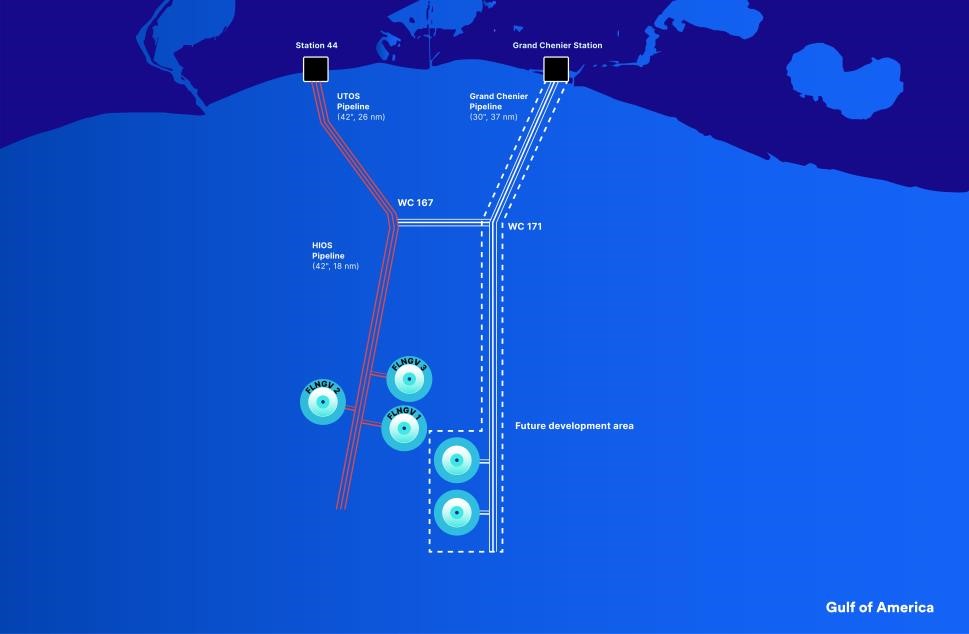
Delfin FLNG 1 is the first of three planned vessels off Louisiana, all being developed by Delfin Midstream, an investment group under the U.S. fund Global Infrastructure Partners. The first vessel, in which MOL will hold its 23% stake, is being built by Samsung Heavy Industries.
In addition to participating as an investor, MOL will support the project through its expertise in Floating Storage and Regasification Units (FSRUs), which can replace onshore LNG import terminals. MOL provided West Africa’s first FSRU in 2021 and Hong Kong’s first in 2025.
The company has experience both in commissioning new FSRUs and converting existing LNG carriers. Such conversions are typically much faster than building onshore terminals and retain the mobility associated with floating infrastructure.
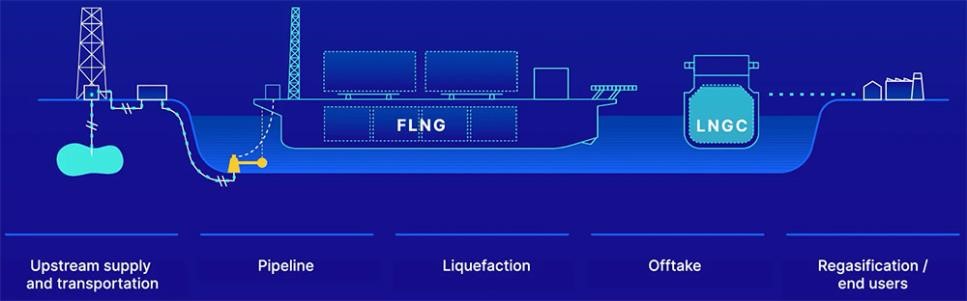
While FSRUs turn imported LNG back into gas, FLNG plants perform the opposite task: liquefying natural gas at sea and reducing it to around 1/600 of its gaseous volume for transport.
MOL also brings considerable operational know-how. It operated 107 LNG carriers in 2025 as part of a wider private fleet of about 935 vessels, including extensive experience in ship-to-ship transfers.
Delfin Midstream is already advancing plans for a second vessel, Delfin FLNG 2, in partnership with MidOcean Energy, which was formed by U.S. investment firm EIG. Under their agreement, MidOcean may acquire up to a 50% stake in the project and the same share of its LNG production.
Japanese financing is again playing a role. In March, Idemitsu Kosan announced a $500 million investment in MidOcean Energy, describing the deal as the beginning of its fullscale entry into the LNG market, starting unusually with FLNG development.
Not all FLNG are the same
While most FLNG facilities are designed to exploit offshore gas fields, the three planned Delfin vessels will receive gas from the U.S. mainland through subsea pipelines.
Together, they are expected to have an annual production capacity of 13.2 million tons.
If the first three projects succeed, Delfin plans to develop another two vessels in the Gulf of Mexico using the same model.
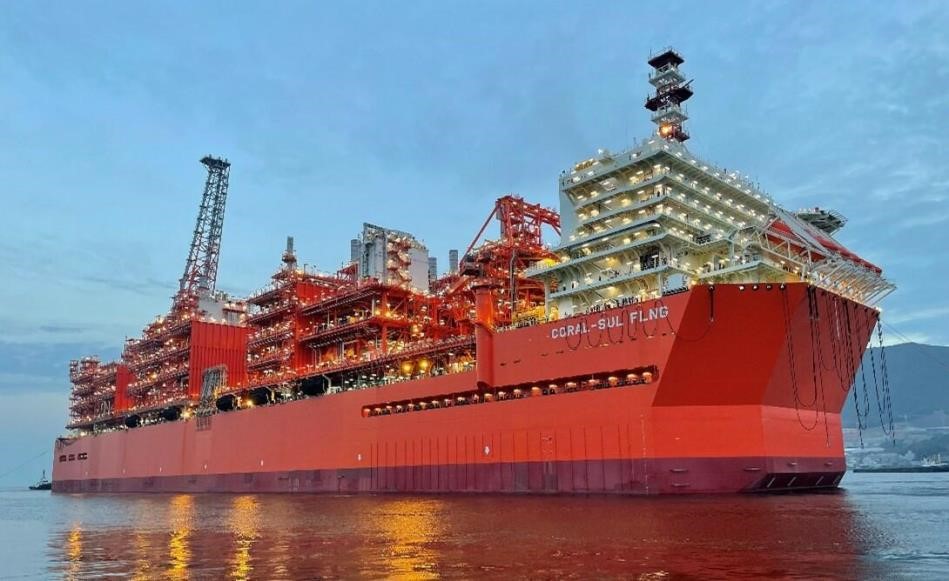
Most FLNG facilities, however, sit directly above the offshore fields they exploit. Differences in water depth, gas composition, weather conditions and the companies involved have pushed the industry towards costly, time-consuming and highly customized designs.
Yokohama-based JGC Corp, which has established a leading position in the global FLNG industry, is trying to change that.
JGC France and several consortium partners are now building the Coral North FLNG project off Mozambique, following the success of Coral South, which shipped its first LNG cargo in November 2022.
Coral North will be located about 50 kilometers off Mozambique’s northern coast, with planned annual output of 3.6 million tons and operations scheduled to begin in 2028. Together with its previous involvement in two Petronas FLNG projects in Malaysia, the development gives JGC a growing base of experience across different offshore environments.
JGC Global is now drawing on that experience to develop a standardized FLNG package that could reduce both project costs and construction timelines.
This is not its first attempt to improve LNG production efficiency. In 2022, JGC partnered with shipping company Kawasaki Kisen to develop a new type of FLNG hull using LNG storage tanks repurposed from retired or ageing carriers.
For the standardized package, JGC has partnered with U.S. technology group Honeywell. The design will use Honeywell’s proprietary dual mixed refrigerant LNG process, known as AP-DMR, which combines a coil-wound heat exchanger with a smaller footprint and lower energy requirements than traditional shell-and-tube systems.
JGC previously deployed AP-DMR in the Coral South project. At the time, the technology belonged to Air Products, which sold its LNG process technology and equipment business to Honeywell in 2024.
JGC is also relying on modular construction. Sections of the eventual facility, complete with piping and equipment, are assembled off-site inside structural frames before being transported and installed on the vessel.
The approach resembles fitting together large industrial building blocks. It can reduce on-site construction requirements and is particularly useful in locations where harsh weather limits construction windows or skilled labor is difficult to secure.
The largest prize, however, may be the ability to develop smaller gas fields.
Today’s high costs and project-specific designs naturally favor the largest known reserves. A cheaper and more standardized mobile facility could make it commercially viable to exploit small and medium-sized fields containing less than 1 trillion cubic feet of gas.
That would expand the number of resources available for development and potentially reshape the economics of the global LNG market.
Public push and market expansion
In early July, METI and India’s Ministry of Petroleum and Natural Gas released a joint statement on energy resilience, pledging cooperation on stockpiling systems and potential investments in maritime energy transportation.
A few days later, JOGMEC signed a cooperation agreement with JAPEX and Indonesia’s Padjadjaran University to conduct oil and gas surveys in the North Sumatra sedimentary basin, which is believed to contain undiscovered large-scale gas fields.
The collaboration falls under JOGMEC’s Overseas Geological and Geophysical Survey program. Through the program, the METI-affiliated agency forms agreements with governments and institutions in priority regions before inviting Japanese companies to propose and lead exploration projects.
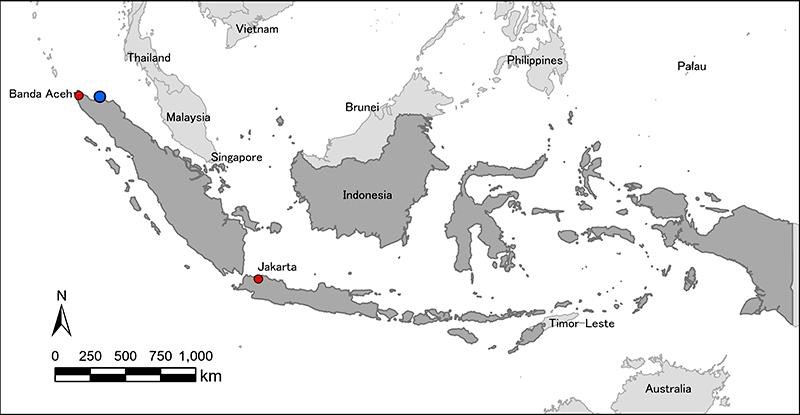
In April, JOGMEC signed a similar memorandum of cooperation with Malaysia’s stateowned Petronas covering the development of stable natural gas supplies and other areas. It was the latest in a series of agreements with Malaysia, Japan’s second-largest source of LNG imports.
Japan’s 7th Basic Energy Plan identifies LNG as a critical transition fuel and calls for public-private cooperation to secure long-term supplies. Although the plan anticipates a decline in thermal generation, much of that reduction is expected to come from lower coal use.
If Japan cannot achieve its target of cutting GHG emissions by 73% from 2013 levels through the expansion of renewables and other low-carbon energy sources, the plan’s reference scenario indicates that annual LNG use could reach 74 million tons in 2040 – above current levels.
The outbreak of the U.S.-Iran war has added urgency to the search for new supply routes and more flexible energy infrastructure. As Japan’s nuclear restart proceeds slowly and renewable capacity expands unevenly, LNG looks sure to remain central to balancing the power system.
Japan’s FLNG push represents more than a collection of overseas investments. It is an attempt to convert the country’s dependence on imported gas into an industrial advantage, using Japanese capital, ships and engineering to shape the infrastructure on which its future energy security may depend.
ANALYSIS
BY FILIPPO PEDRETTI
Japan’s SMR Push Exposes a Nuclear Paradox
Japan’s nuclear industry sees small modular reactors as a potential new growth market. For now, however, that market lies almost entirely overseas.
A growing number of Japanese manufacturers, engineering companies and specialist suppliers are positioning themselves for a future SMR supply chain. Their opportunity is partly driven by large technology and semiconductor companies seeking reliable, lowcarbon power for data centers and manufacturing sites. SMRs are presented as a possible source of captive or behind-the-meter generation for such facilities.
Japanese firms are participating in projects and partnerships in the U.S. and elsewhere. But inside Japan, there are no comparable commercial projects, no clearly identified deployment sites and no regulatory framework designed specifically for SMRs.
The contrast reflects a broader paradox in Japan’s nuclear sector. The country retains world-class engineering and manufacturing capabilities, yet has not completed a new reactor since 2009, before the March 2011 Fukushima disaster. Leading utilities remain focused on restarting existing plants and, over the longer term, replacing them with advanced versions of conventional light-water reactors.
For Japan’s nuclear engineers, SMRs may offer a new source of overseas business well before they become a realistic part of the country’s own energy system.
New market for Japan’s nuclear supply chain
The renewed interest in SMRs can be closely tracked to rising electricity demand from data centers, semiconductor plants and other large industrial users.
For those companies, the attraction is straightforward. A reactor located close to a major load could, in theory, provide round-the-clock power without relying entirely on a constrained public grid. It could also help companies meet emissions targets while avoiding some of the intermittency associated with renewable generation.
This remains largely a theoretical market. Commercial SMRs have yet to prove that they can be built repeatedly, on schedule and at sufficiently low cost. But the prospect of large corporate buyers has given the sector fresh momentum.
Japanese companies seek a place in this emerging supply chain. Hitachi-GE, IHI and Japan Steel Works are among the larger groups involved, alongside precision-equipment specialists such as Tamagawa Seiki and TLV.
Their roles range from reactor development and heavy components to valves, control systems and other specialized equipment. Several are looking particularly closely at U.S. projects, where developers seek to turn approved designs into repeatable commercial products.
The BWRX-300, developed by GE Vernova Hitachi Nuclear Energy, is one of the most prominent examples. Hitachi is one of several Japanese companies involved in its industrial base, while proposed projects in North America could provide the first meaningful test of whether the design can move from licensing and demonstration into wider deployment.
Japan also supports the sector through overseas investment and industrial cooperation. The logic is not just to export fully-made reactors but to ensure that Japanese firms have a role in the components, engineering and services surrounding a new generation of nuclear projects.
The U.S. is the most obvious proving ground because it combines large potential demand, federal support and a regulatory process that is already engaging with SMR designs. Japanese nuclear supply chain vendors have also pursued discussions and cooperation in Southeast Asia, where rising power demand could create another market.
Overseas progress, domestic absence
The picture inside Japan is very different.
The nation’s latest energy strategy includes next-generation nuclear technologies in its longer-term plans, and government roadmaps envisage SMRs potentially entering operation in the 2030s. But those dates remain aspirational.
There is no domestic SMR project approaching construction. No major utility has committed to building one, and no site has entered a concrete approval process.
The largest nuclear operators are instead concentrating on technologies closer to the existing fleet. Mitsubishi Heavy Industries is developing the SRZ-1200, an advanced pressurized-water reactor; while Hitachi-GE has promoted the HI-ABWR, based on the boiling-water reactor lineage already used in Japan.
That makes sense in Japan’s context. Utilities, manufacturers and regulators already have decades of experience with large light-water reactors. And even these designs face a lengthy process of regulatory discussion, site selection, local consent and construction – a process that became that much more arduous since the Fukushima accident.
SMRs would begin much further back.
The Nuclear Regulation Authority has not yet established a dedicated regulatory framework for their design and operation. Basic questions would need to be addressed over emergency planning, staffing, security, multiple-module sites and the extent to which claims of passive safety could justify different requirements from those applied to conventional reactors.
The U.S. Nuclear Regulatory Commission already spent years examining such issues. Japan has not yet begun an equivalent process in earnest.
Building experience abroad has obvious advantages. Japan’s nuclear equipment vendors can participate in real licensing cases, qualify equipment, gain operating knowledge and establish commercial relationships without waiting for a domestic project to emerge.
But foreign approval won’t translate automatically into approval in Japan. Domestic regulators would still need to assess how any design performs under local requirements, including seismic, tsunami and other site-specific risks.
A boost for industry, not yet for the grid
This makes the SMR opportunity important, but narrower than some of the industry rhetoric suggests.
For Japanese nuclear firms, overseas SMRs could provide new orders, preserve specialist manufacturing capabilities and give younger engineers experience. After years of limited reactor construction at home, that alone would be a significant benefit.
SMRs could also broaden the customer base for nuclear power. Conventional reactors are built by utilities and integrated into large power systems. Smaller units may eventually appeal to industrial parks, data-center operators and other companies willing to contract directly for dedicated power.
Yet the commercial model remains unproven. Smaller reactors lose some of the economies of scale enjoyed by large plants and must compensate through factory production, standardized designs and repeated construction. That requires a volume of orders that does not yet exist.
Several early projects have already struggled with rising costs, delayed schedules and uncertain customer demand.
Japan could be judged as making a rational but limited bet on a new global market that has yet to justify its excited promotion. Tokyo won’t be an early adopter of SMRs but is positioning itself as the equipment maker, investor and engineering partner.
Japanese SMRs’ fastest route back home may actually materialize as an import.
Government roadmap
| Reactor Type | Key Milestones | Expected Operation Timeline |
| Fast Reactor | Design and R&D phase through 2028; decision on transition to basic design after assessing technology, long-term energy policy, and economic viability; fuel selection (oxide vs. metal fuel) to be completed in FY2026. | Demonstration reactor operations targeted for the 2040s. |
| High-Temperature Gas-cooled Reactor (HTGR) | Conceptual design for the demo reactor to conclude in FY2026; basic design phase begins FY2027; hydrogen production testing using the HTTR starts in FY2028; cost assessment and decision on further development; deployment in FY2029. | Demonstration reactor operations expected in the late 2030s; commercial deployment in the 2050s. |
| Small Modular Reactors (SMRs) / Innovative Light Water Reactors | Design and construction activities planned throughout the 2020s and early 2030s. | Innovative Light Water Reactors expected to begin operation in the mid-2030s; Small Light Water Reactors expected to enter domestic operation in the 2040s. |
| Fusion Energy | Continued development toward a demonstration power-generation system during the 2030s. | Demonstration power generation targeted for the 2030s. |
ASIA ENERGY REVIEW
BY JOHN VAROLI
A brief overview of the region’s main energy events from the past week
Australia / Data centers
Despite growing opposition, the govt pledged to press on with a nationwide effort to ensure that new data centers use renewable energy. The govt will pass laws to encode this policy.
Australia / Shale gas
Vast shale gas resources give Australia an edge in the global energy sector, especially at a time when the U.S.- Iran war is constraining supplies, said investor Bryan Sheffield.
China / Coal
China’s use of coal for electricity grew in H1 of 2026 as a record amount of wind and solar power was wasted through curtailment. China brought 30 GW of new coal power capacity online; coal-fired generation rose 3%, according to Global Energy Monitor. Only 2.7 GW of coal power was retired in the same period.
India / Oil
Moscow remains vital to India’s energy security. According to Kpler, in July, India imported around 2.8 mbpd of Russian crude, exceeding June’s record of 2.7 mbpd. Russia supplied roughly 55% of India’s total crude imports.
India / Renewables
The govt will consider waiving transmission charges for solar and wind energy developers facing delays in the commissioning of projects due to transmission line shortages.
Indonesia / Fuel subsidies
The govt said it will keep the price of subsidized Pertalite gasoline unchanged through December despite elevated global crude oil prices. State energy company Pertamina has already lowered prices for several non-subsidized fuels.
Malaysia / Solar
The govt unveiled the next round of its large-scale solar tender, offering 2.5 GW of solar PV colocated with 1.25 GW of BESS capacity.
Philippines / Renewables
Next year, the govt will launch a dedicated Green Energy Auction for off-grid islands served by National Power Corp, to replace diesel generation with renewable energy and BESS.
South Korea / Coal
South Korea will drop plans to co-fire ammonia with coal at power plants, amid fears this could extend the life of coal power and hamper the country’s decarbonization efforts.
Taiwan / Renewables
TECO inked a corporate PPA with an unnamed semiconductor maker to supply more than 30 MW of renewable power; it plans more deals in the near future.
Disclaimer
This communication has been prepared for information purposes only, is confidential and may be legally privileged. This is a subscription-only service and is directed at those who have expressly asked K.K. Yuri Group or one of its representatives to be added to the mailing list. This document may not be onwardly circulated or reproduced without prior written consent from Yuri Group, which retains all copyright to the content of this report.
Yuri Group is not registered as an investment advisor in any jurisdiction. Our research and all the content express our opinions, which are generally based on available public information, field studies and own analysis. Content is limited to general comment upon general political, economic and market issues, asset classes and types of investments. The report and all of its content does not constitute a recommendation or solicitation to buy, sell, subscribe for or underwrite any product or physical commodity, or a financial instrument.
The information contained in this report is obtained from sources believed to be reliable and in good faith. No representation or warranty is made that it is accurate or complete. Opinions and views expressed are subject to change without notice, as are prices and availability, which are indicative only. There is no obligation to notify recipients of any changes to this data or to do so in the future. No responsibility is accepted for the use of or reliance on the information provided. In no circumstances will Yuri Group be liable for any indirect or direct loss, or consequential loss or damages arising from the use of, any inability to use, or any inaccuracy in the information.
K.K. Yuri Group: Hulic Ochanomizu Bldg. 3F, 2-3-11, Surugadai, Kanda, Chiyoda-ku, Tokyo, Japan, 101-0062.