
WEEKLY
September 7, 2026
ANALYSIS
CONTROL ROOM, NOT POLICY, LIKELY TO DECIDE TIMING OF POWER MARKET TRANSFORMATION
- Japan has spent years redesigning electricity markets, but the critical path may now run through software engineers rather than another METI committee.
- A now-delayed dispatch platform would replace today’s regional patchwork with a national operating brain, allowing market decisions, grid constraints and generator instructions to line up in real time.
TOKYO LEARNS FROM WAR’S TOUGH LESSONS
- Japan restored lost crude procurement by July, but only after a costly scramble that exposed several sensitivities: freight costs, naphtha shortages, refinery compatibility and dependence on specific ports.
- The lesson for Tokyo is that stockpiles alone are no longer enough. METI is now rethinking energy security around the full supply chain – how fuel is transported, refined, stored and converted into the industrial inputs the economy actually needs.
ASIA PACIFIC REVIEW
This column provides a brief overview of the region’s main energy events from the past week
NEWS
- METI and MoE seek larger FY2027 budgets
- METI considers non-fossil transition ranking
- MoE selects technologies and projects to cut data center emissions
- JEPX auctions underline the divide between FIT and non-FIT certificate markets
- EEX trading volume rises for third month
- Capacity auction still leaves FY2027 shortfall as ANRE proposes new capacity procurement measures
- Hitachi buys bio-methanation tech from Germany
- Itochu invests in India ammonia import tank
- JFE Techno-Research launches electrolysis tester
- NITE warns of typhoon risks at solar farms
- Japan added 5.9 GW of solar in 2025: RTS
- JFE Techno Research launches PSC testing services
- PowerX and Smart Energy to develop co-located BESS
WIND POWER AND OTHER RENEWABLES
- MoE comments on Tsugaru offshore wind review
- MLIT picks seafloor excavation tech for offshore wind
- Kyushu Electric plans mid-sized pumped-storage hydro
- MOL Sunflower and Kanematsu test biodiesel ferry fuel
- Mihama Unit 3 to resume commercial operations
- METI asks another locality to consider nuclear waste survey
- KEPCO updates dry storage plans in Fukui
- Japan power forwards rise as LNG curve stays elevated
- Oil firms admit diesel cartel violations
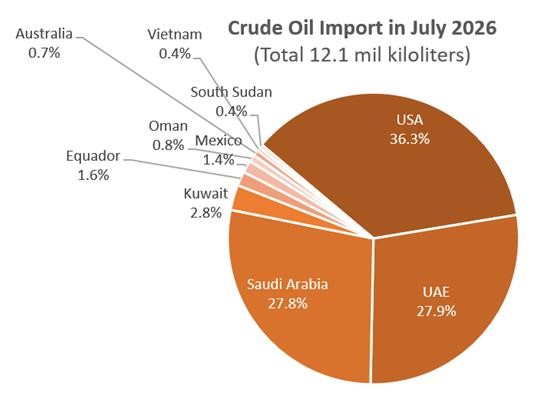
- U.S. becomes Japan’s top crude supplier in July
CARBON CAPTURE & SYNTHETIC FUELS
- BIPROGY to test clean fuel certificate system
- Atierra raises ¥60 mln for microalgae-based SAF
EVENTS
Sept 7-10 APPEC 2026 @ Singapore
Sept 9-11 Smart Energy Week (Autumn) 2026 @ Makuhari Messe (co-exhibiting H2 & FC Expo, Battery Japan, Smart Grid, Wind Expo, CCUS Expo, etc.)
Sept 9-11 Automotive World @ Makuhari Messe
Sept 14-18 IAEA General Conference 2026 @ Vienna, Austria
Sept 14-17 Gastech @ Bangkok
Oct 8 Innovations for Cool Earth Forum (ICEF) @ Westin Tokyo
Oct 13-15 Global Offshore Wind Summit – Japan 2026 @ Nagasaki
Nov 2-5 ADIPEC 2026 @ Abu Dhabi
Nov 3 U.S. Midterm Elections
Nov Publication of International Energy Agency – World Energy Outlook 2026
Nov 18-19 Asia-Pacific Economic Cooperation – Leaders Meeting @ Shenzhen, China
PUBLISHER
K. K. Yuri Group
Editorial Team
Yuriy Humber (Chief Editor)
John Varoli (Senior Editor, Americas)
Kyoko Fukuda (Data, Events)
Filippo Pedretti (Thermal, CCS, Nuclear)
Tetsuji Tomita (Power Market, Hydrogen)
Aglaé Bange (Renewables, Biomass & Energy Storage)
Gillian Sawyer (Renewables)
George Hoffman (Sales, Business Development)
Rada Kuznetsova (Clients Accounts, Website)
Tim Young (Design)
SUBSCRIPTIONS & ADVERTISING
Japan NRG offers individual, corporate and academic subscription plans. Basic details are our website or write to subscriptions@japan-nrg.com
For marketing, advertising, or collaboration opportunities, contact sales@japan-nrg.com. For all other inquiries, write to info@japan-nrg.com
NEWS: GENERAL OUTLOOK AND TRENDS

METI and MoE seek larger FY2027 budgets for investments
(Government statements, Bloomberg, Denki Shimbun, August 28–31)
- METI requested about ¥7.8 trillion for FY2027 across its general and special accounts, roughly 2.5 times its FY2026 initial budget.
- The request emphasizes AI, semiconductors, robotics, critical minerals, energy security and GX.
- About ¥5.7 trillion is earmarked for crisis-management and growth investment. This includes:
- ¥1.99 trillion for AI, semiconductors and robotics;
- ¥1.55 trillion for economic security and defense industrial-base measures;
- ¥1.98 trillion for resources, energy and GX.
- METI also requested ¥150 billion in additional fiscal-investment funding for state-backed semiconductor maker Rapidus via the Information-technology Promotion Agency, alongside a separate ¥32 billion debt-guarantee request intended to support borrowing from financial institutions.
- The MoE requested a combined ¥1.145 trillion across its general account, energy special account and reconstruction special account, exceeding ¥1 trillion for the first time in seven years.
- MoE also requested ¥1 billion for a new program to support locally led decarbonization projects that use regional resources, including disaster-resilience, domestic-resource-utilization and localeconomic-revitalization models.
- The ministry requested ¥73 billion for the regional decarbonization promotion grant, which supports local govt decarbonization projects.
- TAKEAWAY: The FY2027 budget requests show how GX is pulled into broader industrial and security policy. METI’s requests are no longer driven by GX per se, but specifically tied to AI and semiconductors, or critical minerals, and security. The MoE’s request is smaller but points in the same direction, linking regional decarbonization with resilience, local resources and economic development. These numbers are only requests and will face Ministry of Finance scrutiny and possible downward revision.
METI considers new non-fossil transition ranking for large energy users
(Government statement, August 18)
- METI’s working group on energy-efficiency standards for factories and other large energy users discussed creating a new 非化石転換クラス分け制度 (Non-Fossil Transition Classification System), which would rank companies according to the share of their energy use supplied from non-fossil sources.
- The system would complement the existing S/A/B energy-efficiency classification.
- For electricity, companies’ performance would reflect the non-fossil value associated with purchased power, including the use of non-fossil certificates. METI is also considering whether procurement that contributes more directly to increasing non-fossil supply, including on-site generation and PPAs, should receive additional recognition.
- The existing calculation methodology already gives a 1.2 weighting to certain measures considered to contribute more directly to non-fossil energy expansion. The working group is considering how such differences could be reflected in the new classification.
- METI aims to finalize the framework during FY2026, make the necessary regulatory changes in the early months of 2027, and begin publishing classifications based on FY2027 performance in FY2028.
- TAKEAWAY: The proposal is another indication that METI aims to distinguish between simply acquiring nonfossil value and procurement methods that contribute more directly to new supply. Non-fossil certificates would remain part of the compliance framework, but PPAs and on-site renewables could receive greater recognition.
MoE selects projects to reduce emissions from digital infrastructure
(Government statement, August 28)
- MoE selected four projects under its FY2026 program to develop and demonstrate environmentally friendly technologies (cooling, optimization, etc.) for decarbonizing digital infrastructure, including data centers (DCs).
- The projects are:
- POLASTECH: Adsorption heat pumps utilizing low-temperature waste heat at 50–55°C from liquid-cooled direct liquid cooling (DLC);
- TEPCO Renewable Power: Cooling energy supply systems for DCs utilizing renewable energy-derived heat;
- MORGENROT: CO2 reduction through integrated optimization of DC resources and job management;
- Otowa Electric Co.: Current-limiting DC (direct current) circuit breakers to reduce CO2 emissions from AI DCs.
- CONTEXT: To help achieve the targets for FY2030, FY2035, and FY2040 set in the Global Warming Countermeasures Plan, as well as carbon neutrality by 2050, technologies are needed to reduce CO2 emissions from digital infrastructure.
- TAKEAWAY: The selected projects signal a shift toward system-level decarbonization of DCs, integrating wasteheat recovery, renewable thermal energy, AI-driven optimization and advanced power infrastructure to enable both rapid digitalization and carbon neutrality.
TEPCO EP launches working group on DR value
(Company statement, September 1)
- TEPCO EP (TEPCO Energy Partner) launched a working group on demand response (DR) flexibility evaluation metrics and use under the GX Future League.
- The firm leads the initiative in partnership with eight others: Kansai Electric, Chubu Electric Miraiz, Hokkaido Electric, Hokuriku Electric, Shikoku Electric, CORONA, Daikin, and Mitsubishi Research Institute.
- METI and the Central Research Institute of Electric Power Industry (CRIEPI) will participate as observers.
- The working group will examine approaches and metrics for quantifying the social value of flexibility provided by DR-enabled devices such as heat-pump water heaters, batteries, and EVs.
- CONTEXT: As renewable energy deployment expands, DR is increasingly important for balancing electricity supply and demand. However, DR’s contribution to grid stability and carbon neutrality hasn’t been sufficiently quantified; thus, the need to develop a framework to assess its value.
- TAKEAWAY: If successful, the metrics could improve the visibility and economic value of DR and encourage greater investment in DR-enabled devices and services.
e-dash raises ¥3.3 billion via share allotment
(Company statement, August 31)
- e-dash raised ¥3.34 billion via a third-party share allotment.
- The firm is a GHG emissions visualization startup that was spun out from Mitsui & Co in 2022.
- Mitsui & Co supported the funding round. Other investors include West Holdings and Chugoku Electric’s subsidiary Chuden Kankyo Technos.
- The startup will help clients navigate growing disclosure requirements.
- CONTEXT: Firms in the Tokyo Stock Exchange Prime Market now face mandatory sustainability disclosures, under the Sustainability Standards Board of Japan (SSBJ) standards. As a result, demand for emissions consulting services is likely to grow.
NEWS: ELECTRICITY MARKETS

JEPX auctions underline divide between FIT and non-FIT certificate markets
(Exchange data, August 31)
- JEPX completed the first non-fossil certificate auctions of FY2026 across three categories.
- FIT certificates: 23.12 TWh cleared at a volume-weighted average price of ¥0.40/ kWh, down from ¥0.44/ kWh in May and returning to the market floor. Cleared volume increased 28.4% from 18 TWh in the previous auction.
- Non-FIT renewable-designated certificates: 1.14 TWh cleared at ¥1.21/ kWh, down from ¥1.30/ kWh. Buy bids totaled 12.26 TWh against 1.98 TWh offered.
- Non-FIT certificates without renewable designation: 0.11 TWh cleared at ¥1.20/ kWh, also down from ¥1.30/ kWh. Buy bids reached 11.15 TWh, compared with just 0.20 TWh offered.
- CONTEXT: FIT certificates are traded in the renewable-energy value market and can be purchased by both electricity retailers and eligible end users. Non-FIT certificates are traded in the market for meeting electricity retailers’ obligations under the non-fossil energy target framework.
- TAKEAWAY: Prices declined in all three categories, but underlying market conditions remain sharply different. FIT supply exceeded buy bids even as cleared volume increased, returning the price to the ¥0.40/ kWh floor – the level kept for most of the past two years. Non-FIT auctions remained heavily oversubscribed and cleared at roughly three times the FIT price, reflecting their more limited supply and distinct regulatory role. The shortage was acute for non-renewable-designated certificates, which are mainly generated by nuclear plants. Auction supply fell 68% YoY, suggesting that nuclear operators and affiliated utilities made more of their certificate volumes available through internal or bilateral channels rather than the exchange.
- SIDE DEVELOPMENT:
- Regulator finds no improper conduct in non-FIT certificate trading
- (Government statement, August 26)
- The Electricity and Gas Market Surveillance Commission (EGC) completed its review of the fourth FY2025 non-FIT certificate auction, held in May, as well as bilateral and internal certificate transactions during FY2025.
- For the auction, the commission examined major generators’ available certificate volumes and bidding behavior to identify possible supply withholding or price manipulation. It concluded that the monitored companies had offered their available volumes and found no problematic practices.
- The commission also compared bilateral sales with transfers between generators and affiliated retailers, looking for preferential pricing, discriminatory treatment or inappropriate cross-subsidization. It found no evidence of improper pricing.
- TAKEAWAY: While the review found no misconduct by major sellers, it does not resolve the non-FIT market’s structural transparency and liquidity issues. Most certificates are handled through bilateral or internal transactions, leaving exchange supply dependent on individual utilities’ procurement and compliance strategies. The latest August auction shows why continued scrutiny remains important.
EEX Japan power futures trading rises for third straight month
(Exchange report, Sept 2)
- EEX Japan power futures volume rose for a third consecutive month in August, reaching 17.6 TWh, up from 16.5 TWh in July.
- EEX said August is usually quieter because of summer holidays, but volatility linked to continued uncertainty around the Iran war and concerns over possible winter gas shortages in Europe supported trading activity.
- Half of the August trading was linked to fiscal-year contracts, suggesting participants may be starting to hedge next-fiscal-year exposure earlier than the conventional Nov–Feb period. Short-term products declined from July’s high but remained active, with week-based futures setting a monthly record.
- Chubu and Kansai led the increase in area trading volume even though Tokyo remained the most liquid. Chubu had a record 21 active participants, while volume approached the previous monthly record set in March.
- Almost two-thirds of market participants now trade Chubu and Kansai contracts in addition to Tokyo area derivatives, according to the exchange. The number of active participants reached a record 69 in August. This refers to those trading at least 100 GWh in a month.
- EEX’s market share declined slightly as TOCOM and ICE saw more trading.
- Three international firms made their first trades in August, bringing the total number of participants with a trading history to 134.
- CONTEXT: From Sept 7, clearing hours and the orderbook trading window for Japan Power will be expanded to 9am–6pm Japan time.
- TAKEAWAY: August’s data suggest power futures liquidity is more resilient. As EEX noted, even the slower summer holiday period was imbued with geopolitical and fuel-market volatility, which spurred hedging demand. The continued strength of fiscal-year contracts is also notable: participants appear to be hedging next-year exposure earlier than before, which points to a gradual normalization of futures use in procurement and risk management. There’s also a welcome diversification of activity away from Tokyo, which supports a nationwide role for the market.
ANRE reviews results of Capacity Market Additional Auction for FY2027
(Government statement, August 31)
- ANRE reviewed the results of the Capacity Market Additional Auction for FY2027 delivery year.
- The average clearing price rose to ¥9,286/ kW, up ¥1,439/ kW from the FY2023 main auction (FY2027 delivery year).
- Total bid capacity was 4.58 GW, with a 100% clearing rate. Including this, capacity secured for FY2027 reached about 192.8 GW, still 1.18 GW below the procurement target.
- Higher secured capacity and clearing prices are expected to raise FY2027 capacity payments to ¥1.32 trillion, which is ¥440 billion more than FY2026.
- CONTEXT: Supply adequacy is challenged by rising demand and power plant retirements. Even after capacity contracts are secured, around 3 GW of capacity leaves the market annually due to deteriorating economics and aging facilities.
- Since capacity-maintenance costs are expected to rise, and procurement costs may increase as targets are raised, the government will consider additional measures.
- CONTEXT: An Additional Auction was held in June because the nationwide FY2027 supply capacity secured (188.8 GW) fell short of the target (193.98 GW) by 5.18 GW as of March.
- SIDE DEVELOPMENT:
- ANRE to act to secure supply capacity
- (Government statement, August 31)
- ANRE explained the need for, and direction of, measures to secure supply capacity through FY2030.
- Additional capacity procurement is needed at an earlier stage – two or three years in advance – based on mid- to long-term supply-demand outlooks following the Capacity Market Main Auction.
- A 3% reserve margin will remain as the minimum benchmark target for stable supply, while procurement will aim for a 5% reserve margin to avoid supply tightness.
- Unlike existing capacity procurement, which is limited to a specific period, multi-year contracts may be allowed to improve predictability for plant maintenance and continued operation.
- Also, ANRE will discuss the detailed design based on OCCTO’s proposal for the supplementary auction.
- CONTEXT: On Aug 24, OCCTO outlined the Supplementary Auction’s design.
- TAKEAWAY: The proposed Supplementary Auction is considered because the existing Main Auction and Additional Auction may not be sufficient to address emerging supply capacity shortages. The new auction will bridge the timing gap between the four-year-ahead Main Auction and the one-year-ahead Additional Auction, and secure supply capacity before potential shortages become critical.
- SIDE DEVELOPMENT:
- OCCTO to revise several provisions of Capacity Market rules
- (Agency statement, September 1)
- OCCTO plans to revise the Capacity Market’s resource classifications, requirements, and penalties based on its FY2025 comprehensive review and actual market operations.
- The criteria for distinguishing Stable Power Sources from Dispatchable (Dispatch-Instruction) Power Sources will be clarified, particularly for BESS and self-generation.
- OCCTO will reconsider the current 90-hour penalty assessment period (Z), including whether market-bidding and supply-instruction requirements should continue to be assessed together or treated separately.
- For Dispatchable Power Sources, opportunities will be provided for previously nonparticipating or unsuccessful resources to enter the market by utilizing capacity freed up when existing resources exit the market.
- Market administration and assessment procedures will be enhanced, including more efficient information submission and management of a growing number of resources.
- CONTEXT: OCCTO’s FY2025 Comprehensive Review of the Capacity Market is a five-year review of the market’s operation and effectiveness and published in March 2026. The aim is to improve the system based on operational experience and feedback from market participants, without being constrained by the existing framework.
- TAKEAWAY: The revisions should make the capacity market better aligned with actual operating experience. Clearer resource classifications would reduce uncertainty for assets such as BESS and self-generation, while revised treatment of penalty assessment periods could make obligations more proportionate. The broader aim is to maintain supply adequacy while improving participation rules and administrative efficiency as the number and diversity of registered resources grows.
Govt proposes consultation framework with TSOs on large power plant retirement
(Government statement, August 31)
- ANRE proposed a framework for prior consultation with TSOs on the retirement of large-scale power plants.
- The proposed ordinance will apply to:
- Power plants: a capacity of 100 MW or more;
- Operators: owning at least 100 MW of capacity;
- Timing: No later than 12 months before the planned retirement or suspension date;
- Procedure: generators submit a consultation request to TSOs.
- Consultation will not restrict generator retirement decisions and should start as early as possible with sufficient dialogue between both parties.
- TSOs will gather retirement outlooks in advance to support planned grid development, but the information must be managed under applicable regulations.
- CONTEXT: Under the amended Electricity Business Act, large-scale power producers are required to consult with TSOs in advance when retiring large-scale power plants. The current deadline for prior notification is nine months before the planned date.
- TAKEAWAY: Large-scale power plant retirements can affect supply reliability and grid operation, making early information sharing with TSOs important. The new prior consultation requirement should help TSOs identify retirement risks earlier and reflect them in network planning and operational responses. However, it does not give TSOs authority to block retirement decisions. For generators, the main impact is procedural: they will need to disclose retirement or suspension plans earlier, making the protection of commercially sensitive information important.
- SIDE DEVELOPMENT:
- OCCTO to revise guidelines for replacement of aging facilities
- (Agency statement, September 1)
- OCCTO presented a draft for the revised Guidelines for Renewal of Aging Facilities.
- The revision aims to improve the assessment of the quantity of transmission and distribution facilities that need to be renewed by clarifying both failure probabilities and failure impacts.
- The key proposed changes are:
- Reflect obsolete equipment in failure probabilities by applying reliability factors to health-score thresholds;
- Reflect loss of grid redundancy in outages by accounting for the risk of subsequent failures following an N-1 failure, meaning the outage of one grid facility;
- Reflect social impacts of damage to critical crossings by accounting for disruptions to railways and major roads caused by transmission equipment failures.
- The guideline will be revised and published in FY2026, followed by TSOs’ trials and application preparations. Applications and regulatory review will take place in FY2027, with the second regulatory period starting in FY2028.
- CONTEXT: As part of the long-term cross-regional network policy, the guideline sets out standard methods for quantifying the risks associated with transmission and distribution facilities, as well as basic approaches to estimating the volume of work required for facility replacement. The current version was originally published in December 2021 and is now being revised for the first time to reflect accumulated operational data and improve the risk assessment methodology.
- TAKEAWAY: The revision should help TSOs estimate more accurately which aging transmission and distribution assets need replacement, and when. The key change is a broader risk assessment that considers not only the probability of equipment failure, but also the impact of that failure, including loss of redundancy and possible disruption to railways or major roads. This should make renewal planning more systematic ahead of the next revenue-cap regulatory period.
OCCTO outlines cost-benefit assessment for cross-regional network development
(Agency statement, September 1)
- OCCTO outlined a cost-benefit assessment methodology for cross-regional network development, including treatment of project finance-related costs.
- Under the proposed approach, costs would be assessed from a social-cost perspective, including opportunity costs while excluding value transfers such as financing costs and taxes.
- Included: construction costs, O&M costs, actual fishery and land compensation costs, insurance premiums, advisory fees and agent fees;
- Excluded: interest, commitment fees, upfront fees, GX debt-guarantee fees, other financing costs and corporate taxes;
- Contingency reserves are excluded from the base case and assessed through sensitivity analysis.
- The methodology will also update key parameters used to calculate benefits.
- For fuel prices, CO2 transportation/ storage costs and fuel-related expenses, the latest exchange rates and economic indicators will be used.
- For adequacy benefits, the latest Net CONE (cost of new entry) will continue to be used.
- Interconnection projects are assessed from a societal perspective, including their contributions to renewable energy and resilience.
- Many projects under consideration have significant social impact and require clear explanations to consumers.
- CONTEXT: OCCTO’s cross-regional network development plan pursues grid expansion based on cost-benefit analyses to show social benefits, recognizing that associated costs ultimately burden the public. As recent grid projects have grown in scale, project financing has emerged as a potential funding approach.
- TAKEAWAY: The proposed methodology should improve the transparency and consistency of cost-benefit assessments for large grid projects by distinguishing genuine social costs from financial transfers. This matters as cross-regional network projects become larger, more expensive and more likely to use project finance structures. Updating assumptions for fuel prices, exchange rates, CO2 transport and storage costs, and Net CONE should also make benefit estimates more reflective of current economic conditions.
NEWS: HYDROGEN

Hitachi purchases bio-methanation tech from Germany
(Company statement, August 28)
- Hitachi and Hitachi Power Solutions purchased intellectual property and related assets for biomethanation technology from Germany-based Electrochaea, including patents, technical documents and rights to use the transferred technology.
- Bio-methanation uses methanogenic microorganisms to produce synthetic methane from hydrogen and CO2.
- The technology offers several potential advantages, including low-temperature and low-pressure operation, reduced dependence on scarce metals, tolerance to gas impurities and relatively rapid methane production.
- Hitachi plans to combine Electrochaea’s technology with its own microorganism cultivation R&D and Hitachi Power Solutions’ expertise in engineering, system integration, operation and maintenance.
- CONTEXT: Hitachi already licensed the technology from Electrochaea in November 2024 and was working toward commercialization in Japan. However, due to changes in Electrochaea’s business circumstances, the company’s assets were sold as part of legal restructuring proceedings.
- CONTEXT: Methanation generally refers to synthesizing methane from hydrogen and CO2. Commercial development has mainly focused on catalytic methanation using the Sabatier reaction, while other approaches such as SOEC-based systems are also under development.
- TAKEAWAY: Hitachi’s acquisition gives it more direct control over a bio-methanation technology it was already trying to commercialize in Japan. The appeal is that biological methanation could avoid some of the high-temperature, catalyst-related constraints of conventional methanation and fit into Japan’s broader interest in e-methane. But the deal also underlines the technology’s uncertain commercial position: Electrochaea’s restructuring suggests that technical promise has not yet translated into a robust standalone business. Hitachi will still need to prove cost, scale and operational reliability before the technology can be seen as more than a niche option.
Itochu invests in ammonia import tank project in India
(Company statement, August 31)
- Itochu acquired shares in Aegis Vopak Terminals, which developed an ammonia import tank in Gujarat state, India.
- The tank will have 36,000 tons of storage capacity in Pipavav harbor.
- Completed last month, this is India’s first independent ammonia storage terminal.
JFE Techno-Research begins sales of water electrolysis testing device
(Company statement, September 3)
- JFE Techno-Research began sales of a water electrolysis evaluation and testing device that supports R&D for green hydrogen manufacturing technology.
- The device controls voltage, current, temperature, and flow rate for a single water electrolysis cell to perform evaluations from initial performance to long-term durability, and provides test data for future R&D.
- CONTEXT: Conventional water electrolysis evaluation tests have shown interference from metal materials used in piping, which accelerates degradation of the electrolyte membrane and risks metal corrosion.
- SIDE DEVELOPMENT:
- NEDO and Yamanashi launch Japan’s largest electrolysis hub
- (Organization statement, August 20)
- A 16 MW water electrolysis facility was installed at Green Hydrogen Park in Yamanashi Pref and began operation. NEDO says the facility can produce up to 2,200 tons of hydrogen per year if operated continuously.
- Hydrogen is produced from water using a hydrocarbon-based electrolyte membrane and supplied to Suntory’s Minami Alps Hakushu Water Plant via a 2 km pipeline.
NEWS: SOLAR AND BATTERIES

NITE warns of typhoon-related accidents at solar farms
(Organization statement, August 25)
- The National Institute of Technology and Evaluation, NITE, issued an alert on accidents at solar power plants caused by typhoons and other natural disasters.
- Of 332 natural-disaster-related accidents at power plants between FY2020 and FY2025, 261, or almost 80%, involved solar facilities.
- In about one-third of the solar cases, damage to third-party property was also reported, including solar panels being blown away and sediment flowing from elevated sites.
- NITE inspections found defects such as gaps between solar panels and mounting structures, detached nuts, loose bolts and damaged mounting structures.
- NITE recommended regular inspections of mounting-structure joints and clear communication procedures for operating equipment during emergencies.
- TAKEAWAY: The warning highlights a practical weakness in Japan: many projects are exposed to typhoons, heavy rain and site-management risks long after construction is complete. Third-party property damage from blown panels or sediment runoff can undermine local acceptance, even when no injuries occur. NITE’s message is therefore not so much about the solar technology itself and more about reminding the sector of maintenance discipline, structural checks and emergency procedures for projects operating in disaster-prone areas.
Japan added 5.9 GW of solar in 2025, a tenth of India’s level: RTS
(Company statement, August 31)
- Global solar additions reached 698 GW in 2025, bringing cumulative installed capacity to about 2,974 GW. Asia-Pacific accounted for most of the 2025 additions, with 527 GW, led by China at 415 GW and India at 56 GW, according to a new RTS report on the state of the solar sector.
- Japan added 5.9 GW in 2025. The Japanese market is marked by a shift from FIT-driven deployment toward more diverse business models, including FIP, corporate PPAs, self-consumption and solar-plus-storage.
- There is also growing interest in Japan in underutilized surfaces, building-integrated PV and nextgeneration technologies such as perovskite solar cells.
JFE Techno Research launches evaluation services for PSCs
(Company statement, August 25)
- JFE Techno Research launched evaluation services for PSCs, covering:
- Analysis of the cells themselves, including film thickness, composition and perovskite structure;
- Power generation efficiency measurements;
- Weather resistance testing, including exposure to UV radiation, temperature, humidity and vibration;
- Degradation testing
- TAKEAWAY: This type of service provides firms seeking to sell or install PSCs with a wide range of tests, from R&D through to mass-production review. Given that PSCs are now moving toward commercialization, tests are needed to assess their actual power generation potential and expected lifetime. These tests can help estimate future maintenance costs.
- SIDE DEVELOPMENT:
- Sompo Japan launches insurance services for PSCs
- (Nikkei, August 25)
- Sompo Japan launched an insurance service for PSC manufacturers.
- Developed in collaboration with Sekisui Chemical, the service aims to cover repair or replacement costs arising from defects, as well as losses resulting from reduced power generation.
- CONTEXT: Sekisui Solar Film, a subsidiary of Sekisui Chemical, began commercializing its film-type PSC model, “SOLAFIL”.
- The service also aims to help manufacturers offer warranties to local public authorities and companies where PSCs could be installed.
- TAKEAWAY: This service addresses the challenge of assessing risks for a technology with limited historical data. Other insurers are expected to offer similar packages, potentially expanding coverage as PSC use grows, with products eventually providing guarantees comparable to those for silicon.
Mitsubishi Gas Chemical plans indoor PSC field test
(Company statement, August 26)
- Mitsubishi Gas Chemical was chosen by Niigata City to promote PSC demos.
- A demo will be held at MGC Ice Arena to measure electricity generation from indoor light using independent IoT devices.
- The PSCs will use polycarbonate films as a flexible substrate, improving moisture resistance and mechanical flexibility.
- The demo will be conducted with PSC manufacturer Enecoat Technologies.
PowerX and Smart Energy to develop co-located BESS
(Company statement, September 1)
- PowerX agreed with Smart Energy to develop co-located BESS in solar farms.
- Smart Energy will identify candidate projects and provide O&M services, while PowerX will supply BESS units. Aggregation will be jointly pursued to participate in the balancing and wholesale markets.
- The two companies aim for one project by Dec 2026, three projects by Dec 2027, and ten by Dec 2028.
- CONTEXT: Co-location is gaining traction in Japan, particularly as FIT/FIP conditions become more challenging and curtailment increases. BESS offers a tangible way to address these and create an additional source of revenue.
Terra Charge targets 2,500 Tesla chargers in Japan
(Company statement, August 27)
- Terra Charge aims to install plug-and-charge EV chargers from FY2028 in Japan, aiming for 2,500 units by FY2033.
- The NACS-certified chargers will account for 30–40% of the firm’s local charging infrastructure and operate on a pay-as-you-go basis.
- CONTEXT: NACS-compatible fast chargers, developed by Tesla, account for three out of four fast chargers in North America, and adoption is growing worldwide. CHAdeMO remains the standard for fast charging in Japan, but as the country’s automakers look to expand EV exports they will likely need to embrace standards that are popular overseas.
Denso launches traceability tools for battery firms entering EU
(Company statement, August 25)
- Denso launched a service, “Denso Digital Product Passport Solution for Battery”, to help firms ensure battery traceability in compliance with EU rules.
- The EU is developing a digital product passport to support traceability. It will become mandatory for various types of batteries, including those used in EVs, e-bikes, e-scooters and industrial applications.
- CONTEXT: Starting Feb 2027, the digital passport must include information such as safety, carbon footprint and replaceability.
- TAKEAWAY: Japan has similar traceability initiatives, but has so far avoided making them a formal regulatory obligation. For Japanese battery and EV-related firms, however, EU rules effectively create an external compliance standard. Companies that want to sell into Europe will need systems that can track safety, carbon footprint, and lifecycle data, regardless of whether Japan imposes equivalent domestic rules.
GS Yuasa to open factory for stationary lithium-ion batteries
(Company statement, August 31)
- GS Yuasa will open a new factory to make lithium-ion batteries in Ibaraki Pref.
- Commercial operation is planned to start in October 2028, with an annual production capacity of 2 GWh.
- TAKEAWAY: GS Yuasa’s investment reflects a broader trend among Japanese battery manufacturers expanding production to meet growing demand for stationary BESS. PowerX’s new factory in Hokkaido is another example of this trend, highlighting the increasing importance of BESS as a growth market for domestic battery producers, which face Chinese competition. GS Yuasa currently operates four factories: in Kyoto, Gunma, Shiga and Saitama prefs.
- SIDE DEVELOPMENT:
- Asahi Kasei to start production of separators for li-ion batteries
- (Company statement, August 26)
- Asahi Kasei officially launched its lithium-ion battery separator production line in Charlotte (North Carolina).
- CONTEXT: The project aims to meet growing demand for batteries in North America, particularly for ESS and EV applications.
- Two separator lines will be installed: 1) a wet separator, starting later this year; 2) a dry separator, to be produced at a later date.
- CONTEXT: A separator is a membrane that separates the cathode from the anode, preventing direct electric contact while allowing ions to circulate. In lithium-ion batteries, separators can be produced using either wet or dry processes. Wet-process separators generally offer more uniform pore structures, better wettability with the electrolyte and lower internal resistance. However, they are generally more expensive to produce than dry-process separators.
JFE Engineering plans demo to collect used li-ion batteries
(Company statement, August 27)
- The MoE chose JFE Engineering to promote demos for collection of small lithium-ion batteries used in mobile phones and household appliances.
- The demonstrations will be held in four Kanagawa Pref. cities: Yamato, Ebina, Zama and Ayase.
- CONTEXT: These demos aim to reduce the risk of battery fires.
NEWS: WIND POWER AND OTHER RENEWABLES

MoE comments on environmental review of Tsugaru offshore wind project
(Government statement, August 28)
- The MoE submitted the environment minister’s opinion to the METI minister on the environmental impact assessment preparatory document for the Tsugaru offshore wind project.
- Tsugaru Offshore Energy plans to build a 615 MW offshore wind project off Tsugaru City and Ajigasawa Town in Aomori Prefecture.
- The MoE said the operator should prepare and include in the final assessment a concrete post-construction monitoring plan covering the seven items in Japan’s monitoring guidelines for offshore wind environmental impacts.
- The ministry also called for consultation with local governments, residents and other stakeholders over concerns about noise from monopile-driving construction work and facility operations.
- The MoE also said the operator should further examine bird-impact monitoring plans, reflecting the presence of raptors, seabirds and migrating geese, and taking account of the latest knowledge and expert input.
- CONTEXT: Under Japan’s environmental assessment system, wind power projects of 50 MW or more are Class-1 projects. For such projects, the METI minister consults the environment minister during the assessment process, and the operator must consider those comments as it moves from the preparatory document toward the final environmental impact statement.
MLIT selects seafloor bedrock excavation technology for offshore wind
(Company statement, August 31)
- The MLIT chose TODA and Kumamoto University’s project for using pulse power impact fracturing technology to drill seafloor bedrock for floating offshore wind turbines for its Offshore Wind Power Development program.
- The technology will use shock waves generated by pulsed power to fracture seafloor bedrock and install drag anchors without using explosives.
- The project will run from FY2026 to FY2028.
- SIDE DEVELOPMENT:
- TOYO and AIST field tests on oil particle detector for wind power
- (Company statement, September 3)
- TOYO, a measurement device maker, installed the PI-1000 oil particle detector at wind power plants maintained by AIST (National Institute of Advanced Industrial Science and Technology).
- The goal is to improve predictive maintenance through continuous monitoring of abrasive particles in lubricants.
- CONTEXT: Wind power generation equipment uses lubricants for gear boxes and bearings, which is usually checked through periodic testing; however, these methods can’t consistently detect malfunctions.
Kyushu Electric reports on planned 100 MW pumped-storage hydro plant
(Company statement, August 28)
- Kyushu Electric published an environmental report for a planned 100 MW pumped-storage hydropower plant, scheduled to begin operations in 2038.
- The project will use existing water resources from two dams located between Hita in Oita Pref and Oguni in Kumamoto Pref.
- The plant would provide storage and balancing capacity by using off-peak electricity to pump water to the upper reservoir, then generating power during periods of higher demand.
- CONTEXT: Japan’s hydropower capacity has changed little over recent decades, and many recent projects have focused on refurbishing or upgrading existing small hydro facilities, often adding only a few hundred kW. A new 100 MW-class pumped-storage project is therefore notable, especially as Japan looks for more flexible resources to support renewables integration.
MOL Sunflower and Kanematsu test biodiesel for ferry
(Company statement, August 31)
- MOL Sunflower and Kanematsu Petroleum utilized “B5A”, a Class A heavy fuel oil that incorporates 5% of FAME (Fatty Acid Methyl Ester) on a long-distance ferry.
- CONTEXT: Class A heavy fuel oil refers to a low-viscosity fuel oil made of light oil mixed with a small amount of heavy residual oil.
- TAKEAWAY: Using Class A heavy fuel oil, which is commonly used for small- and mid-sized vessels, can help further reduce emissions compared with Class C, as it contains less sulfur and generally produces fewer emissions during combustion. This benefit is enhanced by blending with biodiesel, although the blend used in this project contains a rather modest portion of FAME. Maritime decarbonization focuses more on B20 blends, with tests also conducted on B30, B50 and even B100.
- SIDE DEVELOPMENT:
- Kanematsu supplies biodiesel to tugboat
- (Company statement, August 25)
- Kanematsu Petroleum supplied biodiesel to a tugboat at Mizushima Port (Okayama Pref).
- The fuel was produced by Chubu EcoBio, using UCO (used cooking oil) as feedstock and blending it with Class A heavy fuel oil.
Hokkaido Electric offshore wind personnel training receives grant
(Company statement, August 28)
- Hokkaido Electric was chosen for METI’s offshore wind personnel grant to set up a training center and create a school curriculum.
- The funds will help create an elementary and middle school curriculum, high school subjects, and collaborative training programs with universities.
NEWS: NUCLEAR ENERGY

Mihama NPP to resume commercial operations, but KEPCO profits will struggle
(Company statement, Japan NRG, September 1)
- Mihama NPP Unit 3 (826 MW) will resume commercial operations on Oct 9.
- The unit entered periodic inspection in June following a steam leak in May.
- Reactor startup should happen on Sept 12, with grid-connected trial operations on Sept 15 to confirm generator output stability.
- CONTEXT: Mihama is owned and operated by KEPCO.
- TAKEAWAY: The May shutdown required KEPCO to run thermal generation as a replacement supply source, raising fuel costs. KEPCO expects the outage to reduce FY2026 operating profit by about ¥8 billion. Mihama’s restart should limit further financial damage, but the earlier shutdown has already created a profit headwind for the year.
METI requests Hitachiomiya to survey for nuclear waste disposal site
(Nikkei, August 31)
- METI requested Hitachiomiya City (Ibaraki Pref) to start a literature survey, which is the first stage for selecting a final disposal site for high-level radioactive waste.
- If accepted, Hitachiomiya would become Japan’s fifth candidate site for such a facility. The survey takes about two years.
- The mayor has indicated a positive view of the proposal. The goal is to review active faults and volcanic history.
- CONTEXT: In the government’s 2017 scientific characteristics map, much of Hitachiomiya was identified as having relatively favorable conditions, while the southeastern district could be useful for transport because it lies near existing nuclear infrastructure, including Tokai No. 2 NPP.
- TAKEAWAY: Literature surveys have finished in Suttsu Town and Kamoenai Village in Hokkaido, and are ongoing in Genkai Town, Saga Pref. Selecting a final disposal site is expected to take about 20 years. The government is taking a more proactive stance by asking municipalities to consider becoming candidates, rather than waiting for local governments to volunteer. That marks a shift after two decades in which only a few municipalities stepped forward.
- SIDE DEVELOPMENT:
- KEPCO revised plans to build dry storage at Takahama and Mihama
- (Company statement, August 28)
- KEPCO revised plans to build dry storage facilities for spent nuclear fuel at the Takahama and Mihama NPPs.
- Construction across both plants is now planned to begin in 2027 and finish in 2029. Fukui Pref approved the installation plans on Aug 28.
- Construction should have begun in 2025 at Takahama and in 2026 at Mihama.
- CONTEXT: Fukui Pref delayed its decision over concerns on completion of the Rokkasho reprocessing plant, which is intended to receive spent fuel for reprocessing. Recently, securing Fukui Pref’s consent has enabled KEPCO to set a clear timeline and update its schedule.
NEWS: TRADITIONAL FUELS
Japan power forwards rise as LNG curve stays elevated
(Brokerage data, Sept 4)
- From Aug 31 to Sept 3, Japan power forwards rose across Tokyo, Kansai and Chubu baseload contracts.
- Tokyo baseload rose across the near curve, with Sept 2026 increasing to ¥22.90/ kWh from ¥22.50/ kWh, Oct 2026 to ¥23.85 from ¥23.20, and Jan 2027 to ¥23.90 from ¥23.30, according to Tullett Prebon brokerage prices.
- Chubu baseload saw the largest moves in the front month, with Sept rising to ¥23.10 from ¥22.05, while Jan 2027 rose to ¥22.80 from ¥22.25.
- Kansai baseload also rose, though from a lower level, with Sept 2026 rising to ¥19.90 from ¥19.60, and Jan 2027 to ¥20.15 from ¥19.80.
- The moves came as the LNG forward curve remained elevated. Tullett Prebon showed JKM swaps above $24/ MMBtu for Oct 2026 to Feb 2027, including $25.49/ MMBtu for Nov 2026 and $25.37/ MMBtu for Dec 2026.
- TAKEAWAY: Japan’s power prices remain highly sensitive to LNG expectations, especially for winter contracts. Even though the JKM curve was slightly softer on the day, the level remains high enough to keep pressure on thermal-linked power forwards. The rise was broad across Tokyo, Chubu and Kansai, suggesting traders are pricing in an expensive winter fuel market rather than a single-area supply issue.
Oil product sales firms admit violations of Antimonopoly Act
(Nikkei, September 3)
- In Tokyo District Court, five oil products sales firms admitted violating the Antimonopoly Act. The five are Higashinihon Usami, ENEOS Wing, Enex Fleet, Kitaseki, and Kyoei Sekiyu.
- They formed a price cartel for business-operator diesel oil.
- According to the indictment, the five companies met many times in Tokyo between late Oct and Dec 2024 to coordinate sales prices for businesses.
- They agreed to raise or maintain diesel prices and restrict competition.
- The Fair Trade Commission began an investigation in Sept 2025.
- In April, the FTC accused the five companies.
LNG stocks up from previous week, up YoY
(Government data, September 2)
- As of Aug 30, the LNG stocks of 10 power utilities were 2.42 Mt; up 2.1% from the previous week (2.37 Mt); up 20.4% from end August 2025 (2.01 Mt), and up 14.2% from the 5-year average of 2.12 Mt.
- CONTEXT: Typhoons #10 and #18 landed in the last week of August, bringing heavy rain. Ishikawa and Toyama Prefs suffered flash floods and landslides; over 380,000 residents had to evacuate.
July fuel imports show U.S. becomes Japan’s top crude supplier
(Government data, August 28)
- Japan imported 12.1 million kl of crude oil in July, up 36.8% MoM and 5.1% YoY.
- The U.S. became Japan’s largest crude oil supplier for the first time since 1974, with imports rising 61.4% MoM, reflecting efforts to diversify procurement after the Persian Gulf crisis.
- Middle East crude imports also began to recover, with higher volumes from Saudi Arabia, Kuwait, Oman and the UAE. However, the Middle East share remained around 60%, still well below Japan’s normal dependence on the region.
- Vietnam supplied crude to Japan for the first time this year.
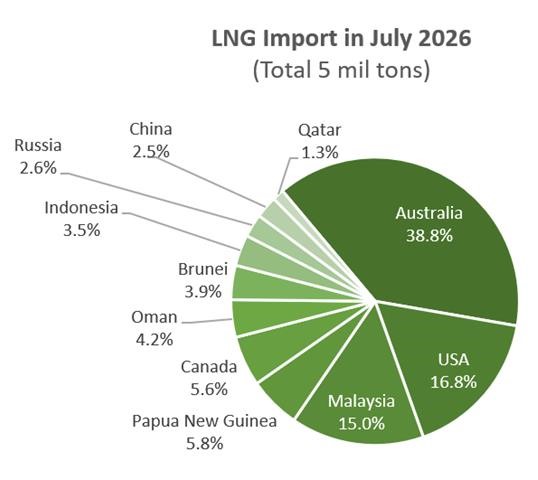
- LNG imports totaled 5.0 Mt, up 6.3% MoM but down 4.8% YoY. Australia remained Japan’s largest LNG supplier, while the U.S. rose to second place after volumes roughly doubled from June.
- Nearly 70% of Japan’s LNG imports came from the Asia-Pacific region. Imports from Oman recovered, but there were no new deliveries from Qatar or the UAE.
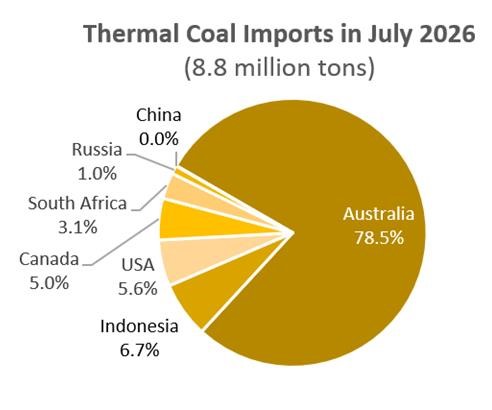
- Thermal coal imports totaled 8.8 Mt, up 23.3% MoM but down 9.2% YoY. Australia remained the main supplier, while imports from Indonesia fell sharply. China supplied a small volume for the first time in 2026.
NEWS: CARBON CAPTURE & SYNTHETIC FUELS

BIPROGY tasked by METI to test clean fuel certificate system
(Company statement, August 28)
- BIPROGY was selected by METI to conduct a field test for a Clean Fuel Certificate System through March 2027.
- The system would certify the environmental value of synthetic methane and biogas, allowing that value to be separated from the physical fuel and traded as certificates.
- BIPROGY will design and operate the test framework, assess its effectiveness and make recommendations for full-scale implementation.
- The company will also review overseas certificate and tracking systems to help design a framework suitable for Japan.
- CONTEXT: Japan aims to introduce synthetic methane and biogas equivalent to 1% of total gas supply by FY2030. These fuels can use existing gas infrastructure, but they remain expensive and lack a clear mechanism for certifying and trading their environmental value.
- CONTEXT: ANRE has proposed a Clean Fuel Certificate System to support wider adoption, particularly in sectors that rely on heat and are difficult to electrify.
- TAKEAWAY: The field test is an early step toward creating a certificate market for low-carbon gas. Such a system could help users claim the environmental value of synthetic methane or biogas even when physical fuel delivery is limited, similar to how non-fossil certificates work in the power sector. The key questions are whether the certificates will be recognized in GHG accounting, whether traceability is strong enough to avoid double counting, and whether customers are willing to pay for the environmental value.
Atierra raises ¥60 mln to develop microalgae production for SAF
(Company statement, August 31)
- Atierra, a startup developing a microalgae bioproduction platform to commercialize low-carbon oils for sustainable aviation fuel, closed a ¥60 million pre-seed funding round.
- The round was led by OIST-Lifetime Ventures, with participation from Shinryo Fund, angel investors and Yuri Group.
- Atierra said the funding will support development of partnerships across the SAF value chain, lay the groundwork for pilot deployment and help validate its production platform.
- CONTEXT: Japan has taken initial steps to support SAF through domestic production targets and customer mandates, but expanding the market beyond 2030 will likely require feedstocks that can scale without creating significant environmental impacts.
- DISCLOSURE: Japan NRG is operated by Yuri Group, which participated in Atierra’s funding round.
ANALYSIS
BY JAPAN NRG TEAM
Control Room, Not Policy, Likely to Decide Timing of Power Market Change
Japan’s electricity reform has produced many new markets, committees and acronyms. But its most important project is not a market at all. It is a control system being built by Hitachi.
The difficulty is that the system has proved much more complex to design than initially expected, and the project is now running behind schedule. This next-generation nationwide load dispatching system was originally supposed to start operating in the latter half of the 2020s. The target is now fiscal 2032, and the transmission operators warn that testing problems or major regulatory changes could push the start date back again.
As METI’s discussions acknowledge, market design can only go so far. The new arrangements cannot work as intended until the software exists to translate market decisions into instructions that power stations and local grid operators can actually use.
Hitachi won the initial order in November 2023 from Transmission and Distribution IT & OT Systems, an entity established by the ten general transmission and distribution operators. The project is supposed to integrate the dispatch systems of nine areas, excluding Okinawa. Until now, each regional utility developed and operated its own dispatch system. But as the power trading sector expands with more renewable energy and interregional trading, this structure is no longer sufficient.
The new system is meant to replace the regional patchwork with a shared national platform. Of course, it will not remove every regional control room. Local systems will still monitor their networks and communicate with generators, but a common main system will now gather information from all nine areas and calculate how the generation fleet should be operated.
In a way, Japan is moving from nine regional brains exchanging limited information to one national brain connected to nine pairs of eyes and hands.
What the platform changes
This change is technical but important. Today, renewable curtailment and congestion management are still mainly handled inside each area. Some nationwide merit-order balancing already takes place, but the existing arrangement does not fully incorporate congestion within regional grids. Interregional action to reduce renewable curtailment is also mainly organised in advance. The new system is designed to incorporate changing demand, renewable forecasts and transmission constraints much closer to real time.
Its main tools are SCUC, or Security-Constrained Unit Commitment, and SCED, SecurityConstrained Economic Dispatch. In simple terms, SCUC decides which power plants should be running; SCED then decides how much each should generate while respecting transmission and plant constraints.
The numbers help explain the change. The planned system will run nationwide SCUC every four hours, with pumped-storage calculations refreshed every 15 minutes, and nationwide SCED every five minutes.
That five-minute dispatch cycle is not particularly radical by international standards: PJM and MISO, two of the largest U.S. grid operators, also run real-time SCED on five-minute cycles. Japan is therefore importing a well-established operating model rather than inventing one from scratch.
What is harder is fitting that model around Japan. According to Japanese TSOs, the country has roughly five times as many pumped-storage facilities per unit of capacity as North American ISO/RTO markets. Japan also follows priority-dispatch rules in which thermal generation, interregional transfers, biomass, wind and solar and other sources may be curtailed in a prescribed order, rather than simply ranking every generator by operating cost.
Japan’s DC interconnectors and individual power stations also come with operating constraints that differ by region and company. These peculiarities have required new logic and extensive customization.
That is why Japan cannot simply install a globally deployed software package. Hitachi is building the system around Network Manager, a platform inherited through its acquisition of ABB’s power-grid business, with a proven track record worldwide, and used internationally by Hitachi Energy. TSOs originally hoped to standardize Japanese practices around the package. Instead, they found that local priority-dispatch rules, pumped storage, DC links and other equipment constraints could not all be accommodated without substantial modification.
The delay and the market
The consequences are now visible in the schedule. Basic design was completed in November 2025 and the project has moved into detailed design, manufacturing and testing. Full operation is targeted for FY2032, compared with the original goal of the late 2020s. Existing regional systems may also need to run in parallel with the new platform during the transition.
This is where the Simultaneous Market enters the story – to optimize electricity energy, measured in kilowatt-hours, together with balancing capability. The market platform and Hitachi’s dispatch system are separate: the former deals with bids, clearing and settlement, while the latter operates the physical grid. But they need compatible models of generators and transmission constraints. Otherwise the market can produce a schedule that grid operators cannot easily execute.
As per METI committee discussions, the official work on the Simultaneous Market design explicitly includes examining its relationship with the next-generation dispatch system.
That does not mean every year of delay at Hitachi automatically adds a year to the Simultaneous Market rollout timetable. Regulators could introduce functions in stages or rely temporarily on existing systems. But the closer Japan gets to a genuinely national market that optimizes energy and balancing while accounting for congestion, the harder it becomes to separate market reform from the dispatch infrastructure underneath it.
The timing risk is larger because the Simultaneous Market is unfinished. In 2026, METI and OCCTO entered the first phase of detailed business design and technical research. The work includes market rules, technical studies and the relationship with the nextgeneration dispatch system; the June 2026 work plan was still laying out which issues should be examined first.
In short, officials are trying to design the market while the operating system on which it will partly depend is still being built.
How Hitachi became so important
Hitachi reached this position through a series of major electricity-market contracts. Its acquisition of ABB’s Power Grids business gave it grid-control and market software with an international track record.
Even before completing the acquisition, Hitachi used ABB’s Market Management System for the balancing-market platform ordered jointly by TEPCO Power Grid and Chubu Electric. It later won work on OCCTO’s capacity-market system and, in 2026, began a project to rebuild OCCTO’s FIT levy and payment-management platform.
Hitachi is now involved in both market administration and physical grid operation. That gives the company an unusually strong position. Few competitors can combine knowledge of EPCO operations with software already proven in large overseas power markets.
But this has also led to work concentration. Several important pieces of Japan’s reform now rely on the same supplier, and the dispatch project has shown how difficult it is to translate international software into Japanese operating practice.
Japan has spent years redesigning the rules of its electricity market. However, the critical path runs not through another METI committee but through system designers and Hitachi’s software engineers. The danger is not simply that one IT project arrives late. It is that Japan builds sophisticated markets faster than it can build the machinery needed to operate them.
ANALYSIS
BY FILIPPO PEDRETTI
Tokyo Learns from War’s Tough Lessons
For many years, energy security was treated more as a theoretical exercise rather than a central priority. Market logic favored low inventories and cost efficiency, operating under the assumption that chokepoints like the Strait of Hormuz would always function properly.
This was true until the global oil trade came to a halt at the end of February when the U.S. and Israel launched attacks against Iran. For Japan, the closure of the Strait of Hormuz served as a reality check, threatening the rigidity of its industrial structure. Until that time, the Persian Gulf had supplied 93% of Japan’s crude oil imports.
The government acted quickly and decisively, boosted by a massive oil reservoir that covered over 240 days of consumption. By July, Japan had achieved a 100% procurement recovery of lost imports through a pivot to alternative suppliers across the globe. But the financial cost was significant, and hidden fragilities in supply chains, such as naphtha, were exposed.
The government had to overhaul its energy strategy, and announced new measures to be ready for the next challenge. Via METI, JOGMEC and a new working group, the government is preparing for the next challenge by rewriting its basic energy security plans.
Japan NRG identified four weak spots uncovered by the crisis of the past few months and the subsequent lessons that Tokyo has learned.
A supply chain under stress
To understand the size of the policy pivot, one must first look at the extent of the shock in the spring. The last tanker to navigate the Strait of Hormuz before the blockade arrived in Japan on March 21. By April, the disparity between holding long-term contracts and the exposure to the spot market became ruinous.
The lesson is that securing alternative routes can be futile if a nation cannot afford the logistics. During the crisis, spot market freight rates for Very Large Crude Carriers (VLCCs) exploded, reaching $464,930 per day in April 2026, a 11-fold increase over the 2025 average.
To mitigate these supply gaps, the government released 50 days’ worth of its national oil reserves and lowered mandatory private reserve obligations by 15 days. It also used joint reserves held with oil-producing countries to bridge the immediate gaps.
| Metric | Crisis Peak (April/ May) |
| Crude Import Volume (April) | Dropped by 63.7% year-over-year |
| Crude Import Volume (May) | Dropped by 57.2% year-over-year |
| Crude Unit Price (April) | Surged by 37.9% |
| Crude Unit Price (May) | Surged by 67.1% |
| VLCC Spot Freight Rates | Surged by 710% |
| Refinery Utilization | Dropped by 13.7% in April |
Lesson 1: Naptha reservoirs are a good idea
The crisis proved that securing crude oil is not synonymous with securing the broader economy. The primary culprit was naphtha. Despite being crucial for petrochemicals, a 1975 act excluded it from stockpiling. Because it is a highly volatile secondary product, naphtha is difficult to store compared to raw crude.
Going into the crisis, Japan held 0 days of official naphtha stockpile requirements. This, despite having a 50.5% dependency on the Hormuz Strait for its supply.
Manufactures cannot use raw crude right away. Naphtha too needs to undergo additional reprocessing at refineries, where it’s cracked into ethylene and benzene. At the height of the crisis, ethylene cracker operating rates fell to a record low of 68.1% due to maintenance and soaring costs, as producers rationed raw materials and raw naphtha accumulated in tanks.
Importers tried to bypass the domestic bottleneck by importing from abroad. The lack of a reserve caused severe distribution bottlenecks within the downstream supply chain. Even though Japan secured oil volumes, supply anxiety paralyzed the chemical industry.
Learning from this past challenge, the government wants to address the weak spot. In July, METI set up a Working Group to rewrite the nation’s reserve targets. A primary goal is to institutionalize naphtha reserves, and to integrate this feedstock into national and private stockpile targets.
Lesson 2: Avoid chokepoints and dire straits
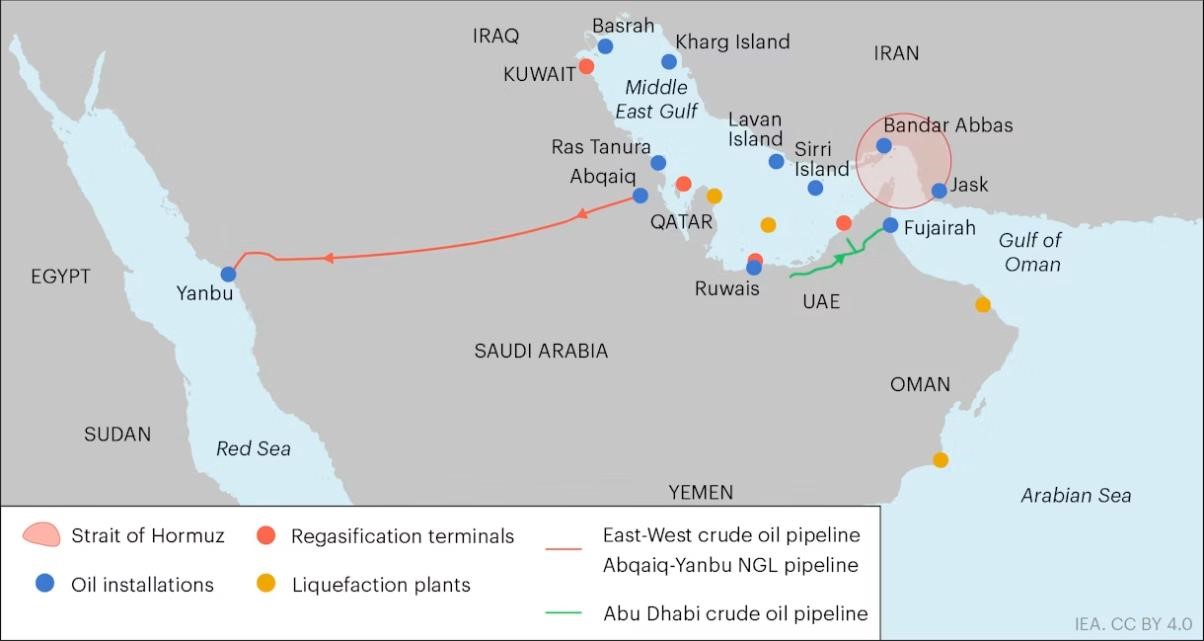
With Hormuz shut, Japan tried to bypass it via pipelines, such as one that led to Saudi Arabia’s port of Yanbu on the Red Sea. For the UAE, the pipelines to Fujairah, on the Gulf of Oman, helped maintain critical supplies. In effect, the focus shifted from a country-based metric to a port-based metric.
Geographical diversification beyond the Middle East, however, incurred logistical premiums. Japan sourced alternative supplies from the U.S., South America, and the Asia-Pacific. But, the financial cost in logistics was severe. Importing crude from the U.S. takes 55 days, compared to 21-23 days from the Middle East.
Even before the crisis, in 2025, U.S. crude transportation carried a premium of $2 per barrel over Middle Eastern crude. The surge, however, in spot freight rates made the cost of diversification unsustainable.
To incentivize permanent diversification, JOGMEC is rolling out financial support mechanisms, to offset the higher transportation costs of diversifying oil procurement. It will also provide support for utilizing alternative pipeline projects. An example is ADNOC’s 2027 pipeline expansion and Saudi Arabia’s new bypass routes
Importers could submit certified plans to procure crude or naphtha via non-chokepoint routes (or bypass pipelines). Then, they will receive assistance from JOGMEC to offset higher freight and pipeline transit costs.
| Origin / Supply Category | Ratio (%) | Hormuz Dep. | Stockpile | Key Mitigation Strategy |
| Crude Oil Imports | ||||
| UAE | 43.3% | Yes | 243 days | Fujairah pipeline bypass |
| Saudi Arabia | 39.4% | Yes | 243 days | East-West Red Sea pipeline (Yanbu) |
| Kuwait | 6.2% | Yes | 243 days | INPEX equity swaps & non-Hormuz diversification |
| USA | 3.8% | No | 243 days | Direct shipping (Gulf Coast / Alaska) |
| Other (Ecuador, Oman, Qatar, etc.) | ~7.3% | Varies | Varies | Direct non-Hormuz routes & equity crude sales |
| Naphtha Supply | ||||
| Middle East Import | 50.5% | Yes | 0 days | LPG/ plastic substitution & supplier shift |
| Domestic Refining | 39.1% | Partial | N/A | Mid-stream product inventory drawdown |
| Other Imports | 10.4% | No | N/A | Expand non-Hormuz imports |
Lesson 3: Oil grades are not all the same
Before February, Japan boasted a robust 243-day oil stockpile – state reserves of 145 days; private reserves of 91 days; and joint reserves of six days. The working group has now concluded that raw volume is a legacy metric; the new standard should be refinery compatibility.
Japan’s domestic refining infrastructure is built to process specific grades of Middle Eastern crude. When the crisis forced a pivot to alternative sources, many refineries could not process the diverse oil types.
Even some grades held within Japan’s own national reserves were unfamiliar to domestic refineries, and refiners scaled back operations. They curtailed export-oriented refining to focus capacity strictly on fulfilling domestic fuel demand, which contributed to the 13.7% drop in refinery use reported in April.
Now the government is pushing for capital investment in refinery upgrades that will allow processing a diverse, global palette of crude specifications.
Lesson 4: At a time of crisis, do not spare any option
LNG relies on Hormuz for about 6% of total import volumes. To protect its highly critical LNG supplies, the government implemented cross-commodity emergency measures.
Most notably, Japan suspended existing policies designed to suppress inefficient coal power. By leaning on its 0% Hormuz-dependent coal supply chain, Japan successfully conserved its LNG reserves.
Normally, Japan enforces operation suppression measures on inefficient coal-fired power plants. During the 2026 crisis, METI enacted an emergency policy suspension for FY2026, waiving capacity-market restrictions on inefficient coal generators.
Ramping up coal power generation served as a fuel-saving mechanism. This helped yield an estimated saving of ~500,000 tons of LNG, equivalent to over 10% of Japan’s annual Hormuz-dependent LNG import volume.
Conclusion
Japan’s 100% procurement recovery by July was a high-cost pivot, but it was necessary, as no other options were on the table. On a political level, much of the troubles came from Japan’s closest ally, the U.S., which started the chain of events that led to Hormuz’s closure.
As the U.S. stepped in to replace supplies, it reaped enormous profits along the way, mostly at Japan’s expense.
Given the unpredictability of the global scenario, Tokyo is now altering its strategic outlook. At first, Japan reassured it had enough reservoirs to counter the crisis. But relying on volumes alone is not much of a security model. A nation must transport the crude, refine it and distribute the chemical byproducts.
METI is rethinking its energy security model so as to cover any fragilities. With no end in sight for conflict in the Persian Gulf, Japan must make a virtue of necessity – or, in harsher terms, simply accept the new reality.
Energy resilience is no longer about stockpiles, but rather, about building an end-to-end supply chain that can weather the current crisis and any future ones.
ASIA ENERGY REVIEW
BY JOHN VAROLI
A brief overview of the region’s main energy events from the past week
Australia / BESS
Energy Vault completed the acquisition of the land needed for its planned 125 MW/ 1 GWh Stoney Creek BESS in New South Wales.
Australia / BESS
Amazon signed its first ever stand-alone battery tolling deal, contracting Anza Power’s 50-MW/ 200-MWh Bairnsdale BESS in Victoria.
China / LNG
China’s LNG imports will slump 18% in August, YoY, bucking a three-month-long trend of rising purchases this summer. High LNG prices have put off some industrial consumers.
India / Russian oil
The Ministry of External Affairs said its energy purchases are guided by national interest and meeting the needs of its 1.4 billion people, adding the Russia-Ukraine war can’t be resolved by buying or not buying Russian oil.
India / BESS
For solar and wind projects commissioned after July 1, 2027, the Central Electricity Authority proposes mandating co-located energy storage equaling at least 10% of the renewable project’s installed capacity, with a minimum duration of two hours.
Russia / LNG
In less than a year, Russia has almost doubled the fleet of tankers ferrying LNG from its sanctioned Arctic project. According to Bloomberg, at least 20 ships are serving the Arctic LNG 2 facility.
Singapore / Carbon
Singapore says that Bangladesh holds significant potential to tap international carbon markets, creating new economic opportunities while strengthening efforts to combat climate change.
South Korea / Energy reform
South Korea will merge several state-run energy and transport firms as part of a broader overhaul to cut costs at a time of rising power demand. Korea National Oil and Korea Gas Corp will be combined, as will five units of Korea Electric Power.
South Korea / Wind
Pacifico Energy pledged investment worth over $1 billion for two offshore wind projects forming part of its 3.2 GW Jindo offshore wind cluster in South Korea.
Taiwan / Gas rates
The govt plans to freeze household natural gas and LPG prices through the end of 2026 as part of a $5.7 billion supplementary budget to stabilize energy costs.
Disclaimer
This communication has been prepared for information purposes only, is confidential and may be legally privileged. This is a subscription-only service and is directed at those who have expressly asked K.K. Yuri Group or one of its representatives to be added to the mailing list. This document may not be onwardly circulated or reproduced without prior written consent from Yuri Group, which retains all copyright to the content of this report.
Yuri Group is not registered as an investment advisor in any jurisdiction. Our research and all the content express our opinions, which are generally based on available public information, field studies and own analysis. Content is limited to general comment upon general political, economic and market issues, asset classes and types of investments. The report and all of its content does not constitute a recommendation or solicitation to buy, sell, subscribe for or underwrite any product or physical commodity, or a financial instrument.
The information contained in this report is obtained from sources believed to be reliable and in good faith. No representation or warranty is made that it is accurate or complete. Opinions and views expressed are subject to change without notice, as are prices and availability, which are indicative only. There is no obligation to notify recipients of any changes to this data or to do so in the future. No responsibility is accepted for the use of or reliance on the information provided. In no circumstances will Yuri Group be liable for any indirect or direct loss, or consequential loss or damages arising from the use of, any inability to use, or any inaccuracy in the information.
K.K. Yuri Group: Hulic Ochanomizu Bldg. 3F, 2-3-11, Surugadai, Kanda, Chiyoda-ku, Tokyo, Japan, 101-0062.