
WEEKLY
September 28, 2026
ANALYSIS
JAPAN GIVES PUMPED HYDRO AN UPGRADE
- Japan has one of the world’s largest pumped hydro fleets – the main form of energy storage globally.
- Utilities are now upgrading that legacy infrastructure to play a greater role in balancing renewables output. With the most pumped hydro capacity per capita globally, does Japan have room to build more?
JAPAN DIVERSIFIES DIVERSIFICATION ITSELF TO BOOST LNG SECURITY
- Tokyo no longer sees diversification as a question of buying gas from more countries. The goal is to diversify the industry on every level.
- Japan wants more suppliers, more contract structures, more pricing benchmarks, more trading capability, more resilient infrastructure and, more ways of ensuring that neighboring economies can withstand the same shocks.
ASIA PACIFIC REVIEW
This column provides a brief overview of the region’s main energy events from the past week
NEWS
- METI selects first GX Strategic Areas for data center clusters
- Ministry-backed Watt-Bit demos begin using all-photonic networks
- DOWA selected for EV motor rare-earth magnet recycling demo
- METI advances mid- to long-term electricity market and retailer procurement rules
- Govt delays full simulation of simultaneous market
- Japan sees record gasoline subsidies and surging electricity rates
- Kyushu Electric earns ¥22b on non-fossil certificates
- Toyota to help expand hydrogen mobility in Europe
- Yokogawa to develop world’s largest liquid H2 carrier
- Residents oppose BESS project in Hiroshima Pref
- Mitsui Kinzoku agrees with U.S. partner to optimize solid-state batteries
- Sumitomo Electric launches EMS for multi-site BESS aggregation
WIND POWER AND OTHER RENEWABLES
- JOGMEC selects four geothermal surveys projects
- Fuji Kosan launches supply of bio-heavy oil
- Top Chubu Electric officials step down over Hamaoka data scandal
- KEPCO shuts down Mihama Unit 3 due to water leak
- TEPCO, KEPCO, and Tohoku Electric agree on spent fuel storage
- Saudi Aramco CEO reassures buyers over disruptions
- INPEX chief sees strong interest in Indonesian LNG
- Osaka Gas takes stake in Australian LNG project
CARBON CAPTURE & SYNTHETIC FUELS
- JAL signs world-first deal for CORSIA-compliant carbon removals
- Asuene acquires CO2 emissions accounting business
- Cosmo Oil to begin production of bio-naphtha
EVENTS
Sept 30-Oct 1 Sustainable Material Expo @ Makuhari Messe
Oct 8 Innovations for Cool Earth Forum (ICEF) @ Westin Tokyo
Oct 13-15 Global Offshore Wind Summit – Japan 2026 @ Nagasaki
Nov 2-5 ADIPEC 2026 @ Abu Dhabi
Nov 3 U.S. Midterm Elections
Nov 9-20 COP31 @ Antalya, Türkiye
Nov 18-19 Asia-Pacific Economic Cooperation – Leaders Meeting @ Shenzhen, China
Nov 28 Taiwan Local Elections
PUBLISHER
K. K. Yuri Group
Editorial Team
Yuriy Humber (Chief Editor)
John Varoli (Senior Editor, Americas)
Kyoko Fukuda (Data, Events)
Filippo Pedretti (Thermal, CCS, Nuclear)
Tetsuji Tomita (Power Market, Hydrogen)
Aglaé Bange (Renewables, Biomass & Energy Storage)
Gillian Sawyer (Renewables)
George Hoffman (Sales, Business Development)
Rada Kuznetsova (Clients Accounts, Website)
Tim Young (Design)
SUBSCRIPTIONS & ADVERTISING
Japan NRG offers individual, corporate and academic subscription plans. Basic details are our website or write to subscriptions@japan-nrg.com
For marketing, advertising, or collaboration opportunities, contact sales@japan-nrg.com. For all other inquiries, write to info@japan-nrg.com
NEWS: GENERAL OUTLOOK AND TRENDS

METI selects first GX Strategic Areas for data center clusters
(Government statement, September 11)
- METI announced the first round of GX Strategic Areas, aiming to create new industrial clusters around decarbonized power, digital infrastructure and other regional assets.
- Selected areas will support large-scale data center (DC) development by coordinating power and communications infrastructure under the Watt-Bit Collaboration concept.
- METI’s selection criteria require areas to have the potential to scale electricity supply to GW-class levels, potentially within 10 years, while offering suitable communications links, industrial land, water access and low disaster risk.
- The program favors areas that can expand decarbonized power use.
- The policy addresses a forecasted rise of about 5 GW in data center power demand over the coming decade, while avoiding connection delays that can exceed 10 years.
- TAKEAWAY: The GX is an effort by Tokyo to pre-plan where the next wave of very large loads should go. Rather than allowing DC projects to cluster wherever grid access happens to be available, METI wants power, telecoms and supporting infrastructure to be built in parallel around designated locations. That turns DC siting into part of national grid and industrial policy. A second feature is geography. Several candidate locations are port cities, and some are areas where offshore wind is progressing. That creates a useful combination of ports, offshore renewables, industrial land and future firm low-carbon generation, although the idea that hydrogen/ammonia thermal generation will also cover 24/7 power is at a stage described more as a possibility than a commitment.
Ministry-backed Watt-Bit demos begin using all-photonic networks
(Government and company statements, September 18-24)
- Projects chosen by the Ministry of Internal Affairs and Communications (MIC) to connect multiple data centers (DCs) using a next-gen high-speed communication network began a demo phase.
- CONTEXT: In July, the MIC selected seven projects under its FY2026 Watt-Bit Collaboration demo program.
- The demos will focus on: 1) using APNs to operate geographically distributed DCs as if they were a single large facility, and shifting computing workloads between locations according to electricity availability, renewable generation, computing-resource use, etc.
- A Kyushu Electric-led consortium is connecting three distributed DCs in Kyushu via APN technology and will operate them virtually as one large DC. It will test applications in medical care, manufacturing, and urban services through Feb 2027.
- Other projects will test whether computing workloads can be shifted geographically or temporally using renewable-generation forecasts, electricity-market prices, grid supply-demand conditions, computing-resource utilization and disaster information.
- TAKEAWAY: MIC sees APNs as an enabling technology for the broader Watt-Bit Collaboration agenda. Since they provide high-capacity, low-latency links, APNs can reduce the need to locate computing close to users and allow DCs to be located in rural areas. This would enable data planning that is much more flexible than today, allowing load to shift not just in terms of locations but also across time slots.
DOWA selected for EV motor rare-earth magnet recycling demo
(Company statement, September 10)
- DOWA Eco-System was chosen for a MOE demo to develop recycling technology for rare-earth magnets recovered from EV drive motors.
- The project will build on DOWA’s own work recovering rare-earth magnets from motors in used home appliances, extending the process to drive motors from end-of-life EVs.
- DOWA will use its recovery and sorting technologies to set up a process for recovering and recycling rare-earth magnets contained in used EV drive motors.
- CONTEXT: Demand for neodymium magnets and other rare-earth materials is rising with the growth of EVs and renewable-energy equipment. Japan also seeks to reduce procurement risks caused by the concentration of rare-earth supply in Chinese hands.
Hitachi agrees with Spacecool for a demo of cooling tech for equipment
(Company statement, September 15)
- Hitachi and Spacecool will conduct a demo of a radiative cooling technology that requires no energy for cooling.
- Targeting data centers and power plants, the demo aims to evaluate the applicability of Spacecool’s cooling material, as well as its installation and maintenance needs.
- The technology features a material that can achieve surface temperatures below ambient temperature without consuming energy, by reflecting sunlight and emitting infrared radiation into space, with an infrared emissivity of about 95%. It helps:
- reduce air-conditioning energy consumption;
- extend equipment lifespan;
- lower energy costs.
NEWS: ELECTRICITY MARKETS

Japan sees record gasoline subsidies and surging electricity rates
(Japan NRG, September 18)
- ANRE increased gasoline subsidies to a record high of ¥51/ liter, effective Sept 17.
- This ¥15 weekly increase will cap average retail gasoline prices at ¥170/ liter amid rising crude oil prices.
- TEPCO household electricity bills for October will reach a high of ¥9,300, rising by about ¥1,000 over Sept. This is the highest level since 2022.
- In November, power transmission wheeling charges will rise, and about ¥239 will be added to standard monthly household bills in TEPCO’s service area.
- Asian spot LNG prices reached around $25/ MMBtu in early September, about 2.5 times higher than levels before the Strait of Hormuz blockade.
- JERA warns that tight European gas inventories could push prices higher this winter.
- Kito Shunichi, Chairman of the Petroleum Association of Japan and Idemitsu Kosan, said domestic crude oil procurement is secured through November.
- CONTEXT: The surge in electricity costs follows the end of the govt’s summer subsidy program. Renewed Middle East tensions are inflating fuel import costs.
- TAKEAWAY: Cumulative national expenditure on electricity and gas relief has reached ¥5.6 trillion since 2023, which shows the heavy fiscal toll of price intervention. If govt support lapses after next winter, monthly electricity bills could exceed ¥10,000 from April 2027. Meanwhile, global energy market tightness is intensifying due to constraints on Qatari LNG exports and the EU’s upcoming January 2027 ban on Russian LNG, which is prompting importers like JERA to diversify procurement sources.
Govt changes schedule for technical study of simultaneous market
(Government statement, September 14)
- ANRE and OCCTO will change the schedule for the first phase of the simultaneous market study, because a proper simulation can’t be completed in FY2026.
- Participants noted a comprehensive simulation integrating all relevant constraints requires substantially more time and is difficult to achieve in the current schedule.
- The FY2026 technical study will focus on overseas market systems, interviews with experienced engineers, and technical assessments of Japan-specific requirements and system implementation possibilities.
- Meanwhile, the govt is surveying generators and TSOs to identify operational and grid constraints, with a survey of electricity retailers in October.
- The findings will be compiled into a report assessing technical feasibility of implementing a simultaneous market system based on these approaches.
- CONTEXT: Deloitte is tasked with running simulations to verify the optimization engine, which will determine the optimal unit commitment and dispatch of power generation resources.
- TAKEAWAY: The govt’s decision to postpone full-scale simulations reflects an approach to assessing technical feasibility based on evidence. The govt sees the simultaneous market as too important to rush through without proper due diligence to clarify technical challenges and requirements to be addressed before proceeding with system development and verification.
ABN AMRO Clearing Tokyo approved for TOCOM energy futures trading
(Company statement, September 14)
- TOCOM approved ABN AMRO Clearing Tokyo as a Broker Trading Participant, while the firm also gained an Energy Futures Clearing Qualification from JSCC.
- The firm begins operations on Sept 30.
- ABN AMRO said approvals allow it to offer clients both brokerage and clearing services for TOCOM energy markets.
- The move is part of the group’s Asia-Pacific expansion and seeks to improve access for international participants to Japan’s energy derivatives market.
- TAKEAWAY: The entry of another international broker should make it easier for overseas firms to trade and clear Japanese power futures through TOCOM, which will support the exchange’s efforts to broaden participation and liquidity.
METI discusses ongoing issues in mid- to long-term electricity market design
(Government statement, September 16)
- METI discussed “market scope and measures to address market-splitting risks” and efforts to boost market offerings for the proposed mid- to long-term electricity market.
- The design favors multiple regional reference markets to balance liquidity, competition, and pricedifference risks.
- As for the market-splitting risk, both sellers and buyers would bear inter-area price risks, with various hedging tools considered.
- Large generators with at least 5 GW of capacity would be required to offer a share of volumes equivalent in aggregate to 10% of retail demand, allocated according to historical output.
- METI proposes requiring retailers to secure kWh supply equivalent to 50% of projected demand three years ahead of the delivery year and 70% one year ahead.
- Four one-month offering periods per year are proposed to improve liquidity and procurement opportunities.
- Volumes left unsold in the three-year-ahead market wouldn’t need to be reoffered in the one-yearahead market.
- CONTEXT: Proposals on how to resolve these issues will be made at upcoming METI advisory council meetings.
- TAKEAWAY: The proposed design seeks to create a sufficiently liquid and competitive electricity market while limiting generators’ operational constraints. The main policy challenge is to balance the following objectives: increase market liquidity and price transparency, manage inter-area price risks, and ensure sufficient supply from large generators without excessively restricting bilateral trading flexibility.
All balancing market products to be procured on a cross-regional basis
(Agency statement, September 15)
- OCCTO reported results from testing cross-regional operation of Secondary Reserve 1 (LFC) in the balancing market.
- The test was completed in both the eastern and central-western areas after resolving a calculation issue in the eastern area.
- Analysis of actual data confirmed the following:
- Frequency stability: Frequency fluctuations remained at a similar level before and after the transition to cross-regional LFC operation.
- Lower LFC requirements: Netting of area requirements reduced upward and downward LFC requirements by 2.29 GWh/ day and 2.73 GWh/ day, respectively, across the eastern and central-western areas.
- Lower balancing costs: The operation reduced balancing energy costs by about ¥57.9 million/ month during May–July 2026.
- Based on the results, OCCTO proposed starting cross-regional procurement of Secondary Reserve 1 in FY2027.
- CONTEXT: Secondary Reserve 1 had been procured and operated separately in each area because the LFC calculation and control cycles of central load dispatching systems differ by area. However, efforts are underway to enable cross-regional operation by adding modules to existing systems. Other products are procured on a cross-regional basis.
- TAKEAWAY: Cross-regional procurement of all balancing market products should allow balancing resources to be shared more efficiently across regions, reducing both required volumes and costs. It should also help further standardize the operation of Japan’s balancing market.
OCCTO surveys out-of-market balancing capacity status
(Agency statement, September 15)
- OCCTO surveyed the status of naturally available balancing capacity that was not procured through the balancing market using real-time supply-demand data from April to June 2026.
- For thermal generation, natural surplus capacity remained in most of the nine areas after the shift to day-ahead trading.
- The nine-area average was 5.49 GW, broadly in line with 5.47 GW in 2024.
- Pumped-storage generation also retained a surplus, averaging 669 MW across five areas, down from 908 MW in 2024, based on both output and stored-energy capacity.
- Since April–June is a low-load period, conditions may differ during high-load periods. Further analysis from July onward will examine why some available capacity is not offered to the balancing market.
- CONTEXT: Since the balancing market was introduced, TSOs have continued to rely partly on balancing capacity that remains available from generators even though it is not procured through the market. In FY2025, this naturally available surplus was deducted when calculating required market procurement volumes, because it could still be called on if needed. With all balancing products shifting to day-ahead procurement in FY2026, OCCTO is reassessing whether this out-of-market capacity remains sufficiently stable and predictable to continue reducing procurement requirements.
- TAKEAWAY: The survey suggests that a sizable reserve pool still exists outside the balancing market, particularly at thermal plants, even after the move to day-ahead procurement. The existence of reliable out-of-market capacity can reduce the balancing volumes TSOs need to procure through the market, potentially lowering procurement costs. But relying on this capacity only makes sense if it is consistently available when the system is tight. The next step will be about understanding why generators leave usable capacity outside the market, and whether market rules or incentives should change to bring more of it into formal procurement.
ANRE survey results on quantitative supply requirements for electricity retailers
(Government statement, September 18)
- ANRE summarized the key issues for designing a system that requires electricity retailers to secure a certain amount of kWh ahead of real-time supply and demand.
- The survey results of 356 retailers to assess their current supply procurement practices show that:
- Three years in advance (N-3), around 80% secured less than 20% of planned sales, while about 60% secured none.
- One year in advance (N-1), half secured less than 20%, with small retailers showing lower procurement levels.
- About 70% of retailers use risk-hedging measures, with long-term bilateral contracts the most common.
- Only around 20% of retailers use electricity futures, mainly due to limited expertise, riskmanagement burdens, and collateral and funding requirements.
- About 76% of retailers participate in multi-company balancing groups, and 70% indicated that joint procurement could be used now or in the future.
- To qualify as quantitative supply, the method should secure physical electricity (kWh) in advance that can be supplied to customers during the actual supply period, with clear contractual terms and verifiable performance.
- Eligible procurement methods would include own generation, bilateral contracts, forward and long-term physical markets, and the baseload market.
- Spot-market purchases would not qualify because they do not secure electricity in advance. Electricity futures would also be excluded because current products hedge price risk but do not themselves guarantee physical delivery.
- CONTEXT: Following the market disruption caused by surging fuel and wholesale electricity prices in 2022, METI seeks a system requiring retailers to secure a certain amount of electricity supply (kWh) in advance. The goal is to ensure stable and continuous supply to customers and prevent sharp fluctuations in electricity prices.
- TAKEAWAY: The government will continue working out the detailed rules, including demand adjustments, enforcement, treatment of specific retailers, and verification of joint procurement. A notable feature is the proposed exclusion of electricity futures: METI is drawing a clear distinction between tools that secure physical kWh and those that only hedge price risk. Current futures would therefore not count toward the quantitative requirement, even though they remain important for retailers’ risk management. The treatment could be reconsidered if products emerge that combine financial hedging with a verifiable commitment to physical delivery.
Kyushu Electric earns ¥22 billion from non-fossil certificates
(Company statement, September 17)
- Kyushu Electric said revenue from sales of non-FIT non-fossil certificates reached ¥22.3 billion in FY2025, up ¥3.3 billion from the previous year.
- Sales volumes were unchanged, but unit prices rose as buy demand continued to exceed supply in the non-fossil value trading market.
- Kyushu Electric said it sells certificates to help other electricity retailers meet their non-fossil power obligations under the Energy Supply Structure Advancement Act.
- The utility used all of the FY2025 certificate revenue to maintain non-fossil generation, including refurbishment and maintenance of hydropower plants and safety-related work at nuclear plants.
- CONTEXT: FY2024 revenue from non-fossil certificate sales was ¥19 billion, meaning FY2025 revenue rose about 17%.
Japan Power Traders Association established
(Nikkei, September 11)
- The Japan Power Traders Association (JPTA), a voluntary industry association, was founded to promote active electricity trading and ensure a stable power supply.
- Members include over 20 major power companies, trading houses, and foreign firms. JERA Global Markets and Tohoku EPCO Energy Trading serve as joint secretariats.
- JPTA will focus on the mid- to long-term electricity market planned by METI. Credit risk management is a key issue due to the long-term nature of contracts. It will also work on improving trading rules and standardized contracts for bilateral transactions.
No bids for third round of reserve power sources
(Agency statement, September 16)
- OCCTO said no bids were submitted for the FY2026 reserve power source procurement, covering resources entering the scheme from FY2027 or FY2028.
- The first procurement in FY2024 also attracted no bids. The FY2025 round subsequently attracted two bids in the western area, both of which were awarded, totaling about 1.36 GW.
- OCCTO and METI have not yet released detailed findings explaining the lack of bids in the latest round.
- CONTEXT: From Aug 19 to Sept 15, OCCTO sought 1 GW in the East (50 Hz) and 680 MW in the West (60 Hz).
- TAKEAWAY: The reserve power source system may not provide sufficient revenue to cover the maintenance costs of aging thermal power plants. A structural issue is that plants with costs below the capacity market price cap are more likely to clear the capacity market, reducing incentives to bid into this system. As the third procurement attracted no bids despite earlier adjustments to the scheme, future discussions are likely to focus on whether compensation remains insufficient or whether the incentive design itself needs revisiting.
J-Power buys stakes in two Thai thermal plants
(Company statement, September 11)
- J-POWER acquired 49% stakes in two gas-fired cogeneration SPP projects from EGCO through its wholly owned subsidiary J-POWER Holdings (Thailand).
- The first asset, Klongluang Utilities, is in Pathum Thani Province, 40 km north of Bangkok.
Operating since July 2017, it has a total generation capacity of 122 MW, yielding J-Power an equity share of 60 MW. - The second asset, Banpong Utilities, is in Ratchaburi Province, about 100 km west of Bangkok. Operating since October 2017, it generates 256 MW of power, giving J-Power an equity share of 125 MW.
- Both facilities are natural gas-fired combined cycle and operate under a 51% EGCO and 49% JPower ownership split.
- CONTEXT: Under Thailand’s SPP framework, wholesale electricity from both plants is sold to the Electricity Generating Authority of Thailand (EGAT).
- TAKEAWAY: This deal boosts J-Power’s presence in Thailand’s gas-fired cogeneration SPP market to 10 projects. As of May, the SPP program encompasses roughly 9.33 GW of operational capacity nationwide.
- SIDE DEVELOPMENT:
- Shikoku Electric enters thermal power business in Thailand
- (Company statement, September 18)
- Shikoku Electric entered Thailand’s thermal power sector, buying a 15% stake in Amata B.Grimm Power (ABPL), an electricity and steam supplier to industrial parks.
- ABPL has 1.4 GW total capacity across thermal and solar power. Shikoku Electric’s equity share comprises 126 MW of thermal power and 10 MW of solar power.
- CONTEXT: This brings Shikoku Electric’s total equity capacity in overseas thermal power projects to 1.72 GW.
Kimitsu and Kashima joint thermal power firms to merge (Company statement, August 6; Denki Shimbun, September 18)
- Kimitsu Kyodo Thermal Power and Kashima Kyodo Thermal Power, both 50/50 JVs between Nippon Steel and JERA, will merge on Oct 1.
- The merged firm will be renamed Higashi-Nihon Kyodo Hatsuden (East Japan Joint Power Generation).
- Kimitsu operates 1.15 GW of generation capacity in Chiba Pref; Kashima operates 650 MW in Ibaraki Pref, giving the new firm about 1.8 GW total capacity.
- The merger will allow a more flexible response to market changes including Nippon Steel’s reorganization of its steelworks.
- CONTEXT: Both plants use by-product gas from nearby Nippon Steel facilities as a fuel source and supply electricity to Nippon Steel and TEPCO Energy Partner.
NEWS: HYDROGEN

Toyota joins European push to scale hydrogen trucking
(Company statement, September 15)
- Toyota joined Daimler Truck, Volvo Group, Bosch, Air Liquide, TotalEnergies, TEAL Mobility and MB Energy in an initiative to expand hydrogen-powered heavy-duty transport in Europe.
- The group aims to coordinate vehicles, hydrogen supply and refueling infrastructure to enable largescale deployment of hydrogen trucks by 2030, initially using Germany as a model.
- Toyota will contribute fuel-cell technology and expertise.
- Daimler Truck plans to deploy a small series of 100 next-generation fuel-cell trucks with customers from late 2026, while preparing hydrogen-combustion trucks for market launch in 2027.
- Volvo is developing both fuel-cell and hydrogen-combustion trucks for rollout toward 2030.
Yokogawa to develop world’s largest liquid H2 carrier
(Company statement, September 14)
- Yokogawa won orders from KHI to develop the world’s largest liquid hydrogen transportation vessel and control system for hydrogen-powered ships.
- The control system will monitor and manage onboard equipment, an emergency shutdown function, and the transport of hydrogen at cryogenic temperatures.
- Yokogawa will also develop a control system for two ships for MHFS (Marine Hydrogen Fuel Systems), a fuel system consisting of fuel supply equipment and liquefied hydrogen tanks. It will integrate safety, control, and monitoring.
- The project is supported by NEDO’s Liquefied Hydrogen Supply program.
Tokyo selects CO2 and green H2 based e-methane feasibility study
(Company statement, September 16)
- Aiming to build a CO2 supply chain, the Tokyo Metropolitan Govt selected Tokyo Gas and Takuma’s feasibility study for using recovered CO2 and hydrogen for e-methane production and city gas pipeline injection.
- CO2 recovered from exhaust gas at the Ota Incineration Plant and green hydrogen from Keihinjima Green Hydrogen Plant will help produce e-methane that will be mixed into the city gas pipeline for use in public facilities.
- Demos begin later in FY2026, followed by FEED from 2028 to 2030, and commercialization set to begin in 2030.
NEWS: SOLAR AND BATTERIES

Residents oppose BESS project in Hiroshima Pref
(Chugoku Shimbun, September 16)
- Residents of Kure (Hiroshima Pref) are petitioning against a local BESS project.
- The petition calls on the city to regulate grid-scale battery storage facilities near residential areas, with the following requirements:
- a 50-meter limit between the site boundary and homes;
- prior consultation with citizens and the fire department;
- secured funds for decommissioning;
- restrictions on projects in landslide- and flood-risk zones.
- TAKEAWAY: Local opposition can undermine a project and lead to its cancellation or delay. Such conflicts can be avoided if developers follow proper guidance. Prior consultation with fire departments is advised to ensure safety and avoid disputes with residents. The 50-meter limit in the petition reflects concerns over noise. Insurers advise placing BESS facilities well beyond 50 meters from residential areas to mitigate such risks. On the other hand, the decision to locate a station in such a controversial area may reflect growing difficulties for developers in securing land as the market grows.
Mitsui Kinzoku agrees with Factorial Energy to optimize solid-state batteries
(Company statement, September 18)
- Mitsui Kinzoku will collaborate with U.S.-based Factorial Energy to improve battery cell manufacturing processes for ASSBs (All-Solid-State Batteries).
- The process will use Mitsui Kinzoku’s sulfide solid electrolyte material, A-SOLiD™.
- Both firms will improve electrolyte performance and develop layer-formation technologies to verify suitability for mass production.
- TAKEAWAY: An ASSB is a type of battery in which the electrolyte is solid rather than liquid. It offers higher safety and energy density because solid electrolytes reduce the risk of leakage and thermal runaway and are generally non-flammable. This makes ASSBs attractive for compact applications such as EVs and small electronics, as well as potentially for stationary BESS. The technology is not widely commercialized; but sales of quasi-solid-state batteries (QSSBs), which use a hybrid electrolyte, have scaled in recent years. In Japan, Elecom began selling mobile power banks featuring QSSBs in March 2026, launching a nascent market of solid-state batteries that will eventually extend to ASSBs.
Bluefield Energy launches aggregation service in solar and BESS
(Company statement, September 8)
- Japanese startup Bluefield Energy entered the aggregation business, offering services for BESS, colocated BESS and solar assets.
- Using its own SaaS platform, BF Cloud, Bluefield will provide forecasting, bidding and plan submission services, including during nighttime and holiday periods.
- The platform features OpenADR (Automated Demand Response).
Ecostyle agrees with Tensor Energy for aggregation of low-voltage BESS
(Company statement, September 9)
- Ecostyle agreed with Tensor Energy to aggregate low-voltage BESS.
- Tensor will provide aggregation for low-voltage BESS units installed by Ecostyle.
- Ecostyle plans to install 1,000 units by mid-2027, targeting idle and excess land at solar farms. A unit can be installed on a site with at least 20 m² of space, with installation costs starting at ¥15 million.
- CONTEXT: Ecostyle is an O&M and EPC firm specializing in solar energy. Tensor is an aggregator with its own platform, operating about 350 MW of installed capacity.
- TAKEAWAY: Co-location is a good strategy to expand low-voltage BESS, with advantages both for FIT/ FIP solar owners seeking more revenue streams and for BESS developers that see low-voltage projects as a natural fit. This is because solar assets often have capacities of just a few hundred kW, an insufficient capacity for a 2 MW/ 8 MWh station.
- SIDE DEVELOPMENT:
- E-GATE enters low-voltage BESS market
- (Company statement, September 10)
- Solar and BESS company E-GATE entered the low-voltage BESS market by registering 400 assets in the Tokyo area for participation in the balancing market.
- The firm aims to operate 1,000 assets by mid-2027 and seeks partnerships with aggregators, EMS companies, BESS manufacturers and local authorities.
Sumitomo Electric launches EMS for multi-site BESS aggregation
(Company statement, September 14)
- Sumitomo Electric launched sEMSA-ESS, an energy management system for aggregators managing multiple battery storage sites.
- The system can control up to 100 BESS stations and is designed to coordinate charge and discharge schedules across the wholesale, balancing and capacity markets.
- It connects with Sumitomo Electric’s existing sEMSA-AC platform, which handles market-related control instructions and operating results.
- CONTEXT: Sumitomo Electric says its broader sEMSA energy-management platform is already used across about 600 MW of installed capacity.
- TAKEAWAY: The significance is less the headline capacity of 100 sites than the shift toward managing larger portfolios of grid-scale batteries across multiple markets. As Japan’s BESS fleet expands, aggregators increasingly need software that can coordinate many assets while optimizing between wholesale trading, balancing services and capacity-market obligations. Sumitomo’s new product is one sign that this operational layer is becoming a more distinct part of the BESS value chain.
Daiwa Energy expands EPC scope to BESS
(Company statement, September 8)
- Daiwa Energy expanded into the BESS market as an engineering, procurement, construction (EPC) firm.
- Its first contract is with ENEOS Power to build a 50 MW/ 109 MWh BESS station at Shimizu’s oil refinery in Shizuoka, to be built by 2028.
- CONTEXT: Daiwa Energy is already active as an EPC in solar power, with 344 MW of installed capacity built. As for BESS, the firm has experience in operating BESS assets in Kyushu and Hokkaido.
PowerX upgrades EV charging station to high-voltage in Tokyo
(Company statement, September 16)
- PowerX upgraded its EV charging station in Ariake (Tokyo) to support high-voltage charging, at up to 240 kW per connector when used individually.
- The firm plans to extend the upgrade to about 20 locations by year’s end.
- CONTEXT: High-voltage charging enables faster EV charging and is suitable for longer-distance travel. EV sales in Japan doubled in H1 of 2026, reaching about 60,000 vehicles (3% of all passenger vehicles purchased).
- SIDE DEVELOPMENT:
- Nature launches new smart charging functionality for Tesla EVs
- (Company statement, September 24)
- EMS and VPP management company Nature launched a new functionality for its EV charging app, “Nature Remo E / E2”, enabling smart charging for Tesla owners.
- The functionality automatically uses surplus solar power to charge a Tesla vehicle or residential BESS. Any unused surplus electricity is sold to power companies.
- CONTEXT: Among all EVs sold in H1 of 2026, Tesla accounted for about 12,000 vehicles, a 20% share; and set a target of 50 dealerships in Japan by late 2026 to expand sales.
Sekisui launches PSC demo in Kagoshima Pref
(Company statement, September 14)
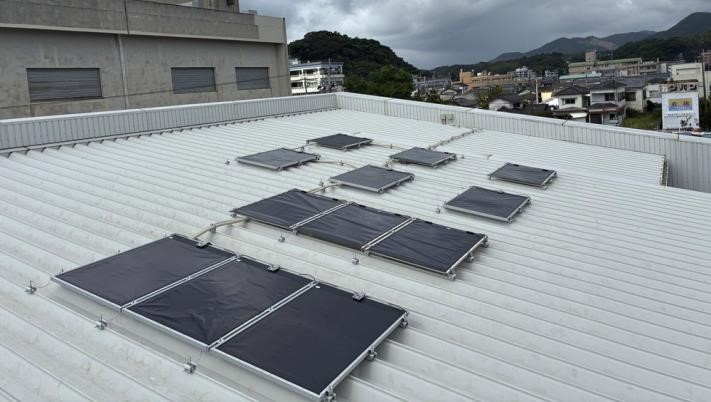
- Sekisui launched a film-type PSC demo in Shibushi (Kagoshima Pref).
- PSCs were installed on Kagoshima Bank’s roof by renewable energy firm Nangoku.
- The demo, to run for three years, aims to:
- Evaluate the impact of harsh environmental conditions on cells (typhoons, exposure to salt, etc)
- Test different installation configurations (continuous or individual units) to facilitate wider deployment on rooftops.
NEWS: WIND POWER AND OTHER RENEWABLES

JOGMEC selects geothermal surveys after competition
(Organization statement, September 14)
- JOGMEC chose four projects out of 10 submitted – following two calls for proposals from May to August – to assess geothermal resource potential.
- The projects are:
| Location | Operator |
| Myoko, Niigata | Obayashi, Kisojiban |
| Ibusuki, Kagoshima | Shin-Nippon Biomedical Laboratories, Cosmo Energy Development |
| Zao, Miyagi | Mitsubishi Gas Chemical, Mitsubishi Materials, Kanto Natural Gas Development |
| Shikabe, Hokkaido | Mitsubishi Materials |
- Preliminary surveys, hot spring monitoring, and well drilling will be carried out this year.
- TAKEAWAY: These are not one-off exploratory surveys but part of longer-running geothermal development efforts; the Myoko project in Niigata, for example, dates back to 2020. JOGMEC support can also extend to projects already moving toward construction, including two previously selected projects in Akita with planned capacity above 10 MW. The latest selections therefore form part of a broader pipeline aimed at identifying sites with potential for commercially meaningful geothermal development.
Fuji Kosan launches supply of bio-heavy oil
(Company statement, August 16)
- Fuji Kosan launched a supply of bio-heavy oil from its plant in Himeji (Hyogo Pref), with deliveries mainly to Okayama, Hyogo and Osaka Prefs.
- The firm has supplied biodiesel since Nov 2025. The heavy oil is blended with FAME (Fatty Acid Methyl Ester). It offers different blending ratios to cover a range of applications, mainly marine vessels and industrial boilers.
- The plant has an annual production capacity of 12,000 kiloliters.
- TAKEAWAY: This annual capacity, although not large-scale, remains sizable for Japan’s emerging bio-heavy oil market. Heavy oil, owing to its higher energy density and lower cost compared with diesel, is widely used by large cargo ships. Fuji Kosan is not alone in selling heavy oil blended with FAME: Idemitsu Kosan has also been selling it since late 2025.
- SIDE DEVELOPMENT:
- ENEOS launches sales of environmental value of marine biofuels
- (Company statement, September 17)
- ENEOS started selling the environmental value of SMF (Sustainable Marine Fuel) to shipping and logistics companies, helping them reduce Scope 3 emissions.
- CONTEXT: Scope 3 emissions are generated across a firm’s value chain, including by upstream suppliers, and usually account for 70–90% of a firm’s carbon footprint.
- TAKEAWAY: Sales of the biofuels’ environmental value have gained traction in recent years. In 2024, Mitsui O.S.K. Lines commercialized such certificates for alternative fuels, with logistics company Nippon Express as a customer. Due to these fuels’ high cost compared with conventional alternatives, selling their environmental value is seen as a gateway to develop sustainable marine fuel use ahead of domestic large-scale production.
Okishin reveals world’s first training CTV for offshore wind personnel
(Company statement, September 16)
- A ceremony at Okishin Shipbuilding in Sasebo, Nagasaki pref introduced the world’s first CTV (Crew Transfer Vessel) intended for training at offshore wind facilities.
- The vessel will be completed by March 2027. It will carry five crew members and 12 workers for offshore wind transfer in ocean environment training, vessel handling training, and ROV training.
Itochu Enex supplies biofuel to construction machinery in Hokkaido
(Company statement, September 15)
- Itochu Enex agreed with Itogumi Construction to supply renewable diesel for its construction machinery used on projects in the suburbs of Sapporo.
- Renewable diesel, a drop-in biofuel made from waste oils and fats, has a pour point of -30°C, providing a valuable competitive advantage in Hokkaido’s cold winters.
- CONTEXT: Pour point refers to the lowest temperature at which a liquid can still flow, and is used to assess its suitability for pumping.
NEWS: NUCLEAR ENERGY

Top Chubu Electric officials step down over data falsification scandal
(Japan NRG, September 25)
- On Sept 14, Chubu Electric released an external investigation report that revealed long-term falsification of seismic motion evaluation data for Hamaoka NPP Units 3 and 4 from at least 2012.
- The report said: Employees adopted a distorted internal logic, convincing themselves that their technical assessments were valid. Thus, they justified manipulation of data to bypass regulatory demands they viewed as unreasonable.
- The report did not find that top executives directly ordered the improper conduct, but concluded that management pressure to accelerate the lengthy restart review was one contributing factor. Technical staff felt compelled to cheat.
- President Hayashi Kingo and Chairman Katsuno Satoru said they will resign.
- Director Yasui Minoru, whose career has largely been outside the nuclear division, becomes president on Oct 1.
- Chubu Electric has withdrawn its safety screening applications for Units 3 and 4. This unprecedented move effectively resets over 12 years of regulatory review.
- METI Minister Akazawa has said the problems undermine the basic trust required to discuss a restart.
- CONTEXT: Hamaoka, in Shizuoka Pref, is Chubu Electric’s only nuclear power station. Units 3 and 4 have remained offline since 2011 and had been under NRA safety review for restart for more than a decade. Following the falsification findings, the NRA was considering rejecting the applications, but Chubu Electric withdrew them before a formal decision. The regulator is now considering other measures, including prolonged additional inspections.
- TAKEAWAY: Japan has a national energy target to generate 20% of its total power from nuclear energy by FY2040; this goal also depended on Hamaoka’s reactivation. The indefinite halt complicates the plan. As for Chubu, with no active nuclear reactors, the utility has to rely on fossil fuels for 60% of its power generation, which exposes it to heavy asset impairment risks and potential customer loss in Chubu’s manufacturing hub. This crisis has reignited debate over whether the “10-regional utility” model should be restructured. Regulators will likely apply far stricter standards to all nuclear safety reviews nationwide.
KEPCO shuts down Mihama NPP Unit 3
(Company statement, September 25)
- On Sept 17, KEPCO shut down Mihama NPP Unit 3 following a water leak. It later discovered a 14 mm by 4 mm hole in an outdoor pipe connected to the high-pressure turbine system. The corrosion was due to rainwater entering a gap from a cover component installed upside down.
- KEPCO is inspecting its other nuclear power plants to ensure similar installation errors do not occur elsewhere.
- TAKEAWAY: In May, Unit 3 suffered a steam leak, then resumed trial operations on Sept 12, but was forced to halt again. Plans to resume commercial operations on Oct 9 are on hold, with no set timeline for restarting.
TEPCO, KEPCO, and Tohoku Electric agree on spent fuel storage
(Nikkei, September 18)
- TEPCO and JAPC agreed to share their spent nuclear fuel interim storage facility in Mutsu with KEPCO and Tohoku Electric.
- TEPCO will store 3,500 tons and JAPC 900 tons of spent nuclear fuel.
- Starting 2028, KEPCO will transfer 500 tons and Tohoku Electric 100 tons.
- Mutsu Mayor Yamamoto said the city would not immediately approve the expanded storage plan. TEPCO shipments are, meanwhile, suspended in FY2026 after Aomori Gov. Miyashita withheld consent amid continued delays at the Rokkasho reprocessing plant.
- TEPCO has been unable to deliver 60 tons from its Kashiwazaki-Kariwa NPP.
- CONTEXT: The Mutsu facility is operated by Recycle Fuel Storage (RFS) with a total capacity of 5,000 tons. In August, Mutsu asked TEPCO to involve other power companies to avoid tax revenue losses due to unused capacity. Meanwhile, KEPCO’s on-site plant pools are 90% full, risking capacity exhaustion within two to three years.
- TAKEAWAY: The long-term success of the arrangement hinges on local consent and confidence that stored fuel will eventually leave Mutsu. The utilities therefore need a credible pathway to transfer the fuel onward for reprocessing at Rokkasho. That remains difficult because the Rokkasho plant has faced repeated delays over roughly three decades.
KEPCO and Kindai Univ to collaborate on nuclear power
(Nikkei, September 14)
- KEPCO and Kindai University agreed to collaborate on human resource development in the nuclear power sector. This is the first such agreement for KEPCO with a university.
- KEPCO employees will take part in experiments using Kindai Univ’s research reactor.
- TAKEAWAY: The initiative aims to strengthen the nuclear power industry amid persistent struggles to attract young people. KEPCO officials say they have enough nuclear personnel, but partner and contractor companies face difficulties in recruitment. Over 15 years of problems in the industry since the Fukushima disaster have seen many qualified personnel leave the field.
NEWS: TRADITIONAL FUELS

Saudi Aramco CEO reassures crude oil buyers on war-related disruptions
(Nikkei, September 24)
- Saudi Aramco CEO Amin Nasser said Middle East conflict-related disruptions can be resolved in “days, not weeks or months.” Aramco is evaluating engineering plans for a fourth and fifth crude export route.
- The firm is negotiating expanded storage capacity in Japan to bypass sea chokepoints.
- Operations on the 1,200 km East-West pipeline plan to restart, despite recent attacks. Its multi-line design prevented complete shutoffs. Asian buyers under long-term sales agreements continue receiving full orders. But, extra spot market supply is paused.
- Still, Nasser warned that global oil markets are in worse shape than benchmarks suggest. He argued that record IEA stock releases and reduced Chinese imports are masking acute supply shortages. This is evident in surging diesel/naphtha prices.
- TAKEAWAY: U.S.-Israel strikes on Iran in February have led to huge disruptions in global energy markets. With a slim chance of peace over the upcoming months, regional energy producers have explored alternative transport routes, such as pipelines to export terminals outside the Persian Gulf. This can reduce dependence on maritime chokepoints, but cannot eliminate physical-security risk. After all, pipelines, pumping stations, and ports can themselves become targets.
INPEX chief sees strong interest in Indonesian LNG
(Asia Nikkei, Japan NRG, September 16)
- INPEX president Ueda talked about Indonesia’s Abadi LNG Project with a planned output of 9.5 Mtpa. This is over 10% of Japan’s total annual LNG imports.
- INPEX has received strong off-take inquiries, covering more than half of this planned production, and it is near a final agreement on key sales terms with energy firms such as BP and Shell.
- Ueda warned that 2026 sales from UAE crude operations may decline even further than 1H performance, when it was down 30% YoY.
- CONTEXT: INPEX is also considering investing in LNG export projects in the U.S. or South America. Ueda said this in a Nikkei interview at Gastech in Bangkok. INPEX is interested in upstream and midstream U.S. gas projects.
- TAKEAWAY: Abadi’s strategic advantage is that its LNG can reach Asian buyers without relying on the Gulf’s main maritime chokepoint. INPEX is pursuing a similar resilience logic in the UAE, where expanded export pipelines would allow more crude to reach terminals outside the Persian Gulf. The infrastructure would reduce exposure to shipping disruptions, although it would not remove broader security risks, including attacks on pipelines or export facilities.
Osaka Gas takes minority stake in Australian LNG project
(Company statement, September 18)
- Osaka Gas will buy a minority stake of 5% from BP in the offshore natural gas project, Browse, in Australia.
- With this venture, Osaka Gas plans to import 550,000 tons per year of LNG, with deliveries targeted to begin in the mid-2030s.
- Osaka Gas is partnering with a global consortium, with funding from JOGMEC.
- CONTEXT: Australia is currently Japan’s top LNG supplier, covering more than 40% of its imports.
- TAKEAWAY: Transitioning to equity stakes in upstream projects gives control over supply stability, and hedges against market fluctuations. Expanding into Australian LNG reduces reliance on higher-risk supply such as from the Persian Gulf. While many speculated that alternative imports, such as from the U.S., could potentially substitute Australian LNG especially due to the absence of re-sell restriction clauses, Australia’s geographical proximity and stable political environment remain huge advantages.
- SIDE DEVELOPMENT:
- INPEX to buy a stake in Ichthys LNG from JERA
- (Company statement, September 25)
- INPEX will buy a 0.735% stake in Australia’s Ichthys LNG project from JERA. The stake covers the upstream offshore gas-condensate blocks (WA-50-L and WA-51-L), and equity in the entity controlling the gas pipeline and liquefaction plant.
- JERA planned to sell the stake to UK-based MidOcean Energy. INPEX exercised its right of first refusal to acquire the interest itself.
- JERA confirmed the buyer change will not impact its LNG procurement. JERA will still move forward with selling its stake in another Australian LNG project, Gorgon, to MidOcean Energy.
LNG stocks up from previous week, up YoY
(Government data, September 16)
- As of Sept 13, the LNG stocks of 10 power utilities were 2.49 Mt; up 2.9% from the previous week (2.42 Mt); up 50.9% from end Sept 2025 (1.65 Mt); and up 21.5% from the 5-year average of 2.05 Mt.
August Oil / Gas / Coal trade statistics
(Government data, September 16)
| Imports Volume YoY Value (Yen) YoY | ||||
| Crude oil | 11.6 million kiloliters (72.9 million barrels) | 3.6% | 1,190.5 billion | 58.7% |
| LNG | 5 million tons | -6.9% | 588.2 billion | 29.7% |
| Thermal coal | 9.1 million tons | -13.6% | 217 billion | 15.1% |
NEWS: CARBON CAPTURE & SYNTHETIC FUELS

JAL signs world-first deal for CORSIA-compliant carbon removals
(Company statements, September 18)
- Japan Airlines signed a purchase agreement with Switzerland-based Climeworks Solutions for CORSIA-compliant carbon removal credits.
- JAL and Climeworks said it is the world’s first agreement of its kind.
- Climeworks will assemble a portfolio of carbon-removal credits that meet ICAO’s CORSIA requirements, including credits from soil carbon sequestration and biochar.
- JAL will also separately purchase credits from Direct Air Capture (DAC).
- The deal aims to help JAL secure future compliance credits as CORSIA enters its mandatory phase from 2027 and demand from airlines is expected to increase.
- CONTEXT: JAL already began using CORSIA-eligible credits and said it retired a large volume of such credits in FY2025. It is also pursuing aircraft renewal, operational efficiency and SAF as its main direct emissions-reduction measures.
- TAKEAWAY: JAL is moving early to secure carbon-removal supply before CORSIA demand broadens from 2027. It’s also interesting to see removal credits such as biochar and DAC in aviation compliance rather than relying only on conventional avoidance credits. That may become increasingly important if eligible credit supply tightens and airlines face higher compliance costs.
Asuene acquires CO2 emissions accounting business
(Company statement, September 16)
- Asuene acquired ScopeX, a CO2 emissions accounting business, from materials developer TBM.
- ScopeX visualizes GHG emissions across entire corporate supply chains.
- CONTEXT: TBM’s business focuses on developing materials such as carbon recycling technologies. Selling ScopeX allows TBM to concentrate on its main material innovation operations. Since 2024, Asuene has executed an aggressive M&A roll-up strategy in the carbon accounting market. This is Asuene’s ninth acquisition.
- TAKEAWAY: Asuene is rapidly consolidating within the corporate carbon accounting software space. It is scaling the user base by buying existing client portfolios. The expansion comes at a time when major firms in Japan face mandatory carbon accounting and disclosure requirements under the GX ETS framework. Companies and software providers that can accurately track emissions will become more important for compliance with the new rules.
Cosmo Oil and partners to begin production of bio-naphtha
(Company statement, September 17)
- Cosmo Oil, Maruzen Petrochemical, Ube-Maruzen Polyethylene and Saffaire Sky Energy will produce bio-naphtha as a co-product of SAF production at Cosmo Oil’s refinery in Sakai (Osaka Pref).
- The bio-naphtha will be derived from used cooking oil (UCOs).
- TAKEAWAY: This is Japan’s first large-scale bio-naphtha production facility. Amid conflicts in the Middle East and import disruptions, Japan aims to promote biomass feedstocks to produce biofuels/ plastics, ideally of domestic origin. Although prices remain high compared with conventional fossil-based alternatives, bio-naphtha has been under development for several years. In 2021, Mitsui Chemicals began processing imported bionaphtha blended with conventional naphtha to produce plastics. Meanwhile, R&D is underway on domestic bionaphtha production using feedstocks beyond UCOs, such as woody residues.
Mitsui Kinzoku agrees with Wildfire Energy to produce biomethanol for SAF
(Company statement, September 9)
- Mitsui Kinzoku agreed with Wildfire Energy to produce low-cost biomethanol from biomass and waste feedstocks in Australia for use in SAF applications.
- The project, which aims for an annual production capacity of 200,000 tons, will combine Mitsui Kinzoku’s methanol synthesis technology with Wildfire Energy’s MIHG (Moving Injection Horizontal Gasification) that converts biomass and municipal waste into syngas without pre-treatment or sorting.
- Mitsui Kinzoku’s methanol synthesis equipment will be installed at Wildfire Energy’s plant in Queensland.
Mitsubishi Shipbuilding receives AiP for LCO2 transport vessel
(Company statement, September 15)
- Mitsubishi Shipbuilding received Approval in Principle (AiP) to build a liquefied CO2 transport vessel with K Line, MOL, and NYK.
- ClassNK granted the AiP.
- CONTEXT: Shipping is expected to play an important role in Japan’s CCS buildout, particularly where captured CO2 must be transported over long distances or across the sea to storage sites. Several of Japan’s advanced CCS projects envisage maritime CO2 transport.
ANALYSIS
BY THOMAS SHOMAKER
Japan Gives Pumped Hydro an Upgrade
Pumped hydro is often viewed as an energy storage method of the past, with batteries seen as the more flexible and investable vessel for storing green electrons. But Japan’s biggest utilities have not only maintained faith in the former – they are tapping into little-known, specialized systems to imbue the technology with the flexibility needed to balance solar and wind.
Adjustable-speed pumped hydro systems have had little public attention since their debut around 1990, but their ability to vary power consumption while pumping has made them increasingly attractive to utilities facing sharper swings in electricity supply and demand.
Japan already has one of the world’s largest pumped hydro fleets, a technology that remains by far the biggest form of energy storage globally, and utilities are now upgrading portions of that legacy infrastructure to play a more active role in balancing renewable generation.
Most of Japan’s pumped hydro infrastructure dates to the latter half of the 20th century, when plants were built largely to complement nuclear generation: water was pumped uphill at night when electricity demand was low and released to generate power during daytime peaks. The shutdown of the nation’s nuclear fleet after Fukushima disrupted that operating model just as solar and, later, wind began expanding rapidly.
That shift has given pumped hydro a new role. Utilities have expanded and upgraded capacity as variable renewables increase the need for storage to absorb surplus electricity and respond to short-term imbalances. In 2025, curtailment of solar and wind reached 1.77 TWh across Japan’s four main islands, further incentivizing making existing storage assets more responsive.
Having built by far the most pumped hydro capacity per capita globally, does Japan have room for more?
Innovation
The technology – adjustable-speed pumped hydro – has been available for several decades now. KEPCO and Hitachi began developing such units in the early 1980s and commissioned a 17.5 MW demonstration at KEPCO’s Narude hydroelectric plant in 1987. Toshiba Corp deployed the first at-scale system in 1990 when it supplied Unit 2 of TEPCO’s Yagisawa pumped hydro plant with an adjustable-speed unit equipped with an automatic frequency control (AFC) function.
An AFC function means that during both pumping and generation (discharging), power to and from the system can be controlled in response to variations in grid frequency. During pumping, this is achieved by rotational speed adjustment – an innovation especially useful for capturing as much energy as possible from variable renewable sources, such as solar and wind energy.
The flexibility is rather dramatic. Even with robust renewables and storage capacity deployment (pumped hydro or BESS), major utilities still view a certain amount of thermal power generation as necessary to provide the necessary grid balancing.
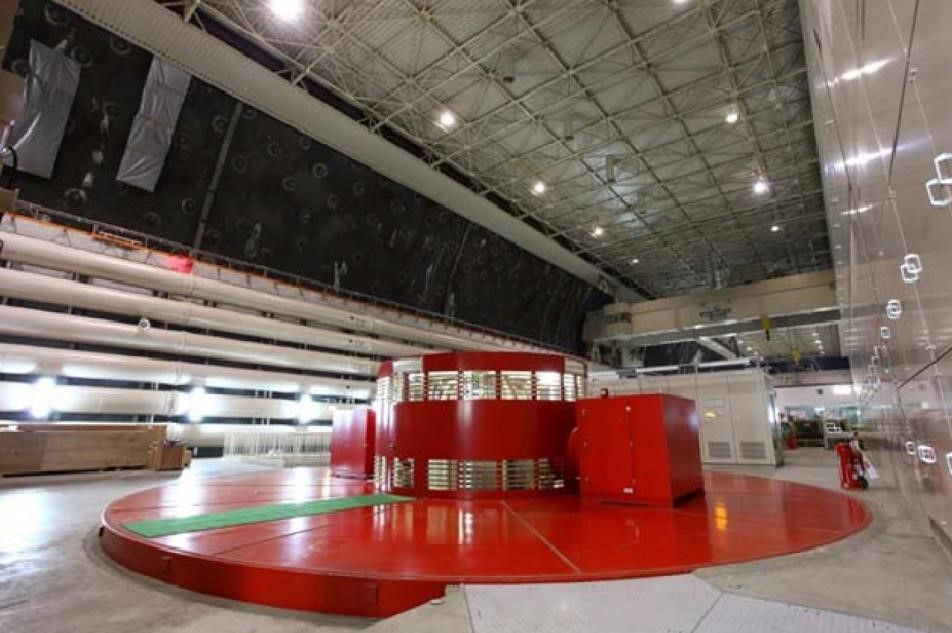
Toshiba told Japan NRG that the output regulation range of thermal power plants is about ±5%. But, the input regulation range of variable-speed pumped-storage units is about ±15% (from 70% to 100% of rated input), providing roughly three times greater flexibility.
In other words, one variable-speed 300 MW pumped storage unit can provide the same level of balancing capability as 900 MW of thermal power output control.
A strong start, a modern reboot
With 15 installed variable-speed units as of 2026, Japan has the world’s largest deployment of such systems. During the 1990s, there was a strong start with seven units rolled out in six pumped storage plants. However, this was followed by a slowdown in variable-speed systems deployment, which reflected the overall slowdown in pumped hydro construction.
About a decade later, this started to change as Japan’s utilities began to plan for a coming influx of intermittent solar and wind energy. The post-Fukushima grounding of the country’s nuclear reactors and the debut of the Feed-in-Tariff system for renewable energy in the early 2010s further emphasized the need for grid balancing and flexible power storage.
Kyushu Electric was a bit early to the party, installing a Hitachi 340 MW adjustablespeed pumped storage generation system when the first unit of its now-1.2 GW Omarugawa pumped hydro plant came online in 2007.
New units & retrofitting
In 2014, TEPCO followed suit by selecting a Toshiba 400 MW adjustable-speed system for Unit 4 – which was the third unit to come online – of its now-1.2 GW Kazunogawa pumped hydro plant. Although construction of Unit 4 was suspended in 2002, it restarted after the 2011 earthquake as an urgent countermeasure against electricity shortages.
The final Unit 3, currently under construction, will also be an adjustable-speed system. Most recently, Toshiba won an order in July for an adjustable-speed 200 MW system for Unit 3 of HEPCO’s Kyogoku Power Plant, slated to go online in 2031.
Fully completing pumped hydro plants takes decades. The low-hanging fruit for reducing curtailments and increasing balancing capabilities is upgrading existing fixedspeed units of pumped hydro plants to variable speed. In 2018 and 2019, this was done for two of KEPCO’s six units at the 1.93 GW Okutataragi pumped hydro plant, which came fully online in 1974 and is Japan’s largest pumped hydro plant.
Retrofitting underground units is still a substantial engineering undertaking. Most pumped-storage plants are built below ground between upper and lower reservoirs, limiting access and complicating major equipment replacement. Even so, several components of a conventional fixed-speed unit can often be retained or modified rather than replaced outright, with much of the work concentrated on the generator-motor, exciter and pump-turbine runner.
Crucially, utilities do not necessarily need to convert every unit at a plant. Retrofitting one or two units can provide much of the additional balancing flexibility, while the remaining units continue operating at fixed speed. This allows existing plants to gain variable pumping capability without a full-site overhaul.
Take a 900 MW pumped hydro plant with three 300 MW fixed-speed units. If 670 MW of surplus power becomes available during an off-peak period, only 600 MW could be absorbed because the third unit would require the full 300 MW to begin pumping. If that third unit were variable-speed, however, it could absorb the remaining 70 MW, allowing the plant to capture power that would otherwise be curtailed.
Innovation’s path
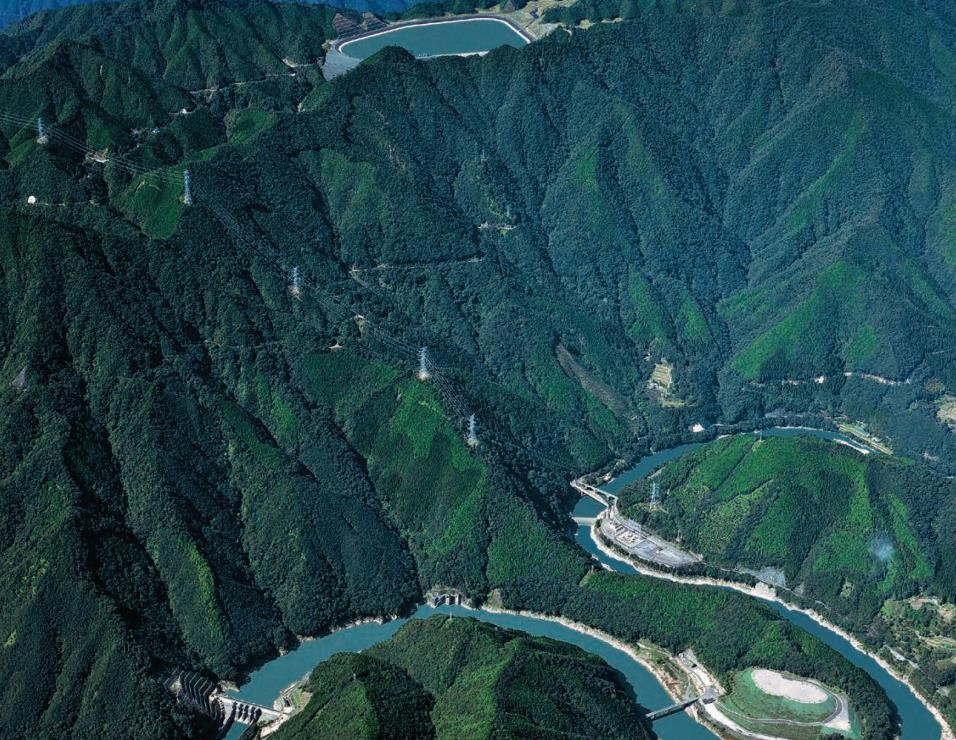
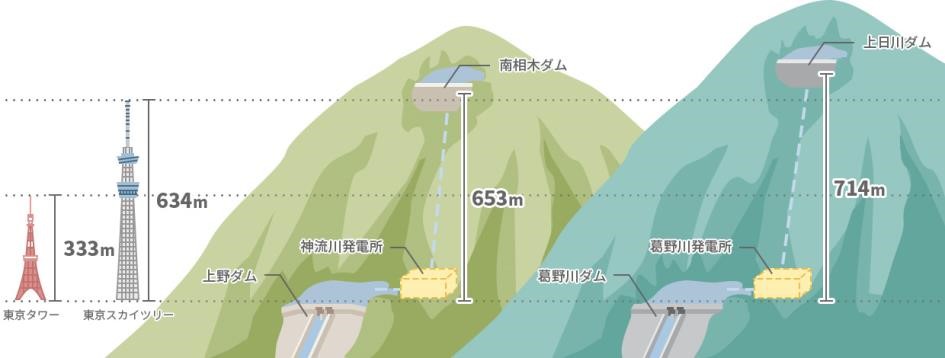
Japan’s rapid construction of pumped hydro plants was largely in response to the proliferation of nuclear power and made possible by the country’s topography. The pumped hydro industry’s rule of thumb is that a plant’s upper reservoir should have a hydraulic head, or elevation, that’s 200 meters above the lower reservoir to provide sufficient energy upon discharge.
But Japan’s mountainous terrain means many of its plants vastly exceed this. For instance, TEPCO’s Kannagawa and the aforementioned Kazunogawa pumped hydro plants have hydraulic heads of 653 meters and 714 meters, respectively; both higher than the 634 meter Tokyo Skytree.
While a 2022 report from the Japan Science and Technology Agency proposed development of small-scale pumped hydro plants powered by renewables across the country and identified about 1,000 suitable sites, the volume of concrete and time required for pumped hydro construction means that utilities favor large projects with significant storage and generation capacities.
The consensus is that most locations realistic to such massive endeavors – meaning a suitable site above a large existing dam – have already been exploited in Japan, which has nearly 21.9 GW of pumped hydro generating capacity installed.
The realistic next steps for increasing Japan’s balancing options are in completing ongoing pumped hydro buildouts and making existing plants more efficient. Variable speed systems continue to evolve, mostly around increasing responsiveness to grid fluctuations.
For instance, the previously discussed Hitachi 340 MW adjustable-speed system installed in 2007 for the Omarugawa Power Plant deployed the world’s first active-power-based control that could provide power supply and demand balancing functions within seconds of grid fluctuations. This nimbleness has now become standard.
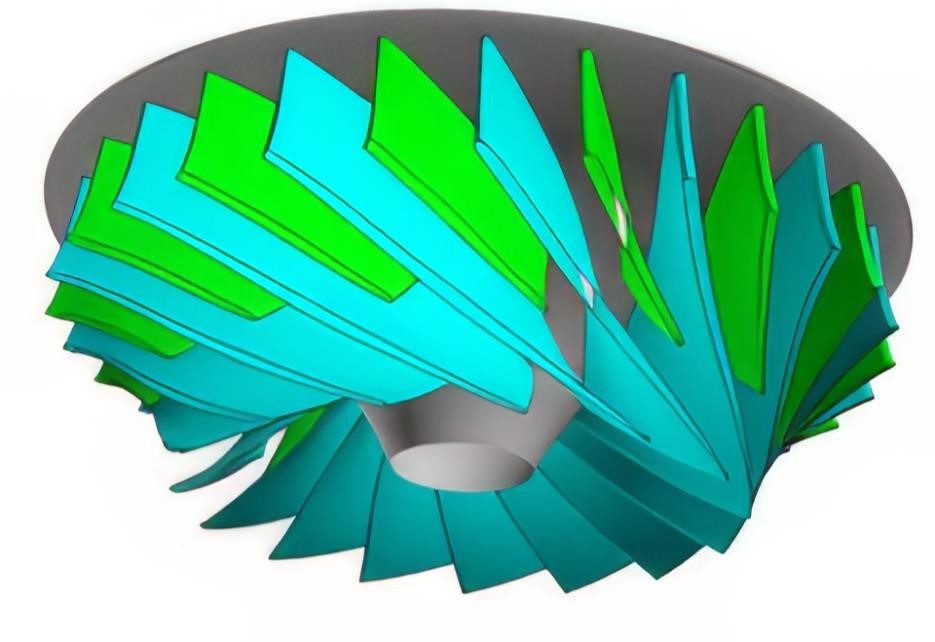
The technological improvements are not limited to variable speed systems. In the early 2000s, Toshiba developed the world’s first splitter pump turbine runner, alternatively equipped with longer and shorter runner blades that restrain turbulence and reduce pressure pulsations and vibrations that can impact turbine reliability.
First deployed in 2003 in TEPCO’s Azumi hydroelectric plant, a splitter runner was then installed for the fixed-speed Unit 1 of TEPCO’s Kannagawa pumped hydro plant, which upped the turbine output from 450 to 470 MW.
From Japan to the world
As renewables proliferate across the world, Japan’s leadership in pumped hydro storage is turning into opportunities abroad. Toshiba established its Chinese subsidiary Toshiba Hydro Power in 2005 and has since supplied 87 hydro turbines and 101 generators for projects in China and other overseas markets.
With projects advancing across Europe, Africa and Australia, and China’s installed pumped hydro capacity expected to reach 120 GW in 2030 – a 3.7-fold increase from 2025 – Japanese manufacturers are entering a much larger global market for technologies they have spent decades refining at home.
The opportunities inside Japan are different. With most locations suitable for large new plants already developed, the next phase is less about adding reservoirs than extracting more flexibility from the 21.9 GW already installed.
Completing unfinished projects, converting selected fixed-speed units to variable speed and upgrading turbines and control systems can turn infrastructure built around the nuclear-heavy power system of the 20th century into a balancing resource for the renewables-heavy system now emerging.
ANALYSIS
BY YURIY HUMBER
Japan Diversifies Diversification Itself to Boost LNG Security
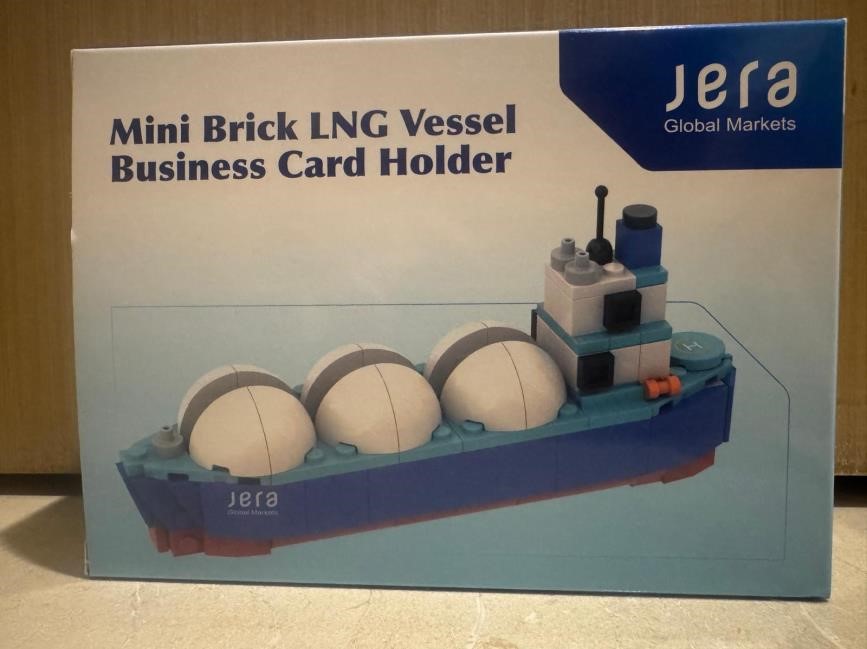
One of the more popular giveaways at Gastech in Bangkok this month was a Lego-like LNG tanker handed out by JERA, the world’s largest LNG buyer. The model came in dozens of small pieces. Japan’s emerging energy-security strategy looks much the same.
Tokyo is no longer treating diversification as a simple question of buying gas from more countries. The goal is to diversify the industry on every level – Japan wants more suppliers, more contract structures, more pricing benchmarks, more trading capability, more resilient infrastructure and, pragmatically, more ways of ensuring that neighboring Asian economies can withstand the same shocks.
Even LNG stockpiles, difficult and expensive to hold physically, were re-imagined by Japanese officials at Gastech as future financial tools such as call options that could provide access to gas without requiring Japan to store every molecule itself.
Thanks to elevated prices, a prevalent confidence was hard to miss at Gastech 2026, with the vast BITEC convention center in Bangkok filled with over 50,000 energy professionals, 1,000 exhibitors and 200 conference sessions, followed by a seemingly endless circuit of dinners and side events. Gas producers and traders had much to celebrate after another year of tight supply and strong prices. Yet one of the industry’s giants was conspicuously absent: QatarEnergy.
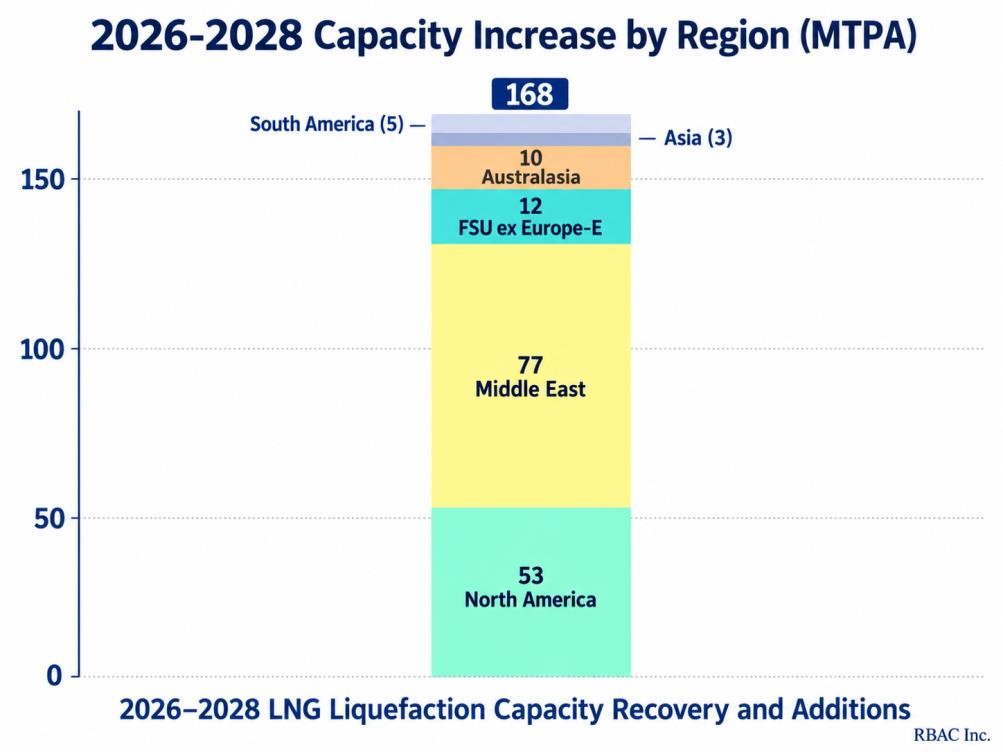
The world’s largest single LNG producer has seen its output and exports heavily disrupted by the near-closure of the Strait of Hormuz and attacks on infrastructure at Ras Laffan, the world’s largest LNG export hub – an uncomfortable reminder of the sector’s vulnerabilities.
For Japan, however, few commodities now sit at the intersection of economics, decarbonization and national security quite like LNG. Gas-fired power remains central to the electricity system and LNG costs feed quickly into wholesale power prices, while the slowdown in some clean energy investments has reinforced gas’s role as the dispatchable partner to renewables.
Japan was also one of the countries that built the modern Asian LNG market: its first cargo arrived from Alaska in 1969, followed by decades of investment in receiving terminals, shipping, long-term contracts and gas-fired generation. More than half a century later, even as Asia’s center of LNG demand shifts toward larger emerging economies, Tokyo is still pushing much of the argument for gas as the fastest practical route away from coal across the region.
But how does Japan see the LNG sector evolving from here?
What next?
The short answer is: more diversification. But the application of that term is now expanding.
Japan has spent decades broadening the geography of its supply, and that will continue as METI officials show interest in new LNG sources such as Mozambique and potentially Argentina. Yet conversations at Gastech suggested that adding countries to the procurement map is no longer enough.
Resilience now also means combining different contract structures, pricing benchmarks, delivery terms, infrastructure and trading capabilities so that ships will continue to arrive when demand, prices or physical supply move in directions that were not anticipated.
JERA Global Markets, for example, wants a mix of free-on-board and delivered LNG, alongside exposure to different benchmarks such as Henry Hub and TTF, according to a senior executive. A counterpart at Tokyo Gas described a resilient portfolio in similar terms: not one optimized for the demand scenario that was forecast, but one capable of finding extra supply when demand surprises on the upside and redirecting cargoes when it falls short.
This helps explain why Japan can simultaneously pursue new U.S. and other supply while resisting pressure to relinquish existing Russian LNG. METI was unusually explicit in saying that Sakhalin-2 is important to Japan and that Tokyo will continue explaining those imports to its U.S. and European partners.
In this version of diversification, adding another source of supply does not necessarily make an existing one expendable.
Stockpiles and financial options
Japan has minimized the impact of this year’s disruptions to Persian Gulf oil flows thanks to national and private stockpiles. Tokyo spent half a century building these strategic reserves and, as Japanese officials stressed at Gastech, those buffers worked well during the latest crisis.
LNG is different. It is more difficult and costly to store, while suitable underground gas storage is scarce in much of Asia and almost nonexistent in Japan. That limits how far Japan can simply replicate its oil-security model for gas.
The answer may be to make part of the stockpile financial rather than physical. METI officials floated ideas such as call options and other mechanisms that would give buyers access to gas when needed without requiring the molecules to sit in Japanese tanks in advance. In METI’s worldview, the gas would ideally be stored across parts of Asia – accessible in an emergency.
The obstacle to creating such a regional network has long been the willingness to pay for the necessary storage infrastructure. Japanese officials hinted that attitudes among ASEAN nations are changing and the political dialogue needed for such a step is gaining momentum.
The value of a right to LNG supply under stress is especially high today. Until regional storage options emerge in Asia, much of that value sits with portfolio LNG suppliers. Cheniere argued that buyers are paying for confidence that a supplier can perform across multiple projects, while Japanese importers prize contracts that allow cargoes to be redirected when demand is weak and pulled back when domestic needs rise.
What can look like over-contracting in normal times can therefore function as an insurance premium when supply is disrupted.
More options via regional ties
One of the main lessons drawn by METI from the current crisis is that national stockpiles can only protect so much. Japan may hold enough oil to keep domestic supply secure, but that offers limited comfort if factories, ports and suppliers elsewhere in Asia are hit by shortages. A country deeply embedded in regional supply chains can no longer treat energy security as a purely national exercise.
That is pushing Tokyo toward a collective model of resilience. ASEAN nations are warming to discussions about regional fuel stockpiles, while Japan is promoting LNG infrastructure, supply diversification and emergency-response capabilities across the region through initiatives such as POWERR Asia and AZEC. Progress is still embryonic, but the idea is clear: stronger energy buffers in Southeast Asia also strengthen Japan’s own economic defenses.
A comparison is being made with food. ASEAN, China, Japan and South Korea operate a joint emergency rice reserve. Earlier this year, Singapore’s prime minister raised the question of whether some version of that model could eventually work for energy.
Strait of Hormuz Disruption: Base Case Assumptions (RBAC)
| LNG Recovery | UAE: Full recovery by Nov. 2026 |
| Qatar: 83% of pre-conflict capacity by Nov. 2026 | |
| Damage | 17% of Qatar capacity remains offline |
| Full restorage by May 2029 | |
| Expansion | Qatar expansion begins 2027 |
| Latest Update | QatarEnergy extends force majeure into Nov. 2026 |
Alternative fuels
Of course, Japan’s diversification drive also extends beyond LNG. Officials and executives at Gastech repeatedly returned to the idea of keeping multiple technology pathways open. Hydrogen remains a major long-term bet, in part because its potential supply geography is far broader than that of fossil fuels.
Kawasaki Heavy Industries (KHI) is also pitching gas-to-liquids as another security option, allowing natural gas to be converted into petroleum products when crude supply is constrained. Biofuels, nuclear and other alternatives were regularly mentioned by Japanese participants.
But the sequencing matters. KHI chairman Kanehana was blunt that hydrogen costs still need to fall substantially and that, until they do, LNG remains the most practical option.
That is also why Japan is pushing dual-fuel turbines and other equipment capable of moving between gas and lower-carbon fuels: they preserve flexibility without forcing an early bet on which fuel will ultimately win.
Conclusion
There is a catch to building energy security around optionality. Everyone else also now wants it. Vitol warned that if European methane rules allow Qatar to keep supplying Europe, Japan could enter its next major LNG recontracting cycle just as competition for Qatari volumes intensifies. The very flexibility Japan is trying to accumulate may itself become more expensive.
Just how much Qatari supply returns, and how quickly, is one of the great uncertainties. ExxonMobil, a partner in parts of Qatar’s LNG industry, made a forceful case at Gastech that the country will remain an important supplier, helped by volumes from projects outside the Persian Gulf. Others were more circumspect about how quickly damaged domestic capacity can recover. Some even pondered if these volumes were largely lost.
Russia’s rising Arctic output – and whether more of it ultimately flows toward markets such as India – adds another variable.
Japan’s expanded diversification strategy is, in effect, an attempt to avoid having to guess correctly about each of them. Instead, Tokyo is assembling overlapping options. Redundancies look inefficient in calm markets but are almost priceless when the unexpected happens.
ASIA ENERGY REVIEW
BY JOHN VAROLI
A brief overview of the region’s main energy events from the past week
Australia / Data centers
The Northern Territory’s govt rejected a proposed national requirement for large data centers to fully offset electricity demand with new renewable generation, instead backing dedicated standalone power generation that could be supplied by the Territory’s natural gas resources.
Australia / Renewables
On Sept 19, sunshine and wind met 80.4% of main power grid demand, a new high bar for renewable electricity. Solar panels on rooftops provided more than half of power used in the national electricity market.
China / Energy storage
China began building the Ruitan demo project in Shandong, the first plant to pair molten salt thermal storage with a supercritical CO2 turbine; operations are expected next year. The first phase combines a 50-MW supercritical CO2 unit with 100 MW of molten salt storage. Built at a coal power station in Yantai, it will soak up surplus power, releasing it at peak demand.
China / Fuel exports
China’s refined-product exports rebounded sharply in August and are expected to remain strong in September. But low gasoline and diesel inventories could prompt refiners to reduce exports and prioritize domestic supply in October.
China / Wind
China Energy Overseas Investment and SANY Renewable Energy will build in Kazakhstan two 500-MW wind power plants, two energy storage systems, and 800 km of 500-kv high-voltage transmission lines. They’ll partner with Samruk Energy.
India / Curtailment
In Q1 of 2026, transmission constraints accounted for nearly two-thirds of all renewable energy curtailment totaling 300 GWh, reports Ember.
India / Diesel
India will keep exporting diesel to help meet global demand and ease the fuel crunch, the Oil Ministry said. India’s refining capacity is around 5.36 mbpd, rising to 5.8 mbpd next year. By 2032, India targets 6.4 mbpd of refining capacity.
Southeast Asia / Natural gas
More than $160 billion worth of gas-fired power and LNG import capacity, for a total of 100 GW, remains in development across SE Asia, reports Global Energy Monitor.
South Korea / Energy security
The govt inked an MoU with the IEA to launch RISE ASIA, aiming to strengthen energy security across Asia. This will be South Korea’s flagship international platform for leading energy transition and security cooperation in Asia.
Vietnam / Wind
Pacifico Energy Vietnam secured a sea survey licence from the govt for the 1.3 GW Nam Trung Bo 3 offshore wind project in Lam Dong Province; commercial operations are expected between 2031 and 2035.
Disclaimer
This communication has been prepared for information purposes only, is confidential and may be legally privileged. This is a subscription-only service and is directed at those who have expressly asked K.K. Yuri Group or one of its representatives to be added to the mailing list. This document may not be onwardly circulated or reproduced without prior written consent from Yuri Group, which retains all copyright to the content of this report.
Yuri Group is not registered as an investment advisor in any jurisdiction. Our research and all the content express our opinions, which are generally based on available public information, field studies and own analysis. Content is limited to general comment upon general political, economic and market issues, asset classes and types of investments. The report and all of its content does not constitute a recommendation or solicitation to buy, sell, subscribe for or underwrite any product or physical commodity, or a financial instrument.
The information contained in this report is obtained from sources believed to be reliable and in good faith. No representation or warranty is made that it is accurate or complete. Opinions and views expressed are subject to change without notice, as are prices and availability, which are indicative only. There is no obligation to notify recipients of any changes to this data or to do so in the future. No responsibility is accepted for the use of or reliance on the information provided. In no circumstances will Yuri Group be liable for any indirect or direct loss, or consequential loss or damages arising from the use of, any inability to use, or any inaccuracy in the information.
K.K. Yuri Group: Hulic Ochanomizu Bldg. 3F, 2-3-11, Surugadai, Kanda, Chiyoda-ku, Tokyo, Japan, 101-0062.