
WEEKLY
October 5, 2026
ANALYSIS
CHUBU ELECTRIC’S SEISMIC DATA SCANDAL IS MAJOR BLOW TO NUCLEAR INDUSTRY
- Japan faces the most devastating blow to its nuclear power industry since Fukushima. Last month, Chubu Electric’s credibility collapsed when a report exposed data manipulation at Hamaoka NPP.
- This scandal’s shockwaves could challenge the role of nuclear power in Japan’s future energy mix.
GX STRATEGIC AREAS TO SPARK DATA CENTER GROWTH AND REGIONAL REVITALIZATION
- A new wave of large data center construction could begin across Japan by 2030. The goal is to create computing hubs outside Tokyo and Osaka.
- If successful, this policy will catalyze domestic and foreign investment in DCs, while creating conditions for new industrial and IT clusters outside Japan’s biggest cities.
ASIA PACIFIC REVIEW
This column provides a brief overview of the region’s main energy events from the past week
NEWS
- Electricity bills hit all-time highs
- Power forwards remain elevated, but risk concentrates at the front of the curve
- New power sales up 10%, Tokyo Gas retains top spot
- JEPX begins displaying intraday market bids by area
- OCCTO reviews grid reinforcement needs for next Master Plan
- World’s first hydrogen-only engine vessel completes demo voyage
- Daiwa House to test power generation from food waste biomethanol
- Ebara opens full-scale liquid hydrogen pump test hub
- ANRE identifies priority commercial solar types for FIT/FIP support
- NTT and JERA launch hourly-matching demo using solar and BESS
- Eliiy Power develops high-nickel lithium-ion battery
- Panasonic and Kobe to demo glass-type PSCs
WIND POWER AND OTHER RENEWABLES
- Toyota affiliates sign virtual PPA for onshore wind
- METI picks Eurus for offshore wind training program
- Donan Offshore Wind forms strategic partnerships
- METI plans NEDO financing for next-gen reactors
- JAIF offers NPP economic benefits analysis
- Helical Fusion to begin pilot reactor tests in 2027
- Shell and partners approve Phase 2 for LNG Canada
- Saudi oil prices up 29% for Japanese buyers
- Saibu Gas finalizes deal with JERA on LNG tank at Hibiki terminal
CARBON CAPTURE & SYNTHETIC FUELS
- METI discusses rules and price ceiling for GX-ETS emissions market
- Sumitomo Osaka Cement-led group studies Tokyo CO2 recycling chain
- GS Yuasa and Toho Gas develop lower-power direct ocean capture
EVENTS
Oct 8 Innovations for Cool Earth Forum (ICEF) @ Westin Tokyo
Oct 13-15 Global Offshore Wind Summit – Japan 2026 @ Nagasaki
Oct 19-20 Japan CCUS Summit @Hamamatsucho Convention Hall.
Nov 2-5 ADIPEC 2026 @ Abu Dhabi
Nov 3 U.S. Midterm Elections
Nov 9-20 COP31 @ Antalya, Türkiye
Nov 18-19 Asia-Pacific Economic Cooperation – Leaders Meeting @ Shenzhen, China
Nov 28 Taiwan Local Elections
Dec 1-3 DeCarbon Tokyo 2026 @ Tokyo
Marriott Hotel
PUBLISHER
K. K. Yuri Group
Editorial Team
Yuriy Humber (Chief Editor)
John Varoli (Senior Editor, Americas)
Kyoko Fukuda (Data, Events)
Filippo Pedretti (Thermal, CCS, Nuclear)
Tetsuji Tomita (Power Market, Hydrogen)
Aglaé Bange (Renewables, Biomass & Energy Storage)
Gillian Sawyer (Renewables)
George Hoffman (Sales, Business Development)
Rada Kuznetsova (Clients Accounts, Website)
Tim Young (Design)
SUBSCRIPTIONS & ADVERTISING
Japan NRG offers individual, corporate and academic subscription plans. Basic details are our website or write to subscriptions@japan-nrg.com
For marketing, advertising, or collaboration opportunities, contact sales@japan-nrg.com. For all other inquiries, write to info@japan-nrg.com
NEWS: GENERAL OUTLOOK AND TRENDS

Electricity bills hit all-time highs
(Japan NRG, September 30)
- Residential electricity rates across all 10 major power providers will hit all-time highs in October as govt summer utility subsidies end and fuel import prices surge.
- Standard household charges will rise from ¥835 to ¥1,578 compared to September. Bills for Hokkaido Electric and Okinawa Electric will surpass ¥10,000 for the first time.
- Sept figures show large geographical price differences across Japan. Kyushu Electric is at ¥6,876, and Hokkaido Electric is at ¥9,266 (a ¥2,390 gap), while Tokyo’s bill reached ¥8,275. The latter is ¥1,342 higher than Kansai’s ¥6,933.
- TAKEAWAY: Price surges stem from several factors – Middle East tensions, a weak yen, and high power grid maintenance costs. Utilities like Kansai and Kyushu maintain lower rates because they have already hit regulatory fuel-cost pass-through caps. The limitations of the fuel adjustment system and how the utilities are starting to work around it was covered in an Analysis article in the recent Sept 14 issue of the Weekly.
TEPCO tightens grid reservation rules for data centers
(Asia Nikkei, October 3)
- TEPCO Power Grid revised its connection rules to discourage data center operators from reserving grid capacity that is later delayed, reduced or left underused.
- Contracts can be canceled if operators fail to pay their share of grid infrastructure costs within three months, or if they materially change agreed power demand or construction schedules.
- From around April 2027, operators that delay the start of electricity use may also face charges for underused grid capacity built on their behalf.
- CONTEXT: Utilities are facing a surge in connection requests from large data centers, while some projects are being postponed or scaled back after grid capacity has already been reserved.
- The Japan Data Center Council supports the changes as a way to prioritize projects with firm demand, while some operators warn that stricter penalties could make investment decisions more difficult.
Japan targets Russian shadow fleet in new sanctions package
(Asia Nikkei, October 3)
- Japan imposed new sanctions on Russia, including restrictions on repairs, insurance, financing and other services for 35 vessels linked to Russia’s “shadow fleet.”
- Tokyo also added 33 entities and nine individuals linked to Russia’s military sector to its asset-freeze list, including organizations accused of helping evade financial sanctions through cryptocurrency.
- Japan banned exports to four entities in the UAE and Turkey accused of helping Russia circumvent sanctions, while expanding restrictions on chemicals, steel products and other industrial goods.
- CONTEXT: Japan continues to balance sanctions policy with energy-security concerns. Roughly 10% of Japan’s LNG imports in 2025 came from Russia, while Japanese companies retain stakes in the Sakhalin-2 LNG project.
- TAKEAWAY: This is the first set of sanctions against Russia introduced by PM Takaichi’s administration and is seen as a response to President Vladimir Putin’s visit to the disputed southern Kuril Islands, which are claimed by Japan and known in the country as the Northern Territories.
NEWS: ELECTRICITY MARKETS

Power forwards remain elevated, but risk concentrates at the front of the curve
(Japan NRG, broker data, October 2)
- Japan’s power forward curve remains elevated heading into autumn, although recent contract moves suggest that market concern is concentrated in the immediate delivery period rather than further into winter.
- Tokyo baseload for October stood at ¥24.30/ kWh as of Oct 1, up from ¥23.50/ kWh on Sept 24, according to Tullett Prebon data. By contrast, November eased to ¥23.05/ kWh from ¥24.40/ kWh. December slipped to ¥23.80/ kWh from ¥24.10/ kWh.
- The curve still points to expensive electricity through winter. Tokyo baseload remains above ¥23 through February, while Tokyo peak contracts are around ¥27–29 for October-February. Prices then fall sharply from March and April, with Tokyo baseload dropping to ¥19.80 in March and ¥16.05 in April, the curve shows.
- The spring decline likely reflects expectations for milder shoulder-season demand combined with stronger daytime solar output, which weighs on power prices outside the winter and summer peaks.
- TAKEAWAY: Some easing along the near-term curve may reflect reduced concern over Middle East supply disruption. Recent Kpler estimates say crude exports from the Middle East Gulf, excluding Iran, recovered to about 16.5 million barrels/ day in September, back to pre-war levels. But the trade now relies more heavily on bypass pipelines and tanker transfers outside the Strait of Hormuz. Kpler also noted that LNG prices eased in late September as renewed U.S.-Iran talks reduced some of the geopolitical premium. Still, shipping through Hormuz remains disrupted, and energy prices retain a sizable risk premium. The Japanese forward power curve seems to point to continued concern over fuel costs and supply security.
New power retailers continue to gain share, Tokyo Gas retains top spot
(Government data, September 28)
- Electricity sales by new power retailers reached about 13.07 TWh in May, up 9.9% YoY, according to preliminary METI data.
- Sales rose across all customer classes: low voltage +7.5% YoY; high voltage +12.9%; and extra-high voltage +8.1%.
- Tokyo Gas remained the largest new power retailer for the 38th consecutive month, with May sales of about 884 GWh; but volume fell by nearly 20% from April, sharply narrowing its lead over second-ranked Ennet.
- Ennet sold about 744 GWh, followed by Osaka Gas at 516 GWh, Mitsuuroko Green Energy at 475 GWh, and CD Energy Direct at 466 GWh.
- More recent June data show new power retailers accounted for 22.98% of nationwide electricity demand, up from 22.53% in May and 21.42% a year earlier.
- CONTEXT: Nationwide electricity demand in June totaled 59.24 TWh, down 1.6% YoY but up 2.7% from May.
- TAKEAWAY: After a notable drop in the market share of the new market entrants (shin denkryoku), the longterm trend remains one of gradual expansion in the competitive retail market, particularly among high-voltage customers. Tokyo Gas still holds a sizable lead over the competition, but its sharp May sales decline shows that its dominance is not translating into steadily rising volumes.
JEPX begins displaying intraday market bids by area
(Denki Shimbun, Oct 2, Organization statement, Sept 8)
- On Oct 1, JEPX began displaying intraday market bids for five areas – Hokkaido, Tohoku-Tokyo, Chubu-Hokuriku-Kansai, Chugoku-Shikoku, and Kyushu.
- This allows participants to identify sell bids available within their interconnected areas and better account for interconnection constraints.
- The change is expected to improve market predictability and support intraday trading to avoid imbalances.
- CONTEXT: JEPX is upgrading its trading systems. For the spot market, the new system went live on April 1; the intraday market was scheduled to go live on Sept 30, with trading for delivery on Oct 1 onward.
- The cap for the adjustment imbalance price during tight supply-demand conditions was raised from ¥200/ kWh to ¥300/ kWh.
- A cumulative price threshold (CPT) system was also introduced to temporarily lower the cap to ¥100/ kWh when spot prices remain above ¥200/ kWh.
- CONTEXT: The former imbalance pricing system, introduced in FY2022, included a temporary cap of ¥200/ kWh. In 2024, the govt decided to raise the cap to ¥300/ kWh from Oct 1, 2026. A CPT system was also introduced to prevent excessive financial burdens on retailers during periods of sharp price increases.
JWA launches two-year-ahead electricity demand forecast by area
(Organization statement, September 25)
- The Japan Weather Association (JWA) launched a two-year-ahead electricity demand forecast by area.
- Using JWA’s long-term weather forecasts together with its electricity demand forecasting technology, the service forecasts electricity demand in 30-minute intervals for Japan’s ten power areas up to 24 months ahead.
- The service analyzes expected weather conditions, seasonality, and day-of-week patterns to forecast future demand levels, demand patterns, and peaks.
- By combining forecasts with a retailer’s own demand data and customer mix, users can estimate future supply requirements and support medium- to long-term power procurement planning, such as bilateral contracts, futures, and forward markets.
- Forecasts are updated monthly. The JWA said its 2026 summer verification showed a 20% improvement in forecast accuracy.
- CONTEXT: Electricity providers need to forecast future demand early to plan supply capacity and power procurement. However, accounting for weather-driven demand fluctuations is a major challenge. Since June 2024, JWA has provided two-year-ahead long-term forecasts for weather; and it also provides electricity demand forecasting services to major power companies and electricity retailers, accumulating expertise and know-how in weather-based electricity demand forecasting.
- TAKEAWAY: The service aims to improve the accuracy of mid- to long-term electricity demand forecasts by incorporating future weather conditions rather than relying mainly on historical trends. If the service functions as planned, retailers will be able to improve supply procurement planning and reduce the risk of over- or underprocurement. Monthly forecast updates will allow procurement strategies and management plans to be adjusted as weather expectations change. This is the service’s key advantage.
- SIDE DEVELOPMENT:
- Kyushu Electric sees regional power demand rising 20–30% in 10 years
- (Denki Shimbun, October 2)
- Kyushu Electric President Nakamura said electricity demand in the Kyushu area could rise by 20–30% over the next decade, driven partly by new data centers.
- He said demand growth on that scale could still be met with the utility’s existing generation fleet, while Kyushu Electric continues to build a portfolio combining renewables, maximum use of nuclear power and lower-carbon thermal generation.
- The company recently started commercial operation of the 620 MW Hibiki LNG-fired power plant and is developing the ~900 MW Shin-Kokura Unit 6 selected in the FY2025 LTDA. The new combined-cycle plant is scheduled to start in FY2033.
- Nakamura said coal-fired generation volumes will decline in line with national policy, but existing plants need to be maintained to support security of supply.
- Kyushu Electric also plans to consider carbon-neutral fuels and CCS for thermal generation, taking into account government policy and support measures.
- CONTEXT: Kyushu Electric operates a total capacity of 15.76 GW across nuclear, thermal, hydroelectric, and geothermal facilities. This includes Units 3 and 4 of Genkai NPP (Saga Pref), each with 1.18 GW capacity; and over 8 GW of thermal power plants.
- TAKEAWAY: Kyushu Electric is ready for a different demand outlook from the stagnation that has marked much of Japan’s power market. A 20–30% increase over a decade would give the utility more room to maintain and renew generation alongside plans for renewables and nuclear power. President Nakamura sees LNG capacity remaining a big part of the power mix into the 2030s, with carbon-neutral fuels and CCS interesting but distant options.
OCCTO reviews grid reinforcement needs for next Master Plan
(Agency statement, September 28)
- OCCTO simulations assessed how changes in demand, renewables, BESS and generation siting could affect assumptions in the 2nd long-term cross-regional network policy, or Master Plan.
- The simulations examined how these changes could affect regional supply-demand balances and grid reinforcement costs through 2050.
- Regional dispersion of data centers and other large loads could reduce interregional power flows, curtailment and grid reinforcement needs, while greater concentration in urban areas would increase transmission requirements.
- For the 3rd long-term policy, possibly to be developed for 2027-28, OCCTO will reassess reinforcement measures while considering generation and demand siting, implementation capacity, and the renewal of existing interconnections.
- CONTEXT: OCCTO launched the review toward the 3rd Master Plan in FY2025, initially focusing on how changes in energy policy, demand, and power-source deployment affect the assumptions of the 2nd Master Plan.
- TAKEAWAY: The review shows that future grid investment will depend increasingly on where new demand is located, not just on how much renewable generation is added. Large loads such as data centers could either increase transmission requirements or reduce them if they are located closer to generation. That makes demand siting an increasingly important variable in the next Master Plan alongside renewable deployment and interconnection renewal.
OCCTO advances design of supplementary capacity auction
(Agency statement, September 29)
- OCCTO reviewed the proposed design of a Capacity Market Supplementary Auction, including its relationship with other supply-capacity measures, procurement criteria and detailed participation requirements.
- The procurement trigger would be based on whether the reserve margin under severe-weather assumptions falls below around 3%. Capacity could potentially be secured up to roughly 5–6% to cover additional supply-demand uncertainty, including possible market exits.
- The auction would generally use cost-based bidding, with the aim of minimizing social costs while avoiding excessive incentives for generators.
- OCCTO will continue discussions with the government on the relationship with reserve power sources, procurement volumes and criteria, detailed requirements, and the treatment of demand response, which is currently outside the proposed Supplementary Auction framework.
- CONTEXT: OCCTO outlined the initial concept in August as an additional supply-capacity measure through FY2030, complementing the Capacity Market Main and Additional Auctions. It is intended in particular to help retain large, aging thermal plants that might otherwise retire, with final operating decisions deferred until after the Additional Auction. Detailed design will now be taken up through further OCCTO and government discussions.
- SIDE DEVELOPMENT:
- OCCTO proposes new surplus/shortage indicator for retailer procurement
- (Agency statement, September 29)
- OCCTO plans to use a surplus/shortage ratio showing whether retailers have secured sufficient electricity relative to forecast demand on a cross-regional block basis.
- The ratio compares retailers’ secured supply with TSO forecast demand: 0% is the benchmark, a negative value indicates a shortfall, and a positive value a surplus.
- OCCTO says the indicator would complement the existing cross-regional reserve margin, which mainly reflects reserve capacity available to TSOs.
- FY2025 analysis showed that lower reserve margins generally coincided with larger retailer shortfalls, but negative surplus/shortage ratios also occurred when reserve margins were relatively high.
- OCCTO is considering incorporating the new indicator into imbalance pricing so that retailer procurement shortages are reflected more directly in price signals.
- Trial calculations showed that doing so could significantly raise imbalance prices, so the pricing formula will require further adjustment.
- TAKEAWAY: The proposal would give the market a clearer signal of whether retailers are under-procuring power, rather than relying only on system-wide reserve margins. That could encourage earlier procurement and faster demand-forecast adjustments. Tying the indicator directly to imbalance prices, however, could increase costs and volatility, so the main design challenge is how strongly to penalize retailer shortages without overamplifying price signals.
NEWS: HYDROGEN

World’s first hydrogen-only engine vessel completes demo voyage
(Organization statement, September 30)
- Kikomaru, a roughly 4,500-ton vessel equipped with what the Nippon Foundation says is the world’s first hydrogen-only marine engine, completed a demo voyage in Osaka Bay.
- The vessel sailed for about two hours and 33 km using the hydrogen-only engine developed by Yanmar Power Solutions.
- The project is part of the Nippon Foundation’s Zero-Emission Ship Project and was developed by a consortium led by Yanmar Power Solutions, with Ueno TransTech responsible for retrofitting the vessel and training crew for hydrogen-fueled operation.
- The demo reduced emissions by about 1.2 tons compared with operating the vessel on conventional fossil fuel.
- CONTEXT: The engine uses a pilot-ignition system. The Nippon Foundation says this is the world’s first development and demonstration voyage of a vessel equipped with such a hydrogen-only engine.
Daiwa House to demo power generation from food-waste biomethanol
(Company statement, September 24)
- Daiwa House will begin a demo in March 2027 of a power generation system using biomethanol produced from food waste.
- Food residues from the company’s Tochigi Ninomiya plant in Moka will first be converted into biogas. Daiwa House will then use a proprietary photo-oxidation reaction technology, developed with Osaka University, to synthesize biomethanol from the biogas.
- The company says this will be Japan’s first demo of the full process from food-waste-derived biogas to biomethanol production and power generation.
- About 25 kg of food waste per day will produce 1–2 m³ of biogas, which will then be converted into a methanol-water solution containing about 58% methanol for use as power-generation fuel.
- The biomethanol will be transported to Daiwa House’s pavilion at GREEN×EXPO 2027 in Yokohama, where it will be used to generate electricity for cooling equipment.
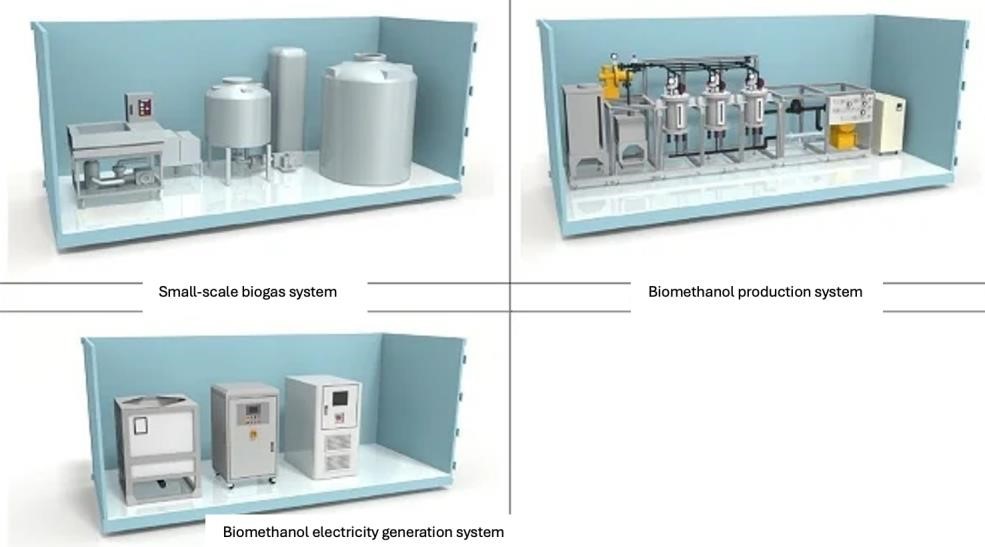
- Daiwa House will also procure domestically produced biomethanol from Mitsubishi Gas Chemical under a mass-balance system. The company estimates the combined system could reduce CO2 emissions by about 2.7 tons during the expo period.
- The demo will run from March 19 to September 26, 2027.
Ebara opens world-first full-scale liquid hydrogen pump test center
(Company statement, October 2)
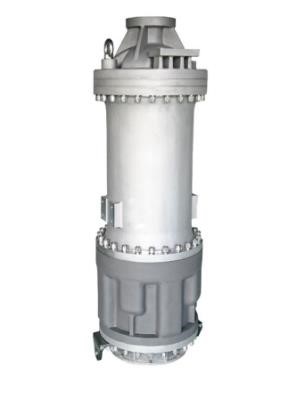
- Ebara began full operation of E-HYETEC in Futtsu, Chiba Pref, a testing and development center for commercial-scale liquid hydrogen pumps using actual liquid hydrogen.
- The company says it is the world’s first facility of its kind.
- A cryogenic equipment manufacturing base, E-HYEFAB, is co-located at the site, allowing development, testing, assembly and shipment to be handled in the same area.
- SIDE DEVELOPMENT:
- KHI and Shinko agree on liquefied hydrogen transportation pump
- (Company statement, September 28)
- KHI and Shinko agreed on the manufacture of cargo pumps for a 40,000m3 liquid hydrogen transportation vessel that KHI will build for Japan Suiso Energy.
Resonac to supply green ammonia for NEDO demo
(Company statement, October 2)
- Resonac will supply green ammonia produced in Fukushima Pref as part of a NEDO Green Innovation Fund demonstration led by Asahi Kasei and JGC Holdings.
- The ammonia is produced at JGC’s demonstration plant in Namie using renewable hydrogen supplied from the Fukushima Hydrogen Energy Research Field.
- Resonac will purchase and transport the ammonia to thermal power plants in Fukushima, where it will be used for flue-gas denitrification.
- CONTEXT: Resonac has experience supplying ammonia to thermal power plants for NOx removal, including JERA’s Hirono and Tohoku Electric’s Haramachi plants.
NEWS: SOLAR AND BATTERIES

ANRE clarifies commercial solar power types for FIT/FIP support
(Government statement, September 30)
- ANRE named priority commercial solar installations for support under the FIT/FIP.
- Three criteria are proposed for selecting projects: 1) potential for future deployment; 2) compatibility with local communities; and 3) suitability for the FIT/FIP.
- Based on these, ANRE proposes prioritizing FIT/FIP support for four categories:
- Solar PV on land owned by national or local govts, where continued public-sector oversight can be secured.
- Projects developed under the Act on Promotion of Global Warming Countermeasures framework, where municipalities can provide guidance and oversight.
- Solar carports, utilize existing parking areas without new land development.
- Infrastructure spaces – including airports, roads, railways and ports – where existing regulatory and permitting frameworks ensure safety.
- The following types of projects would not be prioritized.
- Local electricity supply, community contributions, local funds and emergency-power functions alone would not be sufficient to qualify a project for priority treatment.
- Solar-sharing (agrivoltaics) will be considered following regulatory reforms.
- Solar PV on industrial/commercial premises, former golf courses and ski resorts, abandoned farmland, and degraded farmland are not prioritized due to land-use changes, limited public oversight, etc.
- CONTEXT: ANRE plans to focus FIT/FIP support for utility-scale solar power starting FY2027 on solar projects that promote coexistence with local communities. New ground-mounted utility-scale solar projects will become ineligible for FIT/FIP support in FY2027, while ANRE will consider which other types of solar projects, in addition to rooftop installations, should remain eligible for support.
- TAKEAWAY: As new ground-mounted commercial solar loses FIT/FIP eligibility from FY2027, policy support is shifting toward sites that require less new land development and offer stronger public oversight, such as rooftops, public land, solar carports and infrastructure spaces. This should redirect investment toward projects with lower local-consent and environmental risks, although developers will face stricter eligibility, permitting and community-coexistence requirements. Agrivoltaics remain a possible growth area, but their treatment will depend on reforms that ensure genuine agricultural activity and appropriate local oversight.
NTT and JERA launch hourly-matching demo using solar and BESS
(Company statement, September 29)
- NTT Anode Energy, NTT Docomo and JERA Cross launched a demo for hourly matching by combining solar power and BESS to supply electricity to Docomo’s telecom buildings in western Japan.
- CONTEXT: From Dec 2024 to Sept 2025, the three firms held a similar demo using non-FIT solar and biomass power. They achieved hourly matching using biomass power, including during periods when solar power was not generating electricity. But, the demo also identified periods of insufficient supply when the biomass power plant was under maintenance, leading the companies to rely on BESS for the next project.
- The demo will evaluate the extent to which BESS can improve the hourly matching rate of carbon-free electricity.
- It will also assess how storing surplus solar power in BESS and discharging it during periods of low solar generation can improve the hourly matching rate.
- The hourly matching evaluation will use the platform developed by Granular Energy, an EnergyTagaccredited firm in partnership with JERA Cross.
Eliiy Power develops high-nickel lithium-ion battery
(Company statement, September 28)
- Eliiy Power developed the HY Battery E Series, a new lithium-ion battery lineup featuring a cathode with a high nickel content; this gives it high energy density.
- It reaches 240 Wh/kg, compared to 90–160 Wh/kg for conventional lithium-ion batteries using lithium iron phosphate chemistry.
- The battery promises improved safety, with low thermal runaway and explosion risks. The battery did not catch fire during nail penetration tests.
- The battery can be used as a backup or portable power source.
- The company plans to launch production at its Kawasaki plant in FY2026.
- TAKEAWAY: Producing a high-nickel battery while maintaining a high degree of safety is significant given the thermal-stability challenges with high-nickel cathodes. Investment in high-nickel battery series aligns with strong demand for high-energy-density applications, including large-scale backup battery systems for data centers, or EVs.
Mitsubishi HC Capital and partners launch agrivoltaic business
(Company statement, September 16)
- Mitsubishi HC Capital Energy, Kyuden Mirai Energy and enblue formed an agrivoltaic power generation firm, Boso Solar Sharing.
- Their first project is in Chiba Pref, with commercial operations to begin in 2027.
- It will feature solar PV panels installed over a soybean field operated by Tsunagu-farm, a subsidiary of Chiba Eco-Energy.
- CONTEXT: Chiba Pref is home to many agrivoltaic projects and had the highest number of permits issued for such facilities, with 702 out of 6,137 permits nationwide. Notable projects include the Sosa Ohisama Power Plant (1.92 MW), one of Japan’s largest agrivoltaic projects.
Orix to build extra-high voltage BESS in Kyushu and Tohoku
(Company statement, September 30)
- Orix began building two extra-high-voltage BESS projects:
- 70 MW/ 280 MWh in Yufu (Oita Pref), scheduled to start operation in 2028
- 75 MW/ 309 MWh in Yonezawa (Yamagata Pref), to start operation in 2030.
- Orix holds a 23.7% stake in the projects, while the remaining 76.3% is held by three other investors, including a subsidiary of Mitsubishi UFJ Trust and Banking.
- TAKEAWAY: The announcement does not mention any subsidies, though subsidy-free projects are not new in Japan, for example, large-scale projects such as the 49.5 MW Fukuchiyama BESS in Kansai. Owned by Tokyo Century and operated under a fully merchant business model, it shows that large-scale BESS projects can proceed without direct subsidy support where investors are willing to take merchant market risk.
NEXTES supplies battery system for Chinese electric freighter
(Company statement, September 24)
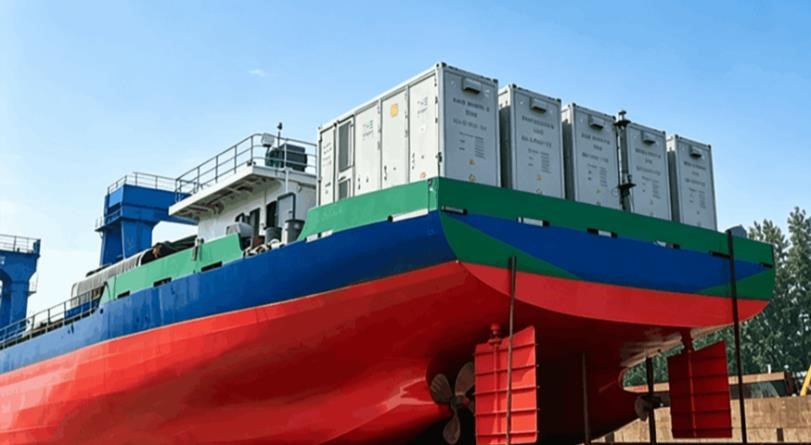
- NEXTES subsidiary Shanghai EVTD supplied five battery units totaling 4.3 MWh for the 3,000-ton electric freighter Tianhedian 1 in China.
- The batteries were developed and manufactured by NEXTES in Japan.
- NEXTES says its proprietary active-balancing technology transfers energy between cells to correct differences in charge levels, improving battery utilization and reducing energy losses.
- The vessel was launched in June 2026.
- TAKEAWAY: Beyond biofuels, vessel electrification is another way to decarbonize maritime transportation. Battery retrofits can reduce fuel consumption while maintaining the use of the engine through hybrid propulsion, as well as fully power a vessel with electricity, or provide backup power while improving overall energy efficiency. While Tenwaden 1 is a Chinese vessel, BESS have also been installed on Japanese vessels, with the 492 ton tanker Asahi equipped with a 3.48 MWh battery system. BESS capacity can be even larger, with AYK Energy (Andorra) having completed the retrofit of a ferry with a 12.6 MWh battery system.
Panasonic and Kobe to demo glass-type PSCs
(Company statement, September 24)

- Panasonic Holdings, Panasonic Environmental Engineering and Kobe City will demonstrate glass-type perovskite solar cells (PSCs) at Nakatottei Central Terminal (Kamomeria) in Kobe.
- The project forms part of NEDO’s next-generation solar cell program and will run through March 2029.
- Eight glass-type PSC panels will be installed, using laminated glass construction, and the demonstration will evaluate installation methods, durability and power-generation performance.
- CONTEXT: Kobe has previously hosted PSC demonstrations at Kobe Airport, where the technology was tested in locations that are difficult to cover with conventional solar PV.
- TAKEAWAY: Panasonic is one of Japan’s main developers of glass-type PSCs, although national support has focused more heavily on lightweight film-type cells that can be installed on a wider range of surfaces. Glass-type PSCs have a different advantage: they can be integrated into building façades and other urban structures while allowing greater design flexibility. That creates potential for BIPV applications where appearance, space constraints and compatibility with the surrounding environment matter as much as generation efficiency.
- SIDE DEVELOPMENT:
- Maeda and Aichi Pref hold demo of PSCs on public road
- (Company statement, September 30)
- Maeda Construction, Aichi Prefectural Road Public Corp and Aichi Road Concession launched a demo for PSCs installed on a sound barrier along a local road.
- The PSCs will supply power to local equipment.
Kita Gas and mui Lab to demo home EMS
(Company statement, September 18)
- Kita Gas and mui Lab will hold a demo through February 2027 to study the automatic control of gas and electricity consumption in Hokkaido households.
- The goal is to:
- Improve Kitagas’ EMS to optimize energy use from rooftop solar generation, residential power generation and BESS;
- Expand heating optimization that uses indoor temperature and humidity data;
- Use of DR to control air conditioners based on electricity supply and demand.
- CONTEXT: Due to its cold climate, Hokkaido households have higher electricity and gas consumption levels, at 1.6 times the national average, as well as heating and hot water consumption at 2.3 times the national average. HEMS need to deliver greater efficiency gains than in other regions to provide sufficient value for local households to adopt such systems.
NEWS: WIND POWER AND OTHER RENEWABLES

Eurus and Toyota affiliates sign virtual PPA for onshore wind
(Company statement, October 1)
- Eurus Green Energy and three Toyota-affiliated companies signed a virtual PPA using output from the 51 MW Eurus Yurikogen Wind Farm in Yurihonjo City, Akita Pref.
- The wind farm has transitioned from the FIT to the FIP scheme.
- Under the agreement, the environmental value associated with power generated by the wind farm will be supplied to the Toyota-affiliated companies.
- CONTEXT: Eurus Yurikogen Wind Farm has operated since December 2015.
- SIDE DEVELOPMENT:
- METI selects Eurus for offshore wind power training project
- (Company statement, September 28)
- Eurus Technical Service was selected for METI’s offshore wind human-resource development program.
- It will expand the Eurus Training Center (Chiba pref) to include training facilities for wind turbine blade repair.
- CONTEXT: Offshore wind turbine blade repair currently relies on workers going to overseas training institutions to acquire the specialized knowledge and skills; thus, this project aims to build domestic capacity for specialized blade-repair training.
NYK Line orders service vessel for offshore wind facilities
(Company statement, September 25)
- NYK Line ordered a service operation vessel (SOV) from PaxOcean Group (Singapore) to support offshore wind facility construction and maintenance.
- The vessel will be completed in 2029 and deployed to offshore wind projects around Asia in partnership with IOVTEC, a Taiwanese offshore wind company.
- The SOV will accommodate up to 120 people and provide offshore accommodation, logistics, and safe personnel/cargo transfer during construction and maintenance.
- TAKEAWAY: While this news is minor, it reveals how Japanese industry sees growing opportunities in servicing the offshore wind industry across Asia in the coming years.
Donan Offshore Wind forms strategic partnerships
(Company statement, October 1)
- Donan Offshore Wind Platforms, a newly formed Hokkaido Electric group company, announced partnerships with six firms to accelerate offshore wind power generation in Donan region.
- They are: IC Holdings; Kuribayashi Trading; DENZAI E&C; Nippon Marine Enterprises; NYK Line; and Hokuyo Bank
- The partners will contribute expertise in construction, logistics, maritime services and regional finance, while supporting a planned offshore-wind maintenance training center and broader industry development in southern Hokkaido.
NEWS: NUCLEAR ENERGY

METI plans to have NEDO financing next-gen nuclear reactors
(Nikkei, September 28)
- METI seeks to enable NEDO to finance development of next-gen nuclear reactors. Support could begin in FY2028.
- METI will submit an amendment to the law regulating NEDO during the 2027 regular Diet session. Currently, the law excludes nuclear energy from NEDO’s scope.
- METI requested ¥141 billion in its FY2027 budget draft to foster nuclear startups and innovation via subsidies and commissioned projects.
- CONTEXT: METI has categorized reactor types. Fusion development aims for a power-generation demo in the 2030s. Development of Fast Reactors should reach basic design in FY2028. Innovative LightWater, SMRs, Fast and HTGRs have operations targeted for the 2040s.
- TAKEAWAY: Many existing reactors will reach around 60 years of operation from the 2040s onward, increasing the need for replacement capacity. METI estimates that, under certain assumptions, Japan could face a nuclear capacity shortfall equivalent to around 2–5 reactors in the 2040s and 11–14 by the 2050s. Next-generation reactors could fill part of that gap, but long development timelines, high capital costs, and unresolved technical risks make public financing important if Japan wants to maintain nuclear capacity over the long term.
JAIF says one new NPP could generate ¥4.3 trillion in economic benefits
(Nikkei, October 2)
- The Japan Atomic Industrial Forum (JAIF) issued a report claiming that replacing one nuclear reactor could generate ¥4.3 trillion in economic benefits across Japan over the plant’s roughly 100-year lifecycle.
- This includes construction, operation, and decommissioning. The report also estimates that over 90% of nuclear plant equipment is from domestic production
- JAIF said this is the first time it has presented such figures.
- One reactor could reduce CO2 emissions by 4.84 million tons per year.
Helical Fusion to test its pilot fusion reactor in 2027
(Reuters, September 30)
- Helical Fusion wants to begin preliminary power-on tests of its Helix HARUKA pilot fusion reactor in 2027 at the National Institute for Fusion Science in Toki, Gifu.
- If the initial tests succeed, the company plans to install extra components. These include a second superconducting coil and liquid-metal blanket.
- Full-facility power-on tests will be held in 2030. Helix HARUKA must prove stable, continuous fusion reactions using a helical fusion approach.
- The goal is to develop a larger 50-MW reactor, Helix KANATA, in the 2030s, and build a commercial fusion power plant as early as the 2040s.
- CEO Taguchi Takaya said major challenges remain, such as technology, costs, safety, and construction speed.
- CONTEXT: To support fusion development Japan plans ¥3.1 trillion in public and private investment through 2040.
- SIDE DEVELOPMENT:
- Kyoto Fusioneering wins order for gyrotron system
- (Company statement, September 29)
- Kyoto Fusioneering won an order from Quaise Energy, a U.S.-based deep geothermal developer, to supply a complete gyrotron system.
- This is Kyoto Fusioneering’s first gyrotron contract for use outside of fusion energy.
- Quaise Energy is building a specialized drilling technology that uses millimeter-wave energy emitted by gyrotrons to melt and vaporize rock to reach supercritical deep geothermal resources. Existing mechanical drill bits cannot achieve this.
- CONTEXT: Kyoto Fusioneering is a Japanese fusion engineering startup founded in 2019, with hubs in the U.S., UK, Germany, and Canada. It is backed by a network of roughly 200 Japanese supply chain partners. Quaise Energy is a 2018 MIT startup.
- TAKEAWAY: The deal shows that hardware developed for fusion can have applications in adjacent energy sectors. It also broadens Kyoto Fusioneering’s customer base beyond fusion. The technology could eventually be relevant in Japan, where deep and supercritical geothermal resources are attracting growing interest, although Quaise’s drilling approach remains at an early commercial stage.
Hitachiomiya accepts first phase of survey for radioactive waste final disposal site
(Japan NRG, September 30)
- Following a meeting with METI Minister Akazawa, the mayor of Hitachiomiya City (Ibaraki Pref) accepted a ‘literature survey’ for radioactive waste final disposal.
- The METI Minister assured the mayor that no radioactive waste would be brought to the city during the survey and promised measures to prevent reputational damage.
- Local residents and city councillors have voiced strong opposition, raising alarms over agricultural safety, environmental protection, and future impacts.
- The mayor said advancing to the survey’s second phase will require a referendum.
- TAKEAWAY: The so-called ‘literature survey’ is the first phase of Japan’s nuclear waste site selection process, which takes around two years to check geological data on paper. Hitachiomiya is the fifth location nationwide – and the first on Honshu island – to accept the literature survey. Transitioning to the second phase would need explicit consent from both the local mayor and the prefectural governor.
KEPCO releases investigation results for Ohi and Mihama NPP incidents
(Company statement, October 2)
- Ohi Unit 3: KEPCO completed its investigation into the Aug. 9 automatic shutdown following a generator “loss of excitation” alarm. The problem originated in equipment supplying the generator’s magnetic field, where a detached component contributed to a short circuit. The unit entered a scheduled inspection on Oct. 10, while the restart timing remains undecided. KEPCO had already reported the initial shutdown in August and an interim investigation on Aug. 19.
- Mihama Unit 3: KEPCO concluded that rainwater entered through a gap in a protective cover installed incorrectly over piping connected to a high-pressure feedwater heater. The resulting corrosion created a hole and caused the Sept. 17 water leak. KEPCO found one incorrectly installed cover among 62 inspected locations.
NEWS: TRADITIONAL FUELS

Shell approved Phase 2 for LNG Canada export facility
(Japan NRG, September 30)
- Shell and partners approved Phase 2 expansion of the LNG Canada export facility, which will double capacity to 28 MTPA.
- Commercial operations are expected in the early 2030s. Phase 1 began LNG exports in June 2025.
- The expansion represents about C$33 billion / USD$ 23 billion of private investment.
- The JGC-Fluor joint venture received Notice to Proceed for engineering, procurement, fabrication, construction and commissioning. Fluor said its share of the contract is US$7.5 billion.
- CONTEXT: Shell leads the consortium with a 40% stake; PETRONAS holds 25%, PetroChina and Mitsubishi 15% each, and KOGAS 5%.
- TAKEAWAY: For Japan, LNG Canada Phase 2 strengthens access to a large Pacific Basin LNG source in a politically stable G7 country. British Columbia offers an 8–10-day route to Northeast Asia without relying on the Panama Canal, Strait of Hormuz or Malacca Strait. The project is also significant for Japanese industry through Mitsubishi’s 15% equity stake and JGC’s major role in project engineering and construction. Mitsubishi’s offtake from the project will double to 4.2 Mtpa.
Saudi oil prices up 29% for Japanese buyers
(Nikkei, October 2)
- The price for September shipments of Saudi Arabia’s crude oil (Arabian Light) to Japan rose 29% ($25) MoM hitting $111.88 per barrel, a four-month high.
- This is due to a sharp rise in Middle East benchmark prices (Dubai and Oman crude) over fears of prolonged clashes between the U.S. and Iran, alongside Houthi attacks on Saudi oil infrastructure, such as an attack that halted the East-West pipeline.
- Pipeline operations later resumed and spot prices pulled back, but ongoing tensions mean supply risks persist.
- CONTEXT: Saudi Arabia has been using its East-West pipeline to move crude to the Red Sea port of Yanbu, allowing some exports to avoid the Strait of Hormuz. The pipeline resumed operations after being damaged in September attacks, although regional infrastructure remains exposed to security risks.
Saibu Gas finalizes deal with JERA on LNG tank at Hibiki
(Denki Shimbun, October 1)
- Saibu Gas finalized a contract with JERA on the use of the No. 3 LNG tank at Hibiki LNG Terminal.
- The deal allows mutual LNG supply and accommodation between Saibu Gas and JERA once the new facility is operational. Commercial operation of the No. 3 LNG tank will start in the first half of FY2029.
- CONTEXT: The deal builds on an agreement reached in April 2025.
LNG stocks down from previous week, up YoY
(Government data, September 30)
- As of Sept 20, the LNG stocks of 10 power utilities were 2.52 Mt; up 0.8% from the previous week of Sept 13 (2.50 Mt); up 52.7% from end Sept 2025 (1.65 Mt); and up 22.9% from the 5-year average of 2.05 Mt.
- As of Sept 27, the LNG stocks were 2.41 Mt; down 4.4% from the previous week; up 46.1% YoY; and up 17.6% from the 5-year average.
August Oil/ Gas/ Coal trade statistics
(Government data, September 30)
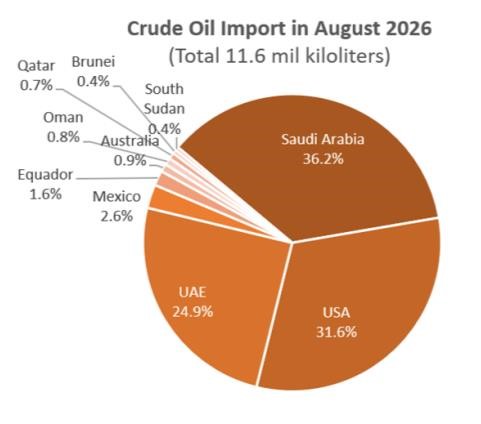
- Crude oil imports in August totaled 11.6 million kiloliters, down 3.9% from July, but up 3.6% YoY. So far, Saudi Arabia is the top supplier for 2026, followed by the UAE. The U.S. is the third largest supplier in the past three months and growing, but its total this year is about half of the UAE.
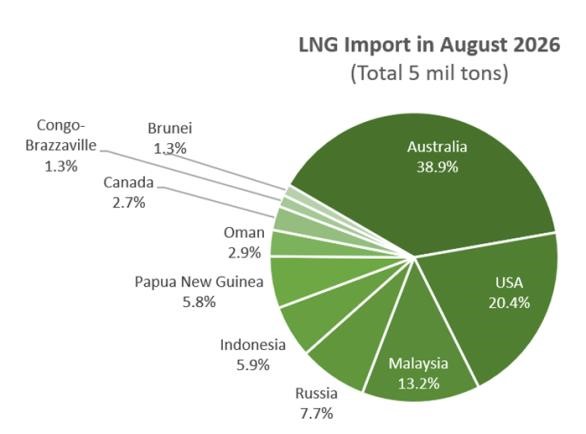
- LNG imports in August totaled 5 Mt down 0.5% over July, and down 6.8% YoY. Imports from the U.S. jumped 20.4% MoM. Australia remains the leading LNG exporter to Japan. Japan imports LNG from 18 countries.
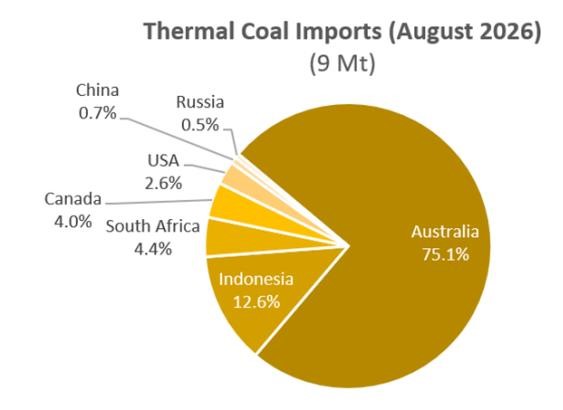
- Thermal coal imports in August totaled 9 Mt, up 2.5% from July, but down 14.2% YoY. Imports from Indonesia rose 93.7% MoM, and those from South Africa were up 45.7%. Australia remains Japan’s leading LNG supplier.
NEWS: CARBON CAPTURE & SYNTHETIC FUELS

METI discusses rules and price ceiling for GX-ETS emissions market
(Government statement, September 25)
- A METI subcommittee discussed operational rules for the upcoming GX-ETS market.
- METI proposed a price ceiling safety valve called “deemed compliance”. Participating businesses can meet emissions obligations by paying a fixed price in case market allowance prices surge or market liquidity dries up.
- If market prices drop below a set floor for a sustained period, the govt plans to intervene with reverse auctions to buy back allowances and tighten market supply.
- The subcommittee’s next focus is setting rules for banking, allowing companies to save surplus emission allowances for future use. Banking helps smooth allowance purchasing costs, but excessive hoarding risks lowering market liquidity and triggering price spikes.
- The Central Research Institute of Electric Power Industry (CRIEPI) examined international practices and identified three ways for managing banking: 1) imposing holding limits; 2) setting allowance end dates; 3) and adjusting total market supply.
- CONTEXT: This mandatory GX-ETS began from FY2026 for large emitters, replacing the current voluntary framework with binding allowance obligations. A separate fossil-fuel levy under the broader GX carbon-pricing framework is scheduled to begin in FY2028.
Sumitomo Osaka Cement-led group studies Tokyo CO2 recycling chain
(Company statement, September 17)
- Sumitomo Osaka Cement, Iwatani and partners will study a CO2 capture and utilization supply chain using emissions from waste-incineration plants in Tokyo.
- The feasibility study will examine three main pathways: artificial limestone, high-purity CO2 and biological utilization.
- The project will run through FY2027 and assess technical feasibility, economics, lifecycle emissions and regulatory issues.
- Consortium roles include:
- Takuma: CO2 capture;
- Iwatani: transport and supply;
- Taisei: construction applications and implementation;
- Omnia Concerto: biological utilization.
- CONTEXT: The project was selected under a Tokyo Metropolitan Government program aimed at developing CO2 supply chains from facilities where emissions are difficult to avoid.
GS Yuasa and Yoho Gas to cooperate on Direct Ocean Capture
(Company statement, September 17)
- GS Yuasa, Toho Gas and Hokkaido University will conduct R&D on Direct Ocean Capture (DOC) using electrodialysis combined with hydrogen pumping. The companies say this is the first application in Japan of such an approach to DOC.
- The approach may potentially reduce power use for DOC to one-sixth of conventional methods. The project roadmap targets a pilot for large-scale testing in the late 2030s.
- The technique aims to reduce the electricity required to extract CO2 from seawater by using a small amount of hydrogen to supply hydrogen ions, rather than generating them through conventional high-voltage water electrolysis.
- GS Yuasa will design the electrodialysis cells; Toho Gas will evaluate system-level energy use and costs; and Hokkaido University will conduct laboratory-scale CO2 recovery tests.
- The project was selected for NEDO’s Frontier Development program for industrial ocean carbon dioxide removal.
- CONTEXT: DOC removes dissolved CO2 from seawater. Because the ocean naturally exchanges CO2 with the atmosphere, lowering dissolved CO2 can enable additional atmospheric CO2 uptake, giving the technology potential as a carbon-removal method.
ANALYSIS
BY FILIPPO PEDRETTI
Chubu Electric’s Seismic Data Scandal is Major Blow to Nuclear Industry
Japan now faces possibly the most devastating blow to its nuclear power industry since the earthquake and tsunami in March 2011. On September 14, Chubu Electric’s credibility collapsed with the release of a 250-page independent report exposing data manipulation at the Hamaoka Nuclear Power Plant.
The scandal prompted the resignations of Chief Executive Hayashi and Chairman Katsuno, and 11 days later, Chubu Electric took an unprecedented step asking the Nuclear Regulation Authority (NRA) to withdraw its restart review applications for Units 3 and 4.
Located within the seismic fault zone of the Nankai Trough, the Hamaoka NPP (Shizuoka Prefecture) has long operated under a cloud of environmental and regulatory risk, earning Hamaoka the unfortunate reputation as Japan’s most vulnerable nuclear installation.
In brief, the damning report said that fears over potential threats from Mother Nature led to excessive corporate pressure on staff to do everything necessary to secure state approval for a potential restart. Zealous staff resorted to dubious practices that mounted into a decade of falsified calculations meant to mislead state regulators.
The repercussions of Chubu Electric’s deception will extend far beyond the downfall of a single utility giant. This scandal’s shockwaves could challenge the foundational assumptions of the role nuclear power can play in Japan’s future energy mix.
Mechanics of falsification and governance failure
The independent investigation that uncovered widespread fraud centered around how Chubu Electric calculated Hamaoka’s “baseline earthquake ground motion” – a parameter required for regulatory approval and which relies on computer simulations across many fault lines.
Investigators determined that Chubu Electric’s Civil and Nuclear Construction Department manipulated 90% of the fault-model evaluation cases. The remaining 10% lacked fundamental documentation, rendering them unassessable.
Data fabrication began as early as 2012 and accelerated in 2018, persisting even after an external whistleblower led the NRA to launch an official inquiry in May 2025.
The external investigation committee rejected that this was the work of a few rogue engineers. Instead, it cited a culture of toxic executive pressure that mixed with a warped internal ideology labeled “unique self-justification theory.”
As Hamaoka’s regulatory review dragged on, boardrooms grew hostile. Katsuno – then President, later Chairman – scolded the nuclear construction team during meetings. Stuck between deadlines and technical realities, field engineers manufactured compliant data. They believed NRA requirements were “unreasonable and unscientific” and claimed that they “knew” Hamaoka was safe. Engineers viewed data alteration as a necessary shortcut.
This insular mindset triggered a series of compliance breakdowns. In 2019, an employee filed an internal hotline complaint detailing discrepancies in seismic data. The report went back to Chubu Electric’s Civil and Nuclear Construction Department, but no investigation followed.
| Phase | Timeline | Key Events |
|---|---|---|
| 1. Hidden fraud | 2012 – 2025 | ・Engineers alter seismic calculation data under hostile pressure to hit targets. ・Internal whistleblower reports and legal warnings are buried by management. |
| 2. Regulator exposure | Early 2025 – June 2026 | ・External tip triggers official inquiry by the Nuclear Regulation Authority (NRA). ・Shareholder support for board members drops to record lows (56%–61%). |
| 3. Executive collapse | Sept – Oct 2026 | ・Independent report confirms widespread fraud; top leadership resigns. ・Application for Hamaoka restart officially withdrawn on September 25. |
External legal counsel later warned leadership of grave regulatory risks, but department heads brushed off the warnings. They claimed that transparency would mean “abandoning Hamaoka.” Chairman Katsuno reviewed these files but accepted the department’s deflections without independent verification.
The culture of falsification extended to other departments; for example, investigators learned that employees altered records on decommissioning Units 1 and 2. One case is unrelated to nuclear power. In mid September Chubu Electric admitted to systemic calculation errors, claiming the cause was due to uncorrected software glitches. These led to overcharging at least five million residential and commercial accounts since April 2024.
| Facility | Issue | Core Impact | Primary Risk |
|---|---|---|---|
| Units 3 & 4 | Falsified seismic motion data due to executive pressure | ・Top leadership resigned (Sept 2026) ・Restart application withdrawn; 12-year review reset ・Safety reviews halted by NRA | ・Permit revocation ・Severe financial losses & key enterprise clients (e.g., Toyota) switching to other suppliers ・Forced consolidation |
| Units 1 & 2 | Falsified decommissioning reports to meet target deadlines | ・Investigation expanded across all 36 decommissioning projects ・Management took joint responsibility | ・Escalating delay and waste management costs ・Heavy administrative penalties ・Total erosion of site viability |
Financial fallout and leadership transition
The scandal’s fallout has been immediate. Chubu Electric’s stock plummeted 4% following the September 14 disclosure, a substantial drop for a strictly regulated sector. The decline over the month of September was close to 10%. The Nikkei-225 stock index was up slightly in the same period.
Beyond immediate market volatility, the utility faces staggering asset write-downs. Chubu spent a decade investing in safety retrofits at Hamaoka. Now, it must confront the likelihood of declaring massive impairment losses on Units 3 and 4.
The utility is in a precarious state. Without Hamaoka’s 2 GW capacity, it has no nuclear assets and few other low-carbon options to lower its emissions footprint. This complicates Chubu Electric’s offering to the local region’s auto-led manufacturing hubs, with firms like Toyota looking to increase their CO2-free power supply.
The situation also leaves the utility firmly dependent on its 50-50 joint venture with TEPCO – JERA – to secure adequate power volumes to meet retail contracts, and tied to the volatility of fossil fuel prices. In FY2025, coal and LNG generated 60% of the utility’s power output.
Incoming CEO Yasui Minoru took over the beleaguered Chubu utility on October 1. Hoping to restore stakeholder confidence, he’ll hold a press conference on October 8 to lay out his vision and outline a plan for recurrence prevention measures.
Still, as a non-nuclear executive with a background in thermal generation and strategy, Yasui faces an uphill battle; shareholder support for the outgoing board already hovered at a dismal 56% to 61% at the June annual meeting.
Implications for national energy policy
The scandal certainly dealt a heavy blow to Japan’s energy strategy, which targets a 20% nuclear share in the national power mix by 2040. This goal relied on Hamaoka Units 3 and 4 returning online. Meanwhile, the METI Minister Akazawa dismissed hopes of a swift resubmission of Hamaoka’s restart application, saying that a comprehensive structural overhaul was necessary before such a development.
Furthermore, the NRA is preparing multi-year, deep-dive audits. Similar regulatory freezes at TEPCO’s Kashiwazaki-Kariwa NPP dragged on for over two and a half years. Japan NRG expects Hamaoka’s regulatory freeze to last even longer. In damage limitation mode, Chubu Electric’s management maintains that withdrawing the application is equivalent to a temporary pause. But a restart is even more improbable given the loss of regulatory trust and fierce local opposition in Shizuoka. Some industry observers suggest that a permanent decommissioning of Units 3 and 4 may be the only path forward, which would leave Chubu Electric with just one reactor – Unit 5 (1.3 GW).
As Yasui takes over the leadership, Chubu Electric stands at a critical juncture. His background could signal a pivot away from nuclear generation. The focus may be toward renewable infrastructure, grid modernization, and joint ventures such as JERA.
Rebuilding institutional trust, however, will need more than strategic diversification. It will mean tackling the insular corporate culture that enabled a decade of deceit. The only way to accomplish this is via uncompromising external oversight.
ANALYSIS
BY GILLIAN SAWYER
GX Strategic Areas to Spark Data Center Growth and Regional Revitalization
A new wave of large data centers could begin construction across regional Japan by 2030, as the government moves from identifying candidate sites to preparing land, power and communications infrastructure for future AI and cloud demand.
METI’s first GX Strategic Area designations, announced last month, cover nine prefectures and 10 locations selected for data-center (DC) cluster development. The goal is to create new computing hubs outside the traditional concentration in Tokyo and Osaka, where available land and grid capacity are already highly limited.
The timetable is deliberately phased. METI’s selection criteria favor areas where roughly 30 hectares or more of industrial land can be assembled within a 10-kilometer radius, with land preparation preferably completed within about three years and further expansion possible thereafter. At the same time, electricity supply should be capable of scaling over the longer term toward GW-class levels, with around 10 years cited as an illustrative timeframe.
That means the first projects do not have to wait for an entire GW-scale cluster to be built. In the more advanced locations, data-center construction could begin before the end of the decade, while grid capacity, generation and surrounding infrastructure continue to expand around them.
The dramatic rise in power demand is expected to be met by building new decarbonized energy sources. Clean power sites, such as nuclear and large-scale renewables, are scattered unevenly around the country. By co-locating high-power-demand industries near such sources, officials hope to improve efficiency, reduce grid bottlenecks, and strengthen energy and IT security.
If successful, this policy would catalyze domestic and foreign investment in DCs and other AI-related facilities, while also creating the conditions for new industrial and IT clusters outside Japan’s biggest cities.
Strategic Areas and selected regions
GX Strategic Areas apply the Watt-Bit collaboration concept to expand decarbonized power sources in tandem with DC cluster development. It focuses on the integrated development of power (“watts”) and telecom infrastructure (“bits”).
Japan’s power infrastructure, however, is showing signs of strain. There are cases when it can take more than 10 years to connect to the power grid. Thus, officials say the grid must be upgraded to allow at least another 5 GW of power capacity to connect within a decade to cover new DC demand across Japan – all while supporting national decarbonization goals.
Watt-Bit seeks to address this by enabling faster and more efficient DC deployment without waiting solely for major upgrades on existing transmission lines. It promotes a wider geographic distribution of DCs, especially to areas with ample renewable energy potential. It’s also seen as a way to reduce renewables curtailment.
The Strategic Areas were selected based on disaster risk, access to industrial land and water resources, as well as sufficient communication links. In the first round, one region was selected in the industrial complex regeneration category; eight regions were selected for the decarbonized power source utilization category; and nine regions were selected for the DC cluster category.
| GX Strategic Area Type | Prefecture | Municipality |
|---|---|---|
| Industrial Complex Regeneration | Kanagawa | Kawasaki City |
| Decarbonized Power Source Utilization | Aomori | Rokkasho village, Rokunohe town |
| Decarbonized Power Source Utilization | Akita | Akita city |
| Decarbonized Power Source Utilization | Fukushima | Namie town |
| Decarbonized Power Source Utilization | Niigata | Seiro town |
| Decarbonized Power Source Utilization | Niigata | Kashiwazaki city |
| Decarbonized Power Source Utilization | Niigata | Ojiya city |
| Decarbonized Power Source Utilization | Fukui | Fukui city, Obama city |
| Decarbonized Power Source Utilization | Shimane | Matsue city |
| Data Center Cluster | Hokkaido | Ishikari city, Tomakomai city |
| Data Center Cluster | Akita | Akita city |
| Data Center Cluster | Miyagi | Tomiya city |
| Data Center Cluster | Tochigi | Yaita city |
| Data Center Cluster | Ibaraki | Joso city, Tsukuba city |
| Data Center Cluster | Toyama | Nanto city |
| Data Center Cluster | Kawaga | Ayagawa town, Sakaide city, Marugame city |
| Data Center Cluster | Fukuoka | Kitakyushu city, Nogata city, Kurate town |
| Data Center Cluster | Kagoshima | Satsumasendai city |
Kagawa Prefecture said it’s committed to promoting the use of AI and industrial DX, citing its support for DC development as a way to stimulate the regional economy. Fukuoka Prefecture said it will fully utilize state support to collaborate with local businesses to create a major GX-related industry hub based on DC clustering.
Satsumasendai City discussed its plan for developing the former Sendai power plant site and its surrounding forest reserve, aiming to establish one of the largest AI data centers in Japan and related industries to support it.
As much as the national government stands to benefit from regional decentralization of DCs, local economies view such development as a chance to cultivate new local industries.
Simultaneous promotion of DC and GX
While GX Strategic Areas are an effort to simultaneously advance DCs and GX goals, the initiative only helps to determine the locations. How quickly each area can now assemble the power capacity, networks and customers to proceed on a commercial basis will be up to the local authorities and industry. And that varies quite substantially.
The ten DC locations, for example, do not all start from the same position. Ishikari already has an established DC industry, but many others have few if any such facilities.
Some of the locations overlap with areas rich in renewables or other decarbonized power sources, but proximity to generation does not by itself provide electricity supply in the orders of magnitude required for large AI campuses or similar. That distinction will be key for investors looking at the practical pathways for a local cluster to scale from tens to hundreds of megawatts and eventually a gigawatt scale.
If local offshore wind and solar operators cannot guarantee continuous supply, then attention will turn to what grid reinforcement, power storage, nuclear or thermal generation and other solutions will be made available locally.
Solving the chicken-and-egg dilemma
The Areas initiative is trying to solve the old chicken-and-egg problem. Japan’s utilities have traditionally reinforced networks in response to specific connection requests, while DC and other AI-related developers are reluctant to commit funding without the confidence that their projects will have access to electricity soon.
In this sense, the Areas mechanism creates a way for grid infrastructure to be planned ahead of individual projects, thus shortening connection times.
The communications side is beginning to move in parallel. Ministry of Internal Affairs and Communications-backed demonstrations also launched last month are testing an allphotonic network that would connect geographically separated DCs and shift computing workloads according to renewable output, electricity prices, grid conditions and available computing resources.
A Kyushu Electric-led project, for example, is linking three regional facilities and operating them virtually as a single DC through February 2027. If such a design works at commercial scale, the implications extend beyond faster communications. Computing loads could become more mobile geographically and, to some degree, temporally, allow DCs to follow available power rather than requiring every new facility to reproduce Tokyo’s winning combination – dense connectivity and electricity supply.
That would strengthen the logic behind the GX Strategic Areas. But it also illustrates how much remains to be designed, tested, and built. While September’s announcements identify where Japan wants its next major computing clusters to emerge, it does not yet determine which of those locations will attract customers and capital, as well as the continuous low-carbon power needed to bring them online.
ASIA ENERGY REVIEW
BY JOHN VAROLI
A brief overview of the region’s main energy events from the past week
Australia / BESS
FRV commissioned its first utility-scale battery project in Australia with the 100 MW/ 200 MWh Terang BESS now operating at full capacity. This is FRV’s first standalone battery energy storage project.
Bangladesh / Coal
Power generation has shifted toward coal relative to gas and LNG. Coal overtook gas-fired output for the first time in summer due to cost pressures, domestic gas decline, and supply disruptions. This is not a formal policy abandonment of LNG.
China / Diesel
China aims to cut diesel usage by boosting electric truck sales, which are on track to account for one-third of total truck sales this year.
China / Oil
China is not expected to boost crude oil imports through year’s end as oil prices surged above $100/ barrel again and independent refiners struggle to procure cheaper supply amid a shortage of Iranian oil. But in September China will import the same volume of crude as in August.
India / Coal
Electricity generators ended summer with coal stocks at their lowest for five years; electricity demand was at a record high. Generators held stocks totalling 22 Mt this week, down from 46 Mt at the same point in 2025. Stocks were just one-third of the desired level, said the Power Ministry.
India / Renewables
India’s cabinet has approved a $20 billion renewable energy program to upgrade existing grids and add storage, the country’s information minister said. This can unleash up to 135 GW of clean energy.
Indonesia / Coal
Captive coal power plants solely serving dedicated industries generated 134 TWh of electricity in 2025, about 58% of the country’s 233 TWh of grid-connected coal generation, said Ember. The estimate was 30 TWh higher than the govt’s figure.
Philippines / Renewables
The Aurora Pacific Economic Zone and Freeport Authority inked an MoU with Huge Energy and Dong-A Global to develop a $131 million, 1 GW solar power facility with a BESS and power substation. Construction starts next year and will run until 3031.
Singapore / Energy efficiency
Singapore firms will increase investment in energy-efficient technologies over the next 12 months, as the 2030 net-zero deadline approaches, claims Schneider Electric.
South Korea / U.S. investments
Trump said South Korea will invest $200 billion in U.S. energy projects, but Seoul said one key element, a $54 billion pipeline for Alaska LNG, was not yet set in stone.
Disclaimer
This communication has been prepared for information purposes only, is confidential and may be legally privileged. This is a subscription-only service and is directed at those who have expressly asked K.K. Yuri Group or one of its representatives to be added to the mailing list. This document may not be onwardly circulated or reproduced without prior written consent from Yuri Group, which retains all copyright to the content of this report.
Yuri Group is not registered as an investment advisor in any jurisdiction. Our research and all the content express our opinions, which are generally based on available public information, field studies and own analysis. Content is limited to general comment upon general political, economic and market issues, asset classes and types of investments. The report and all of its content does not constitute a recommendation or solicitation to buy, sell, subscribe for or underwrite any product or physical commodity, or a financial instrument.
The information contained in this report is obtained from sources believed to be reliable and in good faith. No representation or warranty is made that it is accurate or complete. Opinions and views expressed are subject to change without notice, as are prices and availability, which are indicative only. There is no obligation to notify recipients of any changes to this data or to do so in the future. No responsibility is accepted for the use of or reliance on the information provided. In no circumstances will Yuri Group be liable for any indirect or direct loss, or consequential loss or damages arising from the use of, any inability to use, or any inaccuracy in the information.
K.K. Yuri Group: Hulic Ochanomizu Bldg. 3F, 2-3-11, Surugadai, Kanda, Chiyoda-ku, Tokyo, Japan, 101-0062.