
WEEKLY
October 19, 2026
ANALYSIS
WANT TO BENEFIT FROM THE AI BOOM? JAPAN TELLS INVESTORS TO HELP PAY FOR FUKUSHIMA
- The proposed restructuring of TEPCO would allow outside capital into its commercial operations while ensuring profits continue to support Japan’s largest industrial cleanup and compensation effort.
- The stakes extend beyond TEPCO. A successful restructuring could influence how other major Japanese power utilities are valued, finance new capacity and pursue their data center ambitions.
ENERGY JOBS IN JAPAN: SPECULATIVE AND PROP TRADING PLAYERS SEEK LOCAL PRESENCE
- Traders overseas usually take positions in Japanese baseload with a screen, a data sub, and a trading terminal. That’s changing. Speculative and prop players are looking for someone in Japan.
- The driver is both a lack of data and an understanding of the nuances in the available data. Bad trading decisions are often due to something you couldn’t see from overseas.
ASIA PACIFIC REVIEW
This column provides a brief overview of the region’s main energy events from the past week
NEWS
- JERA IPO case strengthens as thermal, data center needs grow
- SoftBank eyes TEPCO restructuring for AI power
- NTT Data in talks to build 500 MW data center for Anthropic
- ANRE shifts focus to smarter use of DR and BESS
- Hitachi, Tohoku Electric automate distribution voltage control
- Tokyo hydrogen conference pushes from plans to deployment
- KHI tests low-NOx hydrogen aircraft engine
- JERA backs U.S. natural hydrogen startup
- Toho Gas and Mitsubishi Corp to generate solar power in Texas
- Omron system integrates solar, batteries and V2H
- Vena starts large-scale Okayama solar project
- JGC tests lightweight film-type CSCs on factory roof
WIND POWER AND OTHER RENEWABLES
- Govt selects three areas for centralized offshore wind surveys
- Japan geothermal market forecast to reach ¥352 billion
- Tohoku Electric to shut Onagawa rector for valve inspection and repair
- MHI ships replacement steam generators to EDF
- Govt backs crude, naphtha imports that bypass Hormuz
- METI moves to ease Hokkaido kerosene price spike
- MODEC sees FPSO demand rising as deepwater oil gains strategic value
CARBON CAPTURE & SYNTHETIC FUELS
- Japan pushes carbon recycling toward commercial deployment
- TEPCO turns household EcoCute savings into JCredits
EVENTS
Oct 19-20 Japan CCUS Summit @Hamamatsucho Convention Hall
Oct 26 GGZ Finance Summit @ Tokyo Prince
Hotel
Nov 2-5 ADIPEC 2026 @ Abu Dhabi
Nov 3 U.S. Midterm Elections
Nov 7 New Zealand General Election
Nov 9-20 COP31 @ Antalya, Türkiye
Nov 18-19 Asia-Pacific Economic Cooperation – Leaders Meeting @ Shenzhen, China
Nov 28 Taiwan Local Elections
Dec 1-3 DeCarbon Tokyo 2026 @ Tokyo Marriott Hotel
Dec 14-15 G20 Summit @ Miami
PUBLISHER
K. K. Yuri Group
Editorial Team
Yuriy Humber (Chief Editor)
John Varoli (Senior Editor, Americas)
Kyoko Fukuda (Data, Events)
Filippo Pedretti (Thermal, CCS, Nuclear)
Tetsuji Tomita (Power Market, Hydrogen)
Aglaé Bange (Renewables, Biomass & Energy Storage)
Gillian Sawyer (Renewables)
George Hoffman (Sales, Business Development)
Rada Kuznetsova (Clients Accounts, Website)
Tim Young (Design)
SUBSCRIPTIONS & ADVERTISING
Japan NRG offers individual, corporate and academic subscription plans. Basic details are our website or write to subscriptions@japan-nrg.com
For marketing, advertising, or collaboration opportunities, contact sales@japan-nrg.com. For all other inquiries, write to info@japan-nrg.com
NEWS: GENERAL OUTLOOK AND TRENDS

JERA weighs IPO as thermal replacement and data center investment needs grow
(Diamond, October 1)
- JERA is considering an IPO and possible holding-company structure as it seeks greater independence from parent companies TEPCO HD and Chubu Electric.
- One driver is a need for capital to replace aging thermal power plants. Five of JERA’s domestic thermal sites operate for over 40 years; six more pass that mark in the 2030s.
- JERA also sees plant replacement as a growth opportunity. More efficient new thermal units could free up land at existing power sites for large data centers supplied directly from nearby generation, reducing reliance on constrained transmission networks and potentially lowering wheeling costs.
- The firm’s relationship with its parents is changing. Long-term power sales contracts with TEPCO and Chubu Electric ended in FY2025 following regulatory pressure for more equal wholesale treatment between affiliated and non-affiliated buyers.
- JERA’s IPO plans are linked to the outcome of TEPCO HD’s alliance talks. TEPCO could be reluctant to dilute its 50% indirect stake in JERA because the firm is an important source of earnings.
- CONTEXT: TEPCO and Chubu Electric created JERA in 2015, expanding it from thermal generation into LNG procurement, trading, renewables and wholesale power. FY2025 revenue reached about ¥3 trillion, near Chubu Electric’s ¥3.5 trillion.
- TAKEAWAY: JERA was created in part to take over the thermal power and fuel businesses of TEPCO and Chubu Electric when TEPCO focused on Fukushima recovery. Since 2015, JERA has evolved into a much more independent and expansion-minded energy firm than its parents. IPO speculation has circulated for years, but the rapid growth in expected data center demand has strengthened the strategic case: JERA believes its existing power-station sites could become valuable hubs for AI-related load growth while helping justify investment in thermal replacement. The complication is that JERA’s ownership remains politically sensitive, with the govt still controlling TEPCO and TEPCO’s own restructuring needs potentially affecting how quickly JERA can move toward greater independence.
- SIDE DEVELOPMENT:
- SoftBank interested in TEPCO restructuring due to data centers
- (Diamond, October 8)
- SoftBank Group Chairman Son Masayoshi expressed interest in a capital and business alliance with TEPCO HD since this can secure more electricity for AI data centers.
- SoftBank is a leading candidate in TEPCO’s alliance discussions, with access to large volumes of power seen as a key attraction as AI data center development accelerates.
- Son frames electricity and data center capacity, and semiconductors, as bottlenecks to AI growth/ SoftBank seeks large data center projects in Japan, the U.S. and France.
- Soon after the 2011 Fukushima accident, Son made a big push into Japan’s power sector, advocating rapid renewable expansion and the original FIT tariff. But over the years, his interest in energy waned. SoftBank scaled back its renewable-generation business, selling the former SB Energy to Toyota Tsusho, while expanding AI infrastructure and clean-power development overseas via U.S.-based SB Energy.
NTT Data in talks to build 500 MW data center for Anthropic
(Asia Nikkei, October 13)
- NTT Data Group is in final-stage talks to develop a dedicated data center in Osaka Prefecture for U.S. AI company Anthropic. A deal is targeted by late FY2026 with partial operations potentially starting in 2028.
- The facility could have a 500 MW power intake capacity, making it one of Japan’s largest DCs. Construction alone could reach ¥1 trillion; total investment including advanced AI servers could rise to several trillion yen.
- Since obtaining 500 MW through the grid could take considerable time, the project seeks alternatives such as on-site generation and fuel cells for the initial phase.
- The facility would be Anthropic’s first dedicated data center in Japan.
- CONTEXT: NTT Data operates more than 1.6 GW of data center capacity globally and is seeking to build experience operating very large AI-focused facilities in Japan.
- TAKEAWAY: The project comes amid a wave of 300–500 MW data center proposals, such as in Akita and Kagoshima prefs. These are considerable requirements for a grid described by officials as already strained, which suggests a need for significant investment in new generation capacities. Given the timescales, nuclear power projects are unlikely. Gas, renewables and batteries are more likely, and will compete against and complement each other. It would be interesting to see also if such projects pursue behind-the-meter solutions.
NEWS: ELECTRICITY MARKETS

ANRE reviews performance and policy direction for DR and BESS
(Government statement, October 13)
- ANRE reviewed the deployment and performance of distributed energy resources (DERs), including demand response (DR) and BESS, and outlined measures to improve their contribution to powersystem flexibility.
- DR participation is progressing, particularly through the capacity market, but VPP/DR bids accounted for less than 1% of balancing-market bids in FY2025.
- Industrial DR remains concentrated on reducing demand through production rescheduling and onsite generation, while demand-increasing DR to absorb surplus renewable electricity remains limited.
- Household resources including batteries, heat pumps and EVs offer significant potential, but barriers remain around remote control, IoT connectivity, metering, market access and viable aggregator business models.
- Policy priorities include upgrading equipment for IoT control, standardizing DR-ready functions, improving incentives for demand-increasing DR, establishing ways to track DR performance and strengthening cybersecurity.
- Grid-scale BESS deployment is expected to grow, while connection applications are already well above modeled long-term deployment needs. Business models also remain heavily dependent on the balancing market, with wholesale-market arbitrage providing relatively limited returns.
- TAKEAWAY: The policy focus is shifting from simply expanding DER deployment toward making those resources contribute more efficiently to system flexibility. For DR, that means developing incentives for increasing as well as reducing demand; for BESS, it means broadening revenue sources beyond balancing services and avoiding overdevelopment relative to local system needs.
Hitachi and Tohoku Electric launch centralized voltage control
(Company statement, October 7)
- Hitachi and Tohoku Electric Power Network launched centralized voltage control in Aomori Pref using a jointly developed power quality management system.
- By integrating IT data, including smart meter readings, with grid operation data, the system automatically detects voltage deviations, calculating and remotely adjusting optimal voltage regulator settings.
- This improves power quality, reduces manual workload, and helps accommodate more variable distributed generation.
- Deployment across other prefectures in the Tohoku region is planned, with future enhancements to address complex distribution grids, including those affected by BESS and EV adoption.
- TAKEAWAY: As renewable energy expands, weather-driven generation fluctuations and increasingly complex power flows make distribution voltage management and regulator operation more important. Utilities must maintain voltage within limits to prevent equipment malfunctions; manual calculation and configuration of voltage regulator settings are burdensome. The new system is a specific deployable example of how existing grids can absorb more renewables without new heavy infrastructure by making voltage control real-time, centralized, and automated. It will serve as a scalable template for other T&D operators.
NEWS: HYDROGEN

Wrap-up from international hydrogen energy conference in Tokyo
(Japan NRG, October 14-15, Government statement, October 15)
- The Hydrogen Energy Conference for Action (HENCA) was held Oct 14-15.
- Governor Koike called to “move from discussion to action” and certified five firms and institutions (Akasaka Heat Supply, University of Tokyo, ARM Technologies, Aisin, and Institute of Science Tokyo) as early adopters of green hydrogen.
- Day 1 had three sessions on hydrogen deployment and public-private collaboration.
- These sessions highlighted that:
- Japan is accelerating hydrogen adoption via ¥3 trillion in GX transition bonds and the public-private Hydrogen Backbone Initiative.
- Aichi and Tokyo are promoting fuel-cell (FC) commercial vehicles, including a proposed 350-km logistics corridor for heavy-duty trucks, while JH2A aims to build demand through mobility before expanding into industry.
- Hydrogen projects are advancing in urban energy and industrial applications. Fukushima aims to meet over 100% of local energy demand with renewables by 2040.
- Day 2 featured keynote speeches from the IEA and U.S. and highlighted that:
- Global hydrogen demand exceeded 100 million tons in 2025, but demand for low-emissions hydrogen remains limited, constraining market growth.
- Key challenges include securing binding offtake, interoperable certification and bankable projects.
- The Atlantic Hydrogen Corridor is advancing through international cooperation, while H2Global and France’s electrolyzer support scheme promote market development.
- Tokyo aims to expand FCVs to 5,000 by 2030, establish a bay-area hydrogen hub and increase production capacity fivefold.
- On Oct 19-21, the Fuji Hydrogen Summit 2026 will be hosted by Yamanashi Pref.
- CONTEXT: Tokyo Govt launched HENCA Tokyo in 2023 to accelerate the implementation of hydrogen by promoting international collaboration among cities, govts, and businesses. The initiative builds on Tokyo’s hydrogen policy, including the Tokyo Hydrogen Vision, which aims to expand green hydrogen use toward a decarbonized society by 2050.
- TAKEAWAY: With the volume of hydrogen projects nationwide much smaller than was expected a few years ago, the Tokyo government has taken a strong leadership role in pushing the development of the sector, especially in terms of green hydrogen production and consumption. Over the past year, a number of new green hydrogen projects have emerged in Japan and the Suntory facility in Yamanashi Pref has started operations. The scale of these projects, however, is not large and that is not expected to change in the coming years.
Japan tests first hydrogen aircraft engine with low-NOx performance
(Company statement, October 8)
- Kawasaki Heavy Industries (KHI) successfully tested a small aircraft engine powered by 100% hydrogen, equipped with a newly developed low-NOx combustor.
- The test confirmed stable combustion and thrust across startup, acceleration, cruise-equivalent operation, and shutdown.
- Kawasaki’s proprietary micro-mix technology, originally developed for gas turbines, spreads hydrogen combustion across small flames to reduce localized high temperatures and NOx emissions.
- The technology is expected to help meet increasingly stringent ICAO (International Civil Aviation Organization) emissions standards.
- CONTEXT: In October 2024, KHI successfully tested a small aircraft engine with 100% hydrogen. Further progress was made in this test using a low-NOx burner.
- TAKEAWAY: Globally, Rolls-Royce and easyJet achieved 100% hydrogen operation at full take-off power for hydrogen aircraft engines in April. But KHI’s achievement highlights Japan’s progress in low-NOx hydrogen combustion, a key challenge for commercial aviation. The next step is to integrate the engine, liquid hydrogen tank and aircraft systems and verify overall performance through ground testing.
JERA invests in natural hydrogen startup in U.S.
(Company statement, October 15)
- JERA invested in U.S. natural-hydrogen startup Koloma, viewing naturally occurring hydrogen as a potential future low-carbon energy source that could eventually be supplied at lower cost than manufactured hydrogen.
- CONTEXT: Natural hydrogen is naturally produced in the ground and can be directly extracted. Its presence has been confirmed in several locations globally, including Japan. The U.S. Geological Survey estimates 5.6 trillion tons of natural hydrogen possessing more energy capacity than current confirmed reserves of natural gas.
- TAKEAWAY: The investment gives JERA exposure to an emerging hydrogen pathway without having to build exploration expertise internally. Natural hydrogen remains highly uncertain commercially, but if recoverable resources can be identified at scale and low cost, it could become another option alongside manufactured lowcarbon hydrogen.
KHI and TBG complete commercial-spec LH2 loading arm
(Company statement, October 14)
- Kawasaki Heavy Industries (KHI) and TB Global Technologies (TBG) announced completion of the joint development of the world’s first 6-inch liquid hydrogen (LH2) loading arm in commercial specification for ship-to-shore cargo transfer.
- Evolving from the 2018 pilot-spec arm that achieved the world’s first LH2 ship-to-shore loading at “Hy touch Kobe” in 2022, the commercial version was developed and verified through real-liquid LH2 tests at JAXA’s Noshiro Rocket Testing Site (August 2025 – July 2026).
- Three units will be installed at the Kawasaki LH2 Terminal (being built by Japan Suiso Energy), and used for LH2 loading and unloading of 40,000 m³-class carriers.
- CONTEXT: Japan depends on importing hydrogen from resource-rich countries, making large-scale marine transport of hydrogen essential. Using a pilot-scale loading arm, KHI demonstrated the world’s first international LH2 supply chain, from ship loading to onshore unloading. However, commercialization required adapting cargo handling equipment for larger vessels and compliance with international standards (ISO 24132) and regulatory certifications.
- TAKEAWAY: The resolution of technical bottlenecks in ship-to-shore transfer facilities, which are critical for maritime hydrogen transport, removes one of the barriers to large-scale LH2 transport. Commercial-grade standardization (ISO, ClassNK certification) will lower technology risk, facilitating other projects in Japan and abroad to adopt the equipment.
Aisin, and ARM Tech secure green hydrogen transport certification
(Company statement, October 16)
- A project by the University of Tokyo Research Center for Advanced Science and Technology, ARM Technologies, and Aisin received certification under the Green Hydrogen Leading Utilization Business Certification System.
- The project demonstrated an integrated system that uses a liquid hydrogen carrier to store and transport green hydrogen for use as electricity across Tokyo.
- The system uses direct electrolysis and direct power generation to reduce conversion losses. Aisin says the technology could achieve about 64% overall efficiency, versus around 23% for conventional hydrogen-carrier pathways; the recent demo recorded about 45.2%.
- CONTEXT: Demos were held between Feb 22-March 27, with hydrogen produced and stored at the Sagamihara Industrial Creation Center, transported by fuel cell or EVs, and utilized for power generation at the University of Tokyo.
NEWS: SOLAR AND BATTERIES

Toho Gas and Mitsubishi Corp to generate solar power in Texas
(Nikkei, October 16)
- Toho Gas invested in a solar power project in Texas with the U.S. power generation unit of Mitsubishi Corp.
- Their 50/50 JV will build a 150 MW solar farm near Dallas that’s scheduled to begin commercial operations in March 2029.
- The deal stipulates a 15-year virtual PPA with Toyota Motor North America, allowing the latter to receive renewable energy certificates generated by the project. The contract does not involve the physical delivery of electricity.
- This is Toho Gas’s first renewable energy power generation business in the U.S.
- CONTEXT: Based in Nagoya, Toho Gas supplies gas to cities in the Tokai region. It has been expanding overseas, having joined a project to produce synthetic methane (e-methane) in Nebraska. It has also invested in renewable energy operations in Australia.
Omron system integrates solar, BESS and EV charging
(Company statement, October 8)
- In January, Omron Social Solutions will unveil new products for its KPTP-B Series, such as a triplestorage power conditioner designed to withstand high salt exposure; a 9.7 kWh battery unit; and an electricity distribution board with metering functionality, compatible with EMS.
- The system integrates solar PV, residential BESS and V2H control through a single powerconditioning system.
- Also, a full-load hybrid configuration can be set up to supply electricity to the house during a power outage.
- SIDE DEVELOPMENT:
- Eliiy to expand lineup of V2H-compatible home BESS
- (Company statement, October 14)
- Eliiy Power will expand its lineup of V2H-compatible residential BESS, Power iE Connect, adding a 10.7 kWh battery unit, scheduled for release in early 2027.
- The new unit will feature a lithium-ion battery made in-house, offering about 10% greater capacity than the previous model.
- This will enable longer power supply and backup durations while providing households with more flexible storage capacity options tailored to their needs.
- TAKEAWAY: The introduction of systems offering higher battery capacities comes amid growing demand for EVs and the electrification of household energy use. Although EV adoption remains relatively low in Japan, accounting for less than 5% of new car sales, the country aims to achieve 100% electrified passenger vehicle sales by 2035. This target includes FCVs, battery EVs, plug-in hybrid EVs and hybrid electric vehicles. Given the significant market share of conventional hybrids (53% of passenger vehicle sales in FY2023), companies such as Eliiy or Omron offer systems that support hybrid vehicles.
Vena starts 72 MW solar power plant
(Company statement, October 8)
- Vena’s 72 MW Maniwa solar plant in Okayama Prefecture, built on a former golf course, began commercial operation on August 15.
- The company signed a 20-year virtual PPA to supply environmental value to LINE Yahoo, Japan’s largest internet company and digital platform operator.
- The electricity is traded on JEPX by Digital Grid.
- CONTEXT: Gulf courses are attractive sites for solar power development in Japan, as they are already cleared and spacious. Pacifico Energy’s Sanda solar farm is one of the largest built on such land, with 121 MW of installed capacity.
Honda and Taisei develop wireless charging tech for EVs
(Company statement, October 5)
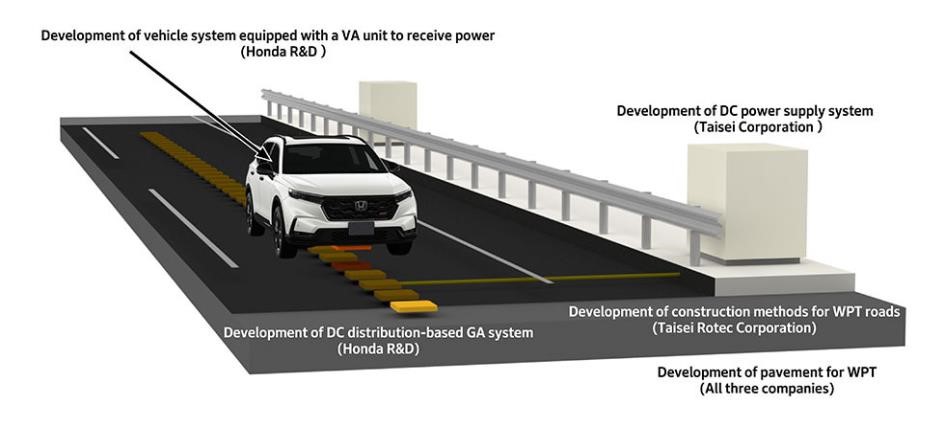
- Honda R&D, Taisei and Taisei Rotec have developed a technology for a magnetic-coupling wireless power system embedded in roadways that charges EVs including large commercial vehicles while moving.
- The system combines Honda’s power transmission and reception units with Taisei’s power supply system and road-embedding technology.
- The firms will hold demos to address challenges:
- Ensure that ground assembly units and pavement structures can withstand heavy vehicles;
- Enable the power supply system to charge EVs travelling at high speeds;
- Improve installation and ensure the system can be upgraded.
- The firms plan to build a test roadway to assess durability using actual vehicles, wireless power transfer tests, and evaluations of measures to mitigate electromagnetic field leakage; and participate in a demo on an expressway in Chiba Pref in FY2027.
- TAKEAWAY: The technology could reduce dependence on stationary charging and potentially allow commercial EVs to operate with smaller batteries or longer daily ranges. But this initiative is not the first of its kind in Japan. Automotive parts supplier Denso began tests in 2022 and plans to develop a wireless charging system by FY2029. However, several hurdles to wireless EV charging remain, such as ensuring interoperability between charging systems installed on different road sections and addressing the higher infrastructure costs compared to conventional charging stations.
JWA and Recharge Power to collaborate on BESS operations
(Organization statement, October 13)
- The Japan Weather Association (JWA) and Recharge Power agreed to collaborate to enhance BESS operations in Japan.
- Using JWA’s electricity market price forecasts, the two will optimize the operation of Recharge Power’s BESS systems and improve market bidding decisions.
- The firms aim to promote more efficient BESS operations, maximize the utilization of renewable energy, and contribute to power system stability.
- CONTEXT: Recharge Power is the subsidiary of Taiwan-based Recharge Power. It can leverage its parent’s global track record of over 1 GWh in 14 BESS projects to expand in Japan, a key strategic market, and support Japan’s energy transition.
- TAKEAWAY: JWA is steadily expanding from weather forecasting into power-market analytics, including electricity-demand and balancing-market price forecasts. Because weather is a major driver of both renewable output and electricity demand, combining those forecasts with BESS dispatch can help aggregators improve bidding and capture more value from storage assets.
Toshiba and partners start 10 MWh thermal storage
(Company statement, October 14)
- Toshiba, Chubu Electric and Shin-Tokai Paper began demo operation of a roughly 10 MWh rockbased thermal energy storage system at Shin-Tokai Paper’s Shimada plant in Shizuoka Pref.
- Toshiba supplied the EMS; Chubu Electric provided the concrete storage tank.
- The system stores surplus electricity in the form of heat at temperatures up to 700°C. The stored heat is used to supply steam generators, electric heaters and blowers involved in the paper-drying process at Shin-Tokai Paper’s plant.
- TAKEAWAY: In addition, Chubu Electric plans a market study to promote thermal energy storage. In 2025, it agreed with Okazaki City (Aichi Pref) to hold demos and plans to develop a thermal storage facility with a capacity of several tens of MWh, in collaboration with Toshiba. Thermal energy storage is part of the alternatives of lithium-ion batteries for electricity storage, alongside pumped-storage hydro. This offers competitive advantages in terms of environmental impact, installation costs and safety. Potential applications include air conditioning and industrial heating. However, the market is nascent in Japan. The Shimada facility is the country’s first large-scale project of its kind.
JGC launches demo of sheet installation method for film-type CSCs
(Company statement, October 8)
- JGC launched a demonstration under Mie Pref’s next-generation solar program using PXP-made film-type chalcopyrite solar cells on the folded-sheet roof of Honda’s Suzuka factory.
- The project runs until early February 2027 and will assess installation workability, safety, maintainability, power-generation performance and heat-shielding effects.
- The modules are about 3.3 meters long, 0.5 meter wide and 2 kg/ m², making them suitable for roofs where conventional silicon panels may be too heavy.
- Generated electricity will charge swappable batteries used in electric scooters.
NEWS: WIND POWER AND OTHER RENEWABLES

Govt chose target survey areas for centralized approach to offshore wind
(Government statement, October 8)
- METI and MLIT have established a centralized approach to offshore wind site selection, under which local authorities, the central government and JOGMEC collaborate on early-stage site surveys.
- The eastern coast of Wakayama Pref and Ichikikushikino, Kagoshima Pref, were selected for surveys to begin as soon as possible, while Hiyama, Hokkaido, was selected for work focused on project feasibility and cost reduction.
- Five areas expressed interest in the initiative. The three selected areas had already begun coordinating with local stakeholders likely to be affected by survey activities, including fisheries groups.
- CONTEXT: Since FY2023, JOGMEC has conducted offshore wind site surveys covering wind, weather, ocean and seabed conditions.
- TAKEAWAY: The centralized model is intended to reduce duplication and upfront risk for developers by having JOGMEC carry out key early-stage site surveys before operator selection. Instead of multiple bidders commissioning similar investigations independently, developers can compete using a common base of government-backed site data.
Forecast: Japan’s geothermal energy market to reach ¥352 billion
(Nikkei Shimbun, October 14)
- A report on geothermal energy by Fuji Keizai examines R&D, risks, and costs associated with nextgen technologies, as well as leading projects and firms in Japan.
- There is also focus on Enhanced Geothermal Systems (EGS), closed-loop systems, and supercritical geothermal energy.
- Closed-loop geothermal is reportedly the most advanced, accounting for about 60% of subsidies allocated to geothermal energy under the Green Innovation Fund.
- Supercritical geothermal energy could benefit from declining costs over the longer term, but operating at great depths and very high temperatures are major challenges.
- The number of 10 MW or more projects is rising. Starting in the mid-2030s, next-gen technologies will allow larger projects, fostering a market that could reach about ¥352 billion by FY2050 (about 13-fold more than the ¥27 billion in FY2026).
- Existing geothermal assets are being modernized. Matsukawa geothermal power plant, Japan’s oldest asset founded in 1966, has been repowered. But its new capacity dropped to 15 MW, much less than its original 23.5 MW.
- The replacement of equipment at other large geothermal plants, with capacities ranging from 20 to 50 MW, is also expected by the 2040s.
- SIDE DEVELOPMENT:
- Mitsui Fudosan targets Japan’s first closed-loop geothermal project
- (Nikkei, JOGMEC statement, October 14)
- Mitsui Fudosan plans to develop a closed-loop geothermal project in Ibusuki, Kagoshima Pref, with Shin Nippon Biomedical Laboratories and startup J-Nec.
- Unlike conventional geothermal projects, the closed-loop system circulates water through underground pipes to recover heat and is less dependent on natural geothermal fluids, potentially widening the range of suitable sites.
- Drilling was completed at an existing SNBL geothermal site. A demo plant is planned for FY2028, with commercial deployment targeted from FY2029.
- Separately, JOGMEC records show that SNBL’s Ibusuki geothermal resource survey was selected for govt support in September.
- CONTEXT: SNBL already operates a 1.5 MW geothermal plant in Ibusuki, as well as a 625 kW hot-spring power facility that began in 2025.
- TAKEAWAY: Closed-loop geothermal could address two longstanding constraints: dependence on suitable hydrothermal resources and conflict with existing hot-spring users. However, deep drilling remains capital-intensive, so this demo must show competitive costs at several MW per well for the technology to gain wider interest from investors. This tech is promising because, unlike EGS, it does not require fluid injection into the geothermal reservoir, a major challenge in a country with high seismicity and complex geology.
ENEOS and partners to hold environmental certificate demo for next-gen fuels
(Company statement, October 8)
- NTT Docomo, ENEOS, Kajima, Shimizu, Tsurumi Sunmarine, T2, Tokyu, NIPPO, Toyota Motor, and JAL will participate in ANRE’s demo for a system to certify and transfer the environmental value of next-gen fuels.
- ENEOS will be responsible for importing hydrotreated vegetable oil (HVO) and issuing environmental value certificates to test the system’s design. The other firms will act as end users, verifying the practical use of certificates.
- TAKEAWAY: This initiative aims to align certification with either domestic frameworks, such as Japan’s SHK System (the statutory greenhouse gas accounting and disclosure scheme), or international standards, such as the GHG Protocol. By testing the framework first with HVO, the goal is to broaden access to environmental value certificates, enabling more firms to support demand for low-carbon fuels in the transport sector, particularly in maritime shipping and aviation. This could be applicable to railways for biodiesel trains.
J-Power agrees on biofuel scale-up demo in Indonesia
(Company statement, October 9)
- J-Power agreed with Green Earth Institute on a demo to scale up a biofuel production facility in the Jakarta region, using oil palm trunks (OPTs) as feedstock.
- The OPTs will be processed into a sugar solution and fermented to produce bioethanol, which could ultimately be used as SAF feedstock. The companies aim toward commercial plants processing tens of thousands to more than 100,000 tons of OPT annually.
- The demo is scheduled to continue through 2027.
- CONTEXT: J-Power first invested in Green Earth Institute in 2019 and the two have collaborated on feasibility studies using OPTs for biofuel production. Indonesia is the world’s largest palm oil producer, with annual output of 46.7 million tons, about 57.3% of global harvests.
- TAKEAWAY: Producing biofuels from palm oil residues help reduce the palm oil industry’s environmental footprint, whose production generates methane emissions. As Japan’s climate is unsuitable for oil palm cultivation, companies invest in SE Asia projects that valorize palm oil residues. In Indonesia, TESS HD began trials at its factory in North Sumatra in May to produce biomass pellets for power generation. Toyota Tsusho will soon launch operations at a biomethane production plant that uses palm oil mill wastewater.
NEWS: NUCLEAR ENERGY

Tohoku Electric to shut Onagawa Unit 2 for valve inspection and repair
(Company statement, October 15)
- Tohoku Electric will shut Onagawa NPP Unit 2 as part of a planned shutdown to inspect the relief valve on the high-pressure No. 1 feedwater heater.
- Tohoku Electric plans to restart the reactor by month’s end.
- CONTEXT: All water is contained in the drainage tank with no leakage and no radioactive impact on the environment.
MHI delivers replacement steam generators for NPPs
(Company statement, October 15)
- MHI delivered three replacement steam generators for NPPs operated by EDF, the first delivery to the French utility in nine years.
- These units transfer heat from the reactor to the turbine.
- Produced at MHI’s Kobe facility, the three generators are for Cruas NPP Unit 2 in southeast France.
- CONTEXT: Plant lifespan extensions and a global shift back to nuclear energy are boosting demand for replacement generators. EDF is replacing steam generators across its 57-unit domestic PWR fleet to extend the operating lifetime of 1980s-era reactors beyond 40 years. MHI already has orders for six more units slated for sequential delivery, starting 2028. Before this latest delivery, MHI had supplied 15 replacement steam generators to EDF since 2005.
NUMO begins literature survey for nuclear waste disposal site
(Nikkei, October 15)
- NUMO began a literature survey in Hitachiomiya City, Ibaraki Pref, aiming to check potential sites for high-level radioactive waste disposal.
- The central govt will provide up to ¥2 billion in subsidies. Hitachiomiya is the fifth location nationwide to make this survey, which will take about two years, focusing on potential volcanic impact.
- METI Minister Akazawa approved the business plan modification.
- CONTEXT: The literature survey serves as Stage 1. Focusing on geology, surveyors test the suitability of specific regions for waste storage.
- TAKEAWAY: Moving to the Stage 2 overview survey requires consent from both the prefectural governor and the municipality. That phase involves more detailed geological work, including borehole investigations. Ibaraki’s governor has said he has no intention of consenting, creating a clear political barrier to the project progressing beyond the literature-survey stage.
NEWS: TRADITIONAL FUELS

Govt to subsidize refineries and firms importing from sources that bypass Hormuz
(Nikkei, October 13)
- The govt approved three bill proposals to secure stable energy supplies, subsidizing oil refineries and trading firms that import crude oil and naphtha via routes that avoid the Strait of Hormuz.
- Domestic non-life insurers will be able to contract with the govt when overseas reinsurance for tankers in the Middle East is unavailable. This will ensure that govt grants cover payouts in emergencies.
- JOGMEC can now make equity investments and guarantee debts for crude oil pipelines bypassing Hormuz. Also, it will provide grants for CCS projects.
- CONTEXT: The subsidy will be funded by levies collected from oil refineries and trading firms. There are no details on specific levy rates and grant amounts. The alternative route subsidy takes effect within six months of promulgation. The shipping insurance scheme and JOGMEC expansion take effect this year.
METI announces new subsidies for high costs of kerosene in Hokkaido
(Japan NRG, October 16)
- METI minister Akazawa announced new subsidies addressing high costs of kerosene in Hokkaido, targeting the price difference between imported and domestic wholesale kerosene from Nov 2026 to March 2027.
- CONTEXT: Import prices are now ¥20/ liter higher than domestic wholesale prices. METI requested oil refiners to sell kerosene to retailers starting November to bypass distributors. Authorities also urged suppliers and distributors to keep order and sales volumes equal to the same month last year.
- The Hokkaido Bureau of Economy, Trade and Industry will investigate supply clogging, when distributors experience anxieties or operational issues.
- Authorities say there’s enough kerosene supplies and no national shortage.
- TAKEAWAY: On Oct 13, Hokkaido’s retail kerosene reached ¥155.5/ liter, about ¥13 higher than the national average. Hokkaido suppliers rely on imported kerosene. International refining shortages and Middle East instability have pushed up local prices. There was early rush-ordering by distributors attempting to secure inventory ahead of winter but this led to localized supply bottlenecks.
MODEC sees FPSO demand rising as deepwater oil gains strategic value
(Diamond, October 14)
- Japanese upstream specialist, MODEC, expects growing demand for floating production, storage and offloading vessels (FPSOs) as deepwater oil development expands in Brazil, Guyana, Suriname and West Africa.
- The Hormuz crisis has increased the value of crude supplies that can reach global markets without passing through the Persian Gulf, while improvements in drilling technology have made some deepwater fields much more competitive.
- In Brazil’s pre-salt fields, drilling times have fallen sharply and some wells can produce 70,000– 80,000 barrels/ day, helping reduce unit costs. One MODEC official said some pre-salt production costs were in the $20s/ bbl.
- MODEC completed 35 FPSOs, with four more under construction and 18 operating. The firm is one of two leading global players.
- MODEC has relied heavily on Chinese shipyards for construction, but rising orders for tankers and LNG carriers have tightened yard capacity. Thus the firm is exploring cooperation with Japanese shipbuilders, including modular or split construction.
JERA gets JOGMEC’s stake in PEJ, strengthens presence in Wheatstone LNG
(Company statement, October 14)
- JERA purchased JOGMEC’s entire 42.08% stake in Pan Pacific Energy (PEJ), boosting its ownership from 8.02% to a controlling 50.1%. Financial terms were not released. Mitsubishi Corp and Nippon Yusen are other shareholders.
- PEJ’s underlying holdings in Australia’s Wheatstone LNG project remain unchanged, standing at 10% in the upstream gas field and 8% in the liquefaction facility.
- CONTEXT: JERA holds its interests in Australia’s Wheatstone LNG Project via PEJ. Wheatstone is a core supply source for JERA, providing around 5.2 Mtpa of LNG from gas fields off the coast of Western Australia.
- TAKEAWAY: JERA is reshaping rather than simply reducing its Australian LNG exposure, selling small stakes in some projects while increasing control over PEJ, which holds interests in Wheatstone. Earlier this year it agreed to divest minor interests in Australia’s Gorgon LNG (0.417%) and Ichthys LNG (0.735%). This is part of a diversification of imports across the Asia-Pacific, the Middle East, and the U.S.
ANRE launches public-private council for next-gen gas promotion
(Government statement, October 13)
- ANRE reorganized the Methanation Promotion Public-Private Council, broadening its scope to include next-gen gases such as e-methane and biogas.
- Govt economic policy and the Power GX package promote fuel switching to natural gas and wider use of synthetic methane and biogas.
- Methanation R&D projects using the hybrid Sabatier process and solid oxide electrolysis cell (SOEC) technology are underway.
- Supply chain verification requirements for imported synthetic methane are under review, with finalization in FY2026 for FY2027 reporting.
- As far as clean fuel certificates, a FY2026 pilot will test the full certification process.
- CONTEXT: Launched in June 2021, the council on methanation has developed rules for CO2 accounting and supply chains to support 1% synthetic methane supply by 2030. Biogas has also gained attention as a decarbonization fuel for heat.
- TAKEAWAY: Synthetic methane and biogas are now framed not just as decarbonization tools but as instruments of energy security and economic growth. They are attractive because they leverage existing gas infrastructure and can decarbonize heat demand. Council discussions will focus on policy directions beyond 2030 and considering policy directions beyond the 2030 1% e-methane target.
LNG stocks up from previous week, up YoY
(Government data, October 14)
- As of Oct 11, the LNG stocks of 10 power utilities were 2.64 Mt; up 2.7% from the previous week (2.57 Mt); up 41.2% from end Oct 2025 (1.87 Mt), and up 25.7% from the 5-year average of 2.1 Mt.
NEWS: CARBON CAPTURE & SYNTHETIC FUELS

Govt hosts public-private gathering on CO2 recycling
(Denki Shimbun, October 13)
- METI and NEDO hosted the 8th Carbon Recycling Industry-Academia-Government Conference. Experts from industry, universities, and govt discussed technologies, regulations, and business models that treat CO2 as a resource, aiming to align decarbonization with industrial competitiveness.
- Panel sessions focused on two primary topics: 1) International Situation Surrounding Carbon Recycling and Japan’s Initiatives; and 2) Advanced Carbon Recycling Technologies Contributing to Building CO2 Value Chains.
- Discussions covered real-world applications such as CO2-derived concrete and efforts to lower CO2 resource-conversion costs.
- Attendees highlighted the need for stronger international partnerships to deploy carbon recycling technologies.
- CONTEXT: This event is the main public-private international forum on CO2 recycling, aiming to align policy, tech development, and strategy.
- TAKEAWAY: The conference reflected Japan’s push to move carbon recycling from tech demos toward commercial deployment. Lower conversion costs, stronger international cooperation and the creation of markets for CO2-derived products remain key challenges.
TEPCO EP to launch J-Credits program via heaters
(Company statement, October 14)
- TEPCO EP will launch the TEPCO Ethic-Action Program, targeting households using EcoCute heatpump water heaters.
- Operating an EcoCute water heater for one year reduces annual CO2 emissions by 0.4 tons compared to a conventional gas water heater.
- TEPCO EP aggregates the CO2 reductions from participating EcoCute units, applies for J-Credit certification, and sells the resulting credits to companies.
- TEPCO will return part of the revenue to participating households as Kurashi TEPCO points; the program offers 500 points on enrollment and 30 points per month.
- CONTEXT: Corporations can buy them to support their decarbonization efforts.
- TAKEAWAY: Energy-saving household appliances reduce emissions, but consumers rarely utilize J-Credits due to administrative and certification hurdles. TEPCO EP is an aggregator. The initiative connects individual home energy efficiency with corporate sustainability needs, turning everyday household hot water usage into tradeable carbon offsets. Also, it lowers living costs for consumers through long-term point returns.
ANALYSIS
BY YURIY HUMBER
Want to Benefit from the AI Boom? Japan Tells Investors to Help to Pay for Fukushima
Japan wants investors to help finance the Fukushima nuclear disaster cleanup, offering in return a stake in some of the country’s most valuable electricity infrastructure. The proposed restructuring of Tokyo Electric Power Holdings (TEPCO) would allow outside capital into its commercial operations while ensuring that profits continue to support Japan’s largest industrial cleanup and compensation effort, whose final cost and duration is uncertain.
As a result, the negotiations have proved more difficult than anticipated. Five prospective investor groups, reportedly including SoftBank and major U.S. investment funds, have fallen behind an unofficial end-September deadline for due diligence, with the process potentially extending into 2027.
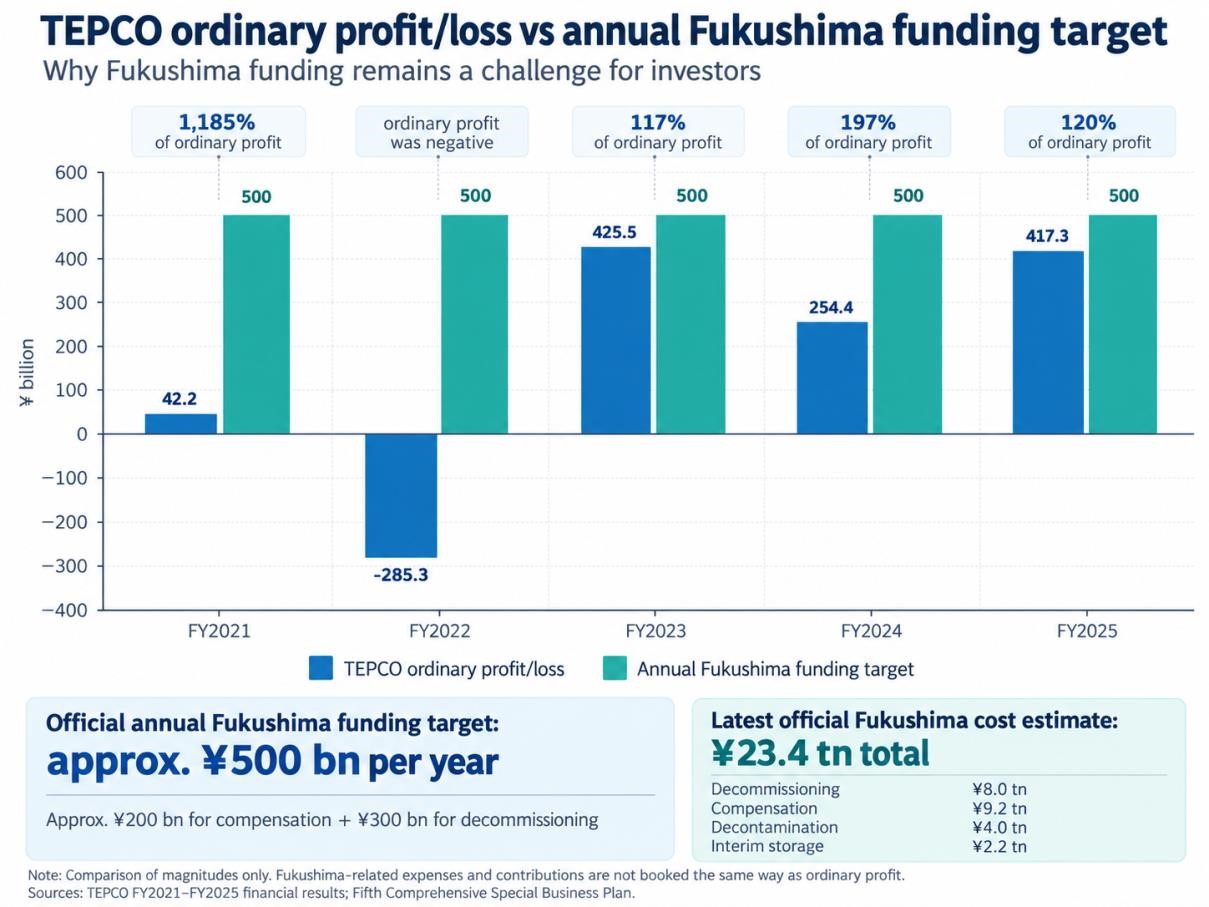
The challenge goes beyond valuing TEPCO’s generation, transmission and retail divisions. Investors must also assess how much of their future returns may be absorbed by Fukushima-related obligations, currently requiring about ¥500 billion a year and forecasted to exceed ¥20 trillion. Neither the final outlay nor the timetable for completing the work are certain.
The stakes extend beyond TEPCO. A successful restructuring could influence how other major Japanese power utilities are valued, finance new capacity and pursue their data center ambitions. Few companies have more at stake than JERA, the country’s top power generator, which is exploring a stock market listing that could provide greater financial independence from its parent companies, TEPCO and Chubu Electric.
What’s actually for sale?
TEPCO’s Fifth Comprehensive Special Business Plan, approved in January 2026, envisages bringing outside investors into its commercial operations to strengthen earnings and fund new investments. The company has left open the possibility of an alliance in which it holds either a majority or minority interest, provided the arrangement preserves sufficient financial and managerial independence for the new business.
One restructuring option reported by Japanese media involves establishing an intermediate holding company jointly owned by TEPCO HD and outside investors. The new entity would oversee four operating subsidiaries: TEPCO Power Grid, TEPCO Energy Partner, TEPCO Renewable Power and TEPCO Fuel & Power. Nuclear operations would remain with TEPCO HD, separating them from the businesses offered to private investors.
This would give investors exposure to some of Japan’s most important electricity assets, including the transmission and distribution network serving the Tokyo metropolitan area, the country’s largest concentration of electricity demand. It would also provide access to retail customers, renewable generation assets and future infrastructure developments linked to electrification and data centers.
However, this would not amount to a conventional privatization. The governmentbacked Nuclear Damage Compensation and Decommissioning Facilitation Corporation (NDF) intends to retain more than half of the voting rights in TEPCO HD, while exercising oversight over major restructuring decisions. The eventual investors’ ownership, voting rights and dividend arrangements remain to be negotiated.
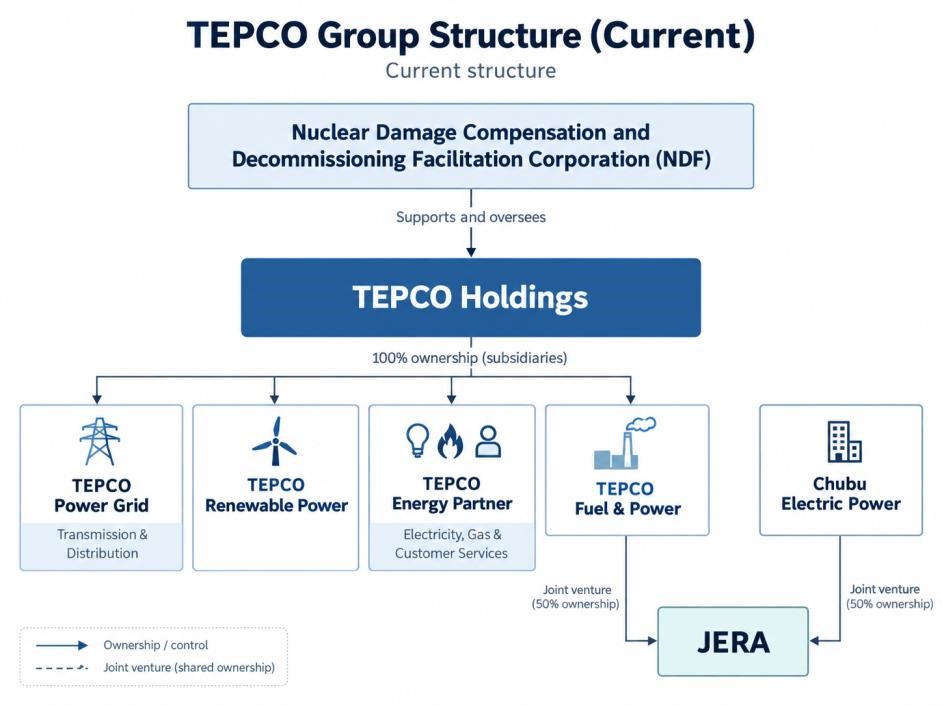
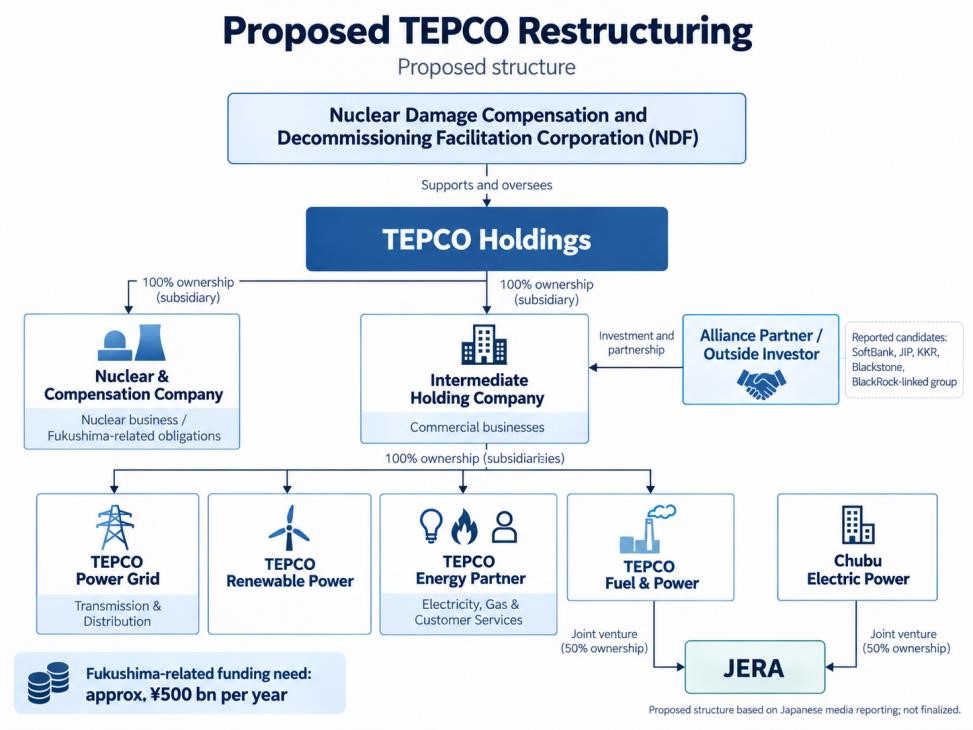
This has an impact on valuations. An equity stake in an independently financed operating company would offer considerably more flexibility than a minority interest in a tightly controlled holding structure. Much will depend on which assets and liabilities are transferred, how much operational independence the investor receives, and whether the new entity can retain enough earnings to finance growth.
The ¥500 bln question
TEPCO’s restructuring is complicated by the scale of its Fukushima obligations. The government’s latest overall estimate for Fukushima-related costs stands at ¥23.4 trillion. This comprises ¥8 trillion for decommissioning, ¥9.2 trillion for compensation, ¥4 trillion for decontamination and ¥2.2 trillion for interim storage.
Under the current financing framework, TEPCO must secure approximately ¥500 billion annually toward decommissioning and compensation obligations. Other funding requirements are supported through mechanisms including contributions from power companies, proceeds from TEPCO shares and government accounts.
Even the ¥8 trillion decommissioning estimate – which TEPCO is primarily responsible for – is uncertain, as substantial engineering and removal costs have yet to be determined.
The company has estimated that preparation for large-scale debris retrieval alone could take 12–15 years under certain assumptions. The broader government roadmap continues to target completion of decommissioning around 2051, although the most technically challenging stages are still ahead.
Put in the context of TEPCO’s financial performance, the ¥500 billion annual funding requirement is enormous. It exceeds the company’s FY2025 ordinary profit of ¥417.3 billion by approximately 20%, although Fukushima-related expenses and contributions are treated differently in its accounts.
Still, for prospective investors, the bigger problem is not necessarily the size of the current annual funding. It’s the absence of a defined endpoint or comprehensive cap on future costs. The distinction between the legal liabilities retained by TEPCO and the future financial contributions expected from its commercial subsidiaries is therefore central to negotiations.
Investors can use the existing annual funding target as a basis for financial planning, but can’t be certain that the same amount will remain sufficient, especially in an inflationary period.
| Category | Estimate | Funding mechanism |
| Decommissioning | ¥8.0 trillion | TEPCO contributions to NDF |
| Compensation | ¥9.2 trillion | Contributions from TEPCO and other power companies |
| Decontamination | ¥4.0 trillion | Proceeds from government-backed TEPCO shareholdings |
| Interim storage | ¥2.2 trillion | Government energy special account |
| TOTAL | ¥23.4 trillion | Multiple funding sources |
Three ways to bridge the financing gap
There are several ways the government and prospective investors could make the proposed alliance more attractive without abandoning TEPCO’s responsibility for Fukushima.
The first would be to set clearer rules governing the subsidiaries’ contributions to TEPCO HD. A fixed annual payment or a defined share of distributable earnings would offer investors greater visibility over the cash available for dividends and reinvestment. Such an arrangement would not limit TEPCO’s legal liabilities, but could reduce uncertainty at the operating-company level.
The second would involve stronger financial separation. An intermediate holding company with its own balance sheet, borrowing arrangements and dividend policy could raise capital independently, provided it had sufficient control over its assets and retained earnings. This is key because TEPCO needs outside capital not only to meet its legacy commitments but also to invest in new generation, renewable energy facilities, BESS and grid infrastructure.
The third, and politically more difficult, option would be for the government to assume a larger share of exceptional Fukushima-related costs or provide a mechanism to address future overruns. That could substantially reduce the risk premium demanded by investors. However, it would also revive the long-standing debate over how much of the disaster’s financial burden should ultimately fall on the taxpayer. It would be an easy target for tabloids.
Yet, the alternative is continued dependence on TEPCO’s existing earnings and incremental asset sales, limiting its capacity to invest during a period of expected electricity demand growth. If TEPCO loses further ground to competitors encroaching on its traditional markets and customers, the cash flow available for Fukushima will suffer.
This creates a difficult trade-off. Maximizing payments to Fukushima could weaken the financial position of the commercial businesses and reduce their attractiveness to investors. Allowing those businesses to retain more earnings could strengthen their valuations and borrowing capacity, but delay the recovery of public funds.
Linking the two also raises questions about fair competition. The government has a financial interest in TEPCO’s commercial success, even as the company competes against other utilities and independent power suppliers. Any measures designed to protect its earnings or preferentially support its investment plans could raise concerns about competitive neutrality. TEPCO’s own restructuring plan targets positive free cash flow from FY2028. Achieving that through commercial improvements is one thing; relying on preferential government support to deliver it would create a different set of regulatory and political risks.
Lending on what basis?
Whoever invests in TEPCO’s commercial businesses will need substantial financial resources, particularly for grid upgrades and new power infrastructure supporting data center development. Japanese banks and other lenders, however, will need clarity over the assets and cash flows underpinning their loans.
The critical questions concern the predictability of operating earnings, the priority of payments to Fukushima, restrictions on dividends and the degree of state control over investment decisions. Even assets with relatively stable regulated or contracted revenues could face higher borrowing costs if their available cash flows remain subject to uncertain transfers to the parent company.
Much will depend on whether the new investment vehicle can borrow independently, pledge assets as collateral and retain sufficient earnings to service its debts. A clear separation of financial obligations could improve its creditworthiness, while continued uncertainty could force investors to rely more heavily on equity, raising the overall cost of financing.
Ultimately, the government may need to define more clearly which assets and cash flows belong to the new entity, and whether it is prepared to provide guarantees or other forms of financial protection. Such measures could make the restructuring more bankable, but might also return part of the financial risk to the public sector.
That would leave the fundamental question unresolved: who ultimately pays for Fukushima?
The JERA factor
TEPCO’s restructuring could also have implications for other major utilities, particularly those seeking to capitalize on rising electricity demand from AI and DCs. The terms eventually offered to outside investors could establish a benchmark for valuing power generation, transmission and retail businesses, while potentially reshaping competition for capital.
JERA is especially exposed to these developments. The largest power generator is owned equally by TEPCO Fuel & Power and Chubu Electric, but has developed into an independent and an international energy company. JERA’s assets reached ¥10 trillion in FY2025, with revenue of ¥3.05 trillion and net profit of ¥193.5 billion, and the firm targets about ¥5 trillion in investment through FY2035, when it aims to lift annual profit to ¥350 billion.
Financing those ambitions requires greater access to external capital. JERA has reportedly begun examining a possible U.S. stock market listing, although no decision had been made on timing, structure or valuation.
The importance of financial independence is growing as JERA pursues its own opportunities in the AI sector. On October 1, it announced plans with Dell Technologies and RHAELM for an AI data center complex of up to 400 MW at its Chiba thermal power plant, with total investment across the project estimated at more than ¥2.3 trillion.
Operations are targeted to begin around 2028. The project would use on-site power generation to bypass some of the delays associated with conventional grid connections.
Such developments are a competitive challenge for TEPCO. Meanwhile, a JERA listing could complicate TEPCO’s restructuring. While a higher valuation for JERA would strengthen the value of TEPCO’s stake, a reduction in its ownership would affect future dividend income and the financial resources available for Fukushima.
With METI unwilling to separate TEPCO’s future from its Fukushima past, the competitiveness of the Tokyo utility remains unclear. Investors are looking for a ringfenced project, but what’s on offer is a whole lot more.
ANALYSIS
BY ANDREW STATTER
Energy Jobs in Japan: Speculative and Prop Trading Players Seek Local Presence
EEX now holds over 90% of Japan’s power futures market, and more than 110 companies trade on the exchange. A good number have never needed a desk in Tokyo. Traders in Singapore, London and Geneva have taken positions in Japanese baseload with a screen, a data subscription, a Bloomberg terminal and a view on fuel costs.
Physical power has always been different. Anyone trading physical power in Japan needs a local presence, licenses with JEPX and OCCTO, and a team to trade, run operations and handle scheduling. Many add risk management, analysts and originators on top. A physical desk has always meant at least a handful of people on the ground. Futures desks never carried that overhead, and they didn’t need to.
That’s changing. Speculative and prop trading players are increasingly looking for someone in Japan. The driver is both a lack of data and an understanding of the nuances in the data available. When your model says one thing, you make a trade call but the market settles at another level, that gap costs real money and is often due to something you couldn’t see from overseas.
Rules change faster than translation
Japan’s power market has not reached the regulatory stability that participants enjoy in Europe or other more mature markets. Rules are still being written and adjusted, and the announcements are not always communicated with full clarity. A notice from the regulator is generally met with a range of interpretations by market analysts.
That notice is only the end of a long process. Someone who followed working group discussions, knows which parties pushed for the change and understands what the regulator was trying to fix – as these Japan NRG pages regularly demonstrate – will read the same official shift very differently. Understanding the background and who influenced the changes are key to understanding the actual impacts.
A translated summary arriving in Singapore two days later is not the same information, and that information is accessible by all of your competitors. It lacks the competitive edge and IP of in-house analysis, and therefore data to make a trade call is missing.
Weather is the data problem everyone talks about, and good weather data firms (such as G2 and JMA) claim to have largely solved it. Personally, I still believe weather forecasts and tarot cards have roughly the same believability, but I’m digressing. Planned maintenance is harder to calculate. Plants under 50 MW don’t need to publish their outage schedules, and those outages shift the supply-demand balance in a specific region at a specific time.
Individually, a sub-50 MW outage is small. Several in the same area in the same week are not. Futures settle against JEPX spot prices, so a tighter regional balance shows up in settlement whether or not your model saw it coming.
Then there are TSO issues and grid congestion, which shape how power actually flows between areas. Vendor data gives you a starting point but it is not comprehensive. Firms want someone in Japan who can test what the vendors say against what they hear in the market, and form their own assessment.
Talent pool is thinner than demand
Japan’s power market talent is still nascent. In our E-World comparison, we described it as sitting where renewable energy talent was in 2015, with people joining from adjacent industries and learning as they go. People who understand congestion, the effect of maintenance on regional supply and demand, and the history behind regulatory changes exist across EPCOs and the retail sector. Though factor in a language barrier and suddenly you are at <10% of the actual market.
Most firms describe the ideal hire the same way: excellent analytical capability, local market depth, and the confidence to challenge the data. They want to keep trading centralized in HQ or in a tax-advantaged location. What they desire locally is analytics, but often the best analysts don’t want to stay as analysts.
People with that depth of knowledge and analytical ability often have ambitions beyond analysis. They want to build trading strategies and trade themselves.
In more mature markets, the line between analyst and trader is clearer, and so is the career path across it. Analysts can follow a career track vertically, or shift to being the trading side over time.
Japan doesn’t work that way. The talent market is young and competition for the few qualified people is high, so more negotiating power sits with the professional in question than with the company. When you are trying to secure talent, you need to consider that competing firms may be more flexible, and an analyst who sees a faster route to the desk elsewhere has options.
The offers won’t only be about money. They will be about the role, and how much of the book the person is trusted with. The firms that win this talent won’t be the ones with the best analyst title and salary. They’ll be the ones that treat the Tokyo seat as the first step of a trading career, and say so at the offer stage.
In summary
Trading Japan from overseas has always been a bit like reading a coastline from satellite imagery. You see the general shape, but the data may be a little old, and the small details that matter may be missing.
As liquidity and volatility increases, more players enter the game, more data becomes available and needs an accurate and unique read.
Hiring locally is the easy decision. Building a role that a strong local analyst will actually stay in is the hard one.
Andrew Statter is a Partner at Titan GreenTech, an executive recruitment agency focused on the clean energy space.
ASIA ENERGY REVIEW
BY JOHN VAROLI
A brief overview of the region’s main energy events from the past week
Asia / Coal
Asian thermal coal benchmark prices are trading around $150/ metric ton (such as high-grade Australian thermal coal out of Newcastle), a surge of about 40% since January to reach a twoyear high.
Australia / Coal
Australia’s coal futures have risen to the highest for two years as the U.S.-Iran war disrupts gas supplies across Asia. Front-month futures have averaged $150/ ton so far in October, up from $110 in January, and the highest since Oct 2024.
Australia / Natural gas
Shell criticized the govt’s plan to force LNG producers to reserve a portion of their output for domestic use. The govt will introduce legislation this week to implement its new domestic gas reservation policy to address supply shortfalls and bring down energy prices.
China / BESS
China’s energy storage battery output exceeded 420 GWh in H1 of 2026, up 110% YoY; also, the domestic content rate of key production equipment surpassed 90%, according to data released at the World Energy Storage Conference.
China / Hydrogen
China is expanding the use of hydrogen energy across production, storage, transportation and consumption. In August, the country launched comprehensive pilot programs for hydrogen applications in five major city clusters, covering fuel cell vehicles and aiming to strengthen hydrogen supply capacity.
China / LNG
China’s LNG imports in September are estimated at 5.3 million tons, an 8% drop compared to Sept 2025, and the second straight monthly decline.
Indonesia / Nuclear
Indonesia raised its nuclear power target to 1.5 GW as it evaluates technology offers from the U.S., South Korea, Japan, and Russia. Site selection is targeted for 2027 as domestic electricity demand is projected to reach 600 TWh by 2030.
Singapore / Nuclear
The Energy Market Authority has put nuclear power back on the agenda, projecting SMRs could meet up to 10% of Singapore’s electricity needs by 2050.
South Korea / Coal
Soaring prices of spot LNG supply amid the lack of Middle Eastern deliveries have pushed South Korea to rely more on coal-fired power. South Korea is the world’s fourth-largest coal buyer.
Vietnam / Natural gas
Petronas and Petrovietnam strengthened their partnership by signing a Strategic Alliance Agreement, reaffirming their commitment to advancing energy security, with a focus on natural gas projects.
Disclaimer
This communication has been prepared for information purposes only, is confidential and may be legally privileged. This is a subscription-only service and is directed at those who have expressly asked K.K. Yuri Group or one of its representatives to be added to the mailing list. This document may not be onwardly circulated or reproduced without prior written consent from Yuri Group, which retains all copyright to the content of this report.
Yuri Group is not registered as an investment advisor in any jurisdiction. Our research and all the content express our opinions, which are generally based on available public information, field studies and own analysis. Content is limited to general comment upon general political, economic and market issues, asset classes and types of investments. The report and all of its content does not constitute a recommendation or solicitation to buy, sell, subscribe for or underwrite any product or physical commodity, or a financial instrument.
The information contained in this report is obtained from sources believed to be reliable and in good faith. No representation or warranty is made that it is accurate or complete. Opinions and views expressed are subject to change without notice, as are prices and availability, which are indicative only. There is no obligation to notify recipients of any changes to this data or to do so in the future. No responsibility is accepted for the use of or reliance on the information provided. In no circumstances will Yuri Group be liable for any indirect or direct loss, or consequential loss or damages arising from the use of, any inability to use, or any inaccuracy in the information.
K.K. Yuri Group: Hulic Ochanomizu Bldg. 3F, 2-3-11, Surugadai, Kanda, Chiyoda-ku, Tokyo, Japan, 101-0062.