
WEEKLY
October 26, 2026
ANALYSIS
AS MIDDLE EAST WAR WIDENS, JAPAN’S OIL SECURITY COMES AT A STEEP PRICE
- Crude shipping costs for a large tanker from the Persian Gulf to Asia are five times higher than before the war. Also, Japan’s refineries are configured to process mostly Middle Eastern grades.
- The mix of higher crude prices, disrupted shipping and the yen’s weakness is feeding through to domestic business costs, with potentially significant implications for inflation and competitiveness.
RAILWAYS IN TRANSITION: FROM LOW-CARBON TRANSPORT TO ENERGY MARKETS
- Rail has the lowest carbon footprint among transport modes. With extensive land holdings, infrastructure and experience managing large electricity loads, railway operators are well placed to expand their role in the energy sector.
- They are already sizable offtakers of green electricity. Their bigger role may lie not on the consumer side but as power market participants.
ASIA PACIFIC REVIEW
This column provides a brief overview of the region’s main energy events from the past week
NEWS
- Underlying power demand continues decline despite data center growth
- Japan to prioritize investment by technology maturity in new growth plan
- Warmer Japanese winter expected: Atmospheric G2
- Govt mulls scaling back gasoline subsidies
- Spot power prices hit four-year high as fuel costs rise
- Forwards push baseload prices to ¥30 across regions
- Imbalance price hits new ¥300/ kWh cap as supply tightens
- KEPCO unit retirements to leave capacity gap
- NEDO sets technology roadmap for scaling hydrogen infrastructure
- Work starts on Japan’s largest liquid hydrogen plant
- Japan Weather Association expands focus to BESS traders, power supply-demand management tech
- Panasonic to launch mass-scale production of glasstype PSCs
- Renova sees large drop in solar power sales
WIND POWER AND OTHER RENEWABLES
- JWD plans nationwide expansion of wind-powered electricity retail
- Tokyo Gas drops 30 MW floating wind project off Fukushima
- Honda inks deal for India-sourced biofuel production
- Overseas funds pressure Chubu Electric to decide future of Hamaoka NPP
- New Chubu Electric CEO outlines strategy vision
- Idemitsu expands into LNG wholesale, plans to sell non-Middle Eastern LNG in Japan
- LNG stocks decline but stay over 20% above 5yr avg
CARBON CAPTURE & SYNTHETIC FUELS
- Tangguh CCS could expand thanks to JCM, says bp
- METI releases draft safety guidelines for pipelines and underground storage
- Advantage Partners to launch fund in biomass and carbon credits
EVENTS
Oct 26 GGZ Finance Summit @ Tokyo Prince Hotel
Nov 2-5 ADIPEC 2026 @ Abu Dhabi
Nov 3 U.S. Midterm Elections
Nov 7 New Zealand General Election
Nov 9-20 COP31 @ Antalya, Türkiye
Nov 18-19 Asia-Pacific Economic Cooperation – Leaders Meeting @ Shenzhen, China
Nov 28 Taiwan Local Elections
Dec 1-3 DeCarbon Tokyo 2026 @ Tokyo Marriott Hotel
Dec 14-15 G20 Summit @ Miami
PUBLISHER
K. K. Yuri Group
Editorial Team
Yuriy Humber (Chief Editor)
John Varoli (Senior Editor, Americas)
Kyoko Fukuda (Data, Events)
Filippo Pedretti (Thermal, CCS, Nuclear)
Tetsuji Tomita (Power Market, Hydrogen)
Aglaé Bange (Renewables, Biomass & Energy Storage)
Gillian Sawyer (Renewables)
George Hoffman (Sales, Business Development)
Rada Kuznetsova (Clients Accounts, Website)
Tim Young (Design)
SUBSCRIPTIONS & ADVERTISING
Japan NRG offers individual, corporate and academic subscription plans. Basic details are our website or write to subscriptions@japan-nrg.com
For marketing, advertising, or collaboration opportunities, contact sales@japan-nrg.com. For all other inquiries, write to info@japan-nrg.com
NEWS: GENERAL OUTLOOK AND TRENDS

Japan’s underlying power demand continues decline despite data center growth
(Company presentation, October 19)
- Japan’s underlying electricity demand has declined noticeably over the past four years due to energy efficiency and other structural changes, according to data analysis by Yes Energy.
- New demand from data centers is emerging but isn’t sufficient to offset the decline in electricity consumption.
- Tokyo winter peak demand reached around 53.7 GW on Jan 6, 2022, amid cold and snowy conditions. Applying the same weather conditions to today’s demand base (i.e. Jan. 6 2027) would produce a daily average demand that’s 4.4% lower and a peak demand that’s 3 GW less, said Yes Energy at an event during Japan Power Week.
- The decline is stark in summer: Tokyo peak demand reached 59.3 GW on Aug 2, 2022, but equivalent weather on Aug 3, 2027 would result in daily average demand that’s around 3.7% lower. Peak demand would be 2.35 GW lower.
- Summer demand is more temperature-sensitive, while winter peak demand appears less weathersensitive than in 2022.
- Kansai shows a smaller structural decline: applying the weather conditions of the Jan 12, 2021 winter peak of 26 GW to Jan 12, 2027 would result in average daily demand that’s around 1.9% lower. Peak demand would be down 550 MW.
- Despite that underlying decline, Kansai recorded a new winter peak of 26 GW on Feb 9, illustrating how extreme weather can still push demand to records.
- Yes Energy estimates weather-driven peak-demand flexibility at roughly 20 GW in summer and 10 GW in winter across Japan.
- CONTEXT: Yes Energy also expects rising springtime solar surpluses, estimating curtailment around 5.5% in the TEPCO area, 6.5% in Kansai and 2–3% in Chubu during the 2026 spring shoulder season.
- TAKEAWAY: The data center boom is changing expectations for Japan’s electricity demand, but it is taking longer to filter through than expected, mainly due to ever-extending grid connection queues. Still, even without that growth, there is plenty of room for more asset and system optimization because the demand flex is increasingly extreme.
- SIDE DEVELOPMENT:
- Japan plans security certification for data centers and cloud services
- (Asia Nikkei, October 20)
- Japan plans to introduce a security certification system for domestic data centers and cloud services, targeting infrastructure that handles sensitive data in sectors such as finance, healthcare and research.
- Certification would assess factors including corporate ownership, data-leak prevention and risk-management procedures, and equipment suppliers.
- The govt is expected to recommend that organizations handling sensitive or nationalsecurity-related personal data use only certified providers.
- During the ordinary Diet session beginning in January, amendments will be submitted for the Economic Security Promotion Act that would allow authorities to halt projects posing serious data-security risks.
- Participation would formally remain voluntary, but organizations handling sensitive information would face oversight.
- The scheme is expected to draw on Japan’s existing JC-STAR cybersecurity labeling framework for connected equipment.
- Separately, grid-connected solar and BESS equipment will face baseline JC-STAR requirements from April 2027.
- TAKEAWAY: Japan lacks a dedicated framework for certifying the security of domestic DC and cloud operators. This proposal would extend national economic-security policy deeper into digital infrastructure, adding ownership and supply-chain scrutiny to regular cybersecurity requirements. For DC and cloud operators, certification could become an important commercial requirement even if it’s voluntary, especially for contracts involving finance, healthcare, research and other sensitive data.
- SIDE DEVELOPMENT:
- Hitachi and partners create JV for self-reliant data centers
- (Company statement, October 19)
- Hitachi, Brookfield Japan, Hartree Partners Singapore and Tokyo Gas signed a MoU to establish a JV to develop green data centers in Kanto and Kyushu.
- They will generate their own power to reduce grid reliance, and promote expansion of data center locations alongside local energy production and consumption.
- Planned energy sources include on-site power generation equipment combined with BESS, as well as the use of environmental value.
Japan to prioritize investment by technology maturity in new growth plan
(Cabinet Office; Prime Minister’s Office; Nikkei, October 22)
- Japan plans to set out a five-year investment roadmap by year-end, prioritizing technologies according to their commercial maturity, growth potential and importance to economic security.
- The govt’s July growth strategy identified 17 strategic sectors and 62 products and technologies, with more than ¥370 trillion of cumulative public and private domestic investment envisaged through FY2040.
- The govt says the portfolio should distinguish between current revenue sources, the next major growth engines and longer-term sources of growth, with the timing and form of support reflecting each technology’s development stage.
- According to Nikkei, semiconductors and content industries such as video games will gain more emphasis because they’re already commercial or close to it.
- Physical AI, hydrogen and PSCs are positioned as next-stage growth engines, while technologies including fusion and quantum computing remain further from commercialization.
- CONTEXT: FY2027 will begin a five-year period of concentrated investment under the govt’s new “Strong and Prosperous Japan” investment framework, with multiyear funding intended to give firms greater visibility over state support.
- TAKEAWAY: From the energy perspective, hydrogen and next-gen solar cells remain a central part of the state investment strategy, which should reassure those making longer-term bets on those technologies.
The cabinet approves 2026 Energy White Paper
(Government statement, October 23)
- The cabinet approved the 2026 Energy White Paper, stating that recent Middle East turmoil exposed vulnerabilities in Japan’s energy supply and demand.
- The paper forecasts more trouble for shipping via the Strait of Hormuz.
- Japan has been able to maintain crude oil supplies by releasing reserves and diversifying and expanding procurement routes.
- Alternative procurement restored inventories to normal levels and stabilized supply.
- In an innovative step to protect against future shocks, Japan is collaborating with Asian partners to build regional reserve systems. This is crucial because major Japanese companies have operations throughout SE Asia.
- The decommissioning of Fukushima Daiichi NPP is another important topic mentioned in the White Paper. TEPCO finalized operational planning for large-scale fuel debris removal at Unit 3, and it completed installation of the large protective cover for spent fuel removal at Unit 1; finally, TEPCO began dismantling ALPS-treated water storage tanks.
- CONTEXT: The White Paper is the govt’s annual report on the energy sector and relevant policies. Publication was delayed from the usual June timing due to the war in the Middle East.
- TAKEAWAY: White papers in previous years tended to be routine retrospectives, but this year’s is more of a crisis-informed strategic document that treats the Hormuz crisis as proof that Japan’s energy security model needs deep, structural upgrades rather than incremental adjustments. The document frankly acknowledges that the crisis “once again revealed the vulnerability” of the nation’s energy structures, explicitly stating that Japan has entered an era in which the stockpile systems, diversification efforts, and emergency measures built up since the 1970s oil crises are no longer sufficient on their own.
Atmospheric G2 expects warmer Japanese winter but flags cold-burst risk
(Company presentation, October 19)
- Atmospheric G2 expects Japan’s 2026/27 winter to be around 1–2°C warmer than average, although temperatures could vary considerably.
- For Tokyo, heating degree days from Nov through Feb are forecast around 14% below normal, with Osaka around 16% below normal, implying weaker underlying heating demand, reported Atmospheric G2 at an event during Japan Power Week.
- November is expected to average around 0.5–2°C warmer than usual, despite the potential for a short-lived cold event in northern Asia, including Japan, around late Oct/Nov. This could be driven by a large high-pressure area over the Ural Mountains that could push colder air into northern Asia.
- December could be the wettest winter month, while no month between Nov and Feb is forecast to average colder than usual.
- Jan 10–31 is the highest risk of a cold burst, a pattern similar to recent El Niño winters in Tokyo, where colder conditions followed a warm start to winter.
- The current El Niño is expected to peak around Dec and strengthen through the remainder of 2026. Historically, a strong El Niño has added around 0.64°C.
- TAKEAWAY: The outlook points to weak weather-driven heating demand across Japan over the winter as a whole, particularly in Tokyo and Osaka. However, the January cold-burst risk means the seasonal average could disguise a shorter period of strong power and gas demand. Japan’s power system is much more robust than it was five years ago, but it should be noted that the biggest price surge – which led to the record JEPX spot price of ¥251/ kWh in the winter of 2020/21 – was in January.
Possible phasing out gasoline subsidies as costs mount
(Government statement, October 23)
- The govt is considering scaling back gasoline subsidies starting December amid concerns that funding could run short.
- PM Takaichi said she would instruct METI minister Akazawa to review the subsidy.
- Introduced in March, the emergency measure aims to cushion households and businesses from a surge in oil prices due to the U.S.-Israeli war with Iran.
- CONTEXT: After a decline in the summer global crude prices once again surpassed the $100/barrel threshold this fall and may rise further on heating demand. This will accelerate the depletion of the ¥3.1 trillion supplementary budget approved in June to cap the gasoline retail price at ¥170 per liter.
- Under a govt proposal, weekly subsidies paid to fuel distributors could gradually be reduced, pushing retail gasoline to around ¥175/ liter on average in December and ¥180 in January.
- SIDE DEVELOPMENT:
- Govt considers subsidizing electricity and gas bills
- (Kyodo, Japan NRG, October 21)
- The govt is considering reintroducing electricity and gas subsidies for households from January to March to cushion against rising heating costs.
- TEPCO projects standard household electricity bills for November usage (billed in December) to hit an all-time high of ¥9,738, up ¥177 from October’s record high. This is the second consecutive month of record-breaking utility rates.
- The big power utilities will announce their November rates on Oct 29, following the release of trade statistics.
- CONTEXT: War in the Middle East has pushed up LNG import costs. Govt subsidies have prevented bill spikes during peak summer cooling (July–Sept). But the program ended this month.
Sumitomo plans demo on energy efficiency in Manila
(Company statement, October 19)
- Sumitomo and Hankyu Railway will conduct an energy-efficiency demo on trains operating on the Light Rail Transit Line in Manila, Philippines.
- Selected under the JCM, the demo aims to assess how surplus electricity generated during train braking can be reused to power other trains or station facilities.
- CONTEXT: Energy-efficient trains can recover kinetic energy during deceleration through regenerative braking, converting it into electricity.
- TAKEAWAY: For more information on the decarbonization of railway operations, see this issue’s Analysis section.
NEWS: ELECTRICITY MARKETS

Japan spot power prices hit nearly four-year high as fuel costs rise
(Exchange data, October 19-23; media reports October 19-21)
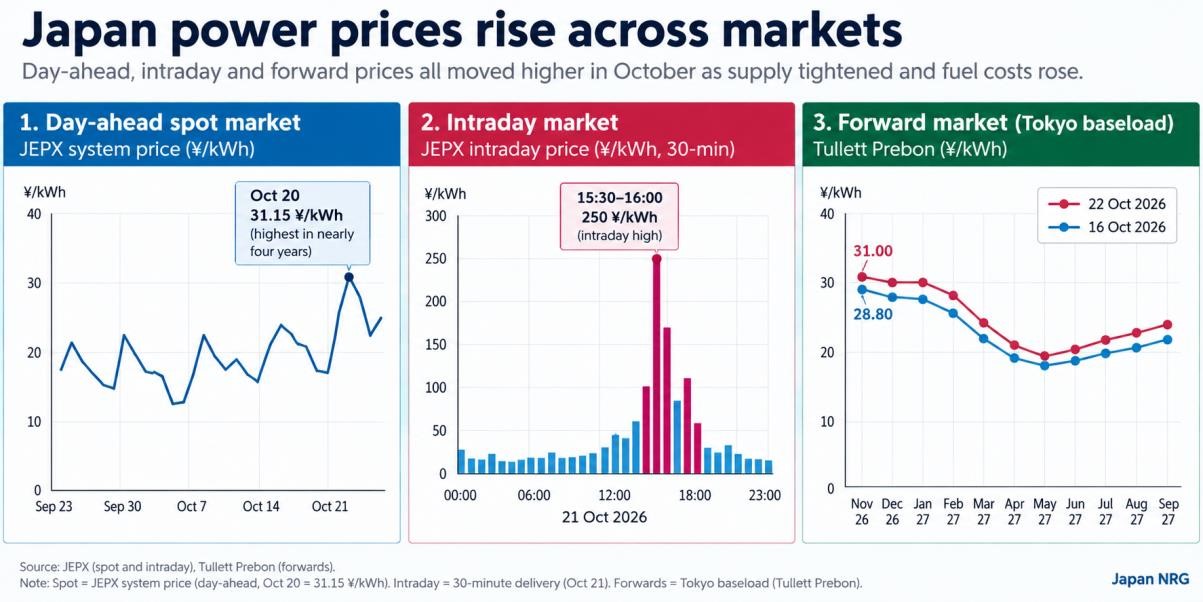
- The JEPX price for Oct 20 delivery averaged ¥31.15/ kWh, the highest in nearly four years and up over 25% from a week earlier. The day’s system price ranged from ¥24.15–47.88/ kWh.
- Prices remained almost unchanged for Oct 21 delivery, averaging ¥31.13/ kWh, with Tokyo at ¥32.49/ kWh, and Kansai at ¥29.45/ kWh.
- The market eased, with the nationwide average falling to around ¥20/ kWh for Oct 22 delivery, before the system price recovered to ¥25.34/ kWh on Oct 23. The latter remained more than double the ¥11.55/ kWh recorded a year earlier.
- Higher fuel costs are providing a much firmer floor for thermal generation. Northeast Asian spot LNG for December delivery rose to around $29.30/ MMBtu, its highest in nearly four years, amid continued Middle East supply disruption and competition for winter cargoes. JKM swaps through January trade above $30/MMBtu, easing to $29.67/MMBtu for February 2027.
- Coal prices have also risen sharply since the Middle East conflict, while scheduled maintenance and reduced availability of domestic generation have added to upward pressure on JEPX prices.
- TAKEAWAY: The spot market has now had several periods of elevated prices in 2026, but the latest increase is notable because it occurred during the relatively low-demand autumn shoulder season. Prices eased as the week went on, but remained above the average for this time of year as a 30th named typhoon approached Japan.
- SIDE DEVELOPMENT:
- Power forwards push baseload prices to ¥30 across regions
- (Brokerage data, October 16-22)
- Power forward prices rose across the curve over the past week, with the strongest gains in near-term winter contracts, according to Tullett Prebon data.
- Tokyo baseload (TBL) November 2026 increased to ¥31/ kWh from ¥28.80/ kWh on Oct 16, while December rose to ¥29.95/ kWh from ¥28.20/ kWh and January to ¥29.95/ kWh from ¥28.40/ kWh.
- Kansai baseload (KBL) November increased to ¥22.75 from ¥21.30, with December at ¥22.95 and January at ¥24.15.
- Chubu baseload (CBL) November rose to ¥29.75 from ¥27.70, while December increased to ¥29.25 and January to ¥29.10.
- Prices also moved higher further along the curve, by smaller amounts. Tokyo April-May 2027 contracts reached ¥20, while July-August remained around ¥23–24.
Imbalance price hits new ¥300/ kWh cap as power supply tightens
(Denki Shimbun, October 23)
- On Oct 21, the imbalance price reached its new ¥300/ kWh ceiling in the Chubu-Hokuriku-Kansai area as power supply-demand conditions tightened sharply.
- Prices remained at the ceiling for four consecutive 30-minute periods from 15:30 to 17:30, when the wide-area reserve margin fell to the critical level of 3% or below.
- The intraday market, where electricity can be traded until one hour before delivery, also recorded an actual high of ¥250/ kWh between 15:30 and 16:00.
- CONTEXT: The event came only three weeks after the Oct 1 revision of the scarcity imbalance pricing formula, which increased the maximum price from ¥200/ kWh to ¥300/ kWh. The higher ceiling is intended to provide stronger incentives for generators and retailers to secure additional supply, including resources such as demand response that may not be activated at normal market prices.
- Tightness already emerged on Oct 20, when imbalance prices reached ¥92 across four western areas excluding Shikoku.
- Conditions worsened on Oct 21, with the Chubu-Hokuriku-Kansai price rising to ¥134.50 at 14:30– 15:00 and ¥266 at 15:00–15:30, before reaching the ceiling.
- OCCTO issued instructions to improve the supply-demand balance and repeatedly released normally reserved interconnector capacity to facilitate additional power transfers between areas.
- No formal supply-demand tightness alert or warning had been issued beforehand because additional measures were expected to keep the reserve margin above 5%.
- Actual demand, however, exceeded forecasts and the measures proved insufficient, pushing the margin below 3%.
- TAKEAWAY: The episode provided a real-world test of Japan’s tougher scarcity pricing regime, with both imbalance and intraday prices responding sharply as reserves tightened. It also highlighted the difficulty of forecasting short-term system tightness. Conditions deteriorated enough to require emergency use of interconnector capacity despite earlier expectations that reserve margins would remain above the level requiring an official alert.
- SIDE DEVELOPMENT:
- Intraday power price spikes to ¥250/ kWh as supply tightens
- (Exchange data, October 19-23)
- The intraday power market recorded a high of ¥250/ kWh for 15:30–16:00 delivery on Oct 21, as supply-demand conditions tightened sharply. The average transaction price for the period was ¥62.58/ kWh.
- The spike coincided with the wide-area reserve margin falling to 3% or below in the Chubu-Hokuriku-Kansai area. OCCTO repeatedly released normally reserved interconnector capacity to allow additional electricity transfers between areas as it sought to improve the supply-demand balance.
- Intraday prices remained volatile but eased. JEPX data show a maximum of ¥100/ kWh on Oct 22, while the maximum had fallen to ¥50/ kWh by Oct 23.
- CONTEXT: The intraday market allows participants to adjust positions after the day-ahead spot market and closer to actual delivery. JEPX operates it as the adjustment market following the day-ahead market.
JOGMEC economist stresses role of power markets as system becomes more complex
(Japan NRG, October 21)
- Electricity security is important as electrification, renewables and data centers make power systems more complex, said Sadamori Keisuke, JOGMEC Chief Economist and ex-IEA Director of Energy Markets and Security, at Japan Power Summit.
- Increasing variable renewables will require much more system flexibility. Batteries and DR can handle short-term fluctuations, but Sadamori said thermal and hydro generation are still expected to provide much of the flexibility needed to manage longer-duration and seasonal variations.
- Short-term electricity markets have provided transparent pricing, efficient scheduling and access to different resources, he said. Power futures have an important role in allowing market players to manage volatility and respond to those price signals.
- Longer-term markets remain challenging, with limited liquidity constraining the ability of participants to hedge further forward. While long-term PPAs are expanding, access is uneven, with large companies such as major IT groups better positioned to secure such contracts than smaller businesses and households, Sadamori said.
- Although the LTDA is a strong investment mechanism designed to support large-scale investment in low-carbon generation, Sadamori cautioned that such tools must be designed carefully to avoid excessively distorting price signals or weakening the functions of short- and long-term electricity markets.
- TAKEAWAY: Sadamori’s comments highlight a central tension in Japan’s evolving market design. Government energy planners are more focused on trying to instill longer-term predictability and control over the market to offset the rise of renewables output. But market trading is leaning to shorter-duration products to create a more accurate and faster price response, and to match the changing generation mix.
ANRE progresses on key designs of mid- to long-term electricity market
(Government statement, October 20)
- ANRE discussed market participants, products, scope and market-splitting risks in the proposed mid- to long-term electricity market, and proposed several design refinements.
- The original concept envisaged generators participating mainly as sellers and retailers as buyers. The working group clarified that generators could also buy electricity and retailers could sell surplus volumes in some circumstances. Independent traders would not be permitted to participate.
- There will be caps on retailers’ purchase volumes, based on their electricity demand, to prevent over-procurement and excessive concentration of purchases.
- One-year-ahead products would be added alongside three-year-ahead trading, giving retailers a shorter-term option for meeting their forward procurement obligations. After one year of market operation, product-specific minimum supply requirements could be considered for products where demand consistently exceeds available supply.
- Regional markets could be consolidated where price risks are considered manageable, with the aim of improving liquidity and competition. Market boundaries would take account of regional price differences and the availability of hedging tools.
- CONTEXT: The government is developing a new mid- to long-term electricity market to encourage retailers to secure more electricity in advance while improving predictability for generators’ investment and fuel procurement. Following earlier discussions on the basic framework, the working group is now refining participation rules, procurement flexibility, liquidity and regional market design.
- TAKEAWAY: The latest proposals make the market somewhat more flexible than the original generatorsells/retailer-buys concept, while still keeping participation limited to physical electricity businesses rather than pure traders. Allowing retailers to resell surplus electricity and introducing one-year-ahead products should make it easier to manage procurement obligations without locking retailers too heavily into three-year positions.
enechain and JWA to collaborate on electricity supply-demand management tech
(Company statement, October 23)
- enechain and JWA agreed to collaborate on technology for electricity supply-demand management for power companies.
- The collaboration will link enechain’s eBalance system, launched this autumn, with JWA’s weather data and electricity demand forecasts to improve operational efficiency and convenience for electricity companies.
- JWA will provide weather data, electricity demand forecasts, and forecasting expertise; enechain will develop and offer a supply-demand management system.
- CONTEXT: Since weather greatly impacts electricity consumption, accurate forecasting is needed to maintain supply-demand balance. But, conventional energy management systems often require manual data integration and lack sufficiently accurate forecasting capabilities. JWA provides high-precision demand forecasting services to dozens of electricity companies, including major utilities and new retailers.
- TAKEAWAY: JWA’s electricity-related services are expanding beyond weather forecasts to predict power generation, encompassing renewable energy output forecasting, supply and demand optimization, electricity market trading support, and the utilization of distributed energy resources such as BESS. Following an announcement on October 13, JWA announced two more collaborations with other companies in electricity-related services this week, highlighting its growing partnerships in the power sector.
Meanwhile, on Oct 22, JWA said it will establish a subsidiary, Japan Weather Association, on Nov 1. The existing foundation will continue its public-interest activities, while the new company will focus on business growth in competitive markets.
See the solar section for more JWA collaborations.
KEPCO to retire Himeji No. 1 Units 5 6 in 2028
(Company statement, October 19)
- KEPCO will retire Units 5 and 6 at its Himeji No. 1 Thermal Power Station on February 29, 2028. The two gas-fired combined-cycle units, commissioned in 1995–1996, have combined capacity of 1.44 GW.
- KEPCO plans to replace them with three roughly 650 MW high-efficiency combined-cycle units, increasing the site’s capacity to about 1.95 GW. Generation efficiency is expected to rise from about 54% to 63%, reducing the plant’s CO2 emissions intensity.
- Construction is planned to start in FY2029, with the new units targeted to begin operation from FY2033 onward. The existing and replacement units will continue to use natural gas.
- TAKEAWAY: The retirement creates a sizable gap between the closure of 1.44 GW of existing gas capacity in early 2028 and the commissioning of the replacement units from FY2033. The two units account for about 6% of KEPCO’s total generation. As such, KEPCO says there might be grid stability concerns during the interim period, and that supply-demand countermeasures will be addressed in coordination with OCCTO. The project nevertheless represents a net expansion of Himeji No. 1 capacity by roughly 0.5 GW once completed, while improving the efficiency of gas-fired generation that KEPCO expects to retain in its future power mix.
Sumitomo Electric opens UK’s first HVDC cable production plant
(Company statement, October 19)
- Sumitomo Electric opened the UK’s first High Voltage Direct Current (HVDC) undersea cable production plant in Scotland, with a ¥70 billion investment.
- The site covers about 15 hectares and will produce 525kV HVDC cross-linked polyethylene (XLPE) insulated undersea cables.
- CONTEXT: HVDC undersea cables efficiently transport renewable energy generated by sources such as offshore wind to consumers over long distances, in high volume, and with minimal transmission loss.
NEWS: HYDROGEN

NEDO sets technology roadmap for scaling hydrogen infrastructure
(Agency statement, October 16)
- NEDO published a new Hydrogen Infrastructure Technology Development Roadmap, setting out scenarios for 2030, 2040 and 2050 and identifying technology-development priorities for scaling hydrogen supply infrastructure.
- The roadmap covers four areas: large-scale hydrogen supply chains, domestic demand-area supply chains, hydrogen refueling stations, and common technological foundations.
- Key challenges include reducing infrastructure costs, scaling equipment from demo to commercial sizes, coordinating supply with demand, and improving the economics of hydrogen refueling stations.
- The roadmap reflects Japan’s national target to increase the introduction of hydrogen and related fuels from up to 3 Mt/year in 2030 to around 20 Mt/year in 2050. These targets include ammonia on a hydrogen-equivalent basis rather than representing physical hydrogen alone.
- For liquefied hydrogen supply chains, NEDO envisages:
- Major equipment scale-ups, including hydrogen liquefaction capacity toward 1,000 tons/ day (from 25 tons),
- Liquid-hydrogen storage tanks from around 50,000 m³ to 200,000 m³, and
- Carriers from around 40,000 m³ to 160,000 m³.
- Ammonia storage is considered separately, with facilities scaling toward around 100,000 tons (from 40,000 tons).
- The roadmap retains Japan’s existing national hydrogen supply-cost targets of ¥30/Nm³ by 2030 and ¥20/Nm³ or below by 2050, rather than setting new cost benchmarks.
- NEDO said the roadmap will be updated as technologies and market conditions evolve, providing a common framework for government, industry and academia as hydrogen projects move toward larger-scale deployment.
- CONTEXT: NEDO has published fuel-cell and hydrogen technology roadmaps since 2005 and has repeatedly updated individual areas including fuel cells and water electrolysis. The October document is a new roadmap focused specifically on hydrogen infrastructure, complementing the fuel-cell and waterelectrolysis roadmaps updated in recent years.
- TAKEAWAY: The roadmap illustrates the size of the engineering jump still required if Japan is to move to commercial hydrogen supply chains. In liquid hydrogen alone, liquefiers, terminals, storage tanks and carriers must all scale by multiples.
At the same time, NEDO has retained the longstanding national cost targets of ¥30/Nm³ by 2030 and ¥20/ Nm³ or below by 2050, even though energy, equipment and financing costs have risen sharply and many industry participants now regard those levels as extremely difficult to achieve.
The government itself appears to be taking a more pragmatic view in actual support schemes. Recent LTDA revisions substantially increased allowable cost benchmarks for hydrogen and ammonia projects and broadened support for fuel-cost differentials, reflecting today’s much higher project costs. The unchanged ¥30/¥20 targets therefore look increasingly like long-term policy reference points rather than hard near-term commercial thresholds.
KHI begins work on Japan’s largest liquid hydrogen plant
(Company statement, October 19)
- KHI began work on a hydrogen liquefaction plant at the Kawasaki LH2 Terminal, which can produce 50 tons of liquid hydrogen/ day. This is 35 tons more than the previous largest capacity domestic plant.
- The plant is scheduled for completion by late 2028, to be used for commercialization demos from 2030 after completing trial operation.
- Hydrogen is cooled to extremely low temperatures and the hydrogen liquifier device, consisting of elements including a heat exchanger and expansion turbine, controls the efficiency and reliability of the liquefaction process.
- The current liquifier is based on KHI’s first prototype and its first domestically produced commercial model able to produce 5 tons/ day that launched in 2020.
- TAKEAWAY: KHI is determined to spearhead liquefied hydrogen infrastructure in Japan and lead the domestic industry. The Kawasaki LH2 Terminal is supported by NEDO’s GI Fund. KHI has been conducting hydrogen liquefaction demos since 2014. Prior to the present plant, the firm began building a hydrogen production facility that will use the Steam Methane Reforming (SMR) method; it’s scheduled for completion in spring 2029 and will produce 18 tons of high-purity hydrogen each day.
Tsubame BHB starts ammonia production and supply at INPEX site
(Company statement, October 23)
- Tsubame BHB, a deep-tech startup originating from Tokyo, began ammonia production and supply at its commercial-scale demo plant at INPEX’s Kashiwazaki site.
- It developed electride catalyst technology that performs low-temperature, low-pressure, highefficiency ammonia synthesis.
- INPEX supplies the ammonia to Mitsubishi Gas Chemical.
- The tech is rooted in the ‘local production for local consumption’ model, in which ammonia is made to meet local demand.
- This is the first time the technology has been used at commercial scale.
- CONTEXT: Including this facility, Tsubame BHB has orders to develop two ammonia synthesis plans in Japan, and has inked MoUs for facilities in Brazil and India.
Fuji summit shifts hydrogen debate from technology to deployment
(Japan NRG, October 20, Government statement, October 19-21)
- This year’s Fuji Hydrogen Summit 2026 in Yamanashi focused less on new hydrogen technologies than on the practical barriers to moving existing systems from demos into sustained commercial deployment.
- Yamanashi Governor Nagasaki said the prefecture’s Power-to-Gas program is moving beyond the demo stage, but identified high costs, insufficient demand, regulatory and institutional constraints, and shortages of skilled operators as continuing barriers.
- Yamanashi is increasingly positioning itself as a regional hydrogen supplier rather than simply a pilot site. Nagasaki and Tokyo Governor Koike highlighted plans to connect green hydrogen production in Yamanashi with demand in Tokyo, building on cooperation between the two governments.
- The prefecture has already established the Yamanashi Hydrogen Company as an operating vehicle and sees the state as playing both a coordinating role across the supply chain and a direct role in creating the conditions for deployment. Yamanashi says its objective is to use locally produced renewable power to make hydrogen for transport and heat while retaining more energy spending within the region.
- Corporate speakers including Kanadevia, Suntory and Toyota repeatedly returned to demand uncertainty and investment risk, arguing that hydrogen projects need credible users and commercially sustainable initial applications before they can scale.
- Presentations from India, Brazil, Canada and South Korea showed that other countries are also moving toward place-based hydrogen ecosystems, combining production, local demand, infrastructure, regulation and public support rather than treating hydrogen production as a standalone project.
- Nobel laureate Kitagawa Susumu highlighted potential future applications for metal-organic frameworks in gas storage, separation and conversion, although industrial-scale deployment remains the key challenge.
- The summit concluded with the Fuji Hydrogen Declaration 2026, under which Yamanashi pledged to share operating experience, open training opportunities and support other regions attempting to develop hydrogen projects.
- TAKEAWAY: The Tokyo-Yamanashi partnership offers one of Japan’s clearer attempts to build a regional hydrogen market by linking renewable hydrogen production in Yamanashi with a much larger demand center in Tokyo. For now, however, the model remains constrained by small and fragmented offtake volumes despite Tokyo’s efforts to create a Green Hydrogen Exchange. This makes it difficult to achieve scale or materially reduce costs.
KHI and Transgaz to partner on land-based hydrogen gas transport
(Company statement, October 20)
- During the Japan-Romania Innovation Forum in Tokyo on Oct 20, KHI and Transgaz, a Romanian gas transportation company, inked an MoU to partner on transportation of land-based hydrogen gas.
- Transgaz will combine its pipeline expertise with KHI’s centrifugal hydrogen compressor technology (KM Comp-H2) to develop a large-scale, land-based hydrogen gas pipeline across central and eastern Europe.
- The companies will conduct field tests transporting pure hydrogen across Romania using KM CompH2. This will be the world’s first demo of a large-scale hydrogen gas transportation pipeline.
Brother Industries agrees on hydrogen fuel cell project
(Company statement, October 20)
- Brother Industries inked a deal with the city of Tokyo to install and utilize hydrogen fuel cells (FCs) as an emergency power source at the Chuo health care center.
- CONTEXT: Brother is developing hydrogen FCs that don’t emit CO2, promoting green hydrogen use. Tokyo certified the firm as a green hydrogen pioneer.
NEWS: SOLAR AND BATTERIES

Fuji Electric, JWA to collaborate on grid-scale BESS
(Company statement, October 19)
- Fuji Electric and the Japan Weather Association will launch a business in grid-scale BESS operations.
- Operators and aggregators using Fuji Electric’s BESS trading management system, EnergyGATE, can access JWA electricity market price forecasts.
- Fuji Electric’s system automates trading operations such as the balancing market and develops optimal trading plans to maximize revenue.
- JWA’s service covers a wide range of time horizons, including day-ahead, weekly, and monthly forecasts, supporting BESS planning and operations.
- CONTEXT: Fuji Electric has expertise in BESS operation planning. JWA specializes in electricity price forecasting based on advanced weather data and market analysis.
- TAKEAWAY: Integrating JWA’s forecasts will provide longer-term price outlooks and support better informed trading decisions based on market trends. As renewable energy expands, growing supply, demand and price volatility increases the need for BESS flexibility, making accurate price forecasts essential for optimizing operations.
Panasonic HD to launch mass-scale production of glass-type PSCs
(Company statement, October 20)
- Panasonic HD will mass produce glass-type PSCs at its plant in Nagahama (Shiga Pref) starting April 2029, instead of the planned 2030.
- The modules will be marketed for building-integrated PVs, with installations on facades and windows. They will use laminated and multi-layered glass, aiming to improve building aesthetics.
- CONTEXT: Last month, Panasonic began to sell modules from its plant in Moriguchi.
- TAKEAWAY: Panasonic’s decision to bring forward mass production at an additional facility (in Nagahama) reflects growing competition from Chinese firms, which in turn raises questions about how the govt will support domestic companies as they head toward commercialization.
- SIDE DEVELOPMENT:
- Koshida Tech becomes local distributor of Chinese PSCs
- (Company statement, October 19)
- Koshida Tech became the local distributor of glass-type PSCs made by Kunshan GCL Optoelectronic (China), which is also developing PSC/silicon tandem modules.
Renova sees over 20% drop in large-scale solar power sales
(Nikkei, October 21)
- Renova reported a 23.2% drop in large-scale solar power sales and a 34.8% increase in biomass sales compared to Sept 2025.
- In H1 of FY2026, total electricity sales exceeded 1.7 billion kWh, which was 2.1% less than planned but up 15.8% YoY.
- CONTEXT: Renova owns seven solar farms, (total installed capacity of 445 MW), giving the company a substantial revenue stream
- TAKEAWAY: In FY2023, solar made up about 9.8% of Japan’s power generation mix. Renova’s new development illustrates a shift from large-scale solar in favor of smaller assets. Large projects are now less central to corporate strategies in the wake of reforms on subsidy allocation and social acceptability issues.
MFT Energy agrees with infrastructure fund for solar assets
(Company statement, October 19)
- Denmark-based energy trading company MFT Energy agreed with an unnamed global infrastructure fund on a wholesale power supply for five solar farms in Japan, with deliveries to begin in December.
- The solar farms are in Hokkaido, Miyagi, Yamaguchi, Chiba and Tochigi prefs.
- CONTEXT: An increasing number of foreign energy trading firms are eager to enter Japan’s market, attracted by growing electricity demand and price volatility, which create opportunities for power trading and hedging.
Nakatani Setsubi and TSP launch demo of lightweight solar modules
(Company statement, October 20)
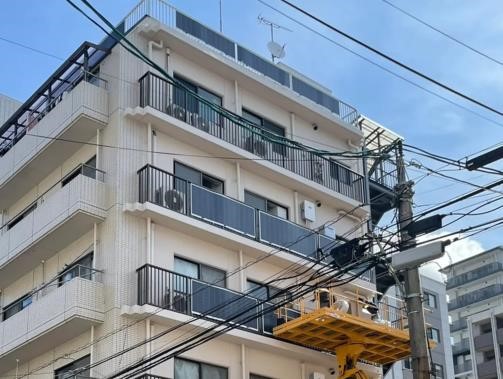
- Nakatani Setsubi and TSP launched a demo installing ultra-lightweight, ultra-thin solar PV panels on a residential building in Hiroshima.
- The panels – Perapera Solar®, supplied by TSP – are installed on balconies and rooftop fences.
- Electricity will be supplied to residential units rather than the whole building.
NEWS: WIND POWER AND OTHER RENEWABLES

JWD plans nationwide expansion of wind-powered electricity retail
(Nikkei, Company statements, October 22)
- Japan Wind Development (JWD) plans to expand its electricity retail business nationwide, targeting sales of around 220 GWh in FY2030.
- JWD began electricity retailing in April 2026, initially supplying customers in the Kanto region using electricity from existing wind farms, including projects that have exited the FIT scheme. Its first announced customer was a wastewater concession operator in Kanagawa.
- From FY2027, the company plans to expand sales to other regions, including fixed-price contracts backed directly by electricity from its own wind portfolio.
- JWD has developed 37 wind farms totaling around 605 MW nationwide. The company plans to increase the amount of wind generation available for retail and other direct supply arrangements as more existing projects reach the end of their FIT periods.
- The strategy is not limited to retail. JWD has also agreed to supply electricity from four new Aomori wind projects to Chubu Electric Miraiz under a long-term contract and says it plans to use retail, wholesale and corporate PPAs to monetize wind generation.
- TAKEAWAY: JWD is trying to turn its maturing wind portfolio into a broader electricity-supply business rather than simply selling output into FIT or wholesale markets. Post-FIT wind could become more valuable if corporate buyers increasingly seek renewable power that can complement daytime-heavy solar generation. Potential revisions to the GHG Protocol Scope 2 rules could strengthen that advantage by putting greater emphasis on when and where renewable electricity is generated. Hourly matching remains under discussion rather than finalized, but wind’s different generation profile could make it more useful alongside solar for companies seeking more continuous renewable-energy coverage.
Tokyo Gas drops 30 MW floating wind project off Fukushima
(Nikkei, October 25)
- Tokyo Gas has abandoned plans for a 30 MW floating offshore wind project off Fukushima, concluding that rising construction costs made the project uneconomic. The two-turbine project was targeted for 2027 and had entered the environmental assessment process in 2023.
- Floating wind requires additional infrastructure including floating foundations, mooring systems and specialized subsea cables, making development and maintenance more expensive than fixedbottom projects.
- Government measures introduced to prevent further offshore wind withdrawals mainly support fixed-bottom projects already awarded through national tenders. Tokyo Gas is expected to focus for now on fixed-bottom developments, including the Yuza project off Yamagata.
- TAKEAWAY: Mitsubishi Corp.‘s withdrawal from all three Round 1 projects raised concerns about broader retreat from Japan’s offshore wind tenders, but this Fukushima project was outside the government auction system. So far, Mitsubishi’s exit has not triggered cancellations of other awarded projects.
Honda inks deal for India-sourced biofuel production
(Company statement, October 16)
- Honda Trading India agreed with Buyofuel to establish a biofuel supply chain using corn as a feedstock, leveraging Buyofuel’s procurement network and digital platform.
- The deal aims to valorize agricultural residues, particularly those procured from small-scale farmers.
- TAKEAWAY: With support from the Indian govt, ethanol consumption has grown into billions of liters, and its explosive growth has primarily been driven by the Ethanol Blended Petrol (EBP) program. The biofuel market is expected to be dominated by biodiesel and compressed biogas, making it an attractive investment opportunity for foreign companies. Corn-derived ethanol has much potential, given India’s corn production of 55 million tons in 2025–2026, among the world’s largest.
Osaka Gas and MHI test platform of biofuel-derived environmental value
(Company statement, October 21)
- Osaka Gas and MHI launched a demo of a platform for managing environmental attribute certificates tied to biofuels.
- Digital platform, CO2NNEX®, handles procedures related to third-party certification and management of certificates for e-methane, e-gasoline, biogas, HVO and SAF.
- The demo aims to assess the platform’s efficiency and prevent double counting.
MHI renovates Indonesian geothermal unit to boost production capacity
(Company statement, October 20)
- MHI completed upgrades on Unit 3 of Darajat geothermal power plant in Indonesia; it resumed operations with its output capacity rising to 129 MW from 121 MW.
- These upgrades make this unit the country’s largest in terms of installed capacity.
- CONTEXT: ITO is part of a management strategy introduced by MHI CEO Eisaku Ito to halve lead times via digitalization and AI, streamline value chains, and generate an additional ¥100 billion in business profit over the longer term.
NEWS: NUCLEAR ENERGY

Foreign funds pressure Chubu Electric to decide future of Hamaoka NPP
(Facta, November 2026)
- Chubu Electric faces renewed questions over the future of its Hamaoka NPP after withdrawing restart applications for Units 3 and 4 following the discovery of manipulated seismic-review data.
- The utility says it intends to pursue restarts after rebuilding trust, but the withdrawal annuls more than a decade of regulatory review and leaves the timetable for any new application highly uncertain.
- Hamaoka Unit 3 is near to 40 years of operation; additional work may be required on seismic assumptions and tsunami protection. Unit 5 also faces unresolved technical concerns following seawater ingress in 2011.
- Chubu Electric has spent over ¥400 billion on Hamaoka safety upgrades, raising questions over how much more should be committed.
- Some overseas investment funds are privately urging Chubu Electric to consider exiting nuclear generation, arguing that the utility can maintain adequate power supply without Hamaoka NPP. Foreign investors hold roughly 30% of the utility’s shares, with BlackRock Japan holding about 7.6%.
- Any decision to decommission the remaining reactors would itself carry substantial financial costs, including accelerated depreciation and decommissioning expenses, complicating the economics of a nuclear exit.
- CONTEXT: Last month, Chubu Electric withdrew the restart applications for Units 3 and 4 after an external investigation linked data manipulation to excessive internal pressure surrounding prolonged regulatory review. The company’s chairman and president subsequently resigned.
- TAKEAWAY: Hamaoka has shifted from a restart question into a capital-allocation problem for Chubu Electric. Restarting would require renewed regulatory scrutiny and possibly further investment; abandoning the NPP would crystallize large sunk costs and decommissioning liabilities. Facta suggests this trade-off is an issue between management and shareholders, although the reported pressure from foreign funds is based on unnamed sources.
- SIDE DEVELOPMENT:
- Chubu Electric president outlines post-Hamaoka strategy
- (Denki Shimbun, October 19)
- In an interview, Chubu Electric’s new president Yasui said he has put rebuilding trust and governance reform ahead of any Hamaoka NPP restart discussion.
- On Hamaoka Units 3 and 4: Yasui says Chubu Electric likely needs to redo standard seismic ground motion calculations following the data issue; technical and economic viability to be reassessed afterward.
- However, Yasui does not support walking away from nuclear power, saying it remains crucial to meet rising demand and decarbonization.
- Yasui wants Chubu Electric to maintain some direct ownership or control of generation capacity, rather than relying only on external procurement.
- Options include participation in the LTDA, partnerships with major generators and gas companies, and investment through SPCs.
- On renewables strategy: Yasui wants to acquire post-FIT solar and wind assets, use O&M capabilities to identify attractive projects, and then repower or upgrade them.
- Energy management and DR are also seen as growth areas nationwide.
- On JERA, Yasui said boosting corporate value comes first; an IPO is a possible route and he will not be opposed if Chubu’s shareholder value is protected.
- Chubu does not favor major holding company restructuring; management wants stronger internal cohesion while governance reforms are made.
Genkai NPP Unit 3 to restart commercial operation
(Company statement, October 23)
- Kyushu Electric said Genkai NPP Unit 3 (1.18 GW, PWR) is close to completing its 19th periodic inspection that began on June 30.
- The reactor will restart and reach criticality on Oct 27, with electricity generation resuming on Oct 29.
- Operators will then start trials, ramping up power output to verify functionality. After a load performance inspection it will return to commercial operation on Nov 25.
- Maintenance included replacing 64 of the 193 fuel assemblies with fresh fuel and upgrading the reactor safety protection sequence board.
- TAKEAWAY: The unit’s return comes as Kyushu Electric staggers maintenance across its nuclear fleet. The adjacent Genkai NPP Unit 4 will begin periodic inspection in November, followed by Sendai NPP Units 1 and 2 in early 2027.
Hokkaido Electric addresses NRA safety ahead of Tomari NPP restart
(Nikkei, October 22)
- Hokkaido Electric addressed NRA safety inquiries on the fire suppression system design for Tomari NPP Unit 3.
- Following a Sept 3 meeting, the NRA requested detailed explanations.
- Hokkaido Electric said it will provide the information in a future review session.
- CONTEXT: The company maintains its target to restart Tomari Unit 3 as early as possible in 2027. The restart would be critical for Hokkaido. The region’s governor backs the restart in order to support semiconductor manufacturer Rapidus, which is seen as a highly strategic project of national importance.
NEWS: TRADITIONAL FUELS
Idemitsu expands into LNG wholesale, plans to sell non-Middle Eastern LNG in Japan
(Nikkei, Japan NRG, October 21)
- Idemitsu Kosan plans to begin importing and wholesaling LNG in Japan in the early 2030s, with a focus on securing supply from outside the Middle East.
- The move would take Idemitsu into Japan’s domestic LNG market, which is currently dominated by major utilities and trading houses.
- In March, Idemitsu committed $500 million, or roughly ¥80 billion, to UK-based MidOcean Energy as the first step in its full-scale entry into LNG. MidOcean has interests in LNG projects across Australia, Canada and South America, giving Idemitsu access to a geographically diversified portfolio.
- Idemitsu already produces natural gas in Southeast Asia, but much of that gas is consumed locally. The new strategy would mark its first effort to bring LNG into Japan and sell it domestically.
- CONTEXT: Idemitsu’s 2026–30 medium-term plan identifies LNG as a new growth business, combining upstream expansion, LNG investment, trading and marketing. The company says it sees natural gas and LNG as increasingly important for both energy security and rising power demand, including from data centers.
- TAKEAWAY: Idemitsu is moving beyond upstream gas production toward a more integrated LNG business. Its MidOcean stake gives it access to supply outside the Middle East, while a future Japanese wholesale business would create a route to monetize those volumes domestically and diversify the country’s LNG procurement base.
LNG stocks down from previous week, up YoY
(Government data, October 21)
- As of Oct 18, the LNG stocks of 10 power utilities were 2.54 Mt; down 3.8% from the previous week (2.64 Mt); up 35.8% from end Oct 2025 (1.87 Mt), and up 21% from the 5-year average of 2.1 Mt.
September Oil/ Gas/ Coal trade statistics
(Government data, October 21)
| Imports Volume YoY Value (Yen) YoY | ||||
| Crude oil | 11.2 million kiloliters (70.2 million barrels) | 3.1% | 1,110.2 billion | 51.1% |
| LNG | 4.8 million tons | -7.3% | 590.6 billion | 39.2% |
| Thermal coal | 8.8 million tons | 5.9% | 200.8 billion | 34.3% |
NEWS: CARBON CAPTURE & SYNTHETIC FUELS
Japan CCUS 2026 calls to speed up APAC cross-border deployment
(Japan NRG, October 21)
- The Japan CCUS Summit 2026 (Oct 19-20) gathered energy policymakers, financiers, and industrial developers.
- Delegates called for an urgent transition away from non-binding MoUs toward commercial deals that can achieve final investment decisions (FID).
- Participants highlighted Japan’s role as one of the Asia-Pacific’s largest prospective CO2 exporters.
- Cooperation with SE Asian and Australian geological hubs is crucial for successful CCUS projects.
- Panels pressed the need to complete bilateral govt-to-govt agreements to establish rules for crossborder carbon accounting and long-term liability transfers.
- Discussions addressed the cost and regulatory barriers facing projects, such as narrow carbon pricing under schemes like Japan’s GX-ETS.
- Participants also argued that the main obstacle is a lack of high compliance penalties as in Western nations.
- JOGMEC, INPEX, etc spoke about efforts to confirm domestic reservoir injections.
- TAKEAWAY: The event showed that CCUS deployment cannot progress on private capital alone. Within the next 12 to 24 months, Japan and its partners must formalize bilateral G2G treaties and state-backed risk allocations. The goal for Japan is to secure these frameworks with high-capacity CO2 storage hosts such as Indonesia and Malaysia.
Tangguh CCS could expand under JCM, says bp
(Japan NRG, October 19)
- bp has taken FID on the first phase of the Tangguh CCUS project in Indonesia, which will capture naturally occurring CO2 from the gas reservoir and reinject it underground as part of an Enhanced Gas Recovery scheme. bp said the project could subsequently expand to accept CO2 from additional domestic emitters, helping increase utilization of the transport and storage infrastructure and lower unit costs.
- One potential route is the Japan-Indonesia Joint Crediting Mechanism (JCM). Tangguh has already advanced under the bilateral framework and is being developed as the first CCUS project registered under the JCM, creating a route for emissions reductions from CCS to generate carbon credits.
- CONTEXT: This represents a significant broadening of the JCM. The mechanism has historically been used mainly for renewable-energy and energy-efficiency projects, particularly solar, whereas CCS requires accounting for capture volumes, transport, injection, permanent storage and long-term monitoring.
- bp and Mitsubishi Research Institute have also been selected under a NEDO program to develop JCM methodologies for low-carbon CCUS technologies in Indonesia, suggesting the Tangguh case could become a template for other CCS projects.
- TAKEAWAY: Bringing CCS into the JCM could give large storage projects an additional revenue stream while helping Japan develop the accounting rules needed for cross-border CO2 management. For Tangguh, expanding beyond reservoir CO2 to third-party domestic emitters would improve infrastructure utilization and could eventually strengthen the economics of accepting imported CO2 as Indonesia develops into a regional storage hub. More broadly, the project is important because it tests whether a crediting mechanism built largely around renewables and efficiency can be adapted to the much more complex task of verifying permanent geological storage.
This month, Japan presented updated SHK accounting proposals to clarify how domestic and cross-border CCS reductions are reflected in emissions reporting. The treatment is also relevant to JCM credits and the future recognition of CCS reductions under GX-ETS.
METI releases draft safety guidelines for pipelines and underground storage
(Government statement, October 23)
- METI’s CCS Safety Office proposed regulations for CO2 pipeline transport and compression facilities.
- CCS pipelines must use Gas Business Act standards as a reference.
- Operators must perform dispersion simulations using software that meets government criteria, with DNV’s Phast cited as one example.
- Mandatory health and safety criteria regulate CO2 levels near protected facilities.
- As for underground storage management, operators must plan three scenarios: Injection Plan, a Monitoring Plan, and a Response/Judgement Plan.
- CONTEXT: CO2 poses safety hazards and operational challenges such as formation of acidic carbonic acid, decompression phase changes, and health risks. Existing natural gas regulations require tailored technical interpretations and guidelines.
Advantage Partners to launch ¥20 billion fund in biomass and carbon credits
(Nikkei Asia, October 20)
- Advantage Partners plans to launch Japan’s first major forestry fund in spring 2027, aiming to consolidate underutilized woodland assets and generate value through biomass fuels and carbon credits.
- The fund is expected to grow from an initial ¥20 billion to ¥100 billion over 5 years.
- Possible participants include Sumitomo Mitsui Trust Bank, Tokyo Century, MUFG Bank and Marubeni.
- Investments will focus on the Tohoku and Kyushu regions. Asset management firms will acquire forestland, while the fund will purchase rights to exploit the resources. Returns for institutional investors will be generated through sales of biomass, timber and carbon credits, with an annual return target of 6–7%.
- TAKEAWAY: Upcoming projects are expected to receive support from local banks, suggesting they will be smallscale. This is typical of many biomass projects in Japan, where local stakeholders seek to leverage underutilized biomass resources in forests to produce biochar (a charcoal-like material made through pyrolysis), support agricultural revitalization, provide heat and power, or convert waste into useful resources.
- SIDE DEVELOPMENT:
- Tokyo Gas, Idemitsu Kosan and Mizuho Bank agree on JCM
- (Company statement, October 19)
- Tokyo Gas, Idemitsu Kosan and Mizuho Bank will cooperate to develop projects that generate Joint Crediting Mechanism (JCM) credits that can be used on the GX-ETS.
- The goal is to develop projects in partner countries by providing assistance with business development, financing and carbon credit generation.
- Discussions target a project in SE Asia to generate JCM credits starting 2028.
- CONTEXT: Such support services are needed given the diversity of JCM partner countries and the investment challenges that firms face in certain regions.
Toho Gas joins startup on AI-powered forest analysis service
(Company statement, October 19)
- Toho Gas launched a drone- and AI-powered forest analysis service in collaboration with Kyoto University startup DeepForest Technologies.
- Using AI analysis drones with laser sensors (LiDAR) scan forests, measuring tree height, trunk diameter, canopy density, etc.
- The data evaluates CO2 absorption and supports generation of J-Credits, as well as assesses landslide risks, and tracks biodiversity.
- This can reduce the workload of on-site surveys.
- Toho Gas hopes to secure its first order by FY2027.
ANALYSIS
BY JOHN VAROLI
As Middle East War Worsens, Japan’s Oil Security Comes at a Steep Price
The U.S. war on Iran has triggered one of the most serious global energy crises in decades, with import-dependent Asian economies highly exposed. By August, the average price Japan paid for imported crude oil was about 55% more than before the war began in late February.
With hostilities continuing to disrupt Middle Eastern supplies and global oil demand running at about 105 million barrels per day, the crisis is placing much pressure on international energy markets. For oil-importing nations, the result has been a double blow: higher crude prices and rising transportation and insurance costs.
Crude shipping costs for a large tanker from the Middle East Gulf to Asia are five times the level before the start of the U.S.-Iran war, according to the IEA’s latest figures.
Japan Crude Cocktail (JCC) – the customs-cleared average monthly import price – includes the cost of crude, insurance and freight (CIF). In February, before the war began, JCC averaged $65.68/barrel. By August, it had climbed to $101.66/barrel. The shift toward distant suppliers, alongside rising freight and insurance costs, is adding to Japan’s import burden.
This diversification is complicated by the fact that Japan’s refineries are configured to process particular crude grades, especially Middle Eastern sour. Suitable alternatives are not always readily available, thus increasing procurement costs and limiting buyers’ options.
The challenge, however, isn’t limited to simply securing enough oil. The mix of higher crude prices, disrupted shipping and the yen’s weakness is feeding through to domestic business costs, with potentially significant implications for inflation and industrial competitiveness.
How long can the economy absorb the higher costs?
Rising cost of oil security
Japan has long depended on imports for virtually all its crude oil requirements, with the Middle East accounting for approximately 94% of supplies in 2025.
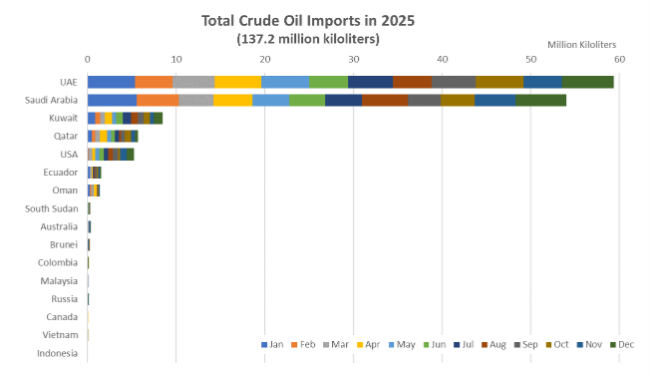
In 2025, the country’s two largest suppliers were the UAE, which delivered 59.4 million kiloliters, and Saudi Arabia, with 54 million kiloliters. Together with Kuwait, Qatar and Oman, Middle Eastern producers dominated Japan’s crude supply. The U.S. accounted for just 5.3 million kiloliters, or 3.9% of the total.
Japan’s 19 operating refineries, with combined processing capacity of about 3.11 million barrels per day, were built around this long-established supply relationship. As long as Middle Eastern oil could flow freely through the Strait of Hormuz, the system offered relatively short voyages (~18 days), established commercial arrangements and crude grades well suited to Japanese refining operations.
The war has disrupted that model. Japan has been forced to diversify, increasing purchases from the U.S.and other producers. By August, Middle Eastern suppliers accounted for about two-thirds of Japan’s crude imports, while the U.S. became one of its largest sources.
The UAE and Saudi Arabia have responded, seeking to make greater use of export routes that bypass the Strait of Hormuz. The UAE’s Fujairah terminal on the Gulf of Oman and Saudi Arabia’s Red Sea facilities at Yanbu offer alternative outlets for crude, although their effectiveness depends on pipeline capacity, terminal operations and maritime security.
But Saudi Arabia’s Red Sea route faces its own problems. The Yemeni militant group the
Houthis has nearly shut all tanker traffic seeking to exit the Red Sea via the Bab elMandeb Strait, complicating access to Asian markets and forcing tankers onto much longer routes.
Most Saudi tanker traffic now heads north and exits via the Suez Canal, onward through the Mediterranean Sea, around Africa’s Cape of Good Hope, and finally north through the Strait of Malacca and to Japan. That voyage takes about 50 days, almost three times more than before the war began.
Those extra days at sea means less tankers are available to move oil for global markets. When the empty tanker returns to Saudi Arabia, assuming the same return journey, it has spent an extra 64 days at sea than it would otherwise have during peacetime. When repeated across a market already operating with limited spare capacity, the delay has significant consequences for freight prices.
Under these conditions, the U.S. may be a more attractive source. A tanker traveling from Texas needs 35 days to reach Japan via the Panama Canal – longer than the traditional Saudi to Tokyo journey but shorter than the route around the cape of Africa. And although the ships that pass the Canal are smaller than the very large crude carriers (VLCCs) used on Middle Eastern routes, their logistics look more favorable under current conditions.
Building additional tanker capacity is not a quick solution. VLCCs take years to construct, meaning the global fleet cannot respond rapidly to a sudden increase in demand for long-haul voyages. There are currently around 800 VLCCs in service, carrying 2-2.5 million barrels each. The smaller Suezmax tankers number ~550, each carrying about 1-1.2 million barrels.
The Trump administration hopes to alleviate the global tanker shortage by authorizing the sale of sanctioned Russian and Iranian tankers to international investors. U.S. Energy Secretary Wright said this could add “dozens or even hundreds” of tankers to trade routes under U.S. control.
Time is, of course, money. The longer journeys have sent tanker costs soaring, with routes to Asia hit the hardest. The IEA reported that by mid-October charter rates on the Middle East–Asia route have reached $1.3 million per day, or over $37 per barrel. According to shipping company Frontline, average daily spot earnings for VLCCs rose from $74,200 in the final quarter of 2025 to $103,500 in Q1 2026 and $152,700 in Q2.
The increase is also striking when measured per cargo.
According to Bloomberg, the cost of shipping crude oil from the U.S. to Asia averaged about $9.2 million per VLCC voyage in 2025, equal to $4.60/ barrel for a 2-millionbarrel cargo. By mid-September 2026, that cost rose to about $26/ barrel, and by October, freight quotations soared to $77 million to $80 million per voyage, or about $39–40/ barrel.
While import volumes recovered via diversification, Japan’s total crude import bill still surged due to transport costs. In August, Japan’s crude oil import prices were up 53.1% compared to a year earlier.
Oil grades and the yen
Transportation is only part of the challenge.
Japanese refineries are largely configured to process medium-to-light sour crudes from the Middle East, which typically are about 30–40° API with higher sulfur. The UAE Murban and Das Blend are light sour, with strong middle-distillate yields; and there’s also Saudi Arab Light / Extra Light.
These match Japanese refinery setups for efficient production of diesel, jet fuel, gasoline, and other products. Best substitutes across global markets command high premiums, for example U.S. Mars medium-sour. Asian refiners, including Japanese ones, bid aggressively for these because they process more efficiently in existing units with better yields of desired products.
Foreign exchange adds another complication with the yen near a 40-year low. Because crude oil is predominantly priced in U.S. dollars, a weaker yen raises the domestic cost of purchases even if the dollar price is unchanged.
Toward a solution
Since March, Japan has pursued several measures to protect oil supplies, including greater procurement from the U.S. and alternative producers in Mexico, Africa, Azerbaijan, Australia and Canada.
The immediate priority has been physical supply security: ensuring that Japanese refineries can continue receiving sufficient crude despite disruption to traditional shipping routes.
But the growing transportation burden has also prompted a policy response.
On October 13, Japan’s Cabinet approved three bills aimed at strengthening the country’s oil supply chains. One would provide support to refiners facing additional costs from procuring crude through routes that bypass the Strait of Hormuz. Another would establish government support for marine insurance and reinsurance where private coverage becomes unavailable. The third would expand JOGMEC’s authority to provide investments and debt guarantees for overseas oil pipeline projects.
The proposals acknowledge that diversification involves costs that individual refiners may struggle to absorb, such as when freight markets become exceptionally volatile.
Overseas pipeline investments could help preserve access to Middle Eastern oil without relying exclusively on Hormuz, while government-backed insurance arrangements could reduce the risk of tankers unable to operate because commercial coverage is unavailable.
Japanese refiners have also been adjusting procurement and processing operations. They can now handle more light sweet U.S. crude and others after upgrades in processing. Japan tried to mitigate the mismatch of importing U.S. light sweet crude by blending it with heavier, high-sulfur grades from alternative regions, mimicking traditional Middle Eastern feedstock.
Finally, Japan already holds large combined public and private stocks, which are historically well above the IEA’s 90-day net import minimum. Japan made a substantial release earlier this year in coordination with the IEA, but it still has enough in stock for 200+ days of consumption.
The economic cost
Even with growing diversification and flexibility, Japan will pay more for oil than the U.S. or EU simply due to geography. But how much?
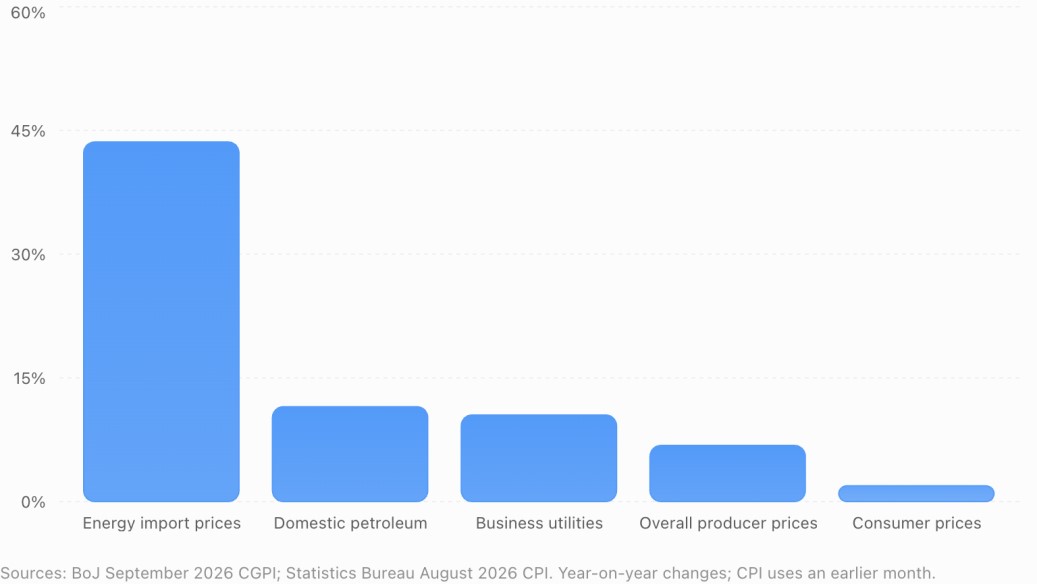
According to the Bank of Japan’s latest Corporate Goods Price Index, published October 13, import prices for petroleum, coal and natural gas were 43.6% higher YoY in yen terms in September. Even on a contract-currency basis, the increase was 36.1%, illustrating the extent to which the energy shock goes beyond exchange-rate movements.
The impact is also evident further along the supply chain via domestic producer prices for petroleum and coal products. Electricity, gas and water prices charged to businesses jumped 10.5% YoY in September even if the August headline consumer inflation was calculated at 1.9%. The contrast suggests that the energy shock is considerably more visible in import and business input costs than in consumer prices, at least for now.
The danger is that elevated costs will gradually be passed on through supply chains, affecting manufacturers, transportation operators and eventually consumers. The government’s latest measures may ease the burden of securing alternative supplies, but they cannot fully insulate the country from the economics of a disrupted global oil market.
For Japanese industry, the price of greater energy security may therefore be a lasting increase in procurement costs – one that becomes harder to absorb the longer the Middle East crisis continues.
ANALYSIS
BY AGLAÉ BANGE
Railways in Transition: From Low-Carbon Transport to Energy Markets
Take the train instead of flying. This is a common call in the public debate over the lowcarbon advantage of railways versus airplanes.
As rail has the lowest carbon footprint among motorized transport modes, initiatives to further decarbonize the sector are less conspicuous than those in aviation or road transport.
Japan’s major railway operators have committed to carbon neutrality by 2050 and are investing in energy efficiency, renewable electricity and next-generation train technologies, including hydrogen-powered and battery-electric trains. But their ambitions increasingly extend beyond reducing emissions from railway operations.
With extensive land holdings, infrastructure and experience managing large electricity loads, railway operators are well placed to expand their role in the energy sector. They are already becoming sizable green electricity offtakers, with power purchase agreements representing at least 400 MW of contracted generation capacity. Some are now going further, investing in battery energy storage systems (BESS) and entering the electricity trading business.
So, while it’s true that increasing rail transport’s share of passenger and freight mobility could help Japan reduce transport emissions, the real bigger role for the country’s railway operators may lie not on the consumer side but as active participants in the power market.
What opportunities and challenges lie ahead?
Rail’s inherent low-carbon advantage
In FY2024, Japan emitted 971.5 million tons of CO2. The transportation sector accounted for 19.3% of these emissions, equivalent to about 188 million tons. The breakdown of emissions by mode of transport was as follows:
| Means of transport | CO2 emitted (Mt) | Share of total transport sector emissions (%) | Share of total emissions (%) |
| Road* | 160.6 | 85.5 | 16.5 |
| Sea | 9.6 | 5.1 | 0.98 |
| Air | 10.03 | 5.5 | 1.06 |
| Rail | 7.7 | 3.8 | 0.73 |
Carbon footprint of the transportation sector in Japan (FY2024 figures). Source: MLIT (Ministry of Land, Infrastructure, Transport and Tourism)
Road vehicles account for a major share of emissions – about 75% of transport-sector emissions and 12% of total global emissions, according to the IEA. While air is the most energy-intensive mode of transport per passenger and per seat, Japan’s low volume of domestic air traffic compared with road transport means that its overall share of the national carbon footprint is limited.
Emissions from rail transport primarily arise from the combustion of fossil fuels in diesel-powered trains, and from electricity consumption by electrified railways, which account for about 70–75% of Japan’s rail network. This electricity is generated from a mix of fossil fuels, nuclear power and renewable energy sources, mostly hydro and solar.
JR East even owns a gas-fired thermal power plant in Kawasaki (Kanagawa Prefecture) with an installed capacity of 809 MW. To reduce its carbon footprint, the company is exploring hydrogen and CCUS solutions. In parallel, JR East is expanding its solar power capacity, targeting 1 GW of installed solar capacity in the Tohoku region by FY2051.
Decarbonizing stations and rail infrastructure
In FY2025, the MLIT estimated the total installed capacity of renewable energy facilities across railway infrastructure and affiliated sites in Japan, no matter the operator, at about 50 MW. Spread across 150 locations, these installations consist of solar PV systems, which have proven the most readily deployable renewable energy technology near railway infrastructure, mostly rolling stock centers and railway stations.
For example, a 130 kW solar PV system was installed at the Sasebo Rolling Stock Center (Nagasaki Prefecture), with a 140 MWh annual generation. Utilizing a self-consumption model, the installation will reduce the site’s electricity-related CO2 emissions by 17.2% over FY2021 levels. The project operates an on-site PPA; the low initial installation costs are facilitated by the building’s distance from railway tracks and main electrical lines.
An installed capacity of 50 MW remains modest though, even taking into account future expansion. Onsite installations are able to meet the electricity needs of only small stations with a limited power demand (handling less than 15,000 passengers a day).
In these stations, solar PVs can either cover the entire electricity demand on sunny days, for example Kobuchizawa Station (Yamanashi Pref, operated by JR East), or specific station facilities such as elevators, escalators and air conditioning, as seen in the image below of Daimotsu Station (Hyogo Pref, operated by Hanshin Railway).
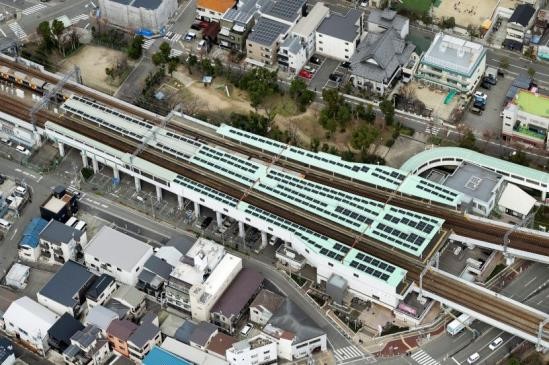
Stations, however, have limited surface area for on-site PV deployment. Even if panels cover the entire rooftop, the available area is insufficient to meet a large station’s entire electricity demand, and even then, only under optimal weather conditions. Nextgeneration solar cells such as PSCs, which can be fitted on walls could be useful in such circumstances, but their efficiency and overall capacity is still insufficient.
Meanwhile, railway tracks and large maintenance depots – including the JR East Shinkansen General Depot that spans 53 hectares – cover large areas that can’t be adequately supplied by on-site solar PVs alone. This creates a market oriented towards off-site PPAs, in addition to renewable assets owned by the JRs.
Among the largest agreements is the supply of the equivalent of 530 GWh of biomass NFCs annually to JR East under a virtual PPA signed with Osaka Gas. This covers about 12% of the company’s emissions. Other examples of rail operator-related PPAs of are shown below:
| Energy source | Start Year | Capacity (MW) | Supplier(s) | Utilization |
| Solar | 2026 | 98 | SPCs* backed by Tokyu | Supply power to Tokyu Railway lines |
| Solar | 2025 | 37.6 | Tohoku Electric, Mitsubishi HC Capital Energy, Kubota Main Store | Supply power to JR East Tohoku shinkansen |
Wind | 2024 | 18 | Cosmo Energy, TEPCO | Supply environmental value to Tokyo Metro’s Ginza line |
| Solar | 2027 | 8 | Kyushu Electric, Fuyo General Lease, Enbio HD, CRE | Supply power to JR Kyushu shinkansen on the Kagoshima route |
| Solar | 2025 | 3.8 | ENEOS, Hokkaido Electric | Supply power to trains Muroran, Chitose lines, and railway stations of JR Hokkaido |
From electricity buyers to market participants
Renewable electricity procurement is not the only way railway firms are expanding their involvement in the energy sector. Several are now moving into BESS and power trading, opening up new commercial opportunities beyond the core businesses.
JR Kyushu entered the BESS market in 2026 and JR Central announced it will start operating a project in 2028, both stations being high-voltage. JR East is also planning a co-located BESS project in the Tohoku region, while its subsidiary JR East Development is set to provide electricity trading services for an extra-high-voltage storage project in Hokkaido.
These initiatives are at an early stage but represent a notable shift. Rail operators are major electricity consumers with extensive physical infrastructure, land holdings and experience managing complex energy systems. BESS and trading could allow them to leverage these capabilities into new revenue streams, while also contributing assetbacked flexibility.
Energy efficiency: AI predictive maintenance tools
One natural path to reducing emissions for train operators is through using cleaner trains. This is particularly important for rural non-electrified lines, where diesel trains remain common and installing overhead electrical infrastructure can be prohibitively expensive for a low passenger volume.
JR East has been testing its HYBARI hydrogen fuel-cell hybrid train, which combines hydrogen fuel cells with batteries and regenerative braking. The company is targeting passenger service with a modified HYBARI train by the end of FY2027, followed by a next-generation hydrogen hybrid train around FY2030. Separately, JR Central is developing a hydrogen engine and fuel-cell hybrid systems, while JR Kyushu has introduced battery-powered trains and is testing renewable diesel fuels.
These technologies offer alternatives to conventional diesel traction, although their wider adoption will depend on costs, supporting infrastructure and, in the case of hydrogen, the carbon intensity of fuel production. Many factors lie outside of the rail operators’ control.
An area that the train operators can have more oversight over, however, is maintenance. There are several types:
- Corrective maintenance: repairing equipment after a failure occurs;
- Preventive maintenance: interventions at set intervals to lower risk of failure;
- Predictive maintenance: based on the actual condition of components or sections of railway infrastructure.
Given the long service life of rolling stock – with the most durable fleets in service for over 40 years – maintenance accounts for a sizable share of railway-related carbon emissions. It can be between 5% and 15%, depending on the railway line length and rolling stock type.
The growth of AI has opened up new possibilities for predictive maintenance. By helping optimize maintenance schedules and detect problems before they lead to equipment failures, AI can improve operational efficiency and potentially reduce energy use, unnecessary maintenance work and associated emissions.
In one example of predictive maintenance, Tokyo Metro installed cameras and sensors in 2026 to transmit data to an AI-powered platform designed to anticipate potential issues in electrical rooms and substations across its network.
Bigger networks and future opportunities
As Japan seeks to shift more passenger and freight traffic from roads to rail, improving the efficiency and profitability of existing railway networks will become more important. Major projects such as the Chuo shinkansen maglev line, connecting Tokyo and Nagoya in its first phase, and the Hokkaido shinkansen extension to Sapporo could expand rail’s appeal.
Elsewhere, particularly in suburban and rural areas, optimizing existing lines may be more realistic than building new ones. Freight transport offers further opportunities, encouraged by MLIT, although growth is constrained by terminal capacity, Japan’s mountainous geography and the cost of transporting goods between railway terminals and their final destinations.
Maintaining profitable rail operations will also be important for funding investments beyond transport, including new energy infrastructure. The JR companies have a potential advantage: extensive customer networks and relationships with businesses and communities along their routes. If they can translate these client networks into new energy services, opportunities may open beyond BESS and generation assets and into aggregation, demand response, and more.
ASIA ENERGY REVIEW
BY JOHN VAROLI
A brief overview of the region’s main energy events from the past week
Australia / Natural gas
Natural gas power generation on the main grid fell to its lowest Q3 average in 25 years. A surge in battery capacity reduced fossil fuel demand. Average Jan 1 to Sept 30 generation from gas in the National Electricity Market was 881 MW, the lowest for a Q3 since 2000. Coal’s share of total output fell to 52.2%, while renewables supplied a record 44.3%.
Australia / Pumped storage
Australia’s largest renewable energy project will cost 11 times more than originally planned. A reassessment of the Snowy 2.0 pumped storage power station, a major expansion of the Snowy Mountains hydro project in New South Wales, said it will cost at least 22.2 billion AUD; the govt’s original estimate was 2 billion AUD.
China / Hydrogen
China accounts for over 70% of the world’s installed electrolysis capacity, according to the Hydrogen Council. Global installed capacity reached 4.5 GW, with China adding the majority of new capacity this year. China’s largest electrolysis projects exceed 500 MW, in contrast to Europe’s largest operating projects in the 20 MW to 50 MW range.
China / Oil & Gas
The National Energy Administration called on the country’s oil and gas firms to expand production capacity, speed up the creation of oil and gas reserve bases and be responsible for safeguarding national energy security.
India / Ammonia
India will convert a natural gas-fuelled ammonia plant to renewable-power, with capacity to produce about 1.1 Mt of green ammonia annually, backed by the Asian Development Bank.
India / Nuclear
India plans to lift nuclear capacity from 31 GW in 2040 to 170 GW in 2060, second to China, which will account for 77% of total global nuclear capacity additions by 2040, or 140 GW of the 180 GW expected to be added.
Indonesia / Grid
The Java-Madura-Bali grid can absorb only 3.2 GW of more than 12 GW in projected highvoltage data center demand from 2026 to 2030, forcing state utility PLN to accelerate grid upgrades as developers seek connections faster than substations can be built.
Singapore / Renewables
Keong Hong Holdings and Helios Photovoltaic (Malaysia) agreed to explore collaboration in renewable energy, solar, battery storage systems, data centers, etc.
South Korea / HVDC
Under a new CEO’s guidance, Taihan Cable & Solution plans to expand in the U.S. and EU by enhancing competitiveness in next-gen businesses such as HVDC and submarine cables.
South Korea / Renewables
Installed renewable-energy capacity surpassed coal-fired for the first time, reaching 41 GW on Oct 21, according to the Korea Power Exchange. Coal-fired capacity clocked 40.8 GW. Renewables now account for 25.4% of the country’s installed generation capacity, second only to LNG, at 46.8 GW.
Disclaimer
This communication has been prepared for information purposes only, is confidential and may be legally privileged. This is a subscription-only service and is directed at those who have expressly asked K.K. Yuri Group or one of its representatives to be added to the mailing list. This document may not be onwardly circulated or reproduced without prior written consent from Yuri Group, which retains all copyright to the content of this report.
Yuri Group is not registered as an investment advisor in any jurisdiction. Our research and all the content express our opinions, which are generally based on available public information, field studies and own analysis. Content is limited to general comment upon general political, economic and market issues, asset classes and types of investments. The report and all of its content does not constitute a recommendation or solicitation to buy, sell, subscribe for or underwrite any product or physical commodity, or a financial instrument.
The information contained in this report is obtained from sources believed to be reliable and in good faith. No representation or warranty is made that it is accurate or complete. Opinions and views expressed are subject to change without notice, as are prices and availability, which are indicative only. There is no obligation to notify recipients of any changes to this data or to do so in the future. No responsibility is accepted for the use of or reliance on the information provided. In no circumstances will Yuri Group be liable for any indirect or direct loss, or consequential loss or damages arising from the use of, any inability to use, or any inaccuracy in the information.
K.K. Yuri Group: Hulic Ochanomizu Bldg. 3F, 2-3-11, Surugadai, Kanda, Chiyoda-ku, Tokyo, Japan, 101-0062.