
WEEKLY
November 2, 2026
ANALYSIS
SURVIVAL OF THE FITTEST: ELECTRICITY RETAIL MARKET FACES A NEW SHAKEOUT
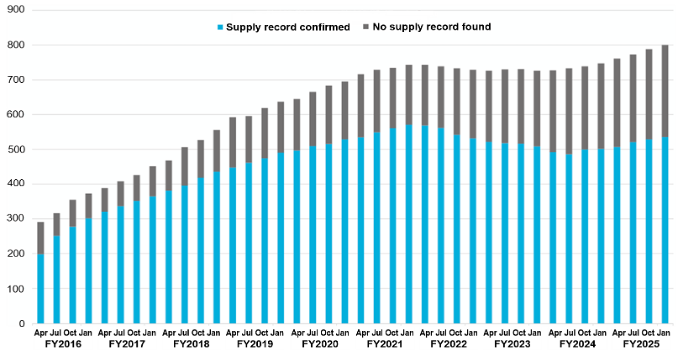
- Japan may be approaching a turning point in electricity retailing. Over 800 businesses hold retail electricity registrations, but about 250 have no confirmed electricity supply record.
- The government has threatened to withdraw registrations from businesses that remain inactive without justification.
- Also, competition is shifting toward companies with the financial strength and trading capabilities to operate across complex electricity markets.
- The result is likely to be a decline in the number of registered retailers.
ASIA PACIFIC REVIEW
This column provides a brief overview of the region’s main energy events from the past week
NEWS
- Japan to use ¥1.1 trillion of reserves for gasoline subsidies; Daily spending exceeds ¥10 billion
- IEEJ sees rising power demand reshaping global energy security
- IEA’s Birol sees no return to pre-war energy markets in 2027
- Chubu Electric faces record loss after ¥380 bln Hamaoka writedown
- Balancing market bid shortages ease, but regional gaps persist
- OCCTO seeks to fill capacity gaps left by dispatchable resource exits
- Household power bills for Nov reach record highs
- JERA agrees on green ammonia supply from India
- Japan consortium develops ammonia supply chain for shipping
- METI, Germany sign clean hydrogen declaration
- Govt backs PSC scale-up with subsidies and rule changes
- Stationary battery market seen at ¥15 trln by 2045
- Omron, Tokyo Century expand low-voltage solar/BESS tie-up
WIND POWER AND OTHER RENEWABLES
- Tokyo Century, Egg Power invest in UK wind, solar
- METI, Siemens Energy cooperate on floating offshore wind
- METI readies business improvement order for Chubu
- Chubu Electric concludes Hamaoka decommissioning investigation
- NRA tightens safety-review document requirements
- Japan set to take LNG import crown from China
- Kyushu Electric inks LNG supply deal with Canada
- September oil, LNG and coal imports show mixed trends
CARBON CAPTURE & SYNTHETIC FUELS
- New KEPCO coal transport ship cuts CO2 emissions
- INPEX launches shipboard CO2 capture demo
EVENTS
Nov 2-5 ADIPEC 2026 @ Abu Dhabi
Nov 3 U.S. Midterm Elections
Nov 7 New Zealand General Election
Nov 9-20 COP31 @ Antalya, Türkiye
Nov 18-19 Asia-Pacific Economic Cooperation – Leaders Meeting @ Shenzhen, China
Nov 28 Taiwan Local Elections
Dec 1-3 DeCarbon Tokyo 2026 @ Tokyo Marriott Hotel
Dec 14-15 G20 Summit @ Miami
PUBLISHER
K. K. Yuri Group
Editorial Team
Yuriy Humber (Chief Editor)
John Varoli (Senior Editor, Americas)
Kyoko Fukuda (Data, Events)
Filippo Pedretti (Thermal, CCS, Nuclear)
Tetsuji Tomita (Power Market, Hydrogen)
Aglaé Bange (Renewables, Biomass & Energy Storage)
Gillian Sawyer (Renewables)
George Hoffman (Sales, Business Development)
Rada Kuznetsova (Clients Accounts, Website)
Tim Young (Design)
SUBSCRIPTIONS & ADVERTISING
Japan NRG offers individual, corporate and academic subscription plans. Basic details are our website or write to subscriptions@japan-nrg.com
For marketing, advertising, or collaboration opportunities, contact sales@japan-nrg.com. For all other inquiries, write to info@japan-nrg.com
NEWS: GENERAL OUTLOOK AND TRENDS

Japan to use ¥1.1 trillion of reserves for gasoline subsidies
(Mainichi, Nikkei, October 29-30)
- The Cabinet has approved about ¥1.15 trillion from the government’s Middle East contingency reserve, mostly to replenish the fund used to cap retail fuel prices.
- The decision came a day after PM Takaichi pledged to continue subsidies for gasoline and other fuels, while gradually reducing them amid concern about the costs.
- The subsidies currently aim to keep regular gasoline at around ¥170/ liter. Without support, prices would exceed ¥220/ liter.
- From December, the government will raise the benchmark gasoline price by ¥5/ liter each month toward spring, gradually reducing subsidy payments.
- The gasoline subsidy is now costing more than ¥10 billion per day, with the subsidy rate at a record ¥52.4/ liter. More than ¥1.2 trillion was paid to refiners between the scheme’s March restart and end-September.
- CONTEXT: The FY2026 supplementary budget established a ¥2.5 trillion contingency reserve for the Middle East crisis. After an earlier ¥616 billion allocation in September and the latest ¥1.15 trillion draw, about ¥735.8 billion remains.
- TAKEAWAY: Cumulative fuel-price support since 2022 is approaching ¥10 trillion, making the current scheme increasingly difficult to sustain while oil prices remain high. The government is therefore beginning to unwind gasoline support while shifting near-term relief toward electricity and gas bills over the winter.
IEEJ sees rising power demand reshaping global energy security through 2050
(Organization statement, October 23)
- The Institute of Energy Economics, Japan (IEEJ) released its 2027 outlook, examining global energy supply-demand through 2050 and the broadening challenges around energy security.
- In its reference scenario, global primary energy consumption rises 12% from 2024 to 2050, while the advanced technologies scenario sees a 7% decline.
- Electricity’s share of final energy consumption rises from 24% in 2024 to 35% in 2050 under the reference case and to 47% under the advanced technologies case. The 35% level by 2035 is seen as challenging.
- In the advanced technologies scenario, global electricity generation reaches about 1.8 times the 2024 level by 2050, supported by data center growth, industrial expansion, and heating and cooling demand.
- Oil and natural gas remain major energy sources under the reference case, while coal use declines but remains substantial. IEEJ also highlights growing renewable curtailment in China and continued oil-import dependence in Indonesia.
- Energy security concerns are intensifying and measures are needed such as:
- Strengthen Asia’s fossil fuel security via supply diversification, infrastructure investment, demand reduction, and flexible LNG markets;
- Invest in generation and grids, flexible demand, and fair cost allocation to support DC growth;
- Diversify supply chains, build domestic manufacturing, equipment recycling, and stronger cybersecurity to balance cost competitiveness with international cooperation in order to grow renewables resources.
- CONTEXT: The IEEJ publishes its global energy supply-demand outlook every October using its own energy-economic model. This year’s outlook places greater emphasis on how geopolitical risks, power demand growth and supply-chain vulnerabilities are broadening the concept of energy security.
- TAKEAWAY: A key issue in this year’s outlook is assessing the impact of war in the Middle East. The 2026 outlook reinforces a shift in energy-security thinking from securing fuels alone toward securing electricity systems, grids, equipment supply chains and flexible demand as electrification accelerates. It also provides an early benchmark ahead of the IEA’s annual World Energy Outlook.
- SIDE DEVELOPMENT:
- IEA’s Birol does not expect energy markets to return to pre-war levels in 2027
- (Reuters, October 26)
- The head of the International Energy Agency does not expect energy markets in 2027 to return to pre-U.S./Iran war levels.
- “I don’t see any credible pathway that the markets will go next year, where we were before this war started,” said IEA Executive Director Fatih Birol at Singapore International Energy Week.
- “We all need to get prepared, taking energy security as a number one priority.”
- “Oil prices are flirting with $120 a barrel and the prices for products are even much higher.”
- “We are facing a tough winter because European countries decided to cut gas imports from Russia and with the additional problem now rising from the Iran war, namely Qatar and the Emirates not being able to export gas as they were before.”
- Birol expects a “strong comeback” for the nuclear sector as a result of the crisis.
- The IEA’s recent survey showed that 90 GW of nuclear power plants are under construction and this is the highest in the last four decades, he added.
Fujikura to join forces with Proxima Fusion for superconducting wire factory
(Company statement, October 29)
- Fujikura signed a MoU with German fusion startup Proxima Fusion on the feasibility of building a superconducting wire factory in Europe. They will assess the viability of building and operating the facility.
- Fujikura produces superconducting wire at its plant in Chiba Pref.
- CONTEXT: Superconducting wire conducts electricity with zero resistance below critical temperatures. It is an important component for fusion reactors. Proxima forecasts a need for 20,000 km of wire for its demo reactor and 40,000 km for a commercial power plant, necessitating a reliable, high-volume supply.
NEWS: ELECTRICITY MARKETS

Chubu Electric faces record loss after ¥380 bln Hamaoka writedown
(Company statement, October 29)
- Chubu Electric expects extraordinary losses of about ¥380 billion ($2.4 billion) in FY2026 due to uncertainty over the future of its Hamaoka NPP.
- Chubu Electric revised its FY2026 earnings forecast from a ¥160 billion net profit to a ¥215 billion net loss, potentially its largest on record. Its operating outlook also deteriorated, with the ordinary profit forecast cut from ¥185 billion to ¥110 billion.
- The utility already recognized ¥305 billion in impairment losses on nuclear-related fixed assets and ¥65 billion in nuclear fuel valuation losses; further writedowns are expected in the second half.
- In September, Chubu Electric withdrew restart applications for Hamaoka Units 3 and 4 following revelations that seismic assessment data was manipulated. The scandal raises uncertainty over the restart and the cost of additional safety measures.
- New Chubu Electric President Yasui stressed that the writedowns are an accounting decision and do not mean Hamaoka will be decommissioned. The utility continues to regard nuclear power as important for energy security and decarbonization.
- TAKEAWAY: The impairment highlights the financial consequences of the Hamaoka scandal. While Chubu Electric hasn’t abandoned plans for a restart, it’s currently hard to see how nuclear investments could be recovered through future electricity sales. Prolonged uncertainty complicates the utility’s efforts to improve capital efficiency under its upcoming medium-term management plan, for which the date of release remains uncertain.
OCCTO published autumn report on electricity supply-demand
(Agency statement, October 28)
- OCCTO published a final review on electricity supply and demand, covering the FY2026 summer actuals and the FY2026 winter forecasts.
- The FY2026 summer results:
- On July 22, national peak demand reached 164.22 GW, exceeding the previous year’s level and ranking the second highest in five years.
- The nationwide reserve margin was 6.9% at peak demand and 5.6% during the evening minimum, ensuring stable supply.
- Peak demand exceeded the severe-weather forecast in four areas (Chubu, Chugoku, Shikoku, and Kyushu), due to high temperatures later in July.
- The FY2026 winter forecast:
- All areas are expected to achieve the minimum 3% reserve margin under severe-weather demand assumptions, supported by dispatchable power sources, increased thermal output, and interregional power transfers.
- But, during the first half of January, reserve margins in several areas are projected to be tight, declining to 4.5%.
- Additional capacity will be secured from the capacity market to cover supply fluctuations caused by unexpected generator outages and other factors.
- OCCTO will monitor winter kW and kWh balances, coordinate additional measures with the government and utilities, and issue public alerts when supply-demand tightness is anticipated.
- CONTEXT: Twice a year, in May and October, OCCTO publishes a Verification of Electricity Supply and Demand report. The October edition reviews the previous summer and forecasts the upcoming winter. The May edition does the opposite. The report serves as a basis for considering measures to ensure stable electricity supply during peak summer and winter periods.
- TAKEAWAY: According to the Japan Meteorological Agency’s winter weather outlook, the winter of FY2026 (Dec 2026–Feb 2027) is likely to be warmer than average nationwide due to the continuation of El Niño conditions. This is expected to reduce both peak demand (kW) and consumption (kWh), easing supply-demand conditions. However, temporary cold spells and heavy snowfall remain as risks. In particular, supply-demand balances will be tight in January, warranting continued attention even under warmer-than-average conditions.
- SIDE DEVELOPMENT:
- Balancing market bid shortages ease, but regional gaps persist
- (Agency statement, October 26)
- OCCTO reviewed H1 FY2026 balancing market performance and the key issues for H2 and beyond.
- Bid volumes increased overall following measures introduced this fiscal year, including dayahead trading for composite products and 30-minute trading intervals. Shortfalls eased across most products from June, although regional shortages remain.
- Further reforms will focus on wider cross-regional procurement, optimized procurement volumes, relaxed primary reserve requirements, greater renewable participation and other measures to increase bidding.
- OCCTO also reviewed primary reserve participation rules, including technical requirements and eligibility for offline resources such as batteries.
- CONTEXT: Since the balancing market’s full launch in April 2024, insufficient bids and cleared volumes relative to procurement requirements have been a recurring problem. OCCTO says the FY2026 reforms have increased bids, but have not yet eliminated shortages across all products.
- TAKEAWAY: The FY2026 reforms appear to be improving liquidity, but OCCTO is still widening access and procurement options to make the market more competitive and reduce reliance on scarce regional resources.
OCCTO seeks to fill capacity gaps left by dispatchable resource exits
(Agency statement, October 22)
- OCCTO outlined measures to address capacity lost due to the market exit of dispatchable resources (発動指令電源) including demand response (DR), and expand participation opportunities in the capacity market.
- The measure would allocate capacity to eligible dispatchable power resources up to the volume withdrawn from the main auction when no procurement auction is held.
- Key design features are as follows:
- Capacity limit: Capped at the withdrawn capacity of dispatchable power awarded in the main auction, as determined in April of the previous year.
- Contract price: Main auction area price.
- Allocation: Priority to resources with higher effectiveness-test achievement rates.
- Conditions: Applied only if no procurement or release auction is held.
- Framework: Classified as an existing procurement auction type for early implementation.
- Timeline: Targeted for the next additional auction for FY2028 delivery year.
- CONTEXT: Dispatchable resources bid into the main auction four years before delivery based partly on capacity they expect to secure later. Some subsequently fail to secure enough underlying resources by the effectiveness test and exit the market. Because their original awards may have displaced other eligible resources, OCCTO wants to give those resources another opportunity to contract closer to the delivery year when no procurement auction is held.
- TAKEAWAY: The measure would allow capacity becoming available closer to delivery to replace dispatchable resources that previously cleared the main auction but later exited. The replacement volume would be capped at the withdrawn capacity, avoiding additional procurement beyond the original award.
- SIDE DEVELOPMENT:
- OCCTO makes capacity tests more flexible for dispatchable resources
- (Agency statement, October 22)
- OCCTO reviewed the implementation requirements for the current effectiveness test of dispatchable power sources in the capacity market.
- To ensure fairness and reduce operational burden, these requirements will be revised:
- Timing: Weekdays before and after the Obon and New Year holiday periods will be excluded from the test dates, as designated by OCCTO.
- Number of tests: A maximum of two test opportunities will be allowed, in summer or winter. Any retest must be held in the same period as the initial test.
- Alternative reporting: Actual dispatch records may be used without a complete match between test and dispatch resource lists. Alternative reporting is allowed even below a 100% achievement rate, but missing resource-level records and non-matching dispatches count as zero.
- The revisions will apply to FY2027 effectiveness tests for FY2029 delivery, with updates to the operational manual and capacity commitment contract terms.
- CONTEXT: The effectiveness test verifies whether dispatchable power sources can deliver the committed capacity when instructed. Held two years before the delivery year, the test assesses whether resources can provide the required capacity for three consecutive hours, helping ensure reliable capacity procurement. The FY2025 review of the capacity market (March 2026) identified concerns for the alignment of effectiveness tests with their intended purpose and the operational burden.
- TAKEAWAY: The revisions seek to better align capacity accreditation with actual deliverable supply capacity, balancing fair assessment and operational flexibility against the need to maintain reliable capacity during periods of tight supply-demand conditions.
Household electricity bills for Nov reach record highs
(Nikkei, October 29)
- Household electricity bills for Nov usage (billed in Dec) will reach record highs for seven of the ten major power utilities. This will be the second consecutive month of peak rates.
- TEPCO’s standard household bill will rise by ¥177 from October to a record ¥9,738. Record highs also relate to the Tohoku, Chubu, Hokuriku, Chugoku, Shikoku, and Okinawa service areas.
- Rising LNG costs have pushed up generation costs since June.
- CONTEXT: Govt relief programs shielded households from price spikes during the peak summer months (July–Sept). The end of those subsidies last month amplified the financial impact on consumers. On Oct 28, the ruling LDP submitted a proposal urging the govt to reinstate utility subsidies.
Tokyo Century becomes electricity aggregator
(Company statement, October 26)
- Tokyo Century (TC) officially entered the electricity aggregation business as part of its 2030 strategy. Previously, the company relied on an external aggregator, Tensor Energy, for its co-located projects in Kyushu.
- TC now aims to handle aggregation in-house, starting with assets in Tohoku.
- After gaining experience, the firm plans to offer aggregation services and market the environmental value from solar power and BESS. As an electricity retailer, it also aims to supply electricity generated by low-voltage BESS through off-site PPAs.
- TAKEAWAY: Tokyo Century’s entry into this market shows why BESS asset owners choose to bring aggregation in-house. By managing aggregation internally, they optimize electricity trading activities and reduce costs associated with outsourcing these services. This trend is likely to gain traction, particularly among owners of large portfolios of energy assets, those with at least 10 units, whose revenues could be sufficient to internalize aggregation.
Idemitsu’s VC arm invests in U.S. firm developing power generation with aluminum
(Company statement, October 26)
- Idemitsu Corporate Venture Capital invested in Voya Energy (U.S.), which aims to develop a carbonneutral electricity generation system powered by aluminum pellets.
- The system generates electricity by reacting aluminum with oxygen and water, using Voya’s proprietary electrolyte and system design. It produces no CO2 during generation and is designed for quiet operation.
- The aluminum pellets are made from scrap aluminum, easy to transport and store. Aluminum hydroxide, a by-product of the process, is intended to be sold as a raw material for aluminum-based products.
- Voya Energy is targeting data centers and factories, aiming to replace diesel-powered backup generators and other power systems with its technology.
- TAKEAWAY: Aluminum’s high energy density, recyclability and ease of storage could make it an attractive energy carrier for distributed backup power. Voya also ultimately aims to regenerate aluminum from the process by-product using low-cost renewable electricity, creating a closed-loop energy system. Voya Energy’s 2-MW system, housed in a container, is expected to be commercialized at scale in 2028.
NEWS: HYDROGEN

JERA and Indian firm agree on green ammonia supply to Japan
(Company statement, October 27)
- JERA and India’s AM Green agreed for the supply of about 70,000 tons of green ammonia annually to Japan for five years, with an option to extend.
- Production at AM Green’s plant in Andhra Pradesh begins in 2028-2029.
- Using facilities near Hekinan Thermal Power Station as a distribution hub, green ammonia will be supplied as fuel for car carriers, mostly via an ammonia bunkering JV set up by K Line and NYK Line.
- The deal supports the development of Japan’s low-carbon ammonia supply chain and strengthens India’s role as a green ammonia supplier.
- CONTEXT: AM Green Group is developing large-scale green ammonia projects across India, targeting 5 Mtpa of capacity. When built, its Kakinada plant (1 Mtpa) will be one of the world’s largest green ammonia facilities.
- TAKEAWAY: India is re-emerging as an important prospective source of green ammonia for Japan, helped by low-cost renewable power and strengthening bilateral energy ties. JERA agreed in 2024 to jointly develop a 100,000 t/year project with ReNew, although that proposal has not visibly progressed to a firm supply contract.
Momentum has since picked up: IHI’s planned supply from ACME received Japanese price-gap support (CfD) in June, while the latest AM Green agreement gives JERA a binding route to procure Indian green ammonia for maritime use. The trend also fits the closer energy-security relationship promoted during PM Takaichi’s India visit in July.
Consortium to develop ammonia supply chain to decarbonize international shipping
(Company statement, October 27)
- Seven firms – Imabari Shipbuilding, K Line, Kyokuyo Shipyard, JERA, Shin Kurushima Dockyard, NYK, and Nihon Shipyard – agreed to develop an ammonia fuel supply chain in the Chubu region.
- This project will include procuring green ammonia, developing loading facilities, building a dedicated bunkering vessel for ship-to-ship fuel transfers, and building and operating four ammoniafueled car carriers.
- JERA will procure green ammonia, including from India, and install loading facilities at the Hekinan terminal to supply bunkering vessels.
- Shin Kurushima Dockyard, Imabari Shipbuilding, and Nihon Shipyard will design and build Japan’s first ammonia-fueled car carriers equipped with dual-fuel engines.
- K Line and NYK will each introduce two ammonia-fueled car carriers, for a total of four vessels. Scheduled for completion in 2030, the vessels will transport finished vehicles for customers, including Toyota Motor.
- Kyokuyo Shipyard will build the ammonia bunkering vessel, to be completed in 2030. NYK will own and operate the vessel.
- CONTEXT: JERA is developing a low-carbon ammonia value chain for use in fuel at the Hekinan thermal station and for supply to other companies. K Line and NYK are working to transition to nextgen fuels to achieve net-zero emissions by 2050.
- TAKEAWAY: JERA is beginning to position Hekinan as a multi-grade ammonia hub rather than a single-purpose power-sector import terminal. The likely early balance will be volume from blue ammonia and lower-carbon intensity from the smaller green-ammonia supply. As a quick reminder: JERA plans to import about 500,000 t/ year from the U.S. Blue Point project, which compares with just 70,000 t/ year under its new Indian green ammonia agreement (see item above). The two inputs allow JERA to spread infrastructure costs across power generation, industry, and shipping while offering customers different combinations of price and carbon intensity.
- SIDE DEVELOPMENT:
- Japan Engine wins order for ammonia-fueled engines for car carriers
- (Company statement, October 29)
- Japan Engine won an order for four domestically developed ammonia-fueled main engines for four car carriers to be built and operated by a seven-firm consortium.
- CONTEXT: In August 2025, Japan Engine completed the world’s first full-scale, fully Japanese-developed ammonia-fueled engine. It was installed on a medium gas carrier being built by Japan Marine United for NYK.
METI and Germany sign clean hydrogen declaration
(Government statement, October 29)
- METI signed a declaration of intent with Germany’s Federal Ministry for Economic Affairs and Energy for clean hydrogen and its derivatives.
- Collaboration between Japan and Germany will be centered on production, storage, transportation, distribution, trade, and utilization of clean hydrogen products.
- CONTEXT: Germany and Japan have a history of collaboration in hydrogen, including an MoU for a Japan-Germany hydrogen supply chain between KHI, Toyota, Kansai Electric, Daimler Truck, and Hamburger Hafen und Logistik AG.
Green hydrogen and CPPA to help fuel Shinagawa Intercity
(Company statement, October 23)
- Nippon Steel Kowa Real Estate, Obayashi, and Sumitomo Life will cooperate on renewable energy at Shinagawa Intercity via a corporate PPA.
- The offsite physical CPPA will supply Shinagawa Intercity with renewable electricity from solar facilities through the grid, while a separate rooftop solar system will be used to produce green hydrogen.
- The project also envisages roof-based solar panels to produce green hydrogen that will be stored in a hydrogen-absorbing alloy.
- CONTEXT: The three firms jointly own and manage Shinagawa Intercity, a large-scale, mixed-use urban development complex that serves as a hub for business and culture. Nippon Steel Kowa Real Estate spearheads the Intercity series of sustainability-focused urban development projects; Obayashi has its main offices in the complex, and Sumitomo Life has a leasing office there.
- TAKEAWAY: Implementation of the physical PPA allows the project to combine the provision of electricity and environmental value. Also, by producing and storing hydrogen from onsite solar power and later using it for fuel-cell generation, the system can help manage the time difference between solar generation and electricity demand.
Nikkiso announces next-gen pump for hydrogen stations
(Company statement, October 26)
- Clean Energy & Industrial Gases Group, a subsidiary of industrial manufacturer Nikkiso, announced P2KHF, a next-gen reciprocating pump as a solution for the high boil-off gas rate at hydrogen stations.
- In demos at hydrogen stations in California, P2KHF showed the ability to transfer liquified hydrogen with less than 1% loss; each pump could save up to $150,000 worth of hydrogen per year.
- CONTEXT: Pump discharge piping is one of the main points for loss of liquefied hydrogen.
- TAKEAWAY: Demand for hydrogen fuel for large-size and heavy vehicles has increased in recent years in light of the strengthening of emissions regulations and incentive systems in transportation. However, because liquefied hydrogen must be managed at extremely low temperatures, developing storage mechanisms, as well as measures for vaporization from outside heat, is a challenge. Efforts to improve pump technology can increase hydrogen fuels’ efficiency and retention, and improve its competitiveness with traditional fuels.
NEWS: SOLAR AND BATTERIES

Govt to provide billions in subsidies, change regulations to scale up PSC production
(Nikkei, October 26)
- The govt will provide ¥100 billion in subsidies over the next four years to Ricoh and Choshu Industry to scale up PSC production.
- Ricoh is developing inkjet printing technology to reduce production costs of film-type PSCs compared with conventional laser-based methods. Choshu Industry, which has so far focused on silicon PVs, plans to begin producing about 100 MW of tandem silicon/PSC modules annually, starting next year.
- CONTEXT: Ricoh and Choshu Industry would broaden Japan’s emerging PSC manufacturing base. Sekisui Chemical is developing film-type PSCs and moving toward GW-scale mass production, while Panasonic is developing glass-based modules (due for commercialization around 2029); tandem PSC/silicon technology is also being pursued by several Japanese manufacturers.
- To support the expansion of domestic PSC production, the govt plans to introduce the following regulatory changes:
- A new regulatory framework to revise the requirement that at least 25% of industrial sites be dedicated to green facilities. The new rules would allow compliance to be assessed based on the visible surface area of installations when viewed from the front, rather than from above, enabling wall-mounted PSCs to qualify.
- The Fire and Disaster Agency plans to revise guidelines to allow PSCs to be installed at gas stations and automotive plants without protective cover glass.
- CONTEXT: Protective cover glass adds weight and rigidity, undermining one of the main advantages of film-type PSCs: their ability to be installed on walls, curved surfaces and other locations unsuitable for conventional silicon panels. Govt rule changes are therefore aimed at preserving that lightweight flexibility while expanding eligible installation sites.
- TAKEAWAY: These measures reflect the govt’s approach to support all three types of PSCs by substantial investment in the technology. It is also covering both production subsidies and regulatory changes, which are designed to create domestic demand. Rather than restricting Chinese imports, Japan is trying to build a competitive domestic supply chain around its strengths in materials, manufacturing technology and iodine supply. Export potential will become a more important question as domestic production scales and PSC deployment broadens.
Global stationary battery market seen reaching ¥15 trillion by 2045
(Company statement, October 22)
- Fuji Keizai forecasts the global battery market for stationary energy storage systems will reach ¥15.08 trillion in 2045, 3.7 times its 2025 size, driven primarily by grid-connected and renewablelinked storage.
- Battery manufacturers are increasing their focus on stationary storage as growth in the xEV market slows, while improving electricity-market frameworks are creating more revenue opportunities for grid-scale BESS.
- Grid and renewable-linked systems currently account for more than 60% of the market and are expected to retain a large share as renewable deployment increases demand for flexibility and grid stabilization.
- Residential demand is also expanding as higher electricity prices increase the value of solar selfconsumption, while resilience needs and greater use of batteries in DR and VPP programs provide additional support.
- Data center expansion is driving rapid growth in UPS batteries, including demand for larger systems. In Japan, demand for UPS units above 1,000 kVA is increasing, with some installations reaching the 2,000 kVA class.
- Lithium-ion batteries currently account for around 90% of the grid-scale storage segment, but sodium-ion batteries are expected to gain share as costs fall, while redox flow batteries benefit from safety and long operating life.
- CONTEXT: The study covers lithium-ion, lead-acid, sodium-ion and redox flow batteries, as well as EDLCs and lithium-ion capacitors. It examines grid and renewable-linked storage, residential and commercial systems, and UPS/base-station applications across Japan and major overseas markets.
Omron agrees with Tokyo Century on FIT-linked low-voltage power sales
(Company statement, October 28)
- Omron Social Solutions agreed with Tokyo Century to offer a service selling FIT electricity generated by low-voltage solar assets, aiming to reduce power generation losses through the use of BESS.
- Omron Social Solutions will handle electricity aggregation, while Tokyo Century will leverage its investment and financing capabilities to enable electricity companies to introduce the service for a limited initial cost.
- CONTEXT: The two firms made a similar deal in 2024 for the sale of electricity from high-voltage solar assets. Their collaboration now extends to the low-voltage BESS segment, following the entry of these systems into electricity markets.
NEWS: WIND POWER AND OTHER RENEWABLES

Tokyo Century and Egg Power to invest in onshore wind and solar in the UK
(Company statement, October 29)
- Tokyo Century will acquire 50% of shares in Egg Power Finance through a joint investment in solar and onshore wind projects in the UK with Egg Power Holdings, a subsidiary of European telecom firm Liberty Global.
- Tokyo Century will participate in the operation of the 52 MW Rag Lane solar power plant and the construction of the 70 MW Grange solar power plant and the 90 MW Chirmorie onshore wind power plant, totaling 212 MW of power generation.
- Rag Lane began operations this year; Grange is expected to begin commercial operation in 2027, and commercial operation at Chirmorie is planned for 2028.
- CONTEXT: Tokyo Century stated overseas renewable energy projects as an area of focus for development through 2030, and has been investing in solar and onshore wind power plants in the UK and Italy.
- TAKEAWAY: The investment fits Tokyo Century’s emerging model for overseas renewables: taking minority stakes alongside experienced local partners, entering projects during development or early operation, and building a pipeline that can later generate both operating income and asset-recycling gains. The UK is becoming one of its main platforms for this strategy, with investments now spanning operating wind and solar assets as well as projects still under construction.
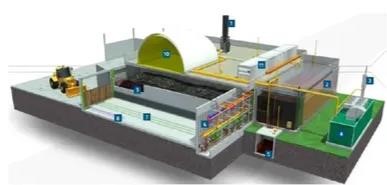
Dry batch methane fermentation plant starts operation
(Company statement, October 21)
- Konoike Construction opened its methane fermentation plant in Shizuoka Pref to process dairy cow manure and other organic waste using a dry-batch process.
- Located on Fuji Biotech’s agricultural product processing facility, the plant will produce biogas to fuel heat and power generation systems.
- CONTEXT: Unlike wet fermentation processes, which require wastewater treatment and may involve pretreatment equipment, dry-batch fermentation does not require wastewater treatment facilities. Raw materials with relatively low moisture content are loaded into the fermentation tank in batches with the digestate being recycled.
- The fermentation equipment was supplied by BEKON (Germany).
- TAKEAWAY: Anaerobic digestion systems can be classified into three types: wet, dry-batch and continuous dry processes. Biogas fermentation plants in Japan use the wet process. While this facility could open up a small market for dry fermentation technology in Japan, other foreign companies are reluctant to enter this segment, as the available feedstocks are not well suited to the process. Cow manure contains methanogenic bacteria that need to circulate throughout the material, which dry fermentation does not allow. Besides, dry fermentation systems involve higher equipment costs.
METI and Siemens Energy sign MoC to develop floating offshore wind
(Government statement, October 29)
- Siemens Energy inked an MoC with METI to strengthen development of floating offshore wind projects, supply chain, and human resource development in Japan.
- Siemens Energy will set up an O&M hub in Hokkaido.
- CONTEXT: The goal is to form a local supply chain in Hokkaido. For example, turbines will be manufactured in Muroran City, and regular equipment inspections and emergency response will operate out of the Siemens Energy facility.
Vestas and Akita ink MoU for wind power personnel training
(Company statement, October 29)
- Akita Pref, Vestas, and the Nagasaki Marine Industry Cluster Promotion Association inked an MoU to study developing highly-skilled personnel training for Japan’s wind power generation industry.
- Under the MoU, the parties will research launching a program focused on technical and safety training, regional cooperation, provision of programs in Japanese, and industry-academia collaboration.
- CONTEXT: Developing highly-skilled personnel is a critical challenge in the wind power industry. There is a dire need for a sizable reserve of wind farm workers that can support the stable, long-term operation of facilities.
NEWS: NUCLEAR ENERGY

METI readies business improvement order to Chubu Electric
(Nikkei, October 29)
- This month, METI plans to issue a business improvement order to Chubu Electric, following procedural irregularities and misconduct at Hamaoka NPP.
- METI determined that fundamental organizational reform is essential. The utility must clarify executive accountability and overhaul its compliance framework and establish a new management governance system.
- Also, internal whistleblowing and operational procedures must be improved.
- CONTEXT: The regulatory escalation follows a series of misconduct cases at Chubu Electric, most seriously the manipulation of seismic data submitted during NRA safety reviews for Hamaoka NPP Units 3 and 4. Separate irregularities were also uncovered in decommissioning work and cost claims for Units 1 and 2, while retail subsidiary Chubu Electric Power Miraiz faced an overcharging case. For more on this, see the Analysis section of Japan NRG’s Oct 5 issue.
- SIDE DEVELOPMENT:
- Chubu Electric concludes own investigation on improper procedures
- (Company statement, October 29)
- Chubu Electric announced the final results of an internal investigation on improper procedures during the decommissioning of Hamaoka NPP Units 1-2. The utility revealed fraudulent reporting and accounting from FY2024 into FY2025.
- Investigators also uncovered 16 cases of improper inspection and payment processing in FY2024 and eight in FY2025.
- Staff instructed contractors to adjust billing amounts to match plans of the Nuclear Decommissioning and Spent Fuel Reprocessing Organization of Japan. Other violations included reporting incomplete dismantling work as finished. Also, there were cases of logging fictitious usage records for dismantling machinery.
- SIDE DEVELOPMENT:
- Shizuoka court dismisses lawsuit against Hamaoka NPP
- (Nikkei, October 27)
- The Shizuoka District Court dismissed a 15-year lawsuit by residents seeking an injunction against the operation of Chubu Electric’s Hamaoka NPP Units 3-5.
- The judge ruled the dispute was “immature”, lacking legal grounds for an injunction because plans to restart the reactors are not yet defined.
- The plaintiffs plan to appeal the decision.
- CONTEXT: The court’s ruling follows Chubu Electric’s withdrawal last month of its restart application for Units 3 and 4 following revelations that the utility falsified seismic data. The court said this scandal raised serious doubts about Chubu Electric’s “technical competence”. A recent external investigation found that management did not order the data falsification but extreme demands on employees created an atmosphere that led to a breakdown in compliance.
NRA asks utilities to hold onto safety review documents
(Nikkei, Oct 27)
- The NRA will ask utilities to hold on to documents related to nuclear plant safety reviews and will impose penalties for violations and false applications.
- This measure is in reaction to Chubu Electric’s manipulation of seismic data at Hamaoka NPP. The NRA seeks to revise the Reactor Regulation Act during the 2027 ordinary Diet session to allow regulators to trace the calculation of safety data.
- The NRA will also introduce a system that allows companies to finish disaster impact assessments before designing facilities. This will avoid the current process of altering designs every time evaluations change during a review.
- Anti-terrorism measures will be approved earlier so they can be integrated during the design phase.
- A new independent administrative agency will be set up to take over certain govt duties and strengthen the country’s capability to handle IAEA nuclear inspections.
- CONTEXT: On Oct 28, the NRA confirmed Chubu Electric manipulated earthquake safety data during safety screenings for Hamaoka NPP. The NRA will continue investigating external contractors involved in data falsification. By late December, the NRA will decide on additional inspections.
KEPCO delays commercial operations of Ohi Unit 3
(Company statement, Japan NRG, October 29)
- Commercial operation of Ohi NPP Unit 3, operated by KEPCO, will start on Feb 16 2027, pushed back from its previous target of Jan 22, 2027.
- KEPCO said it needs extra time to complete construction work aimed at preventing a recurrence of equipment failure.
- CONTEXT: The reactor automatically shut down in August after a loss-of-excitation alarm. KEPCO found that conductive dust and brush fragments had accumulated around insulation in the generator exciter, causing a short circuit that damaged components.
NEWS: TRADITIONAL FUELS

Japan set to take LNG import crown from China
(Reuters, October 30)
- This year, China will likely cede its position as the world’s largest LNG importer to Japan as forecasts of a mild winter and the Middle East war curb demand.
- Consultancy ICIS expects Japan to come in at 62 million metric tons (Mt) and China at 61 Mt. Kpler expects 63 Mt and 62 Mt, respectively.
- CONTEXT: Demand in Japan is also falling, although more slowly, driven by the restart of several nuclear reactors in recent years. In 2025, China imported just under 70 Mt; Japan 67.4 Mt; South Korea 48.7 Mt; and India 24.6 Mt. LNG is super-chilled natural gas that’s transported on ocean-going vessels.
- TAKEAWAY: Japan and China have exchanged the title of world’s largest LNG importer several times since China first moved ahead in 2021: Japan regained the lead in 2022, before China retook it in 2023. China’s latest decline reflects both weaker underlying LNG demand and policy effects, including retaliatory tariffs that sharply curtailed U.S. LNG imports. Japan’s return to No. 1 would say as much about China’s reduced spot-market appetite as about Japan’s own demand, which has been stable in the past several years.
Kyushu Electric inks deal to buy LNG from Canada
(Company statement, October 28)
- Kyushu Electric agreed with a subsidiary of Mitsubishi Corp to buy 850,000 tons of LNG per year from LNG Canada in a 15-year deal, starting in the early 2030s.
- Kyushu Electric will get 12 shipments per year once the project’s planned expansion begins commercial operation.
- Mitsubishi is a 15% stakeholder in LNG Canada.
- CONTEXT: This is Kyushu Electric’s first LNG procurement from Canada. The utility imports LNG under long-term contracts from Australia, Russia, and Indonesia.
- TAKEAWAY: Canadian LNG has strong interest from Japanese buyers. Located on Canada’s west coast, the project has a 14 Mtpa capacity, eventually to double to 28 Mtpa. Also, it offers shorter shipping routes to Japan compared to the U.S. Gulf, while avoiding geopolitical chokepoints.
September Oil/ Gas/ Coal trade statistics
(Government data, October 28)
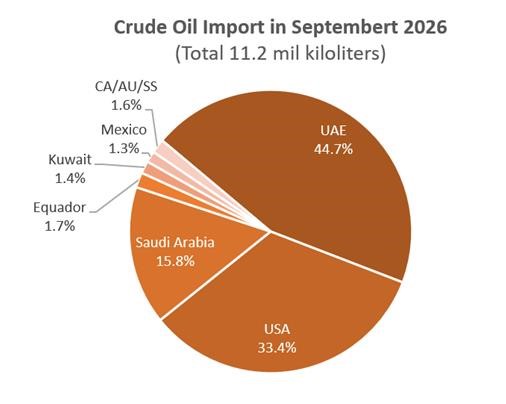
- In September, Japan imported 11.2 million kiloliters of crude oil, down 3.7% MoM, but up 3.1% YoY. For the past three months, total import volumes were almost back to the same level as in 2025. Only 62% of the total came from the Middle East: those from Saudi Arabia were down 57.9% MoM, but from UAE were up 72.8%; none came from Qatar and Oman.
- Imports from the U.S. were about the same as in August, and ranked #2. Very small volumes came from Canada, Australia, and South Sudan.
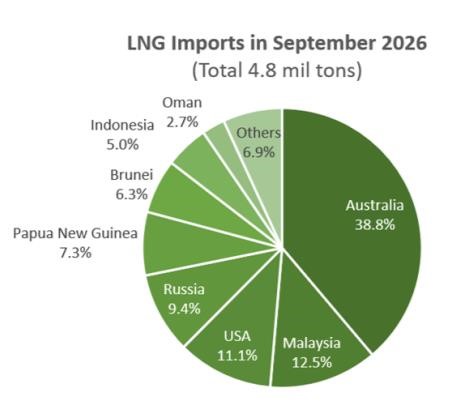
- LNG imports totaled 4.8 Mt, down 4.2% MoM and down 7.3% YoY. Imports from Russia were up 17.4%, but those from the U.S. were down 47.8%. Brunei’s volume increased almost 4.8 times over the previous month, but it did not have a big impact on the total. “Others” in the graph represent Canada, Equatorial Guinea, Trinidad & Tobago, UAE, and China. None came from Qatar this month.
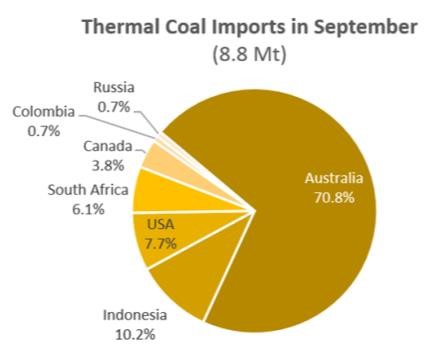
- September thermal coal imports were 8.8 Mt, down 2.7% MoM, but up 5.9% YoY. While imports from Australia and Indonesia were down 8.3% and 21.2%, respectively; those from the U.S. were up 182.6%, ranking as the third-largest supplier. September’s import value per ton was ¥22,704, down 4.9% MoM, but up 26.9% YoY. This high price directly impacts electricity bills.
LNG stocks down from previous week, up YoY
(Government data, October 28)
- As of Oct 25, the LNG stocks of 10 power utilities were 2.15 Mt; down 15% from the previous week (2.53 Mt); up 15% from end October 2025 (1.87 Mt), and up 2.4% from the 5-year average of 2.1 Mt.
NEWS: CARBON CAPTURE & SYNTHETIC FUELS

New KEPCO coal transport ship cuts CO2 emissions
(Company statement, October 28)
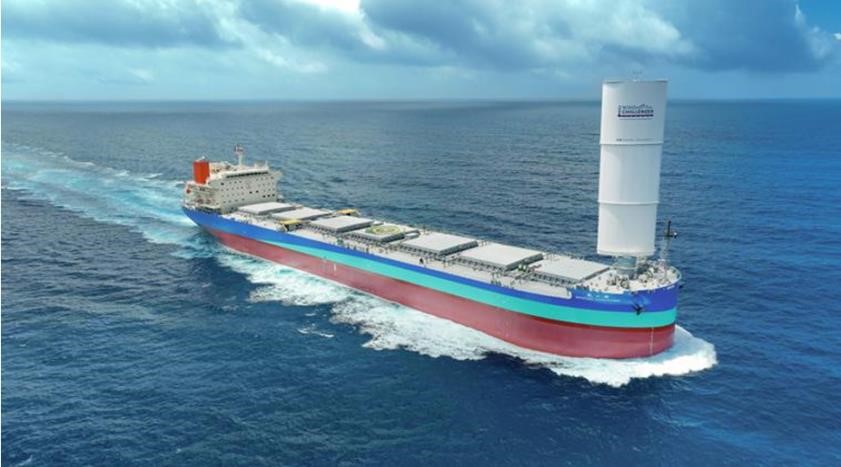
- KEPCO completed Maizuru Kazenomal, a new dedicated coal transport vessel designed to cut CO2 emissions by 30%.
- The builder is Oshima Shipbuilding and the operator is Mitsui O.S.K. Lines (MOL).
- The vessel will import coal from Australia and Indonesia for the Maizuru coal-fired power plant in Kyoto Pref.
- Unlike previous ships running on heavy oil, the vessel can run on LNG, reducing CO2 emissions by about 25%.
- It has rigid sails to harness wind power, generating an extra 5% to 8% in fuel savings.
INPEX launches demo to capture CO2 from maritime vessels
(Company statement, October 19)
- INPEX and Sumitomo Osaka Cement launched a demo of a calcium-looping system to capture CO2 from large vessels for underground storage.
- Captured CO2 is converted into calcium carbonate for transport, then separated again near the storage site, with the CO2 injected underground and the calcium compound recycled.
- CONTEXT: This demo expands INPEX’s commercial CCS initiatives to the maritime sector. INPEX is also doing exploratory drilling off the Chiba Pref coast to store emissions from the Keiyo Industrial Zone.
NX Shoji supplies HVO blend for Nagoya work vessel demo
(Company statement, October 26)
- NX Shoji, part of the Nippon Express group, launched a demo in Nagoya (Aichi Pref) using a dieselHVO blend to fuel the DCM8, a vessel operated by Tomac and owned by Toyo Construction.
- The demo aims to assess the efficiency of the fuel supply process for a vessel carrying out civil engineering works in Nagoya Port.
- TAKEAWAY: Demos on the use of HVO as a marine fuel have been conducted several times in Japan. The first trial dates back to 2022, when NYK Line tested 100% HVO in tugboats. Similar initiatives have since been carried out by other firms, as recently as 2026. As a drop-in fuel compatible with existing diesel engines, HVO could be used as a standalone fuel for vessels, rather than only as a blend with conventional diesel.
ANALYSIS
BY JAPAN NRG
Survival of the Fittest: Japan’s Electricity Retail Market Faces a New Shakeout
Japan may be approaching a turning point in electricity retailing. More than a decade after full liberalization, over 800 businesses hold retail electricity registrations, but about 250 have no confirmed electricity supply record. Some are genuinely dormant. Others entered the electricity business primarily to trade power, rather than compete for household or commercial customers.
The distinction is important. The government is tightening registration requirements, preparing to withdraw registrations from businesses that remain inactive without justification, and developing new rules intended to encourage electricity retailers to secure supply further in advance. At the same time, competition is shifting toward companies with the financial strength and trading capabilities to operate across increasingly complex electricity markets.
The likely result is a decline in the number of registered retailers. But that should not necessarily be interpreted as the collapse of retail competition. Rather, Japan may be entering a phase in which the gap between companies licensed to sell electricity and those actually competing for customers becomes harder to maintain.
We examine why Japan’s retail licensing system is under scrutiny and what will determine the winners and losers in the next shakeout.
Growth in Number of Registered Electricity Retailers
The meaning of a retail license
When Japan fully liberalized its electricity retail market in April 2016, the primary objective was to introduce competition into a sector historically dominated by regional utilities. The reforms encouraged new entrants, including gas companies, oil distributors, telecom groups, trading houses, renewable energy developers and independent electricity suppliers.
The number of registered retailers expanded rapidly, passing 800 by 2026. New electricity suppliers, commonly known as shindenryoku, accounted for 22.3% of retail sales in January 2026, compared with 5.2% in April 2016.
But the number of registered retailers has never been a perfect indicator of competition.
For some, retail registration was a way to enter Japan’s electricity trading ecosystem. Industry participants say that firms interested mainly in wholesale transactions – buying and selling power in bulk, hedging and trading – obtained retail licenses and had to prepare retail supply plans to satisfy the registration requirements, even when developing a substantial customer-facing business was not their priority. In effect, it was a tickbox exercise.
These discrepancies are now receiving greater attention from policymakers. In July, an ANRE official told a parliamentary committee that roughly 250 of Japan’s approximately 800 registered retailers had no confirmed electricity supply record.
The figure requires careful interpretation. Not every business without a retail supply record is inactive in the broader electricity industry. Some may be involved in wholesale transactions, while others may be preparing to begin supply.
Still, the existence of such a substantial group raises a fundamental question: how many of Japan’s registered electricity retailers are actually competing to sell electricity to end users?
The government has already begun addressing the issue. Amendments to the Electricity Business Act enacted in July 2026 added prolonged inactivity without legitimate justification as grounds for canceling a retail registration.
Under the proposed implementation criteria discussed in August, regulators would be able to examine businesses that have failed to commence supply within a year of registration or have suspended operations for at least a year. Registrations would not be canceled automatically. METI would consider the circumstances of each business and whether there were legitimate reasons for inactivity or credible plans to resume operations.
The approach marks a significant change. Retail registration is now treated not as an authorization to enter the electricity business, but as a commitment to carry out the activities for which that authorization was granted.
From easy entry to tougher requirements
A second change is taking place at the point of registration. Industry participants say METI has become more demanding in its assessment of applicants’ business plans, particularly where the commercial rationale for retail activity is unclear.
This is consistent with official statements. During parliamentary deliberations in June, ANRE confirmed strengthening its assessment of supply procurement and financial sustainability following the wave of retailer failures in 2021–2022.
Applicants are now required to submit three-year business plans, including assessments of procurement-cost risks, proposed mitigation measures and financial targets. After commencing operations, retailers also face reporting requirements related to their riskmanagement arrangements and financial condition. These requirements address weaknesses exposed during Japan’s first decade of liberalization.
Many independent retailers initially operated asset-light business models, purchasing power from JEPX and reselling it to customers through fixed-price contracts. The strategy worked while wholesale electricity prices remained relatively low.
It became dangerous during the winter 2020–2021 electricity crisis, when JEPX spot prices briefly reached ¥251/ kWh, and again during the global energy crisis following Russia’s invasion of Ukraine in 2022.
Retailers without adequate financial reserves, long-term supply arrangements or hedging strategies found themselves purchasing electricity at prices far above the tariffs they were receiving from customers.
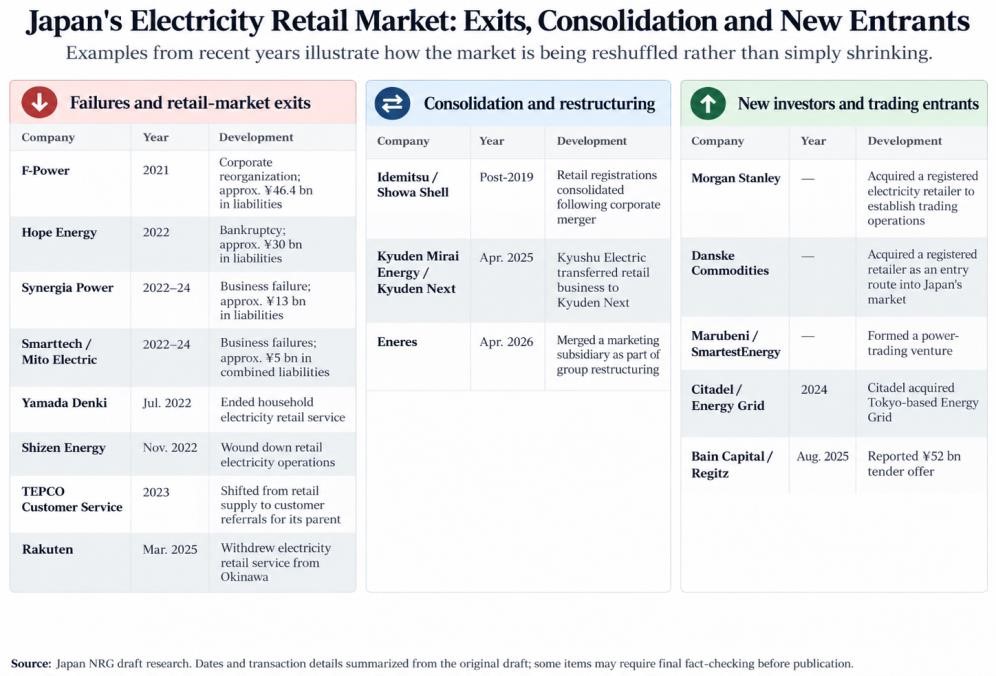
The casualties included F-Power, once a major independent supplier to business customers, which entered corporate reorganization in 2021 with liabilities of approximately ¥46.4 billion. Hope Energy, a supplier to municipalities and public agencies, filed for bankruptcy in March 2022 with liabilities of about ¥30 billion.
These were not isolated cases. According to Teikoku Databank, 119 of the 706 electricity retailers it tracked had withdrawn or gone bankrupt by March 2024, while another 69 had suspended new customer contracts. The crises demonstrated that a retail license and access to wholesale electricity were insufficient foundations for a sustainable business.
The government’s latest measures suggest that it no longer intends to leave those questions entirely to market forces.
How many retailers can Japan support?
The existence of more than 800 registrations also invites a comparison with other liberalized electricity markets. Britain provides one striking example. Its regulator reported just 17 active domestic energy suppliers in March 2026, following years of consolidation after the country’s own energy crisis. The non-domestic segment supports a much larger group of providers.
Germany presents a different picture. Its regulator reported that households could choose among as many as 139 electricity providers in 2024, reflecting a more fragmented competitive landscape.
Neither market offers a definitive model for Japan. Different licensing systems, customer segments, local utility structures and wholesale trading arrangements make direct comparisons difficult. Still, the contrast raises a question: does Japan’s annual electricity consumption of roughly 880 TWh justify hundreds of independently operated retail firms?
The answer depends less on the total volume than on how that electricity is distributed among suppliers and what services they provide. A small retailer specializing in municipal customers, corporate PPAs or renewable electricity procurement may have a viable business without a large national customer base. A technology-driven provider may similarly operate with lower administrative costs than a traditional retailer.
By contrast, a small business offering little more than discounted electricity tariffs may struggle to sustain the forecasting systems, credit facilities, procurement arrangements and regulatory compliance required in today’s market.
Japan therefore does not necessarily need fewer retail competitors. It needs a clearer distinction between viable, specialized suppliers and businesses maintaining registrations without a convincing retail proposition.
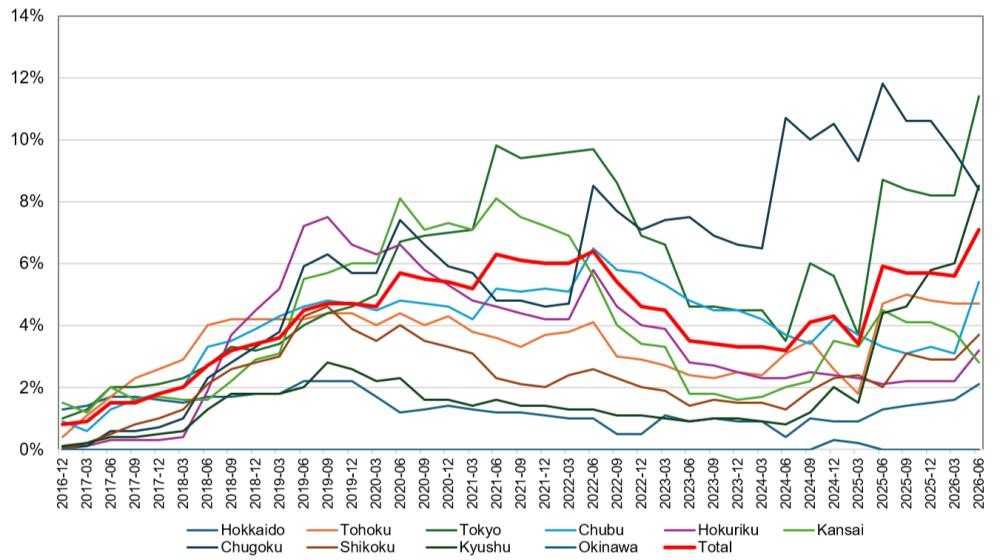
Share of Outside-Area Retail Electricity Supply by Former General Utilities and Affiliates
The next test: securing electricity in advance
The pressure on retail business models is unlikely to stop with stricter licensing. METI is developing a new Mid-to-Long-Term Market, potentially beginning in FY2028, to address another structural weakness in Japan’s liberalized electricity system.
Existing retailer obligations aim to support stable electricity supply, but they don’t necessarily ensure that retailers have procured sufficient electricity well in advance of delivery. Consequently, some retailers remain heavily dependent on short-term wholesale purchases, exposing themselves and their customers to sudden price changes.
The proposed market would introduce standardized opportunities for electricity procurement one and three years ahead. METI is considering requirements for large generators, and potentially dominant suppliers in particular regions, to offer a proportion of their output through the mechanism.
A mandatory offer volume of around 10% has been under discussion, although the detailed rules, product structures and regional arrangements remain undecided. The proposal could improve retailers’ access to longer-term supply, particularly for smaller companies without established relationships with major generators.
But it also points to a more demanding future. Retailers will need to forecast customer demand, decide how much electricity to secure in advance, manage exposure to changing fuel prices and maintain sufficient financial resources to support procurement strategies.
Long-term contracts reduce exposure to sudden wholesale price spikes, but they introduce other risks if demand falls or spot prices decline below contracted levels. The competitive advantage will therefore belong to retailers capable of managing diversified procurement portfolios rather than simply finding cheap electricity on the day-ahead market.
A changing competitive hierarchy
This does not mean that every successful retailer must own power stations. Indeed, even firms with substantial generation portfolios increasingly rely on sophisticated trading strategies to manage their market exposure.
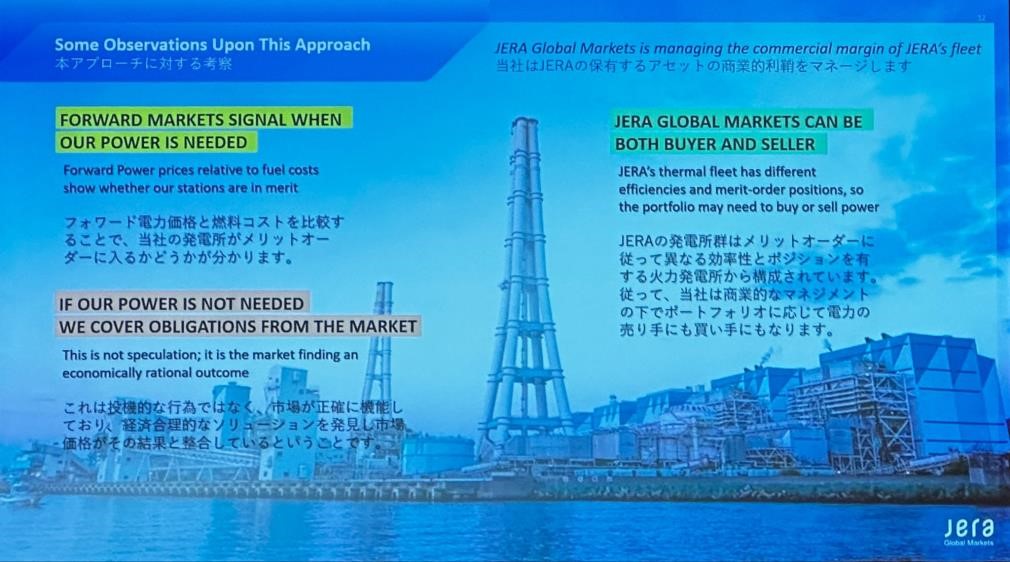
At a recent industry presentation, JERA Global Markets illustrated how financial and physical trading complement one another. A gas-fired generator, for example, may sell forward electricity and secure the corresponding LNG exposure when expected generation margins are attractive. If margins subsequently turn negative, it may reverse its positions and purchase electricity instead of operating the plant, preserving the previously hedged margin.
The implication extends beyond generators. Electricity trading is not necessarily speculative, but an important tool for managing procurement costs, protecting earnings and responding to changing market conditions. For retailers, particularly those without substantial generation assets, the ability to combine forward contracts, futures, spot procurement and demand forecasting may become just as important as access to physical supply.
As shorter-duration trading products develop, these capabilities will increasingly distinguish sophisticated electricity suppliers from businesses built around simple resale margins.
Ennet, backed by NTT Anode Energy, Tokyo Gas and Osaka Gas, illustrates the advantages of combining customer relationships with extensive energy procurement experience and financial resources. The company has expanded its services beyond basic electricity supply to include demand response, renewable electricity and other energymanagement solutions.
Looop offers a different model. Its residential retail business benefits from market-linked tariffs, partnerships with established energy and infrastructure companies, and a strategy that differs from the fixed-price offerings of traditional suppliers.
Both examples suggest that success will depend on the ability to manage risks and offer customers differentiated products, rather than just competing on headline electricity prices.
Competition is also changing among the EPCOs. Liberalization removed the historical barriers preventing regional utilities from selling electricity in one another’s service areas. That competition was initially limited but has become increasingly important, particularly in the large Tokyo market.
In 2026, utilities from neighboring regions continued competing for major electricity contracts in the capital. Tohoku Electric’s success in winning a large Tokyo Metropolitan Government supply contract shows how even established customer relationships are more contestable.
Such competition may accelerate consolidation among weaker independent retailers. Companies with large generation portfolios or strong procurement capabilities, backed by access to credit and financial hedging tools, can pursue national customers while managing wholesale price exposure across their businesses.
Yet size alone will not determine success. Digital retailers, specialist renewable electricity suppliers and companies capable of aggregating distributed energy resources may continue to find profitable niches.
The likely outcome is a more differentiated retail market, comprising major integrated energy groups, tech-driven suppliers and smaller specialists operating independently.
From retailing to energy management
Electricity retailers today have opportunities to manage not only the electricity supplied to customers, but also when those customers consume, store or return power to the grid. Demand response, battery aggregation, electric vehicle charging, renewable PPAs and non-fossil certificates are creating new opportunities for customer-facing businesses.
However, taking advantage of these services requires software, forecasting, trading expertise and the ability to operate across multiple electricity markets. Aggregation and retailing may therefore become more closely connected. A company that can coordinate customer demand and distributed batteries may manage procurement costs more efficiently than a competitor dependent entirely on wholesale purchases.
This could provide smaller firms with a route to differentiation and increase competitive pressure on retailers that lack the resources to develop or acquire these capabilities.
Another potential consequence concerns licensing itself.
Japan’s electricity business is increasingly diverse, with companies specializing in retail supply, wholesale trading, aggregation, asset optimization and financial risk management. Yet the regulatory classifications do not always correspond neatly to those commercial functions. In fact, as the market expands, the distinctions between retailers, generators, aggregators and specialist electricity traders are becoming less clear.
A separate framework for businesses engaged primarily in electricity trading could offer a clearer distinction between market participants. However, METI has not announced plans to establish a dedicated wholesale-trader license, and such a reform remains speculative.
For now, the more immediate development is tighter scrutiny of existing retail registrations and the ability to remove businesses that cannot justify their continued status.
A smaller market—or a more competitive one?
The power retail market is likely to emerge from the current reforms with fewer registered participants, but predicting the scale of consolidation would be premature.
Some registrations may disappear because their holders are no longer active. Others may be voluntarily surrendered as firms reorganize operations. Retailers lacking financial resources or procurement capabilities may withdraw or merge with larger competitors.
At the same time, new entrants offering sophisticated trading, digital customer services or renewable energy solutions may continue to enter the market. After all, a decline in registrations could occur without a comparable reduction in genuinely active retail competitors. Conversely, market concentration could increase even if the number of licenses remains relatively stable.
The real test will be whether the next phase of market reform produces a smaller number of financially stronger suppliers while preserving meaningful competition and customer choice.
Japan spent the first decade of full electricity liberalization welcoming new entrants. The next decade will test which of those entrants are prepared to take responsibility for securing supply, managing risk and serving customers in a more complicated electricity market, optimizing performance.
The number of retail licenses may decline. The need for capable electricity retailers will not.
ASIA ENERGY REVIEW
BY JOHN VAROLI
A brief overview of the region’s main energy events from the past week
Asia / Gasoline
On Friday, Asian gasoline margins more than halved from the previous session, in tandem with global cracks after China issued a surprise fuel export quota and as inventories at major trade hubs rose. The refining profit for gasoline shrank to about $11/ barrel over Brent crude, the lowest since March, from a record peak of $50.53 on Oct 1.
China / Green hydrogen
China Energy Engineering Corp began building the second phase of its integrated green hydrogen, ammonia and methanol project in Jilin province. Combined annual green ammonia production capacity will grow to 600,000 tons.
China / Liquid air
A 60 MW liquid air energy storage project in Northwest China was connected to the grid and started generating power. It’s the largest facility of its kind in the world.
India / Diesel
India’s diesel exports are set to surge from 2027, giving India a bigger role in global markets, as state-run firms boost refining capacity, said industry officials.
India / Fossil fuels
By 2060, India will generate 730 TWh of fossil-fired power, more than China with 720 TWh, according to DNV’s Energy Transition Outlook 2026. In 2025, China generated 6,780 TWh of fossil-fired power, against 1,650 TWh in India.
India / Oil
India faces no pressure from the U.S. to reduce Russian crude imports, the govt said, adding that India was getting 0.2% of its oil imports from Russia before the Ukraine war, but imports have surged since the war started due to discounts on Russian oil.
Indonesia / Oil
The United Arab Emirates will supply Indonesia with up to 30 million barrels of oil, said Indonesia’s upstream oil and gas regulator, SKK Migas.
Renewables
The world will add less clean energy capacity in 2026 for the first time in five years due to inadequate transmission networks and trade barriers, said the head of IRENA. Growth in solar and wind capacity has been accelerating every year since 2021, when the pandemic disrupted global supply chains. Clean power installations including hydropower surged a record 692 GW, or 15.5%, to 5.15 TW in 2025, half the world’s power capacity.
Singapore / Power plant
Sembcorp said its 600-MW hydrogen-ready combined-cycle gas turbine in Jurong Island began commercial operations. The new capacity will provide reliable power for energy-heavy industries. The facility is designed to accommodate low-carbon fuels over time.
South Korea / Offshore wind
The govt launched competitive bidding for fixed-price contracts for offshore wind power for H2 of 2026 — a total of 2.2 GW of capacity. In H1 the total was 1.8 GW of capacity.
Disclaimer
This communication has been prepared for information purposes only, is confidential and may be legally privileged. This is a subscription-only service and is directed at those who have expressly asked K.K. Yuri Group or one of its representatives to be added to the mailing list. This document may not be onwardly circulated or reproduced without prior written consent from Yuri Group, which retains all copyright to the content of this report.
Yuri Group is not registered as an investment advisor in any jurisdiction. Our research and all the content express our opinions, which are generally based on available public information, field studies and own analysis. Content is limited to general comment upon general political, economic and market issues, asset classes and types of investments. The report and all of its content does not constitute a recommendation or solicitation to buy, sell, subscribe for or underwrite any product or physical commodity, or a financial instrument.
The information contained in this report is obtained from sources believed to be reliable and in good faith. No representation or warranty is made that it is accurate or complete. Opinions and views expressed are subject to change without notice, as are prices and availability, which are indicative only. There is no obligation to notify recipients of any changes to this data or to do so in the future. No responsibility is accepted for the use of or reliance on the information provided. In no circumstances will Yuri Group be liable for any indirect or direct loss, or consequential loss or damages arising from the use of, any inability to use, or any inaccuracy in the information.
K.K. Yuri Group: Hulic Ochanomizu Bldg. 3F, 2-3-11, Surugadai, Kanda, Chiyoda-ku, Tokyo, Japan, 101-0062.