
WEEKLY
November 16, 2026
ANALYSIS
BESS CO-LOCATION: UNLOCKING VALUE FROM EXISTING POWER ASSETS
- Japan’s growing renewable energy capacity is creating opportunities for BESS due to the rising impact of solar and wind curtailment.
- Co-locating BESS can reduce curtailment losses and generate more revenue as solar projects transition from the FIT to FIP. How much value can co-location unlock, and what offers the most growth potential?
HOW WILL THE MIDTERMS IN THE U.S. IMPACT JAPAN’S ENERGY SECTOR
- The Democratic Party’s control over Congress will constrain Trump’s ability to advance his domestic agenda, including energy legislation; but the president retains authority over foreign policy, trade and military operations.
- For Japan, the immediate implications may be felt more in global energy markets than in changes to U.S. energy policy.
ASIA PACIFIC REVIEW
This column provides a brief overview of the region’s main energy events from the past week
NEWS
- METI boosts offshore wind, synthetic methane support in latest GI Fund revisions
- Govt weighs state ownership of critical industrial and materials plants
- China curbs send yttrium prices soaring
- Weak demand fails to bring down October power prices; TOCOM power futures hit record volume
- Hokkaido Electric faces scrutiny over regulated rates
- OCCTO finds persistent unused balancing capacity
- METI links power investment more closely to industrial location
- KHI and RWE collaborate on Europe’s first hydrogen-fired gas turbine demo
- Partners in low-carbon ammonia hub in Hokkaido launch new company
- Mitsubishi targets broader market for ammonia fuel systems
- Solar market shifts toward asset optimization: RTS
- Govt advances solar-panel glass recycling rules
- PowerX and Energy Vault to supply BESS to Japan, Australia and U.S.
WIND POWER AND OTHER RENEWABLES
- Onshore wind auction sees capacity fall by half
- Chubu Electric expands UK offshore transmission portfolio
- Eurus joins 900 MW Egypt wind project
- Mihama 3 cleared for operation beyond 50 years
- Takahama 3 prepares for restart after major overhaul
- NRA clears way for online nuclear maintenance
- ASEAN and Japan to launch emergency petroleum stockpiling
- Vortexa warns of unusually wide LNG supply risks
- Non-Gulf crude gives Asian refiners more options
CARBON CAPTURE & SYNTHETIC FUELS
- SAF growth threatens to tighten Asian feedstock supply
- Mitsui links SAF production with bioplastics recycling
EVENTS
Nov 18-19 Asia-Pacific Economic Cooperation – Leaders Meeting @ Shenzhen, China
Nov 18-20 Smart Energy Week @ INTEX Osaka
Nov 25-27 Factory Innovation Week @ Aichi Sky
Expo C~F, Nagoya
Nov 28 Taiwan Local Elections
Dec 1-3 DeCarbon Tokyo 2026 @ Tokyo Marriott Hotel
Dec 14-15 G20 Summit @ Miami
Feb 17-19 Factory Innovation Week 2027 @ Tokyo Big Sight
Mar 24-26 Smart Energy Week @ Tokyo Big Sight
PUBLISHER
K. K. Yuri Group
Editorial Team
Yuriy Humber (Chief Editor)
John Varoli (Senior Editor, Americas)
Kyoko Fukuda (Data, Events)
Filippo Pedretti (Thermal, CCS, Nuclear)
Tetsuji Tomita (Power Market, Hydrogen)
Aglaé Bange (Renewables, Biomass & Energy Storage)
Gillian Sawyer (Renewables)
George Hoffman (Sales, Business Development)
Rada Kuznetsova (Clients Accounts, Website)
Tim Young (Design)
SUBSCRIPTIONS & ADVERTISING
Japan NRG offers individual, corporate and academic subscription plans. Basic details are our website or write to subscriptions@japan-nrg.com
For marketing, advertising, or collaboration opportunities, contact sales@japan-nrg.com. For all other inquiries, write to info@japan-nrg.com
NEWS: GENERAL OUTLOOK AND TRENDS

METI adds offshore wind, synthetic methane priorities to GI Fund
(Government statement, November 10)
- METI outlined revisions to the Green Innovation (GI) Fund as projects move toward completion in FY2030–FY2032.
- Two new projects will be included, with a combined budget of ¥120 billion.
- Offshore wind: Additional R&D and demos of construction methods for complex seabed conditions, together with next-gen domestic floating wind technologies.
- Synthetic methane: Further development of innovative methanation technologies and pilot demos aimed at earlier commercialization.
- Up to ¥80 billion will also be allocated across 11 existing projects to cover additional costs from inflation, higher wages, supply-chain changes, regulatory changes and natural disasters. Additional support will generally be capped at the amount of existing subsidies.
- Participants in new GI Fund projects will be required to join the GX Future League, which replaced the GX League in April 2026.
- METI will strengthen evidence-based evaluation using indicators covering R&D progress, international competitiveness, mobilization of private investment and economic spillover effects.
- CONTEXT: Five years after the fund’s creation, many projects are entering larger-scale demonstration stages, where higher costs and commercialization hurdles are becoming more visible. The GI Fund was designed to support technologies requiring sustained assistance from R&D through social implementation.
- TAKEAWAY: The additional funding provides a useful signal of where METI still sees scope for progress before the GI Fund winds down in the early 2030s. Offshore wind support is shifting toward the harder engineering problems needed for floating deployment in deep and complex waters, while synthetic methane remains a priority for moving from technology development toward commercialization. The extra ¥80 billion for existing projects also shows that METI is prepared to protect strategically important programs from cost inflation rather than allow earlier budget assumptions to derail them.
METI considers state ownership of critical-material plants
(Government documents, Kyodo, Asia Nikkei, November 12 13)
- METI is considering a framework under which the government could temporarily acquire strategically important private-sector production facilities when aging equipment and weak profitability threaten domestic supply.
- The scheme would target products such as chemicals and castings where closure of a sole or critical domestic plant could leave Japan heavily dependent on particular foreign suppliers.
- Under the proposal, an independent administrative agency could acquire and upgrade the facility using public funds, while the existing company would continue operations. Ownership could eventually return to the private sector after the investment has been depreciated.
- The approach follows the government-owned, contractor-operated (GOCO) model already examined by METI as an exceptional option where subsidies, loans and other conventional support may be insufficient to maintain strategically important manufacturing capacity.
- METI aims to incorporate the concept into the government’s revised economic-security action plan, expected as early as next spring, before pursuing necessary legislation.
- CONTEXT: METI’s April manufacturing-base report argued that geopolitical risks and export restrictions on critical minerals have increased the need to preserve domestic manufacturing capabilities even where private-sector economics are weak.
- TAKEAWAY: The shift from conventional subsidies toward direct government intervention in strategically important supply chains does not look especially dramatic in the current geopolitical and business environment. The key question is whether public ownership or government-led restructuring can actually restore struggling industrial assets. TEPCO in energy and Japan Display in manufacturing illustrate how extensive state backing and oversight do not necessarily produce quick turnarounds. The positive here is that the threshold for intervention appears deliberately high and the use case is narrow: essentially where the loss of a domestic plant could create a major dependency on foreign supply.
Yttrium prices surge as China tightens exports
(Asia Nikkei, November 12)
- Benchmark yttrium prices in Europe reached $1,087/ kg in September, about nine times higher than a year earlier and 174 times the end-2024 level, amid tighter Chinese export controls.
- Japan’s import price for yttrium oxide rose 64-fold YoY in September, while imports in January– September fell about 70% to 294 tons.
- CONTEXT: China tightened rare-earth export controls in April 2025 and introduced further restrictions on dual-use exports to Japan this January. Prices inside China remain below 1% of overseas benchmark levels.
- Japan is trying to diversify supply through cooperation with the U.S. and G7 partners, while increasing procurement from South Korea and sourcing from countries including Germany, Turkey and Estonia.
- TAKEAWAY: Shin-Etsu Chemical is investing at least ¥35 billion in a new refining facility capable of processing 16 rare-earth elements, including yttrium. So far, major users such as IHI and Kioxia say production has not been materially affected. But the widening price gap between China and overseas markets shows how export controls reshape the economics of goods and offer Beijing a major advantage in industrial competition. For now, Japan’s immediate challenge is securing alternative raw-material supply.
NEWS: ELECTRICITY MARKETS

October power demand falls, but tighter supply keeps prices elevated
(Exchange data, November 1-10)
- In October, electricity demand across Japan’s nine power regions, excluding Okinawa, fell 2.4% YoY as summer heat faded and cooling demand declined.
- Despite weaker demand, supply-demand conditions tightened. Scheduled thermal plant maintenance reduced available capacity during the autumn shoulder season, while cloudy and rainy weather lowered solar generation.
- Eastern Japan saw firm spot prices, while parts of western Japan also saw tight conditions later in the month, triggering interregional power transfers.
- Still, the average JEPX day-ahead system price rose to ¥22.5/ kWh, up 17.7% MoM and 98% YoY. Prices exceeded ¥20/ kWh on nearly two-thirds of October days and climbed above ¥30/ kWh several times toward month-end.
- Higher fuel costs added to supply-side pressure, with NE Asian LNG spot prices finishing October in the low-$30s/ MBtu amid uncertainty over Middle East supplies.
- TAKEAWAY: It’s interesting to see that softer electricity demand does not always translate into cheaper power. Autumn maintenance works, lower renewables output and expensive fuel were sufficient to tighten the market even as consumption declined. The power price dynamics are stepping outside of their more traditional peak / shoulder season patterns.
- SIDE DEVELOPMENT:
- Intraday power trading falls in October, prices rise
- (Denki Shimbun, November 11)
- JEPX intraday market volume averaged 2.83 GWh/ day in October, down 20.7% MoM and declining for the first time in seven months.
- Monthly traded volume fell 18.0% to 87.9 GWh, while the number of trades dropped 12.6% to 312,634. The share of intraday trading relative to electricity demand across nine regions excluding Okinawa slipped 0.2 percentage point to 1.4%.
- Part of the decline may reflect JEPX’s transition to a new intraday trading system on Oct 1, as some participants were not fully prepared for the change.
- Trading picked up after Oct 19 as unusually high temperatures tightened supply-demand conditions. On Oct 21, imbalance prices reached the ¥300/ kWh cap in Chubu, Hokuriku and Kansai, while intraday prices hit a monthly high of ¥250/ kWh between 15:30–16:00.
- The monthly average intraday price rose ¥2.46 MoM to ¥24.07/ kWh, ¥1.56 above the JEPX system spot price.
- Oct 26 recorded the month’s highest daily trading volume at 51.2 GWh, while the largest number of transactions was 14,422 on Oct 20. The number of ¥0.01/ kWh trades rose to 225 intervals, up 61 from September.
TOCOM power futures volume hits record
(Exchange data, November 10)
- In October, TOCOM power futures trading reached 916.8 GWh, surpassing the previous monthly record of 901.8 GWh set in March 2025.
- Trading was concentrated not only in monthly contracts but also in fiscal-year exposure, with several large transactions covering all 12 months of FY2027.
- In Tokyo baseload, 12 monthly contracts from April 2027 to March 2028 traded in blocks at ¥18.20/ kWh on Oct 6, ¥20.55/ kWh on Oct 16, and ¥21.80/ kWh on Oct 23. In western Japan, the same 12-month strip traded at ¥15.80/ kWh on Oct 5.
- Inter-area spread trading also increased, particularly between Tokyo, Kansai and Chubu, as participants hedged regional price differences for the coming winter.
- The highest October transaction price was ¥34.20/ kWh for Tokyo daytime contracts covering Dec 2026–Feb 2027, while the lowest was ¥14.10/ kWh for western Japan baseload contracts covering April–June 2027.
- October settlement prices for monthly baseload contracts were ¥27.02 in Tokyo, ¥25.46 in Chubu and ¥19.50 in western Japan.
- CONTEXT: October also saw a sharp rise in EEX Japan power futures trading, where volumes reached 28.3 TWh and fiscal-year contracts accounted for more than 60% of activity. TOCOM remains much smaller, but both exchanges saw stronger demand for longer-dated hedging as participants moved earlier to manage FY2027 risk.
- TAKEAWAY: TOCOM’s record month reinforces the broader October trend toward deeper forward hedging in the country’s power markets. The absolute scale remains far below EEX, but the rise in 12-month strip and interarea spread trading suggests growing use of futures for portfolio and regional basis risk management.
EGC reports on efficient procurement measures for regulated electricity rates
(Government statement, November 6)
- Power and gas market regulator EGC reported on the follow-up review of procurement measures of seven utilities.
- In FY2025, every utility saw fuel and purchased-power costs fall YoY on lower fuel and power market prices; so, total actual costs came in below approved cost at all seven.
- Repair and outsourcing costs still exceeded approved cost everywhere, despite efficiency gains, due to higher material and labor costs and unplanned repairs.
- CONTEXT: The seven major utilities – Hokkaido, Tohoku, TEPCO, Hokuriku, Chugoku, Shikoku and Okinawa – sought regulated-rate increases in 2022–23, but experts pointed out the industry’s structural high-cost culture, citing cartel-related market distortions and very low competitive tendering rates in some procurement categories. Still, METI approved the hikes while tightening cost-efficiency requirements. FY2023–FY2025 was designated as an intensive improvement period, requiring the seven utilities to develop procurement-efficiency roadmaps.
- TAKEAWAY: The three-year procurement-efficiency framework appears to have achieved its immediate purpose: fuel and purchased-power costs fell below approved levels at all seven utilities, while the most persistent overruns were concentrated in repair and outsourcing expenses affected by inflation and unplanned work. With the intensive monitoring period now ending, the regulatory focus will shift from prescribed procurement reforms toward how regulated businesses can sustain acceptable profitability without renewed upward pressure on customer tariffs.
- SIDE DEVELOPMENT:
- EGC keeps 30% equity assumption for regulated power returns
- (Government statement, November 6)
- The EGC concluded that the 30% equity ratio used in calculating the allowed return for regulated electricity rates does not need to be revised for now.
- Financing needs remain high and debt funding conditions have become less favorable, but utilities’ balance sheets have improved. The ten major utilities’ average equity ratio rose to 25% in FY2025 from 17% in FY2022.
- Kansai Electric and Chubu Electric already have equity ratios above 30%, while most major utilities are targeting around 30% by FY2030–FY2035.
- EGC will continue monitoring actual equity ratios, financing conditions and capital policies during future rate reviews, and may revise the benchmark used in calculating regulated returns if circumstances change materially.
- CONTEXT: The 30% assumption has been used since June 2024. At the time, EGC estimated an appropriate equity ratio of around 35% based on the existing formula, but retained 30% after considering comparable utilities in Japan and overseas, as well as companies’ own capital targets.
- TAKEAWAY: The decision suggests EGC is not moving immediately toward a higher benchmark simply because utilities’ balance sheets have strengthened. Instead, future reviews are likely to place greater weight on each company’s actual capital structure, financing needs and market conditions when testing whether the 30% assumption still remains appropriate.
- SIDE DEVELOPMENT:
- Hokkaido Electric faces closer review of regulated retail rates
- (Government statement, November 6)
- EGC reviewed whether the current transitional regulated retail rates of the ten major utilities remain appropriate after the end of their original cost-recovery periods.
- Nine utilities did not exceed the first-stage profitability threshold and therefore require no further examination over whether METI should order a rate revision.
- Hokkaido Electric was the only utility to advance through the initial tests. Its three-year average profit margin for the regulated retail segment was about 10%, while accumulated excess profits reached ¥14.9 billion, above the ¥8.5 billion benchmark.
- EGC will now examine Hokkaido Electric in greater detail, including the reasons for its profitability and whether maintaining its current regulated rate level remains justified.
- CONTEXT: Transitional regulated rates have remained in place since full retail liberalization to protect households in areas where effective competition may still be insufficient. Separately from deciding whether such regulation can eventually be removed, EGC conducts an annual review after utilities’ original cost-calculation periods end to check whether existing rate levels are generating excessive profits. If profitability and accumulated profits exceed specified thresholds, regulators can consider whether METI should order the utility to submit a rate revision application.
OCCTO finds persistent unused capacity outside balancing market
(Agency statement, November 5)
- OCCTO reported the results of its Q2 FY2026 survey of “natural surplus capacity.” This is generation capacity that remains available in real time but is not offered into the balancing market.
- Thermal generation showed an average 5.32 GW of such unused capacity across nine regions during the July–September heavy-load season, up 321 MW YoY. Relative to peak demand, the share ranged from about 1.3% in Kansai to 7.4% in Tohoku.
- Pumped hydro also retained surplus capacity. Across the five surveyed regions, average unused capacity was 669 MW, down 273 MW YoY but still clearly present.
- Similar results were found in the April–June light-load season, showing that unused balancing capability persists across both low- and high-demand periods.
- CONTEXT: The issue matters because bid shortages and high balancing costs remain recurring problems even though some generation capable of providing balancing services is sitting outside the market. OCCTO plans to survey providers on reasons including failed bids, risk management, product requirements and fuel constraints.
- TAKEAWAY: OCCTO has now shown that a meaningful amount of balancing-capable generation remains outside the market in both light- and heavy-load seasons. What the regulator still does not understand well enough is why. The next step is about identifying the commercial or technical barriers that keep generators from bidding it into the market.
ANRE maps new coordination models for power-sector investment
(Government statement, November 10)
- ANRE discussed how closer coordination among utilities, grid operators, local governments, retailers and consumers could strengthen the industrial foundations needed for stable electricity supply.
- The discussion covered several existing and planned approaches:
- Corporate PPAs using existing nuclear and hydropower assets are expanding, supported by regulatory easing for decarbonized power procurement.
- The GX Regional Co-Creation Subsidy supports projects that combine industrial investment with access to decarbonized electricity, with many projects planning to source more than half their power from nuclear or offshore wind.
- Local governments can attract new industrial demand near power-generation assets, linking regional development with better use of local electricity supply.
- Generators can work with private grid operators to supply nearby large-scale users directly, potentially reducing network and connection costs.
- Utilities and municipalities can guide major new loads, including data centers, toward substations and grid areas with spare capacity to shorten connection times.
- Better information sharing among retailers, consumers and grid operators could improve demand forecasts and help transmission and distribution companies plan future investment.
- CONTEXT: Japan’s electricity challenge is increasingly about matching new generation, grid capacity and large industrial demand geographically and on the same timeline. ANRE is looking beyond individual power projects at mechanisms that coordinate where generation, networks and major electricity users intertwine.
- TAKEAWAY: METI’s emerging policy direction is to treat power supply, grid development and industrial location as a single planning problem. Rather than simply adding generation or subsidizing individual factories, officials want new demand to locate where low-carbon electricity and network capacity can actually be delivered. This also gives utilities clearer visibility over future loads.
Govt moves toward final decision on simultaneous market
(Government statement, November 9)
- ANRE and OCCTO proposed how to reach a final decision on introducing the simultaneous market, due at the end of Phase 2.
- The decision will be based on feasibility, effectiveness, and implementation readiness.
- Phase 1 assesses feasibility via overseas research and technical verification, using results in the design and clarifying the future market operator and system developer.
- Phase 2 develops requirements with those entities and runs a simulation if needed.
- CONTEXT: A five-phase roadmap was established to introduce the simultaneous market. Phase 1: Business design; Phase 2: Requirements definition; Phase 3: System development; Phase 4: Onboarding and final preparation; Phase 5: Go-live (launch).
- TAKEAWAY: The simultaneous market is expected to provide a more integrated framework for optimizing energy and balancing resources. However, ongoing reforms to the balancing market highlight several practical challenges that must be addressed before further market integration can proceed, including procurement efficiency, market liquidity, price formation, and the participation of flexible resources. Resolving those issues in the balancing market will be essential to the successful implementation of the simultaneous market.
NEWS: HYDROGEN

(Organization statement, November 9)
- NEDO, Kawasaki Heavy Industries (KHI) and German utility RWE inaugurated a 30 MW-class hydrogen gas turbine demonstration facility at RWE’s hydrogen park in Lingen, Germany.
- KHI supplied its L30A turbine, the first 30 MW-class gas turbine in Europe capable of both hydrogen co-firing and 100% hydrogen-fired generation.
- The turbine uses wet diffusion combustion and can flexibly switch the hydrogen share from 0% to 100%, allowing the same equipment to operate as hydrogen availability increases.
- Field testing will use natural gas and CO2-free hydrogen supplied from RWE’s wind-based energy system, assessing emissions, combustion stability, durability and operability.
- CONTEXT: The project was selected by NEDO in FY2021 as an international demonstration project and builds on longstanding cooperation between NEDO and Germany’s NOW.
Partners establish company for Hokkaido ammonia supply hub
(Company statement, November 6)
- Hokkaido Electric, Mitsui & Co., IHI and Tomakomai Port Development established Hokkaido Clean Ammonia Terminal to advance a planned low-carbon ammonia supply hub in the TomakomaiAtsuma area.
- The company will prepare for commercialization of facilities to receive, store and distribute imported low-carbon ammonia to power and industrial users.
- The partners aim to establish the hub by FY2030 as part of what they describe as Japan’s first commercial-scale low-carbon ammonia supply chain.
- CONTEXT: The project received certification in March under the Hydrogen Society Promotion Act’s hubdevelopment support program. It is linked to Mitsui’s separately approved plan to import up to 280,000 tons/ year of low-carbon ammonia from its Blue Point project in Louisiana for Hokkaido Electric, Mitsubishi UBE Cement, Tosoh and other users.
- TAKEAWAY: Establishing the project company marks a move from government-backed planning toward implementation. More importantly, the Hokkaido project brings together the two parts of Japan’s hydrogen policy – support for the cost of imported low-carbon ammonia and support for the infrastructure needed to distribute it among multiple users.
Mitsubishi Shipbuilding gains WinGD approval for ammonia fuel system
(Company statement, November 9)
- Mitsubishi Shipbuilding received Supplier Pre-Approval from Swiss marine engine designer WinGD for components of its MAmmoSS ammonia fuel-handling system, the first such approval for a Japanese company.
- The approval covers the fuel valve unit and ammonia injector cooling-water system used with WinGD’s X-DF-A ammonia-fueled large marine engines.
- Mitsubishi Shipbuilding plans to commercialize the two components and integrate them with its broader ammonia supply and safety system.
- CONTEXT: MAmmoSS combines a common core package with modules customized for individual engine makers, allowing centralized control of ammonia supply, treatment and related equipment. Mitsubishi also plans systems capable of serving multiple ammonia engines and boilers aboard a vessel. TAKEAWAY: Mitsubishi Shipbuilding is positioning itself around the fuel-handling infrastructure rather than the engine itself. A modular system that can be adapted to different engine makers and multiple onboard users could give the company a role across a broader range of ammonia-fueled vessels, including ships built by other yards.
KHI automates production of commercial-scale LH2 piping
(Company statement, November 11)
- KHI invested about ¥2 billion in an automated production line for vacuum-insulated double-wall piping used in commercial-scale liquefied hydrogen facilities.
- The company shipped the first pipe spools from the line to the Kawasaki LH2 Terminal under construction at Ogishima in Kawasaki City.
- Vacuum between the inner and outer pipes limits heat ingress, allowing liquid hydrogen at −253°C to be transported safely and efficiently.
- The scale-up is substantial: compared with piping produced for KHI’s earlier Kobe pilot, the commercial demonstration requires about 33 times as many spools, while maximum inner-pipe diameter is about 2.3 times larger. KHI automated machining, welding and inspection processes to handle the increase.
- CONTEXT: The Kawasaki LH2 Terminal is a core facility in NEDO’s commercial-scale liquid hydrogen supply-chain demonstration. It includes a 50,000 m³ storage tank and a 50-ton/day hydrogen liquefaction plant, with the latter scheduled for completion by end-2028.
- TAKEAWAY: The significance is KHI’s move from bespoke demo equipment toward repeatable industrial production. Automating critical cryogenic piping is one of the manufacturing steps needed if liquid-hydrogen infrastructure is eventually to be built at commercial scale.
Morimura, Samsung Heavy target SOFCs for ships and floating DCs
(Company statement, November 9)
- Morimura SOFC Technology signed an MoU with Samsung Heavy Industries (SHI) to jointly develop and commercialize solid oxide fuel cell (SOFC) systems by 2028 for ships and data centers.
- SHI will handle engineering, system integration and commercialization of large-capacity SOFC systems, while Morimura will supply the core cells and stacks.
- SOFCs offer higher generation efficiency and lower carbon emissions than conventional enginebased generation and can operate on fuels including hydrogen and LNG.
- SHI plans to explore SOFCs for commercial vessels as part of its shift toward electrification and autonomous operation, as well as for floating data centers where rapid access to reliable power is a key requirement.
- CONTEXT: Morimura SOFC Technology was established in 2019 by Noritake, TOTO, NGK Insulators and Niterra, combining the Morimura Group’s ceramics expertise in SOFC cells and stacks.
- TAKEAWAY: The partnership has a fairly clear division of labor: Morimura supplies the electrochemical core while Samsung Heavy turns it into large marine power systems. The ability of SOFCs to operate on LNG as well as hydrogen is particularly useful for shipping, because systems can be deployed before a large-scale hydrogen fuel supply chain is available.
NEWS: SOLAR AND BATTERIES

RTS sees Japan solar market shifting toward asset optimization
(Company statement, October 26)
- RTS said Japan’s solar market is entering a more difficult phase as installation growth stalls even though the government still expects substantial expansion toward 2040. At the same time, new rules on MW-scale solar projects, cybersecurity and project siting are tightening development requirements.
- Its 2026 business guide highlights policy changes affecting ground-mounted solar, FIT/FIP projects, agrivoltaics and participation in wholesale, balancing and capacity markets.
- RTS also points to diversification in procurement models and project types, including PPAs, agrivoltaics, floating solar, rooftop systems and solar carports.
- As greenfield development becomes harder, the report identifies growing business opportunities around existing assets and adjacent services, including O&M, repowering, BESS co-location, PV recycling and reuse, and commercialization of perovskite solar cells.
- CONTEXT: State policy today favors projects that are viewed as compatible with regional needs and community acceptance, rather than a blanket welcoming of all solar capacity.
- TAKEAWAY: For more information on BESS co-location with solar power plants, please refer to the analysis section.
METI, MoE advance rules for solar panel glass recycling
(Government statement, November 11)
- METI and MoE discussed measures to expand recycling and resource recovery from end-of-life solar panels. Glass is a major focus because it accounts for about 60% of a panel’s weight.
- The government wants to encourage higher-value recycling, including recovering cover glass for reuse in products such as flat glass, glass wool and glass beads, rather than relying mainly on simple crushing.
- At the same time, crushing and sorting processes could also qualify under the certification system, allowing a wider range of recycling methods to participate.
- Certified operators would be able to conduct recycling and resource recovery without obtaining separate waste-processing permits, while remaining subject to annual reporting requirements.
- The proposed framework would also ease some storage and transport requirements to support larger and more cost-efficient operations, while retaining rules on safe storage, accident prevention and waste traceability.
- CONTEXT: As solar-panel waste volumes are expected to rise sharply in coming years, the policy challenge is not only to build enough recycling capacity but also to recover materials at a quality and cost that makes reuse commercially viable. Glass wool is commonly used as building insulation.
PowerX and Energy Vault to supply BESS to Japan, Australia and U.S.
(Company statement, November 5)
- PowerX agreed with Energy Vault to possibly supply up to 1.5 GWh of its products for deployment in the U.S. in 2027. The two companies also intend to collaborate on BESS and data center projects in Japan, Australia and the U.S. by leveraging Energy Vault’s global commercial platform.
- The Mega Power series comprises three product lines: a containerized BESS, an all-in-one grid connection package, and a scalable modular data center with built-in large-scale BESS. The products would be made in Japan and designed to comply with Foreign Entity of Concern (FEOC) requirements under U.S. federal law.
- CONTEXT: FEOCs are foreign entities subject to restrictions under U.S. law because of their links to countries considered a national security or geopolitical concern, such as China, Russia, and Iran. FEOCrelated restrictions can affect the eligibility of energy storage projects for certain federal clean energy tax credits, making supply-chain origin and component sourcing important considerations for developers.
- TAKEAWAY: Demand for BESS in the U.S. continues to grow, driven by data center expansion and the integration of renewable energy. The EIA expects a record 24 GW of utility-scale battery storage capacity to be added in 2026, about 60% more than in 2025. PowerX’s Japanese manufacturing base and efforts to meet FEOC requirements could give it an advantage in the U.S. The partnership could also become a key milestone in the firm’s international expansion, building on its initial export activities in Vietnam.
Digital Grid reaches 250 MW of BESS capacity
(Company statement, November 5)
- Digital Grid’s aggregated BESS capacity reached 250 MW, increasing by 50 MW from 200 MW in one month.
- The company operates aggregated BESS projects across all TSO areas in Japan, excluding Okinawa, and aims to exceed 380 MW by 2028.
- TAKEAWAY: The sustained growth recorded by aggregators of different sizes shows a market sufficiently dynamic to revise growth forecasts upward. Digital Grid had only 4 MW of aggregated capacity in January 2025, with co-location being indeed one of the drivers behind this momentum. Focusing on a portfolio of co-located projects, as KEPCO’s E-Flow appears to be doing, is also an effective way to rapidly increase aggregated capacity and build credibility with developers of larger standalone projects.
NEWS: WIND POWER AND OTHER RENEWABLES

OCCTO announces FY2026 onshore wind bidding results
(Organization statement, November 2)
- OCCTO released results of the FY2026 auction for new onshore wind projects of 50 kW or larger.
- Nine project plans totaling 461.07 MW were submitted for qualification against a 700 MW auction volume. Seven projects totaling 329.07 MW qualified to bid, and all seven were awarded.
- Winning prices ranged from ¥10/ kWh to ¥13.89/ kWh, below the ¥14/ kWh ceiling. The capacity-weighted average winning price was ¥11.12/ kWh.
- Three Vena Energy projects – Yamanami Wind, Akita Oga Wind and Ojiroi Okeuri Wind – secured the lowest price of ¥10/ kWh. Together they account for 234 MW, more than 70% of the awarded capacity.
- The largest winning project was Yamanami Wind at 150 MW, while the smallest was Shiunji Wind Power Generation at 1.99 MW. GPSS Business Development submitted the highest winning price of ¥13.89/ kWh.
- CONTEXT: The FY2025 auction awarded all 14 bids totaling 650.77 MW against a 900 MW target. Winning prices ranged from ¥11/ kWh to the ¥13/ kWh ceiling, with a weighted average of ¥11.96/ kWh.
| Company Name | Facility Output (MW) | Supply Price (¥/kWh) |
|---|---|---|
| Yamanami Wind Power | 150 | 10 |
| Akita Oga Wind Power | 46.2 | 10 |
| Ojiroi Okeuri Wind Power | 37.8 | 10 |
| Shiunji Wind Power Generation | 1.99 | 13.48 |
| Nozomi Energy | 15 | 13.78 |
| KA Wind Fukamochi | 12 | 13.86 |
| GPSS Business Development | 66.08 | 13.89 |
- OCCTO will not hold an additional FY2026 auction because bid volume fell below the 1,100 MW threshold required under the auction rules.
- TAKEAWAY: The FY2026 auction points to noticeably weaker participation in onshore wind. Although the auction volume was reduced by only 200 MW, awarded capacity fell by almost half from 651 MW in FY2025 to 329 MW. This year’s awards were also much more concentrated, with a single 150 MW project accounting for about 46% of capacity. At the same time, pricing improved slightly: despite the ceiling rising from ¥13 to ¥14, the weighted-average winning price declined from ¥11.96 to ¥11.12. So, the results are mixed: Fewer projects and significantly less capacity, but somewhat lower prices.
Chubu Electric acquires priority negotiation rights for UK offshore wind project
(Company statement, November 10)
- Chubu Electric, together with Diamond Transmission UK, acquired priority negotiation rights for an undersea power line project at the Dogger Bank B Offshore Wind Power Plant, 130 km off the UK’s east coast, with a 1.2 GW capacity.
- The project will undertake electricity transmission for 25 years, managing a facility that consists of a direct current (DC) undersea-onshore power line and an ancillary offshore-onshore AC-DC transformation facility.
- CONTEXT: This is the third undersea electricity transmission project in the UK that Chubu Electric will join. The others are the 660 MW capacity Walney Extension wind farm, and the 1.22 GW capacity Hornsea One wind farm.
Eurus Energy participates in 900 MW wind power IPP project in Egypt
(Company statement, November 12)
- AOELUS SAS, a JV between Eurus Energy and CFAO SAS (France) will take part in the third wind power generation Independent Power Producer project in Egypt.
- The project will build, own, and manage the 900 MW capacity Gulf of Suez Wind Farm III in the Gulf of El Zayt region along the Gulf of Suez, which will consist of 86 wind turbines with 10.5 MW capacity each.
- After commissioning of the first 300 MW in January 2028, the companies plan to scale-up to fullscale commercial operations by September 2028. Ownership in the project company is split as follows: AEOLUS 40%, ENGIE 35%, Orascom Construction 25%.
- Based on a 25-year electricity sales contract with Egyptian Electricity Transmission Company, the companies forecast electricity supply equal to that used by 2.2 million Egyptian households.
- CONTEXT: The Egyptian govt aims for 42% renewables in the power mix by 2030. Through AOELUS, Eurus Energy is invested in the expansion of renewable energy in Africa and has already developed Gulf of Suez Wind Farm I and Gulf of Suez Wind Farm II for a combined 912.5 MW.
JWA launches area-based wind power output forecast API
(Organization statement, November 12)
- The Japan Weather Association (JWA) launched its new Area-based Wind Power Output Forecast API.
- The API aggregates 30-minute wind power forecasts, including offshore wind, across 10 electricity areas up to 78 hours ahead, using JWA’s proprietary weather data and forecasting technologies.
- The service helps electricity retailers and other businesses anticipate wind power fluctuations for market trading, power procurement, and supply-demand management.
- JWA also plans to launch an area-wide solar power output forecast API.
- TAKEAWAY: JWA is expanding from weather forecasting into tools directly used for electricity trading and supply-demand management. Combining area-wide wind output forecasts with its existing demand forecasts should give retailers and other market participants a better basis for procurement decisions and imbalance management.
JFE Engineering to conduct offshore wind BOP equipment inspection and maintenance
(Company statement, November 13)
- A JFE Engineering and Akita Maritime Service JV has been entrusted with long-term periodic inspection and maintenance of BOP (Balance of Plant) equipment for the Akita prefecture Oga, Katagami, and Akita cities offshore wind project.
- The project was publicly selected and will consist of 21 fixed bottom-type wind turbines, each with a capacity of 15 MW for a total of 315 MW.
- At the earliest, operation is scheduled to begin in June 2028.
- CONTEXT: BOP equipment refers to all offshore wind power plant equipment except wind turbines, including onshore transformers, onshore power lines, undersea cables, and monopile infrastructure.
- TAKEAWAY: The contract extends JFE Engineering’s role in offshore wind from domestic monopile manufacturing into long-term BOP maintenance. That gives it experience across both construction and operation of fixed-bottom offshore wind assets as Japan’s first large auction projects move toward commissioning.
OILES to supply metal bearings for 450 MW hydro plant in India
(Company statement, November 6)
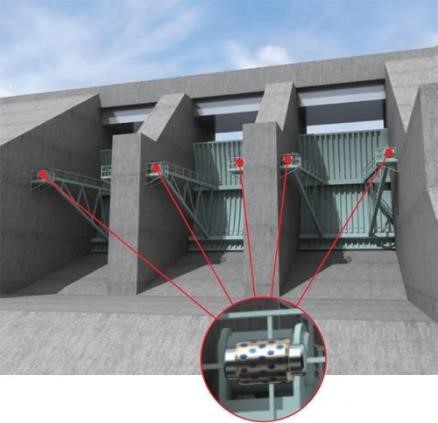
- Metal machinery maker OILES will supply self-lubricating metallic bearings for radial gates at the 450 MW Shongtong-Karcham hydroelectric project in Himachal Pradesh (Northern India).
- CONTEXT: The company produces self-lubricating metallic bearings that can operate underwater. The Shongtong-Karcham project has three turbines of 150 MW each. The 450 MW plant is scheduled to start operation in early 2027.
- CONTEXT: Himachal Pradesh has significant hydropower resources, supported by five perennial river basins. The state’s current installed hydroelectric capacity amounts to more than 10 GW, and it has an estimated hydropower potential of 24 GW, about 25% of India’s national potential.
NTT Anode Energy and Renova biomass plants receive RE100-compliant certification
(Company statement, November 4)
- Four biomass power plants operated by NTT Anode Energy and Renova completed third-party assessments confirming compliance with RE100 standards:
- Kanda (Fukuoka Pref): 75 MW;
- Sendai Gamo (Miyagi Pref): 75 MW;
- Omaezaki (Shizuoka Pref): 75 MW;
- Tokushima Tsuda (Tokushima Pref): 74.8 MW.
- The two firms aim to complete assessments of their three remaining biomass plants by the end of this year, for a total installed capacity of 370 MW. They intend to use the RE100 compliance verification to promote biomass corporate PPAs.
- SIDE DEVELOPMENT:
- BM Certification opens Japan office to help biomass firms with sustainability standards
- (Company statement, November 5)
- Latvia-based firm BM Certification, which opened an office in Japan, focuses on the requirements for verifying sustainability and life-cycle GHG emissions under the FIT/FIP system for biomass fuel procurement.
- The firm aims to address challenges in the biomass business, including:
- Auditing overseas biomass fuel production and processing facilities in North America and SE Asia, including those producing PKS and wood pellets;
- Completing certification for supply contracts and bids;
- Avoiding overlapping costs due to multiple certifications and weak yen;
- Helping Japanese exporters meet due diligence requirements imposed by EU customers under regulations such as EUDR.
erex and Green Earth to study rice-derived bioethanol in Vietnam
(Company statement, November 6)
- erex and Green Earth Institute launched a study for their Golden Rice Circle Project to develop a bioethanol production facility in Can Tho (southern Vietnam).
- The goal is annual production of 120,000 kL using 300,000 tons of rice as feedstock.
- GEI will test biomass fermentation production technologies, while erex will leverage its experience in project development.
- CONTEXT: The bioethanol produced would be used for E10 gasoline, a conventional gasoline blend containing 10% bioethanol. This follows the Vietnamese govt’s decision in June to move toward nationwide use of E10 gasoline containing 10% bioethanol.
Osaka Gas and Yanmar Energy to supply biogas-derived environmental value
(Company statement, November 10)
- Osaka Gas began supplying renewable electricity to Yanmar’s headquarters using environmental attributes from Yanmar Group-owned biogas generation (223kW).
- TAKEAWAY: While installed capacity is small, this contract is noteworthy considering how rarely environmental value derived from biogas is sold in Japan. In 2024, Osaka Gas took the first steps in this area, acquiring Clean Gas Certificates to recognize the environmental value of refined biogas produced at a waste incineration facility in Kagoshima Pref. The Clean Gas Certificate scheme was developed through a Japan Gas Association initiative to commercialize the environmental value of biogas and e-methane.
Rhinoflux to demo sludge-to-energy tech
(Company statement, November 6)
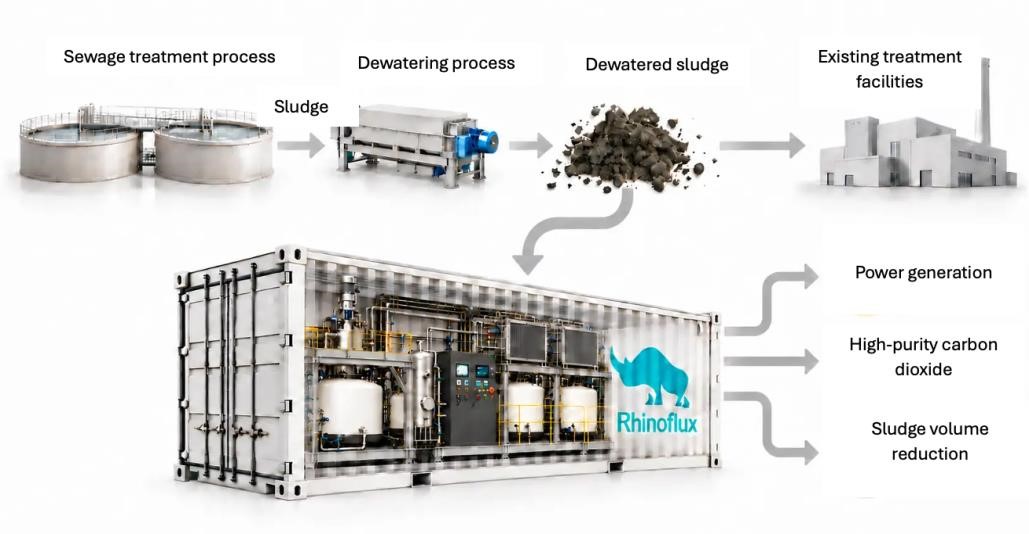
- The Tokyo Govt selected Rhinoflux for a demo (from Nov 2026 to April 2028) to test its wet chemical looping technology at a large-scale sewage treatment facility.
- Rhinoflux developed a plant that generates electricity and captures 99.9% pure CO2 from biomass without combustion. This tech can process a range of high-moisture biomass feedstocks, including food and beverage waste, sewage sludge, etc.
- Wet chemical looping technology achieves power-generation efficiencies two to four times higher than conventional biomass.
- CONTEXT: Japan generates about 2.3 million tons of sewage sludge annually, but only 10% is recycled as energy (out of a 76% recycling rate) due to the high moisture content of sewage sludge. Drying and pretreatment is energy-intensive, undermining the economic viability of energy recovery for municipalities and plant operators.
- TAKEAWAY: Rhinoflux’s technology could help address one of the main barriers to the energy recovery of sewage sludge: the cost and energy required to process high-moisture feedstocks. By avoiding combustion and the associated drying requirements, the technology could improve the economics of sludge-to-energy projects. This could be relevant for smaller municipalities seeking to make better use of locally available biomass resources.
NEWS: NUCLEAR ENERGY

KEPCO receives NRA approval to operate Mihama NPP Unit 3 beyond 50 years
(Company statement, November 11)
- KEPCO received NRA approval for Mihama NPP Unit 3’s long-term facility management plan covering operation from 50 to 60 years, the third reactor in Japan permitted to do so.
- The 50-year-old milestone comes on Dec 1. The new authorization allows the reactor in Fukui Pref to operate through late November 2036.
- On Nov 4, Unit 3 resumed commercial operations after a six-month shutdown due to a steam leak from a turbine cap in May and a later pipe leak found during inspections. This delayed an earlier planned restart.
- SIDE DEVELOPMENT:
- IAEA to inspect Mihama NPP Unit 3
- (Nikkei, November 11)
- An IAEA SALTO follow-up team inspected Mihama Unit 3 to assess progress on recommendations and suggestions from its previous long-term-operation safety review.
- The Safety Aspects of Long Term Operation (SALTO) mission focuses on verifying improvements made to maintenance. Findings will be released in about three months.
- KEPCO, the operator, requested the inspection. Mihama NPP Unit 3 will mark 50 years of commercial operation in December.
Takahama NPP Unit 3 to resume commercial operations
(Company statement, November 9)
- On Dec 8, Takahama NPP Unit 3 will resume commercial operations. It has been offline since April for routine maintenance that included ultrasonic piping inspections. It also underwent a major engineering overhaul to replace the steam generators that supply steam to the power turbines.
- KEPCO will ramp up output and transition into commercial power generation. The steam generators were replaced as a preventive measure following past problems including tube thinning and stresscorrosion cracking.
- CONTEXT: Takahama Units 3 and 4 surpassed 40 years of service. Nearby Takahama Unit 4, located on the same site, will have a scheduled periodic inspection this month.
KEPCO to begin major inspections at Takahama NPP Unit 4
(Company statement, November 12)
- KEPCO will begin a scheduled inspection of Takahama NPP Unit 4, such as pipe inspections and replacing spent fuel assemblies. The inspection runs Nov. 14, 2026 to early August 2027.
- It will replace the steam generators, the devices that produce steam to drive the power turbines, the first time since the reactor began operating in June 1985. It will also replace reactor protection panels and other major components.
- CONTEXT: Routine reactor inspections (typically required every 13 months of operation) take three months. But this inspection will last roughly nine months due to the scale of the replacement work.
Govt conducts nuclear disaster drill simulating severe accident at Tomari NPP
(Jiji press, November 7)
- From Nov 6-8, the govt held a nuclear disaster drill simulating a severe accident at Hokkaido Electric’s Tomari NPP, the first such exercise there since 2016.
- On Nov 7, PM Takaichi declared a nuclear emergency as part of the exercise protocol.
- Authorities mobilized to establish emergency response headquarters via video conference links, and practiced evacuation and medical transport of residents.
- CONTEXT: The drill coincides with Hokkaido Electric’s protracted bid to bring the NPP back online. The NRA ruled in 2025 that Unit 3 met post-Fukushima safety standards, but technical reviews of its facility construction plans remain incomplete.
NRA clears way for online maintenance at nuclear plants
(Denki Shimbun, November 12)
- The NRA revised its review standards to allow online maintenance (OLM), which enables selected equipment to be inspected and maintained while reactors remain in operation.
- Shikoku Electric aims to introduce OLM at Ikata Unit 3 in early February 2027, ahead of its scheduled periodic inspection later that month.
NEWS: TRADITIONAL FUELS

ASEAN and Japan to test emergency petroleum stockpiling
(Nikkei Asia, ERIA, November 12)
- ASEAN partners are moving toward pilot arrangements that would give the Philippines emergency access to petroleum products stored in Indonesia and Thailand.
- The initiative is being developed with support from the Economic Research Institute for ASEAN and East Asia (ERIA), a Jakarta-based think tank backed by Japan.
- Rather than immediately creating a single regional stockpile, the pilots will test oil-ticketing arrangements using existing commercial storage facilities. Under such a system, participating entities pay for the right to access stored oil during an emergency.
- ERIA and the Indonesian Business Council signed LOIs with PNOC Exploration and storage/energy companies in Indonesia and Thailand to explore the arrangements.
- CONTEXT: ERIA argues that Southeast Asia remains highly exposed to oil-supply disruptions, with crude import dependence reaching about 66% in 2024. Its proposed framework combines national reserves, oil-ticketing and regional cooperation rather than relying on a single ASEAN-wide reserve.
- CONTEXT: On Nov 17, PM Takaichi will attend the Asia Zero Emission Community (AZEC) summit in Manila and will promote the initiative – including proposals to store SE Asian reserves in Japan’s idle domestic tanks under her “Powerr Asia” energy cooperation framework. The International Energy Agency requires members to have 90-day reserves, but no ASEAN nation belongs to the IEA. ASEAN reserves remain low – below 30 days in countries like the Philippines and Indonesia.
- TAKEAWAY: For Japan, supporting ASEAN fuel security also protects Japanese supply chains. The recent disruption to Middle Eastern flows showed that shortages in Southeast Asia can quickly affect manufacturers and logistics networks serving Japan. For example, shipments of medical supplies to Japan were delayed earlier this year.
- SIDE DEVELOPMENT:
- METI minister aims to advance Asia’s energy resilience at AZEC summit
- (Reuters, November 13)
- METI minister Akazawa said he will attend the Asia Zero Emission Community (AZEC) summit in the Philippines next week.
- Akazawa declined to provide details because he said they require coordination with other countries.
- SIDE DEVELOPMENT:
- Bangladesh approves direct LNG imports from JERA
- (Dhaka Tribune, November 12)
- The Bangladesh govt approved imports of LNG from four suppliers – JERA Global Markets (JERAGM), ADNOC Trading, Ojimadu & Marites Oil Marketing Nigeria, and Uzzy Gems Beehive.
- CONTEXT: Bangladesh is using direct procurement and shortened tender procedures to accelerate LNG purchases amid energy-supply concerns. The goal is to stabilize critical energy supplies.
Vortexa sees unusually tight LNG balance heading into winter
(Company presentation, November 11)
- Vortexa expects European gas storage levels to be a key driver of global LNG markets this winter. Under its scenarios, EU storage could end the winter at about 28% in a mild-weather case, but fall to around 11% in a cold winter, close to the technical floor and likely forcing aggressive restocking in spring.
- Northeast Asian LNG demand has weakened mainly in the power sector, while non-power demand has been relatively resilient. Vortexa said at a Tokyo presentation that softer power consumption and fuel switching have helped offset part of the LNG supply shortfall in Japan, South Korea and China.
- LNG flows through the Strait of Hormuz improved in October to their highest level since the conflict began, but remained far below normal. Qatari outbound traffic is still only around one-third of the 2025 average, while a large share of LNG carrier movements remain “dark” with AIS signals switched off.
- Qatar has said it could restore LNG exports within four weeks once conditions normalize, but Vortexa considers an eight-week ramp-up more consistent with previous large-scale supply recoveries.
- Europe’s ban on Russian LNG imports from 2027 will force more Yamal LNG toward Asia, but winter export volumes will depend heavily on Novatek expanding its shipping fleet. Without additional vessels, Yamal winter output is potentially constrained to below 55% of capacity.
- The LNG shipping market remains distorted. Around 40–50 conventional LNG carriers have recently been idle for more than 40 days, excluding the QatarEnergy and ADNOC fleets, even as new vessels continue to enter service. Meanwhile, sanctioned Russian projects are increasingly relying on shadow-fleet capacity.
- New liquefaction supply is also back-loaded: Vortexa expects most of the major new capacity additions in 2027 to arrive in H2 rather than H1. That leaves the market exposed to a tight first half if winter inventories are heavily depleted, but also creates a risk of oversupply if Hormuz flows normalize at this same time.
- TAKEAWAY: LNG prices have reversed their recent slide and moved back above $30/ MMBtu for the nearest winter contracts, while the forward curve does not fall below $25 until April. Vortexa’s thesis suggests spring prices could face even stronger pressure unless Hormuz flows recover substantially. The gap between the tight- and loose-supply scenarios is becoming unusually wide and could remain one of the biggest market risks through much of 2027 as new liquefaction capacity comes online.
Non-Gulf crude supply expands options for Asian refiners: Argus
(Company presentation, November 12)
- Argus expects oil-market fundamentals to put downward pressure on prices over the next two years despite continued geopolitical risk. Its base case sees WTI broadly in the $80–90/barrel range during 2027, before trending lower in 2028. Longer-term oil demand is still expected to decline only gradually.
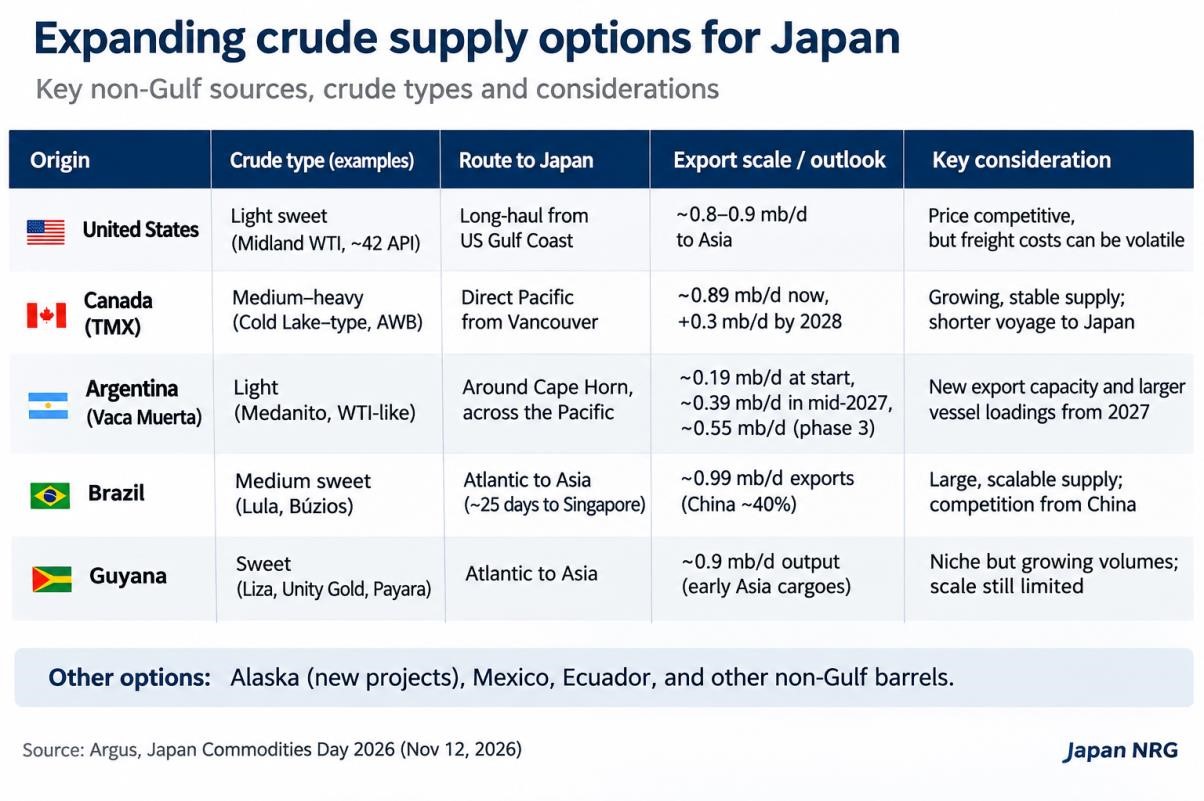
- Asian buyers are gaining access to more non-Gulf crude, led by rising supplies from the U.S., Canada, Argentina, Brazil and other producers. For Japan, these barrels offer greater diversification from the Strait of Hormuz, although refinery configuration and freight economics remain important constraints, Argus said at its event in Tokyo.
- U.S. crude exports to Asia have surged as the WTI discount widened. Japan was the largest Asian buyer in May, taking about 0.81 million b/d, while South Korea received 569,000 b/d in September. However, high freight costs can quickly erase the price advantage of U.S. crude, particularly when VLCC rates spike.
- Canada is becoming a more important Pacific supplier following the Trans Mountain (TMX) expansion. The pipeline currently has a capacity of about 0.89 million b/d and is expected to add roughly 0.3 million b/d by the end of 2028. Asia accounted for about 77% of Vancouver crude exports in 2026 YTD, while Japanese buyers have begun taking TMX cargoes.
- Argentina could become another significant source from 2027 as Vaca Muerta production and export infrastructure expand. The VMOS system is expected to increase export capacity from around 0.19 million b/d at start-up to 0.39 million b/d in mid-2027 and eventually 0.55 million b/d, while new loading infrastructure will allow larger vessels to access the trade. Japanese refiners including ENEOS and Taiyo have already purchased Medanito crude.
- Other emerging alternatives include Brazil, Guyana, Alaska, Mexico and Ecuador. Their attraction varies by crude quality and shipping route: Canadian barrels offer relatively short Pacific voyages, while light U.S. and Argentine grades may require more blending at Japanese refineries historically designed around Middle Eastern sour crude.
- Freight remains the swing factor. VLCC costs to Asia roughly doubled on several routes between August and September, at times adding around $20/ barrel to the U.S. Gulf Coast crude delivered to Asia. Rates have since begun to ease as buyers pulled back and tanker availability improved.
- TAKEAWAY: Japan and other Northeast Asian refiners now have a broader menu of non-Hormuz crude than at any point in recent years. Canada and Argentina are particularly important because both are adding new port and other shipping infrastructure to boost export capacity – with an eye directed to Asia. But diversification will ultimately be determined by economics: once Gulf crude flows normalize, Middle Eastern producers can discount barrels to defend market share, forcing U.S., Canadian and Latin American supplies to remain competitive after freight, blending and refinery-adjustment costs.
JAPEX raises net profit forecast to ¥70 billion
(Company statement, November 12)
- JAPEX raised its FY2026 consolidated net profit forecast by ¥5 billion to ¥70 billion (a 30% YoY increase). Full-year revenue will be ¥336 billion (down 1% YoY, but ¥22 billion higher than previous estimates).
- The revision mainly reflects higher expected crude oil sales prices amid prolonged Middle East instability. JAPEX raised its assumed full-year crude oil price by $17.40 to $94.60/ barrel. Dividend forecasts remain unchanged.
- The company is considering selling some overseas assets to improve asset efficiency; any disposal could generate a one-off loss.
- SIDE DEVELOPMENT:
- Idemitsu Kosan raises profit forecast
- (Company statement, November 11)
- Idemitsu raised FY2026 net profit guidance to ¥295 billion, up ¥220 billion from its previous forecast. Higher oil prices created large inventory valuation gains, while overseas fuel trading and resources businesses also improved.
- Excluding inventory effects, net profit is forecast at ¥165 billion, up ¥75 billion from the previous estimate.
- The firm raised its Dubai crude oil price assumption by $10.50 to $91.80/ barrel.
- SIDE DEVELOPMENT:
- Cosmo Energy reports record net profit
- (Company statement, November 10)
- For H1 of 2026, Cosmo Energy reported a record net profit of ¥147.4 billion, due to surging jet fuel prices and larger inventory valuation gains on oil.
- The company maintained its earnings forecast for FY2026, projecting that declining petroleum product prices will offset gains in H1.
- CONTEXT: Dubai crude now hovers in the $90s per barrel range. But Cosmo’s chief managing officer Iwai said it’s likely to drop toward their original annual forecast of $75.
LNG stocks flat from previous week, down YoY
(Government data, November 11)
- As of Nov 8, the LNG stocks of 10 power utilities were 1.92 Mt, no change from the previous week (1.92 Mt); but were down 7.2% from end November 2025 (2.07 Mt), and down 9.9% from the 5year average of 2.13 Mt.
NEWS: CARBON CAPTURE & SYNTHETIC FUELS

SAF growth risks tightening Asian feedstock markets: Argus
(Company presentation, November 12)
- Argus sees substantial upside for sustainable aviation fuel (SAF) demand in Asia-Pacific as announced blending targets and other policies take effect. Under current policy assumptions, regional demand could rise above 4 Mtpa by 2035, with significantly greater upside if proposed targets are fully implemented.
- Japan stands out as the region’s largest potential SAF deficit market by 2035. Firm domestic production capacity remains well below forecast demand, although several Japanese projects are still progressing toward final investment decisions (FID) and could narrow the gap if built, Argus said at its event in Tokyo.
- The main constraint may increasingly be feedstock rather than refining capacity. Argus expects demand for waste oils and fats eligible under major biofuel schemes to overtake available supply, with the gap widening substantially through the 2030s.
- Producers are therefore looking beyond conventional used cooking oil (UCO) and animal fats toward alternative waste streams, intermediate crops and other eligible lipids. Alternative production pathways, including alcohol-to-jet (AtJ), are also expected to gain importance, although hydrotreatment/HEFA remains dominant among firm projects.
- China is a major wildcard. It exported about 2.8 Mt of UCO in 2025, but an illustrative 5% domestic SAF blending mandate would require roughly the same amount of UCO feedstock. Such a policy could therefore absorb virtually all of China’s current UCO exports, tightening feedstock availability and potentially prompting export restrictions or higher taxes.
- China is simultaneously expanding SAF production and remains the largest HEFA supplier in the region. Chinese producers benefit from lower costs, secure domestic feedstock supplies and shorter project-development cycles, while Southeast Asian operational HEFA capacity already exceeds 3.3 Mtpa.
- Market confidence nevertheless remains uneven. Much of the region’s future production capacity has yet to reach FID, while Japan is still developing a domestic SAF pricing benchmark. Buyers face uncertainty over feedstock eligibility, lifecycle-emissions rules, freight, import parity and international regulations, all of which can materially change the relative value of SAF supplies.
- TAKEAWAY: SAF demand has looked good in terms of policy backing for a while, but supply is actually much less certain despite the many plans announced by Japanese refiners. The top risk looks likely to shift to the security of eligible feedstock at reasonable prices. A Chinese blending mandate would be particularly disruptive, but this is still at a speculative stage.
Mitsui Chemicals inks recycling deal for biomass-derived plastics and SAF
(Company statement, November 10)
- Mitsui Chemicals agreed with Yokohama City and Nisshin OilliO to develop a recycling model for used cooking-oil containers and waste cooking oil.
- PET bottles recovered through the scheme would be recycled into new PET bottles, while polyethylene containers would be processed through Mitsui Chemicals’ chemical-recycling chain.
- Waste cooking oil would be used as SAF feedstock. Mitsui Chemicals will also study using biomass naphtha produced alongside SAF as a raw material for biomass-derived plastics.
- The partners will test Nisshin OilliO’s collection equipment and establish a local collection and recycling system with Yokohama City.
- TAKEAWAY: Japan is trying to expand both SAF production and the use of biomass-derived plastics, creating a potential link between the two markets. Yano Research forecasts domestic bioplastics sales reaching about 81,000 tons by 2030, while domestic bio-naphtha production, including SAF byproducts, could reach 126,000 tons. As imports of bio-PE and PLA decline, domestically produced bio-naphtha could become an increasingly important feedstock for Japan’s bioplastics market.
ANALYSIS
BY AGLAÉ BANGE & GILLIAN SAWYER
BESS Co-Location: Unlocking Value from Existing Power Assets
Japan’s growing renewable energy capacity is creating new opportunities for battery energy storage systems (BESS), not least because of the rising costs of solar and wind curtailment.
Since Japan’s first renewables curtailment in Kyushu in October 2018, the practice has spread nationwide, reaching the TEPCO area for the first time in March and recurring this autumn.
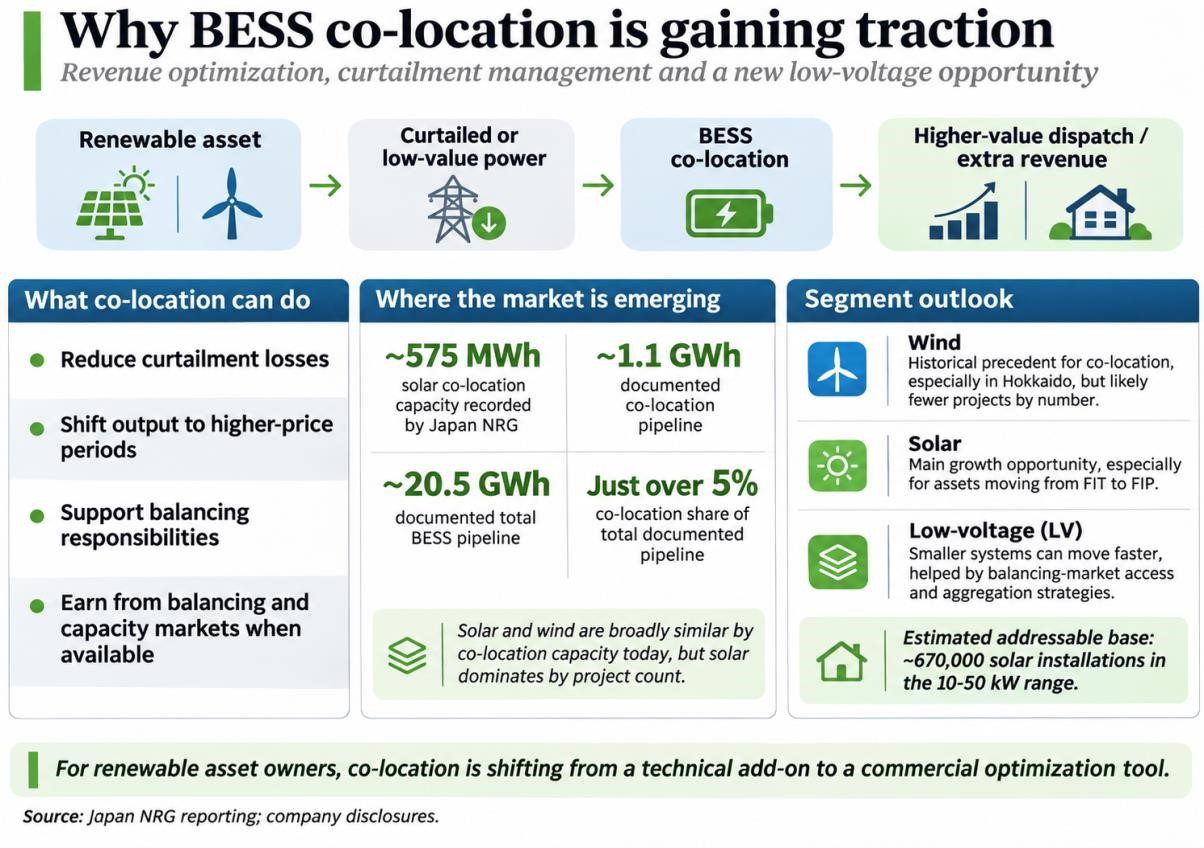
For renewables asset owners, co-locating BESS offers a way to reduce curtailment losses and generate additional revenue, particularly as solar projects transition from the feedin tariff (FIT) to the feed-in premium (FIP) scheme.
While early projects primarily used batteries to stabilize fluctuating renewables output, more commercially oriented co-location projects began emerging around 2024. By storing surplus electricity, operators can shift sales to periods of higher prices, while potentially earning additional revenue from the balancing and capacity markets, much like standalone BESS.
Most co-location projects in Japan involve solar power, although wind is also attracting interest. How much value can co-location unlock, and which segments offer the strongest growth potential?
Co-location with wind: a market poised for growth?
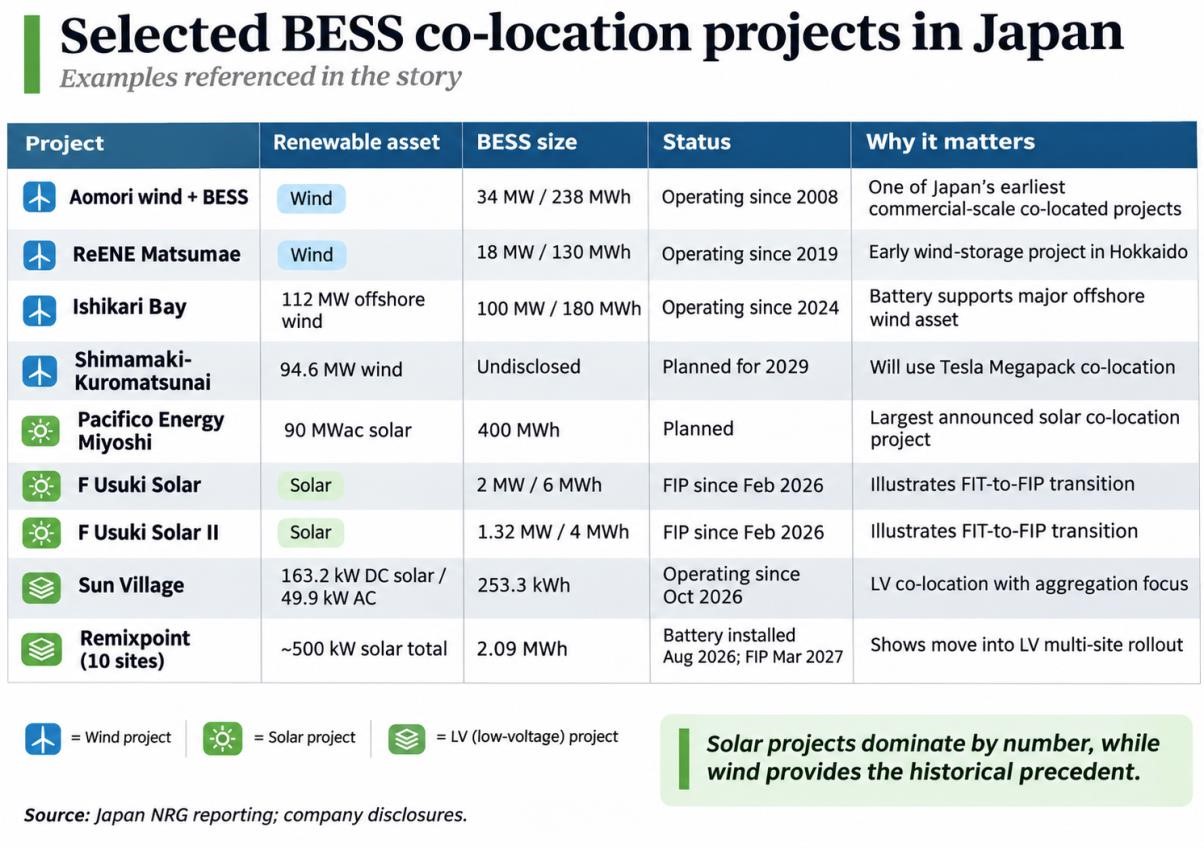
One of Japan’s earliest commercial-scale BESS projects was co-located with a wind farm in Aomori Prefecture. Commissioned in 2008, the station has a capacity of 34 MW / 238 MWh. Two other notable projects followed: ReENE Matsumae in 2019 (18 MW / 130 MWh) and Ishikari Bay in 2024 (100 MW / 180 MWh), the latter supporting a 112 MW offshore wind farm in Hokkaido.
All three projects incorporated batteries to stabilize fluctuations in wind power generation, reflecting technical grid connection requirements at the time.
Hokkaido Electric Power Network, in particular, required wind farms to adopt output fluctuation mitigation measures, including co-located batteries or dedicated extra-highvoltage (EHV) storage facilities. The 240 MW / 720 MWh Kita-Toyotomi project was originally developed for this purpose.
These specific grid connection requirements, however, were abolished in July 2023, and Kita-Toyotomi is now expected to operate as a standalone commercial BESS facility.
Does this mean wind-BESS co-location is becoming outdated? Not necessarily.
Hokkaido has Japan’s largest installed wind capacity, at approximately 1.28 GW at end2025, with a substantial pipeline of additional projects. Meanwhile, the planned restart of the Tomari nuclear power plant, targeted for 2027, along with continued renewables expansion, could increase curtailment pressures. One government estimate suggests that renewables curtailment in Hokkaido could reach 26% of generation in the 2030s without sufficient countermeasures.
These developments could create further opportunities for wind-BESS co-location. One example is the 94.6 MW Shimamaki-Kuromatsunai wind farm, which will feature a colocated Tesla Megapack facility. Its battery capacity has not been disclosed, while operations are scheduled to begin in 2029.
Nevertheless, wind-BESS projects are expected to remain considerably fewer in number than solar-BESS projects.
Overview of co-location of BESS with solar
To date, Japan NRG has recorded approximately 575 MWh of battery capacity across operational and planned solar co-location projects. Around two-thirds are high-voltage (HV) installations, contrasting with the wind segment, where documented projects are predominantly EHV.
The largest announced solar co-location project in Japan is being developed by Pacifico Energy in Miyoshi, Hiroshima Prefecture. It features a planned 400 MWh battery alongside a 90 MWac solar power plant, accounting for about 70% of the currently recorded solar co-location capacity.
In addition, two co-located solar projects secured awards in the first round of the LongTerm Decarbonized Power Sources Auction (LTDA) in 2024. Only their derated capacities have been disclosed, at about 16 MW each.
Miyoshi stands out for its scale. Other documented EHV co-location projects are considerably smaller, with the second-largest having a capacity of just 35 MWh.
Co-location supports the transition from FIT to FIP
These early developments suggest that smaller installations could drive much of the future growth in solar co-location, particularly among assets transitioning from FIT to FIP.
Under FIT, electricity is sold at a fixed price, limiting the commercial incentive for storage beyond reducing curtailment losses. FIP offers greater opportunities for revenue optimization, as operators can store solar generation and discharge it during periods of higher market prices.
NTT Anode Energy provides an example. The company installed batteries at two existing solar plants in Oita Prefecture, F Usuki Solar and F Usuki Solar II, with capacities of about 2 MW / 6 MWh and 1.32 MW / 4 MWh, respectively. Both plants transitioned from FIT to FIP in February 2026.
Co-location can also help FIP operators meet their balancing responsibilities, reducing costs associated with generation imbalances.
A major Chinese battery manufacturer told Japan NRG it has received a growing number of inquiries from FIP solar asset owners and those considering FIT-to-FIP transitions about installing co-located batteries.
The manufacturer expects solar co-location to gain traction faster than data center colocation, as data center projects generally take longer to complete. A Japanese competitor expressed a similar view.
While most inquiries currently concern HV installations, both companies also see growing opportunities in the low-voltage (LV) segment.
Low-voltage co-location: a new growth opportunity
The opening of Japan’s balancing market to eligible LV resources in March has stimulated interest in smaller batteries, including those installed at commercial facilities and residential properties.
Japan has an estimated 670,000 operational solar installations in the 10–50 kW range, creating a potentially substantial market for retrofits and revenue optimization through FIT-to-FIP transitions. Developers and EPC contractors are already pursuing this opportunity.
One example is Sun Village, which commissioned an LV solar-BESS facility in October. It combines 163.2 kW of solar panels, a 49.9 kWac output connection and a 253.3 kWh battery. According to the company’s simulations, the system can deliver 50 kW of output for 14 hours by storing surplus solar generation for later discharge.
Sun Village will also act as the aggregator, managing electricity sales and battery operations under the FIP scheme.
Separately, Japanese developer Remixpoint completed battery installations in August across 10 sections of an existing solar facility, with combined output of approximately 500 kW and battery capacity of 2.09 MWh.
The transition to FIP and commercial operation are set for March 2027, with balancing market participation in April. Already active in the HV battery market, Remixpoint is extending its revenue-diversification strategy into LV co-location.
Similar initiatives are likely to become more common, but not all developers are convinced. Some say the balancing market is too small to support economies of scale and could become saturated before smaller projects achieve attractive returns.
LV projects also benefit from shorter grid connection lead times, often within a year. However, rising application volumes could lengthen processing times, following a pattern already seen in the HV and EHV segments.
Outlook
Japan’s BESS market is expected to remain dominated by standalone EHV facilities through 2030, supported by the need for grid flexibility, renewables integration and growing electricity demand from data centers and semiconductor manufacturing.
Nevertheless, co-located projects could take a larger share of the market. Japan NRG has documented a pipeline of about 1.1 GWh of co-located storage, compared with around 20.5 GWh of total BESS capacity, just over 5%.
Solar and wind account for equal shares of this co-location pipeline by capacity, although solar dominates by project count. That gap is likely to widen as smaller solar installations adopt batteries to improve revenues and manage curtailment.
The LV segment offers an additional growth avenue, with short grid connection lead times allowing smaller projects to advance faster than many HV and EHV installations. However, this advantage may narrow as applications increase.
Co-location also offers operational benefits when combined with aggregation strategies and PPAs. For owners of renewable energy assets, especially those transitioning from FIT to FIP, batteries are becoming a practical tool for maximizing the value of their generation rather than simply managing fluctuations in output.
ANALYSIS
BY JOHN VAROLI
How Will the U.S. Midterms Impact Japan’s Energy Sector?
The Democratic Party’s victory in both chambers of the U.S. Congress will constrain President Trump’s ability to advance his domestic agenda, including energy legislation. However, the president retains authority over foreign policy, trade and military operations. For Japan, the immediate implications may therefore be felt more in global energy markets than in changes to U.S. energy policy.
The election has raised expectations that Washington could seek an end to the conflict with Iran, which has disrupted global oil and LNG supplies since February. Brent crude prices have fallen by about 10% since election day, partly on hopes of a diplomatic settlement. Nevertheless, the extent to which Democrats in Congress can influence U.S. foreign policy remains uncertain.
Japan is particularly exposed to these developments because of its dependence on imported fossil fuels and its close security and economic relationship with Washington. Prime Minister Takaichi’s government must now navigate a divided U.S. political system while assessing the implications for energy procurement, investment commitments and bilateral cooperation.
Democratic leaders have called for an end to the Iran war while maintaining stronger support for Ukraine. These positions could have different implications for energy markets. Reduced hostilities in the Persian Gulf would help restore oil and LNG supplies and lower transport costs, while continued pressure on Russia could prolong disruptions to its energy exports and infrastructure.
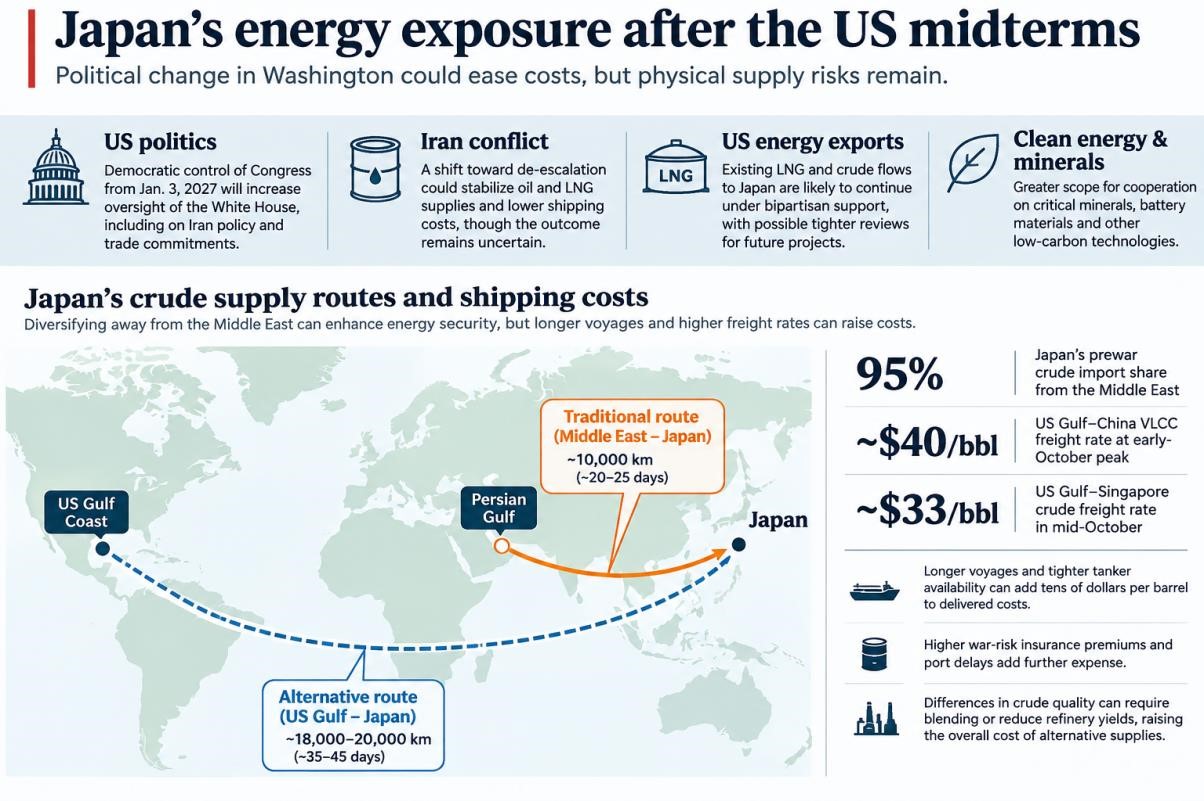
Democrats also place greater emphasis on climate policy, clean energy incentives and supply-chain security, particularly in relation to China. This could create opportunities for Japan-U.S. cooperation in critical minerals, battery materials and low-carbon technologies. However, energy security and the cost of living are likely to remain important constraints on any attempt to revive ambitious climate legislation.
For Tokyo, the election could also reduce pressure from Washington over trade and investment commitments. The July 2025 bilateral trade agreement included a $550 billion Japanese commitment to American investment and financing in industries, including energy. Greater congressional scrutiny of trade policy could give Japan more room to negotiate implementation, although the existing agreement will not automatically change.
War’s impact
The most immediate issue for Japan is whether a Democratic-controlled Congress can influence the direction of U.S. policy toward Iran. The incoming majority will be able to increase oversight, investigate military operations and use legislation to challenge the White House’s conduct of the war. However, efforts to restrict funding or military operations could face presidential vetoes, making a rapid policy reversal far from certain.
There is also a risk of renewed escalation before the new Congress convenes on January 3, 2027. Such an outcome would add to volatility in oil and LNG markets, particularly if attacks on energy infrastructure or shipping routes intensify.
For now, markets appear to be pricing in some improvement in the outlook. Brent crude has declined from around $103/ barrel on election day to below $92/ barrel in midNovember, reflecting expectations of diplomatic progress and recovering supply. A sustained decline would help ease Japan’s import bill, inflationary pressures and the fiscal burden of energy subsidies.
Japan’s exposure remains substantial. Before the war, the Middle East supplied around 95% of Japan’s crude oil and 11% of its LNG, with much of the crude passing through the Strait of Hormuz. The conflict has disrupted traditional procurement routes, damaged regional energy facilities and increased both commodity prices and shipping costs.
Japanese refiners have responded by securing alternative cargoes from the U.S. and other suppliers. However, diversification comes at a considerable cost, especially when longer voyages coincide with tight global tanker availability.
Freight has become an increasingly important component of crude procurement costs. In early October, the cost of chartering a very large crude carrier (VLCC) to transport around 2 million barrels from the US Gulf Coast to China reached almost $80 million, equivalent to roughly $40/ barrel. The same route averaged less than $8 million per voyage in the five years before the conflict. Although rates subsequently eased, they remained close to $60 million in late October.
These are U.S.-China route benchmarks rather than actual freight costs to Japan, but they illustrate the scale of the additional expense faced by Asian buyers. The IEA estimated that U.S. Gulf Coast-to-Singapore crude freight reached around $33/barrel in mid-October. Higher war-risk insurance premiums, port delays and longer vessel turnaround times can add further costs.
Such increases can eliminate the price advantage of purchasing American crude, even when its benchmark price is below that of competing Middle Eastern grades. Japanese refiners must also consider differences in crude quality, sulfur content and product yields when replacing traditional supplies. Additional blending requirements or less efficient refinery operations can further raise the effective cost of diversification.
The financial pressure is already affecting trade flows. Asian orders for U.S. crude for November delivery fell sharply in October as high tanker rates weakened the economics of long-haul shipments. This shows that energy security cannot be assessed solely through the availability of alternative suppliers: cost and logistics are equally important.
Consequently, a political settlement that restores more predictable Persian Gulf shipping could provide Japan with benefits beyond lower benchmark oil prices. Improved tanker availability, reduced insurance premiums and shorter shipping routes would lower landed procurement costs. Conversely, a prolonged conflict could maintain pressure on Japan’s energy import bill even if crude prices retreat.
The U.S. nevertheless remains an important alternative supplier, particularly for LNG. Japanese firms have expanded their exposure to U.S. upstream gas production and liquefaction projects, often through long-term offtake agreements and equity investments. These arrangements provide greater security over future supply, although they do not eliminate exposure to shipping costs or market volatility.
Democratic control of Congress is unlikely to materially disrupt existing U.S. LNG exports to Japan. Export infrastructure, contracts and investment decisions operate over much longer time horizons than election cycles.
The main potential changes concern future projects. Democrats may seek tighter environmental reviews, methane-emissions controls and greater scrutiny of local impacts when considering new LNG and oil pipeline infrastructure. Such measures could affect the cost and timing of additional export capacity, but are unlikely to reverse the broader growth in U.S.-Japan hydrocarbon trade.
Security, supply chains and climate
The election has improved investor sentiment toward parts of the clean energy sector. The RENIXX World index, which tracks 30 major international renewables companies, gained 5.9% in the week following the vote, with several U.S. solar firms posting strong gains.
However, a Democratic Congress does not necessarily mean a return to the expansive climate policies of the Biden era. With Trump retaining the presidency, major new federal incentives would require political compromises that may prove difficult. Congressional support may be more achievable in areas where clean energy development overlaps with industrial competitiveness, domestic manufacturing and national security.
For Japan, this points to opportunities in critical minerals and technology supply chains. Both countries share an interest in reducing dependence on China for rare earth processing, battery materials and other strategic inputs. Cooperation could expand through investment guarantees, joint projects and measures to strengthen domestic processing capacity.
Nuclear energy may offer another area of bipartisan cooperation. Unlike some renewables policies, nuclear development has attracted support from both U.S. parties because of its potential contribution to energy security, industrial competitiveness and the growing electricity requirements of data centers. Japanese companies could benefit from participation in reactor supply chains, fuel-related technologies and related infrastructure.
These initiatives build on existing bilateral cooperation rather than representing a fundamental change following the midterms. Their implementation will depend on financing, regulatory approvals and the willingness of companies to commit capital.
The broader geopolitical relationship will remain equally important. Japan continues to rely on the U.S. security alliance, while also seeking greater predictability in trade and investment policy. A politically constrained Trump administration could become more willing to negotiate with Congress and allies, but it could also pursue unilateral foreignpolicy initiatives where presidential authority remains strongest.
For Japanese energy companies, this creates two distinct considerations. In the short term, developments in the Iran conflict and global shipping markets will remain the main drivers of procurement costs. Over the longer term, U.S. political uncertainty will influence investment decisions in LNG, critical minerals, nuclear energy and other strategic sectors.
The U.S.-Japan energy relationship is likely to remain resilient because it rests on substantial commercial investment and shared security interests. Nevertheless, the midterm results underline the risks of Japan’s dependence on decisions in Washington. Diversification of suppliers, shipping routes and investment partners will remain key even if the immediate geopolitical pressures on energy markets begin to ease.
ASIA ENERGY REVIEW
BY JOHN VAROLI
A brief overview of the region’s main energy events from the past week
Australia / Batteries
The Cheaper Home Batteries Program marked 600,000 home battery storage systems sold, said the energy ministry. The total is now about 16.8GWh, up from around 14 GWh at 507,000 installations a year ago.
China / Climate issues
China is leading the world in moving away from fossil fuels. The rest of the globe – including the U.S. – must now follow, said ex-US secretary of state John Kerry.
China / Energy transition
In 2026, China will invest $940 billion in its energy transition, maintaining its global lead while shifting spending toward grid expansion and infrastructure. China plans $140 billion in grid investment this year, with its largest grid operator targeting $574 billion through 2030 to improve renewable energy integration.
Global electricity
Generators are emitting far less CO2 and other GHGs per unit of output as natural gas, wind and solar provide most of the incremental growth, and older and less-efficient coal-fired units are retired. The carbon intensity of generation declined at a compound annual rate of 1.5% between 2015 and 2025.
India / BESS
The govt approved the next $1.5 billion phase of a support mechanism for energy storage capacity additions. Also, a Ministry of Power official said state power companies will likely soon be required to include BESS in new renewable energy projects.
India / BESS
The NHPC invited bids for co-located BESS at the 1.2 GW Jalaun Solar Park in north India, offering two configurations with 800 MW of storage power and different energy capacities.
Indonesia / Energy transition
Indonesia, Cambodia and Germany launched a trilateral cooperation programme to promote renewable energy development and energy efficiency with activities.
Jet fuel
Asia-Pacific airlines are increasingly exposed to jet fuel prices as their pre-war hedges expire.
South Korea / Nuclear
The govts of South Korea and France held the 27th meeting of their coordinating committee on nuclear energy in Saclay, France. This technical meeting aimed to strengthen their alliance in atomic R&D.
Tanker charter rates
Charter rates are slumping despite continued attacks on shipping in and around the Strait of Hormuz. The Baltic Exchange’s Dirty Tanker Index has fallen in 18 of the last 20 trading days. The index has retreated by nearly 40% from its peak on Oct 13 to the lowest in almost two months.
Disclaimer
This communication has been prepared for information purposes only, is confidential and may be legally privileged. This is a subscription-only service and is directed at those who have expressly asked K.K. Yuri Group or one of its representatives to be added to the mailing list. This document may not be onwardly circulated or reproduced without prior written consent from Yuri Group, which retains all copyright to the content of this report.
Yuri Group is not registered as an investment advisor in any jurisdiction. Our research and all the content express our opinions, which are generally based on available public information, field studies and own analysis. Content is limited to general comment upon general political, economic and market issues, asset classes and types of investments. The report and all of its content does not constitute a recommendation or solicitation to buy, sell, subscribe for or underwrite any product or physical commodity, or a financial instrument.
The information contained in this report is obtained from sources believed to be reliable and in good faith. No representation or warranty is made that it is accurate or complete. Opinions and views expressed are subject to change without notice, as are prices and availability, which are indicative only. There is no obligation to notify recipients of any changes to this data or to do so in the future. No responsibility is accepted for the use of or reliance on the information provided. In no circumstances will Yuri Group be liable for any indirect or direct loss, or consequential loss or damages arising from the use of, any inability to use, or any inaccuracy in the information.
K.K. Yuri Group: Hulic Ochanomizu Bldg. 3F, 2-3-11, Surugadai, Kanda, Chiyoda-ku, Tokyo, Japan, 101-0062.